Larimar: the blue stone mined in a single place on Earth
There are tens of thousands of deposits of precious and ornamental stones across the world. Larimar has exactly one. A single slope of a single mountain in the Barahona province in the south-west of the Dominican Republic. Gem-quality blue pectolite is found nowhere else, and once the vein is exhausted, the stone simply stops existing. This is the rare case where the finite nature of a deposit is not marketing but a verifiable fact.
Larimar was found late by the standards of jewellery history: the official date is usually given as 1974. Its colour is something almost no other natural stone offers, a milky turquoise like Caribbean shallows at noon, with white veining that looks like foam. That is where its whole reputation comes from: the sea, calm, water.
What follows, in order: what the stone is made of and how it forms, why the deposit really is the only one, what shades exist, how larimar differs from similar blue stones and from fakes, how to care for it and what to wear it with. We talk about symbolism briefly and with a sceptic's eye: wherever we mention "properties", that is what people believe, not something the stone guarantees anyone.
What larimar is: chemistry and physics
Larimar is the trade name for the blue variety of the mineral pectolite. Pectolite has been known for a long time and turns up in many countries: Canada, the United States, the United Kingdom, Italy and elsewhere. Almost everywhere, though, it is white, grey or colourless, occurring as needle-like crystals that interest mineral collectors more than jewellers. What makes pectolite blue is a copper impurity that replaces part of the calcium in the structure. That copper is exactly what gives the range from a soft sky tone to a dense blue, and gem-quality blue pectolite has been found in precisely one place on the planet.
By composition it is a hydrous sodium calcium silicate, with a formula close to NaCa2Si3O8(OH). The crystal system is triclinic, the structure fibrous and radiating. Because of this, a polished surface shows a fine silky sheen and the characteristic interwoven white-and-blue pattern that jewellers call "tortoiseshell". No two stones are alike: each has its own pattern, like the grain in a slice of wood.
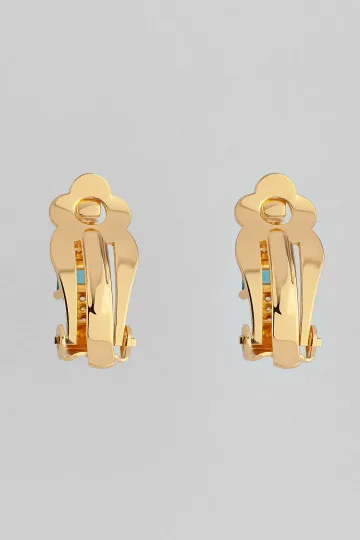
Wear the symbol, don't just read about it. These are in stock:






Hardness on the Mohs scale sits at 4.5 to 5, which means the stone is soft. For comparison: quartz is 7, ordinary glass around 5.5. Larimar can be scratched even by household dust, which almost always contains quartz grit. This is the key practical detail we will return to in the sections on jewellery and care. Density is moderate, roughly 2.62 to 2.87 g/cm3 according to reference data, so even a large cabochon in earrings will not drag at your earlobes.
The stone is opaque or slightly translucent at a thin edge; its refractive index is low (around 1.6), and it has no notable dispersion or pleochroism, so it has nothing to sparkle with the way transparent gems do. That is why larimar is never faceted but cut into cabochons, smooth domed shapes that show colour and pattern best. Less often it is made into flat plates for inlay, beads and small carved figures.
Where the blue colour comes from
Copper, having taken calcium's place in the crystal lattice, is what makes pectolite blue. The more copper and the more evenly it is distributed, the deeper the blue. The colour within a single piece is rarely uniform: the copper settled unevenly, and when cutting, the craftsman decides which part of the stone to bring to the face of the piece. The white areas are zones the copper barely reached, effectively ordinary white pectolite. Their interplay with the blue is what creates that signature pattern.
What larimar looks like in real life
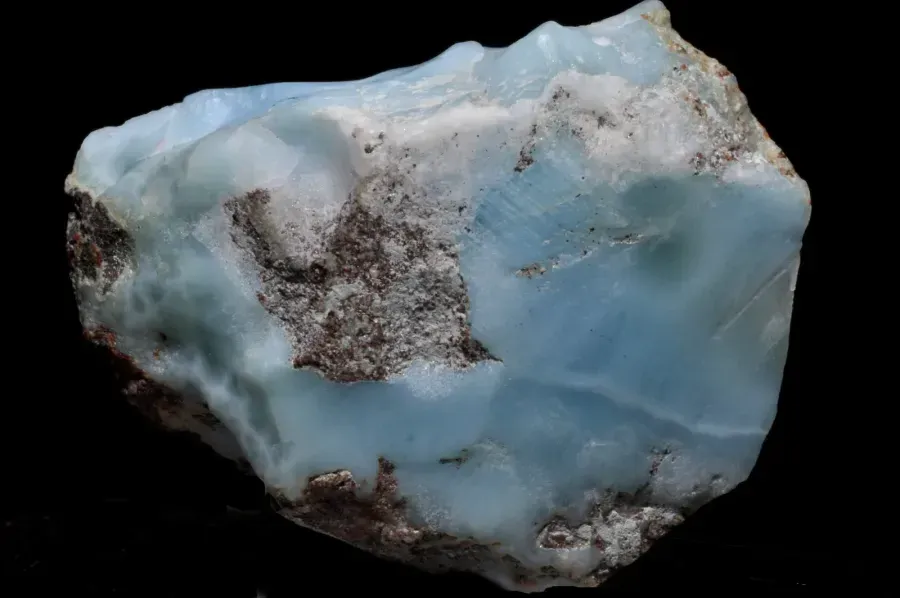
In the hand a good larimar is cool and pleasantly smooth. The colour is matte and deep, without a glassy shine, with a faint silky lustre from the fibrous structure. The white areas look like clouds or foam on a blue ground. In the light the stone does not "catch fire" but seems calm and dense, like a piece of frozen water. That quiet, unshouting beauty is its signature trait.
Geology: why the deposit really is the only one
Larimar formed through ancient volcanic activity. Basaltic lava, rising toward the surface, left cavities and cracks in the rock. Hot hydrothermal solutions, saturated with minerals including copper compounds, passed through them. Pectolite crystallised in these cavities, and the copper tinted it blue. The process requires a very specific combination of conditions: the right rock, the right solutions, the right concentration of copper, the right temperature and pressure, and all of that in quantities large enough to mine.
That coincidence happened in the Bahoruco mountains in the south-west of the Dominican Republic, in Barahona province. Geologically similar conditions exist elsewhere in the world, but the exact combination that produced specifically blue gem-quality pectolite in commercial quantities has never repeated anywhere else. Geologists keep searching for analogues, yet half a century on, nothing comparable has been found.
How the stone ends up on the beach
Blue pectolite is born high in the mountains, but the first finds were not in mines, they were on the shore. For centuries rivers and rains washed fragments out of the bedrock and carried them down the riverbeds to the sea, where the waves rounded them and tossed them onto the beach near the village of Las Filipinas. So people long thought of the stone as a sea stone, even though geologically it is born in volcanic rock deep inside the mountains. That mistake is a beautiful, human one: a stone the colour of the sea, washed ashore by the sea itself, naturally gets taken for a sea stone. The "sea stone" reputation took shape long before the bedrock outcrop was found, and it stayed forever.
The only mine: Los Chupaderos
The main and effectively only industrial extraction takes place at a spot called Los Chupaderos, near Las Filipinas. The mountainside is dotted with hundreds of vertical shaft-wells that prospectors dig by hand. It is heavy and dangerous work: narrow shafts go down dozens of metres, groundwater floods the workings, and cave-ins happen. The veins lie unevenly, in pockets: a prospector can dig for weeks with nothing, then strike a rich pocket. Because of this, mining is almost a lottery, and supply on the market swings from season to season.
A finite resource
The deposit is finite, and that is not a figure of speech. Extraction comes from a limited body of rock on a single slope, the best near-surface pockets are gradually being worked out, and digging has to go ever deeper and more dangerous. There is no second deposit on the planet, as far as anyone knows. For a buyer the takeaway is simple: a quality, saturated blue larimar is not the kind of thing there will be more of tomorrow, and that will get cheaper. Rather the opposite.
From mine to display case
The mined rock is washed, the blue pieces are separated from waste material, and they are sorted by colour and clarity. Then the stone is cut into plates, shaped into cabochons, ground and polished. The best, the bluest and cleanest pieces go into jewellery; the pale and mottled ones go into beads and souvenirs. Polishing soft larimar is harder than polishing hard stones: it overheats and scratches easily in the process, and an even, mirror-smooth surface reveals the depth of colour, while a careless one dulls even a good blue. Most of the cutting and manufacturing happens right there in the Dominican Republic.
There is essentially no synthetic larimar on the market: reproducing blue pectolite with a natural pattern is difficult and unprofitable given the small market. Imitations, on the other hand, are widespread, dyed stones, glass and plastic. There is a separate section below on how to spot them.
Larimar belongs on tanned skin and linen, not burgundy. Warm red drowns the sea, and don't argue.
What to wear larimar with
Blue stone is trickier than it looks: it is cold, matte and impatient with warm colour beside it. When I build a look around it, I start from the neckline, the metal and the occasion. Here is what actually works.
What do I wear larimar with every day? For daytime I recommend something small: studs or a thin pendant over a T-shirt, a polo neck, a denim shirt. The cool blue lives happily with grey, white, beige and denim, so you barely think about combinations. Silver is the natural choice here, it picks up the stone's coolness.
How do I put together an evening look? For going out I suggest the reverse logic: one large, saturated-blue stone and no rivals near it. Long earrings or a bold pendant in deep blue are expressive enough on their own. I set them against dark or neutral smooth fabric so the cold depth reads.
Which neckline does larimar ask for? An open neck. A boat neck and a V-neck call for a pendant that lies exactly along that line. I recommend choosing the length to match the neckline, not the other way round, so the stone sits in the open zone rather than hanging in empty space.
Which fabrics and colours does it get on with? I choose light summer fabrics: linen, cotton, silk. The sea stone clashes with dense wool. By colour, blue wins on a cool, neutral range, while warm orange-red dulls it, so I never wear larimar with burgundy or terracotta.
Who does it suit, and with what? Those who like to wear colour quietly, in half-tones. Pearl, moonstone, turquoise and aquamarine, the whole sea palette, sit well alongside larimar. And one rule for keeping it safe: I never string it in one bracelet with hard quartz, the soft stone would scratch.

Turn on your camera, pick earrings, a pendant or a ring, and see the piece on yourself in real time.
Switch items in one tap.
Everything runs in your browser: no photo or video is ever uploaded.
History: from a rejected claim to a name in honour of a daughter
Larimar is the rare case of an almost exact "birth" date, and even the name of a specific person who gave it its name. It has no ancient legends, no pharaohs, no thousand-year traditions; an honest conversation about it is about facts, not magic.
The first claim, which was rejected (1916)
The earliest documented episode dates to 1916. The Spanish priest Miguel Domingo Fuertes de Loren, serving in Barahona province, noticed a blue stone and filed a claim for permission to mine it. The claim was rejected: officials did not understand which mineral was meant and did not consider it valuable. The stone was forgotten again for nearly sixty years. This detail dismantles the myth that larimar was "only discovered yesterday": it was known back at the start of the twentieth century, the world simply walked past it.
1974: the name that became a brand
The official date is 1974. The Dominican Miguel Méndez and the American Peace Corps volunteer Norman Rilling picked up blue pebbles on the beach at the foot of the Bahoruco mountains, alluvial fragments carried down by the Bahoruco river. The bedrock outcrop (the future Los Chupaderos working) was found later, after searching upstream. It became clear the stone had a genuine deposit.
The name was Miguel Méndez's invention. He joined his daughter Larissa's name with the word mar, Spanish for "sea". The result was Larimar: Larissa plus sea. So one father's personal story became the name of the stone. Few minerals have an origin to their name this human and this precisely matched to its essence.
The face of the Dominican Republic
The eighties and nineties carried larimar onto the international stage. Tourists took jewellery with the blue stone home, and it became one of the country's symbols alongside rum and cigars. Today the government counts the stone as part of the national heritage, mining is regulated, and there is a museum dedicated to the stone on the coast in Barahona, showing the history of its discovery, rock samples and the stages of working it.
There is also a romantic theory the island loves to retell: that the mystic Edgar Cayce, in the first half of the twentieth century, supposedly predicted that a blue healing stone linked to the legendary Atlantis would be found in the Caribbean basin. When the stone was found precisely there, Cayce's followers declared it that "Atlantic stone". This story has no evidence behind it and should be treated as a pretty legend rather than fact.
Customer reviews
Zevira is a real jewellery shop. Genuine payments, deliveries and customer thank-yous.
🥰🥰🥰 gracias

Ok, ¡gracias! 🙂

Shades and grades: from milky sky to volcanic blue
Colour is the main thing in larimar, and the entire price ladder is built on it. The deeper and purer the blue, the dearer the stone.
Light blue
The most common shade, a soft milky blue, the colour of a morning sky or a shallow lagoon. Such stones go en masse into inexpensive jewellery and beads. They are calm, pair easily with silver, but are valued the least because they turn up most often. This is a happy choice for a first piece and for everyday wear: light larimar conveys best that "lagoon" softness the stone is loved for.
Turquoise-green
Some stones drift into a greenish range, closer to the colour of a wave breaking in the shallows. Such larimar recalls turquoise or amazonite and looks good in summer jewellery. This is the mid-value segment. The greenish tone appears because of the distribution of copper and impurities.
Deep blue (volcanic blue)
The top of the pyramid, a saturated, dense blue stone that the market calls "volcanic blue". The more intense and even the blue, the higher the price, and the gap with pale stones can be very large. Such pieces go into bespoke and collectible items. Dense blue is noticeably rarer than light, looks as "precious" as it gets and holds attention by itself. If a budget allows one serious stone, it is wiser to invest in depth of blue rather than size at a pale colour.
Pattern and flaws
Beyond colour, the pattern is prized: the interweaving of blue and white that forms a net, a web or a "tortoiseshell" design. A clear, contrasting pattern without dirty-grey or brownish patches is valued. Grey and brownish inclusions (traces of foreign minerals and oxides), cracks, chips and dull polish lower the value. Sometimes monochrome blue cabochons with almost no white are cut; they look as "precious" as possible and cost accordingly. Larimar has no clear international grading standard, so much depends on the seller's honesty.
Upload a photo of your pet, someone you love, or an object. We'll build a 3D model and hand-cast it in pewter.




Symbolism: briefly and honestly
Larimar has no thousand-year esoteric tradition; its symbolism took shape over the last half-century and rests on two things: the colour of the sea and the place of birth. The main association is water and calm. The blue of the lagoon reads as serenity and openness, so the stone is called the "stone of serenity". In popular literature it is also assigned to a "feminine", water element, as opposed to "fiery" red stones, and linked with the throat centre in the chakra system.
Let us be honest: the stone has no proven effect on a person. Larimar does not heal, does not lower blood pressure, does not affect sleep and guarantees nothing. A seller who promises otherwise is being disingenuous. A calm colour and a pleasant surface to the touch genuinely help you switch off, the way a view of water helps, but that is ordinary psychology, not a property of the mineral. Sorting stones into "masculine" and "feminine" is a cultural habit too, not a law of nature: anyone who likes its colour can wear larimar. The value of a blue stone lies in its colour, its rarity and the meaning you yourself invest in it.





Larimar and similar blue stones: how it differs
There are many blue stones, and a newcomer can easily confuse larimar with turquoise, amazonite or chrysocolla.
Larimar and turquoise
Turquoise is usually more matte, denser and more opaque, its veining dark, brown or black (the so-called matrix), with its colour drifting toward sky-blue and greenish-turquoise. Larimar, by contrast, has white veining, and its blue is cooler and more "watery". Turquoise has been mined in many countries since antiquity; larimar in one place and for just half a century. They are close in hardness, both soft. A dark net of veins is turquoise; white cloudy swirls over a cool blue is larimar.
Larimar and amazonite
Amazonite is a greenish-blue feldspar with a characteristic gridded pattern. It is greener than larimar and usually more matte, without the sea "depth" of the blue. Amazonite is harder and more common, which means cheaper. An obvious green and a lattice pattern point more to amazonite.
Larimar and chrysocolla
Chrysocolla is another blue mineral involving copper, sometimes very similar in colour. But it is often brighter, a turquoise-blue, and frequently mixed with other minerals. When in doubt, go by the combination of a cool blue with white cloudy veins: that is larimar's signature.
Larimar and labradorite
These are quite different stones, joined only by their cool palette. Labradorite is a dark feldspar famous for the labradorescence effect: turn it and blue and golden flashes run across it. Larimar does not "flash"; it has an even matte blue with a white pattern. For more on its rainbow cousin in the cool palette, read the article on labradorite.
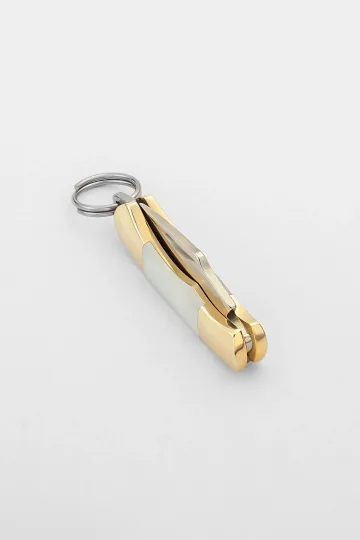
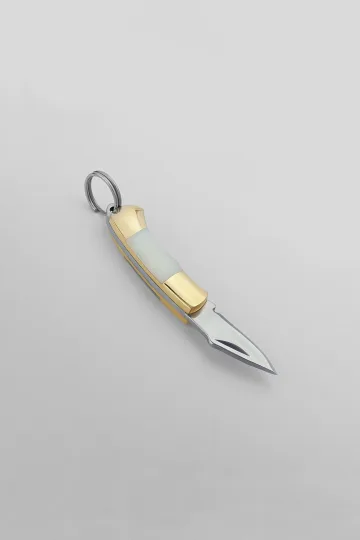
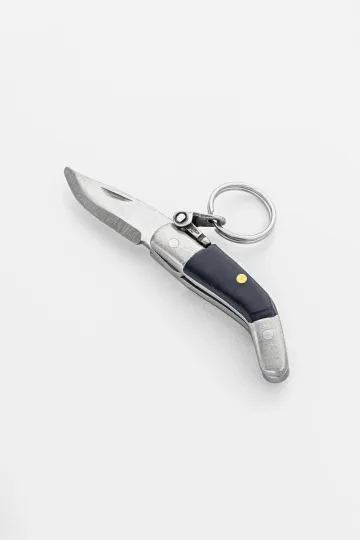
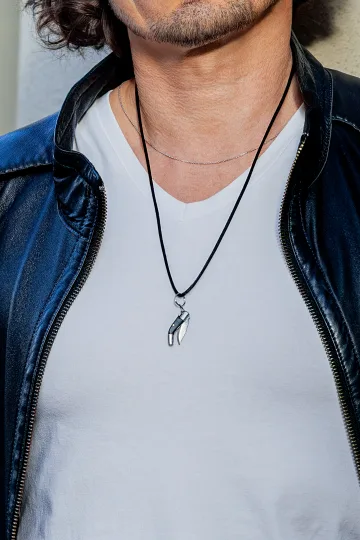
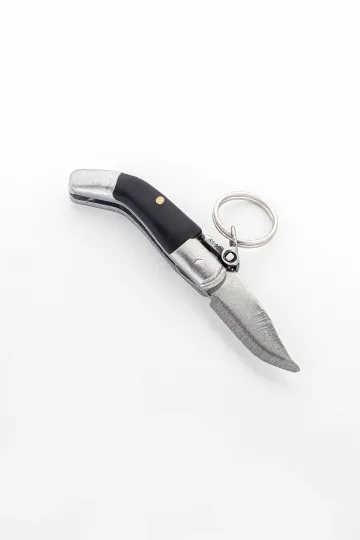
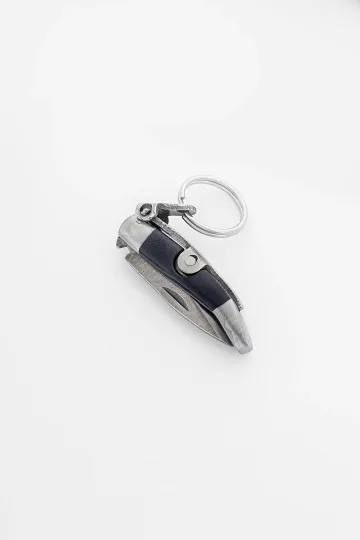
CAPAORA mini knife pendant
The 18th-century Spanish navaja in miniature: 40 mm of stainless steel, a real folding mechanism and a Palanquilla lock that clicks. An affordable gift to remember.
Authentic · Ships from Spain · 14-day returns
Larimar jewellery: what people choose and what it is made from
Larimar is soft, so the format of a piece strongly affects how long it will last.
Pendants
A pendant is the ideal format. On the chest the stone takes almost no knocks or friction, unlike a ring, so even a large, expensive blue cabochon will be safe. Most often larimar is set in 925 silver: the cool gleam of the metal underlines the cool blue of the stone. A pendant is where it makes the most sense to invest in quality; since the stone is protected and always on view, it is worth taking a deeper-coloured, cleaner-patterned cabochon.
Rings
The riskiest format. Hands are constantly rubbing against something, and a hardness of 4.5 to 5 means the stone is easy to scratch and chip. If you really want a ring, choose a bezel setting (metal wrapping the cabochon all around the rim), a low profile and a stone that is not too large. A larimar ring is best worn as a special-occasion piece and taken off for cleaning, cooking, sport and hands-on work. Treated this way, even a soft stone lasts for years.
Earrings
A good format, close to a pendant in safety: the stone hangs, rubbing against nothing. Larimar's lightness is a plus: ears do not tire even from sizeable cabochons. Silver earrings with a blue stone are a classic of summer jewellery, especially with a tan and light clothing. Studs suit everyday wear, long drops an accent look.
Bracelets and bead strands
A larimar bead bracelet looks lovely, blue beads with white patterning resemble sea pebbles. But the wrist moves a lot, the beads rub against tables and door handles and lose their polish over time. Choose larger beads, take the bracelet off during physical work, and do not wear it pressed against hard stones like quartz. On balance a bracelet is not the most fortunate format for a soft stone: if durability matters, a pendant or earrings are wiser. Beads are also strung into long necklaces that give the most "sea" effect: a cascade of blue at the neck.
Men's jewellery
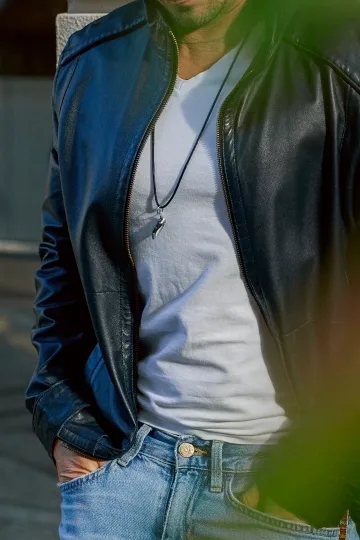
Despite its reputation as a "feminine" stone, a calm blue looks good in men's pieces: a clean cabochon in a silver signet ring, a pendant on a leather cord, an inlay in cufflinks. For a man's look people usually choose a deeper blue and a simple, massive setting without decoration. Silver works best here. A pendant on a roughish leather cord reads as masculine and protects the soft stone from knocks.
Metals and setting
Most often larimar is set in 925 silver, the most natural and affordable frame. For more on the metal, read the piece on 925 silver. White gold gives a similar cool effect but costs more; yellow gold creates a warm contrast that bespoke pieces love. For a soft stone, the type of setting is a question of both beauty and survival: a bezel setting protects the edges from chips and suits rings, while an openwork setting reveals the stone more handsomely and is fitter for pendants and earrings. A simple rule: the more actively you wear it, the more closed the setting should be.
Pairing with other stones
Larimar gets along well with stones of a kindred palette. Its most natural neighbours are turquoise, aquamarine and amazonite: together they create a coherent sea look. White pearl and mother-of-pearl pick up the veining in the stone and reinforce the association with foam and shells. Moonstone, with its bluish shimmer, rhymes by the water theme. For a warm contrast, larimar is paired with rose quartz or a restrained carnelian.
There is a practical preservation rule too: do not wear larimar pressed against harder stones, quartz, topaz, still less corundums. In one bracelet or one box they will leave scratches on the soft stone. Store it separately, in a soft pouch.
Leave your email, we'll send your discount code. No spam, unsubscribe anytime.
The code arrives by email, valid on your first order.
Caring for larimar
A soft and porous stone calls for gentle handling. The rules are simple, but worth keeping. It is precisely the hardness of 4.5 to 5 that sets the whole logic of care: what does no harm to quartz or sapphire is dangerous for larimar.
When to take it off
Take larimar jewellery off before cleaning, cooking, showering, bathing, swimming, sport and sleep. Anywhere there are knocks, friction, chemicals or water with impurities, the soft stone is at risk. A handy rule: put larimar on last, once cream and perfume are already applied, and take it off first when you get home.
What to avoid
The main enemies are aggressive chemicals and abrasives. Cosmetics, perfume, creams, varnishes, household chemicals, chlorinated pool water and salty sea water eat into the porous surface and dull the colour. Salt is especially harmful; do not use it even for "cleansing". Sand, dust and hard stones scratch it. Prolonged direct ultraviolet weakens the blue over time, so the stone is kept in the shade.
How to clean and store
Clean larimar with a soft damp cloth without abrasives, then wipe it dry at once. For heavier soiling, lukewarm (not hot) water with a drop of mild soap works, a quick wipe and drying. No ultrasonic baths, steam cleaning, brushes or tooth powders; they injure the soft stone, and vibration and heat can cause cracks. Do not soak it long: water penetrates the pores. Store the stone separately from other jewellery, in a soft pouch or its own compartment, in the shade and away from heat. Treated this way, larimar keeps its colour and shine for decades.
How to choose and not buy a fake
Larimar is often faked, because a beautiful blue colour is easy to imitate.
What gives away a genuine stone
Real larimar is almost always opaque or slightly translucent at the edge, with a natural, uneven pattern of blue and white. No two stones are alike. To the touch it is cool and warms slowly in the hand. Slight unevenness of colour inside is acceptable; a perfectly even blue with no pattern is exactly what should make you wary.
Common imitations
Most often what is passed off as larimar is dyed howlite or magnesite (white porous stones easy to dye blue), blue glass, plastic and polymer resin. Air bubbles and too bright, too even a colour give glass away. Plastic is warm to the touch and too light. Dyed stones often have an unnaturally even, "poisonous" blue, and the dye gathers in cracks and pores in uneven streaks. The check is simple: take the stone in your hand (a natural one is cool and warms slowly), look at it against the light at an angle, judge the pattern (a real one is living and unrepeatable) and match it all against the price.
Price as a signal
A quality blue larimar is rare and not cheap, and a saturated blue at a bargain price is almost certainly an imitation. Without exact figures the logic runs like this: a calm light-blue stone in silver costs about as much as a good dinner out; bespoke pieces with a saturated blue, about a weekend away; and large collectible cabochons of a rare colour notably more. A sharply lowered price is the first reason to doubt.
What to look for in the setting
Half of a piece's durability is in the setting. For rings and active wear choose a bezel setting that wraps the cabochon around the rim. For pendants and earrings a more open seat is fine. Check that there are no sharp protruding edges of metal and that the stone sits securely. A certificate for larimar is a rarity on the mass market, so what matters is the seller's reputation, a sensible price and your own attentiveness.
Style and looks with larimar
Larimar is a flexible stone; it fits into different looks if you understand its character. It is not for loud effects but for a quiet, considered beauty.
Summer and resort looks
The stone's most natural setting is summer and a holiday. Silver earrings or a pendant with the blue stone over a linen shirt, a white dress or tanned skin look like part of the landscape: sea, sand, blue. A bead bracelet or strand adds lightness to the look.
Everyday minimalism
A small larimar cabochon is a quiet accent for everyday wear. Studs, a narrow ring, a modest pendant on a fine chain add colour to a look without arguing with the clothes. A cool blue gets along well with grey, white, blue, beige and denim, a happy way to wear colour with restraint.
Boho and natural aesthetics
Larimar is at home in looks built on natural materials: silver, leather, wood, linen. A pendant on a leather cord, layered beads, a large cabochon in a textured silver setting, all of this is in the spirit of a free, natural aesthetic.
Evening and accent looks
A large, saturated-blue stone can act as the meaningful centre of an evening look. In that case it is left as the only bright piece: long earrings or a prominent pendant with a dense blue are expressive enough on their own. The cool depth of the blue looks good with dark and neutral outfits.
Send a friend a discount code, they save on their first order.
Common misconceptions about larimar
"Larimar is an ancient magical stone"
No. It has been known as a stone for only about half a century; it has no pharaohs and no thousand-year legends. All its symbolism took shape in the second half of the twentieth century on the basis of colour and place of birth. This does not make the stone any worse, quite the opposite: its history is honest and verifiable.
"Since it is a sea stone, sea water is good for it"
Exactly the reverse. Salt is especially harmful to porous larimar: it penetrates the pores and ruins the polish and colour. The stone's link with the sea is about colour and origin, not about needing to be dunked in the ocean.
"The brighter the blue, the surely better"
Not always. Too even, "poisonous" a bright blue with no natural pattern is exactly what should make you wary; it is a common sign of a dyed imitation. A genuinely good larimar has a deep but living blue, with natural transitions.
"Larimar can be worn as an everyday ring"
Risky. A hardness of 4.5 to 5 makes it vulnerable in rings with daily wear. This is a stone for pendants and earrings; a ring is better kept and taken off for hands-on work.
"Cheap just means I got lucky"
More likely it means it is not larimar. A real blue stone is rare and not cheap because of the single deposit and hand mining. A suspiciously low price on a saturated blue almost always gives away glass, plastic or a dyed stone.
FAQ: common questions about larimar
Where is larimar mined?
Only in the Dominican Republic, in Barahona province in the south-west of the country, in the Bahoruco mountains. The main extraction is at a spot called Los Chupaderos near the village of Las Filipinas. This is the world's only industrial deposit of gem-quality blue pectolite. The mineral pectolite itself turns up in many countries, but almost everywhere it is white or grey; a copper impurity is what makes it blue, and that combination came together in only one district of the Dominican Republic.
Why is larimar called that?
The name was coined by the Dominican Miguel Méndez in 1974. He joined his daughter Larissa's name with the Spanish word mar, "sea". The result was Larimar. The name proved apt: the stone's colour really is like a Caribbean lagoon, and for centuries people picked up the first pieces on the shore.
Is larimar a precious or semi-precious stone?
Formally it is classed among the semi-precious (ornamental) stones, like turquoise, malachite or agate. But that division is largely outdated and arbitrary. A quality blue larimar, thanks to its rarity, can cost more than many formally "precious" stones of mid quality. More important than the category are the colour, clarity, pattern and size of the specific stone.
What is larimar's hardness?
4.5 to 5 on the Mohs scale, which means the stone is soft: both quartz (7) and ordinary glass (5.5) are harder. So larimar is easy to scratch, and for long service pendants and earrings suit best, rather than rings and bracelets.
How can you tell real larimar from a fake?
A natural stone is opaque or slightly translucent at the edge, with an uneven natural pattern of blue and white, and every stone is unique. Fakes are most often made from dyed howlite or magnesite, blue glass and plastic. Glass is given away by bubbles and too even, bright a colour; plastic by warmth to the touch and low weight; dyed stones by an unnaturally even blue and a low price. A good sign of authenticity is precisely the imperfection: a living pattern, gentle colour transitions, the coolness of the stone.
Can larimar be worn every day?
With caveats. Because of its hardness of 4.5 to 5, pendants and earrings suit daily wear best, there the stone hangs and rubs against nothing. Rings and bracelets quickly lose their looks in everyday wear. If you want to wear larimar constantly, choose a pendant or earrings.
Is larimar afraid of water?
Brief contact with cool clean water does no harm. But the stone is porous, so long soaking, hot and especially salty or chlorinated water harm it: they get into the pores and ruin the polish. Take larimar off before showering, swimming in the sea and the pool.
Does larimar fade in the sun?
Yes, over time prolonged direct ultraviolet can dull the blue colour. So keep the jewellery in the shade, not on a sunny windowsill. With ordinary wear fading is almost unnoticeable; this is about long, direct sun.
What does larimar symbolise?
Above all the sea, calm and the water theme. The symbolism is young, about half a century old, and took shape on the basis of colour and Caribbean origin, not ancient traditions. The stone has no proven effect on a person: a calm colour helps you switch off about the way a view of water does, and that is ordinary psychology, not magic.
Which larimar is the most valuable?
A saturated, dense blue, which is called "volcanic blue". The deeper, more even and purer the blue, the higher the price. Additionally prized are a clear, contrasting pattern without grey patches, a large size and a good polish. Pale-blue and greenish stones turn up more often and cost less.
Is larimar a feminine or masculine stone?
In popular symbolism it is considered feminine, but that is a cultural convention. A calm blue looks good in men's jewellery too: a signet ring with a cabochon, a pendant on a leather cord, cufflinks. Anyone drawn to its colour and character can wear larimar.
Which stones does larimar go with?
Best of all with stones of the sea palette: turquoise, aquamarine, amazonite, moonstone. White pearl and mother-of-pearl pick up the light veining. For a warm contrast rose quartz suits. An important preservation rule: do not wear larimar pressed against harder stones (quartz, topaz), they will leave scratches. For the same reason, store it separately.
Which metal is best for larimar?
Most often the stone is set in 925 silver, the cool gleam underlines the blue, and it is the most affordable frame. White gold gives a similar effect but costs more; yellow gold creates a warm contrast. For rings a bezel setting wrapping the cabochon around the rim is preferable. You can read more about larimar's most popular metal in the piece on 925 silver.
How do you care for larimar?
Take it off before cleaning, cooking, showering, sport and sleep. Avoid cosmetics, perfume, household chemicals and chlorinated water. Clean it with a soft damp cloth without abrasives, then wipe it dry. Do not keep it long in direct sun. Store it separately from other jewellery in a soft pouch. Do not use salt or salt water even for "cleansing".
Will larimar run out?
Most likely, yes. The deposit is finite, extraction comes from a limited body of rock, the best pockets are gradually being worked out, and there is no second deposit, as far as anyone knows. So larimar is often called a stone with a countdown, and a good blue stone is unlikely to get cheaper over time.
Why is larimar not faceted like a diamond?
Because faceted cutting is needed for transparent stones: light enters, reflects off the facets and returns as a play of sparkle. Larimar is opaque, light does not pass inside it, and facets would look dull. So, like turquoise and malachite, it is cut into cabochons, which show colour and natural pattern. A "faceted transparent larimar" is either a misunderstanding or a glass imitation.
Does larimar come in colours other than blue?
Blue is its essence. Some stones drift into a greenish sea range; there are patches of grey, white and brown where copper is scarce or foreign minerals are present. There is no purely red, purple or yellow larimar: copper gives it the blue, and without it the stone is just white pectolite. "Pink larimar" is either a different mineral or a tinted imitation.
Is larimar suitable for an engagement ring?
With caution. Aesthetically it is a tender and unusual alternative to the usual stones, but a hardness of 4.5 to 5 makes it vulnerable to everyday wear, and an engagement ring is usually worn without taking it off. If you decide on it, choose a protective bezel setting. As an option, larimar in a ring for special occasions, and a harder stone for daily wear. For those choosing a ring, a general guide on how to choose an engagement ring is useful.
How does larimar differ from aquamarine?
Aquamarine is a transparent blue beryl, it is faceted and "plays" with light. Larimar is opaque, it is cut into cabochons and gives a calm matte blue with a white pattern. Aquamarine is noticeably harder and suits everyday rings; larimar is soft and calls for care.
Where do larimar's white veins come from?
These are zones where copper is scarce or absent, effectively ordinary white pectolite with no blue colouring. Because the copper settled unevenly, saturated-blue and almost white areas sit side by side in one piece, and when cut they combine into the signature white-and-blue pattern. Pure white in contrast with blue is prized, while dirty-grey zones are considered a flaw.
Does larimar react to body heat?
It warms from the hand, but slowly, unlike plastic, which warms almost at once, this is one way to tell a fake. The stone has no real reaction to "mood": stories that larimar "dulls when its owner feels low" are explained more simply, by surface soiling with skin oil and cosmetics, which cleaning removes.
Does larimar need a certificate?
On the mass market certificates for larimar are a rarity, unlike for expensive transparent stones. The country of origin is obvious anyway (there is no other). So the main guarantees remain the seller's reputation, a sensible price and the signs of authenticity: a living pattern, an imperfect colour, the coolness. For expensive collectible stones a clear description of origin is desirable.
Buying it as a gift? Each one arrives ready to give.
 A branded Zevira box and a little card come with every order.













The short of it
Larimar is the rare case of a stone with an honest, short biography. It is the blue variety of pectolite, a hydrous sodium calcium silicate; a copper impurity gives it the blue colour. Its hardness is only 4.5 to 5, so the stone is soft and calls for care, and the world's single deposit in the Dominican Republic makes it genuinely rare and exhaustible.
Larimar reveals itself best in pendants and earrings; it dislikes knocks, chemicals, salt and long sun. Quality and price follow the depth and purity of the blue, and the gap between a pale and a dense-blue stone is enormous. The main risks when buying are imitations and a lowered price; protection against them is an attentive eye and a trusted seller. Keep the symbolism in mind as a pretty frame rather than a promise: the stone does not heal and guarantees nothing, but it offers genuine rarity, a clear history and a colour almost no other natural stone has.
Wear the symbol, don't just read about it. These are in stock:

About Zevira
Zevira is jewellery in which stone and metal are chosen deliberately, not for a pretty price tag. We love stones with a history and a character, such as larimar: rare, from a single island in the world, the colour of the Caribbean sea. Our approach values honesty about materials, clear care and an aesthetic that does not shout.
The catalogue has pieces in 925 silver and gold, with natural stones, symbolism and matching designs, for yourself and as a gift. We talk about stones the way we would tell a friend: where it was mined, what it is afraid of, how to wear it so it lasts.
Silver, gold, jewellery with natural stones, a sea theme, symbolism.
If you love the sea and quiet, larimar is an honest choice: a stone with a clear history, a finite supply and a colour that calms without any magic.