Heliodor in Jewellery: Golden Beryl, Its Chemistry, Geology and History
Heliodor is beryl coloured yellow by iron. The same mineral as emerald and aquamarine, only with a different impurity. The name joins the Greek helios (sun) and doron (gift), and it was coined in 1910 by German specialists studying golden beryl from Namibia (then German South-West Africa), where the stone was mined near Rössing. The gem is rare: the conditions for its birth are narrow, and from similar raw material nature more often makes blue aquamarine, which is easier to sell.
Chemistry and physics: what heliodor is made of
Heliodor is a variety of beryl, a ring silicate of beryllium and aluminium. The formula of beryl is Be₃Al₂Si₆O₁₈, and the yellow colour comes from an impurity of trivalent iron Fe³⁺ built into the crystal lattice. This is the key point: the colour is not painted on top but locked into the structure of the stone.
- Crystal system is hexagonal. Crystals grow as six-sided prisms with flat or slightly pyramidal terminations, the recognisable shape of beryl.
- Mohs hardness of 7.5 to 8. The stone scratches glass, is not scratched by a steel knife, and everyday dust (which carries hard quartz) barely troubles it. But this is not corundum: a direct knock against a hard surface can chip or crack it.
- Density of 2.68 to 2.90 g/cm³, usually around 2.8. The stone feels distinctly heavier than quartz of the same size and noticeably heavier than glass, the first clue you can sense by hand.
- Refractive index roughly 1.57 to 1.60, with weak birefringence (about 0.005 to 0.009). Hence the calm, glassy glow without diamond fire.
- Dispersion is low (about 0.014). Heliodor does not scatter light into spectral flashes; its beauty lies in the purity of colour, not in the play of facets.
- Pleochroism is weak: as you turn the stone the intensity of the yellow shifts slightly. In iron-coloured beryl it shows softly, but the effect is real.
- Cleavage is imperfect, the fracture conchoidal. Unlike topaz, beryl does not split easily along a plane.
- Chemical resistance is high. Heliodor does not react with ordinary acids or alkalis, does not fade under normal wear and does not absorb moisture.
The natural iron colour in beryl is stable to light. Some heliodor on the market is treated by irradiation or heating to strengthen or stabilise the tone. Such treatment does not make the gem any less beautiful, but it affects the price and should be stated in the paperwork.
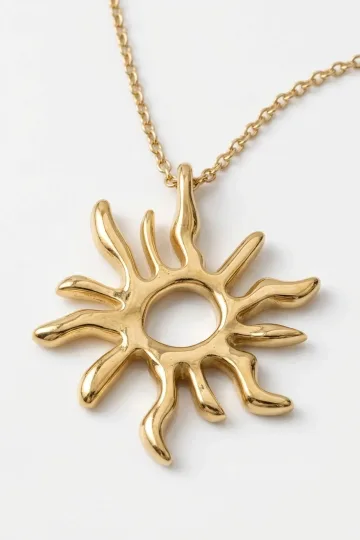
Wear the symbol, don't just read about it. These are in stock:


How it forms in nature
Beryllium is scattered through the Earth's crust in fractions of a percent and never builds large ore bodies. For its atoms to gather and crystallise into beryl, a special situation is needed: the residual melt of granite magma. When a large body of magma cools at depth, the common minerals crystallise first, while rare elements such as beryllium concentrate in the last liquid portion. This saturated residue fills cracks and cavities in the host rock and forms pegmatites, coarse-grained veins in whose pockets the largest beryl crystals grow.
Colour is settled at the moment of growth. If trivalent iron locks into the lattice in certain positions, the stone turns yellow, and that is heliodor. A slightly different distribution of iron valence and position pulls the beryl towards blue, and from the same solution aquamarine is born. That is why yellow and blue beryls are often found in neighbouring pockets of one vein, and sometimes a single crystal is zoned with a shift of colour.
Time and temperature decide clarity. Slow cooling lets the atoms line up into an even lattice, and the crystal grows transparent, with sharp faces. Rapid cooling leaves internal stress, cracks and haze. Most gem heliodor is the result of calm crystallisation stretched over hundreds of millions of years, after which tectonics and erosion slowly carry the pegmatites closer to the surface.
A honey beryl belongs on a navy lapel or on bare skin, never on a mustard scarf. Yellow on yellow is not a look, it is a fainting fit.
What to wear heliodor with
After years working with coloured stones I have learnt one thing: heliodor will not share the stage with a rival colour. I recommend building the outfit around that warm yellow point rather than fighting it. Here is how I do it, occasion by occasion.
What goes with heliodor day to day? For everyday I suggest a small dose: a modest ring or stud earrings on a calm background. Jeans, a light knit, a linen shirt, dense cotton in neutral tones. Against beige, grey and cream the stone reads as a warm spark of light, and that is enough.
Does it work at the office? It does, as long as you keep it restrained. I recommend one stone in a strict setting, no scatter. A suit in deep navy, graphite or wine gives heliodor an ideal contrast. Large, shouting pieces I save for another occasion.
How do I build an evening look? Under soft light I choose a large pendant or earrings with a saturated golden beryl: they glow a warm honey tone. I suggest baring the neck and décolletage, and picking a dress in emerald, sapphire or black so the golden shine reads especially clearly.
Which metal and clothing colour should I pick? For warm complexions, olive and tanned skin I recommend yellow and rose gold; for cool ones, white gold, platinum and silver. In clothing the stone befriends deep blue, emerald, burgundy and neutral beige. With other yellows and oranges it gets lost, so I advise avoiding that background.
Does it hold up layered with chains? It does, gladly. Heliodor likes the company of cool blue stones such as aquamarine: warm and cool in one look create a lively tension. One rule: give the stone its own length line and do not crush it between five pendants, a single sunny accent beats a crowd.

Turn on your camera, pick earrings, a pendant or a ring, and see the piece on yourself in real time.
Switch items in one tap.
Everything runs in your browser: no photo or video is ever uploaded.
Geography: where heliodor is mined
Heliodor has a character tied to its birthplace, and an experienced gemmologist can often guess the region from the hue and inclusions.
- Brazil, Minas Gerais. The main and historical source of gem material. The stone itself, as a distinct variety, was described and named in 1910 after Namibian (German South-West African) beryl rather than Brazilian samples. Brazilian heliodor is usually a warm honey-yellow tone, of good transparency, and often large.
- Namibia. The homeland of the name heliodor: it was here, near Rössing, that golden beryl was mined, the material on which the stone was described in 1910. Namibian material can be very clean and is prized for warm, saturated tones, but it is rarer.
- Madagascar. Yields a pale, almost lemon heliodor of high transparency. Mining comes from mica-bearing pegmatites worked by small crews, with volumes that depend on the season.
- Nigeria and Cameroon. West African pegmatites have, in recent decades, brought a noticeable flow of yellow beryl of varied quality, from industrial to clean gem grade.
- United States, Connecticut and Maine. The old pegmatite mines of New England yielded golden beryl back in the nineteenth century; today these are mainly collectors' grounds.
- Ukraine (Volhynia). A historical source. The Volhynian pegmatites produced rare specimens for collections, but gem heliodor was never mined here in commercial volumes. These stones today are valued scientifically rather than commercially.
Mining is almost always by hand or semi-artisanal: the concentration of gem material is too small for industrial quarries. Diggers follow the vein, open the pockets and pick out clean crystals by hand. For hundreds of kilograms of rock there may be grams of usable heliodor, and that arithmetic explains the rarity.
History: beryl from antiquity to the twentieth century
Heliodor as a separate name is young, a little over a century old. But golden beryls were known long before that; they simply were not set apart as a distinct gem.
In antiquity beryl was generally held to be a noble and costly stone, brought from afar along trade routes. In Egypt beryls reached the jewellery of the elite, in Rome the rings of patricians. Pliny the Elder, in his Natural History (first century AD), described beryls and their transparency; he distinguished colours but did not single out yellow beryl as a separate kind. The cost of such a stone was beyond an ordinary person: the journey of luxury goods from the east took months.
In the Middle Ages interest in transparent gems faded, and yellow beryl all but vanished from written sources. The lapidaries, medieval treatises on stones, described beryl in general terms, without dividing it by colour.
The Renaissance brought back a taste for gems. Venetian and Genoese traders carried beryls from Greece and Asia Minor, and golden stones reappeared in rings and pendants. The cutting was primitive by today's standards, more often a cabochon or a simple table form.
The scientific revolution of the seventeenth and eighteenth centuries forced minerals to be sorted systematically by composition. Beryl was gradually separated from similar stones, but its colour variants were still confused for a long time and named differently depending on the country and the school.
The turning point came in 1910: German specialists, studying golden beryls from Namibia (German South-West Africa), gave the gem the name heliodor. The name caught on and became the international standard.
At the turn of the nineteenth and twentieth centuries, and in the first decades of the new century, heliodor was in favour with the well-off. The Art Deco style, with its love of clean geometric forms and warm transparent stones, suited it perfectly: step cuts emphasised the clarity of the gem. After the Second World War fashion shifted to brighter, more recognisable stones, and heliodor slipped into the shadows, remaining a stone for connoisseurs and collectors.
Customer reviews
Zevira is a real jewellery shop. Genuine payments, deliveries and customer thank-yous.
🥰🥰🥰 gracias
Ok, ¡gracias! 🙂
Types and shades
Heliodor is not uniform in colour, and different tones are valued differently.
Honey-gold is the benchmark and the most sought-after shade. Warm, saturated, with a sense of inner light. It commands the highest price.
Straw-yellow and pale fawn are light, cool tones. A pale stone can look almost colourless in daylight, then reveal its gold under a lamp. It is common, valued moderately, and gains from a contrasting cool setting that adds depth.
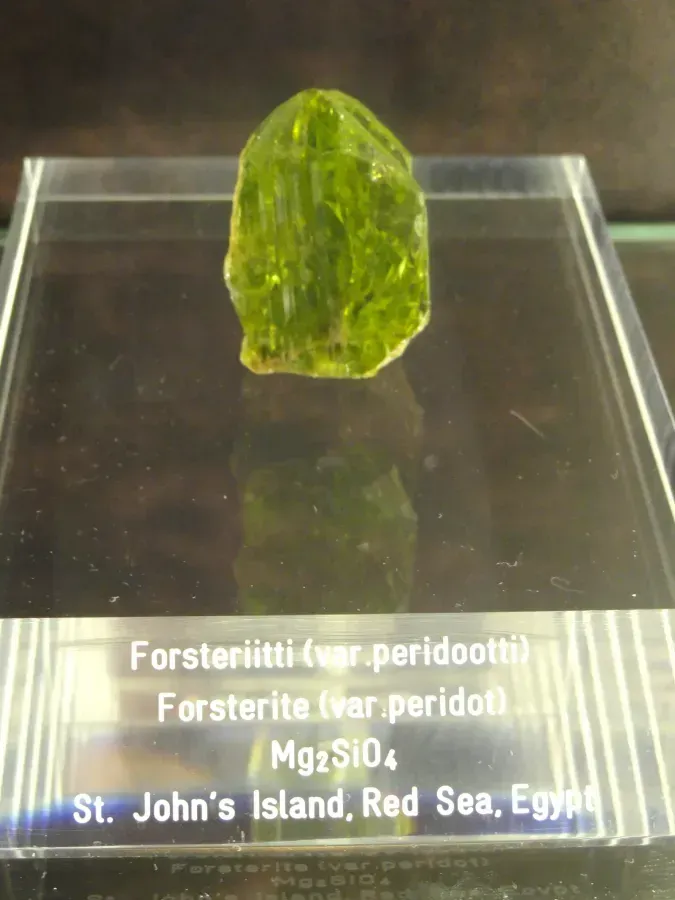
Yellow-green is the result of a shift in the iron ratio within the lattice. It lowers the market price but gives an unusual natural hue that lovers of the atypical appreciate. In the same zone sits peridot, another sunny stone, with which heliodor is sometimes confused by colour.
Amber-orange is the rarest and most expensive variant, found mainly in Namibian and Madagascan material. A deep, warm tone close to topaz, an object of special pursuit for collectors.
Very rarely the finest tubular inclusions grow in parallel within a crystal, and when cut as a cabochon they produce a band of light, the cat's-eye effect. Such heliodors are rare and valued above the ordinary.
The beryl family: heliodor's relatives
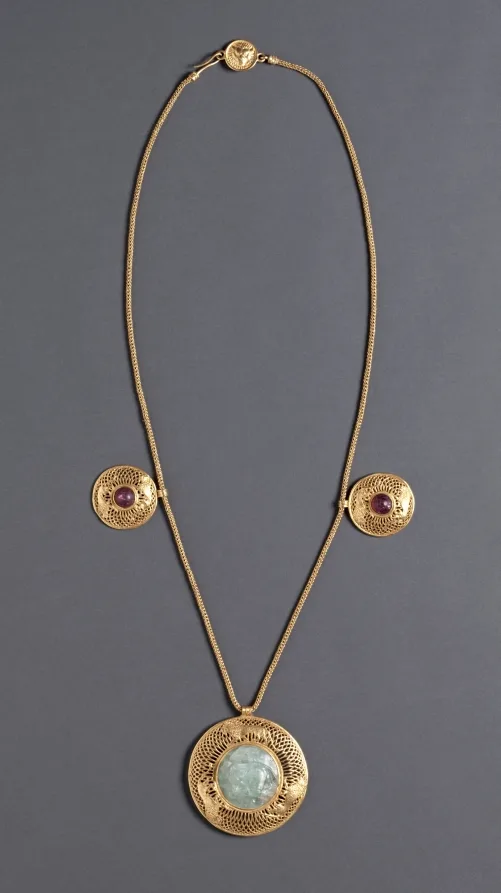
All these stones are a single mineral species, beryl, and they differ only in the colouring impurity. Their mineral base, hardness and density are shared.
- Emerald: green from chromium and vanadium, the costliest of the beryls, almost always with inclusions.
- Aquamarine: blue from divalent iron. The closest relative of heliodor, often growing with it in one vein. Demand for it is higher, and from common raw material the blue stone is made more readily, which partly explains heliodor's rarity.
- Morganite: pink and peach from manganese.
- Bixbite (red beryl): coloured by manganese to a raspberry-red, the rarest of all.
- Goshenite: colourless beryl with no colouring impurities.
Among its relatives heliodor occupies the niche of a rare but not ruinous gem: cheaper than emerald and bixbite, comparable to or a touch dearer than good aquamarine and morganite, and carrying a unique sunlit colour.
Upload a photo of your pet, someone you love, or an object. We'll build a 3D model and hand-cast it in pewter.


How to tell heliodor from similar stones and fakes
The final verdict always rests with a gemmological laboratory using spectral methods, but a basic orientation will save you from crude deception.
Heliodor and citrine. Citrine is quartz, softer (7 against 7.5 to 8) and lighter (density around 2.65 against 2.8). Most citrine on the market is produced by heating amethyst and carries a reddish undertone. Heliodor is heavier, cooler to the touch and often shows tubular inclusions under a loupe.
Heliodor and yellow sapphire. Sapphire is corundum, hardness 9, noticeably heavier, with a brighter lustre. Yellow sapphire is usually dearer than heliodor of similar quality and better suited to daily wear.
Heliodor and yellow topaz. Topaz is a touch harder (8 to 8.5) and has perfect cleavage along which it can split from a knock. Optically they are close, hence the frequent confusion; they are told apart by density, cleavage and certificate.
Heliodor and chrysoberyl. Chrysoberyl is harder (8.5) and denser, a different mineral, although the names overlapped historically.
Heliodor and glass. The crudest imitation. Glass is lighter, softer, optically uniform, without birefringence or pleochroism, and often holds round gas bubbles inside that never occur in natural beryl. On the scales and under a loupe it is exposed quickly.
What to check in practice: weight in the hand (beryl is heavier than you would expect for glass), coolness to the touch (a mineral draws heat away quickly), inclusions under a loupe (natural heliodor shows fine tubular channels, films, pinpoint crystallites; a perfectly empty interior points more to synthetic or glass), and the absence of spherical bubbles. Natural and synthetic heliodor are physically identical and can be separated only in a laboratory, which is why a certificate is essential for a serious purchase.
How to choose heliodor when buying
Transparency matters more than size. The chief value of heliodor is a pure, even colour, so you look first at the water of the stone: hold it to a light source and check for haze, milky clouds and visible cracks. In beryl haze usually comes from gas-and-liquid inclusions that scatter light, and such a stone looks dull even at a saturated tone.
Judge the colour in daylight and under a warm lamp separately. Heliodor does not change colour sharply like alexandrite, but a pale fawn stone warms and gilds noticeably under an incandescent lamp, while it looks almost colourless under cool daylight. If a steady honey tone in any light matters to you, choose a stone that is saturated from the start rather than a pale one.
Size barely limits the price of heliodor the way it does with emerald. Beryllium concentrates in large pegmatite pockets, and clean crystals of tens of grams are not rare, so a large heliodor does not cost many times more than a small one at the same quality. It is colour and clarity that command a premium, not weight. This is convenient for pendants and cocktail rings, where you want a noticeable stone.
Ask about treatment directly. An irradiated stone is outwardly indistinguishable from a naturally saturated one, but an untreated natural gem is valued higher and should be stated as such on the certificate. The wording "colour enhanced by irradiation" is normal and honest; the absence of any treatment information on a dear, saturated stone is a reason to be wary.
Is the tone even across the whole stone? Beryl often grows zoned, and within a single crystal the colour can run in bands from yellow to bluish or colourless. In cheap material such zoning is visible against the light; in good material the cutter orients the stone so the tone reads evenly from the top. Turn the stone: the saturation should not drop away into zones.



Treatment and synthetics: what is honest to know
Irradiation is the most common way to influence the colour of beryl. Under directed radiation the state of the colour centres in the lattice changes, and a pale or greenish beryl can become a more saturated yellow. A stone after such treatment is safe and stable in ordinary wear, with no residual radioactivity left in gem material. But there is a nuance: the colour gained by irradiation is, in some stones, less stable against heat and very long intense light than the natural iron colour, so an irradiated heliodor likes hot procedures and brightly lit display cases even less.
Heating works in the opposite direction. Heat often turns yellow iron-bearing beryl into blue aquamarine, because it changes the valence of the iron. On the market this means a simple thing: part of the raw material that could have become heliodor is deliberately heated and sold as the more saleable aquamarine. This is another reason there is less ready yellow beryl on the counter than blue.
Synthetic beryl exists and is grown by the hydrothermal method: a seed is placed in a solution under pressure and temperature, and the crystal builds up in layers over weeks instead of millions of years. In composition and properties it is true beryl, with natural hardness, density and lustre. You can tell synthetics by the character of the inclusions: a grown stone may show fir-tree and wavy growth structures, sometimes comet-like inclusions around the seed, whereas natural heliodor has fine straight tubular channels and isolated mineral crystallites. Only a laboratory separates them reliably, which is exactly why a saturated, cheap stone without a certificate should be treated with caution.
Cutting: what reveals heliodor
The chief value of the stone is a pure, even colour and transparency, so the cut is chosen for the colour rather than for the sparkle.
Step cuts (emerald, baguette, Asscher) work as windows into the depth of the stone and emphasise the purity of the tone. Any haze shows in them at once, so they are chosen for the best material and saturated stones.
Brilliant cuts (oval, pear, marquise) add liveliness and help pale stones look more saturated through the play of facets. Oval and pear are versatile; the marquise suits an elongated crystal.
Mixed cuts combine a step-cut base with a brilliant top, a sensible compromise for medium material.
Cabochon is used rarely: for stones with the cat's-eye effect or a vintage styling.
The quality of the cut shows in the symmetry of the facets and in how evenly the stone returns light without dark dead zones.
Leave your email, we'll send your discount code. No spam, unsubscribe anytime.
The code arrives by email, valid on your first order.
Heliodor in jewellery
Heliodor is rarely found on the mass market, but when it is, it follows the classic rules of setting for coloured stones. The perception of the stone depends strongly on the metal.
Yellow gold strengthens the gold of the stone, and the piece looks whole and honeyed. The boundary between stone and setting is softened. White gold and platinum give contrast and make the yellow read more distinctly, especially next to colourless accents. Rose gold is a soft compromise, old-fashioned in the good sense, and suits pale lemon stones. Silver gives a clean, cool contrast and is fitting for everyday pieces and medium-quality stones.
Rings are the most common format: usually a central stone with or without diamonds around it. Stud earrings emphasise the symmetry of a paired colour. Pendants are safe for daily wear: a stone on the chest takes fewer knocks than one on the hand. In any format the setting must hold the stone tightly and protect its edges from blows, since it is precisely the edges and corners of the cut that are the most vulnerable.
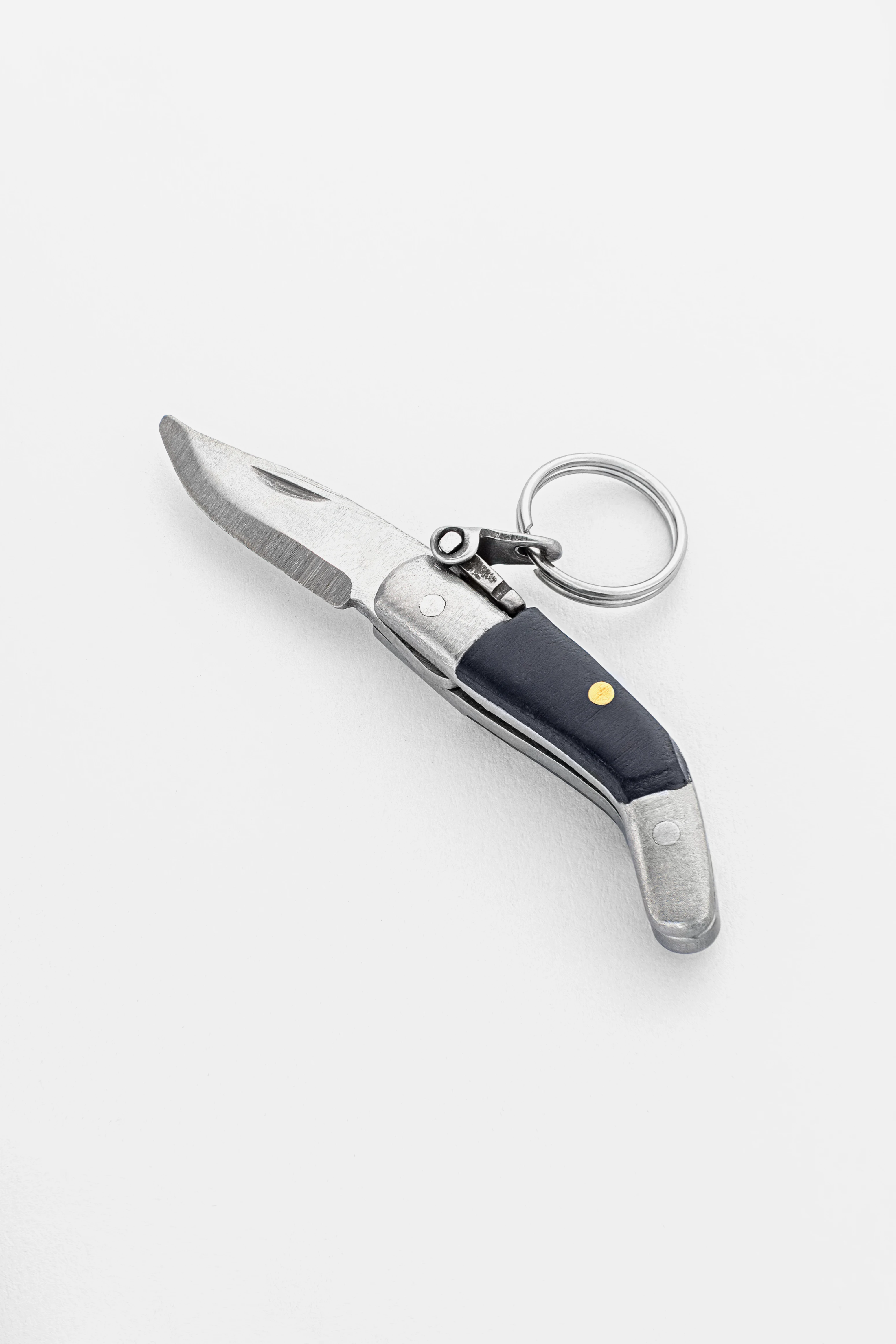
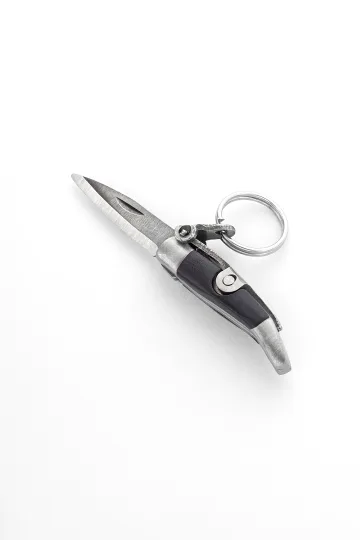
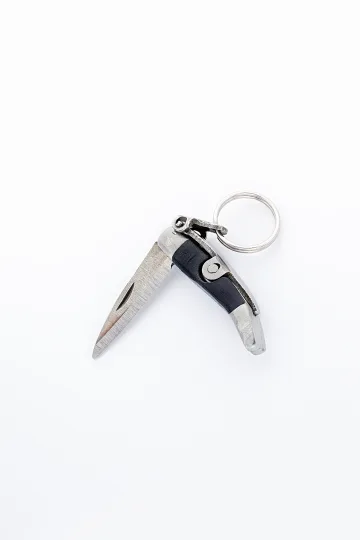
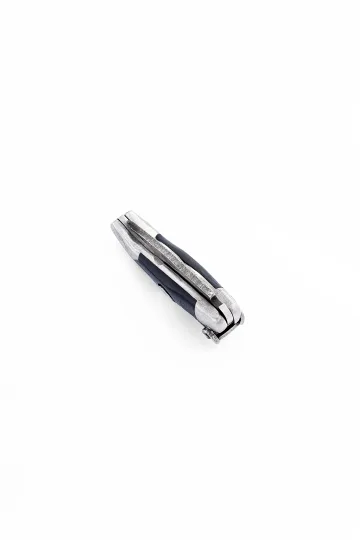
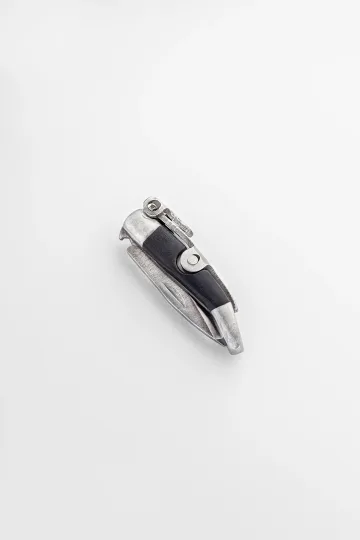
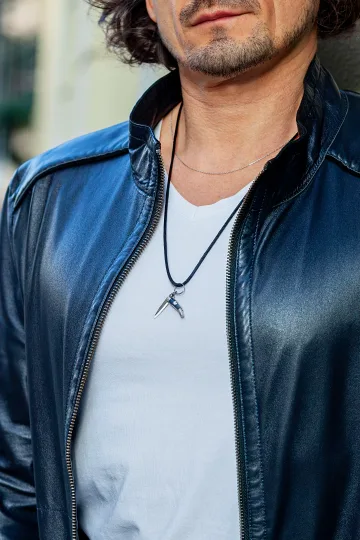
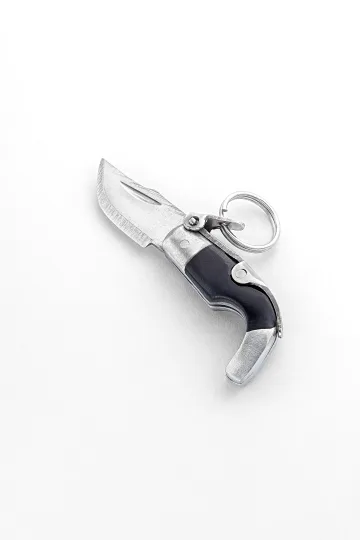
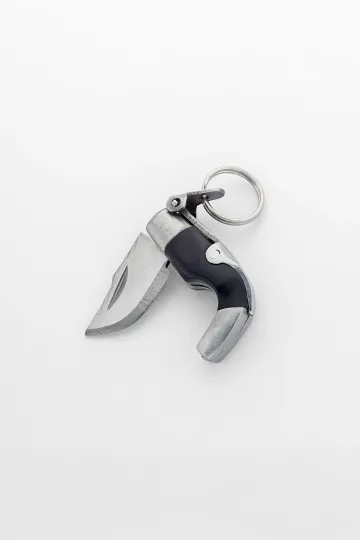
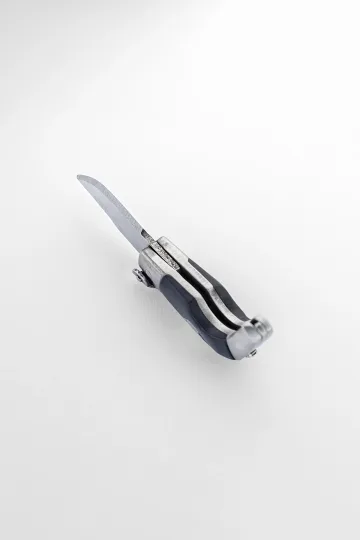
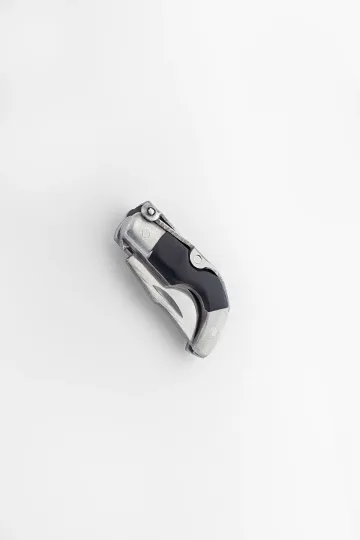
CAPAORA mini knife pendant
The 18th-century Spanish navaja in miniature: 40 mm of stainless steel, a real folding mechanism and a Palanquilla lock that clicks. An affordable gift to remember.
Authentic · Ships from Spain · 14-day returns
Care and wearability
A hardness of 7.5 to 8 lets you wear heliodor daily, but it is softer than corundum and asks for care. It is not a put-it-on-and-forget-it stone.
Take the piece off before cleaning with household chemicals, before sport, garden work and any dirty or impact-heavy task. The point is less the chemical danger to beryl (it is resistant) than protection from knocks, abrasives and grime on the setting. Put heliodor on last, after make-up, perfume and hand cream, so cosmetics do not settle on the stone and dull its shine.
Cleaning is gentle: warm water with a mild or jewellery soap and a soft brush, then dry with a linen cloth. No abrasives, harsh solvents, ultrasonic or steam baths; vibration is dangerous to a stone with internal cracks.
Storage is separate: a fabric pouch or a lined box, in a dry, dark place at room temperature. The main thing is to keep heliodor away from diamonds and other hard stones that scratch it.
Check the setting once a month: does the stone wobble, are the prongs intact? A loosened mount is a frequent cause of losing a stone, and tightening it is cheaper than finding a replacement.
Water is a matter of indifference to the stone; it does not absorb moisture. But chlorine in a pool and salt in the sea harm the metal of the setting and leave a film, so it is best to remove the piece before swimming and to rinse it in fresh water after the sea.
Sudden heat is undesirable because of the difference in thermal expansion between stone and metal: do not bring the piece near an open flame, do not leave it on the hot panel of a car and do not put your hands under hot water straight from the cold.
Treated this way, a piece with heliodor serves for generations. It is usually the setting that wears, not the stone itself, and the setting yields to restoration: tightening the prongs, replacing the mount, repolishing a dulled surface at a craftsman who works with coloured stones.
Symbolism: what tradition says
In the traditions of crystal lore heliodor is counted among the "sun" stones and linked with warmth, confidence and creative energy; in the chakra system yellow stones are assigned to the solar plexus. In astrology it is matched with the Sun and with Leo. All this is cultural symbolism, not a property of the mineral: the stone has no proven physiological or curative action, and it cannot be treated as medicine. What really works at most is the psychology of colour: yellow is associated with cheer and lifts the mood through visual perception, but that is the effect of the colour itself, not of the stone's "energy". The most honest view is to see heliodor as a beautiful object of a warm tone, to which you may, if you wish, give a personal meaning.
Beryl in science: how the yellow colour was explained
The study of heliodor is the story of chemistry catching up with something the eye had known for centuries. Golden beryl was worn, traded and admired long before anyone could say why it was yellow, and the answer arrived only when spectroscopy and precise trace analysis made it possible to see which foreign atoms sit inside the crystal lattice. Until then jewellers sorted yellow stones by look and by hardness, which is how heliodor spent generations being sold under the names of quite different minerals.
Why iron colours beryl yellow
Pure beryl is colourless; that variety is called goshenite, and it is the blank sheet on which every other beryl is written. Colour comes from guest atoms that slip into the lattice in place of aluminium or lodge inside the open channels running through the structure. In heliodor the colouring agent is trivalent iron, Fe³⁺. It absorbs part of the visible spectrum in the blue and violet region, and what reaches the eye is the complementary yellow. The same element in its divalent form, Fe²⁺, turns beryl blue, which is why the valency of a single metal decides whether a growing crystal becomes yellow heliodor or blue aquamarine. Nothing else about the stone changes: the same beryllium, the same aluminium, the same silicate rings, and a handful of iron atoms in a different oxidation state.
What the spectrum of heliodor shows
Under a spectrometer heliodor gives a characteristic absorption pattern in the violet and blue zone, and a gemmologist reads that pattern the way a chemist reads a signature. It separates iron-driven yellow from yellow that comes from irradiation, from a dye or from a coating, and it does so without cutting or damaging the stone. This is the point where a pretty object becomes a matter of exact knowledge: a spectrum cannot be flattered by a clever setting or a well-judged cut, because it reports on composition directly. Laboratories in the United Kingdom that issue coloured stone reports work from exactly this kind of evidence, which is why a report carries more weight than any verbal assurance at the counter.
Channels in the beryl structure
Beryl is built from stacked rings of silica tetrahedra, and those rings leave hollow channels running the length of the crystal along its main axis. Water molecules, alkali metal ions and gases trapped during growth all sit inside these channels. They influence the optics of the stone, they change how it behaves when heated, and they partly explain something that surprises new owners: beryl tolerates sudden temperature swings less gracefully than its hardness suggests. A stone that shrugs off a scratch can still be damaged by a jump from cold hands to hot water, because the channel contents expand at their own rate.
Heliodor in culture and perception
A yellow stone has always been read as a solar one, and that is a durable association rather than an accident. It survived the move from antiquity to the medieval workshop, from the medieval workshop to the Victorian display case, and it settled into a recognisable image that a modern buyer still reaches for without having to be taught it.
The sun as the enduring image of a yellow stone
For thousands of years people have tied golden yellow to the sun, to gold itself and to ripe grain, which is to say to warmth, wealth and harvest. A transparent stone of that tone looks as though it is holding a fragment of daylight, so the name heliodor, gift of the sun, settled onto golden beryl without any strain. The Greek roots in the word are a bookish flourish from the early twentieth century, but the image they fixed in place is far older than the label. Yellow was the colour of the good season across agricultural Europe, and jewellery has borrowed that meaning steadily ever since.
A warm stone in Art Deco
In the first decades of the twentieth century, when the geometry of Art Deco went looking for clean transparent stones of even tone, heliodor arrived at the right moment. Step cuts and the severe lines of settings from that period revealed its clarity better than any baroque abundance could. The warm honey colour balanced the cold graphics of platinum and white gold, and in the pieces of those years golden beryl looked modern and restrained at once. British and continental workshops of the period used it alongside aquamarine precisely because the two stones came from the same mineral family and behaved identically in the setting.
The psychology of yellow: why it draws the eye
Yellow is the lightest of the saturated colours, the closest to white in luminance, and the eye registers it as a signal of warmth and alertness. That explains the pull towards yellow stones in a cloudy climate and in the dark half of the year, which anyone who has spent a British winter will recognise. A warm point of light at the wrist or the throat works on the mood through ordinary visual perception, with no mysticism required. That is an honest account of the appeal of heliodor, and it is quite enough reason to want to wear one.
Send a friend a discount code, they save on their first order.
Heliodor as a collector's mineral
Beyond the jewellery counter heliodor has a second life among mineral collectors. They value qualities that have almost nothing to do with what a ring buyer looks for, and for the sake of those qualities they will happily leave a fine stone uncut for ever.
Crystal against cut stone
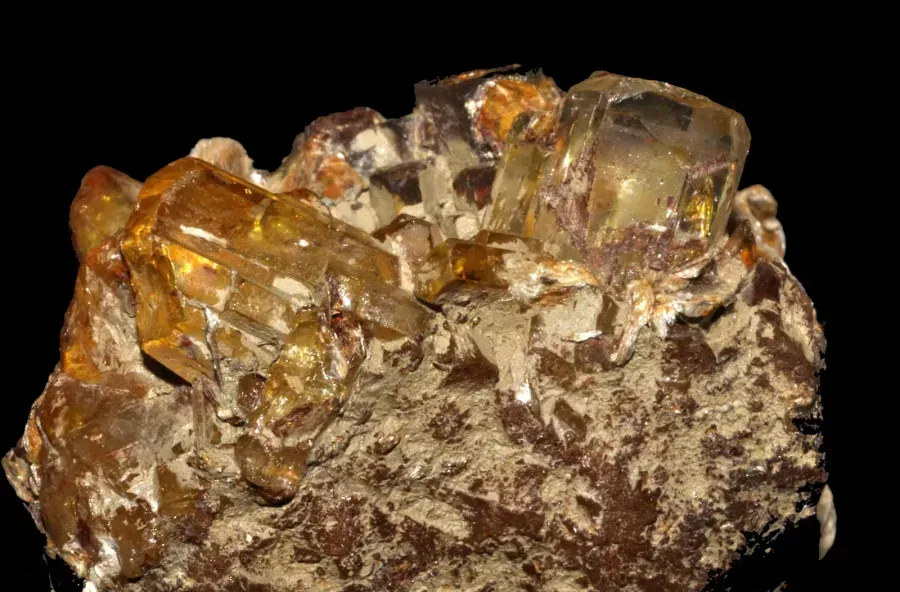
For a jeweller the value sits in the clarity and colour of a faceted stone. For a collector it sits in the survival of the natural crystal. A well formed hexagonal prism with intact faces and clean terminations, still resting on its matrix, is prized above the same material sent to the cutting wheel. Sawing such a crystal destroys the rarity rather than releasing it, so the best specimens stay untouched in cabinets and museum drawers. Mineral fairs in the UK trade these pieces on entirely separate terms from the gem trade, and the same stone can be worth quite different things to the two audiences.
Why large crystals matter
Beryl grows to remarkable sizes, and among the yellow varieties specimens measured in tens of centimetres have turned up in pegmatite pockets. The larger the transparent zone of even colour, the greater the rarity, because nature far more often supplies cloudiness, fractures and patchy colour zoning. A clear heliodor the size of a fist belongs in a museum case rather than a shop window, and specimens of that class rarely change hands more than once in a generation.
Heliodor in museums and collections
Major mineralogical collections keep heliodor in the beryl section alongside aquamarine and emerald, and they often display colour-zoned crystals in which yellow shades gradually into blue. The mineral galleries of the Natural History Museum in London show beryl this way, and the arrangement teaches the family relationship better than any label could: one crystal, two colours, and the whole difference lying in the valency of iron across the growth zones. Anyone who has stood in front of such a specimen understands at once why heliodor and aquamarine are the same mineral wearing different clothes.
Heliodor among the yellow gemstones
Nature supplies several transparent yellow stones, and each holds its own niche. Understanding how heliodor differs in character makes it possible to choose deliberately rather than by colour alone under shop lighting.
Heliodor or citrine: quartz against beryl
Citrine is cheaper and far easier to find, there is plenty of it, and most of what sells is produced by heating amethyst. Heliodor is rarer, denser and cooler to the touch, with a calm glassy shine and none of the reddish undertone that heated citrine usually carries. If rarity matters, and if you want a clean iron yellow without any orange in it, beryl is the answer. If you want a large warm stone for occasional wear and do not mind that it is common, citrine will serve perfectly well.
Heliodor or yellow sapphire: tone against toughness
Yellow sapphire is harder and considerably tougher, it takes daily punishment better, and that makes it the sensible choice for a ring worn every day on a working hand. Heliodor is softer and more delicate, but it gives a different tone altogether, honey-warm rather than the icy brightness a sapphire can have. The choice is between durability and the character of the colour, and there is no universally right answer: it depends on whether the piece will live on a hand that gardens and washes up or on one that mostly wears it out in the evening.
Heliodor or yellow topaz: lookalikes by sight
Topaz and heliodor resemble each other optically to a degree that had them confused for centuries, and a good deal of historic jewellery labelled one way holds the other. What separates them is cleavage: topaz has perfect cleavage in one direction and will split cleanly along that plane under a knock, while beryl has almost none. By colour and lustre the eye cannot reliably tell them apart, and the definitive answer comes from specific gravity, refractive index and a laboratory report.
Facts that surprise
Heliodor is a quiet stone, but a surprising amount has collected around it. A few facts that change how golden beryl looks once you know them.
One mineral, six names
Emerald, aquamarine, morganite, goshenite, red beryl and heliodor are all the same mineral, beryl, carrying different impurities. The most expensive and the most modest gemstones on that list are close relatives, separated only by a few colouring atoms inside a shared lattice. A buyer who learns this tends to look at the whole family differently, because the gap in price between its members has nothing to do with any gap in substance.
Aquamarine and heliodor from the same vein
Yellow and blue beryls often grow in neighbouring pockets of a single pegmatite vein, and sometimes within one crystal: half blue, half yellow, with a visible boundary between them. The stone demonstrates in the most literal way possible how the same iron in two oxidation states paints the same rock two different colours. Specimens like this are among the most instructive objects in any mineral collection.
Heating turns heliodor into aquamarine
Part of the yellow beryl on the market disappears from it, and the reason is commercial rather than geological. Heating changes the valency of the iron, the yellow drains away and the stone comes out blue, at which point it sells as the more popular aquamarine. This is one of the reasons that finished golden beryl is scarcer at the counter than the amount of raw material in the ground would suggest, and it explains why heliodor of good colour holds its standing among people who know the trade.
The name is barely a century old
Golden beryls were known in antiquity, yet the word heliodor itself was coined only in 1910, when it was applied to golden beryl from what is now Namibia. By the standards of gemstones that is almost yesterday: most of the classic stones carry names that trail back through Latin, Greek or Sanskrit. Heliodor received its Greek-sounding name from a modern commercial decision, and the name stuck because it described the stone accurately.
It can show a cat's eye
When the finest tubular channels grow parallel inside a crystal, a cabochon cut gathers their reflections into a narrow band and the stone opens a single glowing eye. Chatoyant heliodor is rare, it is hunted separately by collectors, and it almost never reaches the ordinary retail counter. Anyone who finds one at a mineral fair is generally not the first person in the room to have noticed it.
Size barely inflates the price
Unlike emerald, where every extra carat raises the price out of all proportion, heliodor grows in large clean crystals, so a big stone does not cost several times a small one at equal quality. The premium here is paid for colour and clarity rather than for weight. That makes heliodor unusually forgiving for anyone who wants a generous stone in a pendant or a cocktail ring without the scaling that governs the rarer beryls.
Does it glow under ultraviolet? No
Contrary to what a sunny stone seems to promise, heliodor is normally inert under ultraviolet light or reacts only weakly, unlike a number of other gemstones that light up dramatically in a dark room. Its warmth lives in visible colour rather than in luminescence, and that behaviour gives one more quiet way to separate genuine beryl from some of the glass and synthetic imitations that do fluoresce.
Buying it as a gift? Each one arrives ready to give.
 A branded Zevira box and a little card come with every order.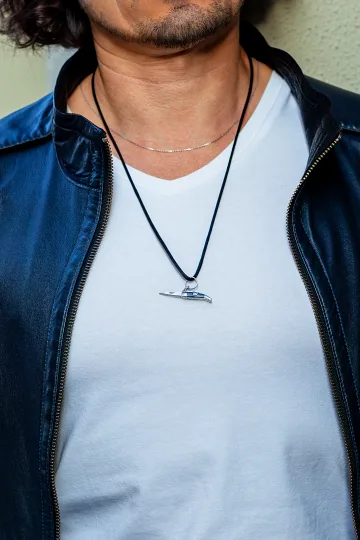





About Zevira: jewellery with heliodor
In the Zevira collection heliodor is a stone for those who appreciate rare materials. We work with natural heliodor, and each stone passes certification in an independent laboratory before it reaches a piece.
We choose stones by several criteria at once: colour, clarity, cut and origin. We make heliodor rings either as restrained minimalism, the stone in gold and nothing more, or as compositions with diamonds and other beryls. For each piece we select a setting that protects the edges of the stone and reveals its tone.
Bespoke work is possible: if you have found your heliodor or inherited it, we will create a setting for it, and an inherited stone we will first show to a gemmologist and, if needed, carefully restore.
Every piece comes with a certificate and a description of the stone: its origin, characteristics and particulars. We speak honestly about properties: the strength of heliodor lies in aesthetics, history and personal meaning, not in promised miracles.
Discover the world of rare stones with Zevira
Heliodor is a rare golden beryl, a sunlit colour sealed in a crystal. Every piece with heliodor from our collection is made with respect for mineralogy, history and your taste.
Frequently asked questions about heliodor
What is heliodor? It is a golden-yellow variety of beryl, coloured by trivalent iron. The same mineral species as emerald, aquamarine and morganite; they differ only in the colouring impurity. The name translates from the Greek as "gift of the sun".
What is the hardness of heliodor? On the Mohs scale, 7.5 to 8. That is enough for rings, earrings and pendants with sensible care, but it is softer than corundum (sapphire and ruby at hardness 9) and asks for its edges to be protected by the setting.
How does heliodor differ from aquamarine and morganite? All three are beryls with a shared base, hardness and density. Aquamarine is blue because of divalent iron, morganite pink because of manganese, heliodor yellow because of trivalent iron. Aquamarine and heliodor often grow in one pegmatite vein, in neighbouring pockets.
How do you tell heliodor from citrine? Heliodor is beryl (hardness 7.5 to 8, density around 2.8), while citrine is quartz (hardness 7, density around 2.65). Heliodor is heavier and cooler to the touch, and under a loupe often shows tubular inclusions. Citrine is often made by heating amethyst, which gives it a reddish undertone. Only a laboratory gives the exact answer.
How does heliodor differ from topaz? Topaz is a touch harder (8 to 8.5) and has perfect cleavage along which it can split from a knock; beryl is almost free of cleavage. Optically they are close, hence the frequent confusion, but they are different minerals, told apart by density, cleavage and certificate.
Where is heliodor mined? The main source is Brazil (Minas Gerais). Saturated yellow-orange stones come from Namibia, and a pale lemon kind from Madagascar. There are deposits in Nigeria, Cameroon and the United States (New England), as well as historical ones in Volhynia and the Urals.
Is heliodor suitable for an engagement ring? Probably not. An engagement ring is worn for years without taking it off, and it takes a great many accidental knocks. Heliodor is a little soft for that load; corundum is wiser for the daily role. As a dress or keepsake ring for special days it is splendid.
Can you wear heliodor every day? You can, with discipline: take it off before cleaning, sport and dirty work, store it apart from hard stones, check the mount once a month. The safest format for daily wear is a pendant: a stone on the chest takes fewer knocks than one on the hand.
Is heliodor treated? Sometimes irradiation or heating is used to strengthen or stabilise the yellow tone. Treatment does not make the stone any less beautiful, but it affects the price and should be stated on the certificate. A naturally saturated, untreated stone is valued higher.
Does heliodor fade in the sun? The colour of natural heliodor, owed to iron in the lattice, is stable to light, and normal wear does not harm it. In some irradiation-treated stones the saturation can, in theory, weaken under extremely long sun exposure over many years; for a natural untreated stone this is not an issue.
Will heliodor go cloudy over time? With proper care, no. A visible loss of shine is almost always caused by a film of skin oil, cosmetics and dust, which is removed by gentle cleaning. The beryl itself is chemically stable.
Which cut best reveals heliodor? Step cuts (emerald, baguette) show the purity and depth of the tone and are chosen for saturated stones. Pale stones are helped by a brilliant cut (oval, pear), which adds liveliness through the play of facets.
Does heliodor occur with a cat's-eye effect? Very rarely. If the finest tubular inclusions grow in parallel within a crystal, a cabochon cut gives a band of light. Such stones are a matter of interest to collectors.
Why is a certificate needed? It is the conclusion of an independent laboratory that the stone really is heliodor, whether it is natural or synthetic, whether it was treated and what its characteristics are. Natural and synthetic heliodor are physically identical and cannot be told apart by eye, so a certificate is the only reliable confirmation.
Can a heliodor piece be passed down as an heirloom? Yes. The stone is durable, the colour stable, the repairability high. Pieces with golden beryl from the start of the last century survive in fine condition. The enemy of longevity is not time but carelessness: knocks, storage in a common heap, aggressive cleaning.