Danburite: The Clear Stone Found by Mistake
A Gem With No Ancient Legends
In 1839, a geologist was poking around a quarry near the town of Danbury, Connecticut, hunting for a completely different mineral. What ended up in his hand matched no description he knew: clear, hard, with a glassy shine, it would not melt like quartz or scratch like calcite. That is how danburite first appeared, a stone named after the little town that people remember today mostly because of it.
Most gemstones come trailing thousands of years of mythology. Danburite has none. It was discovered less than two centuries ago, and for a long time it stayed a single line in mineralogical catalogues, interesting only to scientists. What it does have is rarity, the transparency of rock crystal, soft pink and honey tones, and a curious bit of physics: many danburites glow under ultraviolet light. In this guide we get straight to the practical stuff: what danburite is made of, how it forms in the earth, where it is mined, how it differs from similar clear stones, how to tell it apart from glass, and how to care for it.
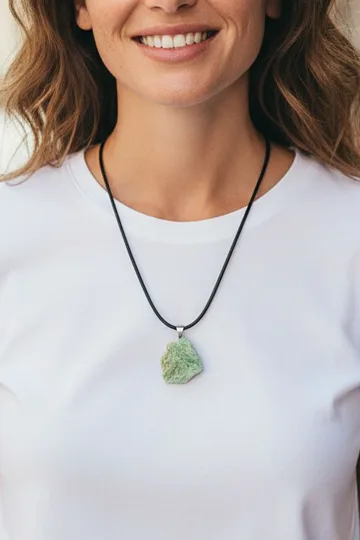
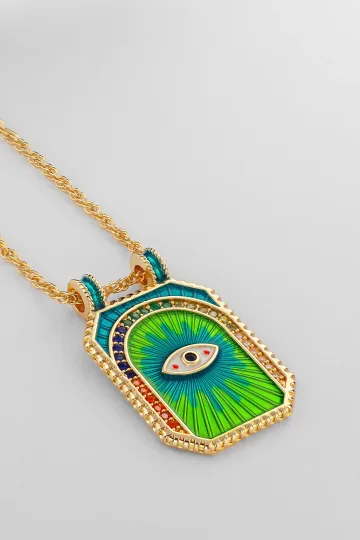
Wear the symbol, don't just read about it. These are in stock:






The Chemistry and Physics of Danburite
Danburite is a calcium borosilicate with the formula CaB₂Si₂O₈. At its core sit three elements: calcium, boron, and silicon, locked into a dense crystal lattice. Boron is what makes danburite a rare mineral, because there is little of it in the earth's crust, and it gathers only under special geological conditions.
Hardness and Density
Danburite rates 7 to 7.5 on the Mohs scale, on a par with quartz and slightly above it. For comparison, window glass sits around 5.5, and a steel knife is roughly the same. So danburite will scratch both glass and steel, while topaz or sapphire would leave a mark on the danburite itself. That degree of hardness is enough for everyday jewellery, which is more than you can say for many soft transparent minerals.
Danburite has a density of around 3.0 g/cm³, noticeably higher than quartz at 2.65. Pick up two clear stones of the same size and the danburite feels distinctly heavier. This is one of the simplest everyday ways to tell it apart from glass and rock crystal: danburite is heavier than it looks.
Crystal Structure
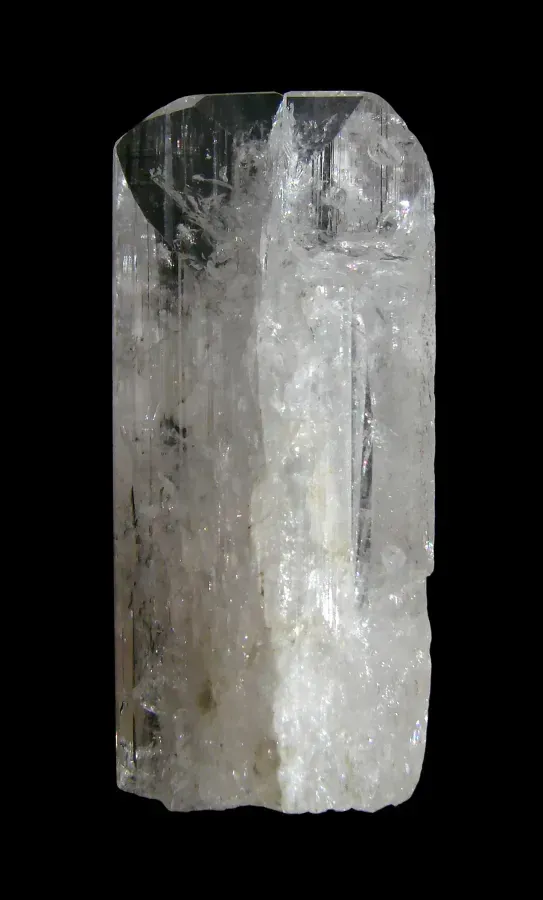
Danburite crystallises in the orthorhombic system. Its crystals are usually elongated and prismatic, with characteristic wedge-shaped tips like a chisel. The faces are often grooved with fine vertical striations. Collectors recognise danburite at a glance from this shape, even though it resembles topaz and an untrained eye confuses the two.
Danburite has imperfect cleavage in one direction. In practice this means that a sharp, focused blow can split the stone along that plane, despite its good resistance to scratching. It helps to separate two ideas here: hardness and toughness. Danburite is hard, but it is not the most impact-resistant gem. That is why cutters handle it gently and jewellers recommend protective settings.
Optics and Glow
Pure danburite is colourless and clear, close to rock crystal in its purity. Its refractive index is moderate (around 1.63), so the play of light is softer than in a diamond, but a good cut gives the stone a calm, warm glow. Dispersion (the splitting of light into colours) is weak, with no vivid rainbow effect.
The most curious thing about danburite is its luminescence. Under an ultraviolet lamp many specimens glow blue or blue-green, and when the light is switched off they keep faintly smouldering for a while. This effect is called phosphorescence, and it once gave rise to tales of a stone that holds light inside it. In ordinary daylight danburite does not glow; the effect shows only under ultraviolet.
A Quick Summary of Its Properties
To gather the essentials in one place: chemically it is a calcium borosilicate, formula CaB₂Si₂O₈. Mohs hardness 7 to 7.5. Density around 3.0 g/cm³. Orthorhombic system, prismatic crystals with wedge-shaped tips. Vitreous lustre. Transparency ranging from transparent to translucent. Colour from colourless to honey, yellow, pink, and rarely a bluish tint. Imperfect cleavage in one direction. Many specimens luminesce blue under ultraviolet.
What Danburite Looks Like in Nature
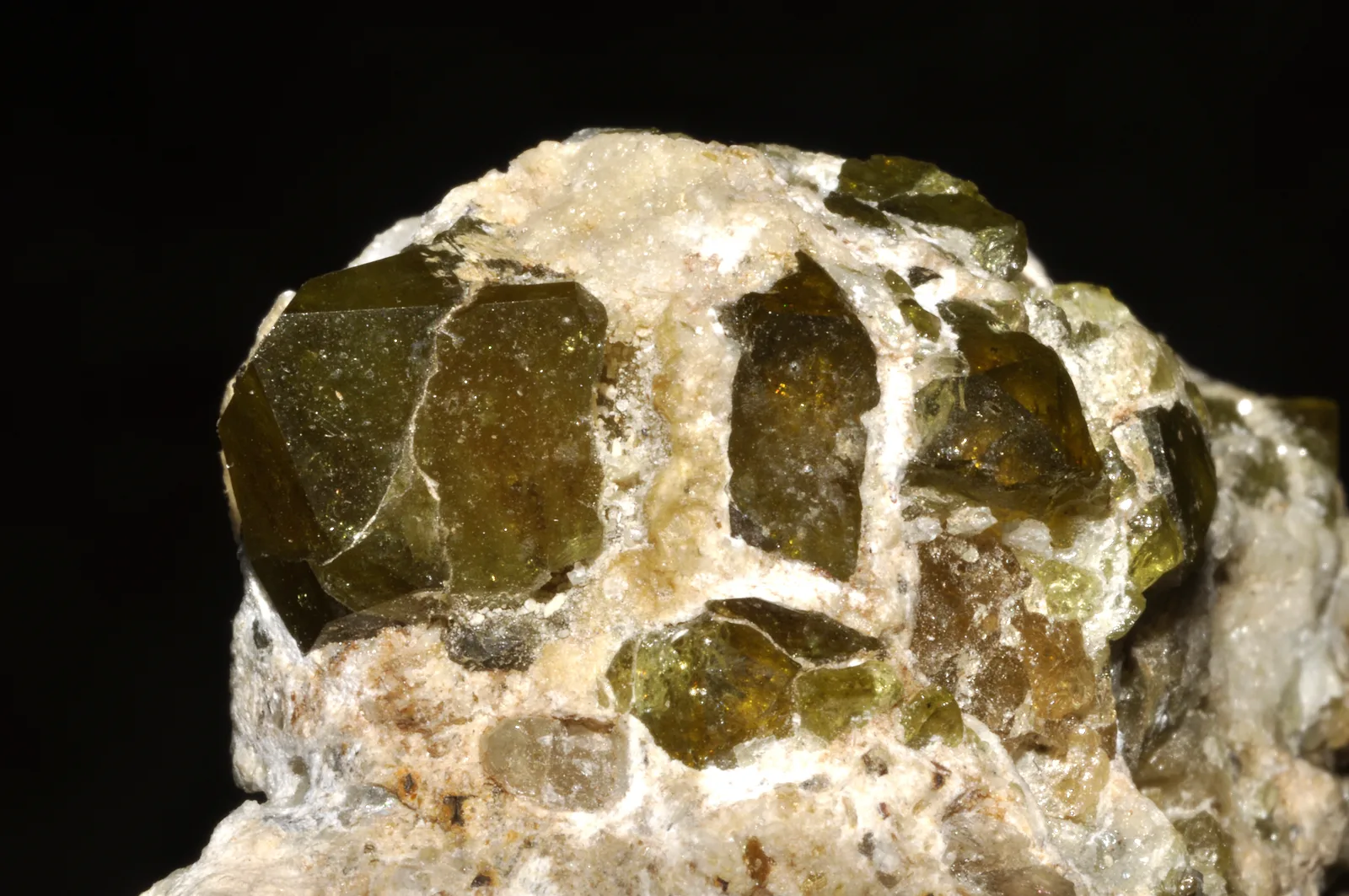
In nature danburite most often turns up as well-formed prismatic crystals, embedded in the host rock or clustered into druses. The faces frequently have a glassy shine and a mirror smoothness by which collectors recognise quality material. Sometimes danburite forms radiating, fan-like clusters that look like a frozen firework. Sizes range from millimetres to large crystals several centimetres across, the kind that the best Japanese and Mexican mines once produced.
Let them mistake it for glass. Danburite outweighs their opinion, and only you are in on it. Keep it that way.
How to Wear Danburite
Years around shoots and display cases have taught me that danburite slips past anyone not paying attention, and that is exactly its charm. Here is what actually works, sorted by occasion.
What do I wear danburite with every day? For daily wear I recommend a small colourless or honey stone in a pendant or stud earrings on a fine chain. It lives happily with the basics: a white shirt, light knitwear, an open collar. A clear stone at the neckline catches the light and lifts even the plainest look, while the thin chain keeps it in place without pulling focus.
Is it right for the office? Yes, as long as you keep it restrained. I suggest a colourless stone in a clean silver or white-gold setting: it reads as a quiet mark of taste rather than an ornament on show. It sits well under a shirt, a blazer, a roll-neck in cool tones. For a work look I choose a single clear stone with no scatter of small accents around it.
How do I build an evening look? For evening I choose the more expressive formats: long drop earrings that shimmer softly when you turn your head, or a pendant in an open setting. Danburite gets on well with a V-neckline and plain fabrics in deep shades, against which its clarity reads cleaner. A pink stone I pair with powder, wine, and warm pastel tones.
Which metal for which shade? The logic is simple. Cool silver and white gold I recommend for colourless stones, since they underline that watery transparency. Honey and yellow shades I bring to life with yellow gold, and pink ones suit rose gold that echoes their tone. The metal should serve the stone, not argue with it.
What does danburite pair with, and what not? Danburite sits calmly beside other pale stones: rose quartz and violet amethyst give it a pretty contrast. What I would not do is keep it in one bracelet with anything harder, like sapphire or topaz, since on contact they will scratch its facets. And the rule that never fails: one expressive danburite always beats a handful of jewellery around it. Let it take the solo.

Turn on your camera, pick earrings, a pendant or a ring, and see the piece on yourself in real time.
Switch items in one tap.
Everything runs in your browser: no photo or video is ever uploaded.
How Danburite Forms in the Earth
Danburite's geological journey begins where hot fluids rich in boron and silicon meet carbonate rocks, limestone or dolomite. In these contact zones a chemical reaction takes place, and danburite slowly crystallises out of the fluids, often in the company of other boron and calcium minerals. The process takes millions of years and demands stable temperature and pressure. A small shift in conditions is enough to stop the growth or produce a crystal with flaws. That is why large clear crystals are such a rarity.
Boron is itself a rare element in the earth's crust, and the places where it concentrates enough to grow large clear crystals can be counted on one hand. This explains the rarity of danburite: it needs boron, calcium, and silicon present together under the right conditions of metamorphism, or of magma meeting carbonate rocks.
Companion Minerals
In nature danburite is rarely found alone. Its frequent neighbours are datolite, axinite, calcite, quartz, and the silicates of contact zones. From the set of companion minerals a geologist can guess a specimen's origin. Collectors are especially fond of pieces where danburite has grown together with contrasting minerals into a handsome natural composition.
Customer reviews
Zevira is a real jewellery shop. Genuine payments, deliveries and customer thank-yous.
🥰🥰🥰 gracias
Ok, ¡gracias! 🙂
Where Danburite Is Mined
Danburite is a rare mineral, and the world has only a handful of major gem deposits. Each gives stones with its own character.
Mexico
San Luis Potosí and Chihuahua are the main source of clear danburite for collections and jewellery. Mexican crystals are large, well formed, often with mirror faces and bevelled tips. The colour is usually colourless or pale yellow, honey. Thanks to the volume of mining, it is Mexican material that most often reaches the market. If you are holding a clear danburite today, there is a good chance it came from Mexico.
Myanmar (Burma)
The Mogok valley and surrounding districts yield danburite with rare pinkish and wine-coloured tints. The same geology that gives Mogok its famous rubies and sapphires occasionally yields pink danburite too. It is found as a by-product, in small amounts, which is why Burmese pink danburite has always been a rarity. It is for this shade that the stone earned its reputation as one tied to the theme of the heart.
Japan
The Obira mine in Ōita Prefecture, in the late nineteenth and early twentieth centuries, produced clear danburite of gem quality: large, clean, perfectly formed crystals. They spread through museum and private collections across Europe and America. The mine closed long ago, so old Japanese danburites are prized especially highly by collectors.
Other Points on the Map
In smaller quantities danburite is found in Madagascar, Bolivia, the Swiss Alps, Tanzania, and in the United States beyond historic Connecticut. These deposits do not set the market, but they widen the stone's geography. Material of true gem quality from these minor sources is uncommon and tends to interest mineralogists first of all, as a characteristic mineral of contact-metasomatic zones.
Upload a photo of your pet, someone you love, or an object. We'll build a 3D model and hand-cast it in pewter.



Boron: Why This Stone Is Rare At All
To understand danburite it is worth looking closely at one of its three elements. Calcium and silicon are everywhere in the crust: whole mountain ranges are built of them. Boron, though, is an outsider in the periodic table. Its share of the crust is measured in thousandths of a percent, and it takes almost no part in ordinary igneous processes. Boron dislikes fitting into the lattices of common minerals, so it accumulates in the residual solutions squeezed out of magma at the late stages of its cooling.
Where the Boron Goes
Those late solutions are hot, mobile and loaded with volatiles. They work along fractures into the surrounding rock and there hand their boron over to the minerals able to accept it. That is how tourmaline, axinite, datolite and danburite come about. All of them are relatives in a sense, united by a rare element without which none of them would exist. So danburite and tourmaline often sit side by side in one vein, grown from the same boron-bearing solution.
Why Clear Crystals Are So Rare
A large transparent crystal needs several coincidences at once: boron enough to work with, a quiet setting free of shocks and shifts, a steady temperature, and time measured in hundreds of thousands of years. Let the setting waver and the crystal picks up fractures and cloudy zones, or simply stops growing. Most danburite in nature is small and opaque for exactly this reason. Gem material is a lucky exception rather than the rule, and that statistic explains directly why clear faceted danburite remains a stone for people who know what they are looking at.
The Link With Borax and Boric Acid
The same boron that sets hard inside danburite gives, under other conditions, substances that look nothing like it: borax, which metalworkers were already using as a soldering flux in the Middle Ages, and boric acid. So a fine transparent gem and an unremarkable technical powder come from one and the same element, having simply taken different roads. That shared thread ties a handsome gemstone to the everyday chemistry of a workshop bench, where a jeweller still reaches for borax before picking up the torch.
The History of Danburite
The Discovery in Connecticut
Danburite's history starts with a specific date. In 1839 the American mineralogist Charles Upham Shepard described a new mineral found in dolomitic rocks near the town of Danbury, and gave it a name after the place of the find. Shepard was a professor of natural history and one of the leading American mineralogists of his day, who assembled a large collection of minerals and meteorites.
Curiously, the original Connecticut deposit turned out to be modest: the crystals from there are small and rarely clear. Real fame came to danburite from other points on the map, opened up decades later. In the first decades after its discovery danburite interested almost no one but scientists, had no market value, and existed as a line in catalogues.
Becoming a Collector's Stone
The twentieth century turned danburite into a stone people wanted. First the Japanese crystals from Obira spread through museums and collections, showing how beautiful this mineral could be. Then the Mexican deposits gave enough clear material for danburite to be cut for jewellery. In parallel, the popular mineralogy industry was growing: magazines, exhibitions, gem fairs. By the end of the century danburite was firmly part of the world of stone enthusiasts. With the arrival of online trade it became more accessible still, though with that came a greater need for caution: online it is easier to run into a substitute.
A Young Stone in Esoterica
Danburite came to crystal healing late, in the second half of the twentieth century, on the wave of the New Age movement. The crystal-book authors of the 1980s and 1990s described this clear, pale stone as a stone of calm and clarity, and those descriptions were copied from book to book. Keep this in mind: it is a cultural tradition of recent decades, not ancient knowledge. Danburite carries no burden of millennia-old mythology, and the meanings attached to it appeared recently. We will return to the symbolism separately, and with scepticism.



Danburite as a Collector's Mineral
Danburite leads two lives. One is on a jeweller's counter, where cut transparent stones are what count. The other is in a mineral collector's cabinet, where the rules are altogether different. Here the stone is valued not for its cut but for its natural presence: the sharpness of the faces, the mirror lustre, the wholeness of the crystal and the matrix it grew on. Collector danburite is most often not cut at all, but kept exactly as the earth made it.
What a Collector Values
A mineralogist looks at a specimen quite differently from someone buying a ring. What matters most is the survival of the crystal termination, the crispness of the lengthwise striations, transparency right through the prism, and the beauty of the natural composition. Danburite intergrown with contrasting datolite or with rose quartz on matrix is worth more than the same crystal prised out of its context. The fewer traces of pick and hammer on a specimen, the higher its price.
Famous Specimens and Museums
The best Japanese crystals from the Obira mine went out to the major mineral collections a century ago and count today as the benchmark for the species. Transparent Mexican prisms with mirror faces turn up at the international gem fairs, where a large clean crystal is genuinely hunted. Natural history collections, the Natural History Museum in London among them, almost always keep danburite in the boron minerals section next to tourmaline and axinite, as a clear demonstration of what that rare element can do.
Size and Form as Value
In the world of collections size settles a great deal. A transparent prism a few centimetres long is already an event, and a crystal the size of a palm is a museum piece. Unusual forms are prized as well: radiating sprays that look like an explosion frozen in place, or twinned crystals. For a collector such natural sculpture says more than a flawless cut, because it cannot be reproduced.
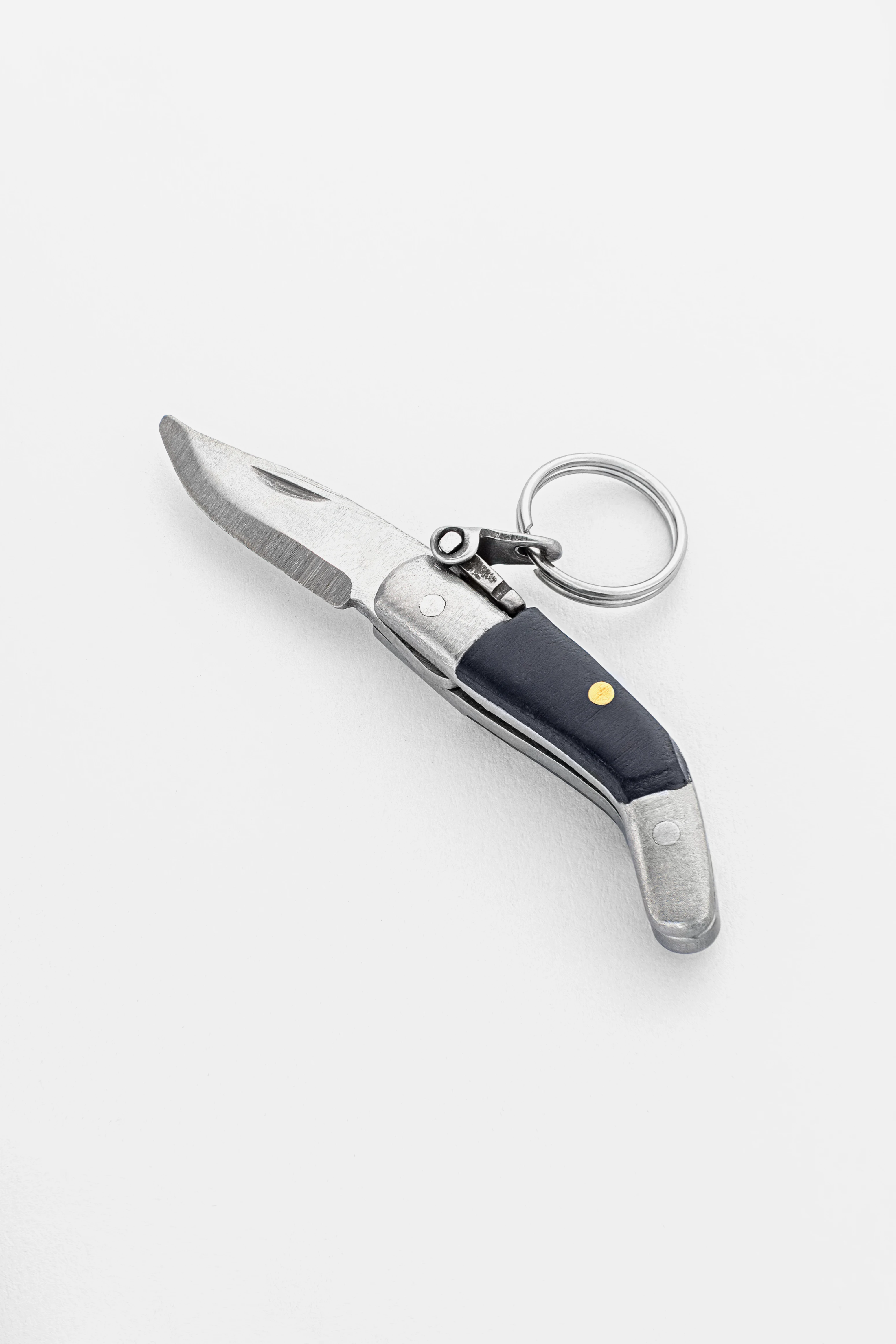
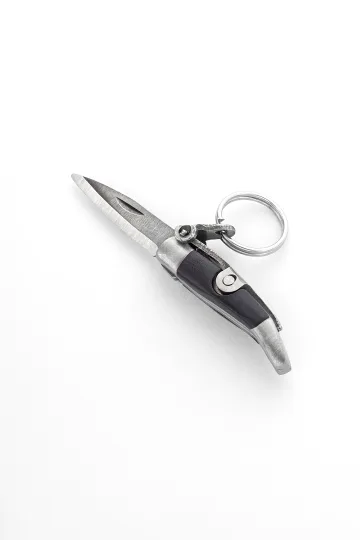
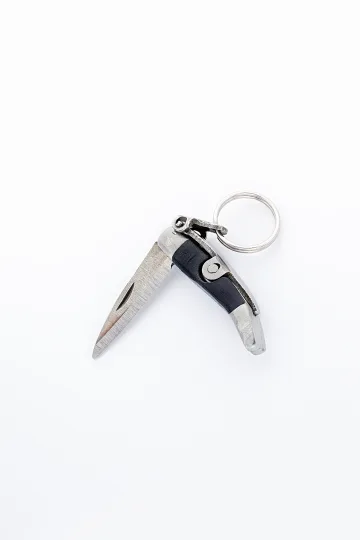
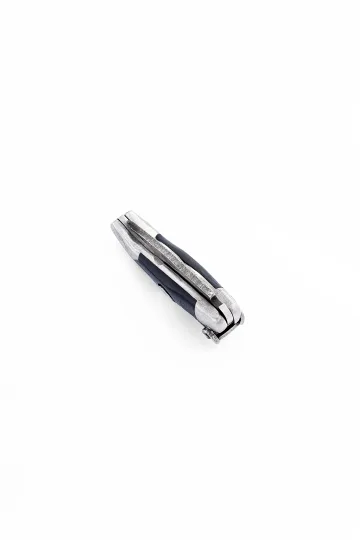
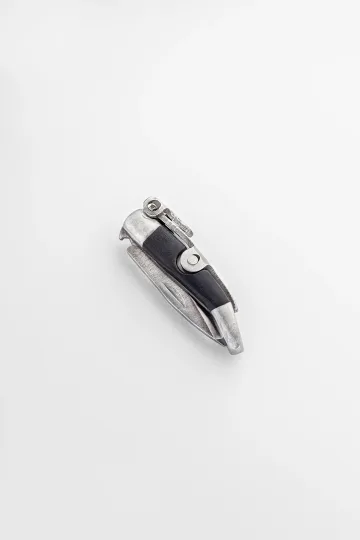
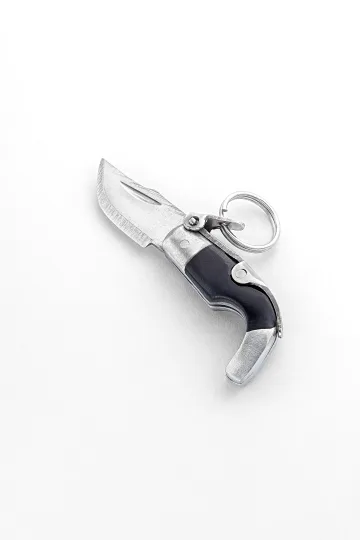
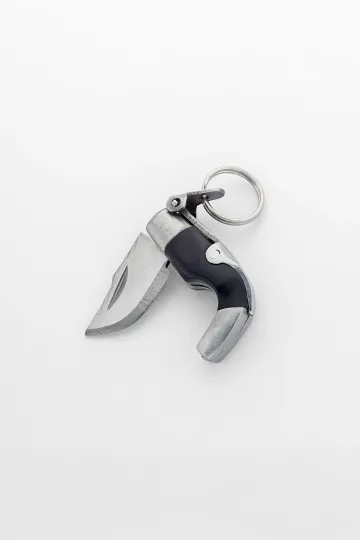
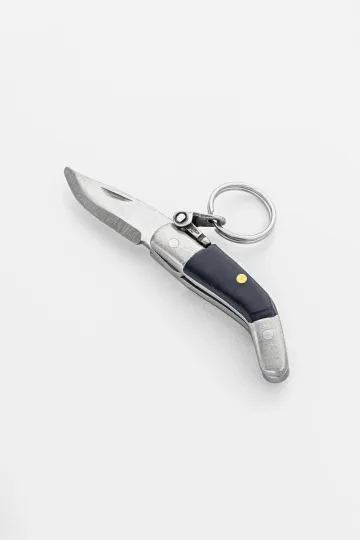
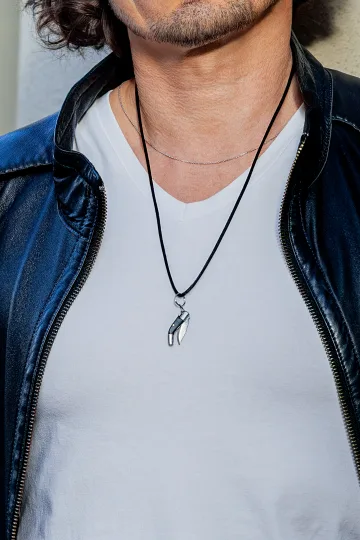
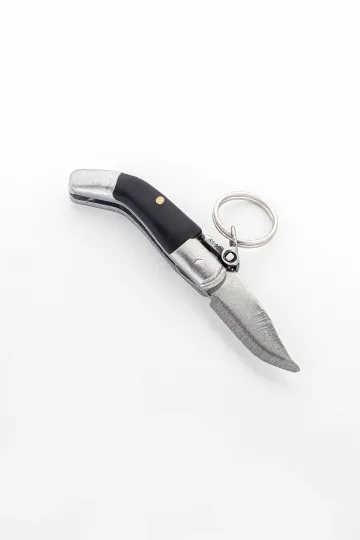
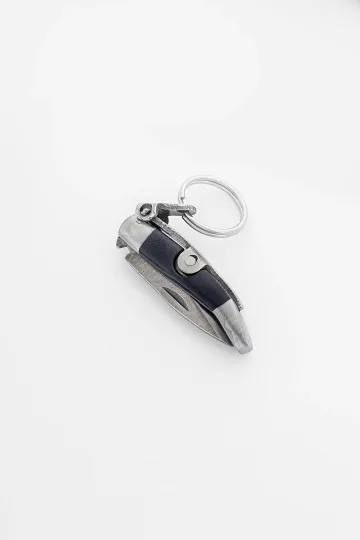
CAPAORA mini knife pendant
The 18th-century Spanish navaja in miniature: 40 mm of stainless steel, a real folding mechanism and a Palanquilla lock that clicks. An affordable gift to remember.
Authentic · Ships from Spain · 14-day returns
Types and Shades of Danburite
Although danburite is often described as colourless, it has a palette of its own. The shade depends on trace impurities and on the deposit. Perfectly pure danburite is colourless, because its composition contains no chromophores, the colouring elements. Colour appears thanks to small impurities and colour centres in the structure, and because it depends on rare factors, richly coloured stones are valued more highly.
Colourless (Clear)
The most common variety. A clean, water-clear stone, close in appearance to rock crystal or white topaz. When cut it gives a calm glow without aggressive sparkle. The default choice for anyone who wants a clear stone with a soft character.
Honey and Yellow
Pale yellow and honey tones are most often seen in Mexican crystals. The warm, sunny shade goes well with gold settings. Yellow danburite is sometimes confused with citrine or yellow topaz, but it is softer in colour and calmer in its shine.
Pink and Wine
The rarest and most coveted variety. Soft pink and pinkish-wine stones come mainly from Myanmar. In jewellery the pink reads as delicate, with no shouting brightness. Such danburite is seldom large and costs noticeably more than the colourless kind.
Bluish and Greyish
Very rarely you come across stones with a cool bluish or greyish cast. This is niche material, mainly for collectors, which almost never reaches mass-market jewellery.
The Cat's-Eye Effect
In exceptional cases, with parallel fine inclusions and a cabochon cut, danburite gives a faint cat's-eye effect, a narrow band of light across the surface. Such stones are a great rarity and interest collectors above all. Far more often danburite's value is set by clarity, colour, and size.
Leave your email, we'll send your discount code. No spam, unsubscribe anytime.
The code arrives by email, valid on your first order.
How to Tell Danburite From Similar Stones and Fakes
Danburite is a rare stone, and cheaper clear minerals or glass are sometimes sold under its name. A few simple pointers will help you avoid mistakes.
Telling It From Glass
The main physical differences between danburite and glass are weight, hardness, and the reaction to ultraviolet. Danburite is heavier than glass of the same size and noticeably harder; it does not scratch under steel, whereas glass scratches easily. Many danburites glow blue under ultraviolet, which glass does not. On top of that, glass often shows tiny round air bubbles, which never occur in a natural crystal.
Telling It From Other Minerals
Danburite is confused with topaz, rock crystal, white sapphire, and phenakite.
- Topaz is harder (8 on the Mohs scale) and has more pronounced perfect cleavage, which makes it trickier to cut.
- Rock crystal is lighter (density 2.65 against 3.0 for danburite) and more readily available.
- White sapphire is significantly harder (9 on the Mohs scale), cooler, and brighter in its shine.
- Phenakite is a beryllium silicate, harder (7.5 to 8), smaller, and even rarer; it is easy to mistake for danburite by eye.
Natural stones almost always carry small inclusions. Danburite has them less often than many minerals, but their presence tends to confirm a natural origin, unlike perfectly clear glass with its bubbles. When buying an expensive stone, especially a pink one, your safest move is to get a gemmologist's report, which identifies the mineral by refractive index and density.
What to Look At When Buying
It is convenient to judge danburite by four criteria: colour (for pink stones a rich, even tone is prized, for colourless ones full transparency without any yellow cast), clarity (the fewer inclusions and cracks, the better), cut (a symmetrical one reveals the shine, an uneven one kills it), and size (large clean stones are rare). A suspiciously low price on a large clean stone almost always means a substitute. There is no mass-market synthetic danburite: growing it in a lab for niche demand is not worth the cost, so the main risk is not synthetics but a swap with another natural mineral or with glass.
The Symbolism of Danburite: What Is Really Behind It
This calls for a clear head. Danburite is a young stone in esoterica, and the properties attributed to it are the work of recent decades, not ancient beliefs. In crystal healing it is called a stone of high vibrations and linked with calm, clarity, and the heart centre, while the pink variety is tied to themes of love and tenderness towards oneself.
Where did the phrase "stone of high vibrations" come from? In crystal-healing literature, clear, pale minerals came to be called this, set against dark grounding stones such as haematite. Danburite fitted the scheme perfectly: clear, glowing under ultraviolet, without a saturated colour. Purely visual qualities of the stone were turned into a metaphor for an inner state. As a cultural language it works: people find it convenient to talk about calm through the image of a pale, clear stone, but the mineral has no proven physical effect.
The honest position is simple: danburite does not cure illness, does not affect blood pressure, sleep, or mood at the level of physiology, and does not replace a doctor. If someone promises that a stone will heal you or is guaranteed to change your fate, that is a reason to be wary. A beautiful, rare stone with a pleasant character does not need invented miracles to deserve attention.
Jewellery With Danburite
A hardness of 7 to 7.5 makes danburite suitable for everyday jewellery, provided you treat it with reasonable care. Its clarity and soft glow let it look good in a range of settings. But because of the cleavage the stone is vulnerable to sharp, focused blows, and that dictates the choice of format and setting.
Rings
The ring is the most demanding format: hands meet knocks and friction more than anything else. For danburite a protective bezel setting suits well, where the metal wraps the stone around its edge and shields the faces from chips. Danburite opens up beautifully in a ring of sterling 925 silver, which underlines its transparency with a cool shine, while honey tones look better in a gold setting. A danburite ring is best taken off before sport, cleaning, and any work with your hands.
Pendants and Earrings
These are the safest formats for danburite: on the chest and by the face the stone is almost never knocked. So you can choose open prong settings that let light pass through the stone and show off its transparency. A clear danburite in a pendant catches the light and shimmers gently as you move, while long drop earrings give a delicate glow when you turn your head. Pink danburite in earrings adds a warm tone to the face.
Bracelets
A danburite bracelet is a pleasure as a tactile piece, but on the wrist it takes more knocks, so for faceted stones a protective setting is the better choice, and for beads a strong thread and careful wear. Strands of clear danburite beads are rare and are usually made to order from small tumbled pieces.
Setting and Cut
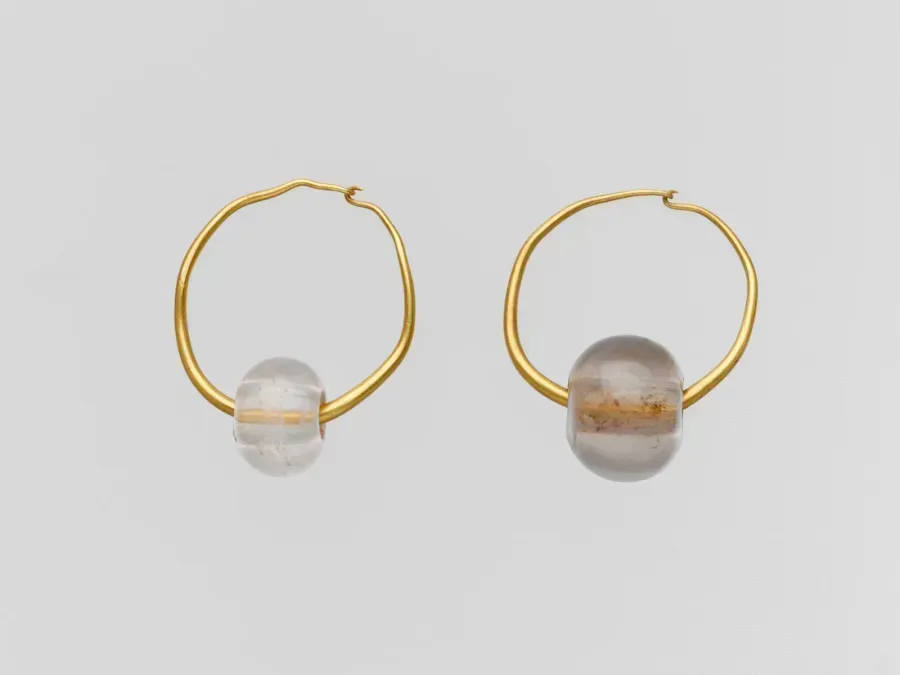
The colour of the stone suggests the choice of metal. Colourless danburite is especially striking in cool settings of silver, white gold, or platinum, which underline its watery transparency. Honey and yellow stones come alive in yellow gold, and pink danburite sits well in rose gold that echoes its tint. The main rule: the setting should serve the stone, not pull attention away from it.
Clean clear stones tend to get classic cuts: oval, pear, the emerald step cut, or round. The emerald step cut shows transparency and clarity well, while a round cut with many facets boosts the sparkle. Lesser material goes into cabochons or tumbling. If danburite is combined with other stones in one piece, it matters that the companion stones are not harder than it, or they will scratch the danburite on contact.
Caring for Danburite
Danburite is sturdy enough, but it asks for sensible handling. Its hardness protects it from everyday scratches, while the main risk is sharp blows because of the cleavage.
Cleaning
Clean danburite with warm water, a mild soap, and a soft-bristled brush, then rinse thoroughly and wipe with a soft cloth. Brief contact with water does the stone no harm. Avoid harsh household chemicals. It is best not to use ultrasonic or steam cleaning: danburite has cleavage, and sharp vibrations could in theory damage a stone with microcracks. If you send a piece out for professional cleaning, tell the jeweller it is danburite with cleavage so they pick a gentle method.
Storage
Store danburite apart from harder stones so they do not scratch its faces. A soft pouch or a separate compartment of a fabric-lined box will do. Pink stones are better kept away from long stretches of direct sun, to preserve the richness of their colour. Sharp swings in temperature are also worth avoiding.
Wearability and Habits
A hardness of 7 to 7.5 lets you wear danburite every day, but rings and bracelets should be taken off before sport, cleaning, gardening, and anything where a knock is likely. Pendants and earrings are almost trouble-free in this respect. Danburite, like most gemstones, dislikes contact with perfume, hairspray, and creams: put jewellery on last, after cosmetics and fragrance. Every few months it pays to check the settings, especially on rings: if the stone starts to sit loose, take the piece to a jeweller. For a rare danburite that is hard to replace, this kind of upkeep is especially worthwhile.
Send a friend a discount code, they save on their first order.
The Psychology of a Transparent Stone
Why are people drawn to clear pale stones like danburite in the first place? The answer lies in ordinary perception rather than in esoterica. We link transparency unconsciously with cleanliness, honesty and calm. Light passes through danburite, there is nothing in it to hide, and that openness reads as pleasant and disarming.
A Colour That Does Not Press
Colourless and honey danburite belongs to the quiet end of the palette. Unlike a vivid ruby or a saturated emerald, it makes no demand for attention and does not argue with a face or with clothing. Colour psychologists noticed long ago that muted pale tones are taken as unassuming, and that people choose them when they want a piece for themselves rather than for an effect on a room. Danburite lands squarely in that request.
A Stone for the Reserved
There is an observation that big expressive stones gravitate towards people who enjoy being seen, while quiet transparent minerals are chosen by those who value restraint. Danburite is rare and unshowy at the same time. Its charm shows at close range, under an attentive look, and that intimacy makes it a stone of private pleasure rather than a social signal. Plenty of people like it precisely because only the owner knows how rare it is.
The Pleasure of Owning Something Uncommon
A separate satisfaction in danburite is the knowledge that what you are holding is not often met with. The same psychology is at work here as in collecting: the value of a thing grows with an understanding of its rarity, even when it looks modest. Transparent danburite is easy to mistake for rock crystal, but the owner knows the difference, and that quiet knowledge adds a personal weight to the stone.
Buying it as a gift? Each one arrives ready to give.
 A branded Zevira box and a little card come with every order.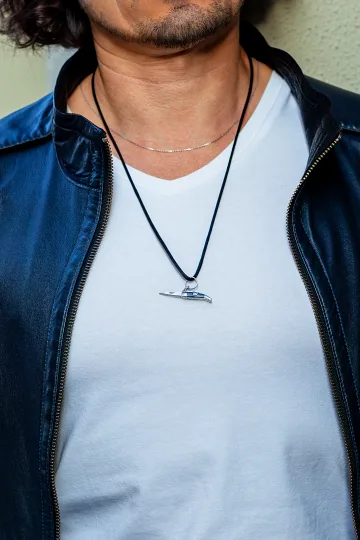






Facts About Danburite That Surprise People
A young stone with no ancient legends has gathered a surprising number of curious stories. Here are a few that make danburite more interesting than it first appears.
The Town Became Famous Through the Stone, Not the Other Way Round
Minerals are usually named after places that are already known. With danburite it went differently: the little town of Danbury in Connecticut was an unremarkable settlement, and for mineralogists across the world its name is tied first to the stone and only then to geography. The gem gave a small town a line in textbooks everywhere.
Its Home Deposit Turned Out to Be a Disappointment
The paradox of danburite is that the place of its discovery yielded close to the worst material of all. The Connecticut crystals are small and almost always cloudy. The real beauty of the stone was shown by mines thousands of kilometres away, in Japan and Mexico, opened decades later. The stone made its name in spite of its birthplace.
It Can Glow in the Dark
After danburite has been held under an ultraviolet lamp, many specimens go on smouldering faintly with a bluish light for a while in complete darkness. This is phosphorescence, the same physics as in the luminous hands of old watches. It is why danburite was once said to store up light.
A Close Relative Colours Fireworks
Boron, without which there is no danburite, is responsible for the clean green in pyrotechnics. So the same element that set hard inside a calm transparent gem flares as green sparks in the sky in another form. One element, two entirely different spectacles.
It Is Easy to Take for Topaz and Be Caught Out
Colourless danburite and white topaz are so alike that even experienced dealers of the past confused them, though the two are quite different in hardness and cleavage. There are recorded cases of danburite sold as topaz and the reverse, and only a gemmologist with instruments could untangle them.
The Pink Shade Comes From the Same Ground as Rubies
Rare pink danburite is mined in the Mogok valley in Myanmar, the same country that has been famous for centuries for rubies and sapphires. The geology that produces those celebrated red stones now and then throws in a delicate pink danburite along the way. That is why it is so scarce: it is found by accident, in passing, while people are chasing rubies.
Nobody Bothered Making a Synthetic
Many gems have long been grown in laboratories, but danburite was passed over. Demand for it is too niche to justify an expensive technology. As a result almost all danburite on the market is natural, and a fake here means a substitution with another mineral or with glass rather than a synthetic.
It Dissolves Quite Happily in Ordinary Acid
Unlike many hard-wearing gems, danburite reacts to strong acids: its calcium base does not stand up to aggressive chemistry. That is one reason danburite has no business anywhere near household cleaning products, and it doubles as a clue for identifying the stone in a laboratory.
Frequently Asked Questions About Danburite
What is danburite in plain words?
Danburite is a rare clear mineral, a calcium borosilicate, discovered in 1839 near the town of Danbury in the United States and named after it. It resembles rock crystal or white topaz, but it is rarer and can come in soft pinkish and honey tones. In hardness (7 to 7.5 on the Mohs scale) it is close to quartz, so it suits jewellery.
What colour can danburite be?
Most often colourless and clear. You also find pale yellow and honey stones, mainly from Mexico, and the rare soft pink and wine shades from Myanmar. Very rarely there are stones with a slight bluish or greyish cast. Pink danburite is the most valuable. Colour depends on trace impurities and on the deposit.
How does danburite differ from rock crystal?
Both are clear, but danburite is heavier (density around 3.0 against 2.65 for quartz), slightly harder at the top of its range, and much rarer. Rock crystal is mined all over and is inexpensive. On top of that, danburite often glows blue under ultraviolet and can come in pinkish tones, which ordinary quartz lacks.
How does danburite differ from topaz?
A colourless danburite and a white topaz look alike. The differences are in properties: topaz is harder (8 on the Mohs scale against 7 to 7.5) and has more pronounced perfect cleavage, which makes it trickier to cut. Danburite is softer in its shine and rarer. A gemmologist can tell them apart reliably by refractive index and density.
How does danburite differ from phenakite?
These are different minerals, confused because of their similar transparency and rarity. Phenakite is a beryllium silicate, very hard (about 7.5 to 8), usually smaller, more expensive, and rarer still. Danburite is a calcium borosilicate, larger, a little more available, and can come in pinkish tones. A gemmologist can tell them apart precisely by physical properties.
Can danburite be worn every day?
Yes, with reasonable care. A hardness of 7 to 7.5 lets you wear it daily, especially as a pendant or earrings. Rings and bracelets are best taken off before sport, cleaning, and work with the hands, because the stone has cleavage and a sharp blow can cause a chip. It is better to choose a protective setting where the metal shields the faces.
Where is danburite mined?
The main gem deposits are in Mexico (San Luis Potosí and Chihuahua), the source of most clear material. Rare pink danburite is mined in Myanmar, in the Mogok area. The historic source of benchmark collector crystals was Japan, the Obira mine, now closed. In smaller amounts danburite is found in Madagascar, Bolivia, Switzerland, Tanzania, and the United States.
Why does danburite glow?
Many danburites glow blue or blue-green under an ultraviolet lamp, and when the light is switched off they keep faintly smouldering for a while. This is luminescence and phosphorescence, caused by features of the crystal structure and by trace impurities. In ordinary daylight danburite does not glow. This is a useful clue when identifying the stone, because glass has no such glow.
How do you tell real danburite from glass?
Danburite is noticeably heavier than glass of the same size thanks to a density of around 3.0 g/cm³. It is harder and does not scratch under steel, whereas glass scratches easily. Many danburites glow blue under ultraviolet, which glass does not. On top of that, glass often shows round air bubbles, which never occur in a natural stone. When buying an expensive stone, the safest move is to get a gemmologist's report.
Is danburite a rare stone?
Yes. Its formation needs boron, calcium, and silicon present together under special geological conditions, and boron is itself a rare element in the earth's crust. The world has few major gem deposits, the main ones in Mexico and Myanmar. Clean large crystals of gem quality will always remain a stone for lovers of the unusual rather than a mass-market product.
Which shade of danburite is the most valuable?
The rich pink and pinkish-wine danburite from Myanmar. It is found far more rarely than colourless and honey stones and is prized for its soft, naturally gentle colour. Among colourless stones the perfectly transparent ones, without any yellow cast or inclusions, are valued higher. Value is set by a combination of colour, clarity, size, and origin.
Which danburite jewellery is best to choose?
The safest formats for the stone are pendants and earrings: they hardly meet any knocks and allow open settings that show off the transparency. Rings are lovely but call for a protective setting and careful wear. For colourless danburite, silver and white gold suit; for honey and pink shades, yellow gold that adds warmth.
Is danburite suitable for an engagement ring?
Technically yes, but with caveats. A hardness of 7 to 7.5 and the presence of cleavage make danburite more vulnerable to chips than sapphire. If you choose a protective bezel setting and treat the ring with care, taking it off under impact, danburite can last a long time. For a very active lifestyle it is better to look at harder stones.
Does danburite fade in the sun?
Colourless and honey stones are generally stable, while the rare pink ones can gradually pale under long, bright, direct sun. That is why pink danburite is best not left on a windowsill for long. For everyday wear this is no problem: ordinary exposure to light does the stone no harm.
Is there synthetic danburite?
There is no mass-market synthetic danburite: growing it in a lab for niche demand is not worth the cost. Far more often other, cheaper clear materials are sold under the danburite name: glass, ordinary quartz, or white topaz. So the main risk when buying is not synthetics but a swap with another natural mineral.
Why was danburite named after an American town?
The mineral was first described in the dolomitic rocks near the town of Danbury in Connecticut, and by the tradition of mineralogy it was named for the place of the first find. The stone turned out to be better known than the town: for geologists the world over, the name Danbury is attached first of all to this gem rather than to a point on the map.
Can danburite get wet?
Brief contact with water does danburite no harm, so washing your hands while wearing it or getting caught in the rain is nothing to worry about. Soaking the stone for long stretches is another matter, particularly in hot water or with aggressive chemicals: its calcium base has no love for acids, and sharp changes of temperature are in theory risky for a stone carrying hidden fractures.
Is danburite expensive?
Transparent and honey stones sit in the affordable to middle segment: for all the rarity of the mineral, demand for it is niche. Rare, deeply pink danburite from Myanmar costs appreciably more and belongs in the premium category among collectors. Colour, clarity, size and origin all bear on what a stone fetches, and a large clean crystal always comes dearer than a small one.
What does danburite mean as a stone?
Modern crystal literature calls danburite a stone of clarity and calm, and links the pink variety to the theme of the heart and of gentleness towards oneself. It is worth keeping in mind that this is a cultural tradition of the last few decades rather than ancient knowledge, and that the stone has no demonstrated physical effect. The honest way to value danburite is for its real rarity and its beauty.
Wear the symbol, don't just read about it. These are in stock:


About Zevira
Zevira is a jewellery brand for people who choose their jewellery with intention. We work with sterling 925 silver and natural stones, and we tell the story of every gem honestly: where it was born in the earth, what history it passed through, and what really lies behind its reputation. We do not promise miracles and we do not frighten with magic. Our job is to give you a beautiful, durable piece and clear knowledge, so the choice is yours and not one pushed by advertising. We love stones like danburite for their quiet rarity and calm character: they are for people who value substance over a loud name.
Open the Zevira jewellery catalogue