Rubellite Tourmaline: The Red Stone Long Mistaken for Ruby
When half the "rubies" turned out to be tourmaline
In the early twentieth century, one of the great European ruby collections was handed to gemmologists for verification. The result startled the curators: a sizeable share of the "rubies" were rubellite, a pink-to-red tourmaline. The stones looked equally noble, yet chemically and physically they are entirely different minerals. Before scientific gemmology existed, a red colour automatically meant "ruby," and rubellite spent centuries living under someone else's name.
Rubellite is a deeply pink or red tourmaline from the elbaite group. Manganese gives it its colour, its hardness is enough for an everyday ring, and among its unusual traits are piezo- and pyroelectricity: heat the crystal or press on it and an electric charge appears at its ends. It was on tourmaline that the Curie brothers first measured the piezoelectric effect in 1880.
Here is where we are headed: the origin of the name, the chemistry and physics, the deposits, how to tell a genuine rubellite from fakes and from similar stones, and how to care for it.
Wear the symbol, don't just read about it. These are in stock:









What rubellite is: chemistry and physics
What it is made of
Tourmaline is not a single mineral but a whole group of borosilicates with a complex composition. Rubellite belongs to the elbaite subgroup, named after the island of Elba where such tourmalines were first described. Elbaite contains lithium, aluminium, sodium and boron; its general formula is written, in simplified form, as Na(Li,Al)₃Al₆(BO₃)₃Si₆O₁₈(OH)₄.
The red and pink colour comes from manganese in the crystal lattice. It is present in two forms: divalent Mn²⁺ gives a light pink shade, while a deeper red appears when some of the manganese oxidises to Mn³⁺. Natural irradiation deep underground shifted that ratio over millions of years, which is why the richest rubellites often grew in pegmatites with natural radioactivity. For comparison, green in tourmaline comes from chromium and iron, and blue also comes from iron.
Physical properties
- Hardness: 7 to 7.5 on the Mohs scale (harder than quartz, softer than ruby and sapphire, which sit at 9)
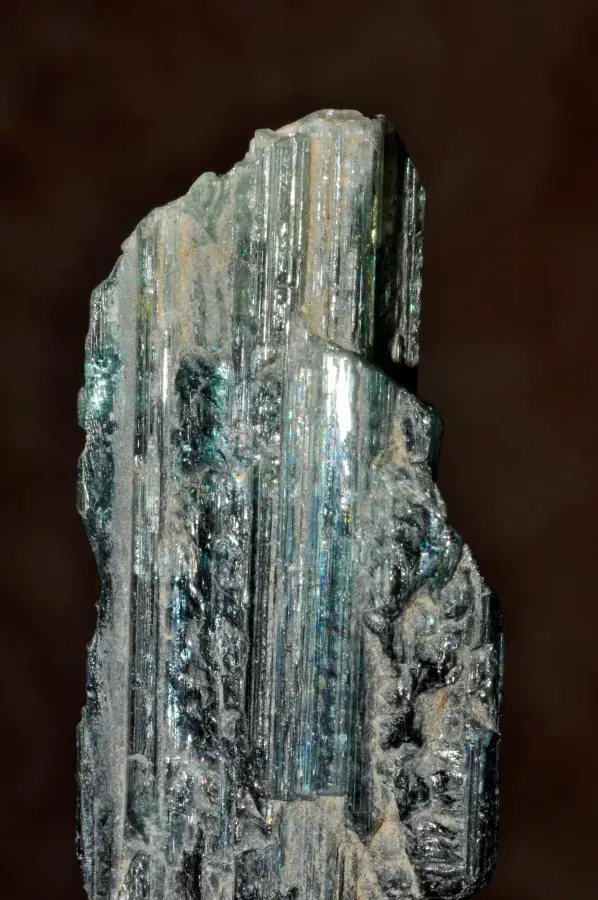
- Crystal system: trigonal; the crystals are elongated and prismatic, with the characteristic lengthwise striations on their faces
- Density: 3.0 to 3.25 g/cm³
- Refractive index: 1.614 to 1.652
- Birefringence: strong (0.036 to 0.044), the doubling of lines is visible when you look through the stone
- Pleochroism: turn the crystal and the colour shifts from lighter to darker
Those lengthwise grooves on the faces are not a flaw but a trace of the crystal's layered growth. They help identify natural tourmaline.
Piezo- and pyroelectricity
Tourmaline is one of the few minerals with pronounced piezo- and pyroelectricity. Heat it or apply mechanical pressure and a potential difference appears at the ends of the crystal, so a warmed stone begins to attract dust and ash. This is pure physics tied to an asymmetric crystal structure, not "energy." Tourmaline was precisely the material on which Pierre and Jacques Curie measured the piezoelectric effect in 1880. Later this property was put to work in pressure sensors and hydrophones, until cheaper synthetic quartz pushed it out.
A rubellite sings solo. Sit a second loud stone beside it and you get a catfight, not a look. Don't you dare.
What to wear rubellite with
Rubellite is a stone with character, and I always build the look so it plays solo rather than argues with the rest. Here is what I actually recommend to clients, occasion by occasion, once red is on the table.
What do I wear rubellite with day to day? For everyday I recommend one piece and a calm background: a white shirt, grey knitwear, jeans, a beige coat. I choose a cool metal, silver or white gold, and a stone of moderate saturation, so it reads as a precise dot of colour rather than shouting across the room. A ring or stud earrings keep the look composed.
Does rubellite suit the office? It does, as long as you keep it restrained. I pick one thing: a signet ring or studs in a slim setting, with nothing piled on. The red gives character to a strict suit and stays within a dress code. Large pendants and stacks of bracelets I save for the evening, they have no place in a meeting room.
How do I put together an evening look? Here I make the stone the main event. A deep raspberry rubellite sits sumptuously on black, on navy, on emerald velvet. For an open or V-shaped neckline I recommend a pendant that settles into the hollow and draws the eye, and for a dress on fine straps, large earrings. I leave the hands almost bare so the wrists do not compete with the ears.
Which metal do I choose for the stone? For a daytime look I suggest a cool metal, silver or white gold: they give contrast and the red rings brighter. For the evening I take a warm one, yellow or rose gold, which softens the stone and adds a classic note. A deep raspberry gains from a cool setting, a light pink from a warm one, so the same stone shifts its mood to suit the occasion.
Which clothes does rubellite befriend, and which not? I recommend cool neutrals and warm earthy tones: beige, grey, wine, chocolate. Green and bright yellow I avoid nearby so the colours do not clash. By fabric I choose matt surfaces, wool, cotton, dense silk, on which the stone reads brighter than on glossy satin. And one rule that never fails: one bold rubellite at a time, a second strong accent only gets in the way of the first.

Turn on your camera, pick earrings, a pendant or a ring, and see the piece on yourself in real time.
Switch items in one tap.
Everything runs in your browser: no photo or video is ever uploaded.
The story of the name and the stone
The first rubellites reached Europe from newly explored lands in the early sixteenth century, alongside other coloured stones. The name "tourmaline" came later, from a Sinhalese word used in Ceylon for gems of mixed colours; through the Italian "tormalina" it settled into European languages. The word "rubellite" itself derives from the Latin rubellus, meaning "reddish."
For several centuries red tourmalines were not regarded as a stone of their own and were sold as "cheap ruby" or "pink topaz." The reason was not ignorance but the absence of any diagnostic method: colour was the only criterion. Sorting minerals by composition and physical properties only arrived with the rise of mineralogy in the eighteenth and nineteenth centuries, when tourmalines began to be classified systematically by colour and the name "rubellite" appeared for the dark-pink and red varieties.
In nineteenth-century Britain, Cornish miners turned up red tourmaline alongside the tin and china clay, and the stones reached the cabinets of London collectors and the workbenches of provincial jewellers. Today those Cornish workings are all but exhausted, and material from them is prized by collectors for its rarity and provenance.
Customer reviews
Zevira is a real jewellery shop. Genuine payments, deliveries and customer thank-yous.
🥰🥰🥰 gracias
Ok, ¡gracias! 🙂
Rubellite in royal regalia: the great "rubies" that were not
The loudest chapter in the history of rubellite belongs neither to a mine nor to a laboratory but to the treasuries of monarchs. For centuries the large red stones in crowns and sceptres were counted as rubies, and only the gemmology of the nineteenth and twentieth centuries revealed that a considerable share of them were spinel or rubellite instead. Red dazzled the valuers, and the instruments needed to tell one mineral from another simply did not exist yet.
The "Caesar's Ruby": a diplomatic gift that turned out to be tourmaline
One of the famous historic stones entered common usage under the nickname Caesar's Ruby, although it has no connection either to Caesar or to ruby. It is a large red gem cut in the form of a bunch of grapes, and it travelled between European courts as a diplomatic gift: it is linked with Queen Christina of Sweden, then with Czech and Prussian owners, and in the middle of the eighteenth century it reached Russia as a present to the empress. For a long time it was recorded as a ruby of exceptional size. When the stone was finally examined with instruments, what the valuers had in front of them proved to be red tourmaline, which is to say rubellite. The cut itself had been hinting at the answer all along: a ruby of that size and clarity would be a fabulous rarity, whereas a large clear rubellite is entirely plausible.
The "Gustav III Ruby" and the Swedish trail
The same stone is associated with King Gustav III of Sweden, who by tradition presented the "ruby" to the Russian court during a visit at the end of the eighteenth century. Hence the stone's second name. Historians argue over the details of the handover, but the point that matters here lies elsewhere: even at the level of crowned heads and their jewellers, a large rubellite was confidently passed off as a ruby, and nobody suspected a substitution, because there was no substitution to suspect. It was the honest self-deception of an entire era.
Why crowns are full of false rubies
The cause was systemic. Before the refractometer and the spectroscope, a mineral was identified by eye: by colour, by lustre, and by a scratch test for hardness. Red plus hardness plus transparency delivered the verdict "ruby". Spinel, garnet, and rubellite all passed that filter without difficulty. That is why later examinations of historic regalia in one country after another turned up both spinel and tourmaline recorded under the name of ruby. For rubellite the result is a curious paradox: its history is grander than its reputation. A stone that spent centuries in crowns under someone else's name is still filed in the popular mind as an inexpensive substitute for ruby.
Ural and Victorian: two waves of fashion for red tourmaline
Two separate episodes gave rubellite its reputation among nineteenth-century jewellers. The first came from the Urals, where mines in the middle of the range began yielding deep crimson tourmalines in the late eighteenth century, bought readily for rings, brooches, and settings and often paired with garnet and amethyst from the same workings. The Ural stone was valued for a dense, faintly violet red that warmed and deepened under candlelight. Those deposits are now largely worked out, and old Ural material with a clear provenance is worth more to a collector than modern Brazilian stone of the same size.
The second wave was British. Victorian jewellers, working through a period of intense enthusiasm for coloured stones and for anything the new mineralogy could name precisely, set red and pink tourmaline into brooches, pendants, and half-hoop rings in considerable quantity. Fresh supplies from Brazil and from the American deposits arrived at exactly the moment when the trade had finally accepted tourmaline as a species of its own, and rubellite began appearing in London catalogues under its own name rather than borrowing someone else's. Pieces from that period turn up regularly at British auctions, and they are one of the more sensible ways to buy an old stone with a documented setting.
Upload a photo of your pet, someone you love, or an object. We'll build a 3D model and hand-cast it in pewter.



The science of the colour: manganese, pleochroism, and why the red is stable
The colour of rubellite is neither a pigment nor a coating but a property of the lattice itself. Understanding the mechanism explains at once why some stones are a washed-out pink and others nearly scarlet, and why a red rubellite holds its colour for decades in places where amethyst fades in sunlight.
Where the red comes from: manganese in two states
The colour is created by manganese sitting in the crystal in place of aluminium. In its divalent form (Mn²⁺) it produces only a pale, almost flesh-toned pink. The deep red appears when part of the manganese shifts into the trivalent state (Mn³⁺) and pairs of ions form between which charge can hop. This charge transfer absorbs the green and yellow part of the spectrum, and what reaches the eye is a saturated pink-red. The greater the proportion of oxidised manganese, the denser the colour. In nature the oxidation happened over millions of years under the weak radioactivity of the surrounding rock, which is why the reddest rubellites often grew in pegmatites with a natural background level.
Pleochroism: one crystal, two colours
Rubellite is dichroic, meaning it shows a different colour along different directions. Along the main axis of the crystal it is darker and more saturated, sometimes drifting into a near black-red; across the axis it is lighter and more transparent. This follows directly from the way light in an anisotropic crystal splits into two rays that are absorbed differently. In practice pleochroism decides how a cutter orients the rough and therefore what the buyer eventually sees. The same effect is useful diagnostically: ruby and spinel do not shift their tone like that when turned.
Why a stable red costs more
Many red tourmalines go dull under artificial light and turn brownish or nearly black. A stone that reads as clean red both in daylight and under a lamp is rarer and priced accordingly. The reason lies in the trace elements: surplus iron muddies the colour and deepens the darkening under warm light. Checking a stone under two light sources is therefore not fussiness but the single most important quality test for rubellite, and it is worth doing by a window and again under a household bulb before committing.
Why rubellite almost always has inclusions
Rubellite grows with a great deal of internal strain and a network of fine channels, so large flawless stones are considerably rarer in this species than in, say, amethyst. Thin threads, gas and liquid inclusions, and growth planes are commonly visible inside. Gemmologists take this calmly: a moderate amount of internal life is normal in rubellite, whereas glassy perfection in a large stone is more of a reason to suspect glass or synthetic material than a sign of quality.
How it forms and where it is mined
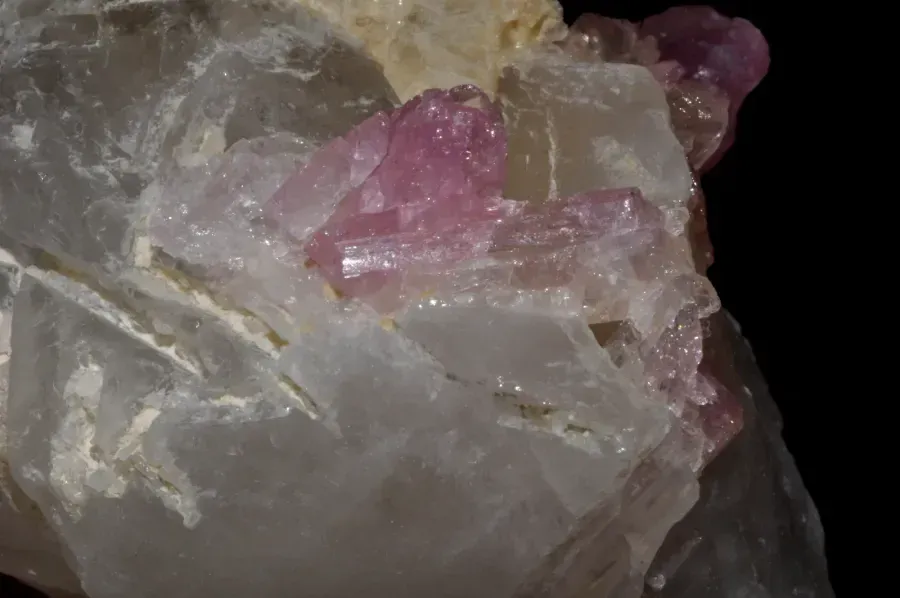
Rubellite crystallises in pegmatite veins, coarse-grained igneous rocks that cool slowly far underground. The stone grows in cracks and cavities together with quartz, feldspar and mica. The key condition for the red colour is the presence of manganese in the melt: the more there is, the richer the shade.
Brazil (Minas Gerais) remains the world's main source of high-quality rubellite. The stones mined here show a deep raspberry colour with good transparency. Large, clean crystals over 10 carats are rare. The finest Brazilian rubellites look almost black-red in daylight and flare a vivid red under artificial light.
Madagascar yields larger crystals, often polychrome: pink shading into green or blue within a single stone. That is a record of how the melt's composition changed as the crystal grew. Madagascan rubellite is on average lighter than Brazilian, but more interesting for its multiple colours.
Afghanistan and Pakistan produce elongated prismatic crystals of intense colour, usually small (1 to 3 carats). They are valued for their natural form.
Kenya and Tanzania give bright, clean rubellites of a deep raspberry colour, sometimes with a violet undertone. African production is rising thanks to new deposits.
Cornwall and the Urals are historic sources that are now barely worked at all. Specimens from them are of interest mainly to collectors.



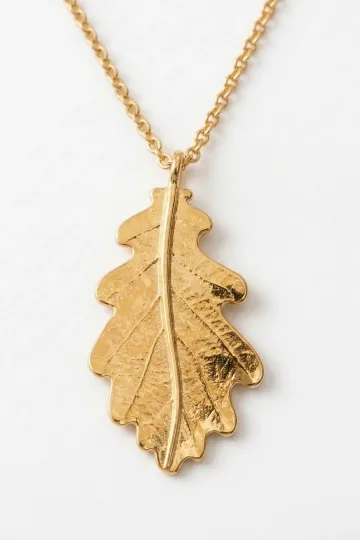
Varieties of pink and red tourmaline
The line between "pink tourmaline" and "rubellite" is not strict in gemmology, and different sellers draw it differently. A useful guide by colour intensity runs like this:
- Light pink tourmaline (rosalite): the gentlest and most affordable, ranging from rose petal to peach. Often with visible inclusions. Suited to everyday jewellery.
- Medium pink-red tourmaline: a clear pink with a reddish undertone, a good balance of price and saturation. The most popular category.
- Deep rubellite: an intense, almost red colour that holds up in daylight and darkens under artificial light. Clean stones over 5 carats are rare and command a high price.
- Polychrome ("watermelon") tourmaline: several colours in a single crystal, pink with green, more rarely all three. Prized for its natural zoning.
Colour zoning is not a flaw
When one end of a crystal is pink and the other green or colourless, that is natural growth zoning. The composition of the melt shifted over time, and each layer recorded the conditions of its surroundings, like the growth rings of a tree. Zoning confirms a stone is natural (synthetics are usually made uniform) and lowers the price only when it creates cloudy, muddy patches. A clean, smooth transition, by contrast, is prized by collectors.
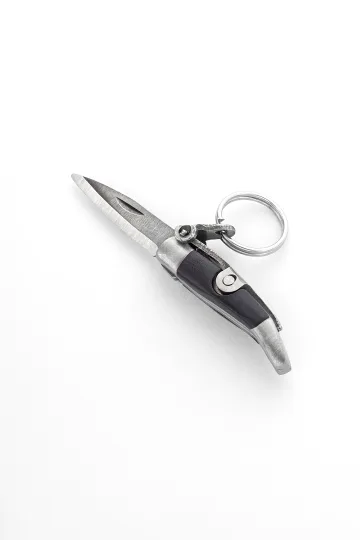
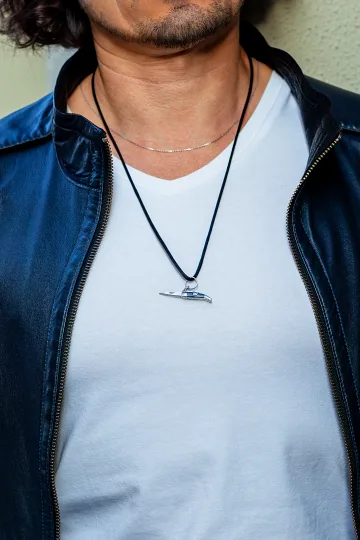
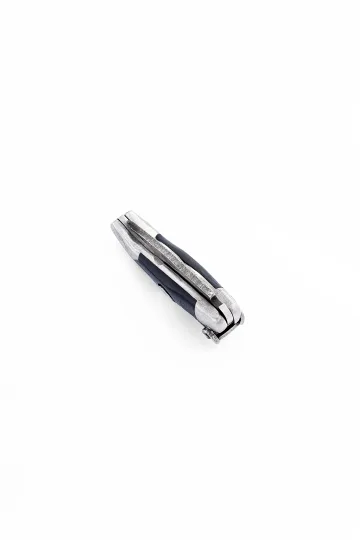
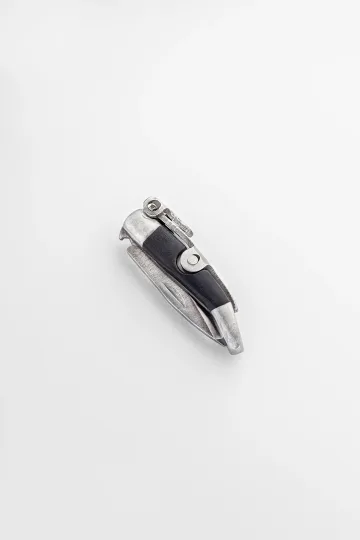
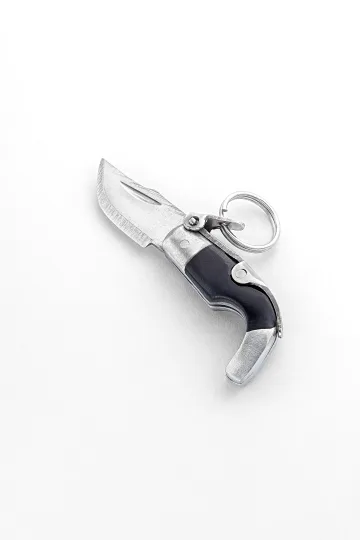
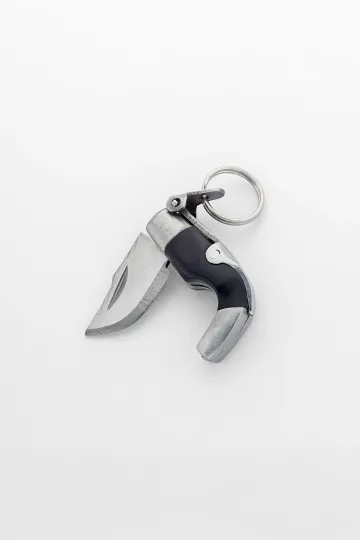
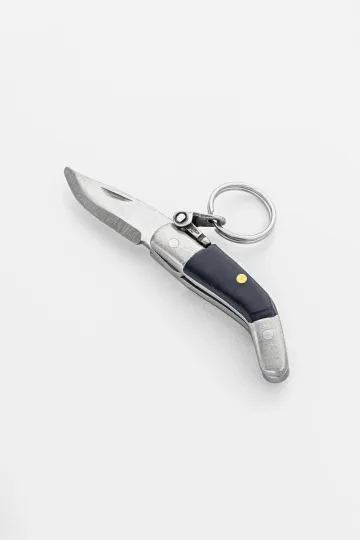
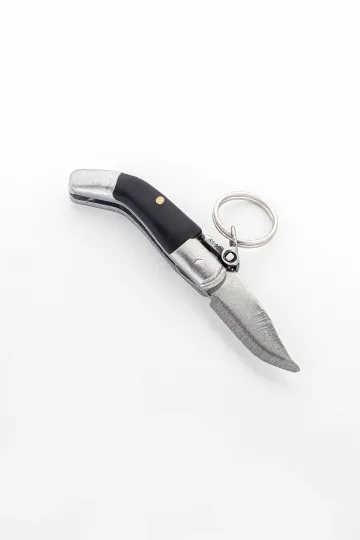
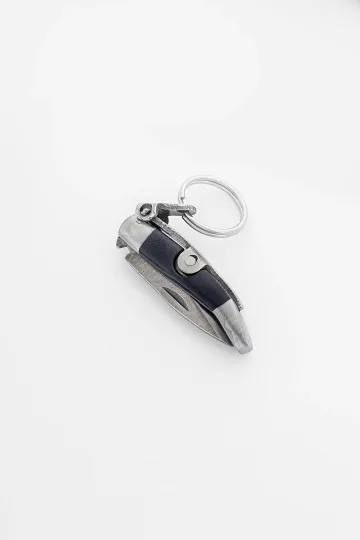
CAPAORA mini knife pendant
The 18th-century Spanish navaja in miniature: 40 mm of stainless steel, a real folding mechanism and a Palanquilla lock that clicks. An affordable gift to remember.
Authentic · Ships from Spain · 14-day returns
How to choose rubellite by quality
Quality is judged on four criteria: colour, clarity, cut and weight. Weight is the least important of them.
Colour. The ideal rubellite is richly red or dark pink, neither fading by day nor turning into impenetrable blackness under artificial light. The test is simple: look at the stone in daylight and under a lamp. By day it should read clearly red; under artificial light it may darken, but light should still pass through it. A stone that is too pale is a rosalite, not a rubellite.
Clarity. Natural rubellite often has small inclusions. Growth lines and bands, needles of other minerals, all of that is normal and sometimes even decorative. Cloudiness and hazy zones, on the other hand, reduce value. The rule: if an inclusion is visible to the naked eye, it is either low quality or grounds for caution. In a fine stone, inclusions are seen only under a loupe.
Cut brings out colour and brilliance. A good cut returns light to the eye and brings the stone to life; a poor one leaves it dull. The shape is chosen to suit the goal: cushion and oval forgive small inclusions and hold colour well, the step (emerald) cut shows the depth of the shade, the brilliant cut delivers maximum sparkle, and a cabochon gives the densest, most velvety colour with no play of light. For a very dark stone, a cut that adds light is used; for a pale one, a step cut deepens the shade.
Weight. Price rises non-linearly: double the linear size and the weight grows about eightfold, so large stones become expensive fast. Stones under 1 carat are hard to resell, 1 to 3 carats is a comfortable everyday size, 3 to 5 carats is already a noticeable piece, and anything over 10 carats is a rarity of museum standard.
Why the same crystal can be vivid one moment and almost black the next
Rubellite has strong pleochroism, oriented along the main axis of the crystal (that same long prism with the striations). Look through the stone along that axis and the colour is deep, saturated, sometimes almost impenetrably dark; look across it and it is lighter and more transparent. This affects how the cutter saws the crystal, and it bears directly on the price.
From a long dark rubellite, the stone is usually oriented so the table faces across the axis, keeping it from sinking into blackness. From a pale one, the opposite: it is cut along the axis to gain colour density. The practical takeaway for a buyer: elongated rubellite stones (baguette, emerald cut, marquise) are often produced for an orientation that flatters the colour, not simply for the shape. And if a stone looks dead-black in room light, the cause is often not the quality of the rough but an unlucky orientation in the cut.
How to tell rubellite from fakes
Dyed or irradiated tourmaline. Light tourmaline is sometimes tinted, and the dye washes out over time. Genuine rubellite does not lose its colour. Under a loupe a dyed stone shows "dirty" zones where the colorant has gathered in cracks.
Rose quartz is noticeably cheaper and often cloudy, dulling with time. Rubellite stays bright and transparent for years.
Coloured glass is almost half the weight of tourmaline and contains round air bubbles instead of crystalline inclusions. Glass has neither birefringence nor pleochroism.
Synthetic tourmaline does not differ from natural in composition or properties, but it looks "too perfect": even colour, no natural inclusions. It is no worse in itself; the problem arises only when synthetic material is sold as a natural stone.
A few tests that work:
- Birefringence. Look through a transparent stone at a fine line or some text: tourmaline doubles it. Glass and most imitations do not.
- Pleochroism. Turn the stone in the light: the shade should shift from light to dark.
- Density. Tourmaline is noticeably heavier than glass of the same size (3.0 to 3.25 g/cm³).
- Certificate. For an expensive stone, get a report from a respected laboratory (GIA, SSEF, Gübelin and the like). It usually states "natural colour" / "no treatment."
Honestly about treatment: the main one is not dye but fracture filling
Unlike many coloured stones, rubellite is rarely heated or irradiated: its manganese red dulls when heated, and irradiation more often spoils the colour than improves it. What rubellite does have is its own characteristic treatment that sellers mention reluctantly, namely fracture filling.
Rubellite grows with a great deal of internal stress, so cracks and cavities occur in it more often than in most gems of the same class. To hide these flaws and raise transparency, surface cracks are impregnated with a colourless resin, more rarely a glass-like compound. The stone starts to look cleaner, but the treatment is unstable: the resin yellows over time, cracks, and can wash out under ultrasound or solvent, so the fracture reappears.
How to spot it. Under a loupe in raking light, a filled crack gives a characteristic flat sheen, sometimes with rainbow swirls, like a thin film of petrol on water. That is a reliable sign that something has been poured into the crack. This is why an expensive stone should come with a certificate noting the absence of treatment, and why ultrasonic cleaning of rubellite without documentation is best avoided altogether.
Price tiers
Without exact figures, in order of magnitude:
- Entry level: light pink tourmaline of 1 to 2 carats, standard cut, possible visible inclusions. For trying the stone out in daily wear.
- Mid-range: pink-red tourmaline of 2 to 5 carats, good clarity, professional cut. A versatile everyday choice.
- Premium: deep rubellite of 5 to 10 carats, high clarity, fine jewellery cut, with a certificate. For a special piece.
- Collector: a large stone over 10 carats with provenance documentation and a rare source.
Leave your email, we'll send your discount code. No spam, unsubscribe anytime.
The code arrives by email, valid on your first order.
Jewellery with rubellite
Rubellite sits happily in any metal, and the choice of setting changes the stone's character. White gold and platinum give a cool, neutral background against which the red reads bright and high in contrast. Yellow gold adds warmth and a classic feel. Rose gold rhymes beautifully with the pink tones. Sterling silver is an affordable all-rounder, its only drawback being a tendency to tarnish. For a deep raspberry stone, white gold or platinum wins out for the contrast; for a pale one, yellow or rose gold harmonises better.
A ring is the most "working" format: a hardness of 7 to 7.5 is enough for daily wear, but the facets fear knocks and chips. If you work with your hands in rough conditions, it is better to wear rubellite as a pendant or earrings and choose sapphire for a ring you never take off.
A bracelet is noticeable on the wrist: beads are practical for everyday wear, while a single large stone at the centre suits special occasions.
A pendant shows the colour well against plain clothing; an uncut crystal in a simple setting looks like a natural object.
Earrings with rubellite bring a touch of colour near the face; for a daytime look, choose a stone of moderate intensity.
Caring for rubellite
Rubellite is hard enough and stable enough in colour that caring for it is straightforward.
Cleaning. The safest method is a soft brush and warm soapy water. Lower the piece into warm (not hot) water with a drop of mild soap for a few minutes, go over the stone and setting with a soft brush, rinse and dry with a microfibre cloth. For a piece worn daily, once a week is enough.
Use an ultrasonic bath only if you are sure of the stone: with micro-cracks or treated stones, ultrasound is dangerous. Steam cleaning is best left to a jeweller.
What to avoid: hard brushes and abrasive pastes (they scratch the polish), aggressive chemistry (bleach, vinegar, lemon juice and alcohol damage the setting), sharp temperature changes and knocks.
Storage. Keep rubellite separate from other jewellery in a soft pouch: it is harder than many stones and scratches them easily, while it itself can suffer from metal and sharp edges. The ideal conditions are room temperature without sharp swings, humidity of 30 to 50%, away from direct sun (over the years a very saturated stone can lighten slightly). Silica gel in the box will protect a silver setting from tarnishing.
By climate. In winter, during the dry heating season, clean more often and do not wash your hands in hot water straight in from the cold. In summer, rinse the stone in fresh water after the beach and the pool: sunscreen forms a film, and salt and chlorine are bad for silver. In a humid climate, wipe the setting more often with a silver cloth. The stone itself does not fear water or moisture, unlike porous turquoise or pearl.
If the stone falls out of its setting, do not glue it back yourself: put it in a pouch and take it to a jeweller, as the cause is most often loosened claws on the mount. Once a year, show pieces with valuable stones to a master for a check-up.
Rubellite and similar red stones
When you are choosing a red or pink stone, it is easy to get muddled: ruby, garnet, spinel, rose quartz, pink sapphire and morganite all occupy nearby shades. The table below compares them on the criteria that matter for an everyday piece.
Rubellite occupies a convenient middle ground: it is brighter and more durable than rose quartz, noticeably cheaper than ruby and pink sapphire, and hard enough for daily wear. If you want a saturated red without the premium price of corundum, rubellite is almost always a sensible choice. If you need maximum toughness for a ring you never take off, look towards sapphire.
Garnet is often confused with rubellite, but garnet is usually darker, with brown or violet notes, and shows no pleochroism. Red spinel is harder (8 against 7 to 7.5), sparkles more brightly, and gives neither pleochroism nor the doubling of lines you see through tourmaline. Morganite is a pink beryl, gentler and cooler, without rubellite's raspberry depth. A simple rule of thumb: if a stone changes shade as you turn it and doubles lines when you look through it, you are holding tourmaline, not ruby or spinel.
Rubellite combines well in jewellery with other tourmalines. Green verdelite gives a contrast of pink and green, black tourmaline (schorl) gives a graphic frame for the red, and blue indicolite gives a cool accent. Polychrome tourmalines with several colours in one crystal need no companions at all.
The symbolism of rubellite: what it was credited with, and what lies behind that
Symbolism is worth approaching soberly. Rubellite is beautiful and historically rich, and that is enough on its own; it has no healing or energetic powers. The traditions that have grown up around it are nonetheless interesting as a piece of cultural history, provided they are read as culture rather than as medicine.
The colour of the heart
In a great many cultures red is the colour of blood, of life, and of love, so deeply red stones have almost everywhere been tied to the heart, to being in love, and to vitality. Rubellite, as the affordable sibling of ruby, slipped naturally into the same symbolic slot and was given as a token of warm feeling. This is a cultural association attached to a colour rather than a property of the mineral, but it does explain why red stones turn up so often in betrothal and memorial jewellery, including a good deal of the Victorian sentimental work that still circulates in Britain today.
The stone of artists and speakers
Parts of the esoteric literature credit rubellite with a connection to creative courage and eloquence, claiming it loosens the tongue and helps with public speaking. There is no evidence for any of this. The root of the belief probably lies in the colour itself: bright red is perceived psychologically as energetic and conspicuous, and someone wearing a piece in that colour tends to feel bolder. The effect is real enough, but it belongs to self-perception and to dress, not to the mineral.
Why the symbolism of rubellite is so vague
Many famous stones carry a settled passport of meanings accumulated over centuries under their own name. Rubellite has almost none, and the reason is historical: it lived too long under someone else's name. All the symbolism that red accumulated went to ruby, while tourmaline was recognised as a species in its own right only in the nineteenth century, by which point the age of talismans was already fading. Modern meanings assigned to rubellite are therefore mostly young and borrowed, and they are best treated as an attractive later addition rather than an ancient tradition.
Send a friend a discount code, they save on their first order.
Facts about rubellite that take people by surprise
Piezoelectricity was discovered on tourmaline
The effect that underpins quartz watches, gas lighters, and ultrasound probes was first measured by the physicists Pierre and Jacques Curie in 1880, and they measured it on tourmaline. Squeeze the crystal and a charge appears on its faces. Rubellite therefore has a legitimate place both in a display case and in a physics textbook, which is more than most gemstones can claim.
A warmed stone collects dust
Because of pyroelectricity, a heated tourmaline attracts specks of dust and ash to the ends of the crystal. Dutch merchants bringing stones back from Ceylon called tourmaline the ash-puller, because they used it to clean out their pipes. This is the same physics of an asymmetric lattice that produces the piezoelectric effect, with nothing mystical involved.
One crystal can be two or three colours at once
Polychrome tourmalines change colour along the length of the crystal: pink passes into green, sometimes with a colourless zone between them. A slice cut across such a crystal with a red core and a green rim is known as watermelon tourmaline. This is not a fault but a record of how the composition of the melt shifted over the time the crystal was growing.
Tourmaline served at sea
Thanks to its piezoelectric behaviour, tourmaline plates were used in pressure sensors and in underwater hydrophones, including instruments for measuring shock waves. Cheap synthetic quartz eventually displaced it, but the episode is real, and it has nothing to do with energy in the crystal-shop sense. It is straightforward engineering.
The red survives where other colours fade
Amethyst and rose quartz both pale over time in strong sunlight. The manganese red of rubellite is stable: nineteenth-century stones in museum cases glow exactly as they did on the day they were cut. The stone can be worn in the sun with no fear of fading, which is not something that can be said of every coloured gem in a summer wardrobe.
The reddest stones grew under radiation
The deep red is tied to natural oxidation of manganese, assisted over millions of years by the weak radioactivity of the surrounding rock. The finest rubellites have, in a manner of speaking, been irradiated by geology itself. They have long since been perfectly safe and are not radioactive in any measurable sense.
The crowns of Europe wore rubellite under the name of ruby
More than one famous "ruby" in historic regalia turned out on examination to be tourmaline or spinel. Rubellite decorated the courts of monarchs long before it had a name of its own, and the paradox of the stone is that its grandest history was lived entirely under a borrowed identity.
Buying it as a gift? Each one arrives ready to give.
 A branded Zevira box and a little card come with every order.
Myths and facts about rubellite
A good deal of confusion has gathered around rubellite: some of it came from esoteric circles, some from unscrupulous trade, some from a lack of geological knowledge. Let us sort it out honestly.
The main conclusion is simple: rubellite does not cure illnesses, does not attract money and does not "activate" anything in a person. There is no evidence for any of that. It is a beautiful, hard, historically rich mineral with real physical properties: piezoelectricity, pyroelectricity, pleochroism, stable colour. That is enough to make it valuable. The military episode in its history (tourmaline in the pressure sensors and hydrophones of the First World War) is sometimes presented as "proof of energetic power," but piezoelectricity is physics, not mysticism.
Frequently asked questions about rubellite
How does rubellite differ from pink tourmaline? It is one mineral; the difference is only in colour intensity. Rubellite is a saturated red or dark pink, while pink tourmaline (rosalite) is light and gentle. There is no strict boundary in gemmology, so when buying, ask the seller directly how they rate the colour and look at the stone under different lighting.
Is rubellite more expensive than ruby? On the whole, ruby is dearer: it is harder (9 on Mohs) and more durable. But the range is enormous, and a fine natural rubellite can cost more than a mediocre ruby. If you want a bright red stone without the premium price of corundum, rubellite is a good choice.
Can you wear rubellite in a ring every day? Yes, a hardness of 7 to 7.5 is enough for that. But it is softer than sapphire and diamond and fears chips on the facets. For intensive manual work, sapphire is better; for office wear, rubellite will last for years.
Are rubellites irradiated? Irradiating rubellite is unusual: it generally spoils the colour rather than improving it, so it makes no economic sense. The documentation for a stone most often reads "natural colour." Buy stones with a certificate.
Does synthetic rubellite exist? Yes. In composition and properties it does not differ from natural and is often cheaper. It is no worse in itself; what matters is that the seller honestly calls it synthetic and prices it accordingly.
Can rubellite fade? The colour of rubellite, given by manganese ions, is stable. The stone does not fade in the sun the way amethyst does, and nineteenth-century rubellites in museums look as bright as they did when first cut. Over time only the surface dulls from grime, and that comes off with cleaning.
Does cat's-eye rubellite exist? Yes, rarely. Many fine parallel inclusions reflect light in a narrow glowing band. Such a stone is cut as a cabochon and valued more highly for its rarity, a case where inclusions become a virtue.
Is it worth buying rubellite online? Red is hard to convey accurately in a photo: screens and lighting distort the shade. If you can, look at the stone in person under both daylight and artificial light. When buying online, ask for several photos under different lighting, a video with the stone turning (to see the pleochroism), exact specifications, a certificate and a clear returns policy.
What should I do if my rubellite falls out of its setting? Do not glue it back yourself. Put the stone in a soft pouch and take it to a jeweller, as the claws on the mount have most likely loosened. The job is inexpensive. Once a year, show valuable pieces to a master for a check-up.
Can you sleep in rubellite jewellery? The stone will survive the night, but the piece can catch on bedding or hair, the claws of the setting can bend and a facet can chip. It is more sensible to take jewellery off for the night.
How does rubellite react to perfume and cosmetics? The stone itself is chemically resistant, but perfume, creams and hairspray form a film that dulls the sparkle, while alcohol and oils act on the setting over time. Put jewellery on last, after make-up and perfume, and wash it once a week in soapy water.
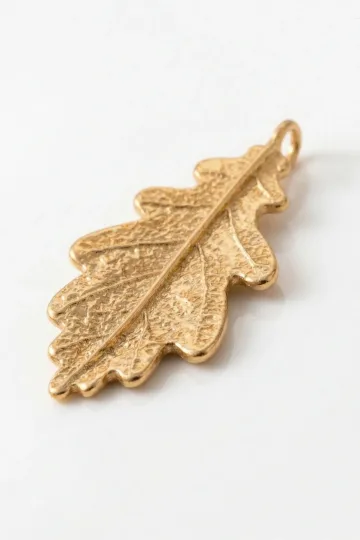
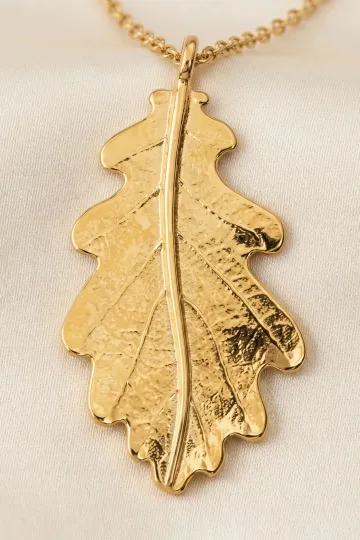
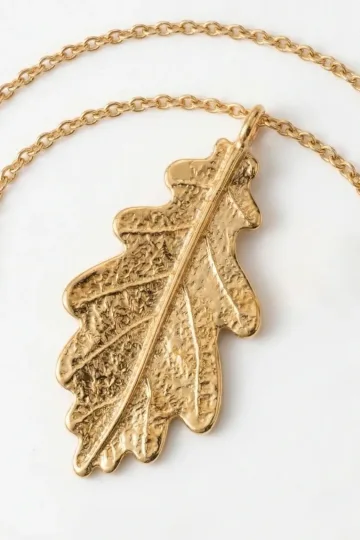
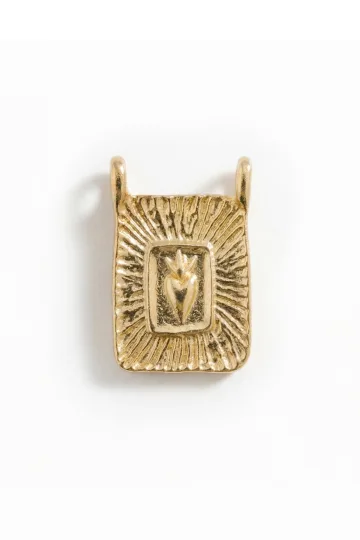
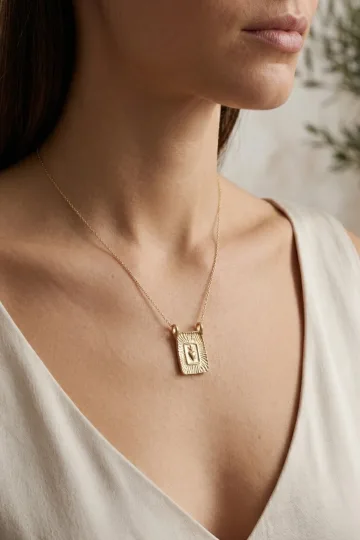
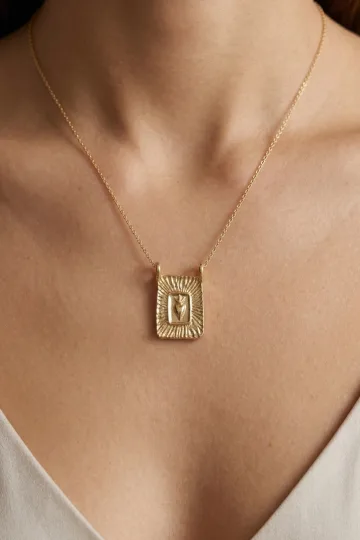
Wear the symbol, don't just read about it. These are in stock:



About Zevira
In the Zevira collection, rubellite appears in various formats, from classic rings to pendants with natural crystals. We choose stones from the finest deposits of Brazil and Madagascar, work with natural rubellites and make settings that last for decades rather than seasons.
When choosing, we look at what genuinely defines quality: the saturation and stability of the colour, the clarity, and a cut that reveals the stone rather than masking its weaknesses. Expensive stones come with documentation.
Rubellite is that rare case where a beautiful red stone does not demand the premium price of corundum, holds its colour for decades and is still hard enough for daily wear. If you want a saturated red you can pass on to your children without losing the shade, it is a sensible choice.
Find your rubellite at Zevira
Browse the collection of jewellery with rubellite and other tourmalines in the Zevira catalogue: rings, pendants and earrings in silver and gold.