Tourmaline in Every Colour: From Pink to Black, the Real Differences and How to Wear Them
Tourmaline is the only gemstone that gives off a faint electric charge when you squeeze it between your fingers. That is not folklore but a measurable fact: in the 1880s the Curie brothers used it to study piezoelectricity. Stranger still, a single mineral can show almost any colour, from clear pink to coal black, and within one crystal those colours sometimes sit side by side in bands.
For centuries people mistook tourmalines for other stones. Pink ones were sold as rubies, blue ones as sapphires, green ones as emeralds. The confusion only cleared up in the eighteenth and nineteenth centuries, when mineralogists realised these were not separate gems at all but one large family sharing a common crystal lattice with a changeable composition. Below we look at the chemistry and geology of tourmaline, what sets its varieties apart, how to tell a real stone from a fake, and how to actually wear the thing.
What Tourmaline Is: The Chemistry and Physics of the Stone
Tourmaline is not a single mineral but a whole group of complex borosilicates that share a common crystal structure. What unites them is a framework of boron, silicon and oxygen; what divides them is which metals slot into the lattice. That set of metals is exactly what decides the colour.
Composition and formula
The generalised formula looks unwieldy: XY₃Z₆(T₆O₁₈)(BO₃)₃V₃W. Behind the letters sit positions in the crystal that different elements can occupy:
- X: a large cation (sodium, calcium, potassium, or a vacancy).
- Y and Z: metals such as iron, magnesium, lithium, aluminium, chromium, vanadium, manganese.
- T: mostly silicon.
- B: boron, the element no tourmaline can do without.
- V and W: hydroxyl groups, fluorine or oxygen.
The point here is not the formula but the idea: tourmaline is a natural construction kit. Drop iron into the Y position and you get a black or blue stone. Add lithium and manganese and pink appears. Chromium and vanadium give green. The same framework, a different filling.
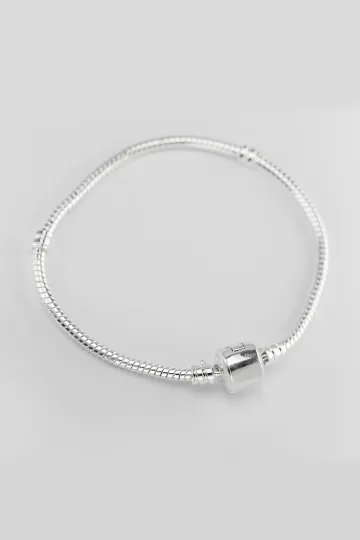
Wear the symbol, don't just read about it. These are in stock:


Hardness, density, how it holds up in daily wear
On the Mohs scale tourmaline sits at 7 to 7.5. That is harder than glass and quartz, on a par with garnet, but noticeably softer than sapphire and ruby (9), let alone diamond (10). In practice 7 to 7.5 is a perfectly workable hardness for everyday jewellery: the stone will not scratch from an accidental brush against clothing or paper.
Density runs about 3.0 to 3.3 g/cm³, so tourmaline feels distinctly heavier than glass of the same size. That is one of the simple at-home ways to tell it from a glass imitation.
There is an important nuance: hardness and toughness are two different things. Tourmaline is hard but fairly brittle, prone to chipping along fractures. A direct knock against a corner or a tiled floor can leave a chip, especially on the edges of a faceted stone. It makes sense to take a ring off when you work with your hands, while pendants and earrings handle daily wear calmly.
Crystal structure
Tourmaline crystallises in the trigonal system. Crystals grow as elongated prisms with a distinctive lengthwise striation on their faces, fine grooves running along the stone. That striation is so recognisable that it serves as a sign of authenticity: glass and most imitations do not have it.
The structure is polar, meaning the two ends of the crystal are not equivalent. That is where its unusual physical properties come from.
Optics: refraction, dispersion, pleochroism
Tourmaline's refractive index is roughly 1.62 to 1.64, its dispersion low; the stone does not throw rainbow flashes the way diamond or zircon do, but gives a steady, saturated colour.
Its most striking optical feature is strong pleochroism: tourmaline shows a different colour depending on the angle you view it from. The very same crystal looks darker along its axis and lighter across it. Cutters take this into account: to keep the colour even and rich, they set the table of the stone perpendicular to the long axis. That is why long tourmaline crystals are usually cut into elongated shapes such as the baguette, the oval, the emerald cut.
Piezoelectricity and pyroelectricity
This is the very quirk that once carried tourmaline into physics labs. Under pressure (piezoelectricity) or during heating and cooling (pyroelectricity) a difference in potential builds up at the ends of the crystal. A warmed tourmaline attracts specks of dust and ash. Europeans noticed this property long before they understood what caused it.
In the twentieth century tourmaline was used in pressure sensors and measuring equipment for this reason, until cheaper synthetic piezoelectrics, quartz and ceramics, pushed it out.
How Tourmaline Forms in Nature
Tourmaline is a classic mineral of granite pegmatites, the coarse-grained veins that form in the late stage of granite magma solidifying. Once the bulk of the granite has already crystallised, what remains is a hot residual solution rich in boron, lithium, water and rare elements. Tourmalines grow out of it.
Crystallisation runs slowly, and that is the key point: the calmer the vein cools, the larger and cleaner the crystals grow. The composition of the solution shifts as growth goes on, now more iron, now more manganese or chromium. The crystal records those changes in layers, and that is how polychrome tourmalines appear, where the colour shifts along or across the stone.
Beyond pegmatites, tourmaline turns up in metamorphic rocks and as a durable mineral in river gravels: it barely breaks down through weathering, so it survives well in alluvial deposits.
A watermelon slice belongs on a bare collarbone, never under a turtleneck. Hide a stone like that and you never deserved it.
What to Wear Tourmaline With
I have handled tourmalines in every shade, from clear pink to coal-black schorl, and almost each one found its place in a look. Here is what actually works, sorted by occasion and by the colour of the stone.
What do I wear tourmaline with day to day? For everyday I recommend a single coloured stone on a fine chain: a green verdelite or a pink pendant over a plain jumper or a white shirt. A light top lifts the stone, a dark one turns it into an accent. A bracelet scattered with small tourmalines looks good with the rolled-up sleeve of a linen blouse. For jeans and knitwear I suggest a larger stone, since a clean background draws out any bright tone.
Is tourmaline right for the office? It is, as long as you keep it restrained. I choose one blue indicolite or a green stone in a plain setting, silver or white gold, at 45 to 50 cm. Stud earrings with a small tourmaline and a slim ring beat a bracelet that taps against the desk. A stone like that reads as the detail of a clever person, not a loud statement.
How do I build an evening look? For the evening I recommend contrast: a deep neckline and a plain dress in a rich colour, black, emerald or wine. A pink rubellite sits on bare skin at the collarbone, a blue indicolite on a choker at the throat, a black schorl in silver under a sharp silhouette. The darker and simpler the fabric, the brighter the stone plays.
How do I match the metal to the colour? Take your cue from your skin undertone and the shade of the stone. For warm pink, yellow and orange tourmalines I suggest gold; cool blues and greens go evenly with silver. Rose gold brings out a rubellite beautifully. Want one piece for both day and evening? Choose a pendant of medium length, 42 to 50 cm: it works over a polo neck and inside a neckline.
Who does tourmaline suit? Almost everyone, because there are so many colours. For calm looks I recommend green and smoky; for those unafraid of attention, pink and watermelon polychrome. One last word: if in doubt, start with a single expressive stone and neutral clothing. That is the surest way to learn which shade is yours.

Turn on your camera, pick earrings, a pendant or a ring, and see the piece on yourself in real time.
Switch items in one tap.
Everything runs in your browser: no photo or video is ever uploaded.
Where Tourmaline Is Mined: The Main Deposits
Tourmaline is mined on several continents, and the deposit often shapes the character of the stone: its colour, clarity and crystal form.
Brazil (the state of Minas Gerais) has historically been the main supplier of coloured tourmalines. Its pegmatites yield large, clean crystals in every colour, and the polychrome stones are especially prized. It was in the state of Paraíba in the late twentieth century that copper-bearing tourmalines were found, the brightest neon blues and greens, which have been called Paraíba ever since.
Afghanistan and Pakistan (the Hindu Kush, Hunza) produce beautiful pink and red tourmalines, along with the elongated wand crystals often used in jewellery in their natural form.
Madagascar yields large crystals across a wide range of colours, frequently with inclusions.
Nigeria and Mozambique are comparatively young sources that have brought a great deal of good-quality green and pink stones to the market.
The United States (the states of Maine and California) are historic deposits, known since the nineteenth century for pink and watermelon tourmalines.
Sri Lanka and East Africa round out the picture, supplying tourmalines that travel through the major cutting and trading centres of Europe.
Black tourmaline (schorl) is found almost everywhere: iron is everywhere, which makes it the most affordable of the whole group.
Customer reviews
Zevira is a real jewellery shop. Genuine payments, deliveries and customer thank-yous.
🥰🥰🥰 gracias
Ok, ¡gracias! 🙂
The History of Tourmaline: How the Stone Found Its Name
A long stretch of tourmaline's history is a history of confusion. The stone existed; the name did not.
A stone without a name
Until the eighteenth century, pink tourmalines were confidently sold as rubies, blue ones as sapphires, green ones as emeralds. The mistake is understandable: in colour and lustre tourmaline really does resemble the costly gems, and there were no tools to tell them apart by composition. There is a well-known story of a batch of bright pink Brazilian tourmalines that was taken for ruby for centuries.
The word itself came from Sri Lanka. In Sinhalese, the mixed-colour stones from the river gravels were called by a word close to "turamali", roughly "stone of mixed colour". Dutch traders, who carried gems from Asia to Europe in the seventeenth and eighteenth centuries, brought the name along, and from it grew the European "tourmaline".
Green tourmaline in China
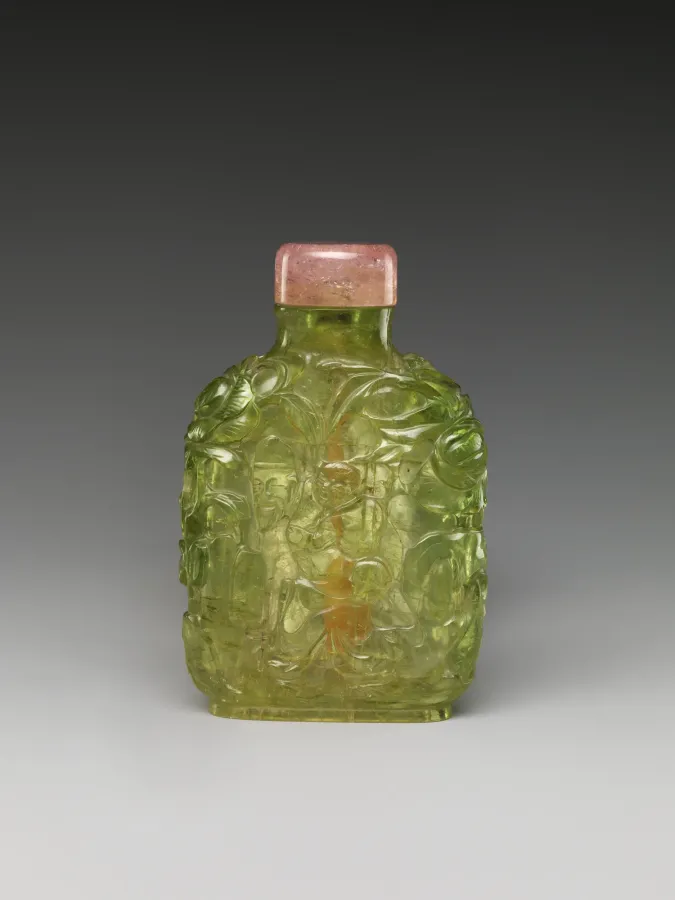
In China tourmaline was known and valued long before European mineralogy. It was carved into seals, snuff bottles and small sculptural pieces. The richly pink stone was a particular favourite, imported in large quantities, including from the American deposits in the nineteenth century. Carved tourmaline objects by Chinese craftsmen of that era survive to this day.
The eighteenth and nineteenth centuries: a classification emerges
In the eighteenth century European scholars began to describe minerals systematically and understood that the multicoloured "pseudo-rubies" and "pseudo-emeralds" were a single mineral species. Names for the varieties gradually settled into place: rubellite for the red-pinks, indicolite for the blues, verdelite for the greens, schorl for the blacks, dravite for the browns. This colour-based classification stuck and is still used today, even though each name carries its own chemical composition.
The nineteenth and twentieth centuries: science and technology
In the 1880s tourmaline became a material for physics experiments, the stone on which piezoelectricity was studied. Later this property found a use in measuring instruments. But as synthetic piezoelectrics appeared, industrial interest in natural tourmaline faded, and it returned to its familiar role as a beautiful, affordable jewellery stone.
Upload a photo of your pet, someone you love, or an object. We'll build a 3D model and hand-cast it in pewter.


Tourmaline in Culture and Art
Before it became a faceted gem in the western sense, tourmaline had a long career as a carving material and a curiosity, and that history explains why it turns up in such different forms in museum cases.
Carving and household objects in the East
Chinese workshops took to pink tourmaline with enthusiasm, and for a long stretch of the Qing period it was among the most sought-after materials for small carved objects: snuff bottles, toggles, belt hooks, hair ornaments, the beads of court necklaces and miniature figure groups. The stone suited the work because it holds fine detail and does not crumble under the tool the way more brittle gems do. Demand from the imperial court was enormous, and it was met largely by imports, since the best pink material was coming from the other side of the Pacific. When the dynasty fell in 1912 the market vanished almost overnight, and the mines that had supplied it went quiet within a season.
Tourmaline in the jeweller's hand
Western jewellery came to the stone later and used it differently. Tourmaline grows in long prismatic crystals, which makes it economical to cut as an emerald cut, a baguette or an elongated cushion, and those shapes dominate the antique material. Art Nouveau makers liked it for its unusual greens and its willingness to appear in large clean sizes at a sensible outlay, and Edwardian and Arts and Crafts jewellers in Britain used it constantly in silver. The one technical demand it makes is orientation: tourmaline is strongly pleochroic, showing a darker colour down the length of the crystal than across it, so a cutter who ignores the axis will produce a stone that looks nearly black from the top. Good tourmaline cutting is largely a matter of knowing which way to point the crystal.
Where to see tourmaline in museums
Anyone in Britain can see excellent tourmaline without buying any. The mineral galleries of the Natural History Museum in London hold both cut stones and crystal groups, including polychrome sections that show the colour zoning clearly, and the jewellery collections of the Victoria and Albert Museum contain tourmaline set in pieces spanning several centuries. Carved Chinese material appears in the East Asian collections of the larger museums. Seeing a watermelon slice or a well-oriented indicolite in a case is worth more than any amount of reading, because the colour behaviour has to be watched rather than described.



Famous Tourmalines and Historic Stones
Tourmaline has an unusual place in gem history: for most of it, nobody knew they were looking at tourmaline.
Caesar's "ruby" and other false rubies
Because red tourmaline can match the colour of ruby closely, a number of celebrated historic red stones turned out on examination to be something else entirely. Britain has the most famous example of the genre: the great red stone in the Imperial State Crown, known for centuries as a ruby, is in fact a spinel. A large carved red gem in the form of a bunch of grapes, which passed through several European royal treasuries as a ruby, was eventually identified as tourmaline. None of these were frauds in the modern sense. Nobody had the means to tell red gems apart until refractive index measurement arrived, and until then colour was the whole of the identification.
The Californian tourmaline rush
At the turn of the twentieth century the pegmatite districts of southern California produced pink tourmaline of remarkable quality, and mines opened along a stretch of country that had been of no gemmological interest at all. The buyer was almost entirely the Chinese court, which took the material for carving, and the trade made real money for about a decade. When the dynasty collapsed the demand evaporated, prices fell through the floor, and most of the workings closed. Several were reopened much later for the specimen and collector market, and their crystals are now in museums worldwide.
The discovery of Paraíba
The most consequential tourmaline find of modern times came from a low hill in north-eastern Brazil, where a prospector spent years digging on the conviction that something unusual lay in the pegmatite. What eventually came out in 1989 was a tourmaline coloured by copper, in a neon blue-green that no gem had shown before. The trade did not believe it at first, then paid extraordinary sums for it. Copper-bearing tourmaline was later found in Nigeria and Mozambique, which broadened the supply without matching the original in intensity, and the name Paraíba now refers to the copper chemistry rather than strictly to the place.
Leave your email, we'll send your discount code. No spam, unsubscribe anytime.
The code arrives by email, valid on your first order.
Tourmaline Varieties by Colour
The handiest way to sort tourmaline is by its coloured varieties: each has its own composition, its own rarity and its own character in jewellery.
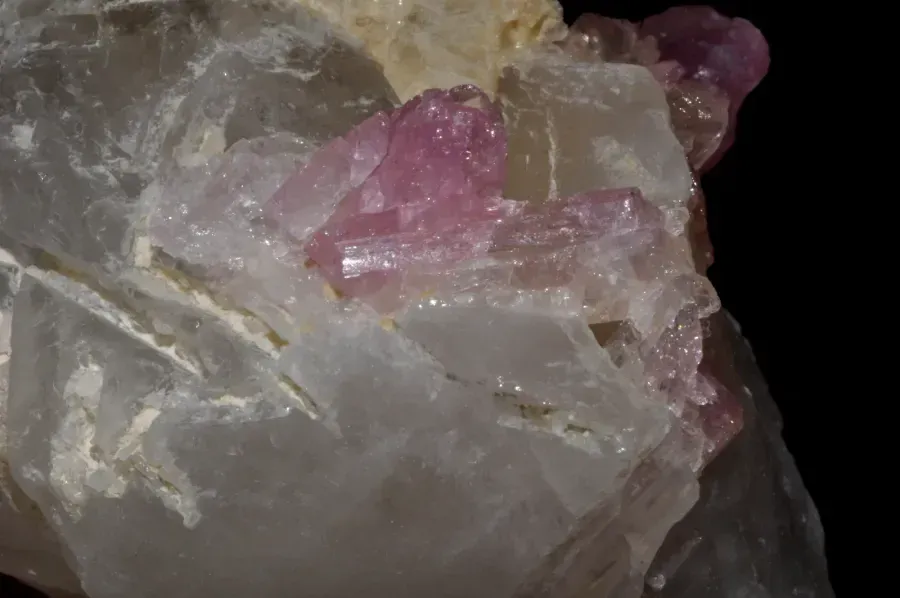
Pink and red (rubellite)
The colour comes from manganese and lithium. Rubellite is the most valued member of the pink-red group; its great virtue is that the colour stays vivid in both daylight and artificial light, whereas ordinary pink tourmalines often turn greyish under a lamp. There is a separate piece on how rubellite differs from ordinary red tourmaline. It is one of the most expensive kinds, especially in large, clean crystals. The main sources are Brazil, Afghanistan, Madagascar.
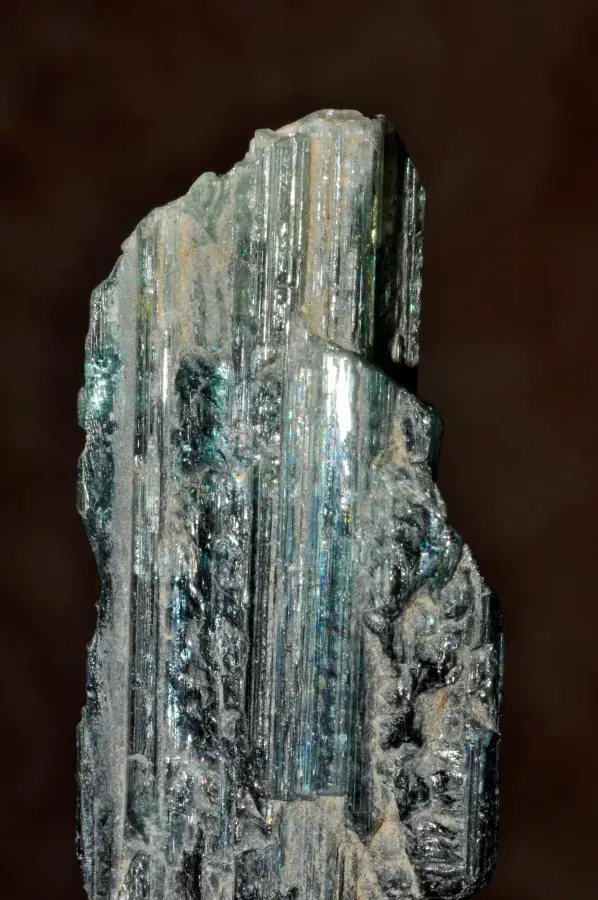
Green (verdelite)
Perhaps the most familiar colour of tourmaline. Its shades run from pale lime to deep forest; iron, chromium and vanadium are responsible for the green. Chromium greens (sometimes called chrome tourmaline) give an especially rich, emerald-like colour and turn up more rarely. The green stone sits well in both silver and yellow gold.
Chrome tourmaline
Worth separating from ordinary green, because the colour behaves differently. Chrome tourmaline owes its green to chromium and vanadium rather than iron, and the result is a rich, slightly warm green with a red flash under incandescent light, closer to fine tsavorite or emerald than to the cooler iron greens. Most of it comes from east Africa, chiefly Tanzania, and it is almost always found in small sizes: a clean chrome tourmaline over three carats is a genuinely uncommon stone. It also tends to be more included than ordinary verdelite, so a clean one commands a strong premium.
Blue (indicolite)
The blue of ordinary indicolite comes from iron, with shades from sky blue to deep indigo. It is scarce compared with green and pink, and the strongly saturated stones are scarcer still, since iron that gives good blue also darkens the stone, and the balance between colour and liveliness is difficult to strike. Indicolite is markedly pleochroic, showing a deeper, sometimes almost black colour down the crystal axis, so cutting is decisive: the same rough can yield a lifeless dark stone or a bright cornflower one depending on orientation. Brazil, Namibia and Afghanistan are the usual sources.
Paraíba (copper-bearing tourmaline)
Paraíba tourmalines stand apart: their neon blue-green colour is created by a trace of copper together with manganese. Such stones were first found in the Brazilian state of Paraíba in the late 1980s, and similar ones later appeared in Africa. Paraíba is one of the most expensive and sought-after gems of our time, thanks to its brilliance and rarity. What separates it from ordinary blue tourmaline is not the hue so much as the apparent glow: copper produces a colour that seems to be lit from inside and holds its intensity even in dull light. Original Brazilian material is generally the most saturated and was mined in tiny quantities, so most stones on the market are under a carat; African copper-bearing tourmaline occurs in larger sizes with a softer colour, and laboratory reports now distinguish origin because the price difference is substantial. This is one of the very few gems where paying for a report is straightforwardly sensible.
Yellow and brown (dravite)
Dravite contains magnesium, with colour running from honey to dark brown. It is named after the Drava region in Austria. Less rare than the lithium tourmalines, so more affordable; it works well in jewellery with a natural, mineral feel.
Colourless (achroite)
Achroite is tourmaline with almost no colouring elements at all, running from water-clear to a faint grey or pale straw. It is genuinely rare in nature, since the chemistry that builds tourmaline almost always brings some iron or manganese along with it, and most colourless material occurs as the clear tip or the clear zone of a crystal that is coloured elsewhere. It is rarely used in jewellery, because a colourless stone with tourmaline's modest refractive index cannot compete on brilliance with the colourless gems people already know. Its real interest is to collectors, who value it as the empty end of the tourmaline colour scale, and to anyone who wants proof that the colour in every other variety is a trace element rather than the mineral itself.
Violet
Rare violet and lilac-pink tourmalines are coloured by manganese with impurities. They turn up infrequently and in small sizes, and are valued by collectors.
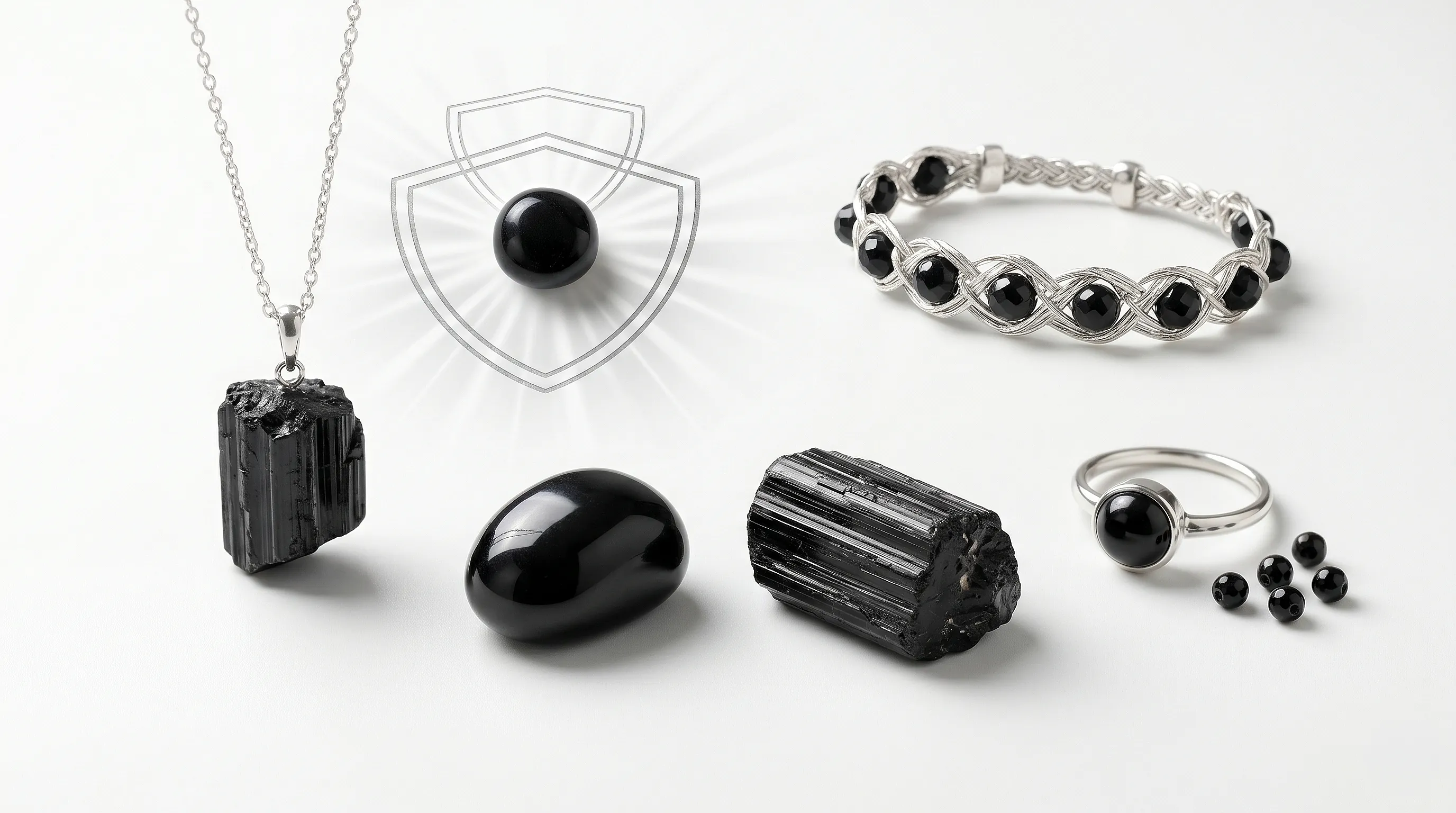
Black (schorl)
The commonest variety, making up the overwhelming majority of all tourmaline mined. The near-black, opaque colour comes from a high iron content. Schorl is affordable, tough and popular in jewellery; we cover what black tourmaline means and which properties are ascribed to it and why people choose it as a stone of protection separately.
Green-blue chameleons and rare transitions
Between the named varieties sits a whole population of stones that refuse to be filed. Tourmaline runs a continuous series between its blue and green ends, so there are stones that read blue in daylight and green under a lamp, teal stones that sit exactly between the two, and material where the colour shifts along the length of a single cut stone. Some of the finest of these come from east Africa and from Brazil, and the trade often sells them simply as teal or as blue-green tourmaline because no varietal name quite fits. Anyone shopping for colour rather than for a label should look hard at this group: the stones are often more interesting than their better-named neighbours and priced below them, purely because they are harder to describe in a listing.
Polychrome and watermelon
If the composition of the solution changed during the crystal's growth, you end up with a stone of several colour zones. The best-known case is watermelon tourmaline: a pink core and a green "rind", which in cross-section really does resemble a slice of watermelon. This contrast cannot be reproduced artificially, so watermelon and polychrome stones are valued for their natural pattern and are often cut into slices to show both colours.
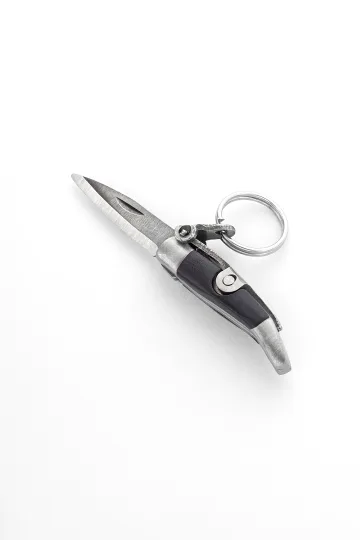
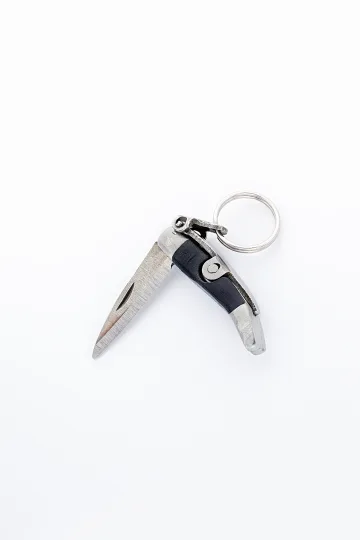
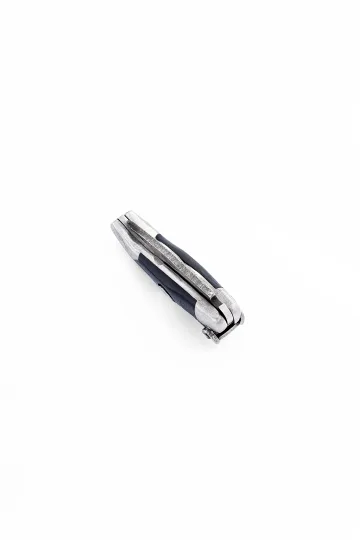
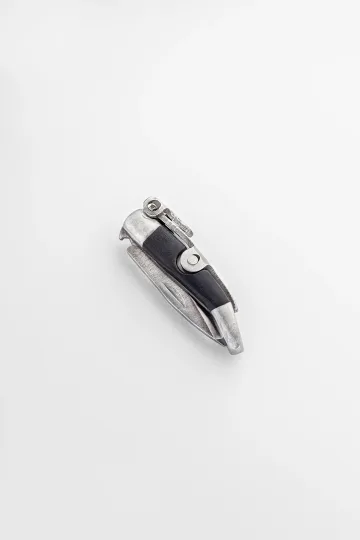
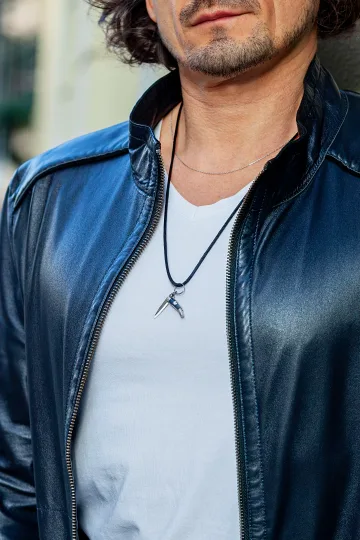
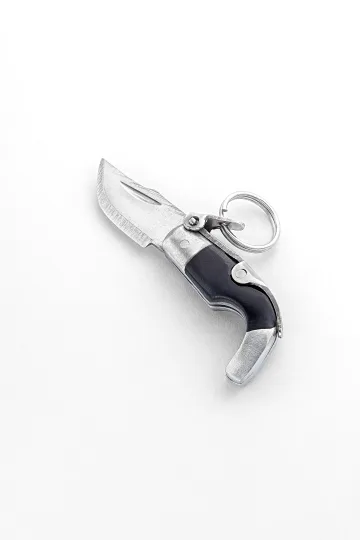
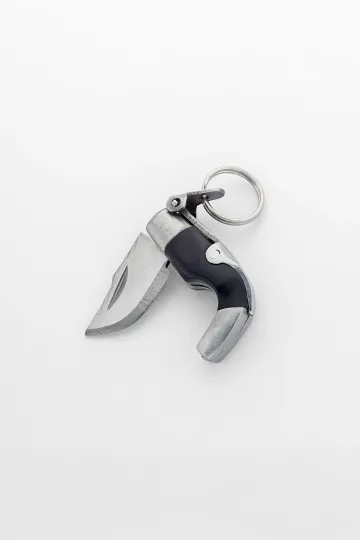
CAPAORA mini knife pendant
The 18th-century Spanish navaja in miniature: 40 mm of stainless steel, a real folding mechanism and a Palanquilla lock that clicks. An affordable gift to remember.
Authentic · Ships from Spain · 14-day returns
How to Tell Tourmaline from Similar Stones and Fakes
Tourmaline is confused with ruby, sapphire, emerald, garnet, amethyst and rose quartz, and is often passed off as glass or cheap imitations. A few practical pointers.
From other gems
- From ruby and sapphire tourmaline differs in hardness and pleochroism. The corundums are harder (9) and do not give such a pronounced two-colour effect when turned.
- From amethyst and rose quartz (hardness around 7) tourmaline differs by being slightly harder, denser, and by the lengthwise striation on its rough crystals. Amethyst can also fade after long exposure to sunlight, whereas tourmaline does not.
- From garnet pleochroism helps: garnet is optically isotropic and does not change colour when turned, while tourmaline changes noticeably.
From glass and imitations
- Weight. Tourmaline is heavier than glass of the same volume.
- Temperature. The stone stays cool to the touch longer; glass warms up faster in the hand.
- Striation. Glass has no lengthwise grooves running along the crystal.
- Inclusions. Natural tourmaline almost always carries small natural inclusions and a slight unevenness of colour. A perfectly even, glaringly bright tone without a single flaw should make you wary: it is a sign of glass, a dyed imitation or heavy irradiation.
Treatment and synthetics
Some tourmalines are heated or irradiated to improve or change the colour. Irradiated stones look unnaturally even and bright. Synthetic tourmaline is rare on the market and unprofitable to produce, so it shows up less often than with many other gems. For expensive stones such as Paraíba and large rubellite it makes sense to ask for a report from a gemmological laboratory.
Caring for Tourmaline
Tourmaline is undemanding, but its hardness and brittleness dictate a few simple rules.
Cleaning
The best method is warm water with a drop of mild soap and a soft brush. Soak the piece for a few minutes, brush it gently, rinse and dry with a soft cloth. That is enough for the everyday care of any tourmaline.
Ultrasonic and steam cleaning are better avoided: vibration and sudden heat are dangerous for a brittle stone and for stones with inclusions, which can crack. For the same reason tourmaline does not like sharp swings in temperature.
Storage
Keep tourmaline away from harder stones so they do not scratch it, and store it so that it does not scratch anything softer in turn. A soft pouch or a separate compartment in a box will do. A silver setting darkens over time, which is normal: it just needs polishing now and then.
Wearability
A hardness of 7 to 7.5 lets you wear tourmaline daily in pendants, earrings and bracelets. A ring is wiser to take off during cleaning, sport and work with your hands; it is rings that pick up chips most often. Take jewellery off before the swimming pool: chlorine slowly damages the findings and the metal of the setting. Bracelets on an elastic cord eventually need restringing, which is a consumable rather than a defect of the stone.
Symbolism: What People Ascribe to Tourmaline
Because tourmaline comes in every colour, different traditions have tied its shades to different meanings. It is worth saying outright: these are cultural ideas, not proven effects. Science finds no confirmed influence of the stone on health, mood or "energy", and tourmaline is not a remedy.
By tradition the pink and red stone is linked to warmth and attachment, the green to calm and renewal, the blue to clarity and the expression of thought, the black to protection and steadiness. In modern esoteric currents the colours of tourmaline are matched to the chakra system. All of this is metaphor and belief: interesting as part of the culture of the stone, but not something to lean on as fact. If tourmaline lifts the mood at all, it does so exactly the way any beautiful piece of jewellery does, when its owner likes it.
The psychology of choosing a colour
Given a tray of tourmalines in ten shades, people choose quickly and then explain the choice afterwards, which is a reasonable description of how most aesthetic decisions work. The useful thing about tourmaline is that it lets you observe your own preference cleanly, since the mineral, the hardness, the cut and the price are held roughly constant and only the colour varies. What you reach for tends to track what you already wear: someone whose wardrobe runs to navy and grey usually lands on indicolite or teal, someone who wears rust and olive lands on dravite. Take the tray to a window, hold each candidate against your own wrist, and trust the stone that still looks right after you have stopped looking at it for a minute.
Why one stone in every colour is so appealing
Part of tourmaline's hold on people is simply that it is a set. Almost every other gem species offers one colour, or one colour with a rare exception, whereas tourmaline covers the entire spectrum plus black and colourless, all from the same crystal structure. That invites collecting in a way that a single-colour gem does not, and it also makes tourmaline unusually easy to build a coherent group of pieces around: earrings, a pendant and a ring in three different colours still read as belonging together because they share a lustre and a character. For a jeweller it is a flexible palette; for a wearer it is permission to buy the same stone repeatedly without repeating yourself.
Send a friend a discount code, they save on their first order.
Facts About Tourmaline That Surprise People
Several things about this mineral rarely make it onto a shop label, and most of them are stranger than the marketing.
A warm tourmaline pulls in ash
Heat a tourmaline crystal and it develops an electrical charge, one polarity at each end, and it will attract dust, ash and small scraps of paper the way a rubbed balloon does. Dutch traders bringing the stone back from Ceylon in the early eighteenth century noticed this immediately and gave it a nickname meaning ash-puller, because pipe smokers used a warmed crystal to draw ash out of a meerschaum bowl. That parlour trick was Europe's first real acquaintance with the stone, well before anyone worked out what mineral it was.
The science of piezoelectricity was born on tourmaline
The ash trick is pyroelectricity, charge from a change in temperature, and it led directly to the discovery of the related effect from pressure. In 1880 two brothers working in Paris demonstrated that squeezing certain crystals produces a measurable voltage, and tourmaline was among the materials they used alongside quartz and topaz. That work underlies a very large amount of modern technology, from ultrasound to the ignition in a gas lighter. A gemstone people had been wearing for centuries turned out to be a working piece of physics apparatus.
Tourmaline measured the pressure of explosions
Because the effect is fast, linear and works under enormous pressure, thin tourmaline discs were adopted as sensors for measuring blast: they can record the pressure profile of an explosion, including underwater, over intervals of microseconds. Gauges of this kind were developed for military research in the mid twentieth century and tourmaline elements are still used in shock and blast measurement today. It is one of very few gemstones with a second career in instrumentation.
One crystal has two different ends
Tourmaline is hemimorphic, which means the crystal has no centre of symmetry and its two ends are genuinely different from one another: differently shaped terminations, differently behaved chemistry, and opposite electrical polarity when the crystal is heated or squeezed. In a well-formed crystal you can see it without any equipment, since one end comes to a flat or three-faced termination while the other is pointed. Almost no other common gem mineral is built this way, and it is the direct cause of the pyroelectric behaviour.
There is more black tourmaline than every colour combined
Schorl, the iron-rich black variety, accounts for the overwhelming majority of all tourmaline in the earth's crust, and it turns up as an accessory mineral in granites and pegmatites worldwide, including in Cornwall and across the south-west of Britain. Every coloured tourmaline is effectively a rare accident of chemistry in which the iron was replaced by something else. When you buy a pink or blue stone you are buying the exception rather than the rule.
One hill in Brazil moved the whole coloured-stone market
The Paraíba discovery did something very unusual: it introduced a genuinely new colour to the gem trade rather than a new source of an existing one. Within a few years copper-bearing tourmaline was among the most expensive gems by weight in the world, laboratories had to develop origin testing for it, and the market learned to distinguish a chemistry rather than a mineral. A single small working in a hillside reset the price ceiling for an entire species.
The name means "mixed"
Tourmaline takes its name from a Sinhalese word used in Sri Lanka for the mixed parcels of assorted gem pebbles that came out of the river gravels. It was a merchant's term for a bag of unsorted stones, not a mineralogical one, and it was applied to the mineral more or less by accident when European buyers repeated what they had been told. Given that tourmaline turned out to be the most colour-variable gem species there is, the name has aged remarkably well.
Frequent Questions
Which colour of tourmaline should I choose for a first piece? Go for the colour that draws you in visually. Black schorl is versatile and affordable, suits any outfit and needs no delicate care. Green verdelite and blue indicolite look more refined and sit well with both silver and gold. Pink rubellite is the choice when you want a warm, soft accent. For everyday wear a bracelet or pendant is more convenient: you do not have to take them off as often as a ring. Start with a single mid-range stone, wear it for a couple of weeks, and you will understand whether you want a second colour.
How does rubellite differ from ordinary pink tourmaline? Rubellite is the most saturated and rare member of the pink-red group. Its key feature is that the colour stays vivid under any lighting, both artificial and daylight. Simpler pink tourmalines often turn grey or fade under a lamp, losing depth. Rubellite contains manganese and lithium, which gives it a steady raspberry-wine tone without a brown undertone. Because of its rarity it costs more than an ordinary pink tourmaline. When buying, look at the stone both by a window and under a lamp.
Can I wear tourmaline every day? Yes. In hardness tourmaline rates 7 to 7.5 on the Mohs scale, which is enough for everyday wear in bracelets, pendants and earrings. The main thing to remember is that the stone is hard but brittle: a direct, strong knock against the corner of a table or against tile can cause a chip. A ring is worth taking off during cleaning, sport and work with the hands; the other formats handle daily wear calmly. Bracelets on an elastic cord eventually need restringing. Take jewellery off before the swimming pool: chlorine slowly damages findings and settings.
Is tourmaline an expensive stone or an affordable one? It depends on the variety. Black schorl and brown dravite belong to the affordable tier, a bracelet of them comparable in price to a good dinner for two. Green and blue tourmalines are already the mid range, closer to the cost of a small treat for yourself. Pink rubellite and especially blue Paraíba are premium: for a rare, clean stone of large size you pay as much as for serious equipment or a short holiday. Tourmaline is handy in that one mineral family holds options for almost any budget, and all of them look respectable.
How do I tell a real tourmaline from a fake when buying? Natural tourmaline is almost always semi-transparent and lets light through when held up to a lamp. On the surface of rough and lightly cut crystals you can see lengthwise grooves, the striation along the stone, and that is a characteristic sign. A natural stone has inclusions and a slight unevenness of colour: a perfectly even, glaringly bright tone is more likely to point to glass, a dyed imitation or heavy irradiation. Tourmaline is noticeably heavier than glass of the same size and stays cool in the hand longer. For expensive stones, especially Paraíba and large rubellite, ask for a laboratory certificate.
Which metal setting goes best with tourmaline? Silver gives a cool, mineral look and works well with blue, green and black tourmaline, emphasising the coolness of the stone. Yellow gold reinforces warmth and suits yellow, orange and pink tourmaline. Rose gold beautifully brings out rubellite and the red shades. If you want versatility, choose silver: it is neutral and suits most colours. Bear in mind that silver darkens over time and needs a light clean, while gold is simpler to care for. The colour of the stone reads differently in different settings, so try it on.
Is tourmaline suitable as a gift? Yes, and it is a convenient gift precisely because of the range of colours. You can pick a shade to suit the character or wardrobe of the person without knowing their exact size, as long as you choose a pendant or bracelet rather than a ring. Black tourmaline in silver is fitting for a woman and a man alike. Green and blue work as a restrained but not banal option. Pink reads as a warm, personal gesture. Tourmaline looks more expensive than its price in the mid range, so the gift looks handsome even on a modest budget. An engraving on the setting makes it personal.
What is watermelon tourmaline? Watermelon tourmaline is a polychrome stone with a pink core and a green border; in cross-section it really does resemble a slice of watermelon. It is valued for the natural contrast of colours within one crystal, which cannot be repeated artificially. It looks best in pendants with a slice of the stone, where both layers are visible, or in a cut that emphasises the transition. It is a rare and striking option. The price is higher than for a single-colour tourmaline of the same size, but lower than for top rubellite.
Does tourmaline fade over time? Natural, untreated tourmaline does not fade from daylight and wear, unlike some amethysts that pale in the sun. The colour holds for years. Only the surface may dull from dirt, skin oil and cosmetics, but that comes off with ordinary cleaning in warm water with mild soap. Dyed or heavily irradiated imitations really can lose intensity within a couple of years, one more argument for the natural stone. More often it is not the stone that dulls but the silver setting, and that just needs occasional polishing.
How many carats of tourmaline should I get for a ring? For a ring with a single central stone, a comfortable range is 2 to 5 carats, roughly 8 to 10 millimetres. A smaller stone gets visually lost in a ring, while above 5 carats it starts to get in the way of daily wear and catches on clothing more easily. If you want a noticeable but comfortable piece, aim for 3 to 4 carats. For earrings and pendants there are no firm limits: there you can go both smaller and larger for the effect you want. With rare kinds such as rubellite and Paraíba, the price climbs non-linearly with size.
Is it true that tourmaline produces electricity? Yes, in the literal physical sense. Tourmaline has piezoelectric and pyroelectric properties: under pressure or when heated, a weak difference in potential builds up at the ends of the crystal, and a warm stone can attract specks of dust. It was on tourmaline that these effects were studied in the nineteenth century. But the phenomenon is microscopic and has nothing to do with "healing energy"; it has no effect whatsoever on the jewellery or on the person.
Buying it as a gift? Each one arrives ready to give.
 A branded Zevira box and a little card come with every order.






About Zevira
In our collection you will find jewellery with tourmalines in every colour, from bracelets with black schorl to rare pendants with blue Paraíba. We aim to work with natural stones, and we state the treatment status for each piece.