Indicolite, the Blue Tourmaline in Jewellery: the Rare Indigo Stone
Blue fire from Brazil
Of all the tourmaline mined worldwide, less than two percent comes out a clean blue. The rest is black schorl, brown dravite, green verdelite. Blue tourmaline with a deep, near-indigo colour is set apart as its own variety called indicolite. Most bluish tourmalines never reach that level and stay pale elbaites.
Indicolite is a blue tourmaline from the elbaite group, coloured by iron. Its deep, cool blue sits closer to indigo than to sky, which is where the name comes from. What follows: where that colour comes from, how the stone differs from sapphire, how it is cut, how to tell it from fakes, and how to care for it.
Wear the symbol, don't just read about it. These are in stock:





What indicolite is: chemistry and physics
Indicolite is a variety of tourmaline, more precisely of elbaite, the lithium member of the group. Tourmalines are complex borosilicates with a variable composition, so the group has no single formula. For elbaite it is written as Na(Li,Al)₃Al₆(BO₃)₃Si₆O₁₈(OH)₄. What matters here is the presence of lithium and aluminium in one of the structural sites, while iron impurities supply the blue.
Where the blue comes from
The colour is down to iron in two valence states, divalent and trivalent (Fe²⁺ and Fe³⁺). When iron ions of different valence sit next to each other in the lattice, charge transfer happens between them: light of a certain wavelength is absorbed, and the eye sees blue. The more iron there is, the deeper and darker the colour, from light sky-blue to almost ink. If chromium gets into the mix, a greenish cast appears; copper gives an entirely different, neon effect typical of Paraiba tourmaline, and that is already a separate variety.
Physical properties
- Mohs hardness: 7 to 7.5. Enough to resist scratching against everyday objects, but noticeably softer than sapphire (9).
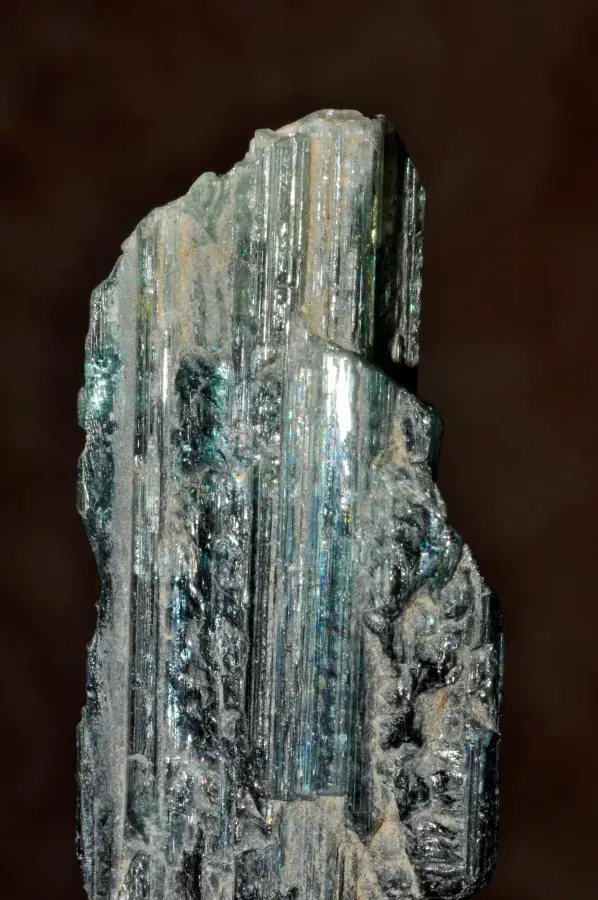
- Crystal system: trigonal. The crystals are elongated, prismatic, with lengthwise striations on the faces, a telltale sign of tourmaline.
- Density: roughly 3.05 to 3.15 g/cm³.
- Refractive index: 1.62 to 1.64, with pronounced birefringence.
- Cleavage: practically none, which is good, though the stone is still brittle and afraid of sharp knocks and thermal shock.
- Pleochroism: strong. Along the optical axis the crystal looks darker, across it lighter. This is the key optical feature that both the cutting and the authenticity check rely on.
Pleochroism, the defining trait
Pleochroism is the change of colour depending on the direction you look through the stone. In blue tourmalines it is strong: along the length of the crystal the colour is deep, across it noticeably lighter. The cutter orients the rough so that the finished stone shows the attractive, saturated tone. Among blue gems, even stronger pleochroism belongs to iolite, the Viking stone, whose colour shift reaches into violet.
Indicolite belongs on white gold under an open collar. Bring yellow gold near it and we are done.
What to wear indicolite with
Blue tourmaline has been through dozens of my shoots, and the rule is simple: this stone cannot stand fuss around it. Give it a cool base and one clean accent, not a garland of pendants. Here is what actually works, occasion by occasion.
What do I wear indicolite with every day? For an everyday look I recommend a small stone in a plain setting on a fine medium-length chain, so the pendant settles at the collarbones. Indicolite gets along with denim, linen and dense cotton in calm tones. On a light jumper or a white tee that blue dot freshens the whole look. Silver works as well as white gold here, and I keep warm yellow gold away from this blue.
Is it right for the office? Quite, as long as you keep it minimal. I suggest a small pendant or studs under a shirt with a V-neck or under a plain jumper: strict, without extra shine. A cool blue sits evenly on a grey suit, a white blouse, dark knitwear. The best metal here is white gold or platinum; they continue the cool line of the stone rather than argue with it.
How do I build an evening look? For the evening I choose an open neckline and a smooth fabric in deep cool tones: wine, emerald, black, navy. Indicolite belongs here in a teardrop pendant or drop earrings; as you move it catches the light and shows its pleochroism. You can build it in two layers: a long chain with the stone plus a short fine one without. One condition: keep a single cool range of metals.
Which metal should I pick for a blue stone? For a cool blue I recommend white metals, white gold and platinum; they underline the colour and give a clean modern look. Silver is good too, though it needs care against tarnish. Yellow gold gives a warm contrast that reads as vintage, so for a crisp contemporary line I leave it aside.
Who does indicolite suit, and how do you not get it wrong? It suits anyone drawn to a restrained, slightly intellectual look: quiet confidence over volume. The cool colouring especially flatters people with a cool skin undertone, but in a small size the stone is universal. Two rules that never fail. First: choose the length to suit the neckline, a short choker or studs at the throat, a long pendant under a deep neckline. Second: one indicolite on a clean chain always beats one squeezed between five other pendants.

Turn on your camera, pick earrings, a pendant or a ring, and see the piece on yourself in real time.
Switch items in one tap.
Everything runs in your browser: no photo or video is ever uploaded.
How the stone looks: shades
Indicolite ranges from light sky-blue to inky blue, and here colour matters more than weight. Three rough levels of saturation are commonly recognised.
Light, sky-blue. It holds the least iron, is transparent, and resembles aquamarine. It often turns up in material from Afghanistan and Sri Lanka. The stone glows when held to the light, but carries less depth.
Medium, saturated blue. The benchmark colour, the one most often called indicolite without qualification. Dark enough to look noble, transparent enough to play in the light. The main material for rings and earrings.
Dark, near-inky. Iron at its maximum: in weak light the stone can look almost black, in sunlight it opens into a deep blue. The most prized examples of this tone come from Brazilian deposits.
Sometimes the colour inside a single crystal is arranged in zones: a dark core and a light shell, or the other way round. It is the trace of changing conditions during growth. A good cutter uses that zoning, orienting the stone so the attractive tone dominates.
Customer reviews
Zevira is a real jewellery shop. Genuine payments, deliveries and customer thank-yous.
🥰🥰🥰 gracias
Ok, ¡gracias! 🙂
Geology: where and how it forms
Indicolite is born in granite pegmatites, in veins that crystallise from a residual melt rich in rare elements during the late stage of a granite setting. Blue tourmaline needs several conditions to coincide, which is why it is rare.
First, lithium. Elbaite needs lithium in its lattice, and that is a scattered element which builds up to the right concentration only in particular pegmatites, where most of the ordinary minerals have already crystallised. Such lithium pegmatites are not common. Second, iron in the right amount and valence; without it the stone stays colourless or pinkish, and with an excess of other impurities the colour drifts to green. Third, the absence of competing chromophores such as chromium or copper, which override a clean blue.
Main deposits
Brazil, the states of Minas Gerais and Paraíba, the chief supplier of jewellery indicolite by volume and quality. Brazilian material is valued for its deep, saturated blue. Large clean crystals are rare even here.
Afghanistan, Nuristan, high-altitude pegmatites. The indicolite from there is usually lighter than the Brazilian, but prized for its clarity and transparency.
Sri Lanka, secondary, alluvial deposits where the tourmaline has been washed out of the bedrock and redeposited in river gravels. Mostly light tones, a niche source.
Madagascar, comparatively young pegmatites that yield stones usually small in size but of good colour.
Pakistan, the Skardu region, mountain pegmatites that have added attractive, often lighter blue material to the market in recent decades.
By rarity, blue tourmaline stands apart among its relatives. Black schorl is the overwhelming majority of all tourmaline mined, brown dravite follows, and the blue and other gem colours make up fractions of a percent. Set against still rarer kin, indicolite looks moderately rare: red tourmaline rubellite and neon Paraiba turn up markedly less often and cost more at a comparable weight.
Clarity and inclusions: what counts as normal
Blue tourmaline has its own rules of clarity, and judging it by diamond standards is wrong. Elbaite grows in pegmatite cavities full of solution, so it traps the neighbouring matter. A fully clean indicolite without a single inclusion is rarer than a clean aquamarine, and a perfectly transparent stone should put you on guard rather than delight you.
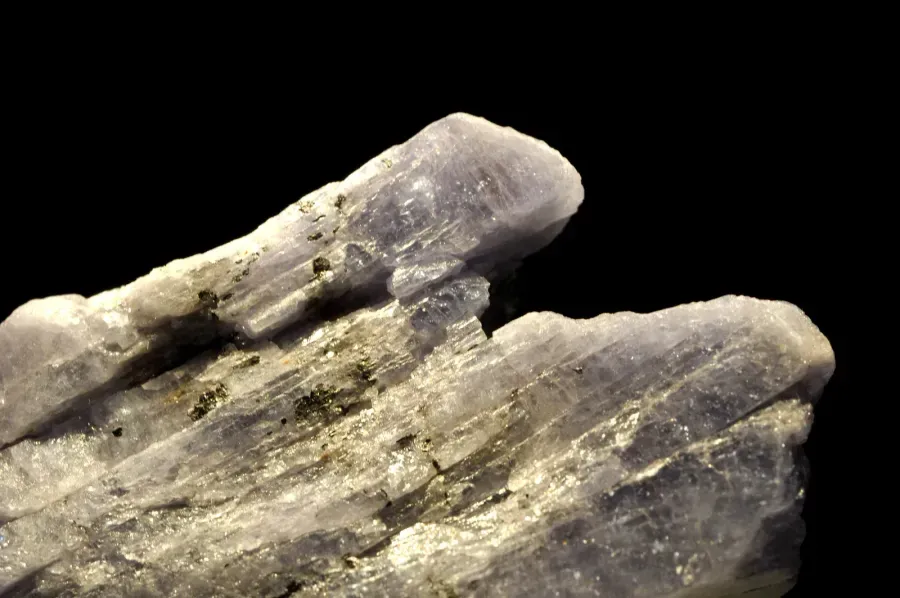
The typical inclusions in indicolite are trichites, thin curved hair-like channels, and hollow tubes stretched along the length of the crystal. They run parallel to the optical axis because they follow the direction of growth. If those tubes are many and dense, the stone is hazy, and a cabochon cut produces a cat's-eye effect. You also meet flat healed feathers and the odd crystal inclusion.
The practical takeaway for a buyer: look at the stone in transmitted light and from the side, not only from the top through the table. Inclusions that do not catch the eye and do not reach the facets have almost no effect on strength and are normal for tourmaline. The dangerous ones are those that reach the surface or form a network near the edges: that is where the stone chips. In a blue tourmaline description, clarity is usually given in words such as "eye-clean" or "lightly included", rather than in letters and numbers as with diamonds.
Upload a photo of your pet, someone you love, or an object. We'll build a 3D model and hand-cast it in pewter.


Why a large clean indicolite is so rare
The price of blue tourmaline rises faster than its weight, not because of fashion but because of the physics of cutting. Several reasons come together.
First, pleochroism dictates orientation. The most attractive saturated blue shows along the optical axis, yet along that same axis the crystal is often dark almost to black. The cutter is forced to turn the rough and cut down the length to catch the transparent blue rather than the inky one. Weight is lost in the process.
Second, dark stones have to be cut smaller and flatter. The more iron, the thicker the colour; a large dense stone smothers light and looks like a black hole. So saturated material is cut thinner, with less depth, to let light through. That limits the maximum size of an attractive stone.
Third, the natural shape of the crystal. Tourmaline grows as a long thin prism with striations along the faces. Such rough naturally yields elongated shapes (oval, pear, emerald), while a round or a large square demands sacrificing a large part of the material. Hence the prevalence of elongated cuts on the market.
Put it all together: rare rough, losses on orientation, the limit set by colour density, and the prism shape. A clean, saturated indicolite above three or four carats is no longer an ordinary item but a find.


History: how the blue tourmaline got its name
Tourmaline had been known since antiquity, but the blue kind was not set apart as a variety for a long time. Before scientific mineralogy, stones were classified by colour and lustre rather than by composition, so blue tourmaline was easily recorded as sapphire, blue topaz, or simply a rare blue stone. In medieval Europe it hardly appears in jewellery at all: mining was limited, and tourmaline was not part of the prestige trio of emerald, ruby and sapphire.
That changed in the nineteenth century, when mineralogy learnt to tell stones apart by chemistry and crystallography. Tourmalines were split into varieties, the lithium one was named elbaite after the island of Elba off the coast of Italy, where it was described. The saturated blue tourmaline took the name indicolite: the colour recalled indigo, the blue dye then shipped to Europe from India in bulk. By the close of the century, blue tourmaline already appeared in the collections and jewellery of the European aristocracy as a rare and costly alternative to sapphire.
In the twentieth century, large finds in Brazil moved mining to an industrial scale, and Brazilian material became the staple on the market. With the rising interest in rare coloured stones, indicolite settled in as a stone for collectors and connoisseurs, those who value the unusual and natural rarity rather than only the familiar name of sapphire.
How to tell indicolite from fakes
Cheaper blue stones and imitations are sold as indicolite. The main candidates are blue spinel, synthetic corundum (sapphire), dyed quartz and glass. A few checks weed out most of them.
Pleochroism, the simplest and most reliable test. Look through the stone in daylight and slowly turn it. With indicolite the colour shifts noticeably, from deep blue to a lighter tone. Spinel and glass show no pleochroism, the colour is the same from every angle. Synthetic corundum will not show such a shift either.
Density. Indicolite is around 3.1 g/cm³. Blue spinel is denser (around 3.6), sapphire denser still (around 4.0). A stone of the same size made of corundum will feel appreciably heavier. On accurate scales the difference shows at once.
Hardness. Indicolite (7 to 7.5) does not scratch with ordinary glass. Dyed quartz or glass is softer and damages more easily. The stone itself must not be scratched, though; specialists run the test on a separate plate or on an inconspicuous spot.
Refractive index. On a refractometer indicolite reads around 1.62 to 1.64, while sapphire is markedly higher (around 1.76). This is a reliable laboratory distinction.
Ultraviolet. Most natural indicolites do not glow under UV or give a weak glow. A bright orange or yellow fluorescence more often gives away dyed glass.
Inclusions under a loupe. A natural stone usually has natural inclusions and microcracks of irregular shape. A perfectly clean crystal without a single flaw is suspicious for synthetic; even bubbles give away glass.
For an expensive purchase the decisive argument is a report from an independent gemmological laboratory. It states the variety (Tourmaline, variety Indicolite), the weight, colour, clarity and the fact of treatment, if there was any.
Natural and grown stone
Synthetic tourmaline is grown, but it is expensive and not worth it for mass jewellery, so it turns up rarely. Far more often, other cheaper stones are passed off as indicolite. Lab-grown tourmaline is chemically identical to the natural kind but almost free of natural inclusions; in doubtful cases the variety is determined by a laboratory from the spectrum and internal features.
About treatment
Most indicolites go without heat treatment; the natural colour is usually good in itself. Sometimes a light heating is applied to remove a greenish or violet cast and make the blue cleaner. The treatment is stable and considered acceptable, but an honest seller states it in the description or certificate, because an untreated stone is valued higher.
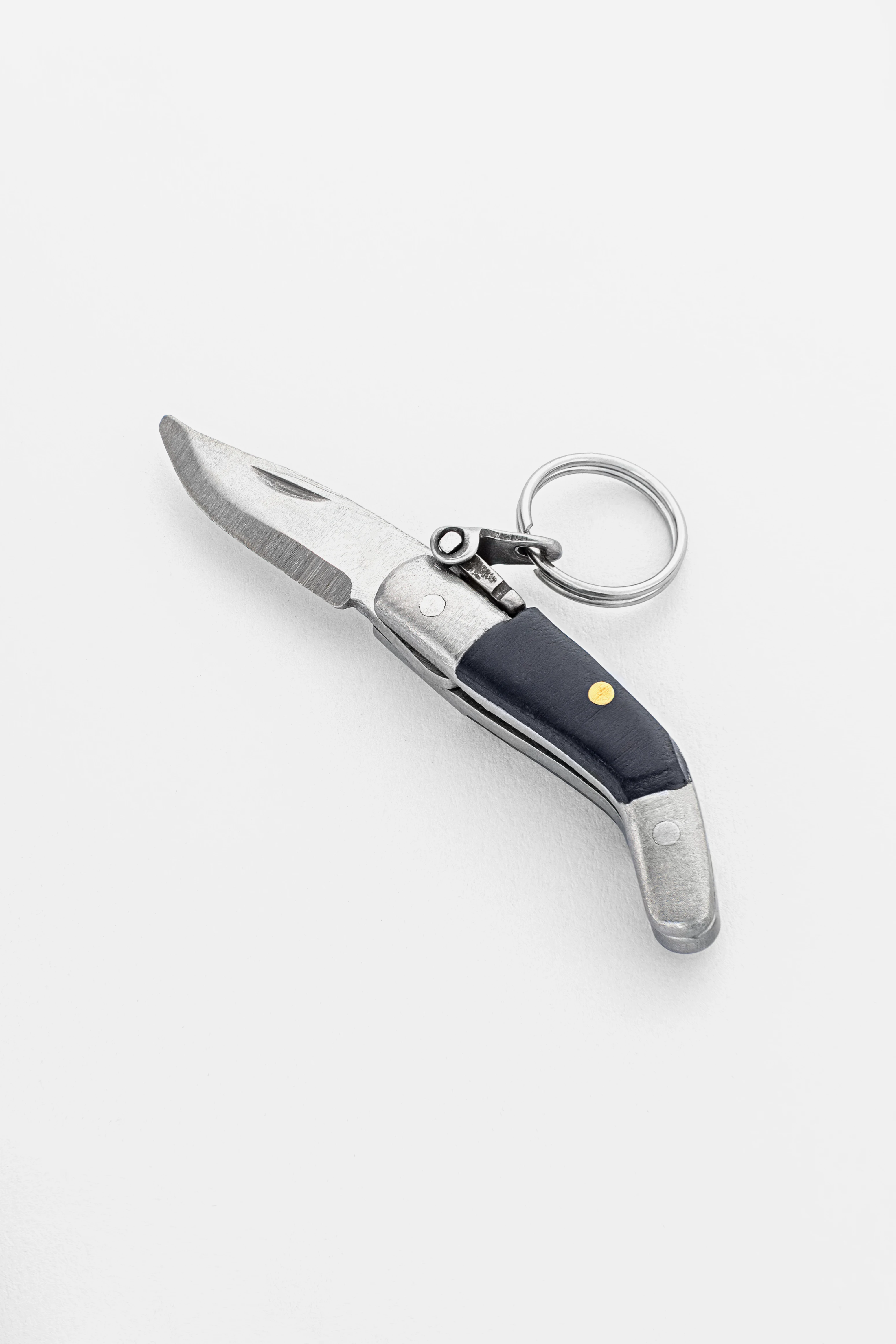
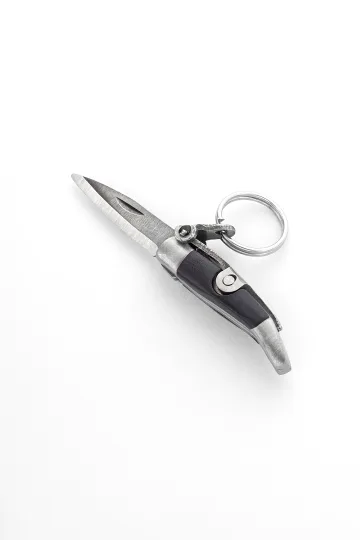
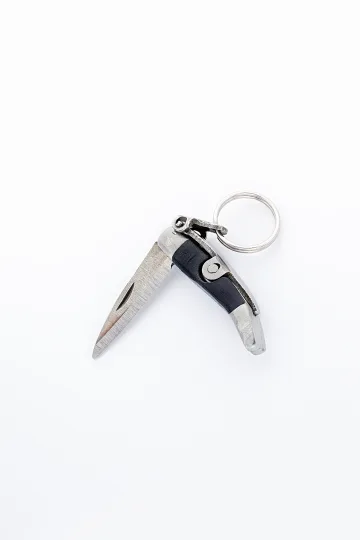
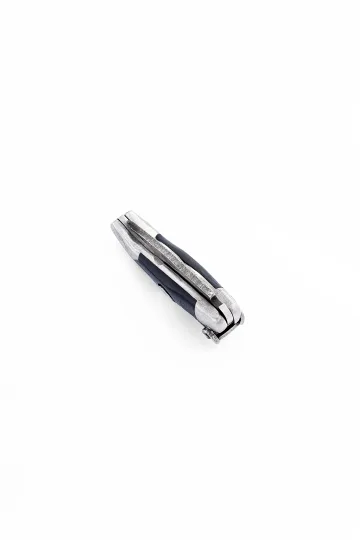
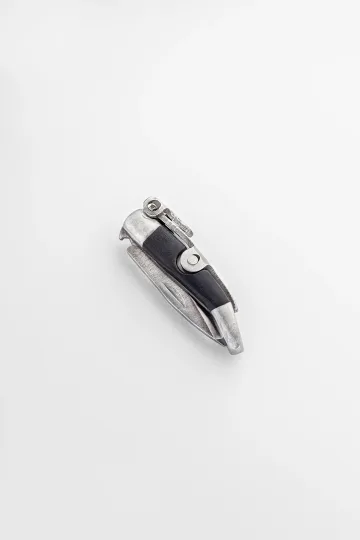
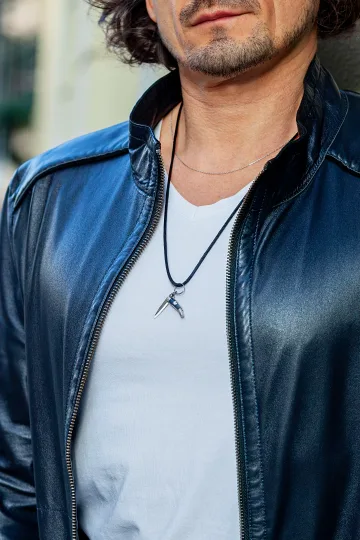
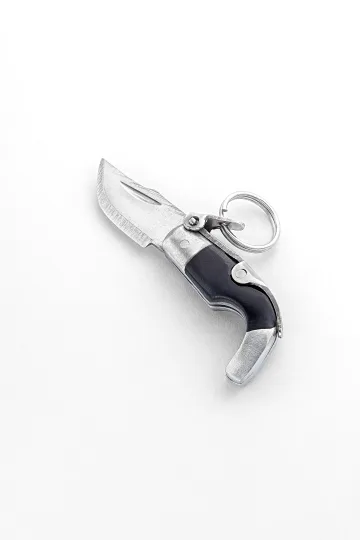
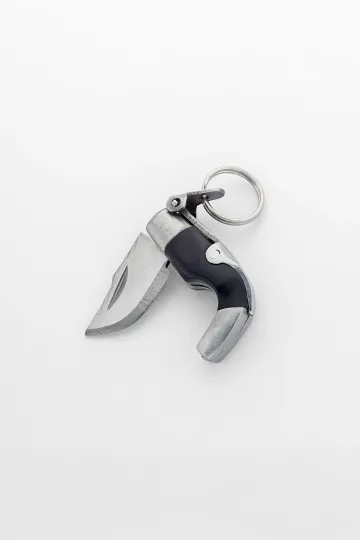
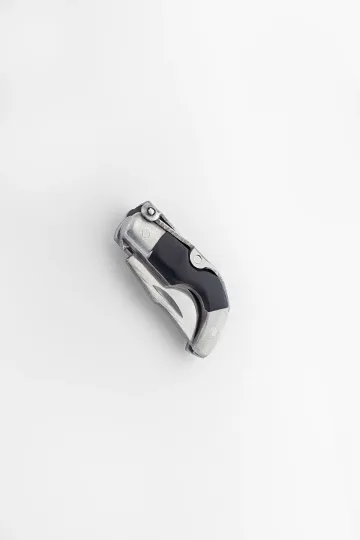
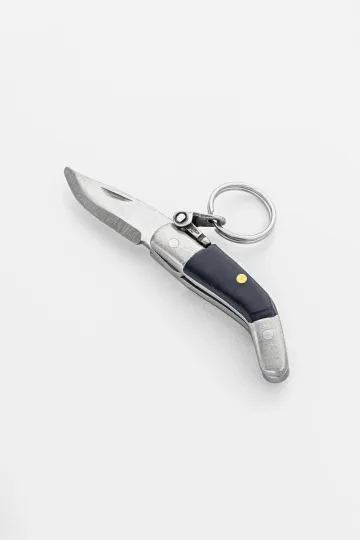
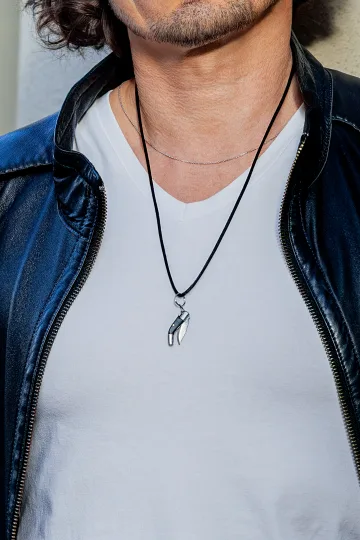
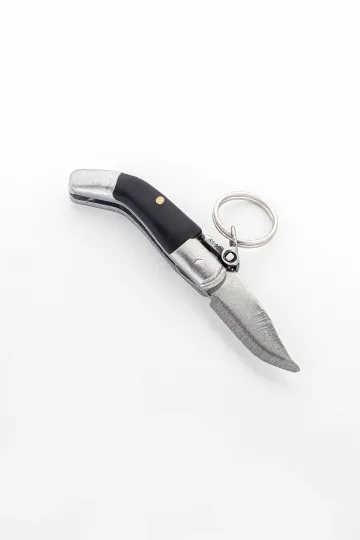
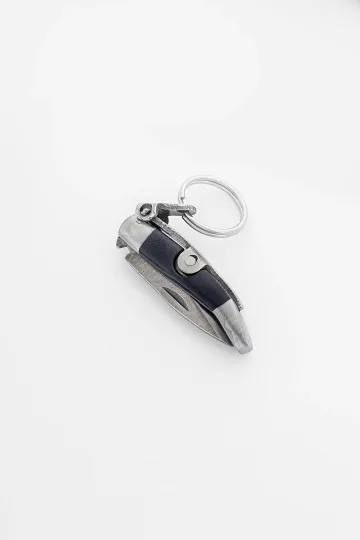
CAPAORA mini knife pendant
The 18th-century Spanish navaja in miniature: 40 mm of stainless steel, a real folding mechanism and a Palanquilla lock that clicks. An affordable gift to remember.
Authentic · Ships from Spain · 14-day returns
What to check before buying
A laboratory report settles the question of authenticity but not the question of quality: a stone can be genuine and still a poor one. A few checks before payment save disappointment.
Look at the colour under two light sources. A cool blue is lovely in daylight, but under the warm lamps of a shop and at home indicolite often goes flat and slides into grey or green. Ask for the stone to be taken to the window and judge whether it "closes up" in room light. Dense material is especially prone to darkening indoors.
Turn the stone and catch a "closed" bottom. If the cutter oriented the rough badly, the dark axis points downward and a dull dark patch shows in the centre of the stone, one that does not play. A well-cut indicolite glows evenly across the whole table, without a black hole at the culet.
Check how the clarity reads in transmitted light. Hold the stone to the light and look from the side. Parallel tubes and hairs are normal, but cracks that reach the facets or the sharp tip of a pear are a reason to bargain or walk away: that is where chips begin.
Confirm the fact of heating in words, not by guesswork. Ask outright whether the stone was heated, and request a note in the description. An untreated indicolite is valued higher, and an honest seller will say so.
For earrings, compare the pair on the spot. The two stones should match in tone, saturation and clarity; matching a pair of indicolites is hard, and a mismatch only shows when the earrings are side by side in the light.
Leave your email, we'll send your discount code. No spam, unsubscribe anytime.
The code arrives by email, valid on your first order.
Jewellery with indicolite: formats
Because of its rarity and price, indicolite is more often set as a single accent than scattered.
Rings
Solitaire, a single stone in a white gold or platinum setting. A classic that draws nothing away from the colour and pleochroism. For indicolite a step-cut emerald shape is often chosen: the wide flat facets show the colour deep and even and help control the pleochroism.
Three stones, indicolite in the centre with two light ones at the sides (white sapphire, a colourless stone). The contrast emphasises the blue and adds volume.
With a halo, a central stone in a ring of small colourless ones. It visually enlarges the indicolite and boosts the sparkle. The halo is best kept thin, otherwise the stone looks cramped.
Pendants
A simple drop, a bare stone in a plain setting of sterling silver or gold. Here the stone has to be clean, there is nothing to hide flaws behind. Convenient for constant wear.
A teardrop pendant, cut as a pear along the natural elongated shape of the crystal. The vertical makes the pendant slim, and the stone catches light as it moves.
With filigree, a stone in an openwork setting of fine gold wire. Handwork that calls for balance, so the setting does not eclipse the stone.
Earrings
A pair of indicolite earrings is a tricky task: you need to match two stones in size, colour and clarity, and that is rare. The formats are the same, studs for everyday and business wear, drops for the evening, versions with extra stones. Drops play with light as the head moves and reveal the pleochroism.
Bracelets and necklaces
Bracelets with indicolite are rare: either many small stones, or a single large one in an awkward spot for the wrist. They are usually bespoke pieces. A necklace with a single large stone is a rare accent choice for those who value the mineral itself.
Cuts and their influence
The cut decides a great deal for indicolite: it brings out the colour, controls the pleochroism, and protects the stone from chipping.
Emerald (step), the classic for blue tourmaline. The broad planes show the colour deep and even, the straight facets help hold the best pleochroic tone. Suits saturated stones.
Cushion, a rounded square with soft corners. It combines depth of colour with sparkle, and the lack of sharp corners makes it one of the safest for an everyday ring.
Oval, it stretches the stone, makes it look larger, and gives a good play of light. A universal choice.
Round brilliant, maximum sparkle and a rounded outline without vulnerable corners; good for light and medium-toned stones.
Pear and drop, they emphasise the natural elongation of the crystal and look theatrical in pendants and earrings. The sharp tip is vulnerable to chipping and needs to be tucked into the setting.
Cabochon, a smooth dome without facets. It is rarely used for transparent indicolite, but it is indispensable if the stone has a cat's-eye effect, which only appears on a smooth surface.
How to wear and care for indicolite
Despite a respectable hardness of 7 to 7.5, indicolite is more brittle than sapphire and more prone to chipping. You can wear it, but with that in mind.
While wearing
The main danger is a mechanical knock against a hard surface and a sharp change of temperature. For an everyday ring it is wiser to choose a protective setting that shields the stone on all sides, a rounded cut without sharp corners, and a moderate size. Sharp shapes such as the pear concentrate stress on the tip and are more vulnerable. White gold and platinum are sturdier than soft yellow gold. If life is active and the ring never comes off, indicolite is better kept for special occasions, with a hardier stone for everyday.
Cleaning
Clean indicolite with warm (not hot) water, mild soap and a soft-bristled brush. Then rinse and dry with a lint-free cloth. No ultrasonic or steam cleaners, no solvents: ultrasound and thermal shock can grow hidden microcracks. Cleaning once a month with regular wear is enough, plus a wipe after each outing.
Storage
Store it apart from other jewellery, in a soft pouch or compartment, so that harder stones do not scratch the surface. Keep it away from heat sources and sharp temperature swings. Take the piece off before swimming in a pool or the sea: chlorine and salt water harm the setting and leave a film on the stone. Apply perfume and cosmetics before putting the jewellery on.
Temperature swings
The main practical risk for indicolite is thermal shock. From the cold into a warm room, from hot water into cold air, a sudden change of temperature can grow a hidden microcrack into a visible one. Let the stone warm up or cool down gradually, and do not bring it straight to a radiator or a hairdryer.
Indicolite and other blue stones
Sapphire
The main blue rival. Sapphire is corundum (Al₂O₃), hardness 9, hardier and more familiar to the buyer. Indicolite is softer and calls for care, but gives pronounced pleochroism and a lively play of tones, and as a variety of tourmaline it is rarer than sapphire. Sapphire is the safe everyday choice, indicolite the choice of the connoisseur who values the unusual.
Paraiba
Also a blue tourmaline, but coloured by copper rather than iron. Paraiba glows from within with a neon blue-green, indicolite gives a calm deep blue without the neon effect. Paraiba is an order of magnitude rarer and dearer. If indicolite is the noble classic, Paraiba is the rarest of phenomena.
Tanzanite
A violet-blue stone from a single district of Tanzania. Softer and more brittle than indicolite, almost always heat-treated. Indicolite is usually a cleaner blue without the violet and a touch more stable. The choice between them is a question of shade.
Blue topaz
Common and inexpensive, its blue most often obtained by irradiating colourless topaz. It gives a lot of bright stone for modest money. Indicolite is incomparably rarer, its blue is natural, and it costs more. These are different categories.
Aquamarine
Light sky-blue, transparent, more affordable. It looks good next to indicolite as a gradient from a gentle blue to a deep one, and the close hardness simplifies the care of a shared piece.
Facts about blue tourmaline that catch people out
Blue tourmaline has properties that rarely make it into a jewellery description, and they are exactly the properties that make the stone interesting to a physicist as well as to the eye.
Tourmaline generates electricity
Tourmaline is piezoelectric. Compress a crystal along its optic axis and charges of opposite sign appear at its two ends, one pole positive and the other negative. The effect was described in 1880 by the brothers Pierre and Jacques Curie, working on tourmaline and quartz precisely because both showed it clearly. Release the pressure and the charge disappears. Blue tourmaline shows the property to the same degree as any other variety, because it depends on the structure of the lattice rather than on the colour.
There is a practical footnote here for anyone who wears the stone. Piezoelectricity is a property of the crystal, not a hazard, and it produces charges far too small to feel. Nobody has ever noticed their ring doing it.
It works in reverse as well
The effect is reversible. Apply an alternating voltage to the crystal and it contracts and expands, which is to say it oscillates. That reciprocity is the basis of piezoelectric sensors and resonators. In the late nineteenth and early twentieth centuries, thin tourmaline plates were used in measuring equipment as sensitive elements able to respond to pressure, including in early work on blast pressure. The stone in your ring belongs, in principle, to the same class of materials as the component in a pressure gauge.
It attracts ash when warmed
Another old observation concerns pyroelectricity. Heating or cooling the crystal also produces charge at its ends, and a warmed tourmaline starts pulling light particles towards it: dust, ash, scraps of paper. Dutch merchants importing the stone into Europe in the eighteenth century noticed that tourmaline drew the ash out of their pipes, and nicknamed it the ash puller. That piece of domestic observation was the first recorded description of the pyroelectric effect, long before anybody could explain it.
One crystal can change colour along its length
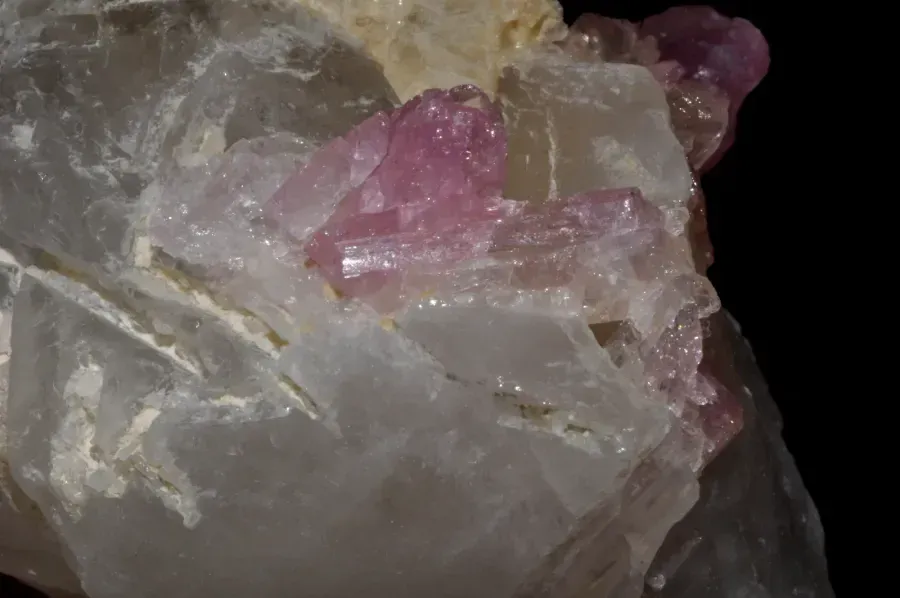
Tourmaline is notorious for zoning. Within a single crystal the colour sometimes shifts along the length and across the width, so you find tourmalines with a core of one colour and a rind of another. For blue material this means that a single piece of rough contains zones of different saturation, and the cutter is quite literally choosing which part of the crystal to use. The trait connects indicolite to watermelon tourmaline, where a pink core sits inside a green rim.
The blue sits on a narrow chemical margin
The difference between a pale sky blue and a dense ink blue comes down to fractions of a per cent of iron and to its valency state. Slightly more ferric iron and the hue slides towards green; add manganese and a brown or pink cast appears. A clean blue with no green in it is a stroke of luck in the composition rather than the norm, which is the single biggest reason good indicolite is scarce. The red dominant side of the family works the same way: the saturation of rubellite hangs on the same fine balance of trace elements.
The name is younger than the stone
The word indicolite came into use only in the nineteenth century, when tourmalines began to be sorted into named varieties. Before that, blue tourmaline travelled the world for fifteen hundred years under other people's names, taken for sapphire, for blue topaz, for an unidentified blue gem. Plenty of blue stones in old European treasuries and church plate, catalogued for centuries as sapphire, turned out to be tourmaline once anybody measured a refractive index. The stone is ancient; its honest name is recent.
Send a friend a discount code, they save on their first order.
The symbolism of blue tourmaline, with a sober caveat
The important thing first: no stone heals anything or alters anybody's fate, and minerals have no demonstrated properties of that kind. What follows is about cultural meaning and personal association, not about medicine and not about magic.
The colour of calm and clear speech
Blue has been linked with stillness, depth and honesty for as long as anybody has written about colour. Cool tones genuinely do have a settling effect on people, which is ordinary colour psychology rather than mysticism, and that is the foundation of the everyday symbolism attached to indicolite: a stone of composure, attention and quiet confidence. In traditions that work with chakras, deep blue is associated with the throat and with the so called third eye, that is with speech and clarity of thought. Treat that as a good metaphor rather than as an instruction.
A connoisseur's stone rather than a status one
Unlike sapphire, indicolite carries no freight of status expectation. Nobody wears it to prove a point, largely because most people who see it will not know what it is. That has given it a reputation as a stone bought for oneself, the choice of somebody who values rarity and natural material over a famous name. In that sense its symbolism is the symbolism of restraint and private taste, and it is one of the few gems where being unrecognised is part of the appeal.
As a gift
Blue tourmaline is given as a sign of a deep, calm regard, without display. The occasions it suits are anniversaries and personal milestones, the moments when you want something rare but quiet. If the person receiving it appreciates unusual stones and is not chasing recognisable names, indicolite lands exactly right. If they would rather have the name than the stone, it will not, and sapphire is the honest answer instead.
Buying it as a gift? Each one arrives ready to give.
 A branded Zevira box and a little card come with every order.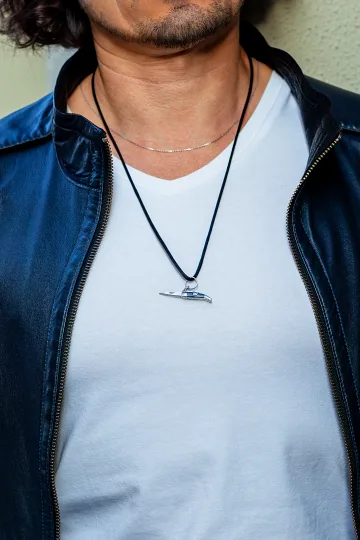






Namibia and African blue tourmaline
Africa has been added to the classic list of sources over the past few decades, and it deserves a separate note, because African material has noticeably widened the supply of blue tourmaline.
Namibia
Namibian pegmatites yield tourmaline in a range of colours, blue among them. Local indicolite is valued for its clarity and often sits in a more accessible segment than top Brazilian material. Some Namibian blue carries a slight green or turquoise cast, which is corrected where necessary with gentle heating. Namibia has a long gemmological history, and the country's pegmatite belt has been worked commercially since the early twentieth century.
Nigeria and Mozambique
The Nigerian and Mozambican deposits made their names with other tourmalines, but they produce blue material alongside. African tourmaline as a whole has made coloured tourmalines more available, and blue shades now appear in the mid segment rather than only in the collector market. For a British buyer this is the main practical change of the past twenty years: indicolite has moved from something you would have had to seek out at a specialist dealer or a gem fair to something a good independent jeweller can source.
What this means for a buyer
Origin affects colour and it affects price, but it does not make a stone better or worse in itself. A clean Namibian blue can easily outshine a dull Brazilian one. Judge the stone in front of you: colour, clarity, cut and whether it has been treated, rather than the name of a deposit in the description. Origin determination for tourmaline is far less developed than it is for sapphire or emerald in any case, so an origin claim on a mid range stone is usually a seller's assertion rather than a laboratory finding.
Frequent questions about indicolite
Are indicolite and the indigo dye the same thing?
No. Indigo is a blue organic dye, historically from a plant, now synthetic. Indicolite is a mineral, a variety of tourmaline. The stone was named for the similarity of its colour to that dye, nothing more.
How does indicolite differ from sapphire?
They are different minerals. Sapphire is corundum (Al₂O₃), indicolite a borosilicate of the tourmaline group. Sapphire is harder (9 against 7.5) and hardier, its pleochroism weak. Indicolite is softer and calls for care, but gives strong pleochroism and turns up less often. For everyday wear sapphire is the more practical, while indicolite is the more collectible choice.
Can indicolite be worn in a ring every day?
You can, but with care. A hardness of 7.5 protects against scratches, but the risk of chipping is higher than with sapphire. Knocks against hard surfaces and sharp temperature changes are the danger. If you wear it daily, choose a protective closed setting, a rounded cut and a moderate size, and avoid working with your hands. Many prefer to keep indicolite for special occasions.
How can I check pleochroism at home?
Look through the stone in daylight and slowly turn it about its long axis. Indicolite will show a colour shift from deep blue to a lighter tone. If the colour is the same from every angle, it is either not indicolite or a poorly oriented cut. Synthetic sapphire gives no such shift.
Does indicolite glow under ultraviolet?
Usually not, or it glows very weakly. A bright orange or yellow fluorescence is a reason to suspect dyed glass.
Does indicolite fade over time?
No, the natural blue is stable and does not fade. Visible dulling is usually caused by a film of sweat, skin oil and dust; after cleaning the brightness returns. If a stone is dull even after cleaning, it is worth checking for microcracks or worn facets.
Is indicolite heated to improve its colour?
More often not: the natural colour is usually good enough. Sometimes a light heating removes a greenish or violet cast. The treatment is stable and acceptable, but it should be stated in the certificate; untreated stones are valued higher.
How does indicolite differ from Paraiba?
Both are blue tourmalines, but indicolite is coloured by iron and gives a calm deep blue, while Paraiba is coloured by copper and glows a neon blue-green. Paraiba is an order of magnitude rarer and dearer.
Is there a synthetic indicolite?
Yes, tourmaline is grown in the laboratory; chemically it is identical to the natural kind but almost free of natural inclusions. It is rare, and more often other cheap blue stones are passed off as indicolite. In doubtful cases the variety is determined by a gemmological laboratory.
Is there a cat's-eye indicolite?
Very rarely. The effect arises with a mass of parallel needle-like inclusions and shows on a smooth cabochon. Such stones are a rarity within a rarity.
Does indicolite suit men?
Yes. The deep blue looks strict and restrained, especially in signet rings and cufflinks. For a man's piece a large stone in a protective setting, a simple cut and a minimal design work well.
What size is best for a ring?
For an everyday ring one and a half to two carats is sensible: the stone shows its colour and pleochroism but stays protected. Above three carats is a noticeable accent for special occasions. Very small stones under half a carat lose the play of colour that indicolite is valued for.
Does indicolite go better with gold or silver?
Cool metals, white gold and platinum, emphasise the blue and give a strict look. Silver harmonises well too, but needs care against tarnishing. Yellow gold gives a warm contrast that suits a vintage style more.
Can indicolite be handed down as an heirloom?
Yes. With careful storage the stone neither fades nor breaks down, and old examples look as they did when bought. Pass it on together with the certificate and the provenance details, and check the setting periodically.
What to do if an indicolite cracks?
Take the piece off and bring it to a jeweller or gemmologist. Sometimes the crack is superficial and the stone can be recut, sometimes the damage is more serious. Crack-filling exists, but collectors regard it as an intervention that lowers value. The best prevention is a protective setting and care against knocks and thermal shock.
Wear the symbol, don't just read about it. These are in stock:


About Zevira
In the Zevira collection, indicolite appears as part of the range of rare blue stones for those who value gemmological rarity and a natural blue. We choose the cut so the colour opens up fully, and the setting so the stone is protected in wear. No two indicolites are alike, so each piece with it is unique in its own way.
Each stone comes with details of its variety, colour and treatment, and for the costlier examples a gemmological report and care recommendations. If you are choosing indicolite as a rare blue stone for everyday wear or for a special occasion, we will help you find something in tune with your taste.
Open the Zevira catalogue and find a piece with blue tourmaline that is in tune with your style.