Iolite: the Viking stone, violet-blue pleochroism and how to choose it
Three centuries before the magnetic compass reached Europe, Norse sailors crossed the North Atlantic without instruments. One theory says they carried a "sunstone", a clear crystal they used to find the sun when it hid behind cloud. The leading candidate for that role is iolite. A stone that changes colour when you turn it in your hand.
This article is about iolite without any promise that the stone will cure something or pull money toward you. Instead you get geology, chemistry, the real history of seafaring, the optical physics of pleochroism, clear buying criteria and ways to avoid mistaking iolite for sapphire or tanzanite. Iolite is one of the most underrated blue gems, and the reason is simple: almost nobody bothers to explain it properly.
What iolite is: mineral, formula and the physics of the stone
Iolite is the gem variety of the mineral cordierite. Chemically it is a magnesium aluminium silicate with the formula Mg2Al4Si5O18, although in nature some of the magnesium is almost always replaced by iron. That iron is exactly what gives the stone its recognisable blue-violet colour.
The name "iolite" appeared in the early nineteenth century and comes from the Greek "ios", violet. Literally "the violet stone". The name describes the finest specimens precisely: a deep violet-blue tone that recalls a violet petal or a summer sky at dusk. The mineral cordierite itself was named after the French geologist Pierre Louis Antoine Cordier, who described it in 1809. Science uses the word "cordierite", the jewellery trade says "iolite". It is the same stone, just different contexts.
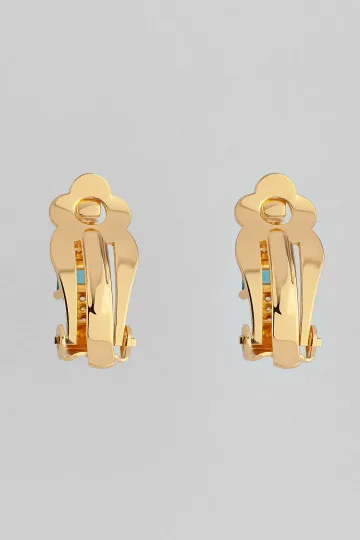
Wear the symbol, don't just read about it. These are in stock:


Physical properties in brief
Here are the main characteristics in one place:
- Mineral: cordierite.
- Formula: Mg2Al4Si5O18 (a magnesium aluminium silicate with an iron impurity).
- Crystal system: orthorhombic (a biaxial crystal).
- Mohs hardness: 7 to 7.5.
- Density: roughly 2.55 to 2.66 g/cm3, so the stone is fairly light.
- Refractive index: about 1.53 to 1.58, noticeably lower than sapphire.
- Lustre: vitreous, transparency from transparent to translucent.
- Cleavage: distinct in one direction (the stone's main weakness).
- Optics: strong pleochroism, more precisely trichroism, three different colours along three axes.
The low refractive index and low density are handy markers for a gemmologist: they tell iolite apart from a similar-looking sapphire. And the low density gives the buyer a pleasant bonus: at the same carat weight, iolite looks slightly larger than denser stones.
Cleavage and brittleness in practice
Cleavage is a crystal's tendency to split along planes where the bonds between atoms are weaker. Iolite has one such plane, and a sharp blow precisely along it can crack the stone even when the hardness would resist a scratch. So despite respectable hardness, iolite is considered relatively brittle and needs a protective setting in rings and bracelets. A cutter takes this into account and tries to orient the stone so the cleavage plane is never under stress.
An old trade name: water sapphire
Iolite has a historical name that still surfaces in antique descriptions: "water sapphire" (saphir d'eau). It came from the French gem trade and reflects two things. First, a blue colour resembling sapphire. Second, a quirk of iolite: depending on the angle it is either deep blue or almost colourless, as if diluted with water.
Yet iolite has nothing to do with true sapphire. Sapphire is corundum, aluminium oxide, hardness 9 on the Mohs scale. Iolite is a silicate, hardness 7 to 7.5. The name "water sapphire" is purely commercial and is considered obsolete today.
What the stone looks like
A good iolite is deep blue with a clear violet undertone. In the light it recalls tanzanite or a blue-violet sapphire, yet it costs noticeably less. Vitreous lustre, medium transparency and that sharp pleochroism collectors love it for. That gets its own chapter, because it is the most interesting thing about iolite.
Geology and deposits: where iolite comes from
How cordierite is born
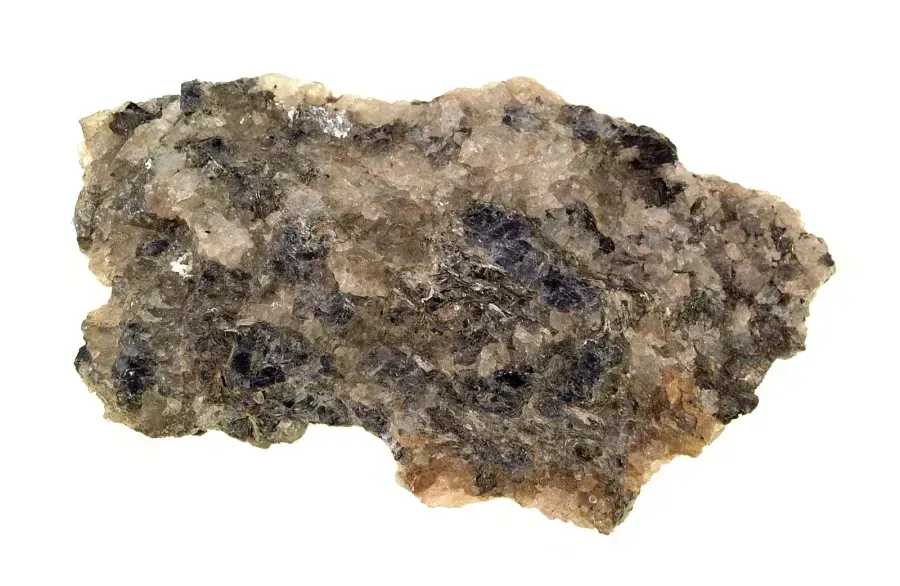
Cordierite is a mineral of metamorphic rocks. It forms when aluminium-rich sedimentary rocks (ancient clays and shales) sink to great depth and meet temperatures usually above 500 degrees at moderate to high pressure. The atoms rearrange, and crystals of cordierite are born out of the clay mass. Geologists find it in gneisses, schists and granulites, and more rarely directly in granites and volcanic rocks.
Gem crystals are most often mined from secondary, alluvial placers: the bedrock breaks down over millions of years, and the heavy, durable grains of iolite collect in river sediments alongside other gems. Gem-quality crystals are rare: most cordierite in nature is cloudy and cracked.
The world's main deposits
The chief suppliers of gem iolite today are South Asia and East Africa.
- Sri Lanka. The historical home of many blue stones. The Ceylon placers yield good blue iolite together with sapphires, spinel and garnets.
- India. One of the largest sources by volume. Deposits in the states of Andhra Pradesh, Tamil Nadu and Odisha. Indian iolite goes to the mass market.
- Madagascar. A comparatively young but important source. It produces deeply blue stones, sometimes large.
- Tanzania and Kenya. East Africa supplies iolite of a deep tone. The rare blood-red variety comes from here too.
- Myanmar (Burma). A source of high-quality material, though iolite volumes are small.
- Brazil. Deposits in the state of Minas Gerais yield iolite alongside the region's whole array of coloured stones.
Cordierite is also found in Canada, Norway, Finland, Germany, Namibia and the USA (especially in Connecticut and Wyoming), but more often as a mineralogical rather than a gem material.
Why good iolite is rare
The paradox of iolite is that cordierite itself is common in the Earth's crust, while transparent crystals of saturated colour and free of cracks are rare. Most of the material mined is cloudy, pale or peppered with inclusions. The larger the stone, the harder it is to find a clean one: iolite is prone to cracking along its cleavage planes.
Inclusions and treatment
Iolite often contains inclusions, and from them a gemmologist can even tell where a stone came from: needle-like tubes, tiny crystals of other minerals, platelets of iron-bearing minerals that in special cases produce the bloodshot iolite or cat's-eye effect. Small inclusions are not seen as a flaw. Large cracks are dangerous: along them the stone can split on impact or under a temperature change.
Good news for the buyer: iolite is almost never treated. Unlike many sapphires and tanzanites, which are heated to improve colour, iolite is usually sold in its natural state. Heating does not help it and is even risky because of the brittleness. So the colour of iolite you see is almost certainly real, laid down by nature.
Customer reviews
Zevira is a real jewellery shop. Genuine payments, deliveries and customer thank-yous.
🥰🥰🥰 gracias

Ok, ¡gracias! 🙂

Iolite wants grey, denim and a turn of the wrist. On warm camel it sulks grey, so don't you dare stand still in it.
What to wear iolite with
I have built this violet-blue into looks for more than a few seasons, and iolite is one of those stones a wrong backdrop ruins fast. Here is what holds up on set, sorted by occasion.
Which iolite for every day? For an everyday look I recommend small studs or a fine teardrop pendant in silver. The cool blue reads best against grey, charcoal, white and any denim, so I suggest building the outfit around a cool palette. A light top lifts the stone, a dark one turns it into the focal point. Under a roll-neck or a sturdy shirt I choose a shorter chain so the iolite sits on the fabric instead of hiding.
Does iolite work at the office? As few blue gems do. I recommend a restrained size, silver or white gold, a 45-50 cm length so the pendant slips under the top button. Iolite never shouts and never looks cheap, so for a strict dress code I choose it over a loud sapphire tone. One expressive detail, nothing piled on.
How do I build an evening look? For the evening I suggest a large stone of a deep tone: drop earrings or a cocktail ring against a dark or silvery outfit. Iolite's pleochroism works on movement, so the bolder the gesture, the stronger the shift of shade. An open boat neck or a V lengthens the neck and opens the stone to the light, which is its best stage.
Which metal suits iolite? Silver and white gold deepen the cool blue and are the safe choice for any skin tone, and that is what I recommend by default. Yellow or rose gold gives a warm contrast and livens a stone of medium saturation, so for a warm undertone I choose those. Rhodium-plated silver adds a crisp edge to the blue.
Which stones do I pair with iolite? I take iolite two ways: in harmony with a cool blue-violet palette or in contrast with a warm one. Moonstone with its milky shimmer, amethyst and grey-blue labradorite sit well beside it for a northern feel. For contrast I choose yellow stones and yellow gold, or stern onyx and haematite that make the blue brighter. One rule: do not set iolite flush against very hard stones in a bracelet, they will scratch it.

Turn on your camera, pick earrings, a pendant or a ring, and see the piece on yourself in real time.
Switch items in one tap.
Everything runs in your browser: no photo or video is ever uploaded.
The history of iolite: Vikings, the sunstone and navigation
The history of iolite rests on one captivating hypothesis, and we will tell it carefully, without exaggeration. It is about Viking navigation.
The problem of navigating without a compass
The Norse sailors of the Viking age (roughly the eighth to eleventh centuries) crossed the open ocean between Norway, Iceland, Greenland and the shores of North America. There was no magnetic compass in Europe then: it arrived later, around the twelfth to thirteenth centuries. Stars are no help in northern latitudes in summer, with white nights when the sky never darkens. That left the sun. But the North Atlantic means fog, low cloud and long overcast days when the solar disc is invisible.
The sunstone hypothesis
The Icelandic sagas, in particular one version of the "Saga of Saint Olaf", mention a mysterious "sólarsteinn", a sunstone. According to the text it was used to find the sun's position in overcast weather. For a long time this was treated as a charming legend. But in the mid twentieth century the Danish archaeologist Thorkild Ramskou proposed a physical explanation: some transparent minerals react to the polarisation of light, and through them you can work out the direction of the hidden sun from the way the sky glows.
Skylight is polarised, and that polarisation forms an invisible pattern across the sky centred on the sun. A crystal with strong pleochroism changes its brightness depending on how it is oriented relative to that polarisation. By turning the stone and noting where the glow is strongest or weakest, an experienced person can pin down the sun's azimuth even under solid cloud, to within a few degrees.
Where iolite fits in
Iolite is one of the prime candidates for the sunstone, because it has one of the most pronounced pleochroisms among transparent minerals: it changes colour sharply when turned, visible to the naked eye, without any instrument. To use it you do not need to understand the physics of polarisation, it is enough to notice empirically that in one direction the stone is blue and in another pale, and to link this with the sun's position. Iolite occurs in Scandinavia and neighbouring regions, which made it available to northern sailors. Other candidates that scholars discuss are Iceland spar (transparent calcite with double refraction) and tourmaline.
But let us be honest: not a single physical sunstone with a confirmed navigational role has been found in Viking burials. In 2013, in the wreck of a sixteenth-century ship that sank off the island of Alderney, a crystal of Iceland spar was found next to navigational instruments, which fanned interest in the subject, but that is already the era after the Vikings. The correct way to put it is this: people linked iolite with sun navigation for centuries, the hypothesis is physically plausible, but there is no direct archaeological proof specifically for iolite.
Experiments testing the legend
The hypothesis has not stayed pure theory. In the twentieth and twenty-first centuries researchers took crystals with strong pleochroism and, under an overcast sky, tried to find the sun's position by watching the stone change brightness. In principle it works: an experienced observer locates the azimuth of the hidden sun to within a few degrees, which is enough for a rough course on the open sea. The behaviour of polarised light at high latitudes was studied separately: even under solid cloud part of the polarisation survives, especially at twilight when the sun is already near the horizon. These studies do not prove that the Vikings used iolite specifically, but they show the physical mechanism is real.
Iolite before and after the nineteenth century
Before cordierite received its scientific name in 1809, blue transparent stones were rarely told apart. Blue iolite, blue sapphire, blue spinel and aquamarine could all pass under shared trade names. Iolite often went as "water sapphire". This makes its early history hard to trace: the stone existed, but under other names.
After Cordier's work the mineral took its place in mineralogy. In the nineteenth century cordierite was studied as an indicator of metamorphic conditions: from it geologists worked out the pressure and temperature at which a rock had formed. Around the same time iolite entered the jewellery of the European nobility as an inexpensive but beautiful alternative to sapphire, set into brooches, signet rings and pendants, prized for its deep blue. Because the stone often went under the name "water sapphire", it is easy to miss in old inventories. Antique dealers even today sometimes discover that the blue stone in an old piece is actually iolite, not the sapphire it was thought to be.
In recent decades iolite has been quietly making a comeback. Rising prices for sapphire and tanzanite pushed buyers to look for more affordable blue stones, while advances in cutting let craftsmen reveal its colour better than the masters of the past managed.
Upload a photo of your pet, someone you love, or an object. We'll build a 3D model and hand-cast it in pewter.




Pleochroism: why iolite changes colour in your hand
This is the heart of the whole article. Pleochroism is the property iolite is worth knowing for in the first place. And it is not magic but optical physics, which can be explained in a couple of paragraphs.
What pleochroism is in plain words
Pleochroism is a crystal's ability to show a different colour depending on the direction in which light passes through it. In iolite it is more pronounced than in almost any other popular gem. Turn a cut iolite between your fingers and it will move from a deep violet-blue to a lighter blue, and along a third direction it will become almost colourless or a yellowish grey.
Why this happens
Iolite belongs to the biaxial crystals of the orthorhombic system. Its atomic lattice is arranged so that light travelling along different axes is absorbed differently. One axis lets through mostly blue-violet light, another a pale blue, the third nearly all the light, so the stone looks colourless in that direction. The eye reads this as a change of colour when the stone is turned. In iolite the pleochroism is three-coloured (trichroism): three different colours along three axes, whereas most pleochroic stones show only two (dichroism).
Why pleochroism is a headache for the cutter
For the craftsman the pleochroism of iolite is a challenge. The stone has to be oriented in the rough so the most saturated blue faces the table, that is, is seen from above when the stone is set. If the cutter gets the orientation wrong, the finished stone will look pale or grey, however good the original crystal was. This is exactly why two iolites of the same size can be priced quite differently: it all comes down to the cut and how the colour has been revealed.
The link with navigation
Now it is clear why iolite in particular is linked to the sunstone. Strong pleochroism means the stone reacts sharply to its orientation relative to the polarised light of the sky. By turning iolite and watching the brightness, you can in theory feel out the direction of the polarisation and through it the azimuth of the hidden sun. The method gives an accuracy of a few degrees in favourable conditions, which is enough on the open ocean to hold a general course, especially together with other techniques: watching birds, swells and the colour of the water. A sunstone, if the Vikings had one, would have been one tool in the kit, not the single miracle.





Shades and varieties of iolite
The colour of iolite is set by its iron content and by the angle from which you look at the stone. The range is wider than it seems at first glance.
Classic violet-blue
The benchmark iolite is a saturated blue with a violet undertone, that very "violet" colour that gave the stone its name. This shade is prized above all. The best specimens come close to a blue-violet sapphire in appearance, and an untrained eye easily confuses them.
Blue, blue-grey and pale
Some stones have a cooler, purer blue tone without a marked violet. This is good material too. Pale blue-grey specimens are cheaper: they lack saturation. Because of pleochroism, iolite always has a direction in which it is almost colourless or a yellowish grey. If the stone is poorly cut, that pale axis ends up facing the table, and the whole stone looks dull.
Bloodshot iolite
A rare and curious variety from East Africa and Sri Lanka. Inside the stone sit oriented inclusions of reddish haematite or iron that, in certain lighting, throw red sparks against a blue background. In English it is called bloodshot iolite. The effect recalls aventurine and is prized by collectors for its oddity.
Cat's-eye and star iolite
Very rarely you find iolites with fine parallel inclusions that, in a cabochon cut, give a narrow band of light, the cat's-eye effect (chatoyancy). Rarer still, inclusions in different directions combine to give a faint star. Such stones are one-offs and of interest above all to collectors.
What sets the value of a shade
The main criterion is the saturation and purity of the blue with its violet undertone, seen from above through the table. The deeper and more even the colour, the less grey and pale, the more the stone is worth. Size matters secondarily: a large but cloudy iolite is cheaper than a small but bright, clean one.
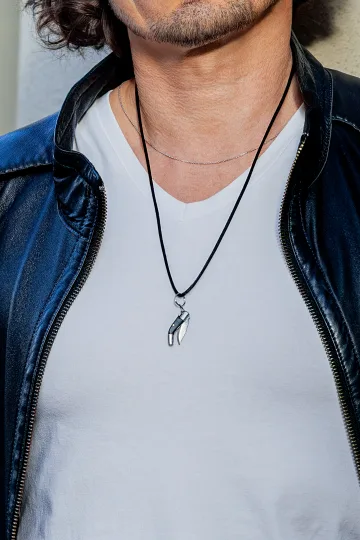
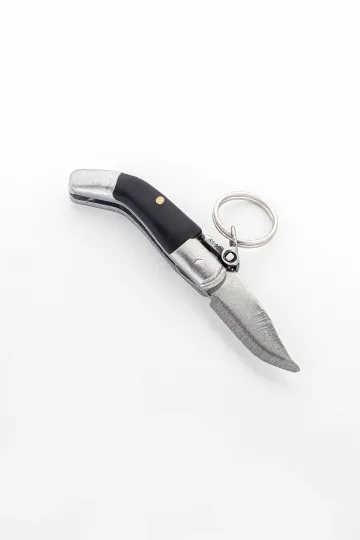
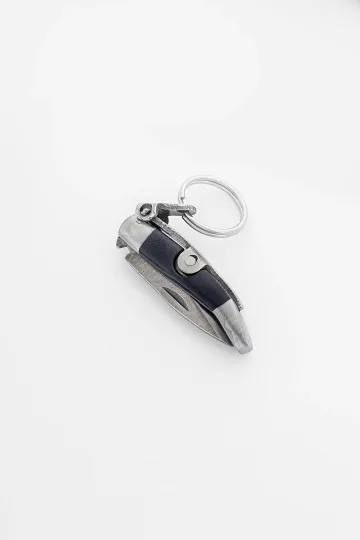
CAPAORA mini knife pendant
The 18th-century Spanish navaja in miniature: 40 mm of stainless steel, a real folding mechanism and a Palanquilla lock that clicks. An affordable gift to remember.
Authentic · Ships from Spain · 14-day returns
Iolite jewellery: rings, pendants, earrings, bracelets
Iolite behaves its own way in jewellery: hardness 7 to 7.5, marked cleavage and brittleness, strong pleochroism. Let us go through the types of piece.
Rings
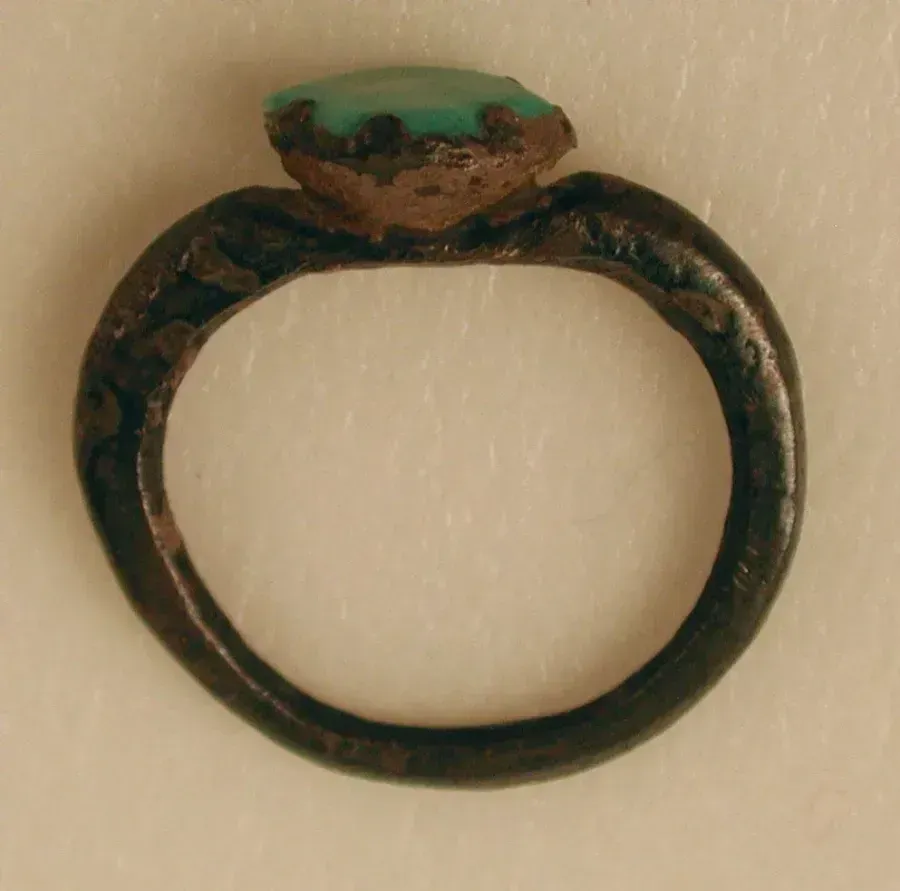
The ring is the most demanding format for the stone, because hands meet knocks most often. Iolite's hardness copes with everyday scratches, but the cleavage makes it vulnerable to a sharp blow on a facet. So for an everyday ring it is better to choose a protective setting: a closed bezel, where the metal wraps the stone all round, or a flush mount, where the stone does not stand proud.
A good metal is 925 sterling silver or gold. Silver emphasises the stone's cool blue tone. You can read more about the material in our guide to 925 sterling silver. Warm yellow gold gives an interesting contrast with the blue, while white gold or rhodium-plated silver deepens the cool depth. A cocktail ring with a large iolite looks striking but calls for especially careful wear.
Pendants
The pendant is the friendliest format for iolite. On the chest the stone is sheltered from knocks, and you can confidently pick a large specimen so the pleochroism plays with every movement. A teardrop or oval pendant in a deep blue tone looks noble and needs no constant worry about its safety. The right cut matters: the stone is seen by transmitted light, and if the pleochroic axis has been brought out well, in the light the pendant shimmers blue and violet.
Earrings
Earrings do not take knocks the way rings do, and here iolite reveals itself in all its glory. Long drop earrings catch the light from different angles, and the pleochroism works with every turn of the head. Studs with a small iolite are a restrained everyday choice, while for the evening large drops or a pear cut suit well. Because of the low density, large iolite earrings wear more lightly than the same in a dense stone: they do not overload the lobe.
Bracelets and sets
In a bracelet iolite is more often found as beads or small cut inserts. A bracelet, like a ring, is exposed to knocks against tables and door handles, so large protruding stones are risky here. A strand of iolite beads in different shades, on the other hand, looks lively precisely thanks to the natural difference of tone between the grains. A set of pendant and earrings looks whole if all the stones are matched in tone from one parcel: because of pleochroism, two iolites can easily turn out different in colour.
Cut and shape
The shape of the cut affects how iolite is revealed. Step cuts such as the emerald cut, with large tables, show the purity of colour and suit deep, saturated stones. The brilliant and mixed cuts add play of light and liven up a stone of medium saturation. The cabochon suits stones with inclusions and is essential for the cat's-eye and star effects. The oval and pear are versatile for pendants and earrings. One key condition holds: the blue pleochroic axis must face the table, or the stone will look pale from above.
Iolite in men's jewellery
The deep blue looks good in men's jewellery too: a signet ring with a dark iolite, cufflinks, a tie clip or a plain pendant on a leather cord. The northern, Viking association adds character to the stone and pairs with restrained silver. For a man's ring a protective setting matters especially, because men's hands take more strain.
Leave your email, we'll send your discount code. No spam, unsubscribe anytime.
The code arrives by email, valid on your first order.
Caring for iolite
Iolite asks for a little more attention than hard stones like sapphire, but the rules are simple, and if you follow them the piece will last for decades.
Cleaning
The best way is warm (not hot) water with a drop of neutral soap, a soft toothbrush or cloth, especially under the stone where dirt builds up. Then rinse with clean water and dry with a lint-free cloth. Ultrasonic and steam cleaning are out: because of the cleavage and possible cracks iolite can split. No acids, acetone, bleach or abrasive pastes.
If iolite looks dull, the cause is almost always dirt, not the stone: skin oil and film settle on the surface and the light passes through the stone less well. Iolite does not fade, it is not treated and there is nothing to dye it with, so a dulling is simply a signal to wash the piece.
Storage
Keep iolite separate from other jewellery. Harder stones (diamonds, sapphires, topazes, rubies) will easily scratch it. A soft fabric pouch or a separate, padded compartment in a box works best. Take the piece off before sport, cleaning, the shower, sleep and work with your hands.
Water and temperature
Iolite does not mind brief contact with cool water, but hot water, sharp temperature changes, steam and aggressive chemistry are dangerous: because of internal stresses the stone can split under thermal shock. A shower, a hot bath, a sauna, a chlorinated pool, seawater and washing up with detergent are all reasons to take the piece off.
Inspecting the setting
Every few months check the setting, especially on rings and bracelets: are the prongs or bezel holding the stone firmly, is there any play. If the stone has started to wobble, the risk of a blow on a facet and a chip rises sharply, so do not wear the piece until you see a jeweller. A preventive check with a craftsman once a year extends the life of any piece with a brittle stone.
Quality, choosing and how to spot a fake
Four criteria for choosing
- Colour. The main thing. Look for a saturated violet-blue seen from above. A pale, grey or cloudy stone is cheap for good reason.
- Clarity. Small inclusions are acceptable, but large cracks are dangerous: the stone can split.
- Cut. Because of pleochroism the cut decides everything. Turn the stone: if it is pale or grey from above, the cut is poor.
- Size. Large clean iolites are rare and prized, but a small bright stone is preferable to a large cloudy one.
How to tell it from similar stones
Iolite is most often confused with sapphire, tanzanite and blue glass or synthetics.
From sapphire, iolite is told apart by pleochroism and hardness. Sapphire is pleochroic too, but more weakly, and it is noticeably harder (9 against 7 to 7.5). It is harder to tell from tanzanite: both are strongly pleochroic, but tanzanite leans more often toward purple, is softer (6.5 to 7) and is almost always heated. A gemmologist tells them apart reliably by refractive index and density.
From glass and synthetics, iolite is told apart precisely by trichroism: glass does not change colour on turning at all. If an "iolite" is equally blue from every side and suspiciously clean and cheap for a large size, be wary. Synthetic iolite exists but is rare: natural material is affordable as it is, so growing it does not pay, and the main risk is not synthetics but an imitation in glass or a swap for another stone.
A simple home test and documents
The most accessible test is to turn the stone in daylight and watch the shade change. A real iolite will show a shift from blue to a lighter and almost colourless tone along the different axes. A complete absence of colour change is a reason to doubt. For an inexpensive iolite a certificate is overkill, but for a large purchase it is useful to get a report stating the mineral name (cordierite/iolite), weight, dimensions and a note on the absence of treatment. Since iolite is almost never heated, an honest seller will confirm this easily.
Iolite among the blue stones: where it belongs
There are many blue gems and it is easy to get lost. Let us compare iolite with its neighbours.
Sapphire is the king of blue stones: harder (9 against 7 to 7.5), more durable, with a loud name, but also many times more expensive. Iolite gives a similar deep blue for a small fraction of the price. Tanzanite is closest to iolite in appearance: both are blue-violet and strongly pleochroic, but tanzanite is softer, almost always heated, dearer and mined in one spot on the planet. Aquamarine is a gentle pale-blue beryl, lighter and clearer, harder (7.5 to 8), with a different character: airy pale blue against the deep violet-blue of iolite. Lapis lazuli is an opaque saturated blue with golden flecks of pyrite, a wholly different look: dense and matt against the transparent, shimmering iolite.
In short: status and permanence come from sapphire; a softer blue-violet shimmer from tanzanite; an airy pale blue from aquamarine; a dense ancient blue from lapis lazuli. And a deep violet-blue with strong pleochroism, natural colour, an affordable price and the Viking legend is iolite.
Send a friend a discount code, they save on their first order.
Meaning and symbolism: with a sceptical eye
Iolite is credited with various properties, and they are worth telling as a cultural phenomenon, not as a medical or physical fact. Let us say at once: none of these properties is proven, iolite does not cure illness and does not affect sleep, blood pressure or anxiety. This is folklore and tradition, not medicine.
Most of iolite's symbolism took shape late, in the twentieth century, on the wave of interest in crystal healing. Ancient sources say almost nothing about the meaning of iolite specifically, because the stone was not then separated from other blue gems. The modern meanings grew straight out of the navigational story: the stone that helped the Vikings see the hidden sun became, in tradition, a symbol of vision, clarity and finding one's way. From the same story grows iolite's reputation as a talisman of travellers and of those seeking their own road.
A similar symbolism of honesty and clear speech is linked in tradition to indicolite, the blue tourmaline, so these two blue stones echo each other in meaning. And the "third eye" zone and intuition are credited in crystal lore to another blue gem, sodalite, with which iolite is often placed side by side. All of this is part of the esoteric tradition, not a scientific fact. The convenience of iolite's symbolism is that it is coherent and all grows from one beautiful story, rather than from a random set of beliefs.
Buying it as a gift? Each one arrives ready to give.
 A branded Zevira box and a little card come with every order.













Frequently asked questions
What is iolite in plain words
Iolite is a blue gem with a violet sheen, the gem variety of the mineral cordierite. Its main feature is pleochroism: the stone changes colour when you turn it. In colour it resembles sapphire or tanzanite, but it costs less. The name comes from the Greek word for "violet". The stone is natural, almost never treated, so the colour you see was laid down by nature itself.
Is it true that iolite is the Viking stone
This is the best-known legend about iolite, and it should be treated as a plausible hypothesis rather than a proven fact. The Icelandic sagas mention a "sunstone" that helped find the sun through cloud. Twentieth-century scholars suggested it was a transparent mineral with strong pleochroism, and iolite is one of the prime candidates alongside Iceland spar. The physics allows it, but not a single confirmed navigational iolite has been found in Viking burials.
What is the pleochroism and trichroism of iolite
Pleochroism is a stone's change of colour depending on the direction along which light passes through it. In iolite it is three-coloured (trichroism): along one axis the stone is a saturated violet-blue, along another a pale blue, along the third almost colourless. The cause lies in the crystal's structure: the atomic lattice absorbs light of different directions differently. Iolite's pleochroism is one of the strongest among gemstones. This same property makes cutting difficult: the craftsman has to bring the blue axis to the top.
How does iolite differ from sapphire
Sapphire is corundum, aluminium oxide, hardness 9 on the Mohs scale. Iolite is the silicate cordierite, hardness 7 to 7.5, noticeably softer and with marked cleavage. Both are blue, but iolite's pleochroism is stronger and its price an order of magnitude lower. Sapphire is often heated, iolite almost never treated. They can be confused at a glance in small sizes, but a gemmologist tells them apart easily by refractive index and hardness.
How does iolite differ from tanzanite
These are the most similar stones, both blue-violet and strongly pleochroic. Tanzanite leans more often into a purple-violet, iolite holds a purer blue with a violet tone. Tanzanite is softer (6.5 to 7) and almost always heated, iolite is natural. Tanzanite is mined in one place in the world, iolite in several countries. They can be reliably told apart in a lab by their optical constants.
Natural or artificial iolite, and how to spot a fake
The vast majority of iolite on the market is natural stone. A synthetic exists but is rare: the natural is affordable as it is. Far more often blue glass or another cheap blue stone turns up posing as iolite. Telling them apart is simple: a real iolite changes colour when turned thanks to pleochroism, glass stays equally blue from every side. A "iolite" that is too large, perfectly clean and yet cheap should put you on guard. Only a lab can finally confirm the authenticity of an expensive purchase.
Can iolite be worn every day, and does it fear water
Yes, with caveats. A hardness of 7 to 7.5 resists everyday scratches, but the cleavage and brittleness make the stone vulnerable to knocks. For daily wear earrings and pendants, where the stone is sheltered, suit best. A ring can be worn in a protective closed setting, taken off before physical work. Iolite does not fear brief contact with cool water, but hot water, temperature changes, steam, chlorine and sea salt are dangerous. Ultrasonic baths are forbidden.
Is iolite suitable for an engagement ring
Technically yes, but with care. Iolite is beautiful and unusual, and an engagement ring with it stands out among the familiar diamonds. However, a hardness of 7 to 7.5 and marked cleavage make it more vulnerable than the classic engagement stones. Choose a protective closed setting that covers the facets, and be ready to wear the ring more gently. For a very active lifestyle iolite is not ideal. There is more about choosing a ring in our guide to engagement rings.
Which colour of iolite is the most valuable
The most valuable is a saturated violet-blue, that very violet tone, seen from above through the table of the cut stone. The colour should be deep and even, without a grey or pale shade. You must look precisely from above, as the stone is seen when set, because pleochroism makes it look different from the side. A good cut bringing the blue axis up raises the value, a poor one turns even a quality crystal dull.
What is bloodshot iolite
Bloodshot iolite is a rare variety with reddish sparks against a blue background. The effect is created by small oriented inclusions of iron or haematite inside the stone: in certain lighting they flash red. It occurs in East Africa and Sri Lanka and is prized by collectors for the unusual combination of blue and red in one stone. It is not a flaw but a feature, and on the mass market it turns up rarely.
Is iolite treated
Almost never. This is one of the stone's chief virtues: it is usually sold in its natural state, without heating or impregnation. The heating that improves the colour of many sapphires and tanzanites does not help iolite and is even dangerous because of the brittleness. So the colour of iolite is almost certainly natural. For a large purchase an honest seller will easily confirm the absence of treatment with a gemmological report.
Why is iolite called water sapphire
The name came from the old French gem trade. First, the blue colour of iolite resembles sapphire. Second, because of pleochroism the stone in one position is deep blue and in another lightens almost to colourless, as if diluted with water. Today the name is considered obsolete, because iolite has nothing in common with true sapphire: they are different minerals with different hardness and composition. On antique pieces it still turns up.
Where is iolite mined
The chief sources of gem iolite are Sri Lanka, India, Madagascar, Tanzania, Kenya, Myanmar and Brazil. Sri Lanka is historically known for good-quality blue stones, India gives large volumes for the mass market, Madagascar supplies saturated blue stones, East Africa is known for a deep tone and the rare bloodshot iolite. Cordierite as a mineral is found more widely (Canada, Norway, Finland, Germany, Namibia, USA), but there it is more often mineralogical than gem.
Why is iolite cheaper, though it is rare
Here the difference between a mineral's rarity and market demand is at work. Good clean iolites of a saturated colour really are rare, but iolite has no loud reputation like sapphire or emerald, and so there is no frenzied demand to drive prices up. The market preferred sapphire for decades, and iolite remained a connoisseur's stone. The price reflects not quality but the popularity of the name, and for the buyer that is a piece of luck.
Which metal is best for iolite
925 sterling silver, white gold and yellow gold all suit well. Silver and white gold with their cool sheen emphasise the depth of the blue and its violet glint, the most common and successful choice. Yellow gold gives a warm contrast: against it the stone looks more saturated. Rose gold looks softer and more romantic. The main thing is that the setting be sturdy and, ideally, protect the stone, especially in rings.
Does iolite change colour like alexandrite
No, these are different effects that are often confused. Alexandrite changes colour depending on the type of lighting: green in daylight and reddish in warm artificial light. Iolite changes its visible colour depending on the angle from which you look at it, under the same lighting, which is pleochroism. Turn iolite and it will move from blue to pale, but if you set it down and do not move it, the shade stays the same under any lamp.
Why does iolite look greyer under artificial light
This is a normal property, not a flaw. The colour of iolite comes out best in daylight, which has enough of the cool blue and violet component. Warm artificial lighting, especially incandescent bulbs and warm LEDs, is poor in the blue spectrum, so the violet undertone is muted and the stone looks a little greyer. In daylight the saturated violet-blue returns.
Why does iolite look larger than its carat weight
It is down to density. Iolite is among the light stones: about 2.55 to 2.66 g/cm3, noticeably lower than sapphire or garnet. At the same carat weight iolite takes up more volume, and so looks larger than denser stones. For the same weight you get more visible size. The lightness makes large earrings comfortable: a heavy drop in a dense stone would overload the lobe, while an iolite of the same size wears more lightly.
Are iolite and cordierite the same thing
Yes, it is the same mineral, the names are just used in different contexts. Cordierite is the scientific mineralogical name, given in honour of the geologist Cordier who described the mineral in 1809. Iolite is the trade and jewellery name of the same transparent variety fit for cutting. In the scientific literature you will meet "cordierite", on a jewellery tag "iolite". If a certificate says "cordierite" and a price tag says "iolite", that is no contradiction but simply two names for one stone.
Blue and violet stones, 925 silver, symbolism, matching sets and jewellery with a history.
Wear the symbol, don't just read about it. These are in stock:


About Zevira
In the Zevira philosophy a piece of jewellery is a story you can wear. Iolite fits this idea almost perfectly: a stone with a thousand-year legend of navigation, with a natural blue colour and a character that opens up only with movement and light.
We choose our stones honestly. Iolite is valuable in itself, without a loud name and without treatment, and we talk about it as it is: a deep blue, strong pleochroism, an affordable price and an interesting past. No promises of miracles, only a beautiful natural stone and a clear story behind it.
If you are drawn to a deep blue with a violet sheen, if the legend of the Viking sunstone catches you, take a look at our jewellery. A pendant, earrings or a ring with iolite is a piece for those who love to notice details and to look at the familiar from a new angle.