Sodalite: the blue stone of the third eye and intuition
Sodalite is a young gemstone. It was first described only in 1811 from samples found in Greenland, and it became widely available at the start of the twentieth century, once large deposits turned up in Canada. By comparison, lapis lazuli, the stone it most resembles, was already being carved into jewellery six thousand years ago. Yet that deep blue threaded with white veins pulled sodalite straight into the tradition of third-eye stones.
A blue stone laced with pale veins, like a night sky scattered with milky clouds. In the Indian tradition the third eye (ajna) is not a physical organ but an inner sight, the kind that switches on when a person actually listens to themselves. Sodalite simply looks the way that intuition is usually pictured: a calm blue with light veins running through it.
Sodalite: origin and deposits
What kind of stone it is
Sodalite is a sodium aluminium silicate with chlorine, formula Na8(Al6Si6O24)Cl2. It crystallises in the cubic system. The blue comes from the mineral structure itself, not from an impurity. It forms in alkaline igneous rocks, alongside nepheline and feldspars.
On hardness it sits at 5.5 to 6 on the Mohs scale. For context: quartz is 7, topaz 8, sapphire 9, diamond 10. Sodalite is softer and noticeably more brittle, which makes it a poor choice for an everyday ring that catches on everything. For a pendant, earrings or a bracelet, which knock against hard surfaces far less often, it works perfectly well, as long as you treat the stone with a little care.
Wear the symbol, don't just read about it. These are in stock:



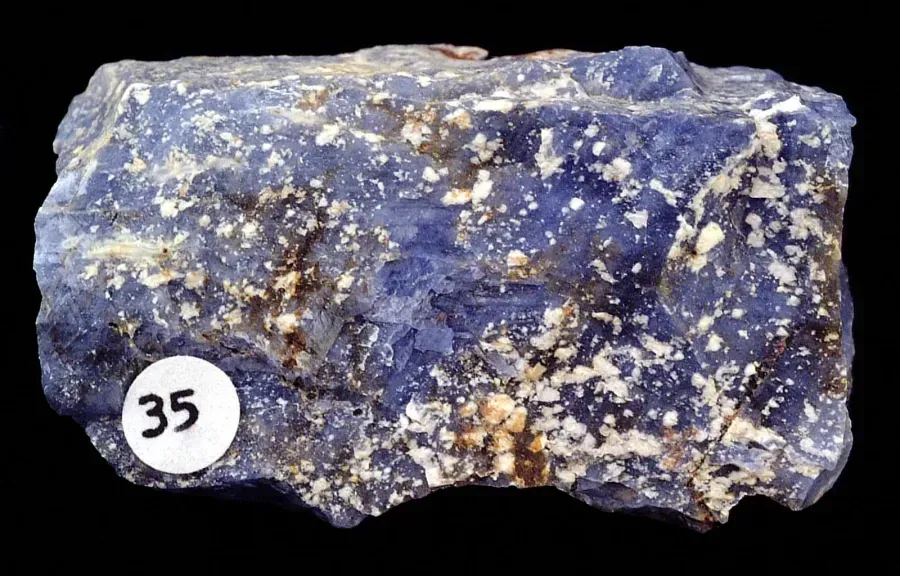
The white veins in sodalite are usually calcite and feldspar. They are what make the stone recognisable: without them it would be just another blue mineral.
How the blue colour is born
In most coloured stones the shade comes from an impurity: chromium turns emerald green, iron makes aquamarine blue, manganese gives rhodonite its pink. Sodalite works differently. Here the blue is born out of the crystal lattice itself, or more precisely out of the defects in it. The framework alternates ions of sodium, aluminium, silicon, oxygen and chlorine, and at some of those sites a sulphur-bearing group sits in place of chlorine. Those sulphur centres trap single electrons and behave like tiny light traps. They absorb the red and yellow part of the spectrum and reflect the blue, and the eye reads a saturated blue.
That is why sodalite is counted among the stones with structural rather than impurity colour. The practical conclusion is simple: the colour of natural sodalite is fairly stable, but it rests on a delicate balance inside the lattice, and strong heat or harsh light can shift that balance. The same mechanism is the root of hackmanite's startling habit of changing shade, which we come to below.
There is a neat way to picture it. In an emerald the green is a guest that moved in; in sodalite the blue is the landlord. Nothing has to be added for the stone to be blue, which is also why a good natural piece holds its tone for decades of ordinary wear, while a dyed one is only borrowing its colour from a bottle.
The sodalite group of minerals
Sodalite is not alone. It heads a whole family of related minerals with a similar framework structure. The sodalite group takes in nosean, haüyne, lazurite and sodalite itself, and all of them are built on the same principle: an aluminosilicate cage with roomy cavities that hold sodium, calcium, chlorine, sulphur or sulphate groups. Change what sits in the cavities and you change the character of the mineral.
Haüyne gives a particularly clean cornflower blue; collectors prize it, and it is occasionally faceted as a rare gem, most famously from the Eifel volcanic district in Germany. Nosean is usually greyish and unremarkable. Lazurite, the mineral behind lapis lazuli, is a complex mixture of several group members together with pyrite and calcite. Understanding that kinship explains why lapis and sodalite look so alike and yet sit at very different points on the price ladder.
The group also explains something buyers notice without being able to name it. Blue stones from this family share a slightly powdery, matte depth of colour rather than the glassy fire of a sapphire. They absorb light instead of throwing it back, which is why a sodalite cabochon looks calm under a shop lamp while a faceted blue gem looks lively. Neither is better; they simply do different jobs in a piece of jewellery.
Crystals, cabochons and the physics of lustre
In its pure form sodalite grows as cubic or rhombic dodecahedral crystals, but large transparent stones are a genuine rarity. Far more often it occurs as a solid massive material, and it is that massive material that goes into jewellery. Polished sodalite has a vitreous lustre, greasy on a fresh break, and its transparency runs from translucent to completely opaque.
Its density is around 2.2 grams per cubic centimetre, noticeably lower than quartz and far lower than heavy lapis lazuli. That gives a useful everyday guide: sodalite feels lighter in the palm than it looks. Its cleavage is fair in several directions, which is where the tendency to chip on impact comes from. A cutter working sodalite always keeps that brittleness in mind and leaves the stone enough thickness to survive.
Polishing behaves in its own way too. Sodalite takes a high shine, but the white calcite veins are softer than the blue matrix, so on a badly finished piece you can feel a faint undulation with a fingertip: the veins sit a hair below the surface. On a well-cut cabochon the dome is even and the veins read as pattern rather than texture. Running a finger across the polish is one of the quickest ways to judge the quality of the work.
How sodalite differs from lapis lazuli
The two get confused constantly, though telling them apart is easy. Lapis lazuli is not a single mineral but a rock: its blue comes from the mineral lazurite (of the haüyne-sodalite group), and the characteristic golden flecks are pyrite. If a blue stone has sparkling gold dots, you are looking at lapis. Sodalite never carries those: it has white calcite veins, not pyrite gold. Lapis is usually pricier and rarer, while sodalite is cleaner in colour and more affordable. Both belong to the sodalite group of minerals, which is where the resemblance comes from.
Deposits
The main supplier of gem-grade sodalite is Canada, the Bancroft area in Ontario. Quality deposits were found there at the start of the twentieth century, and that is precisely when sodalite became available for jewellery. Before that it was treated as a collector's rarity.
There are large deposits in Brazil (the states of Minas Gerais and Bahia), where you find a saturated blue. Sodalite is also mined in Namibia, Greenland, Norway and the United States. The first specimens used for the scientific description came, fittingly, from Greenland (the Ilimaussaq complex).
Canadian sodalite and a royal story
Canadian sodalite carries a handsome trail of legend behind it. The story goes that in 1901 the Princess of Wales, the future Queen Mary, visited the deposits near Bancroft during a Canadian tour and took such a liking to the deep blue stone that she ordered several tonnes of it for the decoration of her London residence. For a while afterwards the Bancroft material went by the name princess blue. How much of that is true and how much is turn-of-the-century marketing is hard to check now, but the episode is exactly what carried sodalite out of mineralogists' cabinets and into wider fashion, and it lifted demand for the Canadian material for a generation.
Bancroft sodalite is valued for an even, dense tone with no greyness in it, and for large uniform blocks that cut conveniently into cabochons and decorative objects. That patch of Ontario is still one of the best-known addresses for the stone anywhere on the map, and the local quarry has long been open to visitors who want to knock out their own piece.
Brazil, Namibia and the other addresses
Brazilian sodalite from Bahia and Minas Gerais often runs darker, a deep indigo with contrasting white veins, and it goes readily into beads and large polished slabs. Namibian material can be a soft, milky blue and takes a fine polish; it reaches European workshops in decorative slabs as often as in jewellery parcels. Afghanistan and Myanmar are famous above all for hackmanite, the variety that changes colour.
The mineral turns up wherever alkaline igneous rocks do, which is a short list of unusual places. Sodalite and its relatives are found in the Kola Peninsula massifs, in the Ilímaussaq complex of southern Greenland where the stone was first described, in the volcanic ejecta of Monte Somma and Vesuvius in Italy, in the Langesundsfjord district of Norway and in Arkansas and Maine in the United States. Most of that material goes to collectors and carvers rather than to mainstream jewellery, but as a mineralogical map it matters. Every deposit gives the stone a slightly different character, and a practised eye can often guess the origin from the tone of the blue and the drawing of the veins.
Shades
Sodalite's colour varies a great deal, from a light pale blue to an almost black-blue indigo:
- Light blue. A milky, soft shade, easy to wear every day.
- Mid blue. The most common in nature, a classic blue with white veins.
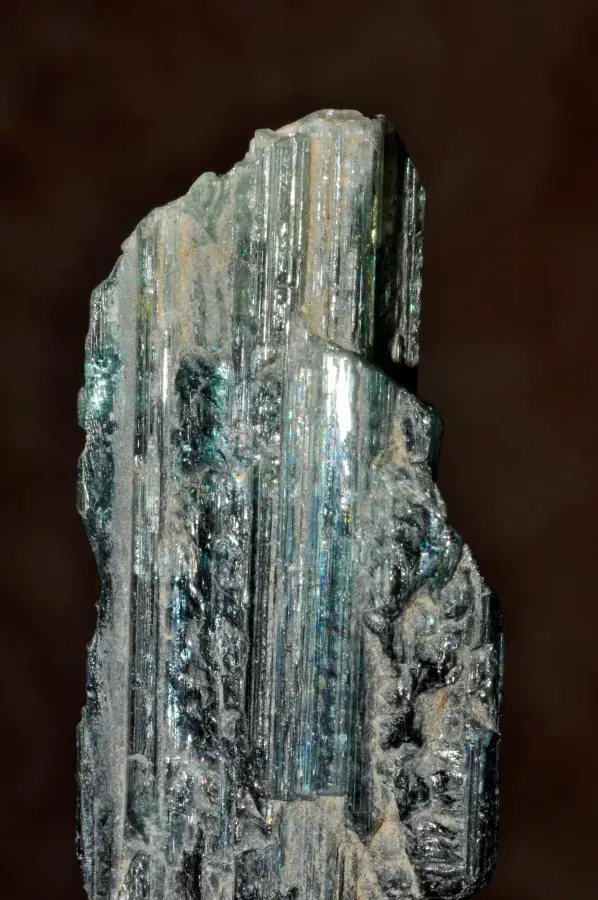
- Deep indigo. Dark, almost nocturnal. It can be boosted by treatment (dyeing, impregnation), so when buying a dark stone it is worth checking where the colour came from. A similar deep blue-violet tone is prized in indicolite, the rare blue tourmaline used in jewellery, when you want a clearer and harder stone of the same mood.
Hackmanite: the sodalite that changes colour
A separate variety of sodalite is called hackmanite. On a fresh break, or after time in the dark, it can be pink, raspberry or violet, but in daylight it fades within minutes to a grey-blue or whitish tone. Put the stone back in the dark, or shine ultraviolet on it, and the colour returns. This effect is called tenebrescence (reversible darkening under light), and among common gem minerals it is rare.
Hackmanite from Afghanistan and Myanmar tends to darken in the light, while the Greenland and Canadian material does the opposite, fading in light and gaining colour in the dark. Many hackmanites also fluoresce a bright orange under ultraviolet. It is a collector's stone and a temperamental one: its colour is unstable by definition, so you almost never meet it in mass-market jewellery, but as a fact about sodalite it matters, because it explains why a blue mineral can suddenly turn pink.
To line up the shades, hardness, deposits and character of the stone in one place, we have gathered the key parameters into a table.
How to tell sodalite from lookalikes and fakes
There are plenty of blue minerals with white or pale patches, and all sorts of things get passed off as sodalite. A few simple guides that need no laboratory.
Lapis lazuli gives off gold pyrite sparks; sodalite has none, it has white calcite veins. That is the first and main difference, and it clears up most of the confusion.
Azurite is brighter, closer to an azure blue, and noticeably softer (3.5 to 4 on the Mohs scale against sodalite's 5.5 to 6), it crumbles easily and reacts to acid by fizzing. Sodalite is harder and does not react to weak acid.
Dumortierite can be blue with a similar pattern, but it is denser, heavier in the hand and usually gives a more even matte blue without clear carbonate veins.
Dyed howlite and magnesite are the most common imitation: a white porous stone is soaked in blue dye. You spot it by the colour sitting unevenly, pooling in cracks and running deeper at the edges than through the body. In natural sodalite the blue is even, and it is the veins that look white, not the background.
Why synthetic sodalite is barely made
Here is a piece of good news for the buyer: laboratory-grown sodalite is practically absent from the market. The stone is inexpensive to begin with, and there is no commercial sense in growing it in a reactor, because the effort would cost more than the result is worth. So unlike emerald or sapphire, there is no need to worry about crystals raised in a vessel. Sodalite is synthesised in laboratories, but for entirely different purposes: the same cage structure underlies synthetic zeolites used as molecular sieves and catalysts, and nobody bothers making it look like a gemstone.
All the real substitution runs along two lines instead: either another cheap mineral is passed off as sodalite, or you are looking at dyed glass and plastic. Knowing this simplifies the check enormously. The question is not grown or natural, but whether the thing is sodalite at all.
Everyday checks that genuinely help: look at a break or an unpolished area (a dyed stone has a paler core than its surface), rub a hidden spot with cotton wool dipped in acetone or nail polish remover (dye leaves a blue trace, the natural mineral does not), judge the weight and temperature (the stone is cooler and heavier than plastic). Glass gives itself away with air bubbles inside and an over-even pattern that looks painted on.
Sodalite wants silver and solitude. A fistful of blue beads is a market stall, not depth. Behave.
What to wear sodalite with
A blue with white veins behaves almost like a neutral, so sodalite slots into nearly any look. Here is what actually works for me at the atelier, by occasion.
How do I wear sodalite every day? I recommend a small pendant over a white tee, a linen shirt or a knitted jumper. The blue reads brightest against a cool palette: white, grey, denim, navy. With warm earthy tones I suggest a copper or gold setting, so the contrast stays soft rather than harsh.
Which setting best brings out the blue? For a cool, clean tone I choose silver or white gold: the metal echoes the chill of the stone instead of fighting it. Rose gold I suggest to anyone who wants the blue softened. I am also fond of sodalite next to mother-of-pearl, which gives a calm white-and-blue contrast without any shine.
Does sodalite work at the office? It does, as long as you keep it restrained. I recommend one noticeable piece: a medium-length pendant under a shirt collar, a neat cabochon ring or studs. The rest I keep to a minimum, so the blue reads as a quiet detail rather than a loud statement.
How do I put together an evening look? For the evening I suggest contrast with black and navy, and a deep indigo in silver or white gold. Under artificial light a stone like that looks understatedly expensive. For a bare shoulder I choose drop earrings, and a pendant on a long chain I place over a plain dress.
How do I wear sodalite in layers? I build one cool line: silver and white gold for a chilly mood, mother-of-pearl and pearls for a soft glow, lapis and aquamarine for a blue gradient. One rule never fails me: a single blue accent on a neutral base beats an overcrowded hand. If you want layers, keep to no more than three textures.

Turn on your camera, pick earrings, a pendant or a ring, and see the piece on yourself in real time.
Switch items in one tap.
Everything runs in your browser: no photo or video is ever uploaded.
Dyeing and treatment: an honest look
Sodalite is often sold as a dark, saturated indigo blue, and that is far from always the natural colour. Light and pale sodalites are tinted to lift the depth of the blue, and less often impregnated for surface shine and strength. Unlike many gemstones, sodalite is not usually treated with heat or irradiation; here the whole story is about dye.
How to suspect dyeing: the colour is too uniform and poster-bright, the blue clogs into micro-cracks and the white veins are tinted along the edge, while at a break or on the back the stone is paler. Dyed sodalite fades faster than natural stone over time, especially in sunlight. Dyeing on its own does not make the stone fake (it is still sodalite), but it affects colour stability and price, so when buying a dark stone it is worth asking the seller outright whether the shade is natural or the result of treatment.
What sodalite's value depends on
Sodalite belongs to the affordable ornamental and gem stones, and there are no dramatic price swings here, yet quality still varies. People look at it this way.
Colour. An even, saturated blue is prized, one that drifts neither towards grey nor towards muddiness. A natural deep tone is worth more than a tinted one.
Vein pattern. Clear, contrasting white veins on an even background look more valuable than a murky mush of blotches. Too much white cheapens the stone; the blue should clearly dominate.
Uniformity and clarity. Cracks, chips, loose inclusions and grey zones lower the grade. For a cabochon it matters that the stone is dense and polishes up to a glassy shine.
Size and cut. A large, single-tone piece without flaws is rarer, so it costs more than a small bead. A neat, symmetrical cabochon cut and quality polishing add to the price.
Sodalite is almost never transparent at gem level, which is why it is worked as a cabochon or turned into beads, rather than faceted like transparent stones.
Sodalite among the other blue stones
Within the family of blue gems sodalite occupies a modest, democratic niche, and that is one of its strengths. Sapphire belongs to the first rank and is priced accordingly. Lapis lazuli holds a middle position thanks to its rarity and its long history. The genuinely affordable blues are sodalite together with dumortierite, blue aventurine and dyed agate. For the price of a coffee and a slice of cake you can assemble a decent bead bracelet, and a full pendant with a large cabochon still sits comfortably in the inexpensive segment.
That is why sodalite so often becomes a person's first blue stone, and a convenient stand-in for lapis when you want the same mood without the premium. It is also the reason it appears so widely in workshops and craft shops: a cutter can experiment with sodalite without agonising over a spoiled piece, and a jeweller can offer a generous size for a modest outlay. Size, in this stone, is affordable in a way it never is with sapphire.
Beads, cabochons and carving
The form of the working changes the way the stone reads. Round beads show off an even blue and suit bracelets and long strands. Faceted beads add a little play of light to what is otherwise a matte material. The cabochon, a smooth dome with no facets, brings out the drawing of the white veins and the depth of tone better than anything else, which is why it is the shape chosen for pendants and rings.
Dense uniform blocks are cut into small figures, signet faces and decorative inlays. Flat plaques and tiles go into boxes and inlaid furniture. The larger and more homogeneous the starting block, the more freedom the craftsperson has, and the more the finished object costs. Waste is the hidden factor here: a block riddled with grey zones and calcite may yield only a handful of usable cabochons, and the price of the good pieces quietly carries the cost of everything that went into the offcut bin.
Customer reviews
Zevira is a real jewellery shop. Genuine payments, deliveries and customer thank-yous.
🥰🥰🥰 gracias

Ok, ¡gracias! 🙂

Sodalite symbolism: the third eye and clarity
A note straight away: sodalite cures nothing and opens no superpowers. Everything below is symbolism and tradition, not medicine. Wearing it makes sense as a beautiful piece of jewellery and a personal reminder, nothing more.
In the Indian chakra system the colour blue is linked with the ajna, the sixth chakra, the point between the brows. We write about this in detail in our piece on what the third eye symbolises and how the ajna shapes the choice of jewellery. Sodalite entered this tradition through its colour: the blue tone matches the way the third eye is depicted in Buddhist and Indian iconography.
In lithotherapy books sodalite is called the stone of clarity and logic. This cannot be tested, but the rational part is simple: many people subjectively read a calm blue as soothing, and a beautiful object that is pleasant to look at really can act as an anchor for attention. If sodalite reminds you to pause and think, that is honest value already, with no mysticism attached.
Any tales about serotonin, melatonin, alpha rhythm or the stone reprogramming the brain we set aside: there is no scientific evidence that a mineral on your neck affects neurochemistry.
History and cultural context
Sodalite is young as a piece of jewellery, but the blue colour in third-eye symbolism is ancient. In the Indian and Tibetan tradition the blue point between the brows is an iconographic sign of inner vision, and before sodalite appeared that role was played by lapis lazuli and sapphire.
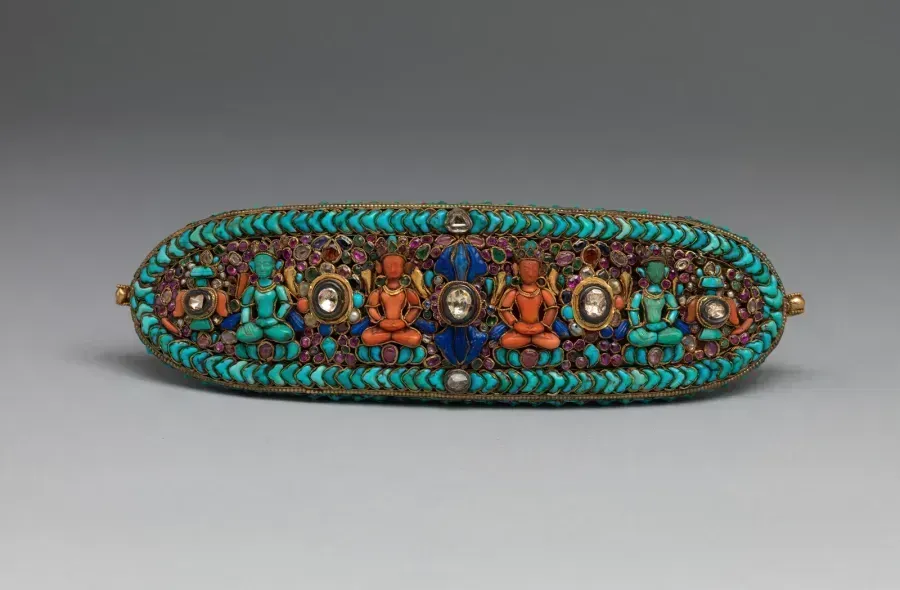
In the Nordic world a similar role was played by iolite, the blue Viking stone with a pleochroism effect and a sense of "sight", which shifts its shade depending on the viewing angle. When sodalite became available in the twentieth century, it logically took the place of an inexpensive blue stone that slipped easily into ready-made symbolism.
How the stone got its name
The name sodalite was coined by the Scottish chemist Thomas Thomson, who examined the Greenland samples in 1811. It is built from the Latin sodium and the Greek lithos, stone: literally, the sodium stone. That is an honest mineralogical name with no poetry in it, and it points straight at the composition, in which sodium plays the key part. For its era this was a piece of very fresh science. Sodalite was described almost at the same time as the element sodium itself, which Humphry Davy had isolated only three years earlier at the Royal Institution in London.
The fact that the stone carries a dry scientific label rather than an ancient folk nickname is a reminder of how young it is in human culture. Turquoise, jade and amber have names in dozens of languages and roles in the myths of many peoples. Sodalite has none of that, because until the start of the nineteenth century nobody had separated it out from the general mass of blue minerals. Whatever names it had, it wore borrowed: it was simply called blue stone, or mistaken for lapis.
Blue stone from ancient Egypt to the Middle Ages
Sodalite itself was not in ancient jewellery, but its relative lapis lazuli ruled the colour blue for thousands of years, and that long shadow falls across sodalite. In ancient Egypt lapis was ground to powder for eye paint and carved into scarabs and amulets, and blue was held to be the colour of the sky and of the gods. The funerary mask of Tutankhamun is set with it. In Mesopotamia blue stone went into cylinder seals and pendants, and in medieval Europe lapis was ground into ultramarine, the costliest pigment a painter could buy, reserved for the robes of the Virgin.
Sodalite walked into that centuries-old love of blue as a ready-made heir. When the twentieth century produced an affordable stone in the same cool tone, the culture greeted it as an old acquaintance. The place for a blue gem was already furnished with meaning; all that remained was to move in a newer and more democratic material.
The twentieth century: sodalite comes into fashion
Sodalite's real arrival in jewellery and interiors came in the first half of the twentieth century, during the vogue for geometry, contrast and dense flat colour. A smooth blue stone with white veining fitted the aesthetic of strict lines and saturated tones perfectly. It was cut into cabochons for brooches and cufflinks, set into cigarette cases, made into cane handles, tabletops and desk sets. Deep blue against silvery metal read as modern and expensive, and it photographed well in the black-and-white magazines of the day.
In the second half of the century sodalite settled in as a popular ornamental stone and a staple of bead strands. Then, with the rise of interest in crystals and meditative practice, it was handed a second life as a third-eye stone, and today people are more likely to search for it in that role than as a decorative blue mineral.
Upload a photo of your pet, someone you love, or an object. We'll build a 3D model and hand-cast it in pewter.




Sodalite jewellery: choosing the form
Pendant
The most popular option, and a logical one: on a chain the stone barely risks knocking against anything hard. A small sodalite (1 to 1.5 cm) is good for daily wear and easy on the budget. A medium one (2 to 3 cm) is more noticeable and more versatile. A large cabochon (3 to 4 cm) becomes the focal point of a look.
Chain length changes how it sits: a short one (40 to 50 cm) keeps the stone close to the face, a long one (60 to 70 cm) lengthens the silhouette and works well over thick fabrics.
Ring
Sodalite is soft, so a ring is one for enthusiasts and certainly not for manual work. If you want one, choose a cabochon in a snug setting that shields the stone. A cabochon (smooth, unfaceted) shows the white veins better than a faceted cut.
Bracelet
A bracelet of sodalite beads is the most popular format: beads are inexpensive, and the blue looks good as a chain around the wrist. The diameter is usually 6 to 14 mm. Sodalite is often combined with lapis lazuli, lava or mother-of-pearl.
Earrings
Studs with a small sodalite for everyday, drops with a cabochon for going out. Earrings are protected from knocks and suit such a fragile stone well.





How to choose sodalite jewellery
By colour. Take the shade you like. If you want dark indigo, check with the seller whether the colour is natural or the result of dyeing: dark sodalites are often treated.
By veins. Clear white veins on an even blue background are prized higher. They should read from a distance, without a loupe.
By setting. Silver is versatile and brings out the blue nicely, white gold adds a sense of luxury, rose gold softens it. Sodalite pairs beautifully with mother-of-pearl: you get a cool white-and-blue contrast.
By authenticity. Fakes are made from dyed glass and plastic. Real sodalite feels distinctly dense and cool to the touch, and the veins look built into the stone rather than painted on the surface. You can ask the seller for the stone's provenance.
The psychology of blue: why the colour calms
There is a plain human explanation for the pull of blue, with no esotericism involved. Blue is the colour of sky and water, backgrounds we see every day in settings where nothing is threatening us, and the brain has learned to associate it with calm and safety. In surveys of favourite colours, decade after decade, blue comes first among people all over the world, and it does so across very different cultures, which is unusual for a colour preference.
That is why a blue stone at the throat reads as a quiet, unaggressive accent. It does not excite the way red does, and it does not demand attention the way bright gold does. Sodalite, with its muted depth, lands in that calm register with particular accuracy, and a good deal of its charm as jewellery comes from exactly there.
There is a second, more practical reason it wears well. Cool blue sits harmlessly beside almost every colour in a European wardrobe: it does not clash with black, it lifts grey, it belongs with denim by definition and it makes white look cleaner. A stone that never fights the clothes gets worn far more often than a dramatic one, and a piece that gets worn is worth more than a piece that stays in the drawer waiting for the right occasion.
Leave your email, we'll send your discount code. No spam, unsubscribe anytime.
The code arrives by email, valid on your first order.
Sodalite through the seasons and occasions
Cool blue is most at home in the cold half of the year. Against a grey coat, dark knitwear and denim, sodalite looks composed and expensive, and the low winter light in northern Europe flatters its depth rather than washing it out. In summer take it in lighter blue shades and smaller forms, so the stone chimes with light clothing instead of arguing with it. A pale sodalite bead bracelet against a tan is a different, easier proposition from a heavy indigo cabochon.
For the office one restrained piece does the work: a pendant sitting under a shirt collar, or a pair of studs. For the evening the stone likes contrast with black and navy, and it holds up well under artificial light, which deepens the tone rather than flattening it. For every day the most practical choices are a small pendant or a bracelet, both of which forgive brisk movement.
Occasions suit it too. A blue stone is a safe present for someone whose taste you know only in outline, it is neutral across genders, and it works as a graduation or new-job gift where the symbolism of clear thinking gives you something to write on the card without overpromising anything.
Caring for sodalite
Sodalite is soft and fragile, but with careful handling it lasts a long time.
Cleaning. Warm water with mild soap and a soft brush, then rinse with clean water. No ultrasonic or steam cleaning, no harsh chemicals, no chlorine. Better not to wear it in a pool or sauna.
Storage. Keep it apart from harder stones (quartz, tourmaline) that could scratch it, in soft cloth or a pouch. Protect it from knocks and from long spells of direct sun: the bright blue can fade over time.
What sodalite fears most
Sodalite has three chief enemies, and all three are domestic. The first is impact and abrasion: at a hardness of 5.5 to 6 the stone can be scratched by a metal buckle or by a bunch of keys sharing a drawer with it. The second is chemistry: perfume, hairspray, household cleaners and acids attack the polish and any dye, which is why jewellery goes on last, after make-up and scent. In hard-water areas, and much of southern and eastern Britain qualifies, limescale deposits from tap water leave a dull film on the polish faster than you would expect.
The third enemy is light and heat: long spells of direct sun and hot air from a hairdryer gradually dull the blue, particularly in treated stones. One simple rule covers nearly all of it. Cosmetics first, jewellery second, and at night the stone goes into a soft pouch away from harder neighbours.
How to bring back the shine at home
If the stone has gone dull over time, the culprit is usually not the polish itself but a film of skin oil, cosmetics and dust. Warm water, a drop of mild soap and a soft toothbrush normally restore the shine. Work without pressure, then rinse and dry with a soft cloth. If you live with hard water, a final rinse from a bottle of still water and an immediate dry will stop the limescale rings from returning.
Harsh pastes, bicarbonate of soda and abrasive powders must not be used, because they leave microscratches on a soft stone. Silver dip is another thing to keep away: it is meant for metal, and it can leach colour from porous veins and any dye in the stone. If the polish really has worn through to a matte surface, only a workshop with a wheel can bring it back, and at home it is better not to risk it.
Sodalite and its setting: what to look for
Because the stone is brittle, the setting decides a great deal. The safest is a closed bezel, where metal wraps the cabochon all the way round the edge and takes the knocks on its own account. Tall claws suit sodalite less well, since they leave the stone exposed. In a ring it makes sense to choose a low seat, so the stone does not stand proud and catch on things.
Sterling silver is the workhorse here: it is strong, its cool shine suits blue, and it keeps the price sensible. If you want gold, a bezel in white gold does the same visual job with more weight behind it. One more detail worth checking on a bead bracelet: the drill holes. A hole with a chipped rim wears through the thread faster and shows a pale ring around the entry point, and on strung beads it is the commonest place for damage to begin.
CAPAORA mini knife pendant
The 18th-century Spanish navaja in miniature: 40 mm of stainless steel, a real folding mechanism and a Palanquilla lock that clicks. An affordable gift to remember.
Authentic · Ships from Spain · 14-day returns
Myths about sodalite
A good deal of confusion has built up around sodalite and the third eye: from belief in an instant "opening" of abilities to mixing it up with lapis lazuli. Let us go through the common misconceptions and separate symbolism from invention.
Sodalite in the chakra tradition: what is said and what can be checked
It is worth drawing the line once more: everything in this section belongs to symbolism and cultural tradition, not to medicine. Sodalite heals nothing and opens nothing, and these descriptions should be read as a beautiful language of images rather than as claims about the body.
The link with the throat and the third eye
In popular crystal literature sodalite is usually tied to two centres at once: the ajna, the third eye between the brows, and the vishuddha, the throat chakra. The logic is chromatic. The blue tone matches the way both zones are conventionally depicted in Indian and Tibetan iconography. The ajna is associated with intuition and clarity of thought, the vishuddha with honest speech and the ability to say what you actually mean.
From that pairing comes the familiar picture of sodalite as a stone for people learning to speak plainly and think calmly. It is a tidy image and it explains why the stone turns up so often in beginners' sets alongside amazonite and blue lace agate, which are read the same way. Treat it as a shorthand that people find useful, and it does no harm.
The stone of logic and a quiet mind
Books on crystals often call sodalite the stone of the rational mind, paired against a more emotional lapis lazuli. It is said to help structure thoughts, quieten anxious chatter in the head and hold concentration. None of that can be measured with instruments, and promising such an effect would be dishonest.
There is a rational kernel in it, though. Many people subjectively read a calm blue as cooling, and the habit of wearing the same object during moments of concentration works as a personal anchor for attention, in the same way a familiar mug or a particular chair does. If sodalite around your neck reminds you to slow down and think, that is honest value, with no need to invoke anything mystical.
Sodalite in meditation and rituals of attention
In meditative practice a blue stone is often held in the hand or placed in front of you as a point of focus. What works here is the ritual rather than the mineral: a smooth cool surface on which it is easy to settle the gaze and the breath helps a person shift out of hurry into a quieter state. People run beads through their fingers or rub a keyring for the same reason, and worry stones have been sold in every culture that ever made small polished objects.
Sodalite suits that role because of the cabochon shape and its pleasant feel: it warms slowly, so it stays cool in the hand for a long time, and the dome fits the pad of a thumb. That is its real, earthbound usefulness, and it needs no further justification.
Sodalite in art and interiors
The decorative stone of palaces and studies
Beyond jewellery, large blocks of sodalite have long gone into decoration. It was cut into tabletops, boxes, inkstands, furniture inlays and small ornamental objects. Deep blue sat well beside dark wood, brass and silver, which is why the stone was a favourite in the studies and drawing rooms of the early twentieth century, when a gentleman's desk was expected to be furnished as carefully as a mantelpiece.
A polished slab of sodalite with its white veining reads as a piece of night sky, and interior decorators valued that effect. It still turns up in contemporary interiors as backlit panels and basin tops, where light passing through translucent zones gives the blue an unexpected glow. Whole rooms have been faced in it, and the material is patient enough for large formats in a way few blue stones are.
Blue pigment and painters
Sodalite itself took almost no part in painting; that role belonged to lapis lazuli and its ultramarine. But the history of blue pigment matters for understanding why a cool blue stone was prized so highly for so many centuries. Natural ultramarine from lapis cost more than gold, and painters saved it for the most important passages of a picture, which is why so many Renaissance contracts specify by weight how much of it the artist must use.
When the nineteenth century learned to make cheap artificial ultramarine, following a prize offered in France for exactly that, blue stopped being a luxury. In almost the same decades affordable sodalite came into circulation. Cool blue, in other words, came down from the heaven of the gods to ordinary people twice over, in paint and in jewellery, and within a single lifetime.
Send a friend a discount code, they save on their first order.
Who sodalite suits
By character and way of life
Sodalite is often described as a stone for calm, thoughtful people, the sort who value clarity and dislike fuss. That is the language of tradition, of course, not a diagnosis from a birth date. In plain human terms the stone suits anyone who likes cool blue and restrained aesthetics: people drawn to minimalism, to quiet luxury, and equally to boho style, where a blue stone in silver looks entirely natural.
There is a practical dimension too. Because it is soft, sodalite suits a life that does not involve heavy manual work, climbing walls or scrubbing floors with rings on. Pendants and earrings sidestep that limitation entirely. Sodalite does not shout; it works as a quiet accent, so it goes to people who prefer a detail over a declaration.
As a gift
A blue stone with white veins is an easy thing to give. It is neutral across genders, modest in price next to first-rank gems, and it still looks dignified. A sodalite pendant or bracelet makes a calm, undemanding present for a colleague, a friend, or someone whose tastes you know only in broad strokes, and it avoids the awkwardness of a gift that looks like it is asking for something in return.
If you want to add meaning, you can lean on the symbolism of clarity and calm without turning it into a promise of miracles. Engraving with a date or a short word turns a simple piece into a personal one, and on a silver bezel or the inside of a bail there is usually room for a few characters. For a first gift of jewellery to a teenager it works particularly well: inexpensive enough not to be a burden, handsome enough to be worn.
Surprising facts about sodalite
- A stone younger than photography. Sodalite was described in 1811 and only truly entered jewellery in the twentieth century. By the standards of the trade it is almost a newcomer: turquoise, jade and lapis have thousands of years behind them.
- Blue with no impurity at all. In most stones the colour comes from a foreign atom. In sodalite the blue is born from defects in its own lattice, so the stone is blue quite literally by itself.
- A stone that can blush. The hackmanite variety is pink or raspberry on a fresh break, then fades within minutes in daylight to a grey-blue. In the dark the colour returns, and the cycle can be repeated over and over.
- It glows orange in the dark. Many hackmanites fluoresce a bright warm orange under ultraviolet, which looks almost implausible for a blue stone.
- Princess blue. By legend the future Queen Mary ordered tonnes of Canadian sodalite for a London residence, and the name princess blue stuck to the stone for a while afterwards.
- Lighter than it looks. Sodalite's density is noticeably lower than that of lapis lazuli, so a large pendant feels unexpectedly light in the palm.
- A relative of the most expensive blue paint. Sodalite shares a mineral group with lazurite, from which ultramarine, a pigment dearer than gold, was made for centuries.
- It has no ancient name. Unlike most gems, sodalite carries no folk nicknames in the old languages: it was identified too late, and chemists gave it the name it has.
- Its family lives in volcanoes. Its close relative haüyne is collected from volcanic ejecta in the German Eifel, so the calm blue of your pendant has cousins that arrived by eruption.
Frequently asked questions about sodalite
Are sodalite and lapis lazuli the same thing? No. Lapis lazuli is a blue rock with golden flecks of pyrite, usually pricier and rarer. Sodalite is cleaner in colour, with white calcite veins, no pyrite. Both belong to the sodalite group of minerals, which is where the resemblance comes from.
Can I wear a sodalite ring every day? Not advisable. The hardness is 5.5 to 6, the stone scratches and chips easily. If you want a ring, choose a chunky setting and take it off for any hands-on work. A pendant, earrings and bracelet are safer.
Does sodalite fade? It can; under long direct sun the bright blue pales. Stored in the dark and away from overheating, the colour holds for years.
Is there such a thing as fake sodalite? Yes, most often made from dyed glass or plastic. Real stone is dense, cool, and its veins are built into the body rather than painted on top.
Do you have to believe in stone energy for sodalite to be useful? No. It is a beautiful piece of jewellery and a pleasant blue colour that you want to look at. There are no supernatural promises behind it, and that is perfectly fine.
In our catalogue you will find jewellery with sodalite and other blue stones. Each piece is created with attention to the character of the stone and the beauty of its form, from small everyday pendants to large cabochons.
Choose the shade and form that you like best.
Buying it as a gift? Each one arrives ready to give.
 A branded Zevira box and a little card come with every order.













The short version
Sodalite is an affordable blue stone from the sodalite group, soft (5.5 to 6 on the Mohs scale) and fragile, with recognisable white veins. It differs from lapis lazuli by the absence of golden pyrite. It lives best in pendants, earrings and bracelets, less so in rings. By tradition it is counted among the third-eye stones for its blue colour, but that is symbolism, not a property of the mineral. Take the shade that pleases you, and protect the stone from knocks, chemicals and long sun.
Pendants, bracelets, rings and earrings with sodalite and other blue stones, in 925 silver and gold.
About Zevira
Zevira makes jewellery in the artisan tradition of Albacete, Spain. Sodalite is no accidental stone for us: we love working with deep blue and white veins, choosing the cut and setting so the character of each stone comes through at its fullest.
What you can find with us on the sodalite theme:
- sodalite pendants in different sizes, from small everyday pieces to large cabochons;
- bracelets of sodalite beads and combinations of sodalite with lapis lazuli, lava, mother-of-pearl;
- signet rings and slim rings with a sodalite cabochon;
- stud and drop earrings with a blue stone;
- settings in 925 silver, white and rose gold that bring out the blue;
- personal engraving: a symbol, a date or a short word on the inside.
Every piece can be personalised with engraving by a craftsperson. 925 silver and 14 to 18K gold.