Prehnite: the pale-green stone they call "grape jelly"
Prehnite holds a quiet record in the history of science: it was the first mineral ever named after a specific human being. That happened in 1788. Before then, stones were labelled by colour, by where they were dug up, or by some old legend. Then science said, for the first time, here is a mineral, and it will carry the surname of the man who carried the first sample to Europe. The colonel's name was Hendrik van Prehn.
That moment opened a separate story for a pale-green, semi-translucent stone that collectors call "grape jelly" and jewellers prize for its tender colour of young foliage and its soft inner glow.
Let us look at prehnite properly: what it is made of, how it forms in nature, where it is mined, how it differs from other green stones, and how to tell a real one from glass. No mysticism, no promises that the stone will cure anything. Just a formula, a hardness figure, and the geography of where it comes out of the ground.
What prehnite is: composition and physics
Prehnite is a hydrous calcium aluminium silicate. Chemists write it as Ca2Al2Si3O10(OH)2. Behind that dry line sits a stone with a very recognisable character.
The first thing you notice about prehnite is the colour. Most often it is pale green, the shade of unripe grapes or the first leaves of spring. Sometimes it drifts towards yellow and lemon, occasionally into a bluish green, and now and then it is almost colourless or white. The green tone comes from traces of iron: the more iron, the deeper the colour.
The second clue is its peculiar translucency. Prehnite is rarely clear like glass. More often it looks faintly clouded from within, like set jelly or frosted glass. That is exactly why the nickname "grape jelly" stuck. Light passes into the stone but not straight through it, scattering gently, and that gives the characteristic inner glow.
Wear the symbol, don't just read about it. These are in stock:

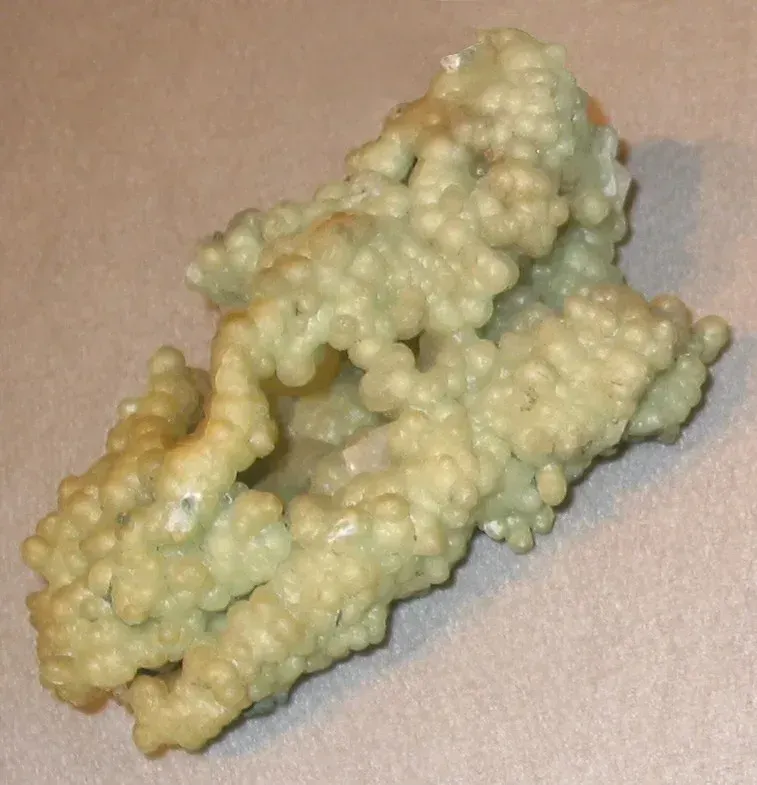
The third clue is the shape of its aggregates. Prehnite almost never grows as single crystals with sharp faces. It forms rounded, kidney-shaped, grape-like crusts and botryoidal masses. The surface of such a cluster is bumpy, like a bunch of grapes, while inside it is built from fine fibres radiating outward.
Physical characteristics
- Hardness on the Mohs scale: 6 to 6.5. Lower than quartz, so the stone calls for some care.
- Density: about 2.8 to 2.95 g/cm3.
- Crystal system: orthorhombic.
- Cleavage: good in one direction.
- Lustre: vitreous, sometimes pearly on a fracture.
- Transparency: from translucent to semi-translucent, rarely transparent.
- Refractive index: roughly 1.61 to 1.67, with weak birefringence.
- Optically prehnite is biaxial, dispersion is weak, and there is no noticeable pleochroism.
The combination of a hardness of 6 to 6.5 and good cleavage shapes everything about how you wear it. Prehnite is tougher than turquoise and malachite, but softer than emerald, quartz, and sapphire. Cleavage means that a sharp knock or vibration can split the stone along a plane rather than simply scratch it. Hence a simple rule: protect it from impacts, abrasives, and sudden heat.
How it looks in jewellery
Cut and polished, prehnite usually appears as a cabochon, a smooth domed insert without facets. The cabochon is what best reveals that gel-like glow: a gentle curved surface gathers light and gives it back as a soft shimmer. Faceted stones are rarer, because faceting needs clean, transparent material, which does not turn up often. Denser stone is turned into round and faceted beads for bracelets and necklaces.
Where the odd name comes from
The mineral was named by the German mineralogist Abraham Gottlob Werner in 1788, in honour of Hendrik van Prehn, a colonel in the Dutch army who served at the Cape Colony in southern Africa and brought the first samples to Europe. Prehnite thus became the first mineral named after a person rather than a colour, a place, or a legend. From it grew the tradition of naming minerals after people, a tradition followed by hundreds of names today.
Werner taught at the mining academy in Freiberg, Saxony, and his school shaped mineralogy for decades. He insisted that minerals be described by strict criteria: composition, colour, lustre, hardness, crystal form, fracture. The fact that this very school gave prehnite a human name captures the spirit of the late eighteenth century, when stone was ceasing to be an object of superstition and becoming an object of science.
Quick property summary
- Name: prehnite, named after H. van Prehn in 1788.
- Class: silicates, a hydrous calcium aluminium silicate.
- Formula: Ca2Al2Si3O10(OH)2.
- Colour: from pale green and yellow-green to bluish green, more rarely colourless and white.
- Hardness: 6 to 6.5 on the Mohs scale.
- Density: 2.8 to 2.95 g/cm3.
- Crystal system: orthorhombic.
- Cleavage: good in one direction.
- Lustre: vitreous, pearly on a fracture.
- Aggregate form: rounded, grape-like, kidney-shaped crusts.
- Special effects: occasionally a cat's-eye effect.
- Main visual signature: the gel-like inner glow, "grape jelly".
- Best gem sources: Mali, Australia.
How prehnite is born: geology
Prehnite is a secondary mineral. It does not crystallise first from a melt; it appears later, when hot fluids pass through rock that has already cooled.
Its main habitat is the cavities and cracks in volcanic rock, above all in basalts. When lava sets, gas bubbles and hollows are left inside it. Later, hot mineralised waters circulate through the rock, carrying dissolved calcium, aluminium, and silicon. These substances are deposited on the walls of the cavities and slowly build up as rounded crusts of prehnite.
Geologists call this process hydrothermal, low-temperature metamorphism. By the presence of prehnite and its companion mineral pumpellyite, scientists identify what is called the prehnite-pumpellyite facies of metamorphism. Put more simply: find prehnite in a rock, and you know warm mineralised fluids once passed through it under mild conditions, neither at the enormous temperatures of deep magma nor at the surface where rock weathers, but somewhere in between. The stone becomes a witness to a region's geological past.
The basalt formations in which prehnite grows can be very old, hundreds of millions of years. The prehnite itself is younger than its host rock, because it built up only after the rock had set.
Prehnite's companions
In specimens, prehnite is rarely alone. The most striking collector pieces are combinations. Particularly prized are clusters where black needles of epidote pierce through the translucent green prehnite: the contrast of the pale bunch and the dark arrows looks very graphic. Frequent neighbours are zeolites (natrolite, stilbite, apophyllite), calcite, datolite, quartz, and copper minerals down to native copper itself.
By the set of companions, an experienced collector can often guess the region. Indian clusters are recognised by their pairing with apophyllite and stilbite, American ones by copper and zeolites, while the Malian gem material tends to come as dense, clean pieces without a showy mineral entourage.
How it is mined
There is no giant industrial mining of prehnite: it is not a mass commodity like quartz. Most often the stone is recovered as a by-product in basalt quarries and during the working of zeolite deposits. The clusters are lifted from the cavities by hand, carefully, so as not to damage the fragile aggregates. Dense, clean, deeply coloured pieces are picked out for cutting and cabochons, while lower-grade material is sawn into beads or kept as collector specimens.
Pale prehnite lives on bare skin and a linen collar, never over a shouting print. Drown it in flowers and it will sulk.
What to wear prehnite with
After years working with pale stones, prehnite stays one of the easiest for me: quiet but alive, and it barely argues with clothes. Here is what actually works, by occasion.
What do you wear prehnite with every day? For an everyday look I recommend small studs or a slim pendant with a pale-green stone: fresh, but without drawing too much attention. Prehnite shows best against a light, muted ground, so I suggest white, cream, beige, grey, or warm sand up top, and natural textures such as linen, cotton, and silk. An open neckline seems made for a pendant, since the stone sits against the clean ground of the skin and works at full strength.
Silver or gold for prehnite? I read the skin undertone. For a cool undertone I suggest silver and white gold: against them prehnite's green reads fresher and cooler. For a warm undertone I recommend yellow or rose gold, which turn the stone warmer and softer. If both metals suit you, I choose by the look: silver for a calm palette, gold for a statement evening.
Is prehnite right for the office? Absolutely. For weekdays I choose a restrained pair in silver and a quiet palette, no shine and no large shapes. Studs or a short pendant tucked under the top shirt button read as a detail, not a loud accent, and hold up against a strict dress code.
And for an evening out? For the evening I take a larger, warmer stone: a deep yellow-green cabochon or moving drop earrings. Against smooth fabric in a rich colour, and under artificial light, the glow of prehnite turns soft and deep. An open neckline works for the stone here.
Which stones pair with prehnite? By colour I recommend clear rock crystal, which underlines the green, gentle rose quartz for a spring palette, and black onyx for a graphic contrast. One physical caveat: prehnite is soft, so in a single bracelet with hard stones I suggest separating it with spacers, or the neighbours will scratch its surface as they rub.

Turn on your camera, pick earrings, a pendant or a ring, and see the piece on yourself in real time.
Switch items in one tap.
Everything runs in your browser: no photo or video is ever uploaded.
Geography: where prehnite is mined
Prehnite is found all over the world, but only a few regions yield gem-quality material.
Mali. In the 1990s, prehnite of outstanding quality was found here: deep yellow-green, dense, fit for faceting and cabochons. Malian material did much to make the stone popular in jewellery.
Australia. One of the most important suppliers. In the state of Victoria and other regions, prehnite of good gem quality is mined, often with an even, calm green tone.
South Africa and Namibia. South Africa is the historical home of the stone, the very Cape Colony. The south of Africa yields both collector specimens and material for jewellery.
United States and Canada. Classic localities are the New Jersey traps and the basalts around the Great Lakes; in Connecticut, well-formed crystalline crusts have been found. American specimens are famous for combinations of prehnite with zeolites and copper minerals.
India and China. The Indian Deccan traps, a vast basalt province, yield prehnite paired with zeolites and apophyllite. This is a popular material for collector clusters.
Europe (Scotland, France, Italy, Germany). Historical deposits, known to naturalists as far back as the nineteenth century. Today they mainly yield collector specimens rather than gem material.
Origin affects colour and density. Malian prehnite is usually the "juiciest" in its green, Australian is even and calm, while Indian and American specimens more often come as collector clusters. If a rich colour matters for a piece of jewellery, look to material from Mali and Australia.
Customer reviews
Zevira is a real jewellery shop. Genuine payments, deliveries and customer thank-yous.
🥰🥰🥰 gracias
Ok, ¡gracias! 🙂
History: a stone of the age of science
Prehnite's history is shorter than that of emerald or pearl: officially it has been known to science for only about 240 years. In return, its history is honest, with no invented legends.
Discovery and the nineteenth century
In the 1780s, the south of Africa was a zone of active Dutch colonisation. The Cape Colony supplied ships, and minerals travelled to Europe through it. Colonel van Prehn brought samples of a greenish stone from the Cape of Good Hope, and in 1788 Werner described the mineral and fixed its name.
Throughout the nineteenth century, prehnite remained above all a mineral for collections and scientific cabinets. Its rounded greenish clusters looked handsome on the shelves of natural-history museums, beside zeolites and other secondary minerals of volcanic rock. Specimens came from Scotland, from the volcanic regions of France and Italy. Into jewellery the stone hardly went: too soft, too matte, too understated by the standards of an age in love with bright, transparent gemstones.
Green stones in culture
Prehnite itself has no ancient legends, but the way people relate to green stones in general took shape over millennia. Green is tied, in almost every culture, to life, growth, nature, and renewal. Greenish gemstones were worn as signs of fertility and hope. Prehnite inherits this general tradition of feeling towards green, but it has no ancient mythology of its own, and that is its honest peculiarity.
So when you come across a text that credits prehnite to the ancient Egyptians or the priests of Atlantis, treat it with scepticism. These are late inventions laid over the stone after the fact. Until the end of the eighteenth century, prehnite was simply not singled out as a separate mineral: greenish clusters from volcanic cavities had been found by people before, but they were not told apart from other green stones and zeolites.
The jewellery renaissance
Prehnite came into real use in the second half of the twentieth century, as amateur mineral collecting grew. And when good gem-quality material was found in Mali in the 1990s, cutters realised that this dense, semi-translucent stone could be made into cabochons and even faceted inserts with a pleasant glow. Beads, pendants, and rings appeared. Today prehnite is a stone for those who seek a quiet, calm beauty rather than a loud sparkle.
Upload a photo of your pet, someone you love, or an object. We'll build a 3D model and hand-cast it in pewter.

Varieties and shades
Although prehnite is a single mineral, you will meet noticeably different versions of it on sale.
By colour
Pale green (the classic). The most recognisable variant, the colour of unripe grapes and spring foliage. The reference look of prehnite.
Yellow-green, lemon. Often this is Malian material. A warm, sunny shade with a golden note.
Bluish green. A rare and beautiful variant, drifting towards the cool turquoise side. Prized by collectors.
Colourless and white. It occurs, but is used less often in jewellery: it lacks the green glow for which the stone is loved.
By texture
Semi-translucent gel ("grape jelly"). The most characteristic type. Light scatters inside, giving a soft glow.
Translucent fibrous. An inner structure of radial fibres gives a light silky sheen, and sometimes a cat's-eye effect (chatoyancy) when cut as a high cabochon. Fine parallel fibres reflect the light as a narrow moving band, and as you turn the stone the bright line slides across the surface. Such stones are rare and prized above the ordinary.
Dense opaque. Used for beads, simple cabochons, and carving.
Prehnite with epidote. A translucent green ground with black needles of epidote. More of a collector piece, but striking custom inserts are sometimes cut from such blocks.



How to tell prehnite from similar stones
There are many green gemstones, and the inexperienced eye confuses them easily. Prehnite has three features that occur together only in it: gel-like translucency, a calm muted green tone, and, in the rough, a rounded grape-like aggregate form.
Chrysoprase (a variety of chalcedony) is more uniform, denser, apple-green, sometimes bright. It has neither the gel glow nor the fibrous radial structure.
Jade (nephrite) is famous for its toughness: it is very hard to break, with high impact resistance and a slightly oily lustre. It is more often dense and opaque, whereas prehnite is translucent and glows from within in that jelly-like way.
Green quartz (prasiolite) is usually clearer than prehnite and lacks its slight cloudiness. Quartz is harder (7) and stands up better to wear.
Green fluorite is softer still (hardness 4), scratches easily, and often has brighter colours and zoning. Prehnite is harder and more stable.
Serpentine is usually opaque or only weakly translucent, with a characteristic pattern and a slightly greasy lustre. Prehnite is paler, cleaner in tone, and gives that gel-like glow that serpentine lacks.
If in doubt, look for three things together: a calm pale-green tone, a soft inner glow like set jelly, and a rounded grape-like form in the rough. That combination occurs only in prehnite.
How to tell real prehnite from a fake
Prehnite is not among the most expensive stones, so crude fakes of it are few. More common is confusion with similar green stones and the dressing-up of poorer material.
Signs of a genuine stone
- Gel-like translucency. The characteristic jelly glow, a soft scattering of light within. Prehnite's signature trait.
- Calm colour. Pale green, yellow-green, more rarely bluish green. A colour that is too bright and acidic is a reason to be wary.
- Grape-like form (in the rough). Untreated prehnite grows in rounded, bumpy crusts, like a bunch of grapes.
- Natural inclusions. A natural stone often has inner fibres and a slight unevenness. Perfect glassy clarity points rather to glass.
What it may be swapped for
- Glass. The most common substitute for cheap jewellery. It gives itself away with round air bubbles inside, a colour too even and "empty", material that feels warm to the touch, and mould seams. A real stone stays cool longer.
- Dyed quartz or agate. A colour too saturated and lifeless, with dye pooling in the cracks.
- Other green stones. Chrysoprase, serpentine, green opal. Honest stones in their own right, but sometimes sold as the more fashionable prehnite.
What to ask and check
- Look at the stone in daylight: the gel glow shows best then.
- For expensive inserts it is worth asking for a gemmologist's report.
- Ask the seller about the mineral and its origin, and whether the stone has been dyed.
- Check the setting: for a soft stone a protective mount, where metal covers the edges, matters.
Leave your email, we'll send your discount code. No spam, unsubscribe anytime.
The code arrives by email, valid on your first order.
Caring for prehnite jewellery
Prehnite is softer than many gemstones, and its cleavage makes the stone sensitive to vibration and sudden heat. A few simple rules will add decades to a piece's life.
Cleaning
- Wash with warm (not hot) water and a drop of mild soap, using a soft brush or cloth.
- Rinse thoroughly and dry with a soft cloth.
- Do not use ultrasonic or steam cleaners: vibration and heat are dangerous for a stone with cleavage.
- Avoid acids, alkalis, household chemicals, and chlorinated pool water.
Storage and wear
- Store separately from hard stones, in a soft pouch or its own compartment in a jewellery box, to avoid scratches.
- Protect it from long, bright sunlight: prehnite's green colour can fade over time.
- Put the piece on last, after perfume and cosmetics, and take it off first.
- Take off rings and bracelets for cleaning, sport, washing-up, and work with your hands. Earrings and pendants take everyday wear more easily, because they are barely exposed to knocks.
If you want to wear prehnite every day, it is better to choose a protective setting or a pendant rather than a ring. A silver setting darkens over time from air and contact with skin; this is a normal patina, easily brought back to shine with a silver cloth. Check now and then that the stone sits firmly in its mount: with soft stones the setting can loosen over time.
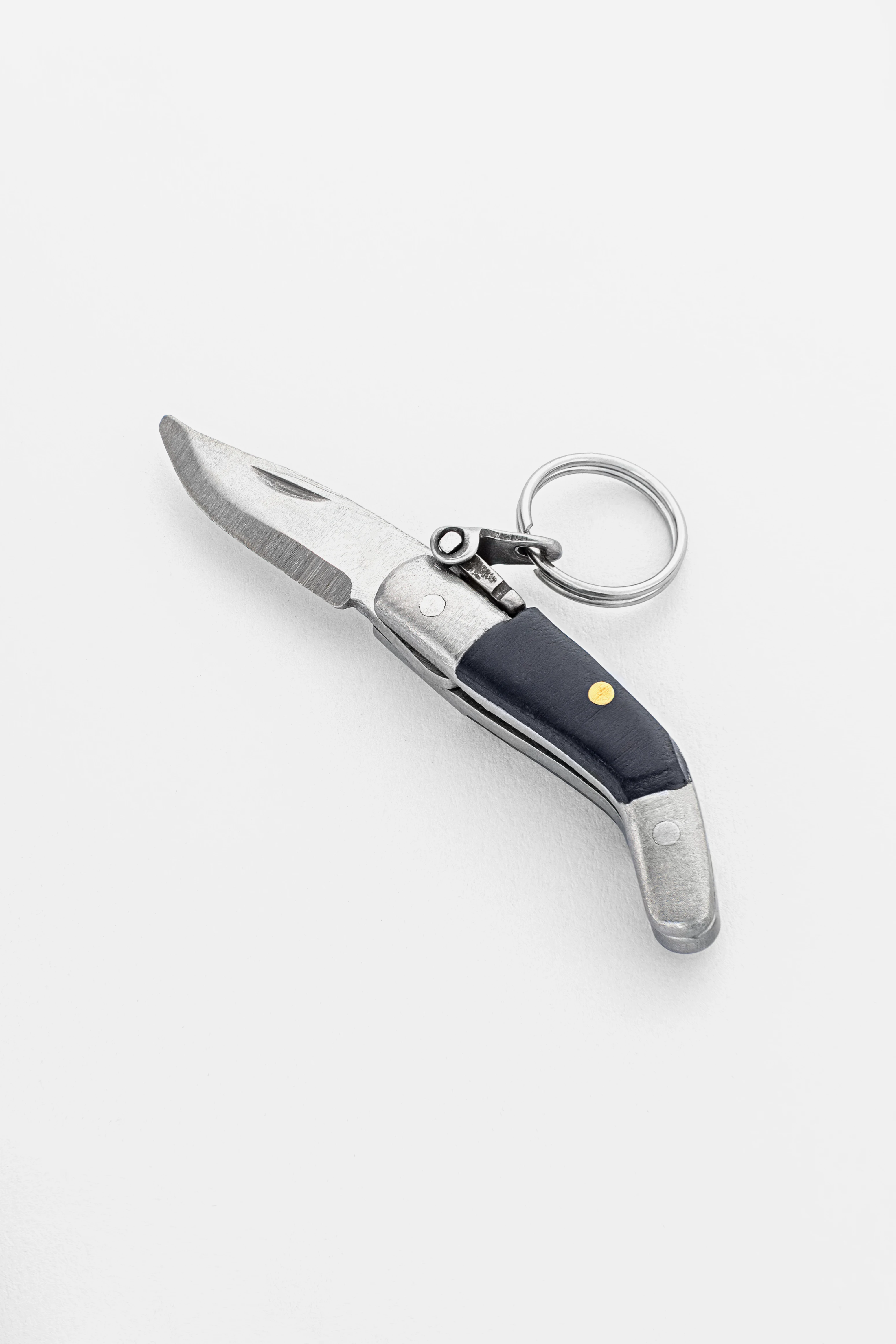
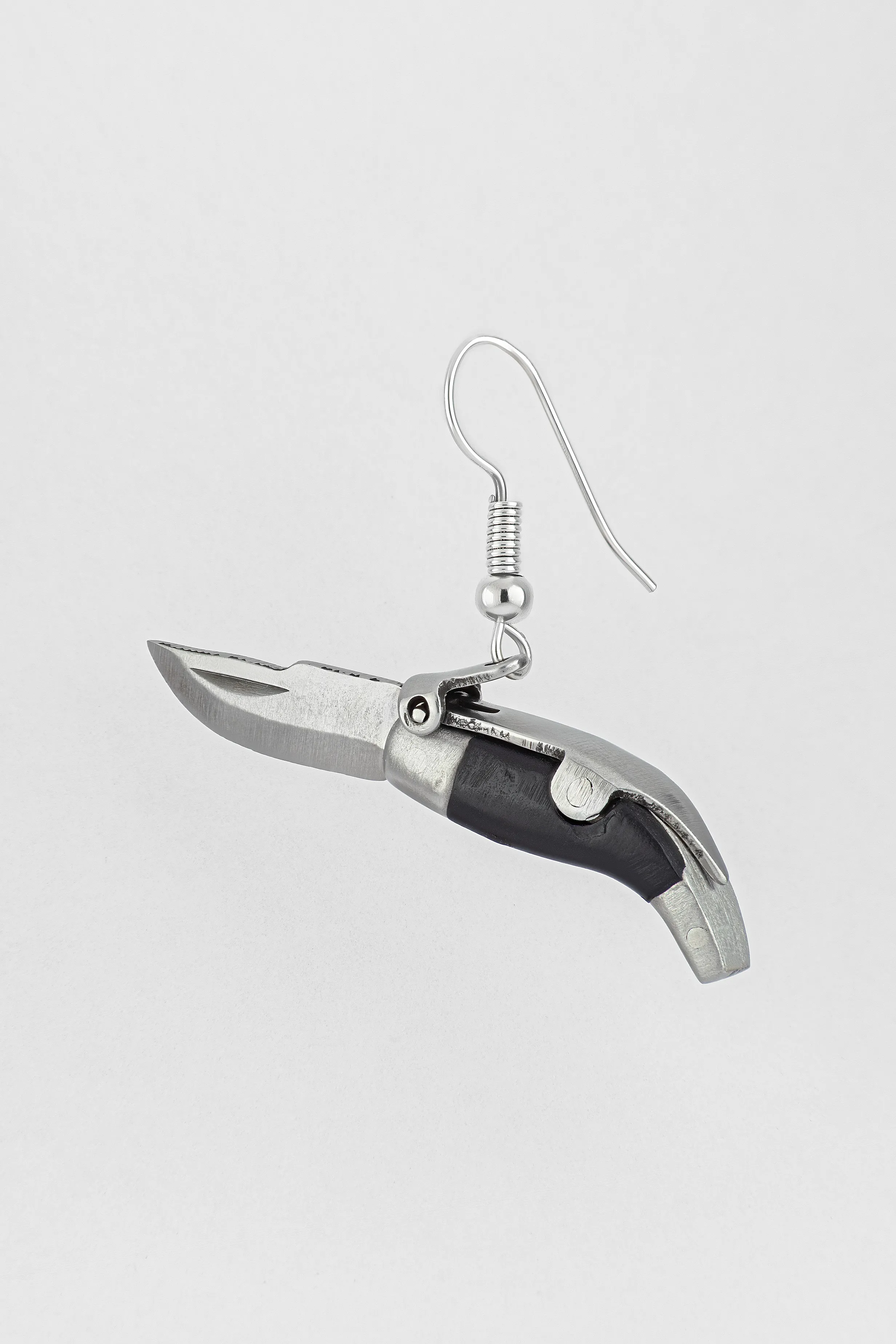
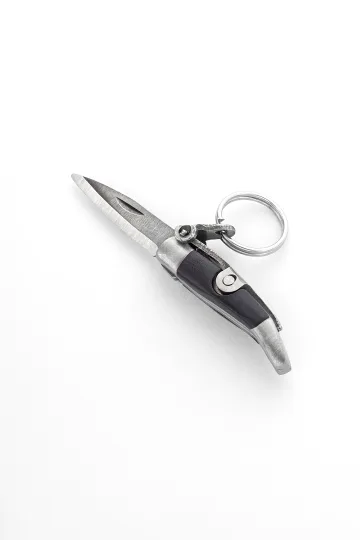
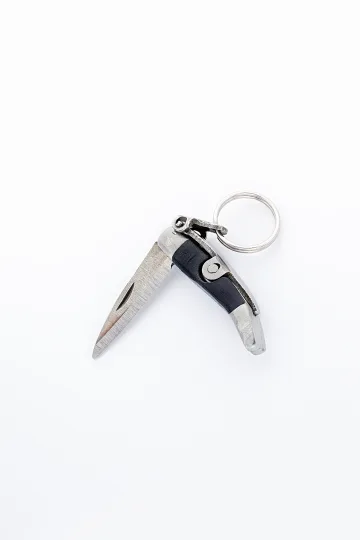
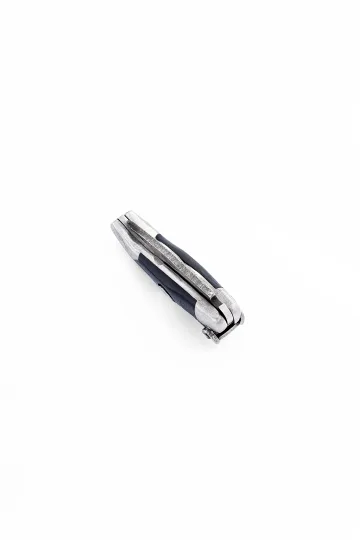
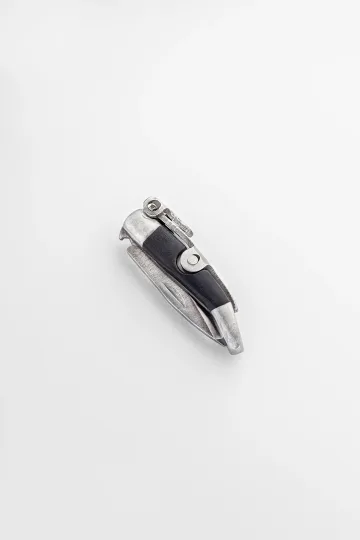
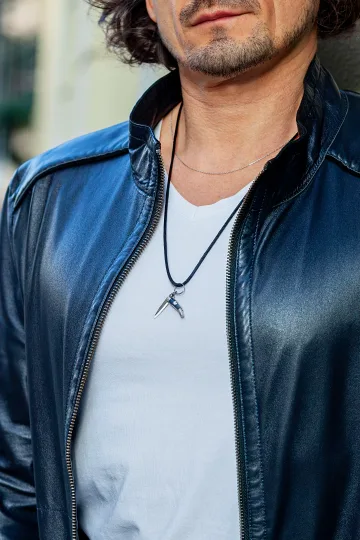
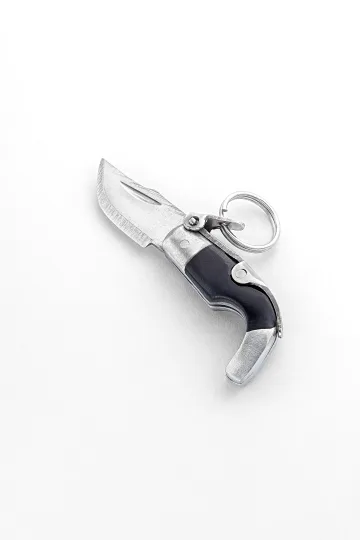
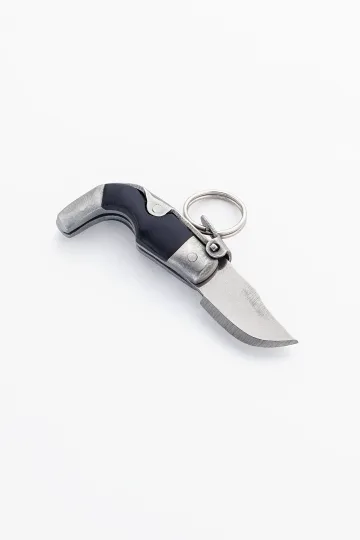
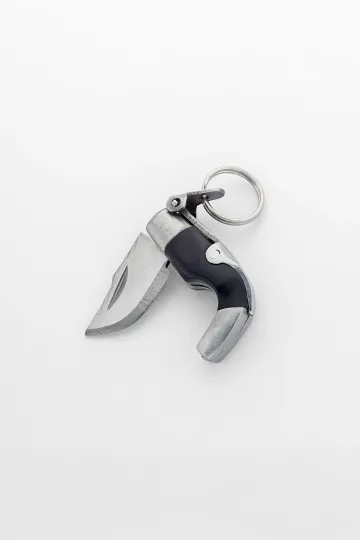
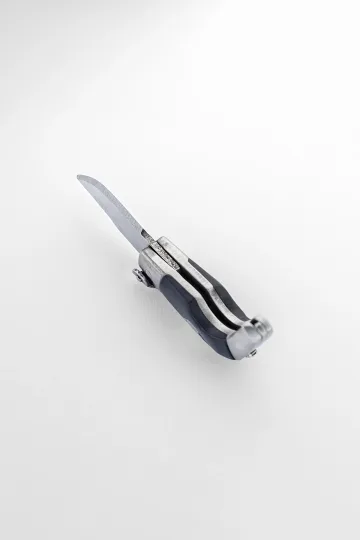
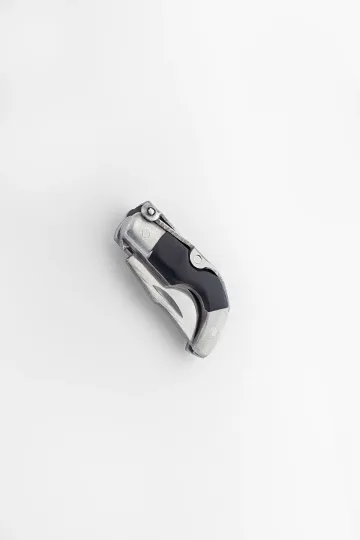
CAPAORA mini knife pendant
The 18th-century Spanish navaja in miniature: 40 mm of stainless steel, a real folding mechanism and a Palanquilla lock that clicks. An affordable gift to remember.
Authentic · Ships from Spain · 14-day returns
Symbolism: what is said and what is proven
Here it is worth being honest. Prehnite has no proven physical "energies". Everything attributed to the stone in this area belongs to folk belief, the tradition of crystal healing, and the psychology of colour.
In crystal-healing books, prehnite is most often called a stone of intuition and foresight, and because of its green colour it is linked to the heart centre and the theme of unconditional love. This symbolism took shape in the second half of the twentieth century, on the wave of the New Age movement, and rests above all on the colour and look of the stone. A calm green tone is associated with peace and nature; the soft glow reads as warmth, hence the "heart" meanings. This is the work of human perception, not a property of the mineral.
An important caveat: the stone does not cure illness and does not replace a doctor or a psychologist. Any claim that prehnite heals organs, lowers blood pressure, improves sleep, or shapes your fate has no scientific basis. If you like the stone's symbolism, it works through your attitude and attention, not through hidden forces. And in that form it can be accepted without giving up common sense: a beautiful piece of jewellery lifts the mood all by itself.
Prehnite as a gift
Prehnite is a thoughtful gift without showy luxury. Its pale-green colour is associated with renewal and the freshness of spring, so the stone is good as a present at the start of something new: a move, a new job, a course of study. If you want to strengthen the theme of beginnings, the same green range also sounds in hiddenite, the stone of growth and new beginnings.
The heart theme makes prehnite a fitting gift for someone close, a sign of warmth and goodwill. For those drawn more to the theme of forgiveness, tradition suggests rhodonite, the stone of forgiveness: its heart symbolism chimes well with prehnite. And buying the stone for yourself is also a form of care: a unique piece with a calm symbolism that will give pleasure for a long time.
Send a friend a discount code, they save on their first order.
Curious facts
The first mineral with a human name. Before prehnite, minerals were named descriptively or by place. The name in honour of Colonel van Prehn set the precedent after which hundreds of minerals received human names.
A stone that grows in bunches. We picture most gemstones as crystals with faces. Prehnite breaks the mould: in nature it is almost always rounded, grape-like, without sharp forms.
A witness to a cooled volcano. Every piece of prehnite is a trace of a distant geological event. The stone built up in the cavities of set lava from warm fluids, after the eruption was over.
A name-twin. The word "olivine" does not belong to prehnite; olivine is an entirely different mineral, the one that makes up peridot, the green stone from meteorites. And the old Greek word "chrysolite" was historically applied to various golden-green stones, which added to the confusion.
Frequent questions about prehnite
What is prehnite in simple terms?
Prehnite is a natural semi-translucent stone of pale-green colour, by composition a hydrous calcium aluminium silicate (Ca2Al2Si3O10(OH)2). It is easy to recognise by its peculiar "gel" glow, which earned the stone the nickname "grape jelly" among collectors. In nature it grows not as separate crystals but as rounded grape-like crusts in the cavities of volcanic rock. In jewellery, prehnite is used as cabochons, beads, and more rarely faceted inserts.
Where does prehnite get its odd name?
The mineral was named in 1788 by the German mineralogist Abraham Gottlob Werner, in honour of Hendrik van Prehn, a colonel in the Dutch army who served in the south of Africa and brought the first samples to Europe from the Cape of Good Hope. Prehnite thus became the first mineral in history named after a person's surname rather than after a colour, a place of discovery, or a legend.
What colours does prehnite come in?
Most often prehnite is pale green, the colour of unripe grapes and the first foliage of spring. There are yellow-green and lemon shades, especially in material from Mali, and more rarely a beautiful bluish-green tone. Prehnite can be almost colourless and white, but it is used less often in jewellery. The colour comes from traces of iron: the more there are, the deeper the green.
How hard is prehnite, and can you wear it every day?
Prehnite's hardness on the Mohs scale is 6 to 6.5. That is a middling figure: the stone is tougher than turquoise and malachite, but softer than quartz, emerald, and sapphire, and it also has cleavage. You can wear it every day, but a ring is best protected from knocks and taken off for cleaning, sport, and manual work. Earrings and pendants take daily wear more easily. For constant wear, choose a protective setting where metal covers the edges of the stone.
Why is prehnite called "grape jelly"?
For two features. The first is its form: in nature the stone grows in rounded, bumpy bunches very like a cluster of grapes. The second is its texture: prehnite often looks like set greenish jelly, with light passing inside and scattering gently, never reaching full transparency. It is exactly this gel glow and grape-like form that make prehnite unlike other green stones.
How does prehnite differ from chrysoprase and jade?
All three stones are pale green. Chrysoprase is usually more uniform, apple-green, without the gel glow or fibrous structure. Jade (nephrite) is dense and tough, with a slightly oily lustre and high impact resistance, hard to break. Prehnite gives itself away by its characteristic jelly translucency, soft scattering of light, and, in the rough, a rounded grape-like form. For expensive purchases, a gemmologist's report is the surest guide.
How do you tell real prehnite from glass?
The most common substitute is dyed glass. In glass you often see round air bubbles, the colour is too even and "empty", the material is warmer to the touch than stone, and inserts may show mould seams. Real prehnite gives a soft gel glow, has inner fibres and a slight natural unevenness. If an insert is perfectly clear, like a boiled sweet, and suspiciously bright, that is a reason to look more closely or ask for a specialist's opinion.
Where is prehnite mined?
Prehnite occurs all over the world, but only a few regions yield gem-quality material. The main gem sources are Mali (deep yellow-green stone) and Australia (an even, calm tone). Collector specimens come from the United States (the New Jersey and Connecticut traps), India (the Deccan basalts), China, Namibia, and South Africa. Scotland, France, Italy, and Germany are known for historical deposits.
Can prehnite get wet and be washed in water?
You can wash prehnite in warm water; this is the main safe cleaning method: mild soap, warm (not hot) water, a soft brush or cloth, thorough rinsing, and dry wiping. You must not wash it in hot water, use ultrasound and steam, keep it in chlorinated pool water, or apply acids, alkalis, and household chemicals. Prehnite has cleavage, so vibration and sudden heat are dangerous for it.
Does prehnite fade in the sun?
Yes, under long exposure to bright sun, prehnite's green colour can fade over time. So do not leave a piece on a windowsill in direct light. A short stay in the sun will not harm the stone; it is constant, prolonged exposure that is dangerous. Keep the piece in a box or pouch, and its fresh green will last for decades.
What is cat's-eye prehnite?
This is a special optical effect (chatoyancy) in specimens with a fibrous structure. When such a stone is cut as a high cabochon, the fine parallel fibres inside reflect light as a narrow moving band, like the pupil of a cat's eye. As you turn the stone, the bright line slides across the surface. The effect is uncommon and needs both suitable rough and the right cut, so such stones are prized above the ordinary.
Can prehnite be transparent and faceted?
Yes, but less often than cabochons. Most prehnite is semi-translucent with that characteristic gel cloudiness, and such material is most beautiful in a cabochon. Yet clean, transparent material fit for faceting does turn up. Faceted prehnite gives extra play of light and looks more dressy; it is used above all in earrings, where the stone is not exposed to knocks.
Is prehnite suitable for an engagement ring?
Technically yes, but with caution. An engagement ring is worn constantly for many years, while prehnite's hardness is only 6 to 6.5, and the stone has cleavage, so it is more sensitive to knocks than the traditional stones for such rings. Choose a protective setting and be ready to take the ring off during sport and manual work. For a very active lifestyle, harder stones, or wearing prehnite as a pendant, are more practical.
Can you give prehnite to a man?
Yes. The calm, restrained green and the absence of loud sparkle make the stone fitting in men's signet rings, cufflinks, and beaded bracelets. For a man's piece, denser, deeper-coloured material and a spare setting in silver or dark metal are often chosen. A bracelet of large beads looks masculine and is pleasant in the hand.
Does prehnite darken over time?
With proper care prehnite does not darken; rather, under long exposure to bright sun, the green colour can fade and grow pale. What can darken is the setting: silver acquires a patina over time, easily fixed by cleaning. The stone itself, kept carefully away from direct light, holds its fresh tone for years.
Is prehnite worth buying as an investment?
Prehnite is not a classic investment stone. Its price is affordable, the market is small, and you should not expect a sharp rise in value. Yet it is an excellent choice for another reason: you get a beautiful piece, unique in its pattern, with an interesting story, without big spending. The exception is outstanding collector specimens, especially rare clusters with epidote or stones with a cat's-eye effect, but that is a narrow niche for connoisseurs.
Myths about prehnite
Beliefs grow around any stone. Let us sort through the most common.
Myth: prehnite is an ancient stone of the pharaohs. No. Prehnite was singled out as a separate mineral only in 1788. Everything attributed to it in deep antiquity is a late invention.
Myth: prehnite heals organs and replaces medicine. No. The stone has no proven healing properties and does not replace a doctor. For health problems, see a specialist.
Myth: the brighter the green, the more genuine the prehnite. Not quite. A colour too bright and acidic is rather a reason to suspect dyeing or substitution. Real prehnite is usually soft, a little muted in tone, with a gel glow.
Myth: prehnite can be worn any old way, it is a stone after all. No. Prehnite is soft (hardness 6 to 6.5) and has cleavage; it is easy to scratch and to split. Protecting it from knocks, chemicals, and long sun is an essential condition for long service.
Find your prehnite at Zevira
At Zevira we love stones with their own character and story. Prehnite is one of those: quiet, glowing from within, never the same twice. Take a look at the catalogue and choose a piece that will glow with a calm green light just for you.
Open the Zevira catalogueBuying it as a gift? Each one arrives ready to give.
 A branded Zevira box and a little card come with every order.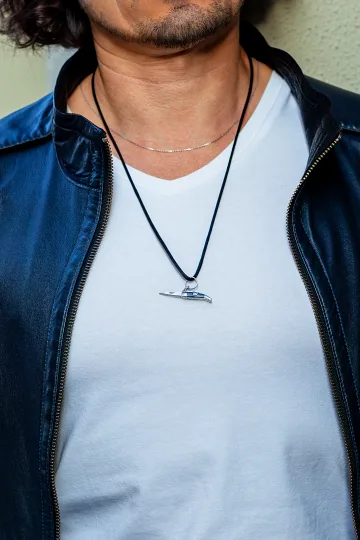




About Zevira
Zevira makes jewellery for those who look in a stone for both beauty and character. We tell honest stories of stones: with a formula, a geography, and a clear note on where science ends and tradition begins. We promise no magic and frighten no one with curses. Instead, we help you choose a piece that will give pleasure for a long time and suit you in particular. If the aesthetic of natural, understated stones speaks to you, you are in the right place.