Seraphinite: the green stone with silver feathers from the Siberian taiga
A stone with a single deposit on the entire planet. It does not come from Bronze Age legend; science described it in the nineteenth century. The mineral clinochlore was identified and described in the first half of the 1800s, and among the chlorites was a dark green stone laced with silvery threads. Someone later saw a wing in those threads, then the six wings of a seraph from an Old Testament vision. So geological clinochlore acquired the trade name seraphinite.
The feather pattern is neither painted on nor glued in place. It is the play of light across the thinnest flakes that grew inside the stone over millions of years. Below we work through the chemistry and geology of the mineral, its single deposit, how to tell the real stone from a dyed imitation, how it looks in rings and pendants, and why it became linked with angels.
What seraphinite is: clinochlore with a feather pattern
Seraphinite is the trade name for a particular variety of the mineral clinochlore. Clinochlore belongs to the chlorite group, a broad family of layered silicates related to the micas. The mineralogical name means little to a buyer, so the jewellery world settled on a poetic one that points to the seraphim, the highest rank of angels.
The defining trait of the stone is its feather pattern. Across a dense green field run silvery and whitish fibres that gather into a design resembling bird plumage, frost on a windowpane, or the curl of a fern. Turn the stone under light and the feathers seem to flare and fade, flowing one into another, creating a sense of movement inside a motionless mineral.
Wear the symbol, don't just read about it. These are in stock:



Chemical composition and formula
In chemical terms, clinochlore is a hydrous silicate of magnesium, iron, and aluminium. The simplified formula reads as (Mg,Fe)5Al(AlSi3O10)(OH)8. Magnesium and iron substitute for one another across a wide range, and their ratio governs the colour. The silvery sheen comes from the thinnest plates of the chlorite itself, oriented parallel to one another: light reflects off a multitude of microscopic planes at once, and the eye reads this as a soft pearly glow.
The green colour arrives from iron and magnesium in the structure. The shade ranges from an almost black bog tone to a rich pine and a pale moss. The more iron, the darker and cooler the green. The more magnesium, the lighter and warmer the tone. The silvery feathers stay consistently bright throughout, and the contrast between field and pattern is the main thing the mineral is prized for.
Physical properties: hardness, structure, optics
Clinochlore crystallises in the monoclinic system (hence the Greek klino, meaning inclined, in its name). Its build is layered: packets of the thinnest layers are weakly bonded and slide past one another easily. From that comes a perfect cleavage in one direction, as in mica, and a low hardness.
- Mohs hardness: roughly 2 to 2.5, sometimes up to 4. That is the level of gypsum and calcite, well below quartz at seven.
- Density: about 2.6 to 3.0 g/cm3, average for layered silicates.
- Cleavage: perfect, along the layers.
- Lustre: from pearly to silky, sliding as the stone moves.
- Transparency: opaque, rarely translucent on a thin edge.
- Refractive index: roughly 1.57 to 1.67, modest, with no bright fire.
Dispersion and faceted brilliance are not part of this stone's nature: it is opaque and soft, so its whole effect rests on light reflected off the inner flakes rather than refracted through facets. For the same reason seraphinite is almost never cut with a table and facets; it is worked as a cabochon, a smooth dome with no edges. Faceting would simply shatter the whole picture of plumage into small splinters of glint.
How it forms in nature
The stone is born through metamorphism, the transformation of existing rocks under pressure, temperature, and hot mineral-rich fluids. The starting material is magnesium-rich ultramafic rock. Under water and heat, chlorites grow out of it, clinochlore among them.
The feather pattern forms when the thinnest platy crystals grow radially, fanning out from shared centres. These fans and rosettes of flakes, once the stone is cut and polished, appear as feathers, plumes, and curls. The silvery sheen arises on those flakes turned toward the light at the right angle. The pattern is not laid on top but runs through the entire body of the stone, and every cut yields a unique picture.
How seraphinite differs from similar stones
Clinochlore is often confused with moss agate, green aventurine, and certain kinds of nephrite. The difference lies in the nature of the pattern. In moss agate the green branches are inclusions of foreign minerals inside transparent chalcedony, seen like waterweed. In seraphinite the feather design is formed by the body of the stone itself, by its own flakes. Nephrite and aventurine produce no such feathery silk.
- Seraphinite: opaque, soft, feathers from its own flakes, silky shimmer, born in Siberia.
- Moss agate: semi-transparent, hard, the green branches are foreign inclusions in chalcedony.
- Green aventurine: even green with sparks of mica, no feather pattern.
- Nephrite: dense, waxy, uniform green, no sliding silk.
- Malachite: bright concentric bands, an entirely different pattern and lustre.
Names of the stone
The stone goes by several names, and they reflect its dual nature, scientific and poetic.
- Clinochlore: the mineralogical name, from the Greek words for inclined and green.
- Seraphinite: the trade name after the seraphim, settled in during the second half of the twentieth century.
- Seraphenite: an outdated spelling found in older texts.
- Green chlorite: a loose everyday name, imprecise but understandable.
How seraphinite looks in the hand
The first impression of the stone is a quiet depth. Seraphinite does not blaze like a faceted gem; it glows softly from within. The surface is smooth and cool, warming in the palm faster than glass. Turn it and a wave of light runs along the feathers, and the pattern seems to breathe. This quiet, unshouting beauty is what makes the stone something you want to study for a long while.
Geology and deposits: why seraphinite comes from Siberia
Unlike quartz, found on every continent, or garnet, mined by the tonne, gem-quality clinochlore is tied to a tiny dot on the map.
The single industrial source
The main and effectively only commercial source of gem seraphinite is the Korshunovskoye iron-ore deposit in the Irkutsk region of Siberia, in the Nizhneilimsky district near Lake Baikal. The mineral clinochlore turns up in many countries: it is found in the Urals, in the Alps, in North America. Yet the feathery variety with a dense green colour and a pronounced silvery plumage is mined in commercial quantities only here.
Geologists have described the deposits within ultramafic rocks, in a zone where ancient igneous masses underwent change under hot fluids. These masses formed hundreds of millions of years ago. The conditions are harsh: high ground, a short summer, no roads, all of which make the work seasonal and expensive. The share of gem-quality material in the total mass is small.
This monopoly geography weighs heavily on the market. When a stone is mined in one place, the supply depends on one mine, one season, one logistics chain. The closest parallel in market logic is charoite, also mined only in Siberia, in a single location. Single-deposit stones always live by special rules: their supply is fragile, and there is nowhere to find a replacement.
Why seraphinite is so soft
The layered structure of the chlorites explains both the beauty and the fragility of the stone. The crystals are built from packets of thin layers weakly bonded to one another. These layers slide and split easily, which gives the mineral its softness and perfect cleavage. That same layering produces the pearly sheen, because light reflects off the planes between the layers.
The practical conclusion follows: the mineral cannot be worked and worn like sapphire. It demands gentle tools, careful polishing, and considerate wear. Chlorites are closely related to the micas; they share the same structural principle. The difference is that the micas have only cations sitting between their layers, while the chlorites have an extra intermediate layer. For the buyer the upshot is what matters: seraphinite behaves like a soft layered mineral, and it should be handled as gently as mica.
Customer reviews
Zevira is a real jewellery shop. Genuine payments, deliveries and customer thank-yous.
🥰🥰🥰 gracias

Ok, ¡gracias! 🙂

Seraphinite goes on the chest, set in silver. Put it on a ring you cook in and it's scratched to death by month's end, and don't you dare crowd those feathers with gold.
How to wear seraphinite
Green with silver goes into a look easily: it is calmer than it seems and quarrels with almost nothing. Here is what actually works with this soft stone, sorted by occasion.
What do I wear seraphinite with every day? For daily wear I recommend a dark green cabochon in silver over a light top (white, cream, grey), so the stone steps forward at once. Dark green on black reads deepest, and against natural tones (khaki, beige, brown) I suggest it for the earthy harmony. I ask you to echo the silver setting with more silver, not gold.
Which shade suits my skin? For a cool undertone I suggest a saturated dark green with bright silver: the contrast of the feathers works on cool skin. A warm undertone is closer to a light mossy stone, softer and no argument with golden skin. If you are unsure, take a mid tone, it forgives mistakes.
Where should it go, a ring or the chest? I choose a pendant. The stone is soft; on a finger it collects scratches within weeks, while on the chest it is protected and fully on show. A ring I recommend only as an accent, taken off for cooking and cleaning. Earrings are the safest format, they knock against almost nothing.
Which neckline for the pendant? Under an open neckline I suggest a large cabochon: the feather pattern reads from across the room and becomes the centre of the look. Under a closed, high top I choose a smaller stone on a short chain so it rests on the fabric instead of sinking under the collar. One expressive stone always beats a scatter of small pieces.
How do I build an evening look with it? For evening I recommend a smooth fabric in a deep colour (wine, emerald, black) and a dark green cabochon in silver at the collarbone. Other jewellery I suggest you set aside: the living silk of the feathers dislikes rivals nearby. Let the stone work alone.

Turn on your camera, pick earrings, a pendant or a ring, and see the piece on yourself in real time.
Switch items in one tap.
Everything runs in your browser: no photo or video is ever uploaded.
The history of seraphinite: from the description of a mineral to an angelic name
The history of clinochlore is shorter than that of emerald or sapphire, and therein lies its charm. This is a stone almost of the modern age, discovered and described by science rather than handed down from legend.
The discovery of clinochlore in the nineteenth century
The mineral clinochlore was identified and described in the first half of the nineteenth century. In 1851 it was given the scientific name clinochlore, formed from the Greek words for inclined and green, after the characteristic tilt of the crystals and their colour; the name was introduced by the American geologist William Blake. In the same era, leading mineralogists studied and described the chlorites of the Urals in detail.
For a long time clinochlore remained a stone for scientific collections and museum cases. It had no industrial or jewellery value: the feathery variety was rare and lay in places hard to reach.
How clinochlore became seraphinite
The trade name took hold in the second half of the twentieth century, when the stone began to trickle onto the gem market. The name was coined not by geologists but by dealers and stone lovers who saw in the feather pattern a likeness to the wings of seraphim. The seraphim, in the biblical tradition, are six-winged angels, beings of fire and light, known from the vision of the prophet Isaiah. Feathers on a dark green field fitted that image perfectly.
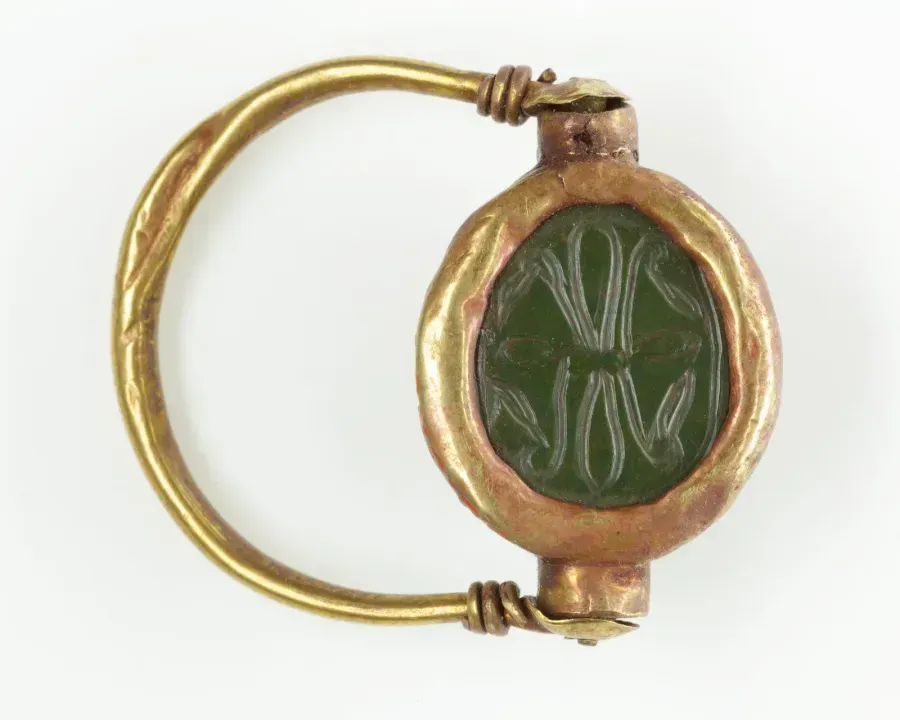
Seraphinite is not among the classic precious stones. It was not set into crowns or shown at the great auctions, because by the time it reached the market the age of crown regalia was long past. Rings with a green stone, on the other hand, were worn for thousands of years: think of the Egyptian signet rings set with green stone. Seraphinite remains the find of mineral collectors, makers of one-off pieces, and devotees of green gems.
Upload a photo of your pet, someone you love, or an object. We'll build a 3D model and hand-cast it in pewter.




Types and shades of seraphinite
Although the stone is mined in one place, it is far from uniform. Stones differ in the tone of green, in the density and brightness of the plumage, and in the character of the pattern.
Classic dark green with silver
The most recognisable and prized type is a deep dark green field, almost pine, with bright silvery plumage. The contrast here is at its strongest: pale feathers literally glow on a dark field. Such a mineral looks noble, especially in a silver setting that echoes the silver of the feathers.
Light green and mossy tones
There is seraphinite with a lighter, mossy or grassy field. It holds more magnesium and less iron, so the shade is warmer and softer. The plumage is less visible on a light field and the contrast is lower, but the stone takes on a calm, pastel charm. Such cabochons suit delicate everyday pendants and earrings well.
The character of the pattern and the silk effect
The pattern varies. The feather design consists of long curving strands resembling a wing. The fibrous kind recalls silk threads running parallel. The rosette kind gathers into stars and plumes spreading out from points. A single stone can combine several types.
In the finest specimens seraphinite shows a soft shifting sheen that moves as the stone is turned. This is a relative of the cat's-eye effect, only blurred across the whole surface of the feathers. When the plumage sends out a wave of light trailing the movement, the stone comes alive. Such a silken shimmer is highly valued.
What counts as a good stone
The best stones have a rich even field, bright contrasting plumage, a pronounced silken shimmer, and no cracks or chips. The more clearly the feathers read as a single pattern rather than as chaotic specks, the higher the quality. A dull colour, a cloudy surface, a weak pattern, and visible damage all lower the value. No two stones are exactly alike, and part of seraphinite's charm lies precisely in its singularity: the thinnest plates of chlorite grow radially from random centres, and nature never makes the same pattern twice.





Seraphinite in jewellery: rings, pendants, earrings, bracelets
The softness of the stone dictates the approach. It is almost always cut as a cabochon and set so as to protect it from knocks. Most often it is paired with silver, less often with gold.
Rings with seraphinite
A ring is the most vulnerable place for a soft stone: hands keep bumping into things. So rings with seraphinite are made with a protective setting, a closed or half-closed bezel that wraps the girdle of the cabochon in metal. The high dome of the stone is tucked into a rim so it does not catch or take blows.
Sterling silver suits seraphinite perfectly. The cool gleam of the metal echoes the silvery feathers, and the green field looks especially deep against it. A ring with a large cabochon reads like a one-off piece, because identical patterns do not exist. Wear it as an accent piece, taking it off for manual work, washing up, and sport. You can read more about the alloy itself in the article on sterling silver.
Pendants and necklaces
A pendant is the best format for seraphinite. On the chest the stone is better protected from knocks than on a finger, while staying fully in view. A large cabochon in a simple silver frame shows the feather pattern at its best. A teardrop or oval pendant emphasises elongated feathers, while a round cabochon gathers the rosette pattern into the centre. A heavy cabochon needs a sturdy bail and a reliable chain.
Earrings with seraphinite
Of all pieces, earrings are damaged least often, because they hang free and rarely strike anything. That allows more open settings and larger cabochons. A pair of earrings has the advantage of showing two different patterns at once: nature makes no identical feathers. Light studs with small cabochons suit every day, while long drop earrings become an evening accent. If your skin is sensitive, choose hypoallergenic ear wires and check the quality of the metal.
Bracelets and beads
A bracelet of seraphinite beads looks noble, especially when the green beads alternate with silver spacers. But do not forget the softness: the beads rub against one another and against other objects, so a seraphinite bracelet loses its polish faster than a quartz one. Wear it on one wrist without hard bracelets nearby and take it off at night and in the shower.
Which setting works best
The softness of the stone makes the choice of setting not a question of taste but of preservation.
- Closed bezel: the edges of the stone are fully wrapped in metal, maximum protection, the best option for rings.
- Half-closed bezel: a rim covers the girdle while leaving the dome open, a sensible compromise.
- Prong setting: pretty but risky, suitable only for earrings and pendants.
- Setting with a protective rim: a frame around the stone takes the blows itself.
Six fast checks, no tools. Leave your email, we'll send the PDF and a discount code.
No spam, unsubscribe anytime.
Caring for seraphinite
The main rule of care follows from the softness. You put the stone on when hands and body are free of heavy work, and take it off for sport, cleaning, cooking, the shower, and sleep. The fewer knocks and the less friction the stone takes, the longer its polish lasts and the more intact its rare plumage stays.
Cleaning is simple: wipe seraphinite with a dry or slightly damp soft cloth, with no abrasives and no harsh chemistry. Put the piece on last, after make-up, creams, and perfume, so that alcohols and oils do not settle on the surface and cloud it. Store the stone apart from hard stones and metal objects, in a soft pouch or a cloth-lined box, to avoid scratches. Guard against drops onto a hard floor.
What you must not do:
- Soak it in water, salt water above all: the layered structure does not forgive this.
- Clean it in an ultrasonic bath.
- Clean it with abrasive pastes and stiff brushes.
- Heat it or expose it to sharp temperature swings.
- Leave it long in full sun or near sources of heat.
If the polish dulls over time, an experienced craftsperson will restore the depth by re-polishing with soft abrasives. Doing this yourself with household means is not worth it: the risk is of finally ruining a rare object. With careful handling the cabochon keeps its depth and silk for decades, and the piece may well pass down through the family.
A silver setting darkens in air over time, a natural property of the metal. Cleaning it near seraphinite calls for special care: only gently wipe the metal parts with a silver cloth, without touching the stone and without soaking the whole piece. You can read more about why silver darkens and how to fix it in the article on tarnished jewellery.
CAPAORA mini knife pendant
The 18th-century Spanish navaja in miniature: 40 mm of stainless steel, a real folding mechanism and a Palanquilla lock that clicks. An affordable gift to remember.
Authentic · Ships from Spain · 14-day returns
Seraphinite among the green stones
There are many green stones in nature, and each holds its own niche. Seraphinite is easier to grasp when set beside its companions in colour.
Seraphinite and emerald
Emerald is the benchmark of green: transparent, hard, faceted, with a cool fire. Seraphinite is its full opposite: opaque, soft, warm, with a silky feather pattern in place of the glint of facets. Emerald is for those who want a classic precious stone. Seraphinite is for those after character, nature, and a story.
Seraphinite and malachite
Malachite is closer in spirit: both are opaque, both are cut as cabochons, both are prized for their pattern. But the patterns differ. Malachite gives bright concentric bands and eyes. Seraphinite gives soft silvery feathers on an even field. By hardness malachite is also soft, but a touch tougher. Whoever likes a graphic pattern will pick malachite; whoever prefers fine silk will settle on seraphinite.
Seraphinite and nephrite
Nephrite and jadeite are dense, tough green stones with a centuries-old culture, especially in East Asia. They are uniform, without a bright inner pattern, prized for an even colour. Seraphinite, by contrast, is all about pattern and the play of light on the feathers. Nephrite is tougher and suits carving and amulets; seraphinite is softer and asks for care.
Seraphinite and moss agate
This pair is confused most often. Yet telling them apart is simple. Moss agate is chalcedony, hard and semi-transparent, and its green branches are foreign inclusions inside the stone. Seraphinite is soft, opaque, and its feathers are the mineral's own flakes. In agate the pattern is like waterweed in glass; in seraphinite it is like bird plumage with a silken shimmer.
Seraphinite and charoite
Both stones are Siberian, both rare, both mined effectively in a single place, both prized for their pattern. Yet they look different. Charoite is violet, with a fibrous shifting pattern, a touch harder. Seraphinite is green, with silvery feathery plumage. They are united by the market logic of single-deposit stones: a fragile supply and the status of a collector's find.
Symbolism: what is ascribed to seraphinite
Let us be plain: seraphinite does not cure illness and does not summon angels. The mineral has no proven physical or medical effect, and any noticeable effect is explained by psychology rather than by the stone's properties. But over a century and a half people have tied a steady set of meanings to it, and that is part of the stone's culture. We tell of them as historians, not as preachers.
The link to the angelic theme was born from the name, and the name from the pattern. The feathers recalled wings, the wings recalled seraphim. In the tradition of working with stones the green colour is tied to the heart, growth, and renewal, and silver to the moon, purity, and light. Clinochlore combines both, and it felt natural to people to place it at the meeting point of those themes. Hence its reputation as a stone of calm and of connection with what a person holds to be higher.
In crystal energetics, a current without scientific recognition, seraphinite is credited with the power to ease anxiety and harmonise the emotions. This is the realm of belief and personal experience, not proven medicine. The soberest view is this: the stone can be a pleasant personal symbol, chosen consciously, but it is not an amulet with power inside and not a substitute for a doctor. And that is enough for it to be valuable.
Send a friend a discount code, they save on their first order.
How to tell real seraphinite from a fake
Since clinochlore is rare, imitations and mislabelling crop up on the market. A few pointers will help you avoid a mistake.
Natural seraphinite has a deep three-dimensional feather pattern that runs through the stone rather than lying on the surface. Each specimen differs a little from the next. The stone is opaque, soft, and warmer to the touch than glass. Turn it under light and a silken wave slides across the surface.
Warning signs of an imitation:
- Too even, repeating a pattern as if stamped from a template.
- An acid-bright, unnaturally lurid green with no natural depth.
- Air bubbles inside, visible against the light, a sign of glass or resin.
- Perfectly identical beads on a string; in a natural stone the pattern is always different.
- Transparency: the real stone is opaque.
- A suspiciously light weight and a warm plastic surface.
- A complete absence of silken shimmer on turning.
Imitations are usually made from dyed glass, plastic, or cheap stained stone. There is virtually no industrial synthesis of clinochlore on the market: the stone is niche, and synthesis would not pay off. So fear not the lab-grown stone but the fakes. A good seller honestly gives both the trade name seraphinite and the mineralogical one clinochlore, states the Siberian origin, and promises no healing miracles. As for cost, a simple cabochon in silver is on a par with a pleasant dinner out, a large high-grade stone in a one-off setting is closer to the cost of a short trip, and collector specimens of rare quality go for more. Pay for the plumage and the shimmer, not for size.
FAQ: common questions about seraphinite
What is seraphinite in simple terms
Seraphinite is the trade name for a rare green variety of the mineral clinochlore with a characteristic silvery feather pattern. The name points to the seraphim, six-winged angels, because the pale fibres on a dark green field recall wings. Geologically it is a layered silicate of magnesium, iron, and aluminium, a relative of the micas and chlorites. Its main feature is the silky plumage that shifts as the stone is turned. The stone is soft, almost always cut as a cabochon, and most often set in silver.
Where is seraphinite mined
Gem seraphinite is mined in practically one place, at the Korshunovskoye deposit in the Irkutsk region of Siberia, in the Nizhneilimsky district near Lake Baikal. The mineral clinochlore turns up in other countries too, in the Urals, in the Alps, in North America, but the feathery variety with a dense green colour and a bright silvery pattern comes in commercial quantities only from this Siberian spot.
Why is seraphinite called the angel stone
The name came from the pattern. Someone saw in the silvery strands on a green field a bird's feather, then a wing, and then several wings of a seraph from the biblical vision. The seraphim are the highest rank of angels, six-winged beings of light. The trade name seraphinite settled in during the second half of the twentieth century. This is a cultural legend born of a poetic name, not a proven property of the mineral.
What hardness is seraphinite and does it fear scratches
The stone is soft, on the Mohs scale usually 2 to 4 units, in its softest part around 2 to 2.5. That is the level of gypsum and calcite, far below quartz. Yes, it scratches easily and fears knocks. So it is cut as a cabochon without facets and set in protective bezels. Wear it carefully: take it off for sport, cleaning, cooking, and the shower, store it apart from hard stones, wipe it with a soft cloth.
Can seraphinite get wet
Better not. The stone belongs to the soft layered minerals, and prolonged contact with water, salt water above all, can damage the surface and cloud it. A brief wipe with a slightly damp soft cloth is fine, but soaking, holding it under running water, washing in salt water, or cleaning in an ultrasonic bath are out.
How to tell real seraphinite from a fake
Look at the pattern and the material. Natural seraphinite has a deep three-dimensional feather pattern that runs through the stone rather than lying on the surface, and each specimen differs a little. Fakes are made from dyed glass, plastic, or cheap stained stone. A too-even repeating pattern, an acid-bright green, air bubbles against the light, and perfectly identical beads on a string should all put you on guard. The real stone is soft and warmer than glass to the touch.
Why is seraphinite cut only as a cabochon
Because of its softness and layered structure. Faceted cutting needs a hard stone that holds sharp edges and shines through the refraction of light. Seraphinite is too soft for that; the facets would quickly wear and chip. Besides, facets would shatter the whole feather pattern into a multitude of small glints and kill the very thing the stone is prized for. The smooth dome of a cabochon keeps the pattern whole and brings out the silky shimmer.
Which metal is best for setting seraphinite
Most often seraphinite is set in sterling silver, and that is justified aesthetically: the cool gleam of silver echoes the silvery feathers, and a dark green field looks deeper on silver. Silver is more affordable than gold, which is sensible for a large cabochon. Gold is used too, white gold especially. The main thing is that the setting be protective: a closed or half-closed bezel that wraps the edges of the soft stone.
Can seraphinite be worn every day
Yes, with caveats. Because of its softness seraphinite wears down faster than hard stones, so daily wear suits protected formats: a pendant on the chest, earrings that hang free. A ring for constant wear is risky; better to wear it as an accent and take it off for manual work. A pendant under clothing during active tasks, and taking it off at night and in the shower, will lengthen the stone's life.
Is seraphinite suitable for an engagement ring
Probably not. An engagement ring is worn constantly, for years, without taking it off, and seraphinite is too soft for that: it will quickly cover in scratches and lose its shine. For a symbol meant to last a lifetime it is better to choose a hard stone. Seraphinite, though, is wonderful for a cocktail, accent, or gift ring worn on occasion, and even better for a pendant or earrings, which are far better protected from wear.
Which seraphinite is considered the most valuable
The most valuable is a stone with a deep even dark green field, bright contrasting silvery plumage, a pronounced silken shimmer that slides on turning, and no cracks or chips. The more clearly the feathers read as a single meaningful pattern with movement, the higher the quality. Pay for the pattern and the shimmer, not for size: a large but lifeless stone yields to a small but bright and living one.
How does seraphinite differ from moss agate
By the nature of the pattern. In moss agate the green designs are inclusions of foreign minerals inside transparent or semi-transparent chalcedony. In seraphinite the feather pattern is formed by the body of the stone itself, by its own chlorite flakes. Seraphinite is softer than agate, opaque, and gives a characteristic silky shimmer. Moss agate is harder, more transparent, and gives no feathery silk.
Does seraphinite heal
No, the mineral does not cure illness and does not replace a doctor or medicine. In crystal energetics, a current without scientific recognition, it is credited with the power to ease anxiety, but that is the realm of belief and personal experience. There is no proven medical effect. Treat the stone as a beautiful symbol, not as medicine.
How to care for seraphinite
Care is gentle: wipe the stone with a dry or slightly damp cloth without abrasives or chemistry, store it apart from hard stones in a pouch or a separate compartment of a box, guard it against drops and knocks. Do not soak it, do not clean it in ultrasound, do not hold it under hot water. Put the piece on last, after creams and perfume. Treated this way, the depth of colour and the plumage will last for decades.
Can seraphinite be blue or another colour
Classic clinochlore is green, from dark pine to pale moss, with silvery plumage. Specimens with a faint bluish or blue-green sheen sometimes turn up thanks to quirks of composition, but a purely blue mineral does not exist in nature. The colour comes from iron and magnesium, and they give precisely the green range. If you are offered a bright blue or violet stone under the name seraphinite, it is either an error or an imitation.
Does seraphinite fade in the sun
The stone is fairly stable in colour: its green comes from iron and magnesium, which are durable colourants. It has no sharp fading, as some organic materials do. But prolonged strong heat and sharp temperature swings harm a soft layered stone; they can cause microcracks and clouding. Do not leave seraphinite long in full sun or near sources of heat; store it in a cool dry place.
Is it safe to wear seraphinite with sensitive skin
The stone itself is inert and causes no irritation; the problem usually lies in the metal of the setting. With sensitive skin, choose seraphinite in quality sterling silver without cheap additives, or in hypoallergenic alloys, earrings especially. Avoid cheap costume jewellery of unknown composition, which may contain nickel.
How does seraphinite differ from ordinary green chlorite
Seraphinite is itself a special variety of clinochlore, but not every green chlorite deserves the name. Ordinary chlorite can be dull, shapeless, without a pronounced pattern. Only the clinochlore that has a dense green field and bright silvery feather plumage with a silken shimmer, fit for jewellery work, is called seraphinite.
Is seraphinite hard for a jeweller to work
Yes, the material is considered temperamental. Its softness and layered structure call for careful handling: the stone chips easily during cutting, overheats during setting, scratches during polishing. So it is almost always cut as a cabochon by hand and set in gentle closed mounts without strong heat. That is precisely why quality pieces with seraphinite are more often one-off and small-batch.
Does seraphinite change colour under different lighting
There is no sharp colour change as in alexandrite. The green field stays green in both daylight and artificial light. But the stone's character depends strongly on the lighting: under bright directed light the feathers flare and the silk slides, while under soft diffuse light the stone is calmer and darker. So seraphinite is best viewed in motion and under varied light.
Which setting metal to choose for seraphinite
If you are choosing between silver and cheaper alloys for the setting, an honest breakdown of the metals' properties is in the article on brass, stainless steel, and sterling silver. For a soft stone the metal matters not for its look but for how it shields the girdle from knocks.
Buying it as a gift? Each one arrives ready to give.
 A branded Zevira box and a little card come with every order.














About Zevira
At Zevira we love stones with an honest story. Seraphinite, for us, is an example of how geology and culture meet in a single object: on one side a soft Siberian clinochlore from a single deposit, on the other a century and a half of human meanings about wings and connection with the higher. We tell both sides, because a beautiful stone needs no exaggeration; the truth is enough for it.
Our seraphinite jewellery we set in sterling silver, shielding the soft stone with closed and half-closed bezels, and we choose cabochons with expressive plumage and a living silken shimmer. Every stone is unique in its pattern, so every piece is one of a kind. We write about stones the way we would want them written about to us: without shamanism, without loud promises, with respect for both mineralogy and tradition.
Seraphinite at Zevira
Choose a pendant or ring with rare Siberian seraphinite in sterling silver. Every stone with its own one-of-a-kind feather pattern.
See seraphinite jewellerySeraphinite is simply beautiful, rare, and filled with the meaning people have invested in it for a century and a half. Green like the heart, silvery like light, soft like everything alive. Sometimes that is enough for a stone to become a favourite.