Celestine: the sky-blue stone of calm, mental clarity, and quiet daydreaming
In 1798 the German mineralogist Abraham Gottlob Werner named this stone after the Latin caelestis, "heavenly", working from samples found in Pennsylvania. The colour really does match a shard of clear winter sky. And hidden inside it sits strontium, the very element that paints firework flames a deep crimson. Sky-blue on the outside, red fire in its chemistry.
Celestine (also called celestite) is strontium sulphate, a soft mineral of a tender pale-blue. By mineral standards it is young: it was described barely two centuries ago, unlike emerald or pearl with their thousand-year biographies. In return it has a rarity of a different kind, an honest double life. It is both an industrial ore of strontium, mined by the tonne, and a darling of mineral collectors who split the rock open for its beautiful blue geodes.
Here is the order of what follows: what celestine is made of and why it is so soft, how it grows in nature and where it is found, how it differs from look-alike stones and fakes, how to handle it so the blue does not fade within a year, and which pieces of jewellery let it last the longest.
What celestine is: a strontium mineral the colour of sky
Celestine is a natural strontium sulphate, formula SrSO4. The crystal grows from strontium-rich solutions and takes the shape of transparent or translucent tablets and prisms. Its most recognisable colour, the pale blue catalogues call heavenly, is the one everyone pictures. You also find colourless, white, yellowish, orange-tinted and, more rarely, greenish samples, yet in the popular imagination celestine is a blue stone.
A quick portrait of the mineral
Key properties:
Wear the symbol, don't just read about it. These are in stock:
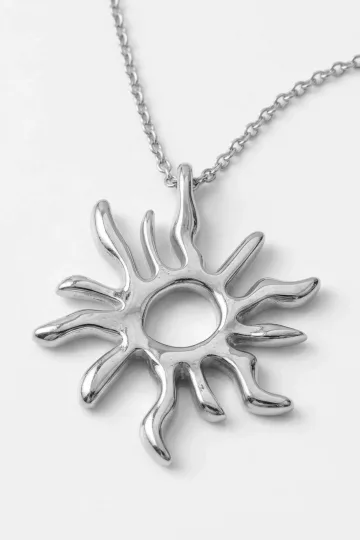



- composition: strontium sulphate, SrSO4;
- crystal system: orthorhombic;
- hardness: 3 to 3.5 on the Mohs scale (soft);
- density: roughly 3.97 to 4.0 g/cm3 (high);
- cleavage: perfect in one direction, splits easily along flat planes;
- colour: usually a tender blue, more rarely white, yellow, orange, grey;
- lustre: vitreous, sometimes pearly on cleavage surfaces;
- refractive index: around 1.62 to 1.63, weak birefringence;
- origin: sedimentary rocks, sulphur and limestone beds.
Hardness and what it means
On the Mohs scale celestine sits at 3 to 3.5. For comparison: a fingernail scratches at about 2.5, a copper coin at roughly 3, window glass at around 5.5. So celestine is a touch harder than a fingernail and noticeably softer than glass. That single number decides everything: how it is cut, what setting suits it, how it should be worn. A stone you can scratch with a coin is no good for an everyday ring, yet it lives happily in a pendant.
High density
Celestine's density is unusually high for such a light-coloured stone, about 3.97 to 4.0 g/cm3. Pick up a celestine cluster and it feels heavier than it looks. That unexpected weight is one of the first signs that tells real celestine from dyed glass or plastic, since a fake is usually lighter. The weight comes from strontium, an element heavier than calcium, built into the crystal lattice.
Cleavage and brittleness
Celestine has perfect cleavage along the (001) plane: it splits along even surfaces, as if along tear lines. Under a knock or strong pressure the stone is more likely to part along a smooth face than to scratch. This is a natural property of the mineral, not a flaw in one particular specimen. Knowing this, people choose protective settings and gentle wear for celestine.
Optics and lustre
Celestine is transparent to translucent, its lustre is glassy, and on cleavage planes it can take on a pearly sheen. The refractive index is low (around 1.62), so a cut celestine does not throw fire like a diamond or a zircon; it glows softly, from within. Birefringence and dispersion are weak. It is exactly for that steady inner glow, rather than for sparkle, that celestine is prized.
The stone's name
The name comes from the Latin caelestis, "heavenly", from caelum, "sky". It settled into use right at the end of the eighteenth century. In English both "celestine" and "celestite" are current, and both are correct. Mineralogical databases tend to write "celestine", while crystal enthusiasts often say "celestite". From here on the two are used as synonyms.
The stone's name is a rare case where the name tells the truth without exaggeration. Many gems carry loud, promising names. Celestine was named simply for its colour: heavenly. No "royal" or "magical" epithets, only a mineralogist's observation that the stone matches the tone of a clear sky.
Baryte, the twin mineral
Celestine has a twin mineral, baryte (barium sulphate). They form an isomorphic series: barium and strontium substitute for each other in the crystal lattice. So nature produces intermediate stones, baryto-celestines, in which part of the strontium is replaced by barium. By eye, baryte and celestine are hard to tell apart; analysis is needed. This is one reason a cheap "celestine" from a market sometimes turns out to be baryte.
Strontium: red fire inside a blue stone
Celestine is the chief natural ore of strontium. Strontium salts burn with a rich red flame, which is why strontium has long been used in pyrotechnics: the red stars of firework displays, signal flares, tracer compositions. The same element that paints the sky a festive scarlet lies quietly inside a pale-blue crystal. Incidentally, this is also a handy way to tell celestine from baryte: in a flame strontium gives red, barium gives green.
The history of celestine: from a scientific name to Sicilian mines
The history of celestine is shorter than that of emerald or pearl. Antiquity did not know it as a separate stone: too soft, too easily confused with other blue minerals for the ancients to single it out. Celestine's real biography begins in the era when people learned to describe minerals systematically, that is, at the end of the eighteenth century.
Late eighteenth century: the stone gets a name
The first scientific descriptions of the mineral we now call celestine date to the 1780s. Samples from Pennsylvania (the Bedford area) and from near Bristol in England reached mineralogists, who noticed: this is not baryte, though it looks like it, and not aquamarine, though it is blue. By the end of the century the Latin name for "heavenly" had taken hold. From that moment celestine officially exists as a mineral species.
English Bristol gave the world so-called Bristol celestine, pale-blue samples from the Yate and Clifton districts. In the nineteenth century this region became a major supplier of celestine to the chemical industry.
Nineteenth century: celestine goes industrial
The great irony of celestine's history: while jewellery preferred harder blue stones, chemists and metallurgists were mining celestine by the tonne. Strontium from celestine went into refining sugar from beet, into pyrotechnics, and later into specialist glass.
In the nineteenth century Sicily was the world's centre of sulphur mining, and along with the sulphur, the volcanic rocks of Agrigento and Caltanissetta yielded gorgeous celestine crystals, transparent, bluish, sometimes with inclusions of sulphur and aragonite. These Sicilian samples are still regarded as the benchmark of museum-grade celestine. The contrast of blue celestine and bright yellow sulphur on a single specimen is one of the most recognisable "portraits" of the mineral in museum cases. Today the Sicilian mines are closed, and the old specimens only grow dearer.
1897: a cave beneath a winery
One of the most famous episodes in celestine's history happened on South Bass Island in Lake Erie, Ohio. While boring a well beneath a winery, workers broke through the roof of a giant cavity entirely lined with blue celestine crystals. The crystals reached around 90 centimetres (roughly three feet) across, the largest known celestine geode on the planet. Some of the crystals were taken out and sold for pyrotechnics in the early twentieth century, but the cave itself was preserved and opened to visitors. Crystal Cave still operates today: you can step inside the geode as if entering a room panelled with blue crystals.
Twentieth century: the discovery of Madagascar
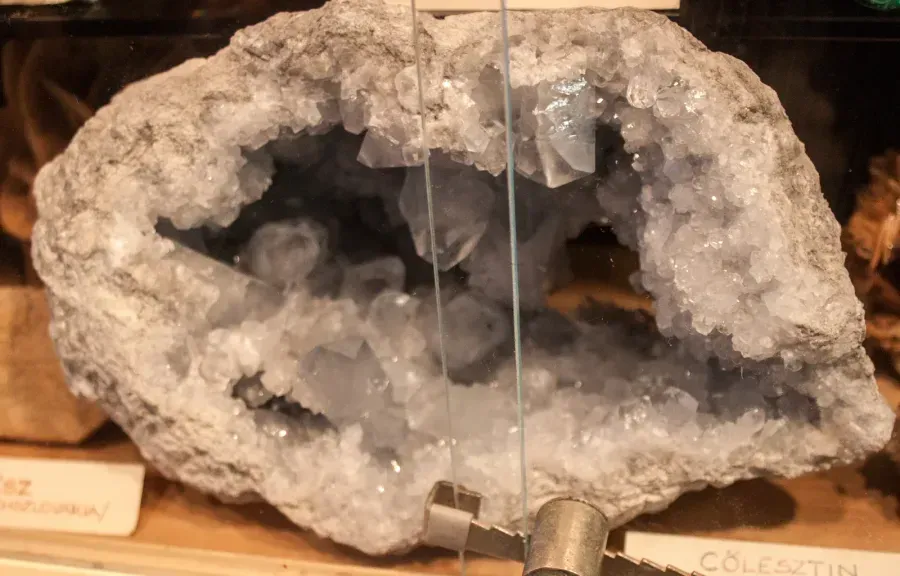
Celestine's popularity with collectors and crystal lovers is bound up above all with Madagascar. In the second half of the twentieth century, in the Sakoany area of the Mahajanga province, rich deposits of celestine geodes were found. They are split open to reveal clusters of sky-blue crystals on a greyish "crust". It is these Madagascar geodes that made celestine recognisable: they are sold at mineral fairs all over the world.
Why celestine has no ancient legends
Unlike emerald, turquoise or pearl, celestine has no thousand-year tail of legends about pharaohs and kings. The reason is simple: ancient people could not single out this soft mineral, so easily confused with others. Its history is young, about two centuries old. The Latin root, though, is older than the stone: it was the name of several Roman popes (Celestine I to V), there are the names Celeste and Celestina, and in Italian celeste means exactly our sky-blue. In other words, language had long fixed the link "celeste = the colour of sky", and the stone received a ready-made trail of meaning along with its name.
Customer reviews
Zevira is a real jewellery shop. Genuine payments, deliveries and customer thank-yous.
🥰🥰🥰 gracias
Ok, ¡gracias! 🙂
Celestine is a cold-blooded stone. Wear silver, wear linen, keep a clear head, and leave the gold circus at the door.
What to wear celestine with
On shoots I add the blue stone last, never first: celestine is quiet, and that is exactly its strength. Here is what actually works, sorted by occasion.
What do I wear celestine with every day? For daily wear I recommend celestine in silver on a short chain so the stone sits in the hollow of the collarbone. A light background works best: white, grey, pale blue, muted beige. Over linen, cotton or soft knit the blue pendant reads fresh and never argues with the clothes. A dark top turns the stone into the accent, and then I suggest keeping the rest of the jewellery calm.
Is celestine right for the office? Yes, as long as you keep it restrained. I recommend silver or white gold and a plain blouse with an open collar, where the stone lands at the collarbone and lifts the face with a cool light. For length I suggest 45-50 cm, so the pendant sits just below the top button. This is a quiet detail, not a loud accent, and a strict dress code is no obstacle.
How do I build an evening look? For evening I choose celestine earrings next to a deep blue, emerald or wine dress: blue on a dark ground sways softly and catches light. The contrast of the cool stone with a warm gold setting adds a dressed-up note. On a smooth fabric in a rich colour celestine looks more expensive than its price suggests.
Which metal should I pick for celestine? By character the stone prefers cool metal: silver and white gold hold its cool note and do not pull focus. I keep warm gold for evening, when a festive contrast helps. If your skin has a warm undertone, a gold setting will warm the blue; with a cool undertone silver reads cleaner.
Who does blue celestine suit most? It suits light eyes and a cool colour type as if made for them, but that is not the whole story. Celestine is a stone of one quiet note, so it is better to let it speak alone than to split attention across a stack of loud pieces. Two rules that never fail. First: a short chain makes the stone a cosy everyday accent, a long one turns it into a calm vertical line for stricter looks. Second: if you want layers, build them from thin silver chains of different lengths and give celestine its own line.

Turn on your camera, pick earrings, a pendant or a ring, and see the piece on yourself in real time.
Switch items in one tap.
Everything runs in your browser: no photo or video is ever uploaded.
Geology and deposits: where the sky-blue stone is born
Celestine forms in sedimentary rocks, where shallow warm seas and lagoons once lay. Seawater is rich in sulphates, and if strontium enters it (it often accompanies calcium), then as the sediments evaporate and recrystallise, celestine grows. That is why the stone favours limestones, dolomites, gypsum-anhydrite beds and sulphur deposits.
Most often celestine occurs as:
- geodes and cavities inside sedimentary rocks, lined with crystals on the inside;
- nests and veins in limestones and marls;
- solid granular masses, which feed the industrial mining of strontium;
- well-formed individual crystals in voids of volcanic and sulphur rocks.
Where the blue colour comes from
Pure strontium sulphate is colourless. It is made blue by colour centres, defects in the crystal lattice linked to natural radiation over millions of years and to micro-impurities. The blueness is not a separate pigment but a fine tuning of the structure. That is exactly why the colour is not light-fast: what defects in the lattice created, ultraviolet gradually destroys. The colour of sky in celestine is, quite literally, a play of light and structure.
How celestine actually grows
The easiest way to picture the stone's path is as the story of one ancient sea. A shallow warm sea, millions of years ago. The water is saturated with salts, among them strontium. The sea shrinks and evaporates, the sediments on the floor compact and recrystallise. In the cavities and cracks of the future rock, slowly, layer by layer, celestine crystals grow out of the saturated solution. Where there was plenty of solution and room, large transparent crystals and roomy geodes form; where it was cramped, a fine blue "brush". So geology explains the whole range of forms, from museum crystal to a modest cluster.
Celestine's companions
Celestine rarely grows alone. Its frequent neighbours in the rock are sulphur (especially in volcanic and sulphur deposits), gypsum and anhydrite, calcite and aragonite, sometimes halite (rock salt) and dolomite. From the set of companions a geologist can read the conditions in which the stone grew.
Madagascar
Today Madagascar is the calling card of collector celestine. The Sakoany area and the Mahajanga province give those very geodes that are split in half and sold as paired "bowls" of blue crystals. Madagascar celestine is prized for its rich yet gentle blue and for its neat, well-formed crystals. Most of the celestine clusters in crystal shops around the world come from here.
Sicily and Italy
The Sicilian sulphur deposits (Agrigento, Caltanissetta) gave the classic museum crystals of the nineteenth century: transparent, pale blue, sometimes together with yellow sulphur and white aragonite. These specimens are rare and have mostly settled in old collections and museums. Sulphur was mined in Sicily for centuries, and celestine came along as a beautiful bonus.
The United States
Ohio (South Bass Island, that very Crystal Cave) and Michigan produced the largest known geodes. In California, New York and other states celestine occurs in sedimentary beds. American celestine is more about geological records and museums than about the jewellery market.
Britain
The surroundings of Bristol (Yate, Clifton) are the historic home of Bristol celestine and a centre of industrial strontium mining in the nineteenth century. Stone from here is more often pale, bluish-white. From the English and Pennsylvanian samples the mineral received its scientific name at the end of the eighteenth century.
Mexico, Iran and other countries
Mexico and Iran are today the largest industrial suppliers of strontium raw material from celestine. Here the stone is mined by the tonne, and nearly all of it goes into chemistry, glass and pyrotechnics. Celestine also occurs in Turkey, Egypt, Tunisia, Poland and Germany. One pattern holds throughout: there is a lot of celestine in the ground, yet truly beautiful jewellery and collector grade is scarce, and it is scattered across the world in occasional lucky deposits.
Why jewellery celestine is a rarity
There is plenty of celestine in the ground, yet little jewellery celestine. The chain of attrition runs like this:
- most mined celestine goes into industry as strontium ore;
- of the beautiful remainder, a large share is collector clusters and geodes that are worth more whole than sawn up;
- of the material fit for cutting, much is rejected for cracks and cloudiness;
- the remaining clear transparent crystals are hard and risky to cut because of their softness and cleavage.
So cut blue celestine is a stone for the connoisseur. Clusters, geodes and cabochons, by contrast, are far more available, and they are exactly where it makes sense to begin.
Shades and types of celestine
Celestine is not a single-tone stone. Under one name hides a whole palette, and understanding the shades helps you choose "your" stone.
Sky-blue
The benchmark, the most desirable shade. A pale, clean, faintly powdery blue, exactly the one the stone was named for. In a good specimen the colour is evenly spread, and the crystals are transparent or translucent. The finest such stones come from Madagascar and from old Sicilian collections. The signs of a truly good sky-blue celestine: even colour throughout, with no dirty grey zones, a soft, airy blue rather than a harsh, paint-like one, a stone that glows from within rather than looking dead and dull.
Milky blue and translucent
A very common variant: blue with a slight milkiness, a matte quality, like sky in a haze. The crystals are translucent, light passes through but scatters. Milky-blue celestine is often more practical than the perfectly transparent kind: the light haze hides small natural imperfections and gives a calm, even look without harsh flashes. For pendants and beads this is a frequent choice.
Colourless and white
Pure strontium sulphate is colourless. Mineralogists prize colourless and white celestines for their transparency and the perfect form of the crystals. In jewellery they appear more rarely, but a cut colourless celestine looks like a drop of clear water. Sometimes a white or greyish stone is the result of a once-blue colour having faded completely.
Yellow, orange, "sunset"
Celestine with impurities can be yellowish and even a warm orange. Such samples come, for instance, from deposits where celestine grew next to sulphur. Yellow-orange celestine looks warmer and more unusual than the blue in jewellery, and it is chosen by those who want warmth rather than coolness.
Greenish and grey
Rare greenish shades and greyish tones also occur. Grey often means either a natural impurity or a blue stone faded by light. If a collector celestine has greyed over time, it is a sign that it stood in the sun for too long.
Transparency as a separate trait
Beyond colour, celestines differ greatly in transparency. There are crystals almost glass-clear, through which you can see the background, the summit of quality and a rarity. There are translucent ones, glowing from within with an even light, the favourite choice for jewellery. And there are cloudy, almost opaque pieces, the lower grade, fit only for industry. When choosing celestine, judge not just the tone but the glow: a living inner glow is worth more than a bright but "dead" colour.
Cluster, geode, cabochon, crystal: the forms of celestine
Beyond colour and transparency, celestine is distinguished by form:
A cluster is an intergrowth of crystals on a common base, a "brush". The most frequent collector and interior format: blue crystals jut out of greyish rock.
A geode is a cavity in rock, lined inside with crystals. A split geode becomes a "bowl" with a blue crystalline inner surface. The famous Madagascar specimens are most often geodes.
A cabochon is a rounded polished form with no facets. The main jewellery format for celestine, because it spares the soft stone from chips.
A single crystal is a tabular or prismatic lone crystal with even faces. An object of collector value, especially if transparent.
Upload a photo of your pet, someone you love, or an object. We'll build a 3D model and hand-cast it in pewter.



How to tell celestine from look-alike stones and fakes
Celestine is a stone easy to be fooled by, because dyed glass, tinted quartz, and its twin mineral baryte are all sold under its name. A few practical guides will keep you from going wrong.
The weight test
Celestine is dense (about 4 g/cm3), heavier than it looks. Glass and plastic of the same size are noticeably lighter. Hold the stone in your hand: if a light, "airy" stone is unexpectedly weighty, that speaks for authenticity. Lightness almost always gives away an imitation. This is the quickest everyday test, available right at the counter.
The hardness test
Celestine is soft (3 to 3.5). It scratches easily with a steel needle and will not itself scratch glass. If a "celestine" confidently scores glass, you have a hard imposter (dyed quartz, glass, a synthetic) and not celestine. Note: this test will physically damage genuine celestine, so it is best left to the seller and only on a hidden spot.
Colour on a chip and in cracks
In a dyed stone the dye often pools in cracks and micro-pores, giving uneven dark streaks. In natural celestine the blue comes from the depth of the crystal evenly, with no "runs". Look at the stone against the light and under a loupe: a natural colour is soft and three-dimensional, while a dyed one is superficial and patchy. Too bright, "candy-like" even blueness is also suspicious.
Baryte, angelite and other substitutes
Telling celestine from baryte (barium sulphate) by eye is almost impossible; analysis is needed, for example by flame colour: strontium gives red, barium green. Angelite (blue anhydrite) is also sold as celestine. A guide: celestine is more often transparent or translucent, with a glassy lustre and crystalline form; angelite is usually matte, "waxy", opaque, like chalk. If it matters to you that it is genuinely celestine, buy from a seller who states the composition and origin.
Price and presentation
Jewellery celestine is rare and hard to cut. More often honest celestine is sold as clusters, geodes, cabochons and beads, not as large sparkling faceted stones. If someone offers a scattering of large, perfectly cut blue "celestines" at a knock-down price, it is almost certainly dyed glass.



Caring for celestine
Celestine is soft, brittle and afraid of light. That does not make it temperamental, it just calls for different handling than hard stones such as topaz or sapphire.
Light
Celestine's chief enemy is direct sunlight. The blue colour fades irreversibly in light to grey over months, and does not come back: colour centres destroyed by ultraviolet do not regenerate. Keep clusters away from windows, store jewellery in the dark (a box, a pouch). You can wear celestine quite safely in ordinary daylight and indoor light; what harms it is constant direct ultraviolet. The paradox is that the "stone of the sky" cannot be kept long under the real sky.
Water and chemicals
Celestine dislikes long contact with water, and acids even more. Brief splashes are no threat, but you should not wash the stone under a tap, soak it overnight or clean it in an ultrasonic bath, especially a polished surface. To clean it, a dry or slightly damp soft cloth with immediate drying is enough. Protect the stone from household chemicals, perfume, hairspray and creams; apply cosmetics before putting the jewellery on. Take celestine off before a shower, a pool or the sea.
Knocks, friction, storage
Because of its softness and perfect cleavage, celestine fears knocks and abrasion. Take jewellery off for sport, cleaning, cooking and any work with your hands. Store the stone apart from hard stones (topaz, quartz, aquamarine), which scratch it easily, in a soft pouch or in a separate fabric-lined compartment of a box. Sharp temperature changes are also undesirable: do not leave celestine on hot surfaces, by the stove, on a radiator.
How hardness affects wearability
The main consequence of softness: the format of the jewellery matters more than for hard stones. A pendant and earrings take almost no knocks; they can be worn often. A ring and a bracelet on the hand take the most friction, so celestine in them scratches and chips quickly. With gentle handling celestine keeps its form and colour for years; with rough use it loses its looks in months. All the typical problems (greying, dull faces) are the result of broken care, not of the stone's age.
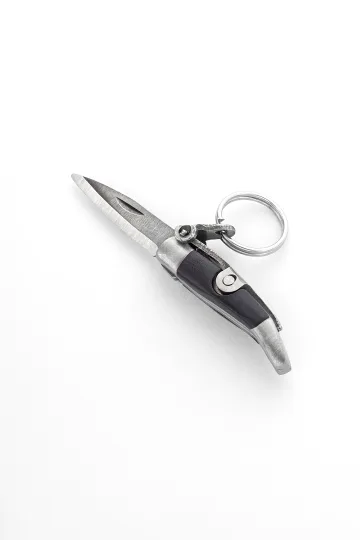
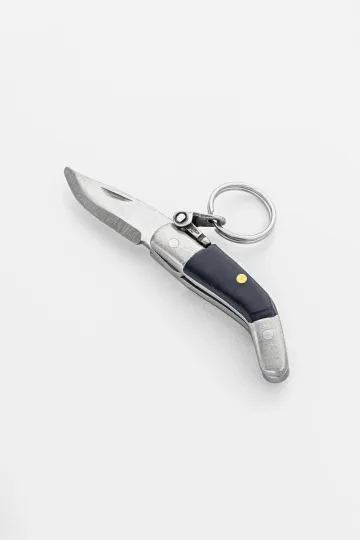
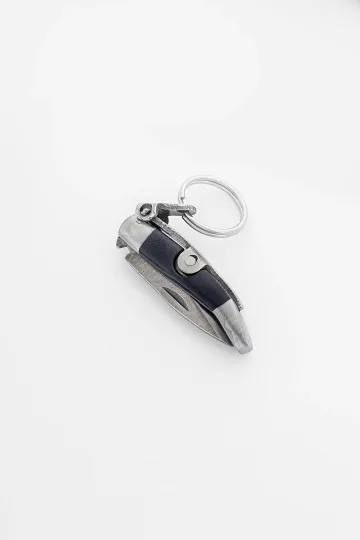
CAPAORA mini knife pendant
The 18th-century Spanish navaja in miniature: 40 mm of stainless steel, a real folding mechanism and a Palanquilla lock that clicks. An affordable gift to remember.
Authentic · Ships from Spain · 14-day returns
Celestine in jewellery: rings, pendants, earrings, bracelets
The main factor in working with celestine is its softness (3 to 3.5 on the Mohs scale) and perfect cleavage. This dictates every decision the maker takes: which setting to choose, how to cut it, what to wear often and what to spare.
Pendants
A pendant is the most sensible format for celestine. The stone hangs, nobody rubs it against a table, the load is minimal. Most often celestine in a pendant is set in a bezel, with the metal wrapping the stone around the perimeter and covering the girdle: that way the fragile edges are protected. Sterling silver suits celestine well, the cool white metal reinforcing the blue. In pendants people often use not a faceted stone but a polished cabochon or a tidy piece of crystal, to take less risk in working it.
Rings
A ring with celestine is jewellery for careful people and special occasions, not for everyday wear. On the hand the stone takes the most knocks and friction, and at a hardness of 3 to 3.5 celestine does not like that. If you do want a ring, two solutions are sensible: a high closed bezel that hides the stone's edges, and careful handling, that is, taking it off for dirty and active work. Better one carefully worn stone than three chipped within a year.
Earrings
Earrings are an excellent format, almost as gentle as a pendant. The stone rubs against nothing, hangs freely, catches the light as you move. Blue celestine in earrings lights the face with a cool, light tone and goes well with silver. Since celestine is soft, earrings avoid thin sharp facets that chip easily. Rounded forms and closed settings extend the stone's life.
Bracelets and beads
A bracelet of celestine beads does appear on the market, but there is a catch: the wrist moves a lot, the beads rub against each other and against tabletops, and celestine is soft, so over time it dents on the facets and goes matte. This is not a flaw, it is the nature of the stone. A wiser format is one where celestine is an accent set among harder stones, with the main load falling on them.
Which metal to choose
Sterling silver. The cool white metal carries the blue colour on and makes it fresher, cooler. The most logical and affordable frame for sky celestine.
Yellow gold. Gives a contrast of warm and cool: blue against a gold background sounds brighter and more festive. The choice for celestine on a special occasion.
White gold and platinum. Close to silver in colour effect, but stronger and more durable.
It is better to avoid cheap alloys that darken quickly: against a dark background the tender blue gets lost.
Which setting extends the stone's life
Because of celestine's softness and brittleness the setting matters more than for hard stones. A bezel (closed) setting is the best choice: the metal wraps the stone around its perimeter, hiding the vulnerable edges. High prongs are dangerous: they leave sharp edges exposed, and celestine chips along them. A cabochon instead of a facet cut is sensible: a rounded polished form with no sharp facets lives longer than a faceted stone and shows off celestine's inner glow well.
Clusters and interior forms
A separate and very popular life of celestine takes place outside jewellery, as an interior object. A split geode with blue crystals on a table or shelf, this is exactly how most people first meet celestine: as a piece of blue light. The main rule at home is the same: not on a sunny windowsill, or within a few months the blue will drift into grey.
Leave your email, we'll send your discount code. No spam, unsubscribe anytime.
The code arrives by email, valid on your first order.
Celestine in the world of collectors
A separate universe of celestine is mineral collecting. Here different rules apply than in the jewellery trade.
What collectors value
For a collector what matters is not wearability but the perfection of the crystal: clarity, transparency, size, the form of the faces, the aesthetic of the whole cluster or geode. A perfectly formed transparent blue crystal on contrasting rock is highly valued, even if it is useless for jewellery. Old Sicilian specimens of the nineteenth century are the object of a real hunt.
The geography of prestige
In the collector world an unspoken hierarchy of origin has settled. Sicily (the old sulphur mines) is the classic and the prestige. Madagascar is the generous and beautiful "mass premium". Ohio is the geological legend, thanks to the giant cave. Sometimes origin matters more for the price than the look of the stone itself.
Geodes as paired objects
Celestine geodes are often split in half, and the two halves of the blue "bowl" are sold as a pair. Many people like the very idea: two parts of one stone, symmetrical, born in a single cavity. It is a popular gift and interior format.
Storing a collection
Collector celestine is kept carefully: in the dark or in diffuse light, away from direct sun, apart from hard minerals, without sharp damp. Closed display cases with ultraviolet protection are the ideal for blue celestine. Specimens are labelled (deposit, source): for celestine origin matters especially, since it largely determines both the beauty and the value.
The symbolism of celestine: what is believed and what is proven
Here honesty is needed. Celestine does not "protect" or "heal", and there is no proven effect on health, sleep or mood. But its reputation as a stone of calm has an understandable cultural basis, and it is worth setting out soberly.
In the tradition of stones, celestine is linked with calm, mental clarity and daydreaming. The logic here comes not from legends but from language and colour. Blue is the colour of sky and water, that is, of space and distance; there are almost no blue animals and no blue food, so blue is subconsciously tied to something large and out of reach. Hence the expressions "a clear head", "to clear up", "to have your head in the clouds". A stone the colour of sky inherits these meanings along with the colour.
In chakra systems celestine, because of its blue colour, is most often assigned to the throat centre (the theme of speech and self-expression), more rarely to the "third eye". In folk correspondences it is linked with the element of air and with the air signs of the zodiac. All this is a cultural language of description, convenient for those who use it, not a law of nature and not a guide to buying. Celestine is chosen by a response to its colour, not by a birth date.
In short, celestine is a beautiful blue mineral with an honest reputation. Tradition holds that it calms and clears the thoughts; there is no proven physical effect. Any promises that the stone heals, lowers blood pressure or guards against misfortune have nothing to do with mineralogy.
Pairing celestine with other stones
Celestine is matched to other stones by colour (other blue and neutral tones) and by character.
Celestine and amethyst. Tender blue and soft violet side by side give a muted range. Many Madagascar celestine clusters sit next to amethyst geodes on the same shelf for exactly this reason.
Celestine and rose quartz. Blue and tender pink, a soft pastel pair. Pink warms, blue cools, and together you get an even, calm mood. It looks good in silver jewellery.
Celestine and rock crystal. Clear quartz beside celestine strengthens the sense of purity; visually it is like a drop of water beside a piece of sky. The quartz, meanwhile, is hard and durable.
Celestine and aquamarine. Blue to blue, but with a different character: aquamarine is marine, hard, celestine is heavenly, soft. The aquamarine in one piece takes on the load, protecting the fragile celestine.
Celestine and lapis lazuli. A contrast of saturation: lapis is a dense blue with golden flecks of pyrite, while celestine is pale, daytime. Side by side they work like night sky and day sky. A striking visual pair.
If you want to strengthen the theme of quiet, transparent calm, celestine sits well beside danburite, an equally light, transparent stone. We wrote about the soft "moon" mineral for meditation in our piece on selenite: it has much in common with celestine in both character and gentle care. Among green stones, a similar light energy is ascribed to seraphinite.
What to keep out of one box
Celestine is soft, so in one box with hard stones (topaz, aquamarine, quartz with sharp facets) it will quickly pick up scratches. Store celestine separately, in a soft pouch or a fabric-lined cell. This is not about energy, but about the simple physics of hardness.
What celestine is not
To avoid falling for unnecessary promises, it helps to list what celestine certainly is not.
Not aquamarine and not topaz. It is a separate mineral with a different composition, softness and character. Celestine is chosen for colour, not for hardness.
Not a remedy. Celestine does not cure illness, does not lower blood pressure and does not replace a doctor. Any "healing" promises have nothing to do with mineralogy.
Not a charm against misfortune. Celestine has no thousand-year tradition of "protection", and no proven effect of that kind.
Not an everlasting stone. It is soft, brittle and fades in the light, so it calls for careful handling.
Not a rare mineral in the ground. There is plenty of celestine underground; it is mined by the tonne. What is rare is precisely the beautiful jewellery and collector stone.
Send a friend a discount code, they save on their first order.
Frequent questions about celestine
Are celestine and celestite the same thing?
Yes, they are two names for one mineral, strontium sulphate (SrSO4). "Celestine" is used more in mineralogical literature, "celestite" among crystal enthusiasts. Both are correct, and both always mean the same sky-blue stone. If a seller calls the stone celestite while you are used to celestine, it is the same mineral.
Why is celestine so blue?
Pure strontium sulphate is colourless. The sky-blue colour comes from colour centres, defects in the crystal lattice linked to natural radiation and micro-impurities. The blueness is a fine tuning of the structure, not a separate colouring mineral. That is exactly why the colour is not light-fast: what defects in the lattice created, light gradually destroys. For the same reason the intensity of the blue differs from sample to sample.
Can you wear celestine every day?
It depends on the format. A pendant and earrings in a protective setting can be worn daily, they take almost no knocks. A ring and a bracelet are harder: at a hardness of 3 to 3.5 the stone on the hand scratches quickly and can chip. If you want to wear celestine constantly, choose a pendant at the throat and take the piece off for active work, sport, cleaning.
Is celestine afraid of water?
Of long contact, yes. Celestine is a sulphate, and although it dissolves only very slightly in cold water, prolonged soaking, hot water and acids most of all harm it, especially a polished surface. A brief splash is no catastrophe, but you should not wash celestine under a tap or clean it in an ultrasonic bath. For cleaning, a dry soft cloth with immediate drying is enough.
Does celestine fade in the sun?
Yes, and this is its main weakness. The tender blue is linked to lattice defects that are destroyed by ultraviolet. Direct sun on a windowsill can drive blue celestine into grey or almost white within a few months, and the original colour cannot be restored. So collector clusters are kept away from windows, and jewellery is stored in the dark. Wear it and admire it in ordinary light, but do not expose it to constant sun.
How is celestine different from aquamarine?
These are wholly different minerals, alike only in colour. Aquamarine is a variety of beryl, hard (7.5 to 8 on the Mohs scale), durable, a classic jewellery material. Celestine is strontium sulphate, soft (3 to 3.5), brittle, rarely cut. Aquamarine more often has a marine green-blue tone, while celestine is a drier sky-blue. By weight celestine is heavier at the same size. If a stone is blue, hard and wear-resistant, it is more likely aquamarine or topaz.
Celestine and baryte, how do you avoid confusing them?
Baryte (barium sulphate) and celestine (strontium sulphate) are twin minerals from one series, almost impossible to tell apart by eye. They form intermediate stones in which barium and strontium substitute for each other. They can be reliably distinguished only by analysis, for example by flame: strontium gives red, barium green. If it matters to you that it is genuinely celestine, buy from a seller who states the composition and origin.
What is the difference between celestine and angelite?
Angelite is the trade name for anhydrite (anhydrous calcium sulphate) of a tender blue colour. Because of the similar colour, celestine and angelite are often confused. But they are different minerals: celestine, a strontium sulphate, is denser and with a more glassy lustre; angelite, a calcium sulphate, is usually matte, "waxy", opaque. Celestine more often occurs as glossy crystals and clusters, while angelite occurs as dense matte stones.
Can celestine be cut?
It can, but it is work for an experienced and careful cutter. Because of its softness (3 to 3.5) and perfect cleavage, celestine chips easily during cutting itself, and the finished stone is delicate in wear. So a cut transparent celestine is a rarity and an object of interest to collectors. More often celestine is worked as a cabochon or left in its natural crystalline form. A large cheap "cut celestine" is reason to be wary.
Why is celestine rarely found in jewellery shops?
Because of its softness and brittleness. At a hardness of 3 to 3.5 and with perfect cleavage, celestine is hard to cut and risky to set in rings worn every day. Large volumes of mined celestine go into industry as strontium ore, while the beautiful crystalline part is worth more in its natural form (clusters, geodes). So it is easier to find at mineral fairs and in crystal shops.
Does celestine darken or change over time?
In itself, in the dark and with careful storage, celestine is stable and keeps its colour. It changes for two reasons: it fades in the light (blue drifts into grey under ultraviolet) and it dents on the facets in wear (the soft edges go matte from friction). Both are a consequence of conditions, not the "ageing" of the stone. If you keep the rules (not in the sun, do not rub against hard things, store separately), celestine looks for years as it did on the day of purchase.
Where does celestine's link with strontium and fireworks come from?
Celestine is the chief natural ore of strontium, a metal whose salts burn with a rich red flame. So for decades strontium from celestine went into pyrotechnics: the red stars of displays, signal fires. The result is a paradox: a sky-blue stone contains the element that paints fire scarlet. This is not a legend but chemistry.
Celestine crumbles, is that a flaw?
If celestine's faces go matte, small chips appear along the even planes or beads dent, this is not a flaw but the nature of the stone. Perfect cleavage and softness mean celestine is more sensitive to friction and knocks than most gems. Only a hidden crack you were not warned about, or another mineral passed off as celestine, should be counted a flaw. With gentle wear and a protective setting, celestine keeps its form for years.
Is celestine expensive?
It depends on the format and quality. Simple clusters are affordable and suit a first acquaintance with the stone; quality collector geodes and rare clear crystals cost noticeably more; cut transparent celestine of jewellery quality is rare and therefore dear. The price depends strongly on clarity, colour and origin: old Sicilian specimens and perfect transparent crystals are the object of a collector's hunt.
Which is better for a beginner: a cluster or jewellery?
For a first acquaintance it makes more sense to begin with a cluster or half a geode. It is striking to look at, asks for no jewellery-grade care in wear, and gives that very "piece of sky" on the table at once. If you grow fond of the stone, the next step is a pendant or earrings in a protective setting. A ring with celestine is the choice for those who already know they are ready to wear a soft stone carefully.
Does celestine go with silver or gold?
With both, but the effect differs. Sterling silver is a cool white metal that carries the stone's blue colour on and makes it fresher; this is the most frequent frame for sky celestine. Yellow gold gives a contrast: blue against a warm background reads brighter. White gold is close in effect to silver but more durable. For an everyday piece, silver is convenient both in colour and in price.
How do you tell if celestine has faded?
A fresh blue celestine has an even, soft sky tone with an inner glow. A faded one drifts into pale grey, a dirtyish white, going dull and "flat". Most often this happens unevenly, more strongly on the side that faced the light. The original colour cannot be brought back: colour centres destroyed by light do not regenerate, so the only strategy is to protect the stone from the sun from day one.
Is there artificial celestine?
Synthetic strontium sulphate is made in laboratories for technical needs, but as a jewellery imitation celestine is rarely faked; it is easier to pass off dyed glass, tinted quartz or the close mineral baryte as it. So the main risk on the market is not "synthetics" but mis-grading and dyeing. Check for weight, softness and the evenness of colour coming from the depth of the stone.
Buying it as a gift? Each one arrives ready to give.
 A branded Zevira box and a little card come with every order.










Conclusion
Celestine is an honest stone with no inflated biography. A strontium sulphate, soft (3 to 3.5 on the Mohs scale), dense, with perfect cleavage and a tender blue colour given by defects in the crystal lattice. It grows in sedimentary rocks from strontium-saturated solutions; the finest samples come from Madagascar and from old Sicilian sulphur mines. Beautiful contradictions live within it: sky-blue on the outside and the red fire of strontium in its chemistry, huge reserves in the ground and the rarity of a good jewellery stone.
The main thing to remember about celestine: it is soft and afraid of light. Protect it from direct sun and prolonged water, store it apart from hard stones, choose pendants and earrings in protective settings for it rather than everyday rings, and the blue colour will stay as heavenly as on the day of purchase.
Wear the symbol, don't just read about it. These are in stock:





About Zevira: jewellery with sky celestine
In the Zevira collection celestine is a stone for those who seek a quiet blue accent rather than a loud sparkle. We work with celestine honestly: it is soft and brittle, so it goes into pendants and earrings in protective settings, where the stone lives long, and not into massive "everyday" rings that quickly chip any celestine.
We choose each stone by two signs: an even sky colour without shrill saturation, and the inner glow of a translucent crystal. We more often set blue celestine in sterling silver: the cool metal carries the colour of sky on and makes it fresher. Each piece comes with a short note on care: protect it from direct sun and prolonged water, store it apart from hard stones.
We do not promise that the stone will "fix" anything in your life. Celestine is not a medicine and not a charm, and to say otherwise would be dishonest. It is a beautiful mineral with an honest biography and a restrained blue colour. If that role appeals to you, the quiet colour of sky in a form you can carry with you, Zevira's celestine is made for you.
Zevira sky celestine
Pendants and earrings with tender-blue celestine in sterling silver. The quiet colour of sky, with a care note so the blue does not fade.
See jewellery with celestine