Red Zircon: The Stone Mistaken for Ruby, and Wrongly So
A Fire You Don't Expect
Set a red zircon beside a ruby and a lot of people will not tell them apart at first glance. The colour is close, the lustre is close. Then the zircon turns toward the light and tiny rainbow flashes run along its edges, something a ruby can never produce. That is its signature: zircon bends light almost the way a diamond does, so the red inside it looks alive, sparked from within.
Zircon was known long before it had a scientific name. It travelled the Silk Road, was cut for church plate, and was confused with garnet and hyacinth for centuries. The word itself traces back to the Persian "zargun", meaning "golden". The mineral is ordinary to a geologist and rare on a jeweller's counter: beautiful red specimens are mined in small quantities, and almost all of them come from a handful of places on the map.
From here, the practical side: what zircon is made of, where it is found, how to tell it from look-alikes and fakes, how to care for it and what to wear it with. No mysticism, no loud promises.
Wear the symbol, don't just read about it. These are in stock:


What Zircon Is: Chemistry and Physics
Zircon is a zirconium silicate, formula ZrSiO₄. In the crystal lattice a zirconium atom is surrounded by oxygen and bonded to silicon, and that bond gives the stone both hardness and brittleness at once. The mineral is common in the earth's crust, yet transparent gem-quality crystals turn up far less often.
Hardness. On the Mohs scale zircon comes in at 6.5 to 7.5. That is above quartz (7) but well below corundum, meaning ruby and sapphire (9), and far below diamond (10). For everyday jewellery this is enough, but you will need to shield the stone from knocks and grit.
Crystal system. Zircon crystallises in the tetragonal system, short square prisms with pyramidal tips. The mineral has directions of cleavage along which it splits more easily, so a hard blow is more likely to chip it than scratch it.
Density. 4.6 to 4.7 g/cm³, one of the highest figures among transparent gems. Garnet sits at roughly 3.5 to 3.8, ruby at 4.0. In practice this means zircon feels noticeably heavier than a similar-sized stone: a small stone has a surprising weight in the hand.
Optics. A refractive index of 1.93 to 1.98, close to diamond (2.42) and higher than most coloured stones. Hence the strong lustre and the visible dispersion, that "play of fire", the splitting of white light into a spectrum. Zircon is also doubly refractive and pleochroic: turn it and a facet can shift from clean red toward a brownish or orange undertone. A good cutter orients the stone so it reads as red as possible from the top.
Where the Red Comes From
Zircon's colour comes from impurities, iron and rare-earth elements in the lattice, along with internal structural defects. Some of these build up over millions of years: uranium and thorium often sit alongside zircon, and faint natural radiation gradually alters the lattice and the tone. If the change goes too far, the crystal partly loses its ordered structure and clouds over. Gemmologists call these "low" zircons; they are less transparent and more brittle. "High" zircons have kept their lattice intact and give the best lustre.
So red zircons from different sources differ in both tone and durability. That is not a flaw in a particular stone, it is a property of the mineral.
High, Medium and Low Zircon
Gemmologists sort zircon into three types by how well the crystal lattice has survived, and for a buyer that matters more than the shade. High zircon has kept its ordered structure: it is the most transparent, its hardness sits closer to 7.5, and it plays with light most strongly. Medium occupies the middle ground. Low zircon, also called metamict, has been partly wrecked from the inside by its own faint radiation over millions of years: the lattice has turned into a glass-like mass, the stone clouds, loses lustre and chips easily. You can see the difference by eye in the transparency and the liveliness of the lustre. The type affects the red only indirectly: the bright Cambodian material tends to sit closer to the medium type, so it wants careful handling, while the calmer pinkish-reds from Sri Lanka usually hold their structure better.
Double Refraction in Plain Words
Zircon splits a beam of light in two, and each half travels a slightly different path. A gemmologist calls this double refraction, and in zircon it is among the strongest of any gem material. In practice it is both a signature and a party trick. Look into the stone through the table under a loupe and the rear facet edges appear doubled, as though drawn with an unsteady hand. Ruby, garnet and glass do nothing of the kind. One look through a loupe will often separate zircon from everything it is confused with.
Dispersion: Where the Sparks Come From
The play of fire, those coloured flashes inside the stone, comes from dispersion, the ability of a material to break white light into a rainbow. Zircon's dispersion is 0.039, higher than ruby, sapphire, garnet and most coloured stones, and noticeably closer to diamond at 0.044. That is why red zircon never looks like a flat patch of colour: orange, gold and greenish sparks keep running through the red. The effect opens up best on a round brilliant cut and is almost lost on a flat cabochon, which is why red zircon is nearly always faceted rather than polished smooth.
Is Zircon Radioactive
The question comes up often, because the stone can contain uranium and thorium. Their quantity in gem zircons is tiny, and the reading from a cut stone in a piece of jewellery sits at ordinary background levels, noticeably weaker than, say, the dose from a flight. There is no danger in wearing it.
Gemmology is another matter. It is precisely the decay of these traces of uranium and thorium over millions of years that breaks down the lattice and turns the stone "low" (metamict): it clouds, loses lustre and turns brittle. A heavily metamict zircon is easier to crack and harder to polish, so when choosing, what matters is not the presence of impurities but the transparency and lustre of the stone, which show how intact the lattice is.
A red zircon wants a black dress and an empty neck. Drown it in chains and you deserve the dead fire you get.
What to Wear Red Zircon With
I always let red zircon play the soloist: a stone with fire this alive tolerates no rivals at the neck. Here is what I have tested on shoots and fittings, sorted by occasion.
What do I wear red zircon with to the office? For weekdays I recommend stud earrings or a fine pendant in silver or white gold: the cool metal hushes the heat of the stone, and the red reads as a detail rather than a declaration. I suggest a plain top in cream, grey, charcoal or navy and a shallow boat neck, so the pendant lands cleanly and does not quarrel with the collar.
How do I build an evening look? For evening I choose a black dress: against the dark the fire inside the stone shows at its brightest. I suggest long drop earrings or a pendant on a chain a touch heavier than the daytime one, and the zircon becomes the centre of the look. For a date or the theatre keep one striking piece and leave the hands and neck light.
Which metal should I pick for red zircon? White gold and platinum I recommend to almost everyone: they give a cool, neutral contrast. Rose gold softens the stone, my pick for a warm palette. Yellow gold is lovely but dims the red a little, so under it I suggest a brighter stone.
Does red zircon suit my skin tone? For olive or darker skin, dark hair and a warm undertone I recommend a deep, fiery red: it catches the skin and reads rich. For fair skin and a cool undertone I suggest a pinkish-red, softer and never tipping into a warning-light brightness.
Can I wear red zircon in layers? You can, on one rule: the zircon solos, and the neighbouring chains stay thin and stone-free so they do not pull focus. Drop the pendant to chest level or a touch lower, where more light passes through the stone and the fire shows better. And keep pink stones away, the shades start to quarrel and both lose.

Turn on your camera, pick earrings, a pendant or a ring, and see the piece on yourself in real time.
Switch items in one tap.
Everything runs in your browser: no photo or video is ever uploaded.
Geology and Deposits
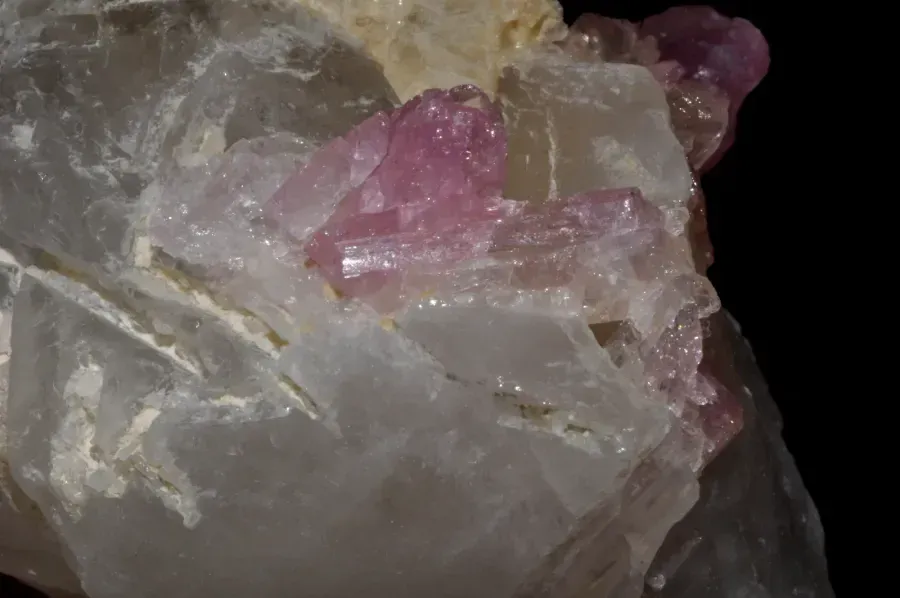
Zircon grows in igneous and metamorphic rocks, but it is mined mostly from placers, river deposits where the heavy grains are washed down as the parent rock breaks apart. Its high density helps here: zircon settles together with sapphire and ruby, and they are often found at the same washing sites.
Cambodia. The country's north-west (the Ratanakiri district and its surroundings) is a known source of saturated red and orange-red zircon. The local placers give the hottest colour, though quality drifts from batch to batch.
Thailand. A historic centre of coloured-stone cutting and trade. Thai zircon tends to be lighter, with a brownish or orange undertone, but is usually clearer and steadier in colour.
Sri Lanka. An island with a centuries-old reputation as a "chest of gems", the Ratnapura district. Zircons from here are often lighter, pinkish-red, and are reckoned more reliable in wear. Red stones from the island were already known in ancient trade.
Red zircon also turns up in Australia, Brazil and the countries of East Africa, but the commercial quantities of good red come precisely from Southeast Asia and Sri Lanka. Large clean crystals are rare: stones above 5 to 10 carats in decent quality are already a notable rarity.
How Zircon Ends Up in a Placer
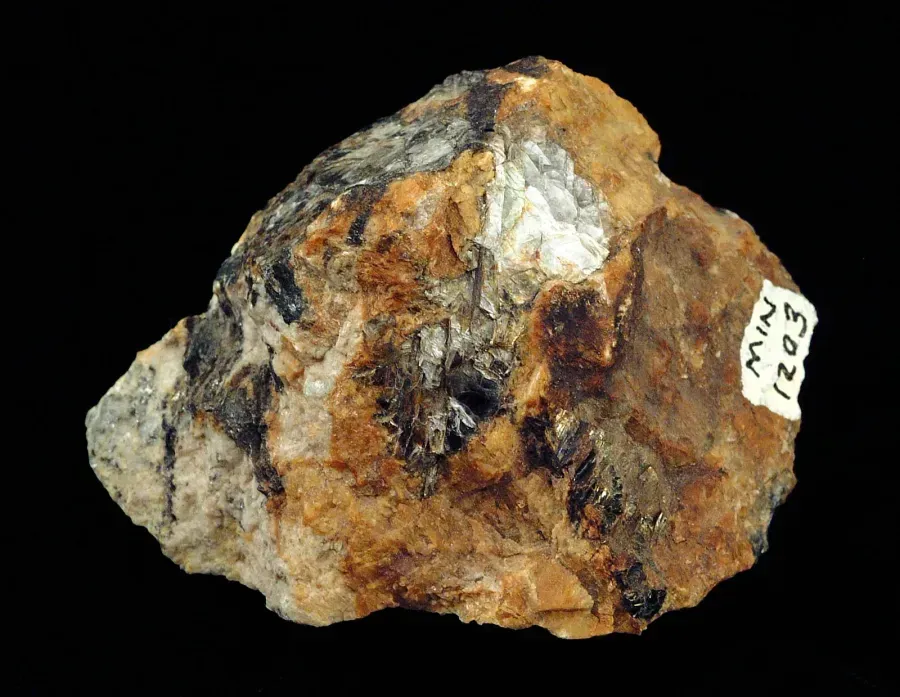
Zircon in its home rock is born deep down, in granite, syenite and metamorphic gneiss, as small grains scattered through the stone. Getting it out of there is difficult and unprofitable: it is easier to wait for rain and rivers to break the host rock down over thousands of years. Water carries the light minerals away, while heavy zircon settles on the bed of river channels and in ancient gravels alongside sapphire, ruby and spinel. The digger washes that gravel in a flat pan: the light material leaves with the water, a heavy concentrate stays at the bottom, and red grains turn up among it. Zircon's high density, the very thing that makes it feel weighty in the hand, works in the miner's favour here.
Why Good Red Is So Rare
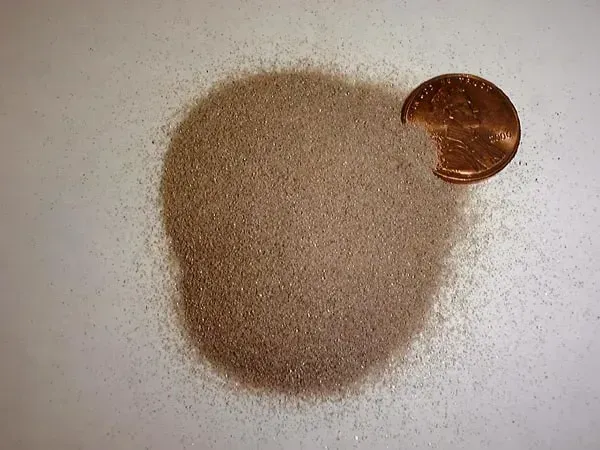
Zircon itself is commonplace, and mineralogists find it in almost any handful of sand. What is rare is a crystal that is transparent, deeply red and still undamaged. For that to happen, several things have to line up: the right proportion of iron impurities for the colour, enough uranium and thorium for nature's slow adjustment of the tone, but not so much that the lattice has time to fall apart. Most natural grains are either colourless-to-brown or already metamict and cloudy. That is why a handsome red zircon costs more than the abundance of the mineral would suggest, and why the large clean stones go to collectors.
Sri Lanka: The Island of Gems
The gravel pits of Ratnapura in the south-west of the island are dug by hand in much the same way as they were centuries ago: the shaft is held against collapse by bamboo timbering, and the gravel brought up is washed in baskets in the river. In that concentrate zircon travels as a companion to sapphire, and the local stones were known to ancient and Arab traders, who carried them west under the name hyacinth. Island red zircon is usually lighter and pinker than Cambodian material, but tougher in wear, which is exactly why it is the sensible choice for an everyday ring.
The History of the Stone
Zircon has kept company with people for a long time, it simply hid under other names for ages. In medieval Europe golden-red and brown-red stones were called hyacinth, and under that name zircon went into rings, brooches and church plate. Red was tied to blood and martyrdom, so the stone was readily set into religious pieces.
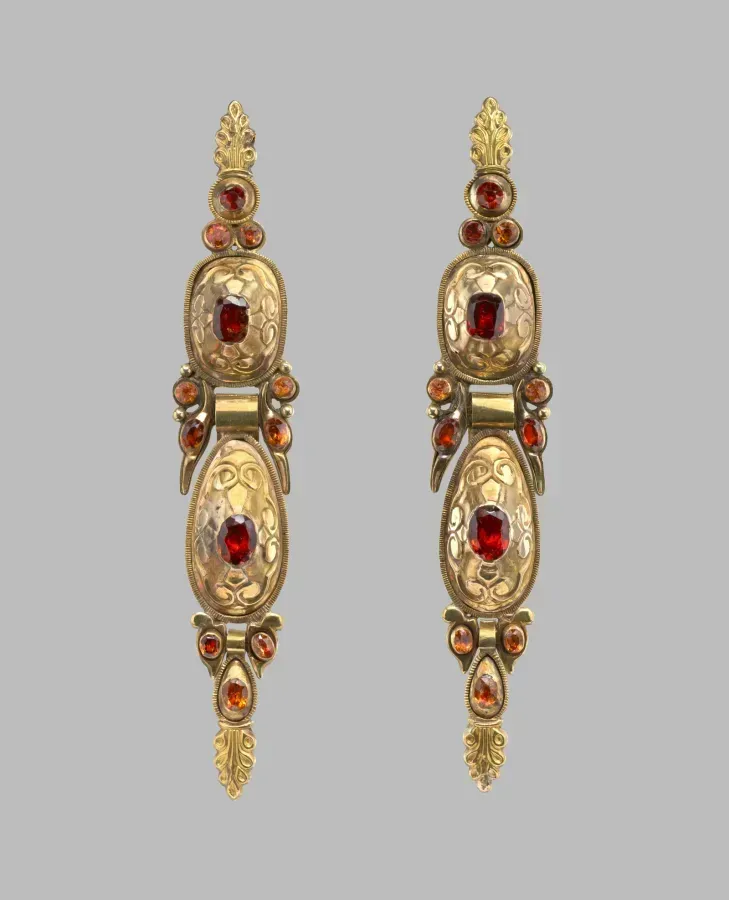
In the Indian tradition zircon is one of the "navaratna", the nine stones tied to the heavenly bodies. Through Persian and Arab traders the stone and its name spread along the Silk Road; the Persian "zargun" ("golden") gave us the European "zircon". In the Victorian era, when the fashion for coloured stones was on the rise, hyacinth-zircon became popular in jewellery once more.
A curious detail: zircon was described scientifically only in the early 19th century, when mineralogists worked out that hyacinth, jargoon and a string of other "different" stones were one and the same substance, zirconium silicate. And in the 20th century zircon was briefly pushed aside by synthetic stones and the louder name of ruby, so red specimens fell into the shade for a while.
Hyacinth in Antiquity
Red and golden-red zircons were reaching Mediterranean trade well before our era. Ancient writers list among the precious stones a certain "hyacinth" or "lyncurium", and although those words could then cover garnet and sapphire too, a good share of the fiery red stones coming off the Ceylon placers was zircon. The stone was cut as a cabochon and set into signet rings, and traders from the Indian Ocean carried it along the same routes that brought spices and pearls. The word hyacinth, tied to the Greek myth of the youth whose blood was turned into a flower, stuck firmly to the red stone and outlived antiquity itself.
Hyacinth in Christian Symbolism
In the Middle Ages red hyacinth entered the Christian language of stones. It was counted among the stones that, in the text of Revelation, adorn the foundations of the heavenly city, and commentators credited it with humility and steadfastness in faith. The warm red-gold tone was linked to the blood of martyrs and to the fire of the spirit, so hyacinth was readily set into altar crosses, book covers and bishops' rings. It was also the traveller's stone of that era: hyacinth was held to guard a wanderer from plague, bad air and homesickness, and to give its owner sound sleep. These beliefs say a great deal about how red was read, and nothing at all about the mineral.
The East and the Navaratna Set
In the Indian jewellery tradition red zircon entered the navaratna, a talisman of nine stones, each answering to its own heavenly body. Hyacinth-zircon in that set was matched to the ascending lunar node, and it was meant to be worn in strict combination with the other eight so as to balance the influence of the planets. Through Persian and Arab craftsmen both the name and the stone spread across the trading cities of Asia. The Persian "zargun", meaning golden, passed through Arabic and Latin and eventually produced the European word zircon, so the mineral's present scientific name comes from an eastern bazaar.
The Victorian Era
The nineteenth century brought hyacinth-zircon back into favour. Victorian fashion loved coloured stones with a history and a warm glow by candlelight, and red zircon offered both: under an evening flame its dispersion played especially brightly. The stone went into brooches, drop earrings and mourning jewellery, where a dark red tone read as restrained, dignified grief. It was in the same period that mineralogists finally sorted out the names and understood that the "hyacinth", "jargoon" and "zircon" of the catalogues were one mineral in different dress. The era's taste for the natural play of a stone rather than showy glitter is precisely what made zircon desirable.
Customer reviews
Zevira is a real jewellery shop. Genuine payments, deliveries and customer thank-yous.
🥰🥰🥰 gracias

Ok, ¡gracias! 🙂

Types and Shades of Red Zircon
Under "red zircon" hides a whole fan of tones, and the shade governs both the character of the stone and how it behaves in wear.
Bright red. The most striking and sought-after, with an almost "fiery" core, most often from Cambodia. It has a flip side: the rich colour often goes hand in hand with greater brittleness and a tendency to fade under strong light.
Pinkish-red. Red drifting toward a cool, raspberry or purplish undertone. It reads softer, is usually steadier in colour and takes daily wear more calmly. A frequent guest among Thai and Sri Lankan stones.
Red-brown (hyacinth). A warm, "earthy" shade, the very historical hyacinth. These are often untreated stones. Modern jewellery prizes it more modestly, but collectors of natural specimens love exactly this one.
Crimson, cherry. A deep red with a violet sheen, one of the rarest tones, found only in the odd stone.
Quality within any shade is judged on two things: saturation (from pale pink to dense red) and clarity (from visible inclusions to a stone with no visible flaws). The happy combination is a saturated but not "shouting" red with good transparency: such a stone glows from within and holds its colour longer.
Red is only one of this mineral's tones. If you would like to see the full palette, from blue to honey, there is a separate overview of all the colours of zircon.
Treatment: Heating and Why It's Normal
Most coloured zircons are heated, a long-standing and accepted practice in the trade. With controlled heating (around 800 to 900 °C, with a slow rise and cooling so the stone does not crack) a brownish zircon turns cleaner and redder, and a cloudy one turns more transparent. The same method coaxes other tones from unpromising rough: at a different temperature, for instance, you get blue zircon, one of the mineral's most recognisable shades.
Heating does not make a stone "fake": the composition stays the same, only the optics of the lattice change. More often than not a treated zircon is even steadier in colour than raw material. An honest seller does not hide the treatment, and it usually has no bearing on the price of a good stone.
Oxidising and Reducing Heat
Zircon's colour depends both on the temperature and on whether there is oxygen in the furnace. Heating in air, the oxidising route, drives brown and red-brown tones towards a clean red and orange-red. Heating with the oxygen shut out, the reducing route, generally yields cool tones, and that is exactly how the famous sky-blue zircon is born from the same rough. One and the same unremarkable brown pebble can come out red or blue depending on how the furnace is run. The craftsman brings the heat up slowly: a sharp change cracks the brittle crystal along its cleavage, so the rise and the cooling are stretched over hours.
What Heating Can Undo
There is a subtlety about heating worth knowing. Some of the induced tones in zircon are not fully stable: a strongly heated red stone left for years in bright sunlight can lighten a little, as though part of the furnace's work were rolling back. This is neither a deception nor a defect but a property of the mineral, and it is precisely why red specimens are best kept out of long direct light. Colour stability in the calmer pinkish-reds is usually higher than in the brightest fiery stones, one more argument for a restrained tone in a ring worn every day.
Upload a photo of your pet, someone you love, or an object. We'll build a 3D model and hand-cast it in pewter.




How to Tell Zircon from Look-alikes and Fakes
Red zircon gets confused with ruby, garnet and red tourmaline, and on top of that it is swapped for glass and CZ (cubic zirconia, not to be confused with zircon itself). A few pointers help you avoid a mistake.
From ruby zircon is set apart by its optics and weight. Ruby has a hardness of 9 and a calm lustre; zircon has a strong "play of fire" and a noticeably higher density. Under a loupe, double refraction gives zircon a slight doubling of the rear facets, "twinned" edges, which ruby does not have.
From garnet zircon is told apart by the same dispersion and density. Garnet (refraction 1.73 to 1.89, density 3.5 to 3.8) burns more weakly and is lighter than zircon, with a warmer, "earthier" colour. If you want a red stone that is simpler and tougher in everyday life, garnet is worth a look: softer in lustre, but stronger and more familiar.
From red tourmaline (rubellite) zircon is told apart again by lustre: it is brighter and heavier, while rubellite is usually pricier and turns up in larger stones.
From glass and CZ. In glass a loupe will often show air bubbles and wavy traces near the edges, which natural zircon will not have. CZ is heavier and harder, with no double refraction, and usually looks "too perfect". A suspiciously low price is almost always a signal of a swap.
The main practical tip: for a valuable stone, ask for a report from an independent gemmological laboratory. A specialist measures double refraction, density and refractive index in minutes, and that settles almost every question.
Mind the Names in Catalogues
The main confusion is not gemmological but verbal. In descriptions of cheap costume jewellery "zircon" routinely means cubic zirconia (CZ). This is not a natural stone but a synthetic, and it has nothing to do with our mineral beyond a similar-sounding name. The English "cubic zirconia" and the word "zircon" are confused on purpose: it makes the synthetic sound more expensive.
What this means in practice: if a listing offers a red "zircon" at a suspiciously low price and sells it "loose, by the batch of identical flawless stones", it is almost certainly CZ or glass. Natural zircon rarely comes in perfectly clean batches; it nearly always shows that "double" facet under a loupe and a respectable weight. What to look for in a listing: whether the word "natural" appears, whether the treatment is named (heated), whether there is a carat weight and any kind of origin. Silence on every point at once is a reason to ask the seller direct questions.





Zircon and Cubic Zirconia: The Great Confusion
These are two different things whose only kinship is a similar sound, and half the deception in catalogues rests on that confusion. It deserves its own section, point by point, because without it a conversation about red zircon goes nowhere.
Zircon Is a Natural Mineral
Zircon, ZrSiO₄, zirconium silicate, grows in the earth's crust on its own, without human help, over millions of years. It has everything a natural stone has: inclusions, uneven colour, pleochroism, double refraction and a comparatively modest hardness of 6.5 to 7.5. Red zircon is rare, comes out of placers, and in large clean stones is expensive. This is the subject of our article.
Cubic Zirconia Is a Synthetic
Cubic zirconia, CZ, is zirconium dioxide, ZrO₂, grown in a laboratory. A different formula, a different crystal system, a different history. It was invented as an inexpensive stand-in for diamond: colourless, very hard at 8 to 8.5, perfectly clean, and cheap because it is grown by the tonne. Red CZ is made by adding colourant to the melt. It has nothing to do with natural zircon beyond the word zirconium in the name, which is what breeds the confusion in the first place.
Where the Name Confusion Came From
The names are too close, and sellers profit from it. The word zircon sounds like a natural stone, so synthetic CZ is often presented as exactly that: a "red zircon" on the listing of a cheap costume piece almost always means CZ. Sometimes the swap is accidental, through ignorance, but more often it is deliberate, because a synthetic under the name of a natural mineral sells for more. The easiest way to hold the difference in mind is by a single letter: the natural stone is zircon, the synthetic is zirconia.
How to Tell Them Apart in Practice
The most honest indicators are price and uniformity. Natural red zircon is rare and never comes as a bagful of identical, perfectly clean stones. If a red "zircon" is cheap, sold as a scattering of clones with not one inclusion, and sparkles a little too flawlessly, you are looking at CZ. Under a loupe natural zircon gives away the doubled facet edge of double refraction, which cubic zirconia does not have at all: it is optically uniform. CZ is also harder and denser. Its dispersion is in fact higher than zircon's, so "lots of sparkle" on its own proves nothing; what to look at is double refraction, inclusions and origin.
| Feature | Zircon (mineral) | Cubic zirconia (CZ) |
|---|---|---|
| Nature | natural mineral | synthetic, laboratory-grown |
| Formula | ZrSiO₄ | ZrO₂ |
| Hardness | 6.5 to 7.5 | 8 to 8.5 |
| Double refraction | strong, doubled facet edge visible | none |
| Inclusions | nearly always present | none, the stone is flawless |
| Price | mid to high, a rarity | very low |
Cutting
Zircon is cut to bring out its strong suit, lustre and dispersion. Because of its cleavage and brittleness the cutter works more carefully than with corundum: too much pressure during polishing brings chips. The classic shapes for red zircon are the round (maximum sparkle), the oval and the pear for pendants, and the cushion and step-cut emerald for stones with deep colour. A poor cut shows to the naked eye: the stone looks flat and "dead" even with good colour and clarity.
Leave your email, we'll send your discount code. No spam, unsubscribe anytime.
The code arrives by email, valid on your first order.
Carats and Real Size: Why Zircon Looks Smaller Than Its Weight Suggests
Here is a detail that matters for a purchase. Because of its high density (4.6 to 4.7 against 3.5 to 3.8 for garnet and 4.0 for ruby) a zircon of one carat covers less surface area from the top than a lighter stone of the same weight. Put plainly, take a zircon and a garnet at 1 carat each, and the zircon will look slightly smaller in the setting.
The practical takeaway: compare stones by diameter in millimetres rather than by carat. If you want a particular "face size" of stone in a ring or earring, go by millimetres and treat the weight as secondary, otherwise the zircon will look bigger on paper than it does in the flesh. The upside is that this same density gives a pleasant heft: a small stone feels more solid in the hand than you expect.
Care and Wearability
A hardness of 6.5 to 7.5 is a working level, not an "indestructible" one, and zircon is also brittle and afraid of knocks. That governs all the care.
Cleaning. Warm (not hot) water, a drop of mild soap, a soft brush, that is enough. Clean it gently, rinse, wipe with a soft cloth. What not to do: ultrasonic and steam cleaning are out for zircons, they work on cracks and can split the stone; abrasive pastes are not needed either.
Storage. Apart from other jewellery, in a soft pouch or a separate compartment: harder stones will easily scratch zircon, and the zircon itself will chip against metal. Long storage in direct sun is undesirable, bright red specimens can fade a little over the years.
Where to wear which. Earrings and pendants are the safest positions: the stone is on show and takes almost no knocks. Rings and bracelets have a harder life, so for them choose stones calmer in colour (often the tougher Sri Lankan ones) and take the piece off before sport, cleaning and any work with your hands. Once a year it is worth showing a ring to a jeweller: the thin prongs of the setting work loose over time, and the stone starts to shift a little in its mount.
If it has dulled or chipped. Surface haze often lifts with a simple clean. Real re-polishing and any work on cracks should be left to a craftsman, you cannot do it at home and the stone is easy to ruin.
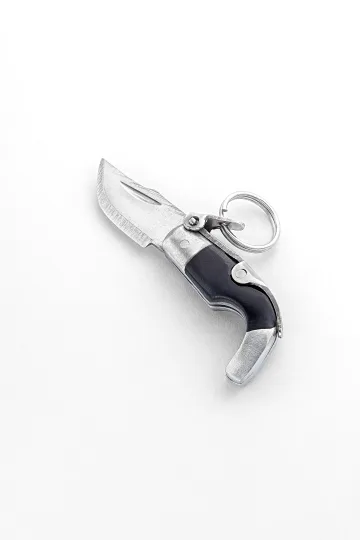
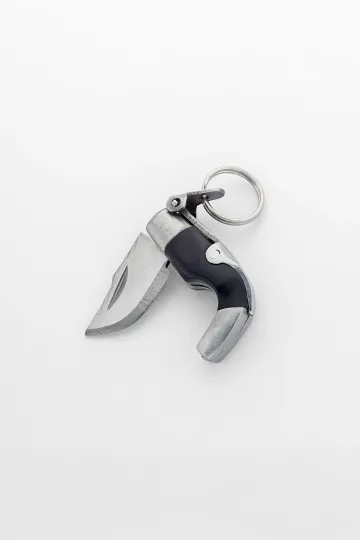
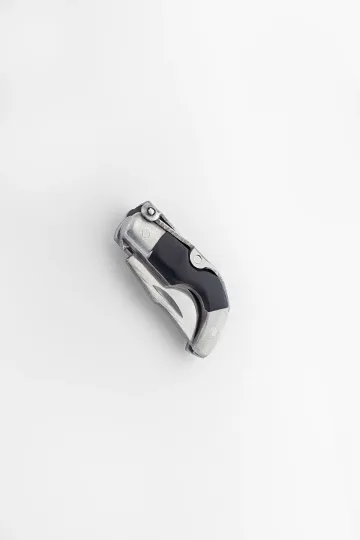
CAPAORA mini knife pendant
The 18th-century Spanish navaja in miniature: 40 mm of stainless steel, a real folding mechanism and a Palanquilla lock that clicks. An affordable gift to remember.
Authentic · Ships from Spain · 14-day returns
Symbolism, Briefly and Without Promises
Red has traditionally been linked across cultures with life, energy and passion, and zircon is no exception: it was credited with vigour, protection on the road, a charm against illness. In the Indian tradition red stones were matched with Mars; in medieval Europe hyacinth was held to be a traveller's stone.
It is worth saying plainly: all of this is cultural belief, not a property of the mineral. There is no proven effect of the stone on health, sleep or mood, and it is better treated as a beautiful part of the history than as a reason to buy. If you like the symbolism, let it be a pleasant backdrop; buying zircon, though, is sensible for its colour, lustre and rarity.
Who Red Zircon Suits
Red zircon is the choice of anyone who wants warm colour and a living play of light but does not care for the coolish perfection of the familiar red stones. It suits people who value the history of an object: behind this stone stand the Silk Road, medieval travellers' rings, and grains as old as the planet. Anyone who wears jewellery daily and works with their hands is better off with a calm pinkish-red stone in a protective setting. Anyone who puts a piece on for an occasion, an evening out or a celebration, has the whole fan of tones open to them, the brightest fiery reds included.
By colouring the logic is gentle, with no rigid rules. Olive and deeper skin tones, dark hair and a warm undertone carry a dense red well; it picks up the colour of the skin and reads richly. Fair skin and a cool undertone take a pinkish-red more evenly, since it does not argue with paleness or tip into a signal-flare brightness. As a gift, red zircon works for anyone tired of the expected: a rare, underrated stone with a genuine biography rather than one more variation on ruby.
The Psychology of a Red Stone
Red is the first colour humans learned to obtain and apply, from ochre on cave walls to red lead on shields, and it acts on us more strongly than any other before thought gets involved. The eye catches red instantly, the heart quickens a little, attention gathers. So a red stone on a person reads as a signal of confidence and presence: it is noticed first. Zircon adds its own play of fire to that, and the red in it does not sit still but lives and winks with every movement. Many choose it not for any folklore but for that sense of gathered energy the stone gives its owner. Set beside a calm ruby, zircon looks warmer and more human, without the coolish perfection, and that slight imperfection is exactly what draws people in.
Send a friend a discount code, they save on their first order.
Red Zircon in Art and Culture
In the church art of the Middle Ages red hyacinth lived alongside garnet and ruby in book covers, reliquaries and vestments, where red stones stood for blood, sacrifice and the fire of the spirit. Secular art loved it for its evening glow: in portraits of the nobility a warm red stone in an earring or a ring caught the flicker of candles and brought a face to life. In the lapidaries, the medieval books of stones, hyacinth was credited with power over melancholy and bad dreams, and those lines were copied from book to book for centuries. The name itself, pointing back to the myth of Hyacinthus, the youth from whose blood a flower grew, tied the stone permanently to the theme of loss and transformation. So red zircon, without ever being the loudest of gems, left a long cultural trail behind it, hidden under an old name.
Facts That Surprise
Zircon is older than anything else on Earth. The oldest minerals ever found on the planet are tiny zircon grains from the Jack Hills region of Australia. They are around 4.4 billion years old, nearly the age of the Earth itself and older than the oldest known rocks. The same mineral that glows red in your earring, in other specimens, remembers a young planet.
Zircon is how science measures the age of the Earth. Uranium in the zircon lattice turns slowly into lead at a known rate, so geologists read the ratio between them to work out when the crystal grew. It was the zircon clock that gave science its figure for the age of the Earth. The stone works, quite literally, as the planet's chronometer.
The same breakdown that spoils the stone also dates it. The decay of uranium and thorium over millions of years wrecks the zircon lattice and makes it cloudy and brittle. That same decay, turned into a number, is what reveals the age. The stone's weakness and its scientific value are two sides of one process.
Zircon can glow under a lamp. Many zircons fluoresce in ultraviolet, answering invisible light with a soft glow, because rare-earth impurities sit in their structure. In a spectroscope zircon shows a characteristic "ladder" of lines by which a gemmologist identifies it almost infallibly.
Its name came from an eastern bazaar. The scientific word zircon goes back to the Persian "zargun", golden, by way of Arab and Mediterranean traders. A mineral with a serious place in geochronology carries a name that began as trade slang for a pretty yellow-red stone.
One stone, a dozen names. Before the nineteenth century red zircon was called hyacinth, the golden and smoky material jargoon, and other tones travelled under names of their own. Only mineralogy reduced the whole menagerie to a single substance, and many an old "hyacinth" in a museum case is in fact zircon.
From brown come both the red and the blue. An unremarkable brown zircon turns either fiery red or sky blue depending on how the furnace is run. One stone, two different celebrities, and it all comes down to oxygen and temperature.
Frequently Asked Questions
How does zircon differ from cubic zirconia?
They are different things, even if the names sound alike. Zircon (ZrSiO₄) is a natural mineral, a zirconium silicate, hardness 6.5 to 7.5. Cubic zirconia (CZ) is a synthetic stone, harder (8 to 8.5) but without zircon's double refraction and strong dispersion, and it costs far less.
Can you wear zircon in a ring every day?
You can, but carefully. Better to choose a setting that protects the stone (a bezel or a rim) and a tougher stone, and to take the ring off before cleaning, sport and any work with the hands. Earrings and pendants are simpler in this respect.
Does zircon lose colour over time?
A saturated red zircon can soften a little in tone over the years under strong light. This is a natural process, the colour does not vanish entirely. To slow it down, do not keep the stone in the sun for long.
How do you tell a real zircon from a fake?
Under a loupe zircon shows double refraction (a doubling of the rear facets), it is noticeably denser than glass and garnet and "plays with fire" strongly. Glass gives itself away with bubbles and wavy edges. For a valuable stone, get a report from a gemmological laboratory.
Is red zircon treated? Is that bad?
Most coloured zircons are heated for clarity and colour, this is normal practice and the composition of the stone does not change. A treated zircon is often even steadier in colour. The main thing is that the seller states the treatment.
Which shade is the rarest?
A deep crimson-cherry red with a violet sheen, only a handful of these exist in nature.
Why is zircon confused with ruby?
The colour and lustre are close, and before the 19th century these and many other red stones were poorly distinguished at all. Zircon is set apart by its strong dispersion, high density and double refraction, which ruby does not have.
Is Cambodian zircon better than Thai?
Not better, just different. The Cambodian is usually brighter and "hotter" in colour but can be more brittle; the Thai and Sri Lankan are often clearer and steadier. For earrings and a pendant take a brighter colour, for a ring a tougher stone.
Which size is best for jewellery?
Stones of 2 to 5 carats often work well: lovely colour, visible play of light and a sensible toughness. Large clean zircons are rare and call for even more care.
Can you bring shine back to a dulled zircon?
Surface haze lifts with cleaning. If it is down to microscratches, re-polishing is a job for a craftsman; this is not one to take on at home.
Are zircon, hyacinth and jargoon the same thing?
Essentially yes. Hyacinth is the old name for red and red-gold zircons, jargoon for the pale and smoky ones. Until the nineteenth century they were reckoned separate stones, until mineralogists proved they were one mineral, zirconium silicate. In museum labels an antique "hyacinth" is usually zircon.
Is it safe to wear zircon if it contains uranium?
Yes. The traces of uranium and thorium in gem zircon are minute, the reading from a stone in a piece of jewellery sits at ordinary background level and below the dose from a flight. Wearing it has no effect on health at all. Those traces act on geology across millions of years, not on the owner's hand.
Is red zircon better than ruby?
Neither better nor worse, simply different. Zircon has stronger dispersion, so the red in it is livelier and more sparkling, and the warm tone looks more human than the coolish perfection of ruby. Ruby in return is harder and tougher in wear. People choose zircon for the play of fire, for the rarity of the red shade, and for a more accessible price at a given brightness of colour.
Would red zircon work for an engagement ring?
It can, with caveats. The stone is beautiful and unusual, but a hardness of 6.5 to 7.5 and its brittleness call for a protective setting and careful wear, and an engagement ring lives on the hand every day. If red is what you want for daily wear, take a calm pinkish-red Sri Lankan stone in a bezel setting and slip the ring off for any work with your hands.
Buying it as a gift? Each one arrives ready to give.
 A branded Zevira box and a little card come with every order.










About Zevira
Zevira is a jewellery house that works with rare, characterful stones, and red zircon is exactly one of those: underrated, with a strong lustre and a story of its own. We pick specimens by colour, clarity and durability, so the stone looks beautiful and lives calmly in a piece.
For us zircon is not a "cheap stand-in for ruby" but a stone in its own right, with its own character. If you are torn between shades or unsure what will stand up to daily wear, we will advise and help you choose.
Choose Your Red Zircon
Every stone has its own tone and its own spark. Browse the catalogue or write to us, and we will help you match the shade and the setting to the way you mean to wear it.