Rhodochrosite: The Stone of Tenderness and Self-Compassion
In the deep underground chambers of Argentina, hot mineral waters percolated through layers of ancient rock for millions of years. Droplet by droplet, layer by layer, a rare pattern emerged: rose-pink and white stripes, like marble veins on the back of a hand. When Argentina declared rhodochrosite its national mineral in 1957, it wasn't a political choice. It was a recognition that one particular mineral had managed to tell the story of a nation as eloquently as any anthem or crest. The name itself reads like poetry: from Greek rhodon (rose) and chros (colour). In English, it's often called the Inca Rose.
Rhodochrosite has long attracted people seeking not just an ornament, but a tool for inner healing. Not because the stone possesses magic in any literal sense, but because its form, colour, and history work on the psychological level more deeply than might be expected. Red sits at one edge of the light spectrum, the colour of blood, of life, of roots. White stripes represent purity, balance, forgiveness. In jewellery, rhodochrosite is genuinely rare, especially in fine luxury design. That rarity alone makes it a powerful symbol. The wearer knows they hold not a mass-produced object, but a fragment of planetary history.
If you've ever felt your heart needed healing, that self-love must become a practice rather than something you feel naturally, rhodochrosite might become your companion on that journey.
What Is Rhodochrosite and Where Does It Come From
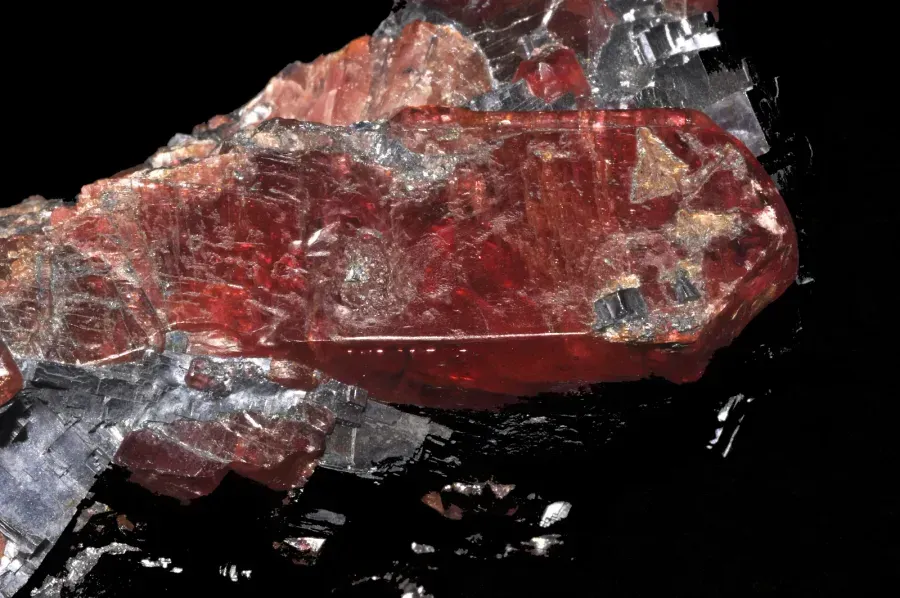
Rhodochrosite is manganese carbonate (MnCO₃), a mineral that forms under low to moderate temperature conditions in hydrothermal veins. It appears as a stone with characteristic rose or crimson colour, often marked with white, grey, or brown bands. The crystal structure is either cubic or rhombohedral, but in nature you'll most commonly encounter rhodochrosite as finely-grained crystalline aggregates that create those legendary layered patterns.
On the Mohs hardness scale, it rates 3.5-4.0, meaning it's relatively soft. The stone scratches easily and demands careful handling. Specific gravity is about 3.5 g/cm³, heavier than rose quartz but lighter than ruby. Transparency and density vary: some specimens are semi-transparent in light, others completely opaque.
The Etymology and History of Its Name
The word "rhodochrosite" comes from ancient Greek: rhodon (rose) and chros (colour). German mineralogist Johann Friedrich Wilhelm Güsfeldt first described it in 1813, working with mineral samples from Saxony. However, specimens from Argentina, discovered in Catamarca Province in the twentieth century, became the gold standard, thanks to their size, transparency, and the perfection of their banded patterns. Argentine rhodochrosite earned global prestige.
In Western mineralogy, it's sometimes called Inca Rose because of its association with Andean cultural heritage. While the Incas didn't work with this mineral in the jewellery sense we understand today, the Andes region remains the world's primary source, so the association has stuck.
Wear the symbol, don't just read about it. These are in stock:


Deposits and Rarity of Rhodochrosite Worldwide
Argentina: The Heart of Supply
Catamarca Province in northern Argentina has given the world its most beautiful rhodochrosite specimens. The Alpini deposit (Minas Capillitas) has been known since the 1960s, and it's from here that museum-quality crystals have emerged. Specimens from this deposit are distinctive: white bands alternate with rose-pink in such perfect regularity that you'd think an artist had planned every stripe.
In 1957, Argentina officially declared rhodochrosite its national mineral. This is extraordinarily rare in mineralogy history: a mineral elevated not for historical reasons, but for geological perfection. Mining in Argentina operates under strict quality control, and the most beautiful specimens remain in museums or private collections.
Other Deposits: Peru, Romania, USA
Rhodochrosite is also mined in Peru (Mëocollock region), Romania (Banat, Nera), the United States (Colorado, Sweet Home locality), China, and Russia (Transbaikalia). However, samples from these locations significantly underperform compared to Argentine material in terms of quality, transparency, and beauty. Romanian pieces are often darker and less translucent. American specimens (Sweet Home Rhodochrosite) frequently contain internal fractures and are less suitable for fine jewellery.
Global annual production is estimated at 200-300 tons. Of that, fewer than 10% are suitable for cutting and jewellery use. This means a fine-quality rhodochrosite piece is genuinely rare, even in the premium market.
Grade by Origin
| Deposit | Colour & Stripes | Transparency | Crystal Size | Jewellery Grade |
|---|---|---|---|---|
| Argentina (Catamarca) | Vivid pink, perfect white bands | Semi-transparent | 3-8 cm | Excellent |
| Peru | Rose pink, broad white lines | Semi-transparent | 2-5 cm | Good |
| Romania | Dark pink, grey bands | Opaque | 1-3 cm | Fair |
| USA (Colorado) | Pale pink, internal cracks | Semi-transparent with flaws | 0.5-2 cm | Poor |
| China | Delicate pink, sparse bands | Semi-transparent | 1-4 cm | Fair |
Inside Capillitas: The Mine That Defines the Material
The Capillitas mine in Catamarca province, high in the Argentine Andes at around three thousand metres, is the source that most people picture when they picture rhodochrosite, even if they have never heard the name.
It is an old working. Copper and silver were taken from these tunnels long before anyone cared about a soft pink carbonate, and there is credible evidence of pre-Columbian mining on the site. The rhodochrosite occurs there as stalactites growing in old cavities, the same drip formations you would find in a limestone cave, only made of manganese carbonate rather than calcite. Some are a few centimetres across, the exceptional ones considerably larger.
Extraction is slow and awkward. The stalactites are fragile, the altitude limits how long anyone can work efficiently, and a formation that took hundreds of thousands of years to grow can be destroyed in a careless second. Material comes out in modest quantities, and the finest banded slices are taken by mineral collectors and museums before jewellery ever sees them. This is the real reason good rhodochrosite is scarce: not that the mineral itself is rare in the earth's crust, but that gem-quality banded material from one mountain in one province is a genuinely limited supply.
Stalactite Slices as a Format of Their Own
The single most recognisable form of rhodochrosite in jewellery is the cross-cut stalactite slice, and it deserves treating as its own category rather than as one cabochon among many.
Cut a stalactite across its growth axis and you get concentric rings radiating from a central point, sometimes with a small hollow core where the water channel ran. Nothing else in the mineral world looks quite like it. The eye reads it as a target, a rose seen from above, or a cross-section of something living, which is precisely why these slices work so well as pendants: the pattern does the entire design job on its own and needs no help from the setting.
Two things to check when buying a slice. The centre should be intact or cleanly finished, since a ragged hollow core catches on clothing and collects dirt. And the slice should be thick enough to have some structural strength, because a wafer-thin cut of a stone this soft will crack the first time it meets a hard surface. Anything under about three millimetres wants a full bezel rather than an open setting.
Lengthwise cuts from the same material give parallel stripes instead of rings, and they suit bar pendants and rectangular pieces. Both come from the same formation; the cutter simply chose a different plane.
Rhodochrosite lives at the collarbone, never on a finger. Jam this tender stone into a ring, go do the dishes, and you brought it on yourself.
How to Wear Rhodochrosite
Over years on set, dozens of pink stones have passed through my hands, and rhodochrosite taught me one thing: it's soft, so you protect it, you don't hide it. Here is what actually works, by occasion.
What do I wear rhodochrosite with every day? For daily wear I recommend a small banded cabochon on a fine silver chain over a plain tee, a linen shirt, or a soft knit in cream, white, or grey. The neutral background hands all the attention to the stone, and the pink reads clean. I suggest keeping it at the collarbone or under a collar, where it rarely scrapes against a bag or a desk.
Does it work for the office? Absolutely. For meetings I choose deep, cool colours: navy, burgundy, graphite, black. They give rhodochrosite a handsome contrast and make it more visible without turning it into party jewellery. I recommend a small cabochon on a short chain and no other bright stones alongside, so the outfit stays composed.
How do I build an evening look? For evening I suggest sizing up the stone and playing with layers: a long chain with a large pendant over silk or velvet, plus a pair of fine silver chains at different lengths. Layering works if all the metal is cool and in one tone, otherwise the look falls apart.
And for a romantic occasion? Here rhodochrosite is in its element. It gets along with pastel dresses, floral prints, and delicate fabrics. I recommend pairing it with rose quartz or mother-of-pearl and adding tiny matching cabochon earrings, and you get a soft, warm accent right at the heart.
Who does it suit? Those who love a calm, sensual aesthetic and prefer one meaningful piece to a dozen small ones. A cool skin undertone is supported perfectly by rhodochrosite in silver, while a warm undertone calls for a slightly whiter gold. Two rules that never fail. First: make rhodochrosite the focus, a fine chain or discreet earrings beside it are enough, no massive rings or bracelets. Second: keep only soft neighbours nearby (rose quartz, selenite, pearl), because hard stones in the same stack will scratch it fast.

Turn on your camera, pick earrings, a pendant or a ring, and see the piece on yourself in real time.
Switch items in one tap.
Everything runs in your browser: no photo or video is ever uploaded.
Physical Properties and Visual Character
Rose with White Bands: Nature's Pattern
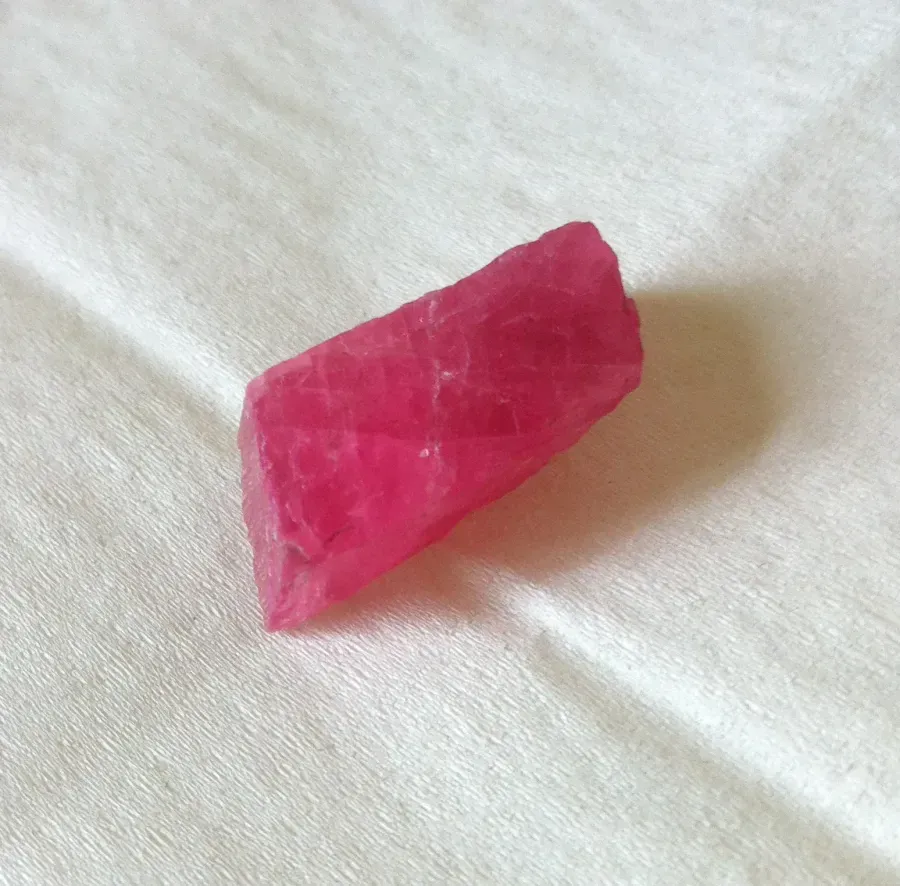
The rose colour comes from manganese content. Higher manganese concentration yields richer, more saturated tones. White bands aren't an impurity. They're simply finer-grained crystal layers that refract light differently and appear white against the translucent pink. This isn't paint. It's not applied. It's pure geology, and every pattern is singular.
That singularity is the key point. If you purchase two rhodochrosite bracelets, even from the same deposit, their designs will differ. No two samples exist in nature that are identical. This isn't industrial production. It's a small miracle, each time.
Why the Bands Come Out So Even
The regularity of the banding puzzles people who assume nature works at random, and the answer lies in how the material grows. Rhodochrosite in the classic Argentine deposits forms the same way a stalactite in a limestone cave does. Manganese-bearing water seeps through fractures in the rock, and where it meets a change in temperature, pressure or acidity, a thin layer of manganese carbonate precipitates out on whatever surface is available. Then the process repeats. Thousands of times.
Each layer records the chemistry of the water at the moment it formed. A season with more iron in solution gives a deeper, more orange-toned band. A period of slower flow gives a finer, whiter band of small crystals. Cut the resulting formation across its axis and you expose the whole sequence at once, in concentric rings, exactly as a tree ring counts years. Cut it lengthwise instead and the same layers read as parallel stripes.
So the pattern is not a decorative accident but a record of time. When people say a slice of rhodochrosite looks painted, the honest correction is that it was painted, extremely slowly, by dripping water over several hundred thousand years.
Where Pink Ends and Red Begins in a Single Piece
Look closely at a good specimen and you will often find several distinct shades within one stone: a milky pale pink at one edge, a deep raspberry towards the centre, sometimes a band that reads almost orange-red. All of it is the same mineral.
The variation comes down to two things. First, manganese concentration, since more manganese means a stronger colour. Second, what else was dissolved in the water at the time. Iron substituting into the lattice pushes the tone towards brown and orange, calcium pushes it towards pale and washed out, and the cleanest, most saturated raspberry occurs where the manganese was almost pure.
For a buyer this matters practically. A stone with strong contrast between its bands is usually more interesting to look at than one of uniform colour, and it is also more clearly natural. Dyed imitations tend to be flatly, evenly pink throughout, because a dye bath has no reason to lay down structure.
Rhodochrosite, Rhodonite and Manganocalcite: One Manganese Family
Three pink stones, three names that get muddled constantly, and one shared element. All owe their colour to manganese, but they are genuinely different minerals with different behaviour.
Rhodochrosite is manganese carbonate, MnCO₃. Soft at 3.5 to 4, translucent, with the characteristic white and pink banding. It reacts to acid, which is why lemon juice and vinegar must never come near it.
Rhodonite is manganese silicate. Considerably harder at 5.5 to 6.5, opaque rather than translucent, and instantly recognisable by black veining through the pink rather than white banding. Because it is a silicate it does not react to acid and it survives daily wear far better, which makes it the sensible choice for a ring if you want pink and cannot be careful.
Manganocalcite is calcite with manganese in it, softer still at around 3, usually a pale, slightly cloudy pink, and often sold as rhodochrosite by sellers who either do not know or hope you do not. It fluoresces pink under ultraviolet light, which is the quickest way to separate it.
The practical shorthand: white stripes means rhodochrosite, black veins means rhodonite, pale and chalky with no pattern means you should ask more questions.
Hardness and Durability Concerns
Rhodochrosite sits at 3.5-4.0 on the Mohs hardness scale. Compare: tanzanite 6-6.5, amethyst 7, topaz 8. This means rhodochrosite is soft, and it cannot be worn in everyday rings on your index or middle fingers, where it faces constant friction and impact. Bracelets and pendants hidden under clothing face less risk, yet they too require protection from falls and sharp blows.
A fingernail (or ordinary glass) will scratch it easily if you apply pressure. That's why people who wear rhodochrosite commit to caring for it like a living thing, not like a functional accessory. Owning such a piece becomes an act of dedication.
Customer reviews
Zevira is a real jewellery shop. Genuine payments, deliveries and customer thank-yous.
🥰🥰🥰 gracias

Ok, ¡gracias! 🙂

The Energy of Rhodochrosite in Mineral Tradition
The Stone of Compassion and the Heart
In literature on lithotherapy and mineral energetics, rhodochrosite nearly always connects to the fourth chakra, Anahata, the heart chakra. Its colour is green or rose; its element is air; its qualities are love, compassion, and healing.
Compassion here means something expansive: not just sympathy for others, but the deep capacity to be present with someone who is suffering, without trying to "fix" or "rescue" them. This is mature, active love. It asks much from the person who practices it.
Many who wear rhodochrosite jewellery speak of how the stone "reminds" them to be gentler, not to others (that's relatively easy), but to themselves. Self-compassion is perhaps our most scarce resource in a productivity-driven culture. When you criticise yourself for a mistake, a stone at your throat becomes a quiet anchor, a point of return to kindness.
Healing Deep Grief
Another association: rhodochrosite aids in healing grief and loss. Not "recovering from" them (impossible and unneeded), but healing your relationship to them. Grief is love stretched across time. According to mineral tradition, rhodochrosite softens grief, makes it less acute, more... pliable. The white bands in rose stone can symbolise moments of relief, shards of light passing through the darkness of bereavement.
Working With the Stone
If you work with rhodochrosite as a healing tool, the practice can be simple: in the moment you feel pain or harshness toward yourself, place your hand on the pendant or bracelet and speak to yourself. One of these phrases, or your own:
"I deserve kindness, especially my own." "My heart heals in its own time." "I forgive myself for being human."
This isn't magic and it isn't belief. It's simply an attention anchor, something that shifts your mind from self-criticism into self-care.
Upload a photo of your pet, someone you love, or an object. We'll build a 3D model and hand-cast it in pewter.




Rhodochrosite in Eastern Medical Traditions
In traditional Chinese medicine, rose-coloured stones are rarely mentioned in classical texts (jade and clear quartz dominate). Yet in Feng Shui practice, rose colour (especially paired with white) is considered harmonizing for the southwest sector of a home, the zone associated with relationships and abundance.
In Ayurveda, rose and red stones traditionally link to Manipura (the solar plexus chakra, seat of transformation) or Anahata (the heart). Rhodochrosite appears in practices designed for "opening the heart" and balancing the flow of love through the body.
Jewellery With Rhodochrosite: Rare Finds
Pendants: The Natural Home
A pendant is the most natural setting for rhodochrosite. Hanging just a few centimetres from the chest, the stone sits within the energetic field of the heart all day. Visually, a rhodochrosite pendant appears as:
- Raw but finished material in sterling silver with open edges, so you see the striations and layers;
- A polished cabochon (smooth, dome-topped) set in white gold or silver;
- Rarely, a pendant made from thin layered rhodochrosite slices bound with silver, which amplifies the visual effect of the banding.
Sizes range from miniature (1-1.5 cm) to statement-making (3-4 cm). Larger pieces showcase the stone's pattern more dramatically but require a more robust chain, ideally 2-3 mm thickness for an anchor or woven link.
Bracelets from Rhodochrosite
Bracelets are more common than pendants, especially as elastic-threaded beaded bracelets. Yet these require real care: the cord stretches and breaks; beads knock against each other and wrists. For a serious piece, a silver chain bracelet with one or more polished rhodochrosite cabochon set in silver bezels is preferable.
Alternatively: a cuff bracelet carved from a single piece of rhodochrosite, polished on the inside, wrapped in silver. These are rare and expensive, requiring sculptural work with soft material.
Earrings With Rhodochrosite
Rhodochrosite earrings exist but are less common than you'd think. Weight matters. A single earring cannot exceed 5-7 grams, or it will stretch your earlobe. So typically you see miniature cabochons (5-8 mm) of rhodochrosite in silver mounts, often paired with rose quartz or subtle mother-of-pearl.
The form is usually round or oval, so you can admire the pattern. Asymmetrical pairs (one with rhodochrosite, one without, or with a different stone) are now trendy and striking against minimalist aesthetics.





Rose Quartz and Rhodochrosite: Two Paths to the Heart
The Physical Difference
Rose quartz (SiO₂) has hardness 7 on the Mohs scale, far more durable. Rhodochrosite (MnCO₃) has hardness 3.5-4, softer, and demands care.
Rose quartz is often cloudy; its colour is uniform. Rhodochrosite has a distinctive layered pattern with white bands; colour ranges from pale rose to deep crimson.
Energetic Difference
Rose quartz is the stone of unconditional love, acceptance, softness. Its influence is calming, like a warm blanket. It works through relaxation and openness.
Rhodochrosite is the stone of aware love, love with boundaries, love with consciousness. Its influence is activating, like a direct gaze. It works through awareness and transformation.
If rose quartz whispers, "You're worthy of love as you are," rhodochrosite speaks: "You're worthy of complex, mature, real love, including compassion for your own shadow sides."
Combining Them in Jewellery
A bracelet or pendant combining rose quartz and rhodochrosite creates balanced energy. Examples:
- A pendant with three beads: rose quartz on top, rhodochrosite in the centre, rose quartz at the bottom, symbolising "softness → transformation → softness";
- A bracelet where small rose quartz beads alternate with larger rhodochrosite focal stones, like the rhythm of breath;
- An elastic rose quartz bracelet paired with a silver-chain pendant of rhodochrosite, different textures and energies in one piece.
Such hybrid pieces hold particular value for people healing while refusing passive acceptance. The two stones together remind you: self-love isn't only tenderness. It's also the strength to say "no." It's the willingness to face your own mistakes.
Leave your email, we'll send your discount code. No spam, unsubscribe anytime.
The code arrives by email, valid on your first order.
Myths and Facts About Rhodochrosite
CAPAORA mini knife pendant
The 18th-century Spanish navaja in miniature: 40 mm of stainless steel, a real folding mechanism and a Palanquilla lock that clicks. An affordable gift to remember.
Authentic · Ships from Spain · 14-day returns
Practical Care: How to Maintain Rhodochrosite Jewellery
Cleaning
Rhodochrosite scratches easily under abrasive cleaners. Here's the right way:
- Fill a bowl with lukewarm water (not hot, not cold);
- Add a drop of gentle liquid soap (no bleach);
- Place the jewellery in water for 10-15 minutes;
- Use a soft toothbrush to gently clean, without pressing hard;
- Rinse thoroughly with clean water;
- Pat dry with soft cloth (cotton or microfiber).
Never:
- Use ultrasonic cleaners (vibration can crack it);
- Use abrasive pastes or powders;
- Leave it soaking for extended periods (it's porous and absorbs water).
Storage
Keep rhodochrosite jewellery separate from harder stones. It scratches easily, and even softer minerals like moonstone or rose quartz can leave marks.
Ideal storage:
- A box with soft cloth dividers or separate compartments;
- A dry location (avoid humid bathrooms);
- Away from direct sunlight (though rhodochrosite is relatively UV-stable, prolonged sun may fade delicate specimens);
- At room temperature (avoid sharp temperature swings).
How to Wear Without Damage
If you wear a rhodochrosite pendant every single day, it will eventually develop micro-cracks and dull. So many collectors practice this: wear pieces with soft stones three or four days a week, alternating with harder materials (silver, clear quartz, labradorite).
For bracelets: put on after you've fully dressed (so you won't bump it reaching for things); remove before physical activity or workouts.
For earrings: relatively safer since movements are gentler than wrist motion. Still avoid sports with sharp head turns.
Repair and Recovery
If a chain with a rhodochrosite pendant tangles, untangle slowly and gently. If a chain link damages, take the piece to a jeweller. Don't attempt self-repair. A careless hammer strike can shatter the stone.
If the stone itself cracks into two pieces, it can still have a life:
- Rework it into a bracelet (secure both pieces in one setting);
- Keep it as is (the crack becomes part of the story, proof the stone "did its work");
- Pass it to someone else as a physical token of healing transmission.
Why Rhodochrosite Rarity Matters
The jewellery industry usually thrives on repetition: a designer creates a template, production clones it thousands of times over. Rhodochrosite operates differently. Each piece is original. That means:
- You'll never meet someone wearing "the same" pendant. Even from one mine, patterns differ.
- No two pieces are alike. Fine Argentine material in particular is prized by collectors for its scarcity.
- The piece carries genuine uniqueness. You're not paying for a brand or manufacture, but for geological singularity.
This scarcity carries psychological weight. When you wear rhodochrosite, you know it's one-of-a-kind. It creates an intimate bond between person and stone. You're not merely possessing it. You're stewarding a fragment of Earth's history.
Rhodochrosite in Culture and Art
The Incas and the Legend of the Rose City
While Incas didn't work with rhodochrosite in the fine jewellery sense (they worked copper, gold, silver, emeralds), legend says the city of Manco Capac (Cusco's mythical founder) was built with rose stones, gifts of the Moon goddess. Likely metaphor, yet the idea took root. Modern Peru and Argentina take pride in this link. On souvenir markets in Lima and Buenos Aires, rhodochrosite sells as "Inca Rose," a symbol of the Andes and ancient civilisation.

European Mineralogy: From Dry Science to Art
In the nineteenth century, as Europeans systematized minerals, rhodochrosite earned status as "rare and beautiful." German universities built collections; it often appeared as "a stone for those who truly understand beauty."
In the twentieth century, with the rise of lithotherapy and the New Age, rhodochrosite was "rediscovered" by Western audiences as a healing instrument. This wave popularized it in jewellery, though it never became mass-market.
Contemporary Art and Design
Modern jewellers rarely work with rhodochrosite, since its softness complicates cutting. Those who do are usually advocates of slow design, ethical sourcing, and stone storytelling. Examples:
- Brands specialising in healing crystals and energy jewellery (spiritual communities);
- Independent artisans in Buenos Aires and Lima working with local material, sharing origin narratives;
- Major museums (Smithsonian, American Museum of Natural History) frequently exhibit spectacular rhodochrosite specimens as examples of the finest jewellery raw material.
Send a friend a discount code, they save on their first order.
Buying Rhodochrosite: A Practical Guide
Choosing a Piece
- Colour saturation. The richer the pink, the higher the price (and usually Argentine origin);
- Stripe visibility. Clean white bands increase beauty dramatically. Faint bands signal lower grade.
- Light transmission. Hold it to light. If light passes through, it's high quality. Fully opaque is cheaper.
- Size of the stone. Pendants need at least 1.5 cm; smaller loses the pattern. Bracelet beads, minimum 8-10 mm each.
- Setting. Sterling silver 925 best highlights rhodochrosite (not gold, which competes with its colour).
- Proof of authenticity. Ask for a gemologist's certificate. A good seller provides one without hesitation.
Fair Pricing
Quality rhodochrosite (Argentine origin, 2-3 cm pendant, sterling silver) typically costs what you'd spend on a fine dinner or several weeks of morning coffee. Below that price, suspect lower quality or synthetics. Significantly above? Verify provenance.
Never buy through mass marketplaces without detailed photos, origin description, and a seller's reputation.
Alternatives if Rhodochrosite Exceeds Budget
- Pink tourmaline (more available, slightly harder)
- Lepidolite pink (softer still, but beautiful)
- Pink opal from Peru (soft, stunning)
- Rose quartz (most affordable, much harder, less "special")
Stabilisation and Treatment: The Honest Position
Rhodochrosite is soft, porous in places, and prone to fine internal cracks, so a good deal of the material reaching the market has been helped along. There is nothing sinister in this, but you should know what you are buying.
Resin impregnation is the commonest treatment. The stone is placed under vacuum with a clear epoxy or acrylic resin, which is drawn into the pores and cracks and then cured. The result is stronger, takes a better polish and is far less likely to fall apart on the cutting wheel. It is the same process used routinely on turquoise. A stabilised stone is still rhodochrosite, but it will feel very slightly warmer to the touch than untreated material and may show a faint plastic sheen in the cracks under magnification.
Backing is standard on thin slices. A layer of dark resin, slate or another stone is glued behind the rhodochrosite to support it. Perfectly legitimate, and often the only way a delicate slice can survive being set at all, but the piece is then a composite and should be described as one.
Dyeing is the treatment to be wary of. Pale or greyish material soaked in pink dye comes out looking dramatically better and fools plenty of people. The tells: colour that pools unnaturally in cracks, a uniform flatness with no variation between bands, and colour that transfers onto a cotton bud dampened with acetone.
Ask the seller directly whether a piece is stabilised and whether it is backed. An honest answer is normal and expected. Evasion is the signal.
How to Spot Imitations and Substitutes
Several materials get sold as rhodochrosite, and most can be caught without a laboratory.
Dyed banded calcite or howlite. The most frequent substitute. Both are softer and lighter in the hand, and the banding tends to look drawn rather than grown, with hard edges instead of the gradual transitions real rhodochrosite shows. The acetone test above usually settles it.
Plastic and resin composites. Warm to the touch immediately, unnaturally light, and often carrying tiny trapped bubbles visible under a loupe. A real stone stays cool against the lip for a noticeable moment.
Glass with printed or moulded bands. Increasingly convincing in photographs, obvious in the hand. Look at the edge of a band under magnification: real banding continues into the depth of the stone, printing sits on a surface.
Reconstituted material. Crushed genuine rhodochrosite bound with resin and pressed. It is real mineral in the sense that the powder came from the ground, but the pattern is a jumble of fragments rather than concentric growth, and the price should reflect that.
Two general habits protect you. Buy pieces where you can see the pattern clearly rather than heavily obscured settings, and treat any pink stone offered as a bargain in a size that would be exceptional for real rhodochrosite with the scepticism it deserves.
Frequently Asked Questions
Q: Does rhodochrosite "really" help with healing? A: No scientific evidence supports energetic effects. However, the psychological impact is real: if you believe the stone helps and wear it as an anchor for self-love practice, it works. It's placebo in the best sense.
Q: Can I wear rhodochrosite as an everyday ring? A: Technically yes, but it's not recommended. The soft stone scratches and dulls quickly. Reserve it for occasions or for people who will polish it frequently.
Q: How do I spot a fake? A: True fakes are rare (it's cheaper than the stones used to fake it). Watch for:
- Over-bright pink with no white bands (likely dyed quartz);
- Surface-only bands (real ones penetrate the entire stone);
- No scratch from a fingernail (real rhodochrosite gives way).
Q: Is lab-grown rhodochrosite available? A: Technically possible, but not commercially produced. Lab-grown rose quartz is common; synthetic rhodochrosite is not. "Synthetic rhodochrosite" labels usually misrepresent.
Q: Will it fade in sunlight? A: Very slowly, over years. Argentine rhodochrosite is stable. Still, protect from direct sun if you want to preserve saturation long-term.
Q: What if my pendant dulls? A: Take it to a jeweller for polishing. It's inexpensive and returns the shine. Do this every 2-3 years if worn regularly.
Q: Why is rhodochrosite so rare in jewellery? A: Softness. It's easier to work with hard stones; easier to market jewellery without special care requirements. Rhodochrosite is a choice for people willing to be in relationship with their jewellery, not just own it.
Deep Self-Love: Practicing With Rhodochrosite
The jewellery is not merely an object. It's an anchor for practice. Several ways to integrate it consciously:
Morning Ritual
- Remove the piece from its box.
- Study the pattern, find something new each day (there always is).
- Place it on your chest, close your eyes.
- Speak one phrase (or your own):
- "I meet today with an open heart."
- "I honour and respect my own pain."
- "My heart is strong enough for truth."
- Put on the jewellery.
When It's Hard (Anchoring Technique)
In a moment of self-criticism, pain, or loneliness:
- Find your pendant or bracelet (or touch it if wearing).
- Cover it with your palm.
- Take three deep breaths.
- Think or whisper: "I'm among people who know being human is hard. I'm not alone."
The stone reminds you that you're not the first or last to feel this way. Strangely comforting.
Evening Reflection
- Before storing your jewellery, consider your day.
- One act: something you did with kindness to yourself? Saying no to an extra task? Letting yourself rest? Listening to your needs?
- Thank the stone for standing witness.
- Place it where you'll see its rose colour first thing tomorrow.
Buying it as a gift? Each one arrives ready to give.
 A branded Zevira box and a little card come with every order.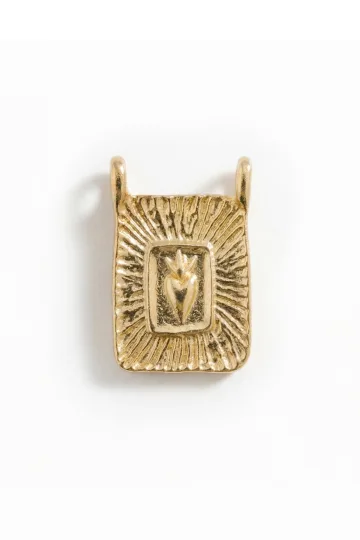














About Zevira
Zevira's collection includes rare and unusual stones that ask for special care and conscious selection. Each piece comes from a master craftsperson's search, from experience with material, from the understanding that jewellery isn't mere decoration but a tool for inner shift.
Our rhodochrosite comes exclusively from vetted Argentine and Peruvian sources, with proof of authenticity and singularity. We believe rarity matters not as status, but as the chance to own something you'll never see on anyone else.
If you seek jewellery reminding you that loving yourself is not narcissism but necessity, that it leads to deeper love for others, rhodochrosite is precisely for that.