Shungite: the black carbon stone of Karelia, its make-up, history and jewellery
A stone mined in essentially one place on Earth
Shungite is roughly 95% carbon, the same element that makes up diamond and graphite. Yet it is neither diamond nor graphite, but a third thing: ancient organic matter, pressed and transformed over two billion years. And it comes, for all practical purposes, from a single spot on the planet, the shores of Lake Onega in Karelia, in the far north-west of Russia.
A lot of noise has built up around this stone. It gets called a filter against every illness, then a shield against the radiation of your phone. Part of that is pure marketing that no laboratory backs up. But the stone itself is real, with measurable physical properties and a genuinely odd geology. Let us sort out what is true about shungite and what is invented, how it is built, how to tell it from a fake, and why it makes such severe, graphic jewellery.
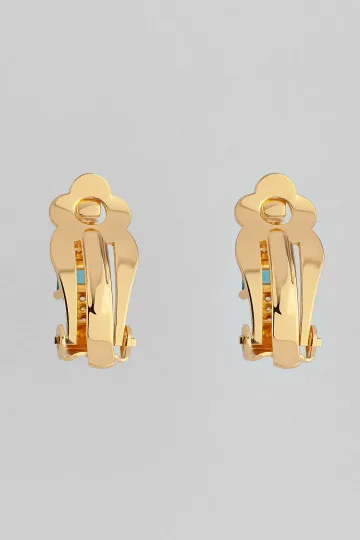
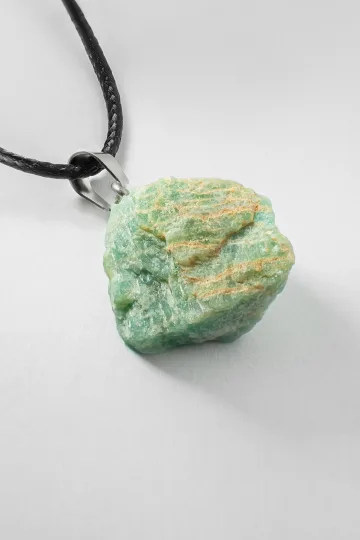
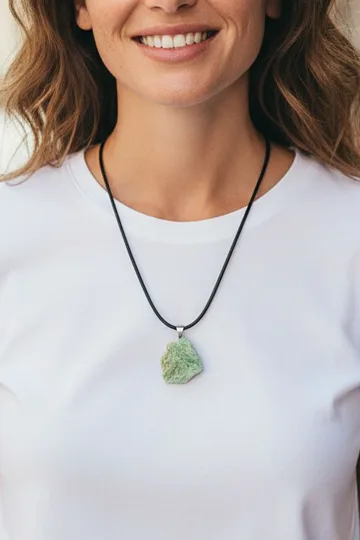
Wear the symbol, don't just read about it. These are in stock:






What shungite actually is
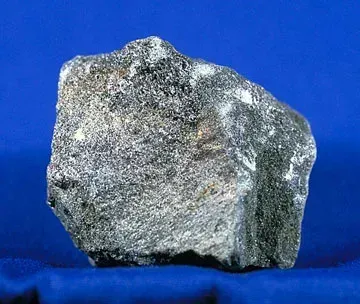
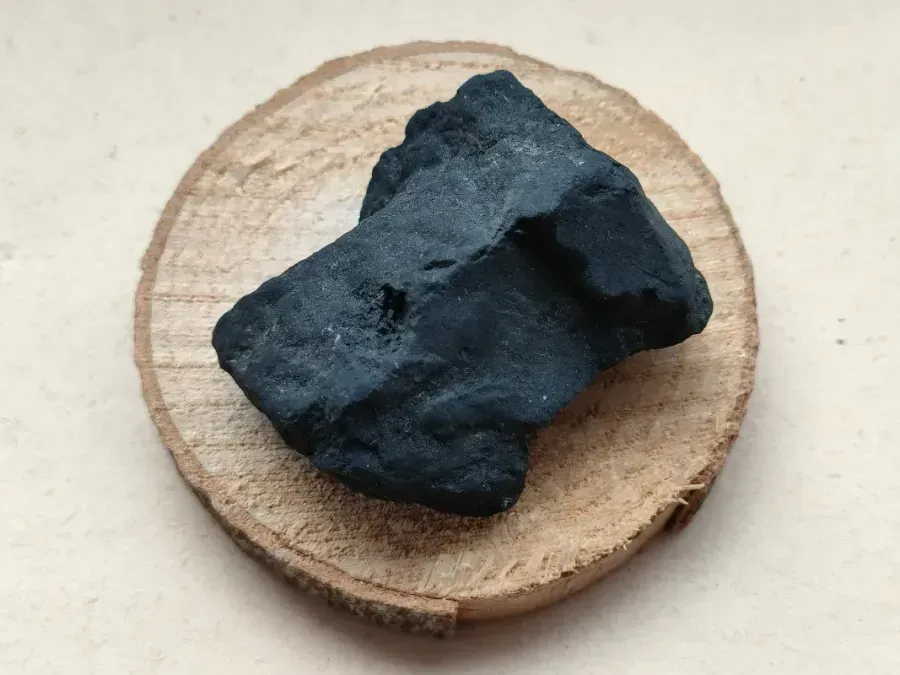
Shungite is a black or dark-grey carbon-bearing rock. It is not a mineral in the strict sense (it has no single crystal lattice and no fixed formula), but a rock proper, a mixture of carbon with silicates. The colour runs from resinous black to grey, the fracture is matte or carries a faint semi-metallic sheen.
The name comes from the village of Shunga on the shore of Lake Onega, beside which the rock was first described and where it was heavily quarried. Geologists tell the varieties apart by carbon content: the most prized is dense black shungite (often called "shungite I" or "elite"), which holds up to 95-98% carbon and glints on a fresh break. The more common grey shungite schists hold less, from 30 to 60%, with the rest made up of quartz, micas and other silicates.
The key physical property: it conducts electricity
Unlike most stones, shungite conducts an electric current. The resistivity of elite shungite is on the order of 0.01-1 ohm·cm, which makes it a conductor, if a poor one (copper carries current roughly a million times better). The conductivity comes from carbon forming extended graphite-like layers along which electrons can travel.
From this same property grows the folk belief that shungite "screens out radiation". We will come back to that below. The short answer: as an industrial powder mixed into paint it really does dampen part of an electromagnetic interference; as a bracelet on your wrist, it does practically nothing.
Hardness and density
- Hardness on the Mohs scale: about 3.5-4 (a touch harder than calcite, softer than quartz). You can scratch shungite with a steel knife.
- Density: 1.8-2.4 g/cm³. The stone is noticeably lighter than quartz, and far lighter than glass; it feels "light" in the hand for its size.
- The fracture is conchoidal, like glass or obsidian, which is exactly why large elite pieces are brittle and chip easily along the edge.
That modest hardness is a practical point worth keeping in mind: shungite polishes up beautifully, but it scratches just as readily, so rings made of it are rare.
One black stone against bare skin owns the room. Hang three and it reads as mourning, not fashion, don't you dare.
Stylist notes: how to wear shungite
I build a black stone into a look by occasion, not by rulebook. Here is what actually works on set and in real life, sorted by the questions I get asked most.
What chain length should I pick for my neckline? For an open collar I recommend a short chain, 45-50 cm, so the pendant sits on bare skin. For a roll-neck or a closed collar I go to 60 cm and up, so the stone reads over the fabric instead of vanishing under it.
Which metal makes shungite look richer? For a cool undertone I suggest silver: high contrast, a cool palette. For a warm undertone I choose gold or brass, and that play of a cold stone against a warm metal looks pricier than it is.
How do I build a bead bracelet without it going flat? I alternate 8-10 mm black beads with clear rock crystal or matte wood. That way the black does not blur into one mass and the stack keeps a rhythm without turning heavy.
What do I reach for on a weekday versus an evening? On weekdays I recommend a thin bracelet or a round pendant with a chunky-knit jumper and a shirt. For the evening I suggest a large form, 15-20 mm, or a cuff: one strong piece instead of a scatter of small ones.
How many black pieces should I wear at once? No more than two or three; past that the look turns heavy when you wanted an accent. One stone on a clean neckline almost always beats three crowded side by side.

Turn on your camera, pick earrings, a pendant or a ring, and see the piece on yourself in real time.
Switch items in one tap.
Everything runs in your browser: no photo or video is ever uploaded.
Make-up: carbon, fullerenes and pores
Elite shungite is mostly carbon (around 95%) plus a few small additions:
- silicon (Si), about 3-4%;
- aluminium (Al), 0.5-1%;
- iron (Fe), 0.5-1%, which lends colour and faint magnetic behaviour;
- magnesium, titanium, nickel, copper, zinc, in tenths of a percent and traces.
The carbon in shungite exists in several forms at once, and that is its geochemical quirk: amorphous graphite-like layers, microscopic pores and voids, and, the thing that made shungite famous, fullerenes.
Fullerenes: what they are and how many there are
Fullerenes are carbon molecules shaped like a closed sphere (the best-known, C60, is a "football" of 60 atoms). They were made artificially in 1985, and for that discovery Robert Curl, Richard Smalley and Harold Kroto received the Nobel Prize in Chemistry in 1996. The prize was awarded for the fullerenes themselves, not for shungite, a distinction the advertising loves to blur.
Later, fullerenes were also found in nature, including in shungite. Hence the marketer's chain of logic: "fullerenes won a Nobel, shungite contains fullerenes, therefore shungite is miraculous." The chain is false. The fullerene content of shungite is vanishingly small: thousandths and hundredths of a percent (0.001-0.01% by mass). That is more than in ordinary coal, yet still tiny, and the fullerenes are firmly locked inside the solid carbon matrix. From a stone that simply rests on your skin, they go nowhere.
Porosity
Shungite is threaded through with a network of microscopic pores, from a few nanometres to micrometres across. It is exactly this porosity that gives it adsorption properties, the ability to hold part of the organic impurities on its surface. On this rests the one practically proven use of shungite: water filtration (more on that below).
Shungite, graphite and diamond: one element, three fates
Carbon is remarkable for the way nature moulds the very same atom into substances with flatly opposite properties. Everything hangs on how the atoms are joined to one another. Set three related materials side by side and shungite's place in the row becomes clear.
Diamond: hardness taken to the limit
In diamond every carbon atom is bonded to four neighbours in a rigid three-dimensional framework. That lattice leaves the atoms nowhere to slide, so diamond is the hardest natural material there is (10 on the Mohs scale) and transparent, since it holds no free electrons and light passes straight through. Producing such a structure takes colossal pressure and temperature, tens of kilometres down.
Graphite: slippery layers
In graphite the atoms lie in flat hexagonal sheets, like a honeycomb, and the sheets hold on to each other weakly and slip apart easily. Hence the softness (a pencil lead writes precisely because the layers shear off onto the paper) and the black colour. Within each sheet the electrons are mobile, so graphite conducts a current. That is already closer to shungite.
Shungite: graphite left unfinished
Shungite got stuck halfway. Its carbon builds the same graphite-like sheets, but they are short, buckled and tangled, and nowhere do they stack into a proper large crystal. The result is an amorphous, loosely packed structure with pores and the occasional spherical fullerene molecule. From graphite shungite inherited the black colour and the conductivity; from the unfinished business of metamorphism it inherited its porosity and its brittleness. Had the pressure been greater, ordinary graphite would stand where shungite stands, and under exceptional conditions diamond. Nature simply stopped earlier.
Why it matters not to confuse shungite with graphite
"Shungite" pieces turn up on sale that are in fact pressed from graphite or coal powder with a binder. They too are black, they too may conduct a current, but they are a manufactured material rather than a natural Karelian rock. Real shungite is solid, dug out of the ground, and keeps its natural unevenness: barely visible threads of quartz, fine pores, a slight play of sheen on the break. A perfectly smooth, plastic-looking coal-black block without a single flaw is more a reason for suspicion than a mark of quality.
Customer reviews
Zevira is a real jewellery shop. Genuine payments, deliveries and customer thank-yous.
🥰🥰🥰 gracias
Ok, ¡gracias! 🙂
How shungite formed
Shungite is around two billion years old (Lower Proterozoic). It is the remains of ancient organic matter: on the floor of a prehistoric sea that once covered what is now Karelia, sapropel accumulated, deposits of algae and microorganisms. Back then life existed only in water, and there was almost no oxygen in the atmosphere.
Then geology took over. The sediments sank to depth, came under pressure and heat of several hundred degrees. The organic material "cooked", lost its hydrogen and oxygen, and turned into nearly pure carbon. The conditions were enough to produce amorphous-graphitic carbon, but not enough (far greater pressures would be needed) to yield graphite or diamond. That intermediate result is shungite. The process is called metamorphism and took millions of years.
Later the Karelian shield rose, erosion stripped the layers bare, and now shungite can be quarried almost at the surface.
Why Karelia in particular
The main deposit is the Zazhoginskoye field on the shore of Lake Onega, plus a string of smaller seams in the same province. The reserves are enormous (counted in hundreds of millions of tonnes), so the rarity of shungite lies not in any shortage of raw material but in geography: the coincidence of the right conditions (an ancient sediment rich in organic matter, moderate metamorphism, preservation over two billion years, exposure at the surface) came together in essentially one district of the planet. Similar carbon-bearing rocks turn up elsewhere, but "shungite" in the classical sense is a Karelian stone.
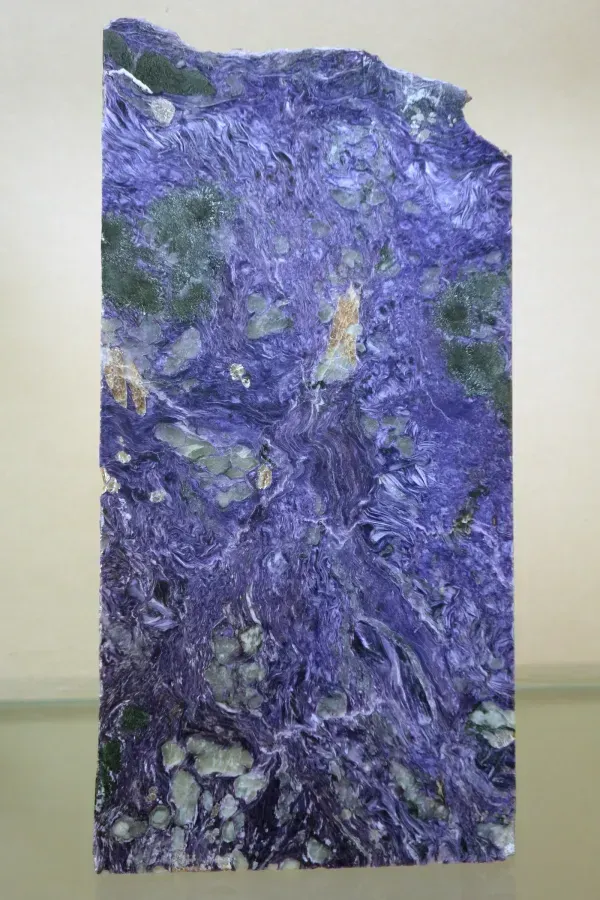
That puts shungite alongside other minerals that effectively have a single source, such as charoite, found in only one deposit on the planet.
Upload a photo of your pet, someone you love, or an object. We'll build a 3D model and hand-cast it in pewter.



History
The people of the Onega region knew about the "black stone" long before science took an interest. The best-known chapter of its story is tied to a spring whose water won fame in the seventeenth century as healing (in truth simply iron-rich). The healing virtue was then credited to the iron in the spring water, not to shungite itself, but the two stories settled side by side and stuck.
In the eighteenth and nineteenth centuries the Karelian "black schist" began to be studied seriously. Samples travelled to European laboratories, and chemists were puzzled by the electrical conductivity of a black rock with no obvious metal in it. The scientific name "shungite" was fixed in 1877 by a geologist who described the rock and linked it to the village of Shunga.
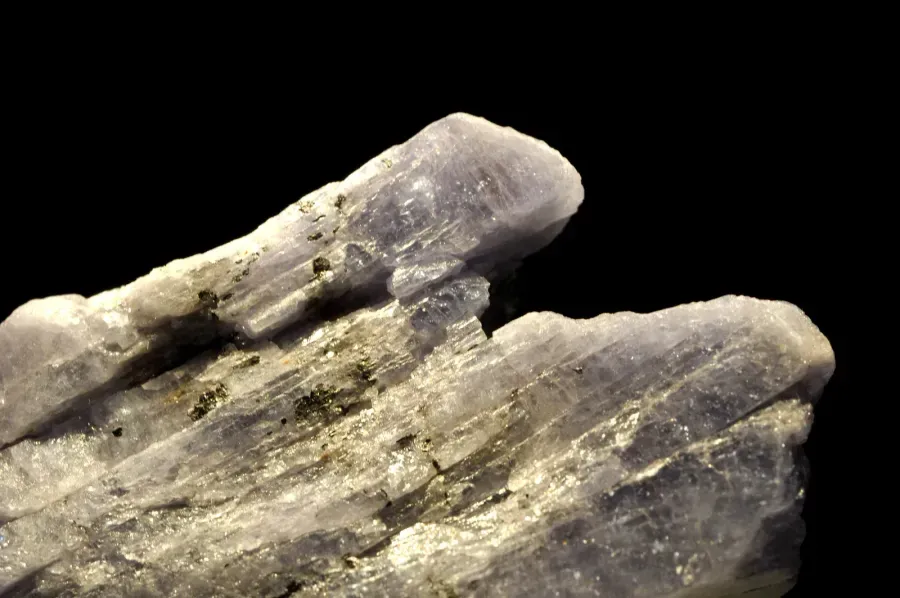
Northern Europe is rich in stones of its own: Finnish geologists, for instance, described and named spectrolite, the rainbow variety of labradorite, which is quarried very close to Karelia.
The broad fashion for shungite came later, in the late twentieth and early twenty-first century, riding the wave of stories about fullerenes and the fear of "radiation" from household gadgets. That was when the stone went from a geological curiosity to a popular souvenir and a material for jewellery.
The spa spring and its iron-rich water
It is worth pausing on that spring, because the legend of "healing shungite" is usually tied to it. The site lay in Karelia, north of Lake Onega, where a chalybeate source broke through the shungite beds; in 1719 a state spa was founded around it under a name that pointed to Mars, god of war and of iron, since the water was heavily charged with iron and therefore counted as bracing. Britain knew exactly the same fashion: the chalybeate spring at Tunbridge Wells, discovered in 1606, drew crowds for the same reason, and nobody credited the rock it ran through. In Karelia the coincidence of geology and geography was later turned into an advertising argument. What actually did the patients good was the dissolved iron and the regime itself: rest, clean air, an ordered day. The spa ran for a short time and fell into neglect, but the memory of that "royal water" survived and still feeds the mythology of the stone.
Alexander Inostrantsev and the scientific name
The rock owes its name to Alexander Inostrantsev, a professor at St Petersburg and one of the founders of the Russian school of geology. Studying the Karelian "black schist", he worked out that he was dealing neither with coal nor with graphite but with a carbon-bearing substance of its own kind, and in 1877 he introduced the term "shungite" after the village of Shunga. It is a rare case of a mineralogical name coming neither from a classical root nor from the surname of a scientist, but from a northern village. Inostrantsev was also the first to describe the electrical conductivity of the rock systematically, the property that had so puzzled the chemists who received the samples.
Industry came long before jewellery
For a long stretch shungite was valued for anything but beauty. Through the twentieth century it went into black mineral pigment, into shungizite, a light porous aggregate for concrete, and into metallurgical charges where the carbon serves as a reducing agent. Blocks and gravel beds of shungite were used in construction and in water treatment, and finely ground shungite still goes into conductive and shielding coatings for laboratories and equipment rooms. The jewellery and souvenir chapter came last, at the close of the twentieth century, when a mass appetite for "natural protection" turned an industrial raw material into something sold for the soul. So a shungite bracelet, for all the antiquity of the rock, belongs to a very young tradition.
What is true and what is myth
Shungite has a rare fate: real physical properties have become tightly braided with exaggeration. Let us go through it point by point, honestly.
Water filtration: it works
This is the one well-supported practical use. Thanks to its porosity and adsorption, shungite holds back part of the organic impurities, lowers turbidity and removes off-odours; laboratory tests record a noticeable drop in chlorine and a range of organic compounds after prolonged contact of water with the stone. The effect does not turn any water into drinking water, and it does not remove salts or most dissolved substances, but as a mechanical and adsorptive polishing filter shungite genuinely works, and industrial shungite filters are built on the same principle.
Radiation shielding: practically nil in jewellery
Shungite conducts a current, and a conductor is in principle able to screen an electromagnetic field. That is why shungite powder is added to special paints and coatings to suppress interference, where it does work.
But a bracelet or a pendant is a different matter. To screen a wave, the barrier must be comparable to the wavelength and ideally surround the source entirely (the Faraday cage principle). The wavelength of a mobile signal is 15-30 cm, while a bracelet is thin and covers only part of the wrist. Physically it cannot create any meaningful screen. Measurements show a field reduction of a few percent right against the stone and practically zero a few centimetres away. So the "phone shield on your wrist" is a myth.
Curing illness: no
Fullerenes do indeed show some intriguing activity in a test tube and in cell cultures, such as the ability to mop up free radicals. But from a test tube to "a bracelet heals you" is an abyss. There is vanishingly little fullerene in shungite, it is locked in a solid matrix and does not pass through skin into the bloodstream. No doctor will call shungite a remedy, and any promise to "cure cancer / blood pressure / eyesight" is the mark of a dishonest seller, not a property of the stone.
"Charging under the moon": no need
Shungite is a stable carbon rock whose structure settled two billion years ago. Moonlight or sunlight is physically unable to change anything in it: the energy of visible photons is not enough to disturb the carbon bonds. The stone needs no "activations" and no "cleansing of negativity": it is a piece of jewellery, not a battery.



Shungite for water: how it is used in practice
Since filtration is the one proven use, here is how it is normally done, without magic. Take the dense elite stone (grey schist crumbles and clouds the water), rinse new pebbles under the tap until the water runs clear, because a fresh break gives off a black suspension, and boil them for 5-10 minutes before first use. A typical household ratio is about 100 g of stone per litre of water. Let the water stand, since adsorbing organics and chlorine takes time: a noticeable effect begins after several hours, and full contact is reckoned as a day of steeping.
The stone is not an eternal filter: its surface and pores gradually clog, so once every week or two you scrub it under running water with a brush, and once every six months it is best replaced. An honest caveat: shungite does not disinfect water and does not remove bacteria, hardness salts or dissolved heavy metals. It works as a polisher of already relatively clean tap water, not as a substitute for boiling or a membrane filter. For jewellery none of this is relevant, but if some shungite pebbles are lying around the house, let them earn their keep.
Shungite and look-alike black stones
There are many black stones, and it is easy to be handed something else as shungite. The difference is not cosmetic, it lies in the make-up and in how the stone behaves.
- Jet (so-called black amber) is also carbon-bearing, but it is fossilised wood. It is noticeably lighter, warm to the touch, can give off a smell when rubbed, and barely conducts a current. Shungite is colder and denser by weight.
- Obsidian is volcanic glass. It is hard (5-5.5 on Mohs, a steel knife will not scratch it), gives a mirror-like glassy lustre and a sharp conchoidal break. It does not conduct a current, and a thin edge can be translucent with a haze against the light. Shungite is mattier and softer.
- Haematite is an iron oxide: heavy (density around 5, twice that of shungite), with a cold metallic lustre, leaving a rusty-red rather than grey-black streak. It is strongly drawn to a magnet, which shungite is not.
- Black tourmaline (schorl) is hard (7 on Mohs), often with lengthwise striations on the crystals, and does not conduct a current. Like shungite it is sold "against radiation", but the physics is the same: jewellery does not screen.
- Black agate is dyed or natural chalcedony, essentially quartz. It is hard, cold, rings when tapped, does not conduct a current and a steel knife will not scratch it.
A simple test that rules out almost every imitation at once: of this group, only shungite conducts an electric current and leaves a graphite streak. The rest are either harder, or heavier, or magnetic.
Leave your email, we'll send your discount code. No spam, unsubscribe anytime.
The code arrives by email, valid on your first order.
Shungite jewellery
Its black colour, matte or polished surface and a neutral, graphic look make shungite a handy material for everyday jewellery. The most common pieces are bracelets and pendants.
Bracelets
The most popular format. The options:
- Beads on an elastic cord: simple and inexpensive. Comfortable to wear, but the cord stretches over time, and the elite-shungite beads themselves are fairly brittle.
- Polished beads with silver spacers or set in sterling 925, more durable and tidier: the silver protects the stone from direct contact with sweat and cosmetics.
- Paired with clear stones (rock crystal): the contrast of black and clear reads strikingly.
- Geometric shapes: cubes and little pyramids for those who like severe minimalism.
Bead size is a matter of taste: 8 mm is a restrained bracelet, 10-12 mm the universal standard, 14 mm and larger a clear accent.
Pendants
Pendants are made round, square, teardrop-shaped, sometimes engraved. The setting is most often sterling 925: it causes no allergy, does not tarnish as fast as copper, and looks good with a black stone. Choose the chain length to suit the neckline: short under an open collar, long over a roll-neck.
Handsome pairings: shungite with rock crystal (the contrast of black and clear), with warm gold or brass (the play of cold and warm tone), with silver (a severe, cool palette).
Rings: rarely
Because of the modest hardness (3.5-4 on Mohs) plain shungite scratches and chips easily, so rings are almost never made of it. Where they exist, they come with a protective silver setting and an inset of polished stone.
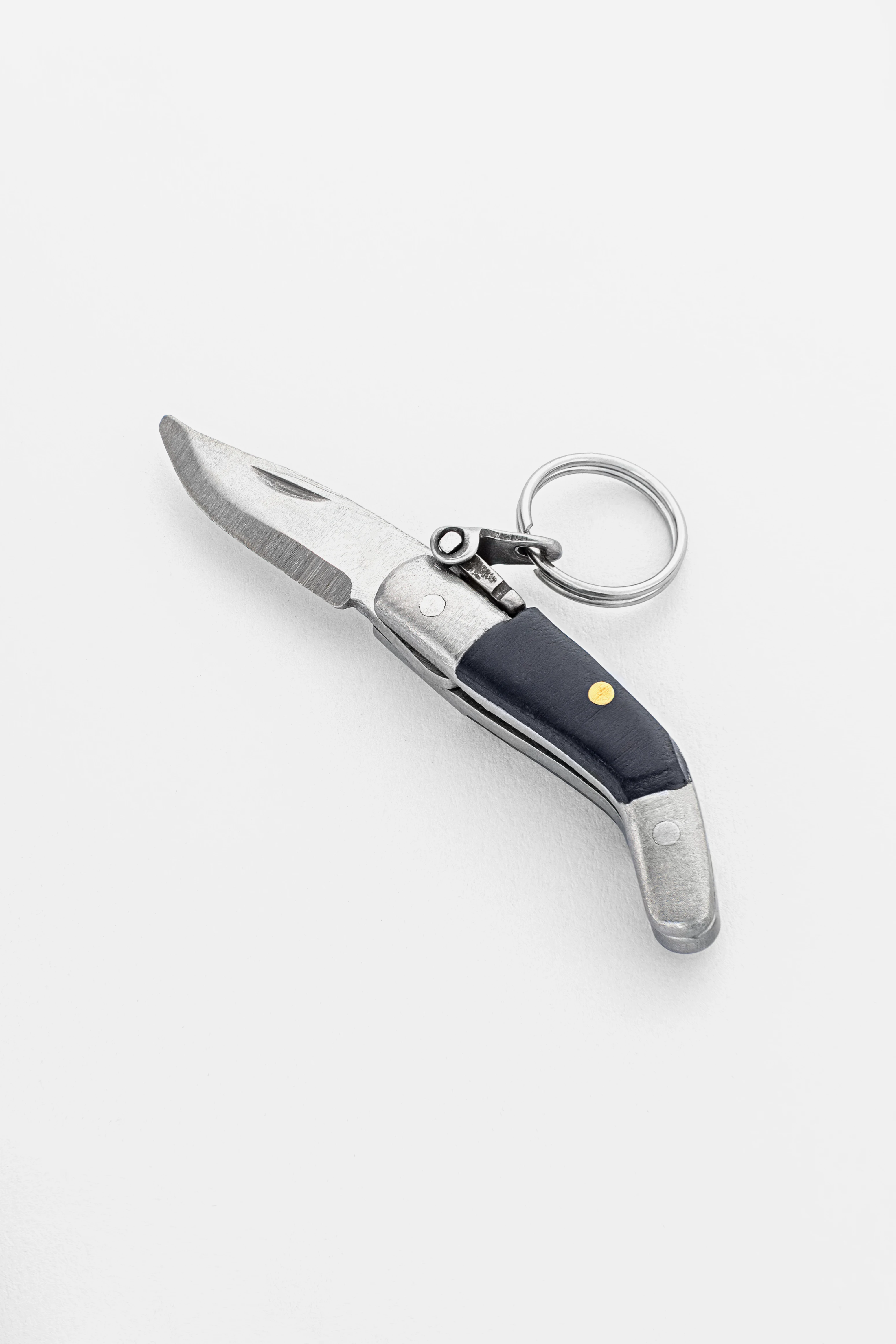
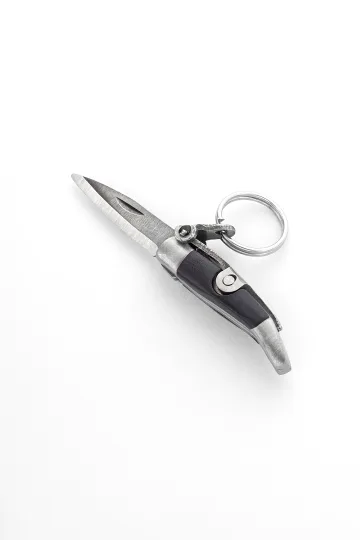
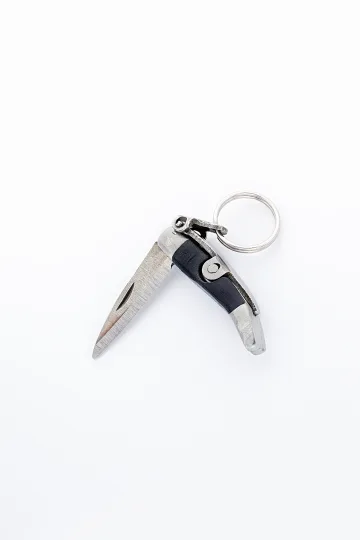
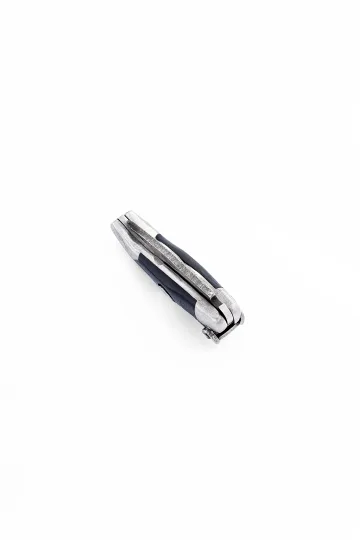
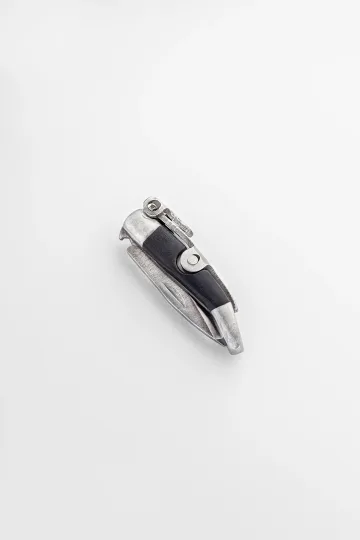
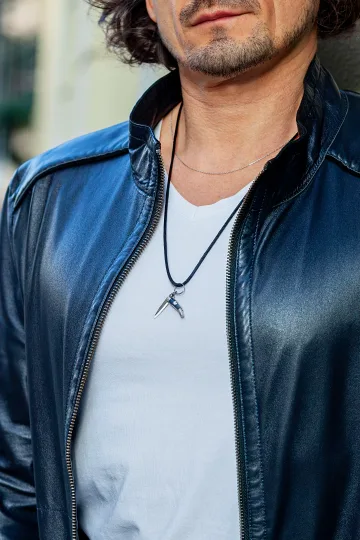
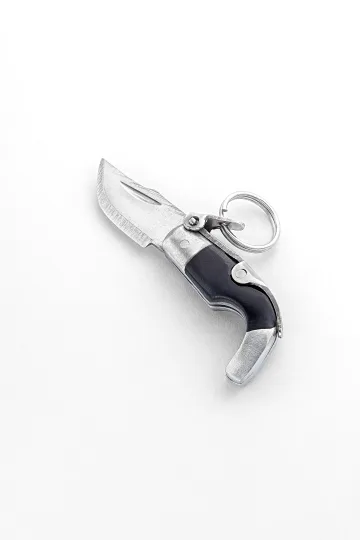
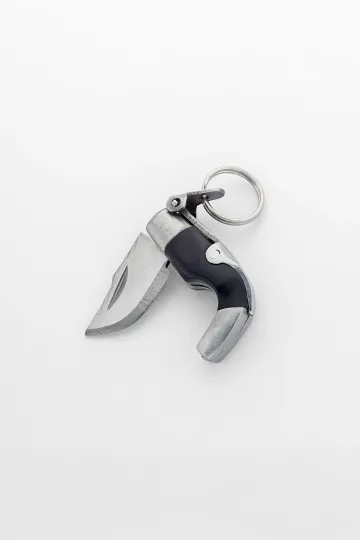
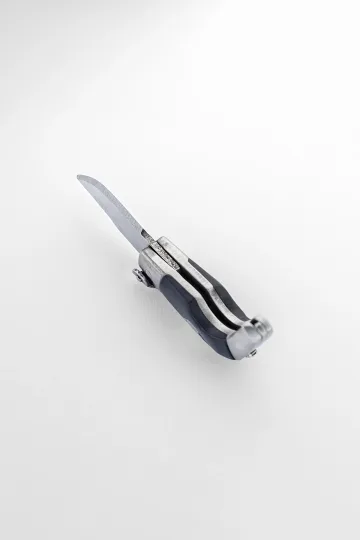
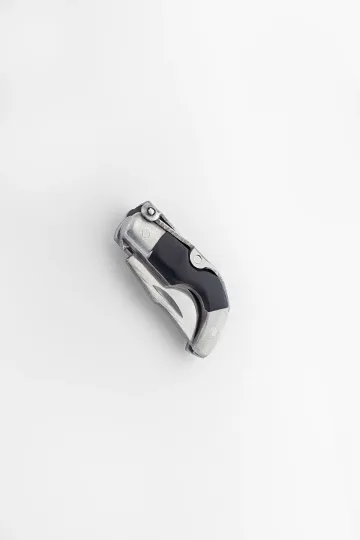
CAPAORA mini knife pendant
The 18th-century Spanish navaja in miniature: 40 mm of stainless steel, a real folding mechanism and a Palanquilla lock that clicks. An affordable gift to remember.
Authentic · Ships from Spain · 14-day returns
The symbolism of a black stone: what is in it and what is not
A great many readings have attached themselves to shungite, as they do to any dark stone. The honest way to approach them is this: the symbolism itself is real as a cultural and psychological fact, but it does nothing to a person physically. The stone is not a source of strength, it is a reminder of it, a worn sign that tunes the person who chose it.
Black as a steadying colour
In most cultures black stands less for mourning, as people sometimes assume, than for solidity, cover and composure. A black background throws everything else forward, black clothing disciplines a silhouette, a black stone against skin reads as a point of stillness. When shungite is credited with "grounding" and "calming", there is a grain of truth in it, but what works is the visual and tactile image rather than the geology: a smooth, slightly weighty dark object in the hand really does settle the nerves, much as worry beads do. That is the effect of ritual and habit, not of anything the stone emits.
The "protective stone": where the idea came from
The amulet reputation grew out of two stories laid one over the other. The older one is that dark stones have long been worn against the evil eye, from Roman jet to the Whitby jet mourning jewellery of the nineteenth century. The newer one is the anxiety about "radiation" from household electronics, and it clings hardest because it plays on a worry that is difficult to check. Nobody forbids wearing shungite as a personal talisman, and if it lends confidence, that is an ordinary human practice. The one thing worth keeping clear is the difference between psychological comfort and physical protection: the first is real, the second is not.
An honest boundary
The sensible position is simple. Shungite can be loved for its antiquity, its colour and the feel of it, and worn as a sign of composure or as a memento of the far north. But the moment a seller promises that the stone "clears chakras", "lifts a curse" or "heals", the conversation has left jewellery and moved into the trade in fears. A handsome black stone needs no superpowers in order to be handsome.
How to tell real shungite from a fake
Dyed glass, plastic or another black stone is often sold as shungite. A few reliable checks:
- Electrical conductivity, the surest sign. Real elite shungite conducts a current. Touch the probes of a multimeter, set to measure resistance, to two points on the stone, and the metre will show a finite resistance (usually from a few to a few hundred ohms for dense shungite). Glass, plastic and most other black stones do not conduct: the metre reads "infinity". A simple household test: shungite can close the circuit of a small bulb with a battery.
- Weight. Shungite is lighter than glass of the same volume (density 1.8-2.4 against 2.5 for glass). A heavy, "glassy" specimen is suspect.
- Hardness. Shungite is soft, a steel knife scratches it, and it leaves a grey-black streak of its own, like graphite. Glass will not scratch like that.
- Colour and lustre. The real stone is a deep matte or semi-metallic black, sometimes with a brownish cast, without the mirror-like "lacquered" gloss of cheap plastic.
- Provenance. Honest sellers state Karelian origin. Any promise of "healing" in place of a description of real properties is a reason to be wary.
How to choose shungite when buying
The grade of the stone is visible to the eye and checkable by hand. What to look at:
- Grade. Jewellery needs the elite kind (also called "shungite I" or "noble"): dense, coal-black, with a light semi-metallic sheen on the break. A matte-grey stone with a dull, dusty surface is shungite schist, cheaper, but in beads it looks grubby and crumbles more easily.
- Surface. A well-polished bead is an even satin or mirror black, without crumbled cavities or whitish streaks of quartz. Fine pores are acceptable, that is the nature of the stone, but chips around the drill hole are a drilling defect.
- Consistency of the set. In a bracelet the beads should be close in tone and sheen. If some are glossy and some grey and dull, elite stone has been mixed with schist.
- Setting. Sterling 925 is preferable not for looks but for protection: bare shungite constantly rubs against skin and clothing and wears smooth over time. Ask specifically for the metal fineness, not for a "silvery alloy".
- Provenance. An honest seller names Karelia and describes real properties. Wording like "heals", "charges", "3-in-1 against all illness" is a marker that the stone is being sold as a myth, not as a stone.
A little on-the-spot trick: pure elite shungite feels noticeably lighter in the hand than glass of the same size and leaves a grey streak if you draw it across unglazed ceramic (the back of a tile, the base of a mug). A glass or plastic imitation does not behave that way.
Send a friend a discount code, they save on their first order.
Care
Shungite is undemanding, but soft, so a couple of simple rules will keep a piece looking good:
- Before first wear, rinse the piece under running water to wash off polishing dust, and wipe it with a soft cloth.
- Now and then (once a week or two) rinse off sweat and cosmetics and dry it thoroughly, especially unset beads.
- Store it apart from other jewellery: shungite can soil neighbouring stones with graphite dust, and it is easily scratched against harder materials.
- Wipe a silver setting with a silver cloth from time to time, as it darkens with oxidation.
- Shungite is not afraid of water, but if a piece has glued-in insets, excess moisture is best avoided.
Shungite is hypoallergenic (it is not organic and provokes no immune reaction), and there are no contraindications to wearing it.
Facts that raise an eyebrow
Even with all the esoterica stripped out, shungite has plenty of traits that lift the brows. Here are a few of the checkable ones.
It is as old as the first life on Earth
Shungite is about two billion years old. It took shape when living things existed only in water and the atmosphere held almost no oxygen. The carbon in it is the compressed remains of the earliest microorganisms and algae. Holding a shungite bead, you are literally touching one of the oldest traces of life on the planet.
A stone that carries an electric current
The overwhelming majority of minerals are insulators. Shungite is a rare exception: you can close a circuit with it and light a small bulb. It was exactly this conductivity that baffled chemists a century and a half ago, since no metal is visible in the black rock and yet the current flows.
Fullerenes were invented first and found afterwards
Usually it runs the other way round: a natural substance is found and then reproduced in the laboratory. With fullerenes it happened back to front. The closed carbon spheres were first made in a laboratory in 1985, and only later did anyone notice that nature had been making them on its own, shungite included, long before people existed.
Reserves for centuries, quarried in one spot
The paradox of shungite is that there is a colossal amount of raw material, counted in hundreds of millions of tonnes, yet geographically almost all of it lies in one district of Karelia. The rarity of the stone is not a shortage but a unique coincidence of geological conditions that came together in essentially a single place on Earth.
It painted and built long before it decorated
Before it became a souvenir, shungite was an industrial raw material: black pigment, a light aggregate for concrete, a charge additive in metallurgy. The stone sold today as an amulet spent decades working on building sites and in factories.
Light, though it looks heavy
Black stones carry an unconscious association with weight, yet shungite is lighter than glass and noticeably lighter than most of its dark relatives. A density of about two grams per cubic centimetre makes a large bead unexpectedly weightless in the hand, and that is one of the simplest ways to tell it from an imitation.
Named after a village, not a scientist
Among minerals this is unusual. Most names come from Greek roots or from the surname of whoever first described the stone, while shungite took its name from the Karelian village of Shunga, where it was first described and quarried.
Frequently asked questions
Does shungite really protect against phone radiation?
As jewellery, no. A thin bracelet cannot screen radio waves: for that the barrier must be comparable to the wavelength and surround the source. Shungite powder in special paints does dampen part of an electromagnetic interference, but that is an industrial use, not a stone on the wrist.
Which shungite to buy: elite or ordinary?
The elite kind (dense black, up to 95% carbon) glints on the break, conducts a current and goes into jewellery and souvenirs. Ordinary grey shungite schist holds more silicates, is less striking and is more often used for filters and in construction. For jewellery, choose the dense black variety.
Why is shungite black?
Because of the carbon (around 95%) in a graphite-like form, plus an iron impurity. The pale, grey "shungite" is a variety with more quartz and less carbon; it is less dense and does not gleam.
Does shungite go with silver?
Yes, it is one of the happiest pairings. Black and silver give a clean contrast, and a silver setting protects the soft stone from sweat and lengthens the life of the piece.
Can shungite be worn all the time?
Yes. It is hypoallergenic and not afraid of water. You only need to spare it knocks against hard surfaces and store it apart from other jewellery, so it scratches neither them nor itself.
Is shungite fragile?
Relatively. With a hardness of 3.5-4 on Mohs the stone is softer than quartz, polishes up easily, but also scratches and chips along the edge readily. That is why rings of pure shungite are made rarely, and beads are preferably protected by a setting.
How does shungite differ from jet and black agate?
All three are black, but different in make-up. Jet is also carbon-bearing (fossilised wood), very light and warm to the touch. Black agate is chalcedony (quartz), hard, cold and does not conduct a current. Shungite stands apart precisely by its electrical conductivity and the carbon make-up of the rock.
Can shungite be worn together with other stones?
Yes. There are no restrictions on "energy compatibility", that idea is invented. There is only a practical caveat: shungite is soft and can leave a grey graphite dust, so in a jewellery box it is better kept apart, where it will neither soil nor scratch its neighbours. In a look it sits happily with rock crystal, silver, warm gold and wood.
Does shungite darken over time?
The stone itself does not. It is stable and its colour does not shift. What can dull is the polish, if unset beads rub constantly against skin and clothing: the surface goes matte and loses its sheen. A silver setting, on the other hand, does darken with oxidation, which is normal and comes off easily with a silver cloth.
How is shungite better than ordinary activated carbon for water?
They are essentially related adsorbents, and both hold back part of the organics and chlorine. The advantage of shungite is that it is a solid stone: it does not crumble into the water the way carbon powder does, it is easy to rinse and it can be reused many times. Do not expect miracles from either, though. Both are polishers rather than a substitute for boiling or a membrane filter, and in a hard-water region neither will do a thing about the limescale.
Buying it as a gift? Each one arrives ready to give.
 A branded Zevira box and a little card come with every order.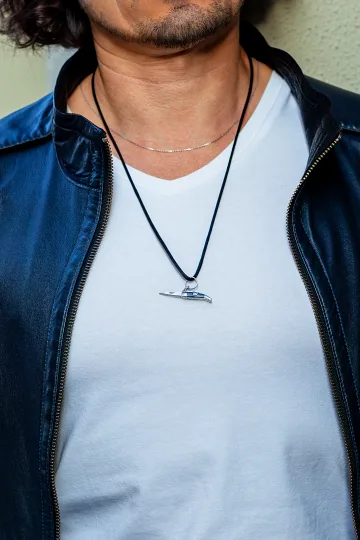





The short of it
Shungite is a real mineral with a real history: a carbon-bearing rock around two billion years old, mined in essentially one spot on the planet, in Karelia. It has genuine properties: it conducts electricity, it is porous and therefore suited to filtering water, it holds fullerenes that are rare in nature. And it has its myths: a bracelet does not protect against phone radiation, the stone heals nothing and needs no "charging under the moon".
Strip away the advertising promises and what remains is exactly what the stone is worth wearing for: a deep black colour, a severe, graphic aesthetic, a pleasant soft texture and a tangible antiquity, two whole billion years of geology in one smooth stone. That is quite enough.
About Zevira
Our shungite bracelets and pendants keep to the metalworking tradition of Albacete: polished Karelian stone set in sterling 925, a severe, graphic form with no needless shine. We describe the stone honestly, without promises of "radiation protection" or "healing", because its deep black colour and the tangible antiquity of the rock speak for themselves.