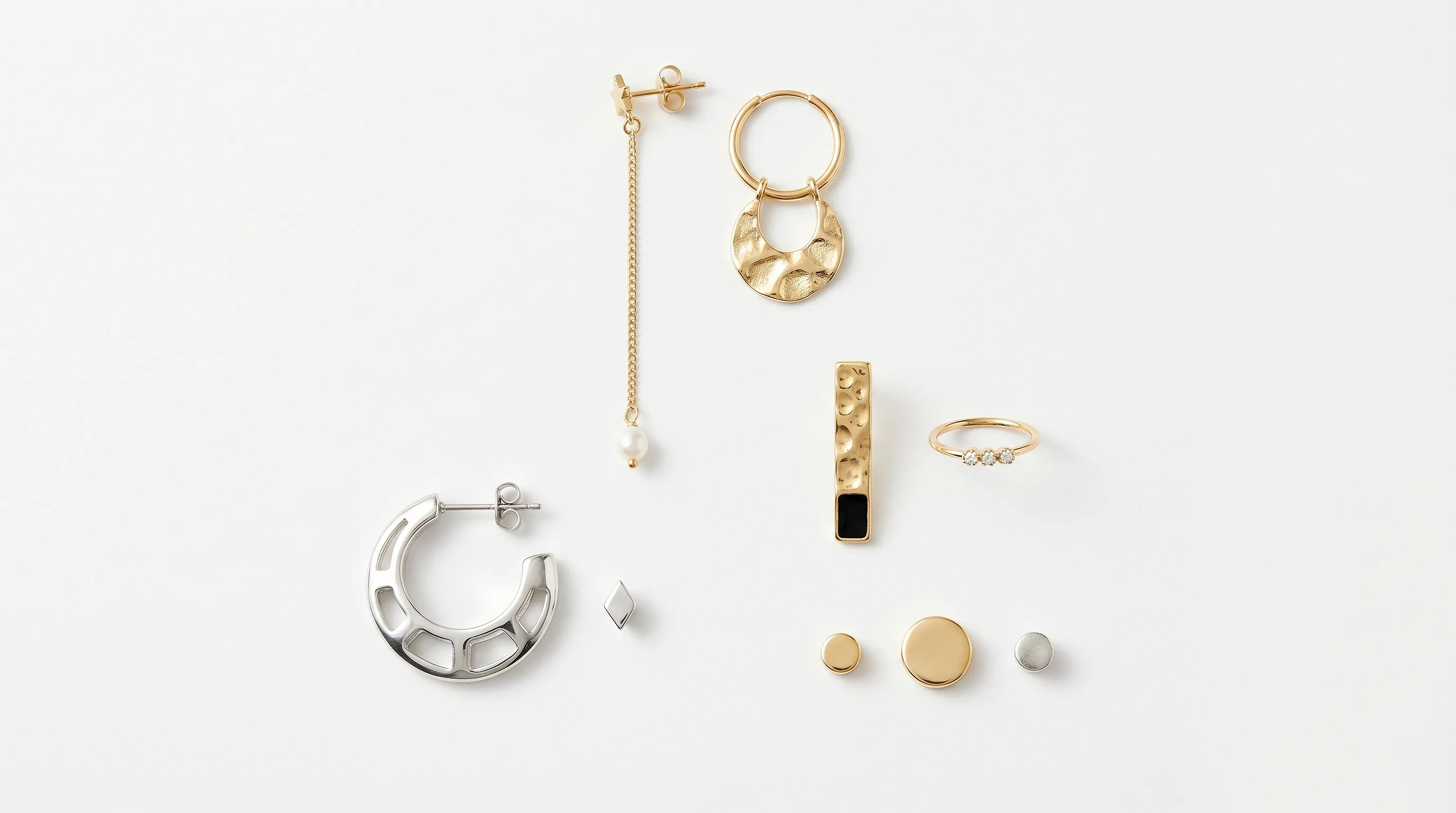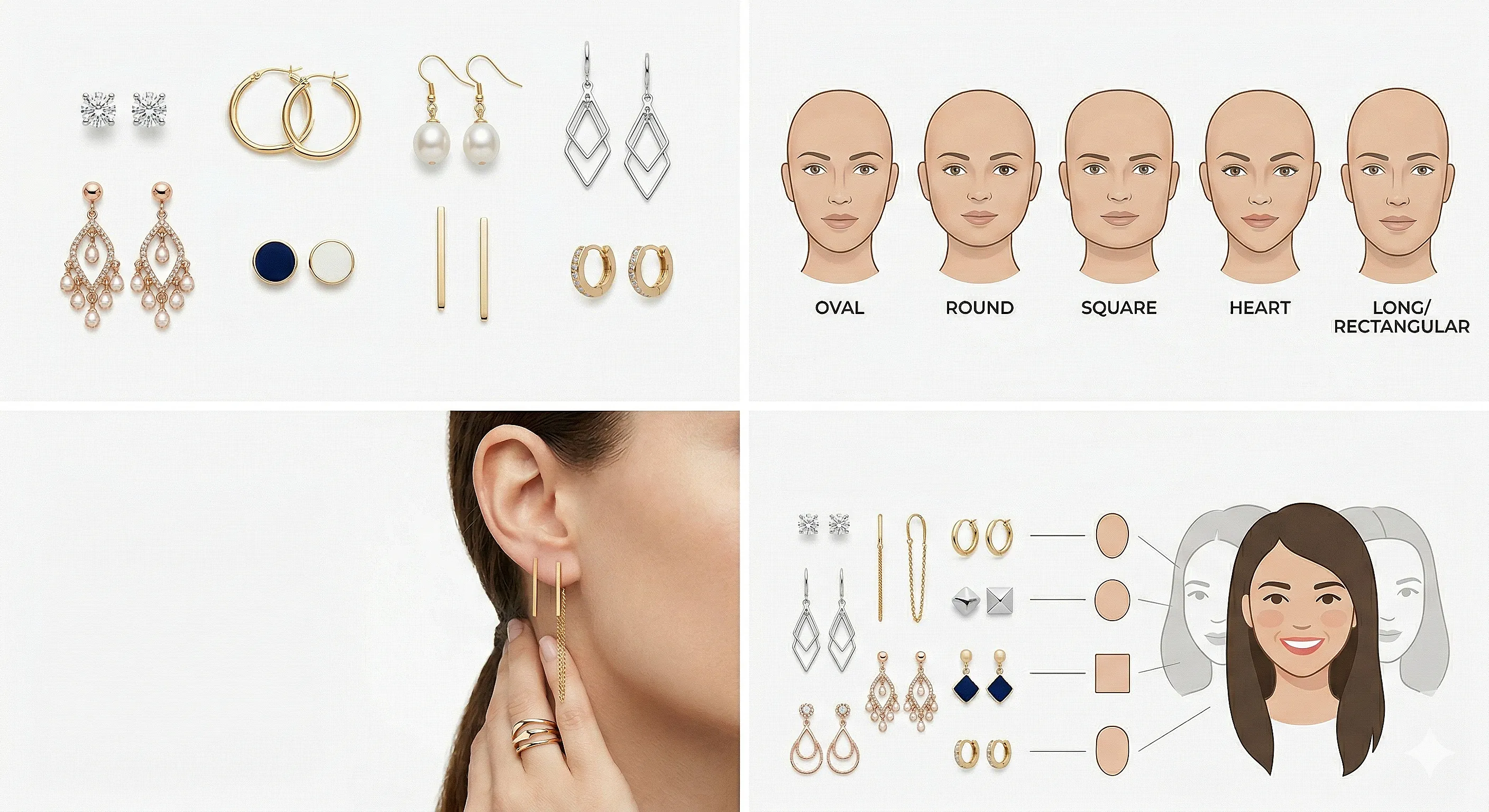
Stud Earrings: One Stone That Everyone Sees When They Look You in the Eye
Studs are visible 80% of the time during a conversation. Other jewellery hides: under clothes, in hair, in your hand. Studs stare directly at your conversation partner. This is why they're chosen more carefully than any other earring format.
This guide covers the simplest and most deceptive format of earrings. Simple in silhouette: stone, post, backing. Deceptive in selection: a half-millimetre larger size, a shade of metal that's one tone colder, the wrong backing type, and your daily studs turn into an irritation. We'll walk through history, anatomy, stones, cases, settings, common pitfalls, and care. By the end, you'll know what's missing from your jewellery box and what you'll add next.
History of the Stud: From Assyria to Diamond Classics
Stud earrings are among the oldest jewellery formats in human history. Not a drop, not a ring, not a bracelet, but a small, snugly fitting object on a post that passes through a piercing. Archaeological evidence for this format goes back four and a half thousand years, and across all those epochs, the basic idea hasn't changed by a millimetre.
Assyrian Gold Studs
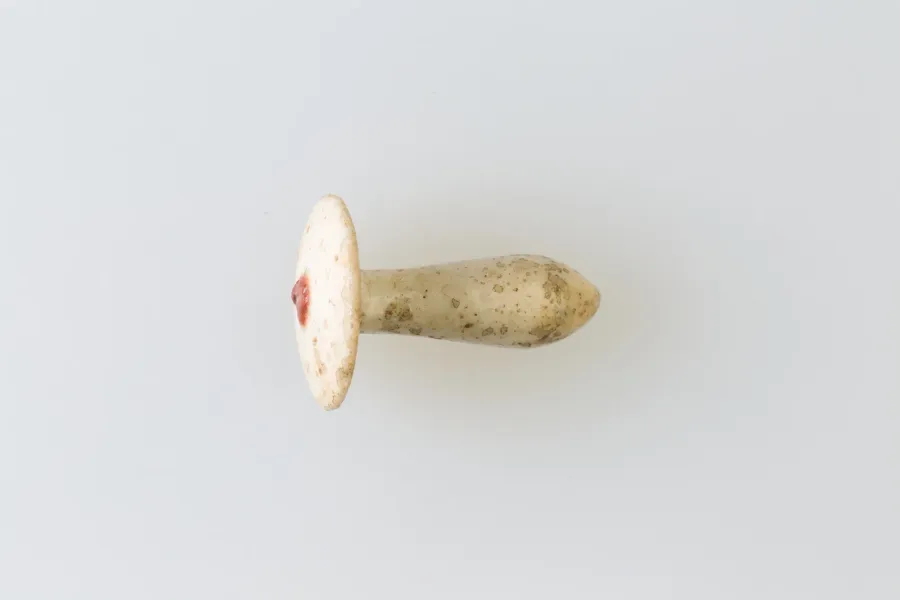
The British Museum collection includes a pair of gold earrings from Northern Mesopotamia, dated approximately 2500-2300 BCE. These are tiny spherical beads on a straight post, without stone, without pattern, with a simple ball on the end. They were found in burials of noble women from the city of Ur and the surroundings of Assyrian settlements. Purpose was dual: ornament and social marker. The size of the bead and weight of gold determined what caste the owner belonged to.
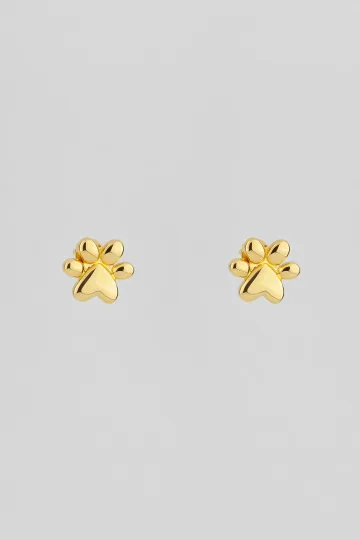
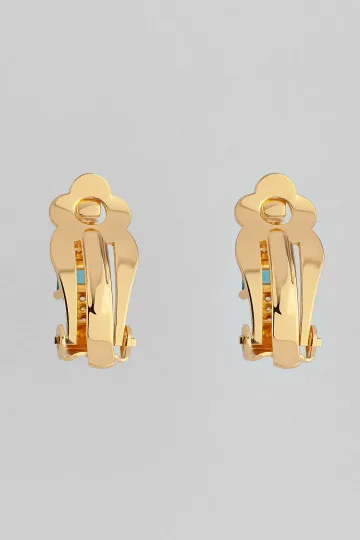
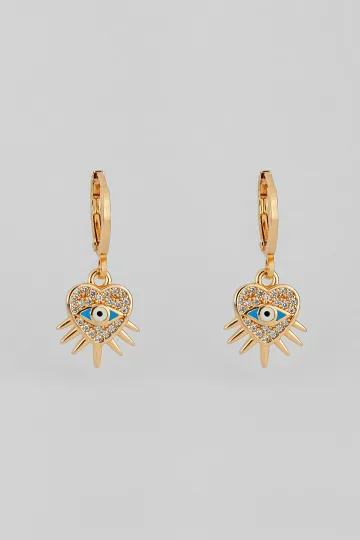
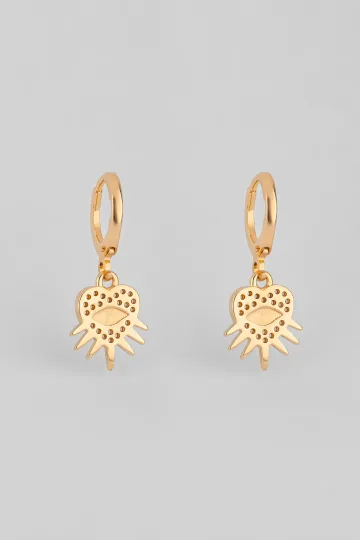
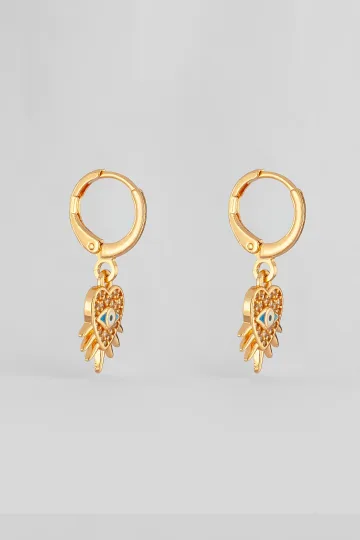
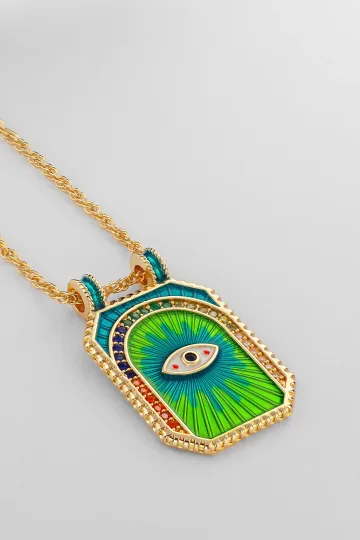
Wear the symbol, don't just read about it. These are in stock:



What matters: the format arose not as a drop but as a stud from the beginning. Earlobe piercing in these cultures was done in early childhood, and the earring stayed in the ear constantly. Removing it was a complex ritual, so the construction was designed for permanent wear: nothing should catch, interfere with sleep, or press against the cheek. A simple ball on a post met all these requirements.
Greco-Roman Tradition
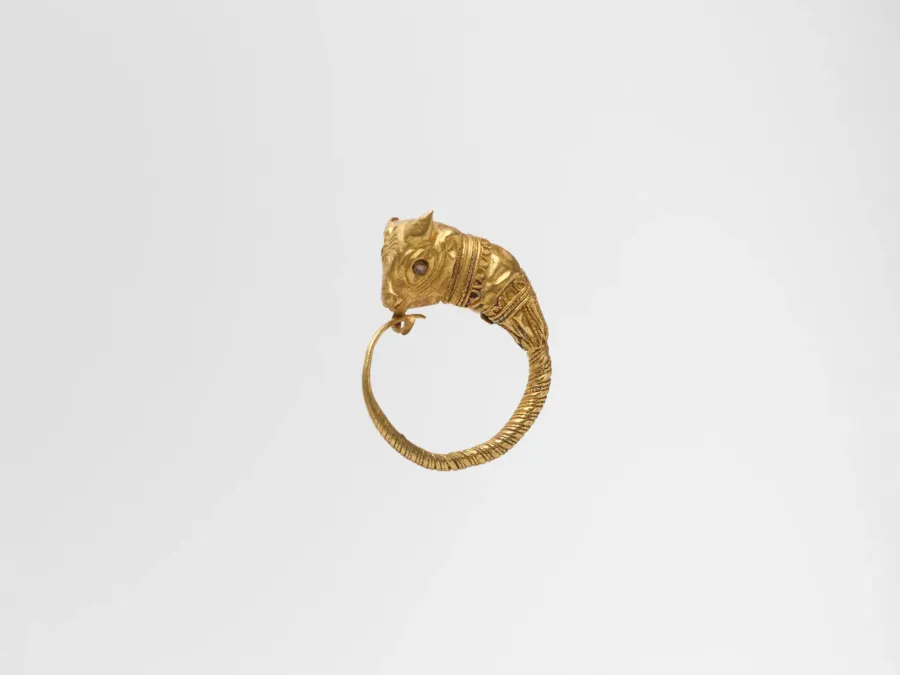
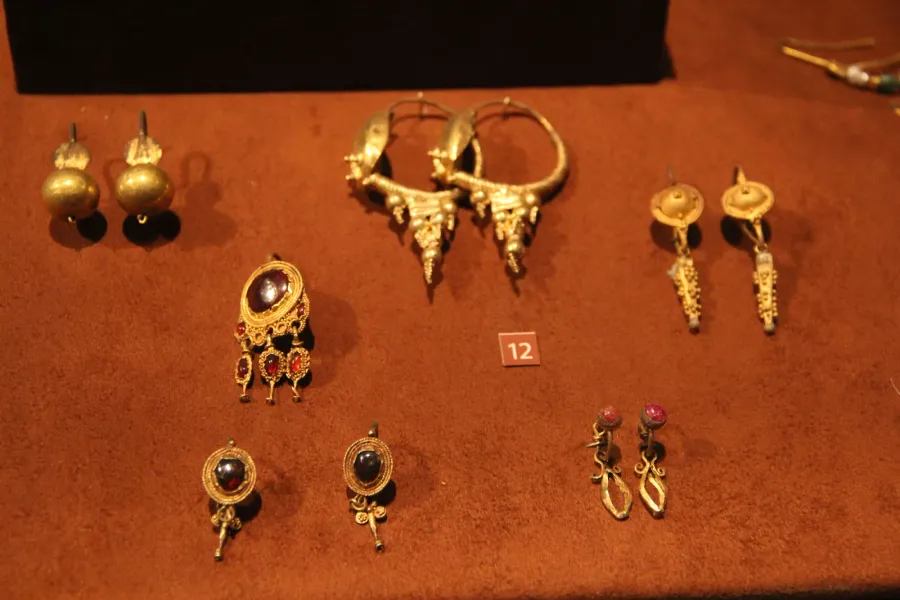
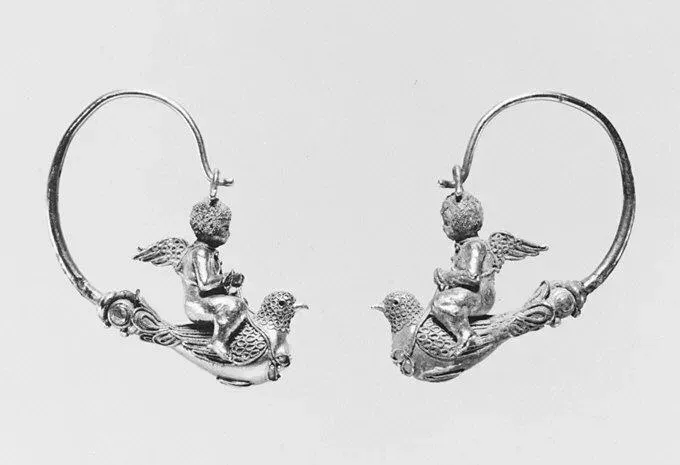
By the fifth century BCE, Greeks adopted the format and enhanced it. In Athens and Corinth, studs with tiny lion heads, eagles, and amphorae appear. The head size remained modest, 5-7 millimetres, to avoid stretching the earlobe. Twenty-two to twenty-four carat gold was used because alloys weren't developed, and pure gold was easier to solder.
Romans made studs a mass category. Excavations in Pompeii uncover hundreds of pairs of studs from different social layers: gold for patrician women, bronze with enamel for the middle class, silver with coloured inlays for freedwomen. By this time, the first centre-stone studs appeared: garnet, agate, rarely emerald. The stone was set without a metal bezel, just sealed with resin in the socket. Unreliable method, but visually striking.
In wealthy Roman families, studs were part of a set: matching studs, pendant, and ring with the same stone. This "three-point set" principle survives today and is often called a parure.
Byzantine Era: Enamel and Gold
After the empire's division, Constantinople became the jewellery capital for a thousand years. Fourth to tenth-century Byzantine studs feature dense cloisonné enamel on the face. On a tiny head diameter, craftsmen fit miniature religious scenes: crosses, doves, monograms. Enamel colours were deep: burgundy, dark blue, emerald green, held in gold dividers that simultaneously served as drawing outlines.
Byzantine stud backings were more complex than Assyrian ones. A loop-fastener appeared behind the post, over which a tiny ring was placed. Such a fastening was hard to open accidentally but easy to remove on purpose.
The style spread via trade routes to Italy, the Balkans, and the Caucasus. Georgian and Armenian craftsmen in the eleventh-thirteenth centuries worked in the same Byzantine tradition and developed it by adding granulation and filigree to the back of the head. These pieces in Tbilisi and Yerevan museums are still considered standards of dense Byzantine work.
Victorian Era: Jet and Memorial Studs
From the 1840s onward, England saw a particular subgenre: mourning studs. After Prince Albert's death in 1861, Queen Victoria wore only black for forty years, and her entire court, followed by the wealthy part of the country, adopted mourning style. The era's main stone was jet: black, light, mined in Whitby on the northern coast of Yorkshire.
Jet studs were worn by widows and elderly women as a sign of respect to deceased relatives. Head size was small, 5-8 millimetres, to avoid looking provocative. Shape was strictly geometric: circle, oval, sometimes octagon. Inside the jet disk, a strand of the deceased's hair was sometimes woven, this technique was called "hairwork" and was especially valued in family jewellery.
The same period saw opposite studs: with diamonds in "rose cut," an old cut that didn't give such brilliance as modern brilliant cut but had a matte velvety sheen loved by old-family ladies. Many of these studs survived to our day and are now considered rare vintage classics.
Art Deco: The First Mass-Market Diamond Stud
In the 1920s-30s, two events coincided and forever changed the format. First: modern "brilliant cut" developed by Marcel Tolkowsky in 1919 gave maximum sparkle with minimal weight loss. Second: platinum's emergence as a mass-market jewellery metal. Platinum is stronger than gold, more inert, lighter in density, and holds tiny claws without deformation for years.
This combination produced what we today call "classic diamond studs": one round stone in platinum settings, minimal metal, maximum sparkle. By the 1930s, this became the standard engagement, anniversary, and graduation gift throughout the Western world.
Parallel to this in Art Deco existed a more decorative line: studs with geometric patterns, enamel, combinations of contrasting stones. These pieces are rarer today and mostly appear at vintage auctions.
Postwar Standardization 1950s-60s
After World War II, final standardisation occurred. Post length stabilised at 9-11 millimetres, diameter at 0.8-1.0 millimetres. The "push-back" (butterfly with two wings) became the industrial standard because it could be stamped en masse and sold as a replacement part. Diamond stud sizes for classic studs settled into a convenient price scale: 0.1 ct, 0.25 ct, 0.5 ct, 0.75 ct, 1 ct.
From the 1960s onward, studs from the premium category gradually moved to the mass segment. Variants in 585-grade gold (14 karat) with cubic zirconia became accessible to ordinary families. By the 1980s, studs were the first earrings parents bought children after ear piercing. Since then, the format hasn't changed: same post, same butterfly, same stone-point at the earlobe.
Today, studs are the best-selling category of earrings worldwide, ahead of rings and pendants by a wide margin. Every third pair of earrings bought at retail is studs.
Stud Anatomy: Post, Head, Backing
To choose studs consciously, you need to understand three components, as each works on comfort, reliability, and durability differently.
Post
This is the metal rod passing through the earlobe piercing. Post parameters affect wearing comfort more than stone size and head metal.
Length. Standard is 9-11 millimetres. This length works for most earlobes: 2-4 mm is the lobe thickness itself, the rest is space for the backing. If the earlobe is very thick (common in older women and men with heavy features), a 9 mm post may not reach the backing comfortably. Custom length 12-13 millimetres is ordered. If the lobe is thin (teenagers, lean people), 11 millimetres sticks out and digs into the neck when you tilt your head. Then the post is shortened to 8-9 millimetres.
Diameter. Standard is 0.8-1.0 millimetre. Thicker posts are rare: a large diameter stresses the piercing, the lobe doesn't regenerate in time, chronic inflammation develops. Thinner is bad too: thin wire bends easily, breaks at the head base, doesn't hold stone weight. For a fresh piercing in a child, a slightly thicker post is used, 1.0-1.2 millimetres, because in the first weeks the piercing must form around a certain diameter, and a thin post may "wander" in the fresh hole.
Material. Surgical steel 316L is standard for medical piercings and for people with potential allergies. Titanium is even more inert but 2-3 times more expensive. Fourteen to eighteen-carat gold is comfort plus aesthetics, but 18-karat gold alloy sometimes contains nickel, which is bad for those with allergies. Nine-hundred-fifty platinum is the most expensive and safest option. Twenty-five silver for posts is rare: it's soft and changes shape under stress over time.
Post-to-Head Connection. Most often the post is soldered to the back of the head. Soldering quality is the key indicator of durability. Poor soldering breaks after 1-2 years of active wear: one morning you pull the earring from your box and the post stays in the backing. Good soldering with jeweller's solder lasts decades. Premium level: a post machined from a single piece of metal with the head's back, with no soldered seam at all.
Head
This is the visible part of the stud, what peeks out from the lobe and what others see. It consists of a setting and the stone (or decorative element if there's no stone).
Head height above the earlobe matters. Low (3-5 mm above) looks neat, doesn't catch on your phone during conversation or pillowcase while sleeping. High (6-10 mm) gives the stone more air, better light refraction, but catches more often. For everyday wear, low is preferable; for evening outings and photos, high.
Head size. Based on lobe shape. A small lobe can't carry a head larger than 6-7 millimetres well: jewellery pulls it down, the piercing stretches, slowly tears out. A large lobe with a 4-5 mm head looks "childish": proportions don't match. Before buying, measure your lobe with a ruler from the top edge of the piercing to the bottom: the distance where the head doesn't show beyond the edge is your maximum.
Backing
The part that holds the stud in the ear from behind. The most common problem with all studs is the backing. It gets lost, unfastens, breaks, digs in.
Push-back (butterfly). Most common type. A tiny metal plate with two wings that spread when you put it on and squeeze back around the post. Holds through friction. Pros: cheap, simple, light, silent. Cons: metal fatigues over time, wings loosen, backing starts falling off. Service life with daily wear: 2-4 years.
Screw-back (threaded). A backing with internal threading that screws onto the post's matching threads. Pros: theoretically impossible to lose with proper tightening. Cons: the thread unscrews itself from micromovement during the day. If you wear a screw-back for a week without retightening, you risk losing the earring more than with a regular butterfly. Paradox: a threaded backing is reliable only if you remember to check it every day. Most people don't.
Locking back (friction with spring). A butterfly with an extra spring that holds the post more firmly. Often called "alpha back" or "la pousette." Pros: significantly more reliable than a regular butterfly, almost impossible to lose. Cons: much more expensive, heavier, slightly thicker, noticeable behind the lobe.
Flat back. Used for fresh piercings and for people who like sleeping in earrings. The backing is flat with no protruding wings, doesn't press the neck when wearing on a pillow. Fastening via internal threading or magnet. Cons: magnetic versions are weak, lose easily.
Which backing to choose. For daily wear of mid-priced studs, locking back. For a fresh piercing, flat back. For everyday classics, push-back with regular replacement every 2-3 years. Screw-back is not recommended for casual wear because of the illusion of reliability.
A stone wider than the lobe isn't luxury, it's a blunder. Measure with a ruler, not your ego, and don't argue.
How to Wear Studs: A Stylist's Notes
Over years on set a stud has passed through hundreds of looks in my hands, and the rule is single: this earring works right at the face, so a miss shows first. Here is what actually decides it, occasion by occasion.
What do I wear studs with every day? Under a turtleneck, a jumper or a shirt buttoned to the throat I recommend a small diamond or a 5-6 mm pearl. A closed collar hides the neck, and the one bright point at the face gathers all the attention. Clothing colour barely matters here: a neutral stone gets along with grey, beige and navy alike.
And what suits the office? Same logic, a touch stricter. I suggest an Akoya pearl or a 0.25-0.5 ct diamond in a calm setting: it reads as neatness, not as a conversation about income. It sits well with a blazer, a dense cotton shirt, fine cool-toned knitwear. A bright sapphire or ruby for the meeting room I keep in check: a colour point pulls the eye off your words and onto your ears.
How do I build an evening look? An open neckline, a bare neck and smooth hair give the stone air, and here I choose a size from 0.75 ct, a cluster or a raised martini setting that catches restaurant light. Under silk, satin, velvet and a deep dress colour a larger or coloured stone becomes the point the whole look is built around.
How do I match it to skin tone? The rule is simple. For warm skin I suggest yellow gold, cream-toned pearl, emerald, ruby. For cool skin I recommend white gold, platinum, silvery pearl, sapphire, diamond. The stone at the face is the first to betray a mismatch, so I would not guess here.
And if I want a second point? A stud plus a cuff on the cartilage works in a younger key. Keep both in one metal and never make the cuff larger than the main stud, or the accent drifts upward and the look falls apart. On the other ear leave a single clean stud for balance.

Turn on your camera, pick earrings, a pendant or a ring, and see the piece on yourself in real time.
Switch items in one tap.
Everything runs in your browser: no photo or video is ever uploaded.
Stones and Materials: What to Choose for Your Skin and Budget
A stud is first and foremost a stone. The size is small, almost no metal shows, so the choice lands on one point. This point works near your face, in light, when you move your head, it must work flawlessly.
Diamond: The Classic and Its Gradations
A diamond stud is the universal choice for a gift that doesn't depend on the recipient's taste. The stone is neutral in colour, works with any clothing, has no religious or cultural baggage.
Diamond size in studs is measured in carats (1 ct = 0.2 grams), but visually the diameter and its proportion to your lobe matter more:
- 0.1 ct (diameter about 3 mm), point accent, almost invisible. Works for a first-grader or teen, looks like a glint. Isn't perceived as a serious earring.
- 0.25 ct (diameter about 4 mm), everyday classic for a 20-30-year-old woman. Visible at arm's length, doesn't overpower the lobe.
- 0.5 ct (diameter about 5 mm), noticeable classic. A gift for something serious: degree, anniversary, child birth. Office-wear standard for an older age group.
- 0.75 ct (diameter about 5.7 mm), representative level. Evening jewellery that gets noticed.
- 1 ct (diameter about 6.5 mm), the line between everyday and evening. One carat is a psychological threshold where the stud starts being perceived as a serious investment.
- 2 ct and up (diameter from 8 mm), evening territory. Too large for everyday wear, pulls the lobe down, causes piercing stretch.
Diamond quality in studs matters more than in rings. The stone is always near your face, and under artificial light all inclusions show. Minimum clarity for a stud is VS2. Colour up to G on the GIA scale. Cut absolutely Excellent: poor cut makes the stone look yellowish under certain lighting and loses its point as jewellery.
The alternative to natural diamonds is lab-grown (lab-grown diamond). Chemically and physically the same diamond, impossible to tell "by eye," difference confirmed only in certified lab. Costs 3-4 times less than natural while looking identical. For studs that get regularly lost and replaced, lab-grown is rational.
Coloured Gemstones
Sapphire. The hardest coloured gemstone (hardness 9 on Mohs scale), doesn't scratch against other jewellery in your box, holds facets for decades. Classic blue sapphire in a stud gives a deep colour contrasting with any skin tone. Pink and yellow sapphires are rarer. Padparadscha (orange-pink sapphire) is a collector's stone, rare in studs.
Ruby. Same material as sapphire (corundum) but red. Price is higher: quality ruby is rare, especially Burmese with "pigeon's blood" colour. A ruby stud works well with warm skin, on cool porcelain it can look harsh. Size for studs is usually modest, 0.3-0.5 ct, because a large ruby costs like a small car.
Emerald. Hardness 7.5-8, slightly softer than sapphire, and has "jardin" (internal inclusions, natural for the stone). In the small stud format, inclusions are barely visible, but the faceting should be protected from impacts. Emerald is a stone for a mature woman; few wear emeralds at 25; from 35-40 they work better.
Tanzanite, Aquamarine, Topaz. Semi-precious but visually vibrant. Tanzanite gives a deep blue-violet visible in any light. Aquamarine is transparent pale blue, delicate, for fair skin. Topaz, especially Swiss blue, is a lively cool blue. Prices many times lower than precious, for studs it's an interesting compromise between vibrancy and budget.
Pearl: The Classic That Stays
A pearl stud is one of the oldest formats and at the same time one of the most current. Pearl doesn't sparkle like diamond, doesn't shine like sapphire, but glows from within with a warm nacre sheen that no other material repeats.
Pearl types for studs:
- Akoya (Japan). The most classical. Five to nine millimetres, perfectly round, white with a silvery or pinkish tint, high lustre. This pearl made the pearl stud a world classic in the 20th century.
- Freshwater (China, rarely Russia). Three to five times cheaper than Akoya. Shape isn't as perfect, often slightly oval or with light surface irregularity. Six to ten millimetres. Good choice for a gift to a teenage girl: safer to lose and replace.
- Tahitian (French Polynesia). Dark pearl, colour range from dark grey to charcoal black with green or blue overtones. Large size, 8-12 millimetres. Suits a mature woman with cool colouring.
- South Sea (Australia, Philippines). The largest and rarest pearl, 9-16 millimetres, colour from pure white to golden. For studs, large ones are used, and this is no longer everyday wear but representative.
Pearl is fragile, hardness only 2.5-4.5 on Mohs. Don't wear in the shower, don't leave in sun, don't contact perfume. Lifespan of a pearl stud with proper care: decades. With neglect: 2-3 years.
Metals: What's Under the Stone and Under Your Skin
Surgical Steel 316L. Standard for medical piercings, hypoallergenic, stronger than gold, doesn't darken, doesn't rust. Minus: cold silvery tone, not for everyone. Used mainly for post and back; the face can be PVD-coated to gold or rhodium.
Titanium, pure or G23 alloy. Most inert of jewellery materials. For the most sensitive skin, fresh piercings, medical piercings. Two to three times more expensive than steel.
Fourteen-Karat Gold (585 stamping). Contains 58.5% pure gold and 41.5% alloy (copper, silver, sometimes nickel). More affordable and stronger than 18-karat, holds claws better. Main minus: cheap alloys contain nickel, which causes allergies in one in ten people. When buying, ask for "nickel-free."
Eighteen-Karat Gold (750 stamping). Seventy-five percent pure gold. Softer than 14K, scratches faster, but warmer and richer colour. Good for warm-toned women. Alloy usually copper and silver; nickel rarer.
Twenty-Four-Karat Gold (999 stamping). Pure gold. Too soft for claws; studs don't get made in pure form, only decorative elements or posts to special order.
White Gold. Gold alloy with palladium or nickel (nickel alloys are gradually leaving the EU market due to regulation) with rhodium plating. The plating wears over time and shows yellow underneath. Every 2-3 years needs replating from a craftsman.
Platinum 950. The most expensive and safest of mass jewellery metals. Inert, hypoallergenic, stronger than gold, denser. Platinum earrings feel noticeably heavier than gold of the same volume. For studs this is a plus: platinum claws hold the stone for decades without loosening.
Customer reviews
Zevira is a real jewellery shop. Genuine payments, deliveries and customer thank-yous.
🥰🥰🥰 gracias

Ok, ¡gracias! 🙂

Studs by Age, Skin, and Occasion
The same stud format works differently depending on who wears it and where. A few patterns that separate a successful pair from an unsuccessful one.
First Earrings for a Girl
Age of first piercing in most European families: from six months to seven years. The younger the child, the stricter the material safety requirements.
Metal strictly hypoallergenic: surgical steel 316L, titanium, or 14K gold with a mandatory "nickel-free" label. No unknown alloys "as gold" even if cheaper and prettier in the window. A child's reaction doesn't show the next day but after 2-3 weeks of chronic irritation, and connecting it to jewellery is often hard for parents.
Stone size: minimum, 0.03-0.07 ct (diameter 2-3 mm). A large head pulls a child's lobe, the piercing stretches, result: sloppy wide hole hard to return to normal later.
Stone: most often cubic zirconia in gold claws. Reasonable choice: even if a child loses the earring in the park or school, replacement costs tens of times less than a diamond. Alternative: small white sapphire; more expensive than cubic zirconia, stronger, holds facets longer.
Backing only flat or simple butterfly with protective cap. No sharp protruding parts a girl could catch on a comb or backpack strap. Post length 8-9 millimetres, not more.
Office Category
Woman 25-45 years old, dress code from smart casual to business. Main requirement: jewellery shouldn't distract the conversation partner but should mark the wearer as neat.
Diamond 0.25-0.5 ct: industry standard. At this size, the stud reads from a negotiating table's distance but doesn't dominate your face. Setting: prong or bezel depending on whether you sit mostly in the office (prongs work well) or travel for meetings (bezel is safer).
Alternative to diamond: Akoya pearl, 6-7 mm. Slightly softer semantics, better for women 35+, especially those in communication fields (HR, PR, sales). Pearl isn't read as "expensive" but creates a sense of classic care.
Coloured stones in office category work worse. Too-bright sapphire competes with your face, ruby can look provocative in a serious meeting. For colour, go pastel: aquamarine, light topaz, moonstone.
Evening Category
Woman 30+ at formal events: anniversary, dinner, presentation, award. Stone size from 0.75 ct, raised setting (martini or basket) so light can breathe through the stone.
Alternative to one large stone: small cluster. One head diameter of 7-8 mm might contain 7-10 small diamonds at 0.03-0.05 ct each. Visually the cluster looks like one big stone but costs 2-3 times less because small stones don't command the same carat premium.
Coloured stones in evening category work well: one large sapphire surrounded by small diamonds, emerald with white outline, ruby in a platinum star. These pieces you can wear monthly at serious events, and each time they'll be an "occasion."
Everyday Category
Every day, without thinking. Main thing: the stud shouldn't interfere, catch, demand attention.
Pearl, 5-7 mm: one of the best options. Glows near your face, doesn't sparkle in sunlight, works with any clothing colour. Backing only flat or locking so sleeping in it is comfortable.
One small diamond 0.1-0.2 ct in a bezel: eternal classic. Glints with movement, doesn't draw excessive attention, won't get lost if the backing fails (you'll quickly notice the sparkle is gone from your face).
Geometric minimalism without stone: small gold disc, cross, moon, dot. Suits young women and those who don't want "weight" from stones in everyday wear.
Men's Studs
Separate category with its own rules. Stone size smaller than women's: 0.1-0.3 ct maximum. Larger is already read as a specific subculture style, not neutral ornament.
One stone, no matching pairs. A man's stud-earring is worn in one ear, the other stays free. Which ear is a matter of habit and regional code. Most European countries have no hard rules, but some older generations still remember an unwritten tradition about what one ear means versus the other. Youth ignores this semantics.
Metal more often white or grey: platinum, white gold, surgical steel. Yellow gold on men works in warmer Mediterranean context: Italy, southern France, Spain. In Northern Europe and Russia, a man's stud tends toward neutral tone.
Backing only reliable: locking back or screw-back with mandatory regular check. A man loses studs in the gym, car, work site. Losing half a pair is always more annoying than losing one earring from a female set.
Upload a photo of your pet, someone you love, or an object. We'll build a 3D model and hand-cast it in pewter.




Five Cases: Daughter, Wife, Mother, Myself, Man
Concrete scenarios where studs solve a task better than other earring categories. Each case has its own logic and set of parameters.
Case One: Daughter at Age Six, First Earrings
Six years old: age when a girl already wants earrings herself but isn't old enough to have a say. This is parents' last chance to make a choice that will stay in family history as "my first earrings."
What matters: skin safety. Surgical steel 316L or 14K gold nickel-free. No compromises with cheap "gold-look" alloys.
Stone: white cubic zirconia, 0.05-0.07 ct. Clear, pure, in gold prong setting. Head size about 3 millimetres.
Backing: flat butterfly with double rubber protective cap. The cap serves two functions: doesn't get lost during sleep and protects the sharp post tip from neck contact.
Post length: 8 millimetres; leaves room under the lobe but doesn't stick out behind.
Gift packaging: small, not fancy. A six-year-old won't appreciate a luxury box; she needs the earring itself. You could include a small mirror so she can see herself in the new earrings in a nice frame for the first time.
Price in this category fits the cost of a good children's scooter. The main investment here isn't money but metal quality: cheap steel with nickel will give eczema in two weeks, and the whole ritual falls apart.
Case Two: Wife for Anniversary, Akoya Pearl
Woman 35-45, married 10-15 years, and she already has a standard diamond stud, probably more than one. Need a format that will shift her inner scale of gifts.
Akoya pearl 7-8 millimetres in 18K white gold. Pearl with a silvery tint, not pink or cream, such a pearl works with any clothing colour and doesn't "stick" to a particular aesthetic.
Backing: locking back. Pearl is expensive (one Akoya pearl of 8 mm costs like a nice city dinner), and losing it would be a shame.
Setting quality. Pearl is glued to the post with an expanded head. Glue quality determines whether the pearl falls off in a year. Premium: using two-part jeweller's resin with press-fixing, which holds for decades. Cheap: ordinary superglue, which softens from perfume and sweat.
The gift works better if a small card with information lies in the box next to the earrings: "Akoya, Japan, 7 mm, 18K white gold, grown in Ehime prefecture." These short technical facts give the recipient a sense that the gift was chosen consciously, not bought at the first boutique.
Case Three: Mother at Seventy, Small Solo Diamond
Woman 70, already has everything; in her jewellery box are pieces from her husband over half a century of marriage, from children over their adult lives, from herself. She won't wear large stones or heavy earrings.
Solo diamond, 0.3-0.4 ct in platinum bezel. Size where the stone works with any clothing, from a robe at home to an evening dress at a family celebration. Platinum is stronger than gold; at seventy you want jewellery that will outlive its owner and pass to a granddaughter.
Setting only bezel: at this age, a lobe isn't as firm as at thirty, and raised prongs catch more easily. Bezel hides the stone in a metal ring, making it safe for everyday wear.
Backing: locking back with fastening. At seventy, losing an earring means frustration with yourself for inattention, and the gift should exclude this frustration.
Post length: 9-10 millimetres; with age, a lobe can thicken slightly from tissue densification, so standard 9 millimetres sometimes runs short.
Gift addition: a photo of parents or granddaughters in the same earrings with a gift inscription. Seventy is an age when a gift's context matters more than the object itself.
Case Four: Myself After Promotion
Woman 28-35, just got a long-awaited promotion. She's making herself a gift that doesn't depend on a husband, parents, environment.
Lab-grown diamond, 1 ct in 18K white gold or platinum. One carat is a psychological threshold: "I have studs with a real carat," and formal value aligns with emotional value.
Lab-grown not natural: a conscious choice. Physically the same brilliant, price 3-4 times less, and when buying for yourself, you want maximum visual event for rational money. Certificate IGI or GCAL mandatory.
Setting martini: raised on three claws, minimal metal, maximum air for the stone. One carat in martini looks larger than the same carat in a bezel, and this matters for a self-gift: you want to see the result every time you look in the mirror.
Backing locking back. Losing what you bought for yourself is more annoying than losing a gift.
The purchase often comes with ritual: breakfast alone, a trip to your favourite boutique, choosing without advice or approval. These small gestures add to the gift a context not sewn into the material but forever tied to the moment of first wear.
Case Five: Musician Man, One Stone
Man 30-50, profession involves stage or public speaking. Already has some style recognised by his audience.
One small diamond or black spinel, 0.15-0.25 ct in platinum or white gold. Worn in one ear, constantly. Replaces any other accent in an image.
Black spinel is an interesting alternative to diamond: a dark stone, doesn't sparkle in light, but gives a deep velvety tone noticed only at close view. This works for an audience meeting the musician on stage and off.
Setting bezel: during active stage movement, prongs are dangerous, bezel is safer.
Backing screw-back with regular check. A musician who wears an earring for years gets used to the ritual of checking it every morning before a concert: it becomes part of the image.
The gift works if a backup set lies next to the earring in the box: a duplicate diamond of the same grade, in case of loss, and two pairs of spare backings. A musician values a gift that thinks ahead: the first lost earring doesn't become a drama because a replacement is in the box.








Stone Setting: Prong, Bezel, Basket, Martini
A setting is the part of a stud that holds the stone in the head metal. Its type affects how the stone glints, how safe it is, and how long before the first repair.
Prong Setting
Most common. The stone is held by 3, 4, or 6 small metal fingers that bend over its top surface.
Pros: maximum light on the stone because metal is minimal. The stone is visible almost completely from all angles. Visually the stud looks larger than the same stone in a bezel.
Cons: prongs catch on sweaters, towels, hair. Over time they bend from impacts, loosen. A stone in a prong setting should be checked by a craftsman yearly: gentle pressure on each prong shows if it "moves."
When to choose: for diamond studs for office wear. For ceremonial pairs worn once a month. Not for active lifestyle (sports, young children, gardening).
Number of prongs: three is minimum, looks modern and light. Four is classic. Six is for stones 0.75 ct and larger to distribute stress evenly. Six-prong became the twentieth-century standard for large solitaires and remains the classic choice for a single stone.
Bezel Setting
The stone is encircled by a metal ring along the entire perimeter. Claws are absent; the edge sits under the metal border.
Pros: the safest setting. Stone barely catches. Works for people who move actively, children, elderly women with less firm skin. Lifespan practically eternal.
Cons: the stone looks smaller because part of its edge is hidden under metal. Light enters fewer facets, glints more dully.
When to choose: for pearl studs (pearl is fragile; bezel protects). For studs you wear daily. For men's studs with active lifestyle. For first children's earrings.
Half-bezel: a halfway option; bezel only on two opposite sides, the other two open. Gives slightly more light than full bezel, slightly more safety than prongs.
Basket Setting
A setting shaped like a tiny openwork cup holding the stone inside. The "basket" of filigree metal is visible from the earlobe side.
Pros: deep setting; stone sits low to the earlobe. Works well for large stones that would look bulky in a high setting. The underside shows a nice pattern, making the setting itself jewellery.
Cons: more complex to make, more expensive. Hard to clean: dust and skin oil collect in the filigree.
When to choose: for made-to-order studs. For those wanting an unusual setting profile. For large stones from 1 ct.
Martini Setting
A raised setting shaped like a tiny cone or triangle on three claws. The stone sits at the top of the "cone," 4-6 millimetres from the earlobe.
Pros: stone maximally freed from metal, catches light from all sides. Looks larger for its stated carat. Works for high-quality stones because it highlights their play.
Cons: the most fragile setting. High seating catches more than all others. Not for active wear. Requires regular check.
When to choose: for evening pairs worn several times a year. For high-quality diamonds (VS1 and Excellent cut minimum). For self-gifts after a landmark event.
Channel Setting
Used for studs with several small stones in a row (for example, a strip with 5-7 small diamonds). Stones sit in a groove between two metal walls, no claws.
Pros: smooth surface, doesn't catch. Stones look like a continuous line.
Cons: hard to repair: if one stone falls out, reinserting without disassembling the whole channel is difficult. Light enters stones only from above; refraction is weak.
When to choose: for linear studs of unusual shape. For experimental gifts.
Pave Setting
A scatter of tiny stones sitting in metal tightly together like a mosaic ("pave" in French means "pavement"). A pave stud is one where the entire visible head is covered with dozens of tiny diamonds.
Pros: maximum visual effect at moderate cost. The stud glints powerfully like a solid light point.
Cons: very hard to repair. If one stone falls out, replacement is expensive and the new stone often looks slightly different.
When to choose: for everyday wear, woman 25-40, wanting maximum sparkle at reasonable price. Not for long-term wear of decades.
Leave your email, we'll send your discount code. No spam, unsubscribe anytime.
The code arrives by email, valid on your first order.
Antipatterns: Where Studs Break, Get Lost, Damage
Not all stud-choosing mistakes show immediately. Some reveal themselves after months, and by then it's too late.
Nickel-Plated Costume Jewellery
Most common problem. "Gold-look" alloys in the cheap segment contain nickel, which causes contact dermatitis in one in ten people. The reaction appears not immediately but after two to three weeks of chronic irritation: the lobe itches, reddens, white coating appears around the piercing, the piercing starts to "leak."
If this happens, remove the earrings immediately, treat the piercing with antiseptic (chlorhexidine or miramistin) and henceforth wear only surgical steel, titanium, or nickel-free 14K gold. Nickel reaction doesn't pass by itself: once sensitized, a person reacts to this metal for life.
EU manufacturers must list nickel in alloy composition, but in mass Asian imports, this control is weaker. When buying studs from an unfamiliar shop, always check the certificate and metal composition.
Screw-Back on Daily Wear
A threaded backing seems more reliable than a regular butterfly, but in practice unscrew more often. Micro-movements during the day, head tilts, neck turns, touching your lobe during phone calls, gradually turn the thread backwards. By week's end, the backing wobbles on one thread, and one sharp movement makes it fall off.
If you have a screw-back, develop a habit: every morning when you put on your earrings, retighten the backing to full fastening. Without this ritual, the format doesn't work.
Stone Too Large for a Small Lobe
Common gift-buying mistake: the giver goes "large," thinking bigger means more expensive and impressive. Reality is different: a stone larger than 6 mm on a small woman's lobe (lobe length 1.5-1.8 cm) pulls the piercing, widens it over months of wear. In a year instead of a neat point you have a sloppy wide hole.
Test it: place the stud on the recipient's lobe and look if the head diameter goes beyond the lobe edge top or bottom. If it extends even a millimetre, size is wrong.
High-Setting Stud on a Pillowcase
If you sleep in studs with a raised setting (martini, basket), the pillowcase will wear through the metal in weeks. Plus, the post presses on the ear cartilage and leads to an unpleasant bruise at the piercing zone.
Solution: remove studs at night or choose flat flat-back format. Alternative: silk pillowcase; it slides, doesn't catch prongs, doesn't rub metal.
Stud in Pool or Sauna
Chlorinated pool water destroys many alloys. Silver darkens in water in one day; cheap gold oxidises; white gold's rhodium coating comes off in flakes. Sauna and hammam with high heat and moisture accelerate this many times.
Before pool and bath, remove all earrings except surgical steel or titanium. These materials are inert to chemistry and temperature.
Stud with One Earring from a Pair
Paired studs separate over time. One gets lost, the second stays alone in a box. To extend a pair's life, when the first backing fails, order a duplicate backing from a craftsman right away, don't buy a "universal" butterfly from a repair shop.
The duplicate backing made for your specific post takes 1-2 days and costs little. A universal butterfly might not fit your post diameter, and the earring starts falling off more often.
Pearl Glued with Epoxy
In the cheap segment, a pearl is glued to the post with ordinary superglue or non-jeweller epoxy. In 1-2 years, glue softens from sweat, perfume, soap, and the pearl comes off the post. Usually it happens unexpectedly and the pearl gets lost without a chance.
Premium makers use special two-part jeweller's resin with thermal fixing. Such a bond holds for decades. When buying a pearl stud, ask what the pearl is glued with and buy from proven makers.
Wearing Studs During Heavy-Weight Training
During strength training, the earlobe is loaded with stud weight and the weight of the headstrap from the machine, headphones, hat. If a large stud sticks in the earlobe at this moment, the piercing can stretch in one workout.
Remove large earrings before the gym. Alternative: training flat small stud of titanium that doesn't catch, doesn't load the piercing, won't suffer from sweat. Such studs are made specially for active lifestyle.
CAPAORA mini knife pendant
The 18th-century Spanish navaja in miniature: 40 mm of stainless steel, a real folding mechanism and a Palanquilla lock that clicks. An affordable gift to remember.
Authentic · Ships from Spain · 14-day returns
How to Buy Studs: Checklist in Store and Online
Buying studs differs from buying rings or pendants. One stone, its properties visible immediately, but tiny technical details (post length, backing diameter, setting type) get lost under the stone's sparkle. Without a checklist, a buyer leaves with what caught her eye, not what suits.
In a Physical Store
Bring a ruler or caliper. Measure the post length and head diameter on the spot. Don't believe the product description card; numbers in retail chains are often rounded for convenience.
Ask to hold the stud to your earlobe without inserting. Size and weight show immediately how the jewellery will sit. If the consultant refuses such a request, it signals poor service: a conscientious seller cares that a purchase doesn't come back in a week.
Check the backing by hand: put on and remove the butterfly several times. Smooth action on the post: good. Tight action: bad (metal will scratch in a month). Too loose: bad (backing will fall off).
For studs with stones from 0.25 ct, ask for a certificate. For natural diamonds: GIA, IGI, HRD. For lab-grown: GIA, IGI, GCAL. Without a certificate, such-price stones are bought only from proven masters with personal reputation.
Look at the stud in different light: daylight (if there's a window), warm artificial, cold artificial. A stone that plays beautifully under window lights can dull under office fluorescent light. If the stone looks bright in all three, the cut quality is good.
Check prongs by touch. All should be smooth, no sharp angles. A sharp prong is a sign of sloppy finishing; such prongs catch sweaters on first wear.
Online
When buying without seeing, specification is crucial. The product description should have all key parameters: post length, post diameter, head diameter, post material, head material, setting type, backing type, single earring weight in grams.
If even one parameter is missing, write support chat. Quality of answers tells much about the shop. A pro consultant answers all technical questions in an hour. An amateur "we don't know exactly, call the office tomorrow" is reason to buy elsewhere.
Study reviews with photos. Text reviews can be anything; photo of ears with this earring is honest information. You immediately see how the jewellery sits on different lobes.
Check return policy. Buying studs online without the ability to return is risky: head size might be larger than expected, metal tone might be colder in the photo, the backing might feel awkward. Fourteen-day return guarantee should be mandatory (and usually is law in most countries).
Gift Without Knowing Parameters
If you're buying studs as a gift without a chance to learn the recipient's measurements beforehand, choose a format that works for most:
- Post length: 10 millimetres (universal standard).
- Post diameter: 0.9 millimetre.
- Head size up to 5 millimetres (any lobe carries without strain).
- Backing: locking back (reliable, doesn't get lost).
- Setting: bezel or low prong (safe for all lifestyles).
With these parameters, the risk of error is minimal, and worst case, the recipient just changes the design to what she likes better without wrestling with sizing.
When Custom Order Is Worth It
Custom order makes sense in three situations. First: the recipient has an unusual lobe (very thin or very thick) and standard post length doesn't work. Second: you want a stone not in the store collection (alexandrite, play-of-colour opal, a specific lab-grown stone of particular faceting). Third: you want engraving or unusual setting design.
Custom order timeline: 3-8 weeks. Price is higher than mass production by 30-50% for craftsman labour. The advantage: exact match to the recipient and history behind the gift, a stud made specifically for her, by her parameters, by a specific craftsman, is worth more than any mass-retail piece.
Studs in the Whole Look: Pairing with Other Jewellery
A stud rarely lives alone. It works in a composition with a chain, with rings, with a watch, sometimes with a brooch or an ear cuff. That composition follows a handful of plain rules, and each rule broken leaves the look either overloaded or falling apart into unrelated pieces.
Studs and a Pendant Chain
The commonest pairing of all. The governing principle: the stone at the face is smaller than or equal to the stone at the chest. If the stud holds a 0.3 ct diamond, the pendant can take the same stone or slightly larger. If the stud holds a full carat, up to 1.5 ct in the pendant still reads as deliberate. The reverse arrangement, a large stud over a tiny pendant, feels unfinished: the eye of the person opposite you catches at the ears and then finds nothing to carry it downward.
Metal is either single or contrasted by the rule of pairs. Single means the whole composition sits in yellow gold, or all of it in white, or all of it in platinum. Contrasted means two metals chosen on purpose: studs in white gold with pendant and chain in yellow, for instance. What matters is that the count stops at two, because a third metal turns the composition into a mosaic and the eye stops reading it as one thing.
Chain length changes the arithmetic. A short choker length, roughly 40 cm, lifts the visual line of the chest and brings the pendant close to the chin: the look closes in on itself and the stud loses the room it needs. Around 45 to 50 cm is the universal case, the pendant sitting just below the collarbones. From 60 cm the pendant drops onto the chest, the look opens up, and stud and pendant work as two independent accents that never compete.
One practical check before you commit to the pair: hallmarking. Anything sold in Britain as gold, silver, platinum or palladium above the exemption weights carries a UK Assay Office mark, struck in London, Birmingham, Sheffield or Edinburgh, and the mark states the fineness in parts per thousand. Studs are light enough to fall under the exemption and often go unmarked, a pendant almost never does. If the pendant is marked 750 and the studs are described as 14 carat, the two yellows will not match in daylight, whatever the shop assistant says about them being close enough.
Studs and Rings
Hands are territory that should not compete with the face. If the studs carry a large stone, from roughly 0.75 ct upward, keep the rings quiet: a plain band, a stacking ring without stones, a minimal signet. If the studs are small, up to 0.3 ct, the hands can afford more: an eternity band with pave, a coloured stone, a vintage cocktail ring.
The rule underneath all of it is one dominant. Either the face speaks, through the studs, or the hands speak, through the rings. When both are loud, nothing is loud, because a viewer given two focal points settles on neither and simply registers "a lot of jewellery" without remembering a single piece.
There is a wear argument as well. Rings take knocks constantly, studs almost never do. Matching a hard-worn ring to a stud in the same alloy means that after five years the ring looks dull and scuffed beside a stud that still reads as new, and that mismatch of surface is more visible across a table than any difference in carat.
Studs and a Watch
A watch works independently of earrings, but the metal colour of the case has to agree with the metal of the studs. A yellow-gold watch with white-gold studs is the common miss, and it reads at a glance as an outfit assembled in a hurry. A steel watch means cool metals at the ears: platinum, white gold, silver, surgical steel. A gold watch means yellow at the ears.
Stones on the watch, a set bezel for example, have to agree with the stones in the studs by type and by tone. Diamonds on the bezel with moissanite at the ears is the awkward case: the difference is invisible in a photograph and obvious across a table, because moissanite throws considerably more coloured fire than diamond, and the eye compares the two directly the moment your hand comes up towards your face.
Studs and a Cartilage Cuff
The current arrangement: one office-weight stud in the lobe plus one or two cuffs on the cartilage of the same ear. It creates a deliberate asymmetry that reads well roughly between twenty-five and thirty-five. The other ear takes a single stud and nothing else, and that restraint is what keeps the asymmetry looking chosen rather than accidental.
The cuff sits in the same metal as the stud. Stones in the cuff stay smaller than the stone in the stud, otherwise the accent climbs upward and the lobe becomes the quiet part of the ear, which is the opposite of what a stud is for. With a 0.3 ct diamond below, stones of 0.05 to 0.1 ct above are the working range. Worth remembering that a cuff on cartilage heals far more slowly than a lobe, six to twelve months against six to eight weeks, so the cuff is a decision with a longer tail than the stud beneath it.
Studs and a Brooch on a Jacket
Rare now and quietly effective on a woman past fifty. The composition is vertical: studs at the face, brooch on the lapel, nothing in between. No chain, no scarf with volume, nothing that fills the gap, because the empty space is precisely what links the two points and makes the eye travel between them. The stone in the stud and the stone in the brooch belong to the same family: both diamond, or both pearl, or both sapphire.
The brooch reads larger than the earring, and it should, because it sits further from the face and needs more visual weight to hold its end of the line. The working ratio is about one to three: a 5 mm stud pairs with a brooch of 15 to 20 mm. Inherited brooches are frequently heavier than that, and on fine wool they drag the lapel out of shape within an hour; a felt or grosgrain patch sewn behind the fabric, which any alterations shop does in a morning, solves it without touching the piece itself.
What Never Goes Together
A stud in one lobe and a heavy hoop in the other. Asymmetry in earrings works within a single form: two different studs, or two different hoops. A stud against a large hoop is not asymmetry at all, it simply looks like one earring was lost and replaced with whatever was in the drawer.
A pearl stud under a diamond collar. The two carry different registers: pearl is private and close-range, made for people who come within a metre of you, while diamonds at the neck are public and read across a room. If the collar is going on, the ears take diamonds.
Silver studs with gold rings and a gold watch. Silver registers as a different price band, and the combination reads as economising at the ears, which is exactly the sentence you do not want a stud to say about you. Wear silver in the rings and the watch, and the ears take silver too.
Care: Alcohol, Cleaning, Backing Replacement
Studs with proper care live for decades. With improper: they quickly lose their appearance, break, trigger piercing inflammation.
Weekly Post Hygiene
Once a week, remove your studs and wipe the post with a cotton swab dipped in 70% medical alcohol. This removes skin oil, powder particles, or foundation bits that accumulate on the post over a week. Without such treatment, the post gets sticky, the piercing gradually inflames.
Wipe the backing too: dirt accumulates inside, which over time interferes with smooth putting on.
After wiping, let the post air-dry 1-2 minutes before putting back in the ear.
Monthly Head Cleaning
Soak the studs in warm water with a drop of liquid soap (not shower gel, not dish soap, exactly neutral liquid soap). After 10 minutes, gently clean the head with a soft toothbrush, especially the filigree part of the setting where dirt collects. Rinse with clean water, dry with a soft cloth.
For pearl studs, don't use soap: it breaks down the nacre layer. Only wipe with slightly damp soft cloth and dry immediately.
For studs with turquoise, opal, lapis: dry cleaning only, these porous stones absorb water and change colour.
Yearly: Stone Check with a Craftsman
Once a year, visit a jeweller and have the stone checked. If it's a 0.25+ ct diamond, the jeweller should inspect the setting, apply gentle pressure to each claw to see if there's any play. A small tightening now prevents catastrophe later.
Pearl studs should be checked for adhesive condition: a jeweller will apply slight pressure to see if the pearl is about to shift. Early replacement avoids the pearl falling off onto asphalt.
Backing Replacement Every Five Years
On daily wear a push-back wears out in two to four years. The friction fit depends on a tiny spring notch inside the butterfly, and thousands of removals flatten it. The signs are easy to read: the backing slides off the post more easily than it used to, it no longer gives that faint click when it seats, and there is perceptible play when you rock the head of the earring between two fingers.
Order the replacement from the same maker who sold you the pair wherever that is possible. Universal butterflies from repair counters are cut to a nominal post diameter, and the nominal 9 by 0.9 mm standard turns out in practice to vary by a couple of hundredths of a millimetre between workshops. A duplicate made to your actual post is a day's work at a bench and costs very little against the value of the stone it holds on your ear.
Screw-backs and locking backs follow a different schedule. A screw thread does not lose tension the way a spring does, but it strips if it is cross-threaded even once, and a stripped thread cannot be repaired, only replaced along with the post. Locking backs with a hinged lever have a small spring of their own that fatigues on roughly the same five-year clock as a butterfly.
Storage
Studs off duty belong in a separate box, or in individual compartments of one box. Never tip them into a common dish: a diamond will scratch pearl, gold, silver and any softer surface it happens to land against, and it will do it in a drawer just as readily as on a workbench.
Pearl and opal prefer a fabric pouch, because both hold water inside their structure and both crack when that water leaves. A sealed plastic container dries them slowly and invisibly over years. The same logic applies to a bathroom shelf in reverse: constant steam is as bad as constant dryness.
Silver studs keep better with a strip of anti-tarnish paper in the box, which any jeweller's supply shop sells. The paper absorbs airborne sulphur compounds and slows the oxidation of silver by a factor of five to ten. In coastal towns and in cities with heavy traffic the difference is stark, because both salt air and exhaust load the atmosphere with what silver reacts to.
Water hardness matters more in Britain than most people expect, and it belongs in a storage conversation because it decides how you dry a stud before it goes back in the box. Across London, the Thames Valley, East Anglia and much of the south and east, tap water carries a heavy calcium load; in Scotland, Wales, Cornwall and the north west it is soft. On hard water, air-drying a freshly rinsed stud leaves a dull calcium film in the crevices of the setting, and that film builds up invisibly month by month until the stone looks tired. Rinse in filtered or distilled water, or dry the piece immediately with a soft cloth rather than letting it stand.
What to Do If a Stud Loses Its Backing
Do not wear the earring without a backing for a single hour. Falling out of the lobe at a moment you do not notice is the standard way an expensive stud is lost, and it usually happens while pulling a jumper over your head or taking off a coat.
If the backing goes missing while you are away from home, the field repair is a pencil eraser: cut a piece off, push it onto the post, and it will hold the earring until you are back. The other option is a cheap universal butterfly from the nearest high street jeweller, which will serve for several days until a proper duplicate is made. Neither is a solution, both are a way of getting the stone home.
The long-term answer is to keep one or two spare backings at home for every valuable pair you own. Buy them at the same time as the earrings, from the same bench, while the exact post diameter is still on record. It is the cheapest insurance in the whole of a jewellery box, and the only one that works at the moment you actually need it, which is late in the evening with a coat half off.
Send a friend a discount code, they save on their first order.
Frequently Asked Questions
How should I clean diamond studs to restore their sparkle?
Use a soft cloth, slightly damp with cool water, and gently wipe the stone. For deeper cleaning every few months, use a small soft brush (a soft toothbrush works) with a drop of mild soap and warm water. After brushing, rinse with clean water and dry with a lint-free cloth. For professional cleaning, visit a jeweller; they use ultrasonic cleaners (fine for diamonds) and can polish the setting.
Can studs with prongs get caught on a sweater?
Yes, frequently. Prongs extend slightly above the stone and can snag fabric. If it happens, gently unhook the cloth and inspect the prongs: if they bent, visit a jeweller right away to avoid bending further. To reduce catching, choose studs with low prongs (three claws) and smooth finishing, and avoid high textiles (knits) when wearing delicate studs.
How long does a pearl stud last if cared for properly?
If the pearl is glued with high-quality jeweller's resin and you follow care rules (no chemicals, no water, minimal sun, storage in darkness), a pearl stud can last 20-30 years or longer. The limiting factor is usually the thread: if you wear the studs frequently and they come loose, you'll need to have them re-glued. Without proper care, lifespan is 3-5 years.
Is titanium really better than surgical steel for sensitive skin?
Titanium is slightly more hypoallergenic because it's more chemically inert, but for most people sensitive to metal, surgical steel 316L is perfectly fine and much cheaper. If you have severe nickel allergy, titanium is worth the extra cost. For mild sensitivity, surgical steel with proper care (clean weekly, don't sleep with studs if your lobe gets irritated) usually works well.
Should I take off my studs at night?
Silver, gold, engagement rings, symbolic jewellery, paired sets.
Not necessary if they're comfortable and the backing is reliable. Many people sleep in studs without problems. If you notice redness, irritation, or the backing pressure bothers you, remove them at night. Fresh piercings should be left in for the first 6-12 weeks, day and night, but once healed, the choice is yours.
What's the difference between push-back and locking back, really?
Push-back (butterfly) is the standard, works for most people, costs less, lighter. It works by friction alone and can loosen over 2-3 years of daily wear. Locking back has an extra spring and holds tighter; it's harder to remove but also harder to lose. If you're active or forgetful, locking back is worth the extra cost. If you're careful or only wear studs occasionally, push-back is fine.
Conclusion
A stud earring is simple in concept but complex in execution. The choice of post material, backing reliability, stone quality, and setting type stacks into a single point of jewellery that you'll see every day for years. The difference between a well-chosen stud and a poorly chosen one manifests not immediately but gradually: comfort, durability, how your skin reacts, whether you feel confident.
The seven sections of this guide, history, anatomy, stones, cases, settings, common mistakes, and care, cover enough ground that the next time you're in a jewellery shop or browsing online, you'll know the questions to ask and how to judge the answers. You'll recognise not just what looks beautiful but what will actually work for your life, your skin, and your wardrobe for the next decade or two.
Studs aren't just jewellery. They're the first thing people see when they meet you.
Buying it as a gift? Each one arrives ready to give.
 A branded Zevira box and a little card come with every order.














About Zevira
Zevira makes jewellery in the artisan tradition of Albacete, Spain. Our studs are built on a hypoallergenic post and a tested backing, because this earring stays in plain view through every conversation and has to work every single day without irritation or loss.
What you'll find among our studs:
- Classic solo-stone studs in prong and bezel settings
- Pearl studs on a jeweller's fixing that holds for decades
- Minimalist studs without a stone: dot, disc, cross, moon
- Hypoallergenic pairs for a child's first piercing and for sensitive skin
- Studs for everyday, office, and evening wear
- Men's studs with a single stone in a neutral metal
Every piece can be personalised with engraving, with personal engraving available. Sterling silver 925 and 14-18K gold.