Women's Signet Ring: A Guide to Selection and Meaning
Introduction: When the Past Wears at Your Finger
Imagine a grandmother's ring with a raised heraldic shield lying in a jewellery box for thirty years. The engraving worn almost beyond recognition, gold darkened at the edges of the plate. You place it on your middle finger, right hand, over a thin band. You look at your hand. Something aligns correctly.
This is the essence of a signet ring: connection, personal symbolism, presence. Jewellery with meaning. Metal with memory.
Signet rings have been worn for thousands of years. For a long time they were considered a male privilege because women had no legal right to sign contracts and therefore had no need for a personal seal. This changed. And with it, the relationship to the ring. Today the women's signet ring occupies its rightful place in the jewellery landscape: not as borrowing of male tradition, but as an independent object with its own proportions, its symbolism, its wearing history.
This guide covers how to choose a signet ring for your hand, what to engrave on it, which finger to wear it on, how to care for it, and what all this means in 2026.
Wear the symbol, don't just read about it. These are in stock:


What a Signet Ring Is and How It Differs from a Stone Ring
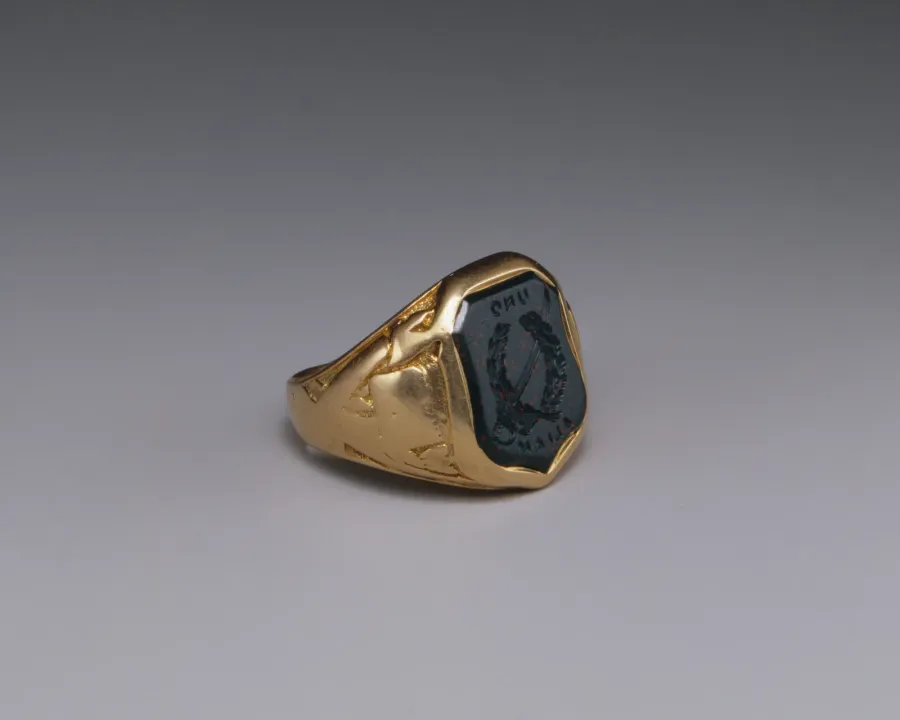
A signet ring differs from other rings in one obvious detail: it has a flat or slightly convex plate, also called a shield or bezel. This surface is specifically designed for engraving or relief imagery. Historically, the plate was pressed onto hot wax or soft clay, leaving an impression. Hence the shape: the image is usually reversed so the impression reads correctly.
Differences from a stone ring:
- A stone in a ring sits elevated, catches light, reads from a distance. The primary value is in the stone.
- A signet ring lies flat, the plate functions as a small canvas. The primary value is in the engraving or relief.
Of course, boundaries blur: there are signet rings with intaglio (sunken image on stone), rings with relief stone on a flat surface. Some craftspeople make signet rings with a small stone in the centre of the plate, preserving space around it for a monogram. But the basic logic remains: this is a ring where the face looks outward like a seal, not inward like a stone in a basket setting.
Another key difference: a signet ring almost always has a shank with a pronounced transition to the plate, called the "shoulders" of the ring. This transition can be straight or angled, with or without decoration. This transition gives the ring its volume and recognisable profile from the side.
A signet wants one bare hand, not a fist stacked with five bands. Pile them on and it reads jumble sale, not pedigree. Strip the rest off, and don't argue.
How to Wear a Signet Ring
Over years of styling work I have put signet rings on all kinds of hands, from strict office looks to evening ones. Here is what actually works, sorted by occasion.
How do I wear a signet every day? For daily wear I recommend a small plate of 10-13 mm on the right hand and little shine beside it. Jeans, a white shirt with an open collar, light knitwear: silver or yellow gold work best. One ring is enough to make a hand look composed.
What suits a signet at the office? For the office I suggest a strict plate shape, a rectangle or a circle, and a clean monogram with no busy texture. Keep the fabric plain, the colour neutral, and other rings to a minimum. If you wear a watch, I recommend moving the signet to the other hand so the wrist is not overloaded.
How do I build an evening look with a signet? In the evening I suggest an open neckline and a dense fabric: silk, velvet, good wool. Against that background the signet reads larger, so I choose a more expressive plate, a shield or a full oval. On light clothing cool metals look cleaner, on a warm palette yellow and rose gold win.
How do I combine a signet with other rings? I suggest keeping one substantial accent on the hand and everything else thin. A signet plus two or three narrow bands on neighbouring fingers in one temperature tone make a clean stack. I do not mix warm and cool metals in one look, or the hand falls apart into details.
Who does a signet suit? A signet suits those who prefer meaning over shine and are not afraid to wear a visible piece for years. With a vintage wardrobe I recommend a signet with retro decor, with a strict jacket an academic shield, with loose linen a natural motif. I choose the shape for the hand, not the other way around.

Turn on your camera, pick earrings, a pendant or a ring, and see the piece on yourself in real time.
Switch items in one tap.
Everything runs in your browser: no photo or video is ever uploaded.
Brief History: From Pharaohs to Modern Women
Ancient Egypt and the First Gem Rings
Signet rings first appeared as recognisable objects in ancient Egypt around 3,500 years ago. Pharaohs and nobles wore scarab rings: the underside of the beetle with carved hieroglyphic signature served as a personal seal.
The mechanics matter more than the mythology. Egyptian administration ran on sealed clay and sealed cord: a jar of grain, a store room, a letter tied and stamped. The scarab swivelled on a wire through its body, so the wearer could turn the flat underside outwards, press it into damp clay, and turn it back. That swivel is the ancestor of every hinged and pivoting signet made since. The British Museum and the Petrie collection in London hold hundreds of them, most no bigger than a fingernail, and the surviving impressions show what the ring was really for: proving that a specific person, not just any literate scribe, had closed that container.
Two features of those rings survive in modern women's signets. The plate is flat and worked on its underside, not built up with a raised stone. And the object is legal as much as decorative: the value sits in the mark it leaves, not in the material it is cut from.
Greece and Rome: The Ring as Document and Status
In Greece, the engraved ring was called a sphragis, a seal. Greeks engraved mythological figures and patron gods. In Rome, the signet (sigillum) became official. The system was rigid: senators wore gold rings, equestrians iron, freedmen bronze. The metal of your ring was your passport.
Roman women of property were not outside this system. A woman who owned land, ran a household of dependants or managed a business needed to seal, and Roman law let her do so. Surviving wax and lead impressions carry female names, and gem cutters produced small intaglios sized for narrower fingers. The engraved stones themselves, carnelian, sard, jasper, banded agate, are the direct ancestors of every carnelian signet sold today.
Roman practice also set the habit of wearing the seal where it could be seen but not caught: on the smallest finger, or turned inward against the palm in a crowd. Both habits outlived the empire and reached Britain more or less intact.
The Middle Ages: The Age of Arms
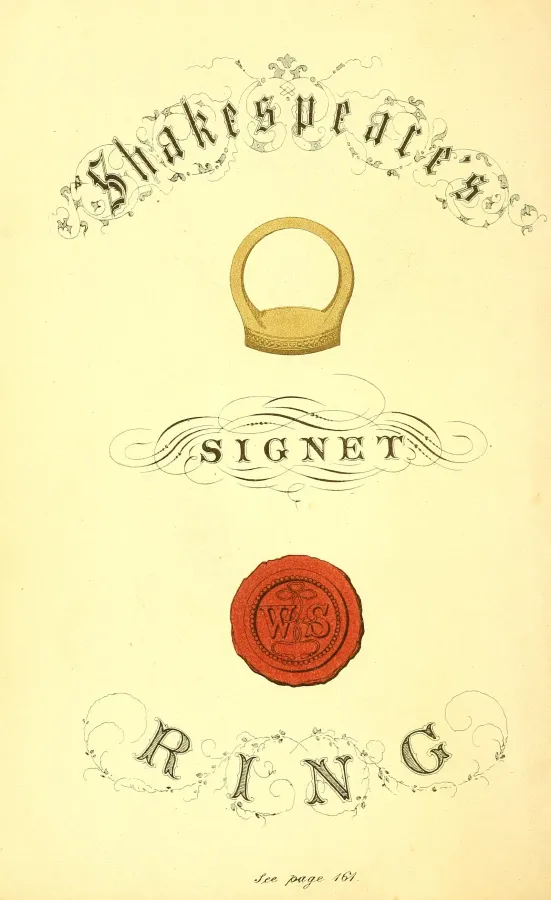
In medieval Europe, the signet became the centre of a system. Family crest, family heraldic shield, family motto. A document without the impression of a personal seal had no legal force. Feudal ladies of high rank had their own seals.
England formalised this more thoroughly than most of Europe. From the late fifteenth century the College of Arms in London held authority over who could bear which arms; in Scotland the Court of the Lord Lyon did the same, and still does, with statutory force. That produced a rule British readers still meet in jewellery shops: an armorial signet is not a decorative motif you pick for its look. A full coat of arms belongs to a named armiger and, under Scottish law, to that one person alone. Wearing a stranger's arms because the shield looked handsome is, in that tradition, closer to signing someone else's name than to choosing a pattern.
The practical rules that grew up around this are worth knowing even if you never touch heraldry. A woman traditionally bore her arms on a lozenge rather than a shield, which is exactly why the older women's armorial rings are diamond-shaped or oval rather than shield-shaped. An unmarried daughter used her father's arms; a married woman's arms were shown impaled with her husband's, side by side on one field. A crest, the figure that sits above the helm, was for centuries treated as the man's element, which is why plain crest signets read as masculine to anyone who knows the code and neutral to everyone else.
The other medieval habit still visible today is the merchant's mark. Traders who had no grant of arms cut a personal cypher, a monogram crossed with a line or a house mark, and sealed with that. It carried the same legal weight in a contract and none of the aristocratic baggage. If you like the idea of an armorial signet but have no arms, the merchant's mark is the historically correct answer rather than a compromise.
The 19th and Early 20th Century: The Ring and Legal Standing
By the 19th century, signet rings were an attribute of a wealthy man. The Victorian gentleman wore it on the pinky finger of his left hand with the family crest. But women were legally restricted in their right to sign. Since the signet ring was historically an instrument of signature, its connection to women seemed legally meaningless.
The restriction was specific, not vague. Under coverture, the legal doctrine that governed married women in England and Wales, a wife's property passed to her husband and her signature bound nobody. The Married Women's Property Acts of 1870 and 1882 dismantled that: a married woman could hold property, contract and sue in her own name. Within a generation the assumption that a woman's mark meant nothing had lost its legal footing, and the assumption that her ring was purely ornamental lost it too.
Victorian and Edwardian workshops in Birmingham's Jewellery Quarter and around Hatton Garden in London turned out signets in enormous numbers, and the trade quietly produced narrower plates and lighter shanks for women long before anyone advertised them as such. Mourning signets with a date and initials, school and college rings, rings marking a coming of age: the category was already there, just not named.
Suffrage and the Change in Rights
When women gained voting rights and signing rights at the turn of the 19th-20th centuries, the legal argument against women's signet rings collapsed. In the 1920-30s among artists and bohemian circles, women openly wore signet rings as decoration and personal statement.
The suffrage movement had its own jewellery language, and it worked the same way a signet does: a small coded object worn in public. Colours carried the message, and members wore pieces in those colours to be read by anyone who knew the code and to pass unnoticed by anyone who did not. That is precisely the logic of an engraved plate: legible to the people who matter, opaque to everyone else.
By the interwar years the women's signet had picked up a second life in the art schools and studios. Plates were cut down, engraving turned personal rather than dynastic, and initials replaced crests. The ring stopped proving descent and started stating identity.
The Women's Revival: 2010s to Today
Today, the women's signet ring is not a niche object or a copy of a men's model. It is a standalone jewellery category with its own proportions, styles, and wearing traditions.
The current revival has a recognisable shape. Plates shrank to suit slimmer fingers, typically 10 to 16 mm across rather than the 16 to 20 mm of a traditional gentleman's crest ring. Engraving moved from heraldry to private code: a single initial, a date, a coordinate, a drawn symbol. Stacking changed the ring's job as well, since a signet now often works as the anchor in a group of thin bands rather than standing alone on an empty hand.
What has not changed is the underlying appeal. Two and a half thousand years after the Roman gem cutters, the object still does the same thing: it puts a private mark on a public surface, and it lets the wearer decide who gets to read it.
Why Women Wear Signet Rings Today
The reason isn't in trends. Trends come and go. The signet ring returns cyclically because it answers a desire that doesn't go out of style: the wish to wear something personal. Something with concrete meaning, not a price tag.
Several concrete reasons women cite:
Personal symbolism. The engraving makes the piece irreplaceable. No one else has a ring with exactly this letter in exactly this font. This matters in a world where most jewellery is mass-produced in thousands of identical copies.
Rejection of the purely decorative. A stone ring says "look at the stone." A signet ring says "look at the meaning." Different statements, different audiences. Many women prefer the latter.
Inheritance. Many wear their grandmother's or mother's rings. Even a signet ring purchased today can become the object passed down. It has this capacity built in.
Anchor element in stacking. Among several thin bands, one substantial object holds the entire composition. The signet ring often plays this role.
Professional and communal meaning. Class rings, professional symbols, mottoes. This hasn't gone out of style. In many professional communities, people wear a ring with the symbol of their specialty as a marker of belonging.
Gender neutrality. A form without pretense to "femininity" or "masculinity" appeals to those tired of jewellery designed around stereotypes.
Customer reviews
Zevira is a real jewellery shop. Genuine payments, deliveries and customer thank-yous.
🥰🥰🥰 gracias
Ok, ¡gracias! 🙂
Shapes of the Plate
The shape of the plate determines the character of the ring. Five basic variants and their characteristics.
Oval
The most common shape for a women's signet ring. A horizontal oval elongates the finger visually and looks soft and organic. A vertical oval makes the plate narrower and more elongated, slightly stricter and more aristocratic. Works well for a monogram of a single letter or small drawing with rounded lines. The oval has no sharp angles, making it the most universal choice.
Rectangle with Rounded Corners (Cushion)
Classic British jewellery tradition. Provides maximum space for engraving: three letters of a monogram fit easily, a coat of arms with details, text in multiple lines. Reads stricter than oval, suits minimalist style, business contexts, those who want clear geometry.
Circle
A simple form that never goes out of style. Softer than rectangle, stricter than oval. Works well with a single-letter monogram, flower, geometric symbol, astrological sign. On a thin shank, it looks like a medallion. Modern, unobtrusive, works in any context.
Shield (Heraldic)
A pointed pentagon. A direct reference to heraldic tradition. For those who want to emphasise the historical connection or family symbolism. Looks serious, with character, slightly archaic in the best sense. Works well with family symbols, initials, heraldic elements.
Horseshoe (D-shape)
The letter D on its side: arc on one side, straight on the other. A modern variant that looks good in minimalist collections. Slightly less traditional, suits abstract symbols and nature motifs.
Which Finger and What It Means
There is no requirement. There are traditions and their interpretations. A detailed analysis of what each finger means can be found in our guide to ring meanings.
The British convention is the most specific one in circulation, and it is worth setting out properly because so much online advice garbles it. The rule is not "the left little finger". The rule is the little finger of the non-dominant hand: a right-handed wearer uses the left, a left-handed wearer uses the right. The reasoning is practical rather than mystical. A seal ring sits on the hand that is not holding the pen, so it neither drags across wet ink nor gets in the way while writing, and it is instantly available to press into the wax once the signature is dry.
Two further points of British etiquette come up often. An armorial signet is traditionally worn plate outwards once it is properly yours, and turned inwards against the palm while the previous holder is still living or while the arms have not yet passed to you. And a signet is conventionally worn on the same hand as, but not on the same finger as, a wedding ring, which in England and Wales sits on the left ring finger and in several other European countries on the right. None of this is enforceable and nobody will stop you at a door. It simply means that if you follow it, people who know the code will read your ring as deliberate rather than accidental.
Pinky Finger
Historically the canonical finger for the signet ring. Especially the left pinky for right-handed people, the traditional place for the British family signet ring. In symbolism, the pinky finger is associated with communication, eloquence, and human connection.
Practically: the pinky doesn't interfere with handshakes and handiwork. The pinky is usually small, which limits the plate size, but is enough for a monogram of a single letter or small symbol.
One warning specific to this finger. The little finger tapers more sharply than any other, so a ring that clears the knuckle often spins at the base, and a spinning signet shows its plate sideways half the day. A slightly heavier shank, a sizing bar fitted inside, or a plate that is oval rather than round all reduce the wobble. Buy for the knuckle, then correct for the base; the reverse never works.
Ring Finger
The second most popular choice. Many women's ring fingers are occupied by wedding or other paired rings, so the signet ring often goes on the right ring finger. There it combines well with a thin band or an eternity ring. The ring finger is symbolically connected to love and creativity.
Middle Finger
The middle finger gives more space for a larger plate. Symbolically, the middle finger is connected to Saturn: responsibility, inner law, structure. A ring here reads as an affirmation, as a statement about yourself. A good choice for those who want a noticeable signet ring that holds a stack together.
Index Finger
The index finger was historically the finger of power and leadership. The Pope's ring, a duke's ring, a sign of authority. Today the index finger is for those who want the ring to be most visible when gesturing, speaking, making eye contact.
Thumb
The thumb wears a ring of someone unafraid of being noticed. Symbolically: will, independence, strength. Practically: the thumb is wider and rounder than other fingers, which requires special adjustment.
Upload a photo of your pet, someone you love, or an object. We'll build a 3D model and hand-cast it in pewter.



Size and Proportions for the Female Hand
The male tradition dictated large plates: 20-25 mm wide. On a male hand with a finger width of 18-20 mm, this is proportional. On a female hand with a finger width of 13-16 mm, such size looks disproportionate unless the larger format is artistically intended.
Working proportions for the female hand:
- Pinky: Plate 8-12 mm wide. Small, delicate ring.
- Ring finger/Middle finger: Plate 10-16 mm. Primary working range.
- Index finger: Plate 12-18 mm. Slightly larger allowed.
- Thumb: Plate 14-20 mm. The thumb can handle volume.
Shank width for the female hand: 2-4 mm. A thin shank under a voluminous plate looks modern. A thick shank 5-6 mm gives the ring more mass and archaic character.
What to Engrave
This is the main question. The engraving transforms the piece from an ornament into a personal object.
Monogram
One or three letters from the name. The classic three-letter monogram: first letter of first name, first letter of middle name or second name, first letter of surname. The surname letter is traditionally placed in the centre and made larger. This is the key visual accent, everything is built around it.
Alternative: one large letter of your name, nothing else. Looks clean and reads from a distance. For a thin shank and small plate, this is the best choice.
Font matters: script italic gives romance and personality, geometric block gives strictness and modernity, serifs give classic feel.
Personal Symbol or Sign
Fish, moon phase, flower, leaf, astrological sign, rune, geometric figure, animal silhouette. Main rule: the symbol must read clearly in metal engraving. Complex details are lost at small size. A good test: if the symbol is understandable at 10 mm, it will work on a signet ring.
Astrological symbols and zodiac signs became popular in recent years. The simplicity of their design works well on a small plate.
Date
A day that means something. Birth date, wedding date, date of loss, turning point. Usually in number format: 14.03 or just 1984. A date in multiple lines requires a horizontal plate of sufficient size.
Coordinates of a Place
Latitude and longitude of a meaningful place. House where I grew up. City that changed my life. Coordinates require a horizontal rectangular plate at least 14 mm wide.
Phrase or Motto
One or two words or a short phrase. A personal rule, Latin motto, line from a poem, someone's name. Around the edge of the plate or in multiple lines toward the centre. Latin phrases look good in serif typeface.
Handwritten Signature
Engraving of your own handwriting. A scan of your signature or written note is transferred to the engraving file. Technically possible with laser engraving. The result is absolutely unique and very personal.
Family Crest or Custom Symbol
If there is a real family crest, that's direct and obvious. If not, some commission the development of a family symbol from scratch: a meaningful animal, plant, letter combination in a special font, family motto. This is a more complex and expensive path, but the result becomes a true family object.
Fingerprint
Your own or that of a close person. The fingerprint is converted to a file for laser engraving. A popular choice for memorial jewellery or jewellery commemorating a child's birth. Every line is unique.
What Is Better Not to Engrave
A short list of things that look right on a screen and go wrong on a finger.
A partner's full name. Initials age well, a date ages well, a full name does not. Nobody wants to be the person quietly wearing a name that stopped being current three years ago. A shared symbol, a shared coordinate or the year you met carries the same weight and survives a change of circumstance.
Anything with more than about five characters at small size. A plate 12 mm wide will not hold a sentence legibly. Engraving that has to be squinted at reads as clutter, not as meaning. If the phrase matters, put it inside the shank where it touches your skin and keep the plate to one mark.
Company logos and trademarks. Aside from the obvious question of permission, a corporate mark dates the ring to a specific job. Professional symbols that belong to a discipline rather than an employer, a caduceus, a set of scales, a specific tool, do the same job without tying you to one payroll.
Somebody else's coat of arms. Covered above and worth repeating, because it is the single most common error on armorial signets. In Scotland it is a matter of law rather than manners. If your family has no grant, a monogram or a personal cypher is the correct historical answer.
Fashionable typography. A typeface that reads as current will read as dated, and the ring outlives the trend by decades. Serif capitals, an interlocking cypher or plain block letters have already survived a century of taste changes.
Text in a script you cannot read. Engraving in an alphabet you do not know means trusting a supplier, a font file and a rendering engine to have got the characters, the direction and the joining forms right. Verify with a native reader before the tool touches the metal, because engraving is subtractive and there is no undo.


Deep Engraving Versus Shallow
Historically, engraving on a signet ring was deep and reversed: the ring was literally pressed into wax and the impression had to be clear and legible. Today, most signet rings are used as jewellery rather than as functioning seals for documents. This changes the logic of the choice.
Intaglio. The image is cut into metal or stone at depth, leaves a clear impression in wax. If you want a real functioning seal for wax seals, wax impressions, to decorate packages and letters, you need deep intaglio. More expensive, requires hand craftsmanship or precision milling equipment. The engraving lasts for decades without loss of clarity.
Relief Engraving (Cameo). The background is removed, the image stands above the surface. Doesn't give a normal wax impression, but looks beautiful on the ring. The tradition of cameos where a relief portrait stands out from a background of different colour. Looks luxurious, requires more metal.
Surface Laser Engraving. Lines are applied by laser, not deep. Looks clean and modern, reads excellently on polished or matte plate. For wax seals works worse (impression less clear), for jewellery works well. Lower price, faster execution.
Matte Background and Polished Image. A combination of textures without depth. The plate is matted, the engraved symbol or letter stays polished. Gives good contrast, doesn't require great depth. Modern, delicate option.
The mirror question. This is the detail most people discover too late. A seal that will actually be pressed into wax has to be cut in reverse, because the impression is a mirror of the plate. Cut a letter R the right way round and every wax seal you make will show a backwards R. Cut it in reverse and the wax reads correctly while the ring on your finger reads backwards to anyone looking at it.
You therefore have to decide what the ring is for before the engraver starts, and there is no arrangement that satisfies both readings at once.
If the ring is jewellery you want a legible plate, cut positive, and you accept that it makes a reversed impression. If the ring is a working seal for letters and parcels, cut it reversed and accept a plate that reads as a puzzle on the hand. The traditional armorial signet is always cut reversed, which is why an old family ring often looks oddly mirrored: it was made to work, not to be read on the finger.
There is a sensible middle route. Symmetrical marks solve the problem outright, since a shield outline, a simple monogram built from symmetrical letters, a star, a compass rose or many geometric devices read identically both ways. Some wearers take a second approach and keep the plate positive for daily wear, then use a separate desk seal for wax. Others accept the mirror because it adds a layer of privacy: the mark on the finger is unreadable to strangers and resolves only when it is pressed.
If you actually want to seal. Wax sticks come in two families. Traditional sealing wax is brittle and posts badly, since it cracks off in a sorting machine; flexible wax with added resin survives the Royal Mail and most European postal handling. Warm the plate slightly, dust it with a trace of talc or breathe on it so the metal releases cleanly, and press straight down without twisting. Depth of around 0.4 to 0.6 mm on the intaglio gives a crisp impression; anything shallower turns to mush in the wax.
Materials: What to Choose for Your Aesthetic and Lifestyle
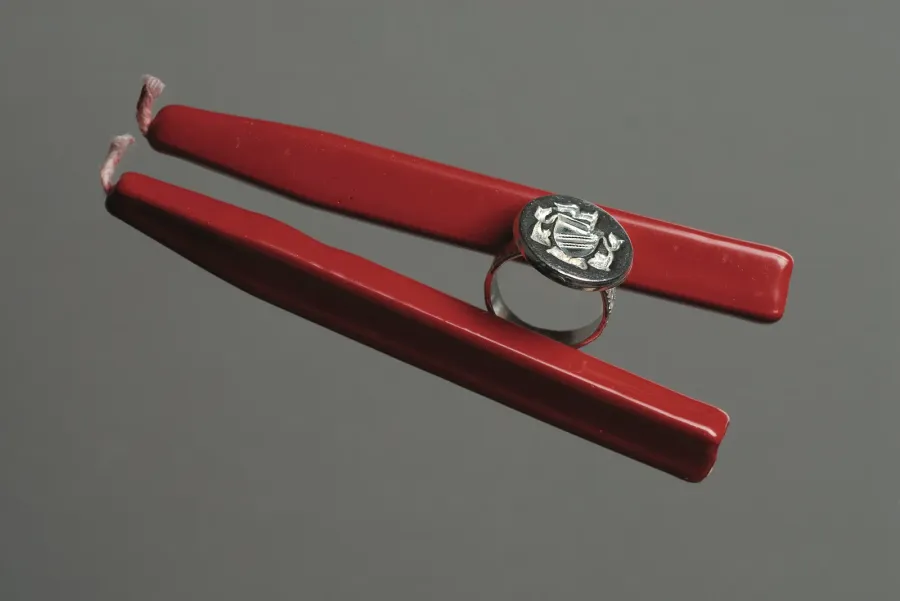
Silver 925
The most accessible metal for a signet ring. Works well for engraving, gives an expressive matte-white tone, contrasts beautifully with dark backgrounds. Drawback: silver darkens over time, especially in the engraving, patina collects in the grooves.
This isn't necessarily a drawback. Darkened engraving reads sharper, the contrast between background and lines intensifies. Many specifically love patinated silver for exactly this character. To remove darkening, polish with a soft cloth or silver polishing paste.
A silver signet ring is good for those who wear rings daily and intensively, for young women on their first serious ring, for those who experiment with shape and engraving before ordering a gold version.
Yellow Gold 585 and 750
Classic. Warm tone looks good with every plate shape. 585 (14 karat) is harder, scratches less, more practical for daily wear. 750 (18 karat) is softer, colour is richer, looks more luxurious.
Yellow gold holds engraving for decades, needs no additional coatings. Warm tone works well with brown and olive skin.
Rose Gold
Came into fashion in the 2010s and held on. A romantic copper hue that works well with oval plate and rounded forms. The copper in rose gold makes it slightly harder than yellow gold, scratches less. Looks good on skin with warm and neutral undertones.
White Gold
A rhodium coating gives a bright silver gloss, close to platinum. Looks cold and modern, works well with fair skin. Requires periodic renewal of the rhodium coating, usually every one to two years with intense wearing.
Platinum
The densest and most durable metal for a ring. Over time it acquires a characteristic patina from fine scratches that gradually blend into a matte surface. This isn't a defect, it's a property of platinum and its particular beauty. Needs no coatings, doesn't yellow, doesn't fundamentally tarnish. High price. For those who buy once and want an object that survives several generations.
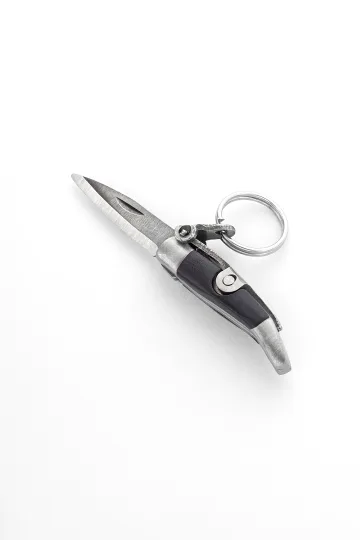
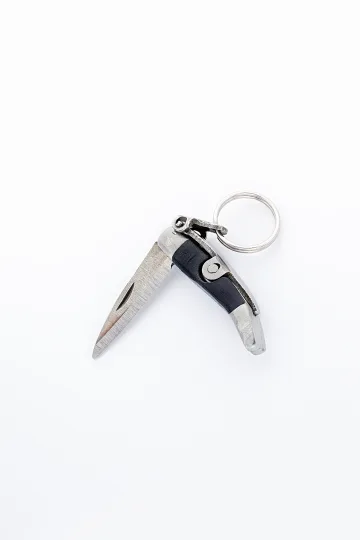
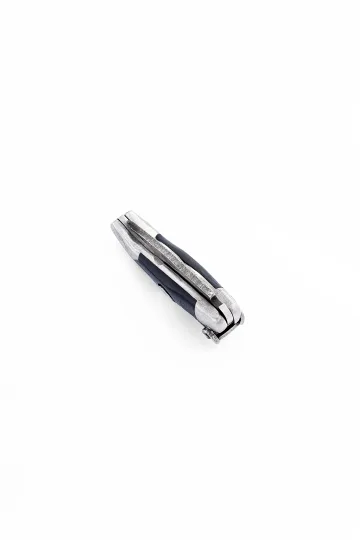
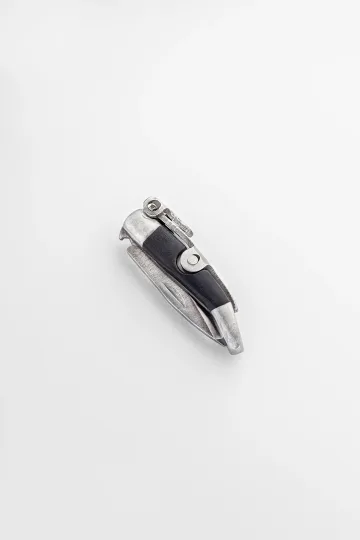
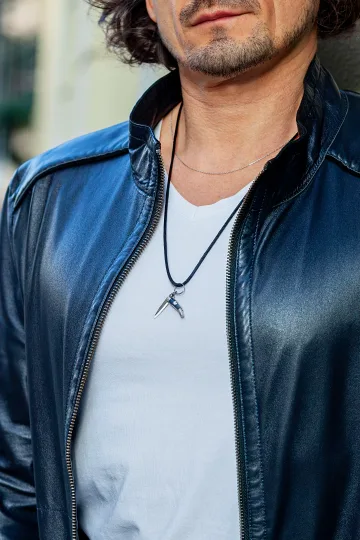
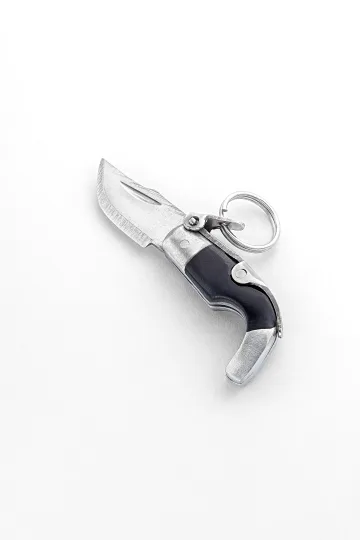
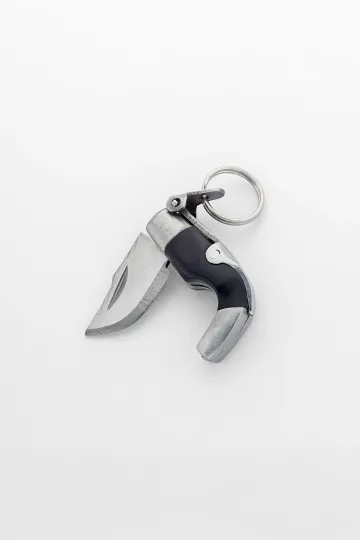
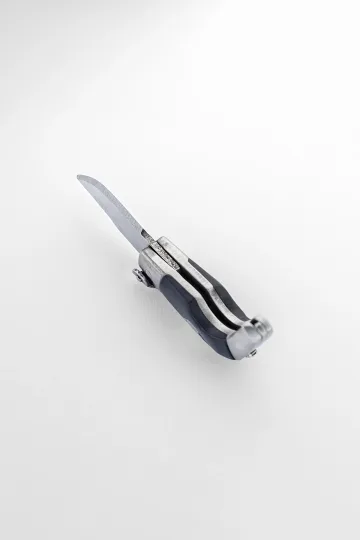
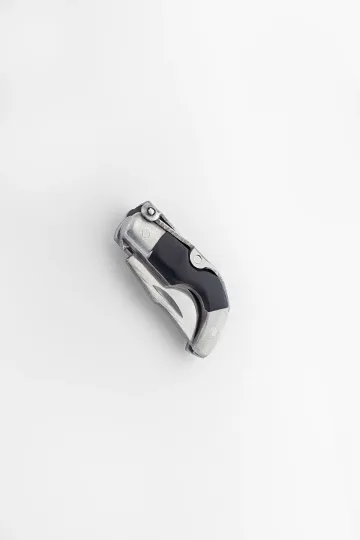
CAPAORA mini knife pendant
The 18th-century Spanish navaja in miniature: 40 mm of stainless steel, a real folding mechanism and a Palanquilla lock that clicks. An affordable gift to remember.
Authentic · Ships from Spain · 14-day returns
Styles
Minimalism
Thin shank 2-3 mm, small plate 10-14 mm, one clean letter or geometric symbol. Nothing superfluous. Works with any clothing, from business suit to plain white dress. Most modern women's signet rings are made in this direction. Works well with thin bands in stacking.
Vintage and Art Deco
Plate with decoration around the edges, image with geometric symmetry, darkened details. A nod to the 1920s-30s. The ring gets a very pronounced character. Works well with retro wardrobe or in combination with substantial earrings.
Gothic
Relief skulls, crosses, lunar motifs, vines with sharp serifs. Dark metals, oxidised silver, blackening. For those who build conscious aesthetics and want jewellery with character that leaves no room for misunderstanding.
Academic Style
Shield, heraldic element, Latin motto. A class ring or faculty ring. Archaic seriousness that can simultaneously be irony and sincere tradition.
Natural Style
Plate with organic form, engraving with botanical motifs, asymmetric lines. Modern and artistic for those who want to move away from heraldry toward living nature. Works well with matte surfaces and unconventional plate shapes.
Modern Scandinavian
Pure geometry without historical references. Simple lines, runic script, nature symbols in minimalist execution. Matted metal, plate form can be unconventional.
Leave your email, we'll send your discount code. No spam, unsubscribe anytime.
The code arrives by email, valid on your first order.
The Signet Ring as an Heirloom
Among jewellery pieces, the signet ring occupies a special place: it's one of the few things people genuinely want to inherit and pass down. Unlike a stone ring, which might not suit someone's style or finger size, the signet ring carries its history directly in the engraving. It speaks about itself.
Three inheritance models:
Literal passing down. Grandmother's signet ring goes to granddaughter. Perhaps the engraving is no longer legible, gold is worn, the shank slightly deformed. Many preserve it as is, with patina and wear. History in the material.
Updating the engraving. The base of the old ring is kept, the plate is re-engraved for a new owner. New monogram, new symbol. The ring's history as an object continues in the next layer.
Commissioning a ring for passing down. Some women buy a signet ring with the intention to pass it to daughter or granddaughter. They choose a family initial or family symbol. The ring becomes an object before it has its own history. This is a declaration of intent.
Several practical tips for a "transfer ring": choose neutral size or plan for resizing possibility. Gold and platinum can be enlarged or reduced better than silver. Make family-symbol engraving deep enough to remain legible for decades. Keep the engraving design file separately: if the original wears away, it can be restored from the file.
The Signet Ring as Personal Statement
A ring you wear every day says something about you. A signet ring with a specific symbol works more powerfully than pure ornament.
Professional symbol. A doctor with the symbol of medicine. An architect with a geometric sign. An engineer with a drafting element. A ring as a marker of profession and belonging to a professional community.
Personal philosophy. A motto phrase. A Latin reminder. A personal rule. You wear it on your finger, visible every day.
Family identity. A family initial. A family crest. The connection to where you came from.
Academic and Communal. A university or faculty class ring. This tradition is strong in the Anglophone world but is gradually appearing in other cultures. In Russia, medical universities have long issued corporate rings.
Simply because you like it. This is also a position. Not every engraving carries a hidden meaning. Sometimes it's just very beautiful, and that's enough.
Public and private meanings. Some signet rings have two levels: the external, which others see (monogram, symbol), and the internal, which only you know (what exactly this letter or date means to you). This is a special kind of jewellery that carries a secret on its surface.
Stones in Signet Rings: When the Plate Isn't Metal
A classic signet ring has a metal plate. But there's another variant: a stone in place of the plate. This tradition goes back to antiquity, when gems (carved stones) were set in rings specifically for use as seals.
Carnelian
One of the most traditional stones for signet rings. Warm orange-red colour, opaque. Works well for carving, holds a clear intaglio image. Roman legionaries wore carnelian rings with images of eagles or Jupiter. Today, carnelian in an oval setting with a carved symbol is one of the most authentic historical variants.
Agate
Agate can be multilayered: dark layer on top, light beneath. This exact structure was used for cameos and intaglio: the dark layer was removed, exposing the light background, or vice versa. Onyx (black agate) is especially popular in signet rings: gold setting with a black plate and white relief reads clearly from a distance.
Lapis Lazuli and Malachite
Bright blue lapis and saturated green malachite don't cut as clearly as agate, but provide expressive colour accent. Good for decorative signet rings where the main goal is colour and beauty, not a functional impression. Work well with yellow gold.
Quartz and Rock Crystal
Transparent or smoky quartz in a flat cabochon cut. Looks modern and neutral. Sometimes under transparent quartz is placed an engraving on a metal background, creating a depth effect.
Pearl Cabochon
Flat pearl or mother-of-pearl cabochon as the plate. A delicate, tender variant. Works well with rose gold. Not intended for wax impression, only decorative function.
Important: if you choose a ring with stone for use as a seal, make sure the craftsperson engraves the intaglio directly in the stone. A decorative cabochon without engraving won't leave an impression in wax.
Styling: How to Wear With Other Jewellery
Signet Ring in a Stack
A ring with a substantial plate works as an anchor element. Thin bands are built around it.
The signet ring occupies one finger, thin bands neighbour fingers. Or signet ring plus one thin band on the same finger, then the thin band goes on the same side of the shank (not between plate and finger, but below). You can mix metals if the overall warmth is maintained: all warm (yellow and rose gold) or all cool (white gold, silver, platinum). Too many substantial elements on one hand overloads the look.
Which Hand
No single rule. There's logic: a ring with personal meaning (monogram, memorial date) usually goes on the right hand. A paired or wedding ring occupies the left ring finger in most cultures. The signet ring on the right hand leaves space for paired symbolism on the left.
With Bracelets
A wrist bracelet on the same hand creates an ensemble. Minimalism: thin bracelet and small signet ring. Volume: several thin bracelets and a larger plate. Avoid too many different metals and textures simultaneously, the look falls apart.
With Earrings and Necklace
The signet ring itself is a substantial element. For balance: small stud earrings or thin ear rings. For contrast: substantial earrings plus delicate signet ring. A necklace with a signet ring should be thin, a simple chain without a pendant or small minimalist pendant.
Suits Which Hand Type
Short fingers. Vertical oval or tall shield. An elongated shape creates visual length. Avoid horizontally wide plates.
Long thin fingers. Any shape works. Horizontal wide rectangles or horseshoes look good.
Wide, pronounced fingers. You can allow yourself a larger plate. A small plate on a wide finger looks disproportionate. Shank should be 3-4 mm.
Small hands. Delicate size: plate 10-13 mm. Thin shank 2 mm. Too large a ring "swallows" the hand and looks like carnival equipment.
Active, athletic hands. Smooth shank profile without sharp protrusions. Secure fit. Cushion or circle shape, no sharp angles. Metal 585 or higher, more durable.
Signet Ring as Gift
Alternative to Engagement Ring
Not everyone wants a traditional solitaire. A signet ring with a monogram of two names, coordinates of where you met, or a symbol meaningful to the couple can be a more personal and non-traditional choice. Such a ring says more about a person than just following tradition.
Coming of Age and Graduation
In British tradition, a signet ring is gifted at 18 or 21. This makes sense: a legally independent person receives a personal seal. A good gift for a young woman entering adult life. An engraving with date or initials makes it personal.
Anniversary
10, 20, 25 years of marriage or relationship. Engraving with date, symbol, or both of your initials. A signet ring as an anniversary gift is good because a concrete date carries a concrete story.
Birth of a Child
A ring with birth date, hospital coordinates, or the child's initials. A gift for mother or grandmother.
For Yourself
Buying jewellery as a personal marker of achievement: promotion, dissertation, completed project, move to a new city. A signet ring with a symbol that reminds you what you've done and what you can do. This isn't narcissism, it's private ritual.
Send a friend a discount code, they save on their first order.
Care for an Engraved Ring
Relief or sunken engraving requires a different approach than a smooth ring.
Regular cleaning. A soft toothbrush and a little liquid soap in warm water. Carefully along the engraving relief, gently work dirt out of the grooves. Rinse with warm water, pat dry with soft cloth. Don't rub hard.
What not to do. Abrasive pastes, hard metal brushes, chlorine-containing products. Ultrasonic cleaning is undesirable if the ring has blackening or an inlaid stone in the plate: the stone can loosen, blackening can wash away.
Patina of silver engraving. Darkening within the engraving is not a defect. It's patina that intensifies the legibility of the image, adds depth. If you want to remove surface darkening, silver polish on a cotton swab, carefully over the flat surface. Don't touch the engraving, leave it dark.
Storage. Separately from other jewellery so the plate doesn't scratch against other metals. A soft pouch or separate compartment of your jewellery box.
Regular professional check. Once a year check the shank for cracks, the condition of the engraving, the fit on your finger. Shank widths can deform over time with intense wearing.
Care for rings with stones in the plate. If a stone is set in the plate (carnelian, agate, lapis), cleaning is gentler: very careful brush, no pressure on the stone setting. Organic stones (coral, pearl) don't tolerate acids or ultrasound. Hard stones (agate, quartz, carnelian) are more stable, but sharp temperature changes don't suit them either.
What to do with a worn shank. If the ring wears daily for years, a thin signet ring's shank can become thinner. A jeweller can add metal or reinforce the shank before it breaks. Better to do this preventatively than when the ring already has a crack.
FAQ
Which finger is traditional for a woman's signet ring?
Historically the little finger of the non-dominant hand: the left for a right-handed wearer, the right for a left-handed one. That is the British convention and it comes from writing, not from symbolism. Today most women wear a signet on the middle or ring finger of the right hand instead. There is no rule to break, only a tradition you can choose to follow.
Can the plate be worn turned into the palm?
Yes, and there is a specific tradition behind it. An armorial signet is worn turned inwards until the arms have formally passed to the wearer, then turned outwards. Today that is more an aesthetic gesture than a protocol. Some people wear a signet inwards deliberately, so the mark faces them rather than the room, which suits an engraving that is private rather than declarative.
What plate size works best on a woman's hand?
Roughly 10 to 16 mm across the wide axis for most fingers. Little finger: 8 to 12 mm. Index finger: up to 18 mm. The reliable check is the ratio rather than the number, since the plate should not be wider than the finger it sits on.
Is a silver signet less durable than a gold one?
Silver is softer and tarnishes faster, but it holds engraving well for decades. Nine carat and 18 carat gold are harder and scratch less. For heavy daily wear gold is the practical choice; for a piece worn on occasions, silver lasts perfectly well. Note that British hallmarking on silver is 925 and on gold is stamped by carat, so a UK ring carries an Assay Office mark from London, Birmingham, Sheffield or Edinburgh that tells you both the fineness and the year.
Can I design the engraving myself?
Yes. Most engravers work from image files. Draw it by hand, scan it, and talk it through with the workshop. Laser engraving wants a clean black and white file with clear lines. The simpler the drawing, the better it reads at plate size, and almost every design that fails does so because it had too much detail rather than too little.
How do I wear a signet if I already wear a wedding ring?
In Britain the wedding ring sits on the left ring finger, so the signet usually goes to the right hand: middle, ring or little finger. In countries where the wedding band is worn on the right, the arrangement mirrors. The two do not compete, because they sit in different positions and carry different messages.
What if the engraving wears away?
Deep intaglio holds for decades. Laser and shallow surface engraving fade faster under hard wear. Any engraving can be recut by a jeweller if the original artwork is known or kept as a file. Often a softened, patinated engraving looks better than a crisp one, and the honest answer is to leave it alone.
Do I have to engrave anything at all?
No. A blank plate is a complete signet ring. You can add engraving later, once you are certain of the symbol, or never. The plate as a form stands on its own, and plenty of the best signets stay blank for years while their owner decides.
What is the difference between a signet ring and a plain statement ring?
A statement ring is any ring with a pronounced upper section. A signet is the specific type with a flat plate intended to carry engraving and, historically, to leave an impression. All signets are statement rings by build; most statement rings are not signets.
Does a signet ring have to carry a coat of arms?
No, and for most people it should not. Arms belong to a named person by grant, and in Scotland that is a matter of law rather than custom. A monogram, a merchant's mark style cypher, a date, a coordinate or a drawn symbol carries the same personal weight with none of the complication.
Will a signet ring turn my finger green?
Not if the metal is right. Sterling silver and carat gold do not cause it. Discolouration comes from copper alloys and from plated bases where the plating has worn through, and it is worse in hard water areas, which covers much of southern and eastern England. A rhodium finish on white gold will need renewing every few years for the same reason.
Is a signet ring appropriate for someone with small hands?
Yes, provided the proportion is right. Small hands suit an oval rather than a broad cushion, a plate at the lower end of the range, and a shank that tapers into the plate rather than meeting it squarely. The ring then reads as fitted rather than borrowed.
How to Choose Your First Signet Ring: A Practical Route
If this is your first signet and you have no idea where to begin, here is the short version.
Step one: pick the finger. Choose where you want to wear it before anything else, because the finger sets the maximum plate size and the shank width that will look right. A signet designed for the middle finger looks heavy on the little finger and a little finger signet looks lost on the index.
Step two: pick the plate shape. A classic oval is the safest starting point and suits nearly every hand. A shield or a cushion reads with more character and more historical weight. A round plate is the most neutral of all and the friendliest to a symbol rather than a letter.
Step three: pick the metal. Silver if this is your first signet and you want to learn how the ring lives on your hand over a year. Gold if this is a long-term object you expect to keep and pass on. White or rose gold if the colour genuinely matters against your other jewellery, and not just because it looked good in a photograph.
Step four: decide about engraving, slowly. There is no hurry here. Order the ring with a blank plate and add the engraving later, once you are sure. Nothing is worse than rushing a monogram and regretting it, because engraving removes metal and cannot be undone, only recut deeper or polished out at the cost of plate thickness.
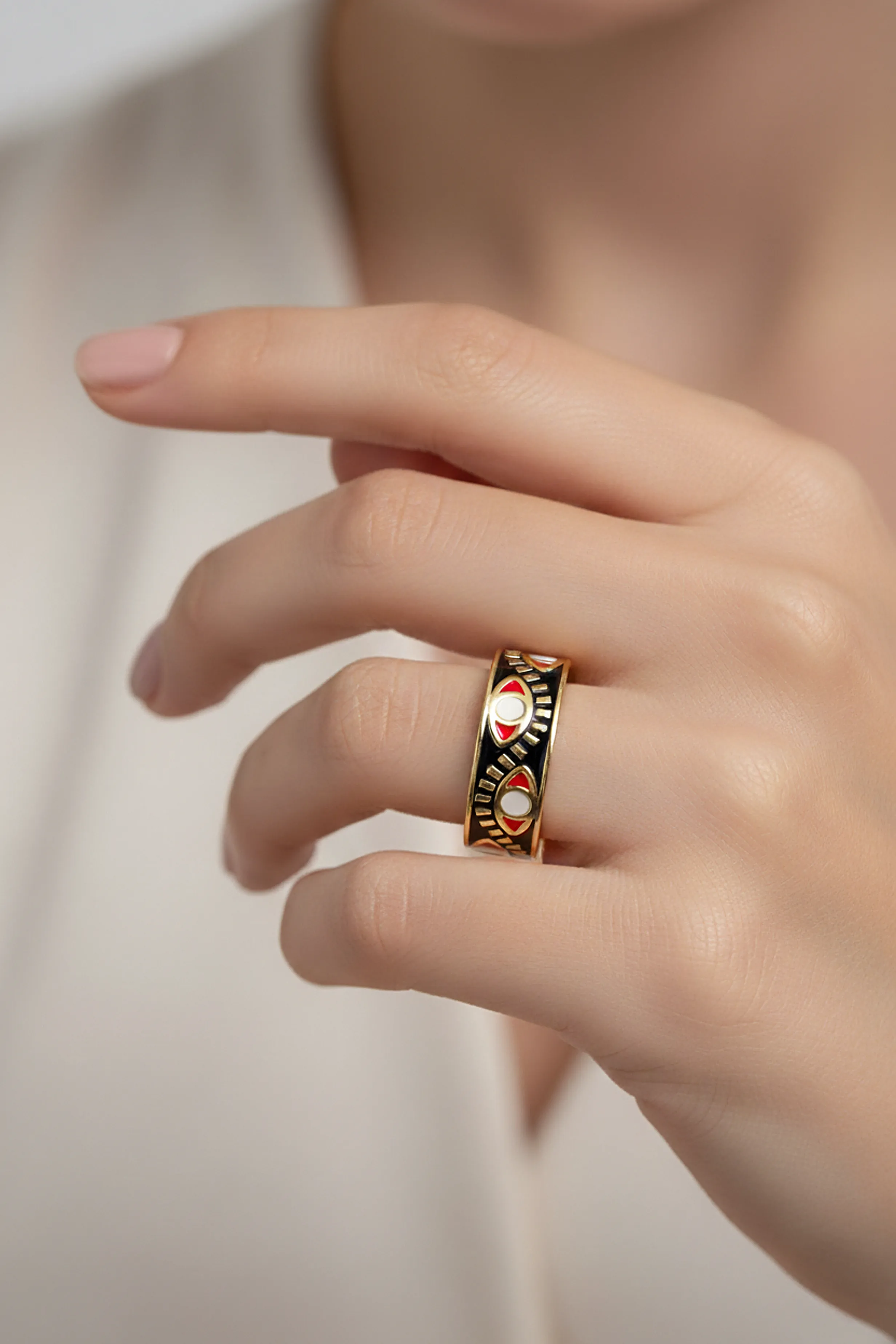
Step five: test the proportion in real life. If you can, put something of similar size on the intended finger and look in a mirror. Better still, have someone photograph your hand in daylight. A photograph of a hand wearing a ring tells you far more than a photograph of the ring itself, because it shows the plate against your finger width and against whatever else you already wear.
Step six: check the sizing twice. Fingers swell in heat and shrink in cold, and in a British winter the difference can be most of a size. Measure at the end of the day, at room temperature, and size to the knuckle rather than the base. If the ring is going on the little finger, expect to need a sizing bar to stop it spinning.
Buying it as a gift? Each one arrives ready to give.
 A branded Zevira box and a little card come with every order.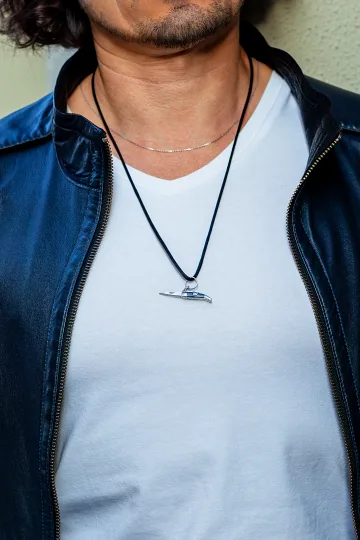





Conclusion
A signet ring holds history longer than most other pieces of jewellery. Engraving transforms metal into a personal document. The shape of the plate determines character. Metal is chosen for aesthetic and lifestyle. The finger determines readable meaning.
Wearing a signet ring means writing your name, symbol, or date into a long tradition that passed through Egyptian pharaohs, Roman senators, medieval abbesses, suffragettes, university graduates, and simply people who had something to say about themselves without words.
You choose the form. You choose the metal. You choose the engraving. You choose the finger. You invest the meaning. The ring does the rest.
Silver, gold, engagement rings, symbolic jewellery, paired sets.
About Zevira
Zevira makes jewellery in the artisan tradition of Albacete, Spain. A signet ring feels close to what we care about: a piece with meaning, worn for years and passed down, not another identical copy off a shelf.
Here is what you can find with us on the signet theme:
- Signet rings with plates in different shapes: oval, circle, shield, rectangle for a monogram
- Personal engraving: a single letter, a monogram, a date, coordinates, your own symbol
- Silver 925 for a first signet ring and 14-18K gold for a long-term piece
- Delicate proportions for the female hand: a thin shank, a smaller plate sized for a woman's finger
- Pieces made to be inherited: neutral sizing, deep engraving, the option to remake later
- Rings to give: coming of age, an anniversary, the birth of a child, or a gift to yourself
Every piece can be personalised with engraving by a craftsperson, with the option of personal engraving. Silver 925 and 14-18K gold.