Bolo Tie: The Cord and Slide That Pretends to Be a Necktie
A necktie that is really a piece of jewellery
The bolo tie is the official neckwear of Arizona, and you will see it on ranchers, on rockabilly musicians, and on brides. The trick is that it was never a tie at all. It is a piece of jewellery wearing a tie's silhouette: a slim cord and a decorative slide that gathers the collar while doubling as a pendant lifted up to the throat.
The word "bolo" (sometimes spelled bola) took hold in the middle of the last century across the American Southwest. The thing has no knot, no silk blade, nothing from a classic necktie except the look of a vertical line down the chest. There is a leather or braided cord, a sliding clasp that rides up and down to set the collar at the height you want, and two metal tips on the ends. The slide holds all the attention: silver, turquoise, onyx, a cameo, an initial, an animal figure. That is why a bolo reads so easily as men's jewellery in places where an ordinary pendant would look out of place.
Below, we go through it properly: what each part is made of, where the bolo came from, how men and women wear it, which cord and which slide suit which look, how the women's bolo borders on the lariat necklace, and how to care for leather and silver so the piece lasts for decades.
Wear the symbol, don't just read about it. These are in stock:



What a bolo tie actually is
A bolo tie is a neck ornament built from three parts: a cord, a sliding clasp, and a pair of tips. The clasp is often called a slide (because it slides up and down the cord). Push it up toward your throat and the collar gathers tight, the way it would under a cinched necktie. Drop it lower and the collar opens, the look loosens. There is no knot, and you adjust the whole thing with one motion.
The slide: the part that matters most
The slide is that decorative plate or figure you notice first. On the back it has a loop or a post with the cord threaded through, and a little friction keeps it in place once you have set the height. Sizes run from modest, about the size of a large button, to massive, the size of half a palm. The bigger the slide, the louder the statement, and the stricter its demands on the rest of the outfit: a huge silver plate set with turquoise asks for a calm shirt, or your chest turns into a county fair.
The holding mechanism varies. Some slides have a simple loop riveted on the back, and the cord is held by friction alone; this kind tends to creep down over the day, and you nudge it back up by hand. Others have a spring or screw fixture inside that grips the cord more firmly and stops it from wandering. A good slide holds the height you set all day; a poor one slides to your sternum by lunch. That is the first thing to check when you buy: slide it along the cord, and it should move with noticeable but not punishing effort and stay where you leave it.
The tips on the ends of the cord
The two metal caps on the ends of the cord are called tips (also aglets, the same word used for the hard end of a shoelace). They weight the ends so the cord hangs straight down the chest, neither curling nor fraying at the cut. On a good bolo the tips echo the slide in metal and pattern: if the slide is silver with engraving, the tips repeat that engraving. It is a small thing, and it separates a piece made as one from a piece thrown together.
The cord: the foundation the look rests on
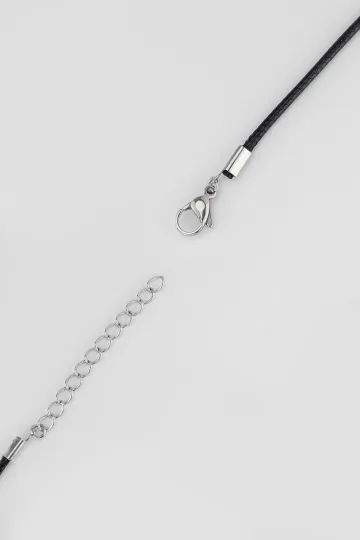
The cord sets the length, the fit, and the character. The classic choice is a round leather cord, usually black or brown, braided or smooth. You also find a thin braided cord of waxed thread, and a metal snake chain for sharper, glossier looks. The thickness of the cord has to match the opening in the slide: too thin and it slips and creeps, too thick and it will not pass through, or it stretches the loop.
A silver slide sits in the notch of the collar like a badge, not swinging loose on your chest. Undo one button too many and it is just a lost bootlace. Don't.
How to wear a bolo tie
Over years on set I have put bolos on cowboys, grooms, and rockabilly musicians. Here is what actually keeps one on the line between dressy and your own, by occasion.
What do you wear a bolo with so it does not look like a costume? The one rule I never break: calm clothing under a characterful slide. I recommend a button shirt with a turndown collar, a plain sweater with the collar out, a denim or flannel shirt. The larger and louder the slide, the more restrained everything else. Costume territory shows up when there are too many western details around the bolo at once.
How do you put a men's bolo together under a jacket? I suggest buttoning the collar to the top, pushing the slide right into the V of the collar, and letting the tips hang quietly down the chest. Under a jacket or a vest the bolo replaces a necktie and looks pulled together, especially when the slide echoes the belt buckle in metal. The more formal the occasion, the calmer the slide I choose: smooth silver or a dark stone for a ceremony.
How do you style a women's bolo? On women I keep the bolo thinner and freer: a delicate slide, a thin cord or chain, the fit just below the throat. I recommend wearing it over a shirt collar, on a blouse, over a turtleneck, or as an accent to a jacket. A slim cord with a neat slide reads on the border between a necktie and a necklace and carries the look without a single classic piece on the neck.
Can you wear a bolo to a wedding? Yes, and it is a strong move in a western, boho, or retro key. For a groom I suggest a bolo instead of a necktie: it looks whole and unexpected, and silver with a dark stone or turquoise adds local colour to the day. For paired looks I match the slides in one metal so the couple reads as an ensemble.
How do you wear a bolo every day? In daily life the bolo works as a noticeable but not shouting accent. I choose a small slide and a leather cord: a flannel shirt, a plain sweater with the collar out, a denim jacket. It is a way to wear jewellery for people who do not care for pendants on a chain but still want a mark of their own on the chest.

Turn on your camera, pick earrings, a pendant or a ring, and see the piece on yourself in real time.
Switch items in one tap.
Everything runs in your browser: no photo or video is ever uploaded.
The history of the bolo tie
The bolo tie was born in the American Southwest in the middle of the last century, in a country of deserts, cattle ranching, and the silver craft of Native peoples. It is a rare case of an accessory with an almost documented birthday, and at the same time a dozen competing legends about who thought of it first.
Cowboy culture and the desert West
The setting that produced the bolo was cattle country: Arizona, New Mexico, Texas, Colorado. A classic necktie was no use in heat and dust; silk got dirty and choked you, while a cord with a slide gave a hint of dress without getting in the way of work or breath. The cowboy silhouette, a shirt with a snap collar, a hat, a belt with a heavy buckle, took beautifully to a cord with a silver plate at the throat. The bolo became the town cousin of working clothes: you wore it to the saloon, to church, to a dance, anywhere you wanted to look sharp while still being yourself.
There is practical logic in it too. On horseback and at work, the long fabric blade of a necktie snags and gets in the way, while a short cord with a slide hangs compactly and stays put. The bolo also needs no tying: you drop it over your head, snug up the slide, and you are ready. For people who valued every minute in the morning and kept no mirror at home for fussing with a knot, that was a find. So the accessory matched both the look of the West and its way of life, and it stuck for good rather than fading as a one-season fad.
Navajo and Zuni silver
The bolo owes its real artistic force to the jewellers of Native peoples, above all the Navajo and the Zuni. The Navajo had a developed school of working with silver and turquoise: sandstone mould casting, large smooth planes of metal, stamped patterns. The Zuni had their own signature, fine inlay: small pieces of turquoise, coral, mother of pearl, and black jet assembled into mosaic patterns and figures. Slides of their making turned the bolo from a practical clasp into a collectible ornament. Many old bolos are prized today precisely as examples of these makers' craft, not as ties.
The two schools are easy for a newcomer to confuse, though their character is quite different. The Navajo think big: one large stone in a heavy silver setting, the emphasis on the shape and proportion of the metal. The Zuni think in mosaic: the picture is built from many small segments, and the beauty is in the painstaking inlay where you see no gaps. When you look at an old bolo and grasp which school it leans toward, the piece stops being just a tie and reads as the handwriting of a specific tradition. That is exactly why such slides are collected alongside the bracelets and rings of the same makers.
Rockabilly and the music scene
In the middle of the last century the bolo jumped from the desert to the stage. Country, western swing, and rockabilly musicians took up the cord with a slide as part of the stage costume: it added shine under the lights and read from the back row. So the bolo moved beyond the Southwest and became a recognisable mark of a certain musical look, rebellious and dressed up at once. Later it was lifted more than once by waves of fashion that brought back an appetite for the western, the vintage, and handmade silver.
An unofficial symbol of the West, and state neckwear
By the end of the last century the bolo had settled in as a sign of the American West. Arizona declared it the official neckwear of the state, and later New Mexico and Texas did the same. For people in those places, a bolo at a celebration is no costume, it is the local standard of dress, as fitting as a classic necktie is elsewhere. That legislated regional identity sets the bolo apart from most accessories: it has citizenship.
Because of that status, the bolo carries a double meaning. In one place it is everyday formalwear, worn to a neighbour's wedding without a second thought. In another the same cord and slide reads as a deliberate nod to the West, to cowboy romance and handmade silver. Whoever wears a bolo is, in a way, declaring a taste for a certain look, and that registers even where no one has heard of Arizona's official neckwear. Few accessories can be a local standard and a cultural statement at the same time.
Customer reviews
Zevira is a real jewellery shop. Genuine payments, deliveries and customer thank-yous.
🥰🥰🥰 gracias

Ok, ¡gracias! 🙂

What the slide is made of
The slide decides everything: the character of the bolo, its price, where it belongs. The same cord with different slides turns into a museum artifact one moment and a bold party accessory the next. Here are the main materials and motifs you meet most often.
Silver
Silver is the base material for a slide and the most historically true. It holds engraving, oxidation, and relief well, and it pairs beautifully with turquoise and dark stones. A silver slide, engraved or smoothly polished, looks dignified and works with almost any shirt. If you want a piece for decades, a silver bolo is a sensible starting point. What a hallmark means and why silver darkens is covered in detail in the guide to 925 sterling silver.
Turquoise
Turquoise is the soul of the Southwestern bolo. A blue or blue green stone in a silver setting points instantly to the desert and to Navajo craft. Turquoise comes plain or laced with a dark web of veins (the so called matrix), and that web is prized for its one of a kind pattern. The stone is soft and porous and asks for gentle handling, but nothing sounds as western as silver and turquoise at the throat. The properties and care of the stone get their own breakdown in the guide to turquoise in jewellery.
The shade of turquoise sets the mood of the whole bolo. A clean sky blue stone reads classic and dressy, a blue green one looks earthier and warmer, and a dense black matrix gives the slide a rough, handmade air. Keep in mind that turquoise is often stabilised, impregnated with a compound to strengthen the soft stone, and that is normal for a piece meant to be worn. High quality natural untreated turquoise is rarer and costs more. For an everyday bolo, a stabilised stone makes more sense: it survives contact with clothing and sweat better.
Onyx and dark stones
Black onyx, jet, and dark agate give a strict, graphic slide with no ethnic flavor at all. A black circle or oval in silver looks spare and goes with a dark shirt, a jacket, a city look. This is the route for anyone drawn to the idea of a bolo but not to desert colour: a dark stone makes the cord and slide almost a minimalist ornament.
Cameo, initial, symbol
Anything small and flat can become a slide: a cameo with a profile, a monogram initial, an animal figure, a skull, a horseshoe, a star, a zodiac sign. Here the bolo turns into a personal mark, and that is exactly why it is so loved as a gift: the slide is easy to choose for someone's character and interests. A figural slide reads from a distance and says more about its owner than a necktie of any colour.
The subject of the slide deserves the same deliberate choice as a stone in a ring. A horseshoe and a clover read as a wish for luck, a skull and a cross lean gothic, a bull, a cactus, and a sheriff's star nail down the western, an initial makes the piece personal. If the bolo is bought as a gift, the subject carries the whole message: a silver wolf for one person and a silver rose for another will say what no inscription could. So a figural slide is treated not as a pattern but as a small portrait of its owner.
Brass, bronze, and steel
Beyond silver, slides are made of brass, bronze, and stainless steel. Brass and bronze give a warm, golden tone that gets along with brown leather and earthy clothing, and they cost less than silver, which is handy for large showy slides. Steel is cool, tough, and does not tarnish; people pick it for strict minimalist and industrial looks. Each metal has its own temperature: warm suits red hair, a tan, and an autumn palette, cool suits black, grey, and graphic contrast.
Upload a photo of your pet, someone you love, or an object. We'll build a 3D model and hand-cast it in pewter.




Cord length and material
The cord decides how the bolo sits and what impression it makes. Too long and it dangles below the belt, too short and it looks pinched. The right length and the right material matter more than they seem at first.
How long the cord should be
The common cord length is roughly thirty five to forty three inches folded, that is from the throat to mid chest and back. You set the height with the slide anyway, but the overall length decides how far the tips reach. The simple guide: with the slide pushed up to the throat, the ends should finish somewhere around the middle of the breastbone or a touch lower, not reaching the belt. For a tall person you take a longer cord, for a small one a shorter cord.
Leather cord
Leather is the classic and the most common pick. A round leather cord, smooth or braided, settles softly, breaks in to your build over time, and ages well. Black leather is universal, brown is warmer and friendlier to the western. There is one drawback: leather fears water and dryness, and it asks for care, or it cracks. But in character it is the leather cord that makes a bolo the real thing.
Braided cord
A braided cord of waxed thread or thin leather strips gives a finer, neater silhouette and a pleasant texture. It is lighter than a leather rope, settles more softly at the throat, and suits delicate women's bolos and minimalist looks. Waxed thread fears damp less than smooth leather, and it holds its shape.
Metal chain
A chain cord, usually a thin snake chain, turns the bolo into a glossy, dressy ornament. The metal catches the light, the look turns sharper and more formal, closer to evening. A chain does not crease and does not fear water, but it has none of the desert western character: this is already a separate reading of the bolo, urban and glamorous. It looks good with a dark stone in the slide.





Styles of the bolo tie
Over half a century the bolo grew its own style dialects. The same construction reads as ethnic, as minimalist, or as gothic. Knowing these directions helps you choose a bolo for yourself rather than the first one you see.
Western
The base style: a silver or silvery slide, a leather cord, motifs of the West, a horseshoe, a bull skull, a cactus, a sheriff's star. This is the bolo in its native ground, dressy and working, masculine, instantly recognisable. It goes with denim, flannel, a leather belt, a hat.
Navajo and Zuni ethnic
The most artistic style: Navajo silver with turquoise, or Zuni mosaic inlay of stones. Here the bolo is a collectible handmade object with the maker's own handwriting. Such slides are worn like a jewel, and they are paired with calm clothing so nothing argues with the pattern.
Minimal
The modern reading: a small smooth slide, a thin cord or chain, no colour riot. A black stone or smooth silver, a spare silhouette. A minimalist bolo fits a city wardrobe and does not look like a costume; it is worn with a plain shirt and a jacket.
Gothic
The dark branch: black onyx, jet, oxidised silver, motifs of the skull, the cross, the snake, the web. A gothic bolo is built on the contrast of a black cord and a dark slide with the cool shine of silver. It goes with a black shirt, a dark look, an aesthetic tilted toward drama.
Rockabilly
The stage, vintage style: a glossy slide, sometimes a large stone or a figural motif, a brash delivery. The rockabilly bolo inherited its scale from the music stage of the last century: it is built to be seen, and it lives well with a pompadour, a short sleeved shirt, a vintage silhouette.
How to choose a bolo for your look
Choosing a bolo comes down to three decisions: the size of the slide, the material of the cord, and the subject. Keep in mind the occasion and the clothing you are buying it for, and it is hard to go wrong.
By slide size
A small slide (button size or a little larger) is universal, hard to wear wrong, and suits the office, the city, daily wear. A medium one (large coin size) is the sweet spot, noticeable but not loud. A large one (half a palm) is a statement: it demands calm clothing and confidence, but in the right context it looks regal. A beginner finds it easier to start with the medium.
By cord colour and metal
The metal of the slide and tips sets the temperature of the look: silver is cool and universal, while warm brass or bronze gets along with brown leather and earthy tones. The cord colour is matched to the shoes and belt: a black cord to black leather, brown to brown. It is the same logic as in classic menswear, and it saves you from an accidental clash.
By occasion
For a celebration, take a calm slide of silver or a dark stone on a leather cord or chain, so the bolo reads as a necktie's replacement. For casual, any characterful slide on a leather cord is fitting. For the stage or a party you can allow yourself something large and glossy. One person comfortably owns two or three bolos for different situations, the way others own several neckties.
Leave your email, we'll send your discount code. No spam, unsubscribe anytime.
The code arrives by email, valid on your first order.
How to tell a good bolo from one thrown together
The bolo is deceptively simple, and that is exactly why the difference between a solid piece and a knockoff is not obvious at once. A few signs separate a bolo that will serve for decades from one that falls apart in a season.
Quality of the slide and the grip
The slide is the heart of a bolo, and you check it first. Casting or stamping should be clean, without pits, burrs, or smeared relief. The stone should sit tight in its setting, with no play and no glue creeping over the edge. The grip on the cord should hold the height all day rather than slipping. The back is worth a look too: on a good piece the loop or post is neatly soldered, not glued in a hurry.
Quality of the cord and tips
The cord should not fray at the cut or split apart. On a leather rope the edges are even, the braid is tight, with no threads sticking out. The tips should sit firmly on the ends, neither rattling nor falling off, and they should echo the slide in pattern and metal. If the tips are random, in another metal and style, that is a sure sign the bolo was assembled from whatever was on hand. A whole piece reads as one ensemble, not a set of parts.
Silver by Navajo and Zuni masters
Old bolos by recognised Native makers are a category of their own, closer to collecting. With the Navajo you prize clean casting, large planes of silver, and the quality of the turquoise; with the Zuni, the fineness of mosaic inlay where dozens of tiny stone pieces are set without gaps. The authenticity of such pieces is confirmed by hallmarks and provenance, and their price is far from a mass accessory. It is worth taking on such a purchase understanding that you are buying craft first, and the necktie function is secondary here.
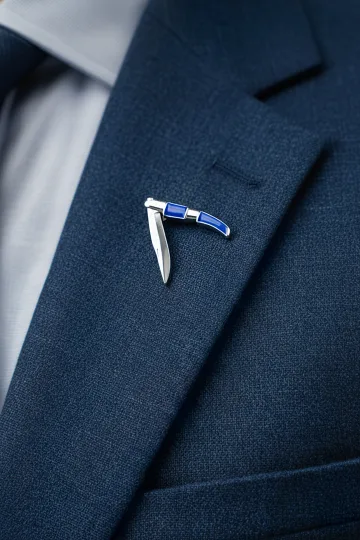
CAPAORA mini knife pendant
The 18th-century Spanish navaja in miniature: 40 mm of stainless steel, a real folding mechanism and a Palanquilla lock that clicks. An affordable gift to remember.
Authentic · Ships from Spain · 14-day returns
Bolo, necktie, and neckerchief: the difference
The bolo is often lined up with the necktie and the neckerchief, but these are three different answers for one zone at the throat. Understanding the differences helps you choose a piece for the occasion and the character rather than out of habit.
Bolo versus the classic necktie
A classic necktie is a strip of fabric tied anew with a knot every time. A bolo is jewellery: a cord, a metal slide, and tips, the height of which you set with one motion. A necktie speaks through the colour and pattern of fabric, a bolo speaks through metal and stone. A necktie is strictly about formality and the office, a bolo is more flexible and fits both a celebration and casual. Where a necktie obliges, a bolo suggests.
Bolo versus the neckerchief
A neckerchief, bandana, or scarf is soft fabric tied around the neck in a loose knot. It gives colour, volume, and nonchalance, but it carries no metal or stone. A bolo is firmer in silhouette, holds a vertical line, and works as an ornament with a slide at its centre. The scarf is about texture and ease, the bolo about a crisp accent at the throat. In a western look they are sometimes even combined, but their roles differ.
When to choose which
If the occasion is strict and classic, the necktie is more familiar. If you want dressiness with character and no knot, especially in a western, retro, or boho key, you choose the bolo. If you need a soft coloured accent and ease, you take the scarf. The bolo is the handiest of the three in one respect: it does not crease, needs no fuss with a knot, and serves for decades, because its value is in the metal, not the fabric.
The women's bolo as a relative of the lariat necklace
The women's bolo and the lariat necklace are two answers to one idea: a long flexible line on the chest with a height adjustable fastening in the middle, no clasp at the back. On the bolo the slide plays the part of the fastening; on the lariat the ends themselves pass through a loop or knot and hang free. Neither has a clasp at the neck, both adjust at the front, both create a vertical accent.
How they are alike and how they differ
They are alike in mechanics: neither the bolo nor the lariat fastens at the back, both hold by a crossing or a slide at the front, and both give hanging ends. They differ in origin and character: the bolo came from the men's western and holds its shape through a rigid slide and tips, while the lariat is a women's necklace with soft falling ends and a more tender delivery. If you are drawn to the look of a long open line, take a look at the breakdown of the lariat necklace: many of the fitting tricks they share.
How to wear a women's bolo
A women's bolo is worn thinner and freer than a man's: a delicate slide, a thin cord or chain, the fit just below the throat. It looks good over a shirt collar, on a blouse, over a turtleneck, as an accent to a jacket. A long women's bolo echoes the look of layered long necklaces such as the sautoir: the same vertical, the same trick of stretching the silhouette.
Send a friend a discount code, they save on their first order.
Caring for the cord and the slide
A bolo is made of two parts with very different care needs: an organic cord (leather, thread) and metal with stone. You cannot clean them the same way, and that is exactly where the piece most often gets ruined.
Caring for the leather cord
A leather cord fears water, heat, and drying out. Do not wet it, do not dry it on a radiator, do not leave it in the sun in a car. Wipe it now and then with a soft cloth, and if the leather goes dry, apply the thinnest layer of a colourless leather conditioner and let it soak in. When you take the bolo off, do not yank the ends, ease it over your head gently, or the slide's loop wears the cord in one spot and over time it frays there.
Caring for silver and stone
A silver slide darkens over time, and that is normal; oxidation even emphasises the relief. Polish it with a special silver cloth and no abrasives. Keep turquoise and onyx away from cosmetics, perfume, and sweat: porous stones soak up everything and cloud over. Do not soak the whole bolo in cleaning solutions, because of the leather and the stones. A spot dry clean of the metal and a wipe of the stone with a soft cloth is the entire ritual you need.
How to put it on and take it off without harm
You put the bolo on over your head without taking it apart, and you set the height with the slide once it is on the neck. Taking it off, do not pull both ends out to the sides the way you untie a necktie: that rubs the slide's loop against the cord in one point, and over time the leather wears through there. The better way is to loosen the slide, drop it, and lift the bolo off over your head calmly. If the slide is tight, move it slowly, holding the cord, so you do not stretch the opening. This habit extends the cord's life more than any cleaning.
How to store a bolo
Store the bolo flat or hung by the cord, so the tips hang free and do not crease the leather. Keep it apart from other metal items, so the slide does not get scratched and the silver does not tarnish faster. A leather cord likes a dry, cool place out of direct sun. The bolo is one of those things that, with the least care, calmly outlives decades and passes to the next generation.
Facts that surprise
The bolo tie seems simple, but a surprising amount of curious lore has gathered around it. A few facts that change how you see the cord and slide.
The bolo has legal standing. Arizona officially declared it the state neckwear, and later New Mexico and Texas joined in. Few accessories in the world are written into a region's law: the bolo is clothing and local identity at once.
The name may come from a throwing weapon. By one account, the word "bolo" is tied to the bola, a hunting tool of South American herders made from cord with weights on the ends. The hanging tips of a bolo really do recall those weights, hence the name.
The credit is claimed by several people at once. Various silver makers and traders of the mid last century claimed the title of inventor of the bolo, and the argument over who first joined a cord to a sliding clasp was never settled for good. Most likely the idea was in the air of the desert West and took shape with several people almost at the same time.
Old bolos are collected as silver, not as ties. Slides by recognised Navajo and Zuni masters are prized as works in their own right, and they are collected on a par with the bracelets and rings of the same schools. The necktie function is secondary here.
The bolo has survived several waves of fashion. From desert practicality it moved to the music stage, then became a mark of western retro, then returned more than once on a wave of interest in handmade silver and vintage. The thing proved hardier than many fashionable accessories of its time precisely because it has roots.
The slide and tips can matter more than the cord. The price and value of a bolo are almost entirely in the metal and stone: the cord is easy to replace, while a slide by a master outlives several cords and stays the main thing in the piece.
Frequently asked questions
Is the bolo tie men's or women's jewellery?
Both. By origin the bolo is a men's accessory from the western, but by nature it is unisex: the same cord with a slide reads as a necktie's replacement on a man and as a bold ornament bordering on a necklace on a woman. Women's bolos tend to be thinner and finer, men's larger and stricter, but there is no hard line.
What do you wear a bolo tie with so it does not look like a costume?
The main rule: calm clothing under a characterful slide. A button shirt with a turndown collar, a plain sweater with the collar out, a denim or flannel shirt. The larger and louder the slide, the more restrained the rest. Costume territory comes when there are too many other western details around the bolo at once.
Can you wear a bolo to a wedding?
Yes, and it is a strong move in a western, boho, or retro key. For a groom the bolo replaces a necktie and looks whole, especially silver with a dark stone or turquoise. For paired looks the slides are matched in one metal. Brides wear a slim bolo over a small collar as an accent.
How long should the cord be?
The guide is roughly thirty five to forty three inches folded. With the slide pushed up to the throat, the tips should finish around mid chest, not reaching the belt. You set the height with the slide, while the overall length decides how far the ends reach. A tall person needs a longer cord.
What is the best material for a slide?
If you want a universal piece for years, take silver: it goes with almost everything and ages well. For western character, choose silver with turquoise. For a strict city look, a dark stone, onyx or jet, suits. A figural slide, an initial, or a symbol is good as a personal gift matched to someone's character.
How is a bolo different from an ordinary necktie?
A bolo has no knot and no fabric blade. It is a cord, a movable decorative slide, and two metal tips. A necktie is tied anew every time, while you set the height of a bolo with one motion of the slide. In essence a bolo is jewellery in the shape of a tie, so its centre of attention is not the colour of fabric but the metal and stone.
Can you get a bolo's leather cord wet?
No. Leather fears water and drying out: damp makes it coarse and cracked. Do not wet the cord, do not dry it on a radiator, and do not leave it in the sun. Wipe it now and then with a soft cloth, and refresh dried leather with the thinnest layer of a colourless leather conditioner. The metal and stone are cleaned separately, without soaking the whole bolo.
Is the bolo only about the western?
No. The western is its home, but the bolo left those bounds long ago. A minimalist bolo with a smooth slide on a thin cord fits a city wardrobe, a gothic one with a black stone goes into a dark aesthetic, and a bolo on a metal chain becomes a dressy evening ornament. The slide and cord set the style, not the construction itself.
A cord and slide that tells about its owner
Silver, a dark stone, a personal symbol at the throat. The bolo is jewellery for people who do not wear pendants on a chain but want a clear mark on the chest. Find a slide for your character and occasion in the Zevira catalogue.
Browse the jewelleryBuying it as a gift? Each one arrives ready to give.
 A branded Zevira box and a little card come with every order.













About Zevira
Zevira makes jewellery with character and a story, where the shine follows the meaning. Silver, expressive stones, strong symbols: pieces you wear every day and pass on. If the idea of jewellery that works as a personal mark of its owner speaks to you, start with the gift guides and the sections on 925 sterling silver and jewellery as a gift for a man.