Clear, milky and smoky quartz: how they differ and how to choose
Quartz makes up roughly 12% of the Earth's crust, second only to feldspars. The same mineral sits in the sand under your feet at the beach, inside the crystal of a wristwatch and in the pendant glinting in a jeweller's window. The difference between clear rock crystal, milky quartz and smoky quartz has nothing to do with composition, which is identical in all three, and everything to do with what happened to the crystal while it grew underground. Let's go through the chemistry, the geology and the human history of these stones, learn to tell them apart from glass and fakes, and work out which type suits which piece of jewellery.
What quartz is: composition, hardness, structure
Quartz is silicon dioxide, formula SiO2. One silicon atom and two oxygen atoms, arranged in a three-dimensional lattice of tetrahedra. That lattice dictates almost every property the stone has.
The key characteristics:
- Hardness 7 on the Mohs scale. This is the reference point: quartz itself defines the seventh step of the scale. It scratches glass and steel but yields to topaz, corundum and diamond. In practice this means quartz shrugs off household dust (the tiny quartz particles in dust are softer than or equal to it), yet a harder stone sharing a jewellery box will leave a mark on it.
- Trigonal crystal system (often written as the "trigonal trapezohedral class"). In nature quartz grows as six-sided prisms with a pointed pyramidal tip, a shape that is hard to mistake for anything else.
- Density around 2.65 g/cm³. The stone feels noticeably heavier than glass of the same volume and cools the hand thanks to its good thermal conductivity.
- Optics. Quartz is optically uniaxial and positive. The refractive indices are roughly 1.544 and 1.553, birefringence is weak (about 0.009) and dispersion is low (0.013). That is why faceted rock crystal gives a clean shine and bright flashes of light but does not throw out coloured sparks the way a diamond does with its high dispersion. Colourless and milky quartz show no pleochroism; smoky quartz shows a faint amount.
- No cleavage, conchoidal fracture. Quartz is hard but brittle: a sharp blow does not split it along a plane, it chips away in the characteristic curved surfaces. Hardness and toughness are two different things.
- Piezoelectricity. Squeeze quartz and it produces an electric charge; feed it an alternating current and it vibrates steadily at its own frequency. This is exactly why a thin slice of quartz sets the beat of a quartz watch and the clock speed in electronics. It has nothing to do with the "energy" of jewellery, but the fact itself is real and important.
All three of our subjects are the same single-crystal quartz. The only difference is what got trapped inside the lattice and what time did to it.
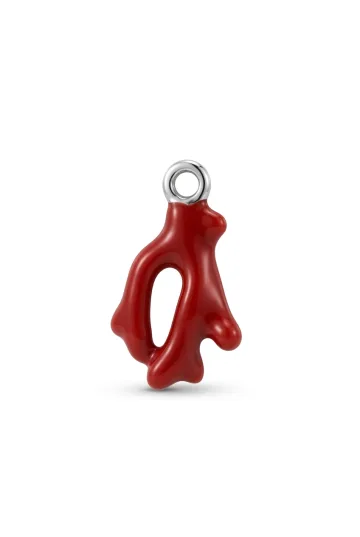
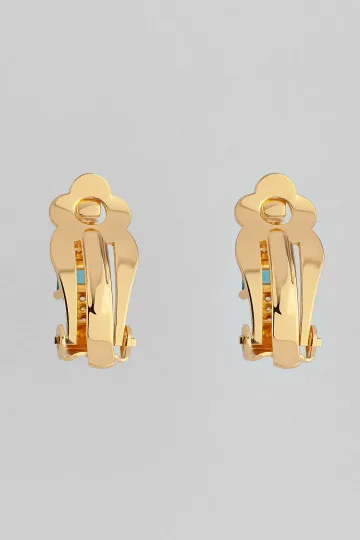
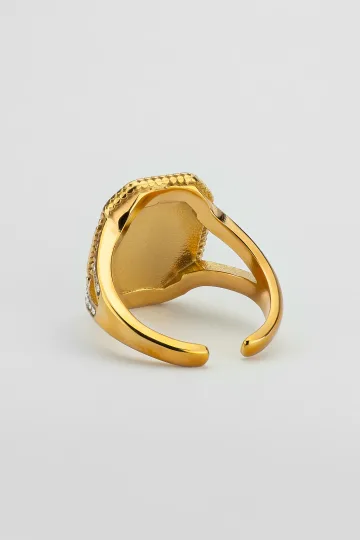
Wear the symbol, don't just read about it. These are in stock:




Where the three varieties come from
Pure silicon dioxide is colourless and transparent. Colour and cloudiness appear because of impurities, inclusions and defects in the lattice.
Clear quartz (rock crystal) is a crystal with no significant inclusions. Light passes through it with almost no loss, hence its full transparency.
Milky quartz clouds over thanks to a multitude of microscopic cavities filled with water and gas, trapped as the crystal grew. They scatter light like the tiniest bubbles in cloudy glass. This is the most common form of quartz in nature, but in jewellery it is valued lower because it is opaque. The cavities are frozen into the lattice for good: milky quartz will not "clear up" on its own over time.
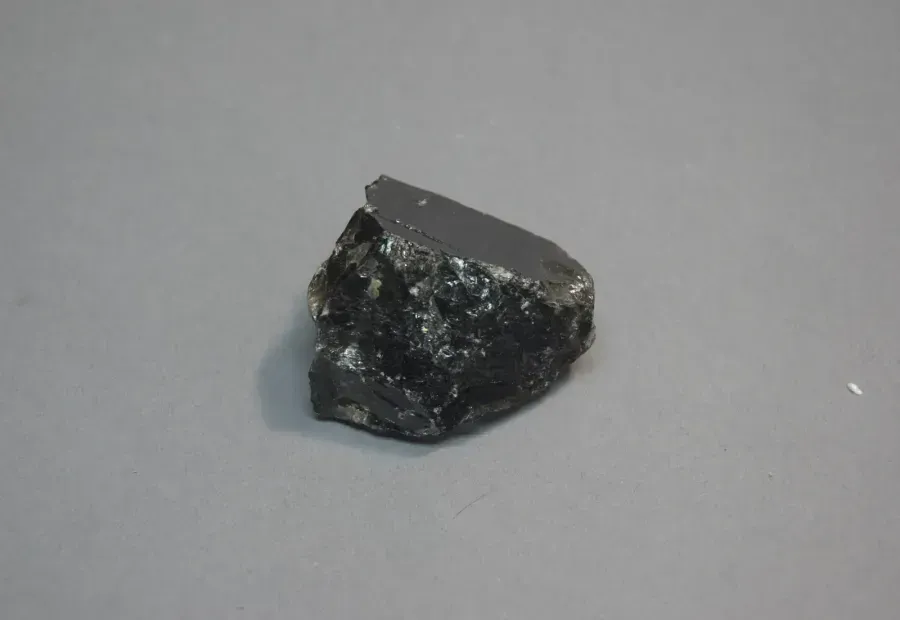
Smoky quartz gets its grey-brown colour not from a colouring impurity but from colour centres. The lattice always contains a little aluminium standing in for silicon. When the crystal lies in the rock for millions of years next to traces of radioactive elements (potassium, uranium, thorium) and receives a gentle natural irradiation, an electron is knocked loose at those aluminium sites. A hole centre forms, which absorbs part of the visible light and leaves the stone its smoky tone. The stronger and longer the irradiation, the darker the stone: from pale beige to almost black (the densely black variety is called morion). Heated above roughly 300-400 degrees the colour centres break down, and smoky quartz lightens all the way to colourless. The stone itself is not radioactive: it received its dose long ago and does not emit anything.
Smoky quartz wants silver. Put yellow gold next to it and you have two cooks in one kitchen, so do not even try.
What to wear quartz with
I have taken quartz through dozens of looks, from everyday to on-set. It is a neutral stone that slots into any wardrobe rather than dictating it, so the whole job here is the pairing of stone plus metal plus occasion. Here is what actually works, by the occasion.
What do you wear quartz with day to day? For every day I recommend clear or milky quartz in a simple setting. It works like an almost invisible piece: a thin chain with a small pendant under a white tee, a grey jumper, a denim shirt. The stone catches the light as you move and the look comes alive without turning formal. A light top brightens the stone; a dark one turns it into a quiet accent.
Does quartz work at the office? It does. I suggest milky quartz in silver: calm, understated, holding a businesslike tone without fighting your shirt. Choose clean, geometric settings and one piece at a time, so the jewellery reads as a detail rather than a statement. A length of 45-50 cm tucks under the top button.
How do I build an evening look with quartz? For evening I choose clear faceted quartz: in the light it flares like ice, and beside an open neckline or a boat neck it looks expensive. With a black dress I recommend smoky quartz in silver, a dark stone on a pale metal gives depth. Rich cool tones (emerald, wine, indigo) win with clear; pastels with milky.
Which metal should I pick for quartz? Silver and white gold suit all three types and underline the cool nature of the stone, so those are my default. Yellow gold is lovely with clear and milky, but with smoky two warm shades start to argue, so leave smoky to silver or a dark metal.
How do I layer quartz? Layering comes together easily: a thin chain with quartz plus a longer one with no stone, or two or three rings on one hand where the quartz stays the only noticeable stone. A pendant sits well on a chain of 45-50 cm, so the stone rests over the chest and does not knock against the collarbone. Do not mix more than two stones in one look, quartz reads better when nothing crowds it.

Turn on your camera, pick earrings, a pendant or a ring, and see the piece on yourself in real time.
Switch items in one tap.
Everything runs in your browser: no photo or video is ever uploaded.
Inclusions, phantoms and Venus hair
Genuinely clean quartz is uncommon, and it is precisely the dirt inside a crystal that makes the stone interesting. Inclusions are not a flaw but a record of growth: a geologist reads from them what happened inside a fracture in the rock over millions of years. In jewellery the pattern of inclusions is frequently valued above perfect clarity, because no two such stones are alike.
What inclusions are and where they come from
An inclusion is any foreign body walled up inside a crystal as it grew. Quartz grows in layers, building its faces out of a hot solution, and anything sitting at the surface at that moment can be trapped under the next layer. That is how droplets of water and gas, minute crystals of other minerals, flakes of mica, needles of rutile and wisps of chlorite all end up inside the stone. Some inclusions are visible only under a loupe; others form a pattern you can see across a room.
Rutilated quartz: golden and silver needles
The best known inclusion is rutile, an oxide of titanium. It grows as fine straight needles, golden, coppery or silvery, and the quartz builds up directly around them. The result is a transparent stone shot through with a net of glittering hairs. The old poetic name for it is Venus hair, given in the Renaissance when the fine threads inside a clear stone were compared to the loosened hair of the goddess. The needles can be sparse and chaotic or dense and parallel, and their arrangement drives the price: a handsome even sheaf is valued well above a tangled ball. Rutilated quartz is cut so that the needles catch the light, which means the shape is chosen to suit the pattern rather than the other way round.
Tourmalinated quartz and the other hair stones
Besides rutile, quartz carries needles of black tourmaline (schorl), green darts of actinolite and brown flakes of goethite. All of these are grouped together in the trade as hair stones. Black tourmaline gives a severe, graphic pattern: clear glass stitched through with charcoal straight lines. Green and brown inclusions give a more natural, mossy look. These stones are not cut for brilliance but sliced into plates and cabochons so that the whole pattern can be read at once.
Phantoms: a crystal inside a crystal
A phantom is the ghost of an earlier crystal tip, frozen inside the stone. When quartz growth pauses for a time, a thin layer of some other substance settles on the faces, usually chlorite, which gives greenish phantoms, or iron oxides, which give reddish ones. Growth then resumes and quartz builds over the layer, sealing it in. In a transparent stone the crisp outline of a smaller pyramid appears, as if the crystal were showing you what it used to be. Sometimes there are several phantoms nested one inside another. These specimens are rarely faceted, because their value lies in the visible geometry of growth, and cutting would destroy it.
Two-phase inclusions and breathing stones
Cavities in quartz frequently hold two phases at once: a liquid and a bubble of gas. Under a microscope you can watch the bubble drift freely in its droplet when the stone is tilted or slightly warmed. Geologists use such inclusions to work out the temperature and pressure at which a crystal grew. For a buyer it is simply a fine fact: sealed inside the stone is water millions of years old, and it is still sloshing about in there.
Customer reviews
Zevira is a real jewellery shop. Genuine payments, deliveries and customer thank-yous.
🥰🥰🥰 gracias
Ok, ¡gracias! 🙂
Geology: how and where quartz forms
Quartz crystallises out of hot silica-rich solutions and melts. Most often it grows in hydrothermal veins and in the cavities (miaroles) of granites and pegmatites: hot water saturated with silica slowly cools in a crack in the rock, and crystals build up on the walls. Large clear crystals need stable conditions and many thousands of years of growth.
Milky quartz is common in quartz veins and turns up practically everywhere. Smoky quartz is especially typical of granite pegmatites and alpine veins, where rocks with natural radioactivity lie nearby.
The key sources of gem-grade quartz are well known:
- Brazil. The largest supplier of clear and smoky quartz, in the states of Minas Gerais and Goiás.
- Madagascar. High-quality clear and smoky quartz.
- The Swiss and French Alps. The classic finds of rock crystal and smoky quartz in mountain fissures.
- The United States. Arkansas is famous for clear quartz, and there are deposits in Colorado.
- The Scottish Highlands. Cairngorm smoky quartz gave the stone one of its oldest names and supplied centuries of brooches and dirk fittings.
There is so much quartz that it is mined by the tonne both for industry and for jewellery. Its abundance is why it is inexpensive: that is a matter of geology, not of quality.
The human history of quartz
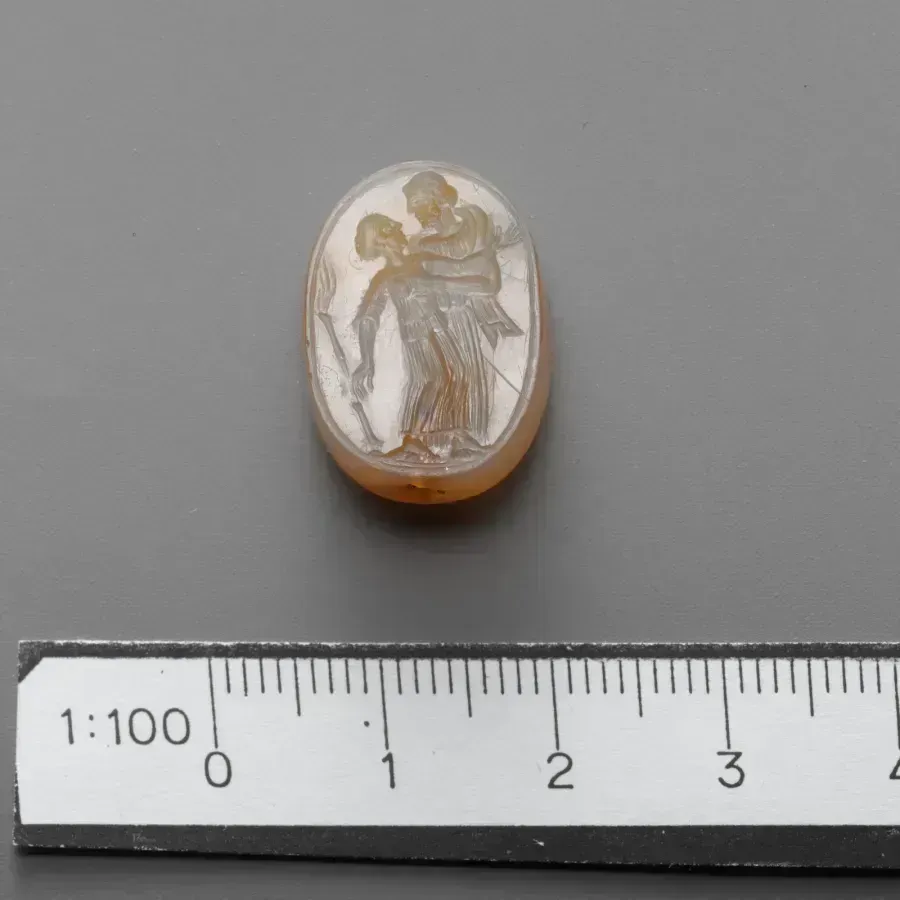
Rock crystal was being worked in antiquity. The word "crystal" itself comes from the Greek "krystallos" (ice): ancient writers, including Pliny the Elder, genuinely believed rock crystal was petrified ice, frozen so hard it would never melt again. Clear quartz was cut into seals, beads, vessels and lenses.
In ancient Egypt quartz went into beads and amulets; thanks to its chemical resistance, stone objects from burials have reached us with their shine intact. In Roman times large blocks of rock crystal were turned into costly vessels and seals, and carving such a hard material was considered the height of craftsmanship.
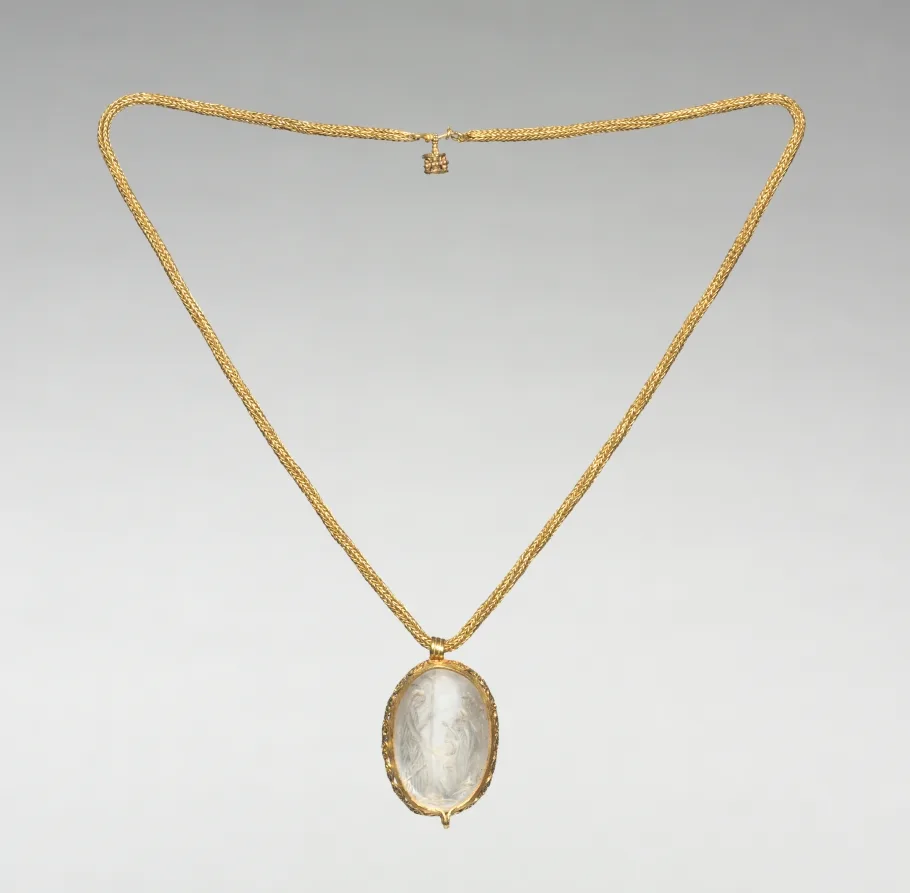
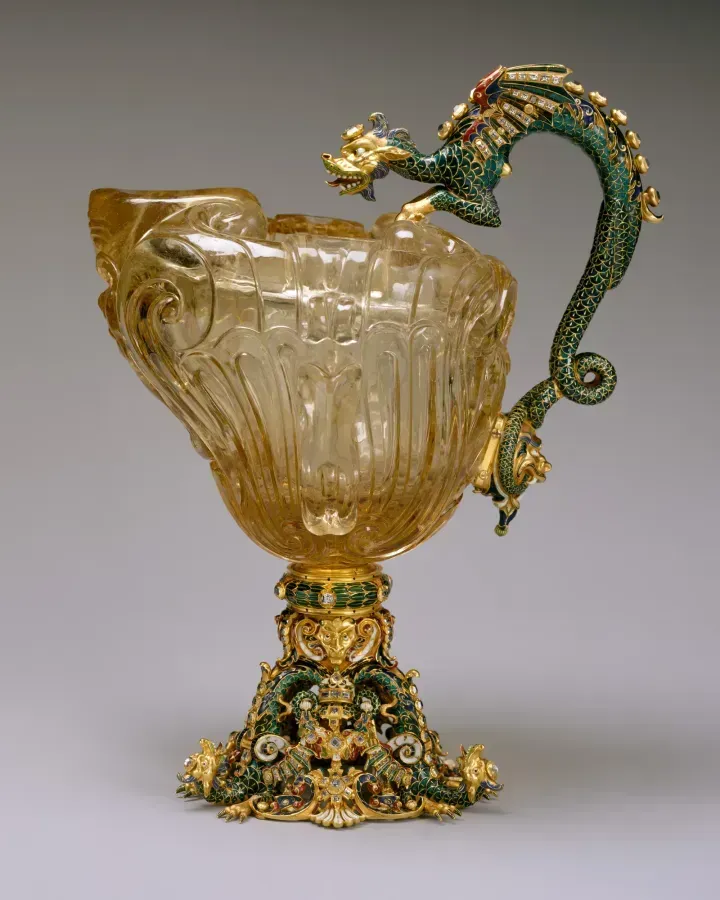
The golden age of rock crystal carving came in the Renaissance and the Baroque. Whole dynasties of stone carvers worked in Milan, Prague and Florence; from solid pieces of clear and smoky quartz they made cups, ewers and mounts, decorated with gold and enamel. One such object is shown below.
Spheres were also ground from rock crystal, both to decorate interiors and as optical curiosities. A smoothly polished ball cut from a single piece of quartz stayed an expensive and rare thing for a long time: finding a solid clear lump of the right size is not easy.
The turning point in our understanding of quartz came in 1880, when the brothers Jacques and Pierre Curie described the piezoelectric effect. That discovery turned quartz from a pretty stone into an engineering material: quartz plates went on to underpin radio transmitters, precise frequency generators and, later, quartz watches. From the 1940s onward quartz could be grown artificially by the hydrothermal method, and today almost all technical quartz is synthetic.
Upload a photo of your pet, someone you love, or an object. We'll build a 3D model and hand-cast it in pewter.

Quartz in the cultures of the world
Rock crystal was worked by very nearly every people who had it to hand, and almost everywhere it was thought a relative of ice, water and light. It is one of the rarer cases where cultures with no knowledge of each other arrived at much the same image.
Antiquity: frozen ice and burning lenses
The Greek name for the stone, krystallos, meant ice, and Pliny the Elder wrote in all seriousness that rock crystal was water frozen permanently hard in the mountains. In Rome, balls were turned from clear quartz to be held in the hand during hot weather: the stone cools the palm, and that was taken as proof of its icy nature. The same coolness produced the earliest optical experiments, since a polished piece of rock crystal gathers sunlight to a point and will set tinder alight, so crystal lenses were known long before glass ones. Roman writers describe the technique as a method of cauterising wounds, which makes quartz one of the first surgical instruments as well as one of the first gemstones.
Crystal balls and scrying
A smooth transparent sphere cut from a single piece of quartz stayed an expensive rarity for a long time: finding a large piece free of fractures is hard, and grinding a true sphere by hand is harder still. It was that expense, combined with the mysterious depth of a clear ball, that made it the emblem of divination. The practice of crystal gazing took shape in Europe in the later Middle Ages, and it flourished in Elizabethan England, where the queen's astrologer kept polished spheres and a black mirror for the purpose; several of them are now in the British Museum. The gazer concentrated on the highlights and clouds inside the ball, and their own imagination supplied the rest. There is no optics in this at all. What works is the familiar effect of free association across an even surface, the same one that fills clouds and firelight with shapes.
Crystal skulls: a beautiful myth
In the nineteenth century a handful of carved rock crystal skulls reached the market, presented as ancient Aztec and Maya sacred objects. Legends of secret knowledge and curses gathered around them at once. Microscopic examination in museum laboratories told a different story: the skulls carry the traces of rotary abrasive wheels, tools that pre-Columbian carvers did not have. The famous examples in the great museums, the British Museum's among them, are now accepted as nineteenth-century work, most likely from German lapidary workshops. The episode is a useful lesson: a fine story about a stone and the actual origin of that stone are two separate things.
The Renaissance and Baroque: carving in crystal
The real high point of quartz working came in the sixteenth and seventeenth centuries. Dynasties of hardstone carvers worked in Milan, Prague and Florence, and the loudest name among them was Miseroni: several generations of carvers who turned cups, ewers and dishes from solid blocks of clear and smoky quartz, which were then mounted in gold and enamel for princely collections. Carving quartz was reckoned harder than carving any softer stone, because a hardness of 7 does not forgive haste and a chip along the conchoidal fracture destroys months of work. One misjudged pressure, and a block that took years to find became a handful of fragments. Pieces from these workshops are among the treasures of the Habsburg collections and turn up in the great European cabinets, including British country house collections assembled on the Grand Tour.
The East and the New World
In China and Japan, rock crystal was turned into prayer beads, seals and small figures, and a smooth sphere was held in the hand as an object for concentration. In pre-Columbian Mesoamerica clear quartz was cut into beads and inlays, valued for its likeness to water and sky. Among many peoples of Siberia and North America transparent quartz crystals were regarded as the living stones of a shaman and kept in special pouches. The common thread everywhere is the same: a clear stone that lets light through was understood as a bridge between the visible and the invisible.



The varieties of quartz and how they differ
Clear quartz (rock crystal)
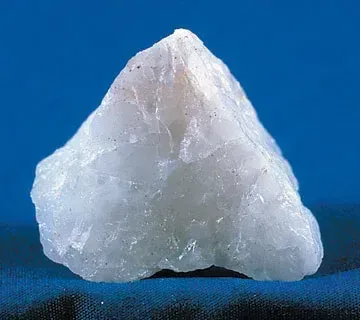
Colourless, transparent, with no inner haze. It takes a cut well: rock crystal is cut into classic facets, brilliant, cushion, oval and pear shapes, as well as forms that echo the natural prism. A faceted stone gives clean flashes but no coloured fire, because the dispersion of quartz is low. It is a calm, "icy" shine rather than a rainbow blaze.
Rock crystal has long been confused with diamond; seen against the light, a well-cut stone does look similar. Telling them apart is simple: diamond is noticeably harder and heavier (the density of diamond is 3.5 against 2.65 for quartz), and under a loupe quartz shows slightly rounded facet edges, whereas a diamond's are sharp. More on the tests below.
Milky quartz
The same quartz, but cloudy because of the microcavities of water and gas. The degree of cloudiness varies, from a light haze to a dense "sugary" white. Light does not pass straight through it but is softly scattered, so milky quartz is usually not faceted: it is cut as a cabochon or rolled into beads. In jewellery it sits well with silver and white gold, which support its cool white tone. Milky quartz, the most common and inexpensive variety, is a frequent material for beaded bracelets.
Smoky quartz
Grey-brown quartz with colour centres. The colour is even or zoned, from beige to the almost-black morion. In different light it looks different depending on the source: under cool daylight it tends towards grey, under a warm lamp towards brown. This is not "magic" but the lighting spectrum plus the faint pleochroism. Smoky quartz plays beautifully when faceted thanks to the depth of its tone and looks good in silver or dark mounts. The main point of care: it fades in bright sunlight, because light gradually breaks down the colour centres. We have a separate full treatment in our piece on smoky quartz as a grounding stone.
The coloured relatives
The same silicon dioxide with other impurities gives a whole family:
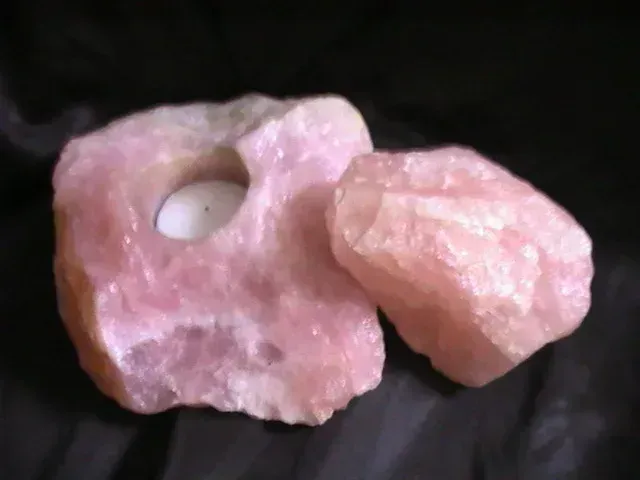
- Rose quartz. Pale pink because of microinclusions and traces of titanium and iron; usually a little matte, it is made into cabochons and beads. More in our piece on rose quartz in jewellery.
- Amethyst. Purple quartz; the colour comes from colour centres on iron, formed under natural irradiation. In direct sun amethyst fades, so it is kept in the shade.
- Citrine. Yellow quartz; the natural kind is rare, and most of what is on the market is amethyst heated to yellow (that is heat treatment, not a fake).
- Ametrine. Naturally two-coloured quartz, where purple and yellow zones sit side by side in a single crystal. A separate piece covers ametrine.
- Rutilated quartz ("Venus hair"). Clear quartz with golden or silvery needles of rutile inside. Prized for the pattern of its inclusions.
A table of differences
When choosing a piece of jewellery, what matters are exactly the practical differences between the three main types: appearance, transparency, sun resistance and care.
| Characteristic | Clear | Milky | Smoky |
|---|---|---|---|
| Hardness (Mohs) | 7 | 7 | 7 |
| Density, g/cm³ | ~2.65 | ~2.65 | ~2.65 |
| Colour | Colourless | White, cream | Brown, grey |
| Transparency | up to 100% | 20-60% | 30-70% |
| Nature of colour | no impurities | microcavities with water/gas | colour centres on aluminium |
| Fading in sun | no | no | yes |
| Typical cut | facet | cabochon, beads | facet, sometimes rough |
Treatments: what is honestly done to quartz
Quartz is cheap, so it is treated not to bump up the price but to get colours and effects that nature provides little of. Here is what you meet on the market and how to read it.
Irradiation for a smoky tone. Colourless or pale quartz with aluminium in the lattice can be irradiated in a reactor or on an accelerator, and it will darken to smoky or morion by exactly the same mechanism as in nature. A stone treated this way is safe: there is no residual radioactivity in commercial samples, and it is checked before sale. You cannot tell natural smoky from irradiated by eye, and for wearability it makes no difference: the properties are the same.
Heating citrine from amethyst. Most of the yellow quartz on the market is amethyst heated to around 400-500 degrees: the purple colour centres break down and a yellow-orange iron tone emerges. This is a long-standing, honest practice, not a fake. A sign of a heated stone is sometimes a reddish cast and colour zoning near the tip of the crystal.
"Mystic" and "aura" coatings. The rainbow metallic sheen on quartz (sold as "mystic quartz", "aura quartz", "angel aura") is the thinnest film of metal (gold, titanium, niobium) vapour-deposited onto the surface of the stone. The quartz itself is ordinary, the effect is only on the surface. The film is thin and rubs off with scratches and abrasives, so these stones go into a protective mount and are cleaned gently.
Dyeing. Cheap milky or cracked quartz is sometimes dyed to pass it off as turquoise, lapis lazuli or another coloured stone. The dye works into the cracks, so uneven colour along the veins and stains on a cotton pad with alcohol give the dyeing away.
Crack filling. In large faceted stones the cracks are sometimes impregnated with colourless resin for shine. Under a loupe such zones give a characteristic flat "glassy" sheen, different from the shine of the quartz itself.
The main rule: the seller must disclose any treatment. Irradiation and heating do not affect wearability and count as the norm; coatings and dyeing need careful handling, and it is worth asking about them outright.
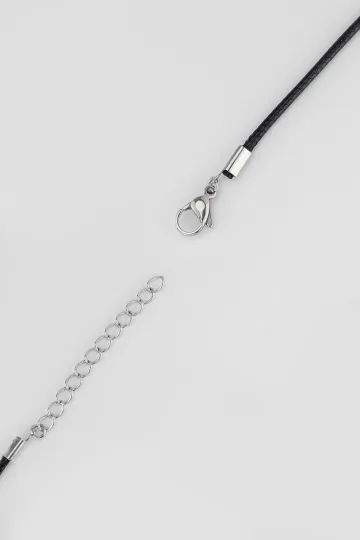
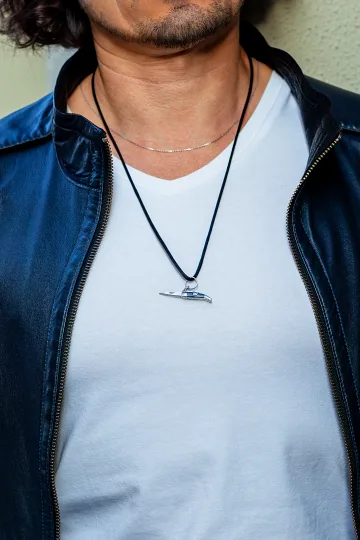
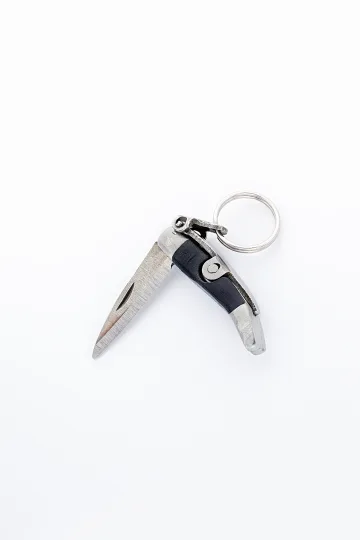
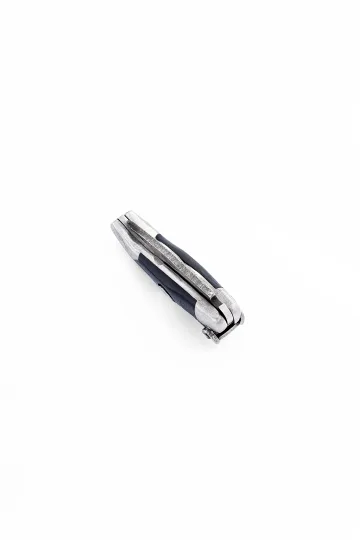
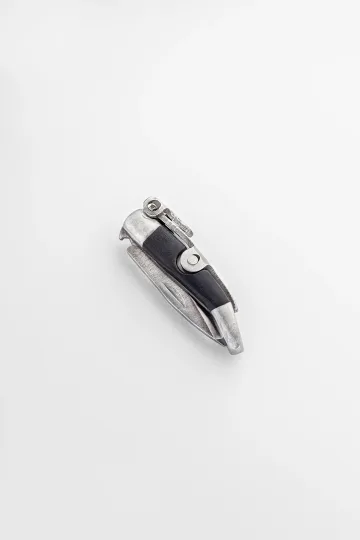
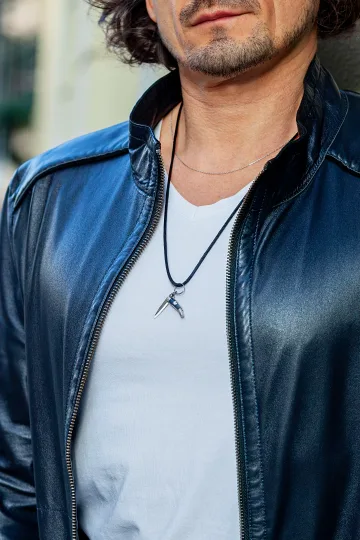
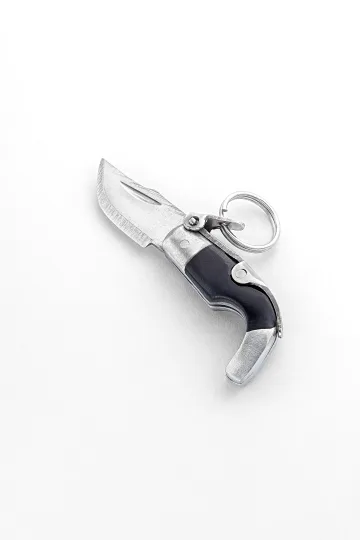
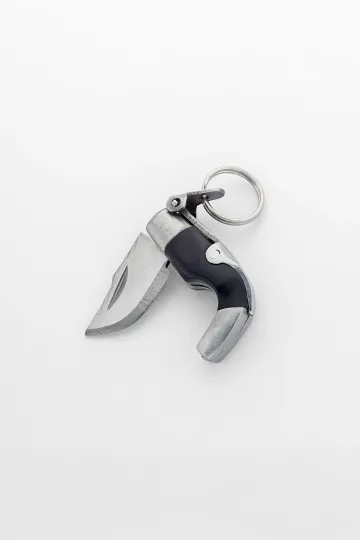
CAPAORA mini knife pendant
The 18th-century Spanish navaja in miniature: 40 mm of stainless steel, a real folding mechanism and a Palanquilla lock that clicks. An affordable gift to remember.
Authentic · Ships from Spain · 14-day returns
How to choose quartz for jewellery
Quartz is cheap, so any premium goes on the work and the setting, not on the stone. Here is what to look at to avoid a mistake.
- For clear quartz take a stone with no visible cracks or haze: against the light it should be clean, with sharp, well-polished facets. Small "veils" and bubble films inside are normal for quartz, but a large crack near the surface is a chipping risk.
- For milky quartz judge the evenness of the tone: a uniform, dense white with no grey patches or yellowness is the prize. The cabochon should be symmetrical, with a smooth dome free of nicks.
- For smoky quartz look at the evenness of the colour and ask about treatment. An over-black cheap morion sometimes turns out to be heated glass or heavily irradiated quartz; an even, warm smoky tone looks dearer than coal black.
- The cut matters more than the size. Quartz has low dispersion, so all the shine rests on the quality of the cut. Crooked facets and a cloudy polish kill the stone even on clean rough. Turn the piece under a lamp: well-cut quartz gives clean, even flashes across the whole table.
- Check the setting. Quartz chips along its fracture, so in a ring or a bracelet (where it knocks against corners) a bezel or semi-bezel setting is safer. Leave open prongs to earrings and pendants, which suffer fewer blows.
- Size is no argument for price. Large quartz is cheap precisely because there is so much rough. If a big "rock crystal" is priced like a precious stone, that is paying a premium for marketing.
Leave your email, we'll send your discount code. No spam, unsubscribe anytime.
The code arrives by email, valid on your first order.
How to tell quartz from glass and fakes
Quartz itself is rarely faked: it is cheap. More often glass or plastic is sold as rock crystal, and milky quartz is passed off as a more valuable stone. A few simple checks:
- Heat and weight. Quartz cools the hand and is heavier than glass of the same size. Plastic is light and warms up quickly from the palm.
- Hardness. Quartz (hardness 7) scratches glass but not the other way round. If "crystal" is easily scratched by a steel knife, it is most likely glass or plastic. Run the test on an inconspicuous spot.
- Bubbles. Glass often shows round gas bubbles and sometimes swirl lines from casting. In natural quartz the inclusions are of a different shape: needles, films, cavities of irregular geometry.
- Birefringence. Through clear quartz the outlines of text double slightly at a certain angle (a weak effect). Glass shows no doubling at all.
- Synthetic quartz is physically identical to natural: the same formula, hardness and optics. It can only be told apart by specific inclusions under a loupe or in a lab. It makes no difference to wearability or durability.
Care and wear
A hardness of 7 makes quartz suitable for everyday wear: it does not scratch from dust or most household surfaces. But it is brittle, so it fears blows and sharp temperature swings.
- Cleaning. Warm water, mild soap, a soft cloth or brush. Abrasive pastes and stiff brushes are not needed; they spoil the polish of the setting and can scratch the metal. Rinse off sea salt and chlorinated water with fresh water after a swim.
- Knocks. Do not drop it on a hard floor: because of the conchoidal fracture quartz chips. Take rings off when working with your hands.
- Sun. Smoky quartz and amethyst fade in bright sun, so do not leave them on a windowsill for long. Clear and milky quartz are light-resistant.
- Heat. Quartz tolerates moderate heat, but a sharp change of temperature can cause internal cracks, and strong heat lightens a smoky stone. Take jewellery off before a sauna.
- Storage. Keep it apart from other stones in a soft pouch or a compartment: a harder stone nearby will leave a scratch, and the quartz itself will scratch anything softer than a seven.
- Setting. The quartz itself is water-resistant, but a cheap setting can oxidise. A bezel setting protects the stone better during daily wear than open prongs.
Symbolism: briefly, and without promises
Various traditions have attributed many meanings to quartz: rock crystal was linked with clarity and purity, milky quartz with calm and motherhood, smoky quartz with steadiness and "grounding". In lithotherapy and esoterica you meet the idea that quartz "amplifies the energy" of other stones.
It is worth saying plainly: there is no proven physical or healing action behind these properties. Quartz does not heal, and it does not affect sleep, blood pressure or mood through "energy". The piezoelectric effect, so often cited, shows up in electronic circuits, not in contact between stone and skin. If a person feels better wearing a favourite piece, that is the normal psychological effect of the object itself, not a property of the mineral. Symbolism is best taken as cultural context and a reason to choose a stone you like, rather than as medicine.
Myths about quartz
A lot of legend has built up around quartz. Some of it rests on real properties, some on confusion. Let's sort it out honestly.
Quartz amplifies the energy of other stones. The idea grew out of the 1880 discovery of piezoelectricity, which esoterica translated into the spiritual plane. There is no measurable "amplification of energy" of a neighbouring stone. Quartz is convenient rather because it is neutral: it adds no colour of its own and looks good beside any stone.
The dearer the quartz, the "stronger" it is. The price of quartz is set by the work, the metal and the rarity of the particular specimen, not by "strength". In a silver piece the main cost is the metal and the labour, not the stone itself.
Milky quartz will become clear over time. The cavities of water and gas are frozen into the lattice for good. Milky quartz stays milky.
Smoky quartz is radioactive and dangerous. It got its colour from an ancient, gentle natural irradiation, but it does not emit anything at a dangerous level. It is safe to wear and store.
Natural quartz is always better than synthetic. Synthetic quartz is physically identical to natural: the same formula, hardness and optics. The difference is in origin, not in measurable properties.
Quartz must be constantly "cleansed of other people's energy". A mineral has no mechanism for "absorbing energy". Ordinary cleaning of dirt and dust is enough.
"Aura quartz" is a special magic stone. The rainbow sheen comes from the thinnest film of metal vapour-deposited onto ordinary quartz. It is a decorative surface treatment, not a rare variety of the mineral.
The psychology of choosing quartz
Quartz is rarely bought for status. More often it is chosen for a feeling, and there is a logic in that worth setting out.
Why clear stones attract us
Transparency reads as honesty and order: you can see straight through the stone, and it has nothing to hide. Psychologists connect the pull of clear, legible objects with a wish for control and calm. A clear quartz at the throat works as a small anchor for attention: a flash catches the eye, and for a second the wearer gathers themselves. There is no mysticism in it, only the ordinary physiology of how we respond to a bright moving object.
Milky quartz and the pull toward softness
A milky white tone carries associations with milk, snow and diffused light, and those images are settling ones. Milky quartz is often chosen by people who want an unshowy, quiet piece with no glitter and no statement in it. This is a stone bought for oneself rather than for the impression it makes on anyone else, and it suits the wardrobe of someone who dresses in linen and wool rather than in anything sharp.
Smoky quartz and the wish for steadiness
The dark warm tone of smoky quartz is described again and again with words like grounding and settling. Behind that lies ordinary colour psychology: dark earthy shades are read as heavy and stable, like soil underfoot. It is why smoky quartz is so often recommended as a grounding stone, though the whole effect rests on colour and personal association rather than on any property of the mineral. Understanding the mechanism does not spoil it, incidentally. The association still works even when you know where it comes from.
Send a friend a discount code, they save on their first order.
Facts that catch people out
Quartz is so familiar that people stop noticing it. And yet several things depend on it without which modern technology would not exist at all.
Quartz sets the pace of almost every clock
A thin plate of quartz under a voltage vibrates at a strictly defined frequency, usually 32,768 oscillations per second. The electronics count those oscillations and measure out exactly one second. That is why a quartz wristwatch or wall clock keeps better time than a mechanical one: its rhythm is set by a stone rather than by a spring. The same principle holds the clock frequency in phones and computers.
Sand, glass and microchips are also quartz
Most ordinary sand consists of quartz grains, because quartz is hard and survives weathering while softer minerals grind away into dust. Glass is melted from quartz sand, and silicon for microchips is grown from especially pure material. The stone in a jeweller's window and the processor in a laptop begin with the same mineral. The white sands of the Norfolk coast were quarried for centuries to supply British glasshouses for exactly this reason.
Quartz can strike a spark
Knock two pieces of quartz together in the dark and a faint light flares along the edges. The effect is called triboluminescence: fresh surfaces accumulate a charge as they fracture and rub, and it discharges in tiny flashes. The related piezoelectric effect is what makes kitchen lighters and the ignition on a gas hob work, and it is the same property that makes a quartz plate vibrate under a voltage.
Ice that does not melt was an ancient mistake
The classical idea that rock crystal was water frozen for good survived almost into the modern era. Disproving it was simple enough: real ice melts in warmth and rock crystal does not, and crystal is noticeably heavier than the same volume of ice. But the name stuck. The word crystal in every European language descends from the Greek for ice.
Most citrine on a counter was once amethyst
Natural yellow quartz is uncommon, so most citrine is produced by heating amethyst: heat destroys the violet colour centres and the yellow iron tone comes through. This is an old and honest practice rather than a fraud, but the fact remains that violet and yellow quartz are frequently the same stone before and after the furnace. If a citrine has an orange-brown cast concentrated at the tips, heat is almost certainly the reason.
One mineral, a whole rainbow of names
Amethyst, citrine, ametrine, rose, smoky, morion, prasiolite, aventurine, agate, onyx, carnelian and jasper are all quartz. Only the impurities, the grain size and the colour centres change; the formula SiO2 is the same throughout. Few minerals can transform themselves so completely while remaining exactly what they were.
Quartz loses its smoke in an oven
The smoky tone rests on fragile colour centres. Heat above roughly 300 degrees knocks them out, and a dark stone pales to colourless in a matter of hours. Nature does the reverse over millions of years under weak natural irradiation, and people simply speed the process in both directions: irradiation darkens, heat lightens. It is also the reason a smoky quartz should never go near a jeweller's torch during a repair.
Buying it as a gift? Each one arrives ready to give.
 A branded Zevira box and a little card come with every order.





Frequently asked questions
What is the essential difference between clear, milky and smoky quartz?
It is one mineral, silicon dioxide with a hardness of 7. Clear is pure, milky clouds over from microcavities of water and gas, smoky is coloured by colour centres formed under gentle natural irradiation. Composition and hardness are the same in all of them; only the appearance and the sun resistance differ.
Which type to choose for an everyday piece?
Clear and milky are versatile and do not fade, so they suit daily wear and lighter looks. Smoky is more expressive and striking in evening pieces, but should not be left long in bright sun.
Can you wear quartz in the shower and the pool?
The stone itself is water-resistant. The limit is in the setting: sterling silver and good gold tolerate water, while a cheap alloy can oxidise. After sea water, rinse the piece in fresh water.
How do you tell quartz from glass?
Quartz is colder to the touch and heavier than glass of the same size, scratches glass and is not scratched by it. Glass often shows round gas bubbles, which natural quartz does not have.
Why is quartz cheaper than many other stones?
Because of its abundance: quartz makes up around 12% of the Earth's crust and is mined in large volumes. The low price is a consequence of plenty, not of low quality.
Does smoky quartz really fade?
Yes. Bright sunlight gradually breaks down the colour centres and the stone lightens. That is why it is kept in the shade and not worn all day under direct sun.
What is "mystic" or "aura" quartz?
It is ordinary quartz with the thinnest metallic film vapour-deposited onto the surface, hence the rainbow sheen. The effect is only on the outside, so such a stone goes into a protective setting and is cleaned without abrasives, or the film rubs off.
How to clean quartz at home?
Warm water, a drop of mild soap, a soft cloth or brush. Abrasives, harsh chemistry and ultrasound are not needed for jewellery with cracks or inclusions.
Is smoky quartz dangerous because of "radiation"?
No. It received its dose in nature a very long time ago and does not emit it in any meaningful amount. It is a safe stone to wear.
The short version
Clear, milky and smoky quartz are one mineral, silicon dioxide with a hardness of 7 on the Mohs scale. Clear is pure, milky clouds over from microinclusions of water and gas, smoky is coloured by colour centres formed under gentle natural irradiation. Care is simple: gentle cleaning, protection from knocks, and for smoky, from bright sun too. The symbolism of various traditions can be kept in mind as cultural background, but the stone is best chosen by its look, its colour and how it sits in a piece, because that is what is real and verifiable in quartz.
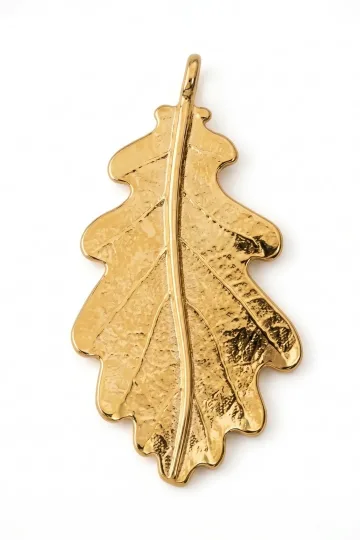
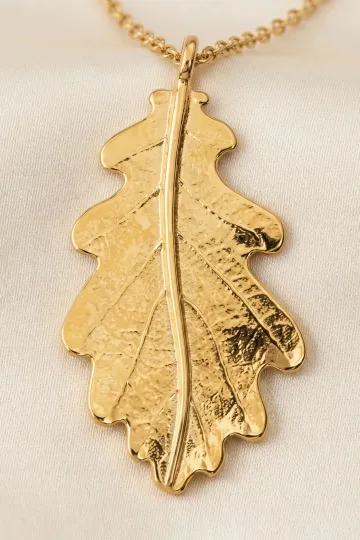
Wear the symbol, don't just read about it. These are in stock:

About Zevira
The Zevira jewellery collection is built around the history and nature of stones. We choose materials and settings so that a piece serves for a long time and looks good every day.
If quartz is to your taste, clear, milky or smoky, take a look at the setting in which it comes alive in our catalogue.