Isis, Egyptian Goddess: Jewellery with Her Symbols
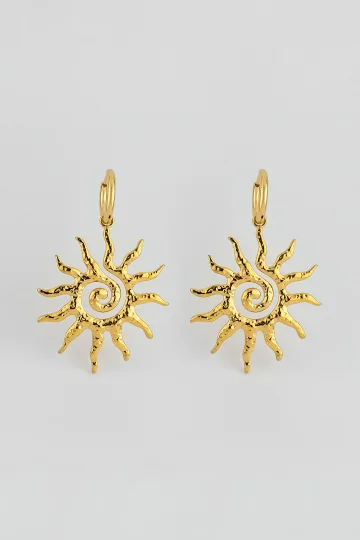
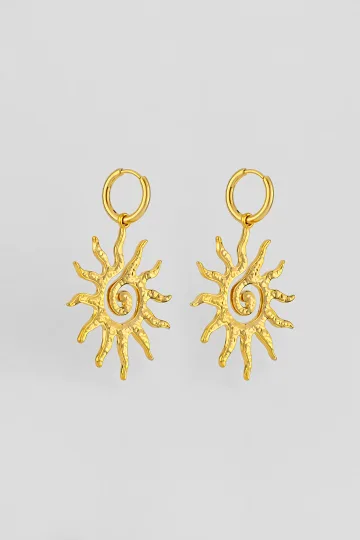
Wear the symbol, don't just read about it. These are in stock:




Introduction
Egyptian symbolism has endured in jewellery longer than most modern nations have existed. The first faience amulets were strung around necks in the Old Kingdom, roughly five thousand years ago. Since then the world has cycled through dozens of religions, languages, and technological eras, yet the winged goddess with a throne on her head, the scarab beetle, and the ankh loop continue to appear in jewellers' workshops, museum display cases, films, and on fashion runways. It is one of the rare instances where a visual language has outlived the civilisation that produced it and gone on functioning.
The reason for this longevity is straightforward. The Egyptians arrived very early at a set of forms in which an idea is grasped at a single glance: falcon, jackal, cat, solar disc, throne, beetle, knot. These images require no caption. A person with no background in ancient history can identify an ankh as "something Egyptian" and read the scarab silhouette immediately. Jewellery, where a piece must work at a distance, prizes exactly this kind of symbol.
There is an important distinction between a museum replica and a living jewellery interpretation. The replica copies the original: form, proportions, hieroglyphs, even stylised cracks. It is beautiful, but it functions like a costume rather than an ornament. A living reading takes the Egyptian motif and adapts it to a contemporary hand, neck, or shoulder, to how a person actually looks in 2026. Such a piece does not shout "Egypt"; it is simply beautiful, and the history lives in a second layer for those who know how to look.
One thing deserves to be said plainly at the outset. In antiquity Egyptian amulets were considered operative. They were placed in mummies, used in healing, worn to protect children from illness. We will not echo advertising copy claiming that a scarab "brings luck" or an ankh "grants the energy of eternal life." That would be untrue both to the Egyptians themselves, whose religious system was far more complex, and to the modern wearer who does not need mythology sold to them. Egyptian jewellery today functions as a cultural and aesthetic choice: an interest in history, in myth, in the beauty of a particular visual tradition. Nothing more, nothing less. That is sufficient for such a piece to carry real meaning.
In this article we examine which Egyptian gods most often appear in contemporary pendants, how the scarab and ankh are structured, why the nineteenth century was gripped by Egyptomania, and how to wear such a piece in daily life without it becoming a theatrical prop.
Egyptian God Jewellery: What to Choose
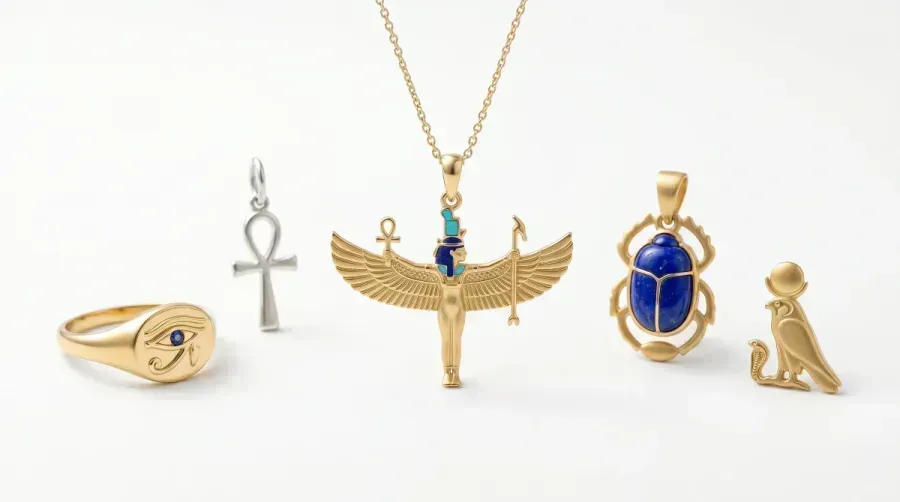
The Egyptian range in jewellery is broad. The most common format is the amulet pendant: a flat or slightly modelled drop bearing the figure of a deity, a scarab, the Eye of Horus, or an ankh. Worn on a long chain so the amulet falls to mid-chest, or on a shorter one for a collarbone accent, the pendant works as a solo piece. It usually needs nothing beside it; the symbol builds the look on its own.
Rings with Egyptian motifs fall into two large groups. The first is cartouche rings, where an oval plaque carries engraved hieroglyphs, most often the owner's name rendered in the Egyptian alphabet. The custom goes back to the nineteenth century, when European travellers to Egypt commissioned personal cartouches in Cairo as mementos. The second group is scarab rings, where the beetle sits on the band as a sculptural element in its own right. Historically worn by both men and women, the scarab often served as a signet seal.
Earrings with an ankh form a quietly distinct genre. A small ankh at the earlobe reads as a geometric mark, barely declaring its Egyptian origin. This suits anyone who wants the symbol without theatrics. Larger earrings bearing the figure of Isis, Bastet, or the Horus falcon are louder and call for calm clothing beside them.
Brooches in Egyptian style are rare, but when they appear they tend to reference the Art Deco of the 1920s: winged scarabs, deities in profile, pectoral-shaped pieces with symmetrical spread wings. Such brooches settle well on a heavy lapel or the collar of a coat, functioning as a small painting on cloth.
Leather cord pendants occupy a separate register, which might be called "archaeological." Metal with leather cord rather than a fine chain immediately evokes excavation, the idea of a found object, of rough handwork. It is a masculine and unisex option, wearing well over a white shirt or a linen vest.
Finally, Egyptian-style cuff bracelets: a wide flat band engraved with hieroglyphs, deity figures, or lotus ornament. A bold piece requiring an open wrist and a quiet upper body, but producing a very expressive silhouette. Such bracelets frequently appear as paired jewellery, when a couple takes matching cuffs engraved with their names in cartouches.
Anubis belongs in black silver, never in gold. A gilded jackal is fancy dress, and I will not argue it.
What to Wear It With
Over years of styling, an Egyptian piece has passed through dozens of looks in my hands. It is loud and instantly read, so the whole trick is keeping everything around it quiet. Here is what actually works, occasion by occasion.
What do I wear an Egyptian amulet with every day? For daily wear I recommend a small sign: an ankh, an Eye of Horus, or a little scarab sitting at the collarbone. Under it I suggest plain knitwear, a white shirt, or a linen tee with no print. An open neckline gives the figure room; under a high collar I choose a longer chain so the pendant rests on the fabric instead of hiding beneath it.
Does an Egyptian symbol work at the office? It does, as long as you keep it restrained. I recommend ankh studs the size of a grain or a cartouche ring: the hieroglyphs read only up close, and to everyone else it is tidy geometry. One rule I hold to: one Egyptian accent per look. If Isis is at the neck, I keep the earrings neutral.
How do I build an evening look around a deity figure? For evening I choose a larger figure: Isis with open wings, or Bastet. I suggest a smooth dark top, black or navy, where the metal and enamel act as the single spot of colour. An open neckline carries that figure best, and I pick the chain length to match it.
How do I mix metals and stones with it? I do not mix them. The Egyptian line keeps to itself: gilt to gilt, silver to silver. Lapis and carnelian in the figure already bring colour, so I recommend leaving the rest of the jewellery stoneless. Stacks of bracelets and layered chains fight the motif; it needs its own space.
Who does the Egyptian look actually suit? Anyone who likes a clear, graphic shape and is not afraid of a piece that sets the tone for the whole outfit. I choose a fine gilt-silver chain for a formal, museum register, and a leather cord for an archaeological, more masculine one. Two rules that never fail: pick the length to suit the neckline, not the other way round, and never wear more than one Egyptian symbol at once.

Turn on your camera, pick earrings, a pendant or a ring, and see the piece on yourself in real time.
Switch items in one tap.
Everything runs in your browser: no photo or video is ever uploaded.
Isis: Mother, Wife, Goddess of Magic
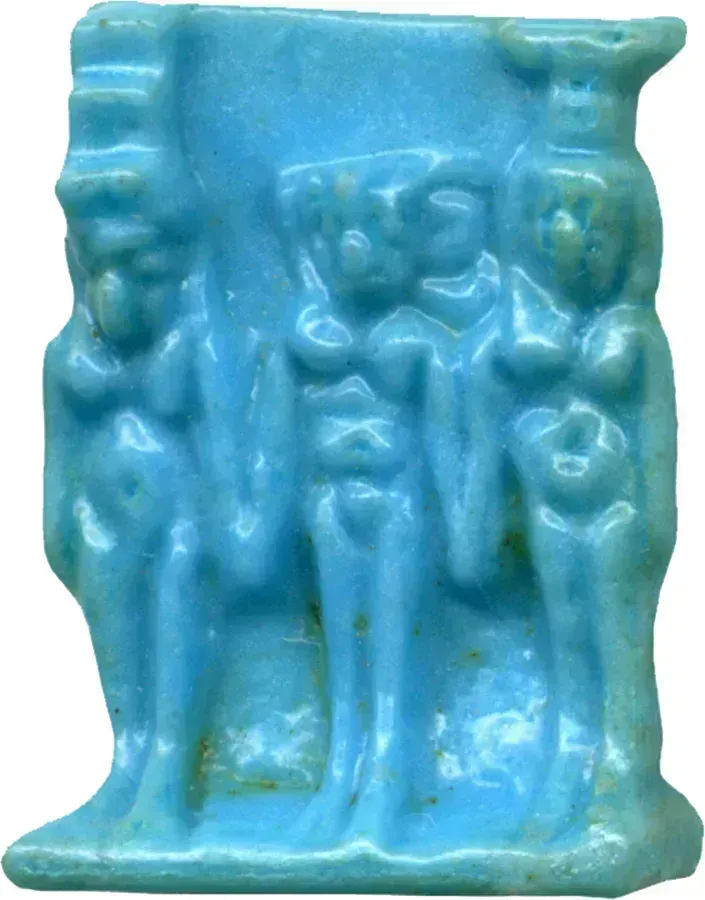
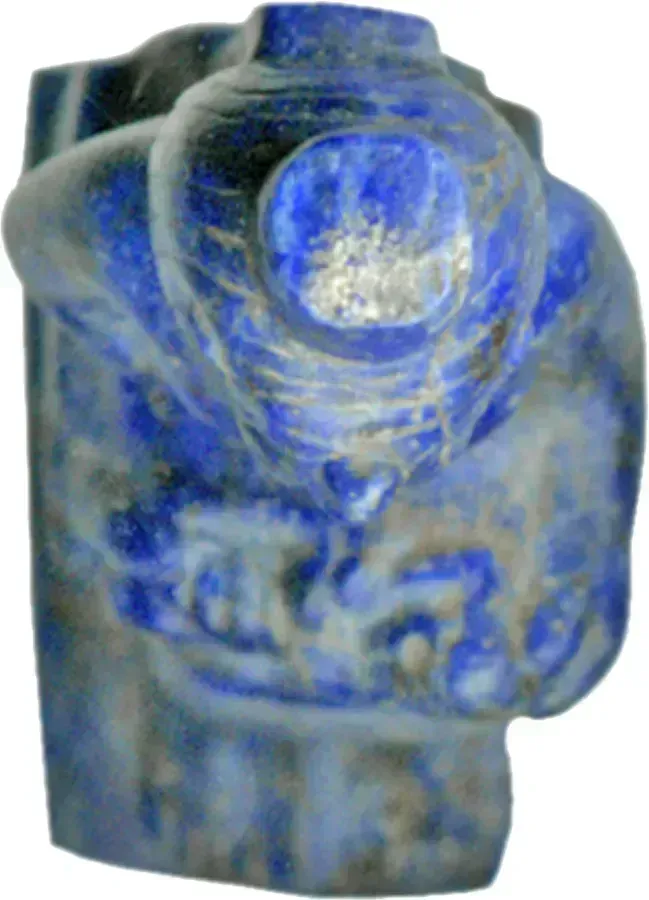
Isis is the principal female figure in the Egyptian pantheon and arguably the most important goddess in the history of the Mediterranean world. Her name in Egyptian sounded approximately like "Aset," meaning "throne." This is why she is depicted with the throne hieroglyph on her head: it is not a headdress, it is literally her name written on her crown. For an Egyptian who could read hieroglyphs, the image of Isis was self-labelling.
Her myth is known to anyone who has opened a book on Egyptian religion. Isis is the wife of Osiris, the divine king, who is murdered and dismembered by his brother Set, the god of chaos. Isis gathers her husband's body piece by piece, briefly restores him to life, conceives their son Horus, and hides the child in the reed marshes to protect him from Set. Horus grows up, avenges his father, becomes the rightful king. Osiris remains lord of the underworld. In this story Isis is the one who holds the world together when the men around her are occupied with war, death, and competing claims.
She was called "the great in magic," meaning one who knows the hidden arts. In Egyptian texts Isis tricks the true name of Ra from him and through this gains power over the cosmos. Her tears shed for Osiris were held to cause the annual Nile flood: the waters rise, the earth revives. For an agricultural civilisation that lived from one inundation to the next, this was not a poetic metaphor; it was an explanation of why the harvest existed at all.
The cult of Isis spread far beyond Egypt. Under the Ptolemies, when the country was ruled by Greek-Macedonian kings, Isis became an international deity. Her temples were built in Greece, Asia Minor, and across the island world. In Rome her cult was sufficiently powerful that emperors alternately banned and permitted it. In Pompeii a complete temple of Isis survived with its paintings and sculpture, destroyed by the eruption of Vesuvius in AD 79. The last temples of Isis operated into the fourth century, until the Christian empire finally closed them. She was, in practice, the last pagan goddess of the ancient world.
In Britain, the cult of Isis had reached London itself: a dedicatory plaque to Isis was found near the Thames at what is now Southwark, and the British Museum holds significant Isiac objects from across the Roman provinces. The Victorian Egyptomania of the nineteenth century, after the decipherment of hieroglyphs in 1822 and the mass publication of Napoleonic survey drawings, placed Isis firmly in the visual imagination of Britain and the Empire, a presence that fed directly into the jewellery and decorative arts of the period.
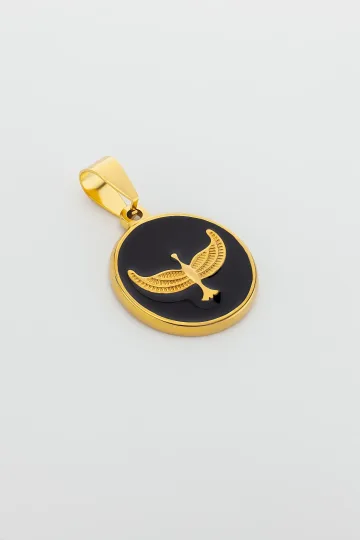
In jewellery Isis appears in several settled compositions. The first is standing with wings outspread, the image of a protector with wings as an embrace. Such pendants are usually large with carefully rendered feathers, sometimes enamelled. The second is seated with the infant Horus on her lap, a pose that Christian iconography later adopted for the Virgin and Child, a parallel that historians of religion have long debated. The third reduces her to the throne hieroglyph alone on her head. The fourth, and most understated, is the Tyet knot, also called the Knot of Isis or the Blood of Isis: a red amulet in the shape of a loop with arms folded down. Placed in mummies for protection in the afterlife, it now appears as a minimalist pendant for those who want an Egyptian symbol without the full figure of the goddess.
Customer reviews
Zevira is a real jewellery shop. Genuine payments, deliveries and customer thank-yous.
🥰🥰🥰 gracias

Ok, ¡gracias! 🙂

Anubis, Horus, Ra, Thoth, and the Other Gods
Anubis
Anubis with the head of a jackal, or black dog (Egyptologists still debate the exact species), is one of the most recognisable figures in the pantheon. His work was embalming and escorting the dead to the afterlife. In Egyptian belief he weighed the deceased's heart on a scale against the feather of Ma'at, goddess of truth. If the heart was lighter than the feather, the soul passed on; if heavier, it was devoured by the monster Ammit.
In jewellery Anubis is almost always shown in profile, with a sharp muzzle and long ears. The material is usually dark metal or black enamel, sometimes with gold details on the collar and staff. Pendants featuring Anubis are often chosen by people drawn to themes of memory, legacy, and engagement with the past. In a contemporary frame this is not an amulet of the underworld but an image that speaks to meeting the past with dignity.
Horus
Horus the falcon, son of Isis and Osiris, heir to the kingdom, was the king himself: pharaohs on earth were considered his incarnation. His chief attribute is the Eye of Horus, known as the Wadjet: a stylised eye with a characteristic "tear" mark and a curved line beneath it. By myth, Set tore out Horus's eye in combat, and Thoth restored it. The Wadjet therefore became a symbol of wholeness, restoration, and completeness.
The Eye of Horus is one of the most frequently encountered Egyptian symbols in contemporary jewellery. It appears as flat pendants, earrings, and bracelet charms. Horus as a full falcon with a pharaoh's crown is less common, usually appearing in more elaborate Art Deco-influenced work.
Ra
Ra is the solar deity, and for a long period of Egyptian history the supreme god. He is depicted as a man with a falcon's head and a solar disc, or sometimes as a scarab rolling the sun across the sky. In myth Ra crosses the sky each day in his solar barque, descends into the underworld at night to fight the chaos-serpent Apophis, and is reborn again on the eastern horizon at dawn. This is a very ancient scheme explaining why the sun appears each morning.
In jewellery Ra is most often reduced to the winged solar disc or to rays of light. This is a powerful graphic form that works well on large pendants and medallions.
Thoth
Thoth is the god of writing, calculation, time, and wisdom. He appears with the head of an ibis or as a baboon. In myth he invented hieroglyphs and taught humanity to write. In the Hall of Two Truths he records the result of the heart weighing. The Greeks identified Thoth with Hermes, and the late-antique tradition produced the figure of Hermes Trismegistus, from whom the entire European hermetic and alchemical literature descends.
Thoth appears rarely in jewellery, but vividly when he does: typically as a seated ibis or a baboon with a scroll and a feather. Pendants with Thoth are often chosen by people who work with text, scholarship, or archives: a symbolic gesture, a cultural reference, not a magical claim.
Other Deities
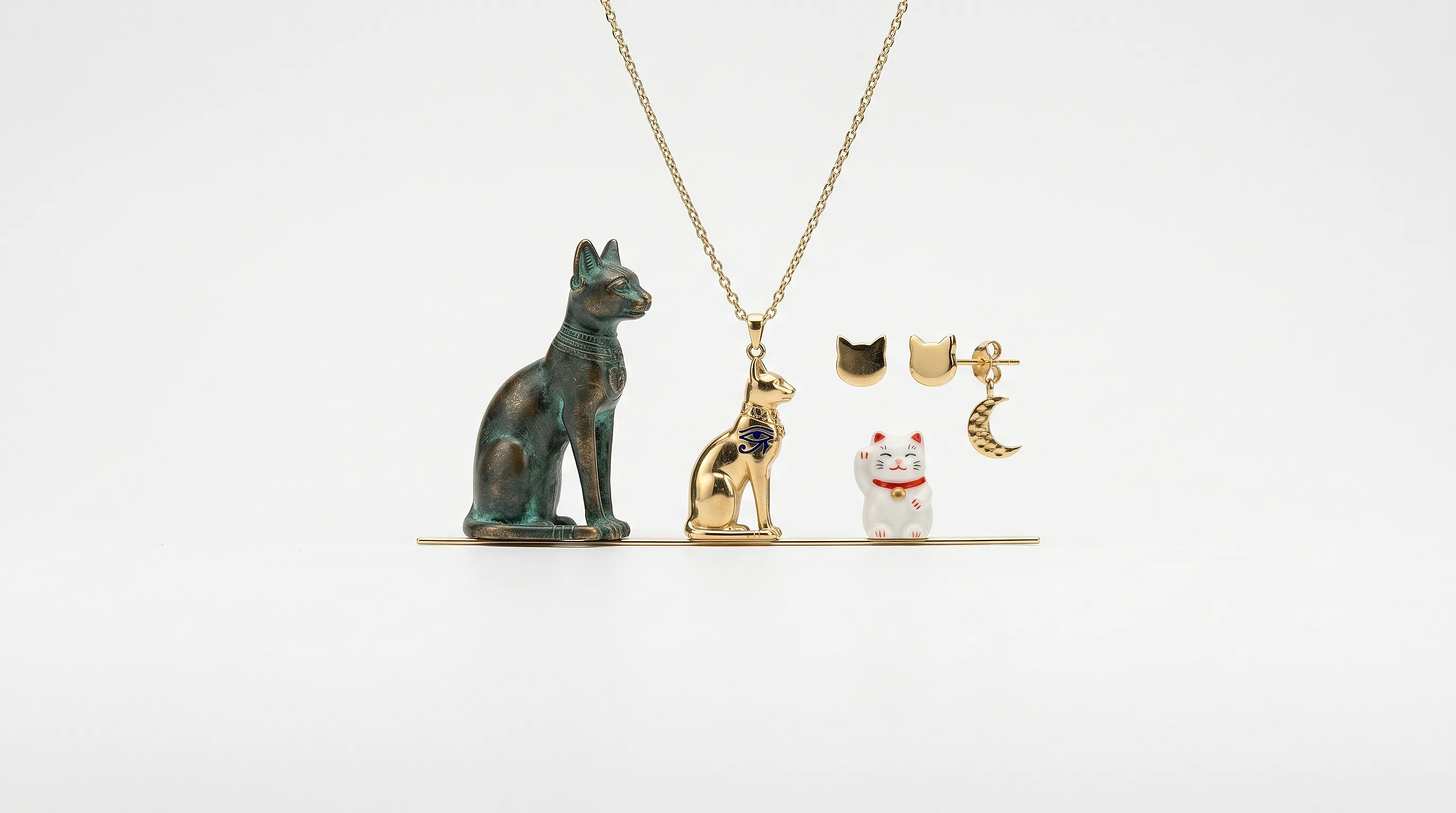
Beyond the four principal figures, others appear regularly. Bastet, the cat-headed goddess, patroness of the home and domestic life, one of the most approachable figures in the pantheon, is popular in pendants and brooches. Her cult is rich enough to warrant its own treatment: see the dedicated piece on Bastet, the cat goddess, in jewellery for how the domestic cat became a sacred motif and what a Bastet pendant carries today. Sekhmet, her fierce counterpart with a lioness's head, goddess of war and healing (in Egyptian logic one and the same domain), produces a stronger image. Ptah, god of craftsmen and artisans, patron of Memphis, depicted as a tightly wrapped figure holding a sceptre, is often chosen by jewellers and makers as their own patron. Nephthys, Hathor, and Ma'at also appear in contemporary work.
Upload a photo of your pet, someone you love, or an object. We'll build a 3D model and hand-cast it in pewter.




Scarab and Ankh as Independent Symbols
The scarab and ankh have moved so far beyond their Egyptian context that they now operate as autonomous international symbols. Many people wear them with no particular connection to Egypt, simply because the forms are beautiful and immediately recognisable.
The scarab is the dung beetle, Scarabaeus sacer in Latin. The Egyptians observed how it rolls a ball of dung, deposits its eggs inside, and later new beetles emerge from the dry sphere. For them this was a perfect metaphor for birth from nothing, for renewal, for the morning sun rising from the nothingness of night. The god Khepri, the dawn aspect of the sun, was depicted as a beetle or as a human with a beetle for a head. Scarab amulets were worn by the living and placed on the chests of the dead, over the heart, as insurance for the correct outcome at the afterlife tribunal.
The most celebrated scarab in history is the large pectoral from Tutankhamun's tomb, uncovered by Howard Carter in 1922. At its centre sits a winged scarab carved from a piece of rare Libyan desert glass, formed, according to modern geologists, by a meteorite impact approximately twenty-nine million years ago. The pharaoh wore a substance that had arrived from space on his chest, a fact that not a single person alive at the time of its making could have known.
The ankh is a loop with a crossbar and a vertical stem: the hieroglyph for "life." In Egyptian art gods hold the ankh when granting the pharaoh the breath of life, touching the loop to his nose. Pharaohs carry the ankh as the sign of their role as intermediaries between the divine and human worlds. The form proved so stable and graphic that it has passed through millennia virtually unchanged.
One confusion is worth addressing directly. The ankh is not a Christian cross. Visually they resemble each other, especially the Coptic cross with its loop at the top, and there is an old hypothesis connecting the Coptic form to the Egyptian ankh; but direct derivation has not been established. The Christian cross derives from a Roman instrument of execution; the ankh derives from Egyptian writing. They are two independent traditions. Wearing an ankh means wearing the Egyptian hieroglyph for life, not a variant of the cross.
Both the scarab and the ankh now live a second life as freestanding jewellery motifs. They are worn across cultures, religions, and generations. This involves no disrespect to Egypt: like the Greek meander or the Roman laurel, these symbols long ago became part of the common visual inheritance of Mediterranean civilisation.
CAPAORA mini knife pendant
The 18th-century Spanish navaja in miniature: 40 mm of stainless steel, a real folding mechanism and a Palanquilla lock that clicks. An affordable gift to remember.
Authentic · Ships from Spain · 14-day returns
What Egyptian Jewellery Symbolises
If Egyptian ornament is broken into its semantic components, the list reads something like this. Protection from unseen threats, illness, the evil eye. Eternity as the proposition that life does not end with the death of the body but continues in another form. Passage between earth and sky, between life and death, between the human and the divine. Connection to gods as the source of order in the world. Royalty, because many symbols belonged first and last to the pharaoh and his family.
These are historical meanings: what the Egyptians believed three, four, and five thousand years ago. They held that the amulet genuinely protected, that the scarab genuinely helped the heart pass the tribunal, that the ankh genuinely conveyed life. For them this was operative magic, as real as food, water, or weather.
The modern wearer of Egyptian jewellery stands in a different position. They may know all of this by heart and yet wear the piece not for operative magic but for meaning, for aesthetics, for cultural connection. That connection is to the history of humanity itself, to one of the oldest civilisations on record, to the idea that beauty and thought outlive their authors. It is an interest in mythology, in archaeology, in a particular visual tradition. It is an aesthetic choice: Egyptian line is graphically very strong and works in almost any setting.
We do not promise that a piece with Isis will bring maternal strength, or that a scarab will deliver renewal. To do so would be dishonest. But we say this: such a piece carries a dense cultural layer, and that layer is real. It will tell stories, provoke questions, and remind its wearer that the world is older and richer than the view from any given window on any given morning.
History of Egyptian Jewellery
The history of Egyptian jewellery divides into three great eras and three waves of revival, and it is useful to separate them, because every contemporary pendant with Isis sits somewhere on this timeline.
The first era is ancient Egypt itself. Jewellery began there very early. In the Old Kingdom, the third millennium BC, the Egyptians made amulets from faience, a ceramic with a blue-green glaze. Blue and green were the colours of life and growth, the colours of the Nile and the sky. In the Middle Kingdom, the second millennium BC, techniques grew more elaborate: complex pectorals appeared with cloisonne inlays, each cell of metal filled with coloured stone or glass. In the New Kingdom, from the sixteenth to the eleventh century BC, Egyptian jewellery reached its peak. Most pieces found in the tomb of Tutankhamun, who died around 1323 BC and was discovered by Howard Carter after 1922, belong to this period. Winged scarabs, pectorals with deities, gold and lapis lazuli masks, cartouche signet rings: a living jewellery language developed a thousand years before the Common Era.
The second era is Hellenistic and Roman Egypt. After Alexander the Great's conquest in 332 BC the country was ruled by the Ptolemaic dynasty until the death of Cleopatra VII in 30 BC. Egypt then became a Roman province. Jewellery of this period blends Egyptian motifs with Greek and Roman ones. Isis became an international goddess, her image appearing in Roman villas and urban temples. Egyptian motifs, the scarab, the cat, the ankh, gradually shifted from local symbols to a common Mediterranean fashion worn from Britain to Syria.
The third era is a long pause. With the closure of pagan temples in the fourth century and the Arab conquest in the seventh, ancient Egyptian religion effectively disappeared. Hieroglyphs ceased to be read. Europe knew ancient Egypt from fragments in Greek authors and from antique statuary brought to Rome.
The first wave of revival followed Napoleon's Egyptian campaign of 1798. The expedition returned with vast quantities of drawings, measurements, descriptions, and with the Rosetta Stone, which carried the same text in three scripts. In 1822 Jean-Francois Champollion deciphered hieroglyphs, and Europe could read Egyptian texts for the first time in roughly fifteen hundred years. Egyptomania gripped the continent. Jewellers in Paris, London, and Rome produced brooches with scarabs, rings with cartouches, earrings in the form of lotus flowers. This wave lasted the entire nineteenth century and fed Victorian Britain in particular: Egyptian motifs appeared across jewellery, architecture, and the decorative arts, reaching as far as estate jewellery that turns up at auction today.
The second wave was the discovery of Tutankhamun's tomb in 1922. When Howard Carter broke the sealed door and saw "wonderful things," as he wrote in his diary, the world lost its mind. Newspapers printed photographs of the gold mask, the pectoral with the winged scarab, the chariots and thrones. The jewellery of the 1920s, already working in the Art Deco idiom, immediately absorbed Egyptian aesthetics into a new language: geometric wings, stylised lotuses, black and gold contrasts. Art Deco Egyptomania is one of the strongest jewellery movements of the twentieth century.
The third wave is the current one. It has been building since the late twentieth century and now works with the inheritance of both previous waves. Contemporary jewellers do not copy the nineteenth century or the 1920s; they take Egyptian motifs and render them in a minimal, graphic, clean form suited to everyday wear. The scarab loses its ornateness, the ankh becomes slender geometry, Isis is reduced to a winged silhouette. This is the third renaissance of Egyptian jewellery, and it continues now.
Leave your email, we'll send your discount code. No spam, unsubscribe anytime.
The code arrives by email, valid on your first order.
Materials and Techniques
The Egyptians established a very clear material logic for their jewellery, and that logic is still legible in contemporary work.
Gold they called "the flesh of the gods." Divine beings were believed to have golden skin, silver bones, and lapis lazuli hair. Therefore the principal sacred objects, pharaonic masks, pectorals, deity figurines, were made from solid gold. Reproducing that density in modern jewellery is prohibitively expensive, so the usual approach is gold-plated silver or vermeil. This gives the same gold surface without the extraordinary cost or weight. For a daily-wear amulet this is the optimal balance.
Lapis lazuli, the dark blue stone with gold pyrite inclusions, was not local to Egypt: it was brought from Afghanistan, from what is now Badakhshan province, thousands of kilometres away. It was one of the most costly materials, comparable to gold itself. The blue of lapis was associated with the sky, with night, with the hair of the gods. Today lapis lazuli remains a frequent companion to Egyptian motifs, especially with gold-plated silver.
Turquoise, the blue-green stone from the Sinai Peninsula, was associated with Hathor, patroness of love and of the mines. Turquoise and its ceramic analogue, Egyptian blue faience, produced the characteristic Egyptian hue that is recognised instantly. In contemporary jewellery the role of faience is often played by cloisonne enamel, where metal partitions create cells filled with coloured pastes fired to a glassy surface. This technique yields durable colour that does not fade or scratch, as faience once did not.
Carnelian, the red-orange stone, was associated with blood, life force, and protection against evil. Red amulets were placed on the body of the dead. In contemporary jewellery carnelian is often set into cartouches and deity figures as an accent.
Enamel as a technique continues the Egyptian idea of "coloured stone in a metal setting" but makes it accessible. A contemporary pendant with Isis may have enamelled wings in four or five shades of blue and green: a direct descendant of the ancient Egyptian tradition.
Hieroglyph engraving is a separate craft, particularly important for cartouche rings. The engraver cuts the signs by hand or with a machine, observing the proportions and direction of each glyph. Egyptian hieroglyphs always "face" the beginning of the line: if a bird sign faces right, the text reads right to left. A skilled jeweller knows this and does not produce grammatical errors in a ring the owner will wear for life.
Chasing is used for wings and feathers. A sheet of metal is worked with hammers over a form to produce a supple, slightly undulating relief, like the surface of a real feather. Wings on figures of Isis and Nephthys worked in this way have a living, breathing quality that casting cannot achieve.
How to Wear
An Egyptian piece requires some attention to what surrounds it. Without that attention a beautiful object can easily slip from ornament into costume.
The basic rule: one Egyptian accent per look. If the necklace carries Isis, keep the earrings neutral, geometric, without Egyptian motifs. If the finger carries a cartouche ring, there is no need to add a scarab bracelet and ankh earrings. One symbol reads; three begin to function as fancy dress.
An amulet on a long chain falling to mid-chest works as the primary accent. The clothes beneath it should be plain, without print or excess hardware. A plain-coloured jumper, a white shirt, a simple vest, an unembellished dress. The chain itself should be fine and quiet so it does not compete with the deity figure.
A cartouche ring is more self-contained and suits daily wear easily. The hieroglyphs are visible only at close range; to most observers it reads as an attractive engraved ring. It sits best on the middle or ring finger; on the little finger the cartouche is typically too long for the phalanx. The same logic of encoded personal information connects cartouche rings to initial and monogram jewellery: both read as a private cipher.
Ankh earrings work at a quiet intensity. A small ankh at the earlobe, an almost invisible mark, suits the office, the university, any context where one does not want to announce "I am wearing an Egyptian symbol." Larger earrings with deity figures suit evening wear or compositions with an open neckline.
Combining several Egyptian motifs only makes sense when the entire composition is built around that theme: a costume event, an Egyptology lecture, a deliberately constructed outfit. In that case keep the clothes absolutely plain and remember that the line between intention and pageant is never far away.
The chain or cord changes the register. A fine chain in gold-plated silver reads "Byzantine": refined, museum-adjacent, slightly formal. A leather cord reads "archaeological": rougher, more masculine, closer to the idea of a found object. A close-linked curb or wheat chain reads "contemporary": the Egyptian motif is presented as design, not as an allusion to antiquity.
Ankh, scarab, Isis, Horus, Anubis in silver and gold plating.
Send a friend a discount code, they save on their first order.
Who It Suits
Egyptian jewellery is a fairly specific choice, and it is more honest to say at the outset who it suits and who it does not.
It suits people with a genuine interest in history and archaeology. If someone reads books on Egypt, watches documentaries, has been to Cairo or wants to go, a piece with Isis or a scarab extends that interest into wearable form. They will know what they are wearing, and that knowledge adds to the value of the object.
It suits lovers of symbolic jewellery in general. Some people do not wear "simply beautiful"; they need the piece to mean something. The Egyptian pantheon offers one of the richest sets of meanings in world culture. Related territory includes the lauburu, the Basque symbol, the Venus symbol, the dragon, and other cultural signs.
It suits students and academics in Egyptology, religious studies, and history. For them such a pendant becomes a small professional marker, a reminder of the subject they work with. The same applies to writers and artists working with Egyptian material.
It suits travellers for whom an image matters as a brought-back object. Someone returning from Luxor or Alexandria who wants to hold that journey physically: an Egyptian amulet becomes a materialised memory. Cartouche rings ordered with one's own name work especially well in this role.
It suits as a gift. Isis for someone interested in history or mythology; Anubis for someone absorbed in archaeology; a scarab for a parent who loves museums. These are gifts that do not stay in drawers; they tend to find their way into daily wear.
It does not suit those in search of an operative magical talisman. We will not mislead: if someone wants a piece that genuinely protects, brings money, or helps in love, Egyptian jewellery will not play that role. It did so for ancient Egyptians within their religious system, but not for us. If "magical action" is what is needed, that requires a different address.
It also does not suit those for whom the aesthetic is simply alien. The Egyptian line is very legible; it is difficult to soften it. If someone prefers only neutral, abstract, minimalist forms without cultural reference, an Egyptian piece will feel like interference.
Frequently Asked Questions
Is the ankh a Christian cross?
No. The ankh is the Egyptian hieroglyph for the word "life." It predates Christianity by thousands of years and has no direct connection to the Christian cross. Visually they resemble each other, particularly the Coptic cross with its loop at the top, and there is an old hypothesis about the ankh's influence on the Coptic form, but this remains a matter of scholarly discussion and is not established. The Christian cross derives from a Roman instrument of execution; the ankh derives from Egyptian writing. Two independent traditions. When you wear an ankh you wear the Egyptian sign of life, not a variant of the cross.
Does the "curse of Tutankhamun" attach to jewellery bearing his symbols?
No, and this is one of the most durable journalistic myths of the twentieth century. When Howard Carter's team opened the tomb in 1922, several participants died in the following years, mostly of natural causes. Newspapers turned this into a story of a curse killing all who disturbed the tomb. Statistically the mortality among expedition members was entirely ordinary for an era without antibiotics. No "curse inscription" appeared on any object in the tomb; the claim was invented. Wearing jewellery with Tutankhamun motifs carries no metaphysical risk of any kind.
Can Christians wear Egyptian symbols?
This is a question of personal conscience and personal theology, not one for jewellers or archaeologists to answer. From the standpoint of religious history, the ancient Egyptian cult ceased to exist more than fifteen hundred years ago. There is no living Egyptian religion in which the ankh or Isis are objects of active worship. They are historical artefacts, comparable to Greek or Roman antiquity. Many Christians wear Greek meanders, Roman laurel wreaths, and Celtic knots without discomfort. Egyptian symbols differ in no relevant way. If someone feels inner unease, that is their right, and no one is obliged to argue them out of it.
Which deity suits a woman, which a man?
In ancient Egypt there was no rigid gendered allocation of amulets. Men and women wore the same symbols. In contemporary jewellery a social convention, not a religious rule, has developed: Isis, Bastet, and Hathor are more often chosen by women; Anubis, Horus, and Ra more often by men. The scarab and ankh are universal. But this is habit, not prescription. A woman with Anubis at her throat or a man wearing Isis is historically entirely correct.
Does the scarab bring luck?
In ancient Egyptian culture the scarab was indeed considered a protective amulet linked to renewal and the morning sun. "Brings luck" is a simplified modern translation of that idea. No scientifically confirmed effect attaches to the scarab, any more than to any other amulet. If an advertisement claims that a jewelled scarab "guarantees luck in money and love," that is marketing, not history or science. The scarab is beautiful, it carries a substantial cultural layer, and that is sufficient reason to wear it. Everything else belongs to the personal belief of the wearer, to which no external promise can add anything.
"Ra" or "Re": which is correct?
Neither is strictly accurate. The Egyptian language recorded only consonants in writing; vowels were not indicated. The sun god's name was written with two signs, conventionally read as "r" and an aleph, a glottal stop. Modern Egyptologists supply vowels for convenience, following a tradition established in the nineteenth century, and arrive at "Ra." German Egyptology tends to write "Re"; English-language scholarship generally writes "Ra." How the word actually sounded three thousand years ago is unknown and likely unknowable. Both forms are acceptable; "Ra" is simply more familiar in English.
About Zevira
Zevira is a Spanish jewellery brand based in Albacete. The Egyptian symbolism line, covering Isis, ankh, scarab, Anubis, and Horus, is one of the categories in the catalogue. Current availability and details are in the catalogue.
Buying it as a gift? Each one arrives ready to give.
 A branded Zevira box and a little card come with every order.















Conclusion
Thousands of years ago people wore the scarab on their chests in the full conviction that it would help their heart pass the judgement of the dead. They believed this as surely as we believe in a weather forecast or a train timetable. For them it was a functioning part of reality, as certain as bread or water. We wear the scarab today in a different way: as a beautiful object with a long history, as a reminder of a civilisation that took eternity seriously, as a small visual quotation from a large book of human experience.
Both approaches are legitimate; they are simply different. An Egyptian of the sixteenth century BC saw operative magic in his amulet; we see operative memory in the same amulet. The magic departed with its religion; the memory remained and has continued through every generation since. That is enough for a piece with Isis, Anubis, an ankh, or a scarab to carry meaning in 2026, as it did in 1926, in 1822, in 30 BC, and in the third millennium before the Common Era. Civilisations come and go; these small signs continue to outlast their wearers and their age.