Jasper: Every Type and Colour, Properties and Jewellery
Walk into any bead shop and you will find a dozen stones sold under the single word "jasper." A red-and-brown slab streaked like a tree trunk. Wavy blue-green ribbons of the so-called ocean variety. Spotted Dalmatian, striped zebra, and slabs that hold whole landscapes inside the rock. Chemically they are almost identical, yet no two look alike. This guide unpacks what jasper actually is from a mineralogical point of view, where all that variety comes from, how to tell it apart from fakes and lookalikes, and how to care for it.
What Jasper Is: One Mineral, Dozens of Stones
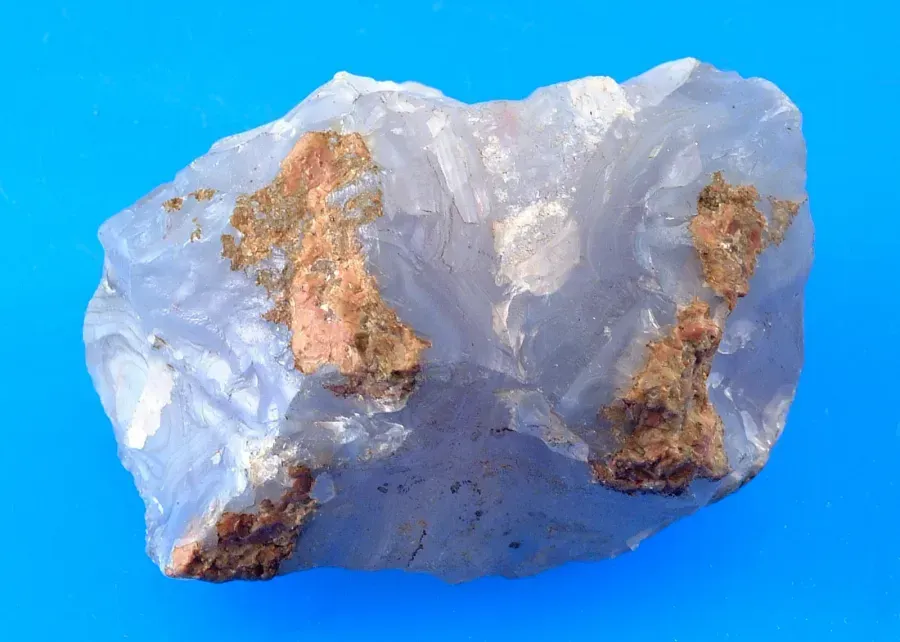
Jasper is a microcrystalline variety of quartz, which is to say silicon dioxide (SiO2). Its crystals are so small that the eye cannot see them, so the stone is dense, opaque, and waxy-matte once polished. That is what separates jasper from clear rock crystal and from translucent agate, even though all three are cousins from the same silica family.
Chemistry and Structure
In terms of composition, jasper is mostly SiO2 carrying foreign minerals that can make up anywhere from fifteen to twenty per cent of the stone. That high level of impurity is exactly what sets jasper apart from pure chalcedony and renders the stone fully opaque.
The crystal structure is the trigonal system of quartz, but the crystallites are microscopic, so jasper does not break with the glassy, shell-like fracture of quartz or obsidian. Instead it breaks even, splintery, or waxy. There is no cleavage.
Wear the symbol, don't just read about it. These are in stock:



A few key physical figures:
- Mohs hardness: 6.5 to 7. The stone resists scratches and a steel knife will not bite it. It yields to topaz (8), sapphire (9), and diamond (10).
- Density: around 2.58 to 2.91 g/cm3, usually close to 2.65, the same as quartz.
- Refractive index: roughly 1.53 to 1.54.
- Optics: jasper is opaque, so there is no dispersion (fire) and no pleochroism. A sample does not let light through, which distinguishes it from agate, which often glows at the edges.
- Lustre: waxy to dull, becoming glassy on a smooth polished surface.
To the touch jasper always feels cool and warms slowly in the hand: it has low thermal conductivity, like most dense stones.
Quartz, Chalcedony, and Where Jasper Sits
When silica crystallises into large transparent crystals, you get ordinary quartz. When the crystals turn microscopic and the stone becomes translucent, it is classed as chalcedony. Jasper is essentially chalcedony oversaturated with impurities: there are so many of them that the stone turns opaque and takes on a rich colour and pattern. Agate, carnelian, onyx, flint, and jasper are all cryptocrystalline silica, and the boundary between them is sometimes arbitrary. A single specimen can hold bands of agate and patches of jasper at once.
Where the Colour Comes From
Pure silica is colourless. All of jasper's colour comes from impurities:
- Iron oxide as hematite gives red and burgundy; as limonite and goethite it gives yellow and brown.
- Manganese oxide brings black and violet tones.
- Chlorite and iron-magnesium silicates bring green.
- Copper and rare trace elements bring blue-green shades.
- Carbonaceous matter and organic remains bring dark layers.
That is why there are so many kinds of jasper: every deposit has its own mix of impurities and its own formation conditions.
How Jasper Forms: The Geology
The pattern in jasper is born in sedimentary and hydrothermal settings. Hot water, saturated with silica, seeps through cracks and cavities in the rock and slowly lays down layer after layer. When the water chemistry shifts, the colour of the new layer shifts with it. Bands, rings, spots, and landscape designs are a record of how the environment changed over millions of years. Turbulent water near a volcano produces wavy, chaotic patterns; a calm setting produces even parallel bands; and the filling of cavities layer by layer leaves concentric rings that look like the cross-section of a tree.
A great deal of jasper formed during the Palaeozoic and Mesozoic eras, in periods of active volcanic and hydrothermal activity. The ocean jasper of Pacific deposits was born in an ancient sea around four hundred million years ago. When the hydrothermal systems faded, the growth of jasper stopped.
Where It Comes From
Origin shapes colour and pattern, and an experienced collector can often guess a region from the design alone:
- The American Southwest (Arizona, New Mexico, California) gives mahogany jasper, picture jasper, and lace jasper. A dry climate and ancient volcanic activity produced a rich range of patterns.
- The Pacific coasts of Asia yield the classic multilayered marine jasper. The Ural region of Eurasia historically gave mottled and picture jaspers used for large decorative pieces.
- Brazil brings warm red-orange-yellow tones. India brings affordable mass-market jasper with blue and green bands on a brown ground.
- Madagascar gives orbicular ocean jasper, polychrome desert jasper, and rare pink marine shades.
- Mexico gives imperial jasper with blue-green orbicular patterns. Australia gives mookaite. Germany, the Czech Republic, and Switzerland give the more restrained European varieties.
Why Every Stone Is Unique
The pattern is the result of one specific set of conditions: the water temperature, its chemistry, the speed of deposition, the presence of organic matter, and later tectonic movements. No place on the planet repeats that combination exactly, so even beads cut from one block differ in their pattern. This singularity is what separates natural jasper from glass and dyed imitations, where the pattern repeats, and it is one of the marks of authenticity.
Customer reviews
Zevira is a real jewellery shop. Genuine payments, deliveries and customer thank-yous.
🥰🥰🥰 gracias
Ok, ¡gracias! 🙂
Jasper belongs on linen and a bare wrist, never under sequins. Leave the glitter to the disco ball, and don't argue.
What to Wear Jasper With
Jasper has been through dozens of shoots with me, and here is what stuck: this stone does not fight an outfit, it holds it together. I have gathered what actually works, by occasion.
What do I wear jasper with every day? For weekdays I recommend the warm varieties: mahogany, red, leopard. They come alive on a simple base: beige knitwear, linen, denim, sandy and olive tones. A large-bead bracelet or a short pendant at the neckline pulls the look together, while smooth plain fabric lifts the stone's pattern. Skip the busy print, it drowns the slab.
Is jasper right for the office? Very much, if you take the calm cool varieties: marine or green. A fine pendant on a long chain over a plain shirt or roll-neck reads understated, especially in white silver. I suggest one piece instead of a handful, so the stone works as a quiet detail rather than a statement.
How do I build an evening look? For the evening I choose one expressive slab against a smooth dress in a dark or wine tone. Jasper does not sparkle, it adds depth, so it works as the single large accent. A scatter of small pieces is surplus here; I recommend taking everything else off and letting the stone lead.
How do I wear jasper in layers? In layers I keep to one range: wooden beads, leather cord, silver, copper. Two or three bracelets in a warm tone on the wrist look cohesive. Cool marine jasper I suggest wearing alone, it likes the room. I never mix warm with cool in one look.
Gold or silver for jasper? By metal I choose like this: warm jasper sounds better in copper and yellow silver, cool jasper in white silver. For a deep neckline I take a long pendant, for a closed neck a larger stone on a short cord. I match the length to the neckline, not the other way round.

Turn on your camera, pick earrings, a pendant or a ring, and see the piece on yourself in real time.
Switch items in one tap.
Everything runs in your browser: no photo or video is ever uploaded.
History: A Stone for Seals and Amulets
People used jasper long before the idea of a precious stone existed. The name itself is international: the Greek "iaspis" probably goes back to a Persian or Semitic root meaning hardness, and similar words appear across many ancient languages. That tells us the stone was known throughout the old world.
Ancient Civilisations
The peoples of Mesopotamia and Egypt sorted jasper by colour: red, yellow, black. From the hard stone the Mesopotamians cut cylinder seals for business contracts, because jasper held fine carving well and did not wear away. In ancient Egypt red jasper went into amulets and scarabs, including funerary ones. Egyptian pebble jasper with concentric rings was worked from deep antiquity, and the variety owes its name to exactly that.
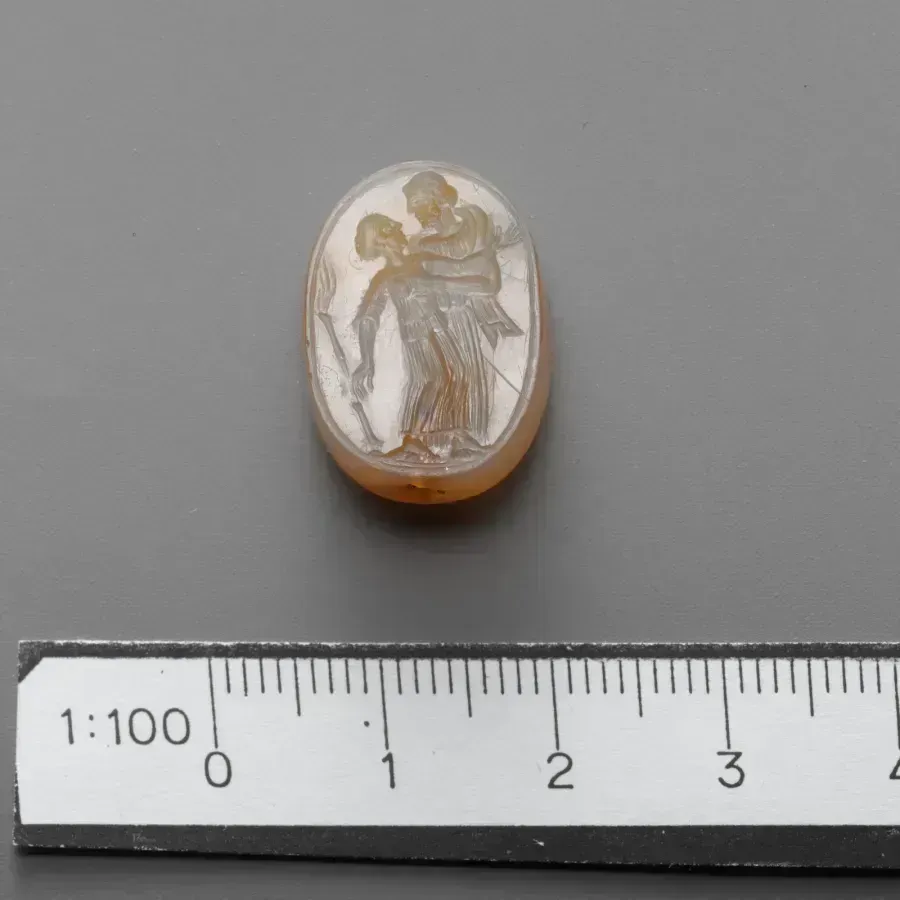
Pliny the Elder, in his "Natural History" in the first century AD, described jasper among the common stones of his time. In Rome it was worn as an amulet and set in signet rings; the hardness of the stone made it a handy material for cameos and intaglios.
The Middle Ages and the Early Modern Period
In medieval Europe red jasper was linked, because of its colour, to blood. The dark-green heliotrope with its red flecks earned the name bloodstone. Jasper appears in the biblical description of the high priest's breastplate among the twelve stones, which fixed it in the Christian tradition. People carved crosses, rosaries, and seals from jasper and kept it in monastery treasuries.
As mineralogy developed in the nineteenth century, jasper began to be sorted systematically by pattern and deposit. Naturalists collected specimens for their cabinets of curiosities alongside fossils, reading the layers of the stone as a record of geological time. That is when the modern division of types, the one still used today, took shape. Workshops cut jasper into large decorative objects, vases, tabletops, and cladding, and that tradition of stonecutting survived for centuries.
Upload a photo of your pet, someone you love, or an object. We'll build a 3D model and hand-cast it in pewter.


Types of Jasper by Colour and Pattern
There is no strict mineralogical classification inside jasper. The division follows how the stones look and what the market calls them. Below are the main types: where they come from, their colour, their pattern, and how to tell one from another.
Mahogany Jasper
A variety with a wood-grain pattern: concentric and radial bands of red, brown, and near-black that recall a cross-section of a trunk. The red-brown colour comes from a high concentration of iron oxide, a mix of hematite (deep red) and limonite (brown tones). The dark seams appear where organic matter or manganese compounds reached the ancient water.
The best specimens come from the arid regions of the American Southwest. In jewellery it shows up most often in bead bracelets and in pendants with a large polished slab. The warm red-brown colour looks striking in a copper or silver setting.
Red Jasper
The oldest variety, and a general term for any red jasper without a compulsory wood-grain pattern. The colour comes from iron oxide, with shades running from brick-red to deep burgundy. The surface can be plain, mottled, threaded with fine veins, or swirled like cloud. Red jasper is exactly what the ancient Egyptians, Greeks, and Romans knew.
How it differs from mahogany jasper. Red jasper is usually uniform or mottled, with no clear structure. Mahogany jasper is a special case of it, with a pronounced concentric or radial wood-grain pattern. In other words, all mahogany jasper is red, but not all red jasper is wood-grained. If you can read growth rings in the stone, it is mahogany jasper; if the colour is even or mottled, it is simply red.
Yellow Jasper
The colour comes from iron hydroxides, limonite and goethite. Shades run from pale sand and mustard to golden ochre, often with brown veins: limonite readily turns into other forms of iron, and those gentle transitions are a sign of authenticity. A fake gives itself away with an unnaturally even lemon-yellow tone. Yellow jasper is easy to confuse with yellow carnelian, but carnelian is translucent and glows in the light, while jasper is opaque and matte.
Green Jasper
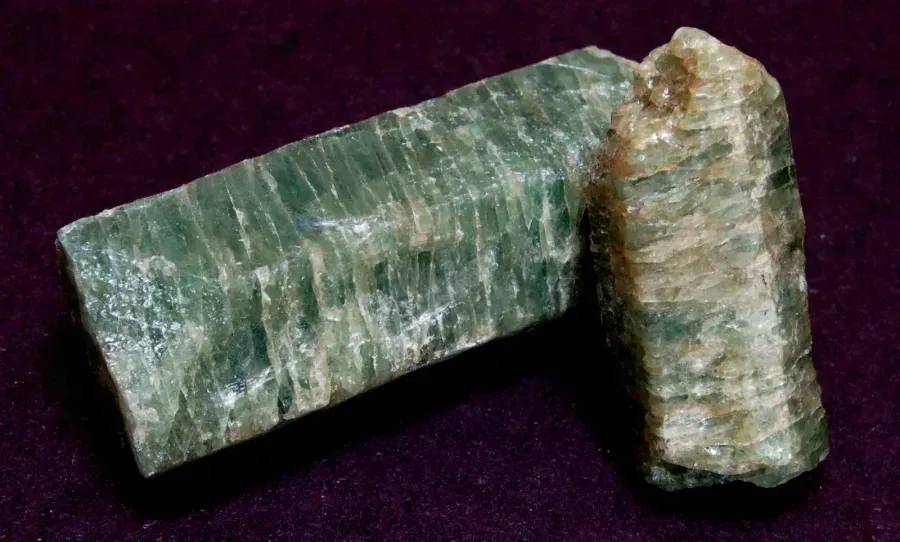
Coloured by iron-magnesium silicates, chiefly chlorite, sometimes with actinolite involved. The colour runs from pale olive to deep moss and dark emerald. Green jasper gets mistaken for nephrite and aventurine, but nephrite is tougher and does not chip so easily, while aventurine sparkles with fine glittering inclusions, which matte jasper does not.
Heliotrope stands apart: a dark-green jasper with red flecks of iron oxide, known as bloodstone. The red dots on a green ground are unmistakable.
Black Jasper
The deep colour comes from a high concentration of manganese and iron oxides and finely dispersed carbonaceous matter. The polished surface is even and waxy-matte. From hematite, black jasper is told apart by its lack of shine: hematite glints almost like metal, is heavier, and leaves a red-brown streak. From obsidian it is told apart by structure: obsidian is volcanic glass, with a shell-like fracture and a glassy lustre, while jasper is microcrystalline and matte. This is the most versatile and sober type, working with any clothing and any metal.
Zebra Jasper (Banded)
Sharp parallel bands of contrasting colours, most often white and black or white and brown. The bands arise from a rhythmic alternation of layers of different mineral composition during slow silica deposition. The bands of natural zebra are uneven, of varying width, and slightly wavy, which sets it apart from a dyed imitation with perfectly even lines. Zebra marble is sometimes passed off as zebra jasper, but marble is softer and scratches with a knife, while jasper is harder.
Leopard Jasper (Spotted)
Rounded rings and spots resembling a leopard's hide: dark and light circles on a grey, pinkish, or brown ground. In composition this is often a rhyolitic rock close to jasper, and the ring-shaped spots are spherulites, radial-fibrous clusters of minerals around crystallisation centres in volcanic material. The main identifying feature is precisely the rounded ring-shaped spots, not a scatter of dots: dots already mean Dalmatian.
Dalmatian Jasper
A pale cream or beige stone scattered with black dots, like the coat of the dog. The black spots are inclusions of a dark mineral (often arfvedsonite or oxides of manganese and iron) in a light quartz-feldspar base. Strictly speaking, Dalmatian is not always pure jasper by mineralogy, but the market sells it confidently among the jaspers, because it is dense, opaque, and polishes well. It differs from zebra in its dotted rather than banded pattern.
Egyptian Jasper
Warm concentric rings of yellow, brown, red, and near-black. The stone is found as rounded pebbles in the Egyptian desert, and its ring pattern recalls a cross-section or a target. The rings inside the pebble were born from the layered deposition of silica in cavities. From mahogany jasper it is set apart by the regularity and contrast of its rings: in Egyptian jasper they form an almost perfect target, while in mahogany the pattern is freer.
Picture and Landscape Jasper
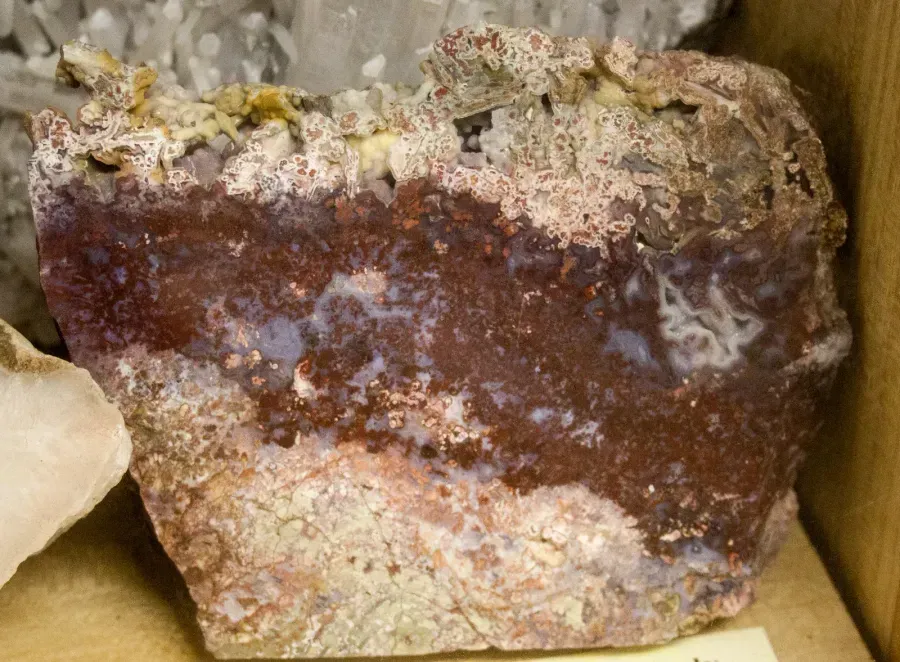
The pattern recalls landscapes: mountains, dunes, horizons, clouds. The effect arises when silica was deposited in a sedimentary setting in layers of differing density and colour, and later tectonic movements bent those layers slightly. In cross-section the bends read as hills and horizons, while dark dendritic veins of manganese oxides read as trees and bushes. The best-known picture jaspers come from the American West. Every slab is unique, so picture jasper is often bought as a one-of-a-kind piece.
Other Trade Names
Behind a host of market names stand the same basic principles of colour and formation:
- Brecciated jasper: angular fragments cemented by silica after the rock was shattered by tectonics. A mosaic pattern of differently coloured pieces with veins as boundaries.
- Ocean jasper: the Madagascan variety with round eye-like spots (an orbicular pattern). It often gets confused with marine jasper, but marine is any wavy banded jasper, while ocean jasper is specifically eyed.
- Mookaite: the Australian jasper in a warm watercolour range from cream and yellow to pink and burgundy, with smooth colour transitions.
- Polychrome (desert) jasper: Madagascan, with a rich many-coloured range and landscape compositions.
- Imperial jasper: Mexican, with soft blue-green and cream orbicular patterns.
Sellers invent names for recognisability, so when buying, go by the pattern, the colour, and the quality of the polish, not by the name.



Marine Jasper
A banded variety whose pattern recalls sea waves: an alternation of white, blue, green, and black in wavy parallel lines. It formed in ancient marine deposits and in bottom-water hydrothermal zones. When the oxygen at the seabed dropped, bacteria reduced the iron and a dark layer appeared; when oxygen returned, the iron oxidised. The white bands are pure silica. The black ones hold manganese and organic matter. The blue and green carry copper and chlorite.
Different deposits give a different signature. Pacific-coast sources yield a classic complex multilayered pattern. The Brazilian is warmer, with straighter lines. The Madagascan is famed for rare pink and lilac shades. Californian crazy lace gives the most intricate labyrinthine pattern and is prized above the rest.
A natural marine jasper is recognised by the unevenness of its bands of differing width: in a dyed imitation the bands are suspiciously even and bright. From agate it is told apart by its opacity, and from zebra by its waves rather than straight bands. The cool range of blue, green, and black makes marine jasper one of the few gemstones that sit naturally in men's jewellery.
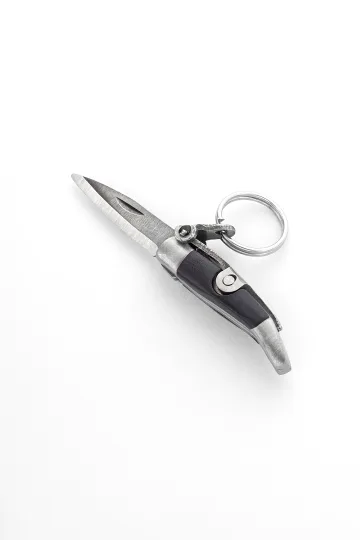
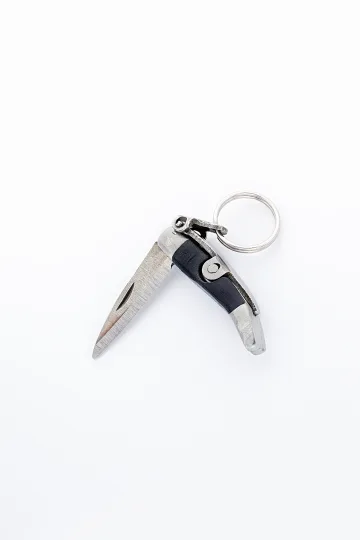
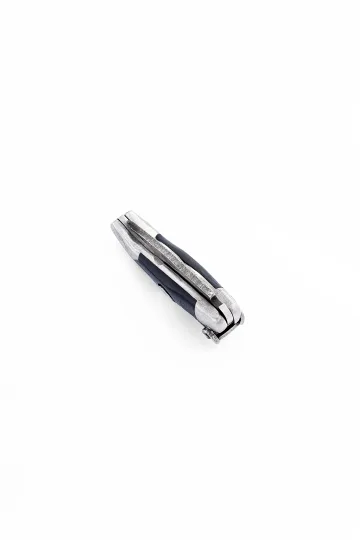
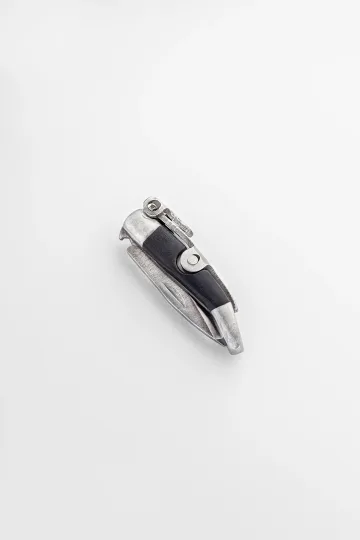
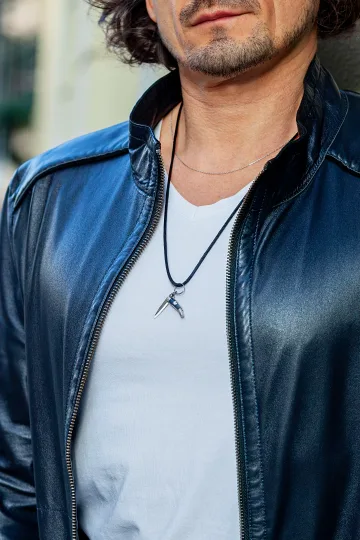
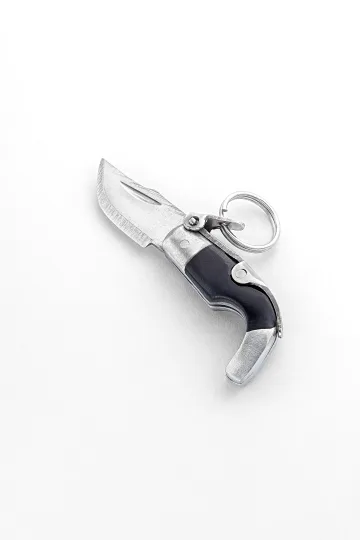
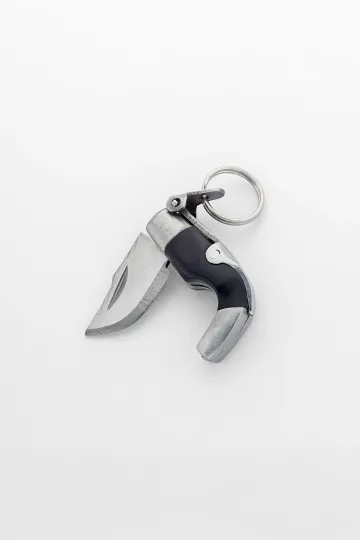
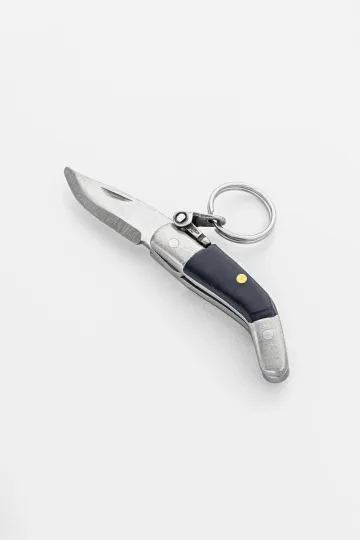
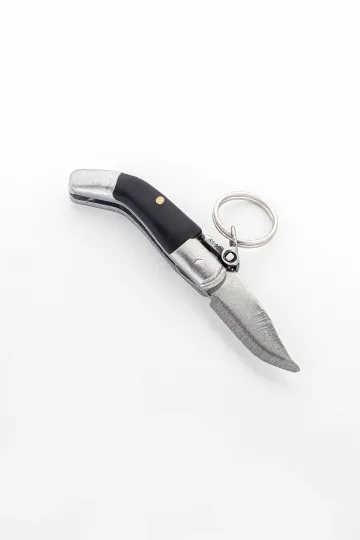
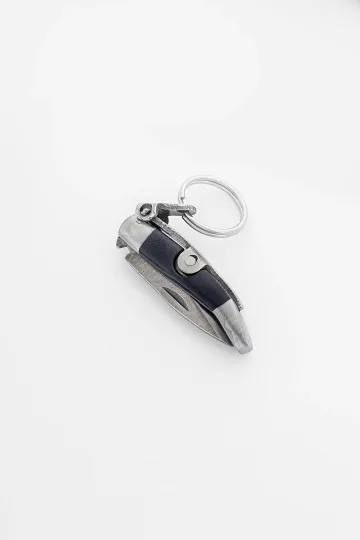
CAPAORA mini knife pendant
The 18th-century Spanish navaja in miniature: 40 mm of stainless steel, a real folding mechanism and a Palanquilla lock that clicks. An affordable gift to remember.
Authentic · Ships from Spain · 14-day returns
How to Tell Natural Jasper from Fakes and Lookalikes
Jasper is an inexpensive stone, so there are few fakes made to save money, but dyed and composite samples do turn up on the market.
Signs of Natural Jasper
- An imperfect, asymmetric pattern. Nature does not repeat a design with a stamp: bands are uneven, spots vary in size, rings are not perfectly round.
- Coolness. The stone stays cool for a long time and warms slowly in the hand; plastic and glass have a different thermal conductivity and heat up faster.
- Hardness. Natural jasper is not scratched by a steel knife, a fingernail, or a copper coin. No scratch is left on the stone itself.
- Weight and surface. The stone is dense and feels heavier than it looks. The polish is smooth and waxy-matte, without a plastic shine.
Dyed Jasper
Cheap pale jasper is dyed to pass for a dearer variety. A dyed stone gives itself away with too bright and unnaturally even a colour, and with dye pooling in cracks and pores as more saturated patches. Wiping it with a cotton bud and alcohol can leave a trace of dye. If the original shade shows through under the layer of colour, you are looking at a dyed stone. Blue and turquoise imitations are dyed especially often: a bright, evenly blue jasper barely exists in nature.
Pressed and Glass Imitations
Pressed jasper is the crumb of low-grade stone mixed with a polymer resin. When scratched it shows graininess instead of a smooth chip, can be noticeably lighter, and under a loupe reveals the boundaries of the crumbs and bubbles in the resin. Glass betrays itself with too even a shine, air bubbles inside, and low hardness: glass scratches easily.
Similar Stones
| Stone | How it differs from jasper |
|---|---|
| Agate | Translucent, glows in the light, often layered; jasper is opaque and matte |
| Hematite | Metallic shine, heavier, red-brown streak; jasper is matte and lighter |
| Obsidian | Volcanic glass, glassy shine, shell-like fracture; jasper is microcrystalline |
| Carnelian | Translucent; yellow or red jasper is opaque |
| Nephrite, aventurine | Nephrite is tougher, aventurine sparkles with inclusions; green jasper is matte and even |
Jasper is most often confused with agate: both come from the same silica family, but agate is translucent and glows at the edges. A clear, sparkling red stone is not jasper but more likely tourmaline or another crystalline gem: jasper is always opaque and matte.
Synthetic jasper can technically be made, but it makes no economic sense: the natural stone is cheaper. So when buying you should fear not lab synthesis but exactly the dyed and composite stones.
Leave your email, we'll send your discount code. No spam, unsubscribe anytime.
The code arrives by email, valid on your first order.
Caring for Jasper
A hardness of 6.5 to 7 makes jasper resistant to scratches and fit for daily wear. But the stone is brittle under a strong point impact and can crack, so rings call for a little more care than earrings and pendants.
Cleaning
Wash jasper in warm (not hot) water with mild soap and a soft brush. On bead bracelets a brush clears the dirt between beads. Avoid sharp temperature swings: they create internal stress. Ultrasonic and steam cleaners are not recommended, as the vibration can grow micro-cracks. After washing, wipe the stone with a soft cloth.
Storage
Keep jasper jewellery separately, in a soft pouch, so that harder stones (sapphires, topazes, diamonds) do not scratch the surface. Keep it out of direct sun: prolonged ultraviolet can slightly weaken the saturation of red and orange varieties over time, though this happens rarely and over years. More often, what people take for fading turns out to be ordinary dirt that comes off with cleaning.
How Hardness Affects Wearability
Bracelets, pendants, and earrings are barely subject to abrasion, so they suit even the more brittle varieties. A ring is the most vulnerable format: it is constantly in contact with surfaces, so the stone is best protected by a setting, cut no thinner than three or four millimetres, and the ring is best removed for sport and physical work. The elastic cord of bracelets wears out over time and should be checked and replaced periodically.
Symbolism, Briefly and Without Illusions
By tradition jasper is held to be a stone of stability, protection, and connection with the earth: the red varieties are tied to energy and courage, the marine to calm, the black to protection. This is cultural heritage, not a property of the mineral. Jasper has no proven physical or healing effect: it does not cure illness, nor does it affect sleep, blood pressure, or anxiety. If touching a cool, smooth stone helps someone gather themselves, that is the work of attention and habit, not of the stone. Symbolism is best treated as part of history and aesthetics, not as medicine.
Jasper Jewellery
Jasper works in almost any jewellery format thanks to its hardness, affordability, and wealth of patterns.
- Bead bracelets of 6 to 10 mm diameter are the most popular format. Each bead shows its own scrap of pattern. The bracelet should sit loosely, with about a finger's gap.
- Pendants are a polished cabochon of oval or teardrop shape, usually on a 45 to 60 cm chain. They are convenient for daily wear and show a large slab well. The optimal stone size is 2 to 3 cm.
- Rings set a polished stone in silver, copper, or bronze. The most vulnerable format, it calls for a protective setting and care.
- Earrings are usually small. They rarely face abrasion, so they suit even brittle varieties. Drop earrings show off the vertical bands of marine or zebra jasper well.
- Brooches, cufflinks, and signet rings suit large expressive slabs well. A jasper signet continues the ancient tradition of carved seals.
Setting Metals
Sterling silver (925) is the standard: its white colour contrasts with warm jaspers and brings out the pattern. Copper and bronze create a warm earthy pairing with red and brown varieties. Nickel silver is cheaper but tarnishes, and its nickel can irritate sensitive skin; for sensitivity, better to choose high-grade silver, titanium, or ceramic. Cool blue-green jaspers fare better in silver and white gold, warm red-yellow ones in yellow gold and copper.
Pairing with Other Stones
The main practical rule: harder stones (sapphire, topaz) can scratch jasper on contact, so they are kept on different pieces or separated by metal spacers. Different kinds of jasper pair freely with each other, having the same hardness. By colour, good pairs are black jasper with black tourmaline, marine with aquamarine or labradorite, green with amazonite.
Send a friend a discount code, they save on their first order.
Frequently Asked Questions About Jasper
What is jasper in simple terms
A dense, opaque stone of microcrystalline quartz (SiO2) with a large amount of impurities that give it colour and pattern. Under one name are gathered dozens of varieties, chemically almost identical but visually very different.
How many types of jasper are there in total
There is no exact number: no strict classification exists inside jasper, and the names are often market names. Types are told apart by colour (red, yellow, green, black), by pattern (zebra, leopard, Dalmatian, picture, wood-grain), and by deposit (marine, Egyptian).
What is the hardness of jasper
On the Mohs scale, 6.5 to 7, like quartz. The stone is not scratched by a steel knife. Density is about 2.65 g/cm3, refractive index roughly 1.53 to 1.54, fracture even or splintery, no cleavage.
How does red jasper differ from marine jasper
Red is warm, red-burgundy, coloured by iron, more often plain or mottled. Marine is cool, blue-green-white with black, banded, coloured by copper, chlorite, and manganese. Mineralogically both are quartz, but visually they are opposites.
How does mahogany jasper differ from red jasper
The difference is in the pattern. Red jasper is usually plain or mottled. Mahogany jasper is a special case of it with a pronounced wood-grain pattern of rings and radial bands. If you can read growth rings in the stone, it is mahogany jasper.
How does zebra differ from Dalmatian and leopard jasper
The shape of the pattern. Zebra has long parallel bands across the whole stone. Dalmatian has fine black dots on a light ground with no lines. Leopard has larger rounded ring-spots on a grey or pinkish ground. Bands mean zebra, dots mean Dalmatian, rings mean leopard.
How does ocean jasper differ from marine jasper
Ocean jasper is the Madagascan variety with round eye-like spots (an orbicular pattern). Marine in the broad sense is any wavy banded jasper. On the market the terms get muddled, so look at the pattern: waves mean marine, round eyes mean ocean.
What are heliotrope and bloodstone
Heliotrope, also called bloodstone, is a dark-green jasper with red flecks of iron oxide that look like drops of blood. A variety of green jasper with an expressive contrast, known since antiquity.
Is jasper a precious or semi-precious stone
Jasper is classed among ornamental and semi-precious stones, not among the precious ones. By hardness (6.5 to 7) it is well suited to everyday jewellery and serves for generations.
Which jasper is the rarest
Most varieties are inexpensive. Among the more valuable are Californian crazy-lace marine jasper with its labyrinthine pattern and Madagascan marine jasper in pink and lilac tones. Price depends on the clarity and rarity of the pattern, the contrast of colours, the size, the absence of cracks, and the quality of the polish.
How to tell natural jasper from a fake
The natural stone has an imperfect, asymmetric pattern, is cool to the touch, dense, is not scratched by a knife, and warms slowly. A dyed one gives itself away with too even and bright a colour and dye in the cracks; a pressed one with graininess on the chip and bubbles in the resin under a loupe; and glass with an even shine and low hardness.
Can jasper be worn every day
Yes. A hardness of 6.5 to 7 allows it, especially in bracelets, pendants, and earrings, which face little impact. Rings call for a bit more care. Clean the stone of sweat and skin oil periodically and keep an eye on the setting and the cord.
Can jasper get wet
Brief contact with water leaves jasper unbothered. But hot water, pool chlorine, and sea salt harm the setting and the bracelet thread, not the stone itself. After the sea, rinse the piece in fresh water and wipe it dry.
Does jasper fade in the sun
Quality natural jasper is stable, but under prolonged direct sun the red and orange varieties can slowly and imperceptibly pale a little. This happens rarely and over years. Often what is taken for fading turns out to be dirt that comes off with cleaning.
Does a silver setting tarnish
Over time, yes: silver reacts with the air and with cosmetics and takes on a patina, especially in a damp climate. This is not damage; the patina comes off with a silver cloth. The stone itself is chemically stable and does not darken from the skin.
Can jasper crack on its own
A solid, quality stone, no, but a sample with an internal micro-crack can split from a sharp temperature swing or a knock. Avoid dropping a cold stone into hot water and protect the piece from blows.
Does jasper cure illness
No. Jasper is not medicine and does not replace it. Claims of healing specific illnesses have no scientific basis. For health problems you need a doctor.
Is jasper radioactive
No. It is natural silica with mineral impurities; it is not radioactive and is safe to wear. Care is needed only when working with dust during cutting and polishing, as with any silica, but that does not apply to the finished piece.
Which jasper suits men
The sober varieties: black, marine in a cool range, graphic zebra, dark mahogany jasper. The formats: chunky bracelets of large beads, signet rings, and cufflinks.
Does jasper look better in gold or silver
It depends on the colour. Cool blue-green and black varieties fare better in silver and white gold. Warm red-yellow-brown ones come out better in yellow gold and copper. The universal rule: a cool stone with a cool metal, a warm one with a warm one.
How does jasper differ from agate
Both are from the silica family, but agate is translucent and often layered, glowing in the light, while jasper is fully opaque. If a stone glows slightly, it is more likely agate; if it is wholly dull, more likely jasper. In one specimen you sometimes find patches of both.
What colours does jasper come in
Almost any. Red and burgundy (iron), yellow and ochre (limonite), green (chlorite), black (manganese and carbon), blue-green marine (copper and chlorite), and mottled combinations besides. Pure silica is colourless; all the colour comes from impurities.
Where does the name jasper come from
The word goes back to the Greek "iaspis", which probably comes from a Persian or Semitic root meaning hardness. Similar words exist in many ancient languages. The name underlines the stone's main quality, its strength.
Buying it as a gift? Each one arrives ready to give.
 A branded Zevira box and a little card come with every order.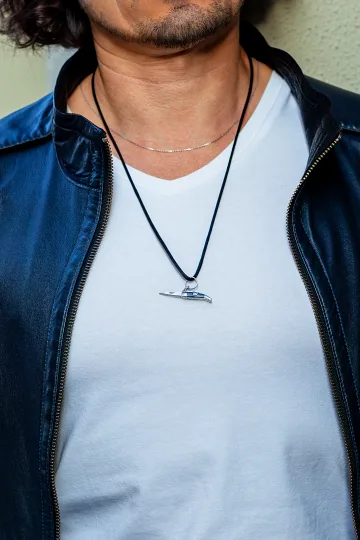






Common Questions
What size of jasper to choose for a pendant and bracelet beads
For an everyday pendant a polished cabochon of 2 to 3 cm is convenient: it shows the pattern and does not get in the way. In a bracelet the most common bead diameter is 6 to 10 mm, with larger beads showing the pattern better and smaller ones looking more restrained. Choose a bracelet so that it sits loosely, with about a finger's gap.
What to pair jasper with in one set
Different kinds of jasper get along freely with each other, sharing the same hardness and a common natural texture. By colour, good pairs are black jasper with black tourmaline, marine with aquamarine or labradorite, green with amazonite. Stones markedly harder than jasper, such as sapphire or topaz, are best kept on different pieces so they do not scratch the surface.
How long will jasper jewellery last
With ordinary care jasper serves for decades and passes calmly to the next generation: the stone is chemically stable and does not fade from the skin. The setting and the bracelet thread wear out sooner than the stone, so the elastic cord is checked and replaced periodically, and the silver is cleaned of patina. A ring lives longer if you protect it from knocks and remove it for physical work.
What can replace jasper if you want a similar stone
If you like a dense matte stone with a natural pattern, agate and carnelian from the same silica family give a close mood, only they are translucent and glow in the light. For a warm earthy range you can look at mookaite, which is itself a variety of jasper. The cool graphics of black jasper are replaced by black tourmaline or hematite, but these look more severe and shine more.
Is jasper suitable as a gift, and for what occasion
Yes, jasper is universal as a gift: it is inexpensive, durable, and offers a huge choice of colours and patterns to match a person's character. The warm red and wood-grain varieties are given for the everyday and as a warm accent, the cool marine and black are chosen for sober, including men's, looks. Every slab is unique, so such a gift turns out personal, and an engraving on the back of a pendant makes it memorable.
Wear the symbol, don't just read about it. These are in stock:


About Zevira
In the Zevira collection jasper appears in its full range of colours and patterns, from warm red and wood-grain to cool marine, graphic zebra, and a landscape painted inside the stone. This is deliberate: jasper is valuable precisely because under one name hides a multitude of different characters, and everyone finds their own pattern and their own colour.
We work with trusted suppliers and check every piece for the quality of its finishing and the soundness of the stone. The cool blue-green varieties we more often set in silver, the warm red-brown ones in silver and copper, so that the setting underlines the pattern rather than argues with it. Minimalist settings leave the stone the leading role. On request we engrave a date, initials, or a symbol on the back of a pendant or the side of a ring.
Jasper does not shine like a diamond, nor shimmer like an opal; its value lies in the dense natural pattern that the earth drew over millions of years. It is a stone for those who prize simplicity, depth, and durability: jasper jewellery is worn for years and passed to the next generation.
Jasper: the stone of the earth in all its colours
A piece of jasper jewellery is a calm, honest choice. A stone that formed over millions of years now serves you as a reminder of stability and the unhurried strength of the earth. Choose your variety: warm mahogany jasper, calm marine, graphic zebra, or a landscape painted inside the stone.
Find the jasper piece that speaks to you.
Open the jewellery catalogue Back to home