Kyanite in jewellery: the blue stone with two hardnesses
A steel needle scratches one and the same crystal in one direction and slides off uselessly in the other. This is no parlour trick and no flaw in the specimen. This is kyanite, a mineral whose hardness depends on the axis along which you press it. Geologists call it hardness anisotropy, lapidaries call it a headache, and collectors of blue stones call it the very reason to seek it out.
Kyanite rarely sits in the cases of high-street jewellers, and the reason is simple: it is hard to cut, brittle and temperamental. In return it offers a deep blue colour, a clear glassy transparency and a character that most familiar gemstones lack. Let us look at the make-up and physics of the stone, how and where it forms, what history did with it, how to tell it from lookalike blue minerals and from fakes, and how to care for it so it lasts.
What kyanite is: composition, formula and structure
Kyanite is an aluminosilicate with the formula Al₂SiO₅, that is aluminium, silicon and oxygen locked into a dense crystal lattice. The name comes from the Greek kyanos, blue, after the colour most prized in jewellery.
Kyanite has two mineral relatives with exactly the same formula Al₂SiO₅, andalusite and sillimanite. These are polymorphs: the same chemistry, but a different crystal structure, because they grew under different pressures and temperatures. Of the three, kyanite is the one born under the highest pressure.
The blue colour comes from traces of iron and titanium in the lattice. The more of them, the deeper the tone. Pure kyanite, free of impurities, is colourless or white. Beyond blue you also meet grey, green, yellow, orange and near-black varieties, all depending on which foreign ions found their way into the structure as the crystal grew. Colour is often spread unevenly inside a single crystal: deep blue toward the centre, paler at the edges.
Wear the symbol, don't just read about it. These are in stock:



Hardness anisotropy, the defining trait
On the Mohs scale (from 1, talc, to 10, diamond) kyanite measures 4 to 4.5 along the long axis of the crystal and 6 to 7 across it. The very same stone is softer than glass in one direction and scratches glass in another.
Because of this, kyanite carries a second, older name, disthene, from the Greek for "double strength". The property is no whim but a direct consequence of how the atoms sit in the lattice: the bonds along the axis are weaker, those across it stronger. For a cutter this means the stone cannot be worked carelessly; the orientation of the crystal must be respected to the letter, or it will split along the weak direction.
Physics and optics
The key properties of kyanite:
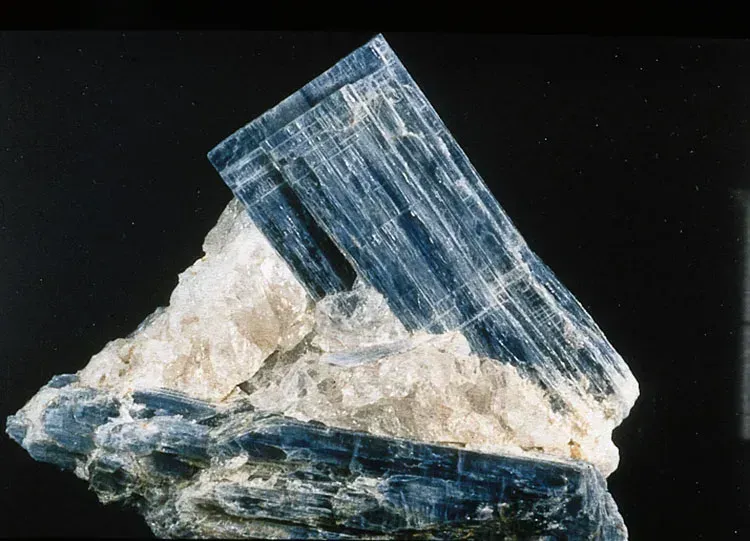
- Crystal system: triclinic (the least symmetrical of all). Crystals are elongated, flat and blade-like.
- Mohs hardness: 4 to 4.5 along the axis, 6 to 7 across it.
- Density: about 3.53 to 3.67 g/cm³. Heavier than quartz, a touch lighter than sapphire.
- Lustre: glassy, pearly on cleavage planes.
- Cleavage: perfect in one direction, another reason for the brittleness.
- Refractive index: roughly 1.71 to 1.73, with weak birefringence (around 0.012 to 0.016).
- Transparency: from transparent to translucent.
Kyanite is strongly pleochroic: turn the stone and its tone shifts from a saturated blue to almost colourless or violet-blue, depending on the viewing angle. Cutters use this to catch the deepest blue across the table of the stone. Under ultraviolet light kyanite usually stays dark or glows very faintly, which sets it apart from some synthetic imitations that luminesce noticeably under UV.
Do not expect the diamond-like fire of a sparkling stone from kyanite; its dispersion is low. Its beauty lies elsewhere: in the depth and clarity of the blue, in the silky sheen on its faces and in that very blade-like form of the crystals.
How kyanite forms: geology and deposits
Kyanite is a mineral of metamorphic rocks. It does not crystallise from a melt the way corundum or beryl does; it appears when existing clay-rich and sedimentary rocks come under high pressure and a relatively moderate temperature deep in the Earth's crust. It is precisely the high pressure that sets the birth of kyanite apart from its polymorphs: with the same composition but lower pressure you grow andalusite, and at high temperature, sillimanite. So from a find of kyanite geologists can read the conditions in which the rock formed.
Most often kyanite turns up in gneisses, crystalline schists and quartz veins, rocks that have gone through serious recrystallisation. Such rocks are frequently hundreds of millions, even billions, of years old.
Where it is mined
Kyanite is more widespread geographically than many suppose, yet little of what is dug out reaches gem quality: the bulk goes to industry. Well-known sources:
- Brazil, one of the largest suppliers. The states of Minas Gerais and Bahia yield a saturated dark-blue material, often with inclusions.
- Nepal and India, the Indian states of Karnataka and Andhra Pradesh plus the Himalayan region. Nepalese kyanite is prized for its clean, vivid blue.
- Kenya and Tanzania, East African material, usually small but richly coloured stones.
- The United States, the Appalachians (North Carolina, Georgia, Virginia). Mostly industrial grade; gem finds are rare.
- Europe, Austria, Switzerland, France, Italy and Scandinavia. Alpine specimens often head into museum and collector cabinets.
Most of the kyanite mined goes not into jewellery but into refractories, technical ceramics and abrasives: under strong heat it converts to mullite and holds high temperatures well. Gem grade, transparent, evenly coloured, free of cracks, is a rare fraction of the total output.
Kyanite as an indicator of metamorphism
Geologists care about kyanite for a reason that has nothing to do with its colour. Its presence in a rock is a message about the conditions that rock passed through.
Kyanite only forms within a fairly narrow window of pressure and temperature, and that window sits at high pressure and moderate temperature. Find kyanite in a schist or a gneiss and you know the rock was buried deep, twenty kilometres or more, and squeezed rather than simply baked. Geologists call this a barrovian sequence, after the Scottish Highlands where it was first mapped in the late nineteenth century, and kyanite marks one of the recognised zones within it.
This makes the mineral a natural instrument. Walking across a metamorphic terrain and noting where chlorite gives way to garnet, garnet to staurolite, staurolite to kyanite and finally kyanite to sillimanite lets a field geologist read the depth and heat history of an entire mountain belt from the rocks underfoot. The blue stone in a pendant is, in its other life, a pressure gauge for the crust.
Why one stone has two hardnesses: a look inside
This is the property that defines kyanite entirely, and it is worth understanding rather than simply memorising.
Kyanite crystallises in the triclinic system as long, flat, blade-like crystals. Inside those blades, the aluminium and silicon atoms are bonded far more tightly in some directions than in others. Run a scratch test along the length of a blade, parallel to its long axis, and the mineral registers around 4 to 5 on the Mohs scale, soft enough that a steel knife will mark it. Run the same test across the blade, perpendicular to that axis, and it registers 6 to 7, hard enough that the knife slides off.
One crystal. Two answers. The old alternative name for the mineral, disthene, comes straight from the Greek for two strengths, and it was coined precisely because early mineralogists could not believe their own results until they repeated them.
The consequence for jewellery is direct. A cutter has to orient every stone deliberately, working the facets against the hard direction and treating the soft direction with respect, and a wheel that would polish a sapphire cleanly will gouge kyanite if it approaches from the wrong angle. This is why gem-quality faceted kyanite is comparatively scarce and why so much of it appears as slices and cabochons instead. The cutting is genuinely difficult, and a mistake destroys the rough.
It also explains the wearing advice. Kyanite has perfect cleavage in one direction, which means that under a sharp knock it does not chip, it splits, cleanly, along an internal plane. Hardness protects against scratching; cleavage has nothing to do with hardness. A stone can be hard and still break in half. For a ring, worn on the hand that opens doors and carries shopping, this is the argument for caution: choose a bezel setting that shields the girdle completely, keep the stone low rather than raised, and accept that a kyanite ring is an occasional piece rather than something to wear while gardening. Pendants and earrings, which live away from impact, have no such problem.
The Al₂SiO₅ polymorphs standing side by side
Kyanite has two siblings with an identical chemical formula and completely different characters, and the trio is one of the classic teaching examples in mineralogy.
Kyanite, andalusite and sillimanite are all Al₂SiO₅. Same atoms, same proportions, three different crystal structures, because each is stable under a different combination of pressure and temperature. Kyanite is the high-pressure form, dense and bladed and blue. Andalusite forms at low pressure and moderate temperature, and comes out in warm brown, green and pinkish tones with a strong pleochroism that makes a single stone flash two colours as you turn it. Sillimanite forms at high temperature and appears as fine fibrous needles, sometimes with a cat's eye effect.
Because the three are stable in different fields, a rock containing more than one of them is telling you it crossed a boundary, and the point where all three could coexist is a fixed reference on the pressure and temperature diagram that geologists use to calibrate everything else.
For a buyer the useful takeaway is smaller but still worth having: if you like kyanite's blue but need something more robust, andalusite is its close chemical relative at 6.5 to 7.5 with no cleavage problem, though the colour is entirely different.
Kyanite goes solo and in cold silver. Bury it under warm gold and a fistful of sparkle and you have a shop window, not a neckline. Don't.
What to wear kyanite with
Over years on shoots I bring kyanite into a look rarely and always on purpose. The stone is moody, cold and quiet, and it only works where you let it be the single bright patch. Here is what I have tested on set, sorted by occasion.
What do I wear kyanite with every day? For daily wear I recommend one blue accent and a calm background around it. A plain T-shirt or jumper in a pastel or earthy tone, jeans, linen, cashmere, and a pendant or drop earrings with kyanite. For metal I suggest the cool side: silver, white gold, with clear rock crystal or small pearls beside them. Warm yellow gold gives a different, slightly vintage character, lovely with cream and sand.
Is it right for the office? Very much, and it even gains there. I choose a pendant on a 45 to 50 cm chain over a white shirt, a grey roll-neck or a linen blazer: the blue chimes with any neutral palette and reads quietly. Where a large piece would be too much, in negotiations, a presentation, an interview, I suggest kyanite studs. The stone reads as a mark of taste, not a claim to luxury.
How do I build an evening look? For evening I recommend a dark background: navy, graphite, black. A blue-black monochrome with a single pendant or drop earrings reads expensive and restrained, with no surplus glitter. An open neckline or bare shoulders give the stone room, and a long chain lengthens the silhouette. Keep the register cool and skip a crowd of bright stones.
Which metal pairs with it? Most often I choose silver and white gold: cold metal holds up the cold blue, and the stone does not fight the setting. I turn to yellow gold when I want a soft contrast and a vintage note, which pulls kyanite toward cream and sand. What I never advise is company with other bright stones: kyanite likes quiet around it.
Who does it actually suit? Anyone who values quiet expressiveness over a loud mass: the calm, thoughtful type, lovers of minimalism and a cool palette. Two rules on length. For a shorter than average height I recommend a shorter chain, 40 to 45 cm, for the tall a longer one, 50 to 55 cm, so the stone settles at its natural point. And on neighbours: other calm blue stones sit well beside it, such as selenite, while if a warm palette is closer look at unakite; for rarity kyanite is often compared with tanzanite.

Turn on your camera, pick earrings, a pendant or a ring, and see the piece on yourself in real time.
Switch items in one tap.
Everything runs in your browser: no photo or video is ever uploaded.
History: the blue stone long confused with others
When it was finally described
Kyanite was isolated and described scientifically in the late eighteenth century, the age when mineralogy turned from the gathering of "pretty pebbles" into a real science. Before that, blue minerals were routinely confused with one another: a single old description might hide sapphire, lapis lazuli, beryl and kyanite all at once. Telling them apart by their internal structure, and not by colour alone, began precisely then.
The old name "disthene", double strength, stuck exactly because of the hardness anisotropy that so struck early researchers. It was one of the first vivid examples of a mineral's properties being set by its crystal structure rather than by its looks.
Blue stones in the old lapidaries
In the medieval lapidaries, books about stones and their supposed powers, blue minerals were jumbled together. Ancient authors such as Theophrastus and Pliny the Elder described various blue stones, but without modern methods there was no way to say exactly what lay before them. So the honest line is this: there is no reliable evidence that ancient cultures singled out and knowingly used kyanite as such. More likely it fell into the general category of "blue stones" alongside sapphire and lapis lazuli.
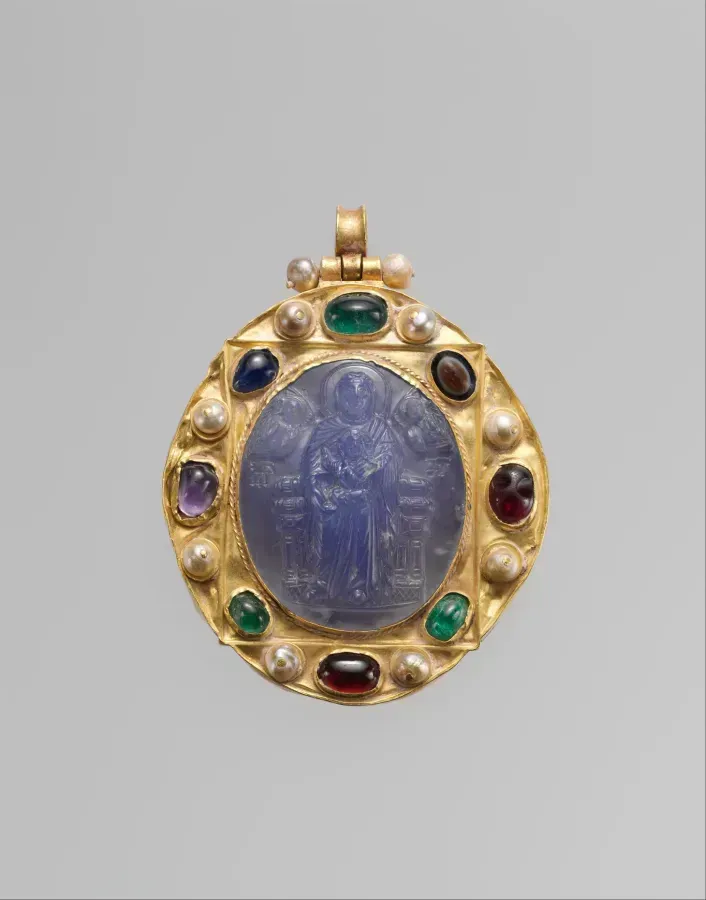
Museum collections have held blue gems for centuries, but in the historical regalia, crowns and ornaments that have reached us, it is sapphire and lapis lazuli that turn up more often, not kyanite. So crediting kyanite with a loud historical past would be a stretch. Its real story is one of mineralogy and collecting, not of crowns.
From the museum shelf to jewellery
In the nineteenth century kyanite interested mineral collectors and natural-history cabinets first of all, not fashionable jewellery: cutting it was simply too hard. It went into jewellery in earnest only in the twentieth century, once cutting techniques improved and a demand grew for unusual coloured stones. Today kyanite is valued by those who want a deep blue but wish to step away from the familiar sapphire.
Customer reviews
Zevira is a real jewellery shop. Genuine payments, deliveries and customer thank-yous.
🥰🥰🥰 gracias
Ok, ¡gracias! 🙂
Varieties of kyanite
- Blue, the best known and most valued. From a soft sky tone to a dense sapphire blue; the most sought-after shade is an even, saturated blue with no grey cast.
- Green, found in East Africa, its colour driven by traces involving chromium and vanadium.
- Orange, a rare variety from Tanzania, its hue linked to manganese.
- Grey, black, colourless, common in nature but barely used in jewellery; more often they serve as mineralogical specimens.
Stones with a cat's-eye effect (a narrow band of light across a cabochon cut) do occur in kyanite, but rarely, since they need correctly oriented inclusions and precise cutting.
Upload a photo of your pet, someone you love, or an object. We'll build a 3D model and hand-cast it in pewter.


How to choose kyanite: what to look for when buying
Kyanite has no scoring system as strict as the four Cs of a diamond, but it does have its markers. The chief one is colour: an even, dense blue with no grey or greenish cast is prized, close in tone to cornflower. Pale and greyish material costs noticeably less. Since the colour inside a crystal is almost always zoned, look at the stone from above, through the table: a good cutter orients the rough so that the deepest blue lies face up and the pale zones drop into the pavilion.
Size works differently for gem kyanite than for many stones. Large, clean blue specimens are rare, because a big crystal is harder to cut without running into a crack along the cleavage. So stones above a few carats are disproportionately scarce, and a clean large blue kyanite fetches markedly more than a couple of small ones of the same total weight.
On clarity, kyanite is judged more leniently than the front-rank transparent stones. Light colour zoning and fine internal streaks along the cleavage are normal, not a flaw: they are part of the mineral's character. What should give you pause are open cracks reaching the surface and chips along the edge of the table; such a stone is very likely to split further during setting or wear. The cut is more often step (emerald, baguette) and cabochon: these load the weak axis less than an elaborate brilliant with sharp facets. An even polish with no crumbled edges around the rim shows that the cutter worked carefully and respected the orientation of the crystal.
Is kyanite treated
Good news for the buyer: blue kyanite reaches the market overwhelmingly in its natural state, without heating or irradiation. The reason is practical. The stone is too brittle and too heat-sensitive to be heated en masse for colour, the way sapphire or topaz is: sudden heat it takes badly and cracks easily. So the deep blue of kyanite is almost always its own, given by nature through traces of iron and titanium, not by a furnace.
That does not mean deceit never happens. You do meet dyeing of pale or colourless material into an unnaturally bright blue or a saturated green, the dye clogging into cracks and cleavage. Under a loupe such colouring gives itself away through pooling of colour along cracks and uneven coloured "streaks". A separate matter is so-called "red kyanite": red kyanite essentially does not exist in nature, and under that name people usually sell a dyed stone or another mineral altogether. Green and orange kyanite can be natural, but they too are worth checking. An honest seller will say plainly whether the colour is natural or induced; if a straight question gets no answer, and the price is suspiciously even for a "perfect" stone, that is reason to ask for a gemmological report.


How to tell kyanite from similar stones and fakes
Blue stones are many, and kyanite is easy to confuse. A bundle of signs helps: hardness, the character of the lustre, pleochroism and the look of the inclusions.
Kyanite and sapphire
Sapphire (blue corundum) has a hardness of 9, the second hardest mineral after diamond; kyanite measures 4 to 7 and is brittle. Sapphire has a bright, almost diamond-like lustre and high density; kyanite is lighter and shines more softly, in a glassy way. Sapphire is worn every day, kyanite only for special occasions.
Kyanite and aquamarine
Aquamarine is a beryl, hardness 7.5 to 8, formed in pegmatites rather than metamorphic rocks. It is lighter than kyanite (density about 2.7 g/cm³) and usually cooler, more "icy" in tone. Kyanite feels noticeably heavier in the hand and often gives a deeper blue.
Kyanite and blue topaz
Topaz, hardness 8, is tougher than kyanite. Mass-market blue topaz is almost always treated (a colourless stone is irradiated and heated to turn it blue). The density is close, but in hardness and in the character of the inclusions the stones differ: kyanite shows bands of colour and tiny cracks along the cleavage.
Kyanite and tanzanite
The trickiest comparison of the set, because both stones sit in the same violet-blue register and both are relatively soft. Tanzanite, a variety of zoisite, runs 6 to 7 on Mohs and shows strong trichroism: turn a well-cut tanzanite and it flashes blue, violet and a burgundy or brownish tone from three different directions. Kyanite is pleochroic too, but in a narrower range, moving between deeper and paler blue with a colourless direction rather than switching hue outright.
The practical separators. Tanzanite is almost universally heat treated to remove a brown component, and it is priced accordingly, well above kyanite. Kyanite carries visible cleavage traces, fine straight internal lines running parallel through the stone, which tanzanite does not show. And tanzanite is usually cut as a proper faceted gem, while kyanite appears far more often as slices, bars and cabochons because of the cutting difficulty.
Kyanite and indicolite (blue tourmaline)
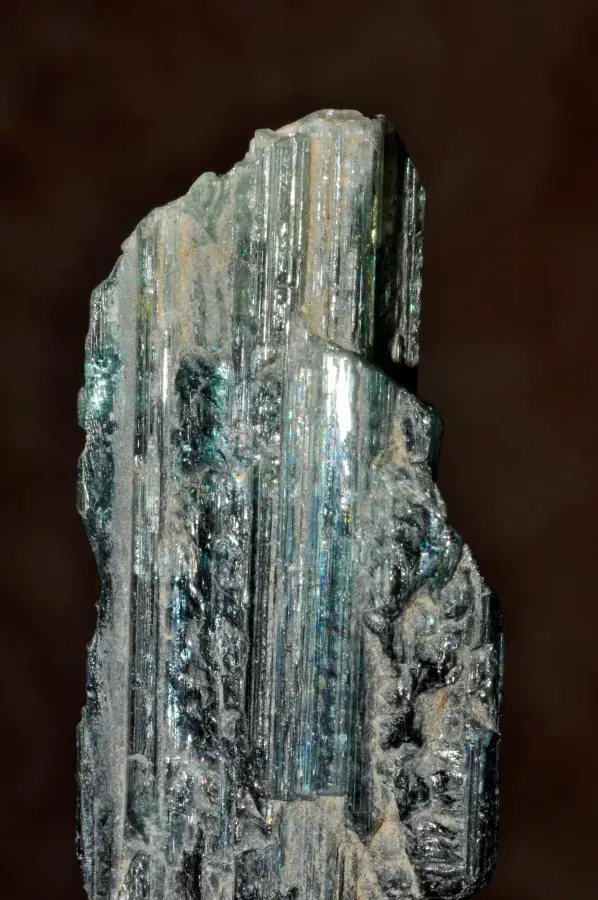
Indicolite is the blue variety of tourmaline, hardness 7 to 7.5, and it is markedly more durable than kyanite with no cleavage to worry about. Its blue tends towards the greenish and teal end of the range, where kyanite leans towards indigo and violet.
Under a loupe the difference is clear enough. Tourmaline typically carries fine parallel growth tubes and threadlike inclusions that follow the crystal axis, giving it a slightly hazy character in long stones. Kyanite shows its straight cleavage planes instead. Tourmaline is also noticeably lighter for its size, with a specific gravity around 3.06 against kyanite's 3.6 to 3.7, so two stones of the same dimensions feel different on the palm.
Kyanite and labradorite
Labradorite (a feldspar) has its characteristic shimmering play of colour, labradorescence, which kyanite lacks. Labradorite is more often translucent or opaque, with a layered structure; kyanite is clearer and more uniform through the body.
How to spot a fake
- Glass and plastic: warm to the touch, lighter than the stone, sometimes with round gas bubbles inside. Kyanite is cold, heavy, with solid mineral inclusions rather than bubbles.
- Too perfect a stone: even colour with no zoning, not a single inclusion, a flawless cut with sharp facets, reason for caution. Natural kyanite almost always shows colour zoning and traces of its brittleness; cutting it flawlessly is hard.
- Glow under UV: bright blue or green luminescence more often points to a synthetic; natural kyanite is usually inert.
- Hardness anisotropy: the signature trait, but you cannot test it by scratching a finished piece; you risk ruining the stone. That is a gemmologist's job.
A laboratory gives the definitive verdict: refractometer, density measurement, microscope. If the stone is expensive, it is sensible to ask for a gemmological certificate.
Leave your email, we'll send your discount code. No spam, unsubscribe anytime.
The code arrives by email, valid on your first order.
Symbolism: what traditions say and what science says
Almost every culture links the colour blue with calm, sky and clarity of thought, and kyanite is no exception. In lithotherapy and chakra-based practices it is assigned to the "throat" chakra and spoken of as a stone of a clear mind and calm speech.
Plainly, then: kyanite has no proven physical or healing effect. The stone does not cure, and does not influence sleep, blood pressure, anxiety or memory; there is no scientific support for any of it. If someone enjoys wearing a beautiful blue stone and tying it to a mood of focus, that is a matter of personal meaning, not of the mineral's properties. We sell kyanite as a beautiful and rare stone, not as a remedy for anything.
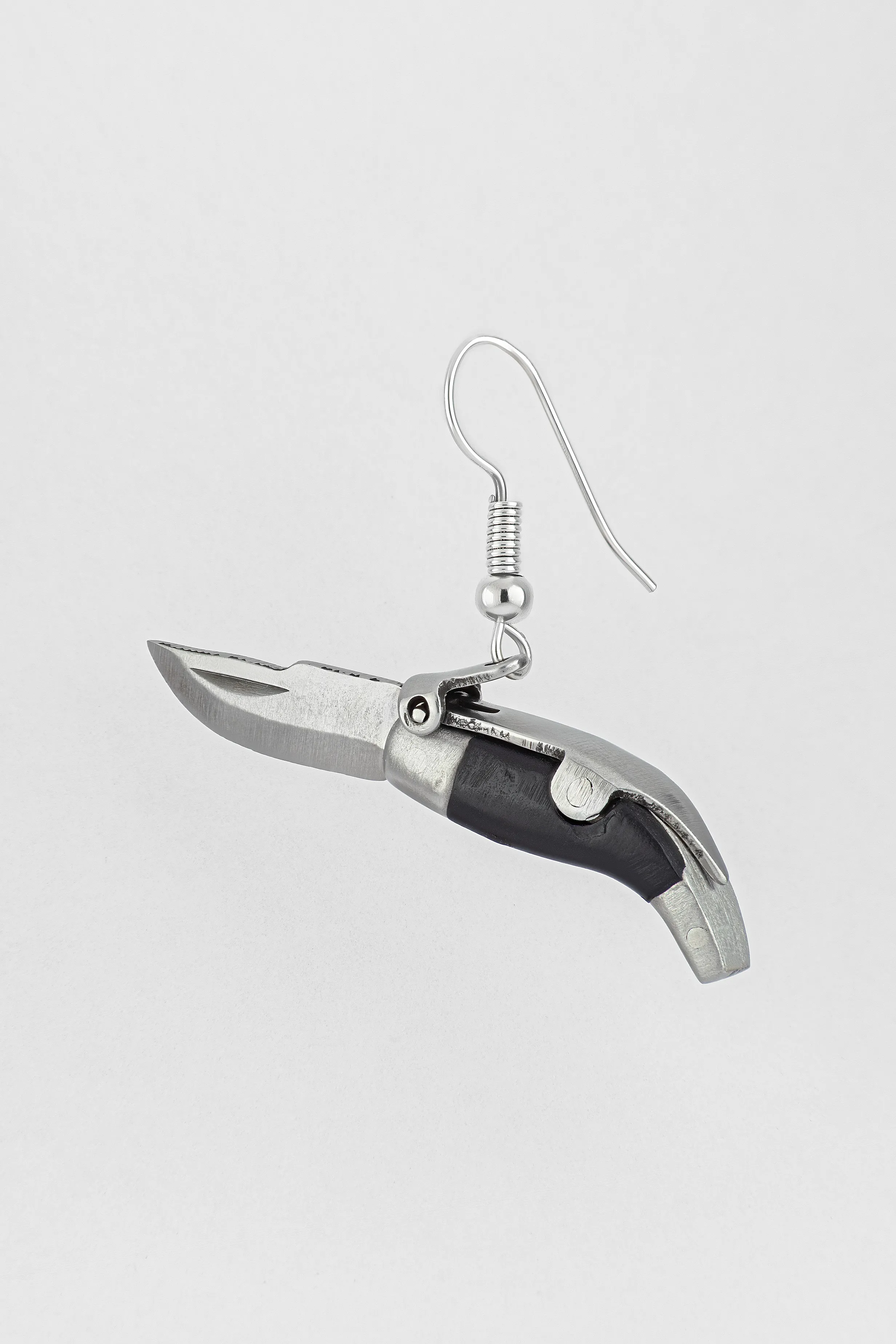
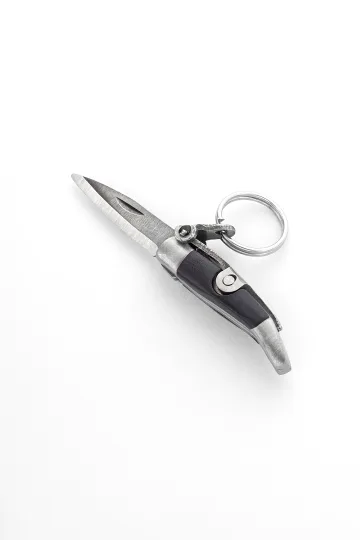
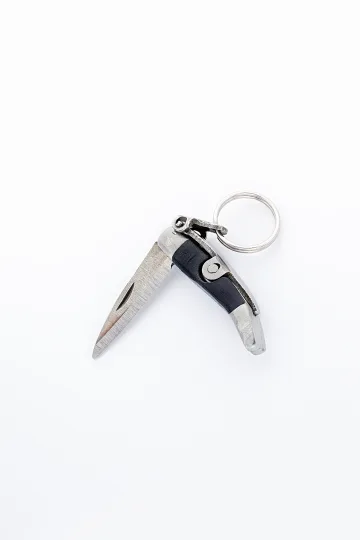
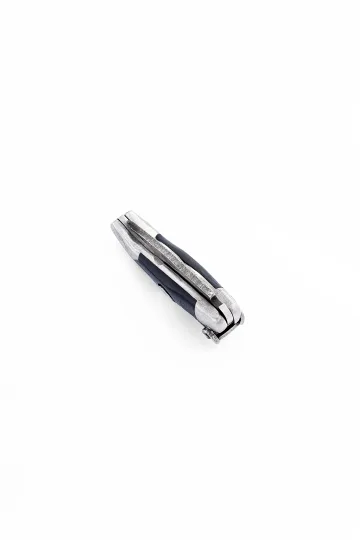
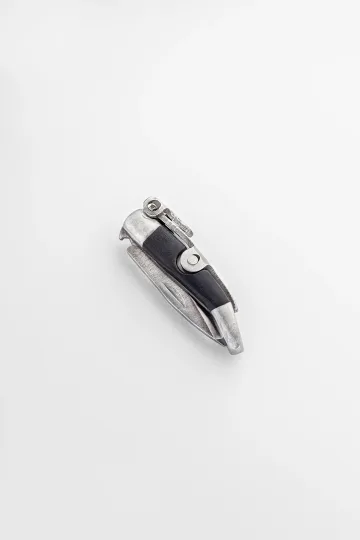
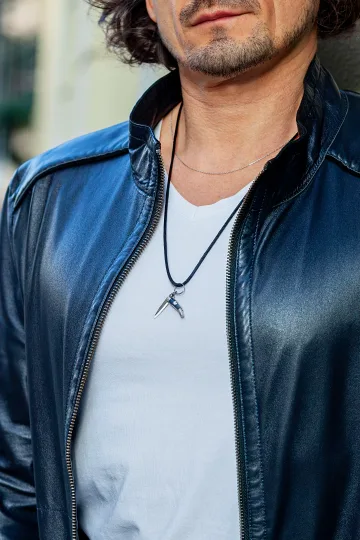
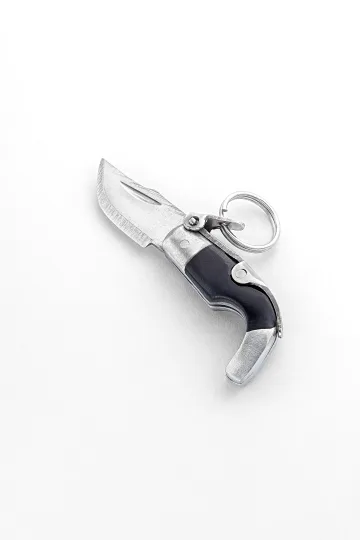
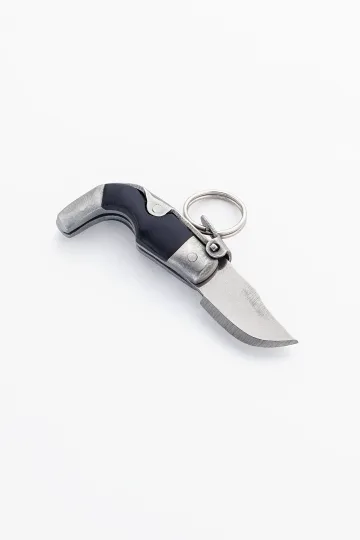
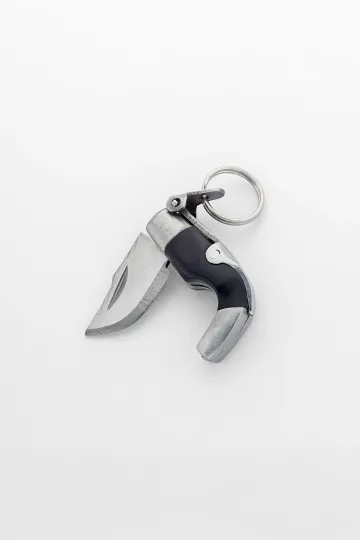
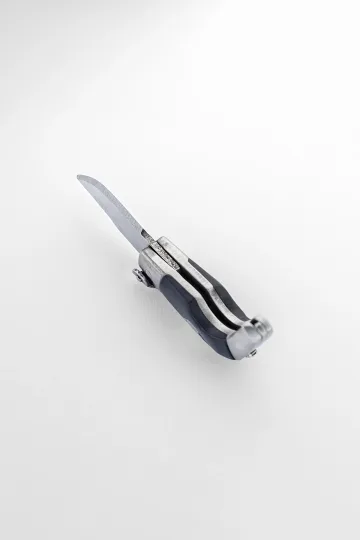
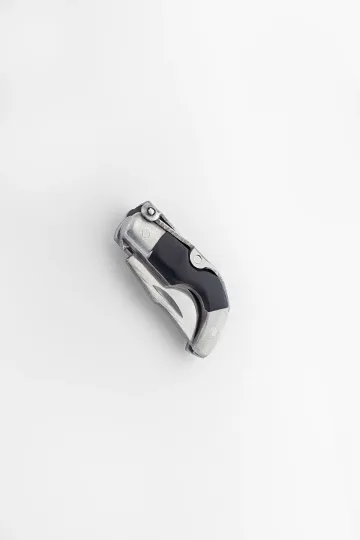
CAPAORA mini knife pendant
The 18th-century Spanish navaja in miniature: 40 mm of stainless steel, a real folding mechanism and a Palanquilla lock that clicks. An affordable gift to remember.
Authentic · Ships from Spain · 14-day returns
Care: how brittleness affects wearability
Kyanite asks for more attention than most gemstones. And it is not down to hardness alone: hardness and brittleness are different things. A stone can be hard enough in one direction and still split easily along the perfect cleavage and the weak axis. Hence the rules.
Where to wear it. Pendants and earrings are safer than rings and bracelets: the stone meets hard surfaces less often. A kyanite ring is a piece for special occasions, not for daily wear, and certainly not for manual work, sport or cleaning.
Cut. A cabochon and closed, protected settings cut the risk of chipping. Open prong settings leave sharp facets and the stone more exposed.
Cleaning. Warm (not hot) water, a drop of mild soap, a soft cloth or soft brush, and a gentle hand. A sharp swing in temperature from cold to hot can bring on microcracks.
What not to do:
- ultrasonic and steam cleaning, vibration and heat widen cracks;
- abrasives (baking soda, toothpaste, harsh pastes);
- hot water and sharp temperature contrasts;
- aggressive chemicals and chlorine (swimming pool, bleach).
Storage. Apart from other jewellery, in a soft pouch or compartment, so that harder stones do not scratch the kyanite. Keep it from long direct sun; the saturated colour may weaken slightly over time.
The psychology of a cold blue
Colour preference is rarely arbitrary, and the pull towards this particular blue is worth unpacking, because it explains who tends to wear kyanite and why they keep coming back to it.
Blue is the most consistently favoured colour across cultures, and studies of colour association find it reliably linked with calm, trust, distance and depth. There is a plausible reason: in nature, blue is the colour of sky and deep water, of open space rather than of anything close at hand. Very little food is blue, very little threat is blue. It reads as neutral territory, which is why it lowers arousal rather than raising it.
Kyanite occupies a specific corner of that range. It is not the warm, friendly blue of turquoise, nor the dense royal blue of lapis. It is a cool, slightly grey, sometimes streaky indigo that reads as considered rather than cheerful. People who gravitate to it often describe wanting something quiet, and the striping helps: because the colour varies across the stone, it holds attention the way a plain saturated blue does not, without ever shouting.
There is also the matter of what a cool blue does next to skin. Against a cool undertone it looks crisp and deliberate. Against a warm undertone it creates a contrast that reads as intentional styling rather than accident. Either way it behaves like a neutral, which is the practical reason kyanite works with almost any wardrobe: it argues with nothing.
None of this is a claim that the stone changes your mood chemically. What is honestly true is narrower and still useful. Choosing an object because it looks calm, and then noticing it several times a day, is a small repeated cue, and small repeated cues genuinely do shape how a day feels.
Kyanite in culture and in collections
Kyanite has a thin folklore record and an unusually rich collecting record, which is an unusual combination for a gemstone and says something about how recently it entered general awareness.
The folklore thinness is easily explained. The mineral was only formally described at the end of the eighteenth century, far too late to accumulate the layers of legend that turquoise, lapis and amber carry. What symbolism it has was assigned in the twentieth century, largely by writers on crystals who read meaning from the colour rather than from any inherited tradition. That is worth stating plainly rather than dressing up: the associations with communication and clear speech are modern inventions, not ancient wisdom.
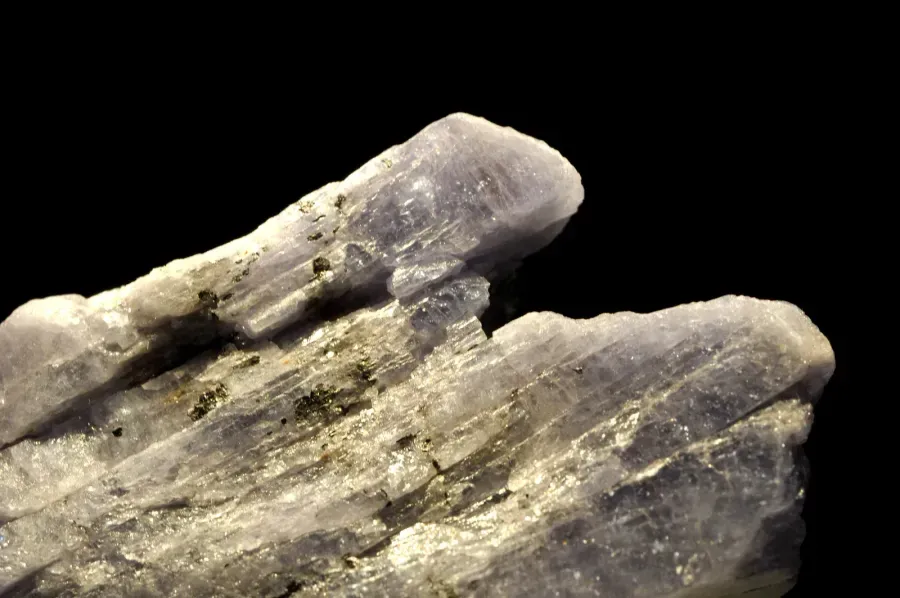
The collecting record is another matter. Alpine kyanite, particularly the material from the Austrian and Swiss valleys, has been sought after since the great age of European mineral cabinets. A well-formed kyanite crystal is a striking object in its own right, a flat blue blade often set into pale mica or quartz, and specimens like these sat in natural history collections long before anyone considered wearing the mineral. Museum holdings across Europe still show Alpine kyanite mounted as scientific specimens with handwritten labels from the nineteenth century.
Brazilian and Nepalese material broadened things considerably in the late twentieth century, when better supply and improved cutting made faceted stones viable. Nepalese kyanite in particular built a reputation among collectors for a clean, vivid blue that rivals fine sapphire in colour if not in durability, and single stones of good size from that source are pursued seriously.
The result today is a mineral with two separate markets that barely overlap. Specimen collectors want the crystal intact on its matrix, unpolished and undamaged. Jewellers want clean sections large enough to cut. The same pocket in the same mine can supply both, and the two groups value entirely different things about what comes out of it.
Send a friend a discount code, they save on their first order.
Facts about kyanite that surprise people
Its old name means two strengths. Disthene, from the Greek, was coined because the mineral gave two different hardness readings depending on which way the tester scratched it. The name is a permanent record of eighteenth-century bafflement.
Most of it never becomes jewellery. The overwhelming majority of mined kyanite goes into refractory bricks, spark plug ceramics and abrasives. Heated above about 1100 degrees Celsius it converts irreversibly to mullite and expands slightly, which makes it valuable for furnace linings. Gem grade is a rounding error in the total tonnage.
It grows in flat blades, not in chunks. The characteristic habit is a long, flat, blade-shaped crystal, which is why so much kyanite jewellery uses elongated forms. The cutter is following the shape the mineral insists on rather than choosing it.
It tells geologists how deep a rock has been. Its presence indicates burial at high pressure, and its position in the mineral sequence of a metamorphic terrain maps the depth and temperature history of a whole mountain range.
It has an identical twin with different properties. Andalusite and sillimanite share kyanite's exact chemical formula and behave completely differently, because pressure and temperature decided which structure the atoms would take.
It can show a cat's eye. Rarely, but genuinely. Parallel fibrous inclusions in some material produce a chatoyant band across a cabochon, giving a blue cat's eye that most people assume must be something else entirely.
It is not treated. In a market where the majority of blue stones have been heated or irradiated, kyanite is almost always exactly what came out of the ground. There is no established treatment to improve its colour, partly because it is not valuable enough to justify the effort and partly because the cleavage makes heating risky.
A knife will scratch it one way and slide off it the other. The single demonstration that convinces people faster than any explanation, and the reason careful cutters treat every rough crystal as an individual problem.
FAQ: common questions about kyanite
How does kyanite differ from sapphire if both are blue?
In composition and hardness. Sapphire is corundum, hardness 9, tough and fit for everyday wear. Kyanite is an aluminosilicate with a double hardness of 4 to 7, brittle, for careful wear. Sapphire plays brighter in the light; kyanite gives a softer glassy lustre and a deep blue.
What colours does kyanite come in?
Most often blue, but you also meet green (East Africa), orange (Tanzania), grey, black and colourless. In jewellery mainly blue and green are used. Red kyanite essentially does not exist in nature: if you are offered "red kyanite", it is either a dyed stone or a different mineral.
Why is kyanite brittle if its hardness goes up to 7?
Hardness and brittleness are different properties. Kyanite has perfect cleavage and weak bonds along one axis, so even a stone hard across the grain splits easily along the weak direction. This follows directly from its crystal structure.
Can kyanite be worn every day?
Better not. Because of the brittleness and cleavage it is not for constant wear as a ring. Pendants and earrings take everyday life more easily; a ring is wiser kept for special occasions and removed for any manual work.
How do you clean kyanite?
Warm water, a drop of mild soap, a soft cloth or brush, gently, with no pressure. No ultrasonic or steam cleaners, no abrasives, no hot water and no chlorine. After cleaning let it dry at room temperature.
Is there synthetic kyanite, and how do you recognise it?
Synthetics do occur. What should alert you is a perfectly even colour with no zoning, a complete absence of inclusions, a flawless sharp-faceted cut and a bright glow under UV. Natural kyanite almost always carries colour zoning and traces of brittleness. A gemmologist tells for certain.
Can kyanite fade?
With very long spells in direct sun the saturated blue may weaken slightly. To keep the colour, do not leave the piece for long under direct rays and store it in the dark.
Is blue kyanite treated by heating?
As a rule no. Kyanite is too brittle and heat-sensitive for mass heating for colour; sudden heat it takes badly. Its deep blue is usually natural, from traces of iron and titanium. Dyeing of pale material does occur: the dye gathers in cracks, and it shows under a loupe.
What should you look at when choosing kyanite?
Colour first of all: an even, dense blue with no grey cast is valued above pale. Look through the table; a good cutter brings the deepest tone face up. Light zoning and streaks along the cleavage are normal, but open cracks and chips along the edge are reason to refuse. Large clean blue stones are rare and cost disproportionately more than small ones.
Is kyanite suitable for an engagement ring?
As a symbol, yes; as a practical everyday ring, no. For a daily wedding band, sturdier stones are better (sapphire, diamond). Kyanite works if the ring is for show and worn with care.
Does kyanite heal or calm?
It has no proven physical or healing effect. Traditions tie it to clarity of thought and calm, but that is symbolism, not a property of the mineral. If there are health problems, that is for a doctor, not a stone.
Why does kyanite need a closed setting?
A closed or protected setting and a cabochon cut shield the vulnerable facets and lower the risk of chipping along the cleavage. Open prong settings leave the stone's sharp edges on show and exposed to knocks.
Where does the best blue kyanite come from?
Nepal has the strongest reputation for clean, vivid, near-sapphire blue, and single stones from there are pursued by collectors. Brazil supplies the largest volume, generally a darker and more saturated blue that often carries visible inclusions. East African material from Kenya and Tanzania tends to come in smaller sizes but with excellent colour. Alpine specimens from Austria and Switzerland are prized as crystals rather than as cut stones. In practice, origin matters less than the individual piece: judge the stone in front of you for evenness of colour, freedom from cracks and how the striping is oriented, not the country on the label.
Why does kyanite have a second name, disthene?
Because of the two hardnesses. Disthene comes from the Greek for two strengths, and the name records the discovery that the same crystal resists a scratch quite differently depending on the direction of the test. Kyanite itself comes from the Greek for dark blue. The older French and German literature uses disthene more often, and you will still meet it on museum labels and in mineralogical writing, but kyanite is now the accepted name in English.
Is it true that kyanite reveals how a rock formed?
Yes, and this is a genuine working tool rather than a curiosity. Kyanite is stable only within a specific range of pressure and temperature, so its presence in a metamorphic rock places tight limits on the depth and heat that rock experienced. Field geologists map the transitions between chlorite, garnet, staurolite, kyanite and sillimanite zones to reconstruct the burial history of an entire mountain belt. The blue mineral in your pendant does duty elsewhere as a pressure gauge for the earth's crust.
Does kyanite ever show a cat's eye effect?
Occasionally, and it is worth knowing about because most people assume a blue cat's eye must be something else. Where a piece of kyanite contains dense parallel fibrous inclusions, cutting it as a domed cabochon with the fibres running across the dome concentrates reflected light into a single moving band. The effect is uncommon, the band is usually softer and less crisp than in chrysoberyl, and such stones are collected rather than mass produced. If you are offered one, check that the band moves as you tilt the stone: a painted or assembled imitation has a line that stays put.
In short
Kyanite is a rare blue aluminosilicate with a unique double hardness and a deep, clean colour. It is hard to cut, brittle and demands careful handling, but that is exactly why it appeals to anyone who wants to step away from the usual stones. Wear it as a pendant or earrings, choose a protected setting, clean it gently and without heat, and a stone with a cool blue glow will serve you long.
Blue and cool-toned stones in silver and gold, settings made for rare and brittle minerals, pendants and earrings worn with care and for special occasions.
Buying it as a gift? Each one arrives ready to give.
 A branded Zevira box and a little card come with every order.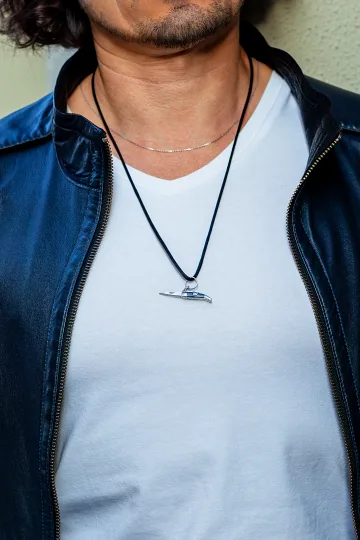




About Zevira
Zevira makes jewellery in the artisan tradition of Albacete, Spain. Kyanite needs a craftsperson who understands the brittleness and the anisotropy of the stone, and it is exactly this hands-on, unhurried approach to the setting and the mounting that we keep at the heart of everything we make.
What you can find with us on the theme of blue and rare stones:
- pendants for blue stones on fine 45 to 50 cm chains, where the stone is shielded from direct contact
- drop earrings and studs in cool blue and sky tones
- solitaire rings in 925 silver and gold for a single-stone setting
- bracelets with delicate drop-shaped and oval inserts
- settings designed for the careful mounting of brittle and anisotropic minerals
- personal engraving on silver and gold for keepsake pieces
Every piece can be personalised with engraving by a craftsperson, with the option of personal engraving. 925 silver and 14 to 18K gold.