Solitaire Ring: One Stone That Holds the Whole World
A solitaire is the only form of ring where a stone must speak for itself. Without side accents, without pavé, without secondary sparkle around the band. This means one simple thing: the size, clarity, and cut of the centre stone matter three times more than in any other setting. Any error in one of these three characteristics shows from conversation distance, not just under a magnifying glass.
This article explores how the solitaire works as geometry, as cultural code, as a lasting emotional value, and why exactly this form survived one and a half centuries of fashion and twenty style shifts. No brand recommendations, no direct prices, no promises that one stone will solve the engagement question. Just how the object works and the logic of choice, proven by generations of wearers.
Solitaires came to Western consciousness from Paris. Before the eighteenth century, rings were almost always arranged in groups: diamond dust around a central sapphire, a scattering of garnets in dense settings, enamel colouring on bands. One stone in a setting was considered either a sign of poverty of the piece or a journeyman's study that hadn't yet earned the right to work with broader sets.
The breakthrough happened in Paris master workshops in the 1740s. The logic was mechanical, not aesthetic: after the discovery of Brazilian mines in the century's beginning, high-quality stones flooded Europe in volumes. There was no sense hiding them in side dust patterns. A large, clean diamond could support a ring's visual weight alone. Side patterns only distracted.
The early Paris solitaires looked heavy by today's standards: a closed setting from gold, with silver or thin copper foil under the stone for light enhancement. There was no open back-facing that lets the stone breathe with light today. The belief was that a diamond from below should rest on a reflecting substrate, like a painting on canvas.
These first "loners" were worn by court men as status markers, not women as engagement symbols. A diamond on the pinky of a king or courtier was a calling card of someone with direct access to imported stones and the best master in the capital. The engagement meaning of this form came only one hundred fifty years later.
History: From Paris to Engagement Canon
Eighteenth-century Paris saw the birth of the diamond solitaire as a form, but it took a century and a half before that form became synonymous with engagement.
The Paris School of the Eighteenth Century
The Paris workshops of the 1740s and 1750s worked to a rule that reads strangely now: the setting was there to correct the stone, not to display it. Under the pavilion went a leaf of silver or a wafer of tinted foil, chosen by eye to push a slightly warm diamond back towards white. A stone with a grey cast got a bluish foil. A stone that leaned brown got a colder backing. The whole craft of the closed setting sat in that choice, and a master's reputation was built on it.
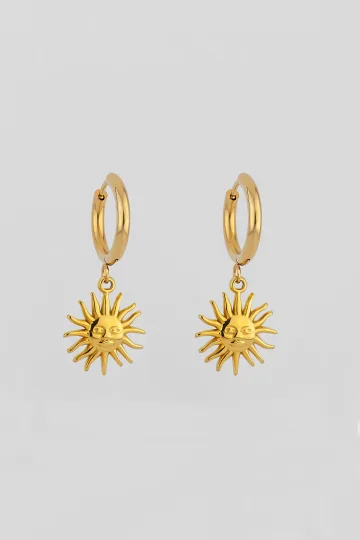
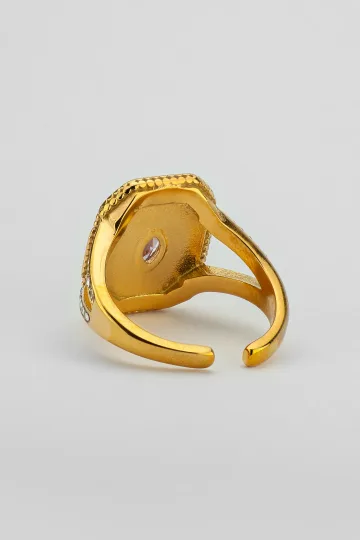
Wear the symbol, don't just read about it. These are in stock:




The consequence was that the eighteenth-century solitaire is a heavier object than it looks in inventories. The rim of gold ran the full depth of the pavilion, the back was solid, and the stone drew all of its brightness from candlelight falling on the table and bouncing off the foil. In daylight these rings look dull. In a room lit by wax they came alive, which is exactly the room they were made for.
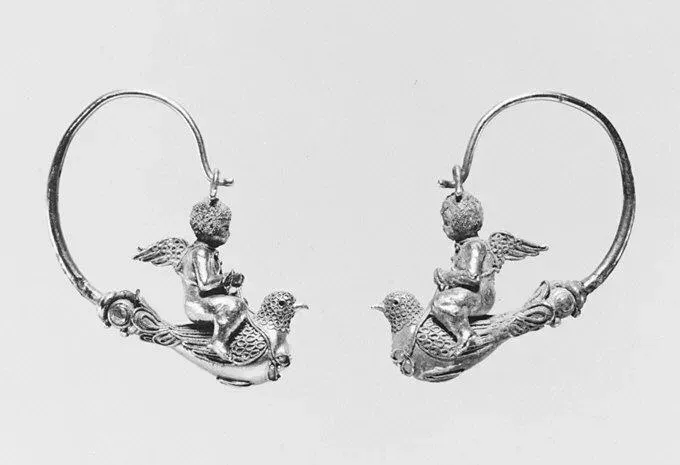
Court inventories of the period list these rings under the names of their wearers rather than their makers, and almost always as men's property. A single stone on the little finger read as access: to Brazilian parcels arriving through Lisbon, to a cutter in the capital, to the credit that both required. Women of the same households wore girandole earrings and stomachers where dozens of stones worked as a mass. The lone stone was a man's signal for another eighty years.
Two technical limits kept these rings from looking modern. Cutting still followed the shape of the rough rather than an ideal, so no two "round" stones matched. And the closed back meant that any moisture that got in stayed in, tarnishing the foil and dimming the stone within a decade. Surviving Georgian solitaires almost all have replacement settings for this reason, which is worth knowing if an antique piece is offered as wholly original.
The Nineteenth Century and the Technical Revolution
In the first half of the nineteenth century in London and Antwerp, two quiet revolutions made the modern solitaire possible. The first was the "old mine cut" with increased facet count and more exact symmetry. The second was the shift to white metal in the centre stone setting, first silver over gold backing, then platinum.
A silver substrate under a white stone immediately removed the yellow reflex that previously tinted diamond toward champagne. The stone started looking cold, bright, pure. This wasn't aesthetic whim. It was optical discovery: jewellers finally understood that metal around a stone affects colour perception more than the stone itself.
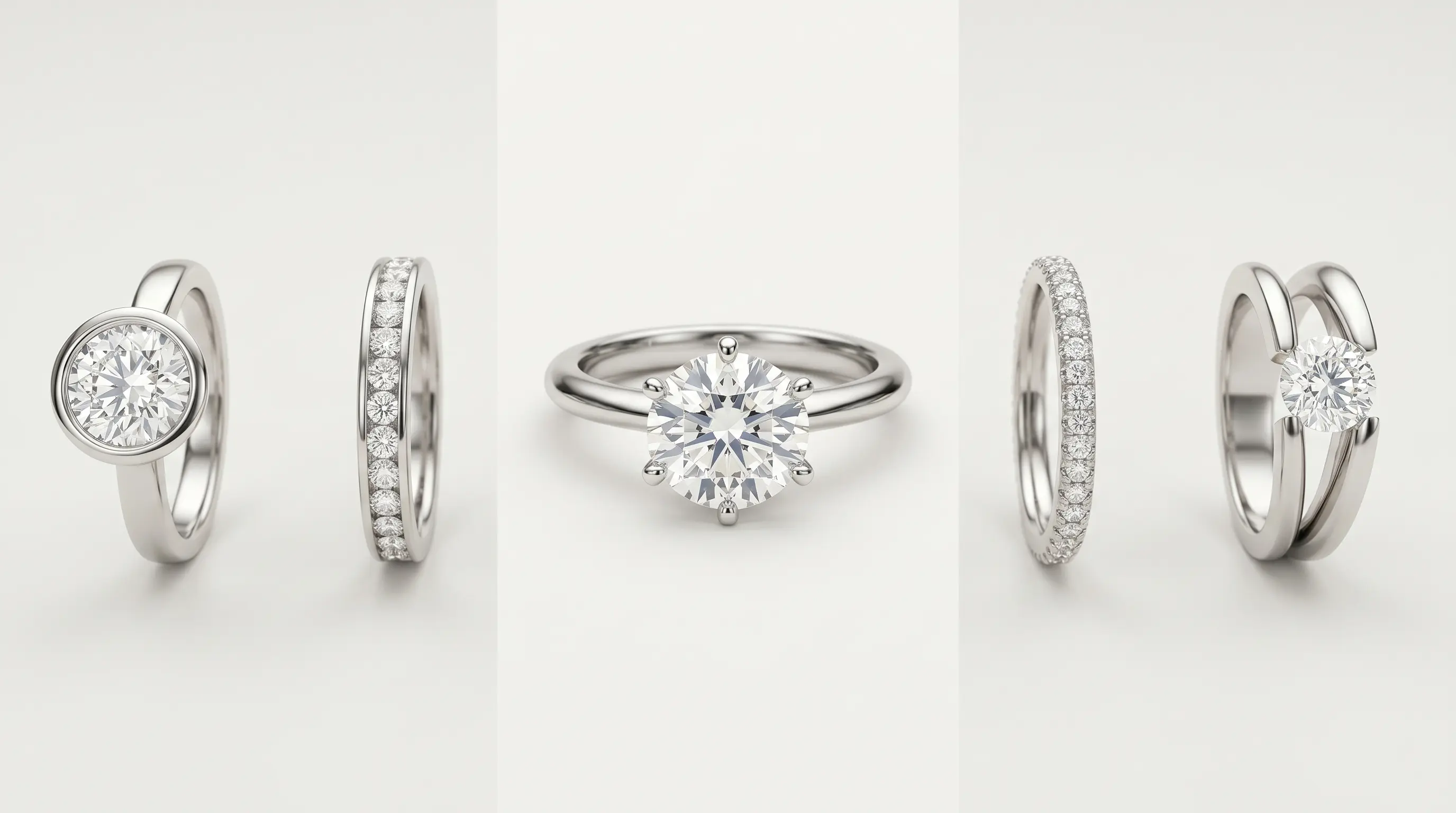
By the 1860s, the idea of "open back setting" emerged: small prongs hold the stone while light passes through the bottom. The stone started glowing instead of reflecting. Then the ancestor of the modern prong solitaire formed: four or six thin metal claws holding a round diamond on a thin band.
The Six-Prong High Setting of 1886 as Canon Fixation
In 1886, a New York jewellery workshop released a setting of six long prongs lifting the stone above the band by almost half a centimetre. The stone ended up physically above the finger, surrounded only by air and the metal of the prongs. This high six-prong setting became the visual standard for all subsequent solitaires.
Historically, it's important to understand one thing: this setting wasn't invented by one house. Paris and London masters moved in the same direction since the 1860s. But exactly the New York workshop fixed the formal canon, gave it a name, and made it the model that all other producers oriented to. From this moment, "engagement ring" in Western mass consciousness began to mean one specific picture: a round brilliant on high prongs over a thin metal band.
After 1886, the construction was repeated countless times in different workshops on both sides of the Atlantic. This setting was copied in Berlin, Zurich, Moscow on Kuznetsky Most, Petersburg at Bolin. The workshop didn't claim copyright, and this lack of protection helped the canon spread. By the 1910s, the high prong solitaire became the standard for the upper middle class across Europe and North America.
1947 Campaign and Engagement Canonization
The final fixing of the solitaire to engagement ritual happened after World War II. Before this, a solitaire was one option among others: a coloured stone ring, an eternity ring, a plain gold band. After the large postwar advertising campaigns of diamond producers in the late 1940s, the solitaire became the unquestionable canon within fifteen years.
The campaign worked through two simultaneous mechanics. First, Hollywood cinema: proposal scenes in 1950s films showed exactly the high-prong solitaire with round brilliant. Second, lectures in girls' schools about how a "real" engagement ring should look. Two generations of American and European women grew up with this picture as obvious norm.
By 1965, more than eighty percent of engagement rings in America sold as solitaires with round brilliant. In Europe the numbers were slightly lower, around sixty percent, with coloured stones and eternity rings splitting the rest. After Soviet Union collapse in the early 1990s, the Western solitaire canon came to post-Soviet space, displacing the local tradition of a bare wedding band.
Modern Variability
Since the early 2000s, the strict canon started blurring. Young brides began choosing oval and cushion cuts more often than round. Coloured centre stones appeared: sapphire, emerald, morganite. Platinum gave way to white gold and palladium. High prongs gave way to low bezels for those worried about snagging.
But the basic scheme hasn't changed. One stone. No side accents. Thin band. Visible clarity. This is a solitaire, recognisable in any country and price category.
Geometry of the Solitaire: Why One Stone
Different laws work in a one-stone setting than in rings with scattered stones. Scattered patterns hide flaws: if one small stone has a defect, it dissolves in the general grid. In a solitaire, there's nowhere to hide. The stone stands alone on a bare band, and any imperfection shows from conversation distance. Therefore, solitaire construction is "smaller setting," a different engineering task.
Head Height and Light Work
The head in jewellery terminology is that part of the setting holding the actual stone. In a solitaire, the head is always raised above the band level. The height varies from two millimetres in bezel to eight millimetres in high prong.
High head gives maximum play: light passes through the stone from all sides, including side facets, and exits as beams. This is the "fire" effect, when sparkle breaks into rainbow sparks as you turn your hand. High head's minus is that the stone protrudes above the finger and catches on clothing, hair, purse handles. An active hand with such a ring loses the stone on average once per ten to fifteen years.
Low head in bezel circles the stone and doesn't let light through side facets. Play becomes calmer, more even, without sharp sparks. But the setting lasts generations. This is compromise for very active hands: cooks, doctors, sculptors, athletes.
Prongs: Four, Six, Eight
The classic solitaire standard is four or six prongs. Four give more open light, better show the stone shape, and are simpler to clean. Six are more reliable: even if one prong damages, the stone keeps holding on the other five. Eight prongs are used for very large stones from three carats and for particularly valuable cut variants where side rays need precise fixing.
Prong thickness is a separate story. Too thin and it bends from a doorframe hit and breathes after five years. Too thick and it closes the stone and shrinks its visual size. Good prong width at its top point is roughly one twentieth of the stone diameter. For half-carat brilliant this is about three tenths of a millimetre, for two carats about half a millimetre.
The High Six-Prong Setting and its Difference from Ordinary Prong
When people say "high six-prong setting" in conversation, they often mean any high-prong solitaire. This is imprecise. The historical 1886 construction has six very long prongs rising straight from the band without widening and tightly holding the stone in its upper third of the girdle. Modern high-prong settings often make prongs shorter and widened at the base. This is terminology more than aesthetics: the difference on the finger isn't obvious to everyone.
Bezel: Solid Metal Ring Around the Stone
Bezel is full or partial metal band circling the stone at the girdle. Full bezel closes the stone completely, partial leaves side facets open. Bezel appeared before prongs, and until the eighteenth century it was the standard for any stone setting.
Bezel's advantages are obvious for daily wear. The stone doesn't snag on anything, protection on the perimeter is maximum, cleaning is simplest. One minus and big: the stone visually becomes smaller. The metal rim takes from the visible diameter about one and a half to two millimetres per side. A half-carat brilliant in bezel looks like a three-tenths in prongs.
Head Height and Proportion to Finger
In solitaire design there's an unwritten proportion: total head height from band to stone top should roughly equal the stone's width. If the stone diameter is six millimetres, head with stone should be about six millimetres high. Then the ring looks balanced.
When head is higher than this proportion, the ring starts looking "sticking," and the eye catches not the stone but empty space under it. When head is lower, the stone seems embedded and loses visual weight. Following this proportion distinguishes expensive solitaire from cheap imitation more than the stone quality itself.
Band Thickness and Balance with Stone
The band is the ring's hoop itself. In classic solitaire, the band is thin: from one and a half to two and a half millimetres at its narrowest. Thick band argues with the stone for attention and makes the ring visually heavy. Thin band intensifies the "floating" stone effect.
But there's technical limit. If the band is thinner than one and a quarter millimetres, the ring bends from ordinary daily hit. Your finger presses on the band every time you make a fist or open a door, and after ten years such a band becomes oval instead of round. Therefore, minimum safe thickness for daily wear is one and a half millimetres at the thinnest point.
For Which Hand Which Construction
Active hand requires low head and wide band. Bezel or low prongs minimise snagging, band thickness of two and a half millimetres withstands hits and doesn't deform. This is configuration for people who work with hands every day: surgeons, dentists, sculptors, cooks, violoncellists.
Quiet hand with office work supports any head. Here the choice logic is purely aesthetic: what you like more visually, you wear. Thin band of one and a half millimetres, six high prongs, open back for maximum light play.
Thin hand with long fingers supports high head without visual discord. Medium stone on thin hand looks larger than the same stone on wide hand. This is optics, not magic: proportion defines perception.
Wide short hand works better with oval or elongated stone in low setting. Round stone in high prong head on short hand often looks "slapped on," while oval seven-eight millimetres long visually stretches the finger.
Cuts in Solitaire: From Round to Marquise
The center stone's cut defines the solitaire stronger than metal or setting. It's its visual signature. Cut sets the rhythm of light play, optical perception of size, readability from distance. Detailed engineering of each cut variant is in separate diamond cuts guide, here only how each shape behaves in a solitaire.
Round Brilliant: Fifty-Seven Facets
Round brilliant cut diamond is the solitaire standard and the only cut with mathematically fixed facet formula. Fifty-seven facets in standard version, fifty-eight if counting the culet at base. This proportion was derived in 1919 by Belgian cutter Marcel Tolkowsky as optical optimum: at such ratio of angle and facet count, the stone returns the observer maximum of the falling light.
Round brilliant is the stone that forgives mistakes. If it's slightly tight in prongs, if the setting isn't ideal precision, if the band is slightly thicker than normal, the round brilliant still plays because its own geometric symmetry overcomes flaws all around. Therefore, round brilliant is the most "ordinary" of all solitaire cuts: it rarely looks bad even when the setting is made by an average master.
One minus and substantial: round brilliant loses more material in cutting. From raw crystal to finish about forty percent of original weight remains. This means a round stone of needed size is always more expensive than a square or rectangular of the same weight because its cost includes scrap material.
Princess: Square with Sharp Corners
Princess is square cut with sharp corners and usually fifty to seventy facets. Princess is more modern in design than round, appeared in 1960s and became popular in 1980s. It gives almost as much play as round but reads more geometrically, cleanly, urban.
In solitaire, princess requires special setting care. Sharp corners of the stone are its most vulnerable point: one hit against hard surface and the corner can chip. So in prong setting, the prongs must hold exactly the corners, not the centre of sides. This is technical detail worth checking when buying: if prongs sit in the middle of sides, the setting is done wrong.
Princess looks good on hand with long fingers and badly on short-fingered hand: the square emphasises shortness. This is shape for those wanting modern form without renouncing classic setting.
Oval and Cushion
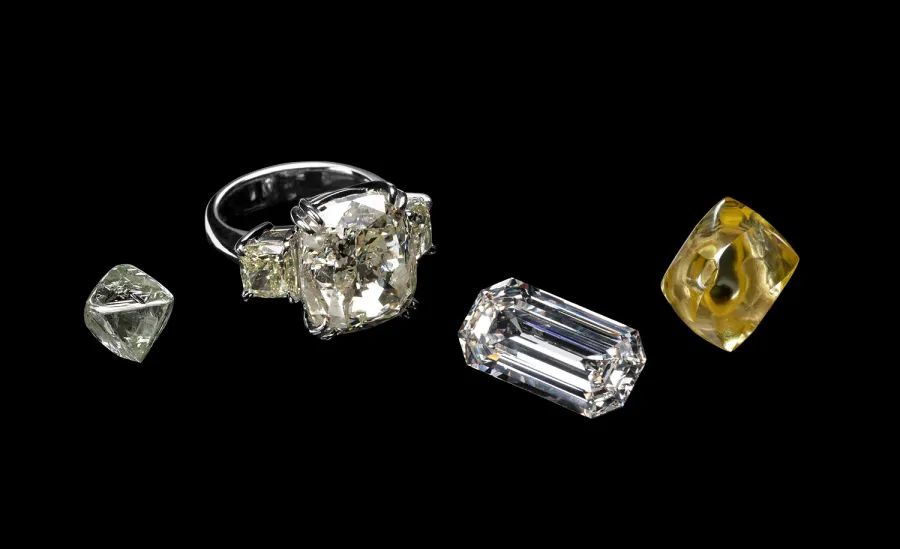
Oval cut is stretched version of round brilliant, usually fifty-six to fifty-eight facets. Since 2010s, oval has become the main competitor to round in engagement rings. By carat weight, oval looks larger than round at same weight because its surface spreads longer. This creates false sense that oval has "more stone" for the money.
Cushion ("cushion") is rectangle or square with rounded corners, usually fifty-eight to sixty-four facets. Cushion is visually softer than princess and keeps more weight in cutting, so big stone in cushion is cheaper than round at same apparent size.
Both oval and cushion work on short-fingered hand: they visually lengthen the finger and don't overweight the proportion.
Emerald and Asscher: Step Cut
Emerald and Asscher cuts are built on different principle. They have no "brilliant" triangular facets but long rectangular steps going from girdle to table. This gives different light play: not sparkling in sparks but calm glimmering of planes. The stone in these cuts looks more restrained, noble, old-fashioned.
Emerald is rectangular, Asscher is square. Both came to mass circulation in 1920s from the art deco era. In solitaire they give "window frame" effect: you look through the stone and see its inner clarity. This means any defect is visible like on a palm. Take only high-clarity stones for these cuts, otherwise instead of nobility you get visual garbage inside.
Pear, Marquise, Heart
Pear combines round and oval cut with one sharp point. Marquise is stretched oval with two sharp points. Heart is heart-shaped with indentation in top. All three come from seventeenth-eighteenth century European court tradition.
In modern solitaire these are chosen rarely. Pear requires exact orientation: the sharp point faces toward the palm, otherwise the ring looks "upside down." Marquise stretches the finger more than any other cut and therefore works on short-fingered hand, but poorly on long-fingered. Heart almost doesn't appear in engagement rings because it reads only at certain angles.
Which Cut for Which Finger
Long thin finger supports any cut but looks especially beautiful with round, oval, and cushion. Short finger wins from oval, marquise, pear: they visually lengthen. Wide finger requires large stone of round or cushion shape not to look bare. Finger with large knuckle works better with thin band and compact stone to not emphasise the bone.
These rules work at medium perception level. Individual exceptions are possible: some long-fingered women don't like marquise because it "stretches the hand ugly." Final choice is always the wearer's, not proportions theory.
Customer reviews
Zevira is a real jewellery shop. Genuine payments, deliveries and customer thank-yous.
🥰🥰🥰 gracias

Ok, ¡gracias! 🙂

Centre Stone Size: From Half Carat to Collectible Five
Carat is weight not size. One carat is exactly two hundred milligrams. This matters because two stones of same weight can look completely different depending on cut. One carat in round brilliant gives diameter roughly six and a half millimetres. One carat in oval gives length almost eight millimetres. One carat in princess is a square of five and a half millimetres per side.
Weight Segments: What They Mean on the Finger
Stone from three tenths to half carat is the lower segment of solitaire market. On medium-size finger such stone looks like noticeable point of light but doesn't dominate the hand. Round diameter from four and a half to five millimetres. This size is chosen when budget is tight, or when wearer principally dislikes large stones, or when the ring is for daily wear not engagement.
Stone from half carat to one carat is the middle segment and simultaneously the "standard" of mass engagement rings in Europe and America. Round diameter from five to six and a half millimetres. Size confidently reads from conversation distance, the ring clearly signals "engagement," but doesn't turn a hand into an exhibition. This is the bestselling segment in the industry.
Stone from one to two carats is the upper-middle segment. Round diameter from six and a half to eight millimetres. The ring becomes the hand's main accessory, reads as "expensive" from three to four metres away. At this segment, cut quality becomes critical for the first time: proportion flaws are visible to the naked eye.
Stone from two to three carats is premium. Round diameter from eight to nine millimetres. On medium finger such stone covers half the finger width from inside to outside. This is no longer engagement ring in everyday sense, it's status object, hard to wear inconspicuously.
Stone from three carats and up is collectible. Different laws apply here: each stone is individual, certified by name, setting is made specially for it. On the market, such stones number only thousands per year worldwide in high-clarity diamonds category, and each has owner history.
Psychology of Size Perception
Stone size is perceived not absolutely but in proportion to the finger. One carat on a thin finger looks larger than one carat on a wide finger. This isn't optical illusion, it's math of proportions: the same stone covers different part of finger width.
There's also the neighbour effect. Half-carat stone next to a bare wedding band looks larger than the same stone next to scattered pavé on a second ring. Scattered pavé draws attention to itself and steals visual weight from the solitaire. Therefore the classic pair "solitaire plus plain wedding" works in solitaire's favour, while "solitaire plus eternity with scattered stones" works against it.
Size perception also depends on stone height in the setting. High-prong solitaire looks visually larger than low bezel at the same stone weight. The effect works because a high stone casts shadow on the finger and creates a second perception outline.
When Stone is Too Large
A visual limit exists beyond which the stone starts working against the wearer. This limit is individual: for thin hand it comes earlier, for wide hand later. General rule: if the stone covers more than two thirds of finger width, the ring starts looking like "exhibition," not jewellery. Others look at size, not the hand.
For most women's hands, the comfortable ceiling is around two carats in round cut. Beyond that begins the zone where the ring requires outfit coordination, hand-holding style, setting. Wearing a three-carat solitaire at a supermarket is technically possible but socially always a gesture.
There are professions where large stone becomes dysfunction. Middle school teachers, nurses, hairdressers, retail sales staff rarely wear large solitaires to work because the ring interferes with people contact. They wear to going-out, keep at home in the box for work hours.
When Stone is Too Small
The reverse edge of the scale also exists. A stone smaller than three tenths carat on a medium finger reads as "fragment of light," not full solitaire. The ring starts looking "childish," like a first piece of jewellery for a fifteen-year-old. This isn't bad in itself, but for an adult woman's engagement ring such visual presentation reads as incompleteness.
Exception is solitaire with coloured stone: ruby or sapphire at three tenths carat reads brighter than diamond of same size because colour saturation. Small stones in colour palette work better than small in transparent.
Budget Segments Without Direct Prices
Accessible is half carat in medium clarity and average cut. In everyday feeling, this is buying size of monthly salary of average specialist.
Medium is one carat in clarity VS2 and Excellent cut. Everyday comparison: three to four monthly salaries of same specialist.
Premium is two carats in clarity VVS and Excellent cut. Everyday comparison: yearly income of average specialist or half yearly income of qualified.
Collectible starts at three carats high clarity. Everyday analogy no longer works, this is buying from "small apartment in provincial city" category and up.
Upload a photo of your pet, someone you love, or an object. We'll build a 3D model and hand-cast it in pewter.




Stone Certification: GIA, IGI, HRD and Why They Matter
From the moment the stone reaches half carat, certification stops being formality and becomes purchase passport. Without certificate you buy a "stone," with certificate you buy a specific physical object with known characteristics. The price difference between certified and uncertified at the same appearance is fifteen to thirty percent in favour of certified.
Three Main Laboratories
GIA is the Gemological Institute of America, founded 1931, headquarters in California. This is the most conservative and strictest lab in the world. A diamond with GIA certificate rates on average one grade stricter than the same stone in other labs. This means G colour in GIA often gets F in IGI, and vice versa.
IGI is the International Gemological Institute, founded 1975 in Antwerp, has branches in Mumbai, New York, Bangkok. IGI is popular with mid-segment producers and almost always accompanies lab-grown diamonds. Standards at IGI are slightly softer but procedure is reliable.
HRD is the High Diamond Council in Antwerp, founded 1976. HRD in strictness is close to GIA. HRD certificates often appear on stones passing through European cutting schools and in antique lots from Belgium and Holland.
What Must Be in Certificate
Full certificate contains the obligatory set of fields. Unique diamond number, laser-engraved on the girdle in microscopic numbers. Dimensions to hundredths of a millimetre. Weight to hundredths of carat. Colour on letter scale (from D as cleanest to Z as noticeably yellow). Clarity from FL (no inclusions) to I3 (visible inclusions to naked eye). Cut from Excellent to Poor. Polish and symmetry as separate grades. Stone's fluorescence under ultraviolet. Graphic map of inclusions with position marking.
Additionally, in premium certificates, cut proportions are indicated in percentages: depth, table size, crown angle, pavilion angle. These numbers are important for checking the stone against re-cutting: if proportions are close to Tolkowsky ideal, the stone wasn't recut.
When Certificate is Mandatory
For stone from half carat, certification is basic requirement of sane purchase. Without it you can't check that the stone is really the weight and quality claimed. Externally, it's almost impossible to tell G colour from J colour even to an experienced eye, evaluation difference between them can be multiple.
For stone from one carat, certificate is no longer question of soundness but legal protection. When insuring the ring, the insurance company demands a certificate for coverage evaluation. When selling a stone on the secondary market without a certificate, you lose forty percent of market price.
For stone from two carats, certificate must be from GIA or HRD only. Certificates from other labs on large stones are perceived by the market with discount and reduce liquidity.
When Certificate Isn't Needed
For stone smaller than three tenths carat, certificate is economically impractical: its cost is a substantial part of the stone cost itself. In this segment, seller guarantee and basic gemological check at purchase place is enough.
For stones with obvious collectible history (old pieces, remelted family rings), modern lab certificate might be impossible in principle because the original cut doesn't match modern standards. In these cases, assessment is done by specialised antique experts who issue their own conclusions.
For lab-grown diamonds, IGI certificate became industry standard. GIA since 2020 also certifies lab stones, but the market still sees their certificates as less significant in this segment.
What to Check Before Buying
First: matching of the certificate number with laser engraving on the stone's girdle. This is checked under 10x magnification and good shops show it obligatory. If numbers don't match, the stone in the ring isn't the one described in the certificate.
Second: certificate date. If certificate is older than five years, it's desirable to renew it because the stone might have gotten micro-damage since previous certification.
Third: matching of the photo in certificate to real stone. Graphic map of inclusions should exactly match what you see in the stone under magnification.
Fourth: original, not copy. Modern certificates have holograms, watermarks, QR-code for online lab website check. Through QR you can open the full card and verify all data.




Solitaire Beyond Engagement
The fixing of solitaire to engagement is so tight that many potential wearers don't consider this form outside wedding context. This is outdated view. Solitaire is universal jewellery form with one stone, and engagement is just one of ten possible reasons to buy or give it.
To Herself at Thirty or Forty
Self-purchase of solitaire on a milestone has become separate demand category since late 1990s. Logic is simple: years that split life in half deserve physical symbol. By thirty, many women already have everyday jewellery; by forty, already have status pieces. But "thing for half-life forward" in the box is often missing.
Solitaire to herself differs from engagement in that you wear it on the right hand, not left. On the right side it's not perceived as relationship symbol, giving more design freedom. You can choose coloured stone. You can larger size than partner would allow. You can more avant-garde setting.
Gift to Mother from Adult Children
Established practice of recent decades is gift to mother on sixtieth or seventieth birthday from grown children pooled. Logic is similar to self-gift: by this age, woman already has everything practical, but separate status piece in the box is often missing cell.
In this scenario, middle-segment stone works (half to one carat) in calm setting. High-prong solitaire is uncomfortable for elderly woman: catches on everything, hard to remove-put on with arthritic fingers. Better works bezel or low prongs on wide band, comfortable to hold.
Coloured stone in this scenario often works better than diamond. Sapphire or ruby of saturated colour gives warmer feeling and doesn't read as "second engagement."
Legacy Through Remelting
Separate strong scenario: solitaire made from stone that previously was in different jewellery of deceased relative. Grandmother's earring, mother's ring, grandfather's cufflink with diamond. Stone is extracted, reset in modern solitaire, and family physical memory continues in new bearer.
This scenario carries deep emotional load. The stone carries history of previous wearer, and new setting becomes bridge between generations. In such cases, the setting is often specially ordered with engraving of name and date inside the band.
Technically, stone remelting is always impossible: diamond can't be remelted, it can only be moved from one setting to another. But coloured stones in antique pieces are sometimes recut for modern setting. This lowers their weight and historical value but gives second physical body.
Man's First Serious Ring
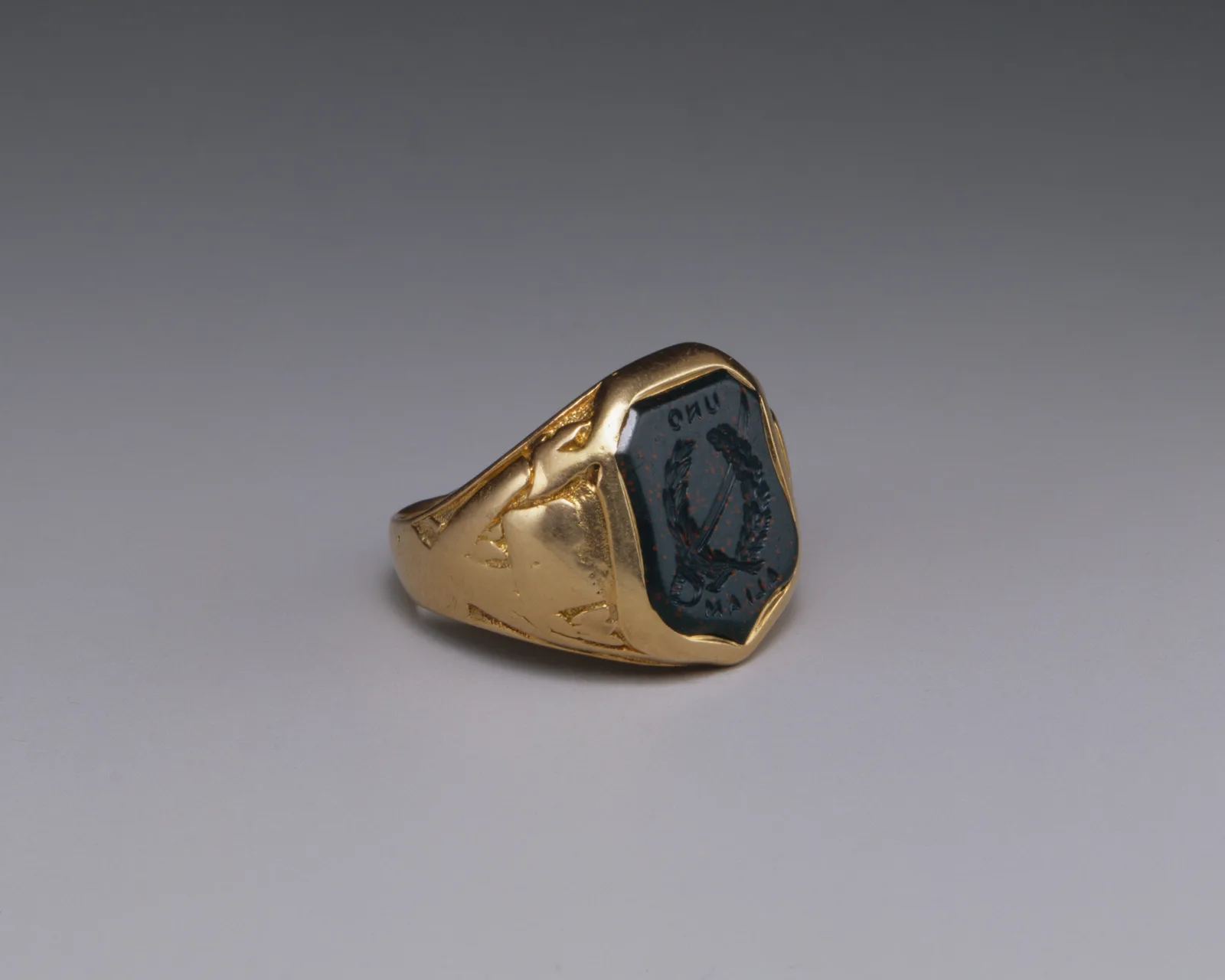
Male solitaire exists as perston form with one large stone in middle. This is ancient form, going back to Roman patrician seals. In modern wardrobe, male solitaire takes the place of "one significant ring," worn constantly or on special occasion.
Stone in male solitaire is usually larger than female: from two carats and up. Cut is often rectangular or cushion, less often round. Metal is substantial, band wide up to five-seven millimetres. This is different visual logic than female solitaire: not floating but weight.
Coloured stone for a man works more naturally than diamond. Black onyx, dark sapphire, garnet, ruby in dense setting create "ring with history" regardless of whether owner has family lineage. Diamond in male ring often reads as overly demonstrative except in exceptional contexts.
Paired Solitaire with Different Stones
Recent years' trend is paired solitaires of spouses or partners with different centre stones. She has white brilliant, he has blue sapphire. She has clear aquamarine, he has deep emerald. The idea is both wear solitaire as unified design, but each with own symbol.
This works in families where both partners value geometry and don't want formal matching. Paired solitaires give both shared style unity and choice individuality. Over long distance, this often proves more durable visual union than standard paired wedding bands.
When Isn't Engagement at All
Solitaire purchase might not relate to relationship and dates. Sometimes: work promotion, thesis defence, end of long therapy process, move to another country, child birth, retirement. Any personal milestone that person wants to physically fix in the box.
In these cases, solitaire works as time capsule. Twenty years later, opening the box, the wearer won't remember she bought it for thesis defence, but will remember the buying moment itself. Memory isn't tied to the stone by itself, but calculated on strong gesture.

Turn on your camera, pick earrings, a pendant or a ring, and see the piece on yourself in real time.
Switch items in one tap.
Everything runs in your browser: no photo or video is ever uploaded.
Five Scenarios: How Solitaire Works in Real Life
Specification lists are easy to read and hard to apply. What follows are five composite situations, each built from the sort of brief that comes into a workshop, with the reasoning laid out to its conclusion. Names are invented, the constraints are not.
Case One: The Engineer and the Thin Band
A design engineer, thirty-one, office hours, keyboard all day, no heavy lifting, narrow hands with fingers about seven millimetres across. She wants the classic picture: round brilliant, high setting, band as fine as it will go.
The office life removes the usual objection to a raised head, so the constraint moves to the band. At seven millimetres of finger width, a two-carat stone would cover most of the top of the hand and read as borrowed. Somewhere between half a carat and three quarters sits the balance point, giving five to six millimetres of diameter against seven of finger.
The band is where the brief has to bend. She asks for one and a quarter millimetres because it makes the stone look larger. That thickness turns oval within a decade of daily wear, and keyboard work is not gentle: the palm side of a ring takes pressure every time a hand closes. One and a half millimetres at the narrowest point, tapering up towards the head, keeps almost all of the visual effect and roughly doubles the working life.
Outcome: round brilliant of about six tenths of a carat, six prongs, band one and a half millimetres tapering to two at the shoulders, white metal. Annual check-up booked into the calendar at purchase.
Case Two: The Surgeon Who Cannot Wear a Raised Stone
A consultant surgeon, thirty-eight, gloves on and off perhaps twenty times a day, scrubbing between each. Any prong that stands proud of the metal will tear a glove, and a torn glove in theatre is a discarded glove and a re-scrub.
This brief has one answer, and it is a full bezel. The stone sits flush inside a wall of metal, the profile is smooth in every direction, and nothing catches. The cost is visual: a bezel eats one and a half to two millimetres of apparent diameter on each side, so a stone of three quarters of a carat presents like a half.
The fix is to buy the size back. Going up to a full carat in the bezel restores the presence of a three-quarter-carat prong setting, and the money that would have gone into a certificate-topping clarity grade goes into carat weight instead, since a bezel hides the girdle region where most eye-visible inclusions sit anyway.
Metal grade matters here more than anywhere. Twenty-two carat gold is too soft to hold a rim under that much handling. Fourteen or eighteen carat, or platinum, holds shape for decades.
Outcome: full bezel, one carat, clarity in the VS range rather than VVS, eighteen carat white gold, band two and a half millimetres and flat inside so it sits still under a glove.
Case Three: Resetting a Grandmother's Stone
A stone of about one and a quarter carats in an old European cut, currently sitting in a worn 1930s ring with a cracked shank. The owner wants it wearable again and does not want it to look new.
The first question is not design but condition. An old cut has a small table, a high crown and often a visible open culet, and its girdle can be thin enough that a modern setter has to be careful. Any chip at the girdle from ninety years of wear needs to be checked under magnification before the stone comes out, because a hidden chip can propagate during setting.
The second is that a modern brilliant-cut setting flatters a modern stone. Old cuts throw fat, slow flashes of colour rather than fast white sparkle, and they look best lifted enough for light to enter from the sides. Six prongs, moderately high, in yellow gold rather than white, keeps the warm register the stone was cut for.
There is no certificate and there will not be one, at least not a meaningful one: laboratories grade against modern proportions and will mark an old cut down. An independent valuation for insurance takes its place.
Outcome: stone checked, girdle sound, reset in a six-prong yellow gold head on a two-millimetre band, date of the grandmother's marriage engraved inside, insurance valuation on file.
Case Four: Buying for Someone Who Has Not Been Consulted
The classic proposal problem: the ring has to be a surprise, and the buyer has one attempt with imperfect information. The common failure is to guess wrong on shape, size and finger measurement at once and end up altering all three.
The workable approach is to fix only what is reversible. Ring size is the easy part, since a plain band can be resized by a size or two in either direction without damaging it. Metal colour is usually observable from what she already wears, and it is the one thing most people are consistent about. Shape is the risk, and round is the shape with the widest tolerance because it rarely looks wrong on any hand.
Everything else can be deferred. Buying a certified loose stone and a simple temporary head, then commissioning the final setting together afterwards, keeps the surprise intact and moves the irreversible decisions to a point where both people are in the room. Many buyers resist this because it feels less complete on the night. In practice a good stone presented in a plain setting reads as confidence, not as an unfinished job.
Outcome: certified round brilliant, plain four-prong head, resizable band in her usual metal colour, final setting commissioned six weeks later.
Case Five: The Fortieth Birthday, Bought by Its Wearer
A translator, forty, buying for herself, right hand, no ritual attached and nobody to please. This is the brief with the fewest constraints and, oddly, the hardest to close, because the usual scaffolding of expectation is absent.
Without an engagement frame, the diamond default loses its grip. A saturated sapphire or a well-cut spinel at the same size costs a fraction and reads with more personality, and on the right hand nobody will misread it as a relationship signal. Colour also solves the small-stone problem: half a carat of deep blue is legible across a room, while half a carat of colourless stone is a point of light.
The setting can go where a wedding-adjacent piece cannot. An off-centre head, an east-west set oval, a hammered band, a mixed metal shank: all of these are difficult to justify when a ring has to match a partner's and photograph conventionally, and all of them are open here.
Outcome: oval sapphire of about a carat and a half set east-west in a low bezel, eighteen carat yellow gold, band two millimetres, no engraving because the buyer knows perfectly well what it is for.
Antipatterns: What to Avoid
Most disappointing solitaire purchases repeat one of a handful of standard errors. The list below comes from what turns up in repair workshops and in resale valuations, which is where mistakes surface a decade after they were made.
A Band That Is Too Thin
A shank thinner than one and a quarter millimetres at its narrowest point is a weak structure. The ring flexes under finger pressure, goes oval in five to seven years, and begins to crack at the flex points around the ten-year mark. This is not a theoretical hazard, it is the single most common repair a jeweller sees on engagement rings.
When a seller pushes a very fine band, there is usually a reason: a thin shank makes the stone look larger, and larger is easier to sell. The price is service life. If the stone is meant to last forty years, the band should start at one and a half millimetres and be checked for thinning at every annual service.
An Enormous Stone on a Narrow Hand
A two-carat brilliant on a finger seven millimetres across creates a visual mismatch. The ring reads as borrowed rather than owned. This is a question of proportion rather than size: the same stone on a ten-millimetre finger looks entirely natural.
Before committing to a large stone, try a dummy of the same shape and dimensions on the actual hand. Most serious retailers keep cubic zirconia demonstration stones for exactly this. If the stone covers more than half the width of the finger from one side to the other, the size is wrong regardless of what the certificate says.
A Poor Cut in a Big Stone Instead of a Good Cut in a Small One
Buyers with a fixed budget constantly face the same fork: more weight with a weaker cut grade, or less weight cut well. Bigger feels like the safe answer. In practice it almost never is.
A stone graded Good or Fair for cut performs worse at any weight than an Excellent stone half its size. Light entering a badly proportioned stone leaks out through the pavilion or escapes from the side rather than returning to the eye. A large, poorly cut diamond reads as glass at conversation distance. A small, well-cut one reads as a diamond.
Put cut above weight every time, and read the certificate for polish and symmetry as well as the headline cut grade. If any of those three falls below Excellent, look at another stone.
Fine Prongs on a Heavy Stone
Delicate prongs look right on stones up to half a carat. From one carat upwards, a fine prong becomes a mechanical liability: it cannot absorb the inertia of the stone when the ring strikes a door frame or a worktop. The working standard from a carat upwards is a prong measuring at least half a millimetre across at its tip.
Unusually elegant prongs on a large stone are often a sign that metal has been saved somewhere it should not have been. Within two or three years the prongs start to lift, and the ring needs servicing annually without exception. Ask what the prong dimension is before buying, and ask again at the first service.
A Bezel in Metal That Is Too Soft
A bezel made in very high purity gold, whether fine gold or a twenty-two carat alloy, is too soft to protect a stone for long. Within a few years the rim deforms and the seat loosens. The working range for a load-bearing rim is fourteen to eighteen carat gold, or platinum at 950. Those alloys hold their shape for decades.
When buying a bezel-set solitaire, ask for the alloy in writing. In the United Kingdom the hallmark itself answers the question: the millesimal fineness is struck into the shank, so 585 or 750 is visible on the piece. A 916 mark on a structural bezel is a warning, not a selling point.
Buying Without Putting the Stone Under a Loupe
A certificate is paper. The stone is a physical object, and the two are only linked if someone checks. Never buy a solitaire without looking at the stone yourself under ten times magnification, at the counter, before payment. A good shop hands over the loupe without being asked and talks you through what you are seeing.
Under the loupe you should find the laser inscription on the girdle, inclusions that match the plotted map in the certificate, clean facet junctions with no abrasion, and prong tips with no chips. If a seller is reluctant to produce a loupe or steers the conversation away from it, that is reason enough to buy elsewhere.
Setting a Stone With No Service Interval Planned
Every solitaire needs a check once a year: prongs tested for movement, shank measured for deformation, stone examined under magnification, bezel seat checked for lift. It takes a quarter of an hour and costs little, and without it rings eventually lose stones.
Ask at purchase whether servicing is included. Many makers cover the first two or three years. If nothing is offered, put a recurring annual reminder in a calendar on the day of purchase. Loss statistics for prong settings over a twenty-year span run at a few percent without servicing and close to zero with it, and the difference is entirely down to whether anyone remembered to book the appointment.
Leave your email, we'll send your discount code. No spam, unsubscribe anytime.
The code arrives by email, valid on your first order.
Solitaire Against the Other Engagement Formats
A solitaire is one option among several, though in the popular picture it takes up most of the frame. Seeing the alternatives clearly makes the solitaire itself easier to read: what it delivers, what it declines to do, and where another format simply performs better.
Solitaire Against Trilogy
A trilogy carries three stones, a larger centre with two smaller shoulders. The symbolism gets read in several ways: past, present and future, or friendship, love and fidelity, depending on who is telling it.
Its advantage over the solitaire is density. The same total carat weight spread across three stones fills more of the finger and looks more generous. Its cost is visual weight: a trilogy reads as heavier, and the side stones compete with the centre for attention rather than deferring to it.
Choose a solitaire when the point is the clarity of a single idea. Choose a trilogy when the point is a narrative with parts.
Solitaire Against Halo
A halo sets the centre stone inside a ring of small pavé. The surround enlarges the apparent size of the centre and adds a general shimmer around it. The format became popular through the 2010s, marketed as a way to get the look of a bigger stone for a smaller outlay.
Its advantage is exactly that visual generosity: half a carat inside a halo presents like three quarters of a carat alone. Its cost is dating. A halo is a recognisable style of one particular decade, and in twenty years it may read as firmly of its period, where a plain solitaire does not read as of any period at all.
If timelessness is the priority, take the solitaire. If maximising apparent size within a budget is the priority, take the halo and accept that it will look like the decade it was bought in.
Solitaire Against Eternity
An eternity ring runs stones the whole way around the band with no dominant centre. The stones match each other, usually somewhere between a fifth and half a carat each, and the symbolism sits in the unbroken line. There is more on the format in the full eternity ring guide.
An eternity is a flat, horizontal piece of jewellery. A solitaire is vertical, built around lift. They are different aesthetics, and they are frequently worn as a pair, the solitaire on the ring finger and the eternity beside it. Worn alone, an eternity reads as a wedding band rather than an engagement ring, which suits couples who do not separate the two stages.
Solitaire Against a Plain Band
A band is a broad strip of metal, sometimes carrying a single line of pavé, often completely plain. It is the solitaire's opposite: the whole idea lives in the metal, with no centre stone at all.
Bands get chosen by people whose hands work for a living and for whom any raised stone is an obstacle, and by people who dislike the display a centre stone involves. Solitaires get chosen by people for whom the behaviour of light in a stone is the point. It is a question of priorities, not of taste.
CAPAORA mini knife pendant
The 18th-century Spanish navaja in miniature: 40 mm of stainless steel, a real folding mechanism and a Palanquilla lock that clicks. An affordable gift to remember.
Authentic · Ships from Spain · 14-day returns
Looking After a Solitaire
One stone on an open band collects skin oil, hand cream and dust faster than a setting full of pavé, because there is nowhere for the dirt to hide and the pavilion sits exposed underneath. The regime is simple: regularly at home, once a year at a bench.
Cleaning at Home
Every two or three weeks, wash the ring free of oil and cosmetics. Warm water, a drop of washing-up liquid, a soft toothbrush, careful strokes around the stone and underneath it where the film builds up. Rinse in warm water and blot dry with a soft cloth. The underside matters more than the top: a greasy pavilion kills the light return long before a dull top surface does.
What to avoid: consumer ultrasonic cleaners, which vibrate prongs loose over repeated use; anything containing chlorine bleach, which attacks the alloying metals in gold; and domestic steam devices. These destroy settings in a handful of applications.
When to Take It Off
A solitaire comes off for prolonged contact with water and detergent. Showering, bathing, washing up, cleaning the house, swimming in the sea or a chlorinated pool: all of these belong on the list of moments when the ring should be sitting on the bedside table instead.
Hard water is a specific British problem worth naming. Across the south and east of England the water carries enough dissolved calcium to leave a scale film on a pavilion within weeks, and that film is what makes a stone look flat. In soft-water regions of Scotland and Wales the same ring stays bright for far longer on the same cleaning schedule.
Sport without hand contact, such as running, cycling or golf, permits wearing the ring but accelerates soiling. Contact sport of any kind, team games, martial arts and weight training all require taking it off, both for the ring and for the hand inside it.
Annual Servicing
Once a year the ring goes to a qualified bench for a check. The jeweller tests each prong for movement, measures the shank for deformation, examines the stone under magnification and checks the bezel seat for lift. Anything found gets corrected before it turns into a lost stone.
A standard service takes fifteen or twenty minutes and costs little. Loss rates for prong settings over twenty years run at roughly three percent unserviced; with annual servicing the figure falls close to zero. That is the entire argument for the appointment.
Storage
At home, keep a solitaire separate from other jewellery, in a soft-lined box or a pouch of its own. Contact with other metal objects in a shared casket produces fine scratching on the setting and, occasionally, knocks to the stone itself.
Diamond is the hardest natural material and nothing in a jewellery box will scratch it, with one exception: another diamond. Two stones rubbing together in a shared drawer mark each other. A separate compartment with a soft lining solves the problem entirely and costs nothing.
FAQ
What Does a Solitaire Cost as a Segment
The accessible segment is a stone of three to five tenths of a carat in middling clarity and an ordinary prong head. In everyday terms this is a purchase on the scale of one month's salary for a mid-career professional.
The middle segment is half a carat to a carat, good clarity, a well-made setting. Roughly three to five months of the same salary.
The premium segment is a carat and a half to two carats, high clarity, Excellent cut. Comparable to a year's income for that professional, or half a year for a senior one.
The collectible segment begins around three carats and stops comparing usefully to salaries at all; at that point the reference class is major assets rather than earnings.
Which Setting Is More Secure
A bezel is more secure than any prong setting. The stone is gripped around its full circumference and shielded from side impact. Unserviced, a bezel runs twenty to thirty years. An unserviced prong head runs five to ten; with annual servicing that extends to thirty or more.
The trade is optical. A bezel takes visible diameter away from the stone and calms the light play, since side facets sit behind metal. If security is the deciding factor and sparkle is secondary, the choice makes itself.
Can a Solitaire Take a Coloured Stone
Yes, and there are more of them on the market every year. Sapphire, ruby, emerald, aquamarine, morganite and tanzanite all work as centre stones. Each brings its own register: sapphire is restrained and formal, ruby is dramatic, emerald is deep and secretive, morganite is soft and warm.
Technically, any gem at seven or above on the Mohs scale can take daily wear in a solitaire. Below seven the stone scratches and loses its polish: opal, turquoise and nacre belong in earrings or pendants, not on a hand that opens doors. Emerald is a special case at seven and a half, hard enough by number but brittle in practice because of its internal fractures, so it wants a protective setting.
What About a Lab-Grown Diamond
Lab-grown diamonds are physically identical to mined ones: the same element, the same crystal lattice, the same hardness. Telling them apart requires laboratory instruments, not an eye and a loupe.
A lab-grown stone in a solitaire is a legitimate budget decision. It costs a fraction of a mined stone at equivalent quality, and on the finger there is no visible difference whatsoever.
The weakness is on the resale side. The secondary market for lab-grown stones is thin and prices have fallen steadily as production capacity has grown, so a stone bought today may recover very little later. If the ring is partly meant to hold value, a mined stone behaves better. If it is meant to be worn, the lab-grown stone is fully equivalent and buys considerably more size.
What Is the Daily Care Routine
Take it off for showering, washing up, sport and sleep. Clean every two or three weeks in warm water with a drop of washing-up liquid and a soft brush. Service once a year at a qualified bench. Store it apart from other pieces.
That short list is enough to carry a solitaire through several decades without losing the stone or wearing out the setting. Nothing more elaborate is required, and most of the elaborate products sold for the purpose do more harm than good.
Can the Size Be Altered
Yes, a shank can be taken in or let out by a size or two at any competent workshop. Sizing down means cutting a segment out and rejoining. Sizing up means letting a matched segment in. Either way the join is soldered and finished so it becomes invisible.
Repeated resizing damages the shank. Every solder line is a stress point, and after several rounds the ring fails at one of them. Establish the correct size once and leave it alone.
Seasonal variation in finger size, swelling in summer heat and shrinking in cold, does not call for resizing. Skin accommodates it, and a ring sized to a mid-point sits comfortably across the year.
Do Men Wear Solitaires
They do, and the form is old: a single substantial stone in the middle of a broad ring descends from the Roman signet. In a modern wardrobe it occupies the slot of the one significant ring, worn constantly or kept for occasions.
Stones for men usually start where women's stop, from a carat and a half upwards, because a wider finger absorbs size. Cuts tend to be rectangular or cushion rather than round. The metal is substantial and the band runs five to seven millimetres. Coloured stones, particularly onyx, dark sapphire and garnet, sit more naturally on a man's hand than a colourless diamond, which can read as demonstrative outside particular contexts.
How Do I Match the Cut to the Hand
Long slim fingers carry any cut, and look particularly good with round, oval and emerald.
Short fingers benefit from oval, marquise and pear, all of which lengthen the line of the finger visually.
Broad fingers need a stone of reasonable size in a round or cushion shape, or the hand looks underdressed.
Fingers with prominent knuckles do better with a fine band and a compact stone, since bulk at the base of the finger draws attention to the joint.
What Happens If the Stone Falls Out
Stop wearing the ring immediately and search the ground carefully. A diamond returns light even in a dusty room and is often recovered within minutes of loss, particularly on hard flooring. Check turn-ups, cuffs and the vacuum bag before giving up. If the ring is insured, notify the insurer promptly, since most policies have a reporting window.
If the stone is gone for good, take the ring and the certificate of the lost stone to a workshop. Replacing a diamond in an existing head is straightforward: the new stone is matched to the seat dimensions and to the characteristics of the original as closely as the budget allows.
How Long Does a Solitaire Last
With regular servicing, a well-made solitaire runs thirty to fifty years with no major intervention. Beyond fifty the shank usually needs replacing through metal fatigue. The stone is untouched by this; it is simply transferred into a new shank.
Nineteenth-century solitaires are frequently still in use at 120 or 150 years old, but their shanks have been remade several times over that span. The stone in them is the same object that came off the cutter's wheel in the 1880s, which is the whole point of the format.
Is a Solitaire an Investment
It can be, but it is a poor instrument for the purpose. Retail carries a mark-up over the underlying stone of anywhere from one to three times, and that mark-up does not come back on resale. A ring bought at a given figure in a shop typically resells for a fraction of it on the secondary market.
A loose certified stone holds value considerably better than a stone in a setting, because the buyer is not paying for someone else's design decisions. When the goal really is investment, people buy stones for a safe rather than rings for a hand.
A ring is an emotional object, and for almost every owner its financial worth is realised through decades of daily wear rather than through an eventual sale.
Can a Lab-Grown Stone Be Swapped for a Mined One Later
Technically yes. The stone comes out of the head and a mined stone of matching dimensions goes in. The setting survives the operation. The cost is the new stone plus a setter's fee, which is usually a small share of the stone's price.
In practice this is rarely done. Most owners either buy mined from the start or stay with what they have. The swap only makes sense if a view about the ring's value has genuinely changed, and by then the sentimental attachment usually sits with the stone that has been worn.
What Should Go on the Engraving Inside the Band
The reliable options are a date, a name or initials, or a phrase of one to three words. Anything longer than five or six words will not physically fit inside a two-millimetre shank and comes out too small to read.
Dates in a year, month, day format give the most durable anchor. Fifty years on, an owner will still be able to reconstruct what the date meant, where a clever phrase may have lost its context entirely.
Does a Solitaire Work on a Hand That Does Physical Work
If the hand that carries the engagement ring in the local custom is also the working hand, choose a bezel and a wide shank. A high prong head on a working hand needs constant attention and often ends with a lost stone.
The other option is to move the ring to the other hand and let the local convention go. There is no single tradition of side in any case: in Germany, Russia and Poland the wedding ring sits on the right hand, in Britain, France and Ireland on the left. The engagement ring generally follows whichever hand the wedding ring takes.
How Do You Explain the Ring to a Child
Children start asking about the bright stone around nursery age. A short answer beats a long one: it is a stone from deep in the ground, very hard and very rare, difficult to find and difficult to make into a ring, which is why rings like this are given on days that matter. Children complicate the explanation themselves as they get older.
There is no need to turn it into a lecture on the economics of the diamond trade. To a child the ring is first of all a beautiful thing belonging to an adult they know, and that reading is enough for the age.
Send a friend a discount code, they save on their first order.
How to Buy a Solitaire: A Method
Buying a solitaire is a process of six or seven stages that, done properly, runs from a fortnight to a couple of months. An impulse purchase in the first shop on the street almost always concedes something critical: cut, clarity, setting quality or price. Buyers who spend three months researching typically end up with materially better characteristics for the same outlay, because they have learned which trade-offs are cheap and which are expensive.
Step One: Establish the Wearing Context
Before looking at any stone, answer questions about how the wearer actually lives. How many hours a day does the hand work. What kind of work: office, clinical, kitchen, laboratory, teaching, studio. What climate, gloves in winter or bare hands most of the year. What dominates the wardrobe: tailored, casual, bohemian, minimal.
These answers settle half the decision on their own. A clinical hand needs a bezel and a wide shank. Office work in a cold climate accommodates a high prong head with no reservations. A minimal wardrobe sits better with white metal and a round stone, a bohemian one with rose gold and a cushion.
Step Two: Set a Budget With Slack
Write down the maximum figure and take fifteen percent off it. What remains is the working budget for the stone and the setting. The fifteen percent covers the certificate, the first year of insurance, the initial service, delivery and engraving, all of which are real and all of which buyers forget.
If a shop takes you past the working budget, stop and check the arithmetic of the upgrade. At the boundaries between segments it is common for a twenty percent increase in price to buy a five percent improvement in anything visible. That is a bad trade, and walking away from it is the single most profitable decision available in the process.
Step Three: Choose the Cut Before the Stone
Settle the shape first, then hunt for a particular stone within it. Working the other way round means choosing from whatever happens to be in the case, which is a smaller and more arbitrary set than the market actually offers. That is how people end up owning a well-priced stone in a shape that never suited the hand.
Three factors decide the shape: what the wearer likes to look at, the geometry of the hand, and the way the hand is used. Round is neutral and works everywhere. Oval, marquise and pear lengthen. Princess, Asscher and emerald bring geometric hardness. Cushion softens a rectangular outline.
Step Four: Compare Certified Stones Only
Within the chosen shape, look only at stones certified by GIA, IGI or HRD. Ignore uncertified stones completely at this stage, however attractive the price looks. Line up three to five candidates with similar characteristics from different sellers; prices for effectively identical stones commonly vary by fifteen or twenty percent, and that spread is free money for anyone willing to make the comparison.
Read past the four headline grades. Symmetry, polish and fluorescence affect what the stone looks like in a room considerably more than their position at the bottom of the certificate suggests. Strong blue fluorescence in particular can make a high-colour stone look milky in daylight, which is why such stones trade at a discount.
Step Five: Try a Prototype On
Before committing, put a ring on the actual hand carrying a dummy stone of the same shape and dimensions. Most serious retailers keep cubic zirconia demonstration stones for the purpose. A prototype tells you what the ring will feel like at a keyboard, in a coat pocket and against a wine glass, which no photograph does.
If no prototype is available, ask to try any ring in the case with a stone of comparable size. On-screen visualisation is not a substitute: proportion between hand and stone reads completely differently in three dimensions, and the screen always flatters.
Step Six: Inspect the Stone Under a Loupe
At the moment of purchase, ask for a ten times loupe and verify four things: the laser inscription on the girdle matching the certificate number, inclusions matching the plotted map, clean polish on the facets with no abrasion, and prong tips with no chips. This takes five minutes and confirms that the object being handed over is the one described on the paper.
If anything fails to match, do not negotiate about it. Ask for the certificate that belongs to the stone, or leave.
Step Seven: Paperwork and Insurance
Take the original certificate on paper with the laboratory's seal. Photograph it and keep a copy at home; the original belongs in a safe or a bank box. Arrange insurance for a year with an option to renew. Specified-item cover for a ring typically runs at a small percentage of its value per year, and unspecified household contents cover will not pay out for it away from the house.
Finally, put the twelve-month service date in a calendar before leaving the shop. Without that entry, most people forget servicing entirely, and five years later the stone is sitting in a head nobody has looked at.
Regional Differences in the Solitaire Market
Britain and Ireland
The British market is the most conservative in Europe on shape and the most liberal on stone type. Round brilliant remains the default, but coloured centre stones have a continuous local tradition rather than a recent revival, sapphire above all, reinforced by a long history of royal engagement rings using coloured stones rather than diamonds.
Hallmarking is the structural difference. Any gold or platinum article above the weight threshold sold in the United Kingdom must carry a hallmark struck by an Assay Office, with London, Birmingham, Sheffield and Edinburgh all still operating. The mark records the fineness, the sponsor and the office. For a buyer this is a free guarantee of alloy content that shoppers in most other markets do not get, and it is worth reading before purchase: a bezel struck 750 is eighteen carat, and one struck 916 is too soft for the job.
Second-hand and antique buying is unusually strong here, with a dense network of auction houses and dealers outside London. Victorian and Edwardian solitaires appear regularly, generally with old cuts and shanks that have already been replaced once.
Continental Europe
The continental market is more fragmented than the American one, with distinct national habits. Italy leans towards coloured centre stones, sapphire and ruby over diamond. Germany holds firmly to the round brilliant canon. France buys a noticeably higher share of emerald cuts. Scandinavia favours minimal bezels in white metal.
Antwerp remains the historical centre of European diamond cutting and the home of HRD certification. For a significant purchase in Europe there is a practical argument for a stone with an Antwerp cut and an HRD certificate: the chain of custody is short and verifiable.
Spain occupies its own position, with a metalworking tradition that runs through Albacete and Córdoba and a domestic preference for substantial settings over the lightest possible shanks. Rings from that tradition tend to be built with more metal at the shoulders than a northern European equivalent.
North America
The North American market is the largest in the world and the most standardised. The six-prong round brilliant dominates, certification is GIA in almost every case, and retail prices run slightly above European equivalents because the distribution chain is longer.
American rings frequently use a construction known as a cathedral setting, where the prongs widen at the base and form arches between the head and the shank. It is a heavier look than a plain solitaire and mechanically stronger, and it wears well over decades. Anyone buying in the United States should know the term, since it is used constantly and rarely explained.
Asian Markets
In Japan the round brilliant solitaire became the engagement standard from the 1970s. Japanese expectations for stone quality run stricter than the European average: VVS clarity and D to F colour appear in the mainstream segment far more often than they do in Europe, and cut grading is taken very seriously.
In China the engagement ring arrived only in the 1990s and 2000s and adapted Western templates quickly. The weight of gold in the shank carries unusual significance, since gold is understood locally as a store of value as much as a material, so rings tend to be built heavier than a European buyer would expect.
In India an engagement ring is one element in a much larger set of wedding jewellery and rarely functions as a standalone object. Indian solitaires often sit in heavier settings with additional filigree work, designed to hold their own beside a great deal of other gold.
Conclusion
A solitaire is jewellery for a moment when one thing holds all meaning. When you can't say it with words, you say it with light passing through one carefully chosen stone.
Of all Western jewellery rituals, solitaire is the most democratic. You don't need a family tradition, a historical precedent, or someone else's approval. You need a person, a stone, and the certainty that what you're saying is worth saying.
When you choose a solitaire consciously, it becomes a piece that stays. Not because it's legally binding (that comes from words and time), but because a stone carries what's been decided. Long after the feeling fades into muscle memory of habit, the stone still says: this moment mattered enough to mark forever.
Silver, gold, engagement rings, symbolic jewellery, paired sets.
Buying it as a gift? Each one arrives ready to give.
 A branded Zevira box and a little card come with every order.













About Zevira
Zevira makes jewellery in the artisan tradition of Albacete, Spain. A solitaire is the kind of piece where everything rests on the precision of the setting and the proportion of the stone to the hand, and that precision is what drives our work: every ring is built around one specific stone rather than stamped to an averaged size.
What you can find with us on the solitaire theme:
- Single-stone rings in four-prong and six-prong settings
- Bezels and low settings for an active hand, the kind that won't catch on clothing
- Options with a coloured centre stone: sapphire, ruby, morganite, aquamarine
- Thin bands from one and a half millimetres for that floating-stone effect
- Resetting an inherited stone from old jewellery into a modern solitaire
- Personal engraving of a date or name on the inside of the band
Each piece is made by hand by a maker, with the option of personal engraving. Sterling silver 925 and gold 14-18K.