Cocktail Ring: a Statement Ring as the Centrepiece
The cocktail ring was born during Prohibition. Women wore it to underground parties, holding the forbidden glass out at arm's length so everyone could see, and the big stone above the knuckle glittered louder than any words. The bolder the stone, the clearer the message: this woman drinks, dances, and asks no one's permission.
The form has barely changed since. A cocktail ring exists for one reason: to announce you through size, colour, and shine. Not for an engagement, not for a seal, not for tradition. For the effect. This piece looks at how that effect works, where it came from, and how to wear a big ring so it works for you instead of against you.
What a Cocktail Ring Is
A cocktail ring is a large decorative ring built around the size of its stone and the overall mass of the piece. The main stone is usually big, often coloured, sometimes ringed by a scatter of small ones. It sits high off the finger, and the silhouette reads from across a conversation. This is jewellery for going out, not for paperwork or vows.
The key word here is accent. A cocktail ring never tries to be quiet or universal. It is made to pull the eye toward your hand. That is why you wear it alone, and rarely tuck it under a sleeve.
How a Cocktail Ring Differs From an Engagement Ring
An engagement ring carries meaning. A solitaire diamond in a classic setting is a promise, a contract, and a social signal all at once. The size of the stone there is secondary to the function: even a modest stone in the right setting does its job. You can read more about that logic in the guide to the solitaire ring.
Wear the symbol, don't just read about it. These are in stock:




A cocktail ring carries no such meaning. It promises nothing and binds you to nothing. Its only job is decorative. So the stone in it can be anything: coloured quartz, synthetic spinel, a big citrine, faceted glass. No one expects a diamond certificate from a cocktail ring, because it is playing a different game.
This leads to a practical conclusion. An engagement ring is chosen for the clarity, cut, and durability of its centre stone. A cocktail ring is chosen for how it looks on your hand in the evening, under artificial light. Those are different criteria, and they should not be confused.
How a Cocktail Ring Differs From an Everyday Ring
An everyday ring is built to live on your hand all the time: a thin band, a low profile, nothing that snags on clothing or gets in the way when you use your hands. You don't notice it, and that is the point.
A cocktail ring is built the other way around. High profile, a large stone, noticeable mass. You can't miss it, and that is also the point. There are in-between formats along that spectrum, but a true cocktail ring always leans toward a statement rather than the background.
Where the Name Itself Came From
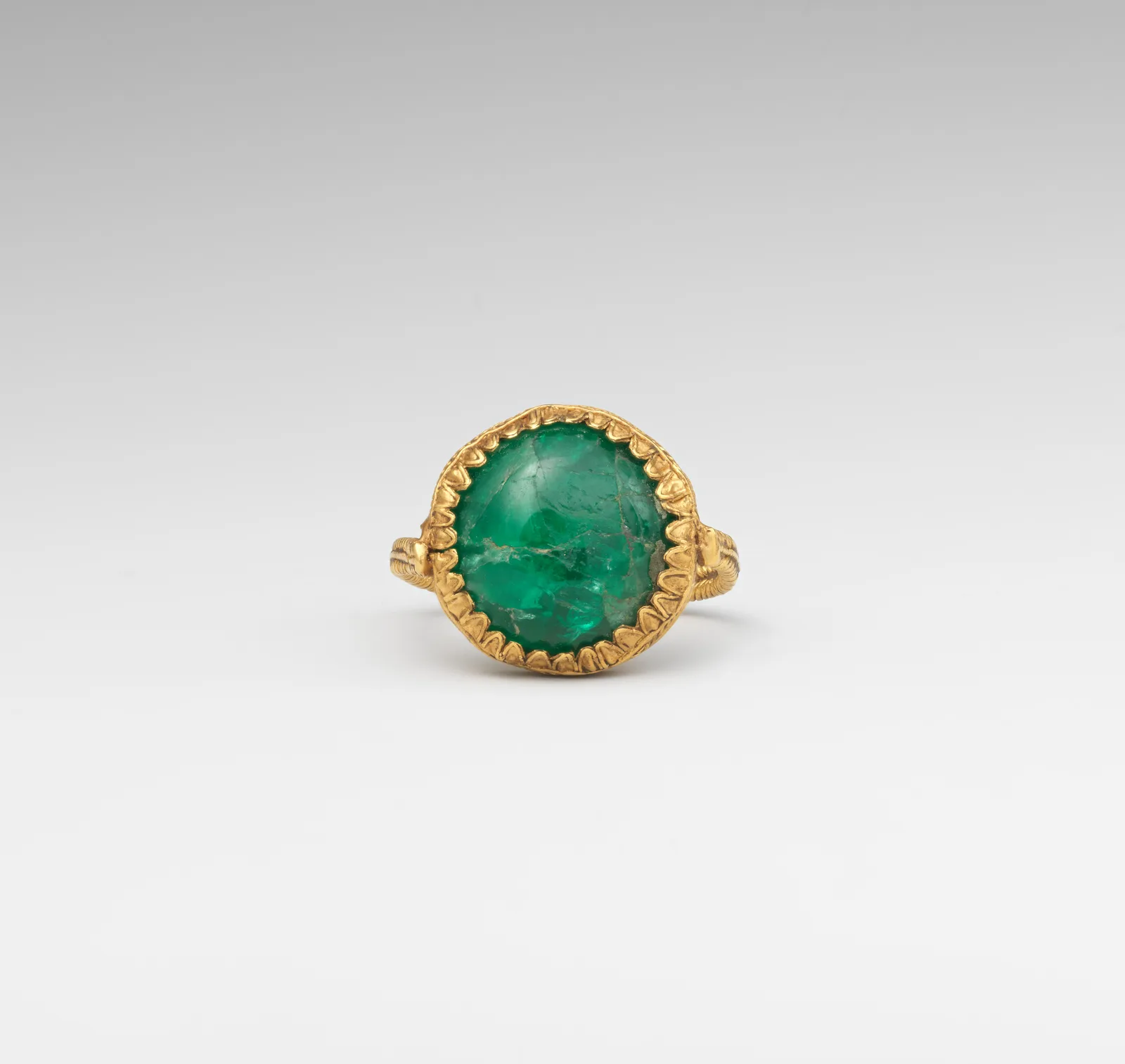
The name is literal. In the 1920s a new kind of private party appeared, the cocktail party, where guests stood, drank mixed drinks, and mingled. That format brought its own wardrobe and its own jewellery. The ring you put on for exactly this sort of evening became known as a cocktail ring. The term stuck and outlived the era that created it, and today we call any large dressy going-out ring a cocktail ring.
History: From Prohibition to Mid-Century Runways
A cocktail ring is one of the few pieces of jewellery with a precise date of birth and a clear social cause. It is not an ancient symbol with a thousand years of history. It is the product of one specific decade and one specific ban.
Prohibition and the Birth of the Genre, 1920 to 1933
In 1920 the United States banned the production and sale of alcohol. The effect was the opposite of the intent: instead of sobriety, the country got an underground culture of illegal bars, speakeasies, where well-dressed people went to drink without getting caught.
The women of that era, the flappers, broke the old rules of propriety openly. Short haircuts, open dresses, cigarettes and cocktails in public. The jewellery to match such a look had to keep pace: large, bold, visible. A big ring on the hand holding a forbidden glass was a gesture of defiance. It spoke of money, freedom, and contempt for the ban all at once.
That is how the genre was born. From the start the cocktail ring was never about love or a husband's status, but about a woman's own independence. That detail matters, and it explains why the form is still loved today.
Art-Deco: Geometry and Colour
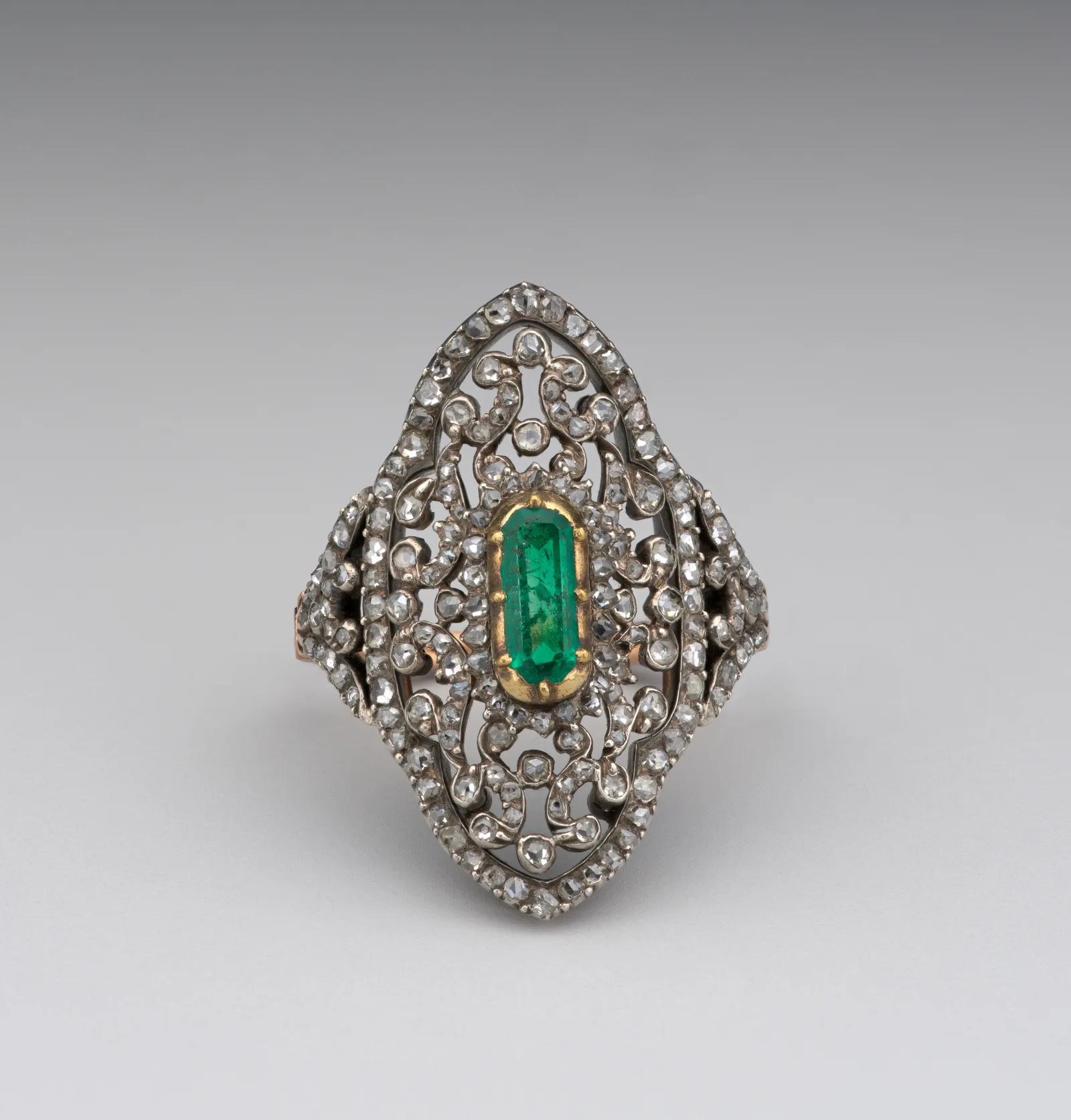
The style of the era was art-deco. Clean geometry, symmetry, bold colour pairings. Cocktail rings of the twenties and thirties were built on these principles: rectangular and step-cut stones, settings with sharp facets, a mix of clear and coloured stones.
Colour was the whole point. Art-deco loved saturated shades and daring contrasts, so blues, greens, and reds appeared next to colourless stones in cocktail rings. The geometry of the cut amplified that effect: an emerald-style step cut gave broad flat tables on which colour read at full strength. For the language of cuts in detail, see the piece on diamond and gemstone shapes.
Peak in the Forties and Fifties
After Prohibition was repealed the genre did not vanish; it only grew stronger. In the 1940s cocktail rings became even bigger and more lavish. Wartime limited access to platinum, and jewellers switched en masse to yellow gold, which gave a warm, voluminous silhouette. Stones were grouped in clusters, settings turned sculptural, and the piece grew visually upward and outward.
The fifties pushed the format to its peak. Postwar prosperity, a flourishing evening culture, and cinema created enormous demand for going-out jewellery. The cocktail ring became a must-have part of the evening look: worn with gloves, with open dresses, with fur wraps. That is when the canon we recognise today took shape: one big central stone, noticeable height, colour as the main argument.
Vintage and Modern Silhouettes
Over a century the genre split into two recognisable lines, and when choosing a ring it helps to know which one it leans toward. The vintage silhouette inherits from the forties and fifties: yellow gold, a sculptural lavish setting, stones in clusters, the metal playing on equal terms with the stone. A ring like that looks rich and warm, and reads beautifully with dressy classic clothing and a vintage look.
The modern silhouette is stricter. One big stone, clean setting geometry, minimal extra metal, more often a white tone. Here the stone almost solos on its own, and the setting merely frames it without decorative noise. A ring like that is easier to fit into a graphic, minimal look and into a daytime work context. Both lines are alive and both have their place; the choice depends on which language is closer to you and your wardrobe.
What Remains of the Era Today
The modern cocktail ring inherits the same logic. Technology and materials have changed, but the principle holds. This is jewellery for the moment when you want to be seen, not for every day and not for signing papers. The historical link to freedom and independence has not gone anywhere either: a cocktail ring is still more often bought for oneself than received as a gift for an occasion.
A big stone glows above a cocktail glass, not under a rubber glove. One per hand, take the other off.
How to Wear a Cocktail Ring
A big ring has gone through hundreds of my shoots and evening looks. Here is what actually holds the effect rather than breaking it.
Which finger should I wear it on? I recommend the ring or middle finger of the right hand: it is the hand of gesture, and the ring lands in someone's line of sight on its own, without effort. The index finger I suggest for a sharper statement, a ring there looks forward and reads as a deliberate choice. The little finger I skip for a big stone: a small finger cannot hold it and the proportion breaks.
How do I size it to my hand? I choose the width so the central stone does not hang over the neighbouring fingers or stop them moving. For long fingers I suggest tall, vertical stones and high settings, they underline the elegance. For short, wide fingers I recommend rounded, horizontal stones, they lengthen the hand rather than shorten it.
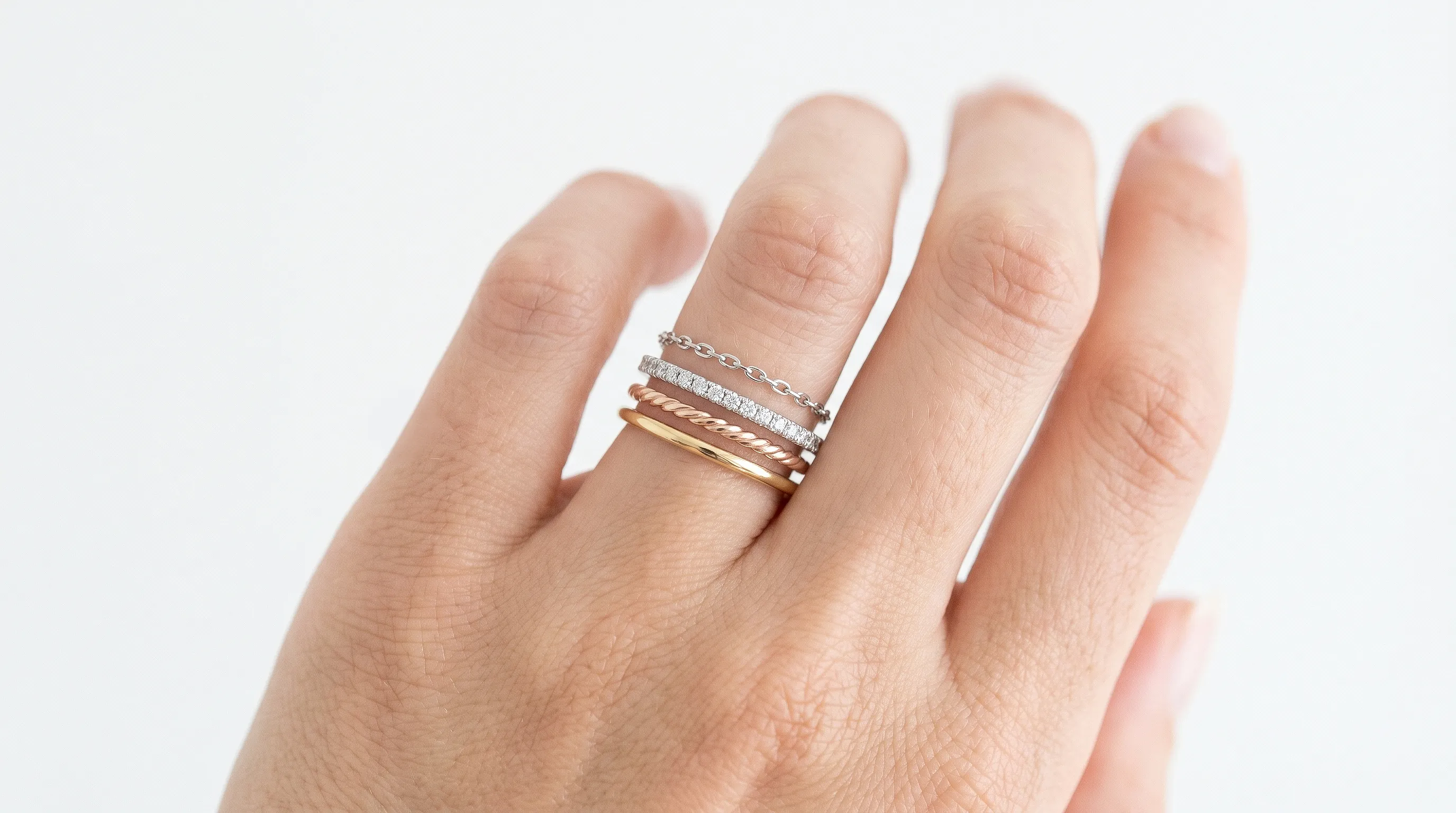
How do I pair it with an outfit? One rule: the ring solos. On the same hand I leave no second big accent, a thin band on another finger is fine, a second large stone is not. I keep the clothes calm: a solid-colour dress, a clean sleeve line. The quieter the outfit, the louder the ring speaks.
Which metal and stone colour suit my skin? For warm skin with a golden undertone I suggest yellow gold and warm stones: citrine, honey topaz, garnet. For cool skin with a pink or bluish undertone I recommend white metal and cool stones: blue sapphire, amethyst, smoky quartz. Neutral skin takes almost anything, so I go by the colour of the outfit.
For the evening or for every day? For going out and shoots I choose the boldest version: a large, saturated stone, a high profile, it catches the evening light. For daily wear I suggest a steadier setting and a lower stone so the ring does not snag on clothes, and I take it off before cleaning, sport and sleep.

Turn on your camera, pick earrings, a pendant or a ring, and see the piece on yourself in real time.
Switch items in one tap.
Everything runs in your browser: no photo or video is ever uploaded.
Which Finger and Hand to Wear a Cocktail Ring On
A cocktail ring has no rigid rule of placement, unlike a wedding or engagement ring. But there is an established practice, and it makes sense.
The Ring and Middle Finger of Your Dominant Hand
Most often a cocktail ring is worn on the ring or middle finger of the right hand for right-handers. The right hand is the hand of gesture: it holds the glass, it points, it greets. A big ring there falls into your companion's line of sight naturally, without being forced.
The ring finger of the right hand is historically preferred for one more reason: it is not taken by the wedding ring, which in most traditions lives on the left hand. That separates two meanings: commitment on the left, jewellery for yourself on the right. For how different fingers read different meanings, there is a separate breakdown in the article on the meaning of rings on each finger.
The Index Finger as a Statement
The index finger is the boldest choice. A ring on it points forward, toward whoever you are talking to, and reads especially sharply. Historically a signet ring on the index finger belonged to people of power, and an echo of that gesture survives. A big cocktail ring on the index finger looks like a deliberate statement rather than a chance ornament.
What to Avoid
The little finger suits a big cocktail ring poorly: on a small finger a large stone overbalances and looks out of proportion. The little finger is traditionally the territory of compact signet rings, not bulky stones. The thumb is possible in bold looks, but it calls for an especially large hand, otherwise the ring looks heavy.
The Left Hand Without a Wedding Ring
If there is no wedding ring, or it is worn elsewhere, a cocktail ring lives happily on the left hand too. The one rule is simple: one hand, one big ring. Two massive rings on the same hand compete with each other and kill the effect of both.
Customer reviews
Zevira is a real jewellery shop. Genuine payments, deliveries and customer thank-yous.
🥰🥰🥰 gracias
Ok, ¡gracias! 🙂
Size and Proportion to the Hand
The size of a cocktail ring is not a matter of whim but of geometry. The ring must be in proportion to your hand, or the effect breaks either way: too small and it disappears, too big and it turns your hand into a stand.
How to Match the Scale to Your Hand
The basic reference point is this: the width of the central element should not noticeably spill past the sides of the finger. If the stone overhangs the neighbouring fingers and stops them from moving, the ring is too big for that hand. If it barely differs in volume from an ordinary band, then it is no longer a cocktail ring, just a ring with a stone.
Long slender fingers suit elongated vertical stones and high settings: they emphasise the elegance. Short, broad fingers are better served by rounded, horizontally oriented stones: they visually lengthen the finger rather than shorten it. A large hand can carry more volume; a petite one should stay at a moderate scale, otherwise the hand looks fragile under the weight of the jewellery.
Profile Height and Daily Life
A high cocktail ring is beautiful, but it catches on everything: gloves, pockets, hair, fabric. That is the normal price of the evening effect, but you have to account for it. The higher the profile, the less the ring suits everyday wear and the more carefully it has to be handled.
Weight and Comfort
A large stone plus a massive setting add up to real weight. For one evening you barely notice it, but if you plan to wear the ring for a long stretch, try the weight on in advance. A heavy ring eventually starts to spin on the finger and slide stone-down, which spoils the look. A correctly chosen band size helps here: it should sit snugly to keep the heavy top on top.
Balance With Other Pieces on the Hand
If your wrist already carries a big bracelet or a chunky watch, a cocktail ring on the same arm creates overload. The logic of an accent demands one dominant piece per arm. Either the bracelet or the ring, but not both at full volume at once.
Upload a photo of your pet, someone you love, or an object. We'll build a 3D model and hand-cast it in pewter.



Big Stones: Natural, Lab-Grown, Glass
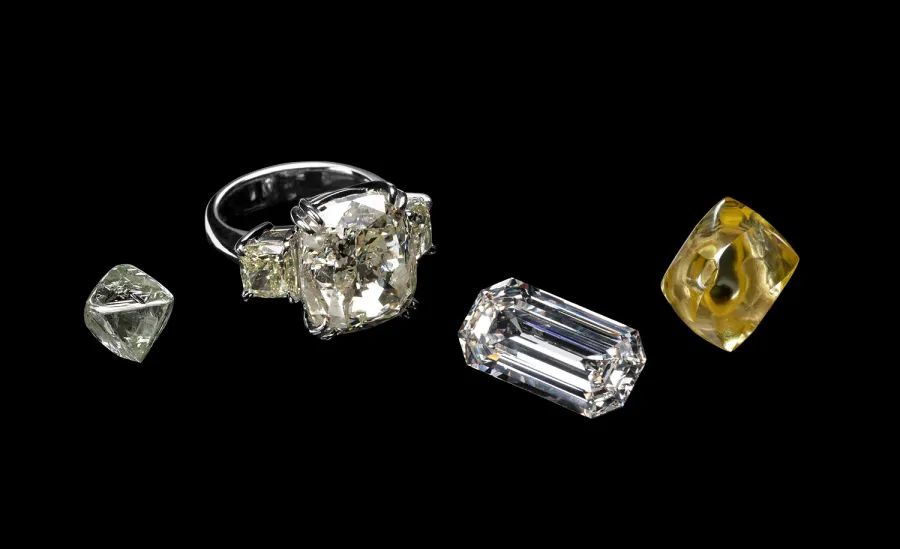
The stone is the heart of a cocktail ring. And here the genre works differently from the engagement world: size and colour matter more than origin and certificate. That opens up real freedom of choice.
Natural Coloured Stones
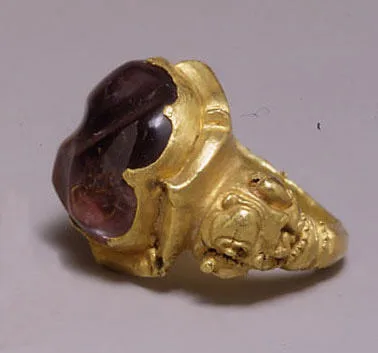
Natural stones in cocktail rings are valued for depth of colour and character. They need not be top-tier precious gems. The genre works beautifully with coloured quartz, which gives large clean stones at sensible cost: citrine in honey and amber, amethyst in purple, smoky quartz with brown depth, rose quartz in a soft tone.
Among the richer options, garnets, topazes, and peridots sit perfectly within cocktail logic. A natural stone is always slightly uneven, with faint inclusions and unevenness of colour, and that is exactly what gives it life. If you want to understand the language of saturated gems, look at the breakdowns on emerald and ruby: even when the cocktail ring holds a different stone, those gems often serve as the colour benchmark.
Lab-Grown Stones
Lab-grown stones are an honest and logical option for a cocktail ring. They share the same chemistry and optics as natural ones, but deliver large size and even colour for less. For a genre where the effect matters more than rarity, this is almost an ideal solution: you can have a big saturated stone with no compromise on looks.
Lab-grown sapphires, spinels, and cubic zirconia let you assemble a ring in any colour scheme, including shades that are rare and costly in nature. The difference between a grown and a natural stone is covered in detail in the piece on moissanite and the lab-grown diamond. For a cocktail ring this choice carries no drama: origin holds none of the meaning here that it does in an engagement ring.
Glass and Crystal
Faceted glass and crystal are a stone native to the genre. The first cocktail rings of the jazz era were often built on faceted glass and paste, and that was considered normal, not a fake. Glass gives bright shine, any colour, and large size very cheaply. For an evening look, a photo shoot, or one striking detail, it is a sensible and honest choice.
Glass has one drawback: it is softer than stone and wears down at the edges over time, losing the sharpness of its shine. So a glass stone is good for occasional outings rather than daily wear.
How Stone Colour Gets Along With Skin Tone
The same stone reads differently on different skin, and that is worth considering when choosing it. Warm skin with a golden undertone gains from warm stones: citrine, honey topaz, garnet, amber. They pick up the skin tone and look natural. Cool skin with a pinkish or bluish undertone gets on better with cool stones: blue sapphire, amethyst, smoky quartz, green peridot. This is not a strict law but a reference: a contrasting pairing also works when it is chosen deliberately. Neutral skin suits almost anything, and here you can go by the colour of the outfit and the metal of the setting alone.
Metal strengthens or dampens that effect. Yellow gold adds depth to warm stones and can slightly mute cool ones. White metals, on the contrary, flatter cool shades and give warm ones a more modern tone. The stone, metal, and skin triangle is three variables worth trying on together rather than one by one.
Colour as the Main Argument
In all three options one rule of the genre holds: colour matters more than formal value. A cocktail ring is chosen with the eyes. Saturated blue, deep green, wine red, honey yellow read from a distance and create the effect you are after. A colourless stone in a cocktail ring is possible, but then the bet is on size and the play of light rather than on hue.



What Occasions a Cocktail Ring Suits
Despite its evening origins, a cocktail ring today has more scenarios than it seems. The genre outlived its era precisely because it proved flexible.
Going Out and Celebrations
This is the native scenario. A party, a celebration, a festive dinner, New Year's Eve. Anywhere there is evening light, dressy clothing, and a wish to look striking. A cocktail ring works at full power in such a setting: under artificial light a big stone plays especially strongly.
Photo Shoots and Filming
The camera loves big accents. A cocktail ring is a ready-made expressive detail for a portrait, for shooting hands, for content. One big stone in frame reads better than a dozen small pieces, which turn into visual noise. For photos even a glass stone works perfectly: the camera sees shine and colour, not a certificate.
A Work Look With Character
A cocktail ring of moderate scale can be the single accent in a restrained work look. Against a sober suit, one striking ring reads as a sign of taste and confidence rather than frivolity. The key here is measure: for the office you take a quieter version, without excessive height and without screaming shine.
Every Day, If You Want To
There is no ban on wearing a cocktail ring daily. There are only practical caveats: a high profile catches, a big stone fears knocks, a heavy ring tires the hand. If you choose a version with a more stable setting and a not-too-high seat for the stone, a cocktail ring can become a favourite everyday piece. It just needs a little more care than a thin band.
A Gift to Yourself
Historically and psychologically, a cocktail ring is jewellery most often bought for oneself. It has no obligatory occasion, no tie to someone else's decision, no expectation that it will be given. It is about your own choice and your own pleasure. In that it is a direct heir to the flappers of the twenties.
Leave your email, we'll send your discount code. No spam, unsubscribe anytime.
The code arrives by email, valid on your first order.
Big Men's Signet Rings as Relatives
The cocktail ring has a male relative in spirit: the big signet ring. The logic is the same, though the look is different.
The Shared Idea of a Noticeable Ring
Both the cocktail ring and the men's signet are built on one principle: a big ring as an accent and a statement. Both are worn alone, both pull the eye to the hand, both are more often chosen for oneself than received for an occasion. The difference is in what carries the mass. In a cocktail ring it is a shiny coloured stone. In a signet it is a flat shield, plain or engraved.
Stone Versus Shield
A signet puts the accent on metal and surface. Its beauty is in the shape of the shield, in the engraving, in the noble mass. A cocktail ring puts the accent on the stone and the shine. These are two different ways to make a statement with a big ring: one through restrained geometry, the other through colour and radiance.
When the Lines Blur
The line between the genres is not made of iron. There are big men's rings with a massive coloured stone, cocktail in character at heart. There are women's signets with a stone in the shield. The format of the noticeable ring stopped being strictly tied to gender long ago. For a detailed look at this genre from the women's side there is a guide to the women's signet ring, and much of its proportion logic applies to the cocktail ring too.
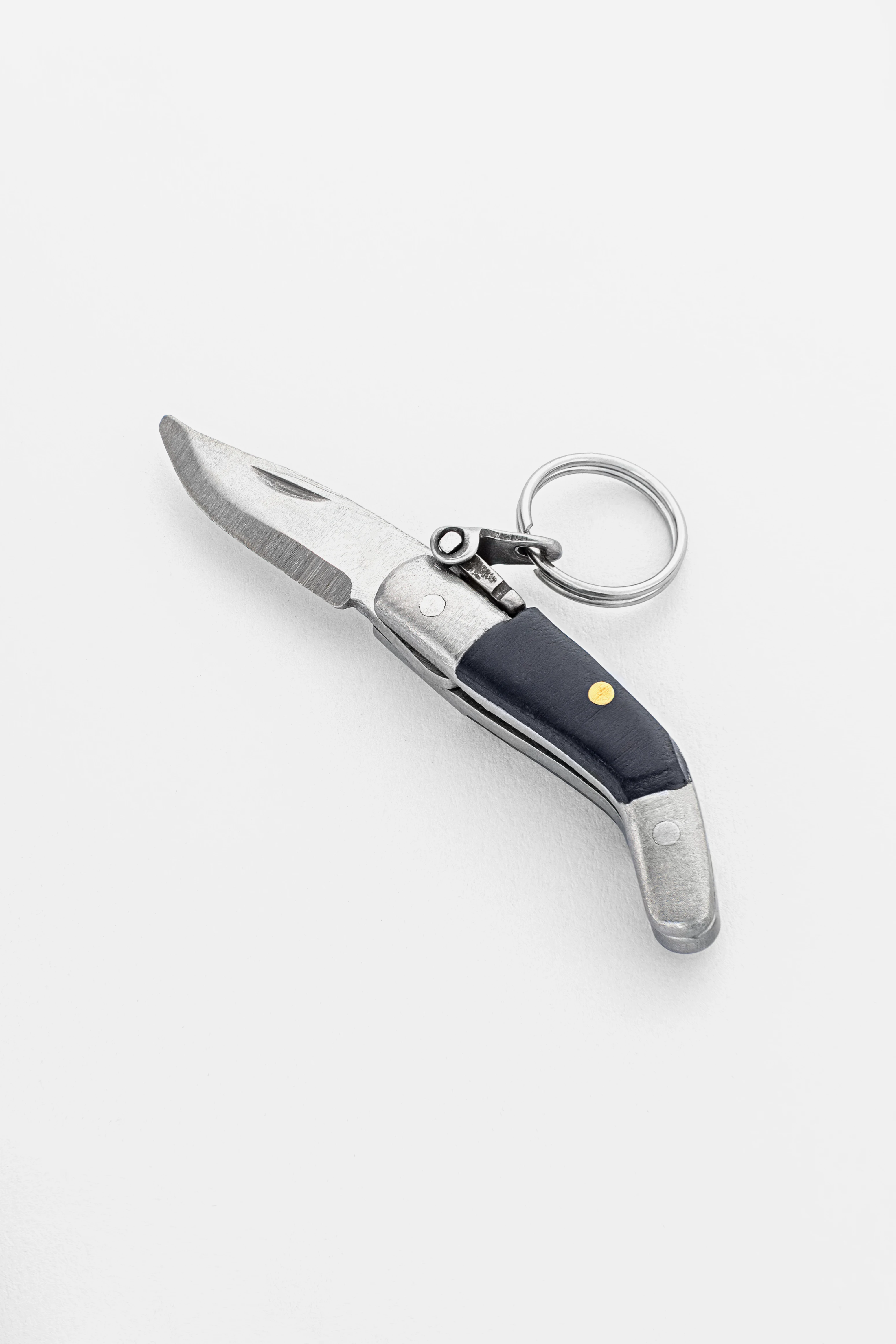
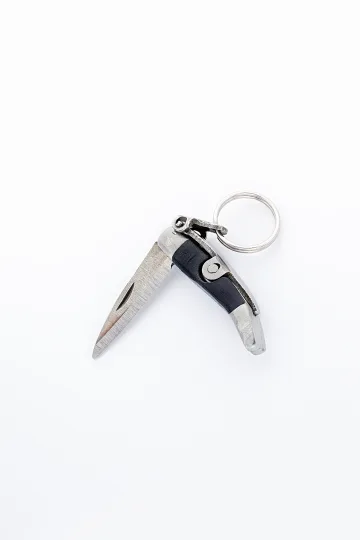
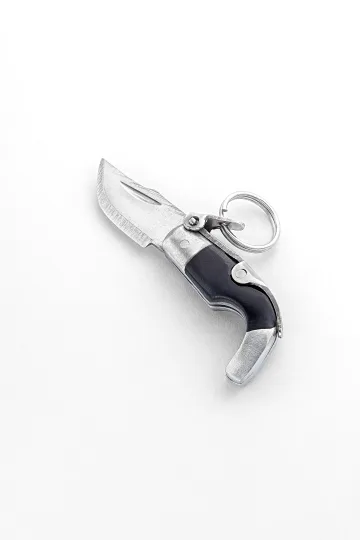
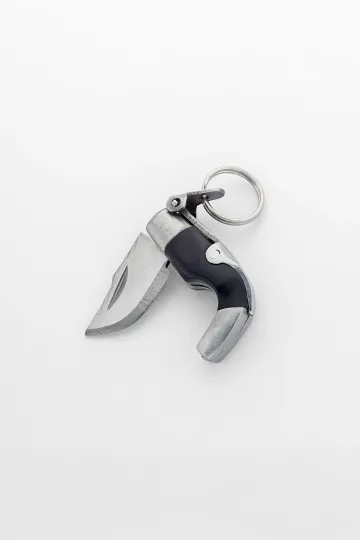
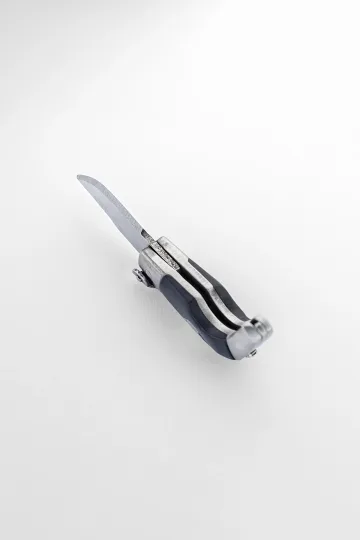
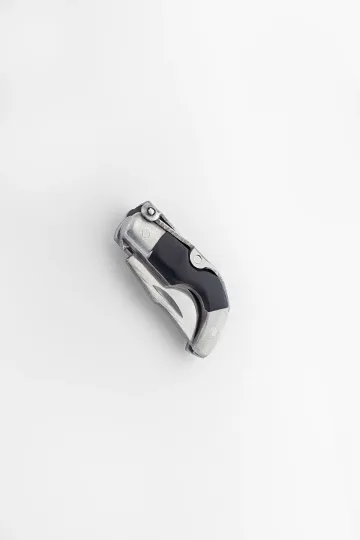
CAPAORA mini knife pendant
The 18th-century Spanish navaja in miniature: 40 mm of stainless steel, a real folding mechanism and a Palanquilla lock that clicks. An affordable gift to remember.
Authentic · Ships from Spain · 14-day returns
Materials and Setting the Big Stone
The bigger the stone, the more serious the task of holding it. The setting in a cocktail ring is not cosmetics but engineering: a large stone is heavier and more exposed to knocks than a small one.
Setting Metal
Cocktail rings use gold in every shade and silver. Sterling 925 silver is a working choice for big decorative rings: it is strong enough, holds a voluminous shape well, and suits any colour of stone. For what lies behind the 925 mark and why this alloy in particular, see the piece on 925 silver. Yellow gold gives the historical warm look, white metals the modern graphic one.
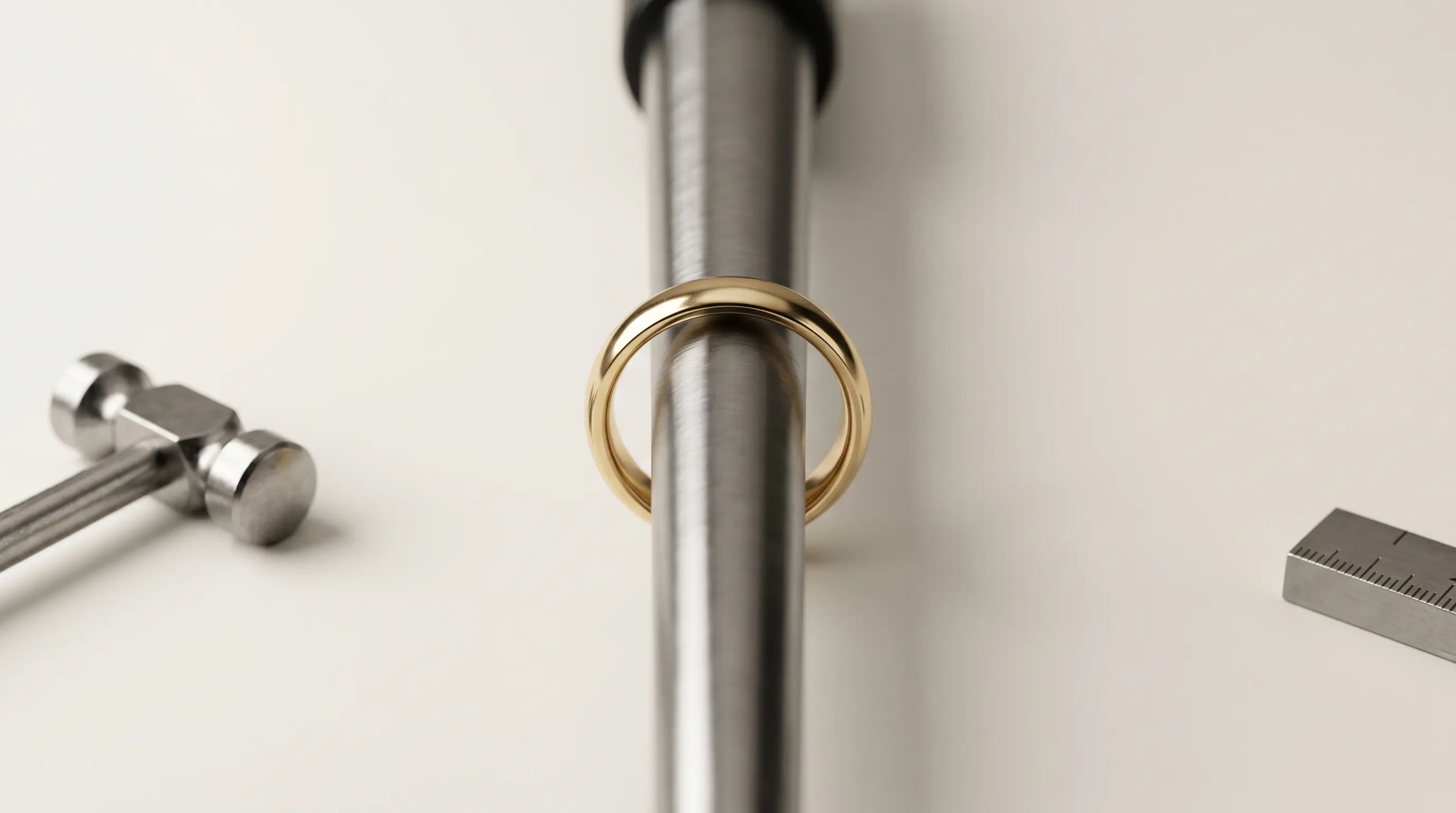
Both the alloy and the heft of the band matter. A heavy stone needs a solid band, or the ring deforms over time and the stone sags. Too thin a band under a big stone is a weak point in the structure.
Types of Setting
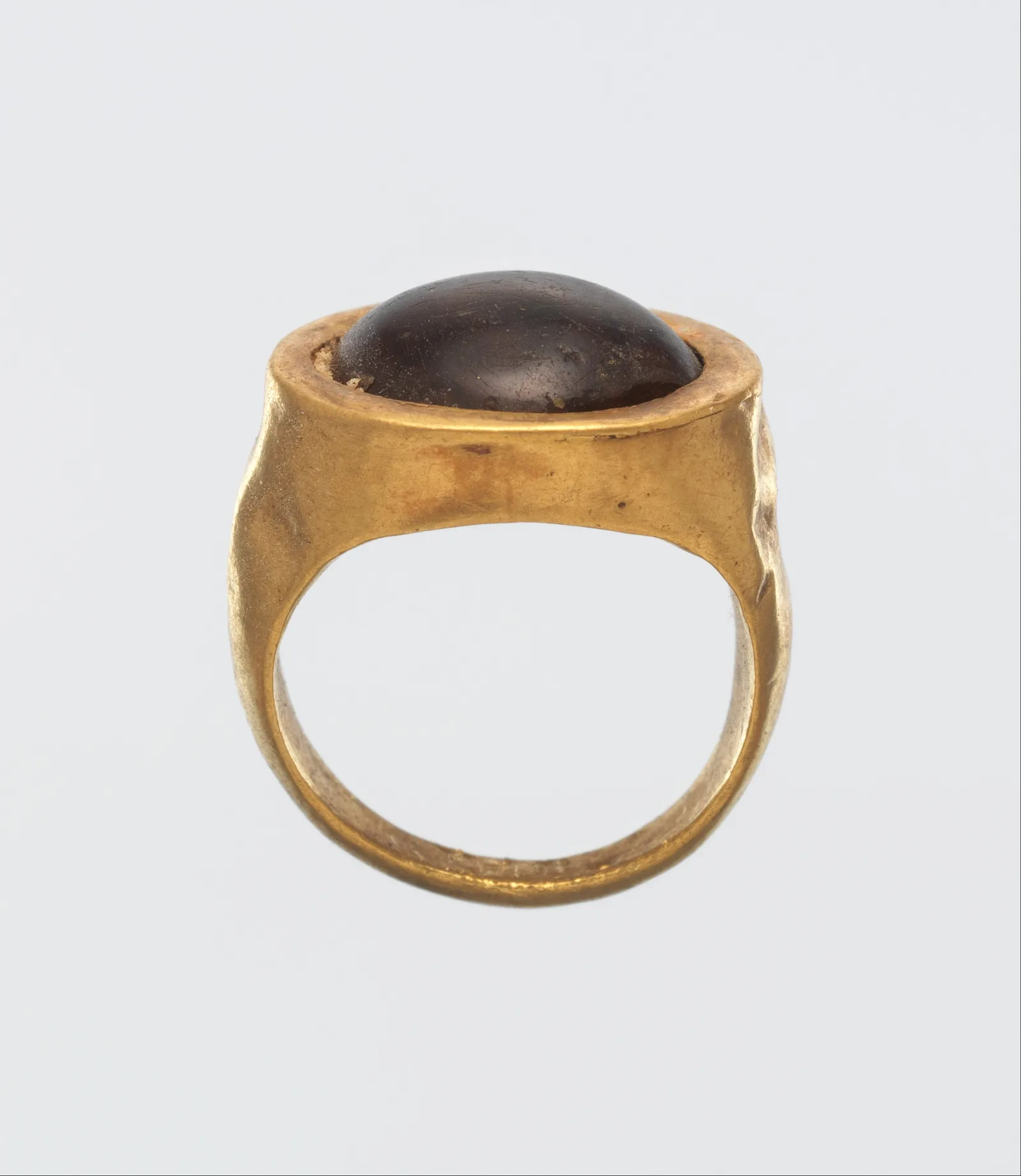
A prong setting, where claws hold the stone, opens it on all sides and lets in the most light. This is the most brilliant option, but also the most vulnerable: prongs catch on things and can loosen from knocks. A bezel setting, where a solid rim of metal hugs the stone, protects a big stone most reliably and gives a clean modern silhouette, but lets less light in at the edges.
Between those poles there are mixed options and the massive fantasy settings typical of the cocktail genre, where the metal becomes part of the decor on equal terms with the stone. A full breakdown of every stone-holding system is in the article on ring setting types.
Protecting the Stone by Hardness
The softer the stone, the more important a closed, protective setting. Hard stones tolerate an open prong seat. Soft stones, including glass and many coloured quartzes, quickly wear down at the protruding edges in an open setting. For them a bezel or semi-closed setting that hides the vulnerable edges makes more sense.
Engraving on the Inside
A cocktail ring is rarely engraved on the outside, because all the expression is carried on the stone and the setting. The inside of the band, on the other hand, is a handy hidden spot for a personal inscription: a date, a name, a short phrase. Since such a ring is often bought for oneself and on one's own occasion, engraving inside turns a decorative thing into a personal one. The shine and the statement stay on the outside, the meaning only you can see hides within. Practically, a massive cocktail-ring band has more room for an inscription than a thin one, which gives freedom of wording.
A Scatter Around the Centre
A classic cocktail device is a big central stone ringed by small ones. The scatter around the edge visually enlarges the centre and adds shine. But every small stone is one more point that can fall out. The more stones, the more careful the setting must be and the more attentive the care.
How to Avoid Bad Taste
The line between an expressive cocktail ring and bad taste is thinner than it seems. But it is quite visible, and staying on the right side of it is not hard.
One Accent, Not Five
The main mistake is trying to boost the effect with quantity. A big ring plus a big bracelet plus a big necklace plus big earrings give not wealth but chaos. One strong accent always reads better than five competing ones. A cocktail ring is already a loud statement on its own; it does not need to be shouted over by the rest.
Quality of Shine Beats Size
A stone that shines dull and flat is not saved by any size. Better a smaller stone with a live play of light than a huge but lifeless one. The eye instantly reads the difference between good shine and its imitation. Size for the sake of size, without quality of cut and shine, is exactly what reads as bad taste.
Proportion to the Hand
A ring that is clearly too big for the hand looks alien and absurd regardless of quality. Proportion is the first thing an outside eye notices. A big ring on a large hand looks natural; the same ring on a delicate hand looks like a prop. You cannot measure by someone else's hand, only by your own.
Fit to the Occasion
A huge sparkling ring with a daytime sporty look is a dissonance that reads at once. The genre is tied to the evening and the dressy context, and a sharp step outside that context creates a sense of being out of place. This is not a ban but a question of measure: for a daytime look you take a quieter version.
Honesty of Material
Glass passed off as a diamond, and dull gilding passed off as solid gold, are not a question of taste but of honesty in the look. A cocktail ring with a glass stone is wonderful when it is a dressy shiny thing in its own right, not an imitation of an expensive gem. The genre has been friends with glass and paste from the start, and there is nothing shameful in that. Only pretence is shameful.
Care and Storage of a Big Ring
A big ring needs more attention than a thin band, simply by virtue of geometry. A high stone collects more dust and grease, protruding edges scrape surfaces more often, and the large mass strains the setting harder.
Regular Cleaning
Grease, cream, and dust build up quickly under a big stone and in a scatter of small ones, and the stone goes dull. Most hard stones clean safely with a soft brush in warm water with a drop of mild soap, after which you dry the ring fully. Soft and porous stones, as well as glass, are cleaned more carefully, with a soft cloth only, without soaking and without harsh products.
Take It Off at the Right Moments
A cocktail ring comes off before cleaning, washing up, sport, sleep, and applying cosmetics. A high profile is easy to catch and loosen the setting, while household chemicals and creams settle on the stone and spoil the shine. The habit of taking the ring off in these situations extends its life more than any cleaning.
Checking the Setting
Every few months it is worth checking whether the central stone wobbles and whether the small ones in the scatter hold. A light tap of the finger and an inspection against the light reveal a problem before the stone falls out. Prong settings under a big stone deserve especially close watching, because the claws wear down over time.
Separate Storage
A big ring is stored apart from other jewellery, in a soft pouch or a separate compartment of a box. In a common pile a hard stone scratches its neighbours and collects scratches from their edges and clasps in turn. A high profile also catches on chains and tangles with them. A separate compartment solves both problems.
Storing Glass Stones
Glass and soft stones are especially afraid of sitting next to hard ones: they take scratches first. Store them strictly apart, in a soft case, and protect them from knocks against hard surfaces. Careful storage matters even more for them than for a natural stone.
Send a friend a discount code, they save on their first order.
Facts That Surprise
- The cocktail ring was born as a gesture of defiance against the law. Its rise coincided exactly with the years of Prohibition in the United States, and the big stone above the glass was a visual challenge to the ban.
- It is one of the few pieces of jewellery with a clear date of birth. Most jewellery forms reach back thousands of years, while the cocktail ring appeared in a specific decade of the twentieth century for a specific social reason.
- The first cocktail rings were often built on faceted glass and paste, and that was not considered a fake. Shine and colour were valued in themselves, apart from the cost of the stone.
- The wartime shortage of platinum in the forties made yellow gold the signature metal of the genre. The warm, voluminous silhouette of the cocktail ring is largely a result of the lack of white metal.
- A cocktail ring is more often bought for oneself than received as a gift. It has no obligatory occasion, and in that lies its direct link to the idea of female independence laid down by the flappers.
- The index finger as a place for a big ring is an echo of rings of power. A ring turned toward your companion was historically read as a mark of standing.
- The emerald-style step cut became popular in cocktail rings not for shine but for colour: broad flat tables show the hue of the stone better than small facets do.
- The size of the stone in a cocktail ring has historically mattered more than its origin. The genre freed jewellery from the demand to be rare and expensive from the outset, leaving only the demand to be noticed.
Frequently Asked Questions
How does a cocktail ring differ from an engagement ring?
An engagement ring carries the meaning of a promise and is chosen for the clarity, cut, and durability of its centre stone, usually a diamond. A cocktail ring carries no meaning and is chosen for its visual effect: size, colour, and shine. Any stones are allowed in it, including coloured quartz, lab-grown stones, and glass.
Which finger do you wear a cocktail ring on?
Most often on the ring or middle finger of the right hand, to keep it separate from a wedding ring on the left. The index finger reads bolder and as a statement. The little finger suits a big stone poorly because of the lack of proportion. There is no rigid rule; the main thing is not to wear two big rings on one hand.
Can you wear a cocktail ring every day?
You can, with caveats. A high profile catches on clothing, a big stone fears knocks, a heavy ring tires the hand. For daily wear you choose a version with a stable setting and a not-too-high seat for the stone, and take it off before cleaning, sport, and sleep.
Is glass suitable for a cocktail ring?
Yes, and it is a stone native to the genre. The first cocktail rings were often made on faceted glass and paste. Glass gives bright shine and any colour cheaply, and works perfectly for an evening and for photos. There is one drawback: glass is softer than stone and wears at the edges, so protect it from daily wear and store it apart.
Which stone should you choose for a cocktail ring?
The one you like for its colour and shine, with no regard for rarity. Coloured quartz works well: citrine, amethyst, smoky and rose quartz, along with garnets, topazes, and peridots. Lab-grown sapphires and spinels give large saturated colour for sensible money. In this genre the effect matters, not the certificate.
How do you match the size of a cocktail ring to your hand?
The width of the central element should not noticeably overhang the neighbouring fingers or stop them from moving. Long fingers suit elongated vertical stones, short ones rounded and horizontal ones. A large hand can carry more volume, a petite one should keep to a moderate scale. You should measure only by your own hand.
Is a cocktail ring women's jewellery?
By origin yes, but the format stopped being strictly tied to gender long ago. The male relative of the cocktail ring is the big signet ring, built on the same idea of a noticeable ring as a statement. There are also big men's rings with a coloured stone, cocktail in character.
How do you care for a cocktail ring with a big stone?
Clean it regularly with a soft brush in warm water with a drop of mild soap for hard stones, and by wiping only for soft stones and glass. Take it off before cleaning, sport, sleep, and cosmetics. Every few months check the setting of the central and small stones. Store it apart in a soft pouch so it does not scratch or catch on other jewellery.
Buying it as a gift? Each one arrives ready to give.
 A branded Zevira box and a little card come with every order.






About Zevira
Zevira makes jewellery for people who wear things with meaning and character. We work with sterling 925 silver and quality stones, thinking through the setting for a big stone and the proportion to the hand, so a striking ring lasts and sits right. A cocktail ring, in our logic, is not an occasion or an obligation but a free choice for yourself.