How to Make a Ring Bigger: Every Method and When to Use Each One
Introduction: The ring that almost fit
Your grandmother wore this ring for fifty years. A slender gold band with a small diamond, passed down through four generations of the family. You open the box, try to slide it on, and it stops dead at the knuckle. Her ring size was a US 5.5. Yours is a 7. What do you do: give it back, keep it locked in a jewellery box as an heirloom, or find a way to make it work?
That scenario plays out in countless variations every day. An inherited ring that doesn't fit. A wedding band that became tight after a pregnancy. A ring bought on a trip abroad sized by feel. An engagement ring where the surprise required a best guess. A vintage find in exactly the right style, wrong size. In every one of these cases the same question comes up: can you make a ring bigger, and if so, how?
Wear the symbol, don't just read about it. These are in stock:

The short answer is yes, most of the time. The longer answer depends on factors that vary ring by ring: metal type, setting style, how many sizes you need to add, and whether the ring has stones. A plain gold band with no stones stretches quickly and cheaply. A ring with stones all the way around the shank requires a completely different approach. A titanium ring cannot be resized by conventional methods. Platinum requires specialised skill.
This guide covers everything you need to make an informed decision. The four main resizing methods. Which rings can be made bigger and which ones cannot. What resizing costs at a jeweller. What you can realistically do at home versus what requires a torch and a bench. What happens to the stones. What warranty to expect. When it makes more sense to buy a new ring instead of resizing. Work through it once and you'll spend less time second-guessing and more time actually wearing the ring.
If you want to figure out your exact size first, read our guide to ring size measurement in millimeters and US sizes. If a ring is already stuck on your finger right now, there's a separate guide on how to get a ring off a stuck finger. This guide focuses entirely on making a ring larger.
What ring resizing actually means
Technically, resizing a ring upward means increasing its inner diameter from a smaller measurement to a larger one. In practical terms:
- The inside circumference of the ring grows to accommodate a larger finger
- The outward appearance stays as close to the original as possible
- Stones, engraving, and decorative elements remain in place
- Structural integrity is maintained
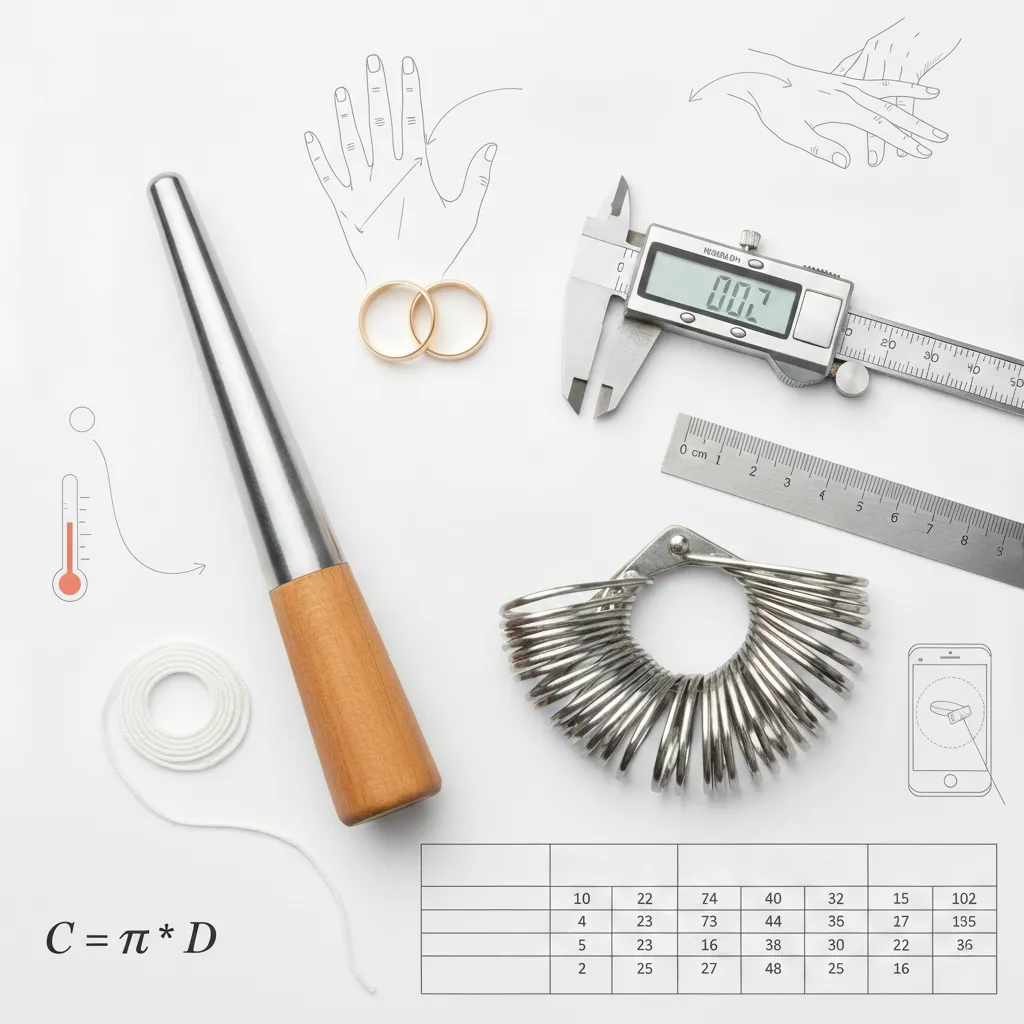
Ring size in the US system is measured by number, where each full size corresponds to roughly 0.83 mm in inner diameter. Moving from a size 6 to a size 7 means adding about 0.83 mm of diameter, or roughly 2.6 mm of inner circumference. In European sizing (ISO 8653), the size number equals the inner circumference in mm, so size 52 to size 54 is a 2 mm jump in circumference.
Size increments and what's realistic in one session
Standard resizing moves a ring up by half a size or one full size per appointment. Going beyond that in a single session risks stressing the metal too much: visible cracking, warping, or weakening at stress points. For two full sizes, most jewellers schedule two visits spaced a week or two apart. For three or more sizes, a different method, adding metal to the shank, becomes necessary.
What resizing cannot change
Sizing up cannot alter:
- The overall profile of the band (flat cannot become rounded)
- Band thickness
- Decorative surface patterns
- Stone placement
It changes one thing: the inside diameter. Nothing else.
A ring should turn, not tourniquet. A finger throbbing purple under gold is bad form, and I won't hear otherwise.
How to wear a ring that actually fits
Hundreds of rings have passed through my hands on shoots and fittings, and almost every problem comes down to size. Here is what actually helps while the ring is still on the finger, not shut away in a box.
How do I know the size is right and not just bearable? I suggest checking the fit in the middle of the day, at a calm temperature. The ring should turn on the finger and pass the knuckle with a little resistance. If you have to soap the finger, or a deep groove is still there by evening, the size is too small. When I fit a ring for a client, I aim for a hold that will not slide off yet does not saw into the skin.
Which finger, and how to wear it? The ring finger or the middle one are the classics, but I recommend going by where the band sits level instead of wobbling. A wide band feels tighter than a narrow one of the same size, and that is worth counting on. A thin ring rides happily on the upper knuckle, a chunky one is better kept at the base.
Can I stack rings? Yes, and this is my favourite part of the job. I suggest keeping one accent band and a couple of thin companions rather than five of equal weight. Mixed widths in a stack read far better than identical rings. One tip: size every ring in the stack for the same finger up front, resizing each one later is expensive.
When do I recommend resizing, and when a fresh one? Plain gold, silver or platinum I resize without hesitation, the original stays intact. Titanium, ceramic or a ring set with stones all the way round I would rather replace: the rework costs more and behaves worse than a new piece. If the ring is a family one, I choose adding metal so the look stays the same.
How do I pick a ring that will be easy to adjust later? If I know the finger will change (seasons, pregnancy, age), I recommend a plain band in a workable metal and no stones around the full circle. A jeweller can size that in a single visit. Stubborn materials and a full row of stones I only suggest when the size is settled for good.

Turn on your camera, pick earrings, a pendant or a ring, and see the piece on yourself in real time.
Switch items in one tap.
Everything runs in your browser: no photo or video is ever uploaded.
When people need to resize a ring bigger
The most common scenarios jewellers see every week.
Inherited jewellery
The single most common reason. A grandmother's, aunt's, or mother's ring passes to someone with larger hands. The decision to resize is often tied to emotional value: people want to wear that specific ring, not a similar new one.
Finger changes after pregnancy
After delivery, many women find their wedding band no longer slides on. Hormonal shifts and fluid retention in the tissues expand the fingers. For some, this resolves within six to twelve months. For others, the change is permanent.
Aging joints
Joints naturally enlarge with age. Arthritis accelerates this. A ring worn for twenty years may become impossible to take off, let alone slide on. This is one of the most physically urgent resizing situations because leaving a ring on a finger with enlarged joints for too long can cause circulation problems.
Weight change
Significant weight gain increases finger circumference. Gaining a substantial amount of weight can add half a size to two full sizes to your ring size, depending on how weight distributes on your hands.
A gift that didn't land on the right size
An engagement ring bought as a surprise. A birthday ring picked out without precise measurements. This happens constantly, and there's no shame in needing a resize after a sentimental gift.
Buying with incorrect size conversion
Ordering online from a store that uses European sizing when you expected US sizing. Buying a ring while travelling abroad and guessing at conversions. A simple measurement error that leaves you with a ring that almost fits.
Seasonal swelling
Some people notice meaningful differences in finger size between winter and summer. Cold contracts fingers; heat expands them. A ring that fit perfectly in January can feel uncomfortably tight in August. If the gap is significant, resizing to the larger measurement is usually the right call.
After a finger injury
A fracture, serious bruise, or surgery can leave a joint permanently enlarged. A ring that fit before the injury may never fit again without resizing.
How to tell if your ring is actually too small
Before you decide to resize, confirm the ring is genuinely too small, not just a bit snug.
The sliding test
Try to put the ring on when your hands are at a neutral temperature, not after exercise or in summer heat. If getting past the knuckle requires real force, the ring is too small.
The removal test
After wearing the ring for a few hours, take it off. A faint, temporary line on the skin is normal. A deep groove that takes many minutes to fade means the ring is too tight. A groove that causes discolouration or takes more than thirty minutes to disappear is a sign you need a larger size.
The circulation test
If the finger under the ring turns red, turns pale, or develops a throbbing sensation, the ring is restricting blood flow. This is not a comfort issue. Long-term restriction can cause permanent tissue damage.
The end-of-day test
Fingers naturally swell slightly through the day. A ring that is comfortable at breakfast and painful by dinner is on the edge. Half a size up often fixes this without making the ring loose in the morning.
The temperature test
Cold weather contracts fingers; warm weather expands them. If the ring is comfortable in both conditions, the fit is good. If it becomes uncomfortably tight in any regular situation you encounter, consider going up half a size.
Signs that require immediate action
- Finger turns blue or purple under the ring
- Ring cannot be removed without significant pain
- Persistent throbbing or numbness
- Skin above or below the ring starts to break down
In any of these cases, do not wait. See a jeweller or, if the ring is truly stuck and the finger is showing signs of vascular compromise, go directly to an emergency room.
For emergency removal methods, read the full guide on how to get a ring off a stuck finger.
Ring anatomy: what changes when you resize
Understanding which part of the ring is being altered helps you ask the right questions and understand the jeweller's plan.
The shank (band)
The strip of metal that forms the circular body of the ring. This is what resizing alters. Most shanks are 1-3 mm thick and 1.5-8 mm wide. Everything else on the ring, the setting, the stones, the decorative top, stays put while the shank is worked.
Upper and lower shank
Many rings are built with a heavier upper shank, where the setting or decorative element sits, and a lighter lower shank, which loops under the finger. Resizing almost always targets the lower shank. The upper portion is not touched.
The setting (head)
The structure that holds the centre stone. Standard sizing methods do not disturb the setting. The exception is eternity rings, where stones are set continuously around the entire band, leaving no safe space to cut or stretch.
Engraving and surface decoration
Any texture, inscription, or relief sits on the visible surface of the band. Stretching may slightly distort very fine surface detail. Adding metal to the lower shank typically leaves the decorative upper portion completely untouched.
What changes after resizing
- Inner diameter: increases
- Band thickness: decreases marginally with stretching
- Metal surface: may show faint tool marks in the work zone
- Outer diameter: increases proportionally
What should remain unchanged
- Stone position and security
- Engraving and decoration on the upper shank
- Overall shape
- Structural integrity across the whole ring
A skilled jeweller finishes the resized ring so that the work zone is polished smooth and invisible. Only the size has changed.
The four resizing methods
There are four approaches, ranging from simple to substantial.
Method 1: Stretching (mandrel sizing)
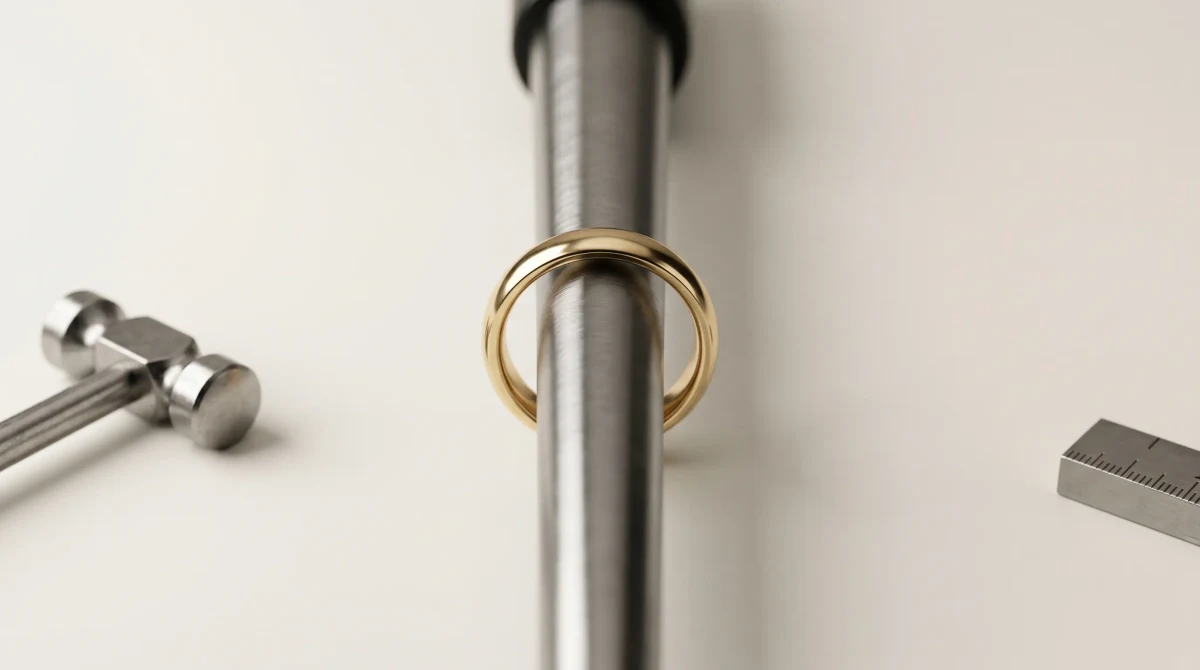
The ring is placed on a tapered metal rod (the mandrel) and expanded by gradually working it down the taper. No cuts, no added material. Works for plain bands with no stones, typically up to one size.
Advantages: fast, inexpensive, no material added, no seam.
Limitations: limited to about one to one and a half sizes; not suitable for all ring types.
Method 2: Cutting and adding metal
The jeweller cuts the lower shank, inserts a piece of matching alloy, solders it in, and finishes the surface. Works for most rings, including many with stones. Appropriate for increases of one to three or more sizes.
Advantages: handles larger size jumps, works for most ring types, lasting structural result.
Limitations: higher cost, requires a seam (visible until polished), creates a minor weak point at the solder join.
Method 3: Spring insert (sizing bar or ring guard)
A small internal spring or sizing bar is installed inside the shank. It holds the ring on a larger finger without altering the metal itself. A reversible solution.
Advantages: does not alter the original ring, fully reversible, good for emotionally important pieces.
Limitations: visible from inside the band, can cause skin irritation, not a permanent size change.
Method 4: Silicone and temporary adjusters
Clear silicone strips, adhesive sizing pads, or tape applied to the inside of the band reduce the effective inner diameter. For occasions or very short-term wear.
Advantages: instant, reversible, inexpensive.
Limitations: visible inside the band, not suited for daily wear, adhesive weakens with moisture and heat.
Method 1 in detail: mandrel stretching
The most common technique for modest size increases.
How it works
The jeweller slides the ring onto a tapered mandrel marked with size increments. Using a specialised sizing hammer or a mechanical stretching press, the ring is gently worked down the mandrel to the target size. The metal deforms outward uniformly around the entire circumference.
The process takes ten to twenty minutes. Thicker shanks require slower, more patient work to avoid stress fractures.
When stretching works well
- Plain bands with no stones
- Thin to medium gold, sterling silver, or platinum shanks
- Increases of half a size to one full size
- Rings with minimal surface decoration
When stretching does not work
- Rings with stones (vibration and stress can loosen prongs)
- Rings with complex surface engraving (detail will distort)
- Very thick shanks (too much resistance, risk of cracking)
- Very thin shanks (risk of tearing)
- Rings made from hardened alloys
What happens to the metal
Stretching thins the metal slightly at the points of maximum expansion, typically fractions of a millimetre. With each subsequent resize, this thinning compounds. Repeated stretching eventually makes the shank structurally fragile.
The deformation also work-hardens the metal, making it stiffer. Jewellers sometimes anneal the ring first, heating it to relieve internal stress and restore ductility, before stretching.
Cost
The most affordable resizing method. Price varies by city, jeweller reputation, and metal type, but stretching typically falls at the lower end of jewellery service pricing.
Time
Ten to thirty minutes of active work. Many jewellers can complete it while you wait, especially if no annealing is required.
Method 2 in detail: cutting and adding metal
The right approach for significant size increases or rings where stretching is not appropriate.
Step by step
- Jeweller measures the target size and calculates how much material needs to be added
- Matching alloy stock is selected: same karat, same colour
- The lower shank is cut cleanly at the centre bottom
- The new metal piece is fitted into the gap and soldered
- The join area is filed, sanded, and polished
- Size is verified against the target
Work takes one to two hours. A follow-up appointment for final polish and fit check is standard.
When this method is the right choice
- Rings needing more than one full size of increase
- Rings with a centre stone (stone remains in the upper shank, untouched)
- Thick shanks that cannot be stretched without risk
- Rings with sentimental value where stone safety matters most
- Vintage or heirloom pieces
When it does not work
- Eternity bands with stones all around the shank (no safe place to cut)
- Rings made from non-solderable metals (titanium, ceramic, tungsten)
- Rings with elaborate interior decoration
- Extremely thin shanks where a cut would create structural weakness
Material matching
The insert must match the original alloy exactly. 14K yellow gold gets a 14K yellow gold insert. 18K white gold gets 18K white gold. Rose gold needs a rose gold insert because the copper content that creates the pink tone must be consistent. A colour mismatch, even a subtle one, will remain visible at the seam for years.
For antique rings with unusual alloys, the jeweller matches as closely as possible. Slight tonal differences may appear at the seam but become less obvious after polishing and over time.
The solder seam
The seam is the structural and visual point to understand. Structurally, a well-executed solder join is nearly as strong as the base metal, but it is theoretically the weakest point in the ring. Under extreme stress, such as a sharp impact, the seam may open before the rest of the band. For normal daily wear this is rarely a real concern.
Visually, a freshly polished seam is nearly invisible on a new ring. Over years of wear the seam may appear as a faint line of slightly different tone, particularly on silver, which develops patina unevenly.
Cost
Substantially more than stretching. The variables: ring complexity, size of the insert needed, alloy cost, and the jeweller's rate. On a mid-range gold ring, expect to pay more than stretching but less than a stones-out procedure.
Customer reviews
Zevira is a real jewellery shop. Genuine payments, deliveries and customer thank-yous.
🥰🥰🥰 gracias

Ok, ¡gracias! 🙂

Method 3 in detail: spring inserts and ring guards
The choice when the ring must not be cut.
What a spring insert is
A small coiled spring or sizing bar, typically made of the same metal as the ring, is fitted inside the lower shank. When the ring is put on, the spring compresses slightly as the finger passes the knuckle. Once past the knuckle, the spring expands to grip the finger.
Why people choose this
- The ring is an antique and cutting feels wrong
- The owner's size fluctuates seasonally and they want a reversible solution
- Budget is limited and a permanent resize is not urgent
- The ring is worn infrequently
Practical considerations
The spring is visible looking down at the inside of the band. Some people find this bothers them; others never notice. The spring can cause mild friction on the skin with prolonged wear. Most springs last several years before weakening.
Cost
Between stretching and metal addition in most jewellery shops.
Method 4 in detail: silicone strips and sizing pads
When you need a temporary fix, not a permanent one.
Silicone strips
Transparent or skin-tone silicone strips adhere to the inner surface of the band. They reduce the effective inner diameter by adding a layer inside the ring. Available in various thicknesses. Last days to weeks depending on activity and moisture exposure.
Adhesive sizing pads
Small, hypoallergenic foam or gel pads that stick to the inside of the band. Stackable for adjustable thickness. Less visible than silicone strips from above. Best for occasional wear.
Tape
Medical tape wrapped around the finger below the ring is a single-use workaround. Uncomfortable for more than an hour or two.
When these work
- A formal event where the ring needs to fit tonight
- Very occasional wear of a ring that is otherwise stored
- A stop-gap until a jeweller appointment can be scheduled
When these fail
- Daily wear
- Active use, sport, swimming
- Hot and humid conditions (adhesive fails)
- Rings worn overnight
Which rings can be resized larger
A reference guide by ring type.
Plain band, no stones
The easiest case. Any medium-thickness gold, silver, or platinum band without stones can be stretched or have metal added with predictable results.
Ring with a single centre stone
One stone, centred in the upper shank, is standard. Metal addition works in the lower shank without touching the setting. Routine procedure.
Three-stone ring
As long as the stones are clustered in the upper half, the lower shank is free. Standard sizing procedure applies.
Engraved exterior
Engraving on the upper shank is untouched by metal addition at the base. Stretching may slightly soften very fine surface lines, but the effect is minimal on most engravings.
Partial enamel
If enamel covers only part of the band, the jeweller can work in the enamel-free zone. If enamel is present all the way around, heat from soldering can crack or discolour it.
Twisted or patterned bands
These require individual assessment. Each pattern affects the workable zones differently. Most can be resized by an experienced jeweller, but a consultation is necessary.
Upload a photo of your pet, someone you love, or an object. We'll build a 3D model and hand-cast it in pewter.




Rings that cannot be resized
The cases where the answer is no, or where resizing is so costly it is rarely worth it.
Eternity bands
When diamonds or other stones are set continuously around the entire circumference of the band, there is no safe place to cut or stretch. Some jewellers can remove stones, insert metal, and reset the stones into new prongs, but this is extremely expensive and the results are not always seamless. Most people choose to purchase a new ring in the correct size instead.
Titanium rings
Titanium cannot be soldered with conventional techniques. Laser welding is theoretically possible but requires specialised equipment and expertise that most jewellery shops do not have. Cost often approaches the price of a new ring. The practical recommendation: buy a new titanium ring in the right size.
Ceramic rings
Ceramic is sintered under heat at manufacturing and cannot be altered mechanically. Any force will crack it. No resizing is possible.
Tungsten carbide rings
Tungsten is extremely hard and brittle. It cannot be stretched or soldered. Attempting any modification cracks the material. New ring only.
Cobalt chrome and stainless steel
Technically weldable, but most jewellers decline the work, and the result is structurally questionable. For rings made in these materials for budget reasons, buying a new ring of the correct size is the practical answer.
Pave settings with exterior stone coverage
If small stones are set across the entire outer surface of the shank, any mechanical work risks displacing the stones. Resizing may be possible only if the inner surface is stone-free, and only through careful method selection.
Very thin shanks under 1 mm
A shank thinner than 1 mm has almost no structural margin. Stretching it risks tearing. Adding metal to an already fragile shank helps structurally but may not solve the cosmetic challenges. Consider a new, better-made ring if possible.
Antique rings with existing cracks
Old rings with visible or suspected internal cracking can fail catastrophically during resizing. Restoration must come before resizing. If the ring has sentimental value, take it to a jeweller who specialises in antique jewellery restoration.
Rings with gemstones: the extra considerations
Stones introduce complications that affect method choice and cost.
Diamonds and moissanite
The hardest stones. They handle vibration from stretching and heat from soldering without damage. Most rings with a diamond or moissanite centre stone can be resized without removing the stone.
Sapphires and rubies
Corundum stones, highly durable. Most sizing procedures do not require removal. Sapphire and ruby are heat-stable within the temperature ranges used in standard jewellery soldering.
Emeralds
Emerald is prone to natural inclusions and fractures. Heat can cause existing fractures to propagate. Most jewellers remove emerald stones before any heat-based work, then reset them afterward. This adds to both cost and time.
Opal, turquoise, malachite
Highly sensitive to both vibration and heat. Standard practice is to remove these stones before resizing and reset afterward. This effectively doubles the labour cost of the procedure.
Pearl
Pearl is organic and cannot tolerate heat. If a pearl is glued into a setting rather than bezel- or prong-set, heat can destroy the adhesive or damage the nacre. Pearls are removed before any heat work.
Quartzes (amethyst, citrine, smoky quartz)
Generally durable, but certain quartzes are sensitive to rapid temperature changes. Jewellers generally work with caution and may opt to remove the stone if the work involves significant heat.
Synthetic stones
Most lab-created stones behave like their natural counterparts. Cheap glass or plastic imitations, sometimes used in fashion jewellery, can melt or crack from heat. If you are unsure what the stones in a ring are, ask before any work is done.
Standard practice for stones and resizing
When in doubt, remove the stones, do the metal work, and reset. The extra cost is usually worth the reduction in risk. A good jeweller will discuss this with you upfront.
Gold: 14K, 18K, and different alloys
Each alloy has its own working characteristics.
14K yellow gold
The most common alloy for US rings. Stretches well, solders easily, and takes a high polish. Standard insert material for sizing is readily available. Seam visibility after polishing is minimal.
18K yellow gold
Higher gold content makes it softer and more ductile than 14K. Stretches with less resistance. Also scratches more easily. The seam after polishing is even less visible than on 14K because the softer metal flows more smoothly.
14K and 18K white gold
More complex than yellow gold. White gold is typically alloyed with palladium (preferable) or nickel (can cause sensitivity reactions). Nickel-based white gold is harder and more prone to cracking under stress, including the stress of stretching. When adding metal, the alloy match must be exact because white gold blends vary in colour depending on the whitening element. After sizing, white gold frequently requires rhodium plating to restore the bright white finish.
14K and 18K rose gold
The copper that gives rose gold its warm colour also affects soldering behaviour. Rose gold solders and stretches well. The insert alloy must match the copper content precisely, or there will be a visible difference in warmth between the original metal and the added piece.
Unusual alloys: green gold, mixed heritage
Green gold (gold with silver) and other non-standard alloys require individual evaluation. Antique rings with unknown alloy history should be tested by the jeweller before any work begins.





Sterling silver: its own working logic
Silver is malleable but has characteristics that differ from gold.
Advantages for resizing
Sterling silver (925) is soft and workable. Plain silver bands resize easily, either by stretching or metal addition. Cost is generally lower than gold work because the insert material costs less.
The patina and seam issue
Silver oxidises and develops a patina from skin chemistry and exposure to air. After resizing, the insert area sometimes develops patina at a slightly different rate than the surrounding band because of minor differences in crystal structure at the solder line. The seam may become faintly more visible over time. Regular cleaning with a silver polishing cloth minimises this.
Rhodium-plated or gold-vermeil silver
If the silver has a surface coating, heat from soldering destroys the coating in the work zone. After resizing, the ring will need to be re-plated or re-gilded to restore the finish across the entire band.
Antique silver
Older silver alloys may differ from modern 925. Some historic silver alloys are less ductile and harder to work without cracking. An experienced jeweller will test the alloy or proceed with extra caution on antique silver pieces.
For more on silver composition, see sterling silver 925: what it means and brass vs. steel vs. silver compared.
Platinum and palladium
Premium metals with premium working requirements.
Platinum
Platinum is dense, extremely hard-wearing, and naturally hypoallergenic. Jewellers respect it because it requires higher temperatures to solder, a specialised flux, and a different technique than gold. Most general jewellers either charge a significant premium for platinum work or refer clients to a platinum specialist.
The upside: platinum does not discolour over time. A seam in platinum remains nearly invisible for decades, often far longer than gold seams. If you're investing in a platinum ring, the extra cost of platinum-specific sizing is worth it.
Palladium
Lighter and less expensive than platinum, similarly white and hypoallergenic. Palladium is tricky to work because it absorbs oxygen when heated, which can affect the integrity of the solder. Not every jeweller has experience with palladium. When seeking sizing for a palladium ring, ask explicitly about the jeweller's experience with this metal.
Antique platinum
Early-twentieth-century platinum items were sometimes made with iridium-platinum or other historic alloy combinations. When working on antique platinum, a jeweller should test the metal first.
Alternative metals and why they resist resizing
The deeper technical reasons why modern alternative metals are difficult or impossible to resize.
Titanium
Titanium forms an oxide layer that prevents bonding with conventional solders. Laser welding can penetrate this layer but requires equipment and technique that go beyond the scope of most jewellery shops. When the cost of titanium laser resizing is quoted, it often approaches or equals the cost of a new titanium ring. The sensible choice is usually a new ring.
Ceramic
High-tech ceramic rings are produced by sintering ceramic powder under extreme heat and pressure. The resulting material is rigid, scratch-resistant, and completely non-workable after manufacture. Any force applied will cause fracture.
Tungsten carbide
Exceptionally hard but also brittle. A ring cutter designed for emergency ring removal, used by emergency room staff, typically cannot cut tungsten. Jewellers have no method for resizing it. If you are buying a tungsten ring, size carefully.
Carbon fibre
A composite material, not metal. Cannot be resized. New ring required.
Silicone rings
Athletic wedding bands made from silicone or rubber. Resizing is not applicable. New ring in the correct size, generally at a modest price.
CAPAORA mini knife pendant
The 18th-century Spanish navaja in miniature: 40 mm of stainless steel, a real folding mechanism and a Palanquilla lock that clicks. An affordable gift to remember.
Authentic · Ships from Spain · 14-day returns
At home vs. at the jeweller: what is actually possible
The honest assessment for those who want to save money.
What you can do at home
- Apply a silicone sizing strip to the inside of the band
- Apply adhesive sizing pads to the inside of the band
- Install a purchased spring insert if your ring type is compatible (follow the product instructions)
- Clean and polish the ring after professional sizing
These are adjustments, not real resizing. The metal does not change.
What requires professional equipment
- Stretching on a mandrel
- Cutting and soldering with metal addition
- Any heat-based work
- Professional polishing after metal work
These procedures require a mandrel, a jeweller's torch, appropriate solders and fluxes, and polishing equipment. Attempting any of them with improvised tools will damage or destroy the ring.
The DIY myths
Social media and informal forums regularly circulate methods: heating the ring with a hair dryer and forcing it over a door handle, hammering the ring over a pipe, prying with pliers. Every one of these approaches:
- Distorts the shank
- Scratches and damages the finish
- Can crack the metal
- Can dislodge stones
- Makes any professional repair afterward more expensive
None of them meaningfully enlarges the ring. Save the ring and your money. Go to a jeweller.
The exception
If you are yourself a trained goldsmith with proper bench equipment, you know what you are doing. This section is for everyone else.
What to do at home (the sensible options)
Practical home solutions that do not risk damaging the ring.
Silicone sizing strip
Buy a pre-cut silicone strip from a jewellery supply store or online. Trim to length. Attach inside the band with clear double-sided tape. Adds roughly one size of tightening effect. Lasts from a few days to a few weeks.
Adhesive sizing pads
Available in multipacks of varying thicknesses. Press onto the inside of the lower shank. Layer for more thickness. Less visible from above than a silicone strip.
Commercial spring insert
If the band width is compatible (typically 3 mm or wider), a ring guard spring insert can be purchased and installed without professional help. Most come with simple installation instructions. This is the most comfortable and durable home solution.
Accepting seasonal variation
If the ring is tight only in summer, consider wearing it on a different finger during warm months, or simply storing it until fall. Many people manage this without any intervention.
Early action
The best home strategy is not waiting until the ring is critically tight. If you notice tightening beginning, remove the ring before it becomes stuck, and plan a jeweller visit without the emergency pressure.
What to avoid at home entirely
A clear list.
Pliers, clamps, or any gripping tool
Applying any mechanical leverage to a ring with pliers will deform it. The shank bends out of round, the finish is destroyed, stones can pop out of settings. Irreversible damage that costs more to repair than the original resizing would have.
Heat from a hair dryer, oven, or open flame
A hair dryer does not generate meaningful expansion in metal. An oven or open flame reaches temperatures that can change the temper of the metal, destroy rhodium or gold plating, damage adhesives in settings, and harm heat-sensitive stones. Even small changes caused this way are usually irreversible without professional work.
Inserting foreign objects inside the band
Coins, screws, rubber bands used as packers: these get stuck, scratch the inside of the band, and can damage the skin. They do not resize the ring.
Dental methods
Attempting to widen a ring with teeth is both ineffective and dangerous to dental health.
Magic stretching products from social media
Occasionally advertised as ring expanders or sizing solutions. Most are either legitimate sizing pads (which work for what they are) or products that do nothing at all. Nothing replaces professional metal work for a permanent size change.
Leave your email, we'll send your discount code. No spam, unsubscribe anytime.
The code arrives by email, valid on your first order.
Cost at a jeweller: what determines the price
What goes into the total.
Metal type
Gold: labour plus material cost for the insert. The higher the karat, the more the gold insert costs.
Silver: generally the most affordable. Insert material is inexpensive.
Platinum: significantly higher than gold due to material cost and specialised labour.
Palladium: between gold and platinum.
Scope of work
Stretching by half a size to one size: lowest cost.
Metal addition, one size: mid-range.
Metal addition, two to three sizes: higher, proportionally more material and time.
Work requiring stone removal and resetting: substantial addition to the base cost.
Antique or unusual alloy work: premium charge.
Jeweller's profile
Chain jewellery shop: base rate, often standardised pricing.
Independent jeweller with experience: mid to upper tier.
Specialist or artisan goldsmith: upper tier.
Location
Pricing in major metropolitan areas, New York, Los Angeles, Chicago, tends to run higher than smaller cities. This reflects rent, labour costs, and market rates for professional services.
Urgency
Same-day or next-day service commonly carries a premium of 25-50% above standard pricing.
Hidden costs to ask about
After the sizing work, additional services may be needed:
- Final polish
- Rhodium plating (for white gold)
- Surface re-coating
- Engraving restoration if disturbed
Ask what is included in the quoted price before authorizing work.
A warning about suspiciously low prices
Resizing involves real materials and real skill. A price significantly below market rates typically means the work will be rushed, less experienced hands will be involved, or shortcuts will be taken. For a ring with emotional or material value, paying a fair price for quality work is worthwhile.
How long resizing takes: realistic timelines
Simple stretching
Ten to thirty minutes of active work. Many jewellers offer same-appointment service.
Metal addition, one size
One to two hours of work. Often completed the same day. Some jewellers schedule a follow-up appointment for final polish and fit check.
Metal addition, two to three sizes
Two to four hours of work. Usually requires a follow-up visit.
Work involving stone removal
Stone removal, metal work, and resetting combined: three to six hours total across the work sessions.
Antique or special alloy rings
May take several days. The jeweller needs to assess the metal, source matching material, and proceed with extra care at every step.
A complete service sequence
The professionally recommended approach:
- Consultation: discuss the ring, agree on method, get a written quote (30 minutes)
- Work appointment: the actual sizing (time depends on method)
- Finish and pickup: final polish, size check, handoff (30 minutes)
Spread over one to two weeks. This is normal for careful work.
How to prepare for your jeweller appointment
Getting the most out of the visit.
Know your target size
Measure your finger at a neutral time of day: not first thing in the morning when fingers are thinnest, not after exercise or a salty meal when swelling is elevated. Mid-morning or mid-afternoon, at room temperature, is a good baseline. If you wear the ring in winter primarily, measure in cold conditions.
See the ring size measurement guide for technique.
Bring any documentation for the ring
A certificate for a diamond, proof of purchase for an antique, or any grading reports that describe the stone. This helps the jeweller understand what they are working with.
Share the ring's history
Inherited? Bought abroad? Unusual alloy? This context matters. A ring bought in Germany and sized in European millimetre increments is different to work with than a ring bought from a US retailer. The more context you give, the better the jeweller can plan.
Photograph the ring before the appointment
Clear photos at multiple angles, in good light, including close-ups of the setting and any engraving. Use these to compare the finished result. They also protect you in the unlikely event of a dispute.
Get a clear scope of work before anything begins
A professional jeweller will give you:
- The method they plan to use
- An estimated time frame
- A price (ideally in writing)
- Any risks specific to your ring
- What the ring will look like afterward
If the jeweller cannot answer these questions before starting, that is a signal to seek a different shop.
Questions to ask your jeweller
Technical questions
- Which method will you use, and why?
- Can you reach my target size in one session?
- Will the stones need to be removed?
- Will the seam be visible after polishing?
- What alloy will you use for the insert?
- What will the shank thickness be after sizing?
Financial questions
- What is the total cost, including polish and any replating?
- Is there an additional charge for removing and resetting stones?
- What does an emergency same-day appointment cost?
Warranty questions
- What does the warranty on the work cover?
- What happens if the seam opens?
- Will you re-polish the ring at no charge if I return in six months?
Process questions
- Who specifically will do the work?
- Can I see before and after photos of similar jobs?
- Will you confirm the size with me before final polish?
Warranties and risks after resizing
What quality jewellers typically cover
- The ring arrives at the specified size
- Appearance is maintained with minimal visible alteration
- Stones remain secure in their settings
- Structural integrity is sound
What is typically outside warranty
- Absolute seam invisibility (some visual trace always exists)
- Surface perfection (faint tool marks in the work zone are possible)
- Seam durability under extreme impact (a hard blow to the join area could open it)
Typical warranty duration
Six to twelve months on the work itself is standard. If the seam opens or the ring deforms without apparent external cause, the jeweller repairs it at no cost within that period.
What can go wrong
- Seam remains visible despite polishing, particularly on old or heavily worked metal
- Slight out-of-round after work
- Stone displacement (rare but possible)
- Metal shows heat discolouration in the work zone
- Surface coating destroyed and not mentioned before the job
How to protect yourself
- Choose a jeweller with verifiable experience and reviews
- Do not give antique or emotionally significant pieces to a shop offering implausibly low prices
- Request a written confirmation of the work to be done and the price
- Take your own before-and-after photographs
Caring for a resized ring
After sizing, care is slightly different for the first weeks.
First two to four weeks
Avoid putting the ring under hard physical stress. No weight lifting with the ring on. No activities where a sharp impact to the hand is likely. The solder join needs time to stabilise fully, particularly in the zone where new metal meets old.
This matters more with the metal-addition method than with stretching.
Regular seam inspection
Every six to twelve months, look at the work zone for:
- A visible line that has become more prominent
- Colour difference that has developed between the insert and the original band
- Any crack or opening, however small
If you see any of these, return to the jeweller.
Cleaning
Standard cleaning for the metal type applies. No special products are needed for a resized ring.
For silver rings that have been sized: the seam zone may develop patina slightly faster than the rest of the band. A silver polishing cloth used monthly keeps the finish even.
Storage
Store separately from other jewellery to avoid surface scratches, especially in the work zone where the metal may be marginally softer immediately after polishing.
Periodic professional polish
Every one to three years, a professional polish refreshes the finish and minimises the appearance of the seam. Many jewellers include one complimentary polish visit after a sizing job.
When buying a new ring makes more sense than resizing
There are cases where resizing is the wrong answer.
When the cost of resizing approaches a new ring
If resizing quotes exceed 60-70% of the cost of a comparable new ring, evaluate whether the original ring's specific qualities justify the expense. If the ring has sentimental or historical value, the math is different. If it does not, a new ring at the correct size may be the better choice.
When the shank is already extremely thin
A shank that is already near the structural limit will be weakened further by stretching and only marginally helped by metal addition. A ring that breaks during daily wear is not serving its purpose.
When the ring is an eternity band
Full-circumference stone settings make resizing prohibitively complex. A new ring in the correct size is the practical answer.
When the metal cannot be worked
Titanium, ceramic, tungsten: when resizing would require exceptional specialised labour at a cost that rivals a new ring, buy a new ring.
When the ring is in poor condition
A ring with thinned shanks, multiple cracks, or damaged prongs should be evaluated holistically. Resizing may be the least of its problems. A full restoration quote versus a replacement cost comparison makes sense.
When the design has lost its appeal
If the only reason to resize is because no other ring is at hand and you do not really like the design, it is worth being honest about that. Living with a ring that does not suit you for years because you sunk money into resizing it is not a good outcome.
What to do with the old ring
- Keep as an heirloom in the family
- Pass on to someone it fits
- Sell, if it has market value
- Have it melted down and recast into a new piece
- Donate if appropriate
Emergency situations: a ring that is too tight right now
Sometimes the problem is urgent.
Signs of a real emergency
- Finger turning blue or purple
- Severe throbbing or pulsing pain
- Finger going numb
- Skin beginning to break down above or below the ring
Act immediately. Do not wait to see if it improves on its own.
First steps to try
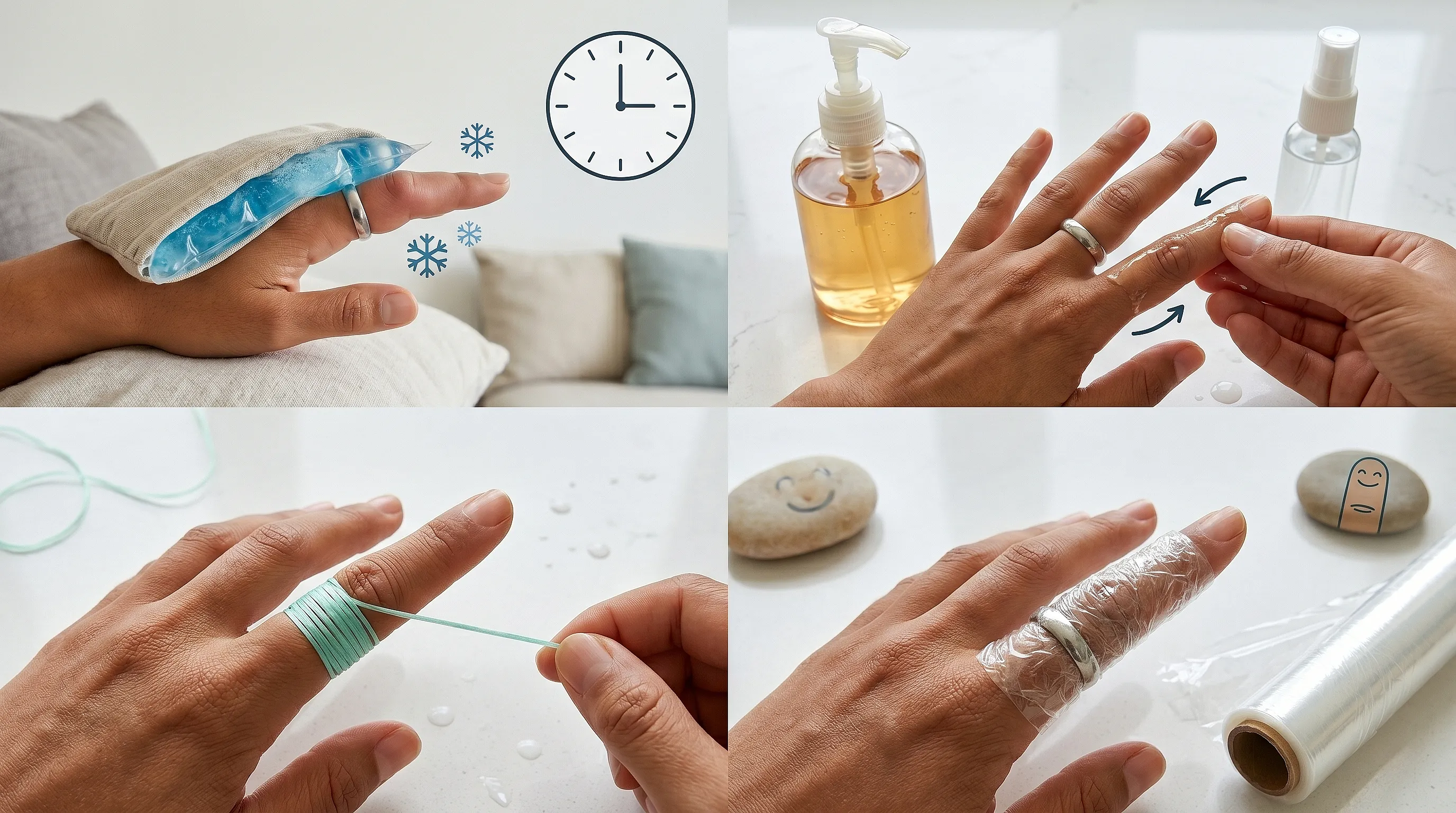
- Elevate the hand above the heart for five to ten minutes to reduce swelling
- Apply a cold compress to the finger
- Use dish soap or cooking oil as a lubricant
- Try the dental floss or thread method (full instructions in the ring stuck on finger guide)
If home methods do not work
If thirty to sixty minutes of attempts produce no progress and the finger shows circulation problems, go to an urgent care centre, emergency room, or directly to a jeweller with ring-cutting tools. Most emergency rooms have ring cutters as standard equipment.
Ring cutting is not a catastrophe
A cut ring can be repaired. A damaged finger is more serious. If cutting is the only safe option, do it. After the finger recovers, the ring can be resized and repaired.
Prevention
The best strategy is not letting the situation become critical. The moment a ring begins to feel consistently tight, remove it, and start planning whether to resize or replace.
Seasonal finger size variation
A factor that many people underestimate.
Summer
Heat dilates blood vessels and causes mild tissue swelling. Fingers are measurably larger in summer. A ring that was comfortable in winter may feel noticeably tight during a warm July afternoon. Some people experience half a size to a full size difference between seasons.
Winter
Cold constricts blood vessels and tissues. Rings can become loose enough to slip off in cold weather, particularly if you are outdoors without gloves.
After salty food
High sodium intake causes water retention in tissues within a few hours. Fingers can swell noticeably the evening after a salty restaurant meal.
Morning versus evening
Fingers tend to be thinnest first thing in the morning after a night of rest. By late afternoon or evening, after a day on your feet, mild swelling is normal. If you measure your ring size in the morning, consider going up half a size.
After exercise
Increased blood flow during exercise causes measurable temporary expansion in finger size. A ring worn through a workout may feel uncomfortably tight for thirty to sixty minutes afterward.
After alcohol
Alcohol dilates blood vessels. Finger swelling can occur within an hour of drinking.
The practical sizing guideline
Measure for ring size in the middle of the day, at a comfortable room temperature, without recent exercise, alcohol, or very salty food. If your lifestyle regularly involves all of these variables, go up half a size from your neutral measurement to accommodate the high end.
Send a friend a discount code, they save on their first order.
When a finger is swollen
Swelling without an underlying ring-size change.
Common causes of sudden swelling
- Finger injury: sprain, fracture, or bruise
- Allergic reaction
- Joint inflammation
- Pregnancy-related fluid retention
- Cardiovascular or kidney conditions causing generalised edema
Injury-related swelling
Remove any rings before swelling peaks. Swelling from a hand injury can increase rapidly. Use soap or oil, the dental floss method, or ask a jeweller to cut the ring if you cannot get it off. After injury recovery and swelling resolution, assess whether permanent resizing is needed.
Metal allergy presenting as swelling
If the finger under the ring is red, swollen, and itching, consider metal allergy before deciding on resizing. A ring made of an alloy containing nickel can cause a contact allergy that presents as swelling and irritation. Remove the ring, let the reaction resolve, and switch to a hypoallergenic metal: titanium, niobium, platinum, or nickel-free gold.
Arthritis
Progressive joint enlargement from arthritis is one of the most common reasons long-worn rings need resizing. When swelling from arthritis becomes permanent, the ring either needs to be resized or retired from daily wear.
Pregnancy
Finger swelling during pregnancy is normal and expected. Removing the wedding band before it becomes stuck is wise. After delivery, swelling typically resolves within a few months, though not always completely. Wait six months postpartum before making a permanent resizing decision.
Preventing fit problems in the future
How to avoid the need for frequent resizing.
Measure properly before buying
Get a ring size measurement at the right time: mid-day, neutral temperature, middle of the week, not after a workout or a salty lunch. If possible, measure twice on different days.
Account for the knuckle
If your knuckle is noticeably wider than the base of your finger, size to the knuckle. A ring that passes the knuckle but is loose at the base can be addressed with a sizing insert more easily than a ring that will not pass the knuckle.
Think about life stage
If you are in your early twenties, your fingers may still change slightly. If pregnancy is planned in the near future, factor in likely swelling. A ring bought with zero margin will likely need resizing within a few years.
Don't buy tight expecting it to stretch
Unlike leather shoes, rings do not break in. A ring that is tight in the store will be tight every day. If a ring is uncomfortably snug at purchase, either size up or look at a different design.
Leave a small margin for gifts
When buying a ring as a gift for someone whose exact size you do not know, go slightly larger rather than smaller. Sizing up is almost always simpler than sizing down.
Check your rings periodically
Once a year, confirm your rings still fit correctly. Catching a gradual tightening early is far less stressful than dealing with a stuck ring.
Men's rings: different considerations
Men's rings present their own set of resizing challenges.
Heavier bands
Men's rings typically have thicker shanks, often 2.5-5 mm versus 1-2 mm for women's rings. Heavier shanks resist stretching and almost always require the metal-addition method. This means longer time and higher cost.
Wider bands
Men's rings are often 5-12 mm wide, versus 2-5 mm for most women's rings. Wider bands require a longer metal insert to span the shank, which increases material and labour costs.
Material choices
Men's rings are more frequently made in alternative metals: titanium, ceramic, tungsten, cobalt chrome. These are the exact metals that resist standard resizing. For men's rings, checking the metal type before buying and sizing carefully at purchase avoids a future problem that may have no good solution.
Surface texture
Many men's bands feature brushed finishes, hammered textures, or carved patterns. Stretching distorts these textures visibly. Metal addition in the lower shank preserves them better, but the insert area still requires matching the surface finish, which adds work.
What drives resizing for men
Men's fingers are somewhat less subject to hormonal fluctuation than women's. Most male resizing requests come from inheritance, weight change, or long-term aging.
Engagement and wedding rings: special considerations
These rings carry particular emotional weight.
Plain wedding bands
The simplest and most frequently resized ring type. A plain gold or platinum band with no stones is the ideal candidate for both stretching and metal addition. After sizing and polishing, the result should be indistinguishable from the original.
The finish of a wedding band matters for long-term wearability. After sizing, ask for a complete re-polish so the ring looks fully cohesive.
Engagement rings with a centre stone
The centre stone in the upper shank is not touched by lower-shank metal addition. This is a routine procedure. If the ring has a row of smaller side stones along the shank, those are handled with care. A slight risk of loosening prong-set side stones exists with stretching, which is why metal addition is the preferred method.
Wedding band resizing after pregnancy
The most frequent request at jewellery shops. Hormonal changes after delivery typically cause one to two finger size increases. Some women regain their original size within six to twelve months; others retain the change. The standard advice is to wait six months before doing a permanent resize, to allow the body to stabilise.
Inherited engagement rings and family heirlooms
These deserve the most careful approach. Seek a jeweller who explicitly works with antique and estate jewellery. Old European cut diamonds, Victorian-era settings, unusual alloy mixtures all require specific knowledge. A general-purpose shop may not have the expertise for delicate antique work.
The sentimental logic of resizing
A resized original ring is almost always preferable to a lookalike replacement. The material history of a family ring, the physical object itself, has a meaning that a reproduction does not. Good resizing preserves that object. The size number changes; everything else stays.
Ring size systems around the world
Since rings are bought globally and resized locally, understanding the systems helps avoid confusion.
US system
Numeric, where size 1 is very small and the scale runs through size 16 and beyond. Common women's sizes in the US fall between 5 and 8. Each full size equals approximately 0.83 mm in diameter. Half sizes are common.
European system (ISO 8653)
The size number equals the inner circumference in millimetres. A US size 7 is approximately European size 54. European sizing is used across most of continental Europe.
UK system
Alphabetic, from A through Z, with half-size increments indicated by a half letter. UK letter N corresponds approximately to US size 6.75. Used in Britain and some Commonwealth countries.
German system (also used in this context)
Germany uses the European circumference system. A German ring sized 54 has an inner circumference of 54 mm, a diameter of approximately 17.2 mm.
French and Italian system
Same as the European circumference system. French and Italian jewellers work with the same millimetre-based numbering.
Japanese system
Numeric but on a different scale than US. Japanese size 12 corresponds roughly to US size 6.
The conversion problem
Buying online across systems is where sizing errors originate. An American buying a ring from a European site and entering "7" expecting US sizing may receive a ring that is a European 7, which is tiny. Always verify which system the seller uses and convert explicitly.
To convert and measure: see the complete ring size guide.
Fixing a conversion error
When a ring is the wrong size due to a unit conversion error, the discrepancy is usually one to two sizes, which is within the range of the metal-addition method. Identify the exact size needed before going to the jeweller so the work only needs to be done once.
A brief history of ring resizing
Ancient practice
Rings in ancient Egypt and Mesopotamia were made individually to the wearer's finger. If a ring no longer fit, the solution was remelting and remaking. The concept of preserving a ring while changing only its size did not exist in any systematic way.
Medieval goldsmithing
By the medieval period, goldsmiths had developed the tools to cut and solder metal rings. Resizing was possible but expensive, accessible mainly to nobility and wealthy merchants. Most ordinary people wore rings made to fit at purchase, and rarely resized them.
Industrial revolution
The nineteenth century brought standardised ring mandrels, consistent gas torch techniques, and precise sizing scales. By the late 1800s, resizing was a standard offered service at any established jeweller. The technique was essentially the same as today: cut, add, solder, polish.
Twentieth-century standardisation
As mass jewellery production created rings in standard sizes, resizing became ubiquitous. By mid-century, any reputable jewellery shop in any American or European city offered ring sizing as a matter of routine.
Contemporary tools
Laser welding now allows work on titanium and platinum that was impractical before. Digital calipers and 3D scanning allow precise size determination before work begins. But the core method, adding a piece of matching metal to an opened shank, remains unchanged from the 1880s.
Buying it as a gift? Each one arrives ready to give.
 A branded Zevira box and a little card come with every order.













Frequently asked questions
How many sizes can a ring be made larger?
By stretching, typically up to one to one and a half sizes. By metal addition, two to three sizes or more. Beyond three sizes, the structural integrity of the band may be compromised, and buying a new ring often makes more sense.
What does ring resizing cost?
Highly variable. Stretching runs at the low end of jewellery service pricing. Metal addition is mid-range. Work requiring stone removal or involving antique alloys runs higher. Get a written quote before authorizing any work. Prices vary significantly by city and by jeweller.
Can I resize a ring at home?
Without professional tools and training, no. Home solutions, silicone strips, adhesive pads, spring inserts, adjust the fit temporarily but do not change the metal. Attempting to stretch or modify the metal at home typically damages the ring.
How long does resizing take?
Stretching: ten to thirty minutes. Metal addition: one to two hours of work, sometimes spread across two appointments. Stone removal and resetting adds significant time.
Will the stones survive resizing?
Usually. Stones in the upper shank are not involved in lower-shank sizing work. Full-circumference eternity settings make resizing very difficult. Fragile stones such as opal, pearl, and emerald are typically removed before work and reset afterward.
Will the seam be visible?
After professional polishing, the seam on a fresh ring is nearly invisible. Over years of wear, a faint line may appear, particularly on silver. On antique rings with aged metal, the seam may be slightly more visible because of tonal differences between old and new metal.
Can a titanium ring be made larger?
In theory, yes, through laser welding. In practice, few jewellers have this capability and the cost often rivals a new ring. Most people with titanium rings that need resizing simply purchase a new ring.
My wedding band is too tight after having a baby. What should I do?
Wait six months. Many women return to their original ring size within a year postpartum. If the change persists after that, a one-size increase by metal addition is a permanent and clean solution.
Can a resized ring be returned to its original size?
Yes, through the sizing-down procedure. This is feasible if only modest resizing has been done. Repeated size changes, up and down, gradually weaken the metal at the work zone. More than three or four adjustments on the same ring is generally not recommended.
What should I do if my finger swelled from an injury?
Remove the ring before the swelling peaks if at all possible. If the ring is already stuck, use oil or soap and the thread method. If you cannot remove it, a jeweller with ring-cutting tools can cut it off safely. After recovery, assess for permanent resizing if the change turns out to be lasting.
Is it better to resize or buy a new ring?
If resizing costs more than about 60% of the price of a new ring of comparable quality, and the ring has no particular sentimental value, buying new makes economic sense. If the ring is a family heirloom, an irreplaceable antique, or deeply significant, resizing is almost always worth it.
Can an engraved ring be resized?
Yes. Engraving on the upper shank is untouched by lower-shank metal addition. Engraving that runs the entire circumference of the band requires a consultation to determine the best approach.
What do I do with an antique ring that needs resizing?
Take it to a jeweller who specifically works with antique and estate jewellery. Standard chain jewellery shops may lack the knowledge to work safely with historic alloys and fragile settings. The extra care and cost are worth it for pieces that cannot be replaced.
How many times can the same ring be resized?
Two to three times without significant structural concern. Each procedure slightly weakens the work zone. After three or four resizings, the shank in the work area is meaningfully thinner and weaker. At that point, consider a new ring or a full shank replacement.
Conclusion
Ring resizing is a standard jewellery service available at any qualified jeweller. Mandrel stretching handles small size increases on simple bands quickly and inexpensively. Metal addition handles larger jumps and works for most ring types, including those with centre stones. Spring inserts and silicone pads are temporary adjustments that are reversible and require no modification to the ring itself.
Three principles guide good decisions. Choose a jeweller based on skill and experience, not the lowest price. Understand what your specific ring can and cannot handle before committing to a method. Keep home attempts limited to temporary solutions that do not involve heat, tools, or any kind of mechanical force on the metal.
Further reading: for measuring your size precisely, see the comprehensive ring size guide. For removing a stuck ring, see the guide on how to get a ring off a stuck finger. For understanding metal composition, see brass vs. steel vs. silver and how to tell if silver is real. For gold types, see hallmark meanings: 925, 585, 750.
Silver, gold, engagement rings, symbolic jewellery, paired sets.
About Zevira
Zevira makes jewellery in the artisan tradition of Albacete, Spain. Every ring is crafted to a specific finger size, so the "I bought it and it doesn't fit" problem gets solved before the purchase instead of later at a bench with a torch.
What you'll find with us for rings and sizing:
- Sterling silver 925 rings made to your exact finger size
- Gold rings in 14K and 18K (yellow, white, rose) in the size you need
- Plain wedding bands that are easy to size up or down later
- Centre-stone rings where the size changes without putting the setting at risk
- Help pinpointing your size before you order, so nothing has to be reworked
- Personal engraving on the inside or outside of the band
Each piece is made by hand, with personal engraving available on request. Sterling silver 925 and 14-18K gold.