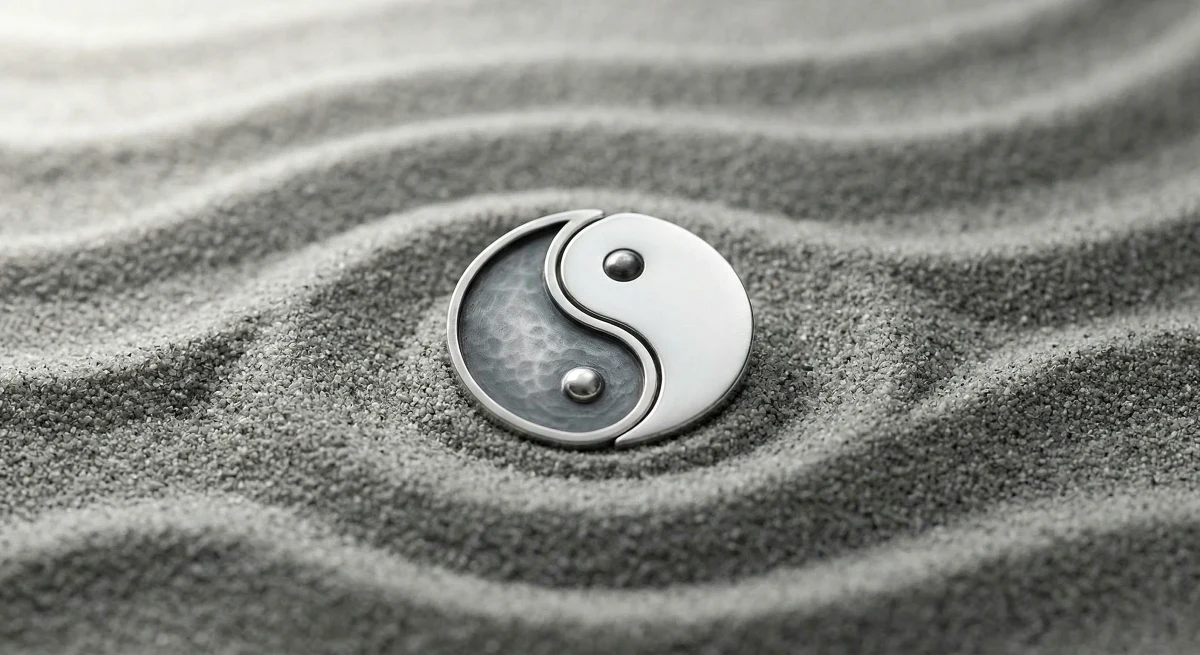
Yin and Yang in Jewellery: The 3,000-Year-Old Symbol of Balance (and What It Really Means)
The symbol everyone recognises but almost nobody understands
You've seen it on necklaces, tattoos, bumper stickers, surf shorts, and dorm room posters. Two teardrops, one black, one white, curled into each other inside a circle. Each one carrying a small dot of the opposite colour.
It's one of the most recognised symbols on the planet. And one of the most misunderstood.
Most people in the West think yin and yang means "good versus evil" or "light versus dark." They think it's about opposites in conflict. Black against white. One side winning, the other losing.
Wear the symbol, don't just read about it. These are in stock:



That reading is wrong. Not slightly off. Fundamentally wrong. And it misses the entire point of a philosophical system that's been shaping thought, medicine, art, and daily life across East Asia for over three millennia.
Yin and yang is not about opposition. It's about complementarity. It's the idea that seemingly contrary forces are actually interconnected and interdependent, that they give rise to each other, and that one literally cannot exist without the other. Light defines dark. Rest defines motion. Cold defines heat. Neither side is better. Neither side wins. The whole point is that they need each other.
This is a 3,000-year-old concept that modern physics, psychology, and ecology keep accidentally rediscovering. And it has become one of the most popular symbols in jewellery for reasons that go well beyond aesthetics.
Here's the full story. Where it came from, what it actually means, how it crossed oceans and centuries, and why people keep wearing it around their necks.
Origins: The I Ching and the Birth of Yin-Yang
Before the symbol: the concept
The concept of yin and yang is older than the symbol. Much older.
The earliest references appear in the I Ching (also written as Yijing), the Book of Changes, one of the oldest Chinese texts still in existence. The I Ching's origins are debated, but most scholars place the core text somewhere between 1000 and 750 BCE, with some elements possibly older.
The I Ching doesn't use the familiar black-and-white circle. Instead, it uses a system of broken and unbroken lines. Unbroken lines (solid) represent yang. Broken lines (with a gap in the middle) represent yin. These lines are combined into trigrams (groups of three) and hexagrams (groups of six) that represent different states of being and change.
The word "yin" originally referred to the shady side of a hill. "Yang" referred to the sunny side. Same hill. Different perspectives depending on where you stand and what time of day it is. As the sun moves, the yin side becomes yang and the yang side becomes yin. This is not a metaphor someone invented. It's an observation of nature that became a metaphor for everything.
From this simple observation, Chinese thinkers built an entire philosophical framework. Yin is associated with darkness, cold, passivity, receptivity, earth, moon, femininity, and contraction. Yang is associated with light, heat, activity, creativity, heaven, sun, masculinity, and expansion.
But here's the crucial part that Western interpretations keep missing: these are not value judgements. Yin is not worse than yang. Passivity is not inferior to activity. The moon is not lesser than the sun. They are two aspects of one reality, and both are necessary.
Laozi and the Tao Te Ching
The concept gets its deepest philosophical treatment in the Tao Te Ching (Daodejing), attributed to Laozi (Lao Tzu), written sometime around the 6th to 4th century BCE.
Laozi didn't invent yin and yang, but he embedded the concept into a complete philosophical system. The Tao (the Way) is the fundamental principle underlying all of reality, and yin-yang is how the Tao manifests in the world of appearances.
Chapter 42 of the Tao Te Ching puts it directly: "The Tao gives birth to One. One gives birth to Two. Two gives birth to Three. Three gives birth to the ten thousand things. The ten thousand things carry yin and embrace yang. They achieve harmony by combining these forces."
That last line is key. Harmony comes from combining, not from one conquering the other. This is not a battle philosophy. It's a balance philosophy.
Laozi's other great contribution was the idea that the "weaker" force often prevails. Water is softer than rock, but water wears rock away. Flexibility survives where rigidity breaks. The valley outlasts the mountain. These are all yin-dominant outcomes, and Laozi presents them not as exceptions to the rule but as the rule itself.
This made Taoism revolutionary in a world of empires and conquest. It argued that power wasn't what it looked like.
The visual: why it looks the way it does
The familiar yin-yang symbol, technically called the taijitu, didn't appear in its current form until surprisingly late. Most historians place the modern version around the Song Dynasty (960-1279 CE), particularly associated with the philosopher Zhou Dunyi, who used a version of it in his "Explanation of the Diagram of the Supreme Ultimate" in 1070 CE.
But why does it look the way it does? Every element of the design encodes a philosophical principle.
The circle. The outer boundary represents totality, completeness, the Tao itself. Everything is contained within it. There is no outside.
The S-curve. The dividing line between yin and yang is not straight. It's an S-curve, like a wave or a flowing river. This represents the idea that the boundary between yin and yang is not a wall but a fluid, constantly shifting transition. Night doesn't suddenly become day. Cold doesn't suddenly become hot. There is always a gradient, a curve, a flow.
The dots. This is the most profound element. Inside the black (yin) area is a white dot. Inside the white (yang) area is a black dot. Each half contains the seed of its opposite. This means that yin is never purely yin. Even at its most extreme, it contains the beginning of yang. Midnight contains the beginning of dawn. The coldest point of winter contains the first stirring of spring.
This is why the symbol is so philosophically powerful. It doesn't just show two opposites coexisting. It shows that each opposite contains the other within it. Opposition is an illusion. At the deepest level, the two are one.
The equal areas. Neither side is larger than the other. Balance is the natural state, not the exception.
A yin-yang belongs on a bare collarbone, not buried under three chains. Crowd it with charms and the balance goes out the window. One clean line, and don't argue.
How to Wear Yin-Yang
I have styled the yin-yang across dozens of looks, from a plain black tee to evening silk. The symbol reads more clearly the calmer everything around it stays, so I keep my rules simple and let the circle do the talking.
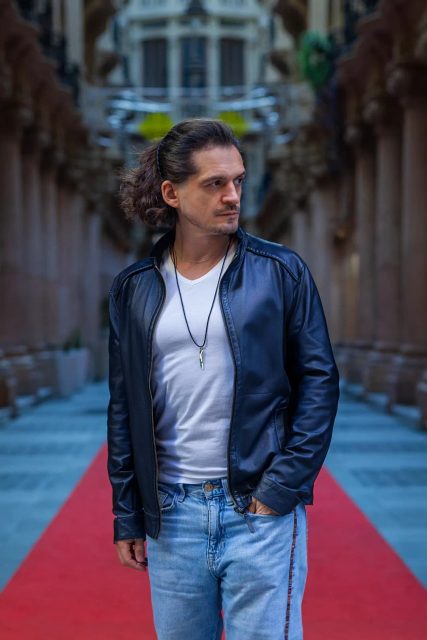
How do I wear yin-yang every day? For an everyday look I recommend a thin chain or a leather cord over a white tee, grey knit, or a shirt with the top button open. A round neckline opens the throat and drops the pendant exactly where it shows. A black-and-white symbol on neutral fabric works every time, nothing competes with it for attention. I suggest a short fit, sitting near the collarbone.
Does it work for the office? It does, as long as you keep it restrained. I choose a yin-yang ring or a small pendant tucked under a shirt collar, a polo, or a fine knit. The symbol stays your private reminder rather than an announcement for the meeting room. One reliable tip: keep a single metal across the look, a watch, ring, and pendant all in silver or steel read as pulled together.
How do I build an evening look? For evening I suggest a dark top, a V or deep neckline, and smooth fabric like silk. On a dark ground the white half of the symbol glows, on a light one the black half comes forward. I recommend dropping the length a little so the pendant sits on open skin. Gold adds warmth and an eastern note, silver keeps the look graphic.
What should I give for an anniversary or a milestone? Here I choose a split two-piece set: each person wears one half, together they close into a full circle. This is the moment when meaning matters more than shine. A tip: engraving the date on the back makes the gift fully personal.
Who does yin-yang actually suit? Almost anyone, because the symbol is gender-neutral and tied to no age. By mood it leans toward those who value quiet symbolism without fuss. By pairing it gets on well with sun and moon, celestial and nature motifs, and layered chains of different lengths. Two rules that never fail. First, keep one or two metals in the look. Second, hold to a single line of meaning, then the symbol rings clear instead of drowning among charms.

Turn on your camera, pick earrings, a pendant or a ring, and see the piece on yourself in real time.
Switch items in one tap.
Everything runs in your browser: no photo or video is ever uploaded.
Not Good vs Evil: The Misunderstanding That Won't Die
If there's one thing this article needs to accomplish, it's this: yin and yang is not a moral system. It's not about good versus evil.
The Western world has a deep habit of sorting things into moral binaries. God versus Satan. Heaven versus Hell. Good versus evil. Light versus darkness. Heroes versus villains. This is a Judeo-Christian inheritance, and it runs so deep in Western culture that many people can't encounter a duality without automatically reading morality into it.
So when the yin-yang symbol arrived in the West, people looked at the black and white sections and immediately mapped their existing framework onto it. White equals good. Black equals evil. The symbol must be about the struggle between them.
This is like reading a Japanese haiku and concluding it's a limerick because that's the poetry format you're familiar with.
In Chinese philosophy, yin (the dark side) is not evil. It's rest, receptivity, the cooling darkness that makes sleep possible, the winter that lets the earth regenerate, the silence that gives meaning to music. Without yin, yang would burn itself out. Endless light with no darkness is not paradise. It's a desert.
Similarly, yang (the light side) is not inherently good. Unchecked yang is destructive. Too much heat, too much activity, too much expansion without contraction, that's fever, wildfire, and empire overreach. Yang needs yin to cool, balance, and sustain it.
The Chinese philosophical tradition has its own concepts of good and evil, but they're not mapped onto yin and yang. Good, in the Taoist framework, is balance. Evil is extreme imbalance. Too much yin or too much yang is the problem, not yin itself or yang itself.
This is a fundamentally different way of thinking about the world. And it's one reason the symbol resonates with so many people today who feel uncomfortable with rigid moral binaries.
Upload a photo of your pet, someone you love, or an object. We'll build a 3D model and hand-cast it in pewter.


Yin-Yang Across Chinese Philosophy and Practice
Taoism: flowing with the current
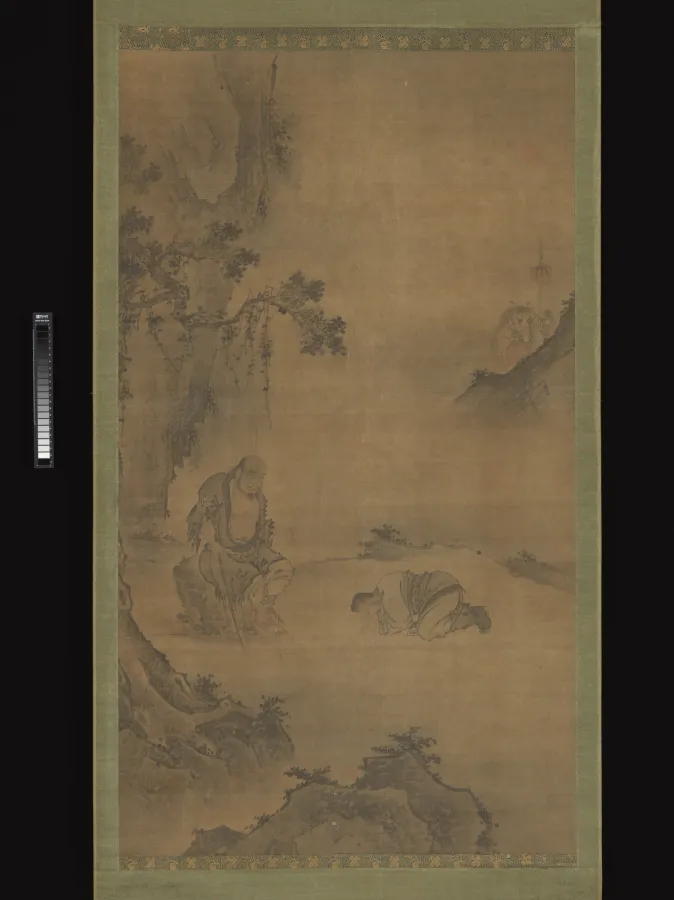
In Taoism (Daoism), yin-yang isn't just a philosophical concept. It's a practical guide for living.
The Taoist ideal is wu wei, often translated as "non-action" but more accurately meaning "effortless action" or "acting in harmony with the natural flow." It's the yin approach to life: don't force, don't resist, don't push against the current. Find the natural direction of events and work with it, not against it.
This doesn't mean doing nothing. It means doing the right thing at the right time with the minimum necessary effort. A skilled martial artist doesn't use brute force. A skilled sailor doesn't fight the wind. A skilled leader, according to Laozi, governs so lightly that the people think they govern themselves.
Taoist monks and practitioners use the yin-yang principle in everything from diet (balancing cooling and warming foods) to daily routine (balancing activity and rest) to meditation (balancing focus and relaxation).
Traditional Chinese medicine
Perhaps nowhere is yin-yang more practically applied than in Traditional Chinese Medicine (TCM), which has been a continuous medical tradition for over 2,000 years and is still practised by hundreds of millions of people worldwide.
In TCM, health is balance. Disease is imbalance. Every organ, every bodily function, every symptom is classified as either yin or yang, and treatment aims to restore the balance between them.
The heart is yang. The kidneys are yin. A fever (excess yang) might be treated with cooling (yin) herbs. Fatigue (excess yin) might be treated with warming (yang) treatments. Acupuncture points are classified as yin or yang depending on their location and function.
This isn't just ancient history. TCM is a massive, regulated healthcare system in China, with dedicated hospitals, universities, and pharmaceutical companies. The World Health Organisation has recognised TCM in its International Classification of Diseases since 2019. You may or may not believe it works, but roughly a quarter of the world's population uses it, which makes it hard to dismiss as folklore.
And at the foundation of the entire system is yin and yang. Every diagnosis, every prescription, every needle placement starts with the question: where is the imbalance?
Feng shui and the five elements
Feng shui (literally "wind-water") is the Chinese practice of arranging spaces to harmonise with natural energy flows. It's another direct application of yin-yang thinking.
A room can be too yin (dark, cold, stagnant) or too yang (bright, hot, overstimulating). Good feng shui balances the two. Light and shadow. Hard surfaces and soft textures. Active spaces and restful spaces.
Feng shui also incorporates the wu xing (five elements or five phases): wood, fire, earth, metal, and water. Each element has yin and yang aspects, and the interplay between them determines the energy of a space. This system is far more nuanced than the simplified "put a fountain in your wealth corner" version that became popular in the West in the 1990s.
Martial arts: tai chi, the supreme ultimate
Here's something most people don't know: "tai chi" literally means "supreme ultimate." The full name is taijiquan, "supreme ultimate fist." And the "supreme ultimate" that the name refers to? It's the yin-yang diagram. The taijitu.
Tai chi is, in essence, yin-yang philosophy expressed through movement. Every posture, every transition, every breath alternates between yin (yielding, soft, retreating) and yang (advancing, firm, expanding).
The martial application is practical: when an opponent pushes (yang), you yield (yin) and redirect their force. When they pull back (yin), you advance (yang) and apply pressure. You never meet force with force. You use your opponent's energy against them.
This principle extends beyond tai chi into virtually all Chinese martial arts, and into many Japanese and Korean martial arts as well. The idea that softness can overcome hardness, that yielding can be a form of power, is yin-yang philosophy in action.
Bruce Lee, perhaps the most famous martial artist in history, frequently discussed yin and yang in his philosophical writings. His famous "be like water" quote is pure Taoist yin-yang thinking. Water yields to every obstacle, fills every container, and over time wears away stone.
Customer reviews
Zevira is a real jewellery shop. Genuine payments, deliveries and customer thank-yous.
🥰🥰🥰 gracias
Ok, ¡gracias! 🙂
Beyond China: Korea, Japan, and the Wider East
Korea and the taeguk
Look at the flag of South Korea. Right there in the centre, unmistakable, is a yin-yang symbol.
The Korean version is called the taeguk (or taegeuk), and it's not identical to the Chinese taijitu. The Korean version uses red (yang) and blue (yin) instead of black and white, and it doesn't include the dots. It's surrounded by four of the eight trigrams from the I Ching, representing heaven, earth, water, and fire.
Korea adopted the taeguk as its national symbol in 1882, making it one of the very few national flags that prominently features a philosophical/religious symbol. The choice was deliberate: it represented the Korean aspiration for cosmic balance, harmony, and the unity of opposites.
The yin-yang concept entered Korea along with Chinese philosophy, Buddhism, and Confucianism, likely during the Three Kingdoms period (1st century BCE to 7th century CE). It became deeply embedded in Korean culture, influencing everything from architecture to cuisine to the colour combinations used in traditional clothing (hanbok).
Korean martial art taekwondo also incorporates yin-yang philosophy. The poomsae (forms) in taekwondo follow patterns based on the I Ching trigrams, and the philosophy of balance between attack and defence, hard and soft, fast and slow is directly drawn from yin-yang thinking.
If you wear a yin-yang pendant and someone asks if it's "the Korean symbol," they're not wrong. Korea made it a national identity.
Japan and the tomoe
Japan has its own version of the circular, swirling symbol: the tomoe.
The most common form, the mitsudomoe (three-fold tomoe), features three comma-shaped forms swirling around a central point. It looks similar to the yin-yang but with three elements instead of two. The futatsudomoe (two-fold tomoe) is even closer to the yin-yang, with two swirling forms.
The tomoe appears everywhere in Japanese culture. It's carved into shrine drums, roof tiles, and family crests (mon). The Shinto deity Hachiman, the god of war, uses a mitsudomoe as his symbol. The Ryukyuan kingdoms of Okinawa used the hidari gomon (left-turning mitsudomoe) as a royal symbol.
The relationship between the tomoe and the Chinese taijitu is debated. Some scholars see direct influence. Others argue the tomoe developed independently from observations of water currents, whirlpools, or the shape of magatama beads (curved jewels that are among Japan's oldest artifacts).
Either way, the visual similarity speaks to something universal: the idea of cyclical motion, of forces curving into and around each other, seems to arise independently across cultures. The swirl is a Chinese idea and, more broadly, a human one.


How Yin-Yang Came West: Hippies, Martial Arts, and Album Covers
The yin-yang symbol's journey to the West happened in waves.
Wave one: the Jesuits. European missionaries, particularly Jesuits, encountered the I Ching and yin-yang philosophy in China during the 16th and 17th centuries. The German mathematician Gottfried Wilhelm Leibniz was particularly fascinated. In 1703, Leibniz published a paper arguing that the I Ching's system of broken and unbroken lines was a binary number system, essentially zeros and ones, predating Western binary mathematics by millennia. This was a stretch (the I Ching is philosophical, not mathematical), but Leibniz's enthusiasm made yin-yang one of the first Chinese concepts to enter European intellectual circles.
Wave two: the 1950s-60s counterculture. The Beat Generation discovered Taoism, Zen Buddhism, and Chinese philosophy through writers like Alan Watts, D.T. Suzuki, and the translations of the Tao Te Ching that began appearing in English. Jack Kerouac, Allen Ginsberg, and Gary Snyder were all influenced by Eastern philosophy, and the yin-yang symbol began appearing in Beat art and literature.
When the hippie movement exploded in the late 1960s, it absorbed everything the Beats had discovered and amplified it. The yin-yang symbol became a countercultural icon alongside the peace sign, the om symbol, and the ankh. It appeared on posters, album covers, van murals, and jewellery. It meant "I'm into Eastern philosophy" and "I reject Western dualistic thinking" and "I probably own a copy of the Tao Te Ching."
Wave three: martial arts. Bruce Lee's films in the early 1970s, followed by the kung fu craze of the mid-70s, brought Chinese martial arts into Western popular culture. With the martial arts came their philosophical foundation, and the yin-yang symbol appeared on dojo walls, martial arts uniforms, and the covers of martial arts magazines across North America and Europe.
The TV series "Kung Fu" (1972-1975), starring David Carradine, opened each episode with Taoist philosophy. It was simplified, sometimes distorted, but it introduced millions of Americans to concepts like balance, wu wei, and the complementarity of opposites.
Wave four: surf and skate culture. By the 1980s and 1990s, the yin-yang had been adopted by surf and skateboard culture. Town & Country Surf Designs made the yin-yang one of its central visual elements. The symbol appeared on surfboards, skate decks, and the clothing of anyone who identified with board sports.
The surf/skate adoption is interesting because it connected the symbol to a specific lifestyle philosophy: balance between control and surrender, between reading the wave and letting the wave take you. Whether surfers had read the Tao Te Ching is debatable. But they were living something that looked a lot like wu wei every time they paddled out.
Wave five: wellness and mindfulness. From the 2000s onwards, the yin-yang entered the wellness, yoga, and mindfulness world. It appeared in spa logos, meditation app icons, wellness brand packaging, and the visual language of the self-care industry. This wave brought the symbol to its widest-ever audience but also its thinnest interpretation, sometimes reducing three millennia of philosophy to "find your balance."
Jung, Anima/Animus, and the Psychological Yin-Yang
Carl Gustav Jung, the Swiss psychiatrist and founder of analytical psychology, never studied Chinese philosophy formally. But when he encountered the yin-yang concept, he recognised something that matched his own findings from decades of clinical work.
Jung's concept of the anima and animus proposes that every man carries an unconscious feminine aspect (the anima) and every woman carries an unconscious masculine aspect (the animus). Psychological wholeness, in Jung's view, requires integrating these opposites rather than suppressing one in favour of the other.
Sound familiar?
Jung was explicit about the parallel. In his commentary on "The Secret of the Golden Flower" (a Chinese alchemical text translated by Richard Wilhelm in 1929), Jung wrote extensively about how Chinese philosophy had arrived at the same insights as his own psychology, but through a completely different path.
The parallels go deeper than anima/animus. Jung's concept of the shadow (the unconscious, rejected parts of the personality) maps onto the yin-yang dots. Each side contains the seed of its opposite. Your conscious personality (persona) always has a shadow that carries everything you've rejected, and that shadow isn't evil. It's necessary. Wholeness means integrating it, not defeating it.
Jung's concept of enantiodromia, borrowed from the Greek philosopher Heraclitus, states that any extreme eventually turns into its opposite. Excessive order produces chaos. Excessive control produces loss of control. This is essentially the yin-yang principle: when yang reaches its peak, it begins to transform into yin. And vice versa.
For many people in the West, Jung's psychology is the bridge to understanding yin-yang. It translates a Chinese philosophical concept into the language of Western psychology, and it makes the case that the yin-yang insight isn't culturally specific. It's describing something real about how consciousness works.
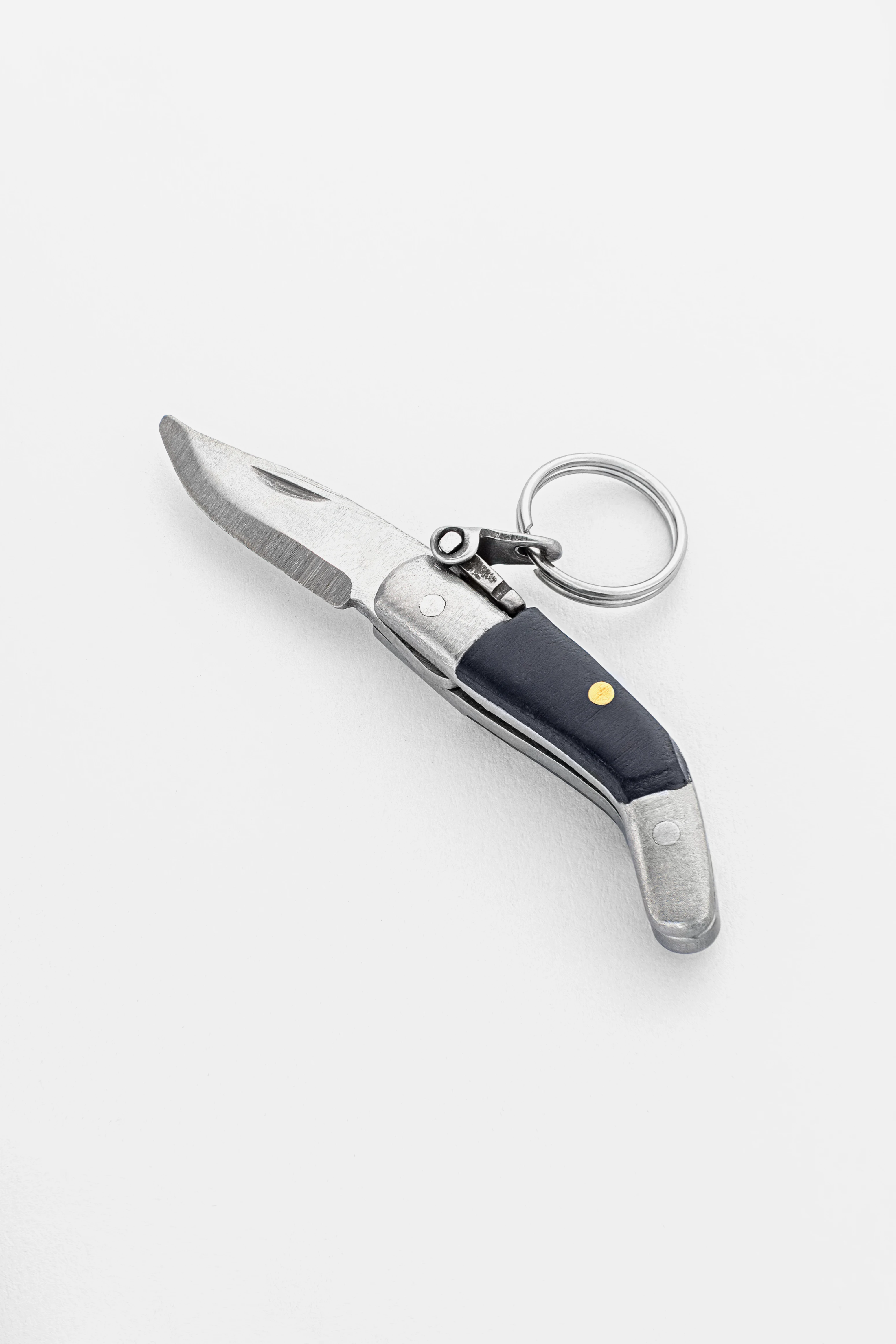
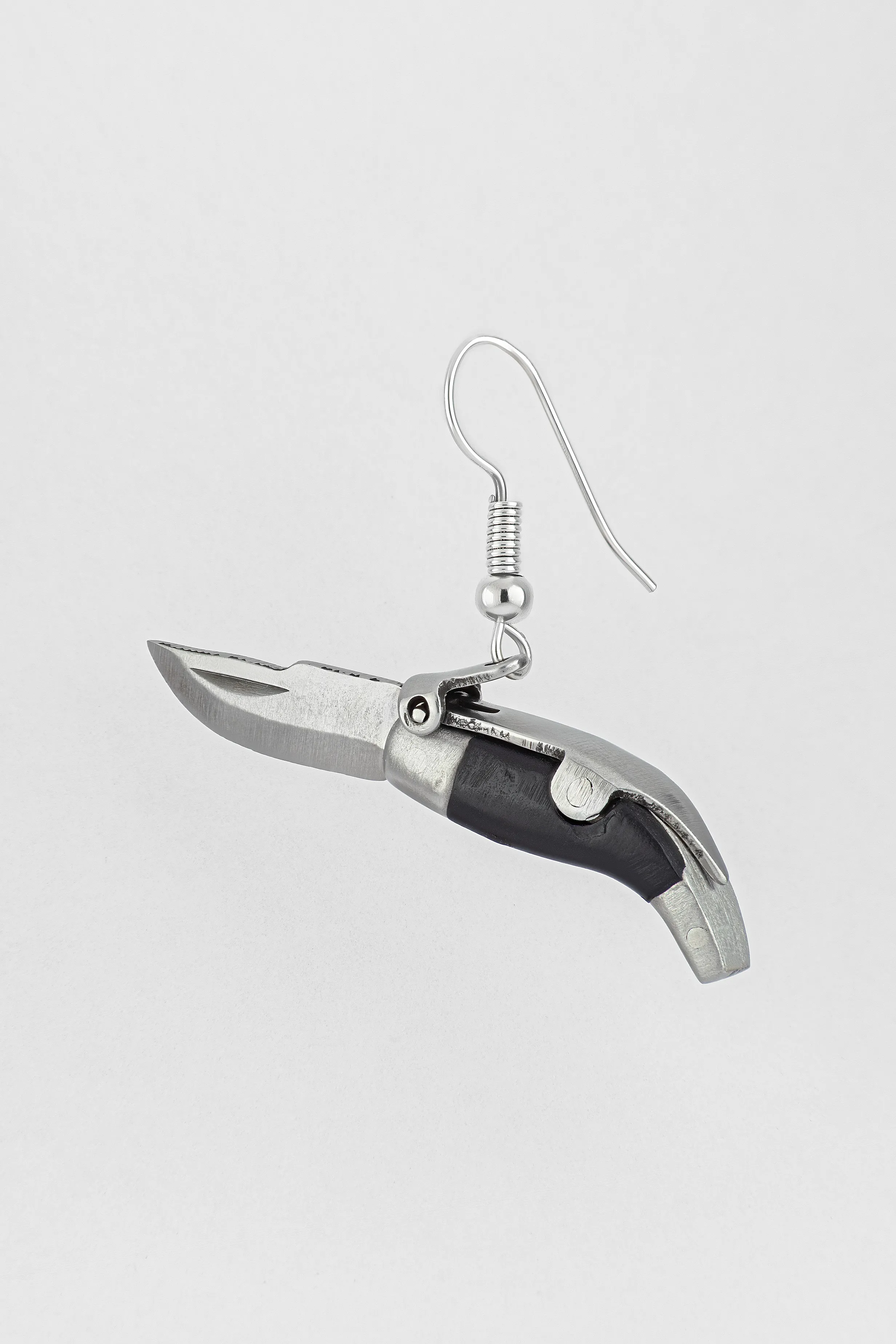
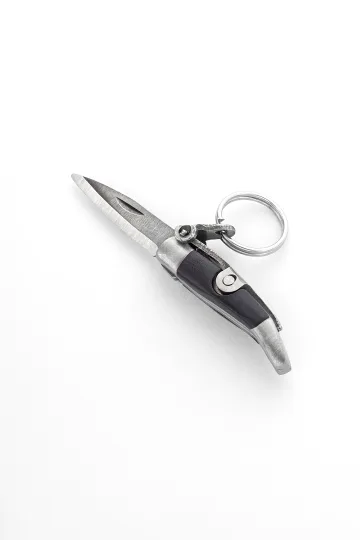
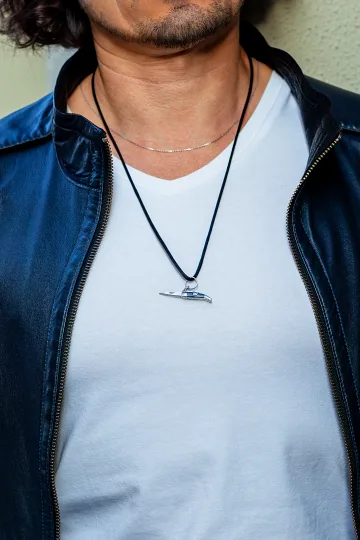
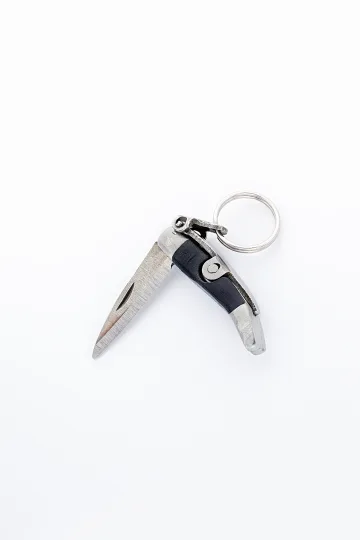
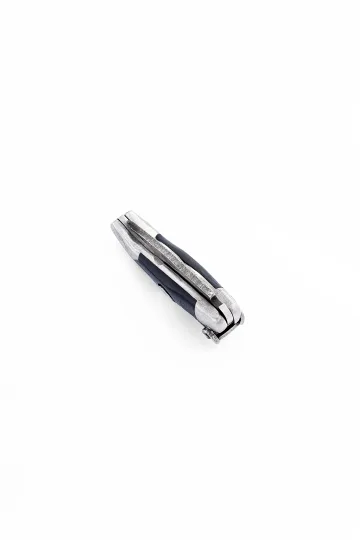
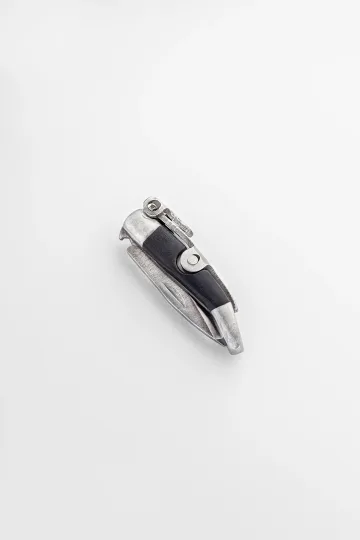
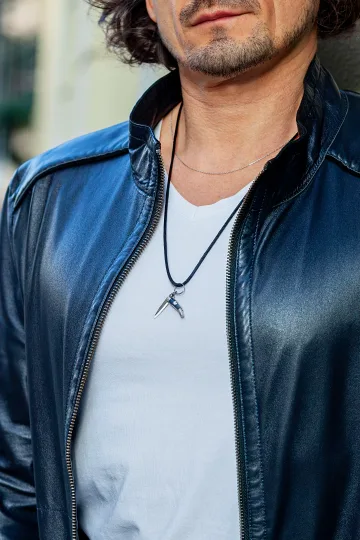
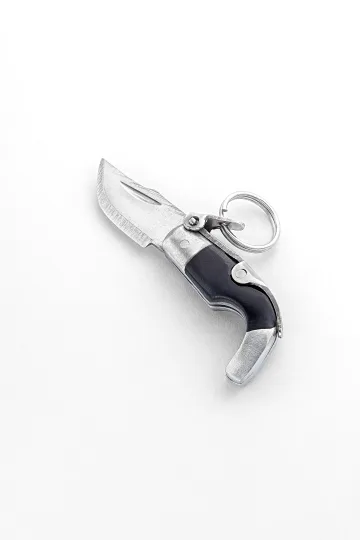
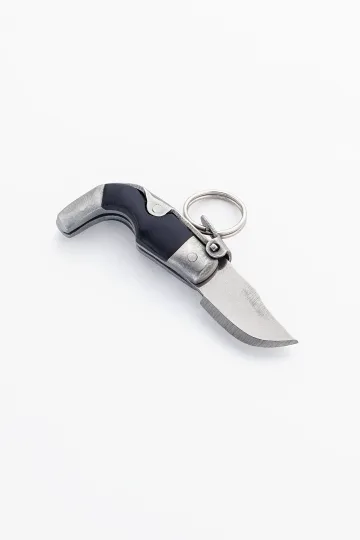
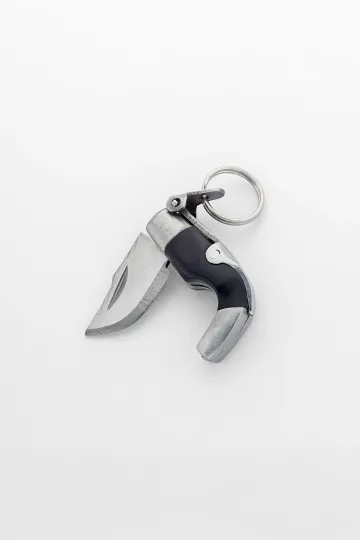
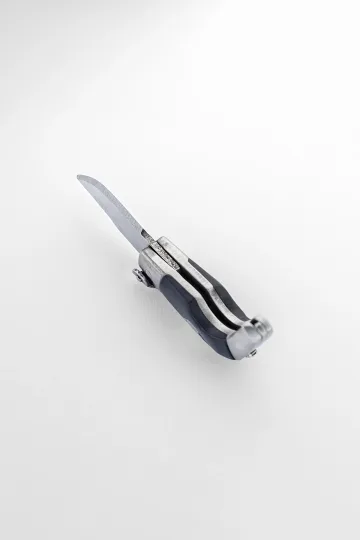
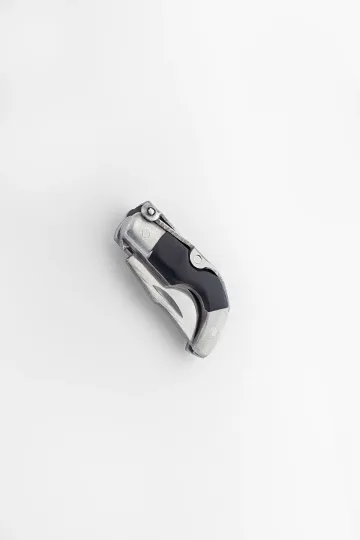
CAPAORA mini knife pendant
The 18th-century Spanish navaja in miniature: 40 mm of stainless steel, a real folding mechanism and a Palanquilla lock that clicks. An affordable gift to remember.
Authentic · Ships from Spain · 14-day returns
Yin-Yang in Modern Jewellery: From Couples Pendants to Everyday Balance
The yin-yang symbol has been worn as jewellery for centuries in East Asia, but its explosion in Western jewellery really begins in the 1960s counterculture and hasn't stopped since.
Couples jewellery. One of the most popular uses of the yin-yang in jewellery is the split pendant. Two people each wear one half of the circle. When they come together, the pieces form the complete symbol. It's a way of saying "we complement each other" or "we're two halves of a whole."
This works on multiple levels. On the obvious level, it's romantic. But on the philosophical level, it actually captures something real about yin-yang theory: that each half is incomplete without the other, and that the relationship between the two creates something greater than either alone.
Balance and wellness jewellery. Many people wear the yin-yang as a daily reminder of balance. Not in a mystical sense (though some certainly intend that), but as a visual prompt. Am I working too hard? Resting too much? All structure and no spontaneity? All play and no discipline? The symbol doesn't answer the question. It just keeps asking it.
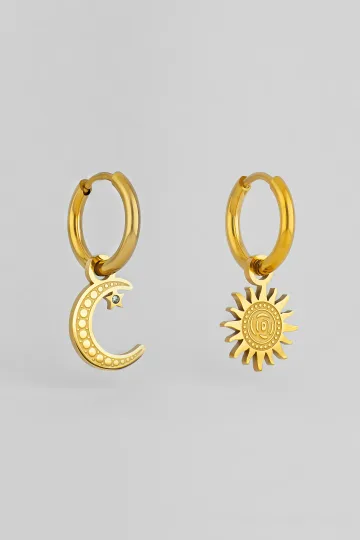
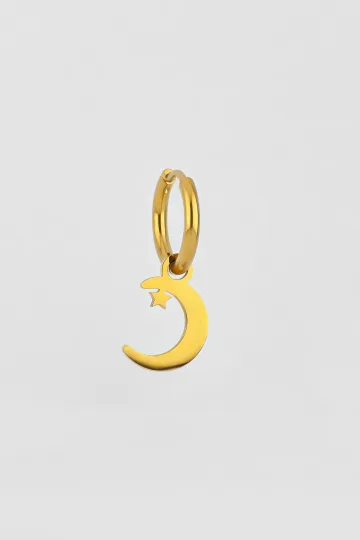
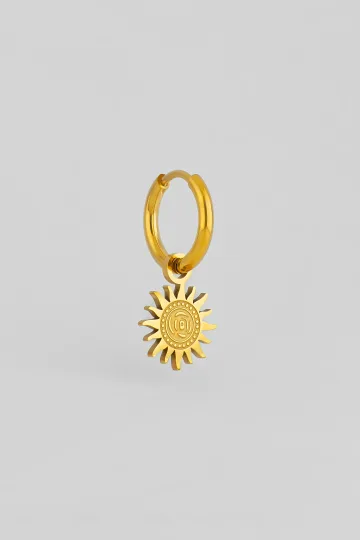
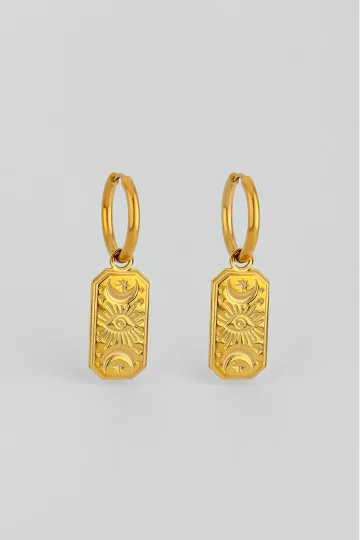
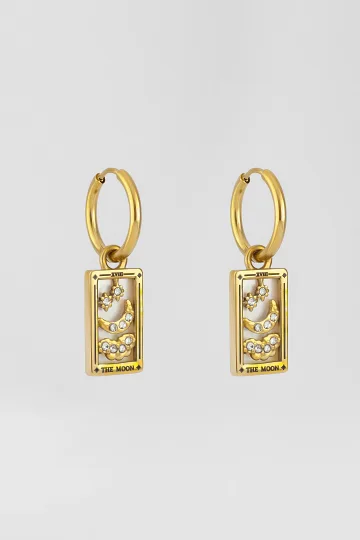
Sun and moon pieces. The sun-and-moon motif in jewellery is often a Western reinterpretation of yin-yang. Sun is yang: active, bright, external. Moon is yin: reflective, mysterious, internal. Sun-and-moon earrings, rings, and pendants tap into the same duality without using the specific yin-yang circle, which gives them a different aesthetic while carrying a related meaning.
Minimalist interpretations. Contemporary jewellery designers have reimagined the yin-yang in countless ways. Abstract curves. Asymmetric halves. Texture contrasts (matte and polished, rough and smooth). Colour contrasts beyond black and white. The symbol's visual simplicity makes it endlessly adaptable while remaining immediately recognisable.
Stacking and layering. The yin-yang philosophy lends itself naturally to jewellery layering. Pairing a bold piece (yang) with something delicate (yin). Mixing metals. Combining statement and subtlety. The practice of thoughtful jewellery stacking is yin-yang thinking applied to personal style.
Gender-neutral appeal. The yin-yang is one of the most gender-neutral symbols in jewellery. Because the entire point is that masculine and feminine are complementary aspects of the same reality, the symbol resists being categorised as "for men" or "for women." It belongs to anyone who values balance.
Leave your email, we'll send your discount code. No spam, unsubscribe anytime.
The code arrives by email, valid on your first order.
Silver, Gold, or Steel: Which Metal Suits Yin-Yang Best
The symbol is built on the contrast of black and white, so the metal decides how cleanly that contrast reads. Silver gives the most graphic result: a cool white shine sharpens the line between the halves, while oxidising (the old niello trick) fills the yin side with a deep matte tone. If you want the pendant to look like a crisp imprint of the idea, 925 silver stays the honest choice. It also takes engraving of a date or name on the back more easily than most metals.
Gold pulls the symbol closer to its homeland. Warm yellow metal echoes the Chinese tradition where gold meant not show-off wealth but durability and the sunlit yang side. In gold the yin-yang reads softer and less stark, which suits anyone who cares more about the warmth of the piece on skin than about sharp edges. Rose gold adds another note, though it moves away from the classic austerity.
Steel and other dense alloys are the territory of everyday wear. They shrug off water, the gym, and the odd knock, which is why steel yin-yang pieces end up on the cords of people who train. Matte steel holds black-and-white enamel well, and it costs less than precious metals, which makes it a comfortable first symbol. If you are torn between alloys, it helps to know the difference in price, weight, and care: there is a full breakdown in brass, steel, and silver. For a paired set we suggest one metal across both halves, so the closed circle looks whole, without a clash of tones.
The Five Elements (Wu Xing): How Two Forces Grow Into a Whole World
Yin and yang rarely work alone. Chinese natural philosophy builds a system of five elements on top of them, the wu xing: wood, fire, earth, metal, and water. These are not literal substances but five kinds of movement, five phases every energy passes through. Wood grows and reaches upward (young yang). Fire blazes at its peak (full yang). Earth holds the balance at the centre. Metal contracts and gathers (young yin). Water sinks and rests (full yin).
The elements link through two circular chains. In the generating cycle, wood feeds fire, fire leaves ash and gives birth to earth, earth yields metal, metal gathers water (dew on a cold blade), water nourishes wood. In the controlling cycle, each element restrains another: water quenches fire, fire melts metal, metal cuts wood, wood grips the earth, earth soaks up water. The result is not a hierarchy but a wheel, with no beginning and no winner.
The wu xing is what turns yin-yang from a handsome idea into a working tool. Traditional Chinese medicine sorts the organs by element, feng shui arranges objects, a calligrapher senses when a stroke has gone too fiery and asks for water. For jewellery it is a hint too: stones and metals were long tied to the elements. Jade to wood, red carnelian to fire, yellow jasper to earth, silver to metal, black onyx to water. A yin-yang pendant set with the stone of the right element became a personal tuning of balance. Similar logic sits behind many protective amulets and talismans, where the material matters as much as the shape.
Yin-Yang in Tattoos: Where People Ink It and What They Mean
Yin-yang left metal long ago and became one of the most recognisable motifs in tattooing. The reason is simple: a circle with two drops reads from a distance, sits well on different parts of the body, and never dates, because an idea stands behind it rather than a trend. Most often it goes where the wearer can see it: the inner wrist, the forearm, the ankle. Larger versions move to the back, the shoulder blade, or the chest, where there is room for extra elements like waves, a dragon, or a landscape.
What people pour into it depends on the person, but a few themes repeat. Some mark a crisis they came through, where the dark and light stretches of life turned out to need each other. Some fix a peace made with their own double nature, calm and hot temper, reserve and openness. Couples and close friends sometimes get a paired tattoo: two halves of a circle on two arms that close when the palms sit side by side. It is the same idea as a split pendant, only permanent.
There are details that often spoil the design. The dots of opposite colour are mandatory: without them the symbol loses its core meaning and turns into a plain comma in a circle. The S-shaped line has to flow, or the halves look torn rather than pouring into each other. And the black-and-white version reads cleaner over time than a colour one: fine shades blur, while an honest contrast holds for decades. For anyone who wants the same meaning without the needle, a pendant you can take off or swap with your mood sits closer.
Yin-Yang for Friendship: A Paired Symbol Beyond Romance
The split pendant is almost always sold as a lovers' token, but yin-yang has a wider logic. The symbol speaks of complementarity, not romance, so the two halves fall just as honestly onto friendship. Two people who balance each other, the loud and the quiet, the impulsive and the level-headed, land squarely inside the meaning of the circle: each carries what the other lacks, and together they are fuller than apart.
A gift like this for friends has a pleasant detail. A romantic split pendant often reads as a promise, and that adds weight to it, sometimes more than wanted. The friendship version is free of that: it marks a bond without expectations or obligations. It suits a long friendship, a farewell before someone moves away, a shared chapter come to an end. Each person's half works as a quiet thread: wherever one of them ends up, the other part of the circle sits with someone who matters.
It works in a family too. A mother and a grown daughter, a brother and a sister, a grandparent and a grandchild, any pair of close people where a difference of character or generation shows plainly. On sets like these we often engrave not names but a short date or a single word, because the meaning here lives in the pair of halves rather than in the inscription. And unlike many paired pieces, yin-yang never looks sentimental: a stark black-and-white circle suits a teenager and an older person alike, which makes it a rare gift no one has to hide.
Buying it as a gift? Each one arrives ready to give.
 A branded Zevira box and a little card come with every order.

Yin-Yang and Science: The Complementarity Physics Keeps Rediscovering
The Taoists ran no experiments and wrote no formulas, yet their observation about interdependent opposites rhymes oddly with what twentieth-century science arrived at. The best-known example is the principle of complementarity in quantum physics. Light behaves as both a wave and a particle, and both pictures are needed to describe it fully, though they cannot be measured at once. Niels Bohr, who framed the idea, was so struck by the resemblance that he chose the taijitu for his personal coat of arms when he was knighted, with a motto about opposites completing each other.
Similar logic surfaces in biology. The body keeps its balance through pairs that pull in different directions: the sympathetic and parasympathetic nervous systems, acceleration and braking, breakdown and synthesis. Health is not the victory of one side but a moving balance between them, exactly what Chinese medicine says, only in another language. Even the double helix of DNA holds together on two complementary strands, where every letter of one chain answers to its pair in the other.
Let us be honest: this is a resemblance, not a proof. Yin-yang is not a scientific theory and predicts nothing in a laboratory, and pretty coincidences are easy to overrate. But the sheer recurrence of the motif says something curious: the idea that the world runs on complementary pairs occurs to a Taoist three thousand years ago and to a physicist with equations alike. Perhaps the point is not mysticism but that the human mind grasps complex systems more easily this way. The symbol on a pendant stays a prompt for thought, not an amulet with power.
Send a friend a discount code, they save on their first order.
How to Choose a Yin-Yang Pendant: What to Look For
The symbol is deceptively simple, which is exactly why cheap work shows at once. The first thing to look at is the dots. In a good piece the white and black dots are clear, even, and set at the centre of each drop. In poor castings they are smeared, shifted, or missing, and without them the symbol loses its core meaning. The second is the line: the S-shaped curve should flow and stay symmetrical, so the halves pour into each other rather than clumping into a shapeless blot.
Next, look at how the contrast is made. In silver the black side usually comes from oxidising, and good oxidising sits in the recesses rather than smeared across the surface, where it wears off fast. In enamel versions what matters is an even edge of colour and no bubbles or chips along the rim. A hallmark helps you check the metal is genuine: how to read it, and how to tell real silver apart, is covered in the guide on how to tell if silver is real 925.
A paired set has its own test: fold the halves together. In a good pair they meet with no gap or step, and the circle looks whole. In a careless one a slit or a change in height stays between the parts, and the whole idea of a closing symbol falls apart. Finally, think about fit and weight. A pendant that is too light and stamped will swing and flip, one that is too heavy drags on a fine chain. A medium weight, a bail threaded through the centre of gravity, and a chain matched to the metal give a piece that sits level and lasts for years.
Wear the symbol, don't just read about it. These are in stock:









Frequently Asked Questions
Is yin female and yang male?
In traditional Chinese philosophy, yin is associated with feminine qualities and yang with masculine qualities. But these aren't the same as biological sex. Every person, regardless of gender, contains both yin and yang. A man has yin aspects. A woman has yang aspects. The associations are about energy qualities (receptive versus active, cool versus warm) rather than literal gender identity.
Is yin the "bad" side?
No. This is the most common Western misunderstanding. Yin is not negative, evil, or inferior. It's rest, cooling, receptivity, introspection, and potential. Without yin, yang would burn itself out. The entire point of the symbol is that both sides are equally necessary and equally valuable.
What religion does yin-yang belong to?
Yin-yang predates any single religion. It's most closely associated with Taoism, but it also plays a role in Confucianism, Chinese Buddhism, Korean shamanism, and various folk traditions. It's a philosophical concept that multiple traditions have adopted, rather than a symbol belonging to one faith.
Why do the two sides have dots of the opposite colour?
The dots represent the idea that each force contains the seed of its opposite. Darkness contains the beginning of light. Stillness contains the potential for movement. This is one of the most profound elements of the symbol: nothing is purely one thing. Every state contains the seed of its transformation.
Is it cultural appropriation to wear a yin-yang?
The yin-yang has been shared across cultures for centuries. It was adopted by Korean culture from China, by Japanese culture in its own form, and by Western culture through multiple pathways. Chinese culture has generally been open to sharing philosophical concepts rather than restricting them. That said, wearing it with some understanding of what it means is more respectful than wearing it purely as a graphic element. Reading this article already puts you ahead of most people.
Can I wear a yin-yang pendant with other symbolic jewellery?
Absolutely. The yin-yang philosophy is compatible with almost any symbolic tradition because its core message (balance, complementarity, wholeness) is universal. It pairs well with sun-and-moon pieces, nature symbols, and other balance-related motifs. For readers exploring the broader vocabulary of meaningful design, our complete guide to jewellery symbols maps the most common motifs and their traditions.
What's the difference between the Chinese yin-yang and the Korean flag symbol?
The Korean taeguk uses red and blue instead of black and white, and typically doesn't include the dots inside each half. The underlying concept is the same, but the visual expression differs. The Korean flag also adds four trigrams from the I Ching around the central symbol.
Silver and gold jewellery, wedding bands, symbolic pendants, paired sets.
The symbol that keeps teaching
Three thousand years is a long time for an idea to survive. Most ideas don't make it past a century. Yin and yang has outlasted empires, crossed oceans, survived mistranslation, commercial exploitation, and reduction to a logo on surf shorts.
It survives because it describes something true. Not true in the sense of scientifically provable (though modern physics keeps finding complementary pairs everywhere it looks). True in the sense of useful. The idea that the world is not divided into good and evil but into complementary forces that need each other, that extremes always reverse, that the seed of change is already present in whatever state you're in now. That's a tool you can actually use.
When you wear a yin-yang pendant or ring, you're wearing a reminder. Not a magical charm, not a religious talisman, but a philosophical prompt. Balance isn't something you achieve once. It's something you keep adjusting, moment by moment, like walking. Each step is a controlled fall that turns into the next step.
Laozi would probably appreciate the simplicity of a small silver pendant carrying a 3,000-year-old idea. He was, after all, the philosopher who said the greatest truths could be spoken in the fewest words.
Or as he put it: "The Tao that can be spoken is not the eternal Tao."
Which, ironically, we've been speaking about for 4,000 words. But that's the yang in us. The yin would have just looked at the symbol and understood.
Wear the symbol, don't just read about it. These are in stock:
About Zevira
Zevira makes jewellery in the artisan tradition of Albacete, Spain. For us the symbol of balance isn't a graphic stamped onto a product. It's a reason to make one quiet, carefully finished piece: the black-and-white contrast of yin-yang reads best in honest metal, and a split set only makes sense when the two halves close without a gap.
What you'll find with us around the themes of balance and duality:
- Yin-yang pendants in silver and gold, on a fine chain or a leather cord
- Split couples sets where each person wears one half and together they form a whole circle
- Rings with balance symbolism, a daily reminder right in front of you
- Celestial sun and moon motifs, the Western cousin of yin-yang, for anyone drawn to a softer aesthetic
- Minimalist takes on duality, contrasting textures instead of the literal black-and-white symbol
- Gender-neutral pieces that suit a man and a woman, a teenager and someone past sixty, equally well
Every piece can be personalised with engraving, with the option of personal engraving. 925 silver and 14-18K gold.