Azurite: the blue copper stone, its chemistry, history and care
Renaissance painters paid for azurite the way they paid for gold. Ground into powder, it gave the skies in their canvases that dense, saturated blue no artificial pigment could match for centuries. And it is one of the few stones in a jewellery box that is genuinely alive: over time, blue azurite can turn green and become malachite. Not a flaw, not a fake, just the chemistry of copper.
Let us sort it out without the esoteric fog: what azurite is made of, why it is so blue and so fragile, where it comes out of the ground, how to tell it from look-alikes, and what you need to know before wearing it every day.
What azurite is: chemistry, structure, properties
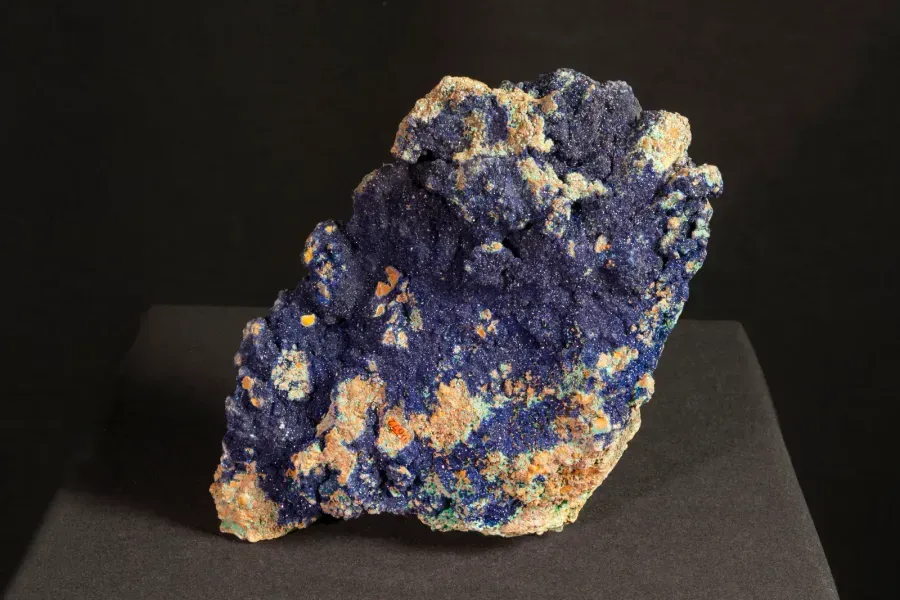
Azurite is a hydrated copper carbonate with the formula Cu3(CO3)2(OH)2. It is essentially the same chemistry that turns a copper roof green: copper compounds react with carbon dioxide, water and oxygen. Here, though, the process ran inside rock for millions of years, and the result was a deep blue crystal.
The blue colour comes from copper ions (Cu2+). Their electron configuration absorbs the red and yellow parts of the spectrum and reflects the blue. That gives the characteristic saturated blue, which in dense crystals can look almost black.
The physics, in short:
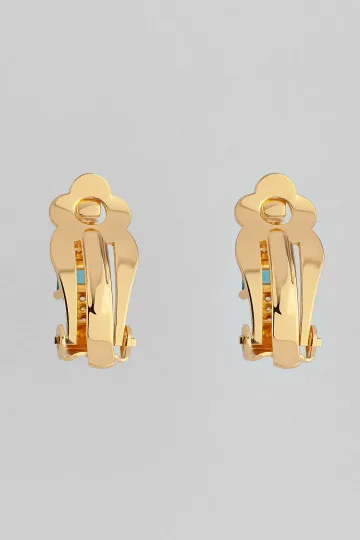
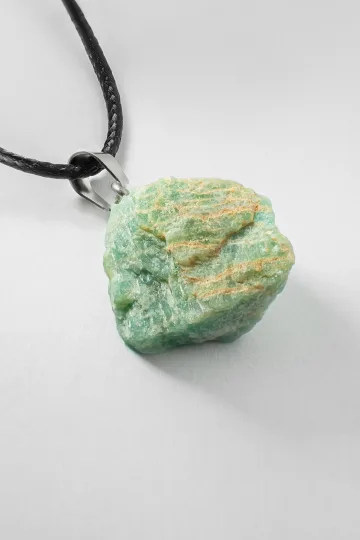
Wear the symbol, don't just read about it. These are in stock:





- Mohs hardness: 3.5 to 4. For comparison: glass sits at 5.5, quartz at 7, diamond at 10. Azurite is softer than glass; a steel needle will scratch it, and so can a knock against another piece of jewellery.
- Crystal system: monoclinic. Crystals are often short-columnar or tabular, and they frequently grow together into dense masses and crusts.
- Density: roughly 3.7 to 3.9 g/cm3, noticeably higher than most familiar minerals. In the hand the stone feels heavier than its size suggests.
- Lustre: vitreous, dull on fractured surfaces.
- Cleavage: good, which adds to the brittleness.
- Transparency: from translucent in thin chips to fully opaque.
Optically azurite is birefringent with high refractive indices (around 1.73 to 1.84), but that matters more to mineralogists: in cabochons, the saturated colour and opacity count for more than any play of light. There is practically no fire of the kind you see in transparent gems.
The defining trait of azurite is its instability. With access to moisture and air it slowly loses water from its structure and converts to malachite, the green copper carbonate. In nature this takes thousands of years; in a piece of jewellery under poor conditions it can green over within years. That is why azurite is so often found with green malachite rims: the stone caught in the act of transforming.
Where the name comes from
The word "azurite" goes back to the Persian "lajward" and the Arabic "lazaward", the same root that gave the English "azure" and the French azur. They all mean one thing: the colour of a deep blue sky. The mineralogical name settled in the early nineteenth century; before that the stone went by dozens of local names.
How azurite forms: geology and deposits
Azurite is a secondary mineral. It is born in the oxidation zone of copper deposits, in the upper horizons where water and air can reach. Groundwater carrying dissolved carbon dioxide dissolves the primary copper ores, carries the copper upward, and where it meets carbonate and hydroxyl ions, azurite crystallises. Malachite usually sits alongside: the same chemistry, but with a different water ratio.
That is why azurite is almost always tied to copper mines. Good jewellery material, dense, free of through-cracks, with an even blue colour, turns up far less often than the loose crusts and earthy masses destined for mineral specimens.
Known sources of saturated blue azurite:
- Australia (New South Wales, the Broken Hill mines): one of the benchmarks for deep blue colour.
- Namibia (the Tsumeb district), famous for large crystals of museum quality.
- Morocco, azurite from the copper showings of the Atlas, often intergrown with malachite.
- Mexico (Sonora state), material where blue azurite and green malachite sit side by side in a single piece.
- United States (Arizona, the copper belt), classic specimens from the large copper pits.
- Chile and Peru, copper-rich geology that yields both azurite and malachite.
Azurite also occurs in France and a number of other countries with copper geology. As a mineral it is widespread, but even, jewellery-grade material is always mined in small quantities.
Chessy and the old name chessylite
Azurite carries a half-forgotten second name, chessylite, after the mine at Chessy-les-Mines near Lyon in France, which in earlier centuries produced specimens of exceptional beauty. For a time mineralogists used the two names side by side, and older British cabinets and catalogue labels still say chessylite where a modern one would say azurite. The French workings gave dense, richly coloured nodules and sharp crystals, and they set the standard against which nineteenth century collectors judged everything else. The name survives now mainly as a marker of age: a label reading chessylite usually means the specimen has been in a collection for a very long time.
Cornish copper and the British cabinet
Britain has its own place in this story through Cornwall. The copper mines of the Camborne and Redruth districts, worked hard through the eighteenth and nineteenth centuries, threw up a famous suite of secondary copper minerals from their oxidised upper levels, azurite among them. Cornish material rarely gave large gem-quality masses, but it gave crisp small crystals and blue crusts that ended up in cabinets across the country and in the national collections in London. Anyone in Britain who wants to see good azurite without buying it will find Cornish and Tsumeb material on display in the major mineral galleries.
Why azurite and malachite always travel together
Both minerals are carbonates of the same copper, and they differ only in the amount of water and how many hydroxyl groups the formula carries: Cu3(CO3)2(OH)2 for azurite against Cu2CO3(OH)2 for malachite. Azurite is the drier of the two and needs a higher concentration of dissolved carbon dioxide to form. When conditions shift, when the carbon dioxide falls away or moisture increases, the blue mineral becomes unstable and the green one becomes the stable form. That single fact explains almost everything about how these stones behave in the ground and in a collection.
The green sickness of old specimens
Collectors have a half-joking phrase for what happens to old material: the azurite is sickening, meaning it is slowly acquiring a green malachite bloom across the blue. The transformation is real chemistry rather than dirt, and it runs faster in damp air than in dry. In a British house, where winter humidity in an unheated room can sit high for months, an unprotected specimen will drift green measurably faster than one kept in a dry cabinet. It cannot be reversed, and the practical answer is stable, dry storage rather than any kind of treatment.
Pseudomorphs: malachite in azurite's shape
Sometimes the change goes the whole way. A blue crystal turns entirely green while keeping the outward faces and form of the original azurite. Mineralogists call this a pseudomorph, literally a false form, and the material is described as malachite after azurite. These are prized rather than pitied: a green crystal wearing a blue mineral's geometry is a visible record of a chemical event, and good examples from Morocco and Arizona are cabinet pieces in their own right. Occasionally the process stops halfway, leaving a green shell over a blue core, which is the most instructive specimen of all.
Crystal habit and druses
Clean azurite turns up in several recognisable forms. There are single short prismatic and tabular crystals with bright, glassy faces, there are spherical and kidney-shaped botryoidal aggregates, there are velvety earthy crusts on host rock, and there are druses where a cavity is lined with hundreds of small bright crystals. The habit largely dictates the use: sharp crystals go to collectors, dense compact masses go to the cutter for cabochons and inlay, and the earthy material historically went into the pigment pot.
Azurite suns
One genuine curiosity is the azurite sun: a flat, round rosette of radiating crystals that grew between the layers of a sedimentary rock, producing a blue disc with rays spreading from the centre. Nearly all of them come from a single copper occurrence in the Australian outback, where the geometry of the host siltstone forced the crystals to grow sideways instead of outward. They are sold as specimens rather than jewellery stones, and a good one needs nothing but a stand and decent light.
Where the deep blue comes from
Colour in minerals is born from how their atoms interact with light. In azurite the blue belongs to the divalent copper ion sitting in a cage of oxygen and hydroxyl groups. That arrangement splits the copper's electron levels by an amount that happens to correspond to red, orange and yellow light, so those wavelengths are absorbed and what reaches your eye is blue with a violet lean. Malachite contains the same copper in a slightly different arrangement, and the small change in the cage is enough to shift the absorption and turn the mineral green. Grind the stone and the powder stays blue, which is why the streak on a porcelain plate is a pale sky blue and one of the quickest identity checks there is.
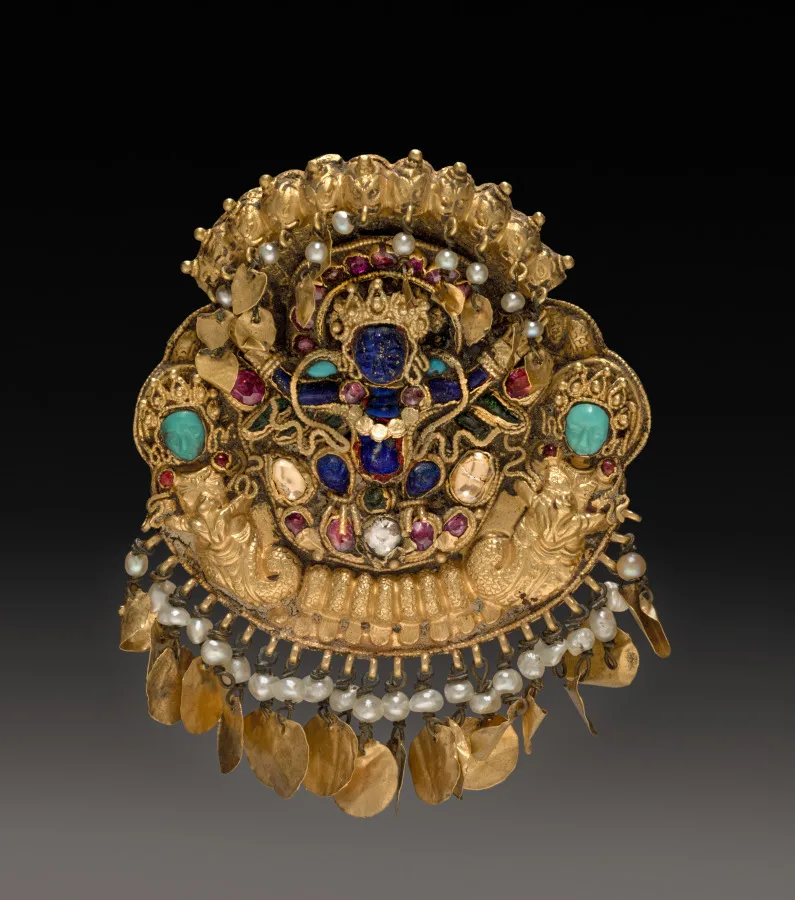
Azurite wants silver and a white shirt. Send the yellow gold to gather dust elsewhere, and spare it the pile of five chains, it sings solo.
What to wear azurite with
After years working with stones I have learned one thing about azurite: it cannot stand fuss around it. Here is what actually works if you want to wear it right.
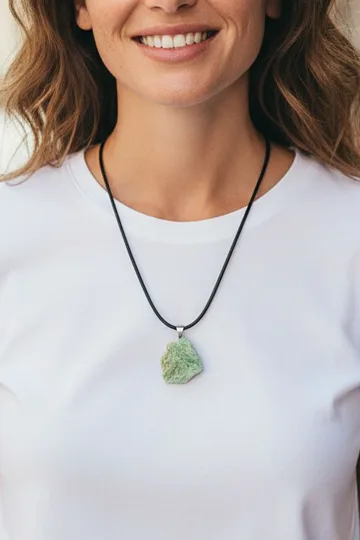
What do I wear azurite with every day? For daily wear I recommend a single accent and nothing more: a fine silver chain, a smooth cabochon. I keep the backdrop quiet, milky white, grey, sand, graphite. On a white shirt or grey cashmere an azurite pendant reads like a drop of ink on paper, and the eye goes straight to it.
Does azurite work at the office? Yes, and surprisingly well. Deep blue reads as composure, so I suggest it for a work look without hesitation. Keep one pendant on a fine chain, no layers, and the stone acts as a quiet but noticeable detail.
What should I pair with azurite for an evening or special occasion? For the evening I recommend stud earrings with a small azurite, but do not load the neck with a second pendant. For a formal outing I choose a brooch on a jacket: that way the stone does not knock against the table and holds more securely than a chain.
Which metal should I choose for azurite? Cool only, sterling silver or white gold. A silvery shine does not argue with the blue, it sets it off. Warm yellow gold I steer clear of: next to it the blue turns murky, as if dusted over.
Which neckline and fabric suit azurite best? I choose an open boat neck or a soft V, where the pendant hangs straight. On dense, textured fabric (tweed, coarse linen, knit) the stone looks most alive, while glossy silk and satin fight it for light. And keep away from another saturated blue in your clothes: next to electric or cobalt, azurite gets lost.

Turn on your camera, pick earrings, a pendant or a ring, and see the piece on yourself in real time.
Switch items in one tap.
Everything runs in your browser: no photo or video is ever uploaded.
The history of azurite
Azurite has been known to people for thousands of years, and its most interesting role is not in jewellery but in paint.
A mineral pigment
From antiquity right through the late Middle Ages, ground azurite was one of the main blue pigments in Europe. It was prized for its brightness and for being relatively affordable next to the imported ultramarine made from lapis lazuli. Painters used azurite blue for skies, robes and backgrounds, and traces of it turn up on medieval manuscripts, icons and panel paintings.
The pigment had one treacherous weakness: over time and under the influence of moisture it could green right on the canvas, exactly like the natural mineral. That is why on some old paintings a sky that was once blue now looks greenish. When cheap synthetic ultramarine appeared in the early nineteenth century, azurite as a paint quickly fell out of use.
In jewellery and everyday life of antiquity
Azurite served as both a carving stone and a decorative one. In ancient Egypt copper minerals, azurite and malachite among them, went into eye paints, for both practical and ritual reasons. Blue and green were linked with the sky, water and rebirth.
It is worth separating fact from pretty legend. Claims along the lines of "Cleopatra opened her third eye with azurite" are later inventions, not historical evidence. One thing is certain: copper blue and green minerals were genuinely valued in Egypt and used in cosmetics and adornment.
Alchemy and copper
Medieval alchemists paid attention to the colour of minerals, and the blue copper of azurite had a place in their ideas about transforming metals. Their faith in transmutation was misplaced, but they guessed the chemical truth correctly: azurite is a copper mineral, closely tied to malachite and to copper ores.
Azurite against ultramarine: the war of two blues
Before cheap synthetic pigments existed, a painter had a choice between two blues, and both were dug out of rock. Ultramarine was made from lapis lazuli carried overland from what is now Afghanistan, and it cost a fortune; commissioning contracts of the fourteenth and fifteenth centuries specified by weight how much of it would go into the Virgin's robe, because the patron was buying the pigment as much as the picture. Azurite was the working alternative: European, mined in quantity from copper districts in Hungary, Saxony and the Tyrol, and sold across the continent under the name German blue. It gave a strong blue at a fraction of the outlay, so it went into skies, draperies, backgrounds and everything that was not the single most important passage in the panel.
How azurite blue was prepared
Simply crushing the stone was not enough. The finer azurite was ground, the paler and greyer the paint became, because small particles scatter light instead of returning a saturated colour. Preparers therefore ground it coarsely and separated the powder by washing it through water, letting the heavy, dark, strongly coloured grains settle first and skimming the fine pale fraction off for cheaper work. The result was a set of graded blues from one lump of rock, sold at different prices. Coarse azurite also made the paint gritty and difficult to spread, which is why it suited egg tempera and glue-bound distemper far better than oil, where it went dull and semi-transparent.
The greening skies of old paintings
Azurite blue has one property that lets conservators identify it on sight. Under the influence of damp, warmth and certain binding media, the paint on a panel slowly turns green as the mineral converts to malachite, exactly as a specimen does in a cabinet. It is the reason a good many late medieval and Renaissance paintings now show a sky of an odd pale green, or a robe that has gone from blue to sage while the neighbouring ultramarine passages stayed true. Conservation departments in British galleries treat a green sky in a fifteenth century panel as a strong clue rather than an artistic choice, and cross-sections under the microscope usually confirm a blue core surviving beneath an altered green surface.
Azurite in manuscripts and Eastern painting
Copper carbonate blue was known far beyond western Europe. English and continental manuscript illuminators used it constantly through the Middle Ages, since it gave a serviceable blue for initials and grounds at a price that let a scriptorium finish a book. Byzantine icon painting used it for garments and architectural backgrounds. Persian and Mughal miniature painters relied on it for skies and tilework, and in China and Japan it was a named studio colour with its own grading system, prepared in the same coarse-to-fine ladder that European workshops used. Wherever copper was mined and pictures were painted, azurite turned up sooner or later.
Customer reviews
Zevira is a real jewellery shop. Genuine payments, deliveries and customer thank-yous.
🥰🥰🥰 gracias
Ok, ¡gracias! 🙂
Varieties and look-alike stones
Azurmalachite
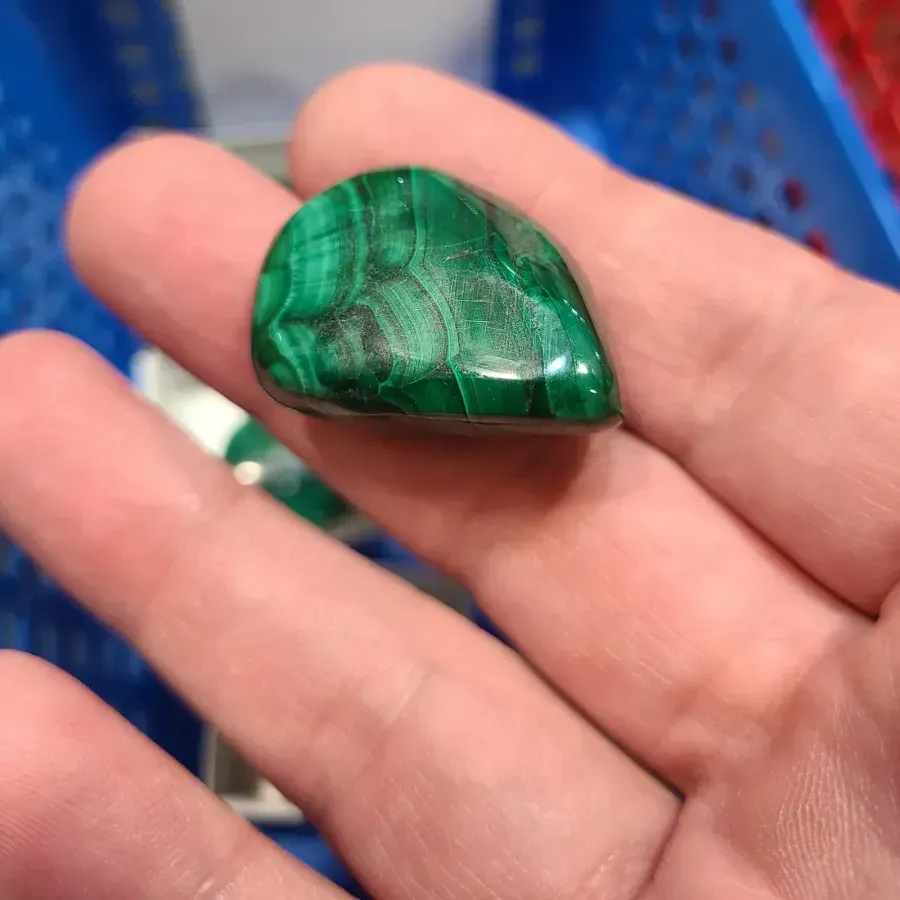
The best-known "variety" is azurmalachite: a natural intergrowth of blue azurite and green malachite in a single piece. The blue and green zones flow into one another in a pattern, and every stone is unique. This material is often more stable than pure azurite and looks striking in cabochons.
How to tell azurite from other blue stones
Several blue minerals are easy to confuse with azurite, but telling them apart is not hard.
- Azurite and lapis lazuli. Lapis is an aluminosilicate, it is harder (5 to 6 on Mohs), stable, often dotted with golden flecks of pyrite. Azurite is softer, has no pyrite, and its blue carries a deeper, more "copper" tone.
- Azurite and sodalite. Sodalite is harder (5.5 to 6) and more stable, with a more even colour and no green rims. Azurite is softer and prone to greening at the edges.
- Azurite and kyanite. Kyanite is usually semi-transparent, with marked banding and sharply different hardness along and across the crystal. Azurite is opaque and soft in all directions.
- Azurite and irradiated or dyed topaz. Such topazes are transparent, bright and hard. Azurite is opaque, heavy and soft.
Signs of a fake
Dyed glass, pressed crumb or plastic is sometimes passed off as "azurite". What to check:
- Hardness. Real azurite is soft: on an inconspicuous spot a steel needle will leave a scratch, while it will not on glass.
- Weight. The mineral is dense and noticeably heavy. A light "stone" is almost certainly plastic or resin.
- Surface. A natural stone may show microcracks, irregularities, zones of greenish malachite. A perfectly uniform bright-blue colour with no transitions is suspicious.
- Transparency. Azurite is opaque; a transparent blue "stone" is some other material.
Upload a photo of your pet, someone you love, or an object. We'll build a 3D model and hand-cast it in pewter.



Treatment and stabilisation: what is done to azurite before setting
Azurite rarely goes into a piece "as is". Because of its looseness and cleavage the rough often crumbles at the edges when cut, so the material is almost always treated, and an honest seller will say so.
- Stabilisation (impregnation). The most common approach: the stone is impregnated under vacuum with a colourless polymer resin. The resin fills the micropores and cracks, binds the loose mass, and also slows the ingress of moisture a little, that is, it slows the greening. This is not deception but standard practice for soft, porous minerals. Stabilised azurite is tougher against chipping and steadier in colour, but it is no longer a hundred per cent natural stone, and it should be priced accordingly.
- Doublets and triplets. A thin slice of handsome blue azurite is glued onto a strong dark base (often black onyx or basalt), and a clear quartz "cap" is sometimes added on top. This turns a fragile layer into a wearable cabochon. Seen from the side, such a stone shows a glue line, and that is how a doublet is recognised.
- Reconstruction. Azurite crumb is mixed with a binder and pressed into blocks. The colour comes out even but "dead", with no natural transitions and no green rims. This is closer to an imitation than to a stone.
- Cutting. Transparent faceted azurites exist, but they are a rarity for collectors: the stone is too soft for a facet to hold its edge in wear. In jewellery azurite is almost always a cabochon or a flat inlay, where colour and pattern do the work, not the sparkle of facets.
The takeaway for the buyer: ask whether the stone is stabilised and whether it is a doublet. Both options are legitimate and more comfortable to wear, but the price for them should be honest, while a solid natural cabochon without impregnation is valued higher and asks for gentler handling.


How to choose azurite when buying
A few practical pointers on what to look at with the stone in your hand:
- Colour and its evenness. A deep, saturated blue with no greyish murkiness is the one to prize. A touch of green at the edges is not a defect but the trace of a transition into malachite that has begun; extensive dull green-grey zones, however, noticeably lower the value. If the blue looks suspiciously uniform and "electric", be wary: it may be pressed crumb or dye.
- Integrity. Through-cracks and crumbling edges are the weak point: such a cabochon splits easily during setting or at the first knock. Run a fingernail across the surface; a dense natural stone will not leave blue on your hand, while a loose earthy specimen does.
- The azurmalachite pattern. If you are buying an intergrowth with malachite, lively, contrasting transitions of blue and green win out over a muddy mix. That pattern is unique, and that is where the value lies.
- For the look. For a pendant or earrings almost any dense cabochon will do. For a ring, choose a smaller stone in a closed protective setting: the larger the stone on a finger, the higher the risk of a snag and a chip.
- The paperwork and the seller's words. An honest seller will say plainly whether the stone is natural, stabilised or a doublet. Evasive answers and the phrase "blue agate" instead of the mineral's name are reason not to rush.
Caring for jewellery with azurite
From a hardness of 3.5 to 4 and good cleavage follows a simple conclusion: azurite is a stone for gentle, not daily-knockabout wear. That is no reason to leave it in a box, but the logic of care is different from that of hard gems.
How to wear it without damage
- Take off azurite jewellery during sport, cleaning, gardening, washing up and anything that involves knocks, grit, chemicals and friction.
- A ring with azurite is the most vulnerable: on a finger the stone is constantly snagging and knocking. A pendant, earrings or a brooch is more practical.
- Store it apart from harder jewellery in a soft pouch or its own compartment, otherwise metal and harder stones will leave scratches.
- Keep it away from direct sun and prolonged moisture: both speed the transition into malachite and the dulling of the colour.
Cleaning
- A soft cloth or a soft brush and slightly warm (not hot) water only, with no soap or products.
- No ultrasonic baths and no steam: vibration and heat destroy the loose stone.
- No acids and no household chemicals: azurite is a carbonate, it reacts even with weak acids like vinegar and lemon juice, and the colour and surface are spoiled irreversibly.
- After contact with water, blot it dry at once.
Treated this way, azurite serves quietly for years. If the blue drifts a little towards green over time, that is a natural property of the mineral, not a defect.
Leave your email, we'll send your discount code. No spam, unsubscribe anytime.
The code arrives by email, valid on your first order.
Symbolism: what the stone is credited with
In various traditions blue azurite was linked with the sky, clarity and intuition: both the colour itself and the rarity of saturated material played a part. In crystal healing and esoteric systems it is filed under the "stones of inner sight" and meditation.
It is fair to say it plainly: azurite has no proven physical or psychological effect. The stone does not heal, does not influence sleep, blood pressure, anxiety or any illness, and does not "charge with energy". All of that belongs to the realm of belief and cultural symbolism, not medicine. If a beautiful rare mineral with a thousand-year history becomes someone's reason to pause, that is the effect of the person's own attention, not a property of the stone.
Why blue gets attached to the mind
The association is older than any crystal book and has a practical root. For most of human history a strong blue was hard to obtain, since blue is uncommon in ordinary materials and every good source had to be mined and processed. Rarity turned the colour into a marker of the elevated and the abstract, and language followed: English still speaks of blue-sky thinking, of true blue for constancy, and heraldry gives azure to loyalty. The word azure itself and the mineral's own name descend from the same Persian root that gave us lapis lazuli, so the colour and the stone have been sharing a name for a thousand years. Once a colour means clarity and distance, the mineral that carries it inherits the meaning; that is cultural inheritance rather than any property of copper carbonate.
Azurite in different traditions
The blue copper mineral was noticed wherever copper was mined. Classical writers described a blue pigment brought from the eastern provinces and used it for wall painting, and Roman fresco in Britain and across the empire contains copper blues alongside the manufactured Egyptian blue. In Mesoamerica azurite went into murals and ornament. In the American southwest it was ground for paint and carried as a small talisman by peoples who worked the copper country. Chinese practice gave it a place in both painting and alchemical writing, where a mineral that changed colour was worth attention on its own terms. None of these traditions agree with each other about what the stone means, which is itself the useful lesson: the meanings were attached locally, and the mineral simply supplied the blue.
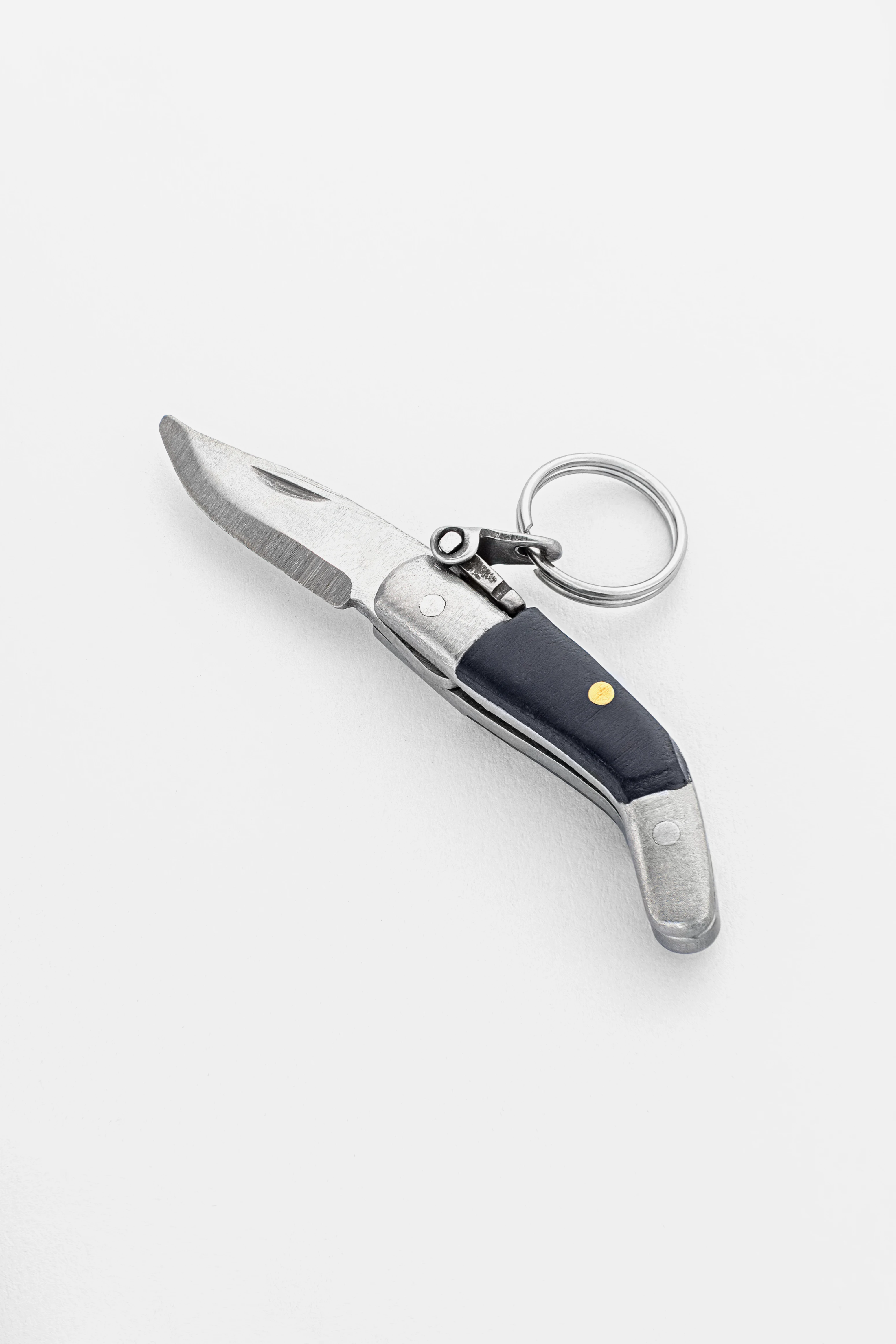
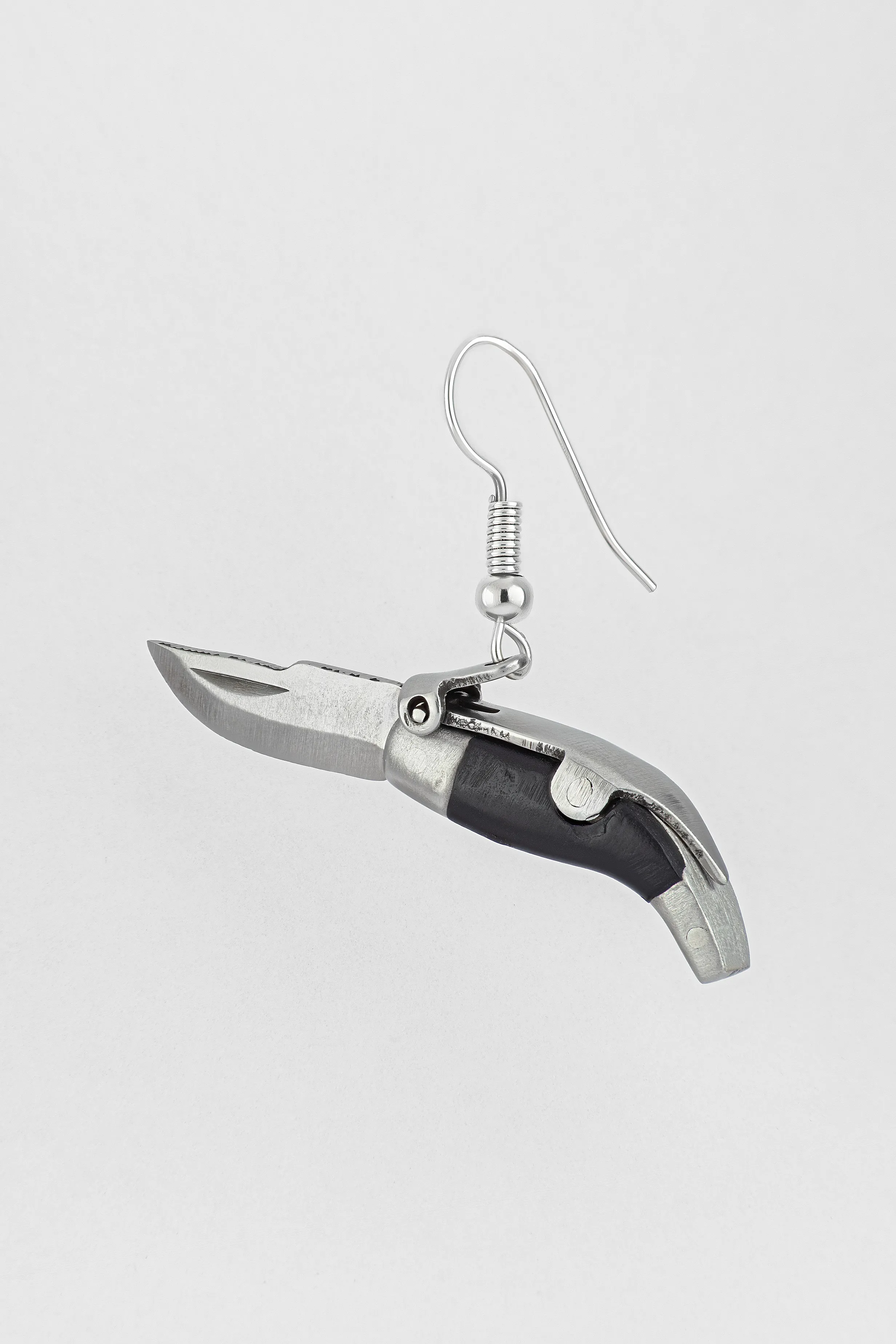
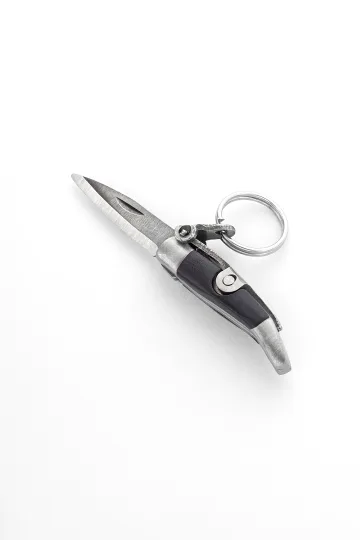
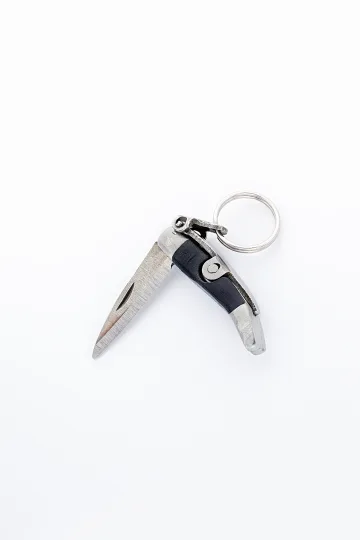
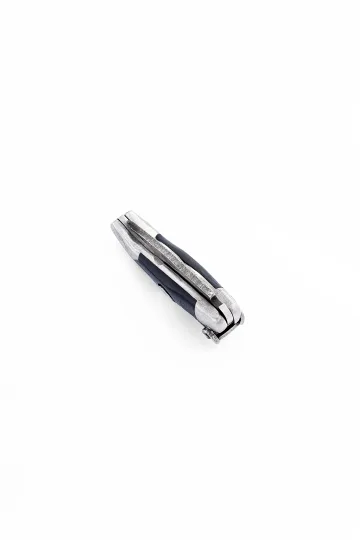
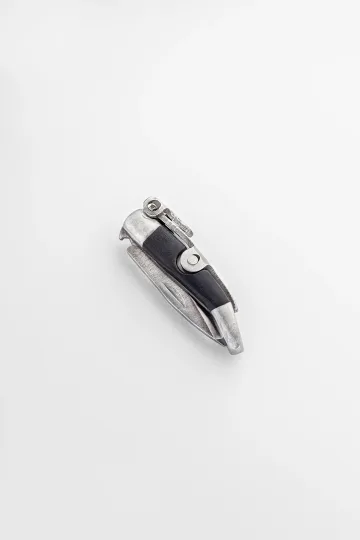
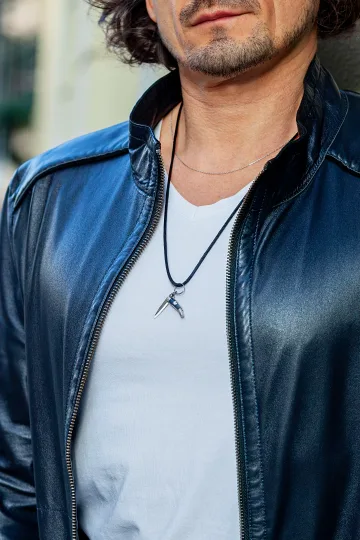
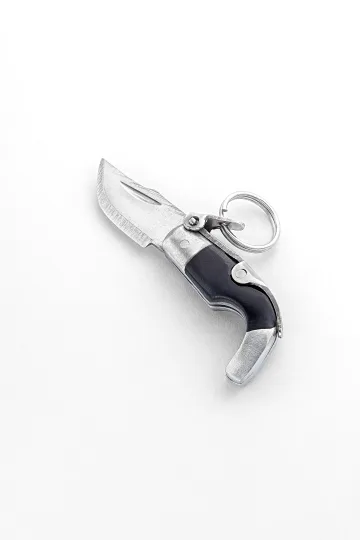
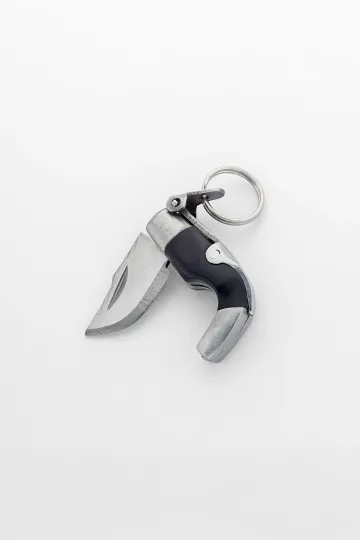
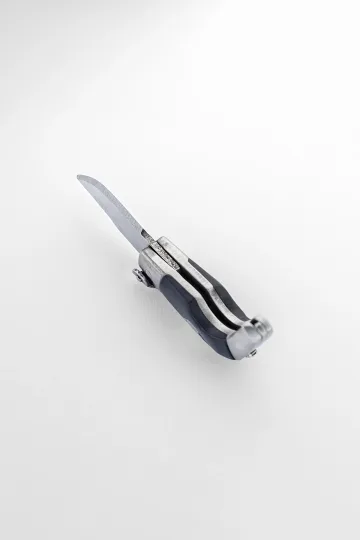
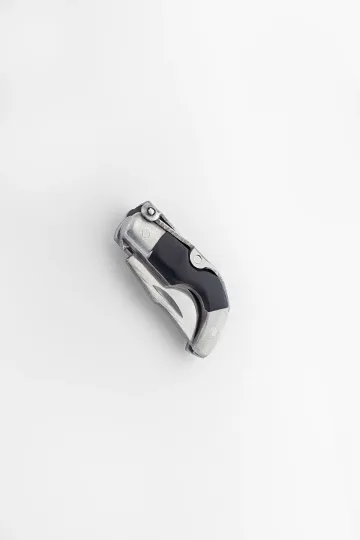
CAPAORA mini knife pendant
The 18th-century Spanish navaja in miniature: 40 mm of stainless steel, a real folding mechanism and a Palanquilla lock that clicks. An affordable gift to remember.
Authentic · Ships from Spain · 14-day returns
Who azurite suits
Azurite is not a stone for everyone, and the honest way to think about it is to ask what kind of wearer it rewards.
Right for anyone who likes the rare and the natural
If what draws you to a stone is that it came out of the ground looking like that, azurite is close to ideal. It has no synthetic equivalent in the shops, no vast industrial supply, and no polished uniformity: two cabochons cut from one nodule will not match. Collectors of minerals often make the easiest converts, because they already understand that a specimen has a history and a chemistry rather than a specification.
A poor choice for the busy and the forgetful
The other side is plain. At 3.5 to 4 on the Mohs scale azurite is softer than a steel key, it is sensitive to acids, and it dislikes damp. Someone who takes their rings gardening, showers in them, and drops jewellery into a dish by the sink will destroy an azurite piece within a year and will conclude, wrongly, that they were sold something faulty. If that describes your habits, buy the blue you want in a harder mineral and keep azurite for a specimen shelf.
A good gift for someone who loves minerals
As a present it works when the recipient values a stone for what it is. A well-cut azurmalachite cabochon in a protective bezel, or a small crystal group on a stand, lands well with anyone who reads about geology or keeps a shelf of rocks. Pair it with a plain honest sentence about care, since the gift is only kind if it comes with the information needed to keep it. As a surprise for someone who has never thought about minerals, it is riskier than a robust everyday stone.
Azurite as a gemstone: a sober view
Azurite occupies an unusual position. It is famous, beautiful, historically important, and almost absent from ordinary jewellery counters. That combination deserves an explanation.
Why you rarely see it in mainstream jewellery
Mass jewellery is built around stones that survive shipping, setting, sizing and years of careless wear. Azurite fails most of those tests. It is soft, it is brittle, it can be damaged by ultrasonic cleaning, it reacts to acids including the ones in perspiration and household cleaners, and over decades it can green. A high street chain cannot underwrite a stone that changes colour, so the mineral stays with independent makers, lapidary shows and mineral dealers, where the buyer is told what they are getting.
The best formats for azurite
The stone shows best in formats that shield it. Cabochons in a full bezel put metal around the vulnerable edge. Pendants and earrings keep it away from the knocks a ring collects. Inlay, where the stone sits flush inside a metal frame, is a traditional and very sensible answer. Azurmalachite, the intergrowth of blue and green, is tougher than pure azurite and takes a better polish, which is why so much wearable material is the mixture rather than the pure mineral. Brooches, which spend their lives on fabric, are the gentlest setting of all.
How quality is judged
Assessment comes down to a short list. The blue should be deep and even, with the violet lean that separates good azurite from a washed out grey blue. There should be no cracks running through the stone, since they will open eventually. The polish should be glassy rather than dull, because a poorly finished soft stone looks tired from the first day. In azurmalachite the pattern matters as much as the colour: a clear contrast and an interesting figure are worth more than a muddy blend. Size adds value, but not at the cost of soundness.
Common mistakes when buying azurite
Three errors account for most disappointments. The first is buying it as an everyday ring stone, which is asking a soft mineral to do a hard job. The second is paying gem prices for what is really a specimen, dyed howlite, or a reconstituted block of powder in resin, all of which circulate freely online. The third is failing to ask about stabilisation, since much of the wearable material has been impregnated with resin, a legitimate treatment that should nonetheless be disclosed because it changes how the piece should be cleaned. Ask what it is, ask whether it has been treated, and buy from someone who answers.
Send a friend a discount code, they save on their first order.
Price and collecting
Azurite belongs among the affordable stones. The value is driven by the saturation and evenness of the blue, the absence of through-cracks, the size and quality of cutting, and the presence of a beautiful pattern in azurmalachite. A deep, even blue is valued above a muted one with green.
As a financial investment azurite does not work: on the secondary market it usually loses value; its worth is aesthetic and historical, not speculative. Mineral collectors prize above all large, well-formed crystals (the classics, the Namibian Tsumeb) and keep them in the dark, in a place stable in humidity and temperature, shielded from the light that speeds the dulling.
Facts about azurite that surprise people
A handful of things about this mineral that rarely make it into a shop description.
A stone that repaints itself
Azurite is one of very few minerals that visibly changes colour on the shelf without anyone doing anything to it. Given damp air and enough decades, the blue converts to green malachite, and the process is one-way. Museums keep their best specimens in controlled humidity for exactly this reason. Nothing about it is a defect; it is the mineral doing what its chemistry requires when the conditions around it shift.
The same stone coloured paintings and lined eyes
Ground azurite served as one of Europe's principal blue pigments for centuries, and finely prepared copper minerals were also used as cosmetics in the ancient world, where copper greens and blues went around the eye. One mineral therefore supplied both the sky above a painted saint and the paint on a face, several thousand years apart, on the strength of the same divalent copper.
You can scratch it with a coin
At 3.5 to 4 on the Mohs scale, azurite is soft enough that a copper coin will mark a polished surface and a steel key will bite into it without effort. Put that next to quartz at 7, which is the hardness of ordinary dust, and the care instructions stop sounding fussy. Everyday grit will dull an azurite cabochon simply through contact.
The blue comes from the same chemistry that greens a copper roof
The verdigris on an old copper roof and the blue in an azurite crystal are both what happens when copper meets air, water and dissolved gases over a long time. The details of the compounds differ, but the principle is identical: copper corrodes into brightly coloured salts rather than the dull oxides most metals produce. A copper-clad public building slowly going green is running the same experiment that produced the stone in your pendant, only faster and above ground.
A green sky in an old painting used to be azurite
When a fifteenth or sixteenth century panel shows a curiously pale green sky, the pigment was very often azurite that has converted to malachite in place. Conservators read this as a diagnostic sign, and cross-sections routinely show an intact blue layer beneath the altered green surface. The painting has changed colour on its own, exactly as a specimen does.
Malachite sometimes wears azurite's skin
The pseudomorph, a green malachite crystal preserving the exact outward shape of the azurite it replaced, is one of the more elegant objects in mineralogy. It is a fossil of a chemical reaction: the form of one mineral filled with the substance of another. Collectors pay more for these than for either mineral on its own.
Faceted transparent azurite is almost never worn
Transparent azurite crystals do exist, mainly from the great Namibian deposit, and they are occasionally faceted. Almost none of them are ever set in jewellery. The stone is too soft for the job, and the colour is so deep that a faceted stone above a few carats reads as nearly black rather than blue. Cut azurite is a collector's curiosity, bought to sit in a box and be admired under a lamp.
Common questions about azurite
Why has my azurite changed colour?
That is a natural property of the mineral. Azurite gradually loses water from its structure and converts to malachite, so the blue can dull and green at the edges over time. Moisture, heat and direct light speed the process. It is not a defect or a fake, just the chemistry of copper.
Can I wear azurite in the shower, the pool or at the sea?
Better to take it off. Water, steam, chlorine and sea salt speed the dulling and the shift to malachite, and swings in humidity harm the stone. Remove the piece before water.
How hard is azurite and how fragile is it?
3.5 to 4 on Mohs, softer than glass. Add good cleavage, and the stone scratches easily and can split on impact. It should be worn with care, especially in rings.
What should I clean azurite with?
A soft cloth or brush and slightly warm water, no soap. No ultrasound, steam, hot water or household chemicals: as a carbonate, azurite is broken down by acids. Dry it at once after cleaning.
What setting is best for azurite?
Cool metal: sterling silver or white gold. A silvery tone does not argue with the blue. Yellow gold makes the blue murky. A closed, protective setting is preferable to an open one, so the stone is at less risk.
How does azurite differ from lapis lazuli?
In origin and composition. Azurite is a copper carbonate, soft (3.5 to 4) and unstable. Lapis lazuli is a hard (5 to 6) aluminosilicate, stable, often with golden specks of pyrite. The blue of azurite is deep and "coppery", while lapis is a quite different blue stone.
Does azurite heal or affect wellbeing?
No. Azurite has no proven medical or psychological effect: it does not influence illness, sleep, blood pressure or anxiety. Tradition credits it with a link to intuition, but that is belief, not fact. Any ailment is treated by a doctor.
Is azurite suitable for an everyday ring?
Not the best choice. On a finger the soft stone is constantly snagging and knocking, scratches quickly and can crack. For daily wear a pendant, earrings or a brooch is more practical, and a ring is better kept for special occasions.
Is azurite safe to wear?
Yes. As jewellery on the skin it is safe: copper does not pass through healthy skin. The stone should not be licked, chewed or crushed (copper compounds are toxic if taken internally), but ordinary wear of a pendant or earrings carries no risk.
Buying it as a gift? Each one arrives ready to give.
 A branded Zevira box and a little card come with every order.





About Zevira
Sterling silver jewellery with original design. Every piece is the work of craftspeople who understand the beauty of rare stones and the delicacy of working them. We work with azurite and other semi-precious stones, choosing a reliable setting to suit their fragile nature.
Pendants and jewellery with blue stones in a silver setting, carefully chosen to suit the fragile nature of such minerals.