Malachite in jewellery: the green copper stone, its history and care
Top-grade natural malachite costs only a little less than emerald, yet it is soft enough to be scratched by a steel pin. This green stone with black banding once carried the eye paint of Egyptian queens, lined entire halls in European palaces, and fears ordinary human sweat more than a knock. Malachite is unlike any other gem: it has a pattern that never repeats twice, and a temperament that demands respect.
It is often confused with dyed jasper, tinted for brightness, and sold to inexperienced buyers as the genuine article. Telling the real thing apart is not hard once you know a few signs. What follows covers the chemistry and geology of malachite, its history, its varieties, the tests for authenticity, and the care rules without which the stone quickly loses its looks.
What malachite is: the chemistry and physics of the stone
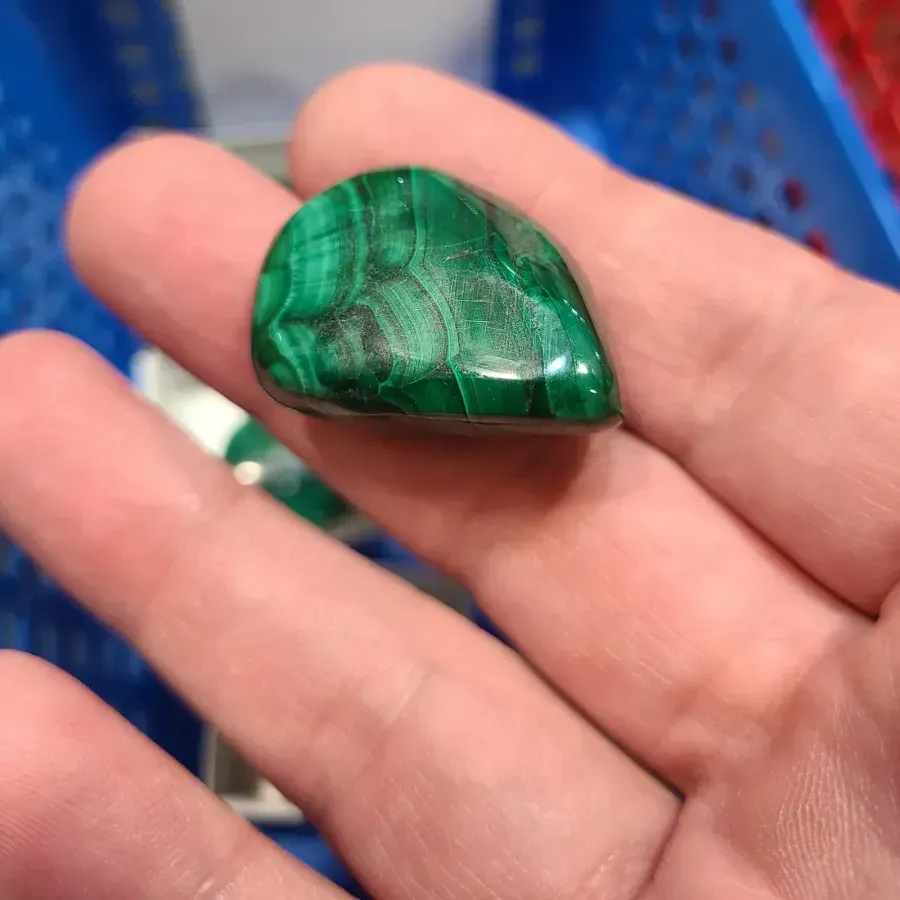
Malachite is a hydrated copper carbonate, with the formula Cu₂CO₃(OH)₂. Copper makes up roughly 57 percent of it by mass, and it is the copper that gives the deep green colour. The stone belongs to the carbonates, the same mineral group as calcite and azurite, and it crystallises in the monoclinic system. Large single crystals of malachite are rare; it usually grows as solid botryoidal and stalactitic masses with a fibrous internal structure, and it is precisely this layered build that brings out the concentric bands on a cut surface.
On the Mohs scale, malachite rates only 3.5 to 4 for hardness. That sits between a fingernail and window glass: the stone is easily scratched by quartz, let alone topaz or diamond. Its density is high for an opaque ornamental stone, around 3.6 to 4.0 g/cm³, so a piece feels noticeably heavier than glass or plastic of the same size. Malachite has perfect cleavage in one direction, which adds to its brittleness.
Wear the symbol, don't just read about it. These are in stock:



Optically, malachite is opaque, or translucent only in thin chips. Its refractive index is high (roughly 1.65 to 1.91), but because the stone is opaque you cannot judge dispersion or play of light the way you can with transparent gems. The lustre is silky or glassy on a polished surface, dull on a fracture. The colour ranges from a light grassy green to an almost blackish green, and it depends on how tightly the copper-bearing layers are packed.
The main chemical quirk follows straight from the composition: malachite is born of a reaction involving acid, which is why acids destroy it. A drop of vinegar or lemon juice makes the surface fizz and pit. For the same reason the stone cannot abide the alcohol in perfume or the acids in human sweat. This is not a weakness of one particular specimen but a property of the mineral itself.
How malachite forms in nature
Malachite is a secondary mineral. It does not crystallise out of magma; it appears in the oxidation zone of copper deposits, in the upper layers of rock where water, oxygen and carbon dioxide can reach. When the primary copper ores (chalcopyrite, for instance) weather, the copper goes into solution and then settles out again as a carbonate. Layer builds on layer, and that is how those bands come together.
The process is slow, measured in thousands and millions of years, and the conditions shift as it goes. Where there is more copper in solution the layer lies rich and dark; where there is less, it lies pale. That is why the pattern differs on every piece: it is a record of how the chemistry of the groundwater changed over the lifetime of the mineral.
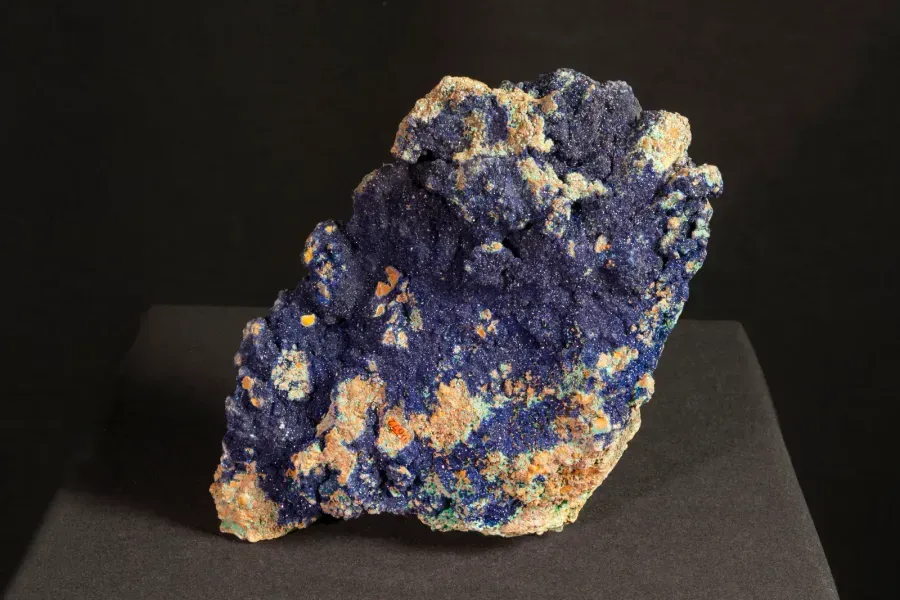
Azurite, a blue copper carbonate of a near-identical composition, often keeps malachite company in the oxidation zone. Under the right conditions the two grow together, giving blue-green intergrowths. Less commonly, chrysocolla and turquoise form in the same zone. The proximity of copper ore is a reliable geological clue: where there is malachite, copper is almost always mined nearby.
Malachite belongs at the opera, not in the pool. A wet stone is a ruined stone, and I will not hear otherwise.
What to wear malachite with
Over years on shoots malachite has passed through dozens of looks with me, and few stones are fussier. Here is what actually works, sorted by occasion.
What do I wear malachite with every day? For daily wear I recommend a single note of malachite on a quiet backdrop: milky white, sand, grey, warm beige. A pendant on a fine chain over a knit roll-neck or an open-collar shirt, small earrings to gathered-up hair. An open neckline, a boat neck or a V presents the stone best: it lands on the skin instead of drowning in folds. If the outfit already carries a lot of pattern, save the malachite for another day, two patterns start to quarrel.
Is it right for the office? Yes, as long as you keep it restrained. I suggest a brooch on a jacket lapel or a calm pendant under a closed top. Green adds character to a tailored look without breaking the rules. One warning about wear: take the stone off before you wash your hands at the office sink, malachite fears water and soap more than a knock.
How do I build an evening look? For evening I choose a plain dress in a deep tone and let the stone speak at full voice: a large brooch, a long pendant in an open neckline, malachite in gold under the warm light of a room. Build the look around the stone, let it be the single bright accent and keep everything else neutral.
Gold or silver? It depends on the look you want. Gold presents malachite warmer, regal, in a historical key, and sets off the green softly. Silver makes it more modern and cooler. A warm skin undertone usually takes gold, a cool one silver. It is hard to get wrong: the stone gets along with both, what matters more is that the setting shields its vulnerable edges.
Who does it actually suit? Anyone who prefers calm depth to glitter and values the rare and understated. Two rules that never fail. First: choose the pendant length so the malachite lands on a clear patch of skin or plain fabric rather than getting lost in a print. Second: keep it the lead and choose modest companions, a fine chain with no stone or a plain ring. A stack of bright stones beside malachite overloads the look.

Turn on your camera, pick earrings, a pendant or a ring, and see the piece on yourself in real time.
Switch items in one tap.
Everything runs in your browser: no photo or video is ever uploaded.
Geography: where malachite is mined
The historical benchmark for quality is Ural malachite from the region around Yekaterinburg. It has a deep grassy-green tone and contrasting dark bands. These deposits supplied the great workshops of the eighteenth and nineteenth centuries, when malachite was made into vases, tabletops and the cladding of palace halls. The richest veins were worked out long ago, so old Ural malachite is especially prized by collectors and museums.
Today the bulk of the world supply comes from the Democratic Republic of the Congo (the former Zaire) and neighbouring Zambia. Congolese malachite ranges from medium to high quality, often with a very dark colour and pronounced rings, though many specimens carry internal cracks and voids. There are notable deposits in Namibia and Australia too; the Australian material goes more often into decorative pieces than into fine jewellery. Historically malachite was also mined on the Sinai Peninsula, where it was taken in ancient times.
One important point about rarity: the total volume of raw material mined is large, but only a small share of it is of jewellery quality, free of cracks and with a handsome pattern. Most of the mass goes into boxes, tabletop inlays, souvenirs and curios.
Deposits: why the classic veins ran out and the Congo did not
The geography of malachite is a story about some veins being exhausted and others rising to take their place, and it bears directly on what sort of stone sits in jewellery today.
The Urals: the benchmark that is almost gone
For two centuries the Ural deposits set the standard: dense stone of a deep grassy green with contrasting rings, in blocks large enough to work. The richest pockets were emptied in the nineteenth century, when individual finds ran to tonnes and went straight into palace commissions. Today Ural malachite is essentially museum and collector material. It very rarely reaches ordinary retail, and antique pieces cut from it carry a premium of their own precisely because the source no longer exists in any commercial sense.
The Congo and Zambia: the base of the modern market
Nearly all the malachite in jewellery and ornamental work now comes from the copper belt of the Democratic Republic of the Congo and neighbouring Zambia. Congolese material can be extremely handsome, with saturated dark colour and crisp concentric rings, but a great many pieces carry hidden cracks and cavities, so the rough has to be sorted hard. Most modern cabochons and beads on the market come from this region.
Provenance is worth asking about for a second reason. Mining in the copper belt ranges from large industrial operations to artisanal digging, and a seller who can tell you where the rough came from is a seller who has thought about the question at all.
Other sources
There are notable finds in Namibia, Australia and Congo-Brazzaville, with the Australian material going more often into decorative objects than into jewellery. Historically malachite was worked on the Sinai Peninsula in antiquity, and green copper carbonates were raised alongside copper in Cornwall and in Cumbria, though neither has any market significance now. The general conclusion holds everywhere: the mass of rough is large, and dense, crack free stone with a beautiful pattern is a small fraction of it.
Malachite through the cultures
Ancient Egypt
Egyptians used malachite very early, long before most precious stones. They ground it to powder and used it as a green pigment for eye paint; cosmetic palettes and traces of green colour survive in tombs. Green was linked to life and fertility, and malachite was associated with the goddess Hathor. Paired with blue lapis lazuli, it made up the basic colour scheme of Egyptian jewellery: green for renewal, blue for the sky.
The cosmetic use of malachite is a fact confirmed by finds. The image of Cleopatra with green eyelids is more a popular retelling than a documented detail of her particular make-up, so it is best treated as a tradition rather than as exact historical evidence.
Imperial palaces of Europe
After the rich Ural deposits were opened in the eighteenth century, malachite became a material of palace luxury. It was made into jewellery and large interior pieces alike. The most famous example is a malachite drawing room in a great imperial palace, where columns, fireplaces and vases are faced with thin malachite plates, selected so that the pattern continues from one piece to the next (a technique known as Russian mosaic). More than a tonne of choice stone went into the work.
Malachite also entered popular culture through literature: nineteenth- and early twentieth-century folk tales tied the stone to the mining heartland of the Urals and to the figure of the master craftsman who could read its grain.
Victorian England
The nineteenth century in Britain saw a surge of interest in minerals, exotic materials and collecting. Malachite was brought in from the colonies and from the Continent, and worked into brooches, boxes, tabletops and ornaments. The stone was read as a sign of means and taste. The Great Exhibition of 1851 in London showed rare minerals and ornamental stones to a broad public, and malachite took a prominent place among them.
Customer reviews
Zevira is a real jewellery shop. Genuine payments, deliveries and customer thank-yous.
🥰🥰🥰 gracias

Ok, ¡gracias! 🙂

Varieties and patterns of malachite
Mineralogically malachite is uniform in composition, but several pattern types are distinguished, and they bear directly on the price and the look of a piece.
Banded malachite is the most recognisable. Parallel lines of varying intensity give the effect of ripples or rock strata across a cut. After polishing the bands look almost three-dimensional.
Concentric (sometimes called "eye" malachite) is a ring pattern that radiates from a centre, like the growth rings of a tree. It forms as the botryoidal nodules grow. It is less common and is prized for its boldness; it tends to be saved for large brooches, where the whole pattern can be seen.
Mottled and streaky is made up of disorderly swirls and eddies with no clear system. The quality varies greatly: it can be striking or flat, so this material is sorted piece by piece.
Uniform is a rare even green with no obvious banding. The paradox is that it is more often taken for a fake, even though in nature it is rarer than the banded kind.
Colour is also a mark of grade. The most expensive is a saturated grassy green with contrasting dark rings and a good polish. Pale, almost grey-green malachite is cheaper in bulk, but it looks softer and easier in everyday jewellery. The key point is that a light tone does not mean a fake: it simply reflects a lower concentration of copper in the layers.
Because the pattern never repeats, no two malachite pieces are alike, even if one craftsman made them from a single block. For a natural stone this is the norm, not a flaw, and at the same time it is an easy way to tell it from mass-stamped imitation.
Upload a photo of your pet, someone you love, or an object. We'll build a 3D model and hand-cast it in pewter.




Intergrown malachite: azurmalachite and other combinations
Malachite rarely grows on its own. In the oxidation zone of copper ore, minerals of similar composition gather beside it, and sometimes they grow together into a single block. Such intergrowths are valued in their own right, and it is worth knowing what you are holding.
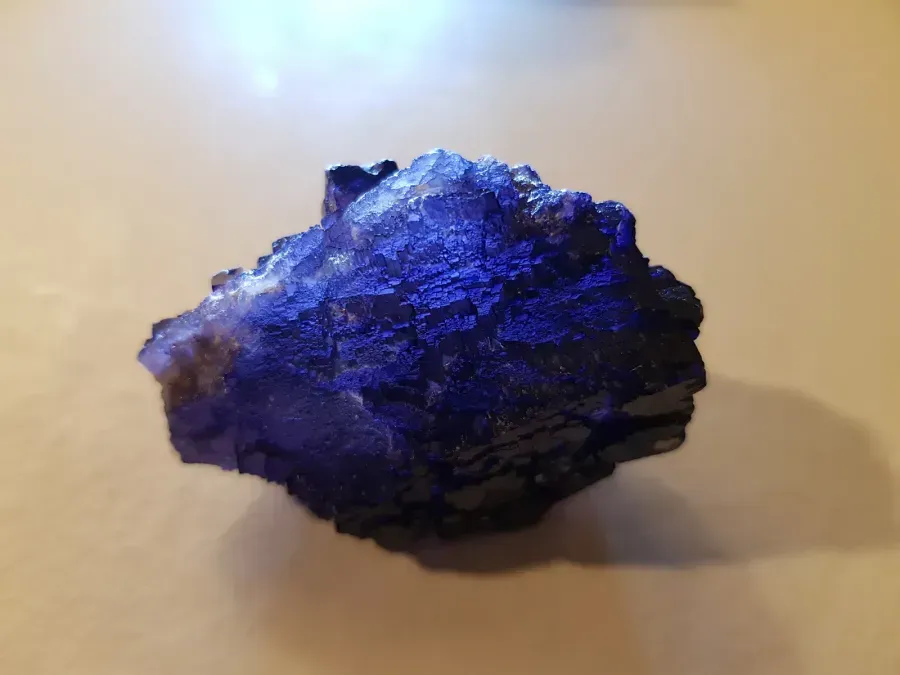
Azurmalachite is blue azurite grown together with green malachite. Both are copper carbonates, but azurite is blue and malachite is green, and a cut surface gives a blue-green mosaic with gradients. Over time azurite turns into malachite in nature (it is the less stable of the two), so a single specimen can show both stages of the change. Azurmalachite is cut into cabochons where blue and green sit side by side without any dye. The hardness is just as low, and the care is the same.
Malachite with chrysocolla gives a lighter, turquoise-green stone. Chrysocolla is softer than malachite and crumbly on its own, so such intergrowths are often impregnated for strength.
Malachite with native copper is a rare collector's material: reddish inclusions of metallic copper show through the green mass. It goes into jewellery only occasionally, but it looks striking on a cut.
A category of its own is eye malachite with a clear "bull's-eye": concentric rings converging on a single dark point. A plate is cut from a large nodule so that the eye lands at the centre of the cabochon. This is the most expensive and the most dramatic cut, and it calls for choice, dense material with no cracks.
Malachite and azurite: two stages of one process
Malachite and azurite are twins from the same chemical family, and it is worth understanding the relationship, because in jewellery they frequently arrive together.
How azurite differs in composition
Azurite is also a copper carbonate, but in a different proportion: the formula is Cu3(CO3)2(OH)2. It holds slightly less copper, fewer hydroxyl groups and more carbonate, and that difference is what makes it deep blue rather than green. Both minerals are born in the same oxidation zone of copper ore, very often side by side in the same specimen.
Why azurite turns green over time
Azurite is the less stable of the pair. In the presence of moisture it slowly rearranges itself, takes up water and becomes malachite. This is why specimens are often found that are blue on the outside and already green within, or that show blue patches stranded in a green mass.
The effect is visible on museum walls as well as in mineral cabinets. Azurite ground as a pigment was the great blue of medieval and early Renaissance painting, and in a number of surviving panels the skies and robes that were painted blue have shifted towards green in the paint layer itself. That is chemistry rather than the artist's intention, and conservators in the National Gallery and elsewhere have documented it carefully. In this pair, malachite is the final, stable form.
What that gives the jeweller
An intergrowth where blue and green sit together is valued in its own right under the name azurmalachite. Cabochons cut from it show a colour transition produced by nothing but the mineral, with no dye involved anywhere. The care is identical to that for pure malachite: low hardness, a fear of acids and of standing water. The one extra caution is that azurite is even softer, so a piece with a lot of blue in it is more easily marked.





How to choose malachite when buying
Malachite is not graded by clarity and cut, the way transparent stones are. It has its own set of signs, and they are simpler than they sound.
The pattern and its centring. First look at the pattern: contrasting rings or even bands are valued above muddy swirls. In a good piece the cutter has shaped the stone so that the pattern makes sense, with the ring centred on the cabochon and the bands parallel to the edge. A random offcut of pattern gives away cheap sawing.
The polish. Malachite is soft, and bringing it to a mirror finish is no easy task: a poorly polished surface keeps dull "rubbed" patches and small pits in the pores. A quality cabochon catches the light evenly, with no bald spots. Run it under a raking light: waves and scratches show at once.
Cracks and pores. Turn the stone to the light at an angle. Thin dark lines are cracks, and the stone will split along them in time. Open pores (small pits) trap dirt and weaken the piece. Congolese material of a fine dark tone is especially prone to hidden cracks.
The type of cut. Malachite is almost always cut as a cabochon, a smooth dome with no facets. Facets are pointless on it: the stone is opaque, it does not refract light, and sharp edges at a hardness of 3.5 to 4 soon wear down. If you are offered a "brilliant-cut malachite", it is almost certainly dyed glass.
For which piece. Match the form to how it will be worn from the start: a dense stone with no cracks or pores will survive a pendant and earrings; a crumbly, porous one, or one glued from chips, is fit at best for a brooch that rarely meets a knock.
How to tell real malachite from fakes
The usual stand-ins for malachite are dyed glass, pressed chips on resin, dyed calcite or plain green jasper. A few checks help to weed out the obvious deception.
Weight. Malachite is dense; a piece is heavier than it looks. A suspiciously light "brooch" is reason to doubt: most likely it is glass or plastic.
The pattern. In a natural stone the bands are organic and never repeat. If several matching earrings or beads have an identical pattern down to the detail, you are looking either at imitation or at pressed chips.
Opacity. Malachite lets no light through. If the stone glows against a lamp, it is not malachite.
Colour. Natural malachite sits in a calm green range. An acid-bright, "chemical" shade gives away tinting.
Reaction to acid. A drop of weak acid on malachite produces a faint fizz (a carbonate-based mineral). This is a destructive test; do it only in a hidden spot, or leave it to a gemmologist. Better not to experiment on a finished piece.
Similar stones are told apart like this. Green jasper is harder, more uniform, and free of layered rings. Aventurine is lighter, translucent, and gives a sparkling glitter. Dyed calcite is softer and reacts differently to acid. Glass feels cold to the touch, and its pattern looks flat, "painted on".
There is one honest question to address: treatment. Porous or cracked malachite is often impregnated with colourless resin or wax for strength and shine. This is a common practice, but a buyer has the right to know whether a stone has been treated or not. Synthetic malachite, grown in a laboratory, also exists; in composition it is the same copper carbonate, and only a gemmologist can reliably tell it from natural.
CAPAORA mini knife pendant
The 18th-century Spanish navaja in miniature: 40 mm of stainless steel, a real folding mechanism and a Palanquilla lock that clicks. An affordable gift to remember.
Authentic · Ships from Spain · 14-day returns
Pressed malachite: telling reconstituted chips from solid stone
The most treacherous imitation is not glass. It is pressed malachite chip. Formally it is real malachite, so a seller does not always feel obliged to mention it, but in substance it is a different material and it should carry a different price.
What reconstituted malachite is
Small fragments and dust of genuine malachite are mixed with resin and pressed into a block, from which beads and set stones are then cut. By composition it is stone; by price it belongs with costume jewellery. Sometimes the material is honestly described as reconstituted or stabilised, and sometimes it is passed off as solid.
How to spot pressed chip
The pattern is the main clue. In solid stone the bands flow continuously and logically, wrapping right round the form of a bead. In pressed material the pattern breaks at abrupt boundaries, with angular fragments sitting in a resin matrix like a coarse mosaic with no transitions. Under a loupe you can see a translucent film of binder between the fragments. Pressed beads on one strand are also often suspiciously alike, which never happens with natural stone.
How pressed material feels and behaves
The resin content makes it slightly lighter and slightly warmer than solid stone, and it heats up faster in the hand. Solid malachite is noticeably heavy and stays cool for longer. It is not a decisive test on its own, but paired with a proper look at the pattern it settles most cases. Pressed material also chips differently, flaking rather than fracturing cleanly, and the resin can yellow with age.
Should you avoid it altogether
Not necessarily. Reconstituted malachite is cheaper, tougher because of the resin, and less prone to small chips, so for an inexpensive everyday piece it can be a sensible choice. The problem is honesty, not the material. Buying pressed stone knowing what it is, is one thing; paying the price of solid stone for it is quite another. The question "is this solid malachite or reconstituted" is always reasonable, and a good seller answers it without hesitating.
Caring for malachite: how softness shapes wearability
From a hardness of 3.5 to 4 follows a simple rule: malachite is easily scratched by almost anything harder than itself, including sand, metal and most gemstones. So it must be stored and worn apart from other jewellery, and a malachite ring should not share a hand with a piece that has hard stones in it.
Water and acids are the chief enemy. The stone is porous and soaks up moisture, while acids (vinegar, lemon, sweat, the alcohol in perfume) eat at the surface. Take malachite off before a shower, a swim, cleaning and sport. Put on perfume, cream and deodorant before the jewellery, not after.
Cleaning. A soft cloth and cool water only. For heavier soiling, use a very weak solution of neutral soap, quickly, then rinse with clean water and wipe dry at once. Forbidden are hot water, any acids, abrasives, brushes, household chemicals and ultrasonic baths: they destroy the stone.
Light and heat. Direct sun dulls the green over time, and strong heat or sharp temperature swings can cause cracks. Malachite is best kept in the dark, at room temperature, wrapped in a soft natural cloth.
The practical conclusion for wear: malachite is a stone for brooches, pendants and earrings, for occasions and quiet days, rather than for active daily wear in a ring or bracelet that constantly meets water, soap and knocks.
Never put malachite in an ultrasonic cleaner
This deserves saying on its own, because it is the single most common way a malachite piece is destroyed, and it usually happens with good intentions. Ultrasonic tanks work by driving cavitation bubbles through the liquid, and those bubbles collapse against the stone thousands of times a second. Malachite is soft, porous and built of layers, so it has cracks the eye cannot see running along the growth banding. The vibration finds every one of them and opens it. A cabochon can go into the tank looking perfect and come out crazed, dulled, or in pieces.
Steam cleaners are just as bad, adding heat and pressure to a stone that dislikes both. Commercial jewellery dips are worse still, because they are acidic and malachite is a carbonate. If you take a mixed piece to a jeweller for cleaning or repair, say the green stone is malachite before you hand it over, because a busy workshop will otherwise treat it like any other cabochon and drop the lot in the tank. The correct method never changes: a soft cloth, cool water, a trace of neutral soap if it is really needed, and dried immediately by hand.
Leave your email, we'll send your discount code. No spam, unsubscribe anytime.
The code arrives by email, valid on your first order.
Is malachite toxic? The dust, the finished piece, and where the line falls
This question comes up constantly, usually in an alarming form, and the honest answer has two halves that need keeping apart.
A finished, polished malachite piece is safe to wear. The copper is locked into the crystal lattice, it does not migrate into the skin during wear, and a polished cabochon sheds nothing. Nobody has ever been poisoned by wearing a malachite pendant. The hazard belongs to a different stage entirely: when the stone is sawn, ground and polished.
Why dry working is the real hazard
Cut dry on a wheel, malachite throws off a fine copper bearing dust, and that dust must not be inhaled. Copper carbonate as an airborne suspension reaches the airways, and with repeated exposure it irritates the lungs and mucous membranes. Old school lapidaries knew about the green dust and kept their workshops ventilated for that reason.
The modern rule is simple and it is not optional. Malachite is worked wet, with water fed continuously onto the tool so the swarf binds into a slurry and never becomes airborne. A respirator and local extraction are standard, and in a British workshop this falls squarely under COSHH regulations rather than being a matter of personal preference. The same applies to anyone grinding a cabochon at home: wet, always, with no exceptions for a quick job.
What that means for a buyer
For someone who simply wears the jewellery there is no risk at all. Knowing about the dust is useful for a different reason: it is a marker of a workshop that respects itself and its staff. A piece cut cleanly, with an even wet polish and no traces of crude dry grinding, very probably came from a place where the safety rules were followed too. Cheap souvenir production frequently cuts dry, which is where both the patchy matt sheen and the risk to whoever did the sawing come from.
Do you need to wash your hands after handling it
A separate everyday question: is it harmful to touch the stone. No. Solid polished malachite leaves no copper residue and no film on the fingers. Washing your hands is worth doing only after handling an unworked mineral specimen, or a piece that somebody has cut dry and not cleaned the dust off. With a finished item of jewellery, no such precaution is needed. The one sensible habit is not to let small children mouth an unpolished specimen, which is true of any mineral sample rather than malachite in particular.
Malachite in jewellery: setting and forms
The safest format for malachite is the brooch. It pins to fabric, barely touches the skin and comes off easily. It is no accident that in historical jewellery malachite turns up most often in brooches. A pendant is a good option too, especially if the setting closes the stone from below and at the sides, leaving only the face open, and if the chain keeps the stone from constantly rubbing against the skin of the chest.
Earrings are lovely and sit well away from the main sources of moisture, but they call for care: leftover shampoo and sweat from long hair gradually harm the stone. Rings and bracelets are the riskiest choice because of constant contact with water, soap and knocks; they should be cherished and worn only for the occasion.
For metal, malachite classically pairs with yellow gold: the warm metal sets off the green and is soft enough not to scratch the stone. White gold gives a cooler, more modern look; rose gold a soft, romantic one. Silver is used too, presenting the stone more coolly. The key thing in a setting is for the metal to shield the vulnerable edges and to cut down the stone's contact with water and dirt.
How a cutter works malachite: pattern orientation and why it is always a cabochon
How the lapidary saws a malachite nodule decides half the beauty of the finished piece. The stone is opaque, so there is no play of light or refraction to fall back on. Everything rests on the pattern and the polish.
Why the direction of the cut decides the pattern
A botryoidal malachite nodule is built of concentric layers, like an onion. Saw across the layers and you get rings and eyes. Saw tangentially and you get parallel bands. The same lump yields completely different pictures depending on the plane of the cut, and an experienced cutter can see in advance how to orient the stone to pull the most expressive figure out of it while steering round the cracks. This is why two cabochons from one nodule can look unrelated, and why a well figured stone costs more than a plain one from the same rough.
Why malachite gets a cabochon and not facets
Malachite is almost always finished as a smooth dome without facets. Facets make sense on transparent stones, where they catch and break up light. Here there is nothing to break: the stone is opaque, and sharp edges on a mineral of hardness three and a half would wear round within months of being worn. A smooth dome, by contrast, shows the pattern properly and takes an even polish. If somebody offers you faceted malachite that "sparkles like a diamond", you are being shown dyed glass.
Small tricks of the trade
To hide pores and micro-cracks, a cutter turns them to the back of the cabochon where they will never be seen. The front is chosen so that a ring or a symmetrical band falls at the centre. On a pair of earrings a good cutter tries to take both stones from a single piece, so the patterns are related without being identical. Visible symmetry and a pattern that is deliberately centred are marks of expensive hand work; a randomly cropped pattern that runs off the edge betrays cheap volume production.
The symbolism of malachite: what tradition says
Different cultures cast malachite as a protective charm. In ancient Egypt green was linked to life and fertility, and malachite amulets were placed in burials. Across northern Europe it was held to be a guardian stone. In modern crystal lore it is counted among the "heart stones" and spoken of in terms of protection, calm and the setting of boundaries.
It should be said plainly: malachite has no proven physical or healing effect. This is the realm of belief and tradition, not medicine. The stone does not cure, does not influence blood pressure or sleep, and does not "charge" under the moon. If someone enjoys wearing a beautiful thing with a history and it lifts their mood, there is nothing wrong with that, but there is no need to credit the stone with healing powers. All the more so since the copper in malachite is firmly bound into the mineral and is not released into the skin in ordinary wear, so the stone is safe, but it does not "heal" either.
Malachite in interiors: vases, tabletops and the mosaic technique
The jewellery history of malachite cannot be separated from its career as a stone for large objects, and it was the interior masterpieces that made its name.
What the mosaic technique actually is
A large uniform block of malachite barely exists in nature: the stone grows in kidney shaped nodules and layers, so a big slab cut from a single piece is impossible. Nineteenth century masters found the way round it. Thin plates of malachite, a few millimetres thick, were glued to a base of cheap stone or metal, with the pattern matched so that bands and rings ran on from one plate to the next. The joints were disguised, and the finished column or vase looked as though it had been carved from a single monolith. The technique is known as Russian mosaic, and it is the reason those objects exist at all.
Malachite rooms and diplomatic vases
Whole interiors were clad this way: columns, fireplaces and vases in palace state rooms, altar facings in cathedrals, and the enormous floor standing vases that were sent to European courts as diplomatic gifts. Several reached Britain, and malachite objects of this kind sit in national collections including the Victoria and Albert Museum, where a malachite piece shown at the Great Exhibition of 1851 caused a considerable stir among visitors who had never seen the stone at that scale.
The economics were brutal. Hundreds of kilograms of selected rough went into a single object, because only the thin surface layer was usable and the waste in sawing was enormous.
Why nobody makes them now
The rich veins that yielded dense stone of the necessary size were exhausted by the end of the nineteenth century. Modern Congolese malachite is more often cracked and comes in smaller pieces, and hand fitting the plates is colossally slow work. Large malachite interiors therefore remain the signature of one era, and the mosaic technique itself is reproduced today mainly by conservators repairing what already exists.
Send a friend a discount code, they save on their first order.
Facts about malachite that surprise people
Malachite was once just an ore for copper
Long before it became an ornamental stone, malachite was smelted for millennia to get the metal out of it. Green crusts on rock were the signal to ancient metallurgists that copper lay beneath. A malachite pendant is, in a strict sense, a lump of unsmelted copper ore that happened to be beautiful enough to spare.
The colour in old paintings turned green by itself
Malachite and its relative azurite were ground into green and blue pigments. The trouble is that azurite blue converts to malachite green within the paint layer over the centuries. On a number of medieval and early Renaissance panels, skies and robes that were originally blue now read as greenish. That is not the painter's choice, it is chemistry running its course on a wall.
Every pattern is genuinely unique
The bands and rings in malachite are a record of how the chemistry of the groundwater shifted while the stone was growing. Two identical patterns cannot exist in principle, and even adjacent plates cut from one nodule differ. This is what identifies malachite instantly against any moulded imitation: repetition is the tell.
The name comes from the colour of a leaf, not the other way round
The word goes back to a Greek root connected with the mallow, a plant with soft green leaves. The stone was named for its resemblance to foliage, not the plant for the stone. It is also a small piece of evidence that the particular green of malachite was noticed and valued in antiquity.
A drop of vinegar literally dissolves it
Malachite is so sensitive to acid that weak vinegar makes the surface fizz and pits it on the spot. This follows directly from its carbonate nature and works as a vivid, if destructive, authenticity test. It is also the practical reason a malachite ring should come off before you dress a salad.
Plain malachite is rarer than banded
A market paradox: buyers often take even green without banding for a fake, when in nature it is scarcer than the patterned material. The pattern is the sign of normality here, and its absence is the thing worth looking at more closely rather than the reverse.
Sunlight fades it permanently
Prolonged direct light dulls the green, and it cannot be brought back. This is a further reason why historic malachite objects are kept away from windows, and why a malachite piece belongs in a dark box rather than on a sunny dressing table.
Is malachite right for you
Malachite is not a universal stone, and it is fairer to work out in advance whether it fits how you actually live than to be disappointed later.
When malachite is a good choice
It is an excellent option if you like deep green with a living pattern, if you are prepared to wear a piece carefully, and if you value the rare and unobvious over conventional sparkle. A brooch, a pendant, earrings for occasions and quiet days, a piece with historical and natural character: these are where malachite is strong. One stone with an unrepeatable pattern as the single focal point works better than any scattering of small bright stones.
When something else would serve you better
If you need a piece for every day that you can forget you are wearing, that will survive the shower, the gym, the washing up and the occasional knock, malachite is not your candidate. A ring or a bracelet in constant wear is a genuine risk. In that case a harder, less demanding green stone makes more sense, and malachite is better kept for occasions. That is not a fault in the stone, simply its honest character.
Buying it as a gift? Each one arrives ready to give.
 A branded Zevira box and a little card come with every order.














Malachite and other green stones
Malachite and emerald share a colour, but they are different stories. Emerald is transparent, hard and costly, while malachite is opaque, soft and ornamental. The two are rarely combined in a single piece, and usually the emerald takes the role of accent while the malachite plays the ground.
With green aventurine malachite pairs more gently: aventurine is lighter and easier, and together they give a calm gradation of green. Pale green chrysoprase beside malachite looks elegant, but it is a rare design choice. With pearl malachite is a classic friend, both calling for gentle handling and close in their "delicacy". Black onyx works by contrast: green and black give a graphic, bold effect.
Frequently asked questions about malachite
Can you wear malachite in the shower? No. That is the main rule. Malachite is porous and absorbs water, while acids and hot water destroy its surface. Take the jewellery off before a shower, a bath, a swim and any contact with water, including washing up.
What is malachite's hardness, and does it scratch easily? Its hardness on the Mohs scale is only 3.5 to 4, so it is a soft stone. It is scratched by quartz, metal, sand and almost all gemstones. That is why malachite is stored and worn apart from other jewellery.
What is malachite made of? It is a hydrated copper carbonate, Cu₂CO₃(OH)₂, with a copper content of about 57 percent. It is a mineral of the monoclinic system, formed in the oxidation zone of copper deposits.
Is it still real malachite if it is very pale? Yes. A light tone means a lower concentration of copper in the layers, not a fake. A fake looks flat and unnaturally bright; natural pale malachite has depth and an organic pattern.
Why is malachite dearer than jasper? It forms only where there is oxidised copper ore, so it is rarer. It is softer and harder to work, and little of the mined material is of jewellery quality. Its historical importance adds value too, especially for old Ural malachite.
Does malachite contain copper, and is that harmful? Copper is part of the mineral, but it is firmly bound into its structure and is not released into the skin in ordinary wear. The stone is safe. Any allergy, if it arises, is usually caused by the metal of the setting, not the malachite itself.
What should I clean malachite with? A soft cloth and cool water only; for heavy soiling, a weak solution of neutral soap, then clean water and immediate drying. Do not use hot water, acids, alcohol, abrasives, brushes or ultrasound.
My malachite has faded in the sun. Can that be reversed? No. Prolonged light dulls the colour irreversibly. You can halt further fading by keeping the piece in the dark.
Can a cracked malachite be repaired? A surface chip can be re-polished by a jeweller, and a shallow crack is sometimes filled with colour-matched resin. A crack right through is hard to deal with: the stone tends to split further, and the piece is more often remade.
Does synthetic malachite exist? Yes, it is grown in a laboratory, and in composition it is the same copper carbonate. Only a gemmologist can reliably tell it from natural. A buyer has the right to know whether a stone is natural or synthetic, and whether it has been resin-impregnated.
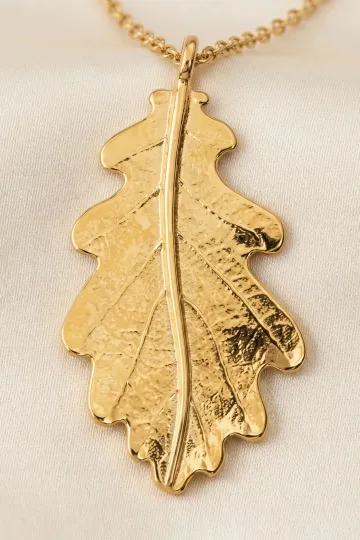
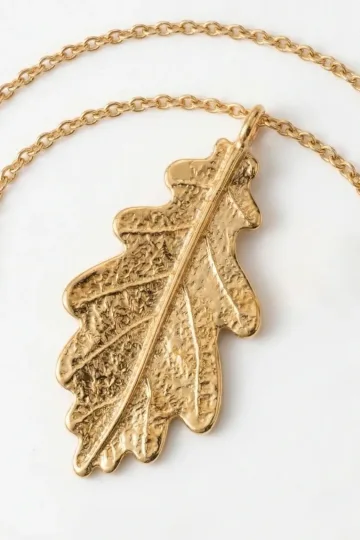
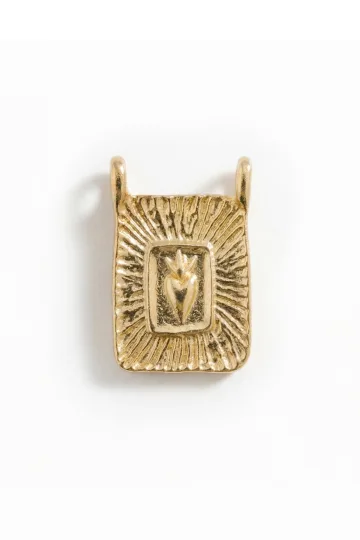
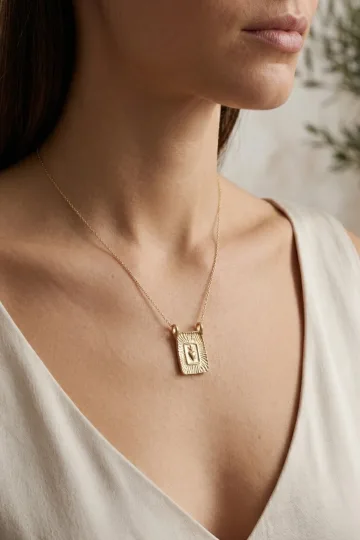
Wear the symbol, don't just read about it. These are in stock:
Common questions
Who is malachite for, and for what occasion?
Malachite suits those who love calm depth of colour and a rare, understated piece rather than the glitter of stones. It is good for an outing, a quiet day, the office in the form of a restrained brooch or pendant. For active daily wear in a ring it is a poor fit; better to save it for the occasion.
What do I pair malachite with so it does not get lost?
Give it a quiet backdrop: milky white, grey, beige, graphite, plain fabric with no busy print. Malachite is itself a pattern, and a second one beside it begins to quarrel with it. Keep it the main accent and choose modest companions, a fine chain with no stone or a plain ring.
What size and shape of stone should I choose?
For wearability, look at the piece, not just the size. A large stone is striking in a brooch and a pendant, where knocks and water barely threaten it. For earrings and a pendant take a dense block free of cracks and pores, and leave crumbly, porous material for brooches.
How long will a malachite piece last?
With gentle handling, a long time; malachite is stored and worn as a stone of mood. Its lifespan is decided not by age but by care: water, acids, knocks and scratches age it fastest. Take it off before a shower and sport, store it apart from hard jewellery, and the stone will keep its looks for years.
What can I use instead of malachite if I want green made simpler?
If you need a green stone for everyday wear without worrying about water, look towards green aventurine or jade; they are harder and take daily life more calmly. They cannot fully copy the banded pattern of malachite, though: no other green stone has a pattern quite like it.
Is it true that malachite heals and needs to be "charged"?
No. Malachite has no proven healing effect, it does not influence blood pressure, sleep or wellbeing, and it does not "charge" under the moon. This is the realm of tradition and belief, not medicine. Wearing a beautiful thing with a history is a pleasure, but there is no need to credit it with healing power.
About Zevira
In the Zevira collection malachite is chosen by its natural pattern and grade of colour, and set so that the metal shields the stone's vulnerable edges and cuts down contact with water and dirt. Every stone is unique in its pattern: no two are ever alike.
If this green stone with a history speaks to you, look through our malachite jewellery and choose a form to match how you intend to wear it: a brooch and a pendant take everyday life more easily, while a ring and a bracelet are best for special occasions.