Peridot in Jewellery: the Yellow-Green Stone from the Earth's Mantle, a Full Guide
A stone older than the continents
The peridot in a ring was born tens of kilometres beneath the crust, at temperatures above a thousand degrees. A burst of volcanic rock carried it up to the surface. In plain terms it is a small piece of the Earth's mantle that somebody cut and set into a band.
It is made of olivine. Olivine itself is one of the most common minerals on the planet, yet a clear crystal of gem quality turns up rarely. That is why a good peridot costs more than plenty of familiar stones.
Let us take it step by step: what it is made of, why it lands on yellow-green, where it is mined, what people did with it in antiquity, how to tell a real one from a fake and from its lookalikes, and how to care for it so it does not crack. We will touch on the symbolism too, but honestly, marking where tradition ends and a checkable fact begins.
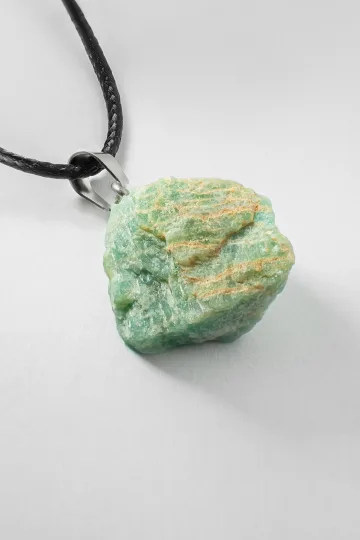
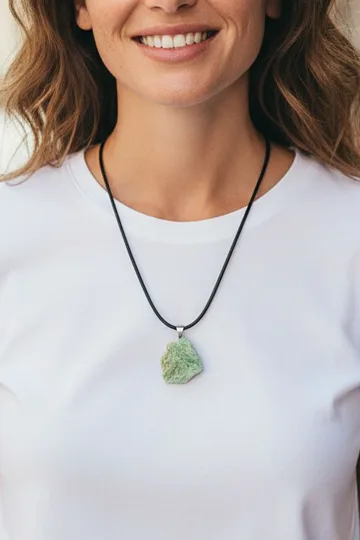
Wear the symbol, don't just read about it. These are in stock:






What peridot is: chemistry and physics
Composition and formula
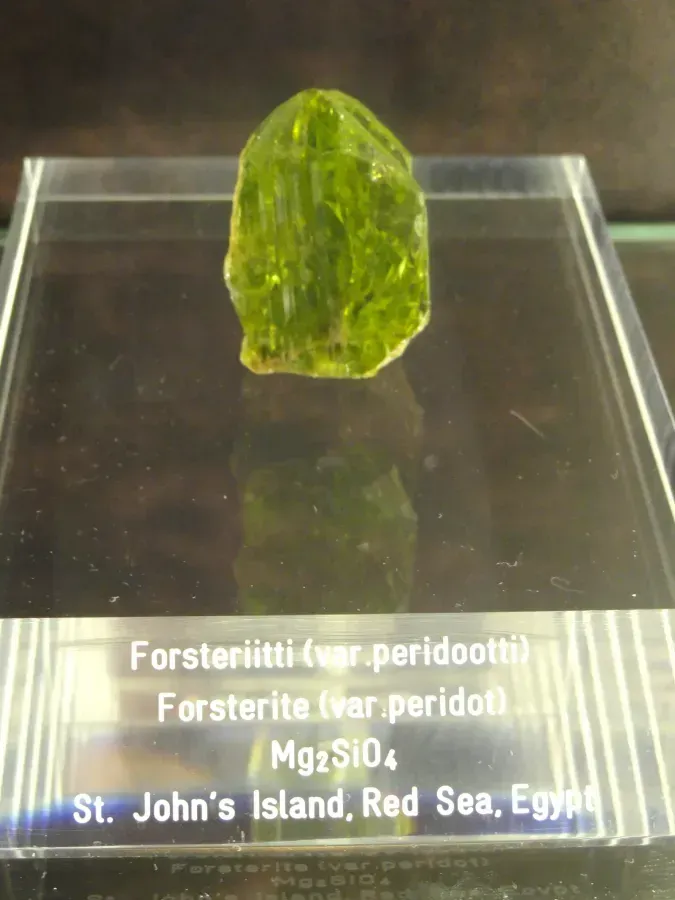
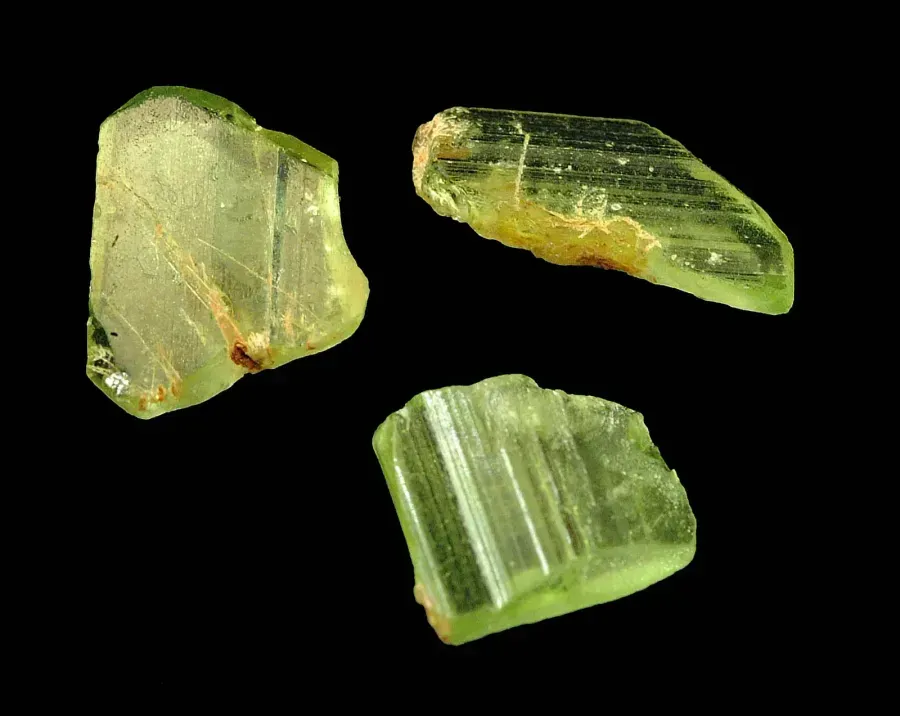
Peridot is the clear, gem-quality variety of olivine. Olivine is not a single mineral but a series running between two end members: forsterite (Mg₂SiO₄, the magnesium one) and fayalite (Fe₂SiO₄, the iron one). Gem peridot sits closer to the forsterite end, yet it always carries a trace of iron. It is precisely that iron, swapping in for some of the magnesium in the crystal lattice, that produces the green.
The ratio of magnesium to iron sets the shade. More iron, and the stone leans greener; more magnesium, and it turns yellower and paler. The finest examples hold the middle ground: enough iron for a deep green and enough magnesium for a warm golden glow. Too much iron drags the colour toward brown, too little leaves a washed-out grass tone.
Do not mix it up: peridot has nothing to do with beryl, even though its colour is sometimes compared to emerald. They belong to completely different mineral families.
Hardness, structure, density
- Mohs hardness: 6.5 to 7. That is the level of quartz. For most everyday situations it is plenty, but the stone is softer than ruby or sapphire.
- Crystal system: orthorhombic.
- Density: 3.27 to 3.37 g/cm³. The stone feels noticeably heavy for its size. If a so-called peridot sits suspiciously light in the hand, you are probably holding glass.
- Cleavage: imperfect, but present. The real weakness is not scratching but brittleness and sensitivity to a knock.
Brittleness is the key practical trait. A sharp blow or a sudden swing in temperature can open a crack, even when the stone looks intact. That is why peridot almost always goes into a protective setting rather than open prongs sitting up at knuckle height.
Optics
- Refractive index: roughly 1.65 to 1.69. Light passes through the stone with almost no loss, hence the lively shine.
- Birefringence is strong, up to 0.036 to 0.038. This is an important diagnostic clue: look through the stone with a loupe and the edges of the rear facets appear doubled. Most imitations show nothing of the kind.
- Dispersion is low. Peridot does not throw rainbow sparks the way a diamond or a demantoid does. Its beauty lies in clean, even colour rather than fire.
- Pleochroism is weak: the shades of green shift only slightly with the angle.
Under ultraviolet, peridot is usually inert, with no noticeable fluorescence. That helps with identification too.
A peridot wants sun-warmed skin and yellow gold, not a grey blazer. Bury it under office wool and I'll never forgive you.
What to wear peridot with
Yellow-green keeps trickier company than a white stone, and that is its strength: one peridot pulls the whole look together. Here are the questions I get most at fittings, sorted by occasion.
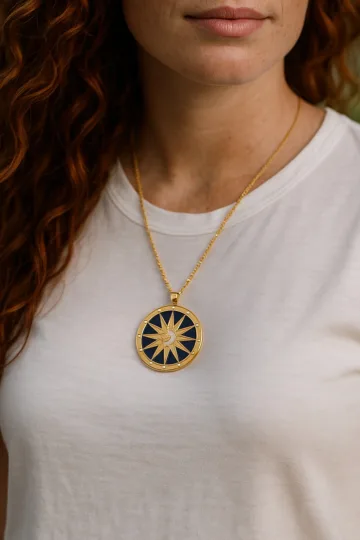
What should I wear peridot with every day? For daily wear I recommend a fine pendant or stud earrings over a calm, pattern-free base: an ivory linen shirt, white cotton, beige knitwear. Against that backdrop the warm stone reads like a drop of light. I suggest an open or V-neckline so the pendant sits on the skin instead of getting lost in the fabric.
Does it work for the office? It does, as long as you keep it restrained. I choose studs or a single-stone ring under a shirt, a blazer, a sheath dress. A cool palette (grey, blue, charcoal) gives contrast while the warm glow of peridot softens it. The one-accent rule is firm here: either the earrings or the ring, not both.
How do I build an evening look? For evening I suggest going louder: long drop earrings or a teardrop pendant on bare skin, open shoulders, a deep neckline. Peridot gets on with wine, emerald and black fabrics, and with silk that catches light the way the stone does. For a special occasion I recommend a monochrome yellow-green set, ring and earrings in one shade.
Which metal suits it? Yellow gold sits closest: it picks up the stone's golden note, and that flatters a warm skin undertone especially. White gold and silver give a cool contrast and push the green forward. On olive and tanned skin peridot adds an inner glow; on fair skin it underlines the golden undertone.
What chain length should I pick? A pendant on a 42 to 45 cm chain rests at the collarbone and works with most necklines, that is my default. Longer, 50 to 60 cm, carries the accent lower under an open collar. I build layers from pendants and rings rather than rigid bracelets pressed together, since the brittle stone takes knocks easily in a stack.

Turn on your camera, pick earrings, a pendant or a ring, and see the piece on yourself in real time.
Switch items in one tap.
Everything runs in your browser: no photo or video is ever uploaded.
How peridot forms in nature
Olivine crystallises deep down, in the upper mantle of the Earth, at depths from roughly 50 to several hundred kilometres. It is one of the chief rock-forming minerals of the mantle. Basaltic lavas and tectonic shifts that haul mantle rock toward the surface bring it up.
The trouble is that almost all mantle olivine is small, cloudy or shot through with cracks. For a clear crystal of the right size and colour to appear, several things must line up: the right chemistry with a balance of magnesium and iron, slow cooling, and the absence of strong stresses that would split the crystal. Such coincidences are rare, which is why gem peridot counts as scarce even though olivine itself lies literally everywhere underfoot.
A curious detail: olivine also turns up in meteorites, in the so-called pallasites, where yellow-green grains sit in an iron-nickel matrix. So a similar mineral crystallises not only in our own mantle.
Peridot, chrysolite and olivine: sorting out the names
Why one stone carries three names
The first snag with this stone arrives before the shop counter, at the level of the word. The same yellow-green gem is called peridot in one text, chrysolite in another and olivine in a third, and it reads as though three different things are under discussion. The reality is simpler. Olivine is the mineral species, a broad family, most of which is cloudy and opaque. Peridot and chrysolite are two labels for one thing: the transparent, gem-quality variety of that olivine, the part of it worth cutting. English-language trade settled on peridot, while chrysolite survives in older books, museum catalogues and Continental usage. One stone, two tickets.
Put briefly: every peridot and every chrysolite is olivine, but not every olivine reaches gem quality. The specifically cosmic side of the story, with the meteorite line running through it, is taken further in the separate guide to peridot and olivine, the green stone from meteorites.
Where the word chrysolite came from
The name is Greek and means, quite literally, golden stone: chrysos is gold, lithos is stone. What the Greeks saw in it was the golden, sunlit cast rather than pure green. And there the catch is hiding. In antiquity "chrysolite" covered nothing so narrow as our olivine. It was a broad basket of yellow and yellow-green transparent stones: olivine itself, some varieties of topaz, golden beryl, even yellow quartz. Stones were sorted by colour and appearance, not by a chemistry nobody yet knew. Ancient chrysolite, therefore, is closer to a colour category than to a specific mineral.
"Topazios" and the great historical swap
A separate and almost comic chapter of this confusion attaches to the word topaz. Classical authors used "topazios" for a stone mined on an island in the Red Sea, the very one we know as Zabargad. Yet by the descriptions, and by the geology of the island, that "topazios" was yellow-green olivine, which is to say our chrysolite, and not modern topaz at all. The swap runs in a mirror: what the ancients called topaz we call peridot, and what we call topaz went under other names entirely for them. Old texts cannot be read literally as a result. A topaz mentioned in one may well be a peridot, and an emerald, on closer inspection, sometimes turns out to be one too.
What it means in practice today
For a buyer the whole tangled story comes down to one sober conclusion. When the word chrysolite appears in an antique description or on a museum label, that is no guarantee you are looking at olivine: the piece may hold topaz, beryl or another yellow-green stone, particularly if it is old and has never been through a gemmological laboratory. The reverse holds as well, and more usefully: a modern stone honestly listed as peridot on an international marketplace is exactly the chrysolite of the older books. So search abroad for the word peridot without missing the familiar older term, and treat the name in an old catalogue as a proposal rather than a diagnosis.
Customer reviews
Zevira is a real jewellery shop. Genuine payments, deliveries and customer thank-yous.
🥰🥰🥰 gracias
Ok, ¡gracias! 🙂
Geography: where peridot is mined
Zabargad Island, Red Sea
The oldest and most famous source. A small island in the Red Sea off the coast of Egypt, known under various names in old texts (St John's Island among them). Mining here ran for thousands of years. Geologically the island is built of mantle rock pushed to the surface by a fault, which explains the concentration of olivine. Stones with documented provenance from here are a rarity today and are prized for their history.
Pakistan, Gilgit-Baltistan
The modern leader for quality. Deposits high in the mountains of northern Pakistan have given the market saturated, often large and clean stones. Active extraction took off at the end of the twentieth century. The olivine here formed during the collision of the Indian and Eurasian plates, the same process that raised the Himalayas.
Myanmar (Burma)
A historic deposit in the Mandalay region, yielding stones of a darker, richer tone. Output here is small today.
China, Arizona, Madagascar and others
Henan Province in China and deposits in the south-west of the United States (Arizona in particular) supply plenty of pale peridot at an accessible level. Madagascar has become a notable source over recent decades, with decent clarity. Small finds exist in Tanzania, Kenya, Norway and a handful of other places, but they barely move the market.
The history of peridot
Ancient Egypt
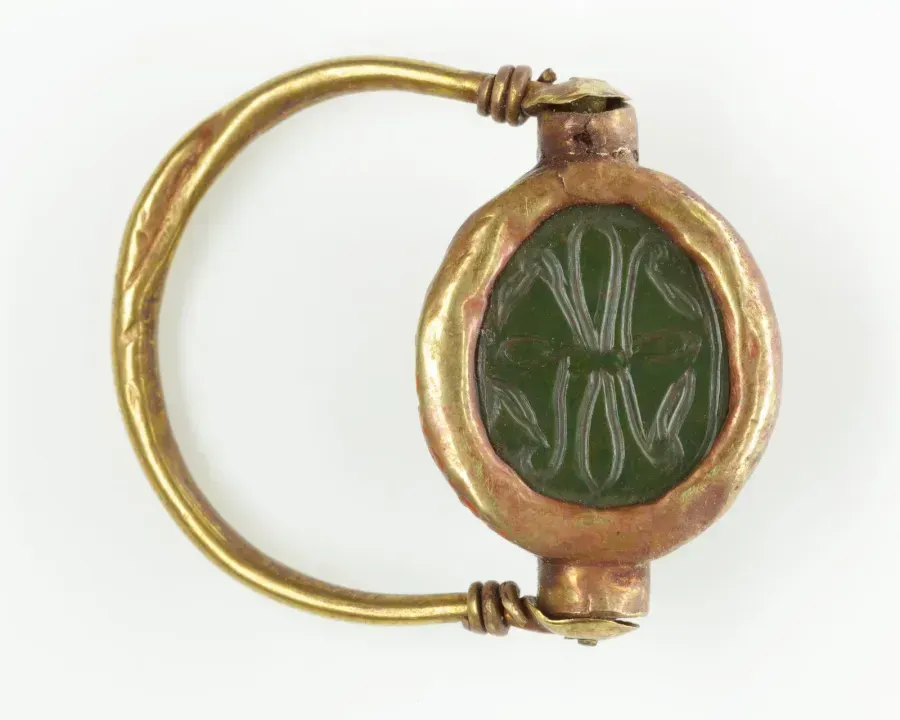
Zabargad was a source of green gems for Egypt over a long stretch of time. The Roman writer Pliny the Elder, in his Natural History (first century AD), describes the mining of a stone on an island in the Red Sea. In antiquity, though, the names of stones were muddled: the word "topazios" was applied by the ancients to exactly this yellow-green stone from the island, not to the modern topaz. Because of that confusion, many an "emerald" in old texts may in fact have been peridot. The Egyptians valued a green stone in a gold setting, and museum finds confirm it reliably.
Medieval Europe
In medieval Europe green stones were used readily in church life: in the rings of the clergy, in book covers and reliquaries. Thanks to the ancient muddle of names, you cannot say with certainty where a true peridot is meant and where some other green stone, but the plain fact that green gems went into costly pieces is beyond doubt. A belief also circulated that a clear, pale stone stood for clarity and honesty, hence comparisons along the lines of "as pure as peridot".
Baroque and the modern era
In jewellery of the seventeenth to nineteenth centuries peridot turns up regularly, especially when "historical" and antique motifs came into fashion. Its warm yellow-green sat well with yellow gold. In the decorative arts of the first half of the twentieth century it was valued for its clean, even colour, which set off handsomely against dark enamel and pale stones in the geometric compositions of that period.
In the second half of the twentieth century, interest in coloured stones in general fell away against the fashion for diamonds, and peridot became, for a long time, a stone for connoisseurs rather than the wider public. Today the attention to unusual coloured gems is rising once more.
Upload a photo of your pet, someone you love, or an object. We'll build a 3D model and hand-cast it in pewter.



Types and varieties
By mineral makeup peridot is always olivine, so its "types" come down mostly to differences in colour, size and origin.
- Pale yellow-green at an accessible level. Often from Arizona, China, Madagascar. Good for everyday pieces.
- Saturated yellow-green of medium and high grade. The classic Pakistani material, dense living colour, often large clean stones.
- A darker, slightly brownish tone, sometimes from Myanmar and older finds. An acquired taste.
- Stones with documented historical provenance (Zabargad) are valued separately for the legend rather than the optics as such.
Terminology deserves a word of its own. Peridot and chrysolite are the same thing. International trade settled on "peridot", while older and Continental usage often says "chrysolite". There is no difference in the stone itself, so search by the word peridot on international marketplaces. Just do not confuse it with chrysoberyl: a similar start to the name, but a wholly different mineral.
How to tell peridot from lookalikes and fakes
The most common slip is not a fake but a mix-up with other green stones. Here are the markers.
Tourmaline (green, verdelite). Harder (7 to 7.5), tougher, better suited to daily wear. It comes in various shades of green, whereas peridot always leans toward a warm yellow-green tone. The birefringence in tourmaline is weaker.
Aquamarine and other beryls. Aquamarine leans blue-green rather than yellow, is harder (7.5 to 8), and shows no noticeable facet doubling. If you want that warm golden glow but something tougher than peridot, take a look at heliodor, the golden beryl.
Demantoid and tsavorite (green garnets). Demantoid throws strong dispersion, sparkling like a diamond, which peridot does not. Tsavorite gives a cleaner green with no yellow undertone.
The main peridot imitations:
- Green glass. Under a loupe you see round gas bubbles, no birefringence, and it feels lighter. The most common fake.
- Dyed quartz or synthetic material. A different refractive index, no telltale doubling of the facets.
Simple signs of a real peridot: noticeable weight for its size, a warm yellow-green colour without sharp fire, and above all a visible doubling of the rear facets when you look through the stone with a 10x loupe. There should be no round gas bubbles inside (those mean glass). The final word on a disputed stone comes from a gemmological lab, but these three signs weed out crude fakes right on the spot.


How to choose a peridot: what to look at before you buy
Peridot has no grading grid as rigid as a diamond's, but the logic is the same: colour, clarity, cut, size. Let us go through what actually matters.
Colour decides almost everything. What is prized in peridot is depth and purity of tone rather than a rare hue: the more saturated and even the yellow-green, the dearer the stone. Pale grass and a slide toward brown both pull the price down. View the stone in daylight and under a warm lamp: peridot does not shift colour with the lighting the way alexandrite does, so if the tone wanders under different light, that is a cue to look harder at the stone, or at the seller.
Clarity. Peridot usually counts among the stones where inclusions should not bother the naked eye. A trait specific to olivine is disc-shaped inclusions that gemmologists call "lily pads": tiny flat cavities around a pinpoint crystal. Under a loupe they look like round petals. This is a natural marker that confirms the stone is genuine rather than a flaw, provided there are few of them and they sit out of sight. Cracks reaching the surface, on the other hand, are dangerous in a brittle peridot: such a stone chips more easily.
Size and availability. Pale peridot from Arizona, China and Madagascar is easy to find in small and medium sizes. Large, clean stones of deep colour, usually Pakistani, turn up noticeably less often, and the price per carat climbs non-linearly: a stone twice the size costs more than twice as much. For a pendant or earrings that is no problem, but for a large ring you should budget some headroom.
Cut. Because of the strong birefringence the cutter tries to orient the stone so the facet doubling does not blur the picture. A well-cut peridot reads clean and even, a poorly cut one looks slightly hazy inside. Check for a dark "window" in the centre (a zone where the stone loses colour) and whether the shine drains away into emptiness because of an overly flat base.
A quick checklist before you buy: even, saturated colour with no brown, clarity to the eye, a tidy cut with no hazy centre, a sound surface with no reaching cracks, a protective setting. And remember the weight: a real peridot is noticeably heavier than glass of the same size.
Cutting and treatment
Peridot is most often cut as an oval, pear or cushion, frequently sacrificing ideal proportions to keep weight and colour. Cloudy and heavily included pieces go into cabochons. A good cutter places the facets so the colour reads evenly, with no dark or empty zones.
A real plus of peridot: as a rule it is not treated. Most stones on the market are neither heated nor irradiated, and their colour is natural. Surface cracks are sometimes filled to hide a flaw, and a seller is obliged to disclose that. So the phrase "natural, untreated" is the norm for peridot rather than the exception.
Leave your email, we'll send your discount code. No spam, unsubscribe anytime.
The code arrives by email, valid on your first order.
Caring for peridot
A hardness of 6.5 to 7 means the stone will survive ordinary wear, but it fears two things: knocks and aggressive chemistry. Cleavage and brittleness make it vulnerable to a pinpoint blow, while the magnesium and iron in its makeup react to acids.
Cleaning. Warm water, a drop of mild soap, a soft brush. Then wipe with a soft cloth. Do not use ultrasonic or steam cleaners: vibration and sudden heat can trigger a crack. No acids, solvents or alcohol.
Storage. Apart from other jewellery, in a soft pouch or a compartment. Harder stones (and a jewellery box almost always holds plenty of them) scratch peridot easily. Keep it away from sharp swings in temperature too.
Wear. A ring with peridot is worth taking off for cleaning, sport and any work with your hands. Earrings and pendants live an easier life, as a blow to them is unlikely. Once or twice a year it is worth having a jeweller check the setting: a loosened stone is more likely to fall out and chip. Because of its brittleness, peridot is better set in a bezel or half-bezel than in open prongs.
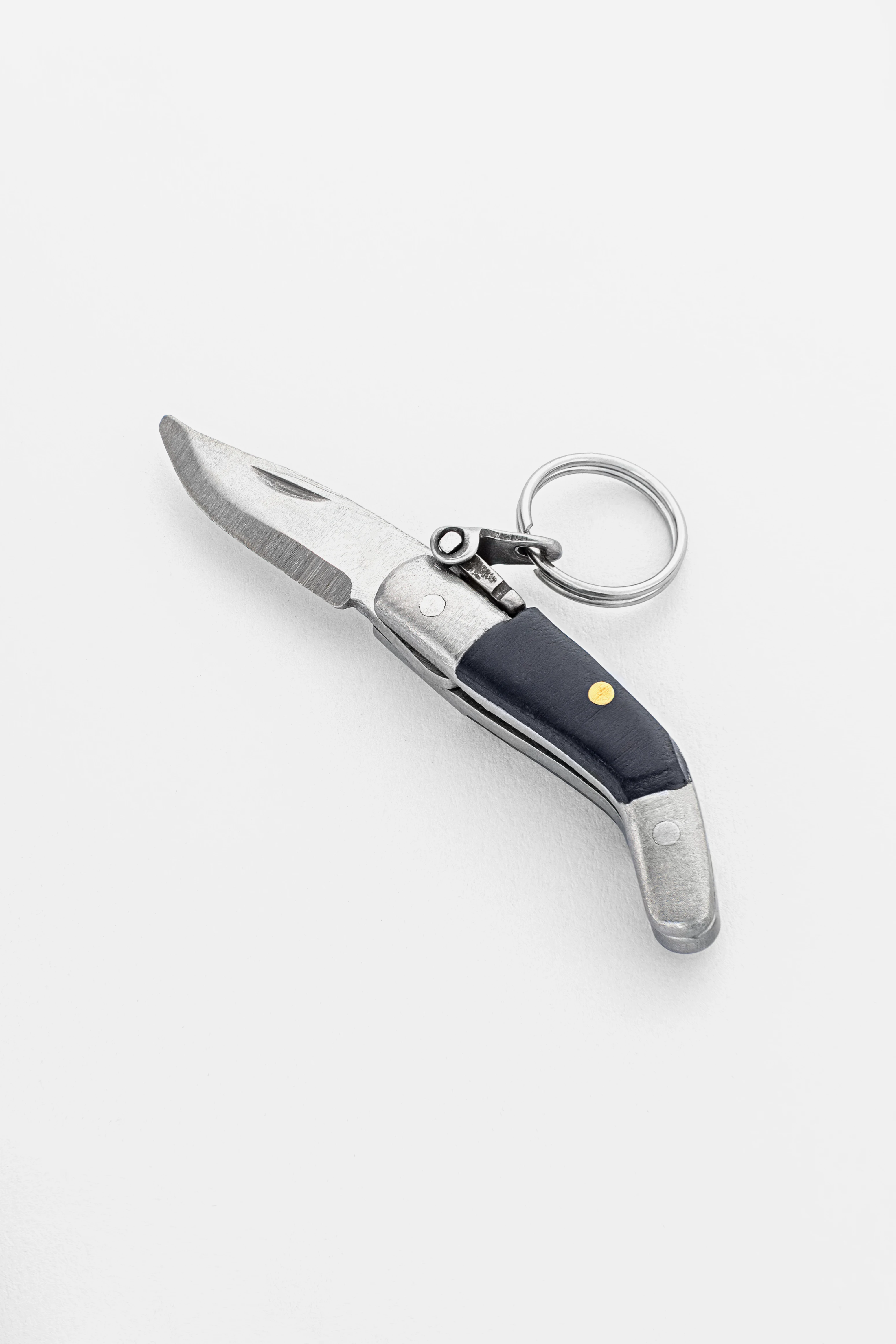
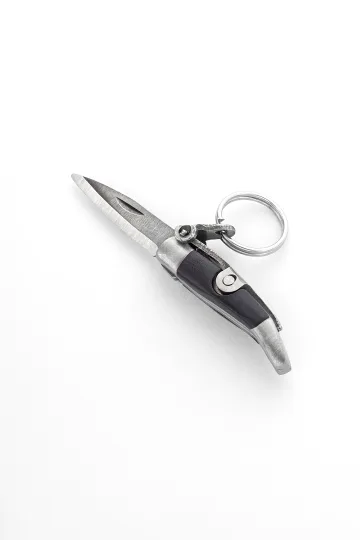
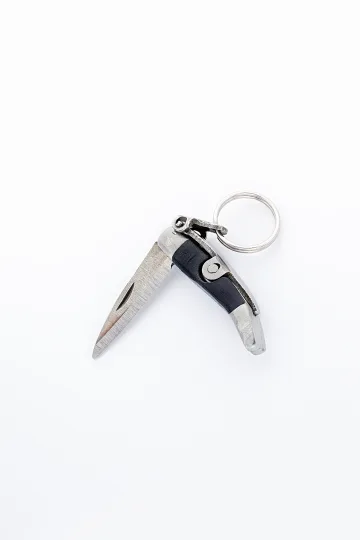
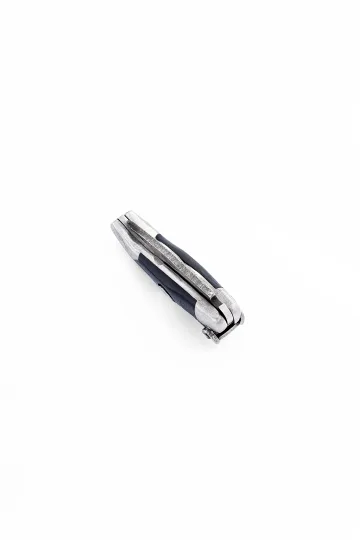
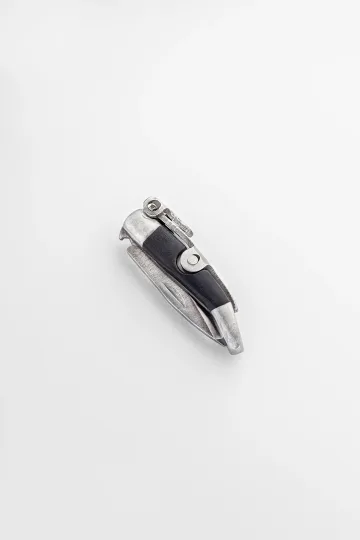
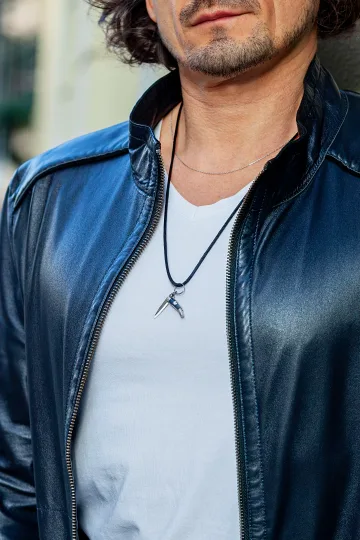
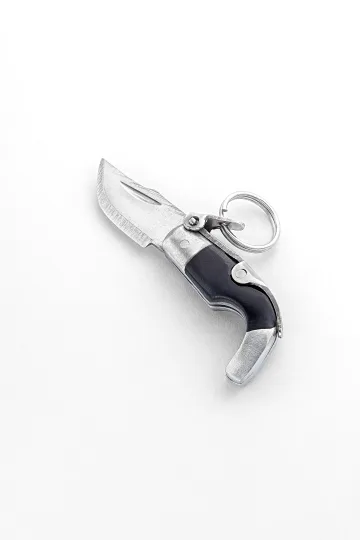
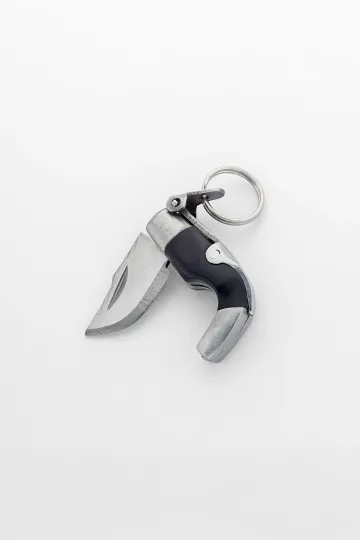
CAPAORA mini knife pendant
The 18th-century Spanish navaja in miniature: 40 mm of stainless steel, a real folding mechanism and a Palanquilla lock that clicks. An affordable gift to remember.
Authentic · Ships from Spain · 14-day returns
Symbolism: what tradition says and what holds up
The symbolism of peridot is best read with its origins in mind. These are above all cultural associations tied to the colour, not proven properties of the stone.
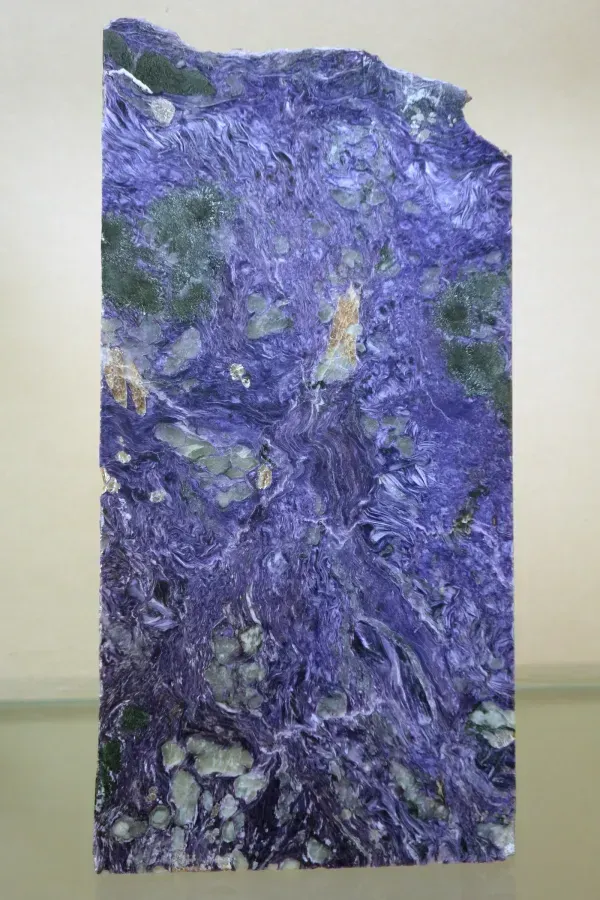
The warm yellow-green tone was traditionally linked with the sun, light and abundance: the green of growth plus the yellow of ripe fruit. In Egypt green stones were placed in burials, and peridot, as a green gem, fell into that logic. Alongside it in rich settings you would often find lapis lazuli, the blue stone of the heavens and the pharaohs: golden-green and deep blue complemented one another. In other cultures the role of the "stone of life and power" was played by green jade, the emperor's stone of the East, where the green shade was tied to longevity and the right to the throne.
Because of its clarity the stone was credited with honesty and lucidity, hence the old comparison of a person being "as pure as peridot". In calendar systems peridot is fixed to August as the birthstone.
Without the illusions: the stone has no proven physical or healing effect. The old beliefs about better eyesight, protection on the road or an influence on health are folklore. Peridot is beautiful, and that is reason enough to wear it.
Peridot as a gift: for whom and on what occasion
Peridot is fixed to August as the birthstone, and that is the first obvious reason to give it: a piece for someone born under Leo or Virgo reads as a personal choice rather than a random one. If you are giving it for a birthday, it makes sense to spell out the link with the month, otherwise the warm green will be taken simply as a pretty colour.
There is an anniversary angle too. In the tradition of wedding-anniversary gifts, peridot is usually tied to the sixteenth year. The date is neither round nor widely known, so a piece with peridot for such a milestone works as a sign that the occasion was not forgotten, and that counts for more than the round fifths and tenths.
What to choose for the recipient. For someone who does not wear anything showy, take a pendant with a single stone on a fine chain, or stud earrings: they slot easily into a wardrobe, and the stone's fragility barely matters here, as a blow to an earring or pendant is unlikely. Give a ring more cautiously: it looks best of all, but it asks for a careful hand and a protective setting, so it is a gift for someone ready to take it off during work and cleaning. For an active person who never parts with their jewellery, it is more honest to give peridot as earrings rather than a ring.
For engraving, peridot suits only indirectly: the stone itself is not engraved, but almost any piece can be inscribed on the metal at the back. For the August stone, short things make sense: a date of birth, a name, the sign of the month. A long phrase is best left aside, as a narrow ring shank holds little.
What not to do with peridot. Do not give a ring to someone who works with their hands or plays sport in their jewellery: a brittle stone will soon take a chip, and the gift turns into a problem. Do not pass off a pale, cloudy stone as a precious one: the difference in colour is visible, and a knowing recipient will spot it. And do not promise healing or protective powers along with the piece: that is folklore, and the gift is more honest presented as a beautiful thing with a history thousands of years long.
Settings for a fragile stone
Since peridot fears knocks, the setting is not only about looks but about protection.
- Bezel setting. The stone is fully ringed by metal. Maximum protection, a calm modern look. The best choice for an everyday ring.
- Half-bezel. Metal covers the stone on two sides, a balance of protection and view.
- Prongs. They open the stone on all sides and let the light through beautifully, but protect less. Risky for peridot in a ring, better for earrings and pendants.
- A frame of small stones. A track of pale stones around the peridot adds sparkle and at the same time shields the girdle.
Sterling silver is softer than gold and holds a fragile stone a touch worse, so for a significant peridot you are better off with 14 to 18K gold or a solid bezel silver setting with protection at the edge.
Peridot from space: meteorites and pallasites
A green stone from another world
The Earth's mantle is not the only place where olivine is born. The same mineral turns up in meteorites, and this is no rare curiosity but a whole class of falling bodies. Pallasites, among the most beautiful of the stony-iron meteorites, consist of yellow-green olivine grains set into a bright iron-nickel matrix. Cut and polished, such a meteorite looks like stained glass: golden-green drops held in a silvery web of metal. These are fragments from the boundary between core and mantle in small planets that broke apart, and the olivine in them crystallised by the same chemistry as the olivine beneath our feet.
Can you wear an extraterrestrial peridot
Occasionally the olivine grains in a pallasite are clear and large enough to be faceted. Such stones exist, they go by the name of extraterrestrial peridot, and for a collector they are a particular thrill: a piece of jewellery with a genuinely unearthly origin. They do not reach the general market. Volumes are tiny and the price sits at rarity level, so you will not meet one in an ordinary window. The fact is still worth knowing, because the yellow-green stone in a ring and the grains in a meteorite that arrived from the asteroid belt are chemically the same olivine. The cosmic side of the subject is taken further in the guide to peridot and olivine.
Olivine has been found beyond meteorites too
Green olivine grains have been recorded in other corners of the Solar System as well. Traces of them have been seen in the dust around distant stars and in cometary material, and on the surface of certain bodies the mineral is inferred from spectra. That makes peridot one of the most universal of gemstones: its chemistry repeats wherever hot silicate matter cools, and that happens right across the galaxy. There is exactly as much romance in this as anyone cares to add, but the geology underneath it is honest.
Send a friend a discount code, they save on their first order.
Peridot in art and interiors
The stone in church furnishing
Green gems went for centuries into the most expensive objects of Christian use: altar crosses, gospel covers, reliquaries, the rings of senior clergy. Warm green read as the colour of hope and eternal life, and peridot, as a green gem, fell inside that symbolism. Because of the naming muddle already described, a chrysolite listed in an old inventory may well have been another stone altogether, but the choice of green for sacred objects was consistent and deliberate.
The famous emeralds that turned out to be peridots
The best-known episode concerns the large green stones in medieval European reliquaries, taken for gigantic emeralds across several centuries. When science finally reached them, some of those emeralds proved to be peridots from the island in the Red Sea: the stones were simply larger and cleaner than the emerald market of the day could supply, and their colour and size gave them away. The story shows two things at once. Before the nineteenth century stones were told apart mainly by eye. And a good peridot can pass for an emerald at a few paces, which flatters the stone and its owner alike.
Peridot in the decorative arts
In the applied arts the yellow-green was valued for an even, calm colour that plays well against contrast. In the period when geometric compositions and combinations of coloured stone with dark enamel came into fashion, peridot supplied a warm patch of light beside black and white. It was set readily into yellow gold, which picked up the golden note in the stone, and into pale suites where it worked as a summer accent. That role has stayed with it: peridot rarely carries a large formal piece on its own, yet it holds a look beautifully as the single warm accent in it.
Peridot, birth month and star signs
The stone of August
In the modern birthstone calendar peridot is firmly attached to August. This is the most practical and checkable part of its symbolism, a settled jewellery tradition rather than anything mystical. A piece with peridot therefore makes natural sense for anyone born in August, and the gift reads as considered rather than accidental.
Leo and Virgo
August is divided between Leo and Virgo, and peridot is commonly linked with both. To Leo the warm sunlit stone suits by temperament: the golden-green cast chimes with the theme of sun, light and confidence. To Virgo, more reserved and analytical, tradition assigns peridot as a stone of clarity and calm, echoing the old figure of speech about being as clear as chrysolite. All of this is cultural attachment to colour and calendar rather than a demonstrated property, though as a reason to choose this particular stone as a gift it works honestly enough.
A wedding anniversary
There is a family occasion too. In the tradition of gifts by year of marriage, peridot is usually tied to the sixteenth anniversary. It is not a round number and not one anybody has at the front of their mind, which is precisely why a peridot piece for that year is remembered: it shows the date was not forgotten and was approached with some thought.
Facts about peridot that surprise
- It is a piece of the Earth's mantle. Peridot crystallises tens of kilometres beneath the crust and reaches the surface with volcanic rock. The stone in your ring came up from the interior of the planet rather than forming near the top of it.
- It can be extraterrestrial. The olivine that peridot is made of occurs in pallasite meteorites. Rare clear grains from those are occasionally faceted, producing jewellery with a genuinely cosmic origin.
- Its mineral is among the commonest on Earth, and the gem is scarce. Olivine is one of the most abundant minerals on the planet, yet transparent crystals of gem quality are in short supply: they need a rare coincidence of clarity, size and colour.
- The ancients called it topaz. The stone from Zabargad island went by "topazios" for classical authors, and it was olivine rather than modern topaz. Half the old confusion over names begins there.
- Large museum emeralds have turned out to be peridots. Some of the famous medieval green stones, taken for emeralds across centuries, proved on scientific examination to be peridot.
- It is almost never treated. Unlike most coloured stones, peridot is usually neither heated nor irradiated: the colour is natural, which is a rare piece of honesty in this market.
- It has lily pads inside it. The characteristic natural inclusion in olivine is a set of flat discs around a pinpoint crystal, which gemmologists call lily pads. Under a loupe they look like round petals, and they confirm the stone is natural.
- Its birefringence is visible to a cutter's eye. The doubling of the rear facets in peridot is so strong that a cutter deliberately orients the stone so the image inside does not appear double.
Buying it as a gift? Each one arrives ready to give.
 A branded Zevira box and a little card come with every order.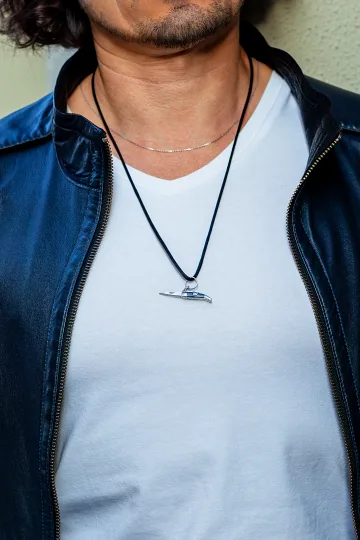





FAQ about peridot
Are peridot and chrysolite the same thing? Yes. They are two names for one stone: "peridot" in international trade, "chrysolite" in older and Continental usage. Both mean the clear, gem-quality variety of olivine.
Are peridot and olivine the same thing? Not quite. Olivine is the mineral as a whole, and most of it is cloudy, fine and unfit for cutting. Peridot is the clear, gem-quality variety of olivine. Every peridot is olivine, but not every olivine measures up to peridot.
Which colour is considered the best? A clean, saturated yellow-green, neither pale nor sliding into brown. Stones that are too light or too dark are valued lower.
Can you wear a peridot ring every day? You can, but with care. The stone is brittle and fears knocks, so it needs a protective setting, and the ring is best taken off for work with the hands, sport and cleaning. Have the setting checked once or twice a year.
How do you clean peridot at home? Warm water, mild soap, a soft brush, then wipe with a cloth. Ultrasonic, steam, acids and solvents are ruled out.
Why is peridot rare if olivine is one of the most common minerals? Olivine really is everywhere, but almost all of it is cloudy and fine. Clear crystals of gem quality and the right colour form under a rare alignment of conditions, hence the scarcity of peridot specifically.
How do you tell peridot from glass right in the shop? Look through the stone with a 10x loupe: in a real peridot the rear facets double (strong birefringence), and there are no round gas bubbles inside. Glass gives itself away with bubbles, and it is lighter in weight. A disputed stone is settled for good by a lab.
Is peridot suitable for an engagement ring? You can, if you want something off the beaten track, but it is a compromise. It is softer and more brittle than the traditional stones, so it needs the most protective setting possible and careful handling. For a very active hand it is not the best choice.
Is peridot treated like other coloured stones? Usually not. Most peridots on the market are neither heated nor irradiated, and their colour is natural. Cracks are sometimes filled, and a seller is obliged to report that.
Is it true that peridot heals or protects? There is no proven effect. All such properties are tradition and folklore tied to the colour of the stone. It is worth wearing for its beauty.
Rings, earrings, pendants and bracelets with yellow-green stones and sunny motifs in sterling silver and gold.
About Zevira
Zevira makes jewellery in the artisan tradition of Albacete, Spain. The warm yellow-green of peridot and the theme of sun and abundance are close to us: we work with green and golden stones, fit them with protective settings, and put together calm summer looks made to be worn every day.
What you can find with us on the theme of peridot and sunny jewellery:
- Rings with green and yellow-green stones in bezel and half-bezel settings that protect a fragile stone
- Stud and drop earrings with warm green accents
- Pendants on a fine chain with a single stone for everyday wear
- Bracelets with green stones and a sun motif
- Jewellery with the symbolism of abundance and growth for those born in August
- Single-colour sets in a yellow-green palette for minimalism and for dressier looks
Every piece is made by a craftsman by hand, with the option of personal engraving. Sterling silver and 14 to 18K gold.