Jadeite in jewellery: the stone emperors of China and rulers of Mesoamerica prized above gold
A stone valued higher than gold
In imperial China jadeite cost more than gold, and smuggling it out of the country was punishable by death. On the far side of the world, with no knowledge of China, the Aztecs and Maya reached the same verdict: the green stone mattered more to them than gold, they laid it in the tombs of rulers and set it into the teeth of the nobility. When Cortés reached the treasuries of Tenochtitlan, he wrote to the king of Spain that the locals valued this green stone above everything else.
Two civilisations, separated by an ocean and by thousands of years, independently chose the same mineral as a symbol of power and continuity. The Spaniards, hunting for gold, never grasped it: they melted golden settings into ingots and threw the jadeite away as a worthless green rock.
Today jadeite remains a stone for collectors and for those who understand the material. It does not compete with diamonds for sparkle. It is valued for something else: depth of colour, toughness, cultural history and rarity. Let us look at what jadeite is from a geological standpoint, how to tell it from fakes and from nephrite, and in which forms people wear it.
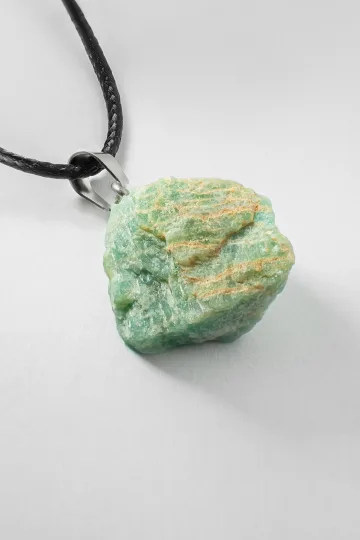
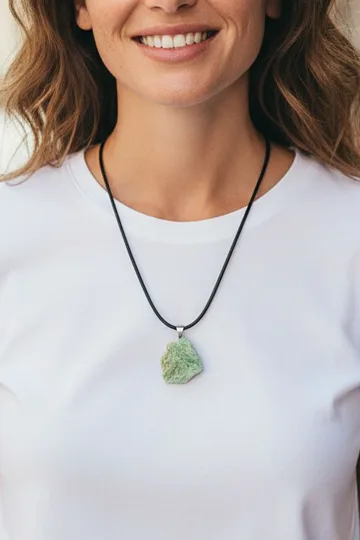
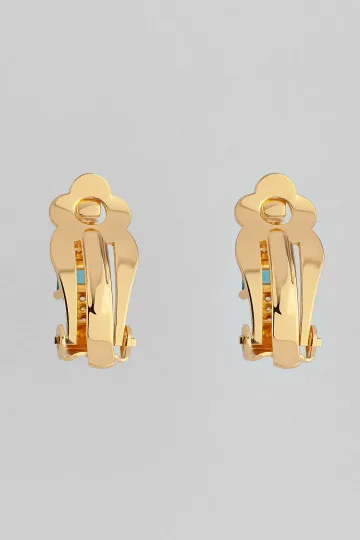
Wear the symbol, don't just read about it. These are in stock:





What jadeite is: chemistry and physics
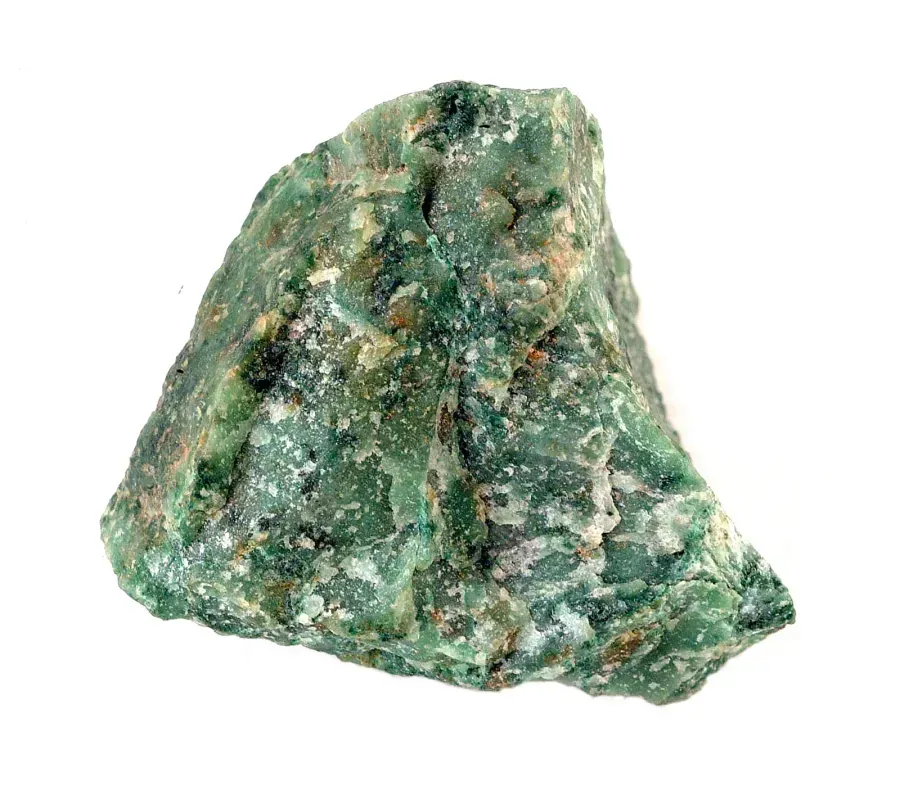
Jadeite is a mineral from the pyroxene group with the formula NaAlSi₂O₆ (a sodium-aluminium silicate). It is not the same thing as nephrite, although both stones were called by a single word, "jade", for thousands of years. Nephrite belongs to the amphiboles, a variety of actinolite-tremolite with a different chemical make-up. Mineralogists managed to tell them apart only in the 19th century.
The name comes from the Spanish "piedra de ijada", "the loin stone": the conquistadors saw locals pressing the green stone against an aching side and concluded that it healed the kidneys. From the same idea comes the Latin "lapis nephriticus", which gave nephrite its name.
Structure and toughness
Jadeite forms under high pressure and relatively low temperature, in subduction zones, where an oceanic plate slides beneath a continental one. The cold plate has no time to warm through, and that rare pairing of strong compression with modest heat creates the conditions for jadeite to grow out of sodium-rich rock.
The mineral grows slowly, and its crystals interlock into a dense fibrous mass. That structure is the key to jadeite's headline property, its toughness. Unlike stones with a clean crystal cleavage, jadeite does not split along a flat plane, it resists a blow like a reinforced material. In some directions it beats even steel for resistance to fracture, which is why carvers spent centuries cutting thin figures from it without fearing that the work would crack.
Hardness, density, optics
- Hardness on the Mohs scale: 6.5-7. Below corundum (sapphire, ruby, 9) and diamond (10), but on a par with quartz or higher. That means everyday dust, which is mostly quartz, barely scratches jadeite.
- Density: roughly 3.2-3.4 g/cm³, higher than nephrite (about 3.0) and noticeably higher than glass. Jadeite feels distinctly heavier than imitations of a comparable size.
- Crystal system: monoclinic.
- Optics: from opaque to translucent. Full transparency is extremely rare and lifts the value sharply.
Colour is born from impurities in the lattice: chromium gives a vivid green, iron muted grey-green tones, manganese a lilac cast. Pure jadeite with no impurities is white.
Colours and their value
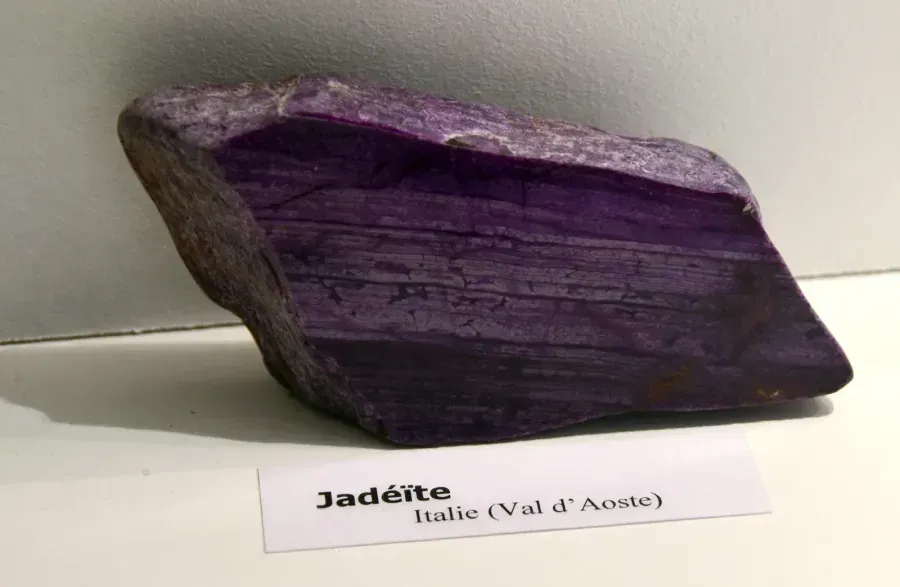
- Imperial green is the rarest and most expensive. A saturated, even emerald-green with a slight translucency. It carries that name because jadeite of exactly this grade belonged to the Chinese court. The historic deposits of this quality are all but exhausted.
- Grass green is a touch duller than imperial, yet bright and translucent. It is the main colour of traditional Chinese carving.
- Apple green is light, almost milky-green. The most common, including in Guatemalan material, and the most affordable.
- Lavender: a soft, natural lilac tone does occur, but the market is full of dyed imitations, so a stone like this calls for a certificate.
- Olmec blue, a blue-green from Guatemala, is prized by collectors of antiquities.
- Black is almost opaque and was used in the burial objects of Mesoamerica. It belongs in the same rank as other dark relics of rulers, such as lapis lazuli, the sky stone of ancient kings.
- White and milky is ordinary, inexpensive, often with inclusions. It has its own beauty and recalls porcelain.
Jadeite belongs in yellow gold. In silver the emperor's stone looks like a market trinket, and that's final.
What to wear jadeite with
Dozens of jadeite pieces have passed through my hands, from family bangles to carved pendants. Here is what actually works, by occasion.
How do you wear jadeite day to day? For an everyday look I recommend a single piece: a thin ring, a beaded bracelet or a small cabochon over a plain knit. Cream, sand and charcoal light the green up, while a busy print smothers it, so I suggest keeping the fabric calm. The green stone wants a quiet backdrop, not a rival.
Does jadeite work at the office? It does, and it is one of the few stones that reads as a sign of taste without any swagger. I recommend a signet with a cabochon or a pendant that slips under a shirt collar: substantial and quiet. Silver and white gold strike a stricter note when the dress code is firm.
How do you build an evening look? For the evening I choose an open or V-neckline and a smooth, single-colour fabric in a deep shade: wine, emerald, black. A long pendant settles into the space between the collarbones and leads the eye to the face, and I suggest a longer chain for that neckline.
Which metal suits jadeite? The stone looks warmest in yellow gold, the classic Eastern pairing that underlines its history. Alongside it I recommend warm tones: pearl, citrine and golden hues open the green up, while a cold scatter of small stones nearby dulls it.
How do you avoid overdoing jadeite? One large piece at a time, and no more. Two heavy jadeite accents argue with each other at once, and the stone likes to take the solo. Thin stacked rings or a pair of bracelets are fine, but a single strong cabochon on bare skin is always more convincing.

Turn on your camera, pick earrings, a pendant or a ring, and see the piece on yourself in real time.
Switch items in one tap.
Everything runs in your browser: no photo or video is ever uploaded.
The history of jadeite
Ancient China
A stone of the jade group held a central place in Chinese ritual as far back as the Neolithic. The Hongshan and Liangzhu cultures (roughly 4000-2000 BC) left behind carved "bi" discs (a flat ring with a hole, a symbol of heaven) and "cong" tubes. These were placed in rich burials, and their number marked the status of the dead. Even then the idea of the stone as a go-between, linking earth and heaven, had taken shape.
Under the Shang and Zhou dynasties the stone settled in as a material of power and ceremony: badges of rank for officials, ritual weapons that never went into battle. Confucius, in the 6th to 5th centuries BC, gave the stone a moral dimension by comparing its properties with human virtues: hardness with justice, a warm lustre with kindness, a clear ring when struck with music. Ever since, a person of noble character in China has been likened to this very stone.
Under the Han dynasty (206 BC to AD 220) the belief that the stone could preserve the body came into full flower. Nobles were buried in suits assembled from thousands of plates, fastened with gold, silver or copper wire according to rank. One such suit took stone-cutters years to make.
An important point: until the 18th century China worked mainly with nephrite. Bright-green, translucent jadeite poured into the country only when active trade in Burmese material from Kachin State opened up under the Qing dynasty. That is when the modern cult of imperial green took shape. The Empress Dowager Cixi had a particular passion for it in the second half of the 19th century, and her taste did much to fix the rich green as the highest ideal.
Pre-Columbian America
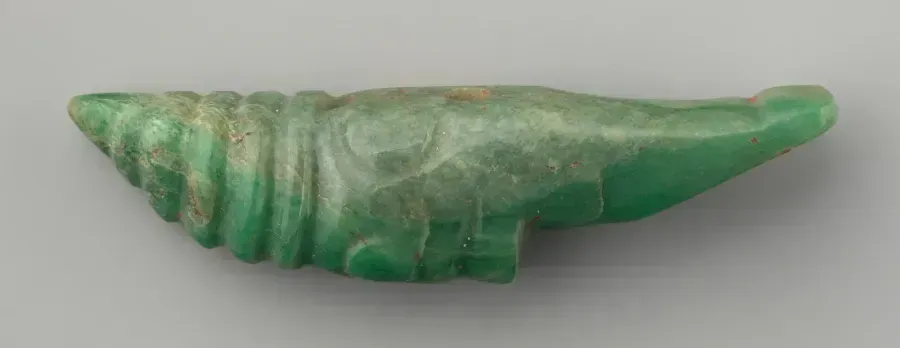
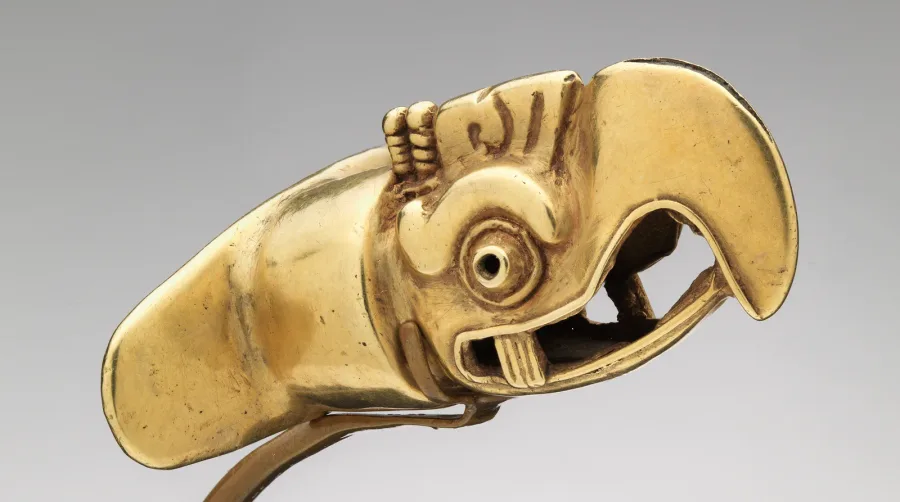
In Mesoamerica the source of jadeite was the valley of the Motagua river in Guatemala. The Olmec (roughly 1500-400 BC) were the first to raise the stone to the rank of supreme treasure, prizing it above gold. The Maya and the Aztecs inherited that cult. Green, for them, was the colour of young maize, of water and of life itself.
The Maya nobility set small jadeite discs into their front teeth, drilling a recess into the enamel and gluing the stone in with a natural compound. The procedure was painful and dangerous, available only to the highest class, and it served as an indelible mark of status. Archaeologists still find skulls with such inlays.
The Aztecs understood jadeite as a link between the world of the living and the underworld of the ancestors. Rulers were buried with funerary masks assembled from fitted plates of jadeite. The fineness of the mosaic is astonishing once you remember that the craftsmen worked without metal tools, using only abrasives and stone implements.
The tradition was cut short by the Spanish conquest in the 16th century. The conquistadors, hunting gold, failed to grasp the value of the green stone, and the Motagua deposits were forgotten for centuries. They were rediscovered only in the second half of the 20th century.
Western rediscovery
Europe long favoured transparent faceted gems and underrated jadeite. Only as ties with Asia widened in the 19th century did Western collectors discover carved jadeite for themselves, and a growing interest in Eastern art brought the stone into the circle of recognised luxury. Since then the finest examples of Asian stone-carving have held their place in museum and private collections.
Customer reviews
Zevira is a real jewellery shop. Genuine payments, deliveries and customer thank-yous.
🥰🥰🥰 gracias

Ok, ¡gracias! 🙂

Where jadeite is found
Jadeite forms only in a narrow set of geological conditions, so the commercially significant deposits in the world can be counted on the fingers of one hand.
Myanmar (Kachin State). The chief source of bright-green, translucent jadeite of the top grade. This is where the imperial-quality material for the Chinese court historically came from. The drawback: mining in the region has long been bound up with armed conflict, which makes the origin of this material an ethically difficult question.
Guatemala (the Motagua valley). The heart of Mesoamerican jadeite culture. It yields a wide range of shades, including the rare Olmec blue and an almost black material. After lying forgotten, the deposits have been worked again since the middle of the 20th century.
Kazakhstan and the alpine belts. In a handful of mountain regions of Central Asia and the high ranges, paler, grey-green material turns up. It rarely reaches the global jewellery market and more often goes into stone-carving and ornamental work, where the value lies in the mass of the block rather than in translucency.
Japan. Jadeite was mined here as far back as the Jōmon period. Archaeologists find magatama beads, curved pendants that were held to be sacred. Japanese material carries above all a cultural and historical significance.
The United States and Canada (California, British Columbia). Less vivid material, but large, uniform blocks that suit sculpture.
It is worth remembering that pure jadeite is rare: as a rule it is mixed with nephrite and other minerals.
Jadeite jewellery: the forms
The bangle
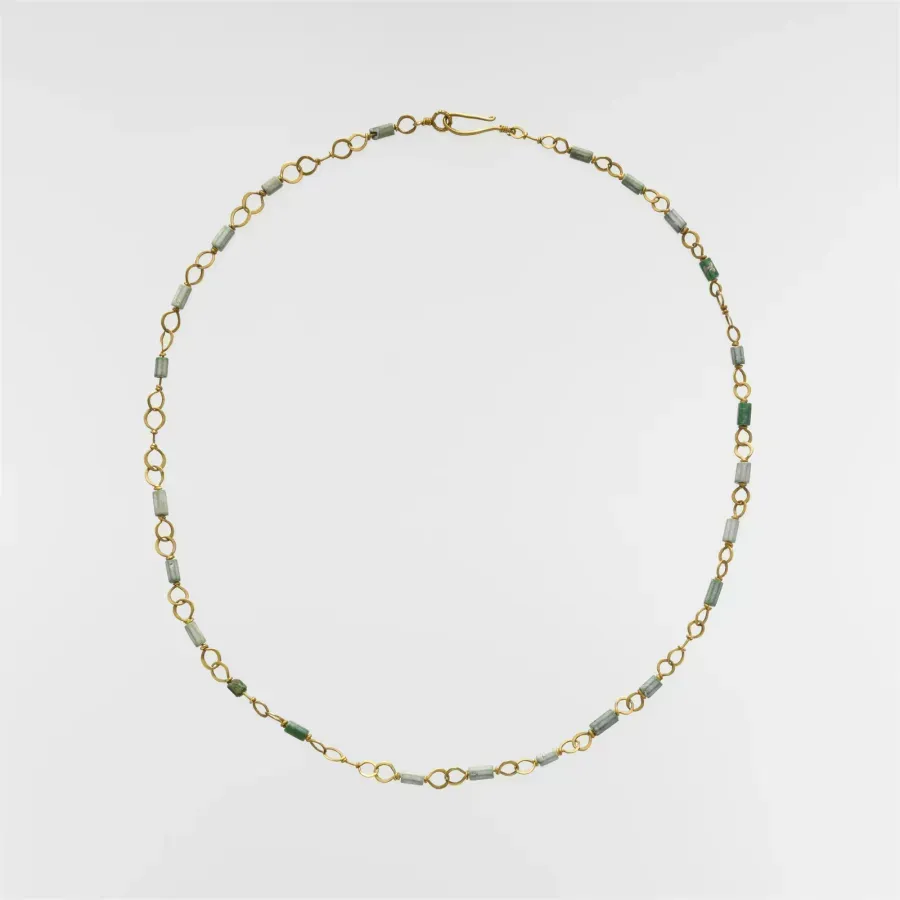
A closed bracelet with no clasp, slipped on over the hand, is the most traditional form. In Chinese culture it is called "yu zhuo". A good bangle is smooth, free of cracks, and of even thickness all the way round the ring. The inner diameter is matched to the wrist (usually 54-62 mm). Historically a bangle was worn continuously, kept on for years, and over time it takes on an individual lustre at the points of contact. This is the classic form of a family heirloom: a mother passes it to her daughter.
The ring
Jadeite in a ring looks like an ancient thing even when the setting is new. The options:
- Bezel setting: the stone is enclosed in metal on every side, with only the top surface visible. The classic Asian style.
- Signet with a cabochon: a broad ring, a large polished stone of 12-18 mm with no facets. It suits both men and women.
- A carved ring: characters, dragons, lotus, phoenix cut into the stone itself.
- Thin stacked rings: modern minimalism with small stones of 5-8 mm.
Pendant and necklace
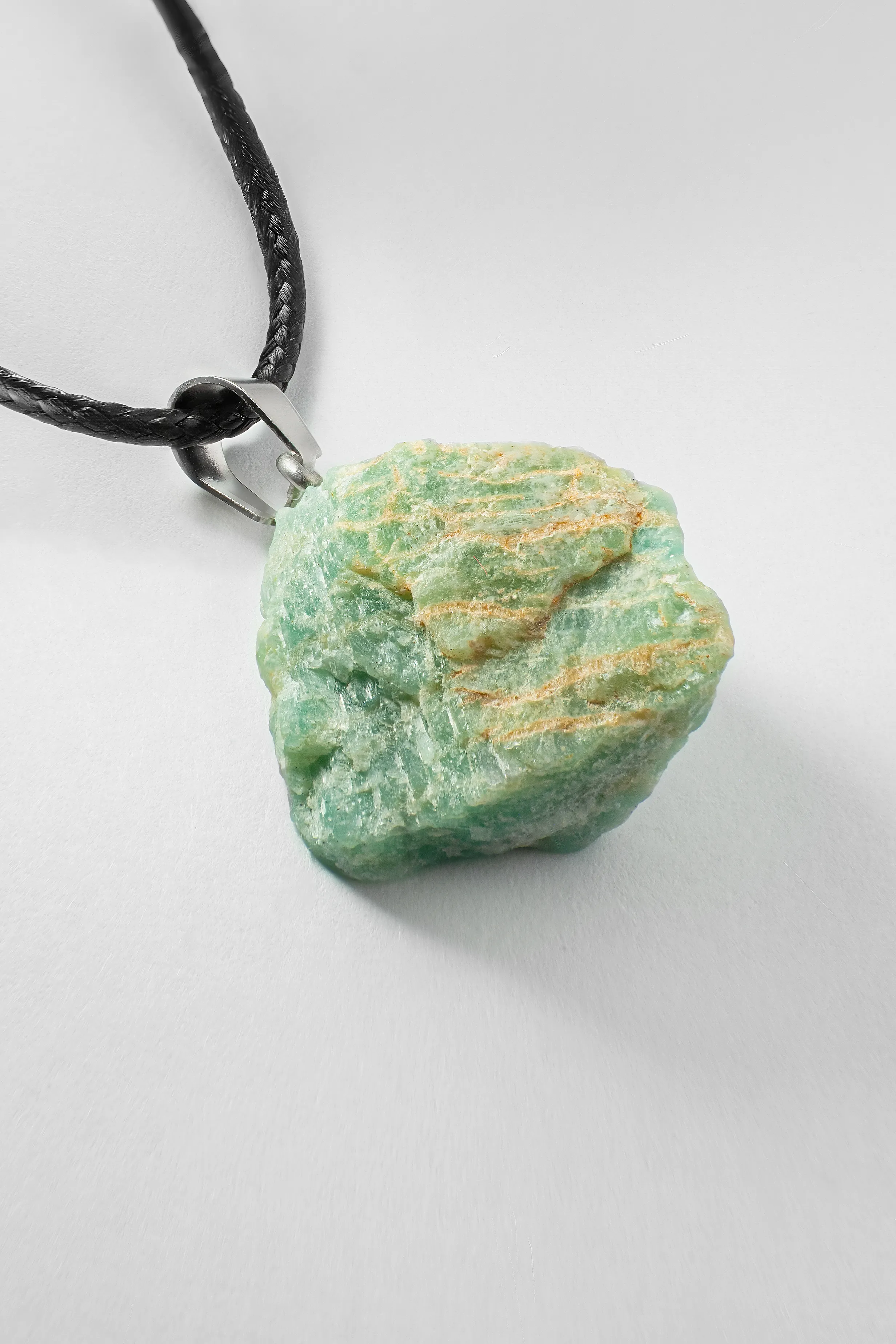
- A simple cabochon: a rounded stone of 15-20 mm on a chain.
- A carved pendant: dragon, phoenix, butterfly, carp, flower. A complex figure can take a craftsman months.
- A "bi" disc: a large disc with a hole on a short chain. An ancient Chinese motif, and a powerful look.
Earrings
Less common, but possible: cabochon studs of 6-8 mm, drop earrings with stones of 12-18 mm on hooks.
Upload a photo of your pet, someone you love, or an object. We'll build a 3D model and hand-cast it in pewter.




How to choose jadeite and avoid a fake
Quality criteria
Jadeite is judged on four parameters.
- Colour: the chief factor, accounting for up to 60% of the value. The richer and more even the green, the dearer. Judge it in daylight: shops use warm lighting that deepens the green and hides cloudiness.
- Translucency: from a dead, light-blocking stone to a translucent one. A translucent stone is worth several times more than a cloudy one.
- Texture: under a 10x loupe a uniform fibrous structure is visible. A coarse, uneven texture points to low quality.
- Cracks and inclusions: microcracks are almost unavoidable, but cracks visible to the naked eye cut the value by a third to a half.
Treatment grades A, B, C
This is an international classification of treatment specifically, not of colour.
- Grade A: a natural stone with no chemical intervention, where only a traditional surface waxing is allowed. The only grade that makes sense for a collection and for long-term keeping.
- Grade B: a stone bleached with acid and impregnated with polymer resin to mask cracks. It looks good at first, but over time it clouds and yellows.
- Grade C: a stone that has also been dyed.
Types of fakes and deception
- Dyeing. Green dye on a cloudy stone gives itself away because it pools in the cracks, forming darker net-like lines under a loupe. Natural colour is distributed unevenly, with subtle transitions; a dyed stone looks suspiciously even and bright.
- Resin impregnation. Filling cracks to hide flaws. Over time the resin can craze.
- Substitution with nephrite or serpentine. Nephrite is softer and cheaper and gets passed off as jadeite. Serpentine ("new jade") is noticeably softer and lighter and scratches easily.
- Full imitation. Dyed glass or plastic. Glass feels warmer to the touch, is lighter, and sometimes has air bubbles inside.
Simple checks at home
You cannot establish authenticity with full certainty at home, but a few signs give a first read: natural jadeite is heavier than imitations of the same size, stays cool to the touch for longer (a dense mineral quickly draws heat away from the skin), gives a clear ringing note when two pieces are tapped together, and shows an interwoven fibrous texture under a loupe instead of bubbles. Only a gemmological laboratory can give the final verdict on authenticity and grade.
The certificate
For any stone sold as valuable, ask for a certificate from a reputable laboratory (for example NGTC in China, GIA in the West) stating the treatment grade. A serious seller will provide one without objection. A price that is too low for a bright-green translucent stone is not a stroke of luck but an alarm bell: almost certainly you are looking at dyed quartz, glass or a grade-B stone.





Jadeite and nephrite: the difference
This is the great confusion in the stone's history. To the eye they are nearly indistinguishable, and until the 19th century both went by a single name. The difference lies in composition and properties:
- Jadeite is a pyroxene (NaAlSi₂O₆): harder (6.5-7), denser (3.2-3.4), more often translucent, brighter in colour, noticeably dearer.
- Nephrite is an amphibole (actinolite-tremolite): softer (6-6.5), lighter (about 3.0), warmer in appearance, oily-smooth, more affordable.
Which to choose depends on your aim. If you want a rare, translucent, bright-green stone of collector grade, go for jadeite. If a warm stone of calm tones for everyday wear at a sensible price matters more, nephrite will suit. Both carry a similar cultural weight of longevity and protection.
Jadeite is easily confused with other green stones as well. From transparent faceted peridot, the yellow-green stone it differs by its opacity and the form of cutting (cabochon and carving rather than faceting). From chrysoprase (a variety of chalcedony) it differs by its fibrous structure. From green aventurine, by the absence of the characteristic glittering inclusions. It is worth reading separately about the collective term jade as a stone of balance to understand the whole group.
The symbolism of carved motifs
Carving in jadeite is a language of its own, built up over thousands of years. The craftsman chose a motif for its meaning, and the owner read the piece as a short wish.
- Dragon: power, the masculine principle, imperial dignity. The number of claws on the foot marked the owner's rank; the five-clawed dragon was a privilege of the court.
- Phoenix: the feminine principle, a symbol of the empress and of prosperity. Paired with a dragon it means marital harmony.
- Carp: persistence and success in a career. By legend the carp that climbs a waterfall turns into a dragon. Given before important examinations.
- Lotus: purity, the ability to keep one's dignity in hard circumstances (it grows clean out of muddy water).
- Bat: happiness and luck (the word sounds like the word for "fortune"). Five bats stand for the five blessings: longevity, wealth, health, virtue and a peaceful end.
- Gourd and peach: health and long life. Given to elders.
- The "bi" disc: a ring with a hole, a symbol of heaven, one of the oldest ritual motifs.
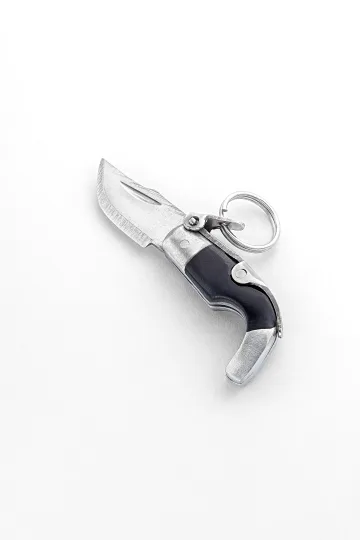
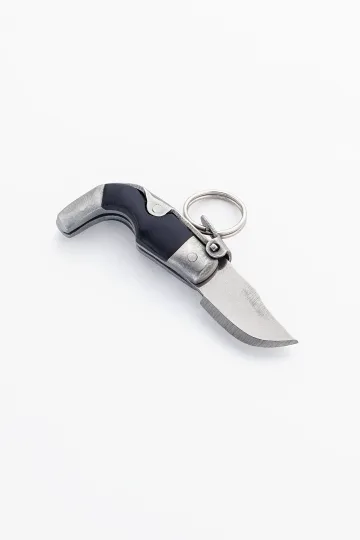
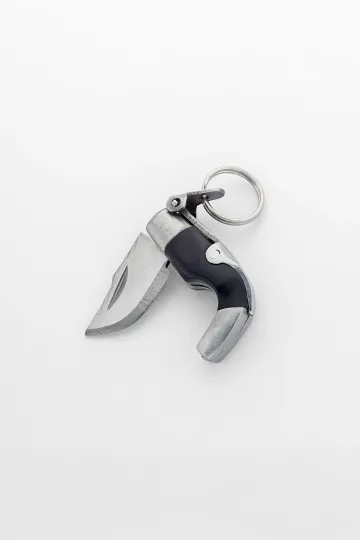
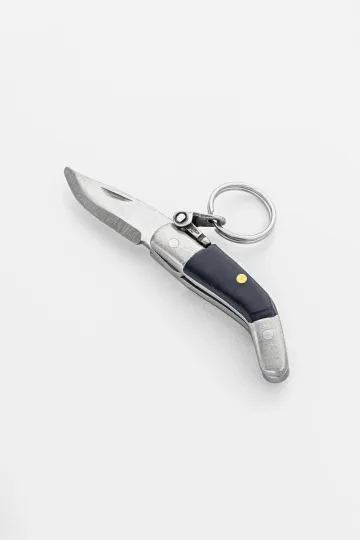
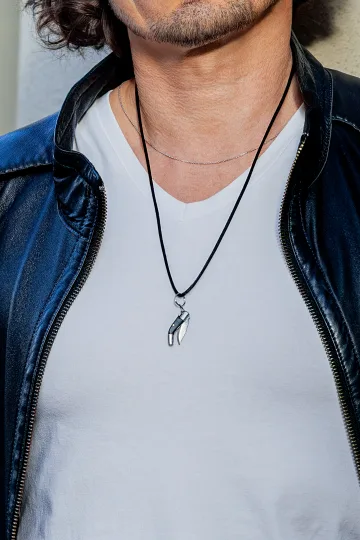
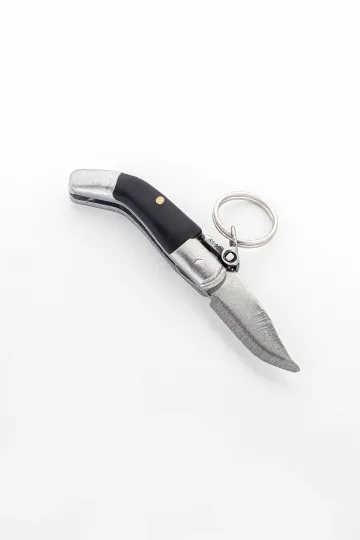
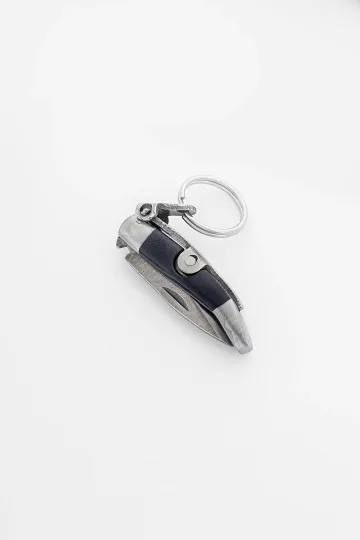
CAPAORA mini knife pendant
The 18th-century Spanish navaja in miniature: 40 mm of stainless steel, a real folding mechanism and a Palanquilla lock that clicks. An affordable gift to remember.
Authentic · Ships from Spain · 14-day returns
Caring for jadeite
Jadeite is tough and durable, and caring for it is simple.
- Daily. After wearing, wipe the stone with a soft dry or slightly damp cloth to lift off skin oils and dust. This preserves the lustre better than any elaborate routine.
- Deep cleaning. Once a season, rinse it in warm water with a drop of mild soap, work a soft brush into the hard-to-reach parts of the carving, rinse and dry. Strictly avoid ultrasonic and steam cleaners: vibration and heat are dangerous for a stone with hidden cracks and ruinous for grade B.
- Storage. Keep it apart from harder stones (diamond, sapphire and ruby can leave a scratch) in a soft pouch or a compartment of a box.
- Water. Natural jadeite takes water in its stride and does not lose colour. The trouble is in what comes with it: soap and shampoo leave a film that dulls the lustre, and the protective layer of wax gradually washes off. Once a year the shine is restored by re-polishing and fresh waxing at a workshop.
- Knocks and chemicals jadeite does not like: take a ring off before heavy physical work, sport and cleaning with aggressive products. A sharp blow to the edge of a cabochon can open a hidden crack.
Treated sensibly, a jadeite piece serves all but indefinitely; archaeologists find objects thousands of years old that have kept their shape and colour. It is precisely this durability that makes it the ideal stone to hand down through the generations.
Leave your email, we'll send your discount code. No spam, unsubscribe anytime.
The code arrives by email, valid on your first order.
Famous jadeite objects
A handful of surviving objects explain, better than any description, what jadeite at the highest level looks like and why collectors have chased it for centuries.
The jadeite cabbage
The best known carved jadeite object in the world is a small sculpture of a Chinese cabbage with a katydid and a locust resting on its leaves. The carver worked with the natural unevenness of the boulder rather than against it: the white portion became the stalk, the green the leaves, and a patch of brownish discolouration at the tip became a wilted edge. That is the whole point of the piece. A less confident hand would have cut away the flaws and lost most of the stone; this one built the design around them.
The cabbage is understood to have been part of a bridal dowry within the imperial household. White read as purity, the green as vitality, and the two insects, both prolific breeders, as a wish for many children. Today it draws queues comparable to those in front of famous paintings, and it is routinely among the most visited single objects in any East Asian museum collection.
The jade burial suits
Nobles of the Han dynasty were buried in suits assembled from thousands of small rectangular plaques of nephrite and, more rarely, jadeite, each drilled at the corners and laced together with gold, silver or copper wire according to the rank of the occupant. A single suit consumed thousands of plaques and years of labour by workshops that must have run on something close to industrial organisation.
The intention was explicit: stone of the jade group was believed capable of halting decay and holding the spirit in place. It did not preserve the bodies. It preserved something else, which is a clear record of how highly the material was valued, and every new tomb excavation forces another upward revision of estimates for the scale of ancient Chinese lapidary production. Fragments and plaques from suits of this type can be seen in the Chinese collections of the British Museum.
The mask of Pakal
In Mesoamerica the summit of the craft is the funerary mask of the seventh-century ruler of Palenque, whose face was assembled from hundreds of fitted plates of green stone, with eyes of shell and obsidian. The Maya had no metal tools. Every plate was shaped, thinned and matched using string, sand and water as abrasives, a process measured in months rather than days for each component.
The mask was not decoration and was never meant to be seen by the living. It was made to give the ruler a fitting face among the ancestors and to bind his lineage to the maize gods, the same deities whose colour the stone shared. Reading it as jewellery misses what it was for.
Dental inlays of the Maya elite
A stranger chapter: tiny discs of jadeite set directly into the front teeth. A specialist drilled a shallow, precisely round cavity in the enamel with a stone bit and abrasive slurry, then seated the disc on a natural cement of plant resin and mineral filler. The procedure was painful, and access to it was limited to the top of society.
What makes it remarkable is the survival rate. Skulls recovered with inlays intact show enamel around the cavity in good condition and cement still holding after burial, which means the drilling stopped short of the pulp with an accuracy that would satisfy a modern dentist. Whoever did this work understood tooth anatomy far better than the period is usually credited with.
Jadeite in art and culture
Stone of the jade group left its mark well beyond the jeweller's bench. It entered language, poetry and the moral vocabulary of several cultures, and in China it is still doing that work today.
The stone as a moral standard
In Chinese thought the stone became a measure of a person. Confucian writing assigned it a set of virtues, and the comparison between the cultivated person and this stone passed into everyday speech. To praise someone by likening them to jade was to credit them with firmness that is not harshness, with clarity, with dignity that does not need announcing. Warmth to the touch stood for benevolence, the fine grain for good faith, the fact that a flaw shows through rather than hiding for honesty.
This moral layer explains a great deal about how the stone is used. It is given at the significant transitions of a life, and it is worn continuously rather than brought out for occasions, because the point was never display. A stone that stands for character is worn the way character is worn.
The image in poetry and proverb
Green stone is embedded in the language. A beautiful face is compared to a polished surface, a clear voice to its ring when struck, a loyal friendship to its resistance to breaking. One well-known proverb holds that an uncarved stone shows no lustre, just as a person without learning cannot show what they are worth. The metaphor endured because the material carries beauty and endurance at once rather than beauty alone, which is more than most gemstones can be asked to represent.
Green as the colour of life in Mesoamerica
For the Maya and the Mexica the value of the stone rested on its colour rather than its rarity. Green was the colour of young maize, of standing water and of breath, which is to say of life itself. A bead of green stone was placed in the mouth of the dead to stand for the heart and the breath that would return. That association explains the ranking that puzzled the Spanish so much: gold shone, but it carried no meaning of renewal, and green stone did.
From curiosity to recognised luxury in Europe
The Western route was indirect. For a long time European taste ranked transparent faceted gems above everything else, and opaque carved stone was filed under ethnographic curiosity rather than fine art. That changed as East Asian art entered serious collecting in the later nineteenth century, and the great London and Cambridge collections were built in that window. Fine carving in a dense, tough material was reassessed as a high craft in its own right, and the best pieces now sit in major collections on equal terms with painting and porcelain. The jade galleries at the Victoria and Albert Museum and the Fitzwilliam in Cambridge are where that shift in British taste is most visible.
Why people choose jadeite
Jadeite is rarely an impulse purchase. It tends to be a considered choice, and the reasoning behind it follows a few recognisable patterns.
A pull towards what lasts
Somebody choosing jadeite is usually looking for an object that will outlive the fashion that produced it. The toughness of the stone and its reputation as a near-permanent material answer a wish to spend on a horizon of decades rather than seasons. This is the buyer who thinks in terms of inheritance and continuity, and who would rather own three things for thirty years than thirty things for one.
The calm of green
Green reads psychologically as the colour of rest and balance, which is why it dominates hospital corridors and reading rooms. A deep, even jadeite green does not excite the eye, it settles it. Where a faceted transparent stone works by flashing light back at you, jadeite's translucency glows from within and does not compete for attention. Over a full day of wear that difference is substantial, and it is why many people who find diamonds tiring find this stone restful.
A connection to roots
For some buyers jadeite is a way of touching an ancestral culture, or a tradition not their own that they have come to love. The stone carries several thousand years of continuous use, and owning a piece feels like joining something larger than personal taste. That motive is strongest where a piece passes down a family line and gathers a private history on top of the public one, which is exactly what a bangle worn for forty years does.
The pleasure of learning it properly
Jadeite rewards knowledge, and unusually the learning is accessible. To distinguish grade A from a treated stone you have to understand what acid does to the structure, learn a few simple checks, and read a laboratory report without being intimidated by it. For many owners that is a large part of the appeal: the stone becomes a small field of expertise where a beginner becomes competent within a year. Buying jadeite quite often pulls people into geology, history and carving technique, and the studying turns out to be as enjoyable as the piece.
Regional traditions of wearing
One stone, but the customs around it developed separately, and knowing them helps when choosing which format suits you.
The Chinese bangle worn for life
In Chinese practice a bangle is often put on in youth and worn without removal for many years, sometimes for a lifetime. It is sized to go on over a compressed hand and then stays put, which is why fitting one is a small ceremony in itself. The stone is understood to settle in with its wearer over time, and a crack or a chip is read as the piece having absorbed a blow that was meant for the person. Passing a bangle from mother to daughter is its own occasion, marking the female line of a family, and a bangle with a repaired crack and a known history is often valued above a flawless new one.
The Japanese magatama
The oldest Japanese form is the magatama, a curved bead shaped something like a comma, pierced at the thick end. It was worn as a sacred amulet in prehistoric periods, and green stone was considered the finest material for it. The magatama became one of the imperial regalia and still carries an unmistakable sense of deep antiquity and connection to ancestors. Its shape has been read as a tooth, a claw, a soul, and an embryo, and no single reading has ever won.
The Mesoamerican disc at the heart
Across Mesoamerica green stone was worn close to the body as a sign of vital force. Pendants, beads and pectoral plates were positioned over the chest, near the heart and the breath. The custom followed directly from the belief that green stone was bound up with life itself rather than serving as ornament, and the placement was therefore not a style choice but a statement about what the object was doing there.
Facts that tend to surprise people
- Two continents ranked it above gold independently. China and Mesoamerica, with no knowledge of each other, both placed green stone at the top and gold below it. The agreement is so precise that it looked implausible for a long time.
- Jadeite and nephrite were confused for millennia. Two distinct minerals hid behind a single word, and science only separated them in the nineteenth century. Until then the entire world trade in the material ran blind.
- The name comes from the lower back. The Spanish term meant stone of the loins, because local people applied it to the flank as a remedy for kidney complaints. The word nephrite comes from the same idea by way of Greek.
- It was set into teeth. Maya nobles had jadeite discs inlaid into their front teeth, and some of those inlays held for decades of the owner's life.
- The conquistadors threw it away. Hunting gold, they failed to grasp the value of the green stone and lost the Guatemalan sources for centuries. They were rediscovered only in the twentieth century, partly by following the river gravels.
- It resists splitting better than some steels. The interlocking fibrous structure makes it so tough that in certain directions it takes an impact better than steel does, which is exactly why carvers could cut such fine detail without the piece falling apart.
- The finest green comes from chromium. The saturated emerald colour of imperial jadeite is produced by traces of chromium, the same element that colours emerald and ruby.
- A carved cabbage outdraws paintings. The queue in front of one small green and white vegetable is regularly longer than the queue for celebrated works of painting in the same building.
Send a friend a discount code, they save on their first order.
Frequent questions about jadeite
What is the difference between jadeite and nephrite?
They are two different minerals that look alike. Jadeite is a pyroxene (NaAlSi₂O₆), nephrite is an amphibole (actinolite). Jadeite is harder (6.5-7 against 6-6.5 on the Mohs scale), denser, more often translucent and noticeably dearer. Nephrite is softer, warmer in appearance and more affordable. Until the 19th century both went by the single word "jade".
How can I tell natural jadeite from a fake?
A natural stone is heavier than glass and plastic, stays cool to the touch for longer, and under a loupe shows a fibrous texture with no air bubbles. Dyed glass is warmer and lighter. Dyed jadeite gives itself away by dye pooled in the cracks. Only a certified gemmologist can give a reliable verdict.
What do the grades A, B and C mean?
This is a classification of treatment, not of colour. A is a natural stone with no chemical intervention (only waxing is allowed). B is bleached with acid and impregnated with resin, and clouds and yellows over time. C is also dyed. For a collection and for long-term keeping, only grade A with a certificate makes sense.
Why is imperial-green jadeite so expensive?
Three properties rarely come together in it: a rich, even emerald-green colour, a slight translucency and the absence of visible cracks. Each on its own is uncommon, and all together extremely rare. Add the exhaustion of the historic imperial-quality deposits, and you get a high price. It is a matter of geological rarity, not of marketing.
Does jadeite spoil in water?
No, the stone does not dissolve and does not lose colour. But the protective layer of wax washes off over time, and soap and shampoo leave a film that dulls the shine. It is enough to wipe the stone now and then and to renew the wax coating once a year. A grade-B stone copes less well with prolonged contact with hot water.
Can jadeite be more expensive than a diamond?
High-quality imperial-green jadeite can cost more than a diamond of average quality. But the price spread is enormous: everything depends on colour, translucency, size, origin and certificate.
Is jadeite suitable for men?
Yes. Historically it was a masculine stone of power: Chinese emperors and commanders wore jadeite signets and belt pendants, while Maya and Aztec rulers wore jewellery and tooth inlays. Modern masculine forms are a heavy signet with a cabochon or carving, and a ring in a bezel setting.
Why is jadeite cold to the touch?
A dense mineral conducts heat well and quickly draws it away from the skin, so it feels cool for longer than glass or plastic, which warm up fast in the hand. This is used as a simple everyday test, though on its own it does not prove authenticity.
Does synthetic jadeite exist?
There is practically no full synthetic jadeite on the market: growing a convincing analogue is expensive and unprofitable. What is widespread instead are imitations of dyed quartz, glass and serpentine, along with treated grade-B and grade-C stone. The buyer's main task is to tell a natural, untreated stone from imitations and treated material.
Is there blue or purple jadeite?
Yes, though rarely. The blue-green Olmec blue from Guatemala is highly prized. Natural lavender jadeite exists, but the market is full of dyed imitations, so such a stone especially calls for a certificate. Natural lavender has a soft, dusty tone, while a dyed one usually looks unnaturally bright and even.
Can jadeite be worn every day?
Yes, that is exactly how it is traditionally worn. A bangle is designed for constant wear. It is sensible to take a ring off before heavy physical work and sport, to avoid knocks to the edge of the cabochon. Water and the body do no harm to the stone, while knocks and aggressive chemicals do.
Is it worth buying jadeite without a certificate?
Inexpensive ornamental material or beads for everyday wear can be bought without a document, understanding that you are paying for ordinary material. But any stone sold as high-quality, bright-green or expensive is risky to buy without a certificate from a reputable laboratory: the temptation to sell grade B as grade A is simply too great.
Buying it as a gift? Each one arrives ready to give.
 A branded Zevira box and a little card come with every order.








In brief
Jadeite has for thousands of years been chosen by those who think for the long term. Two independent civilisations, the Chinese and the Mesoamerican, reached the same conclusion: the green stone of the jade group is worth more than gold. Behind this stands a rare geology: jadeite forms only in the narrow conditions of subduction zones, and the imperial-quality deposits are nearly exhausted.
For the buyer the rules are few: view the stone in daylight, value translucency and the natural play of colour, ask for a grade-A certificate on expensive purchases, and remember that a price that is too low is always an alarm bell. In care jadeite is simple and all but eternal, which makes it ideal as a relic handed down through the family line.
About Zevira: jadeite jewellery
At Zevira jadeite features in a collection of its own, where Eastern traditions of stone-working meet contemporary design.
We work with jadeite from Guatemala and Myanmar, and for expensive and collector pieces we provide, on request, a certificate of authenticity from recognised laboratories. In the collection:
- Bangles of quality jadeite (grass green and imperial green)
- Signet rings with fine carving: dragons, characters, lotus, phoenix, symbols of longevity
- Pendants in a bezel setting of 14K and 18K yellow gold
- Combination pieces: jadeite with pearl, with citrine
- Engraving of names, dates and dedications on jadeite
Pieces are selected with the quality of the stone in mind, and for collector items grade A can be confirmed with a certificate on request.
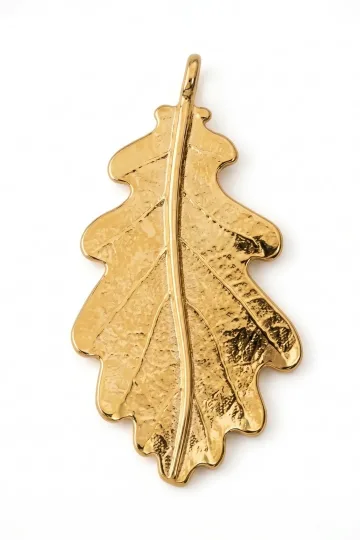
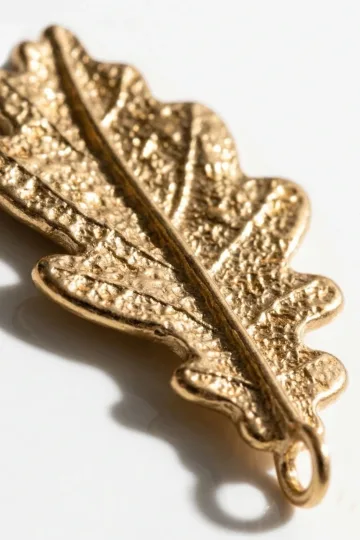
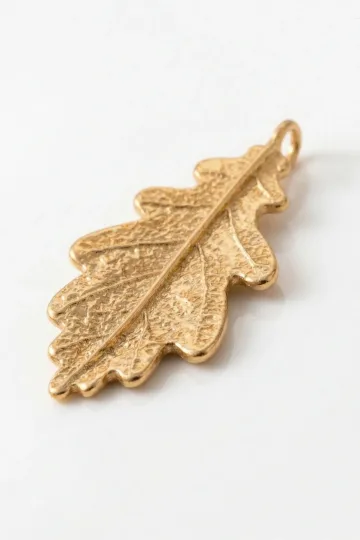
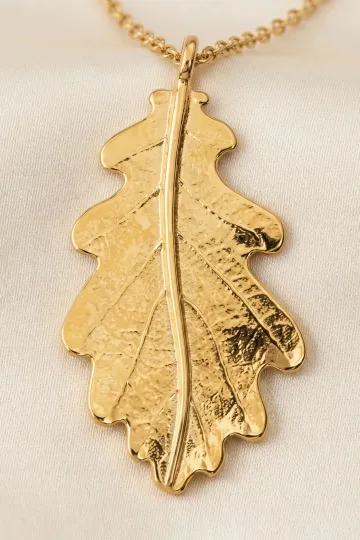
Wear the symbol, don't just read about it. These are in stock:

Find a jadeite piece at Zevira
Explore the full jadeite collection at Zevira. A stone that outlives fashion and passes down through the generations.