Blue spinel: the stone mistaken for sapphire for centuries
For hundreds of years, blue spinel was confused with sapphire. The two stones lay side by side in the same deposits, glowed alike in candlelight, and until instruments arrived they could be told apart only by the eye of a seasoned cutter. It took the twentieth century and spectroscopy to separate them in under a minute. Today the essential fact is settled: blue spinel is a mineral in its own right, with its own chemistry, its own crystal lattice, and a rare blue colour born from cobalt. And it remains noticeably more affordable than sapphire while looking very nearly the same.
What follows is just the facts. What spinel is made of, how it forms in the earth, where it is mined, how to tell it from look-alikes and fakes, and how to care for it. No mysticism, no promises.
Chemistry and physics: what blue spinel is made of
Spinel is an oxide of magnesium and aluminium. The formula is simple: MgAl₂O₄. The mineral gave its name to a whole group of spinels (magnetite and chromite belong to it by structure), but the gem-quality stone is exactly this magnesium-aluminium variety.
The key difference from sapphire shows up at the level of composition. Sapphire is corundum, aluminium oxide Al₂O₃, and there is no magnesium in its lattice. In spinel, magnesium is built into the very structure of the crystal. That accounts for the different density, the different way it is cut, and the different behaviour of light.
Crystal structure
Spinel crystallises in the cubic (isometric) system. This is the central fact for understanding the stone. A cubic lattice means spinel is optically isotropic: light passes through it the same way in every direction. Sapphire has a trigonal lattice, it is anisotropic, and it shows pleochroism, shifting its hue depending on the viewing angle. Spinel has no pleochroism at all. One colour from every side.
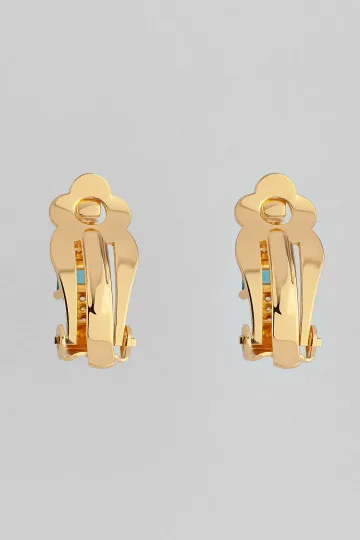
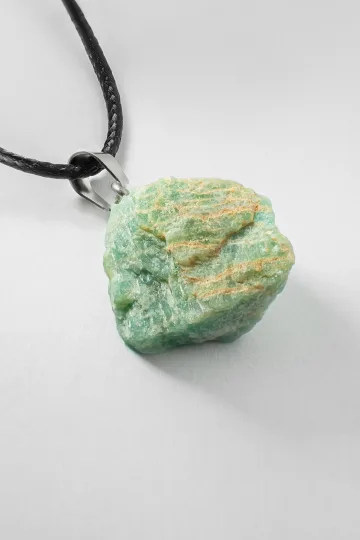
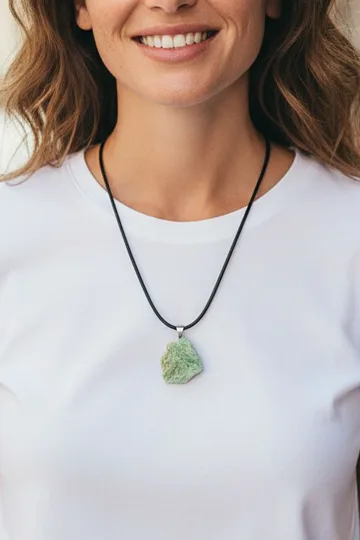
Wear the symbol, don't just read about it. These are in stock:






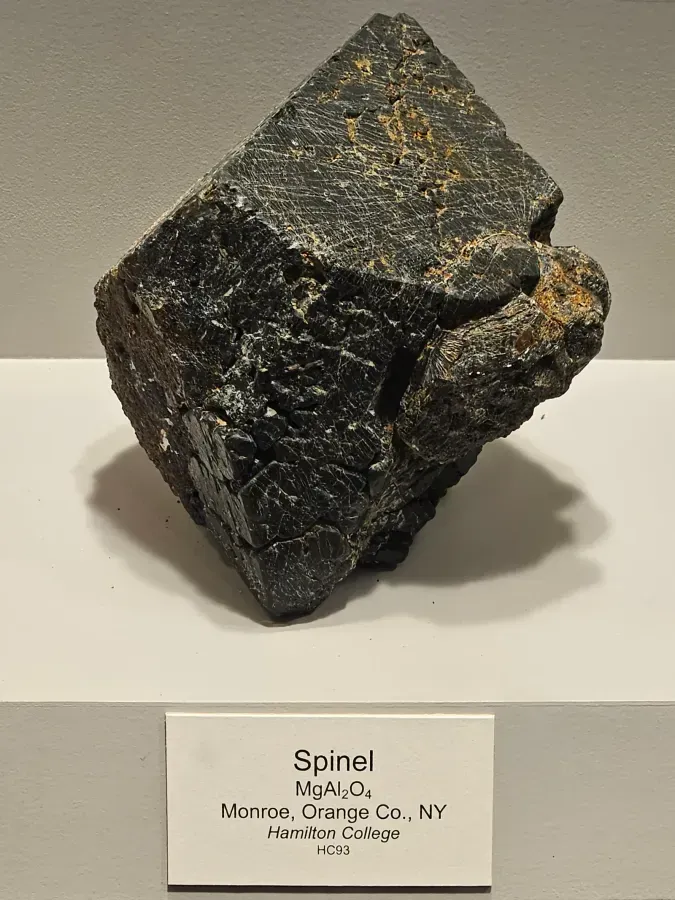
Cubic symmetry also dictates the shape of natural crystals. Spinel often grows as neat octahedra, eight-sided forms that look like two little pyramids joined base to base. These crystals look so tidy that they are sometimes mistaken for stones shaped by human hands.
Hardness, density, optics
On the Mohs scale spinel rates 8. That makes it a hard stone: on a par with topaz and clearly tougher than quartz (7). Only corundum (sapphire and ruby, hardness 9) and diamond (10) can scratch it. For everyday jewellery, a hardness of 8 is more than enough.
The density of spinel is about 3.6 g/cm³, a little lighter than corundum (around 4.0). Its refractive index runs roughly 1.71 to 1.72, uniform throughout the stone (again because of the cubic structure, there is no double refraction). Dispersion, the splitting of light into spectral colours, is moderate in spinel at around 0.020: weaker than diamond, but enough for a well-cut stone to come alive.
The lustre is vitreous. Spinel is transparent, often with high clarity, and it holds a polish well.
Where the blue comes from
Pure spinel is colourless. Colour comes from trace elements. Red and pink spinel are coloured by chromium, sometimes iron. The blue is mainly the work of two elements: iron and cobalt.
Most blue spinels are coloured by iron, and that gives a greyish, inky, sometimes dull blue. The brightest, most saturated, almost neon blue stones owe their colour to cobalt. Cobalt spinel is rare: there is little cobalt in the earth's crust, and it only finds its way into a crystal at the right concentration once in a while. The cobalt examples are prized above all the rest.
Cobalt has one more effect. Under short-wave ultraviolet, some blue spinels glow faintly red, an effect tied to chromium traces. It is not a constant feature, but it helps gemmologists with identification.
Geology: how and where spinel forms
How the stone is born in the earth
Spinel is a mineral of metamorphic and magmatic origin. Most often the gem crystals appear in marble: when limestones carrying some alumina and magnesium are pushed under high pressure and temperature in zones where continents collide, the carbonate rock recrystallises, and spinel grows within it, with corundum (sapphire and ruby) nearby. That is why spinel and sapphire so often lie in the same deposits: they share the same geological kitchen.
The crystals are washed out of the parent rock and accumulate in placers, river and alluvial deposits where they are found together with other heavy gemstones. Most gem-quality spinel is mined from exactly these placers, by washing gravel.
The main deposits
The historical home of the finest spinel is the Badakhshan region on the border of present-day Tajikistan and Afghanistan. The local mines in the valley of the Panj river were supplying large red and pink spinel as far back as the Middle Ages; that is where the famous historical stones came from, the ones long called "balas rubies" (a corruption of "Balakhshan").
Today the main sources of gem-quality spinel are:
- Myanmar (Burma), the Mogok district, one of the richest coloured-stone deposits in the world. It yields spinel across a broad range, including prized blue and deep-red crystals.
- Sri Lanka (historical Ceylon), the Ratnapura district, a city whose name means "city of gems". The placers give sapphires, rubies and spinel in every imaginable shade, blue among them.
- Tajikistan and Afghanistan, the old Badakhshan, still working today.
- Tanzania (the Mahenge area), source of the bright pinkish-red stones that made spinel famous in recent decades.
- Vietnam, the deposits around Luc Yen which yield, among others, the rare bright-blue cobalt spinels.
High-grade blue cobalt stones remain a rarity at every one of these sites: for every cluster of red and pink crystals there is only a handful of truly vivid blues.
Kuh-i-Lal: the ancient mines of the Pamirs
The oldest known source of spinel is not in Burma or Vietnam but high in the Pamir mountains, in what is now Tajikistan, at a place called Kuh-i-Lal. The workings there have been dated to around the first millennium, which makes them one of the longest-running gem operations anywhere on earth, and the medieval geographers who wrote about the region described the stones as the finest tribute a prince could send.
The location matters for the history of the material. Kuh-i-Lal sits above the Panj valley on the old routes between Central Asia and India, which is exactly how its stones reached the Mughal treasuries and, later, the courts of Europe. Most of the great red "balas rubies" that ended up in crowns almost certainly came from here, and the word balas itself is a corruption of Badakhshan, the district name. The mines are worked at altitude in extremely difficult conditions, which is part of why output has always been small.
Blue material from the Pamirs is scarcer than red, but it exists, and it tends towards the greyer, iron-coloured end of the range rather than the electric cobalt blues. For a collector the interest is provenance as much as colour: a spinel from Kuh-i-Lal connects to a documented thousand-year history that almost no other coloured stone can claim.
Why blue stones concentrate in marble
Spinel forms where limestone is cooked. When a carbonate sediment is caught up in a mountain-building event and subjected to heat and pressure, it recrystallises into marble, and the impurities in the original limestone, mainly aluminium and magnesium, reorganise themselves into new minerals. Spinel is one of the results, and this is why the classic sources, Burma's Mogok, Vietnam's Luc Yen, Tanzania's Mahenge, and Sri Lanka's gem gravels, are all associated with marble belts formed in the same great collision that raised the Himalaya.
Marble is also why spinel is so often clean. A carbonate host is low in iron and low in silica, and the fluids moving through it during metamorphism are chemically simple. A crystal growing in that environment has little to incorporate as inclusions, which is one reason fine spinel frequently arrives at the cutter's bench with far better clarity than a sapphire of comparable size from a basaltic source.
The colouring elements have to be delivered separately, and this is the crux of blue spinel. Chromium in the marble gives red. Iron, present almost everywhere in trace quantities, gives the greyish and inky blues. Cobalt is a different matter: it is rare in the crust generally, and rarer still in the specific fluids that circulate through metamorphosed limestone, so the geological accident that puts enough cobalt into a growing spinel crystal to produce an electric blue happens in very few places on earth. That is the entire explanation for the price gap between an iron blue and a cobalt blue of the same size.
How spinel reaches the cutter
Very little spinel is mined from hard rock. Most of it arrives at the surface the slow way: the marble weathers, the crystals are released, streams carry them down, and they accumulate in alluvial gravels along with sapphire, garnet, and tourmaline. Miners in Burma, Sri Lanka, and Vietnam work these gravels by hand, digging pits and washing the material in baskets, and the octahedral spinel crystals stand out in the sieve because they arrive intact and sharply formed rather than rounded like most river stones.
From there the material moves through local dealers to the cutting centres, historically Bangkok and Colombo, and increasingly to cutters working in Vietnam and Thailand for the fine goods. Because rough spinel of good colour is scarce and comes in modest sizes, the cutting decision is unusually consequential: a cutter who orients the stone for maximum weight rather than maximum colour can turn a remarkable crystal into an ordinary gem. This is why so much of the best blue spinel on the market today has been cut by specialists rather than in volume factories, and why a well-cut spinel outperforms a badly cut one so visibly under shop lighting.
Wear blue spinel on a bare collarbone and in silver. Yellow gold never flatters it, so don't argue.
What to wear with blue spinel
After years working with blue stones I keep one rule for spinel: blue gets along with almost everything, but it opens up differently by occasion. Here is what I have tested on shoots and fittings, sorted by where you are headed.
What do I wear spinel with every day? For daily wear I recommend a small stone: studs or a slender ring. This spinel lives easily with a white shirt, a grey jumper, jeans. I suggest keeping light fabric nearby (white, cream, light grey): the paler it is, the brighter the blue reads. The stone catches the light as you turn your head, and that is enough to keep the look from feeling empty.
Is blue spinel right for the office? More than right. For a work look I choose a pendant on a medium chain so it sits at the neckline of a blouse, or a single-stone ring: composed and never loud. Cool clothing tones (blue, grey, charcoal) support the stone, warm beige softens the contrast. A strict dress code is no obstacle for spinel.
How do I bring it out for the evening? For evening I recommend giving the stone a bigger role. An open neckline, a dark dress (black, wine, emerald) and a pendant with a large spinel at the collarbone make the jewellery the centre of the look. In candlelight and under chandeliers the stone drifts to a violet undertone, and that works in your favour. I suggest drop earrings for movement.
Which metal should I pair it with? Keep to the cool range: white gold, silver, platinum bring out the blue most cleanly. Yellow gold I save for anyone who wants a warm vintage effect, which is a matter of taste. Pearl nearby softens the look, colourless stones add sparkle. I allow layered fine chains, but only while the spinel stays the lead and the rest keeps quiet.
Who does blue spinel actually suit? Anyone who prefers restrained depth to loud sparkle. This is a stone of character rather than effect, equally good on a minimal look and in tidy layers. Anyone who reaches for colourless zircon or rare tanzanite over the obvious pick will take to spinel. One rule that never fails: let a single blue accent speak while everything around it works as background.

Turn on your camera, pick earrings, a pendant or a ring, and see the piece on yourself in real time.
Switch items in one tap.
Everything runs in your browser: no photo or video is ever uploaded.
History: the stone in crowns and treasuries
The history of spinel is in large part the history of a great misunderstanding. Before mineralogy learned to tell stones apart, any big red gem was called a ruby and any blue one a sapphire. So for centuries spinel "hid" under borrowed names in the most famous treasuries.
Balas rubies: spinel wearing a ruby's mask
The most famous historical "rubies" in the world turned out to be spinel. The stone in the British coronation regalia known as the "Black Prince's Ruby" is a large red spinel from Asian mines; for centuries it was taken for a ruby. Many stones that reached European treasuries through trade with the East have a similar story: a beautiful red crystal was bought as a ruby, and no one had any way to prove otherwise.
The origin of the word confirms it. The old trade name for red spinel, "balas ruby", comes from the Arabic-Persian name of the Balakhshan (Badakhshan) region, where the stones were coming from. The name itself meant "ruby from Balakhshan", and under that name spinel circulated through the markets for centuries as a kind of ruby.
The East: the Mughals and the Persian treasuries
In the East, large spinel was held in especially high regard. The rulers of Persia and the Mughal Empire collected big red stones, often polished as cabochons rather than faceted, and had them engraved with names and titles of their owners. Such engraved stones make up a notable part of the historical collections and prove that spinel held a place among the most prestigious gems long before anyone learned to tell it apart from ruby.
When the stones were finally separated
The difference between spinel and corundum lives in the physics: different density, different refraction, corundum has double refraction and pleochroism while spinel has neither. As mineralogy advanced through the eighteenth and nineteenth centuries, cutters and scientists gathered up these signs, and in the twentieth century optical instruments and spectroscopy made identification reliable and quick. That is when it emerged how many celebrated "rubies" and "sapphires" were in fact spinel.
Curiously, the stone's reputation gained rather than lost from this. Once spinel stopped being treated as a "mistake" and was recognised as a mineral in its own right, the interest of collectors and jewellers returned. Over the past few decades spinel has settled firmly onto the list of valued coloured stones, and its blue and red varieties keep climbing in demand.
Famous spinels that spent centuries labelled as rubies
The most celebrated example sits in the British Crown Jewels. The Black Prince's Ruby, mounted at the front of the Imperial State Crown above the Cullinan II diamond, is a large irregular red spinel of about 170 carats, still bearing the drill hole from an earlier setting, plugged with a small ruby. It came into English hands in the fourteenth century, was reportedly worn on a helmet at Agincourt, and passed through the coronations of every subsequent monarch under a name that is simply wrong. Nobody has changed it, because by the time mineralogy caught up the name had four hundred years of history attached.
The Timur Ruby, also in the Royal Collection, is a 350-carat red spinel engraved with the names of several of the rulers who owned it, which makes it one of the very few gemstones carrying its own documented provenance cut into its surface. The Russian imperial crown carries a spinel of nearly 400 carats at its summit, bought in the seventeenth century and, again, catalogued as a ruby for generations.
The pattern is consistent and it explains why spinel has no marketing history. For most of the period in which gem reputations were being formed, the finest spinels were not competing with rubies for status; they were being sold as rubies. When the distinction was finally made in the nineteenth century, the stone lost the borrowed prestige and never acquired a name of its own. Everything unusual about spinel's position today, the low recognition, the honest pricing, the enthusiasm of specialists, follows from that historical accident.
Blue spinel in history: why it was less visible
Red spinel had a career because it could pass for ruby. Blue spinel had no equivalent opening, and its history is correspondingly quiet.
Part of the reason is simple scarcity. Cobalt-blue material was almost unknown in quantity before the twentieth century, and the iron blues that did occur were darker and greyer than good sapphire, so they were read as inferior sapphire rather than as anything distinct. A stone that looks like a lesser version of a famous stone does not accumulate legends.
Part of it is confusion of another kind. Much of what was called blue spinel in older European jewellery was in fact synthetic, produced from the 1910s onwards, and this created a lasting association between the name and cheap material. Dealers who knew better did not use the word in front of customers, which suppressed the natural stone's reputation further.
The change came late and came from geology. The discovery of cobalt-bearing spinel at Luc Yen in northern Vietnam in the 1980s, and later at deposits in Tanzania, put material on the market that could stand next to fine sapphire on its own terms. Blue spinel's entire public history is therefore about four decades long, which is why it still feels like a specialist's stone rather than a familiar one, and why the price of the best material has moved so sharply as collectors have caught up.
Customer reviews
Zevira is a real jewellery shop. Genuine payments, deliveries and customer thank-yous.
🥰🥰🥰 gracias
Ok, ¡gracias! 🙂
Types and shades of blue spinel
Blue spinel is not uniform. The shade depends on which element colours it and at what concentration.
Cobalt blue
The most coveted variety. Cobalt gives a clean, saturated, almost electric blue with no grey film over it. Such stones are rare in nature, and the finest of them come from Vietnam's Luc Yen and from Sri Lanka, with a smaller quantity out of Tanzania. Their brightness and purity of colour are exactly what earns blue spinel comparison with the best sapphires.
The rarity is not a marketing position, it is chemistry. Cobalt is an uncommon element in the earth's crust to begin with, roughly a thousand times scarcer than iron, and the fluids that circulate through metamorphosed limestone rarely carry it at all. Only a trace is needed, a fraction of a percent substituting into the crystal lattice in place of magnesium, but that trace has to be delivered to a growing spinel crystal in a rock type that almost never contains it. The result is that cobalt spinel occurs in a handful of localities worldwide and, within those, in a small fraction of the production.
Size compounds the problem. Most cobalt spinel comes out of the ground in modest crystals, and a clean cut stone above two carats is genuinely scarce, while anything above five carats belongs in the auction and collector world rather than in a shop window. Laboratories can confirm the cobalt content by spectroscopy, and for a significant stone that report is worth having, because the difference in value between a cobalt blue and a well-saturated iron blue that resembles it under warm light is very large. If you are shown an electric blue spinel of good size at a price that seems approachable, assume it is synthetic until a report says otherwise.
Iron blue
Most blue spinels are coloured by iron. The colour comes out darker, greyish or inky, sometimes drifting into an almost grey-blue. These stones are more affordable and more common. Well cut, iron blue spinel is also beautiful; it simply lacks that inner neon spark that cobalt provides.
Violet-blue and grey-blue
Between blue and violet lies a broad transition zone. Stones with a clear violet undertone are sometimes called lavender-blue. The same band takes in grey-blue, smoky tones. It is a matter of the ratio of trace elements, and these shades offer a pleasant, soft range for anyone who finds pure blue too sharp.
Colour shift under different light
Many blue spinels shift their hue slightly as the lighting changes: in daylight the stone is cooler and bluer, under warm lamp or candlelight it drifts toward violet. This is a normal property, tied to the way the trace elements absorb different wavelengths. A similar play of light is one of the charms of blue zircon, which likewise changes its mood with the light.
To see where blue spinel stands among other blue stones, it helps to set it beside its neighbours in the display case. Hardness, hue, rarity and price segment add up to a simple picture: spinel offers the depth of sapphire at a noticeably more modest price.
Upload a photo of your pet, someone you love, or an object. We'll build a 3D model and hand-cast it in pewter.



How to tell blue spinel from look-alikes and fakes
A good deal of confusion has built up around spinel. First let us clear away the common misconceptions, then look at how the stone is actually faked.
Spinel and sapphire
The most common pair to mix up. There are differences, and they are physical:
- Optics. Sapphire is anisotropic: it has double refraction and pleochroism, the hue shifts a little as you turn the stone. Spinel is isotropic, with no pleochroism at all. Under a dichroscope this shows up at once.
- Density. Sapphire is heavier (around 4.0 against 3.6 for spinel). A stone of the same size feels noticeably different in weight in the hand.
- Hardness. Sapphire is harder (9 against 8).
- Inclusions. Spinel often contains tiny octahedral crystals, a characteristic picture under the loupe.
A precise answer comes from a gemmological lab, but even these signs help you get your bearings.
Synthetic spinel
Spinel has been grown in the laboratory since the early twentieth century, mainly by the Verneuil method (powder is melted in a flame and the crystal is built up drop by drop). Synthetic spinel is chemically identical to natural spinel. It is a legitimate material that for decades went into inexpensive jewellery and into imitations of other stones.
You tell it apart by the inclusions. Natural spinel shows tiny crystals under the loupe, sometimes healed fractures, the marks of growth in the earth. Synthetic material is too clean, and the Verneuil kind often shows rounded gas bubbles and curved growth lines that nature does not produce. When you buy synthetic, you need to understand you are paying for exactly that, and not for a natural stone.
The scale of this matters more than most buyers realise. Synthetic spinel was not a niche product, it was one of the great mass-market gem materials of the twentieth century. From the 1920s through to the 1970s it was produced in enormous quantity, in a range of colours, and it was used above all as an imitation of other stones: pale blue synthetic spinel stood in for aquamarine, a deeper blue for sapphire, colourless for diamond, green for tourmaline. It went into birthstone rings, into school and club jewellery, into signet rings and dress rings sold on every British high street, very often in 9 carat gold and very often described on the ticket simply as "blue stone".
The consequence is that synthetic spinel is still circulating in large numbers today, in vintage and secondhand jewellery, at antiques fairs, and in inherited pieces. A mid-century ring with a bright, perfectly clean, evenly coloured blue stone and no inclusions visible under a loupe is far more likely to be synthetic spinel than natural anything. This is not a scandal and it is not usually deliberate deception; the current seller frequently does not know either. But it means that if you are buying blue spinel from a vintage source, the identification question comes first and the romance second. Look for the curved growth lines and the gas bubbles, check whether the colour is suspiciously uniform across the whole stone, and note that synthetic spinel of the Verneuil type often shows a strong chalky glow under longwave ultraviolet, whereas natural blue spinel usually does not.
Glass
The crudest imitation, coloured glass. It is soft (hardness 5 to 6), scratches easily, and held to the light it often shows round air bubbles inside and sometimes the swirling streaks of unmelted mass. Glass warms up faster in the hand and is noticeably "deader" in its play of light. A very cheap price for a large "stone" almost always means glass.
Doublets and backings
Sometimes a mirrored or coloured foil is slipped under a stone in a closed setting to add brightness and colour. Or a doublet is assembled, two parts glued together. The sign of this trick is a closed, blind setting that will not let you view the stone against the light, along with an unnaturally even glow. Honest spinel needs no backing.
Treatment
Unlike sapphire, blue spinel is usually not heat-treated; it is fine as it comes from nature, and this is one of its merits. If a seller insists a stone has been "enhanced for colour", it is worth asking for details: for spinel that is not typical.


How to choose blue spinel: what to look for
Spinel is judged by the same four features as any coloured stone: colour, clarity, cut, weight. But the order of importance is its own, and there are subtleties that are easy to miss.
Colour decides almost everything. In blue spinel what is valued is saturation and purity of tone. The ideal is a deep blue with a slight light-blue or faintly violet sheen, with no grey murk. The greyish film that iron often gives knocks the price down harder than any other flaw. Turn the stone: a good spinel holds its blue evenly through the whole volume, rather than glowing with colour only in the centre.
The window. Hold the stone up to text or a pattern. If you can see the background through the centre, the cut is too flat and light falls straight through without reflecting back to the eye. Such a "window" kills colour and brilliance. A properly cut spinel reflects light off its table and seems filled with light from within.
Clarity. Spinel is often eye-clean, which is one of its strengths. Small inclusions under the loupe are acceptable and even serve as proof of natural origin, but cracks visible to the naked eye and dark spots in the centre of the table reduce both beauty and durability. Inclusions near the edge under the setting matter less.
Cut and proportions. Because of the cubic structure, spinel is not pleochroic, so the cutter does not have to align an axis to the colour the way they do with sapphire. That simplifies the cut, and good proportions are more common in spinel. A symmetrical, undistorted facet pattern gives an even play of light.
Size. Clean blue spinels above two or three carats are rare, the cobalt ones especially. The price per carat climbs with weight not smoothly but in steps: a three-carat stone costs noticeably more per carat than one of the same quality at one carat, simply because large crystals turn up less often.
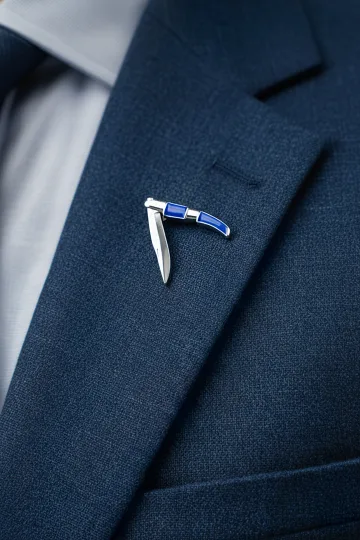
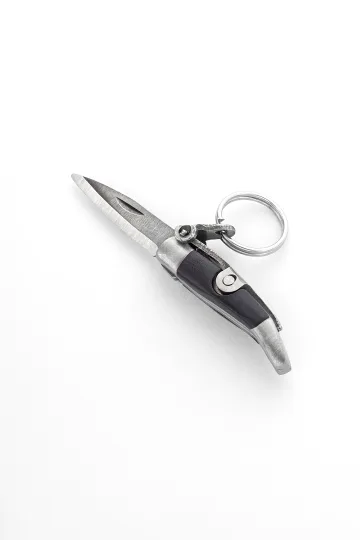
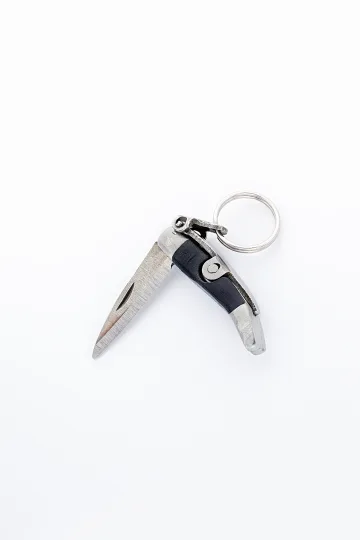
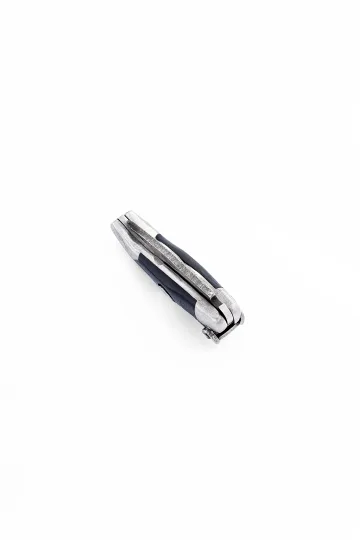
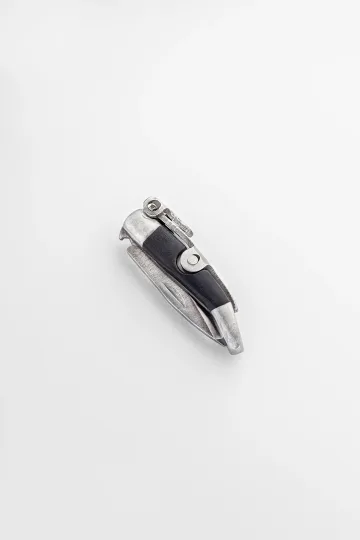
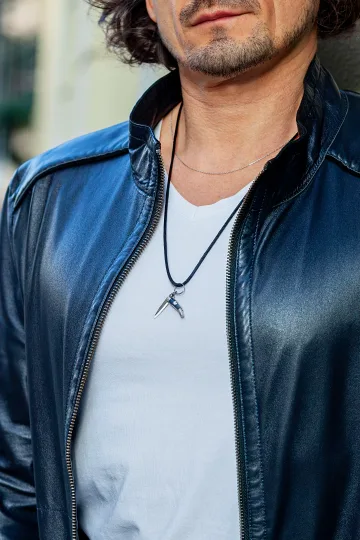
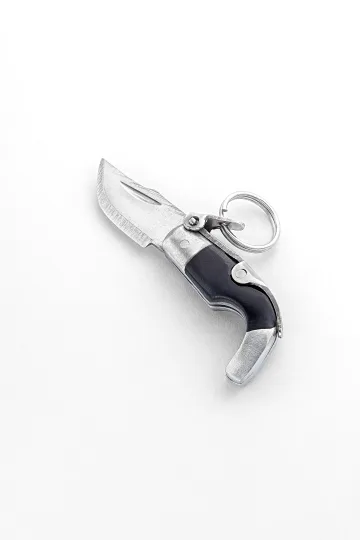
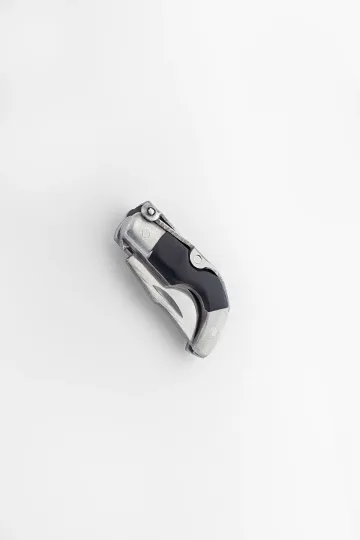
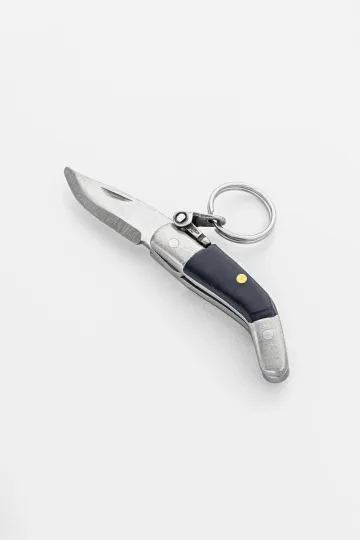
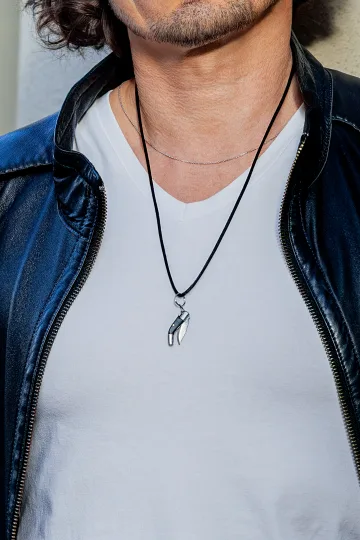
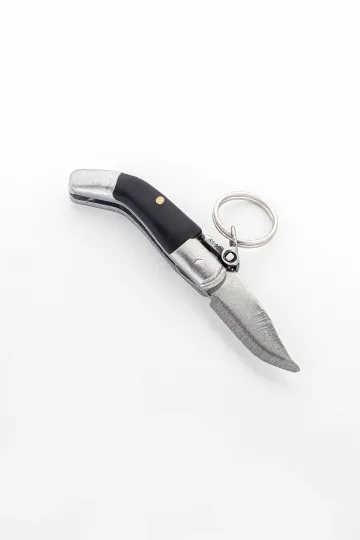
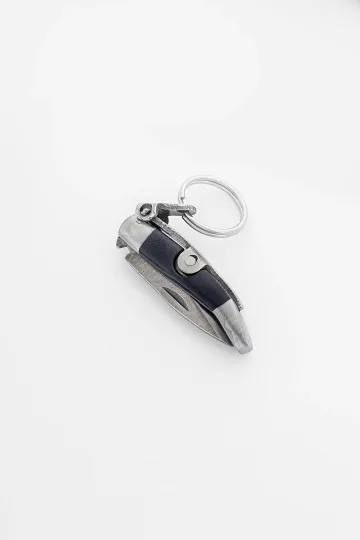
CAPAORA mini knife pendant
The 18th-century Spanish navaja in miniature: 40 mm of stainless steel, a real folding mechanism and a Palanquilla lock that clicks. An affordable gift to remember.
Authentic · Ships from Spain · 14-day returns
What determines the value of blue spinel
The price of blue spinel comes together from several factors, and understanding them helps you avoid overpaying and avoid letting a good stone slip away.
Cobalt against iron. This is the main watershed. A cobalt spinel with a vivid neon blue costs several times more than an iron-coloured grey-blue of the same size. The difference in colour is obvious to the eye, and a lab confirms the cobalt by spectroscopy.
Origin with a certificate. For rare stones, a lab can state the country of mining. Vietnamese Luc Yen as a source of vivid cobalt blue is prized in its own right. A certificate from a reputable gemmological lab on a large stone pays for itself: it confirms both natural origin and the absence of treatment.
Natural state and no enhancement. Because blue spinel is usually not heated, an "untreated" document is the norm for it rather than a rarity. But that is exactly why any "enhanced" stone deserves caution: it lowers the value.
Where spinel beats sapphire on price. Sapphire is almost always heat-treated to improve colour, and a natural, untreated sapphire is expensive. A spinel of the same deep blue is naturally that colour to begin with and yet cheaper. The buyer gets rarity without treatment for more modest money. The same logic of the smart choice works with tanzanite and with blue zircons.
Star spinel and the cat's-eye effect
Now and then spinel shows optical effects that arise from inclusions. If the finest needles (usually rutile) are lined up inside the stone in parallel rows, the light reflected off them gathers into a band. One set of needles gives a "cat's eye" (chatoyancy), a line of light gliding across the cabochon. Several intersecting systems give a star of rays, as in star sapphires.
Such stones are cut not with facets but en cabochon, a smooth dome, otherwise the effect will not appear. Star blue spinel is a great rarity and found mostly among collectors. It almost never turns up in ordinary retail, but it is useful to know about: a smooth blue cabochon with a star or band of light is not a flaw and not a fake, but a valuable natural display.
Leave your email, we'll send your discount code. No spam, unsubscribe anytime.
The code arrives by email, valid on your first order.
Caring for blue spinel
A hardness of 8 makes spinel a convenient stone for daily wear. It is tougher than most coloured gems and does not mind everyday contact. Still, a few rules will extend the life of a piece.
Cleaning
The safest method is warm water with a drop of mild soap and a soft brush (a soft-bristled toothbrush will do). Clean gently, rinse in clean water, dry with a soft cloth. That is enough for any household grime.
Ultrasonic and steam cleaning are best avoided, especially if the stone has inclusions or fine fractures: vibration and a sudden change in temperature can open them up. The stone has no need of aggressive chemicals.
Storage
Spinel is hard and can itself scratch softer stones lying next to it: pearl, opal, turquoise. And the other way round, sapphire or diamond will scratch it. So a piece is best stored on its own: in a soft pouch or a separate compartment of a jewellery box. Away from direct sun and sources of strong heat.
Wearability
In everyday wear a spinel ring takes almost anything, but a direct blow against a hard surface is something no faceted stone likes: a sharp knock can chip an edge of a facet. Before sport, heavy work with the hands, or cleaning with abrasives, it is sensible to take the piece off. Strong heat (open flame, soldering nearby) is also best avoided.
Symbolism: what the traditions say
Here, briefly and honestly. Spinel, like many blue stones, trails a wake of beliefs: in various traditions it was linked with clarity of thought, calm, communication. The stone has no proven physical or healing action; no serious study confirms anything of the kind. Spinel is worth wearing because it is beautiful and pleasant, not for an effect that does not exist.
The stone's historical role is more prosaic than any esoterica and yet more interesting for it: spinel was a symbol of status for centuries simply because a large, clean gem cost a great deal and adorned crowns. That is its true "meaning".
Why people choose blue spinel
There is almost always something behind the choice of a stone besides its colour. Blue spinel attracts a particular kind of buyer, and it is worth understanding that logic before committing.
The depth of sapphire without the loud name
A great many people are drawn to precisely the fact that spinel delivers a near-sapphire blue without demanding a sapphire price and without the heat treatment that is standard practice on the other stone. It is the choice of somebody who cares about the colour and the object itself rather than about the line on the label. The same quiet, self-assured motive connects spinel enthusiasts with the people who buy tanzanite or a fine blue zircon instead of the obvious option.
Honesty as a value
The absence of routine heat treatment makes spinel appealing to anyone who cares that the stone is natural exactly as it came out of the ground. In a market where nearly every blue gem has been improved in some way, untreated spinel feels like a rare piece of straightforwardness. That is a rational argument rather than a sentimental one, and for many buyers it outweighs a more famous name entirely.
A stone for people who dislike noise
Blue spinel is seldom loud. Its deep tone works with a composed, collected look rather than against it, and the people who choose it tend to prefer considered depth to obvious sparkle. It is a stone of character rather than a stone of effect, and that is most of its appeal.
Send a friend a discount code, they save on their first order.
Blue spinel in art and culture
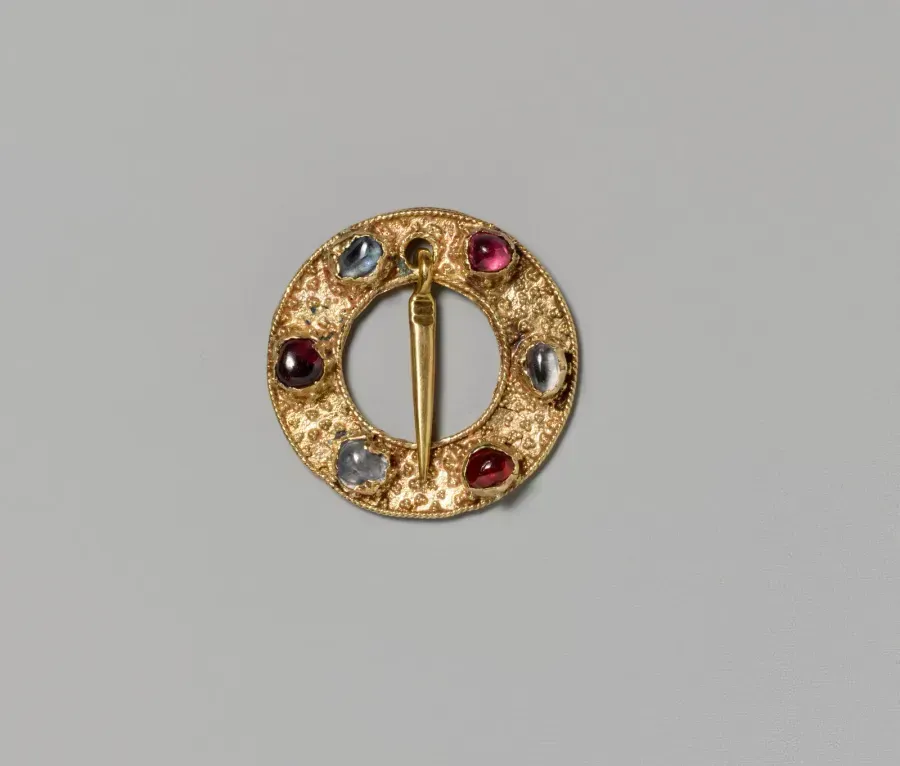
The history of the stone survives in the crowns, but it survives just as clearly in the ordinary objects that have come down to us. Medieval brooches and book covers, where blue stones are set without regard for what they actually are, read today like a frozen argument between the mineralogist and the goldsmith: the maker put sapphire and blue spinel side by side because what mattered to him was the colour, not the chemistry. Museum collections of coloured stones are full of these mixed pieces, and they demonstrate better than any textbook how long spinel went unnoticed as a separate material.
Carved stones and the inscribed crystals of the East
In the East a large spinel was not merely set, it was carved. Owners' names, titles, and regnal dates were engraved directly onto the surface of the stone, and that inscription turned a gem into something between a seal and a family tree. The practice was commoner on red crystals than on blue ones, but the custom itself tells you how the material was regarded: spinel was valued highly enough to be trusted with a text that generations would read. Several such inscribed stones are in public collections in Britain, and they are among the few gems anywhere that carry their own documented ownership on their face.
A collector's stone rather than an advertised one
Unlike most gems, blue spinel never built a reputation through showrooms and campaigns. It was rediscovered by gemmologists and collectors who valued the purity of its colour and the fact that it comes untreated. Its cultural trace is therefore quiet but durable: it rests on the people who know the material rather than on fashion, which is an unusual position for a coloured stone to occupy and a large part of why prices for the best examples have risen without any promotional push behind them.
Surprising facts about blue spinel
Spinel is a stone that rewards a second look, and several things about it are genuinely unexpected.
The most famous "ruby" in the world is a spinel
The Black Prince's Ruby in the Imperial State Crown, mounted where the whole world sees it at every coronation, is not a ruby at all. It is a red spinel of about 170 carats with a drill hole through it from an older setting. The name was fixed long before anyone could tell the two minerals apart, and it has simply been kept.
Cobalt blue is rare because of the chemistry of the earth itself
Cobalt is around a thousand times scarcer than iron in the crust, and it is scarcer still in the fluids that move through the metamorphosed limestone where spinel grows. The vivid blues therefore depend on a geological coincidence that occurs in only a few places on the planet, which is why they behave like collectors' items rather than like a normal supply of gemstones.
Natural crystals grow as ready-made octahedra
Spinel crystallises in the cubic system and arrives out of the ground as sharp, complete eight-sided pyramids, often so regular that they look cut. Miners washing gem gravels pick them out by shape alone. The word spinel is generally traced to the Latin for a thorn, after those pointed crystals.
Spinel is almost never improved by heat
Sapphire and ruby are routinely heated to shift their colour and clarity, and the practice is so standard that untreated material commands a premium. Spinel is different: the great majority of what reaches the market has had nothing done to it, because heating does not reliably improve it. What you see in the stone is what the earth made.
The stone changes its mood with the light
Iron-bearing blue spinel behaves quite differently under daylight and under warm indoor lighting, deepening towards a greyer or inkier tone in the evening. This is not the dramatic switch of a colour-change garnet, but it is noticeable, and it is worth viewing any stone under both conditions before buying rather than trusting a single lighting setup in a shop.
It glows red under ultraviolet
Red spinel fluoresces strongly under longwave ultraviolet, a clean crimson glow caused by chromium, and this is one of the quick tests that separates it from garnet. Blue spinel usually stays inert, while the twentieth-century synthetic blue material frequently shows a chalky greenish or bluish glow, which makes an ultraviolet lamp a useful first filter on a vintage piece.
Spinel and magnetite are family
The spinel group is a whole family of minerals sharing the same structural template, and magnetite, the naturally magnetic iron oxide that has been used in compasses for a thousand years, is one of its members. The gem in a ring and the lodestone in a museum case are built on the same architectural plan, with different atoms occupying the same positions in the lattice.
Buying it as a gift? Each one arrives ready to give.
 A branded Zevira box and a little card come with every order.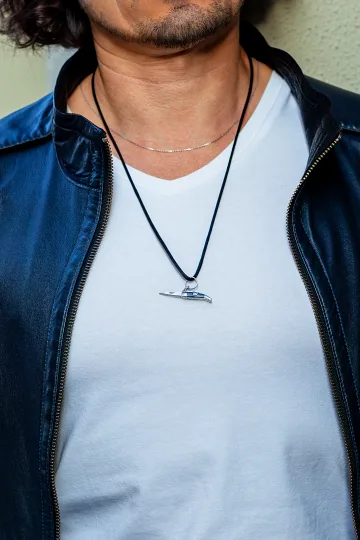







Frequently asked questions about blue spinel
How is blue spinel different from blue sapphire?
They are different minerals. Sapphire is corundum (Al₂O₃), while spinel is an oxide of magnesium and aluminium (MgAl₂O₄). Sapphire has a trigonal lattice, double refraction and pleochroism; spinel has a cubic lattice and a complete absence of pleochroism. Sapphire is harder (9 against 8) and heavier (density around 4.0 against 3.6). For a similar beauty, spinel is usually more affordable than sapphire.
Can spinel be worn every day?
Yes. A Mohs hardness of 8 makes it suitable for everyday jewellery, rings included. You need only avoid direct blows and abrasives.
What colours blue spinel?
Two elements. Iron gives a darker, greyish blue, and those stones are more common. Cobalt gives a bright, clean, almost neon blue. That is the rare and most valuable variety.
Where does the finest spinel come from?
Historically from Badakhshan on the border of Tajikistan and Afghanistan. Today gem-quality spinel is also mined in Myanmar (Mogok), Sri Lanka (Ratnapura), Tanzania (Mahenge) and Vietnam (Luc Yen).
Is it true the famous "rubies" in crowns turned out to be spinel?
Yes. A number of celebrated historical "rubies" proved by composition to be red spinel. Before instruments arrived, a large red stone was simply called a ruby, and the old trade name for spinel, "balas ruby", came from the name of the Balakhshan region.
Does synthetic spinel exist?
Yes, it has been grown since the early twentieth century, most often by the Verneuil method. In composition it is identical to the natural stone. You tell it apart by inclusions: synthetic can have rounded gas bubbles and curved growth lines, while natural spinel contains characteristic tiny crystals.
Is spinel heat-treated?
Usually not. Unlike most sapphires, blue spinel is more often sold without colour enhancement. This is one of its merits.
How do I clean spinel at home?
Warm water, a drop of mild soap, a soft brush. Rinse and dry with a cloth. Ultrasonic and steam are best avoided, especially if the stone has inclusions.
Does spinel fade in the sun?
No, spinel's colour is stable to light. Storing it away from the sun is a matter of general good practice, not a risk of fading.
Is spinel suitable for an engagement ring?
Yes. A hardness of 8 and good toughness make it a sensible choice for a ring worn constantly. A setting in white gold, platinum or silver brings out the blue.
Rings, earrings and pendants with blue stones in 925 silver and gold, with engraving available.
Wear the symbol, don't just read about it. These are in stock:


About Zevira
Blue spinel is an honest stone. It was taken for sapphire for centuries not through any deception but because it really is beautiful: a deep blue, a clean shine, a hardness that holds up to daily wear. Today it has no need to pass for anything.
The Zevira catalogue carries jewellery with blue stones in 925 silver and gold. The cool metal brings out the blue, and the shape of the setting is worked out so the stone is protected while still revealing its colour. If you want deep blue without overpaying, spinel is exactly that.