Chandelier and cascade earrings: tiers of light right at the face
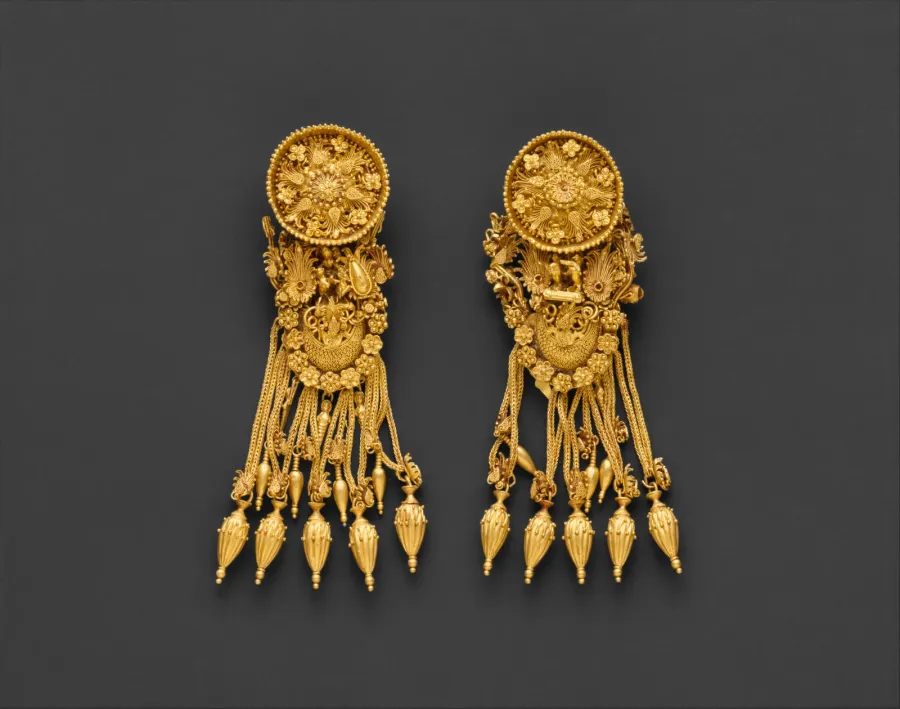
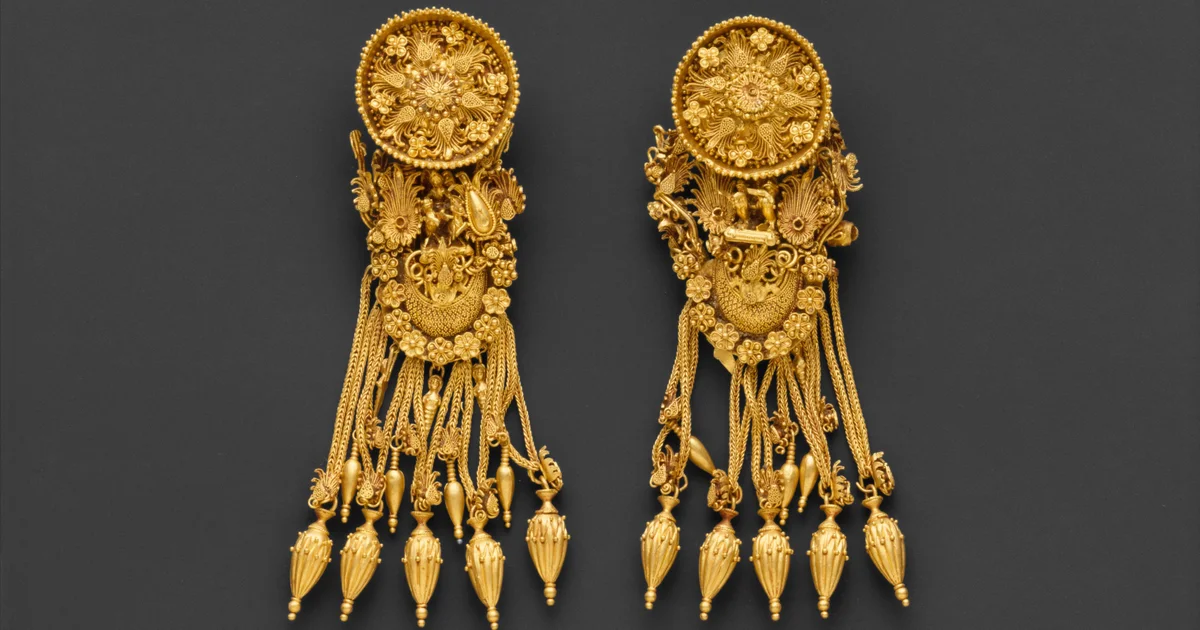
Chandelier earrings are named for their plain resemblance to a multi-tiered crystal chandelier, and they flourished in the same opulent era as the ceiling fixtures themselves, the eighteenth century. Several horizontal bars, each one trailing a row of moving drops, and at every turn of the head the whole structure flares and trembles with light. One earring shape, designed in the image of a lighting fixture.
A chandelier is not just any long earring, and not every dangling thing in a row. A chandelier is architecture: tiers, branches, rows of swaying elements that catch light from a dozen points at once. A cascade works differently, it pours downward in a stream with no rigid tiers. A drop hangs from a single pendant, a stud sits at the lobe. Chandelier and cascade are about volume, movement and spectacle right at the face.
Below we sort out how a chandelier differs from a cascade, a drop earring and a tassel, where the name came from and how the shape survived Baroque girandoles, Indian weddings, Art Deco and the Bollywood screen. We talk about who they suit by face shape and neck, how not to stretch the lobe with weight, which hairstyles and necklines to wear them with, which occasions to save them for and how to choose a pair for a bride. And of course a separate section of facts that surprise.
What chandelier earrings are and how they differ from cascade, drop and tassel styles
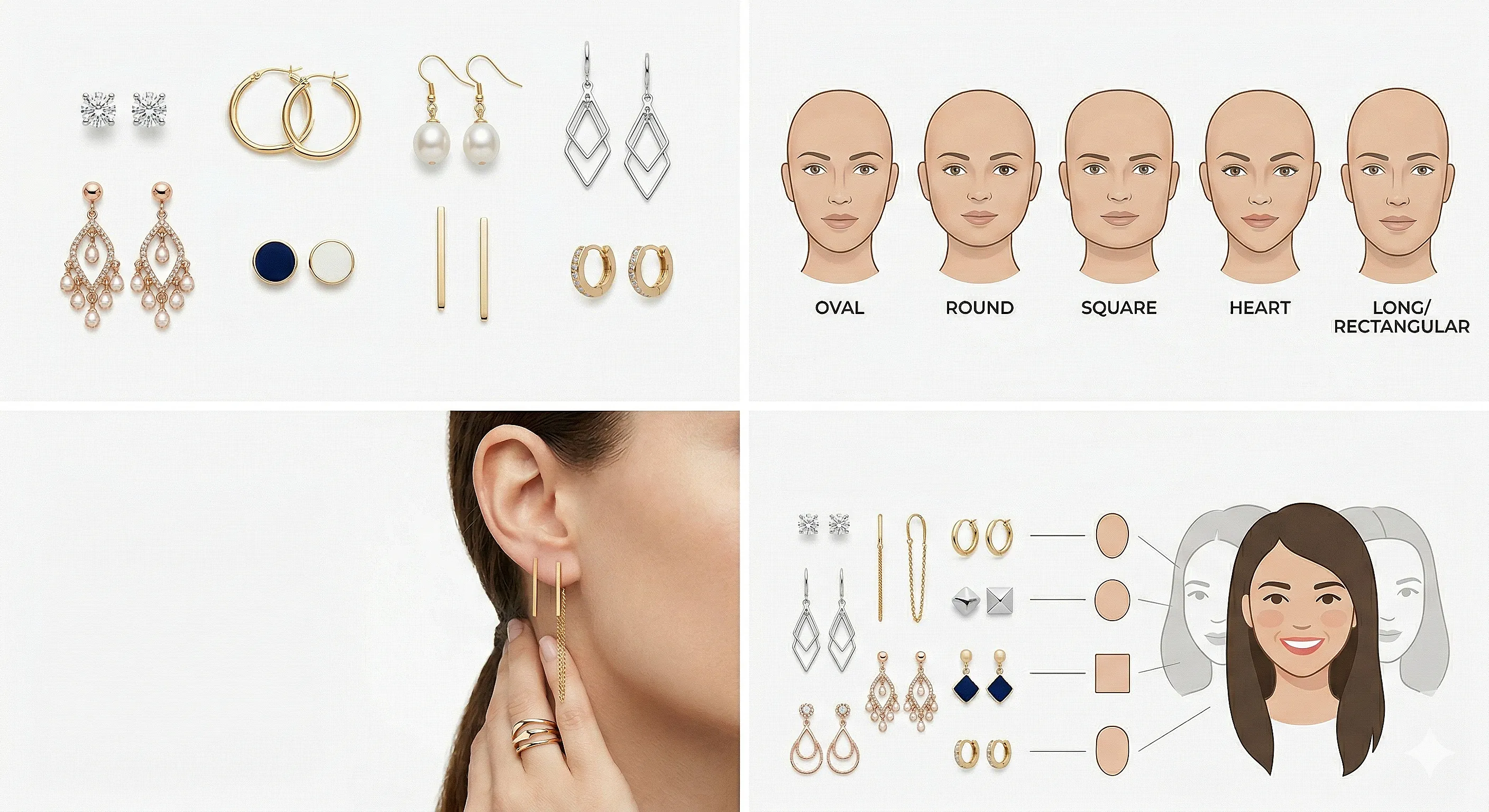
The phrase "dangle earring" is a broad parent term. It covers everything that hangs below the lobe: the single-pendant drop, the thread tassel, the cascade and the chandelier. So calling a chandelier simply a "dangle" is technically correct, but it is rather like calling an oak "a tree". The precise name helps you understand how a piece behaves at the face and which occasion it suits. We laid out the full map of all earring types in the earring types guide by face shape; here we cover only the tiered and cascading branch.
The chandelier earring: tiered architecture
The defining feature of a chandelier is horizontal bars or arcs, set in tiers one beneath the other, with a row of moving drops trailing from each tier. The top point fastens at the lobe, the form widens toward the bottom, and the overall silhouette comes out triangular or fan-like, narrow at the top, wide below. The drops sway along several axes at once, so when the head moves the chandelier shimmers like a ceiling fixture in a draft, rather than swinging quietly along a single line.
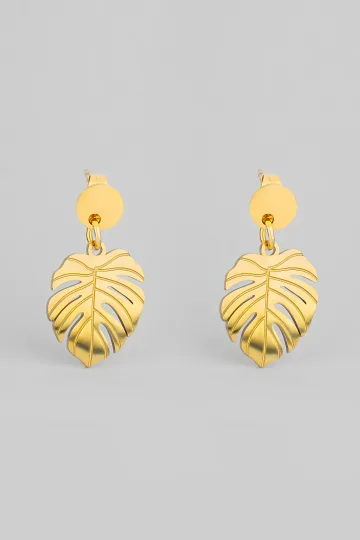
Wear the symbol, don't just read about it. These are in stock:






A chandelier has a noticeable size. Most often the length runs from forty millimetres upward, and the width of the lowest tier can exceed the lobe itself. This is a piece you can see across a room, and it was deliberately built to be noticed.
The cascade earring: a downward stream with no tiers
A cascade is built on a different principle. There are no rigid horizontal bars; the elements pour downward in a free stream, like a small waterfall. The word "cascade" means just that, a stepped fall of water. Chains of varying length, a row of stones, strands of pearls, drops descending one after another, all of it creates a sense of flowing movement rather than a tiered grid.
The line is thin, and at the edges a single earring can be both at once. If the piece reads with clear horizontal levels, it leans toward a chandelier. If the elements flow downward with no steps, in one continuous train, it is a cascade. A cascade is usually softer and more mobile, a chandelier fuller and more geometric.
How chandelier and cascade differ from drop and tassel
A drop is a single pendant below the lobe, roughly ten to thirty millimetres long, with minimal swing. Quiet, neat, for every day. A detailed look at this shape is in the article on drop earrings. A chandelier differs from a drop in its many tiers and strong movement: where a drop sets a single vertical line, a chandelier opens out a whole fan.
The tassel stands apart. It is a bunch of free threads, chains or silk fibres gathered at one point and hanging in an even "tail". A tassel also flows and sways, but with no tiers and no fanning out: it is a stream of identical threads from a single crown. A cascade differs from a tassel in that its elements vary in length and often in type, descending in steps rather than hanging in an even bunch.
Where the line runs with threaders and jackets
Two neighbouring shapes often sit close to the chandelier and cascade, and they are easy to confuse. A threader is a thin chain pulled right through the piercing, so that one end hangs in front and the other behind; it has no tiers and no fan, only one free strand. A jacket (that is an earring in two parts: a stud in front and a removable pendant that slips onto the post behind the lobe) also gives a hanging element, but strictly as one piece below the lobe. A cascade differs from a threader in that several elements of varying length descend in steps, rather than one strand passing through. From a jacket, both cascade and chandelier differ in their many elements and their movement: a jacket hangs one neat pendant, a chandelier opens out a whole grid.
In short: a stud is static, a drop moves moderately, a cascade streams, a tassel sways in a bunch, a threader hangs as a single strand, a jacket hangs one pendant below the lobe, and a chandelier opens out in tiers and shimmers more than any of them. This difference is exactly what decides where each earring belongs.
Where the name came from and how the chandelier moved through the centuries
The chandelier is one of those jewellery shapes whose name arrived from an entirely different field. The earring was named after a lighting fixture, and not by accident: both things were born from the same idea, to catch and multiply light with a mass of hanging crystal drops.
The girandole: a Baroque forebear
The direct ancestor of the chandelier is the girandole earring, which peaked in the seventeenth and eighteenth centuries. A girandole (a French word that meant at once a pinwheel firework and a branched candelabrum) named, in jewellery, an earring of a strict scheme: a large top element, a "bow" or rosette, a connecting link below it, and at the bottom three drops, the central one longer, the two side ones shorter. The result was a symmetrical fan of three drops, echoing the outline of a table candelabrum with three candles.
Girandoles were worn at the courts of Louis XIV and Louis XV. They were made in silver with rose-cut diamonds, in topaz, in rock crystal, and in an evening hall by candlelight they flared exactly as the real candelabra on the tables did. Hence the logic: the earring imitated the light source that lit it, and doubled its glow at a woman's face.
The East: India and the Middle East
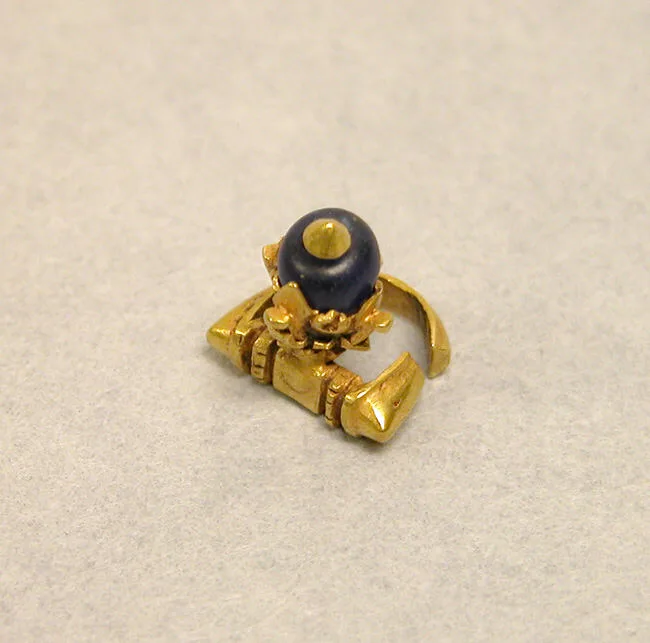
Alongside European Baroque, a rich tradition of tiered earrings lived on in the East. In India, multi-level hanging earrings were part of bridal and temple dress long before Versailles thought up the girandole. They were made in high-karat gold, strung with pearls, rubies and emeralds, and finished with small drops that chimed at every movement. Part of the weight of such earrings was carried on a fine chain looped behind the ear and into the hair, so the lobe would not suffer, and we will come back to that trick in the section on weight.
In the Middle East and North Africa, tiered and cascading earrings in gold and silver, with coin drops and turquoise, were at once adornment and wearable dowry, capital that a woman kept on her person. The chime of the drops as she walked was considered part of the look, not a side effect.
Art Deco: geometry and the long line
In the nineteen-twenties the chandelier saw a fresh revival in the Art Deco style. The short haircuts and bare necks of that era practically demanded a long vertical at the face, and the earring answered. Art Deco gave the chandelier a strict geometry: stepped tiers, clean lines, the contrast of diamond brilliance against the deep colour of emerald, sapphire, onyx and coral. Platinum allowed an openwork, almost lacy grid that held stones on thin bridges. This was the skyscraper chandelier, vertical, graphic, sparkling.
Bollywood and the return of the Eastern look
In Indian cinema, tiered and cascading earrings became the visual signature of the festive, bridal, dancing look. Heavy gold chandeliers with pearls and coloured stones, glinting on screen at every move of a dance, fixed this shape with the status of a piece for celebration and the stage. The Bollywood screen brought the fashion for the large Eastern chandelier far beyond India, and it still feeds an entire strand of festive style.
A return to the modern wardrobe
Today the chandelier and the cascade have come back in two guises at once. The first is evening classic: a lavish, sparkling earring for a celebration, a wedding, the stage, a grand entrance. The second is a lightened everyday version: a light cascade of thin chains, fine pearls or coloured glass, worn with jeans and pinned-up hair simply for the movement and the shine. A shape born of the Baroque candelabrum has comfortably outlived the era of the candle, surviving into a time when bulbs light the rooms, and the chandelier in the ears is worn to a wedding and to a walk alike.
A chandelier is the prima donna. Clear the necklace, sweep the hair up, and do not you dare bury her under a turtleneck.
Which hairstyles and necklines to wear chandelier earrings with
I have hung chandeliers on brides, presenters and models for years, and it comes down to one thing: a chandelier wants a stage, not a floral backdrop. Here is what actually works right by the face.
Which hairstyle should I wear a chandelier with? I recommend hair gathered up or back: a high bun, a sleek ponytail, a chignon. The earring is then visible in full, from the top bar to the lowest tier, and swings freely. Loose strands hide the drops and kill the movement, so I either pin the hair up or sweep it off one side.
Which neckline works with a chandelier? I suggest a bare neck and shoulders: a boat neck, a bandeau, a deep neckline, bare shoulders. On a clean backdrop the fan of the earring reads all the way down. A high collar or a turtleneck argues with a chandelier and the piece runs into the fabric. Under a closed top I choose a graphic cascade that reads as a line, not a lavish tiered chandelier.
And if my hair is down? Then I reach for a light long cascade rather than a full chandelier. A thin stream of chains or fine pearls peeks out from the strands and adds movement. The one thing that matters: the lower edge of the cascade should drop well below the hairline, or it gets lost.
What do I put on my neck with a chandelier? Almost nothing. The chandelier is the soloist, and a big necklace beside it fights for the same attention, so both lose. I keep the neck bare or wear a thin, quiet chain. If a necklace is a must, choose a simpler chandelier and a softer necklace.
How do I keep the look from overloading? I keep one accent. If the chandelier is in the ears, the dress stays simple and the hands stay calm: one ring, a thin bracelet. I move the make-up to the lips or an even tone, or the upper face drowns in shimmer. A chandelier sounds at full volume only where everything around it is quiet.

Turn on your camera, pick earrings, a pendant or a ring, and see the piece on yourself in real time.
Switch items in one tap.
Everything runs in your browser: no photo or video is ever uploaded.
Customer reviews
Zevira is a real jewellery shop. Genuine payments, deliveries and customer thank-yous.
🥰🥰🥰 gracias
Ok, ¡gracias! 🙂
Who chandelier earrings suit by face shape and neck type
An earring at the face works like the frame around a picture: it sets the direction of the gaze and either argues with or agrees with the natural lines. Chandelier and cascade are strong, conspicuous shapes, so the rules here feel sharper than they do with a quiet stud. We covered the general mechanics of matching jewellery to facial features in the article on jewellery by face shape; below, only the tiered and cascading earring.
Round face: the chandelier elongates
A chandelier and a cascade suit a round face about as well as anything can. The vertical, downward-tapering shape breaks up the roundness of the cheeks and adds length to the face, leading the gaze down and visually stretching the oval. Elongated, narrow chandeliers with a pronounced vertical work better than wide fans. A cascade of stepped chains is good too: the downward stream is slimming.
Square face: the cascade softens the angles
A square or rectangular face with a pronounced jaw suits earrings with rounded, flowing elements. A cascade with gentle curves, a chandelier with oval or teardrop drops, softens the sharp angles of the jaw and adds softness. It is worth avoiding hard geometry with right angles in the earring itself, which underlines the angularity of the face instead of balancing it.
Heart-shaped face: balance toward the bottom
A heart-shaped face has wide cheekbones and a narrow chin. Here a chandelier that widens toward the bottom works well: the wide lower tier adds volume around the chin and balances the wide top. The result is a visual balance, the inverted triangle of the face meeting the downward-widening fan of the earring.
Long and oval face: careful with length
A long, elongated face calls for care with a chandelier. A very long vertical earring lengthens an already long oval, and the face stretches further still. If the face is long, it is better to take a shorter, wider chandelier with the accent on the horizontal volume of the tiers rather than on length. A rounded, fanning cascade adds width and balances the vertical. The oval face is the luckiest of all: almost any shape suits it, and you can choose by occasion and mood.
Neck type: neck length decides a lot
The neck matters no less than the face shape. A long, slim neck gives the chandelier room: the piece hangs beautifully, runs into nothing, and the length reads as elegant. A very long chandelier is contraindicated for a short neck: it shortens the distance from chin to shoulders even more and "eats" the neck. A short neck is better served by a compact chandelier that ends above the jawline, or a neat cascade of medium length. The main rule is simple: the shorter the neck, the higher the earring should end.
Upload a photo of your pet, someone you love, or an object. We'll build a 3D model and hand-cast it in pewter.



Length and weight: lobe comfort and the health of the ear
The chandelier is the heaviest category among dangle earrings, so weight here is not a cosmetic detail but a matter of ear health. A beautiful earring that turns the lobe into a burning point after two hours does not work on any occasion.
How length changes the look
The length of a chandelier sets the volume of the look. A short chandelier ending at the jawline looks dressy but restrained, and you can wear it in the daytime. A medium one, to the middle of the neck, is already a pronounced evening accent. A long one, to the shoulder, is a full spectacle piece for the stage, a wedding, a grand entrance. The longer the earring, the less of everything else there should be in the look, or the picture overloads.
Weight and the stretched lobe
The main risk with a heavy chandelier is stretching of the lobe. The skin and tissue of the lobe are elastic, but not endlessly: constant wear of heavy earrings year after year lengthens the piercing, the hole stretches into a slit, and in extreme cases the piercing can tear. A thin lobe and an old, well-worn piercing are especially vulnerable.
A few rules cut the risk almost to nothing. For everyday wear, choose light chandeliers: openwork metal, hollow elements, light stones like crystal and glass rather than dense gems. Save the heavy precious chandelier for separate evenings, rather than wearing it all day. A good, snugly seated lever-back clasp is more reliable than a thin hook: it stops the earring from freely dragging the piercing down with its full weight.
An old trick: shifting the weight behind the ear
Eastern jewellers solved the weight problem centuries ago. On heavy Indian bridal earrings, part of the load is shifted onto a fine chain or hook looped behind the ear and fixed in the hair or to the strands. Then the lobe carries only a share of the weight, and the rest is held by the support behind the ear. The trick is alive today: many large chandeliers have an extra support chain. If you plan to wear a heavy chandelier for a long stretch, look for a model with such support or a very light construction.



Which occasions chandelier earrings are made for
Chandelier and cascade are earrings of the moment. They have their own territory where they sound perfect, and there are situations where they are out of place. Understanding that line saves both nerves and money.
Evening and the grand entrance
Evening is the chandelier's native element. The dimmed light of a restaurant or a hall, candles, lamps, all of it the earring catches and multiplies, exactly as its candelabrum ancestor intended. At a formal dinner, a premiere, an anniversary, a New Year's evening, a large sparkling chandelier at the face looks exactly as it should: festive and noticeable.
The wedding and the bridal look
The wedding is a large topic in its own right, and a separate section is devoted to it below. In short, chandelier and cascade are a classic choice for a bride: they give the face radiance in the frame and work with a gathered wedding hairstyle.
The Eastern and dancing look
For an Eastern, Indian, folk or stage look, a large tiered chandelier is almost obligatory. Here it is part of the costume: gold, coloured stones, pearls, the chime of the drops in movement. Dance, the stage, a themed celebration, all of it is territory where the chandelier is necessary, not merely fitting.
The stage and the shoot
On stage and in the frame the chandelier works like few other things: it reads from a distance, catches the spotlights, trembles and shimmers at every turn of the head. Performers, hosts and models put on a chandelier precisely for that far, moving shine.
Where the chandelier is out of place
And the other side: to the office, a business meeting, sport, every day, a large chandelier is almost always excessive. For everyday wear there is the lightened cascade or a short light chandelier, but the classic lavish evening earring looks out of place in a daytime business context. That is normal, every shape has its own stage.
Materials and stones: what a chandelier is built from
The chandelier is a generous shape, it holds many elements, and the choice of material decides the weight, the sound and the occasion. It is worth knowing the palette here, to understand exactly what you are choosing.
Filigree: lace out of metal
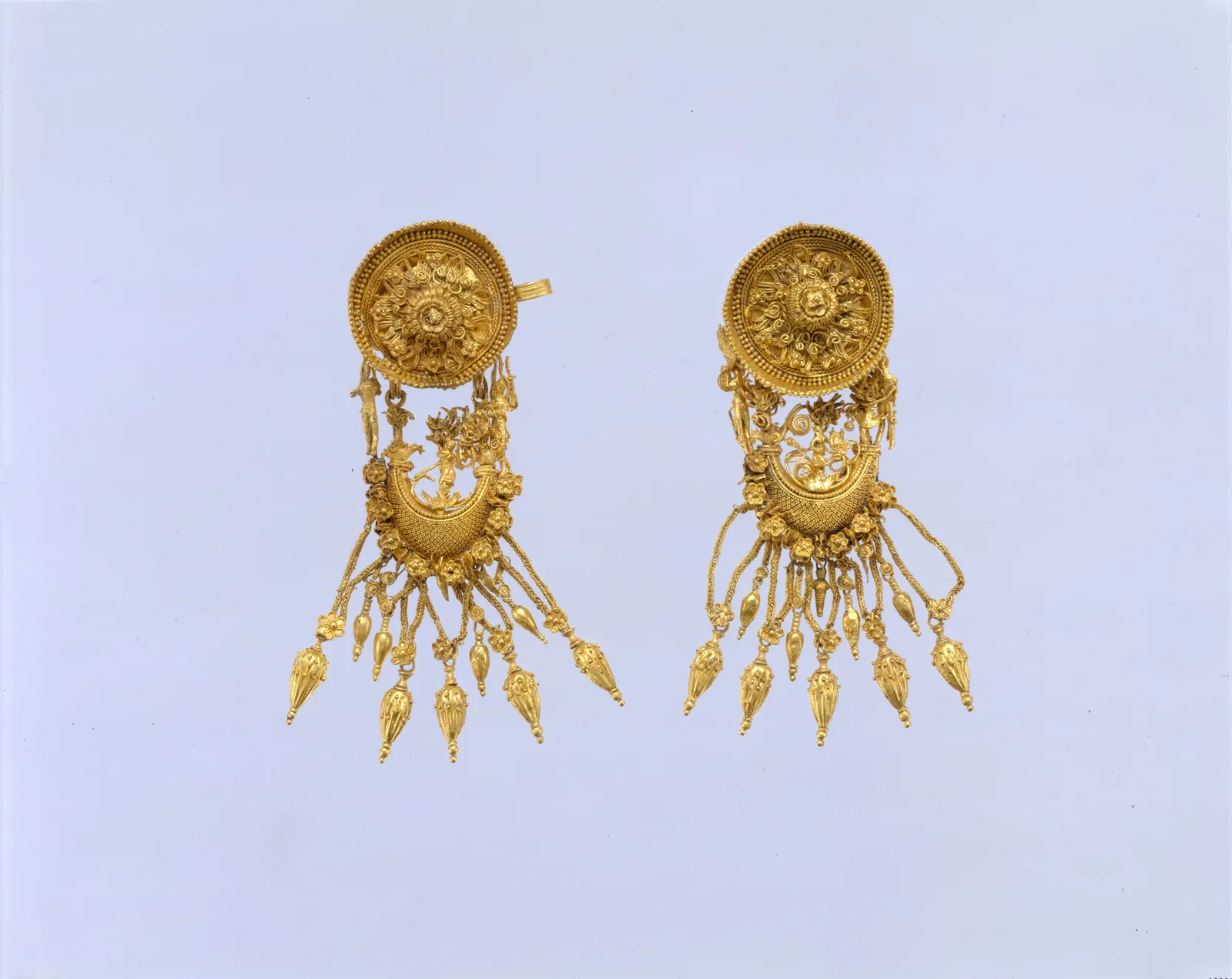
Filigree (a technique in which a pattern is laid out from fine twisted wire and tiny metal beads, soldered into an openwork grid) is ideal for a chandelier. It gives a rich, lacy look at very little weight: the piece looks massive, while in fact it is almost weightless, because there is air inside rather than solid metal. Filigree chandeliers in silver and gold are a classic of Mediterranean, Eastern and Spanish jewellery style, light and dressy at once.
Crystal and glass: light for modest money
Crystal and faceted glass are the most direct way to get that ceiling-chandelier effect. Faceted drops split the light into sparks, give a strong shimmer, and weigh little while costing little. The crystal chandelier is an easy entry into the category: maximum shine, modest weight, no strain on the lobe. If you want a sparkling fan for every celebration without investing in precious stones, crystal is an honest choice.
Pearl: a soft glow
Pearl gives a chandelier a different mood, not sparkling but soft, iridescent, warm. A cascade of fine pearls streams down with a calm light, with no sharp glints. A pearl chandelier looks nobler and quieter than a sparkling crystal one, which is why brides and lovers of restrained classic often choose it. More on the types and choice of pearl is in the complete pearl guide. Pearl is also lighter than many gems, which for a large earring is a plus.
Coloured stones: colour and depth
Coloured stones give a chandelier colour and character. Emerald green, sapphire blue, ruby and garnet red, smoky and golden quartz, coloured glass, all of it turns the earring from merely sparkling into coloured, to match the outfit and the mood. Art Deco built its chandeliers precisely on the contrast of colourless brilliance and saturated colour. Dense gems are heavier than crystal, so a large coloured chandelier is better made on a light openwork base.
Enamel: paint over metal
Enamel (a glassy coating fused onto metal and fired, giving a durable coloured layer) adds a painterly quality to a chandelier. Enamel flowers, peacock feathers, Eastern ornaments on the tiers of an earring give a deep, even colour that does not fade. Enamel is especially good in the Eastern and folk look, where the chandelier is already meant to be vivid and dressy.
The base: silver, gold and gold plate
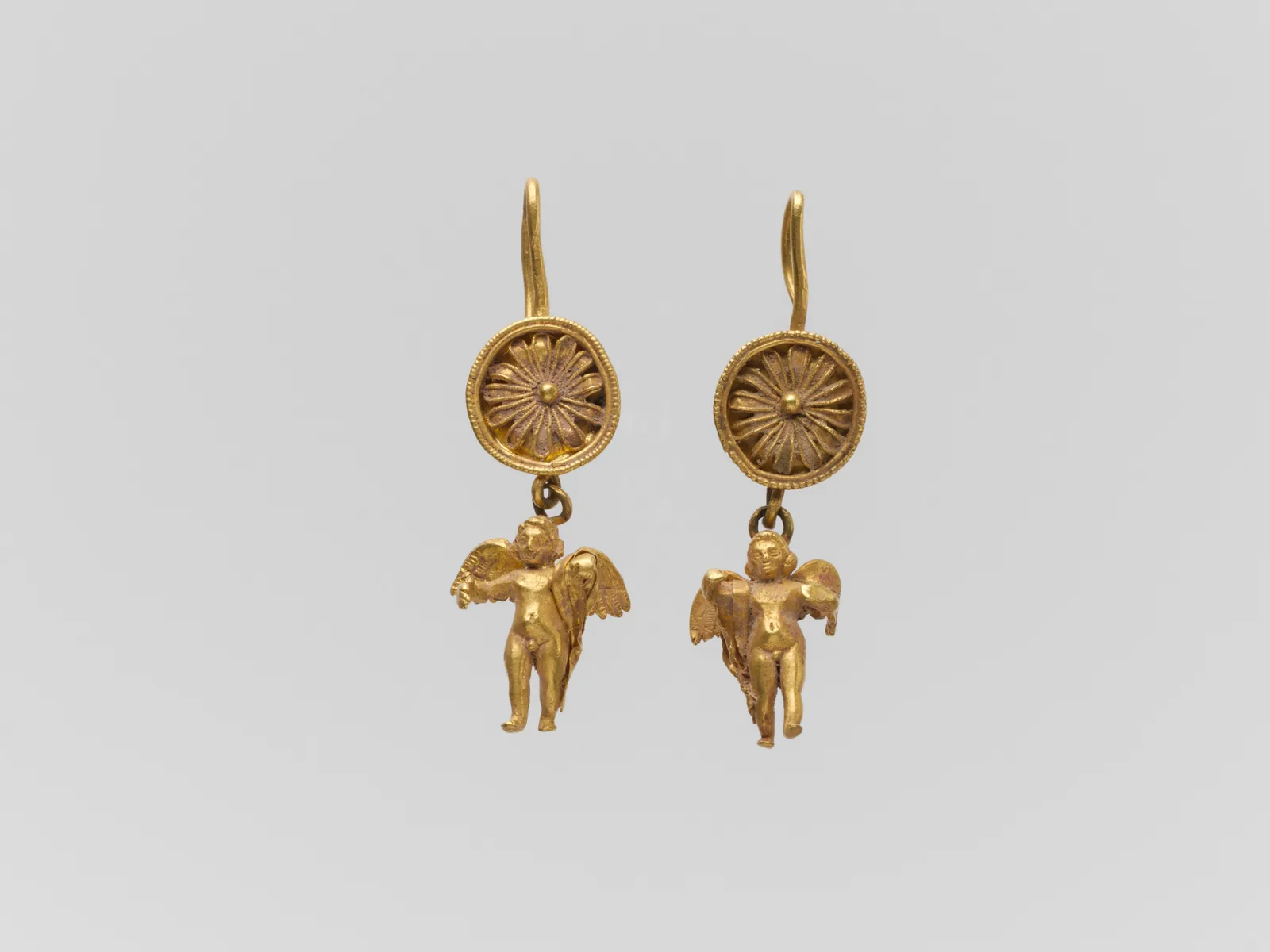
Beneath the stones and enamel a chandelier always has a metal base, and it decides the weight, the durability and the price. Silver is light, a nobly cool tone, holds openwork and filigree well, but tarnishes over time and needs dry storage and polishing. Gold is heavier, so a large gold chandelier is sensibly made on an openwork rather than a solid base, or the earring gains weight and loads the lobe. Gold-plated silver is a compromise: the look of gold at the weight and price of silver, only the coating needs protecting from friction and harsh chemistry, so the gold layer lasts longer. For everyday wear of a large chandelier a light openwork silver or plated base is almost always more comfortable than a massive cast one.
Leave your email, we'll send your discount code. No spam, unsubscribe anytime.
The code arrives by email, valid on your first order.
How to balance the look: the chandelier takes the solo
The main mistake with a chandelier is overload. The earring is already loud, fanning, moving, so the look around it should step aside and give it the stage. There is one law: the chandelier is the soloist, everything else is accompaniment.
Minimum at the neck
If there is a chandelier in the ears, the neck stays bare or nearly bare. No large necklace: two sparkling objects at the face fight for attention, and both lose. At best a thin, unobtrusive chain at the neck, or nothing at all. A bare neck also gives the chandelier that clean backdrop discussed above. If you really want a necklace, choose a simpler chandelier or a calmer cascade, and keep the necklace thin and quiet.
Calm hands and restrained eye makeup
Since a chandelier pulls the gaze to the face and the ears, it is better to mute the rest. Massive bracelets and large rings on both hands draw off part of the attention, so keep the hands restrained: one ring, a thin bracelet, no more. The same balance works with makeup: if the earrings sparkle and shimmer, an accent on the lips or an even tone fits better than heavy glittering eye makeup, or the upper face overloads with shine.
One accent in the look
The universal stylist's rule works here too: one main accent in a look. If you have chosen a chandelier, it is that accent. A simple-cut dress, sleek hair, a minimum of other jewellery, and the earring sounds at full strength. A richly embroidered dress plus a large chandelier plus a necklace plus bracelets is no longer a look but a display case.
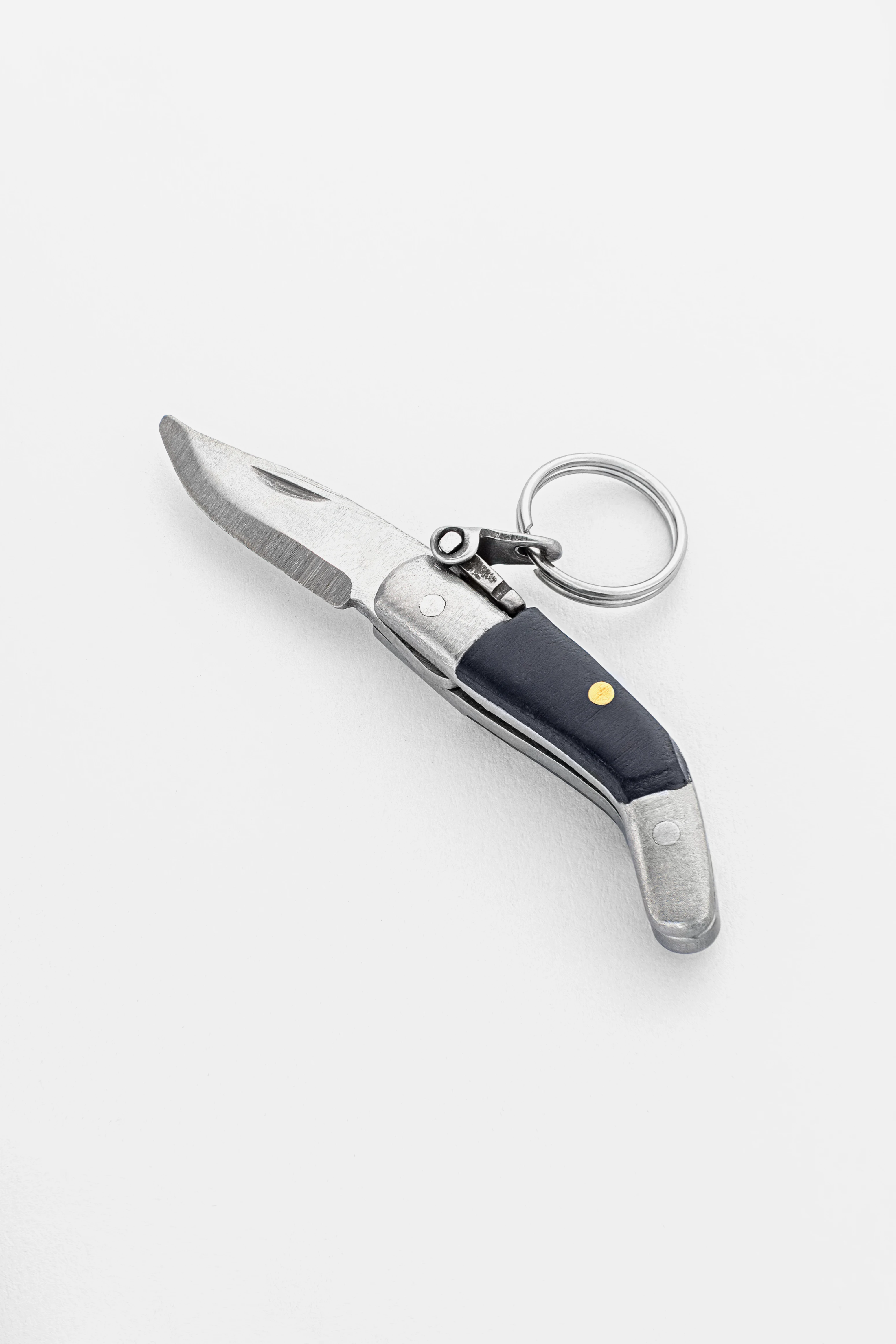
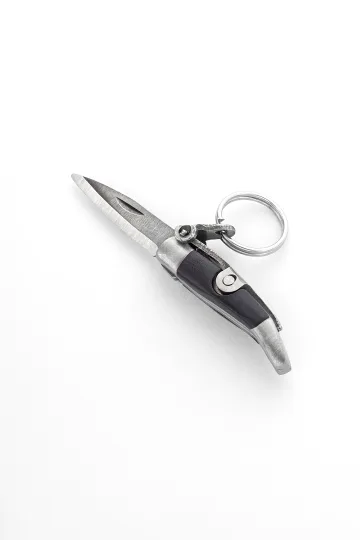
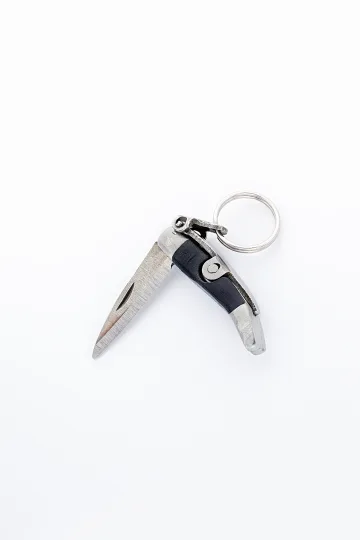
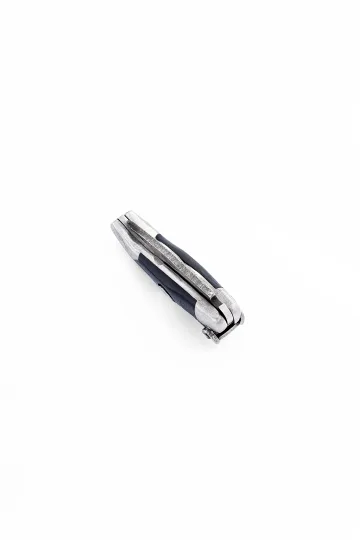
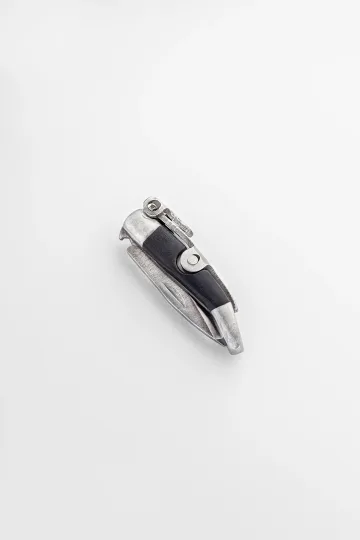
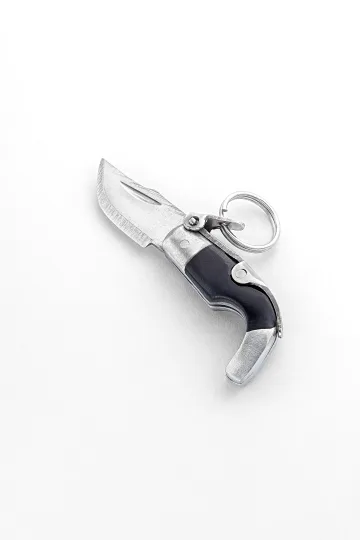
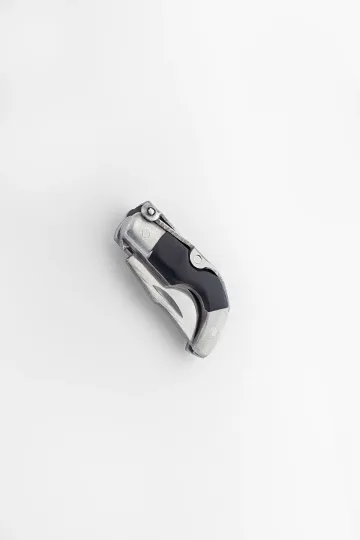
CAPAORA mini knife pendant
The 18th-century Spanish navaja in miniature: 40 mm of stainless steel, a real folding mechanism and a Palanquilla lock that clicks. An affordable gift to remember.
Authentic · Ships from Spain · 14-day returns
Chandelier earrings for the bride
The wedding is about the single greatest occasion for a chandelier in a lifetime, so it deserves its own discussion. Everything converges here: the solemnity of the moment, the gathered hairstyle, close-up photography and the wish to shine.
Why the chandelier suits a bride
A wedding hairstyle is almost always gathered: a bun, curls pinned up, a veil, an open face and neck. This is the ideal backdrop for a chandelier, the earring is visible in full and works to its limit. In a close-up frame a sparkling or softly glowing pearl chandelier gives the face radiance, brings the photograph to life, catches the light of the flash and the spotlights. It is no accident that chandelier and cascade have held a place in bridal classic for more than a century.
How to choose by outfit and hairstyle
If the dress is rich, embroidered, full of detail at the neckline, take a stricter chandelier: clean, not too wide, so it does not argue with the outfit. If the dress is of a simple, spare cut, you can allow a lavish chandelier, and it becomes the main piece of the look. Almost any length suits a veil and gathered hair, but check that the lower tier does not catch on the veil or tangle in it.
Weight across a long wedding day
A wedding day is long: the ceremony, the shoot, the reception, the dancing, hours on the feet and in the jewellery. So for a bride the weight of a chandelier is doubly critical. It is better to choose a light chandelier (filigree, crystal, fine pearl) or a model with a support chain behind the ear than a beautiful but heavy earring that turns the lobes into two burning points by evening. Beauty you cannot wear to the end of the celebration is a poor choice for the main day.
Facts that surprise
The chandelier has centuries of history behind it, and it hides more that is strange and curious than it seems at first glance.
The earring was named after a lighting fixture, not the other way around. First came the hanging crystal candelabra and ceiling chandeliers that caught and multiplied candlelight, and only then did jewellers make an earring in their image, so it would flare at the face the same way in a lit hall.
The word "girandole", which gave its name to the Baroque forebear of the chandelier, meant three different things at once: a branched candelabrum, a pinwheel firework scattering sparks in a circle, and the earring itself. All three were united by one idea, to scatter light or sparks in a fan from a single point.
Eastern jewellers solved the problem of the heavy earring long before the Europeans. Part of the weight of a large Indian chandelier was shifted onto a chain behind the ear, looped into the hair, and the lobe carried only a share of the load. The trick was invented centuries ago, and it is still in use.
The cascade earring took its name from a waterfall. "Cascade" means a stepped fall of water, and the earring is named so because its elements pour downward in a stream, in steps of varying length, echoing the movement of water over ledges.
In the nineteen-twenties the fashion for the short haircut literally created the demand for the chandelier. The bare neck and exposed ear called for a vertical at the face, and the long sparkling Art Deco chandelier answered that call more precisely than any other piece.
Heavy earrings were both adornment and capital. In the Middle East and North Africa, gold and silver tiered earrings with coin drops served as a wearable dowry: a woman kept her wealth on her person, in her ears and at her neck, and could dispose of it herself.
The longer your neck, the longer the chandelier can be, and the other way around. This is not a matter of taste but the geometry of proportion: a long earring on a short neck visually eats the already small distance from chin to shoulders, so a short neck suits a compact chandelier that ends above the jawline.
Send a friend a discount code, they save on their first order.
Care and storage: keeping the chandelier from tangling
A multi-tiered earring with a dozen moving drops has one signature problem: it catches and tangles. A chandelier thrown into a shared box greets you in the morning as a knot of linked chains and bent tiers. A little discipline in storage solves everything.
Store separately and hanging
The main rule: store each chandelier apart from other earrings, and ideally hanging or laid out flat, so the tiers and drops do not tangle with each other and with neighbouring pieces. An organiser holder with hooks, separate compartments in a box, individual soft pouches for each pair, all will do. The main thing is that the moving elements hang freely and do not interweave.
Guard against tugs and snags
When taking a chandelier off and putting it on, do it gently: the drops easily catch on hair, fabric, a scarf. A sharp tug bends the thin tiers and tears out the small links. Take the earrings off first, before you pull a dress or sweater over your head, then nothing will snag.
Cleaning by material
Clean a chandelier by its most delicate material. A pearl or enamel earring must not be soaked or rubbed with anything hard: only a soft dry or slightly damp cloth, no harsh chemistry. Metal with faceted stones is wiped with a soft brush and cloth, getting into the recesses of the openwork where dust collects. A silver chandelier is saved from tarnish by dry storage and periodic polishing with a soft silver cloth.
Plan the trip and the bag in advance
For travel a chandelier is packed so it does not knock about: in a hard case or a sturdy pouch, apart from other jewellery. Hanging each earring on a small piece of fabric or a card with holes is an old and reliable way to carry a chandelier home without knots and kinks.
Frequently asked questions
How do chandelier earrings differ from cascade ones? A chandelier is built in tiers: horizontal bars one beneath the other, with a row of drops trailing from each, and the silhouette widening downward in a fan. A cascade pours downward in a free stream with no rigid tiers, the elements descending in steps of varying length, like a waterfall. A chandelier is fuller and more geometric, a cascade softer and more mobile. At the edge a single earring can be both at once.
Who do chandelier earrings suit by face shape? Best of all a round face: the vertical tapering shape stretches the oval and breaks up the roundness of the cheeks. A square face suits chandeliers with rounded, flowing elements, which soften the angles of the jaw. A heart-shaped face is well served by a chandelier that widens toward the bottom. Very long chandeliers are contraindicated for a long, elongated face, which is better served by short and wide ones. Almost any shape suits an oval face.
Chandelier earrings are heavy, won't they stretch the lobe? With sensible wear, no. For everyday choose light chandeliers in openwork metal, crystal or fine pearl, and save the heavy precious ones for separate evenings. A snug lever-back clasp is more reliable than a thin hook. Large models can have a support chain behind the ear that shifts part of the weight off the lobe. Constant wear over many years of very heavy earrings does stretch the piercing, so weight is important to factor in.
What hairstyle should chandelier earrings be worn with? With hair gathered up or back: a high bun, a sleek ponytail, a chignon, anything that opens the ear and neck. Then the earring is visible in full and swings freely. Loose hair hides a chandelier and catches on the drops. If the hair is loose, sweep it back from at least one side, or take a longer chandelier so the lower tier comes out from under the strands.
Which neckline goes with a chandelier? A bare neck and shoulders: a boat neck, a bandeau, bare shoulders, a deep neckline. This gives the earring a clean backdrop. A high collar, a turtleneck, a buttoned-up shirt argue with a chandelier, which runs into the fabric and loses its air. Under a closed top it is better to take a graphic cascade as a line, or drop the chandelier in favour of a stud.
Can a chandelier be worn with a necklace? Better not. A chandelier is already a loud accent at the face, and a large necklace beside it takes away its attention, so both pieces lose. With a chandelier the neck is left bare or with a thin, unobtrusive chain. If a necklace is essential, choose a simpler chandelier or a calm cascade, and keep the necklace thin and quiet.
Are chandelier earrings suitable for a bride? Yes, it is a classic wedding choice. A gathered wedding hairstyle opens the ear and gives the chandelier an ideal backdrop, and in a close-up frame the earring adds radiance to the face. Under a rich dress take a stricter chandelier, under a spare one you can take a lavish one. The main thing is to choose a light model or one with support behind the ear, since a wedding day is long and a heavy earring will tire the lobes by evening.
How do I store chandelier earrings so they don't tangle? Each pair apart from other jewellery and hanging or laid out flat, so the tiers and drops do not link together. An organiser with hooks, separate compartments or soft pouches for each earring will do. Take a chandelier off before you pull clothing over your head, so the drops snag on nothing, and do not tug sharply, since the thin tiers bend easily.
Earrings that catch the light
The Zevira catalogue has both lavish evening chandeliers for a celebration and light cascades for every day. Choose a pair to match your face shape, occasion and hairstyle, and let the light work right at the face.
Find chandelier earringsBuying it as a gift? Each one arrives ready to give.
 A branded Zevira box and a little card come with every order.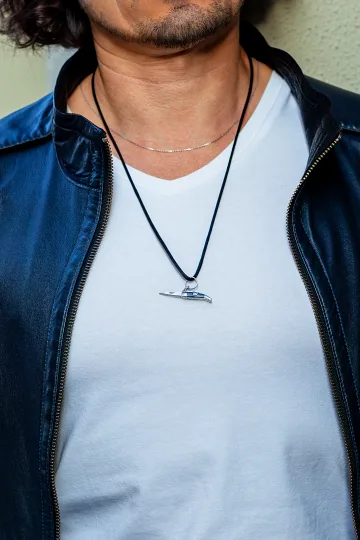








About Zevira
Zevira is jewellery in which form and meaning matter more than a label. We make earrings, pendants, rings and bracelets so that behind each piece stands a story, a material with character and a considered fit on the body. The chandelier and cascade earrings in our catalogue are gathered on the same principle: from lavish evening classic to a light everyday stream, with honest weight, reliable clasps and materials that are a pleasure to wear for a long time.
If you do not know where to start, look at the neighbouring pieces: the earring types guide by face shape, drop earrings and hoop earrings. And when you want shine right at the face, the chandelier and the cascade are already waiting.