Ear Stack: How to Build a Curated Ear Composition (Complete Guide)
Introduction: your ear as a small canvas
A friend came back from six months in London with five earrings on her left ear and three on her right. At first glance it looked like a lot of jewellery. Then you saw what was actually happening: not five separate earrings, but one composed arrangement built across levels. A freshwater pearl stud at the lobe, a gold ball sitting slightly above it, a tiny ring at the second lobe position, a flat-back labret with moonstone at the helix, a thin gold chain connecting the lobe to the helix. On the right ear: one large pearl and two small gold studs, asymmetry deliberately favouring the left. When she turned her head the ear read as a small graphic composition, not a pile of jewellery.
That's an ear stack. Not "a lot of earrings" but a deliberate, layered arrangement of multiple piercings and jewellery pieces on one ear. The concept emerged from New York piercing studios in the early 2010s under the name ear curation, and within a decade it spread across the world. Today you see curated ear stacks at fashion weeks, at weddings, in offices, on stage, on screen. It stopped being a subcultural marker and became a shared visual language for personal style.
Wear the symbol, don't just read about it. These are in stock:
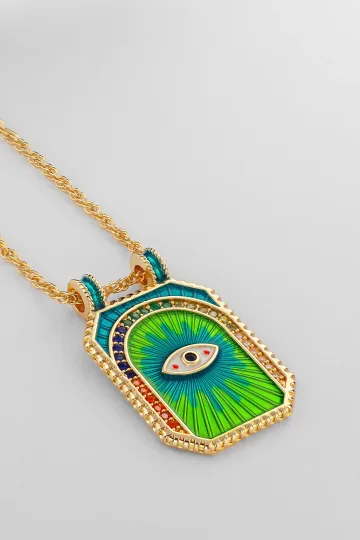


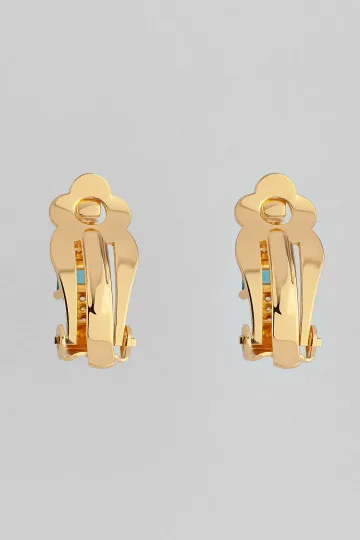
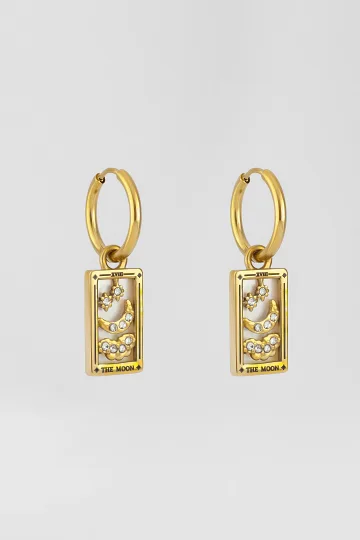


This guide covers everything you need to build your own ear stack: where to start, which composition principles actually work, how to mix metals, what proportions to choose, the order in which to get pierced, what the real risks are, and what to avoid. Planning your first piercing or already have several and want to add more, everything you need is here.
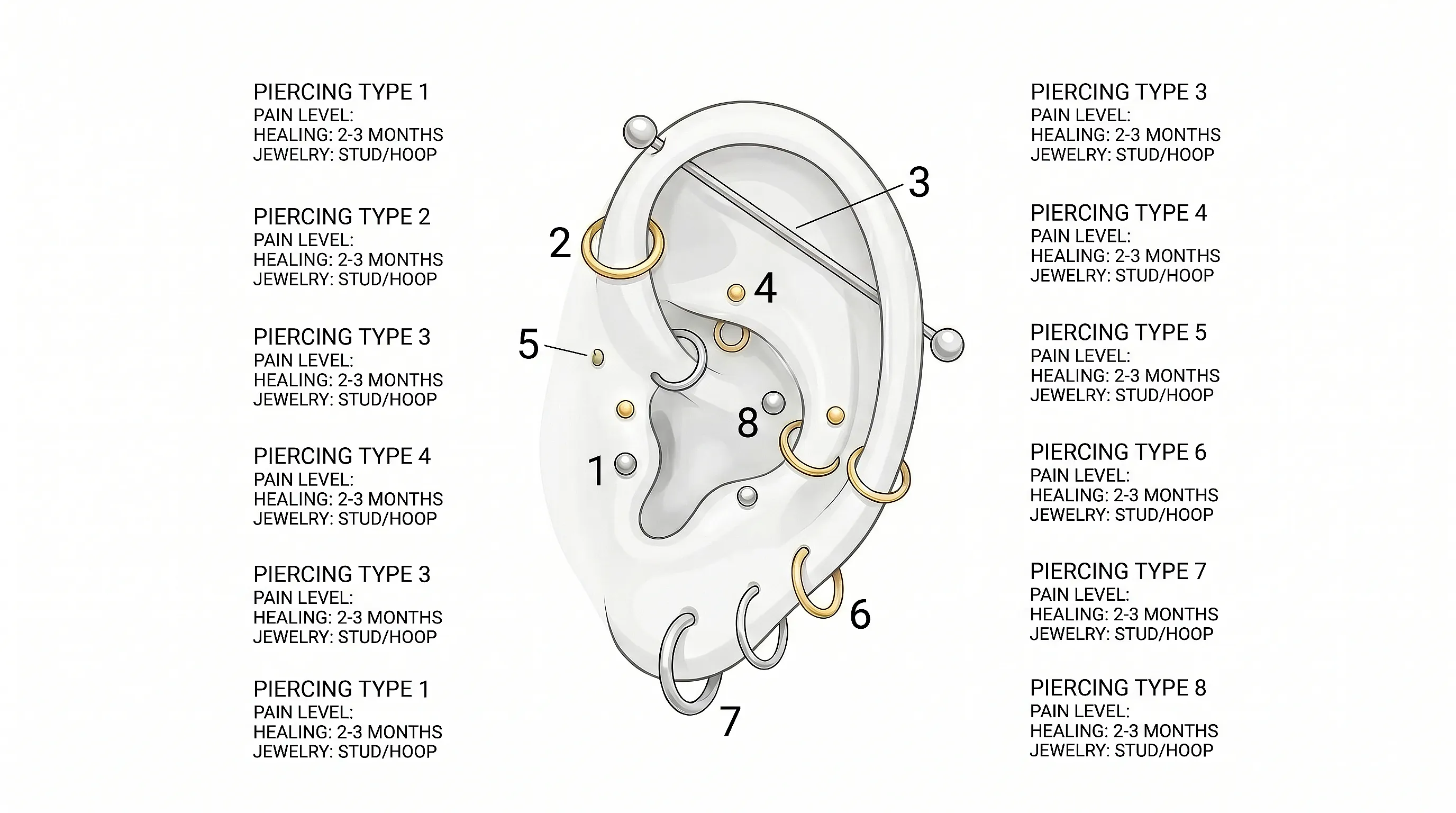
If you want to first understand the anatomy of ear piercings and how each type heals, start with the ear piercing types: a complete guide. For the full map of all body piercings, there's the complete guide to body piercing types. This guide focuses on aesthetics and composition.
What ear stack and ear curation mean
The terminology blurs a little because the words emerged almost simultaneously and are sometimes used interchangeably. In practice there's a distinction worth keeping.
Ear stack (from the stacking of layers) refers to the total collection of jewellery pieces on one ear. It's mostly used to describe what you're looking at. You'd say "she has an ear stack of four pieces on her left ear."
Ear curation refers to the intentional design process. It's the word used when talking about planning, choosing a piercer, developing a composition. You'd say "we're doing ear curation with a specialist who focuses on this."
Curated ear is the result of ear curation: a finished composition built according to a plan, not assembled by chance.
Ear constellation is a specific type of curated ear where the piercings are positioned to form a recognisable pattern, sometimes literally mimicking an actual constellation of stars.
Ear party was an older expression from the late 2010s, more playful and less structured than a stack. It's largely out of use now.
In everyday speech and throughout this guide, ear stack is the general term and ear curation is the process of building one.
Why build a stack at all
Several reasons, usually working together:
Depth of presence. One earring is a piece of jewellery. Several pieces composed together become a statement. Each additional element adds depth and a sense of character.
Play of light. An ear in motion catches light at multiple points simultaneously. This creates a layered shimmer that's hard to achieve with a single piece.
Personal record. Each piercing marks a moment. A stack becomes a timeline written in jewellery.
Aesthetic discipline. Building a stack makes you think about proportion, colour, metal, rhythm. It turns wearing jewellery into a small creative practice.
Self-expression through complexity. One person is "the minimalist with one ring," another is "the architect of a five-layer composition." A stack communicates a lot about taste and way of thinking.
An ear where gold and silver brawl with no plan isn't a composition, it's a spilled button jar. One metal top to bottom, and I won't hear otherwise.
How to build and wear an ear stack
Dozens of ears have passed through my hands on shoots and fittings, from two points on the lobe to a full curated ear. Here is what actually works, sorted by occasion, with no extra theory.
How do I build a first, calm stack? I recommend starting with three points on the lobe from the bottom up and holding the rule of descending size: the largest piece near the lobe, a medium one above, the smallest toward the cartilage. One metal across the whole ear, roughly 4-3-2 mm. A stack like this argues with neither your clothes nor your face and reads as composed, not accidental.
What do I wear a stack with day to day? With a sweater, a tee or a shirt I suggest a quiet set: two or three studs on the lobe plus one at the helix, stones small or clear. Tuck the hair back or behind the ear so the whole composition shows. Under a high neck I choose flat studs with no dangling charms, so nothing tangles in the collar.
Does a stack work at the office? It does, as long as you keep it restrained. I recommend two or three lobe points and one at the helix, a neutral metal, no chains, no loud stones. If you wear a thin ring and a watch in yellow gold, keep the ear in the same tone so the look pulls together.
How do I build an evening look? With bare shoulders and hair swept up, the stack opens up fully. I suggest adding one accent stone or a fine chain between two piercings, and you can play on asymmetry between the ears. With a deep neckline the ear becomes the main piece, and a heavy necklace turns superfluous: let one thing do the work.
Should I mix gold and silver? If you mix, I do it deliberately and across the whole stack at once: at least two elements of each metal for parity, not one stray note. A single silver piece among four gold ones reads as a mistake. It is easier to pick a base metal and build the ear around it, adding at most one graphic piece in black titanium for contrast.

Turn on your camera, pick earrings, a pendant or a ring, and see the piece on yourself in real time.
Switch items in one tap.
Everything runs in your browser: no photo or video is ever uploaded.
Brief history: from subculture to everyday style
Multiple ear piercings aren't a recent invention. In many traditional cultures, women and men wore several earrings or ornaments on one ear as part of ritual or status dress. But as a conscious stylistic practice, the ear stack is relatively new.
Ancient and historical. Multiple piercings on one ear appear across cultures. Egyptian mummies sometimes show two or three lobe piercings. Maya nobility documented helix plus lobe combinations. In Indian tradition, female jewellery often included multiple pendants on one ear, though these were chains attached to a single earring rather than separate piercings.
Polynesia and Africa. Stretched lobes and additional cartilage piercings marked age, status, and rank. Maasai ear composition could include a metal coil on a stretched lobe plus rings through the cartilage.
Twentieth century and subculture. In the 1970s and 80s, multiple ear piercings in Britain and the United States signaled membership in punk or gay communities. By the late 1990s this had moved into mainstream youth fashion, where two or three lobe piercings became standard for teenage girls.
The 2000s. The era of the "ear party": a chaotic collection of mismatched earrings on one ear, without real composition, just because more felt like more. This was the direct predecessor to the modern stack, but without aesthetic discipline.
The 2010s, the turn toward fashion. New York and London piercing studios began developing the curatorial approach: a piercer no longer poked holes on request point by point, but designed the composition of the whole ear. Before any needle was picked up, a plan was drawn, metal choices were discussed, sequence was worked out. Multiple piercing became an art practice.
By the mid-2010s the idea had spread to Paris, Berlin, Seoul, Tokyo. By the end of the decade, ear curation became a mainstream format in major cities, with many new studios opening specifically around this positioning.
The 2020s. The trend moved from fashion capitals to general culture. Magazine covers, celebrities, influencers, corporate professionals, all wearing composed ear stacks. The minimalism of the early 2020s added discipline: fewer pieces, more attention to each one.
Today. Ear stacking is neutral mainstream in most Western cities. It no longer signals a subculture, no longer draws second glances. Just jewellery.
Regional styles of the modern ear stack
By the late 2010s, each major fashion centre had developed a recognisable ear curation aesthetic.
The New York school. Highly minimalist and disciplined. One or two metals, matching scales with mathematically calibrated spacing, focus on transparent stones and pearls. The composition is built like architecture: every line considered, nothing extraneous.
The London school. Bolder, playing on contrast. Black titanium next to gold, unexpected scale combinations, eccentric pendants. The influence of British punk is felt even in the most expensive compositions.
The Paris school. High jewellery tradition, emphasis on natural stones and complex settings. Compositions often feature one expensive central piece surrounded by several simple accents. Material quality matters more than number of elements.
The Seoul school. Kawaii aesthetic and pastel tones. Rose gold, soft-coloured enamel, miniature heart and flower and bow pendants. Very young, light language.
The Berlin school. Industrial minimalism. Black titanium, matte surfaces, rectangular and linear forms. Often gender-neutral looks, rejecting sparkle in favour of graphic effect.
The Tokyo school. Traditional Japanese symbolism (cranes, cherry blossoms, family crests) combined with contemporary minimalism. Small details with layered meaning.
These schools aren't closed to each other. In any major city you can find practitioners of every aesthetic. But regional character influences which trends emerge first and how they evolve.
Principles of composition
A good ear stack lives by the same rules as classical painting, graphic design, and architecture: composition, balance, rhythm, focal point.
The focal point
Every composition needs one dominant element. This can be:
- A substantial central piece (a large pearl at the lobe, a noticeable pendant at the helix)
- A coloured stone among neutral ones
- A unique shape among simpler ones
- A contrasting metal
The focal point gives the eye somewhere to land. Without it a stack reads as noise. The other elements should support the centre, not compete with it.
Balance
Not symmetry, but balance. If there's a substantial element on the right at the lobe, something of comparable visual weight is needed on the left at the cartilage. This could be a small coloured stone, a contrasting shape, an accent pendant.
Balance can be broken intentionally (asymmetry), but consciously and purposefully, not by accident. Unplanned imbalance reads as unfinished.
Rhythm
The spacing between pieces. If three lobe piercings sit at equal intervals, the rhythm is even. If the intervals vary (wide-medium-narrow), you get something closer to a musical rhythm. Both work; what matters is that the spacing feels intentional.
Connections
One element should reference another. If there's a gold ball at the lobe, a gold stud at the helix ties the composition together through material. If a black stone sits at the conch, repeating that black in a lobe pendant creates a connection. Connections make a stack coherent.
Breathing space
Don't fill every millimetre of the ear. Space between elements is part of the composition. A stack with open areas reads better than a dense one. The ideal stack leaves 60 to 70 percent of the ear bare.
The triangle rule, rhythm rule, and anchor rule
A few practical principles developed by stylists and piercers over a decade of work.
The triangle rule
Three points in a composition should form a visible triangle, not sit on one straight line. The eye grasps a triangle as a shape far more quickly than it does a line.
Example: one lobe piercing plus one helix piercing plus one tragus piercing forms a triangle. One lower lobe plus second lobe plus third lobe sits in a vertical line, which reads flat and uninteresting.
The 1+2 or 2+1 rule
A stack should have one anchor point and one or two supporting points. Or two anchor points and one supporting point. If all pieces carry equal visual weight, the result is visual noise.
The anchor is the most prominent piece. Supporting pieces carry less visual weight.
The 3 to 5 rhythm rule
Most stacks consist of three to five pieces. Fewer doesn't yet register as a stack. More starts to feel chaotic and requires exceptional compositional work to hold together. If you want more, better to distribute across two ears with intentional asymmetry.
The single contrast rule
A stack should contain one strong contrast. This could be:
- One coloured stone among transparent ones
- One substantial pendant among small studs
- One metal among another (a gold note in a silver stack)
- One unconventional shape among classic forms
Two or three equal contrasts register as discord rather than design.
The everyday and occasion rule
A stack should be adaptable: one mode for daily wear, one for evenings out. If there's a particularly formal pendant in the mix, it should be easy to remove for the office.
Where to start: first piercings for a future stack
If you have no piercings at all and you're planning a stack, start smart. Your first two piercings determine everything that follows.
First piercing: standard lobe
The safest choice. Heals in four to six weeks, minimal discomfort, opens up every direction afterward. Starting jewellery in implant-grade titanium F-136 with a 3 to 4mm ball.
After the first piercing heals, the question is: second lobe piercing on the same ear, or move straight to the helix? The answer shapes the structure of your future stack.
Second piercing: upper lobe or helix
If the second piercing goes on the same lobe (upper lobe), you're building a vertical lobe stack. Classic path: two, three, four piercings running up the lobe. Heals quickly (eight to twelve weeks each), looks clean and understated.
If the second piercing is a helix, you're building a triangle: lobe plus helix. Heals longer (six to twelve months), but creates a more interesting composition immediately: substantial lobe piece plus small helix piece equals natural contrast.
Which path depends on your disposition. People who prefer gradual steps go up the lobe (faster, lower risk). People who want a clear visual result quickly go helix (one longer wait, then a finished interesting shape).
Third piercing: your choice
After the second, you can go anywhere. Options:
- Third lobe for a classic lobe stack
- Forward helix if the main helix is already there
- Tragus for contrast
- Daith for a deep interior note
The key rule: don't rush. Between cartilage piercings allow at least two to three months, giving the body time to stabilise.
Spacing between piercings
Between lobe piercings: six to eight weeks is enough.
Lobe plus cartilage: six to eight weeks.
Between cartilage piercings: two to three months minimum.
Getting everything in one visit is only advisable for two adjacent lobe piercings. Not more than one cartilage piercing per visit, because the immune response is cumulative.
Building on what you already have
Most people already have one or two piercings by the time they start thinking about a stack. Building a stack means developing from existing piercings, not starting from scratch.
If you have a standard lobe piercing
Simplest addition: a second lobe (upper lobe) for a basic vertical stack. Heals quickly, minimal risk.
Alternative: go straight to a helix for an interesting composition. Expect six to twelve months of healing.
If you have a lobe plus helix
You already have a triangle in development. You could add:
- Tragus for a lower triangle
- Daith for a deep interior note
- Second lobe to anchor the lower section
- Forward helix for an upper triangle
Any of these additions produces an interesting composition.
If you have three or four different piercings
You're almost at a stack. The main question is whether everything in the composition "works," or whether there's a piece that doesn't belong.
If a piercing feels out of place (say, an industrial bar that dominates a minimalist composition), the options are:
- Swap the jewellery for something less dominant
- Remove the jewellery and let the channel close if you don't wear it
- Rebuild the rest of the composition around the dominant piece
If the stack looks chaotic, the problem is usually mismatched metals without visual logic, or scale issues with too many large pieces. Gradually replacing jewellery with more coherent choices solves this without new piercings.
When to stop
Most well-composed stacks stop at five to seven piercings on one ear. Beyond that you're into work-of-art territory that requires ideal ear anatomy and an exceptional piercer.
If you feel the urge to keep adding, consider shifting focus to the second ear, or building a second intentional asymmetric stack.
Lobe stacks: levels and combinations
The safest and most common zone for stacking. All piercings are relatively painless and heal quickly.
The basic three-level lobe stack
Three piercings running up the lobe, spaced five to seven millimetres apart. The most classic lobe stack.
Levels and roles:
- Level 1 (lower, primary). The largest piece. A stud with a visible stone (three to five millimetres), a small ring with a pendant, a pearl stud.
- Level 2 (middle). The connective element. Smaller in scale (two to three millimetres), a thin ring or small-stone stud.
- Level 3 (upper). The smallest piece. A tiny stud (one to two millimetres), a flicker of stone. It closes the composition at the top.
This stack works for almost everyone. Heals quickly, worn around the clock, adapts easily to different styles.
The four-level lobe stack
The same as above plus one additional level, either a fourth position above the third or an additional piece between first and second.
Double-stack on one lobe
Two piercings side by side on the same lobe, not vertically aligned but placed front and back. Less common, but it creates an interesting "double point" effect on a single lobe.
Transverse lobe
One piercing running horizontally through the entire lobe. Not a typical part of a classic stack, but it can serve as an anchor point in a contemporary composition.
Composition ideas
Romantic: pearl at first level, small gold heart at second, tiny pink stone at third.
Minimalist: matching gold balls in 3mm, 2mm, 1mm. One material, three scales.
Natural: labradorite at first level, opal at second, moonstone at third. All natural stones, soft palette.
Graphic: black titanium ball, flat black titanium stud, black titanium ring. One colour, three forms.
Geometric: gold coin pendant, gold spike stud, small gold hoop. A structured architectural look.
Customer reviews
Zevira is a real jewellery shop. Genuine payments, deliveries and customer thank-yous.
🥰🥰🥰 gracias
Ok, ¡gracias! 🙂
Cartilage stacks: the upper ear
A more ambitious path. Slower healing, but more interesting compositions.
Helix plus forward helix
Two piercings on the helix: one on the outer rim, one on the forward-facing edge closer to the face. They form a triangle at the top of the ear.
Ideas:
- Small stud at the main helix, ring at the forward helix
- Star at the main helix, crescent at the forward helix (thematic pair)
- Diamond at the main helix, pearl at the forward helix (classic contrast)
Helix plus conch
One piercing at the outer upper rim, one in the bowl of the ear (conch). They create a diagonal.
Ideas:
- Simple stud at the helix, large flat labret with stone at the conch
- Small ring at the helix, large ring at the conch (same form, different scale)
Helix plus tragus
Helix at the top, tragus at the lower cartilage. They create a vertical line or diagonal.
Ideas:
- A chain between them (ear chain)
- Matching stones (two pearls of different sizes)
Full cartilage stack
Three to five cartilage piercings: main helix, forward helix, daith, tragus, conch. This is a serious investment of time (two to three years of healing) and money. Done with an experienced ear curation piercer.
Cartilage stack with chain
A contemporary trend: a chain running between two cartilage piercings (between the helix and forward helix, or helix and conch). A thin gold or silver chain follows the contour of the ear.
Constellation: composition as a star pattern
A specific genre of ear curation where piercings are positioned to form a recognisable star pattern or abstract graphic shape.
What an ear constellation is
A composition of several small piercings arranged in a specific sequence so that looking at the ear creates the impression of a "star field." Most often this is simply several small studs in a cluster, not a literal astronomical recreation.
Classic compositions
Ursa Minor. Seven piercings forming the "dipper" shape: four on the helix, three on the conch. Very ambitious, requires ideal ear anatomy and a skilled piercer.
Orion. Three to four points in the shape of Orion's belt at the helix, with a couple of accents at the lobe or tragus.
Lyra. Four to five points in a parallelogram shape running along the cartilage.
In practice, most ear constellations don't follow a specific constellation. They play on the idea of "several small stars." This gives the composition a theme without literal astronomical commitment.
Technical requirements
A constellation only works under specific conditions:
- All pieces of one type (only small studs)
- One metal (usually 14K gold, occasionally titanium)
- Small stone inserts (no larger than 1.5 to 2mm)
- Anatomically appropriate placement
Done with an ear curation specialist who works with multi-point compositions.
Seasonality
Constellations are especially popular in winter (for holiday season looks) and often get a coloured-stone refresh in summer.
Mixing metals
One of the most common questions: can you mix metals in one stack?
Mono-metal: one metal throughout
The safest path. Everything in gold, or everything in titanium, or everything in sterling silver (after all piercings are fully healed). The composition reads as unified, no visual conflicts.
Downside: can feel monotonous, no contrast play.
Two-tone: two metals intentionally
Gold and silver in a conscious pairing, for example. Most commonly: gold at the lobe (primary zone) plus silver or white gold at the cartilage (accent zone). More on combining metals in the guide mixing metals in jewelry: the complete guide.
Rule: if you mix, do it across the whole stack (not just one piercing standing out as an exception). You need at least two pieces of each metal to create visual parity.
Three-tone: three metals
Yellow gold, white gold or silver, rose gold. A more complex composition, requiring careful balance.
Works well in small stacks (three to four pieces, one of each metal). Larger three-metal stacks become chaotic.
Black titanium
A current trend. Black titanium adds graphic weight and suits strict minimalist looks. Works well with gold (contrast) and less well with silver (too close in tone, not enough tension).
Combinations to avoid
- Sterling silver in a fresh cartilage piercing. Silver can irritate a healing channel, slowing the process.
- Fashion jewellery next to real gold. The quality difference is visible even at a glance and undermines the whole composition.
- Oxidised silver next to polished gold without aesthetic intent. If you want a vintage look, commit to it across the whole stack, not just one piece.
Which metal to build around
Base recommendation: 14K gold, nickel-free, as the primary metal. It suits most people, causes minimal allergic reaction, is stable, and looks expensive. If budget is a concern, implant-grade titanium is the universal substitute.
Sterling silver as a decorative metal after all piercings are fully healed, never for fresh piercings.
Upload a photo of your pet, someone you love, or an object. We'll build a 3D model and hand-cast it in pewter.



Colour palettes and seasons
Stone and enamel colour in a stack sets the mood. Palettes can shift with the season.
Winter palette
Cool, restrained colours:
- Clear cubic zirconia, moissanite, diamonds
- Moonstone, opal, white pearl
- Labradorite (grey-blue flash)
- Black titanium, hematite
- Silver or white gold
Mood: quiet, graphic, minimalist.
Spring palette
Fresh, natural colours:
- Peridot (light green)
- Amethyst (violet)
- Rose quartz
- Green jade
- Yellow gold
Mood: natural, light, optimistic.
Summer palette
Bright, saturated colours:
- Turquoise
- Carnelian, amber
- Emerald, ruby (or quality synthetic equivalents)
- Coloured opals
- Yellow or rose gold
Mood: warm, vivid, vacation-ready.
Fall palette
Warm, earthy colours:
- Amber, carnelian
- Tiger's eye
- Dark zirconia (olive, honey)
- Rose gold
- Enamel in forest green, burgundy, eggplant
Mood: deep, textured, rich.
Seasonal rotation
Most people don't rebuild their whole stack each season. More typically one or two accent pieces change: swap a summer turquoise for a winter labradorite, leaving the rest of the stack unchanged.
This creates a sense of freshness without a full rebuild. Replacement pieces should match the form and scale of what they're replacing, so the overall composition stays intact.
Scale and proportion
The size of pieces in a stack needs to follow a clear logic, otherwise the composition reads as accidental.
The tapering rule
The largest piece goes at the bottom (the lobe), getting smaller moving upward. A 4 to 5mm ball at the lobe, 2 to 3mm at the second lobe level, 1 to 2mm at the helix.
This works because the lobe is physically larger than the helix, and the proportions follow the natural body. An inverted pyramid (small at the bottom, large at the top) reads as wrong.
The golden ratio rule
For a mathematically precise composition: the ratio 1 : 1.618 (the golden ratio). In practice this means the middle piece is 1.6 times larger than the upper piece, and the lower piece is 1.6 times larger than the middle piece.
In reality nobody follows this strictly, but the best compositions intuitively come close to these proportions.
The single large point rule
The stack should have one piece larger than all the others. If everything is the same size, the result is monotony.
This connects to the focal point principle. The largest piece draws the eye; the others create context around it.
What's too large
No piece in a stack should exceed six to seven millimetres, even at the lobe. Pieces that large dominate so completely that everything else disappears. If you want a statement piece, wear it alone without a stack.
What's too small
Under one millimetre, a piece is nearly invisible and doesn't function as a compositional point. It can serve as backing or as a pendant on a primary piece, but not as a standalone element.
Choosing by face shape
A stack should complement the face, not compete with it.
Round face
A vertically oriented stack (lobe stack plus helix) visually lengthens the face. Avoid horizontal compositions, which make a round face feel wider.
Recommended: three-level lobe stack plus helix. Elongated pendants (a thin chain with a small charm) work well.
Oval face
The universal shape. Any stack works. Experiment freely.
Square face
A stack with soft shapes and rounded elements (rings, pearls, ball studs, round pendants) softens angular features. Avoid overly geometric and angular pieces, especially large ones.
Heart-shaped face (narrow chin, wide forehead)
A stack that accents the lower part of the ear (the lobe) visually balances the proportions. Avoid heavy pieces at the helix and upper cartilage, which draw attention upward and emphasise the wider forehead.
Long face
A stack with horizontal accent or a substantial lobe piece (such as a horizontal transverse lobe) visually widens.
The single attention piece rule
One piece in the stack should draw primary attention. That piece should sit at the point that best suits your face shape: higher for a rounder face, lower for a longer one.



Choosing by ear shape
Ear anatomy determines which piercings are possible and which look good.
Close-set ears (ears that lie flat against the head)
Lateral piercings (helix on the outer rim, forward helix) are difficult because they're hidden under the flat shell. Better choices: lobe stack plus conch.
Prominent ears
Ideal anatomy for any stack. All cartilage piercings are visible. Complex compositions including forward helix, rook, and snug are feasible.
Long lobe
Can accommodate three to four lobe piercings without crowding. A transverse lobe works well as an accent.
Short lobe
Can fit one to two piercings without overloading. Better to add cartilage piercings to expand the composition upward.
Thick cartilage
Any cartilage piercing is possible. Holds heavier jewellery securely.
Thin cartilage
Helix is fine, but tragus and conch can be problematic (migration risk). Worth consulting a piercer before each new cartilage piercing.
Very small ear
Large stacks are physically impossible. Better to work with three to four points: lobe stack plus one cartilage accent.
Asymmetric ears
Most people have one ear slightly different from the other. If the difference is significant, consider building two different stacks that play on the asymmetry rather than trying to mirror them.
Ear chains: connecting two piercings
One of the most striking trends of recent years.
What they are
A thin chain connecting two piercings on the same ear. It can run from the lobe to the helix, helix to conch, forward helix to lobe. The chain is fine and lightweight, no pulling.
Where they run
Front ear chain. Along the front of the ear from lobe to helix. Visible from a distance, dramatic.
Back ear chain. Behind the ear, from lobe to a point at the back. Only visible at certain angles. More subtle.
Helix to lobe. The most popular: from the upper helix down to the lobe. Creates a vertical graphic accent.
Conch to lobe. From the centre of the bowl to the lobe. The chain runs along the inner part of the ear.
Materials
Thin 14K yellow gold chain is the most popular. Sterling silver chain (after full healing). Black titanium for graphic looks.
Chain thickness should not exceed 0.5 to 0.7mm. Thicker looks heavy.
When not to use one
- On a fresh piercing (only after both anchor points are fully healed)
- If you're active in contact sports (chains catch on clothing and helmets)
- If you have long, loose hair (chains tangle)
- If you work with your hands near your face (chains catch and pull)
Installation
The chain attaches to two anchor pieces (one at the lobe, one at the helix). The anchors need small connector rings or loops. Attaching and removing the chain should be done carefully to avoid stressing the posts.
Jewellery forms for each piercing
Knowing the basic forms of piercing jewellery helps you navigate choices faster and build a stack with intention.
Flat-back labret
A flat internal disc instead of a ball, a thin threaded post with the decorative top screwing on from the front. The most versatile format for helix, forward helix, conch, and tragus. Advantages: doesn't press into the skin from behind, doesn't catch on clothing or hair, flat back minimally visible. Disadvantage: installation requires a specific technique (piercer inserts from front, back threadless or internally threaded).
Captive bead ring
A round ring with a removable bead held in place by the ring's tension. Classic form for helix, septum, conch. Suitable after full healing. Minimal for fresh piercings because ring movement slows healing.
Clicker
A ring or horseshoe with a hinged clasp (snaps closed with one click). Convenient for septum, daith, conch. Often set with stones or pendants. Suitable for most healed helix and conch piercings.
Huggie hoop
A small hoop that lies close to the lobe. Doesn't hang, hugs the lobe. Often set with stones along the lower edge. Works as a decorative element in a lobe stack.
Threadless
A threadless system where the decoration presses into a hollow post without screwing. Contemporary format, convenient for frequent jewellery changes. Works in all piercing types once healed.
Stud
Classic stud with ball or stone at the front and a backing. Standard for lobe, base option for helix.
Barbell
Straight or curved bar with two balls. For industrial, tongue, navel. Rarely used in an ear stack.
Heart, star, moon studs
Decorative shapes. Work well as accents in a stack, complementing classic balls and stones.
Multi-stone bar
A thin horizontal bar with several small stones in a line. Contemporary format for the helix, mimicking a "constellation" in a single earring.
Leave your email, we'll send your discount code. No spam, unsubscribe anytime.
The code arrives by email, valid on your first order.
Scenarios: ear stacks for different occasions
One stack can work across different contexts if it's built with adaptability in mind.
Wedding stack
Dominant piece at the lobe: a classic pearl or substantial diamond stud. Supporting pieces in small transparent stones or pearls. Minimal decorative pendants. Goal: maximally neutral, elegant look that photographs beautifully at close range.
Composition: three to four elements, single metal (white gold or platinum for classic; yellow gold for warmer looks).
Office stack
Minimalist set: two to three lobe piercings plus one at the helix. No pendants, no chains, no bold stones. Implant-grade titanium or 14K gold.
This stack should be the kind that doesn't prompt questions from colleagues. Visible enough to read as intentional, understated enough not to stand out.
Vacation stack
Room to play. Turquoise, amber, mother-of-pearl, lightweight pendants, chains. A natural and warm theme. Temporary accents are fine here: magnetic ear cuffs, adhesive crystals.
When you're back, return to the base. Don't carry the beach aesthetic into the office stack.
Concert stack
Expressive and visible. Bold pendants, contrasting metals, unusual forms. The goal is to be seen at a distance, under stage lighting, in motion.
Not for everyday wear, but striking for an occasion.
Everyday minimalist
One piercing with the best possible piece. A large pearl at the lobe or a quality diamond stud. Nothing less is needed, and that's the point.
Often a "stack of one" is more expressive than an overloaded stack of five.
How to choose jewellery for your stack
Buying jewellery for a stack is different from buying a single earring.
Think in sets, not individually
Don't buy each new piece in isolation. First plan the stack as a whole, then buy a set or select pieces that fit within the existing composition.
Verify the metal
For base piercings: implant-grade titanium F-136 or 14K nickel-free gold. The specification should appear on the packaging or in the product description. If the seller can't confirm the composition, don't buy.
Dimensions
Know your gauge (post thickness) and post length at each position. This is in your piercing client card, or can be measured with calipers. Standard thickness: 16g (1.2mm) for most ear positions, 14g (1.6mm) for navel and industrial, 18g (1.0mm) for lobe.
Post length: 6 to 8mm for lobe, 6 to 8mm for helix, 6 to 10mm for conch, 32 to 38mm for industrial.
Thread type
Internal thread or threadless is better than external thread. External threading abrades the healing channel during insertion and removal, gradually damaging tissue. Quality jewellery today is always internal or threadless.
Where to buy
Good piercing shops (with stated materials and certifications), specialist jewellery stores with a dedicated piercing section. Fast-fashion accessories chains and discount costume jewellery don't belong in the base positions of a stack.
Budget
Better to own fewer quality pieces and wear them for years than a collection of cheap ones that undermine the whole stack. A basic set of five titanium pieces is accessible. The same set in 14K gold is a real investment, but pays off across years of wear.
Finding an ear curation specialist
Not every piercer practices intentional ear design. It's a specific specialty.
What to look for
APP certification (Association of Professional Piercers) is the standard in the United States. This is a baseline requirement.
Portfolio. A good ear curation specialist has photographs of composed client ears on their social media. Study the aesthetic and decide whether it fits your vision.
Session time. A standard piercer does a piercing in fifteen minutes. An ear curation specialist spends an hour with you: discussing the ear plan, marking placement, confirming metal and form choices. If a visit takes less than half an hour, it's a standard piercing appointment, not curation.
Experience. Minimum five years in the profession, preferably eight to ten. Complex compositions require an experienced eye.
The studio. Clean, licensed, with an autoclave. A professional works in a studio, not from home.
Questions to ask at the consultation
- How long have you been piercing? Where did you train?
- Do you mark placement before piercing?
- What materials do you use for starter jewellery?
- Do you have an ear curation portfolio?
- What do you do if a piercing starts to reject?
- What's your check-up schedule for healing piercings?
If the piercer answers confidently and in detail, that's a good sign. If the answer is "it'll be fine," look elsewhere.
When to switch piercers
If you already have a piercer but the composition isn't coming together, it's completely fine to switch. One piercer might be technically excellent but have no aesthetic vision. Another might be less technically experienced but have a strong visual sense. Sometimes you need both: one for the actual piercing, another to consult on the design.
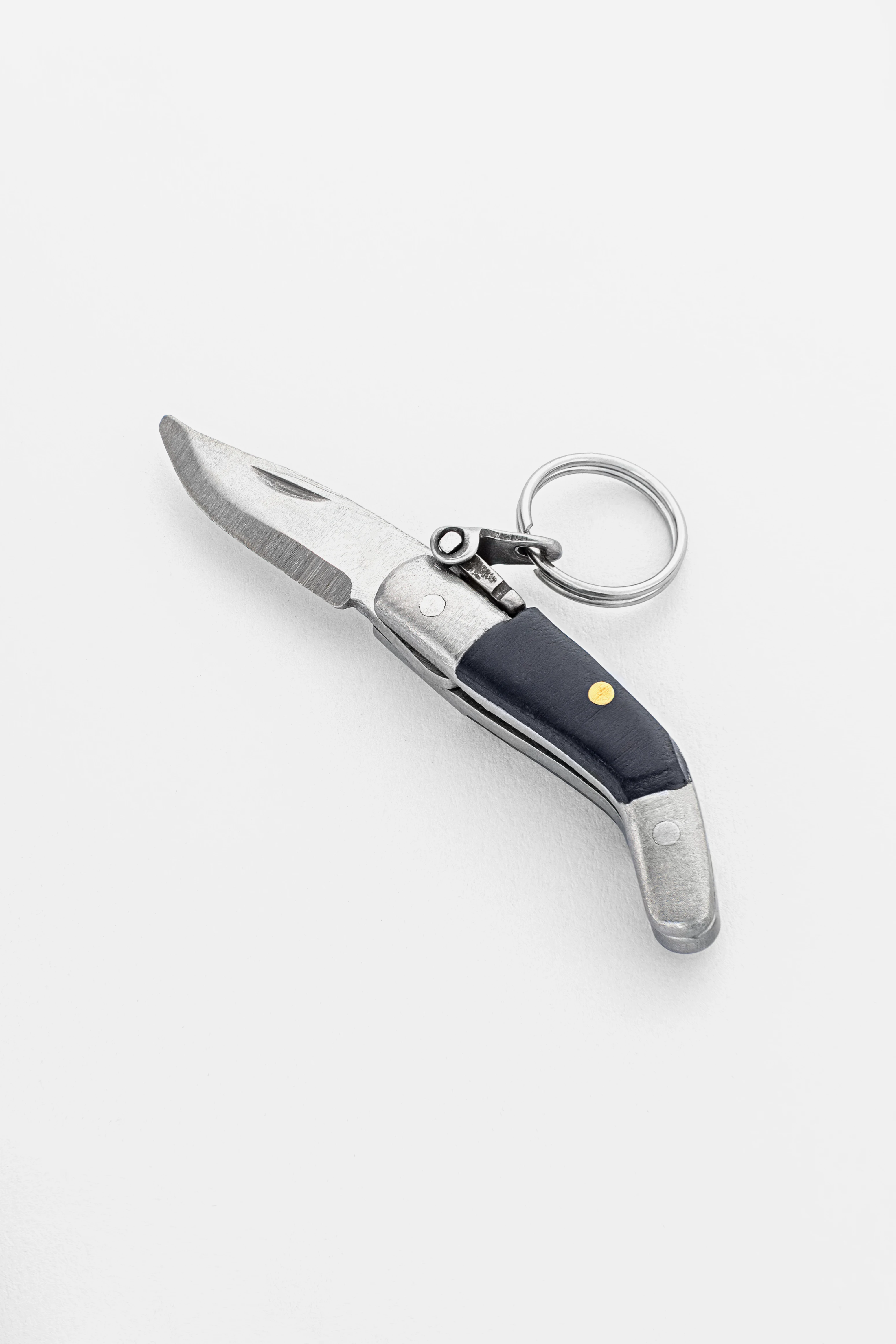
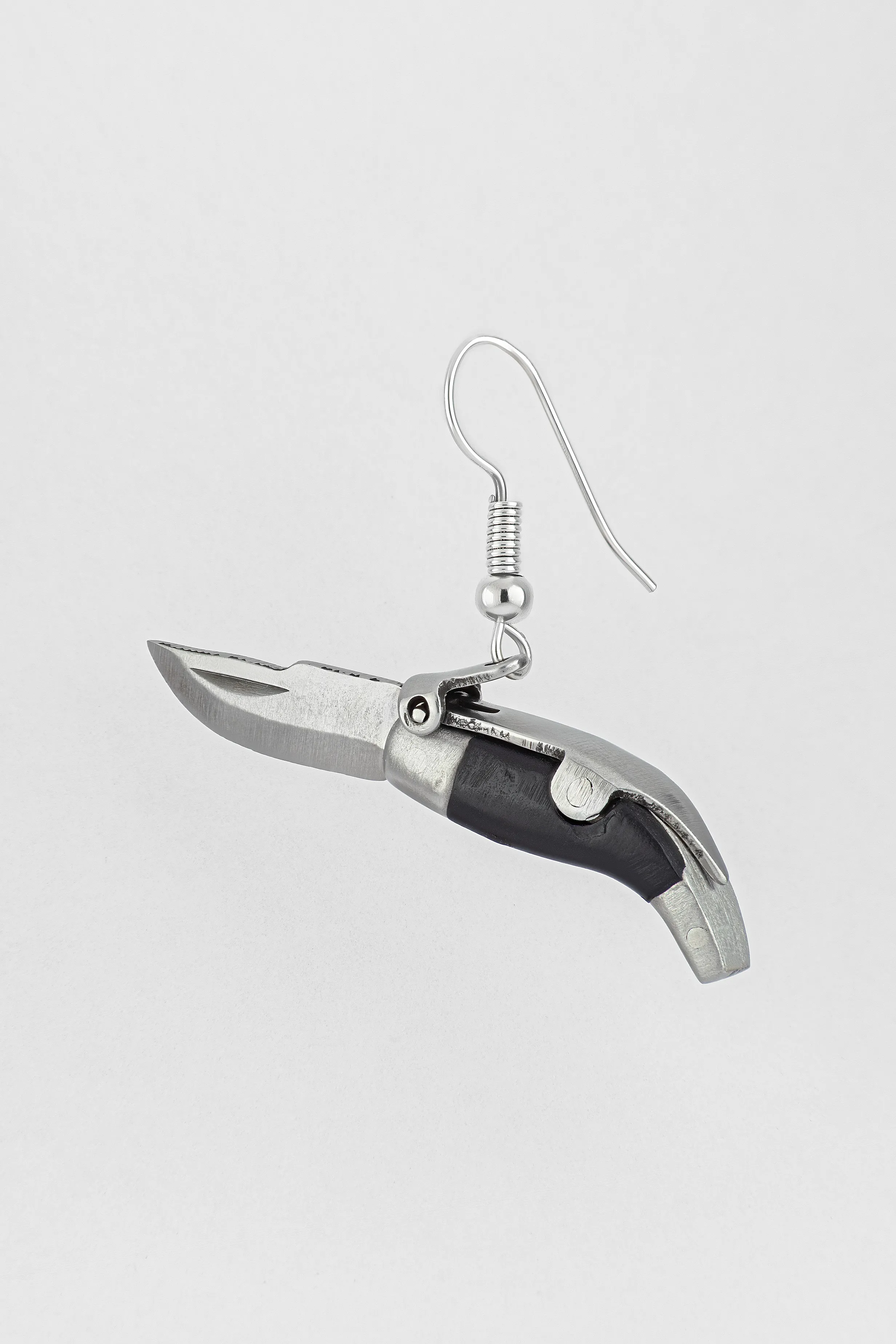
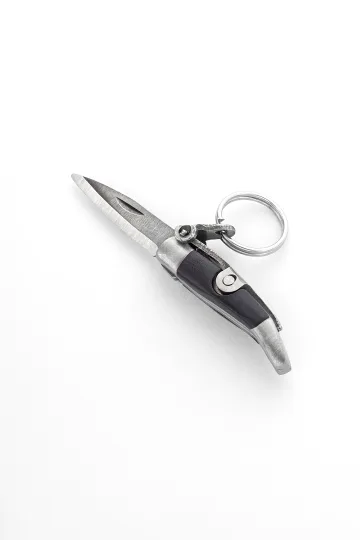
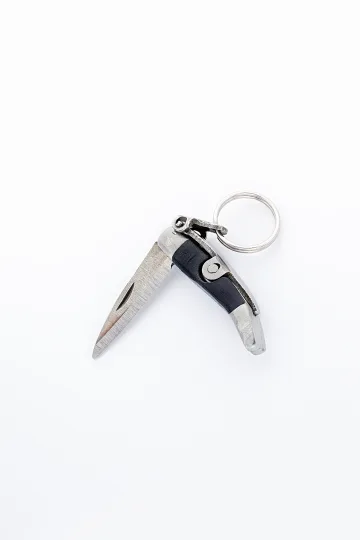
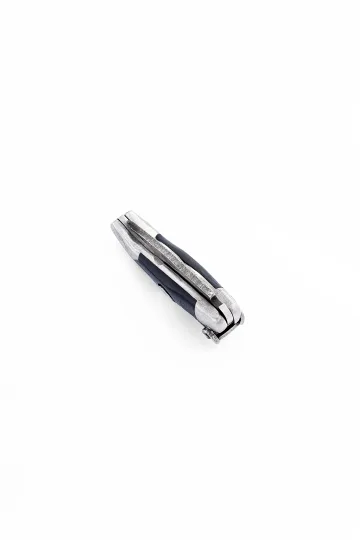
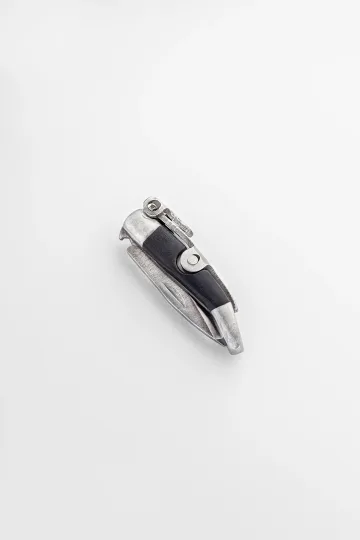
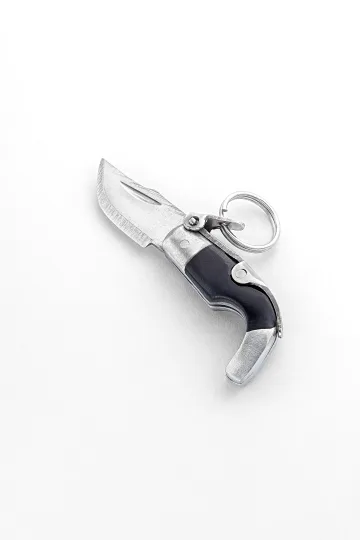
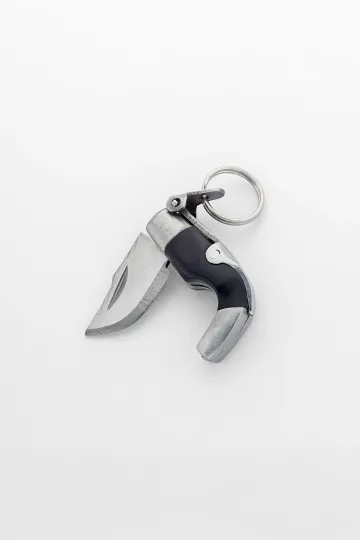
CAPAORA mini knife pendant
The 18th-century Spanish navaja in miniature: 40 mm of stainless steel, a real folding mechanism and a Palanquilla lock that clicks. An affordable gift to remember.
Authentic · Ships from Spain · 14-day returns
Asymmetric stacking: two different ears
One of the most interesting techniques in contemporary ear stacking: two ears that don't mirror each other but play on contrast.
Why
Aesthetic depth. Matching stacks on both ears look more conventional, less surprising. Asymmetry gives the composition room to breathe.
Conceptual play. You can build two contrasting stacks: a "quiet" minimalist one on one ear and a "louder" statement stack on the other.
Working with natural asymmetry. Most faces have one ear slightly higher than the other, one cheek slightly fuller. An asymmetric stack acknowledges this rather than fighting it.
Options
Full asymmetry. Five piercings on one ear with a rich composition, one or two minimalist pieces on the other. Strong visual contrast.
Mirror asymmetry. Same number of piercings on both ears but in different positions with different pieces.
Thematic asymmetry. One ear in a "light" composition (gold and pearl), the other in a "dark" one (black titanium and obsidian). A conceptual contrast.
Situational asymmetry. On the "front" ear (the more visible one in most social situations) a delicate set; on the other a more expressive stack.
Rules
Even asymmetry needs internal logic. If the primary accent is at the top on the right ear, the primary accent should be at the bottom on the left (counterbalanced asymmetry). If the right has several lobe pieces, the left needs some kind of lobe anchor (but not the same shape).
More on wearing different earrings on different ears in the guide asymmetric earrings: how to wear mismatched pairs with intention.
What doesn't work
Completely random asymmetry (just different, with no design logic) reads as unfinished. Even symmetry is better than accidental asymmetry.
An extreme contrast without a connecting thread (heavy stack on one ear, nothing on the other) looks like a person who just hasn't gotten around to the other ear yet.
Budget and time horizon
A stack is an investment of both time and money. Realistic assessment helps with planning.
Time
Basic lobe stack (three piercings): three to six months for everything including healing.
Lobe plus helix: nine to twelve months.
Full curated ear (five to six piercings on one ear): one and a half to three years.
Constellation: two to three years.
Most good stacks take two to three years to assemble. That's a normal pace. There's no benefit to rushing.
Money
No specific figures. Cost structure:
The piercings themselves. Varies by piercer, city, and type of piercing. Higher with well-known ear curation specialists in major cities.
Starter jewellery. Implant-grade titanium is typically included in the piercing price or offered as a required option. 14K gold as a starter piece is significantly more expensive.
Replacement jewellery after healing. The biggest line item. Quality nickel-free gold earrings add up, especially when assembling a matched set of five to seven pieces in one style.
Check-up visits. Once every year or two is recommended.
Occasional replacements (lost ball, worn thread, desire to change a look).
Saving strategies
Pace yourself. One piercing every six months to a year, saving for quality jewellery in between. Over three years you can assemble a stack of five to six piercings with good pieces without straining the budget.
Mix high and low. The primary lobe piece is premium (gold with a natural stone); the others are more accessible (titanium with cubic zirconia). Done thoughtfully, the difference isn't visible.
Base set. Buy one set of five to six minimalist pieces in a unified style from the start, use it as the foundation. Add accent pieces gradually.
When not to save
- On the piercing appointment itself. A cheap piercing means potential infection, keloid, rejection, repiercing. Paying twice costs more than doing it right once.
- On the starter jewellery. Implant-grade titanium or good nickel-free gold pays for itself in faster healing and no irritation.
Common mistakes
What beginners most often do that undermines a stack.
Too much at once
Getting four or five piercings in one visit. The body can't handle the load well; healing is slower, rejection risk goes up.
Fix: no more than two piercings per visit; at least two to three months between cartilage piercings.
Mismatched metals without logic
Pieces from different times and different places ending up in different metals with no visual plan.
Fix: decide upfront which metal anchors your stack, then build with discipline.
All the same size
A stack of four or five identical balls reads as monotonous.
Fix: follow the tapering rule.
Too many competing bold pieces
A large diamond at the lobe, a large pearl at the helix, a large opal at the conch. Each is shouting; nobody is heard.
Fix: one focal point, everything else supports it.
Unbalanced composition
All pieces clustered in one zone (only on the lobe), or scattered with no centre.
Fix: follow the triangle rule, establish a clear anchor.
Ignoring ear anatomy
Building an ambitious stack on a small ear with thin cartilage. Half the piercings migrate; others crowd each other.
Fix: consult a piercer before each new piercing, assess anatomy realistically.
Removing fresh piercings at night
Wanting to "give the ear a rest" and taking out jewellery in fresh piercings. The channel closes within hours; you start over.
Fix: don't remove jewellery from any unhealed piercing, ever.
Fashion jewellery after healing
Saving money by putting cheap costume jewellery into healed piercings. Skin reactions, tarnishing, disappointment.
Fix: for base positions, quality metal only (14K nickel-free gold or implant-grade titanium). Fashion jewellery for very short wear only, never longer than a day or two.
Caring for multiple piercings
Several simultaneous piercings require a systematic care approach.
Cleaning schedule
Each piercing has its own timeline. Fresh piercings (under eight weeks): clean twice daily. Healing piercings (two to six months): once daily. Fully healed piercings (one year plus): occasional cleaning only, after workouts, swimming, showering.
If you have several fresh and several healed piercings at the same time, keep track of each. One fresh helix may need more attention than a lobe piercing you've had for two years.
Sleeping
Fully healed piercings: fine to remove or not. Fresh piercings: never remove at night. For sleeping, avoid lying on the side with fresh piercings. A travel pillow with a centre cutout helps.
Hair management
With multiple piercings, hair can catch on jewellery, especially chains and pendants. Keep hair arranged so it doesn't hang directly over the ear. Blow-drying can snag a chain, so lift hair carefully.
Cosmetics
Hair spray, perfume, and shower gel should not contact fresh piercings. For healed piercings too, minimise direct contact to prevent gradual metal corrosion.
Regular inspection
Once a month, examine each piercing in strong light. Look for signs of irritation, migration, or a loose ball. Early detection means early resolution.
Jewellery replacement
Every one to two years, replace jewellery in all fully healed positions. Check the thread on the ball, the integrity of the post, the absence of microfractures.
When to remove jewellery and when not to
Simple rule: the fresher the piercing, the less you should remove it.
Fresh piercings (0 to 6 months)
Don't remove. Ever. Not overnight, not for sports, not for a wedding photo with a different earring. The channel is still forming and closes quickly.
Exception: medical necessity (a procedure that requires removal). In this case the piercer can fit a temporary retainer.
Healing piercings (6 to 12 months)
Can be removed for an hour or two if absolutely necessary (a photoshoot requiring a specific piece, for instance). Not longer. The channel isn't fully stable yet.
Fully healed piercings (1 to 3 years)
Can be removed overnight or for a day. The channel holds. But regular extended removal (weeks without jewellery) causes the channel to narrow.
Long-established piercings (5 or more years)
The channel holds for years. Can be worn and removed freely. But with long gaps (months without jewellery) even old piercings gradually narrow.
When removal is required
- Before an MRI (titanium and steel are usually safe, but confirm with the radiologist)
- Before surgery
- Before childbirth (even for a C-section)
- Before contact sports (impact risk)
- Before swimming in pools or the ocean during the first two to three months after a piercing
Lifestyle: work, sports, travel
A stack interacts with daily habits.
Office and corporate settings
In most environments, two to three classic lobe earrings are neutral. Helix and tragus piercings are generally accepted too. Septum and stretched lobes may raise questions in conservative settings.
Universal strategy: a "minimal work set" (two to three pieces in standard positions) for important meetings, with additional pieces added later in the day or reserved for weekends.
Sports
Contact sports (boxing, wrestling, rugby). Remove everything before training. Clear plastic retainers are an option.
Gym and cardio. Usually fine to keep everything in, but check that helmets or headsets don't catch on jewellery.
Swimming pools. Fresh piercings off-limits for two to three months. Healed piercings fine, but rinse with fresh water after swimming.
Yoga, pilates. Compatible with all jewellery.
Running. Compatible, but heavy pendants can irritate with extended movement (friction, swinging). Use a lighter set for long workouts.
Travel
Airport security. Modern titanium jewellery usually doesn't trigger metal detectors. It occasionally does; easier to remove before the checkpoint.
Tropical and humid climates. Fresh piercings heal poorly in high humidity. If you're getting a new piercing before a trip to a humid climate, allow at least six months.
Cold climates. Skin dries out, which can cause irritation near piercings. Use a moisturizer (away from the piercing itself).
Backpacking and active travel. Light, secure jewellery. Leave substantial pendants and chains at home.
Send a friend a discount code, they save on their first order.
How a stack evolves over time
A stack is not a static object. It develops alongside you.
After one year
Most piercings are healed. You can replace starter jewellery with more beautiful pieces. The composition settles into a recognisable form.
After three years
Your own aesthetic is visible. You know what you like, what you don't wear, which positions work, which don't. Conscious adjustment is possible.
After five years
The desire for one or two more piercings to complete the composition may emerge. Or the opposite: lightening, removing the less-loved pieces, keeping only what matters most.
After ten years
The stack is part of you, like a signature. Many women in their thirties and forties have a thin, minimalist set of three or four pieces they wear continuously. Others let the stack keep developing as life changes.
Retiring piercings
With time, some piercings get retired for various reasons: loss of interest, professional need, changing taste. The small marks left behind read as "there was a chapter there." Completely normal.
Re-piercing
Sometimes you want to re-open a retired piercing. If the channel has closed, a new piercing is possible after six to twelve months. Often through the same spot, sometimes adjacent.
Three approaches to a living stack
Understanding ear stacks comes most clearly through examples. Here are three imagined but realistic portraits.
Emma, 27, graphic designer. Stack as "quiet architecture"
Got her first lobe piercing at fifteen. Added a second lobe at twenty-two, a helix at twenty-four. After moving to London at twenty-six, she added a forward helix and a tragus. Left ear now has five piercings: three lobe levels, helix, tragus.
All pieces in implant-grade titanium, matte silver, decreasing in size (5mm bottom lobe, 4mm middle lobe, 3mm upper lobe, 2mm helix, 1.5mm tragus). Perfect tapering rule. Right ear has two lobe piercings that match the bottom two on the left.
The look reads as quiet architecture: fine in any professional setting, noticed up close by people who pay attention, forgotten by Emma herself.
Claire, 34, jeweller. Stack as "a collection of stories"
Seven piercings on the left ear, three on the right. Each piercing connects to a specific life moment: the first to a close friend's engagement, the second to moving cities, the third to launching her first jewellery line, and so on.
The jewellery mixes freely: 14K yellow gold at the main lobe (classic), white gold and natural stones at the cartilage, a miniature labradorite at the conch. An ear chain from the tragus to the lobe. Several pieces of her own design.
The stack reads as a collection of stories: each piece has personal meaning, the look is recognisable to colleagues. At weddings she adds a larger pendant; in the studio she sometimes strips back to the base.
Marcus, 30, software engineer. Stack as "graphic minimalism"
Three piercings on the left ear: lobe, helix, conch. Nothing on the right. All pieces matte black titanium, flat, stoneless. One metal, one palette, clear graphic lines.
He built this stack over four years, spacing each new piercing by six months to a year. In no hurry. He might add a daith or a second helix in a year, but isn't sure. His rule: every new piercing has to be justified and has to fit the existing graphic.
The look reads as technical minimalism: very much at home in his professional world, invisible to people outside it.
What the three have in common
Each one has a plan. Not necessarily a rigid one, but a conscious one. Emma chose minimalism, Claire chose a story collection, Marcus chose graphic simplicity. This gives each stack a recognisable language. There are no random piercings in these portraits, and there shouldn't be in a good stack.
The psychology of choosing a stack
The kind of stack you build says something about how you think.
Minimalists with two to three matched piercings tend to value order, clarity, and long-term decisions. They choose one quality piece and wear it for years without switching. For them, a stack is a finished composition, not an ongoing process.
Curated stackers with four to five considered piercings balance discipline and flexibility. They have a plan but adapt it. They change pieces seasonally. They know what works for them.
Maximalists with six or more piercings and regular additions value process over result. Each new piercing opens a new chapter. They frequently rebuild, add, swap. Their stack is never "done."
Constellation enthusiasts are precise and systematic. They like structures, patterns, recognisable geometry. Often found in technical or scientific fields.
Asymmetric stackers value play and unconventionality. Ready to break rules for effect. Often creatives: designers, artists, photographers.
These aren't rigid categories. Most people blend approaches and shift over time. But understanding your own motivation helps make each new piercing a conscious choice.
Stack refresh: when it's time to change
A stack is a living composition, and sometimes you want to update it.
Signs it's time
- Boredom: you open your jewellery box and nothing in the stack interests you
- Your clothing style changed but the stack hasn't
- A new material or palette has caught your attention
- The composition stopped working after a life change (a move, a new job, a new chapter)
What you can change without new piercings
Replace jewellery in existing positions. This is the most accessible and effective update: new jewellery in the same spot gives the stack a new voice. If everything is gold, swap one piece for black titanium. If everything is simple, add one piece with a stone.
Seasonal rotation
Keep two to three sets for different seasons. A winter piece with labradorite, a summer piece with turquoise, an all-season piece with clear zirconia. Rotate quarterly; the stack refreshes without new piercings.
Retiring a piece that no longer fits
If a piercing has stopped interesting you or conflicts with your current vision, remove the jewellery and let the channel close. After six to twelve months the mark is minimal.
Adding a new piercing
The most radical move. Only do it when you're genuinely clear about where the composition is heading. One new piercing rebalances the whole stack.
Deep refresh
Every five to seven years, a more radical reset can be worth it: retire two or three pieces, keep only the base, rebuild from there. Rare, but sometimes necessary for stacks that accumulated organically without a plan.
Photographing your stack
A stack that took years to build deserves good documentation.
Light
Natural soft light (beside a window on an overcast day) is best. Direct sun creates hard shadows; artificial warm light distorts metal colour. Aim for side light at a slight angle to bring out texture.
Angle
A three-quarter profile shows the maximum number of piercings. Straight-on or directly from the side loses some compositional depth.
Background
Solid neutral (white, grey, warm beige). Busy backgrounds pull focus from the stack. If your hair is dark, a light background works better; if it's light, the reverse.
Makeup
Light and neutral for a stack photo. Heavy makeup competes with the jewellery and reduces its visual presence.
Cleanliness
Pieces should be cleaned before shooting. Residue, fingerprints, and skin traces are immediately visible in close-up.
Photo series
Take several shots from different angles: straight profile, three-quarter, from behind (if there are back-of-ear pieces), macro of individual elements. This captures the full composition.
Ear stack trends 2026
What's current and where the aesthetic is moving.
Minimalism. After the maximalism of the 2010s, the pendulum is swinging back. Fewer elements, more attention to each one. A stack of three to four pieces, but with excellent materials.
Mismatched twins. Two nearly identical sets on two ears with one small difference (one stone in a different colour, one pendant replacing a stud). A subtle game.
Natural stone fire. Moonstone, labradorite, opal. Less brilliant faceted diamonds, more organic luminescence.
Ear chains. Returning after a period of absence. Fine and minimalist.
Black titanium as accent. One graphic black titanium element among gold pieces.
Constellation as trend. Multi-point compositions of small shimmering stars.
Ear party 2.0. A return to the chaotic aesthetic of the early 2000s, but with contemporary compositional discipline. Collected disorder rather than actual randomness.
Mediterranean style. Yellow gold, turquoise, white pearl. A warm vacation palette.
Industrial chic. Heavy metal bars, black or matte titanium, a masculine aesthetic.
Gender-neutral. Stacks that read equally well on any ear regardless of the wearer's gender.
Buying it as a gift? Each one arrives ready to give.
 A branded Zevira box and a little card come with every order.






Frequently asked questions
How many piercings make an ear stack?
Technically three. Two piercings is a pair, not a composition. Three forms a triangle and starts to read as a stack.
Can you build a stack only on the cartilage with no lobe piercings?
You can, but it's unusual. Cartilage stacks typically use the lobe as an anchor. A stack on cartilage only reads as "floating" and requires careful compositional work to hold together.
What's the optimal number of piercings in one stack?
Three to five for most people. Six to seven for ambitious compositions. More than seven is hard to maintain in harmony.
Can you mix gold and silver in one stack?
Yes, but intentionally. If you mix, you need at least two pieces of each metal to create visual parity. One silver piece among four gold reads as an accident.
What do you do if you stop liking a piercing?
Remove the jewellery and let the channel close (this takes anywhere from a few weeks to a year depending on how long you've had it). The scar is usually minimal.
How often should you replace jewellery in a stack?
Every one to two years: inspect and replace as needed. More often if you swim or work out frequently.
How long does building a full stack of five to six piercings take?
One and a half to three years, because of the necessary gaps between piercings and the healing time for each. No benefit to rushing.
Can you sleep on your side with an ear stack?
With a fully healed stack, yes. With fresh piercings on the sleeping side, no. Use a pillow with a centre cutout or sleep on the other side.
Is building a stack more expensive than wearing one earring?
Significantly. The piercing plus jewellery plus check-up plus occasional replacements over time. A stack is an investment; worth acknowledging that upfront.
How do you combine a stack with long dangle earrings?
Long dangle at the lobe plus minimalist studs at the cartilage. The dangle hangs free without interfering with the rest of the composition.
Can you wear different stacks on different days?
With healed piercings, absolutely. Change jewellery to suit the mood and the look. That's one of the advantages of a stack: flexibility.
Are ear stacks for men?
Completely. No gender limitations in contemporary jewellery. Men's stacks tend toward minimalism and more graphic elements.
What if the ear is very small?
Don't try to build a large stack. Two to three points in a clean composition outperforms five to six in an overloaded one every time.
Where do you find an ear curation specialist?
Search for "ear curation specialist" or "ear stack piercer" in major cities. Good specialists have portfolio work on social media. APP certification (Association of Professional Piercers) or equivalent is a meaningful credential.
How do you maintain a stack during pregnancy and nursing?
Pregnancy doesn't require removing ear jewellery, unlike navel or nipple piercings. Just check that nothing catches while sleeping or caring for the baby. Remove for delivery (the anesthesiologist will ask).
Conclusion
An ear stack is a small piece of art on the ear, assembled over years. A good stack is built like a painting: with intent, balance, rhythm, and a focal point. A poor stack happens when piercings accumulate without a plan.
Three core rules. First: don't rush. A stack takes one to three years minimum to build, and trying to compress that creates an overloaded healing period with slower results. Second: have a direction, even a loose one. Which metal is primary, which palette, which focal point. Third: invest in quality. One excellent piece is worth more than five mediocre ones.
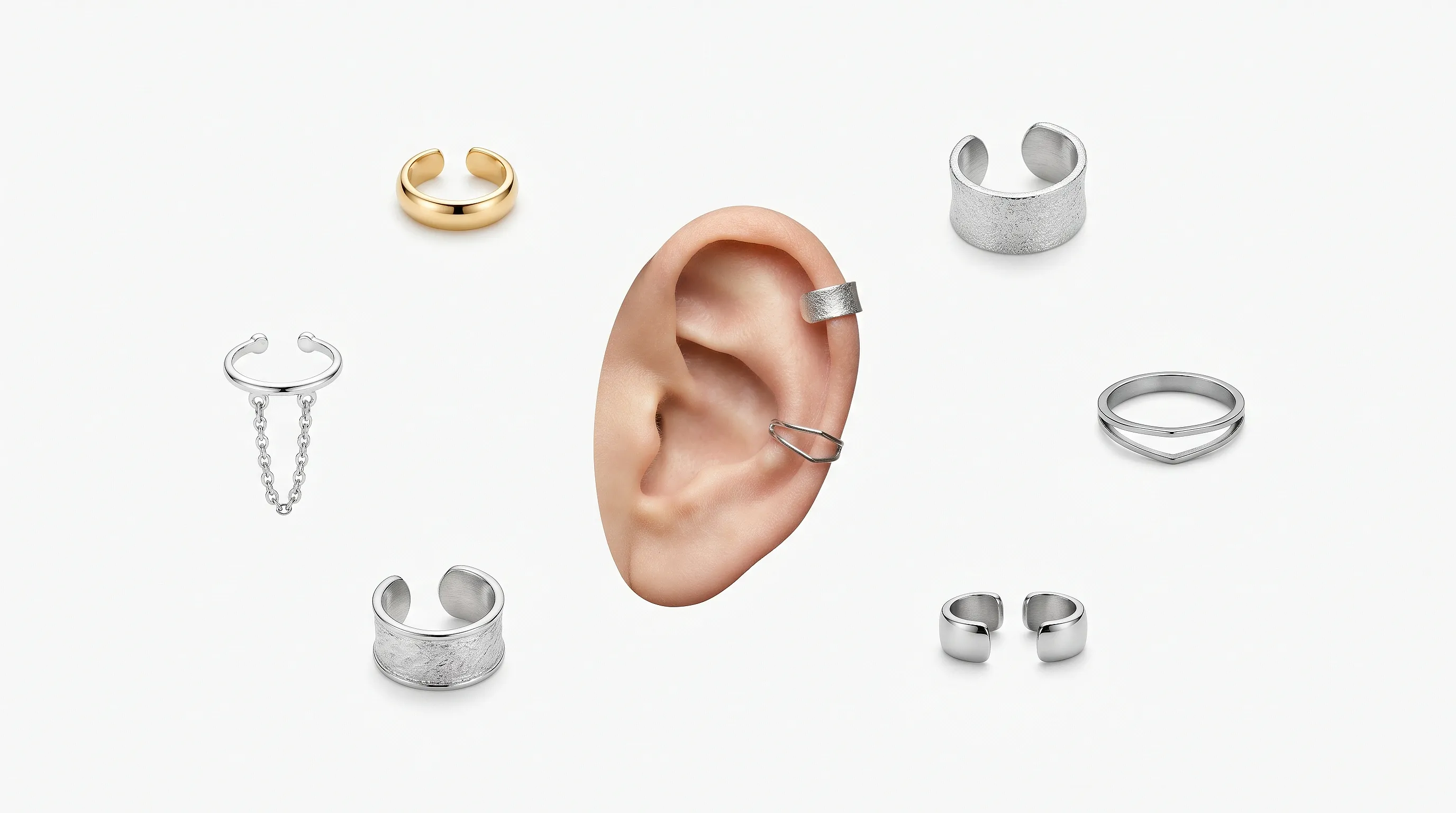
Further reading. For a deep dive into ear piercing anatomy and how each type heals, start with the ear piercing types: a complete guide. For asymmetric styling across two ears, see asymmetric earrings: how to wear mismatched pairs. For the non-piercing alternative for cartilage, there's the ear cuffs guide. For metal combinations, the mixing metals in jewelry guide.
Silver, gold, engagement rings, symbolic jewellery, paired sets.
About Zevira
Zevira makes jewellery in the artisan tradition of Albacete, Spain. An ear stack is all about composing several small, considered pieces, and small pieces are exactly what we make: tiny studs, mini hoops, accent elements in a single style, so you can build a stack as a set rather than a mismatched pile.
What you'll find with us for building an ear stack:
- Studs with and without stones, 1 to 5mm, sized for the tapering rule
- Mini hoops and huggies for the lobe and helix
- Accent pieces with natural stones (moonstone, labradorite, opal)
- Pearl studs for the anchor point at the lobe
- Paired and single earrings for asymmetric compositions
- Sterling silver and 14 to 18K gold, all nickel-free
Every piece can be personalised with engraving, with the option of personal engraving. Sterling silver and 14 to 18K gold.