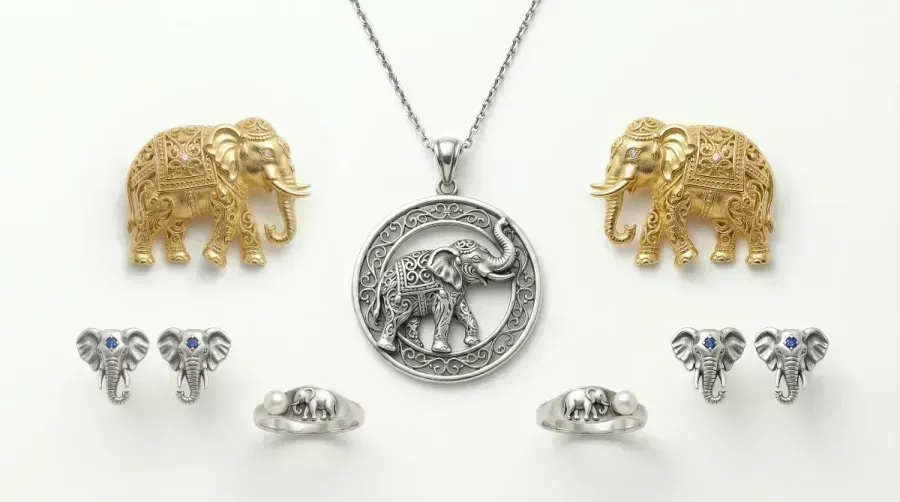
Elephant Jewellery: Symbol of Luck, Wisdom and Strength
Wear the symbol, don't just read about it. These are in stock:

An Animal the World Agrees On
Some symbols carry centuries of cultural weight yet remain the preserve of the initiated. Others flash into fashion and fade with the season. A rare few sit comfortably in almost every corner of the globe, recognised and welcomed without explanation. The elephant belongs to that third group. An Indian child grows up drawing it beside the figure of Ganesha. A Thai schoolchild sees the white elephant on temple murals and old coins. A grandmother in Ghana tells her grandson the story of the wise herd patriarch. A European collector lines seven porcelain elephants on a shelf, dimly aware it is supposed to bring luck. The elephant collects good meanings the way a magnet collects iron filings.
In jewellery the image has lived for a long time and with real confidence. A small elephant pendant on a chain, a heavy signet ring with a relief figure, a pair of earrings with an enamelled ceremonial cloth, a child's bracelet with a tiny calf, a silver charm on a woman's wrist. The elephant in jewellery almost never reads as aggressive. Even when massively three-dimensional it communicates calm power without menace. A dragon demands nerve, a skull demands a position, a spider demands a taste for the gothic. The elephant demands nothing; almost everyone accepts it.
The history of this image runs along several axes at once. The Vedic hymns of the first millennium BCE mention elephants as war animals and royal ones. By the early centuries CE Hinduism had formed the cult of Ganesha, the elephant-headed deity who removes obstacles. Thai, Lao and Burmese monarchs kept white elephants at court for centuries as living proof of heaven's blessing. Hannibal drove war elephants across the Alps and forced Rome to look this animal in the eye for the first time. The British Raj in the nineteenth century turned the elephant into a colonial souvenir, often in ivory. And somewhere in that same Victorian era came the invented folk belief that an elephant with its trunk raised brings luck. All of this poured into a single image that hangs today on the chain of a woman in Madrid and on the cufflinks of a banker in Singapore.
The Order of the Elephant, founded in Denmark in the fifteenth century and one of the oldest chivalric orders still in existence, placed the animal at the centre of European royal heraldry as a sign of wisdom, memory and endurance. In London the Elephant and Castle district takes its name from a trading company that used the elephant as its emblem, connecting the image firmly to commerce and worldly success. And of course Hannibal's elephants, which crossed the Pyrenees through Hispania before scaling the Alps in 218 BCE, left an impression on the Roman imagination that lasted for centuries.
The loudest folk belief, about the trunk, deserves addressing now rather than later. Below we unpack it properly and honestly. Short version: it is Western folklore from the late nineteenth and early twentieth centuries with no roots in Indian, Thai or African tradition. The choice between trunk up and trunk down is a question of aesthetics, not magic. We say this plainly because a brand from Albacete prefers honest conversations before the sale, not after.
One further frame for everything that follows. The elephant as a luck charm is a cultural belief. It has a long and interesting history, but it does not work as a mechanical switch. Ganesha in Hinduism is an active religious image to whom millions of people address prayers. For someone outside the Hindu tradition, Ganesha in a piece of jewellery is more an aesthetic and cultural sign of respect than an object of worship. That distinction does not make the jewellery lesser. It makes it more honest.
Elephant Jewellery: What to Choose
The elephant works in almost every jewellery format, but each one speaks differently. The choice depends less on rules than on how often you plan to wear the piece, at what level of visibility, and within which aesthetic.
Elephant pendant. The most common and most versatile option. A small elephant, roughly one and a half to three centimetres across, on a fine chain, sitting on the collarbone or slightly below. Works under the opening of a T-shirt, under a thin jumper, under a shirt with the top button open. This pendant is worn as a daily amulet, kept on overnight or removed only for the shower. For something with more presence, a large elephant on a rope chain or a leather cord moves into ethnic jewellery territory and calls for calmer clothing around it.
Elephant ring. Two formats exist. The first is a signet-style ring where a three-dimensional elephant figure sits on top like a seal. It occupies almost the full phalanx, reads from a distance, and works as the accent piece of one hand. Indian and Thai craftsmen have been making rings like this for centuries. The second format is a slim band with a flat elephant image, chased or engraved. Worn daily, it does not catch on clothing and stacks well with other fine bands.
Elephant earrings. One firm rule applies. Elephant earrings are worn in pairs, symmetrically, left and right. A single elephant in a single ear does not work, because the animal is inherently asymmetric: the trunk points one way, the tusks another. A pair facing each other or facing outward forms a balanced composition. Stud elephants for the office, drop earrings with enamel for the evening, ethnic pieces with bells and elephant motifs for a free-spirited look.
Elephant charm bracelet. A very feminine format. One elephant or several hang from a chain bracelet, sometimes alongside other Eastern charms: a lotus, a smaller elephant, a coin. In that company the elephant sits naturally.
Large relief signet. A separate category that not everyone will wear, but that no one forgets. An oversized three-dimensional elephant, sometimes with a ceremonial cloth, sometimes rearing on hind legs, sometimes trunk raised. Silver with oxidation, occasionally with gilded tusks. This ring is a character piece, chosen by people who enjoy strong individuality.
Children's elephant jewellery. The elephant is one of the few motifs that suit a child's first amulet perfectly. The image is safe, kind, without sharp symbolism. A silver elephant pendant on a child's chain is a traditional gift for a birth or christening across many cultures, from India to Latin America. The image is warm and does not become childish as the wearer grows.
Brooches and clips. A less common but very expressive format, especially for those who love vintage aesthetics. An enamel elephant brooch on a jacket or coat refers back to art deco and the Indian motifs that were fashionable in Europe from the twenties through the fifties.
Paired elephant pieces. A mother elephant and calf on one chain, as a family amulet. Or two adult elephants walking towards each other, as a paired token for two close people. The topic of paired jewellery is covered in detail in the article on jewellery for couples.
Trunk up, always. A downturned trunk pours your luck out on the floor, and no, there is no other option.
How to wear an elephant
The elephant has crossed hundreds of shoots and shop windows with me. Here is what genuinely works, kept short and sorted by case.
Trunk up or down, when you cannot decide? Here I always recommend trunk up. The old wisdom says a trunk-down elephant lets luck slip away, and while that is Western folklore rather than a strict law, the safe option sits easier, especially as a gift. For yourself a lowered trunk is fine, it looks more contemplative, but by default I suggest up.
Gold or silver for an elephant? Both work, and that is the honest answer. A warm skin undertone I steer toward gold or partial gilding over the cloth and tusks; a cool one toward plain silver with oxidation. If you are unsure of your undertone, choose silver, it gets along with almost everything and never argues with the clothing.
A large elephant or a small one? It depends on how often you wear it. For every day I choose a small silhouette, one and a half to three centimetres on a 42 to 55 cm chain, sitting under the neckline without catching on fabric. A large three-dimensional signet or ethnic pendant I suggest as the sole accent, no rivals nearby, over calm clothing.
Indian elephant with enamel or a minimalist silhouette? I look at the wardrobe. For anyone who loves colour and detail I recommend the Indian elephant with its cloth, enamel and small stones, it reads as a celebration. For anyone holding a quiet minimalism I suggest a smooth stylised silhouette without the cloth, it lives on a fine chain and never breaks the line.
What do I build the look around? The elephant wants a calm natural background: linen, cotton, suede, a plain top. A white enamel elephant I recommend against something dark, that is where it gives the strongest spot. For the office I suggest silver only and a clean line without enamel. And the rule that never lets me down: do not mix more than two metals in one look, the elephant likes quiet around it.

Turn on your camera, pick earrings, a pendant or a ring, and see the piece on yourself in real time.
Switch items in one tap.
Everything runs in your browser: no photo or video is ever uploaded.
Types of Elephants in Jewellery
The elephant in jewellery is not a single thing. There are at least five or six stylistic lines, and they genuinely differ, not just in taste but in cultural origin. Understanding these differences helps you choose what matches your sensibility and wardrobe.
Indian elephant. Recognised by the ceremonial cloth, the decorative headpiece, often by ankle rings. This elephant recalls temple sculpture or Mughal miniature painting. Proportions tend toward the compact, ears are medium, trunk more often lowered or slightly raised. In jewellery the Indian elephant is almost always richly decorated: enamel on the cloth, tiny coloured stones, gilded tusks. This is the Rajasthani register that people recognise from photographs of Jaipur and Kerala. The Indian elephant in jewellery reads as festive, as ethnic accent, as a motif for those who love colour and detail.
African elephant. More realistic, without a cloth, with large ears of the characteristic shape (they really are bigger on the African species; this is biologically accurate). Proportions are leaner, the head flatter, the tusks larger. In silver the African elephant tends to look more austere and archaic: no gilding or enamel, just the texture of the hide, the folds at the neck, oxidation in the recesses. This elephant pairs well with African ethnic pieces: braided leather cords, wooden beads, natural stones such as tiger's eye or onyx. It sits comfortably in a restrained masculine style.
Stylised minimalist silhouette. A contemporary reading. The elephant is reduced to a recognisable line: rounded body, simple trunk, short legs, a dot eye. No cloth, no enamel, no relief. This elephant lives in minimalist collections, on fine chains, on plain bands. It nods toward Scandinavian and Japanese aesthetics where a symbol is reduced to pure form. Convenient for those who want the elephant without the ethnicity.
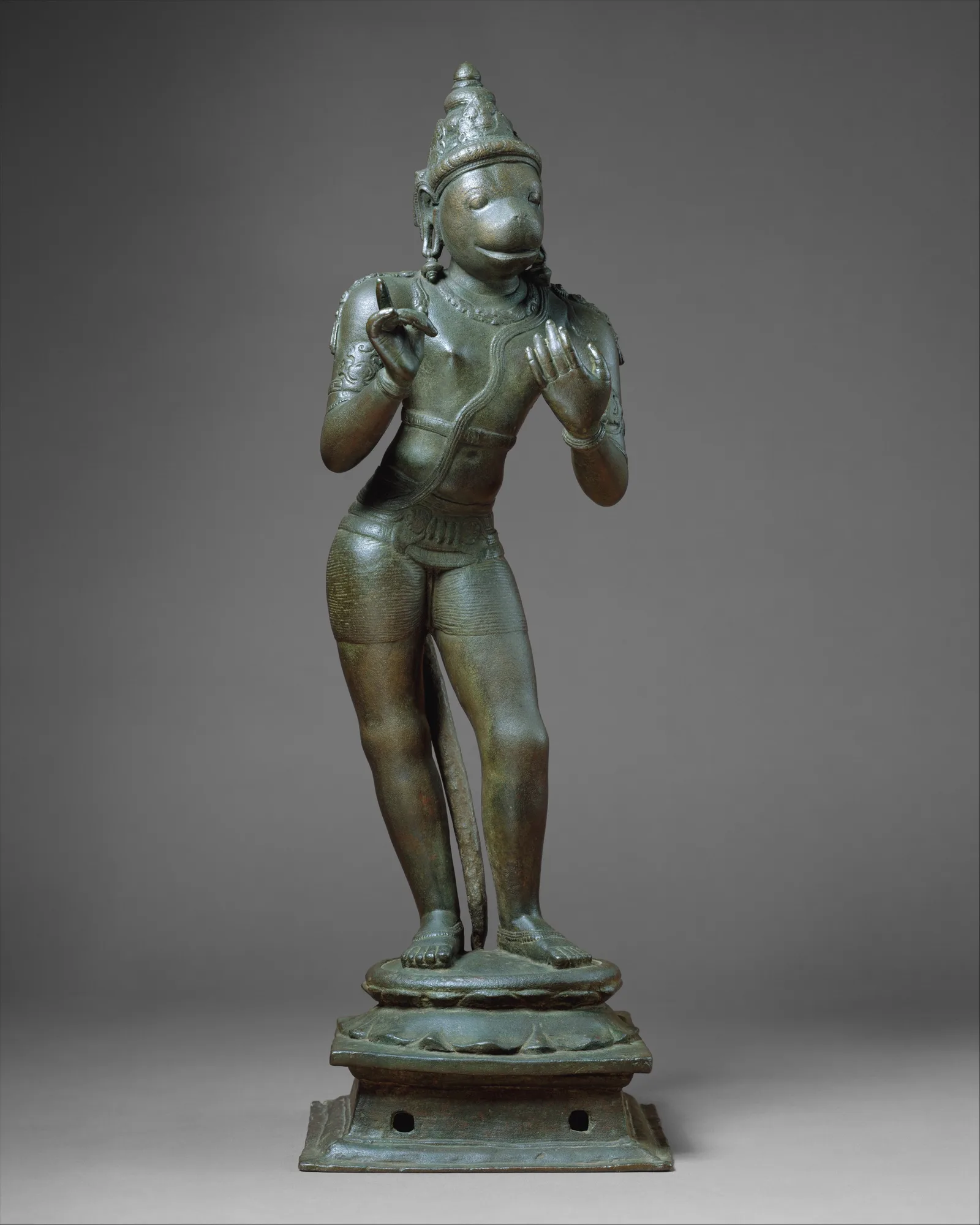
Ganesha. A separate category entirely. Ganesha is not an elephant in any zoological sense: this is a Hindu deity with a human body and an elephant's head. His iconography carries many details: four arms, each holding an attribute (axe, rope, sweet laddu, gesture of blessing), seated cross-legged, a crown, large ears, one broken tusk, a small mouse at his feet as his mount. Jewellery Ganesha ranges from simplified (a silhouette with an elephant head) to canonically detailed. Wearing Ganesha as a non-Hindu is entirely acceptable as an aesthetic and cultural sign of respect for the tradition. Using Ganesha as an ironic meme or as part of a fancy-dress costume is poor form. This is a living religious symbol for over a billion people, and basic respect means not turning it into a joke.
White enamel elephant. A Thai motif. The white elephant in the Buddhist and Hindu tradition of South-East Asia is considered sacred and an attribute of royal power. In jewellery it appears as a figure covered in white enamel, sometimes with a golden cloth and pink tones in the ears. Reads particularly well against dark clothing.
Mother and calf. A composition of two figures, adult and small, often in a shared frame or on one chain. Unambiguously reads as a sign of motherhood and family bond. A popular gift for a mother, grandmother, or new wife. Works as a paired set: the mother wears the cow, the child receives the calf when grown.
Art deco elephant. A geometricised silhouette in the spirit of the 1920s. Angular forms, contrasting onyx and mother-of-pearl inserts, symmetrical composition. Born from the Indian motifs that flooded Europe during the colonial era. Today these pieces live mostly in antique and vintage collections, though contemporary craftsmen occasionally revisit the form.
Customer reviews
Zevira is a real jewellery shop. Genuine payments, deliveries and customer thank-yous.
🥰🥰🥰 gracias

Ok, ¡gracias! 🙂

History of the Elephant as Symbol
The history of the elephant in jewellery cannot be told without the history of the elephant in culture. The two are too tightly interlaced to separate usefully.
The earliest written references to elephants in the Indo-European tradition appear in the Rigveda, the collection of sacred Hindu hymns that took shape by roughly the end of the second millennium BCE. There the elephant is named hastin in Sanskrit, meaning literally "one who has a hand," referring to the trunk. Already then the elephant is linked to royalty and power. The Vedic god Indra rides a white elephant named Airavata, which rose from the foam of the cosmic ocean during the mythical churning of the milk sea. This same Airavata later becomes one of the prototypes for the Thai white elephant.
By the first century BCE and the early centuries CE, Hinduism had crystallised the cult of Ganesha. He is a relatively late god in the Hindu pantheon, but he quickly became one of the most popular. Ganesha is invoked at the start of any important undertaking: a wedding, a journey, the opening of a shop, the writing of a book. He removes obstacles (hence his epithet Vighnaharta, "remover of impediments"). In Indian jewellery the image of Ganesha appears at roughly the same period, first in temple objects, later in personal amulets, pendants and rings.
The Western world met the elephant primarily through war. In 218 BCE the Carthaginian general Hannibal led his army across the Alps with thirty-seven war elephants in its ranks. Most died in the mountains, but several reached the plains of Italy and took part in the first engagement there. For Rome this was a shock. Before this the elephant had been rumour and legend from the East; now it was trampling their infantry. Rome later deployed elephants in its own wars and in triumphal processions, and the elephant entered Roman numismatic and mosaic tradition. Relevant detail: Hannibal's route ran through Hispania before the Alps, which means the Iberian peninsula itself has an ancient connection to this animal that is rarely remembered today.
In the Islamic tradition there is a separate chapter. The Quran mentions the Year of the Elephant, am al-fil, approximately 570 CE. That year the Yemeni ruler Abraha marched on Mecca with an army that included a war elephant. According to Islamic tradition the attack failed, the elephant refused to advance on the holy city, and in that same year the Prophet Muhammad was born. For Islamic culture the elephant remains forever linked to this narrative, and in Arab decorative tradition it appears carefully, without idolatry, but with respect.
Medieval Europe saw the elephant rarely and as a wonder. Charlemagne received as a gift from the Caliph Harun al-Rashid an elephant named Abul-Abbas, and the event was discussed across Europe for decades. In English heraldry the elephant appeared occasionally as a rare exotic symbol associated with the East and the spice trade. Medieval manuscript illustrations of elephants are often fantastical: a trunk resembling a trumpet, ears like a horse's, confused proportions, because artists were drawing from descriptions rather than observation.
The nineteenth century changed everything. The British Raj turned India into a vast source of exotic motifs and materials for European fashion. Ivory became fashionable for combs, pendants and miniatures. Indian motifs including the caparisoned elephant poured into European jewellery. Colonial officers brought home silver and ivory elephants from Delhi, Bombay and Calcutta. It was precisely in this period, the second half of the nineteenth century, that the European belief in the elephant as a luck charm formed. By the early twentieth century this belief was fully embedded in Western popular culture.
The twentieth century made an important turn. As the ecological movement grew, ivory gradually fell from fashion and then from law. The international ban on ivory trading in 1989 changed the industry irreversibly. Silver, gold and enamel elephants took the place of ivory ones. This is a significant moment: contemporary jewellery consciously decouples the image of the elephant from the material of elephant ivory. An elephant in jewellery today is a symbol of the animal, not a product from it. This ethical position is shared by virtually all responsible brands, including Spanish ones.
Upload a photo of your pet, someone you love, or an object. We'll build a 3D model and hand-cast it in pewter.




The Elephant Across Cultures
The elephant holds an honoured place in the mythology and decorative tradition of several regions. The meaning in each is distinct, and collapsing them into a "universal elephant energy" is inaccurate. Below is a brief, honest survey.
India
In Hindu tradition the elephant is connected to several deities. Ganesha, son of Shiva and Parvati, is depicted with a human body and an elephant's head. The myth of how he received it: Shiva in anger decapitated Ganesha without recognising him, then, to correct the mistake, ordered the head replaced with that of the first living creature encountered, which happened to be an elephant. Ganesha removes obstacles and is the patron of writers, scholars and merchants. His image is placed in homes, shops and offices.
Airavata is the white elephant of Indra, king of the gods. He has four or five tusks depending on the version of the myth, and he lives in the heavens. Ancient texts cite Airavata as the prototype for all white elephants appearing on earth.
Lakshmi, goddess of wealth and prosperity, is often depicted flanked by two elephants pouring water from their trunks over her. These images are called Gaja-Lakshmi and are popular in jewellery amulets. Indian wedding jewellery includes elephants as a near-constant element.
In Indian folk belief the elephant is a protection against the evil eye. A small figure is hung above the door of a house, above a child's cradle, on a vehicle. An elephant in jewellery carries the same protective function.
Thailand, Laos, Burma
In South-East Asia the white elephant is a sacred animal and a symbol of royal power. The tradition derives from Buddhist and Hindu mythology of the region: it is said that the mother of the Buddha, Queen Maya, dreamed before his birth of a white elephant offering her a white lotus. Hence the white elephant is linked to the birth of the enlightened one.
Thai kings kept white elephants at court for centuries as living proof of the realm's blessing. Historical footnote: the flag of Thailand until 1917 depicted a white elephant on a red field. The modern tricolour replaced it, but the elephant remained on military banners and royal regalia.
The elephant in Thai and Lao jewellery is always reverential, often trunk-up, often crowned with a small crown or parasol (a symbol of power). Enamel and mother-of-pearl work particularly well here.
Africa
In the cultures of the Savannah and Central Africa, the elephant is a totemic animal, a symbol of seniority, wisdom and collective memory. Many peoples of the region, including the Ashanti in Ghana, the Maasai in Kenya and the Zulu in southern Africa, regard the elephant as an animal of chiefs. Elephant tusks in traditional chiefly regalia signified a connection to long ancestral history.
The African relationship to the elephant differs from the Indian one in emphasis. Where in India the elephant signifies blessing and the removal of obstacles, in Africa it signifies experience, age and heritage. The old elephant in the herd remembers the route to water that the young do not know. This memory is real: ethological studies confirm that matriarchs genuinely retain knowledge of routes and pass it to their daughters across decades.
In the African jewellery tradition the elephant is depicted realistically, without decorative elements, with an emphasis on texture and the power of the silhouette. Materials: silver, brass, sometimes wood combined with metal.
Europe and Britain
Europe's relationship with the elephant has been complicated. Before the colonial era the animal was an exotic from textbooks and travellers' tales. Hannibal's elephants, Charlemagne's Abul-Abbas, rare menageries at royal courts. In heraldry the elephant appeared occasionally as a sign of links with the East or of trade.
The Order of the Elephant, one of Europe's oldest chivalric orders, placed it at the heart of royal symbolism as a sign of endurance and strength. The Elephant and Castle in London, a district whose name derives from a trading company emblem, embedded the image in urban commercial life. These are not casual usages: they reflect a long European tradition of reading the elephant as an emblem of steadfast power.
The nineteenth century shifted everything. The Raj, French colonies, Dutch and Portuguese footholds in Asia brought the elephant into European decorative art, textiles, wallpapers and jewellery. Art deco of the twenties firmly established the elephant as a symbol of luxury and distant travel.
The Western Nineteenth and Twentieth Centuries
This is where the image of the elephant as a luck charm formed. In Victorian England aristocratic and then bourgeois households developed the habit of keeping elephant figurines as talismans. Zoos with live elephants became popular entertainment, circus parades with elephants passed through cities, and the famous legend about the raised trunk took shape. More on that below.
A brief honest note. There is no universal elephant energy that overrides all these traditions at once. In each culture the elephant means something specific. You can wear one from within any of these traditions, or simply because the image appeals to you visually. But speaking of "elephant magic in general" is a simplification we prefer not to transmit.
CAPAORA mini knife pendant
The 18th-century Spanish navaja in miniature: 40 mm of stainless steel, a real folding mechanism and a Palanquilla lock that clicks. An affordable gift to remember.
Authentic · Ships from Spain · 14-day returns
What the Elephant Symbolises
Drawing across different cultural traditions, several stable meanings recur. Important note: these are not "magical properties" but persistent cultural associations. The difference between those two formulations is significant.
Wisdom and long memory. This is a rare case where a cultural symbol rests on a real biological fact. Elephants genuinely possess extraordinary long-term memory. Ethological research shows that elephants recognise relatives after decades of separation, remember routes to waterholes, and remember people, treating them differently based on past experience. The image of the elephant as a "wise elder" is not poetic metaphor but a reflection of documented animal behaviour.
Family bond and mourning. Elephants live in matriarchal herds led by the eldest female. Calves are raised collectively; aunts and sisters help the mother. When a herd member dies, others gather around the body, touch it with their trunks, and sometimes remain nearby for days. This is not sentimental invention but documented behaviour. The elephant as a family symbol stands on solid biological ground, not cultural poetry alone.
Strength without aggression. The elephant is one of very few powerful animals that almost no one considers threatening. A predator by default implies danger. A snake implies fear. A spider implies dread. The elephant, with its mass and strength, manages to project calm and even good nature. This rare combination is one reason it so easily becomes a children's motif.
Luck as a cultural belief. Formulation matters here. The elephant as a luck charm is not a physical property of the animal or a hidden energy in the metal. It is a cultural practice within which certain objects acquire associations with prosperity. People who wear such objects gain psychological support from them, and through that, perhaps greater confidence in their actions. This is a real effect, but it is psychological and social, not magical.
Removal of obstacles through Ganesha. In Hindu tradition this is the central function. Ganesha is invoked at the start of undertakings, before examinations, before journeys. For a Hindu this is a living practice, part of daily religious life. For someone outside the tradition it is a cultural symbol that can be respected and worn without claiming religious significance.
Protection from the evil eye. An Indian folk belief: the elephant (particularly with a raised trunk or with forward-facing eyes) deflects evil glances. A related belief exists around the mystic eye symbols, though the mechanism differs. Elephant and eye are two distinct cultural lines with a similar protective function.
Trunk Up or Down: Does It Matter?
The most common belief about elephant jewellery goes like this: "an elephant with its trunk raised brings luck; an elephant with its trunk lowered lets luck drain away." Let us look at where this came from and how seriously to take it.
The belief is Western and relatively recent. Its roots lie in the late nineteenth and early twentieth centuries, in the era of Victorian spiritualism, popular occultism, fashionable Eastern aesthetics and circus tours with live elephants. In the circus, elephants during parades sometimes raised their trunks. It was a spectacular gesture that audiences remembered. From there the popular culture association crystallised: trunk up equals a "joyful, luck-summoning" elephant; trunk down equals a "downcast, luck-releasing" one. By the 1920s this folklore was firmly lodged in American and European home decor guides.
In the Indian tradition this rule does not exist. The iconography of Ganesha accepts both raised and lowered trunk equally. Moreover, Ganesha has distinct canonical positions: vamamukhi (trunk pointing left, the "domestic" form) and dakshinamukhi (trunk pointing right, the "temple" form). There is no luck counter here; this is iconography.
In the Thai tradition the white elephant is more often depicted with a gently raised or lowered trunk, depending on the scene. A trunk raised in greeting is considered a gesture of respect, but this is an etiquette gesture, not "raised for luck."
In the African tradition the question of trunk position simply does not arise. The elephant in local decorative and jewellery tradition is depicted realistically, its pose following the natural movement of the animal rather than a folkloric code.
Simple conclusion. The trunk belief is Western folklore, an aesthetic superstition on the level of "spill some salt, throw a pinch over your shoulder." There are no energies attached to trunk-up or trunk-down. If you want to observe this tradition, observe it; no harm will come of it. If it means nothing to you, choose the pose that simply looks better visually. In a jewellery piece with a complex composition (for instance, a mother elephant inclining toward her calf) the natural position will often be trunk-down, and that does not make the piece "inferior." It makes it more lifelike.
Practical tip. If buying an elephant as a gift for someone with strong feelings on the subject, ask beforehand or choose trunk-up; it is the safe option. If buying for yourself, follow the visual impression, how the figure feels in the hand and reads on the body. A trunk-down elephant often looks more contemplative and meditative. A trunk-up elephant reads as more animated and celebratory. Both are fine, with different inflection.
Leave your email, we'll send your discount code. No spam, unsubscribe anytime.
The code arrives by email, valid on your first order.
Materials and Techniques
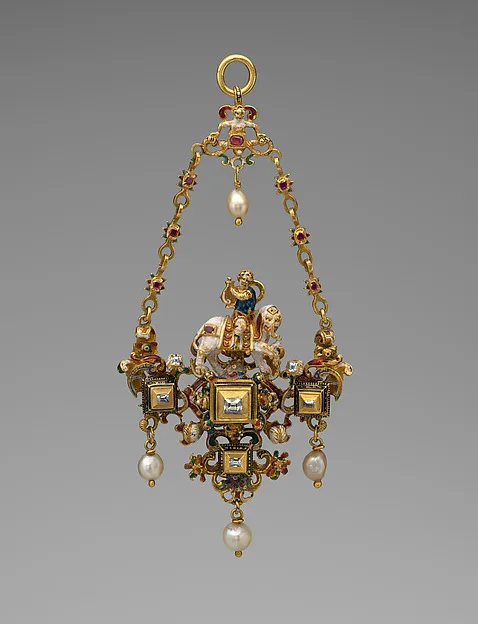
The choice of material for an elephant in jewellery significantly affects how the symbol reads. Here are the main options used by jewellery workshops, including Spanish and Italian ones.
Sterling silver (925). The backbone of most modern elephant jewellery. Silver holds detail well, allowing the wrinkles on the neck, the folds of the ears and the texture of the ceremonial cloth to be worked properly. In its oxidised form silver emphasises the relief by darkening the recesses. Sterling silver is generally safe for those with sensitivities; a full guide to metals and marks is elsewhere, but silver is the optimal material for elephants in terms of cost, durability and aesthetics.
Enamel. The key technique for Indian and Thai elephants. Coloured enamel on the cloth, ears and eyes turns a simple figure into something festive. Craftsmen work in several techniques: cloisonne (partitioned enamel in which coloured areas are separated by fine metal walls), champlevee (enamel poured into engraved recesses), and painted enamel (miniature painting over a base). For the white Thai elephant, dense white enamel with a soft pearlescent effect is typical.
Miniature stone settings. Often used for the elephant's eyes or to ornament the tusks and cloth. Carnelian and garnet give warm red and orange points; turquoise works for Indian-style accents; mother-of-pearl for the Thai register; black onyx for African and art-deco gothic styles. The stones are usually small, one to three millimetres, their purpose not to shine independently but to animate the figure.
Silver oxidation. A technique in which the recesses of a relief are darkened with a special compound to emphasise the detail. An oxidised silver elephant looks older, more ethnographic, more culturally specific. Nearly all good-quality Indian and African silver elephants go through an oxidation stage.
Lost-wax casting. The classic technique in which a figure is first modelled in wax, a plaster mould taken from it, and then molten metal poured in. Casting allows complex three-dimensional figures with high detail, including the folds of skin and the shape of the hooves. Most quality elephant signet rings are made this way.
Gold vermeil. Silver with gold plating on top gives a Rajasthani register, a rich Indian reading. Partial gilding works especially well: the elephant body stays silver while the cloth, tusks and head ornaments are gilded. The contrast of two metals gives visual depth and the sense of a genuine Indian jewellery object.
Mixed materials. Silver with a leather cord, silver with wooden beads, silver with ethnic thread. These combinations work particularly well for African styling and ethnically oriented collections.
How to Wear It
The elephant is versatile, but a few guidelines help avoid missteps.
Elephant pendant as a daily amulet. Worn on a short (42-45 cm) or medium (50-55 cm) chain. The short length places the elephant on the collarbone, working well under the opening of a T-shirt or shirt. Medium length drops the elephant to the chest, working under a roll-neck or jumper. Long chains (70 cm or more) with an elephant are an ethnic option, working with loose clothing and dresses.
Elephant ring as the accent of one hand. If you have a large elephant signet, wear it without competition. Nothing else large on the same hand. On the other hand a fine band or wedding ring is fine. If the elephant is small and flat, the rules relax; that ring stacks well with other slim bands.
Elephant earrings in pairs only. Symmetrically, left and right. A single elephant in a single ear does not work; we repeat this because the error is common. If asymmetry is the goal, choose another motif; the elephant requires a pair.
In an ethnic ensemble. The elephant sits comfortably alongside other ethnic motifs: lotus, mandala, Indian beads, Thai Buddha, Ganesha amulets. Such ensembles are assembled as a conscious ethnographic statement, as part of a traveller's or collector's wardrobe.
In a minimalist wardrobe as the sole accent. Counterintuitively, a small stylised elephant works brilliantly against the calmest clothing. A white shirt, jeans, a grey roll-neck, a black jumper: any plain background makes the elephant more visible and more beautiful. One elephant on a plain chain becomes the owner's recognisable signature.
With natural materials. Leather, linen, cotton, suede, wood, wool: all are native backgrounds for a silver elephant. Synthetic shiny fabrics suppress the elephant; natural ones support it.
White enamel elephant against dark clothing. A purely visual rule. White enamel on a black roll-neck or dark navy dress reads perfectly. The elephant silhouette becomes a bright spot the eye naturally settles on. This is the strongest visual contrast in this category of jewellery.
Pairing with other symbols. The elephant sits well with symbols of protection and wisdom: runes, mandalas, Celtic knots, and the dragon in another part of the collection. The elephant combines less naturally with sharp gothic motifs such as spider or skull, though with intent it is possible; it simply calls for a bolder compositional hand.
In the office. The elephant is one of very few animals that works confidently in professional dress. A small restrained elephant pendant under a blouse, a fine engraved band, a pair of elephant studs: none of these violates a dress code, and all of them remain a personal mark.
Silver, gold, wedding rings, symbolic pieces, paired sets.
Who Is This For?
The elephant is universal, but certain people find it resonates with particular force.
Travellers drawn to Asia and India. For anyone who has been to Varanasi, Chennai, Bangkok or Luang Prabang, and who carries an inner map through that region, the elephant works as more than jewellery; it becomes a memory of place. An Indian or Thai silver elephant is a personal reference to experience, to photographs, to scent.
People for whom family and memory matter deeply. A mother elephant with her calf, an elephant as the symbol of long memory, an elephant as the emblem of the matriarchal herd: all of this resonates with those for whom family bonds are a core value. Such a gift fits the birth of a child, an anniversary, a grandmother's or mother's significant birthday.
Those who want an amulet without aggression or dark symbolism. The elephant does not unsettle anyone. For anyone seeking a protective image who does not want to wear a skull, spider or dagger, the elephant is the obvious choice. It is warm without being cloying.
A gift for a parent, grandmother or grandfather. The elephant is one of very few themes that works across generations with equal ease. A small silver elephant on a chain for a mother or grandmother is rarely met with puzzlement. The image is recognisable, the history behind it is benign, emotionally safe.
A gift for a child. First amulet, first silver jewellery, a christening or birthday gift. The elephant is a sound choice. It is simultaneously childlike and adult; the wearer will not outgrow it the way they might outgrow a cartoon character in five years.
Lovers of ethnic aesthetics. Those who wear jewellery from India, Nepal, Turkey, Morocco, Mexico: for them the elephant is a natural resident of that world. It fits the ethnic wardrobe without effort.
Lovers of quiet symbolism. The elephant does not announce itself. It requires no explanation on a first date or in the office. It can be worn for years while people simply note that you have a beautiful pendant, never suspecting the layers of history behind it.
Who the elephant suits less: those seeking an "instant magical effect" or an "energy charge." This is not that symbol. The elephant is about long time, about respect for history, about patient wisdom, not quick results. The elephant can also feel out of place in a sharp gothic or punk aesthetic built on the opposition of softness; technically it can be fitted there, but it becomes a genre game.
Send a friend a discount code, they save on their first order.
Elephant Jewellery as a Gift
The elephant works as a gift because its meaning needs no explanation. Luck, strength, wisdom, protection of the home: a cluster of associations that reads almost everywhere and asks nothing of the person receiving it. That is why the elephant steps in where other symbols stall. For a housewarming it reads as a wish for a steady, calm home. For a birthday or a promotion it lands as a quiet "for luck." With no occasion at all, it works as a warm gesture that neither obliges nor embarrasses.
Its real advantage shows when you are unsure of someone's taste. The image is neutral and kind, with no sharp symbolism, no gender attachment, no religious obligation for whoever wears it. A small silver elephant on a chain suits a teenager, a grandmother, or a colleague you barely know. It rarely misses the mood.
If you want to sort gifts by occasion and budget, our gift guide for every occasion helps. And for the case when the taste is a total blank, there is a separate piece on choosing a gift when you don't know the taste. To pick out a specific figure, browse the amulets and charms catalogue.
Frequently Asked Questions
Is it true that an elephant with its trunk raised brings luck?
This is a Western folk belief from the late nineteenth and early twentieth centuries, rooted in circus and Victorian culture. In the Indian, Thai and African traditions no such rule exists. If you enjoy this belief, wear your elephant trunk-up. If it means nothing to you, choose the pose that looks better visually. There are no energetic differences between trunk positions.
Can I wear Ganesha if I am not Hindu?
Yes, with respect for the tradition. Ganesha is a living religious symbol for Hindus, and wearing him as an aesthetic or cultural sign is entirely acceptable. Using Ganesha as an ironic meme, as a carnival element, or as part of a party costume is poor form. Otherwise there are no prohibitions, and Hindus generally respond warmly to interest in their culture from outside, provided that interest is respectful.
The seven porcelain elephants on a shelf: is that an Indian tradition?
No, it is a Central and Eastern European folk custom that derives from Western rather than Indian tradition. The "seven lucky elephants" appeared as a motif in the late nineteenth and early twentieth centuries, popular in German, Czech and then Soviet domestic culture. The porcelain figures stood on a sideboard as a collection and were sometimes considered a household talisman. This has no direct connection to Ganesha or other Hindu deities. It is a separate European tradition that borrowed an Eastern form but filled it with its own content.
Should an elephant in jewellery have tusks or not?
A purely aesthetic question. Contemporary jewellery more often depicts elephants with small white (enamelled or gilded) tusks, because they add expressiveness to the silhouette and make the animal instantly recognisable. A tusk-less elephant reads softer; it is often chosen for stylised minimalist pendants. There are no ethical concerns either way, since the reference is to a symbolic image of the animal, not to real bone. No one uses ivory for contemporary jewellery; it is illegal and universally regarded as ethically unacceptable.
Can I give an elephant to a child?
Yes; it is one of the safest and most generous motifs for a child's jewellery. A small silver elephant on a child's chain is a traditional gift for a christening, first birthday or naming day across many cultures from India to Latin America. The image is kind, carries no frightening associations, and is visually recognisable, which matters to children. One practical note: for children under three, small removable parts (pendants, charms) should be selected carefully with safety in mind. For older children there are no restrictions.
Elephant and ivory: are they connected in contemporary jewellery?
Deliberately not. The Convention on International Trade in Endangered Species (CITES) banned commercial ivory trading in 1989, and the vast majority of countries, including Spain and the United Kingdom, adhere to that ban. Contemporary jewellery works entirely in silver, gold, enamel and synthetic materials, not ivory. An elephant image in jewellery today is a symbol of respect for the animal, not a product derived from it. This ethical position is a core element of how the responsible contemporary jewellery industry operates.
About Zevira
Zevira is a Spanish jewellery brand from Albacete. The elephant and Ganesha line is one category within the catalogue. Current pieces and full details are available in the catalogue.
Buying it as a gift? Each one arrives ready to give.
 A branded Zevira box and a little card come with every order.
















Conclusion
The elephant in jewellery is one of the rare symbols received with equal warmth in India, Thailand, Africa, Europe and beyond. Each of those cultures means something distinct by it, and in this article we have deliberately not blended those meanings into a universal mental stew. The Indian Ganesha removes obstacles. The Thai white elephant speaks of royal blessing. The African elephant speaks of ancestral memory. The Victorian elephant speaks of domestic luck. We choose the image that resonates with our own history and wear it not as a magical switch but as a sign of respect: for a culture, for an animal, for the experience accumulated over years.
The elephant travels far, remembers long, and lives long. In jewellery this quality reads even in the smallest figure on a fine chain. No promises of luck are needed; a good symbol does not require them. What is needed is that the piece be made carefully, that the history behind it be told honestly, and that the wearer understand what they are carrying on their neck or hand. When those three conditions hold, the elephant does its work, which is not to perform miracles but to remind us of the qualities we ourselves wish to cultivate.