Flower of Life: meaning of the sacred-geometry symbol and the pattern of 19 circles
Introduction: a pattern older than borders
On a granite column of the ancient temple of Osiris in Abydos, Egypt, someone once carved a pattern of nineteen perfectly overlapping circles. The same drawing later turns up in Assyrian palaces, Roman mosaics, and Gothic rose windows. The symbol known today as the flower of life is older than most world religions and older than most national borders.
The flower of life is one of those signs where plain geometry turned out to be remarkably durable. Nineteen circles of a single radius, laid out on a strict grid, produce a pattern with six-fold symmetry, finished and calm. There is nothing supernatural about the figure itself. You can draw it with a compass in half an hour. But that very clarity is what turned the flower of life into a wandering ornament, one that kept resurfacing across unrelated cultures for thousands of years without asking anyone's permission.
Wear the symbol, don't just read about it. These are in stock:


This guide takes the symbol apart honestly and in detail. How the pattern is built and how it is drawn, where it came from and which eras it travelled through, what it means in the language of sacred geometry, and where in that language the math ends and belief begins. We will look at the family of related forms, from the seed of life to the flower of life, the fruit of life, and Metatron's Cube, and see how the flower of life lives in jewellery, a medallion pendant, an engraving on a ring, a slim silver piece. Wherever the conversation turns to the pattern's "energy" or to "harmonising a space," we will call that plainly what it is: a spiritual concept, not an established fact. And wherever the symbol works as beautiful geometry and a meaningful talisman, we will give it its due.
What the flower of life is: the geometry of 19 circles
A pattern of nineteen circles
The classic flower of life is exactly nineteen full circles of equal radius, set inside one overall circular border. The centres of the circles sit at the nodes of a regular triangular grid, so each circle passes through the centres of its neighbours. That produces a dense web of overlaps, where the lines resolve into petals, rosettes, and hexagonal cells. From a distance the drawing looks intricate, but the rule behind it is a single one: equal circles, spaced at equal distances. All the apparent complexity grows out of that one simple repeat.
The number nineteen itself breaks down cleanly: one circle at the centre, six around it forming the first ring, and twelve more forming the second. The first ring of six circles produces the recognisable six-petalled rosette at the core, and the second ring completes it into the full flower. Between the circles, the same pointed lens shape appears that you get from any pair of overlapping circles, and it is chains of that lens the eye reads as petals. So the seeming tangle of lines is actually built from just two simple layers wrapped around one centre.
That double layer of circles is framed, in turn, by a double border, two concentric circles with a row of smaller circles often set between them. The border is not a decorative afterthought. It cuts the pattern off exactly where the second ring closes, turning an open grid into a finished figure with a clear centre and a clear edge. Without it, the flower of life would simply bleed into an endless field of circles. The border is what turns a fragment of a lattice into a self-contained symbol.
How to draw a flower of life with a compass
The construction starts with a single circle. Set the compass point anywhere on that circle's edge and draw a second circle of the same radius. Where the two circles overlap, they form a lens that geometry calls the vesica piscis, Latin for "bladder of a fish." From there, new circle centres are placed at the intersection points of the circles already drawn, and the pattern grows on its own, ring by ring. Once a full wreath closes around the central circle, and then one more ring beyond it, you get exactly the pattern of nineteen circles, framed by its double border. No ruler and no calculation required, just a compass and patience.
Symmetry and a finished hexagon
A completed flower of life has six-fold symmetry: rotate it by a sixth of a turn and it lines up with itself again. The pattern's outer edge fits inside a regular hexagon, which gives the whole figure a sense of completeness. Six mirror axes, six directions of repetition, even petals running the full circle: the eye reads that structure as order and calm. This finished quality is exactly what separates the flower of life from an infinite grid of circles, which could keep spreading in any direction. The flower is the grid's closed, framed fragment, the one with a centre and an edge.
Vesica piscis: the lens at the heart of the pattern
All the richness of the flower of life grows out of one elementary shape. When two circles of equal radius overlap so that each passes through the other's centre, the shared area forms a pointed lens. It is called the vesica piscis, the "vessel of the fish." The lens is pleasing to the eye and useful in construction: its endpoints and the circles' centres let you build an equilateral triangle with ease, and triangles are what assemble into the pattern's full triangular grid. The lens's own proportions relate to the square roots of two and three, which is why geometers rate it as a small but remarkably fertile building block. In effect, the entire flower of life is a field of interlocked vesica piscis lenses, multiplied by a strict rule.
Hexagonal circle packing
Mathematically, the flower of life is a fragment of the densest possible packing of circles on a plane. Lay identical coins flat against one another and each one ends up surrounded by exactly six neighbours, with their centres forming a triangular lattice. Nature reaches for that same packing wherever a plane needs covering without gaps: honeycomb cells, foam bubbles, scales, the seeds in a sunflower head all lean on the same six-fold logic. The flower of life makes this structure visible by drawing a full circle around every node of the lattice. That is where its echo of the living world comes from, and it is a rhyme with a real physical law, not with mysticism, the law by which circles pack most tightly.
Flower of life: the meaning of the pattern
The meaning attached to the flower of life in the language of sacred geometry grows directly out of how it is built. Every new circle is born from the intersections of circles that already exist, so the whole pattern reads as an image of one thing generating another, of growth from a shared beginning. From that comes the symbol's main associations: unity, the interconnection of all living things, continuous creation flowing from a single point. That is a poetic reading, not a scientific one, but it follows logically from the geometry: the figure genuinely does unfold from one circle according to a strict rule. This is the meaning most people reach for when they wear a flower of life, a sign of connectedness and wholeness.
Customer reviews
Zevira is a real jewellery shop. Genuine payments, deliveries and customer thank-yous.
🥰🥰🥰 gracias
Ok, ¡gracias! 🙂
Take the flower of life large and in silver, on a bare neck under the neckline. A tiny gold medallion kills all the geometry, and don't argue.
How to wear a flower of life: what to pair it with, metal and chain length
I build the flower of life from the pattern outward. The medallion is dense and graphic, so I put together a look where the web of circles reads clearly instead of getting lost in busy prints. Here is what I recommend to clients by occasion.
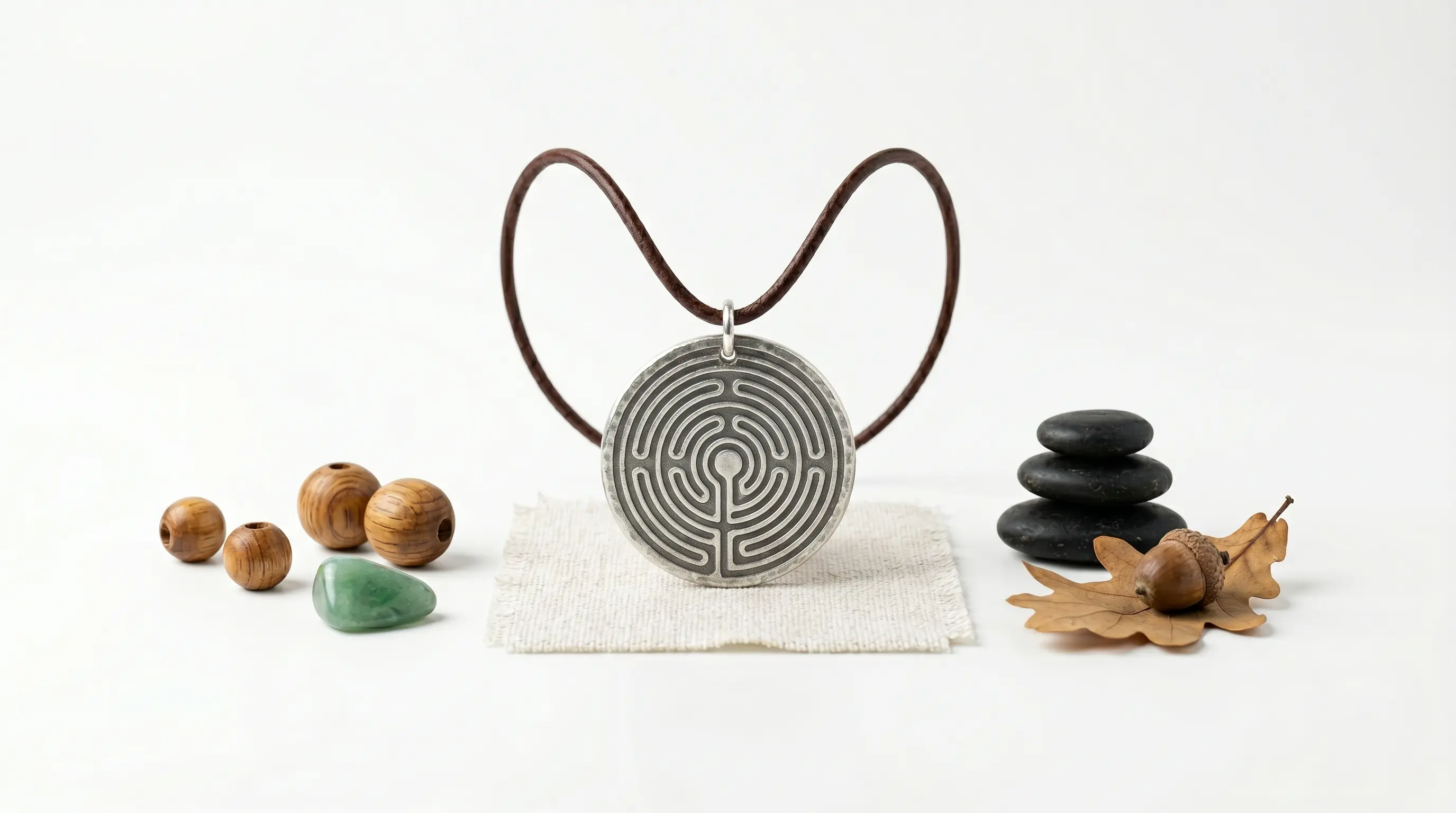
What to wear with a flower of life every day? For everyday wear I recommend a round medallion of 2 to 2.5 centimetres on a medium-length chain, over plain fabric. A dense pattern of circles argues with a printed fabric, so I choose a smooth backdrop: grey, black, olive, sand. An open-work cut plays beautifully against the light when there is even fabric behind it, and the whole web of circles reads clearly instead of blending into a print.
Which metal should I choose for the colour of my clothes? I match the metal to the temperature of the look. Cool silver I recommend with grey, graphite, navy, and white, where it reads cleanly and brings out the pattern's fine lines. Warm gold plating or gold I recommend with sand, chocolate, wine, and ochre. One metal throughout the look keeps the picture composed, so I do not advise mixing silver and gold in the same set.
How do I choose the chain length for my neckline? I match the length to the neckline. Under an open collar or a shallow neckline I recommend a short chain of around 45 centimetres, so the medallion lands at the collarbone, where the pattern reads best. Under a closed top I recommend dropping the pendant to 50 to 55 centimetres, onto the upper chest, so the circle is not crowded by the neckline. Longer chains of 60 to 70 centimetres I keep for a layered look, where the flower of life sits as the bottom tier beneath smaller pendants.
What size medallion should I choose? I choose the size for the job. A small disc of 1.5 to 2 centimetres I recommend as a discreet personal sign under the collar, where the pattern stays quiet. A medium size of 2.5 to 3 centimetres I recommend as a calm accent at the collarbone, where the full web of circles is visible, and it is the most versatile format. A large disc from 4 centimetres up I choose for a long chain and a graphic look, where the medallion works as a visible centrepiece. I would not put a pattern this dense on a small gold medallion, the geometry gets lost.
What suits the office, and what suits going out? For weekdays and a restrained setting I choose a flat disc with an engraving, or a signet ring, where the flower of life reads as a neat geometric mark rather than an esoteric statement. For the evening, by contrast, I recommend a large open-work medallion or oxidised silver on a long chain, over dark, smooth fabric. Polished silver plays beautifully on smooth materials, oxidised silver adds a graphic edge, almost like a drawing in ink.

Turn on your camera, pick earrings, a pendant or a ring, and see the piece on yourself in real time.
Switch items in one tap.
Everything runs in your browser: no photo or video is ever uploaded.
History of the pattern: from Abydos to Gothic rose windows
Ancient Egypt: granite at the temple of Osiris in Abydos
The best-known appearance of the flower of life is tied to the Osireion, a temple structure within the funerary complex at Abydos in Egypt. Several granite columns there carry patterns of overlapping circles, drawn with a precision that startles visitors. It is worth being honest here: the dating of these particular drawings is disputed. Many researchers believe the circles were not cut by the temple's original builders but added much later, in the Greco-Roman period, using red ochre or a heated tool, essentially ancient graffiti on an already old structure. That does not make the motif itself any less ancient, but it does mean the Abydos marks are unlikely to be a coded message from the pharaohs. The circle pattern is old. The specific Abydos imprints are most likely younger than the temple itself.
Assyria, the Phoenicians, and Roman mosaics
The six-petalled rosette, the core of the flower of life, turns up across the ancient Mediterranean and Near East. It appears on Assyrian reliefs and palace thresholds, in Phoenician decorative art, on objects from the Levant. Roman craftsmen happily laid six-petalled rosettes and grids of circles into floor mosaics, where a repeating geometric pattern was an efficient way to cover a large surface. For ancient makers this was a convenient, attractive, and easily reproducible design: a compass gave flawless symmetry without any complicated maths. The drawing travelled from culture to culture as pure decorative form long before anyone attached an esoteric meaning to it.
The rosette talisman in European folk art
A separate, almost forgotten branch of the pattern's history is the folk talisman. Across Europe, from the Alps to the British Isles, people spent centuries carving the six-petalled rosette with a compass into door lintels, beams, chests, and cradles. It went by many names, the daisy wheel, the hexafoil, the rosette. The belief was that a symmetrical figure drawn in a single unbroken motion confused evil forces and turned trouble away from the house and livestock. There was no connection to any esoteric theory of the flower of life in these marks; a farmer with a compass was not reading treatises on sacred geometry. But the hand reached for the same pattern of overlapping circles because it gave flawless symmetry with the simplest of tools. So the core of the flower of life lived for centuries in folk culture as a protective sign, long before its modern fame.
The flower of life in synagogues and Eastern ornament
Religious traditions with no ties to esotericism embraced the motif of overlapping circles just as readily. The floors and thresholds of ancient synagogues in Galilee were decorated with grids of circles and six-petalled rosettes. Islamic art, where images of living beings are restricted, developed geometric ornament to extraordinary heights, and circular grids related to the flower of life sit at the root of many patterns on walls, domes, and manuscript pages. Similar circular lattices appear in Indian and Chinese temples. The reason is the same everywhere: a compass produces an infinitely repeatable, flawless symmetry, and a craftsman needs a pattern that will fill a surface beautifully without gaps. In that sense the flower of life is a genuinely universal language of ornament, arrived at independently by different cultures.
Gothic rose windows and Leonardo's sketches
In medieval Europe the same circle geometry moved into architecture. The great rose windows of Gothic cathedrals are laid out on compass-drawn circles and arcs, where the circles set the tracery for the stained glass, and the resulting six-fold or twelve-fold symmetry echoes the logic of the flower of life. Stonemasons and glaziers were not thinking about esotericism, they were thinking about light and proportion, but their visual language was the same as that of the ancient rosettes. A separate chapter belongs to Leonardo da Vinci: his notebooks contain pages covered in patterns of overlapping circles and the shapes derived from them, where he studied how regular forms and proportions emerge from a simple compass grid. For a Renaissance artist this was a laboratory of geometry, not mysticism. So the flower of life picked up a Renaissance thread, a thoroughly academic one, alongside its ancient trail.
Upload a photo of your pet, someone you love, or an object. We'll build a 3D model and hand-cast it in pewter.



From the seed of life to the flower and the fruit
The seed of life: seven circles of beginning
The whole family of these patterns rests on the seed of life, a figure of seven circles. Take one central circle and surround it with six identical circles arranged in a ring so that each passes through the centre. The result is an even six-petalled rosette inscribed in a circle, simple and instantly recognisable. In sacred geometry the seven circles of the seed are read as an image of beginning, a kernel from which the rest of the pattern unfolds. Mathematically it is simply the first complete layer of circle packing, but that first layer serves as the seed for the entire flower of life. The seed of life is often worn as its own piece of jewellery: it is more compact than the flower and reads clearly even on a small pendant.
The flower of life: nineteen circles
Keep adding rings of circles around the seed, following the same grid, and the rosette grows into the flower of life. The classic form stops at nineteen full circles, enclosed by a double circular border. That stopping point is not arbitrary. At exactly this stage the pattern forms a neat, finished hexagon and reads as complete. Extend the grid further and you simply get an endless field of circles that loses any sense of a centre. Nineteen circles is the balance point between the simplicity of the seed and the infinity of the grid, which is why this particular form is the one properly called the flower of life.
The fruit of life and Metatron's Cube
Hidden inside the full pattern is another key figure, the fruit of life. It consists of thirteen circles picked out of the overall grid by a specific rule, so that their centres form a symmetrical structure. Connect the centres of all thirteen circles with straight lines and you get a complex web known as Metatron's Cube. By the logic of sacred geometry, projections of all five Platonic solids, from the tetrahedron to the icosahedron, can be found inside that diagram. So a simple packing of circles turns out to be the root of an entire family of three-dimensional forms. A full breakdown of this construction is in a separate piece on the meaning of Metatron's Cube in sacred geometry, which shows how the thirteen circles are used to derive the Platonic solids.
The egg of life: eight spheres in volume
Between the seed and the full flower in this family tree sits one more figure, the egg of life. Imagine lifting the seven circles of the seed into three dimensions and adding an eighth sphere, and you get a compact three-dimensional cluster of eight spheres, packed tightly around a shared centre. In sacred geometry the egg of life is read as an image of the embryo, the primary cell structure from which a body unfolds: eight spheres echo the first eight cells of a dividing embryo. That is, of course, a poetic parallel rather than a biological blueprint, but it shows how this tradition tries to carry a flat pattern of circles into three dimensions. In jewellery the egg of life shows up less often than the flower, usually as a three-dimensional cluster pendant made of metal spheres.
The kabbalistic tree of life inside the pattern
Another figure this tradition maps onto the flower of life is the kabbalistic tree of life, the diagram of ten sefirot connected by paths. Enthusiasts of sacred geometry like to show how the tree's nodes fall onto the intersections of the flower's circles, as if the tree were hidden inside it. It is worth keeping an honest frame here: the kabbalistic tree and the geometric flower of life come from entirely different traditions, and overlaying one onto the other is a late esoteric construction, not a historical connection. But as a visual move it is striking, which is why the flower of life, the seed of life, and the tree are often worn together as one set of meanings. Anyone who wants to look at the tree on its own will find it covered in the meaning of the tree of life symbol.



Meaning and symbolism
Unity and interconnection
The main meaning attached to the flower of life is unity and connectedness. Every circle in the pattern overlaps its neighbours and shares points with them, so the figure reads as a network in which everything is linked to everything else. From that comes a popular reading: the flower of life as an image of the interconnection of all living things, in which no single element exists on its own. That is a metaphor, not a physical law, but it rests convincingly on the actual geometry of the pattern, where you cannot remove a single circle without breaking the drawing.
Creation and the birth of forms
A second enduring meaning is creation. The way the pattern is built, with every new circle born from the intersections of the ones before it, reads easily as an image of growth, of complexity unfolding from simplicity. In this reading the flower of life symbolises the continuous generation of form out of a single origin, movement from one point toward a complete pattern. The idea gains extra weight from the family of related figures: the flower unfolds from the seed of life, and the fruit of life and the Platonic solids are derived from the flower in turn. The symbol becomes a visual picture of how a whole world of forms grows out of a single seed.
This reading has a familiar anchor in esoteric literature: the seven circles of the seed of life are interpreted as the seven days of creation from the Book of Genesis, in which the world unfolds step by step from a single point. The central circle is read as the first day, the six circles around it as the six that follow, and the completed flower as the finished world of forms. That is a late symbolic overlay, not an ancient canon, and neither the authors of Kabbalah nor the builders of Gothic rose windows had anything like it in mind. But it does explain why the theme of creation keeps attaching itself so persistently to this drawing: the parallel between circles multiplying and a world being created step by step fits neatly, and the eye is happy to complete it.
The flower of life in meditation
In meditation practice, the flower of life works as a focal point for the gaze, much like a mandala. A person sits comfortably, settles the breath, and lets attention rest gently on the pattern of circles, tracing from centre to edge, following the petals, noticing how one circle flows into the next. The point of the exercise is steady concentration, and the even, symmetrical network gives the eye something to hold onto, helping the mind stay from scattering. What does the work here is the training of attention itself, not the drawing, which is why even people who attach no esoteric meaning to the pattern get something out of it. A medallion pendant is a convenient pocket version of that anchor: in an anxious moment the eye catches the familiar symmetry, and that alone restores a sense of composure.
Why symmetry is calming
Regular geometry has a quiet pull that requires no mysticism at all. The brain is constantly hunting for patterns in the stream of images it takes in, and when a pattern is predictable, symmetrical, and easy for the eye to complete, that work happens effortlessly and reads as pleasant. The flower of life is highly ordered: six mirror axes, repetition in six directions, even petals running the full circle. It is easy to look at, and that ease is exactly where the sense of calm comes from. The same thing explains why people have spent centuries carving rosettes into walls and floors: an ordered pattern simply pleases the eye. So the symbol's calming effect is entirely real, it just belongs to the psychology of perception rather than to any invisible field.
A word of caution on new-age claims
A great many confident claims have grown up around the flower of life: that the pattern radiates a special energy, harmonises spaces, purifies water, or heals. This is where clarity matters. Science finds no measurable field and no healing property in a geometric drawing, and presenting such claims as fact is dishonest. That does not make the symbol empty. As an image of unity and as a beautiful, ordered form it works quite genuinely, on the level of meaning and aesthetics. It makes sense to wear a flower of life with whatever attitude feels true to you, from a spiritual practice to a plain love of geometry, while keeping the poetry of the pattern separate from pseudoscientific claims about its power.
Who it suits and how it's given
Who the flower of life suits
The flower of life suits people who love things with meaning and appreciate quiet geometric beauty. It suits people drawn to sacred geometry and meditative practice, for whom the pattern is a map of the world's connectedness. It appeals to lovers of minimalism and clean form, who value symmetry for its own sake, no esotericism required. It is chosen by people looking for an unobtrusive talisman of unity and wholeness, a sign of connection to loved ones and to the world. And it suits anyone interested in the history of ornament, since behind the modest disc lies a journey through thousands of years and dozens of cultures.
The flower of life as a gift
As a gift, the flower of life works for almost any recipient, because its core meaning, unity and connection, is not tied to gender or belief. A round medallion in silver, mid-sized, is a safe bet: it suits most people and imposes no particular style. It is easy to pair the gift with a warm note explaining the pattern, from the Abydos graffiti to the family of sacred-geometry forms, and that story is what makes the piece feel personal. The flower of life works both as a spiritual talisman for someone into these practices and as beautiful geometry for someone who is not, without forcing a single reading on either. A pendant with this pattern also pairs well with a guide to choosing stones by chakra, if you want to put together a more considered set.
Paired and family sets
The theme of connection makes the flower of life a natural fit for paired and family jewellery. Two identical medallions in different sizes read as a sign of the bond between two people around a shared pattern. A set of the seed of life, the flower of life, and the fruit of life assembles into a collection with a clear, growing logic, where each figure unfolds from the one before it. Sets like this are given as a symbol of family or a close circle, where each person carries their own part of the shared pattern. The geometry itself does the work of meaning here: a pattern in which no single circle exists on its own maps naturally onto the idea of people who are bound together.
Leave your email, we'll send your discount code. No spam, unsubscribe anytime.
The code arrives by email, valid on your first order.
The flower of life and neighbouring symbols
The flower of life and the merkaba
The flower of life and the merkaba often travel as a pair, because in sacred geometry one is derived from the other. The flower of life is a flat network of circles, while the merkaba is a three-dimensional star built from two tetrahedrons, a stellated octahedron. By that logic, the star tetrahedron hides inside the flower of life as one of the forms that can be constructed from it. The difference is one of dimension and role: the flower is a flat diagram and an image of unity, the merkaba is a solid figure and an image of balance and ascent. The two are often worn as a set, and a full breakdown of the three-dimensional star is in the meaning of the merkaba symbol.
The flower of life and the mandala
The flower of life shares a circular shape and radial symmetry with the mandala, but the two come from different traditions. A mandala is a ritual diagram from Hinduism and Buddhism, a map of the cosmos and a meditation aid, built up in layers around a centre. The flower of life is a geometric ornament of equal circles with no tie to a single religion. What they share is the feel of a centred, self-contained pattern that calms the eye. But a mandala carries a specific religious meaning and is often filled with imagery and colour, while the flower of life stays pure geometry. The two are easy to mix up at a glance because of their round silhouette, but the context in which each is worn is different.
The flower of life and the pentagram
With the pentagram, the flower of life shares only membership in the family of geometric symbols. Beyond that they are opposites. The pentagram is a five-pointed star drawn in one continuous line, with five-fold symmetry and meanings built around the five elements and the golden ratio. The flower of life is a network of circles with six-fold symmetry and a theme of unity and generated form. Five against six, a star against circles, sharp points against soft petals. Placed side by side, the two symbols make a good demonstration of just how differently the language of sacred geometry can be built, and anyone who enjoys that kind of comparison will find the meaning of the pentagram in jewellery useful.
The flower of life and the stellated octahedron
It is worth separating the flower of life from its own three-dimensional descendant. Starting from the pattern of circles, through the fruit of life and Metatron's Cube, this system derives all five Platonic solids as well as the stellated octahedron, the very figure esotericism calls the merkaba. The distinction is simple: the flower of life is a two-dimensional diagram, a field of circles on a flat plane, while the stellated octahedron is a finished three-dimensional solid, a star made of two pyramids. One relates to the other as a blueprint relates to the volume built from it. That is why the two are often placed together in a set, a flat disc bearing the flower of life and a three-dimensional star read as the blueprint and its result, together telling the story of how a complex form is born from a simple pattern of circles.
The flower of life and the tree of life
Esoteric tradition links the tree of life and the flower of life directly, holding that the sefirot diagram can be mapped onto the flower's pattern, with the tree's nodes falling on the intersections of the circles. Their origins, though, are different. The tree of life is an image of the structure of the world, found everywhere from Kabbalah to Norse myth, where branches and roots connect different realms. The flower of life is a geometric pattern about the connectedness of forms. What they share is the motif of a single unified structure in which everything is linked, which is why they are often worn together. The difference is that the tree is an image of a vertical axis and growth, while the flower is an image of a flat network and symmetry.
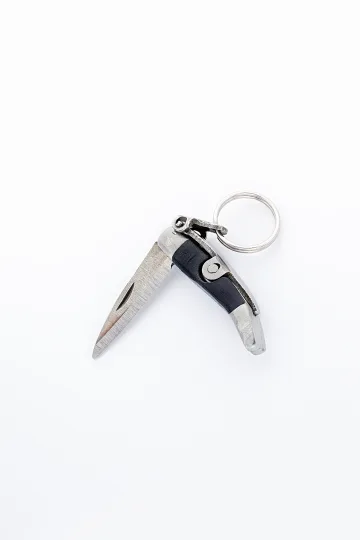
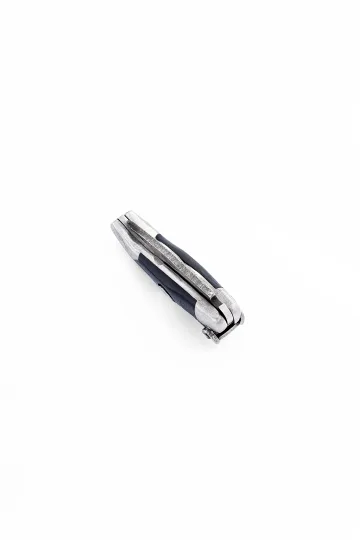
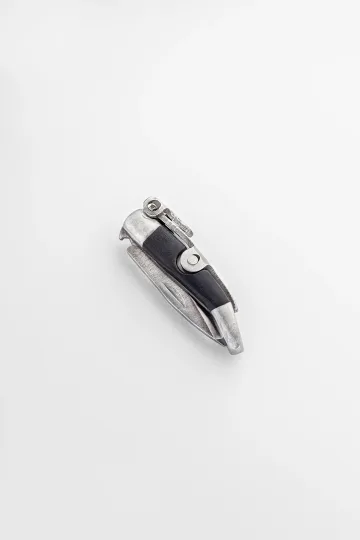
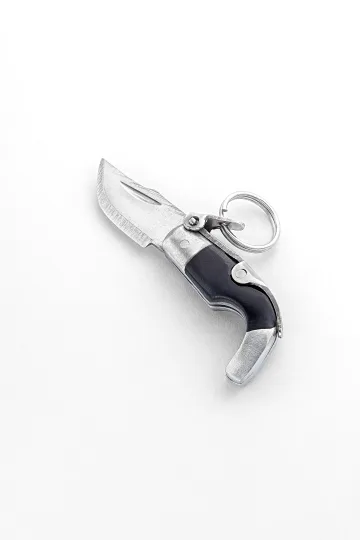
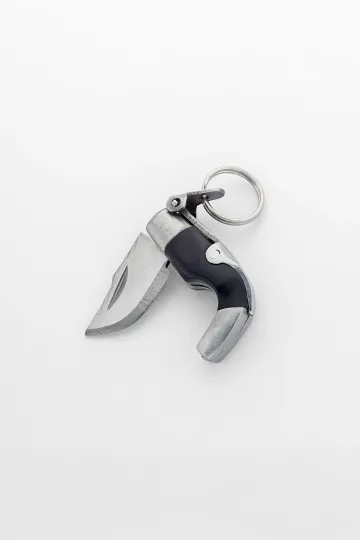
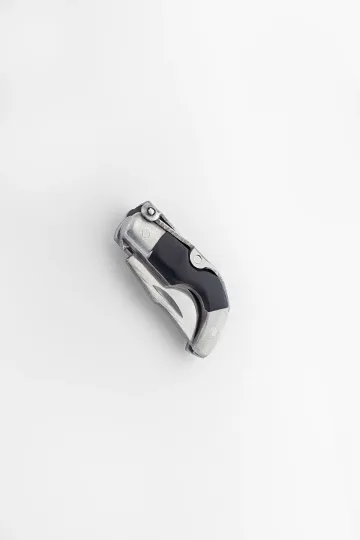
CAPAORA mini knife pendant
The 18th-century Spanish navaja in miniature: 40 mm of stainless steel, a real folding mechanism and a Palanquilla lock that clicks. An affordable gift to remember.
Authentic · Ships from Spain · 14-day returns
Debunking misconceptions
A great many confident claims have grown up around the flower of life, and they are worth working through calmly. Some pass off a nice metaphor as physics, others confuse dates and traditions. Below are the most common ones, sorting what can be checked from what belongs to belief, so the symbol can be worn with a clear head.
The first common misconception concerns the age of the Abydos drawings. They are often presented as a message from the temple's pharaonic-era builders, though by their appearance and the method used to make them, they are most likely much later graffiti from the Greco-Roman period. The motif itself is ancient, but the specific marks on the granite are younger than the structure they sit on.
The second misconception credits the pattern with a measurable energy, claiming the flower of life radiates a field, structures water, or heals. There is no scientific support for any of these properties. This is the language of belief and practice, and it is more honest to describe it that way than to hide behind the word "proven."
Facts that surprise
The flower of life is one of those symbols where a modest appearance hides a surprising amount underneath. Here are a few facts that change how you look at the pattern.
First. The building block of the entire pattern is the lens formed by two overlapping circles, called the vesica piscis, the "vessel of the fish." An equilateral triangle can be constructed directly from this simple shape, and its proportions relate to the square roots of two and three, which is why geometry enthusiasts have long held it in special regard.
Second. The so-called flower of life is rarely "complete" in the natural sense of ornament. The classic form of nineteen circles is a deliberately stopped fragment of an infinite grid, chosen at exactly the point where the drawing forms a neat, finished hexagon.
Third. A similar six-petalled sign was carved for centuries into the door lintels and beams of European homes as a protective charm. It went by names like the rosette or the daisy wheel and was drawn freehand with a compass, with no connection at all to the esotericism of the flower of life, just a handsome protective pattern.
Fourth. Hidden inside the flower of life is a diagram used to derive all five Platonic solids. Through the fruit of life's thirteen circles and Metatron's Cube, the pattern is linked to the tetrahedron, the cube, the octahedron, the dodecahedron, and the icosahedron, the complete set of regular polyhedra.
Fifth. The same motif travelled through cultures that otherwise had almost nothing in common. The circle rosette turns up on Assyrian thresholds, in Roman mosaics, and in the decoration of Beijing's Forbidden City, where the sphere beneath the paw of a guardian lion is often covered in exactly this kind of grid.
Sixth. Much of the pattern's modern esoteric fame grew out of a single late-twentieth-century book series called "The Ancient Secret of the Flower of Life." That is where the motif spread out into meditation courses, notebooks, and jewellery displays, even though the ornament itself is, of course, far older than any book written about it.
Seventh. The entire flower of life can be built without a ruler at all. A compass alone is enough: each new circle is centred on a point where existing circles already cross, and the pattern grows by repeating that one motion of the hand.
Eighth. The six-petalled rosette at the heart of the pattern comes from a simple property of the circle itself: its radius fits around its own circumference exactly six times. Put the compass point anywhere on a circle and step off the same radius repeatedly, and six marks close the loop exactly back at the start, marking out a regular hexagon. That is why a central circle can have exactly six neighbours, not five, not seven, and the whole flower of life gets its six-fold symmetry essentially for free, with no calculation needed. The same property is behind the classic schoolroom construction of a hexagon with nothing but a compass.
Send a friend a discount code, they save on their first order.
FAQ
What is the flower of life in simple terms?
The flower of life is a pattern of nineteen identical circles, laid out on a strict grid and enclosed in one overall circle. Where they overlap, the circles form petals and rosettes with six-fold symmetry. In the language of sacred geometry the pattern is read as an image of unity and generated form, and in jewellery it lives on as round medallion pendants and engravings.
How many circles are in the flower of life?
The classic flower of life has nineteen full circles of one radius, framed by a double circular border. It is distinguished from the seed of life, which has seven circles, and the fruit of life, which has thirteen circles chosen from the larger grid. Nineteen circles is the point at which the pattern forms a finished hexagon.
Where does the flower of life come from?
The motif of overlapping circles is very old and appears across many cultures, from ancient Near Eastern rosettes and Roman mosaics to Gothic rose windows. Its most famous example is carved into granite at the temple complex in Abydos, Egypt, though those specific carvings most likely date to the later Greco-Roman period rather than to the temple's original builders.
What does the flower of life symbolise?
In sacred geometry the flower of life stands for unity, the interconnection of all living things, and continuous creation from a single point. The meaning grows out of how the pattern is built, with every new circle born from the intersections of the ones before it. That is a poetic reading of the geometry rather than a scientific fact, but it is the meaning most people have in mind when they wear the symbol.
Is it true that the flower of life radiates energy?
Claims that the pattern radiates a field, structures water, or heals belong to the realm of belief, not science. No measurable properties of that kind have been found in the geometric drawing. That does not make the symbol empty: as an image of unity and as a beautiful, ordered form, it works genuinely on the level of meaning and aesthetics.
How are the flower of life, the seed of life, and the fruit of life related?
They belong to one family of forms. The seed of life, with its seven circles, is the pattern's seed. Keep adding circles on the same grid and the rosette grows into the flower of life, with its nineteen circles. Inside the flower, thirteen circles are picked out to form the fruit of life, from which Metatron's Cube is built and the Platonic solids are derived.
Which metal should I choose for a flower of life pendant?
925 silver is versatile and holds the pattern's fine lines well, especially in an open-work cut. Gold-plated silver gives a warmer tone, and 14 to 18K gold is the durable, premium option. Stainless steel suits larger flat discs and men's pieces. Oxidised silver brings out the pattern with graphic contrast, almost like a technical drawing.
Can a person of any faith wear a flower of life?
Yes. The pattern itself is geometric and not tied to any single religion, so it is worn by people with a wide range of beliefs, from those drawn to sacred geometry to those who simply like the symmetry of a circle. Its meaning of unity and connection reads as neutral and fitting for almost anyone, and what meaning you put into the pattern is entirely your own call.
Conclusion
The flower of life is a rare case of plain geometry proving remarkably durable. Nineteen equal circles, spaced at equal distances, produce a pattern that has resurfaced for thousands of years across unrelated cultures: on the granite of an Egyptian temple, on Assyrian thresholds, in Roman floors, in Gothic rose windows, on the pages of Leonardo's notebooks. There is nothing supernatural about how it is built, the whole drawing grows from a single circle under a compass. That clarity is exactly what made it a wandering ornament with no single home.
In jewellery, the flower of life works on several levels at once. For some it is a spiritual sign of unity and connectedness, part of a meditative practice. For others it is an image of family and a close circle, where each person carries their own part of a shared pattern. For others still it is simply beautiful, ordered geometry on a silver disc, pleasant to wear with no meaning beyond its symmetry. None of these readings cancels out the others.
The honest bottom line is simple. Where the flower of life is described as a source of energy or a healing field, it is worth keeping a calm distance. And where it works as an image of unity, as a family talisman, and as pure geometry at the collarbone, it does its job honestly. Whatever you put into this pattern of circles is exactly what it will mean.
Silver, gold, sacred-geometry symbolism, paired pieces and gift sets.
Buying it as a gift? Each one arrives ready to give.
 A branded Zevira box and a little card come with every order.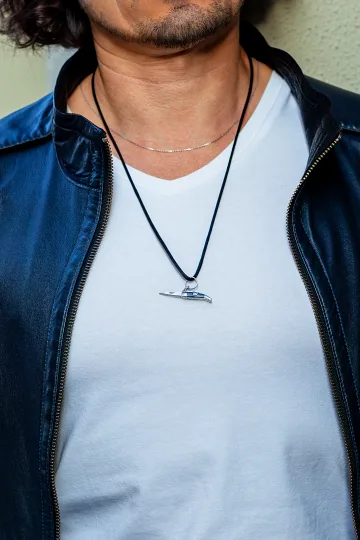







About Zevira
Zevira works in Albacete, Spain, a town with a long craft tradition in metalwork. The flower of life is part of our collection of sacred-geometry symbols, where it sits alongside the seed of life, Metatron's Cube, the merkaba, and the Platonic solids, signs in which form and meaning hold together.
What you can find with us bearing the flower of life:
- Round medallion pendants with an open-work flower of life in silver
- Flat discs engraved with the nineteen-circle pattern
- The flower of life in oxidised silver for a graphic aesthetic
- Gold-plated versions with a warm tone
- Signet rings with an engraved pattern
- Sets combining the seed of life, the flower of life, and the fruit of life
- Paired pieces and gift sets with sacred-geometry symbolism
Personal engraving is available. We work in 925 silver and 14 to 18K gold.