Metatron's Cube: meaning of the sacred-geometry symbol and the blueprint of the five Platonic solids
Introduction: the blueprint named after heaven's scribe
The figure engraved on pendants today as a sign of harmony was named after an archangel-scribe from Jewish mysticism, and its slender frame of thirteen circles holds within it all five "ideal bodies" that Plato used to explain the structure of the world. The overlap of name and content is not a coincidence, and untangling it is more interesting than it looks.
Metatron's Cube is a flat diagram in which thirteen identical circles are joined by straight lines between every pair of centres. At first glance it is simply a handsome grid, a symmetrical snowflake of circles and rays. But look closer, and the interlocking lines reveal the outlines of the regular polyhedra: the tetrahedron, the cube, the octahedron, the dodecahedron, and the icosahedron. That is exactly why the figure is loved by people drawn to sacred geometry: it is presented as a compact map of every basic form in space.
Wear the symbol, don't just read about it. These are in stock:





This guide takes the subject apart honestly, in three layers and in order. First the geometry: how the figure is built and what is hidden inside it. Then the history of the name: who Metatron is and why he was linked to the diagram. And finally the jewellery itself: what pendants are made from, who they suit, and how they are given as gifts. Wherever esotericism starts talking about "energies" and "protective fields," we will say so plainly: that is the language of a spiritual tradition, not verifiable physics. But the geometry of the figure, the fate of its name, and its place among other symbols deserve a calm, attentive telling.
Let us settle the name up front. "Metatron's Cube" sounds odd, since the figure looks very little like a cube. It got the name from one of the Platonic solids hidden inside it; the cube happens to be the one that reads most clearly in this diagram. So "cube" here is a label for the contents, not a description of the outward shape.
What Metatron's Cube is: 13 circles and the lines between them
The fruit of life: thirteen circles at the base
At the base of Metatron's Cube lies a figure that sacred geometry calls the "fruit of life." It is thirteen identical circles arranged in a dense, symmetrical cluster: one at the centre, six touching it directly, and six more around the outer ring. The result is a compact, six-rayed rosette in which every circle touches its neighbours evenly, with no gaps. The fruit of life, in turn, is drawn out of the "flower of life," a larger web of overlapping circles, by picking out exactly these thirteen. So Metatron's Cube sits at the end of a long lineage of circle patterns, in which each successive figure is stricter and more compact than the one before it.
How the centres are joined by lines
From there it is simple and strict. Take the centres of all thirteen circles and join every one to every other with a straight line. Thirteen points give a fairly dense network of segments, and that network, laid over the rosette of circles, is Metatron's Cube. No line is drawn by eye or for the sake of looks: there is one rule, join every centre to every other, and the figure is born from it on its own. That is exactly why lovers of precise construction value it so highly: there is not a single arbitrary detail in the diagram, everything is dictated by the underlying grid of points.
What emerges in the interlocking lines
Once the lines are drawn, familiar forms start to read out of the figure. A hexagon appears at the centre, star-shaped rays surround it, and if you trace certain groups of segments, the silhouettes of solid bodies emerge, shown in flat projection. The eye fills in the volume on its own, the way it does with a crystal diagram or a wireframe model. It is this ability of the figure to "hide" polyhedra that makes it so compelling: it looks like a formula folded into a single drawing.
Each of the hidden bodies has its own strict count of faces, edges, and vertices, and that count is exactly what gives the form away on the flat diagram. The tetrahedron has four faces, six edges, and four vertices; the cube has six faces, twelve edges, and eight vertices; the octahedron has eight faces and only six vertices. There is an elegant relationship between these bodies: the cube and the octahedron are dual to each other, meaning the face centres of one give the vertices of the other, and the dodecahedron and the icosahedron are linked the same way, while the tetrahedron is dual to itself. All five, meanwhile, obey the same Euler formula, where the number of vertices minus the number of edges plus the number of faces always equals two. That quiet arithmetic is exactly the scaffolding the eye catches in the interlocking lines, even without knowing the formula by heart.
Symmetry and order in the figure
The beauty of Metatron's Cube rests on its high symmetry. The figure can be rotated in steps of sixty degrees and reflected in many ways, and it will still coincide with itself. Thirteen circles, equal distances, a single rule of connection, all give a sense of complete order, where nothing can be removed or shifted. The eye reads that order as harmony even before any symbolic interpretation, and much of the figure's popularity in jewellery and graphic design rests on exactly that.
Metatron's Cube loves steel and a black collar. Pastels and gold plating do not suit it; this figure is cold-blooded.
How to wear Metatron's Cube: what to pair it with, metal and chain length
Metatron's Cube holds a look through contrast rather than shine, so I build it from the backdrop of the fabric and the temperature of the metal. I have gathered here what I most often advise clients for different occasions.
What to wear Metatron's Cube with every day? For an everyday look I recommend a flat disc of two to two and a half centimetres on a medium-length chain, over plain fabric. The dense network of lines argues with a print, so I choose a smooth backdrop: grey, black, charcoal, navy. Silver reads cleanly against cool fabric, and on pale cotton the diagram comes through like a fine imprint.
Which metal should I choose for the colour of my clothes? I match the metal to the temperature of the look. Cool silver I recommend with grey, charcoal, black, navy; warm gold plating with sand, chocolate, olive. One metal throughout the look keeps the picture composed, so I do not recommend mixing silver and gold in one set. For Metatron's Cube I more often choose steel and silver: a cool tone suits this figure better than a warm one.
How do I choose the chain length? I match the length to the neckline. Under an open collar or a shallow neckline I advise a short chain of around forty-five centimetres: the disc lands in the collarbone zone, where the diagram reads best. Under a closed top I recommend dropping the pendant to fifty or fifty-five centimetres, onto the upper chest. I keep sixty to seventy centimetres for a layered look with several chains. For a heavy, large disc I choose a sturdier chain; a thin plate suits a light chain.
What size suits which fabric and occasion? Here I choose by the job. A large cut-out plate of three to four centimetres I bring out over smooth fabric, where the network of lines works against the light and becomes an accent. A small engraved disc of around two centimetres I recommend under a shirt, when the cube stays a personal sign: it does not catch its edges and slips quietly under the collar. For delicate knitwear I advise an engraved version with no cut-outs, since fine bridges snag the loops.
What suits the office, and what suits going out? For weekdays and a restrained setting I choose an engraved disc or a signet ring, where the diagram reads as a clean geometric pattern rather than an esoteric statement. For the evening, by contrast, I recommend a large cut-out plate or an oxidised disc on a long chain, over dark, smooth fabric. Polished silver plays on light-coloured materials; oxidised finish adds a graphic edge and comes into its own against black.

Turn on your camera, pick earrings, a pendant or a ring, and see the piece on yourself in real time.
Switch items in one tap.
Everything runs in your browser: no photo or video is ever uploaded.
Who Metatron is
The archangel-scribe and the Book of Enoch
Metatron is a figure from Jewish mystical tradition, where he appears as the highest angel, the scribe of the heavenly chancery who keeps the record of the world's deeds. In some texts he is linked to the patriarch Enoch: according to that tradition, the righteous Enoch, "taken up" to heaven, was transformed into the angel Metatron and set to keep the records before the throne. From this comes his enduring image, an angel with a pen and a scroll, keeper of the heavenly archive. It is worth holding this as a cultural fact: we are telling it as a vivid episode of religious literature, not as a doctrine to be taken on faith.
This story unfolds most vividly in a late mystical text known as the Sefer Hekhalot, or the Third Book of Enoch. In it, Enoch, the seventh righteous man from Adam, ascends to heaven and is transformed into the towering angel Metatron, who is given a throne at the entrance to the highest hall and seventy names. The same text gives him an almost impossible form: a body full of fire, wings spanning the whole sky, and countless eyes to see everything at once. Metatron is also given the title "Prince of the Countenance," sar ha-panim, an angel permitted to stand before the throne itself rather than serve from a distance. Out of this fusion of mortal man and supreme attendant grew the image of the heavenly scribe whose name would later be given to the diagram.
"Lesser YHWH" and a place in Kabbalah
In some mystical texts Metatron is given a bold title, called "the lesser YHWH," a mediator through whom the higher presence touches the created world. Later, in Kabbalah proper, the image of Metatron entered the shared language for describing angelic hierarchies and heavenly worlds. The link between this particular archangel and the geometric diagram appeared late, in circles of modern sacred geometry, where it was convenient to pair Metatron, as keeper of order and record, with a figure claiming the role of a "map" of all forms. There is no direct ancient line running from Kabbalah to the pendant, and it is more honest to say that the archangel's name was attached to the diagram only in our own time, drawing on his reputation as heaven's scribe.
Customer reviews
Zevira is a real jewellery shop. Genuine payments, deliveries and customer thank-yous.
🥰🥰🥰 gracias
Ok, ¡gracias! 🙂
The five Platonic solids inside the cube
What the Platonic solids are
The Platonic solids are the five regular convex polyhedra in which every face is an identical regular polygon and every vertex is arranged the same way. There are exactly five of them, and no more can be built in three-dimensional space; that is a proven geometric fact. The tetrahedron is made of four triangles, the cube of six squares, the octahedron of eight triangles, the dodecahedron of twelve pentagons, and the icosahedron of twenty triangles. Plato, in the dialogue Timaeus, also tied these forms to the elements, and the pairing has held in culture ever since.
Tetrahedron and cube: fire and earth
In the system of the Timaeus the tetrahedron answers for fire: a sharp, light, prickly form that seems to sting like a flame. The cube fell to earth: stable, heavy, resting securely on its face, it reads as an image of solid ground underfoot. These two forms are the easiest to spot in the diagram of Metatron's Cube, and it is the cube that gave the figure its name. The tetrahedron, meanwhile, links Metatron's Cube to another well-known symbol, since the star tetrahedron is the geometric basis of the merkaba, where two opposing pyramids form a solid star.
Octahedron and icosahedron: air and water
The octahedron, an eight-sided solid made of two pyramids joined base to base, Plato gave to air: a mobile, in-between form, as if suspended between sky and ground. The icosahedron, with its twenty triangular faces, fell to water: the more small faces a body has, the closer it comes to a sphere, and the more easily it "rolls," like a drop. In the logic of the Timaeus this is not poetic licence but an attempt to explain the properties of the elements through the shape of their smallest particles. The idea turned out to be wrong as physics, but remarkably durable as a symbol.
The dodecahedron: the fifth element
The fifth body, the dodecahedron with its twelve pentagons, stands apart. It was not given an ordinary element in the system, and Plato cautiously tied it to the cosmos as a whole, to whatever "heaven is made of." Later tradition fixed the dodecahedron's role as the fifth element, aether, the substance of the higher spheres. In the diagram of Metatron's Cube the dodecahedron is the hardest of all to make out, and enthusiasts argue over whether it truly reads there or its outline has to be "filled in" by the imagination. This detail matters for a clear-eyed view: not all five bodies emerge from the figure with equal obviousness.
Why Metatron is the one holding these bodies
The link between the five Platonic solids and this particular archangel is not accidental in the eyes of modern sacred geometry, even though it is a late one. In tradition Metatron keeps the record of the world and guards its order and measure, and old culture also regarded the five regular solids as the building blocks the whole of existence was made from. Pairing the keeper of the record with a diagram of every basic form turned out to be an elegant move: the figure becomes, in a sense, the very book in which the geometry of creation is written down. It is worth holding this as a poetic image rather than a historical fact. The ancient kabbalists did not draw this diagram; the name was attached to the network of lines only by twentieth-century authors, drawing on Metatron's reputation as heaven's scribe and keeper of order.
How the bodies hide in the diagram
The idea behind Metatron's Cube is that all five regular solids can be derived from its lines by joining particular nodes. The tetrahedron, cube, and octahedron read fairly clearly in projection; the icosahedron, and especially the dodecahedron, require some goodwill and imagination. It is worth treating this as an elegant geometric game rather than a strict theorem: the figure really is rich in regular forms, but the claim that it "definitely contains all five bodies" is more a symbolic generalisation than a mathematical proof. That does not cost the diagram any of its charm; if anything, it leaves room for extended looking.
Looking closely is really the key word here. Metatron's Cube rewards anyone who lets their eye linger: first only the rosette of circles is visible, then the network of lines, then the individual polyhedra, and each successive layer opens up only gradually. In jewellery this works in the wearer's favour, since a finely engraved figure on a pendant turns out to be more intricate up close than from a distance, and it rewards a long look.
Upload a photo of your pet, someone you love, or an object. We'll build a 3D model and hand-cast it in pewter.


Meaning and symbolism of Metatron's Cube
Structure and the order of creation
The main meaning given to Metatron's Cube is an image of an ordered world. Since one figure gathers together every basic form in space, it is read as a compact map of how existence is built, where chaos has been drawn into a strict network. Someone wearing this sign is, in effect, carrying a reminder that order stands behind visible disorder, that the world runs on countable rules. It is a calm, almost engineering-minded reading of the symbol, and it comes closest to what the figure actually is: geometry, not magic.
Balance and a single centre
The second meaning follows from the figure's structure. Metatron's Cube has a distinct centre, from which every line spreads out symmetrically, and a great many balanced rays around it. This scheme is read as an image of equilibrium, of being gathered around an axis, of returning to centre. In this sense the figure is worn as a sign of inner footing, a quiet reminder to hold the balance between doing and resting. The symbolic effect here is quite real on a psychological level: an even, balanced form helps you gather yourself, the way any anchor for attention does.
Protection and the diagram as a talisman
In everyday esoteric use Metatron's Cube is often worn as a talisman and a "filter" against negativity, its protective role tied to the image of a guardian archangel. Here honesty is needed. The figure creates no measurable field around a person, and the protection being talked about works on a psychological level: a familiar sign at hand restores a sense of footing in an anxious moment. It is the same mechanism as any lucky object, and it is real without any metaphysics attached. You can wear Metatron's Cube as a personal talisman while understanding where the symbol ends and the imagination begins. A related logic of the sign as a guardian is explored in the piece on the tree of life, which likewise shows how a form becomes a support for meaning.
The number thirteen and the completeness of the circle
A separate meaning comes from the figure's count: thirteen circles, six inner, six outer, and one at the centre. The number thirteen carries a mixed reputation across cultures, from unlucky to sacred, but here it arises not from superstition but from the geometry of close packing: it is exactly thirteen identical circles that settle around a shared centre as an even rosette with no gaps. Symbolically this is read as completeness, a closed circle in which everything needed, and nothing extra, is gathered around a single centre. Some see in this an image of a community around a teacher; others simply enjoy how strictly the number is dictated by the shape. Neither reading is obligatory, but the very coincidence of tight packing and a "complete" number adds weight to the figure in the eyes of anyone looking for meaning in geometry.
Where geometry ends and belief begins
It is worth drawing a clear line. Claims that Metatron's Cube "harmonises energy," "cleanses a space," or "activates higher vibrations" belong to the language of modern esotericism, not to verifiable knowledge. There is no measurable physics behind them, and presenting them as established fact is dishonest. That does not make the figure any less worthwhile: as an image of order, as fine geometry, and as an anchor for concentration, it honestly does its job. It is simply important to keep two things separate, the construction of circles and lines itself, which is strict and objective, and the metaphysical layer built on top of it, which each person accepts only as far as it speaks to them.
Metatron's Cube in history and the culture of form
Polyhedra as a language of harmony
The idea that regular solids express the order of the cosmos is more than two thousand years older than any esotericism. Even the Pythagoreans and Plato saw geometry as speech about the very essence of things, not as a surveyor's side tool. Regular polyhedra seemed ideal to them precisely because there is nothing extra or arbitrary in them: the form is dictated entirely by a rule. When the authors of modern sacred geometry returned to the five solids and gathered them into one diagram, they were drawing on this old cultural layer, in which pure form was read as a blueprint of nature. Metatron's Cube inherited the charm of that tradition: it looks like a formula frozen in metal.
The Renaissance and the fascination with regular solids
Long before pendants, regular and stellated solids lived in pure mathematics and in art. Renaissance masters, fascinated by perspective and proportion, drew, carved, and assembled complex polyhedra, and set them into inlaid wood marquetry and engravings. To artists of that age the regular solids were the summit of visible harmony, and they happily turned geometry into ornament. In the early seventeenth century, Johannes Kepler fitted the five Platonic solids into a model of the cosmos, trying to use them to explain the distances between the planets. The model failed as astronomy, but it remained as a monument to the belief in a geometric order to the world. So the forms hidden today in Metatron's Cube carry a thoroughly academic trail, stretching back several centuries.
Why there are exactly five regular solids
One reason the Platonic solids are so captivating is their strict countability. There did not just "happen" to be five of them by chance; there cannot be four or six: it is proven that exactly five convex polyhedra exist in three-dimensional space in which every face is an identical regular polygon and every vertex is arranged the same way. The reason lies in simple angle arithmetic: for three or more identical faces to meet at a vertex and still leave room to fold the figure into a volume, only the triangle, the square, and the pentagon work, and only in a handful of combinations. Hexagons already tile a flat plane with no gap and form no volume. This completeness, exactly five and not one more, gives Metatron's Cube its symbolic fullness: it points not to a random assortment of forms but to a closed, proven list.
What draws the eye in pure geometry
Regular geometry has a calm, magnetic pull that needs no mysticism at all. Symmetry, equal faces, clean angles are read by the eye as order, and order attracts. Metatron's Cube joins that clarity with richness: many forms are gathered into a single diagram, and it rewards long looking, with a new line to find each time. Hence its popularity among people who value minimalism and mathematical beauty outside any esotericism. For them the figure works as an elegant puzzle at the throat, not as an amulet.




Materials and how Metatron's Cube is worn
The diagram pendant in silver
The most expressive option is a pendant on which Metatron's Cube is rendered as a fine cut-out or engraving on a round disc. The figure is flat by nature, so its honest form is precisely a flat disc bearing the diagram, not a three-dimensional frame. Most often such a pendant is made in 925 silver: the metal holds fine lines well and reflects light handsomely through the cut-outs. The diameter is usually two to three centimetres, so the dense network of lines reads clearly and does not blur together. Mid-range, quiet geometry with no unnecessary shine.
Engraving and the flat line
A more restrained option is the diagram engraved on a smooth disc with no cut-outs. Here the figure reads as a fine drawing, almost like a seal's impression, and looks good against a matte or slightly darkened background. An engraved pendant is more practical than a cut-out one: it does not catch its edges on clothing, slips quietly under a shirt, and serves as an unobtrusive personal sign. Budget and mid-range, convenient for everyday wear.
Metals and finish
Polished silver is universal and brings out the cleanness of the lines. Gold-plated silver gives a warm tone and sits more softly on skin with a warm undertone. Gold of fourteen to eighteen carats is the durable, premium version for those who wear the symbol constantly. Oxidised silver, with darkened recesses, makes the diagram graphic, almost like ink on paper, and comes into its own against fair skin and dark fabric. A simple rule: cool minimalism loves polished silver, graphic aesthetics love oxidised finish, and warm skin gets along well with gold.
Size and how the figure reads
Size changes not the meaning but the loudness of the sign. A pendant of around two centimetres reads as a restrained personal symbol, suited to weekdays and to a shallow neckline alike, though its fine network of lines demands careful workmanship. A disc of two and a half to three centimetres shows the diagram in full, with every line clearly visible. A large plate of four centimetres or more turns the figure into a noticeable accent for an expressive look. Choose the size for how much detail you want the diagram to reveal, since the larger the disc, the more richly the hidden forms come through.
Caring for a pendant with the diagram
A cut-out Metatron's Cube, with its fine bridges and many small openings, collects dust and cosmetic residue in hard-to-reach places. A soft toothbrush with a drop of soapy water easily cleans the network of cut-outs, after which the piece is rinsed and wiped dry. For oxidised pieces it is best to avoid ultrasonic cleaning, since it strips the patina out of the recesses that the whole finish is built around. In that case, polish only the raised outer lines, leaving the hollows dark, for the sake of contrast. Silver darkens on its own over time, especially in damp conditions, and a light tarnish comes off with a special silver cloth. An engraved disc needs less upkeep, but its lines are worth cleaning up occasionally too, so the drawing does not blur together. Gold-plated versions call for more care: the plating gradually wears away on raised areas, so it is worth handling them gently and taking them off before showering and exercise.
Leave your email, we'll send your discount code. No spam, unsubscribe anytime.
The code arrives by email, valid on your first order.
How to choose Metatron's Cube
Cut-out or engraved
The first decision is how the diagram is rendered. A cut-out pendant shows the figure against the light: the network of lines works as openwork, light passes through the gaps, and the sign reads from a distance. Such a disc is more striking but demands careful craftsmanship, since the fine bridges between the cut-outs are fragile, and cheap work easily leads to warping. An engraved pendant renders the diagram as a drawing on a smooth plate. It is sturdier, quieter, does not catch its edges, and suits everyday wear and clothing better. If the figure matters as a visible statement, choose cut-out; if as a quiet personal symbol, choose engraved.
What to check before buying
For Metatron's Cube, precision of line is what matters. The diagram is built on a strict rule, and any skew immediately gives away careless work: the lines should be of even thickness, the openings uniform, the symmetry even on every side. On a cut-out disc, check the bridges; they should not be too thin, or they will bend and break over time. Look at how the pendant attaches to the chain: on a flat disc the bail must sit securely, so the figure does not tip face-in against the body. If the diagram is set with a stone or enamel, make sure the setting sits flush and does not protrude past the plane and catch on fabric.
Pendant or tattoo
Metatron's Cube is often inked as a tattoo, usually on the forearm, back, or chest, where a symmetrical figure sits well. Jewellery works as a softer, reversible version of the same motif: the meaning is the same, but the decision is not final. A pendant can be taken off, resized, passed on, or given away, while a tattoo stays forever. If in doubt, it makes sense to start with jewellery: it lets you live with the symbol without an irreversible step, and the metal, size, and chain length are easy to adjust to a look or occasion. Many people wear both, echoing the tattoo motif in a pendant.
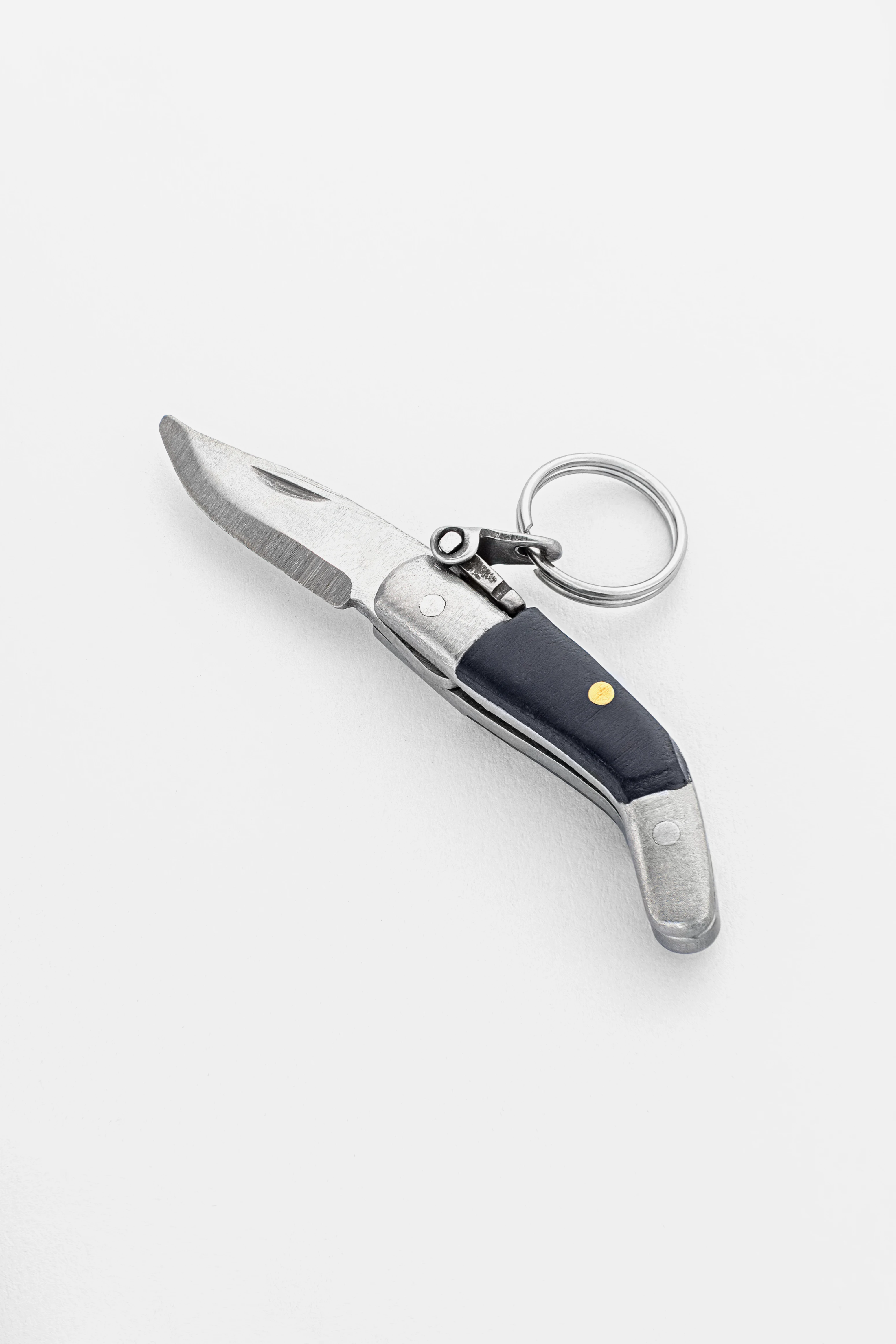
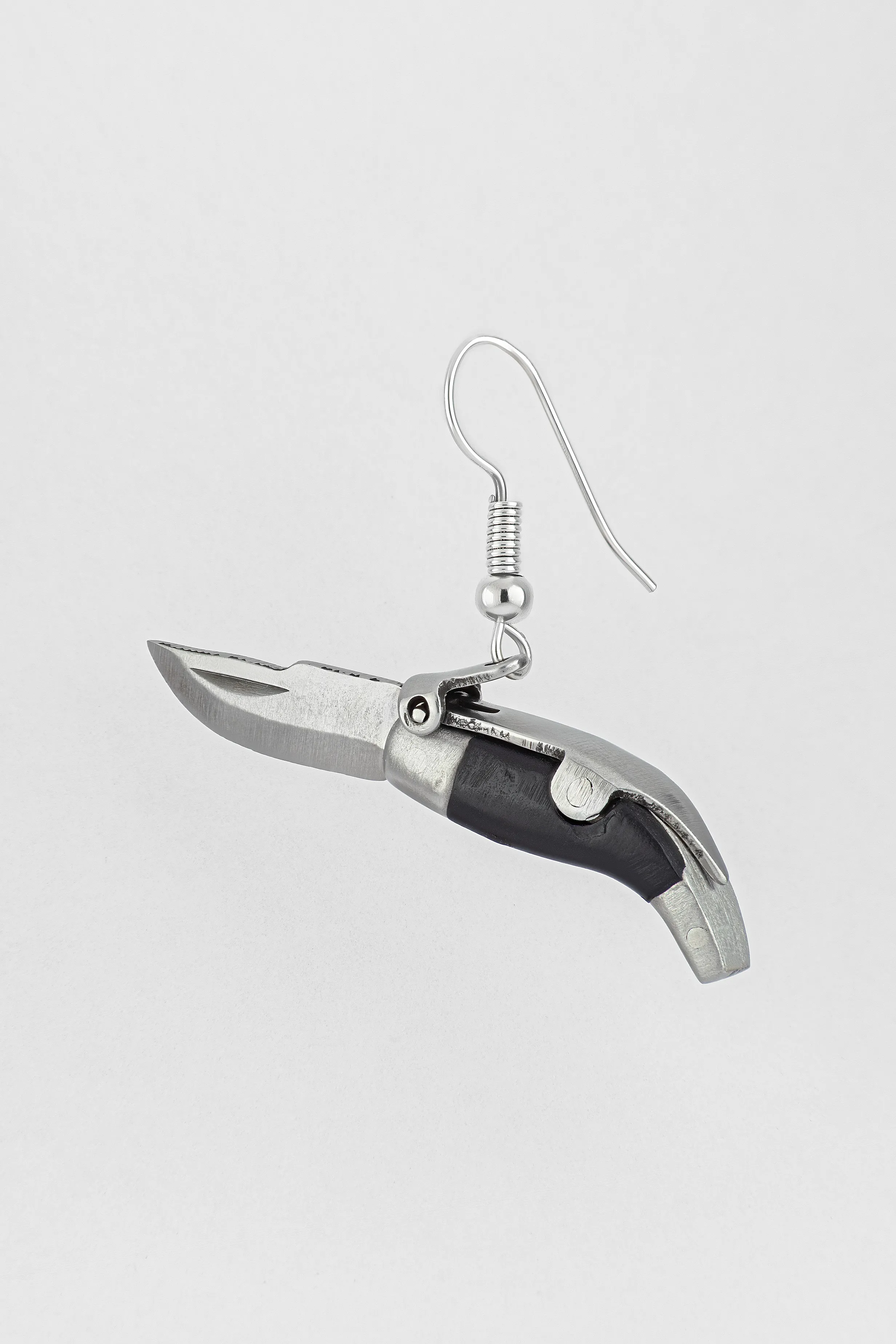
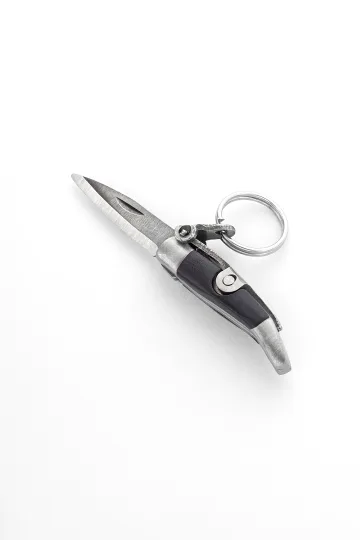
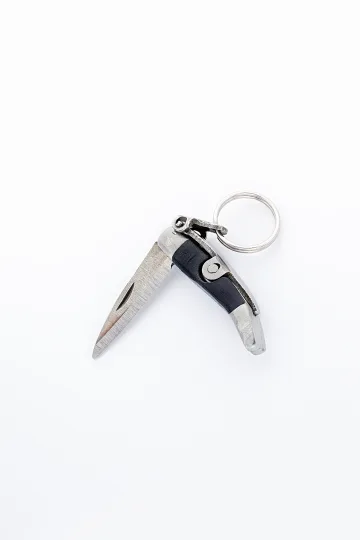
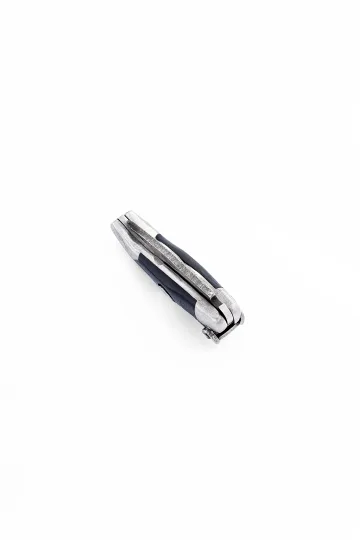
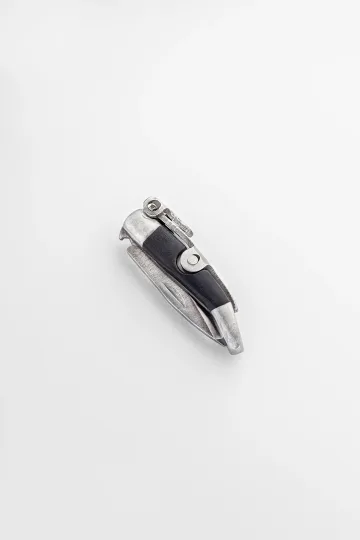
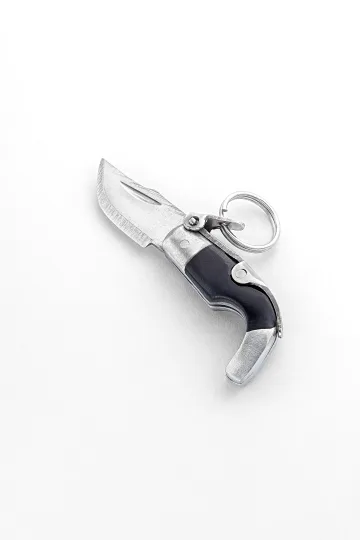
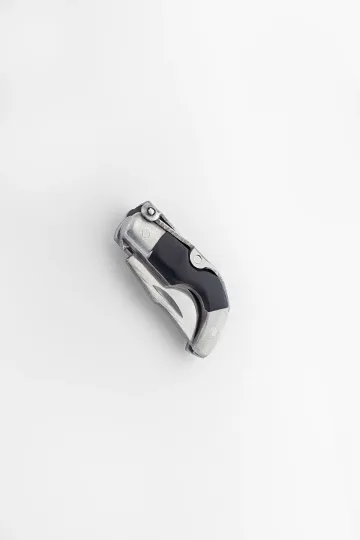
CAPAORA mini knife pendant
The 18th-century Spanish navaja in miniature: 40 mm of stainless steel, a real folding mechanism and a Palanquilla lock that clicks. An affordable gift to remember.
Authentic · Ships from Spain · 14-day returns
Who it suits and how it's given as a gift
Who this sign suits
Metatron's Cube suits people who love things with meaning and value the mathematical cleanness of a form. Lovers of sacred geometry and minimalism like the figure on its own terms, as a beautiful formula in metal, kin to the flower of life and the Platonic solids. For those who practise meditation, it is close as an image of order and centring; the even symmetry helps them gather themselves. For people interested in the history of symbols, the diagram is intriguing for its double fate, from the strict geometry of the regular solids to the name of heaven's scribe. And for lovers of graphic and geometric jewellery it suits on purely aesthetic grounds, a fine network of lines that rewards a long look.
Metatron's Cube as a gift
As a gift, the figure works well. An image of order and balance sounds fitting for almost any recipient, and the history of the name, from Plato to the archangel-scribe, gives a reason for a warm card with an explanation. People give both a neutral Metatron's Cube as fine geometry to someone far from esotericism, and a consciously spiritual talisman to someone who is into it. A safe bet is an engraved or cut-out pendant in silver, mid-sized, on a chain: it suits most people and forces no gender or style. The option of a personal engraving on the back makes the gift even more personal.
Men's and women's versions
The figure is neutral; there is nothing specifically male or female about it, and it is worn by people of any gender. The difference lies only in scale and metal. Men's looks more often go for a large disc in silver or blackened metal on a substantial chain, where the diagram works as a graphic accent. Women's versions commonly include fine small pendants, medium cut-out pendants, and earrings with a miniature version of the figure. When Metatron's Cube is chosen as a paired piece, people usually pick the same diagram in different sizes, one larger, one smaller.
Metatron's Cube and its neighbours: the flower of life, the merkaba, the Seal of Solomon
Metatron's Cube and the flower of life
The flower of life is a pattern of many equal overlapping circles, from which, in the logic of sacred geometry, both the fruit of life and Metatron's Cube itself are derived. Their relationship is direct, the relationship between a source pattern and the diagram drawn from it. The flower of life is softer and more decorative, a network of circles with no straight lines, while Metatron's Cube is stricter and more "engineered," already a network of segments between chosen centres. How the source pattern itself is built, and where exactly those thirteen circles come from within it, is covered in detail in the piece on the flower of life in sacred geometry. In jewellery the two are often set side by side or worn as a set, because together they read as a pattern and the diagram derived from it.
Metatron's Cube and the merkaba
The merkaba is a solid star made of two opposing tetrahedrons, a star tetrahedron. What links it to Metatron's Cube is precisely the tetrahedron: this form is among the bodies derived from the diagram, and so the merkaba is counted as one of the solid figures "hidden" inside the cube. The difference lies in dimension and in emphasis: Metatron's Cube is a flat map of many forms at once, while the merkaba is one particular form carried into volume. A detailed look at the solid star is in the piece on the meaning of the merkaba, which shows how a three-dimensional symbol is born out of a flat diagram.
Metatron's Cube and the Seal of Solomon
What Metatron's Cube shares with the Seal of Solomon is only membership in the broad family of geometric signs and the presence of hexagonal motifs. In substance the two are different things. The Seal of Solomon is above all a protective and magical sign from the medieval tradition of talismans, often drawn as a hexagram, closely tied to legends of the king's power over spirits. Metatron's Cube is a sacred-geometry diagram about order and the structure of forms. How the lineage of six-pointed signs is built is shown in a separate piece on the meaning of the Seal of Solomon.
Metatron's Cube and the pentagram
With the pentagram Metatron's Cube shares even less, beyond both belonging to the family of geometric symbols favoured by esotericism. The pentagram is a flat five-pointed star drawn with one continuous line, and its meanings turn around the five elements and the five senses. Metatron's Cube is a dense network of thirteen circles and the lines between them, and its theme is order and the fullness of forms. Anyone wanting to compare the two structures will find the meaning of the pentagram useful: side by side, it becomes clear how differently a minimalist single-line star and a layered diagram are built.
Debunking misconceptions
A good many confident claims have grown up around Metatron's Cube, and they are worth going through calmly. Some pass off an elegant symbolic game as a strict mathematical fact; others present metaphysics as established knowledge. Here are a few of the most common.
The first misconception: that Metatron's Cube "has been mathematically proven" to contain all five Platonic solids. In fact the tetrahedron, cube, and octahedron read fairly clearly in the diagram, while the icosahedron, and especially the dodecahedron, largely have to be "filled in." This is an elegant symbolic generalisation, not a theorem.
The second misconception: that Metatron's Cube is an ancient figure, drawn by the kabbalists themselves or by the archangel. The rosette of circles and the regular solids really are ancient, but the pairing of this particular diagram with the name of Metatron took shape only recently, in modern sacred geometry. The name was attached to the figure only in our own time.
The third misconception: that the figure "cleanses energy" and "protects a space," and that this works physically. The diagram creates no measurable field around a person. Its benefit is psychological, like that of any anchor for attention, and it is more honest to speak of it that way, rather than passing belief off as physics.
Send a friend a discount code, they save on their first order.
Facts that surprise
Metatron's Cube is one of those figures where something unexpected hides at every step. Here are a few facts that change how you see the symbol.
First. The figure is named after an angel that tradition considers a former human being. By one account, the archangel Metatron is a transformed patriarch Enoch, "taken up" to heaven and set to keep the heavenly records. So the diagram carries the name of a heavenly scribe who was once mortal.
Second. The regular solids hidden in the diagram number exactly five, and there cannot in principle be more. This is a strictly proven fact of geometry: in three-dimensional space there exist only five convex polyhedra in which every face and every vertex is identical. Metatron's Cube points to exactly this complete set of five.
Third. The name "cube" was given to the figure not by its appearance but by one of the hidden bodies. The diagram looks very little like a flat cube, but among the five bodies the cube is the one that reads most clearly in it, and its name stuck to the whole figure.
Fourth. The pairing of the regular solids with the elements was Plato's invention, nearly two and a half thousand years ago, in the dialogue Timaeus. He gave the tetrahedron to fire, the cube to earth, the octahedron to air, the icosahedron to water, and the dodecahedron to the cosmos as a whole. As physics the idea is long outdated, but as a symbol it lives on.
Fifth. The hardest body to make out in the diagram is the dodecahedron, made of twelve pentagons. It is precisely this one that Plato tied not to an earthly element but to the substance of the heavens, and it is precisely its outline in Metatron's Cube that sparks the most debate among enthusiasts of the figure.
Sixth. The tetrahedron, the simplest of the five solids, links Metatron's Cube to the merkaba. The merkaba's star tetrahedron is two such bodies interlocked, so two well-known symbols of sacred geometry rest on one and the same basic form.
Seventh. The base of the diagram, the fruit of life made of thirteen circles, is derived from an even larger pattern, the flower of life. So this compact figure has its own long lineage of circles, in which each successive pattern is stricter than the one before it.
Eighth. An ancient Talmudic story is tied to the heavenly scribe. A sage whom tradition calls Aher saw Metatron seated and recording merits, and concluded that there must be two powers in heaven, since not everyone is permitted to sit before the throne. The tradition hurries to correct that thought, showing that the seated angel is still an attendant at the throne, not a second deity. Out of this anxiety over too-exalted an angel grew his double-edged reputation.
FAQ
What is Metatron's Cube in simple terms?
It is a flat diagram of thirteen identical circles whose centres are joined to one another by straight lines. In the interlocking lines the outlines of the five regular polyhedra, the Platonic solids, can be read, which is why the figure is called a compact map of the basic forms of space. It is named after the archangel-scribe Metatron from Jewish mysticism.
Why is the figure called a "cube" if it is flat?
The name comes from the contents, not the appearance. Among the five regular solids derived from the diagram, the cube is the one that reads most clearly, and its name stuck to the whole figure. So "cube" here is a label for the hidden body, not a description of the flat drawing of circles and lines.
Is it true that Metatron's Cube contains all five Platonic solids?
Partly. The tetrahedron, cube, and octahedron are visible in projection fairly clearly, while the icosahedron, and especially the dodecahedron, largely have to be filled in by the imagination. It is more honest to say the figure is rich in regular forms and symbolically points to the full set of five, rather than that all five bodies are strictly proven within it.
Who is Metatron?
Metatron is the highest angel of Jewish mystical tradition, the scribe of the heavenly chancery who keeps the record of the world's deeds. By one account he was once the patriarch Enoch, transformed. In some texts he is called "the lesser YHWH," a mediator between the higher presence and the world. The link between his name and the diagram appeared late, in modern sacred geometry.
Is Metatron's Cube an ancient symbol?
Both yes and no. The rosette of circles and Plato's regular solids really are very old. But the pairing of this diagram with the name of the archangel Metatron took shape only recently, in circles of modern sacred geometry. So the figure rests on ancient elements, but its current name and interpretation are young.
Does Metatron's Cube really protect and cleanse energy?
That claim comes from esoteric practice, not from science. The figure creates no measurable field around a person. Its benefit is psychological: a familiar, orderly sign works as an anchor for attention and helps you gather yourself. You can wear Metatron's Cube as a talisman, understanding that the protection here operates at the level of symbol and mindset, not physics.
Which Metatron's Cube pendant should I choose?
The figure is flat by nature, so its honest form is a disc with a cut-out or an engraving. A cut-out pendant is more striking and shows the diagram against the light, but is a touch more temperamental to wear. An engraved one is more practical and less noticeable under clothing. For expressiveness people choose a large cut-out disc; for everyday ease, a smaller engraved one.
Which metal is best for Metatron's Cube?
925 silver is universal and holds the fine lines of the diagram well. Gold-plated silver gives a warm tone; gold of fourteen to eighteen carats is the durable, premium version. Oxidised silver emphasises the network of lines with graphic contrast, almost like ink on paper. The choice depends on whether you want clean minimalism or a more expressive, almost technical-drawing look.
Conclusion
Metatron's Cube is a rare symbol in which strict geometry and a mystical name have come together in a single figure. Along one line it reaches back to Plato and his five regular solids, to pure mathematics where everything is counted and proven. Along the other it carries the name of an archangel-scribe from Jewish mysticism, keeper of heavenly order and the record of the world. And between them lies the diagram itself, the thirteen circles of the fruit of life and the network of lines between their centres, out of which the eye fishes familiar forms.
In jewellery the figure works on all these levels at once. For some it is a sign of an ordered world and inner balance. For others an image of protection and centring, a talisman with a history. For others still simply handsome symmetrical geometry, a fine network of lines that rewards a close look. None of these readings is obligatory, and none cancels out the rest.
The honest bottom line is simple. Where Metatron's Cube is described as "energy" and a proven "field of protection," it is worth keeping a calm distance. And where it works as an image of order, as an anchor for attention, and as elegant geometry at the throat, it honestly does its job. Whatever you pour into this network of circles and lines is what it will mean. You can start exploring the family of such symbols from the home page, where the signs of sacred geometry and talismans are gathered.
Silver, gold, sacred-geometry symbolism, paired pieces and gift sets.
Buying it as a gift? Each one arrives ready to give.
 A branded Zevira box and a little card come with every order.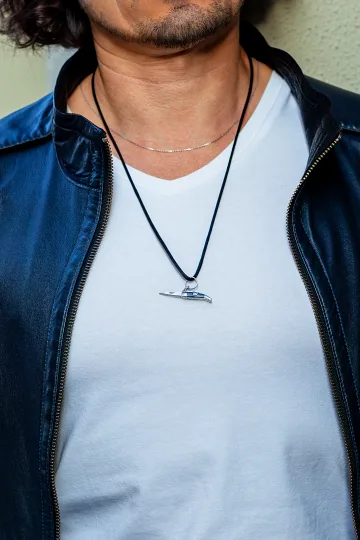








About Zevira
Zevira works in Albacete, Spain. Metatron's Cube is part of our collection of sacred-geometry symbols, where it sits alongside the flower of life, the merkaba, the Platonic solids, and other signs in which form and meaning hold together.
What you can find with us bearing Metatron's Cube:
- Cut-out disc pendants with the diagram of Metatron's Cube in silver
- Engraved pendants with a fine diagram line
- Versions in oxidised silver for a graphic aesthetic
- Gold-plated pendants with a warm tone
- Paired pieces and gift sets with sacred-geometry symbolism
Personal engraving is available. We work in 925 silver and gold of fourteen to eighteen carats.