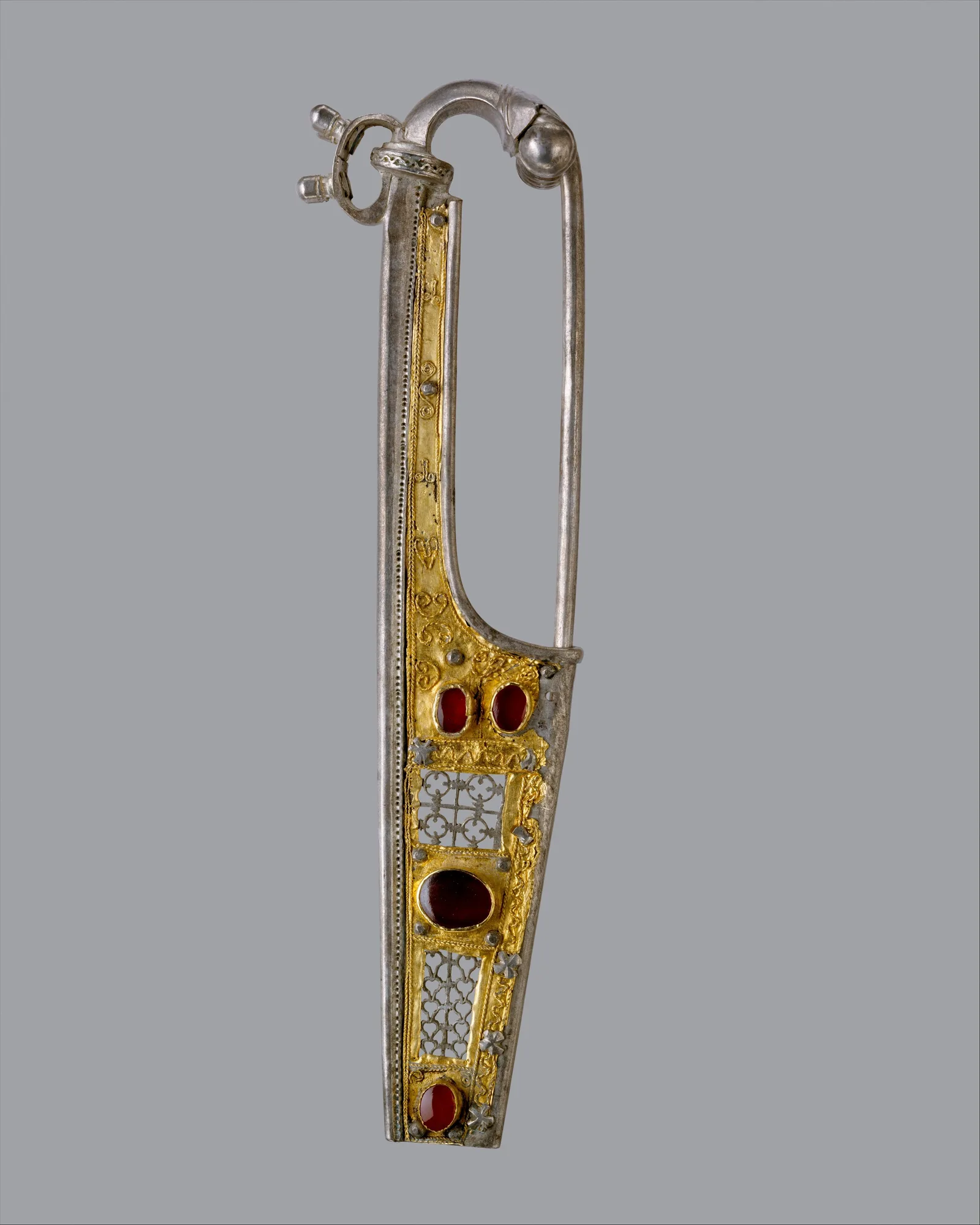
Triquetra: the Celtic trinity knot, three arcs and what they really mean
Three identical arcs woven into an endless loop with no beginning and no end. This sign was carved into the stones of Scandinavia fifteen hundred years ago, monks wove it into the Book of Kells, and millions of viewers recognised it from the cover of a book of spells in a television show about three sisters. One figure, a dozen different trinities inside it.
The triquetra is often confused with the triskele and lumped into a general pile of "Celtic patterns". Yet it has its own character and its own logic. Three equal arcs never fight for dominance: remove one and the whole drawing collapses. That very idea, three equal forces in an unbroken unity, is what made the sign so durable. People read it as a pagan symbol of the three worlds, as the Christian Trinity, and as the threefold goddess. Each age poured in its own meaning while the form stayed the same.
Here is the order of what follows: what the triquetra is and how it differs from the triskele, where it came from, what the three arcs mean in different traditions, what it is made of, how to wear it, whom it suits, and why the sign lived a second life in the twentieth century.
What the triquetra is
The triquetra is a knot of three interlaced arcs that forms a figure with three sharp points. The Latin word triquetrus literally means "three-cornered", from tri (three) and quetrus (corner). In the jewellery world a second name took hold, the Trinity Knot, because the sign is most often read as a symbol of threefold unity.
Each of the three arcs is a pointed oval that geometry calls a vesica piscis, a "fish bladder". Two overlapping circles produce such an oval where they cross. Join three of these ovals, rotating them by equal angles around a shared centre, and you get the triquetra. Sometimes a circle is threaded through it as well: it stresses the idea of eternity and binds the three arcs into a single ring.
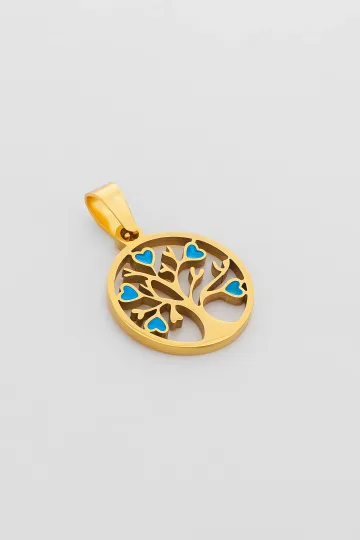
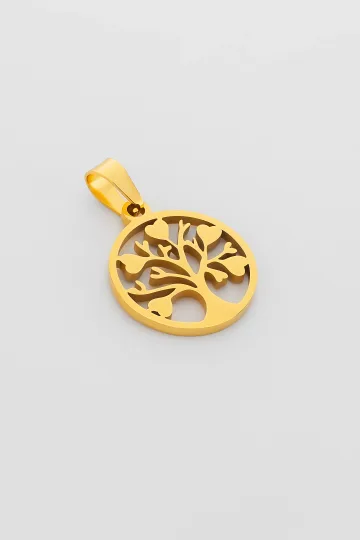
Wear the symbol, don't just read about it. These are in stock:


Three arcs, one line
The key feature of the triquetra is that the whole drawing can be traced with a single unbroken line. Put your finger anywhere on the outline and follow it. The line dives under the neighbouring loop, surfaces, rounds a corner, sinks down, and in the end returns to where you began. No break, no dead end, no crossroads where you would have to choose a path.
This continuity is not decoration but meaning. Three parts that cannot be separated, because they are all one line. In the Christian reading these are the three faces of one God. In the pagan one they are three aspects of a single force. In everyday terms it is simply a beautiful metaphor for what is bound together forever. A wedding ring with a triquetra rests on exactly this idea: the line has no end, just like a promise.
Triquetra or triqueter, how to say it
In English the form "triquetra" is standard, while scholarly and museum writing sometimes uses the Latinate "triquetrus". Both go back to the Latin triquetra, the feminine form of the adjective triquetrus. There is no difference in meaning, it is one and the same sign. It is also called the Trinity Knot, the triple knot, and simply the "Celtic knot of the trinity", though the last is not quite accurate, since there are many Celtic knots and the triquetra is only one of them.
With a circle and without one
The sign has two main versions. The pure triquetra is only three arcs. The triquetra with a circle is those same three arcs, but with a closed rim threaded through them. The circle does not change the basic meaning, it strengthens it: it adds the motif of eternity and unity and closes the three forces into one whole. In jewellery the version with a circle appears more often, because it looks steadier and holds the shape of a pendant better. The pure triquetra looks lighter and more graphic, and it is favoured in minimalist rings and small earrings.
How the triquetra differs from the triskele
Here lies the main confusion. The triskele is three spirals or three bent legs revolving out of a shared centre. The triquetra is three arcs woven into a knot. The triskele speaks of movement and rotation, it has a direction, it seems to spin. The triquetra speaks of balance and connection, it is static and symmetrical. The triskele is older, it was carved as far back as the Neolithic on the stones of Newgrange. The triquetra as an interlaced knot appears later, in the Insular art of the early Middle Ages. An easy way to remember: spirals are the triskele, loops are the triquetra.
Having sorted out the form, let us look at where the sign came from and why in fifteen hundred years it never once fell out of use. The history of the triquetra is surprisingly contradictory: it was claimed by pagans and Christians, by nineteenth-century antiquarians and by the makers of a modern television series. Each was sure the sign was about their own faith, and each was right in their own way, because the form is empty enough and precise enough to hold any trinity.
This history matters for more than curiosity. Once you understand where the triquetra came from and how many hands it passed through, you look differently at the ornament on your chest. It is not a pattern from a souvenir shop but a sign with an unbroken lineage from a runestone to the present day. Some value exactly this depth, others love the triquetra simply for its clean graphics, and both approaches are honest. Below we have gathered jewellery with Celtic and protective symbolism to give you a starting point, and after that we return to the history of the sign era by era.
The history of the triquetra
The Insular Celtic world
The homeland of the triquetra in the form we know it is the Insular art of Britain and Ireland of the sixth to ninth centuries. This is the name given to the artistic tradition that formed in the monasteries after Christianity reached the Celtic lands and merged with the local taste for interlaced ornament. The masters of this school brought knotwork to perfection: ribbons, loops, animal bodies fitted into endless knots. The triquetra became one of the load-bearing motifs of this language. It was carved on stone crosses, chased on metal, written into the initial letters of manuscript books.
It is important that the Celts of the Iron Age left no written explanations of their patterns. Their knowledge was passed on orally, through druids and poets, and when the oral tradition broke off, the interpretations went with it. So everything said about the "ancient Celtic meaning" of the triquetra is a reconstruction, not a decoding. The ornament itself is genuine and ancient. The tidy lists of meanings were for the most part invented later.
The Isle of Man and the Celtic fringes
The little Isle of Man in the Irish Sea holds one of the densest sets of early Celtic and Scandinavian art. Here stand stone crosses where Christian knotwork sits next to scenes from the northern myths, and the triquetra is written into them on equal terms with the cross. The island was a crossroads: the Irish came here, then the Scandinavians, and each added its own layer to the shared pattern. A similar picture is given by the Orkney and Hebridean islands, the north of Scotland, the coast of Wales. The triquetra lived on this Celtic and Scandinavian fringe as a common language of ornament, understood by monk, seafarer and local craftsman alike. It was precisely this fringe, borderland position that made the sign so fused: in it met Christian dogma, pagan memory and a taste for interlace from three traditions at once.
The Germanic peoples and runestones
The triquetra is found not among the Celts alone. It turns up on Germanic coins, on objects of the Migration Period and, most curiously, on Scandinavian runestones. In Sweden and Norway the sign was carved on memorial stelae of the fifth to eleventh centuries alongside runes and animal ornament. Some researchers link it there with the cult of Odin and the idea of the fallen warriors, though solid proof is scarce.
This is an important detail for understanding the sign: the triquetra was not invented in one place and does not belong to one people. Three intersecting arcs is too simple and too natural a figure to have arisen only once. It was drawn independently at different ends of Europe. The Insular monks did not invent the triquetra, they polished it and filled it with Christian meaning.
The sign has an eastern trace too. Similar threefold interlaces appear far beyond Europe, as far as Japanese family crests and Buddhist ornament, where three woven commas or arcs are also read as a sign of harmony and fullness. There is no direct kinship with the Celtic triquetra here, this is coincidence, but it shows once more how universal the idea of "three in one" is. In the most varied cultures people arrived at the same geometry when they looked for an image of unity made of three parts.
Coins, weapons and seals
The triquetra left its trace far beyond stone and parchment. It was struck on coins: the sign appears on the silver of the Germanic tribes and on the Scandinavian silver of the Viking age. On the coins of the Isle of Man the three-legged triskele took hold and became the local emblem, and beside it in the island tradition ran the triquetra as its knotted relative. The sign is found on sword hilts, on belt buckles, on scabbard tips and shield fittings. A warrior wore the triple loop not for beauty: three woven lines were read as an amulet binding strength, luck and protection into one knot. On seals and signet rings the triquetra worked as a personal mark of the owner, because a complex pattern is hard to copy by eye, which means the impression cannot be forged by a stranger's hand. So the sign lived in three roles at once: ornament, amulet and signature.
The Book of Kells and Insular manuscripts
The peak of Insular art is the illuminated manuscripts, and the triquetra is everywhere in them. The Book of Kells, made by monks around the year 800 and kept today in Trinity College Dublin, is covered with interlace of such density that scholars have spent years cataloguing its details. Triquetras hide in the corners of initials, in the gaps of ornament, in the places where ribbons meet in threes. They are not always visible at first glance, but once you know the sign you begin to find it on the page again and again.
The Lindisfarne Gospels, a little earlier, from the start of the eighth century, carries the same tradition. The monk Eadfrith, who by legend made it single-handed, wrote threefold knots into the carpet pages on equal terms with crosses and animal interlace. For the masters of these books the triquetra meant far more than ornament. Three equal arcs fitted the doctrine of the Trinity perfectly, and the sign worked as a tiny sermon hidden in the pattern.
Christianisation: the symbol of the Trinity
When Christianity took hold in the Celtic lands, the Church did not fight the local ornament but adopted it. This suited the triquetra ideally. Three equal arcs joined by one unbroken line became an image of the Trinity: Father, Son and Holy Spirit, three faces of one God. No arc is higher than the others, none can be removed without destroying the whole. Theologians could hardly have dreamed of a more precise geometric metaphor.
That is why the sign entered the Christian symbolism of Ireland and Scotland so firmly. It was carved on high stone crosses, placed on church plate, woven into the covers of the Gospels. The second name, the Trinity Knot, attached itself to the triquetra in exactly this Christian reading and holds to this day. For many believers the sign remains above all a symbol of faith rather than an abstract Celtic antiquity.
There is a lovely detail attributed to the Irish missionaries. Just as, by legend, a certain saint explained the Trinity to pagans on a leaf of clover, three petals on one stem, so the triquetra worked as visual theology for those who could not read Latin. You could point at the sign with a finger and say: look, three parts, and the line is one, that is how God is one in three persons. For a culture where the literate were few and ornament was understood by all, such a visible argument was worth long sermons. The triquetra turned out to be a convenient bridge between the oral, pictorial world of the Celts and the bookish theology of the new faith.
Between the Middle Ages and the revival
After the flowering of Insular art the triquetra did not disappear, but it slipped into the shadows. In the Gothic era and the Renaissance, Europe grew fond of other forms, and the interlaced Celtic knot stopped being fashionable. The sign survived on the fringes: in folk carving, on the gravestones of the Celtic lands, in the church life of Ireland and Scotland, where the memory of the Insular tradition held on more firmly. It was still struck on seals and carved into furniture wherever Celtic culture stayed alive. For long centuries the triquetra was not a loud symbol but a quiet regional habit, a sign that a local master repeated from memory without thinking about its origin. It was precisely this unbroken, if muted, life that let the antiquarians of the nineteenth century raise an already existing sign rather than invent it anew.
The Victorian and Wiccan revival
Like all Celtic aesthetics, the triquetra lived a second life in the nineteenth century. Antiquarians, romantics and nationalists of Ireland and Scotland rediscovered Insular art and made it a banner of cultural identity. Celtic ornament went into mass production: on brooches, book covers, gravestones, jewellery displays. It was then that tidy meanings were assigned after the fact to particular knots, meanings the medieval masters may never have had.
The twentieth century added a new layer. Neo-pagans and Wiccans took up the triquetra as a symbol of the threefold goddess and the three worlds, giving the sign back its pre-Christian, natural ring. And popular culture made it truly universal. Exactly how, we will discuss separately, because the path of the triquetra from a monastery cell to the screen is one of the most unexpected routes a protective symbol has ever travelled.
The triquetra lives by the line, not by the sparkle. Take silver with a sharp polish, where you can see the loop dive under the loop. A blurred knot does not read, and the whole trinity falls apart into mush.
How to build a look with a triquetra
We have sorted out the history and the materials, now to the living wear. I have gathered here what really works when you take the knot off the display and hang it on a person.
Which metal to choose for a triquetra? The triquetra rests on the interlace, and the metal is obliged to show that interlace. For a cool skin undertone I recommend silver with a sharp polish: the light lies on the raised facets, while the dark hollows show where one ribbon dives under another, and the knot reads against the light. Silver here is a safe bet not because it is universal, but because it brings out the line better than anything. For a warm undertone I advise yellow gold: it gives that very manuscript look, as if the sign had stepped off the page of a script. Matte metal with no play of facets I do not advise, on it the interlace sticks together into a blot.
A triquetra with a circle or pure three arcs? This is a question of the look's character, not of correctness. For a strict, minimalist look I choose the pure three arcs: the sign is light, graphic, works as a fine detail and does not argue with the clothing. When weight and completeness are needed, I recommend the version with a rim: the circle closes the knot, holds the form and reads more clearly, so for a gift or a wedding ring I advise exactly that. The rule is simple: the smaller the piece, the cleaner the triquetra should be. On a small earring a dense interlace with a circle will blur, and only a blot will be left of the meaning.
A large knot or a small one, and what about layers? The knot is graphic and loves air around it. For a quiet everyday look I choose a smaller pendant on a thin chain: the triquetra reads as a detail, not as a signboard. For character I recommend a large form on a leather or rubber cord, closer to the Insular, northern texture. If you want layers, give the knot its own separate length of chain, so it is not pinched between other pendants. And keep the metals in one tone: silver to silver, warm to warm. Mixing shades in a Celtic theme immediately reads as an accident.
For what occasion and look does the triquetra suit? A silver triquetra on a leather cord lives in an everyday, sporty, street look and needs no care. For a strict or business look I advise a small knot on a thin chain or an engraving along the band of a ring: the sign is with you, but it stays silent. A gold triquetra with a circle I choose for an occasion where shine is fitting: a wedding, an anniversary, a christening, a memorial gift. Here the sign of an eternal bond wants to be carried out in an eternal metal, and gold falls into place.
Whom does the triquetra suit? The sign is not tied to gender or age and suits almost everyone, because the form is clean and symmetrical. It sits especially well on those who wear a symbol for themselves: with a restrained look, on skin without a pile-up of pendants. A large knot I recommend to a wide neck and a solid build, a small neat triquetra to a slender one. And one thing before you buy: check the interlace against the light. In an honest knot you can see where the ribbon goes over and where it dives under, and this alternation is kept across the whole outline. As soon as the transitions have stuck together into mush, what you have before you is stamping, not a triquetra.

Turn on your camera, pick earrings, a pendant or a ring, and see the piece on yourself in real time.
Switch items in one tap.
Everything runs in your browser: no photo or video is ever uploaded.
Meaning: threefold nature in different traditions
The strength of the triquetra lies in its emptiness, in the good sense of the word. The three arcs do not dictate a single interpretation, they hold a form into which different cultures poured their own trinity. That is why the sign proved so durable: it suited the monk, the druid and the modern person searching for a symbol of balance.
The Christian Trinity
The best known meaning. The three equal arcs are Father, Son and Holy Spirit, and the unbroken line is their unity in one God. The circle, if it is there, adds eternity and divine infinity. For Christians, especially those tied to the Irish and Scottish tradition, the triquetra is above all a sign of faith, on a par with the cross but softer and more ornamental. It is given at a christening, worn as a quiet symbol of conviction, engraved on the wedding rings of couples for whom the spiritual side of the union matters.
Maiden, Mother, Crone
In the neo-pagan and Wiccan reading the three arcs are the threefold goddess in her three ages: Maiden, Mother and Crone. The Maiden is youth, the beginning, the promise. The Mother is maturity, fertility, care. The Crone is wisdom, completion, knowledge. Together they form the full cycle of a woman's life and at the same time the phases of the moon: waxing, full, waning. This interpretation is comparatively young, it took shape in the twentieth century, but it is exactly what made the triquetra a favourite feminine amulet, a symbol of accepting every age and of a strength that does not fade but changes its guise.
Earth, sea, sky
Another widespread reading, Celtic in spirit: the three arcs are three elements or three worlds. The earth underfoot, the sea around the islands, the sky overhead. For a people living on islands beside a cold ocean this triad was not an abstraction but a picture of the world. The triquetra in this sense is an amulet of the traveller and the fisherman, a sign of a person's accord with the surrounding elements. Here the sign draws close to other Celtic and Scandinavian amulets and talismans that helped people hold their place between the worlds.
Celtic triads
Celtic culture was literally shot through with threes, and this is a separate argument in favour of the threefold reading of the sign. Welsh and Irish lore survives in the form of triads: short formulas where wisdom is packed in threes. Three things that adorn a warrior. Three sorrows of the poet. Three pillars of the world. Druidic teaching, by the testimony of ancient authors, was also divided in three: the bards kept the songs, the seers read the omens, the druids judged and taught. The gods of the Celts were often shown in threes: three mother goddesses, three faces of one deity, a threefold Brigid. Against this background the three-part knot fell into the culture as native, long before any Christianity. The Church later translated this familiar threefold nature into the language of the Trinity, but the ground beneath the sign had been prepared centuries earlier.
The protective reading
A separate line of interpretation sees the triquetra as an amulet. The logic is simple and vivid: an unbroken loop with no entrance and no exit seems to tangle up an evil force that has nowhere to enter and nowhere to leave. The threefold nature adds wholeness, and the closed circle around the arcs seals the outline for good. In folk tradition such knotted signs were hung by the entrance, worn on the body, carved on a cradle to confuse the evil eye. This reading is closer to the neo-pagan and folkloric than to the church one: strict theology sees in the triquetra a symbol of faith rather than an amulet. But both views live peacefully on one piece of jewellery, and the owner decides for themselves whether they wear a sign of the Trinity, an amulet, or simply a beautiful knot.
Why exactly three
The number three holds firmer in human culture than any other. A fairy tale has three brothers and three trials. A prayer has a threefold repetition. Time has past, present and future. Space has height, width and depth. Ancient geometers called three the first true number: one is a point, two is a line, and three is already a plane, a stable triangle that does not fold. The triquetra takes this innate pull towards three and locks it into a single line. That is why the sign feels familiar even to someone seeing it for the first time: the eye recognises in it the customary structure of a world laid out in threes. Observers of behaviour explain this by the rule of three: the brain grasps three elements as a finished group, a whole that you do not want either to add to or to cut down.
Three stages, three forces, three worlds
Threefold nature is in general one of the most stable structures of human thought, and the triquetra absorbs them all. Past, present, future. Birth, life, death, and beyond it rebirth in a circle. Body, mind, spirit. Thought, word, deed. Three forces of nature. Three stages of any undertaking: conception, labour, completion. The sign is not rigidly tied to any of these trinities, and that is its convenience. The owner chooses the meaning closest to them, and the form stays unchanged. Many wear the triquetra precisely as a personal reminder of a trinity important to them, one that only they know about.
Before moving on to materials, it is worth trying the triquetra on in your mind. The sign is graphic and spare, it lies equally well on a strict chain and on a leather cord. Next we look at what it is made of and which material suits which character.
Customer reviews
Zevira is a real jewellery shop. Genuine payments, deliveries and customer thank-yous.
🥰🥰🥰 gracias

Ok, ¡gracias! 🙂

What the triquetra is made of
The material of the triquetra is almost always metal, because the sign rests on the clarity of the line. Knotwork demands precise execution: each arc must lie evenly, each crossing must read correctly, where the ribbon goes over and where it goes under. Cheap stamping often blurs these transitions, and the knot loses its meaning. So the quality of the material and the finishing matters more here than in simple forms.
Silver
The most popular and the most fitting choice. Sterling silver 925 in its cool shade echoes the northern, Insular nature of the sign: mist, stone, cold sea. A silver triquetra looks restrained and graphic, it suits both men and women, and it pairs easily with any clothing. Silver is durable enough for daily wear and does not cause allergies in most people. For a knotted drawing it is the ideal material: polished facets stress the transitions of the ribbons, and a slight darkening in the hollows only adds depth to the pattern over time.
Gold
A gold triquetra sounds warmer and more solemn. Yellow gold gives the most traditional, "manuscript" look, as if the sign had stepped off the page of an illuminated book. White gold is closer to silver's severity but nobler in its shine. Rose gold is a modern solution, it softly lights up the curves of the arcs. A gold triquetra is more often chosen for wedding rings and memorial gifts, when you want the symbol of eternity carried out in an eternal metal. Usually a fineness from 585 (14 carat) to 750 (18 carat) is taken.
Wood, bone and other materials
Metal is not the only home for the triquetra, though it is the main one. The sign is carved in wood on pendants and wall panels, where the warm texture adds a homely, natural ring to it. A triquetra cut from bone or horn recalls early craft, when a master worked with whatever the hunt provided. The sign turns up in leather too: a stamped triquetra on a bracelet or on a notebook cover holds the Insular character with no metal at all. There are versions in glass and enamel, where the arcs are filled with colour, and ceramic ones, where the knot is moulded or pressed into clay. Each material shifts the mood: metal makes the sign strict and eternal, wood warm, bone ancient, enamel festive. But the demand for a clean line stays common to all: in any material the crossings of the arcs must read, otherwise the knot falls apart into a pattern with no meaning.
With a stone and without one
The classic triquetra does without settings: its strength is in the line, not in the sparkle. But there are versions with a stone in the centre or in one of the arcs. Green stones support the Irish, "emerald" theme. Blue ones point to the sea and sky. Clear ones add light without arguing with the drawing. Measure matters here: a large stone pulls attention away and kills the pattern, so settings in a triquetra are usually small, more an accent than the main hero. If the symbol matters more than the ornament, it is better to take the pure metal version.
Patina and care
A silver triquetra has a pleasant feature: over time the hollows of the knot darken, and the drawing becomes easier to read. This dark film in the hollows, oxidation, is often applied on purpose to stress the transitions of the ribbons, where one dives under another. The raised facets meanwhile keep their light shine, and the contrast brings out the interlace. If the darkening has gone too far and the sign has dulled all over, silver is easily brought back to life with a soft polish. A gold triquetra hardly gathers any patina and needs only a wipe against grease and dust. The general rule for a knot is simple: clean with a soft cloth along the lines, do not pack the hollows with an abrasive, take the jewellery off before chlorinated water and rough work. Then the drawing stays sharp for years.
Upload a photo of your pet, someone you love, or an object. We'll build a 3D model and hand-cast it in pewter.




How to wear the triquetra
On the neck as a pendant
The most common way. A triquetra on a chain or cord lies at the throat or on the chest and works as a calm graphic accent. A thin chain stresses the elegance of the knot, a leather or rubber cord gives the look a more natural, "Celtic" character. The length is chosen to match the neckline: a longer chain suits a deep V-neck, so the knot lies on open skin, while a shorter one suits a round neckline, so the triquetra does not hide at the collar. The sign reads well at any scale, so it works both as a large expressive pendant and as a small modest charm under a shirt.
A ring and a wedding ring
The triquetra is one of the most logical forms for a wedding ring. The idea is the same as with a plain band: a line with no beginning and no end, a union without a break. Only here it is strengthened by the symbol of the Trinity and the intertwining of two fates. Celtic rings with a triquetra are popular in the English-speaking world precisely as wedding bands, often chosen by couples for whom both the spiritual and the cultural side of the union matter. A similar logic stands behind the Irish Claddagh ring, where the form speaks the feeling directly. The triquetra is also worn as an ordinary ring, and then the knot is usually carved along the whole band as a continuous ribbon.
Earrings, bracelets and small pieces
The pendant and the ring are not the only formats. The triquetra is made into earrings: a pair of small knots by the face works more quietly than a pendant and looks good in a restrained outfit. Size especially matters here, because on a small earring a complex interlace with a circle will blur, and it is better to take the pure three arcs. On a bracelet the triquetra is set as a central medallion or repeated along the links of the chain in a rhythmic pattern. There are quite everyday carriers too: keyrings, tie clips, cufflinks, belt clasps, onto which the sign carries its knotted symbolism without any solemnity. In such small things the triquetra works as a quiet personal mark, clear to the owner and unnoticed by a stranger's eye.
What to pair it with
The triquetra is graphic and calm, so it gets along with almost everything. It looks good beside another Celtic piece, beside a cross, beside a triskele or a simple chain with no pendants. The main rule is the same as for all knotted jewellery: keep to one metal. Silver to silver, yellow gold to yellow. Mixing shades in a Celtic theme looks accidental. And do not overload the look: one expressive triquetra is stronger than a cluster of small pendants around it. If you want layers, give the knot its own length of line and leave the other chains empty.





Whom the triquetra suits
The short answer: almost everyone, because the sign is not closed off by any one culture and does not demand a "correct" wearer. The triquetra does not belong to a closed tradition, it is worn all over the world, and no one will count it appropriation.
It is chosen by people with Irish, Scottish and Celtic roots in general as a sign of heritage. Christians wear it as a soft symbol of faith and the Trinity. Women to whom the idea of the threefold goddess is close wear it as an amulet of every age. Those who value the idea of an eternal bond give it to a partner or wear it as a pair. Lovers of Celtic aesthetics, music and mythology wear it as part of their cultural circle. And simply those who like a clean, balanced graphic sign with a deep history, with no mysticism at all. All these readings are equal, and the sign calmly holds them at the same time.
The triquetra also works well as a meaningful gift: for a christening, an anniversary, an important life transition. The three reads easily as "the three of us" in a family with a child, as "past, present, future" for a jubilee, as "body, mind, spirit" for a person occupied with themselves and their own growth.
Leave your email, we'll send your discount code. No spam, unsubscribe anytime.
The code arrives by email, valid on your first order.
How to choose a triquetra
The quality of the interlace
The main criterion. Run your eye or finger along the outline: the line must be unbroken and the crossings honest. In a good knot it is clear where the ribbon goes over and where it dives under, and this alternation is kept across the whole drawing. In a bad copy the transitions are smeared, the line breaks off in places or merges into a shapeless blot. The human eye notices such an error instinctively, even if it cannot name it. A clean, mathematically correct interlace is a mark of genuine work and the main marker of quality.
Fineness, clasp and weight
Besides the knot itself, it is worth checking the usual signs of honest jewellery. On silver look for the 925 hallmark, on gold a fineness from 585 to 750: genuine metal always carries a stamp. The pendant should not be suspiciously light and hollow to the touch, since hollow stamping often has thin walls that quickly dent. The bail and the clasp give away the class of the work: on a good piece the loop is soldered neatly, the ring does not bend open with your fingers, the chain's fastening holds firmly. The back of the sign should be finished as cleanly as the front, with no sharp burrs or casting marks. These small things say more about a piece than a label: a knot can be copied, but honest assembly is harder to fake.
Size and shape
The complexity of the drawing must be matched to the size of the piece. A large pendant or brooch will carry a dense, detailed interlace with a circle and extra ribbons. On a small earring or a thin ring a complex pattern will blur into mush, so for small forms take a simple, clean triquetra with no extra detail. The smaller the piece, the sparer the sign should be.
With a circle or without one
The choice between the two versions is a question of character. The triquetra with a circle looks more finished and steadier, the circle adds the motif of eternity and holds the shape of a pendant better, this is the more "classic" and protective option. The pure triquetra without a circle is lighter, more modern, more graphic, and it is favoured in minimalist jewellery. If the sign is needed above all as a symbol, the version with a circle reads more clearly. If a spare design matters more, take the pure three arcs.
Material to match the character
Silver for everyday wear and a northern, restrained aesthetic. Gold for solemnity, a gift and wedding rings. Pure metal if the symbol matters more than the sparkle. A stone if you want colour, but small, so as not to kill the drawing. A leather cord for a natural look, a thin chain for elegance. For every character there is its own triquetra, and that is its flexibility.
CAPAORA mini knife pendant
The 18th-century Spanish navaja in miniature: 40 mm of stainless steel, a real folding mechanism and a Palanquilla lock that clicks. An affordable gift to remember.
Authentic · Ships from Spain · 14-day returns
Triquetra, triskele, Celtic knot and valknut: what is the difference
There are many threefold and knotted signs in Europe, and they are constantly confused. Let us sort out the triquetra's neighbours, so you know exactly what you are wearing and how your sign differs from the look-alikes.
Triquetra and triskele
The most frequent confusion. The triskele is three spirals or three bent legs spreading out from a centre and seeming to spin. The triquetra is three arcs woven into a knot. The triskele is about movement and rotation, it has a direction. The triquetra is about balance and connection, it is symmetrical and static. The triskele is far older, it goes back to the Neolithic. The triquetra as an interlaced knot is the early Middle Ages. If you see spirals, it is a triskele. If you see loops, it is a triquetra.
Triquetra and the Celtic knot
The triquetra is a special case of the large family of Celtic knots. A Celtic knot is any unbroken interlaced drawing of the Insular tradition: the lovers' knot, the Dara knot, the Solomon's knot, the endless interlace on a wedding band. The triquetra stands out among them by its specific, recognisable form of exactly three arcs. That is, every triquetra is a Celtic knot, but not every Celtic knot is a triquetra. When someone says "Celtic knot of the trinity", they almost always mean the triquetra.
Triquetra and valknut
The valknut is a Scandinavian sign of three interlaced triangles, tied to Odin and the fallen warriors. Outwardly it resembles the triquetra in its number three and its motif of interlace, but the figure is quite different: the valknut has straight angles and triangles, the triquetra smooth arcs and pointed ovals. And the meaning is different: the valknut is about death, fate and the passage into the other world, the triquetra about unity and life in all its stages. What links them is only the principle of the triple interlace, which the northern peoples loved in general.
Triquetra and other triple amulets
Threefold nature is found all across Europe. The Slavs have their own amulets with triadic symbolism, tied to the triad of worlds and elements. The Christian Trinity gave rise to many triple signs besides the triquetra. The idea of "three in one" is so natural to a person that it surfaced independently in different cultures. The triquetra is simply the most elegant and recognisable of these figures, because it solves the task more gracefully than any: three equal parts, one line, no beginning and no end.
The triquetra in pop culture
The show about three sisters
The triquetra got its most powerful push in popularity at the turn of the century thanks to a television series about three witch sisters, which ran from 1998 to 2006. The sign adorned the cover of their ancestral Book of Shadows and became the symbol of the "Power of Three", magic that works only when the sisters are together. The idea fitted the form perfectly: three equal arcs, none can be removed, the strength is only in unity. The series ran all over the world, and a whole generation of viewers learned the triquetra from there. After that, sales of jewellery with the trinity knot rose noticeably, and the sign itself entered mass esotericism for good.
Rock, metal and album covers
The triquetra has long been loved in rock culture. It flashes on album covers, on stage costumes, in the design of concerts, where its ancient, "pagan" and mystical look is valued. One of the most famous rock albums of the early seventies used the triquetra as the personal sign of a member of the band, and since then the symbol has been firmly linked with heavy music and Celtic folk. For musicians it is a convenient image: it speaks of roots, of mystery and of the unity of the line-up, without requiring a word of explanation.
Tattoos
The triquetra is one of the most popular subjects in tattoo studios, and for the same reasons as the rest of Celtic knotwork. The drawing is technically complex, which means it shows off skill. It is striking and reads from a distance. And it carries a sense of depth and antiquity, letting the owner invest their own meaning. Some ink the triquetra as a sign of faith, some as a symbol of the threefold goddess, some in memory of three close people or three important stages of life. Frequent places are the forearm, the wrist, the neck, between the shoulder blades. The style ranges from a strict black line in the Insular spirit to fine minimalist graphics.
Fashion and street style
From the screen and the rock stage the triquetra long ago crossed into the everyday wardrobe. It is printed on T-shirts and hoodies, embroidered on bags, stamped on belt buckles and buttons. In street fashion the sign is valued for its double play: it looks ancient and mysterious, yet it is graphic and sits easily on a modern piece. Some wear it as a nod to Celtic roots, others simply for the clean drawing that works as ornament without extra pathos. So a medieval knot became an element of ordinary clothing, where it sits alongside runic and Scandinavian motifs in the general "northern" taste of recent years.
Film, games and fantasy
Besides the show about the witch sisters, the triquetra turns up regularly in fantasy film, computer games and book graphics whenever the authors need a sign of ancient magic, the Celtic world or pagan faith. It became a visual cipher for "old magic works here". Thanks to this the sign is familiar even to those who have never heard the word "triquetra": they saw it on screen and subconsciously linked it with magic and antiquity. So a medieval monastic ornament turned into a universal symbol of fantasy antiquity.
Facts that surprise
The sign is older than Celtic Christianity. Although the triquetra was made famous by the Insular monks as a symbol of the Trinity, the figure itself is found on Scandinavian runestones and Germanic coins that are older than the Christianisation of the Celts. The Church did not invent the sign, it neatly took it over.
It is one unbroken line. The whole triquetra can be drawn without lifting the pencil from the paper and without passing twice over the same place. It is exactly this mathematical continuity that makes it a symbol of eternity and unbroken connection.
At its base lies the "fish bladder". Each of the three arcs is a vesica piscis, a pointed oval from the crossing of two circles. The same figure lies at the base of the Christian fish symbol and of many Gothic arches.
The second name was coined for the Trinity. The name "Trinity Knot" took hold only in the Christian era. Before that the sign most likely had no fixed name at all, since the pre-Christian Celts left no written interpretations.
A television series sold more triquetras than a thousand years of the Church. The surge in popularity of trinity-knot jewellery in the early two-thousands is linked not with religion but with a series about three witch sisters. In a few seasons popular culture did more for the sign's recognisability than centuries of Christian tradition.
The triquetra hides in the Book of Kells by the dozen. In the dense interlace of the famous manuscript, triquetras are written into the corners of initials and the gaps of ornament so that you can notice them only up close. The monks turned the decoration of the page into a hidden sermon on the Trinity.
The circle was added for strength and meaning at once. The rim around the three arcs strengthens the idea of eternity and at the same time makes the sign steadier as a form: a closed ring holds the drawing in stone and in metal better than the open ends of the arcs.
It is a mathematical knot. Topologists know the same figure as the trefoil, the simplest of the true knots, which cannot be untied without cutting. The triquetra in jewellery and the trefoil in a knot-theory textbook are essentially the same course of the line, only for the jeweller it carries meaning and for the mathematician it serves as an example.
Send a friend a discount code, they save on their first order.
Frequently asked questions
What does the triquetra mean? The triquetra is a knot of three interlaced arcs, a symbol of threefold nature and unity. Most often it is read as a sign of the Christian Trinity (Father, Son, Holy Spirit), hence the second name, the Trinity Knot. In other traditions the three arcs mean the threefold goddess (Maiden, Mother, Crone), three worlds (earth, sea, sky) or three stages of life. The unbroken line symbolises eternity and what is bound together forever.
Is the triquetra a Christian or a pagan symbol? Both, depending on the reading. The figure is found on pre-Christian Germanic and Scandinavian monuments, that is, it is older than the Christianisation of the Celts. But it was the Church that made the sign famous as a symbol of the Trinity. Today the triquetra is worn both as a Christian sign of faith, and as a pagan symbol of the threefold goddess, and simply as a beautiful Celtic ornament.
How does the triquetra differ from the triskele? The triquetra is three interlaced arcs, the triskele is three spirals or legs revolving out of a centre. The triquetra is about balance and connection, it is symmetrical and static. The triskele is about movement, it has a direction of rotation. The triskele is far older. A simple rule: spirals are the triskele, loops are the triquetra.
Can I wear a triquetra if I am not a Celt or a Christian? Yes. The triquetra is not a closed cultural symbol, it is worn all over the world. The sign is so many-sided that everyone invests their own meaning: heritage, faith, the idea of an eternal bond or simply a love of Celtic aesthetics. No one will count it appropriation.
What does a triquetra with a circle mean? The circle adds the motif of eternity and unity, closing the three arcs into one unbroken ring. The basic meaning of threefold nature stays, but the idea of infinity and wholeness is strengthened. The version with a circle looks more finished and steadier, so in pendants it appears more often than the pure triquetra.
Is the triquetra suitable for a wedding ring? Yes, it is one of the most logical forms for a wedding band. An unbroken line with no beginning and no end is a ready metaphor for an eternal union, strengthened by the symbol of the Trinity and the intertwining of two fates. Celtic rings with a triquetra are popular as wedding bands, especially among couples for whom the spiritual side of marriage matters.
Does the triquetra protect against evil? In folk and neo-pagan tradition the triquetra is credited with protective properties: the unbroken line supposedly tangles up and does not let through evil forces, while the threefold nature gives wholeness and balance. The strict Church sees in it a symbol of faith rather than an amulet. You can wear a triquetra simply as a beautiful sign with a history, with no mysticism at all. All approaches are equal.
How do you say it, triquetra or triqueter? Both forms are correct and mean the same thing. "Triquetra" is the standard English form, while the Latinate spelling turns up more often in scholarly and museum writing. Both words go back to the Latin triquetra, "three-cornered".
What do the three arcs of the triquetra symbolise? The three equal arcs are any meaningful trinity the owner chooses. In Christianity, Father, Son and Holy Spirit. In neo-paganism, Maiden, Mother and Crone, or three worlds: earth, sea and sky. In an everyday reading, past, present and future, body, mind and spirit, three close people. The sign is not fixed to one trinity, so everyone invests their own, and the form stays the same.
Can you give a triquetra to a man? Yes, the sign has no gender. A silver triquetra on a chain or leather cord, a ring with a continuous interlace along the band, cufflinks or a tie clip with the knot are equally fitting as a gift for a man. Celtic knotwork symbolism was shared from the start by warriors and monks alike, so it is quite native to a man's look.
Which metal is better to choose for a triquetra? It depends on the task. Silver for daily wear and a restrained, northern aesthetic, and it is also the most frequent choice. Gold for solemnity, a gift and wedding rings. White gold is closer to silver's severity, yellow gives the traditional manuscript look, rose softly lights up the curves. For a knot what matters more than the metal itself is the cleanness of the interlace and the quality of the finishing.
Why is the triquetra so well known today? Mass recognisability was given to the sign not by the Church but by the popular culture of the turn of the century: a television series about three witch sisters, rock covers, fantasy film and games. There the triquetra works as a visual cipher for ancient magic and the Celtic world. Many recognise the form without even knowing the word triquetra, because they have seen it on screen more than once.
Silver, gold, wedding rings, Celtic symbolism, amulets.
Conclusion
The triquetra has travelled from a Scandinavian runestone and a monastic initial to the screen of a television series and a tattooed forearm. In fifteen hundred years the form never once changed, while the meaning was rewritten again and again: three worlds, three ages of the goddess, the Trinity, the power of three sisters, a personal trinity that only the owner knows about. The sign outlived everyone who tried to pin a single interpretation on it, because three equal arcs in an unbroken loop turned out to be too convenient a metaphor for unity to belong to any one person.
That is the appeal of the triquetra. It does not impose a faith and does not demand explanation. It offers a form, an eternal line of three parts, and leaves it to you to decide which trinity is close to you. Wear it as a sign of heritage, as a symbol of faith, as an amulet or simply as a beautiful knot with a long history. Any of these reasons is real, and all of them hold on one unbroken line.
Buying it as a gift? Each one arrives ready to give.
 A branded Zevira box and a little card come with every order.













About Zevira
Zevira makes jewellery in the artisan tradition of Albacete, Spain. The triquetra is one of those signs we love for the honesty of the form: three equal arcs, one line, nothing extra. Such a knot cannot be stamped in a hurry, it has to be drawn precisely, so that each crossing lies right and the drawing stays unbroken. That is exactly why Celtic knotwork belongs to the patient metalworking tradition and not to the stamping press.
What you can find with us on the theme of Celtic symbolism and amulets:
- Pendants with a triquetra and a trinity knot in the pure version and with a circle
- Rings with a continuous interlace along the whole band, suitable as wedding bands
- Triskeles and other Celtic motifs for lovers of Insular aesthetics
- Amulets and talismans from various traditions for layered selections
- Chains of different lengths and leather cords for a knot of any size
Every piece comes with the option of personal engraving. Sterling silver 925 and gold 14 to 18K.


