Merkaba: meaning of the sacred-geometry symbol and the star tetrahedron
Introduction: the chariot that became a star
The prophet Ezekiel described a chariot of fire and turning wheels rimmed with eyes, hovering above the river Chebar. The word later attached to that vision sounded like "merkava." Twenty-six centuries on, the same word had turned into a three-dimensional star made from two tetrahedrons, worn at the throat as a sign of balance. The road from a heavenly chariot to a pendant is longer than it looks.
The merkaba is one of those symbols where the ancient word and the modern image have drifted a very long way apart. On one side stands an entire branch of Jewish mysticism devoted to interpreting Ezekiel's vision. On the other, late-twentieth-century esotericism produced a completely new reading of the same word: light, spirit, body. Between these two poles sits a beautiful geometric figure, the star tetrahedron, beloved by jewellers and enthusiasts of sacred geometry alike.
Wear the symbol, don't just read about it. These are in stock:



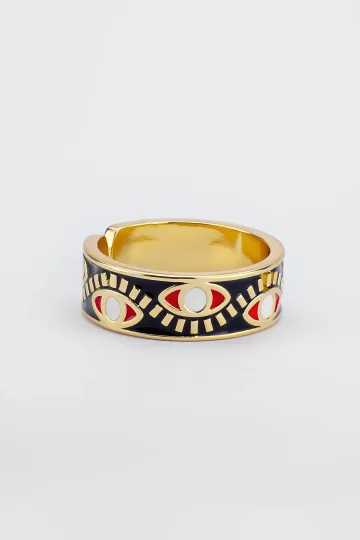
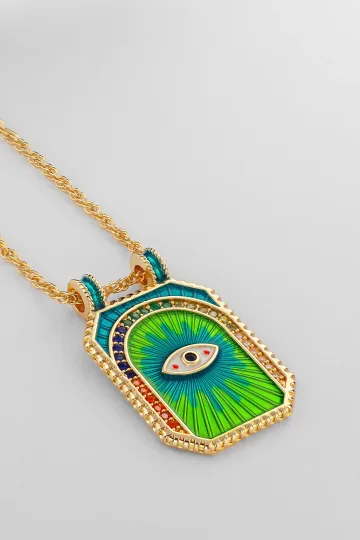

This guide honestly tackles three things: what the merkaba is as geometry, where the word and its meanings come from, and how all of it plays out in jewellery. We will not pass esoteric readings off as scientific fact. Wherever the talk turns to a field around the body or to "ascension," that is a spiritual concept, not physics. But the history of the word, the shape of the figure, and its place among other sacred-geometry symbols deserve a careful, unhurried telling.
Let us settle the terms up front. "Merkaba," spelled with a soft ending, is the esoteric name of the figure and the practice tied to it. "Merkava," with the "v," is the Hebrew word for "chariot" and the name of an ancient mystical tradition. One word, two branches of meaning, and we will follow both.
What a merkaba is as geometry
A star tetrahedron built from two figures
A simple geometric idea sits at the base of the merkaba. Take a tetrahedron, a regular pyramid made of four identical triangles. Take a second, identical tetrahedron and turn it point-down. Interlock them so that they pass through one another. The result is a solid star with eight sharp vertices and a complex silhouette that looks different from every side. That is the star tetrahedron, the geometric body of the merkaba.
The tetrahedron is interesting because it is the simplest of all possible solids. Four vertices, four faces, six edges. You cannot build anything smaller: three points give a flat triangle, and only the fourth lifts the figure into three dimensions. That is exactly why the tetrahedron is prized in any conversation about the basic forms of space. It stands at the very beginning of the geometry of solids.
A three-dimensional Star of David
The easiest way to picture the merkaba is as a solid Star of David. The flat six-pointed star, the hexagram, is formed by laying one equilateral triangle over another, one point up, one point down. The merkaba does exactly the same thing, but in three dimensions: instead of triangles it uses tetrahedrons. That is why, projected onto a plane, the merkaba's silhouette often really does resemble the familiar six-pointed star.
This link matters, because it is the reason the merkaba is so often confused with the Star of David and the Seal of Solomon. The forms are related, but not identical. A flat hexagram and a solid star tetrahedron are different figures, however obvious the visual kinship between them. We will unpack the differences in detail below; for now it is enough to remember that the merkaba is a hexagram carried into three dimensions.
The stellated octahedron: a name from mathematics
The merkaba's figure has a strict mathematical name with nothing esoteric about it. Mathematicians call it the stellated octahedron, or by its Latin name, stella octangula. It was given that name by Johannes Kepler in the early seventeenth century, in a treatise on the harmony of the world. Kepler noticed that if you extend the faces of an octahedron, you get precisely this star of two intersecting tetrahedrons.
The same object can be described in two more ways, and both are correct. It is a compound of two tetrahedrons pushed into each other. And it is at the same time the first, simplest stellation of the octahedron. The shared part that the two tetrahedrons occupy in the middle forms a regular octahedron, hidden inside the star. So at the heart of the merkaba, if you mentally strip away the eight sharp rays, lies a neat eight-sided solid.
How the figure looks from different angles
One reason the merkaba works so well in metal is its complex play of viewpoints. Look at the star tetrahedron along the axis joining two opposite vertices, and you see a symmetrical six-pointed star. Turn the figure, and the silhouette shifts: the sharp rays come forward, and the volume reads quite differently. A flat picture never conveys this fully, but a pendant that sways and catches light on different facets shows the figure in the round.
That is exactly why solid, rather than flat, merkaba pendants are valued more highly. Flat engraving conveys only one projection. A true three-dimensional star tetrahedron in wire or cast metal reveals the very thing the figure is loved for: the constant change of view as it moves.
The star tetrahedron: the symbol's meaning
The meaning of the star tetrahedron grows straight out of its shape. Two pyramids pointing toward each other read as the meeting of two principles: the rising and the descending, the light and the weighty, the upward-striving and the rooted below. Where they cross, a stable core appears, and it is precisely that stability that gives the symbol its main sense, balance through the union of opposites. In sacred geometry the star tetrahedron is read as an image of accord rather than struggle: the figure holds not because one pyramid defeats the other, but because both stand in a shared symmetry. Hence the calm reputation of the sign; it is chosen by people looking not for force but for an inner footing.
How many faces and vertices a merkaba has
Break the merkaba down as a geometric body and the count comes out cleanly. Each of the two tetrahedrons carries four vertices, four faces, and six edges, and together they give eight sharp rays jutting out in every direction. The star's eight vertices are those very rays, while the octahedron hidden inside adds its own tidy symmetry of eight faces. Such a clear, easily counted make-up partly explains why the form is so loved: there are no stray lines in it, everything resolves into round numbers. For jewellery that is a bonus too. A maker assembles the figure from repeating identical edges, and the precision of the build shows immediately in how evenly the rays meet at the vertices.
Silver merkaba on graphite, gold on white. A busy background steals every facet.
What to wear a merkaba with
The merkaba is temperamental to wear because of its edges, so I build the look from the backdrop of the clothing rather than from the figure itself. I have gathered here what I advise clients by occasion.
What to wear with a merkaba every day? For an everyday look I recommend a light frame pendant of two to two and a half centimetres on a chain of medium length, over plain fabric. A busy print argues with the edges, so I choose a smooth backdrop: grey, black, olive, burgundy. Silver reads cleanly against cool fabric, and a solid tetrahedron turns as you walk and plays light on its facets.
Which metal should I choose for the colour of my clothes? I advise matching the metal to the temperature of the look. Cool silver I recommend with grey, graphite, navy; warm gold or plating with sand, chocolate, wine. One metal throughout the look keeps the picture composed, so I do not advise mixing silver with gold in a single set.
How do I choose the chain length? I match the length to the neckline. Under an open collar or a shallow neckline I advise a short chain of around forty-five centimetres: the figure lands in the collarbone zone, where it reads best. Under a closed top I recommend dropping the pendant to fifty or fifty-five centimetres, onto the upper chest. Lengths of sixty to seventy centimetres I keep for a layered look of several chains. I match the chain's weight to the pendant: a heavy tetrahedron needs a sturdier chain, a light frame suits a fine one.
Flat or solid pendant for the fabric? Here I choose by the job. A solid frame tetrahedron I bring out over the fabric: against a plain backdrop it turns and plays its edges as an accent. A flat thin version I recommend under a shirt, when the merkaba stays a personal sign: it does not jut out with corners and does not catch on knitwear. For delicate knits I advise a pendant with softly rounded rays, since sharp vertices snag the loops.
What suits the office, and what suits going out? For weekdays and a restrained setting I choose a flat pendant or a signet ring with an engraving, where the figure reads as a clean geometric pattern rather than an esoteric statement. For the evening, by contrast, I recommend a large solid pendant or a frame star on a long chain, over dark, smooth fabric. Polished silver plays on smooth materials; oxidised adds a graphic edge.

Turn on your camera, pick earrings, a pendant or a ring, and see the piece on yourself in real time.
Switch items in one tap.
Everything runs in your browser: no photo or video is ever uploaded.
Merkaba jewellery: what to choose
The solid merkaba pendant
The most expressive option is a three-dimensional pendant, where the star tetrahedron is built from metal edges. Such an open-frame pendant shows the figure honestly, in full volume, and turns handsomely on a chain. It is usually made in silver or gold-plated silver, most often two to three centimetres across. The frame version is light, airy, and reads well against plain fabric. Mid-range.
The flat star-tetrahedron pendant
A simpler and more affordable option is a flat pendant, on which the star tetrahedron is rendered by engraving or cut-out. Here the figure appears in a single projection, most often as a six-rayed star with internal lines hinting at depth. A flat pendant is thinner, cheaper to make, and easier to wear day to day, because its edges do not snag on clothing. Budget and mid-range.
The merkaba ring
A merkaba ring is usually made either as a signet with an engraved star tetrahedron on a flat face, or as a ring with a small solid star as an accent. The signet is more restrained and fits where you would rather not draw attention. A solid star on a ring is more noticeable and works as a statement of its own. Mid-range and upper-mid.
Earrings and bracelets
In earrings the merkaba appears in two forms: tiny studs with a flat star silhouette, and drop earrings with solid frame tetrahedrons that catch the light as they move. A matched pair of solid earrings looks striking but calls for a light metal, or it drags at the earlobe. In bracelets the merkaba usually arrives as a charm alongside other sacred-geometry symbols: the flower of life, the spiral, the Platonic solids.
As an alternative to a tattoo
The merkaba is often inked as a tattoo, usually on the forearm, back, or chest, where a symmetrical figure sits well. Jewellery works as a softer and reversible alternative: the meaning is the same, but the decision is not final. Many people wear both, echoing the tattoo motif in a pendant.
The merkaba pendant: what the piece means
A merkaba pendant carries the same meaning as the figure itself, only translated into the language of an everyday gesture. It is worn as a sign of balance and of returning to oneself, a quiet reminder to hold the middle between action and rest, outer and inner. For some it is a spiritual sign and part of a meditative practice; for others simply an image of harmony with no esotericism attached. The pendant's value lies in the fact that the wearer supplies the meaning: the same star of two pyramids at the collarbone can stand for a path, a footing, or pure love of geometry. That is why a merkaba is given both as a meaningful talisman and as a beautiful ornament, without forcing a single reading on the recipient.
Merkaba for men and for women
The merkaba is worn by people of any gender, and the figure itself is neutral: there is nothing specifically male or female about it, beyond the symbolism of two opposing pyramids. Men's looks more often go for a large solid frame in silver or blackened metal on a substantial chain, where the star works as a graphic accent. Women's versions commonly include both fine flat pendants and light frame pendants in a smaller size, along with earrings with paired tetrahedrons. The difference here is not in meaning but in scale and metal. When a merkaba is bought as a paired piece, people often choose the same figure in different sizes: one larger, one smaller, but both reading as one pair.
The merkaba as a gift
The merkaba is often chosen as a meaningful gift, and it suits the role well. A symbol of balance and wholeness sounds fitting for almost any recipient, and the twofold history of the word, from Ezekiel's chariot to modern practice, gives a reason for a warm card with an explanation. People give both a neutral merkaba as fine geometry, to someone far from esotericism, and a consciously spiritual talisman to someone who is into it. A safe bet is a light frame pendant in silver, mid-sized, on a chain: it suits most people and forces no gender or style. For a paired gift, two identical figures of different sizes make a sign of the bond between two people around a shared symbol.
Etymology: from Ezekiel's chariot to light, spirit, body
Merkava: the prophet's chariot
The Hebrew word "merkava" means "chariot." It appears many times in the Hebrew Bible in the most direct sense, as a war or ceremonial vehicle. But the word gained special weight from the first chapter of the Book of Ezekiel. The prophet, in Babylonian captivity by the river Chebar, described an overwhelming vision: a radiant cloud, four winged beings with the faces of a man, a lion, an ox, and an eagle, and beside them wheels within wheels, their rims full of eyes. Above it all he saw the likeness of a throne and a shining figure upon it.
The word "merkava" itself does not appear in that chapter; it speaks of wheels and of a throne-chariot. But later tradition named this vision "Maaseh Merkava," the "Work of the Chariot," and the word fixed itself to the whole theme. The chariot here is not transport but an image of the divine presence in motion, a throne borne by living creatures.
Merkava mysticism in Judaism
An entire early branch of Jewish mysticism grew out of interpreting this vision, known as merkava mysticism, or Hekhalot literature, the literature of the "Palaces." Its texts took shape roughly in the first centuries of the Common Era. The mystics described the soul's ascent through seven heavenly palaces to the throne-chariot, the dangers of that path, and the names of the angels guarding it. The theme was held to be so serious and so risky that the sages restricted its teaching: the "Work of the Chariot" could be studied only by mature disciples, and only one-to-one with a teacher.
It is worth holding on to this frame, because it explains the weight of the word. Behind "merkava" stands not ornament but an ancient discipline of contemplation, where the chariot is an image of the highest reality, and the ascent toward it demands preparation. The modern pendant, of course, lives its own life, but the root of the word reaches back to precisely this: the vision by the river Chebar and generations of its interpreters.
The new reading: Mer-Ka-Ba
Late-twentieth-century esotericism produced a wholly different reading of the word, cut loose from the Jewish tradition. According to it, "merkaba" is not the single word "chariot" but three ancient Egyptian roots: "Mer" as a field of rotating light, "Ka" as spirit, "Ba" as body or physical embodiment. Hence the popular formula: the merkaba is light, spirit, and body, joined in one rotating field.
It is worth saying plainly: this reading has no support in Egyptology or linguistics. The real Hebrew "merkava" and the supposed Egyptian roots are different linguistic histories, and the "Mer-Ka-Ba" splicing is a late esoteric construction, not an established fact of any ancient language. That makes the symbol neither better nor worse, but the difference matters: one reading rests on written tradition, the other on the spiritual intuition of the twentieth century.
The author of the new reading
The modern esoteric understanding of the merkaba as a rotating field of light around the body was shaped in the late twentieth century by the American author Drunvalo Melchizedek, in books about the "ancient secret of the flower of life." He linked the star tetrahedron to a breathing and meditative practice, described two tetrahedrons rotating in opposite directions, and presented the merkaba as a means of spiritual awakening and protection. It was from these books that the image spread through esoteric circles, meditation courses, and ultimately jewellery displays.
As with the "Mer-Ka-Ba" decoding, it is worth keeping a calm distance here. Descriptions of rotating fields and "merkaba activation" are the language of spiritual practice, not verifiable knowledge. We recount this as a cultural phenomenon that gave rise to a modern symbol, without passing metaphysics off as physics.
Merkaba: translating the word "chariot"
The literal translation matters here more than any esotericism. The Hebrew "merkava" translates as "chariot" or "carriage," from a root meaning "to ride, to drive a team." It was this word that tradition gave to the throne-chariot of Ezekiel's vision, so "merkaba" in its original sense is not an abstract field but a very concrete image of a moving carriage bearing a rider. When the word migrated into esotericism and swapped its "v" for a "b," the direct translation "chariot" did not go anywhere; it simply slipped into the shadow of the new reading. It is useful to keep both layers in mind: literally, the merkaba is a chariot, and everything else, the fields and rotations, is a later interpretation grown onto an ancient word.
Mer-Ka-Ba: syllable by syllable
The popular decoding splits the word into three syllables and assigns each its own meaning: "Mer" as counter-rotating fields of light, "Ka" as the individual spirit, "Ba" as the physical body or its image. Put together, they yield the formula "light, spirit, and body in one rotating field." It sounds tidy, but honesty demands a caveat: this is a construction of the late twentieth century, not a reading from ancient Egyptian dictionaries. The real word "merkava" is a whole Hebrew word; it does not split into such syllables. So "Mer-Ka-Ba" is best taken as a neat mnemonic of modern practice, pretty and useful for remembering the idea of a threefold unity, but not as a fact of ancient language.
Merkava in Jewish mysticism and Kabbalah
The word "merkava" gave its name to a whole current of Jewish mysticism older than classical Kabbalah. The early texts of merkava mysticism, the Hekhalot literature, described the contemplative's ascent through the heavenly palaces to the throne-chariot. Later, in medieval Kabbalah, the image of the chariot entered the general language for describing the higher worlds, though the emphasis shifted to the teaching of the sefirot and the divine emanations. It is important not to blend these layers: the merkava mysticism of the first centuries, medieval Kabbalah, and the esoteric merkaba of the twentieth century are three different traditions linked by one word. The modern pendant inherits the charm of all that depth, but grows directly only from the last, youngest branch.
Customer reviews
Zevira is a real jewellery shop. Genuine payments, deliveries and customer thank-yous.
🥰🥰🥰 gracias
Ok, ¡gracias! 🙂
The merkaba in culture and the art of form
The star tetrahedron in the history of geometry
Long before any esoteric reading, the merkaba's figure lived in pure mathematics and in art. Renaissance masters, fascinated by perspective and the regular solids, drew and carved complex polyhedra, stellated forms among them. You can meet them in inlaid wooden marquetry, in engravings, in treatises on proportion: the artists of that age saw the regular solids as the summit of visible harmony and happily set them into ornament. The compound of two tetrahedrons as an object in its own right was carefully described by Johannes Kepler, who fitted it into his picture of a harmoniously ordered cosmos. For Kepler the regular and stellated solids were not decoration but a key to the structure of the world, and the stellated octahedron took its place in that picture. So the form that is sold today as an esoteric pendant has a thoroughly academic trace in the history of art and science, running back several centuries and having nothing to do with any metaphysics of a field.
Polyhedra as a language of harmony
The idea that the regular solids express the order of the cosmos is two thousand years older than the Renaissance. Plato already tied the five regular polyhedra to the elements, and the tetrahedron in that system answered for fire: a sharp, light, mobile form. When twentieth-century esotericists returned to the star tetrahedron, they leaned on this old cultural layer, in which geometry was read as speech about the structure of nature. The merkaba inherited the charm of that tradition: it looks like a formula frozen in metal.
Why the form draws you in
Regular geometry has a calm, magnetic pull that needs no mysticism at all. Symmetry, equal faces, clean angles are received by the eye as order, and order attracts. The merkaba joins this clarity with a sense of movement: two opposing pyramids create an inner tension, as if the figure were about to start turning. Hence its popularity among people who value minimalism and mathematical beauty outside any esotericism.
Upload a photo of your pet, someone you love, or an object. We'll build a 3D model and hand-cast it in pewter.


The sacred geometry of the merkaba
The Platonic solids and the place of the tetrahedron
Sacred geometry is not a science but a system of symbolic meanings assigned to regular forms. At its centre stand the five Platonic solids: the tetrahedron, the cube, the octahedron, the dodecahedron, and the icosahedron. These are the only five convex polyhedra whose faces are all identical regular polygons and whose vertices are all arranged alike. The ancients tied them to the elements, and in that scheme the tetrahedron fell to fire.
The merkaba takes precisely the tetrahedron, the first and simplest of these forms, and doubles it. In the logic of sacred geometry this is read as the union of two fiery principles pointing toward each other. From this comes all the further symbolism of balance we will discuss below. Note the framing: we are talking about symbolic meanings, not properties of matter; fire here is a metaphor, not chemistry.
The star tetrahedron and the flower of life
In modern sacred geometry the merkaba rarely lives alone. It is usually set beside the "flower of life," a pattern of intersecting circles from which, by that system, both the Platonic solids and the star tetrahedron can be derived. The idea is that from a simple repeating pattern of circles the whole family of regular forms unfolds, and the merkaba is among them. For jewellery this is convenient: the merkaba, the flower of life, and the seed of life form a recognisable set of motifs that are combined in a single collection.
Symmetry and the inner octahedron
The beauty of the star tetrahedron rests largely on its high symmetry. The figure can be rotated and reflected in many ways and will still coincide with itself. Inside, as we have already said, a regular octahedron hides, the shared core of the two tetrahedrons. This nesting of forms, a star outside and an eight-sided solid within, gives the merkaba the layered quality that sacred geometry reads as an image of unity across different levels of being.
The field around the body: where geometry ends
The best-known esoteric idea about the merkaba is that an energy field in the shape of a star tetrahedron supposedly exists around the human body, and that it can be "activated" through breath and meditation. Here full clarity is needed. Science finds no measurable field of that shape around the body, and claims about "merkaba activation" belong to the realm of belief and personal practice, not physics.
This does not mean the practice is meaningless for those who take it up: meditation, breathing exercises, and working with an image really do help many people focus and calm down. But the benefit here is psychological and tied to the practice of attention itself, not to a rotating field of light. You can wear a merkaba pendant with any attitude to this idea: as a sign of a spiritual path, as a symbol of balance, or simply as fine geometry.
It helps to separate two things: the ritual of attention itself, and the explanation attached to it. The ritual, in which a person sits, breathes evenly, and holds a stable symmetrical form before the mind's eye, works regardless of what the person believes. It lowers anxiety, slows thought, restores a sense of footing. The explanation, whether rotating tetrahedrons or a field of light, is the language of the tradition in which the practice was born. In this sense the pendant is an honest helper: it keeps the image of the figure before your eyes, and what meaning to pour into that image is for each person to decide. That is exactly why the merkaba is worn calmly both by convinced esotericists and by sceptics who simply like the idea of balance and clean geometry.
The merkaba and Metatron's Cube
Metatron's Cube is a flat figure of thirteen circles joined by lines, within which, by the logic of sacred geometry, all five Platonic solids are contained. The merkaba is linked to it directly: the star tetrahedron is derived from this diagram as one of the forms hidden in it. In jewellery the merkaba and Metatron's Cube are often set side by side or worn in one set, because together they read as the blueprint and the solid result of that blueprint. It is worth remembering that this whole system is symbolic, not scientific: Metatron's Cube is a beautiful geometric construction and a mnemonic, not a map of how the world is built. But as a visual language the link between the two forms works convincingly.
The merkaba, the seed of life, and the flower of life
In sacred geometry the forms are laid out in a family tree. The seed of life is a pattern of seven intersecting circles, from which, by that system, the flower of life unfolds, a denser web of circles. From the flower of life, in turn, the Platonic solids and the star tetrahedron are derived. So the merkaba turns out to be a distant descendant of a simple pattern of circles, the final solid form in a long chain. For jewellery this is a handy family of motifs: the seed of life, the flower of life, and the merkaba assemble easily into one set with a shared logic. Like everything in sacred geometry, this genealogy is poetic rather than strict, but it is what makes the set of forms whole and recognisable.
The merkaba in practice: meditation and activation
An entire practice of breathing, visualisation, and "activation" has grown up around the merkaba. Let us go through it calmly, separating the ritual of attention itself from the explanations attached to it, so that it is clear what actually works in it.
Merkaba: how to meditate
Merkaba meditation, in its common form, is built around image and breath. A person sits comfortably, straightens the spine, calms the breathing, and pictures a star tetrahedron around the self: the upper pyramid striving upward, the lower downward, the body at the shared centre. Attention is then held on this image, sometimes with a count of inhalations and exhalations, or a soft sense that the figure is slowly turning. The point of the exercise is steady concentration: an even symmetrical form gives the gaze a footing and helps the mind not to scatter. What works here is the training of attention, not the star itself, which is why even those who attach no esoteric meaning to it get something from such meditation.
Merkaba activation: what people mean by it
"Merkaba activation," in esoteric practice, refers to a particular sequence of breath and visualisation after which the field-tetrahedron around the body supposedly begins to rotate and "switches on." The descriptions can be detailed: a set number of breaths, a position of the hands, the direction in which two pyramids rotate toward each other. It is worth stating plainly: science finds no measurable field around the body that could be "switched on," so "activation" is the language of an inner practice, not a verifiable event. What actually happens is clear enough without metaphysics: focused breathing and holding an image calm the nervous system and give a sense of composure. The ritual has value, but it lies in the realm of attention and breath, not in the physics of a field.
Rotating tetrahedrons and breath
A separate motif of the practice is the counter-rotation of the two pyramids: the upper is mentally spun one way, the lower the other. In the esoteric explanation this creates that field; at the level of the exercise it gives attention a complex but holdable picture for the mind to grip. The breathing is usually slowed and deepened, synchronised with the imagined motion. From a sober point of view, it is the rhythm that helps: slow diaphragmatic breathing lowers the heart rate and helps you calm down, a bodily mechanism long since described. The image of rotating tetrahedrons here works as a convenient anchor for a breathing exercise, not as a lever that releases invisible energy.
What the merkaba practice does not promise
It helps to draw the boundaries, so as not to be let down. Merkaba meditation does not cure illness, does not replace medicine, and does not grant superpowers, whatever the loud descriptions claim. It does not create a measurable protective field around you and does not influence outside events. Everything it really gives lies within: the training of attention, the skill of calming the breath, minutes of quiet, and a sense of footing. That is no small thing, and for its sake the practice is worth taking up by anyone who enjoys it. But to present it as physics or medicine is dishonest. In this sense the merkaba pendant is a handy companion to the practice: it keeps the image of the figure at hand, promising nothing beyond the calm you will build yourself.



What the merkaba symbolises
The balance of masculine and feminine
The first and central meaning of the merkaba is the balance of opposites. Two tetrahedrons point toward each other, one apex up, the other down, and together they form a stable symmetrical figure. In symbolic language the upper tetrahedron is often tied to the masculine, active, ascending principle, and the lower to the feminine, receptive, descending one. Their union is read as the harmony of these forces within a single person. This is a direct development of the old idea of the hexagram, where the ascending and descending triangles stand for the union of heaven and earth.
Earth and heaven
The second meaning follows from the first. The upper tetrahedron reaches for the sky, the lower is rooted in the earth, and the merkaba becomes an image of the link between two worlds, a vertical axis between the material and the spiritual. In this sense the figure is worn as a reminder to hold both poles: neither to fly off into the abstract nor to sink into the everyday, but to stand between them in balance. For many this is the plainest reading of the symbol, one that needs no mysticism.
Ascension and rising
Through the word "merkava," with its chariot, the symbol inherits the theme of ascent. In the esoteric reading the merkaba is called a "chariot of ascension," a means of spiritual rising, echoing the ancient image of a chariot carrying one toward the highest reality. Here again honesty is fitting: "ascension" is the language of a spiritual concept, not the description of an event that can be checked. But as a metaphor for inner growth and movement toward a better version of oneself, this theme lives steadily in the symbol.
Light, spirit, and body
From the new "Mer-Ka-Ba" reading comes the meaning of a threefold unity: light, spirit, and body as three sides of one whole. In this reading the merkaba reminds us that a person is not reduced to any one of the three, but holds together through their accord. Even setting the disputed etymology aside, the idea itself is ancient and found across many cultures: the body, the soul, and that which animates them. The merkaba pendant is often worn with exactly this sense, as a sign of wholeness.
Protection and centring
In everyday esoteric use the merkaba is worn as a talisman and a means of "centring," of returning to oneself. The symmetry of the figure, its stability and completeness, work as a visual anchor: a glance at an even, balanced form helps you gather yourself. This is a case where the symbolic act is quite real on a psychological level, without any metaphysics. Even geometry calms, and in that lies its honest strength.
The merkaba and the chakras
Some esoteric schools link the merkaba to the chakras, imagining that the rotating field lines up along the same vertical axis as the body's energy centres. In this reading the figure helps to align the chakras and gather attention along the spine, from base to crown. We keep the same honest frame: chakras and fields are the language of a spiritual tradition, not anatomy, and there is no verifiable correspondence between them and the body's organs. But as a scheme for concentration the idea works: directing attention upward through the body and holding the image of a symmetrical star, a person really does calm down and feel their own posture better. You can wear a merkaba with this meaning, understanding where the metaphor ends.
The merkaba as a personal talisman
Many wear the merkaba as a talisman, a sign of protection and centring. The most honest way to describe how it works is this. The talisman acts not by radiating a field but by becoming an anchor for attention: in an anxious moment the hand reaches for the familiar figure, the eye catches the even symmetry, and that restores a sense of footing. This psychological effect is real and needs no mysticism; it is familiar to anyone who has a lucky object of their own. The merkaba suits the role well thanks to the completeness and stability of its form. That is why it is given as a meaningful talisman, carrying a wish for balance and protection, and the recipient is free to take that meaning as literally as feels right.
Leave your email, we'll send your discount code. No spam, unsubscribe anytime.
The code arrives by email, valid on your first order.
The merkaba and similar symbols
The merkaba and the Star of David
The Star of David, or Magen David, is a flat six-pointed star of two superimposed triangles, which became a symbol of the Jewish people and of Judaism. The merkaba is its solid relative: the same two opposing elements, but in three dimensions and in the form of tetrahedrons. The key difference lies in meaning, not in form alone. The Star of David is above all a national and religious sign with a concrete history. The merkaba is a symbol of sacred geometry and esoteric practice. They are easy to confuse by sight, but their contexts of wear are different, and it is worth knowing what you are wearing.
The merkaba and the Seal of Solomon
The Seal of Solomon, in one of its forms, is also drawn as a hexagram and is closely tied to legends of King Solomon's power over spirits. By outward drawing, a flat Seal of Solomon and a projection of the merkaba can coincide, hence the constant confusion. But the Seal of Solomon is above all a protective and magical sign from the medieval tradition of talismans, whereas the merkaba is about geometry, balance, and ascent. If you want to sort out the family of six-pointed signs, a separate look at the meaning of the Seal of Solomon is useful, showing how one drawing accrued different meanings.
The merkaba and the pentagram
With the pentagram the merkaba shares only the fact that both belong to the family of geometric symbols favoured in esotericism. In everything else they are opposites in structure. The pentagram is a flat five-pointed star drawn with one continuous line, and its meanings turn around the five elements and the five senses. The merkaba is a solid six-pointed figure of two tetrahedrons, and its theme is balance and ascent. Anyone who wants to compare will find a look at the meaning of the pentagram handy: side by side you can see how differently the two most recognisable "star" symbols are built.
The merkaba among the symbols of sacred geometry
Within sacred geometry itself the merkaba has close neighbours: the flower of life, the seed of life, Metatron's Cube, the spiral, and the Platonic solids. All of them add up to one visual vocabulary in which the forms flow into one another. The merkaba, in that lineup, answers for the theme of volume and balance. If you want to see how the merkaba falls into rank with the other signs, the large guide to symbols on jewellery helps, where different traditions are shown side by side.
The merkaba and the Star of David: what the difference is
The difference is easiest to reduce to three points. First, dimension: the Star of David is flat, the merkaba is solid, a hexagram carried into three dimensions through tetrahedrons. Second, origin: the Star of David, Magen David, is a national-religious symbol of Judaism with centuries of history, while the merkaba is a sign of sacred geometry and twentieth-century esoteric practice. Third, meaning: the Star of David speaks of belonging to a people and a faith, the merkaba of balance, ascent, and geometric harmony. They coincide only in projection: look at the merkaba along its main axis and the silhouette gives exactly a six-pointed star, hence the confusion. Understand these three differences and it is easy not to mix up the symbols, and to wear precisely what you mean.
Debunking misconceptions
Many confident claims have grown up around the merkaba, and they are worth going through calmly. Some of them mix different traditions; some pass a spiritual concept off as historical or scientific fact. Here are a few of the most common.
The first misconception: that "merkaba" is an ancient Egyptian word. In fact "merkava" is Hebrew and means "chariot," and the Egyptian decoding "Mer-Ka-Ba" is a late esoteric construction of the twentieth century, unconfirmed by Egyptology. The figure's form is ancient, but this particular reading of its name is new.
The second misconception: that a field in the shape of a star tetrahedron really rotates around the body, and that this is proven. There is no scientific confirmation of any such field. It is a matter of belief and practice, and it is more honest to speak of it that way, rather than hiding behind the word "proven."
The third misconception: that the merkaba and the Star of David are one and the same. They are related in drawing, but the Star of David is a flat national-religious symbol with its own history, while the merkaba is a solid figure of sacred geometry. To blur them is to lose the meaning of both.
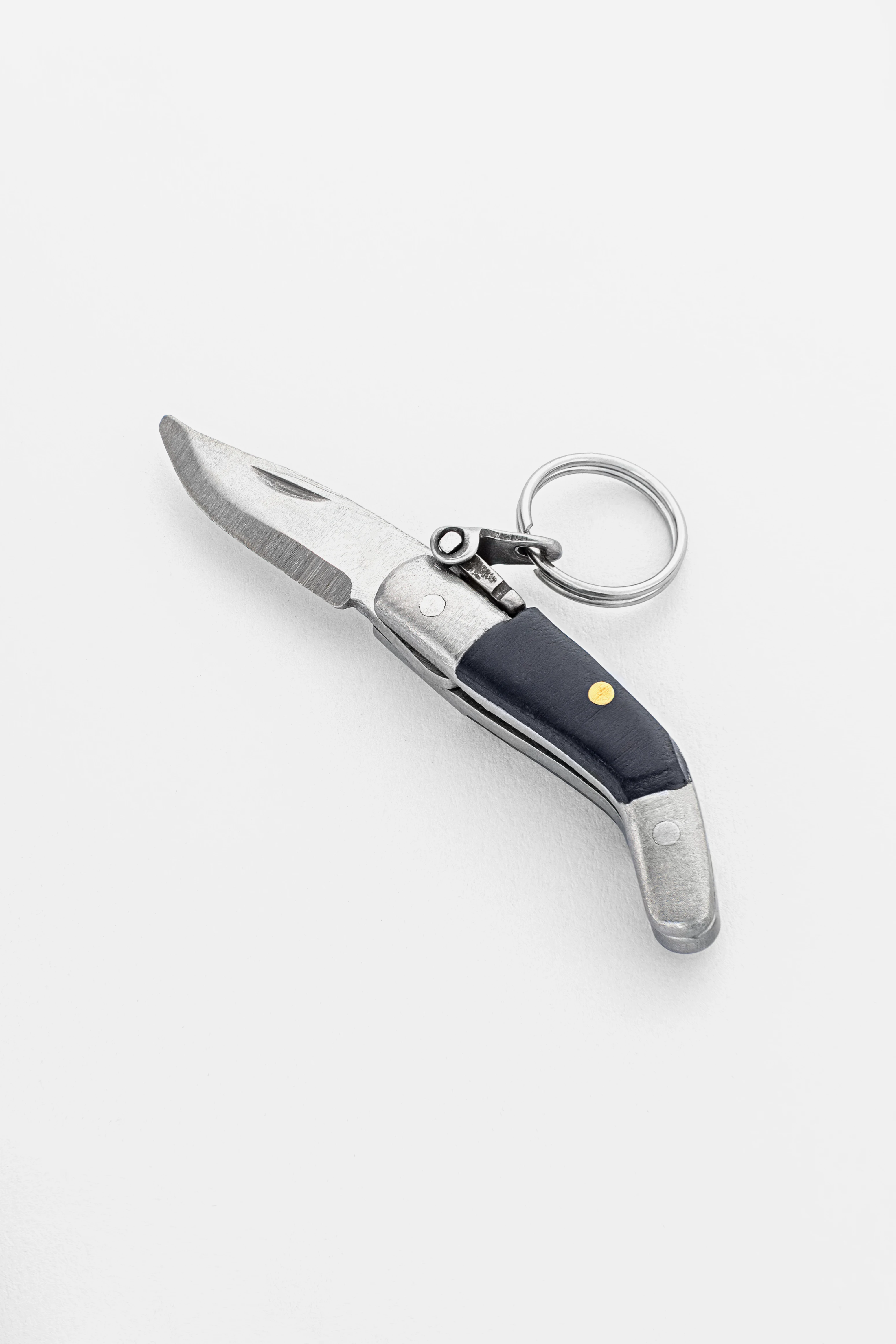
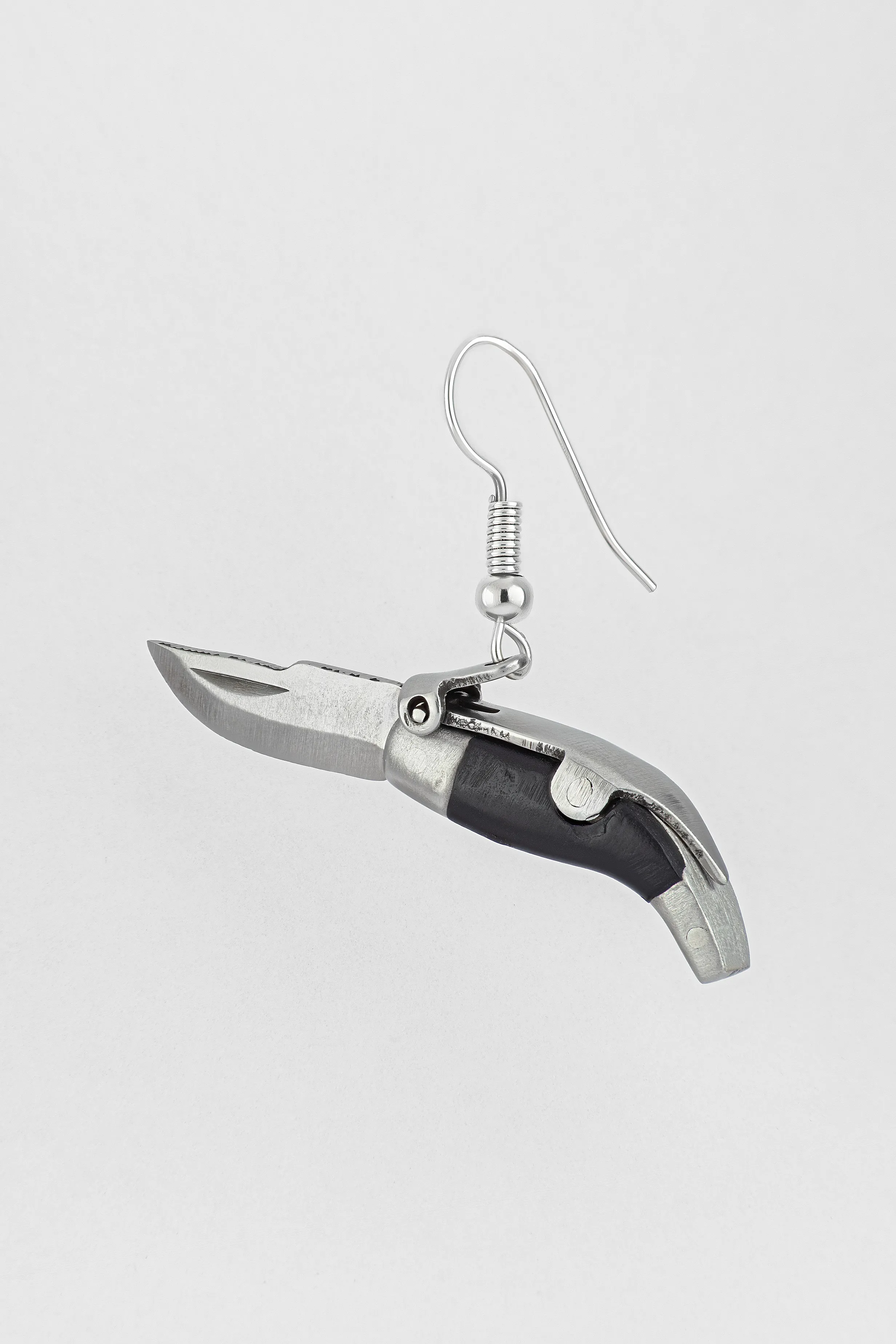
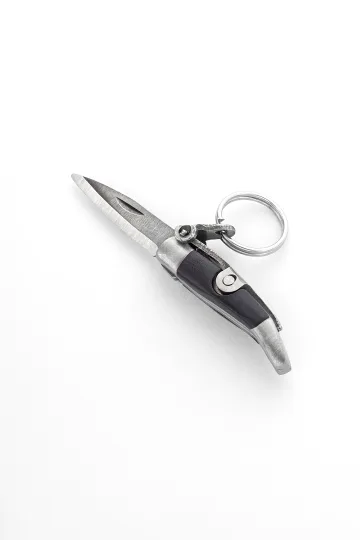
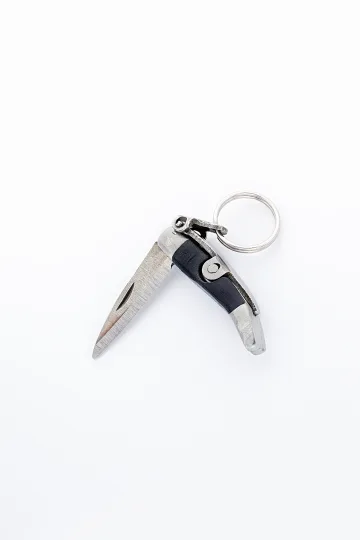
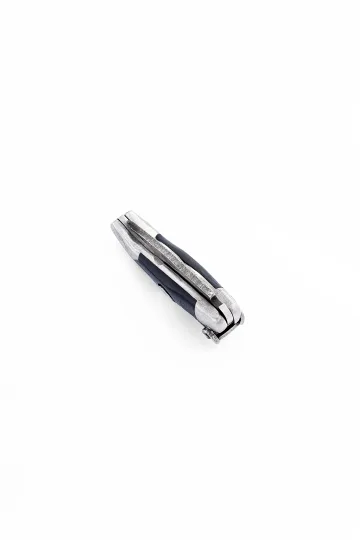
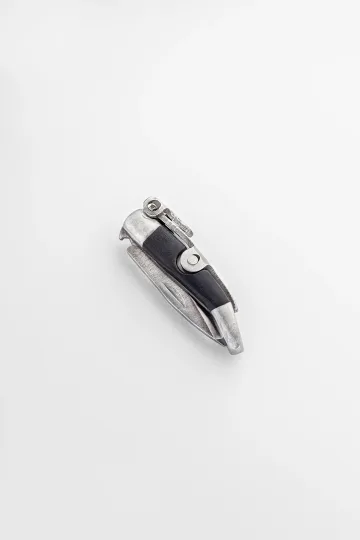
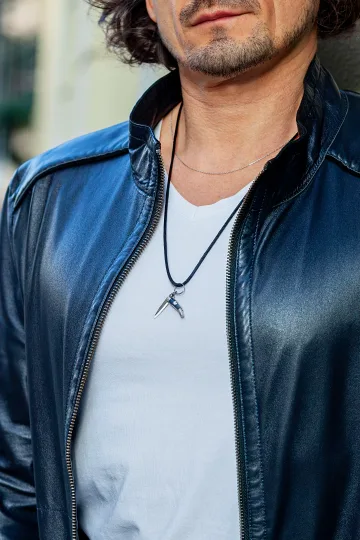
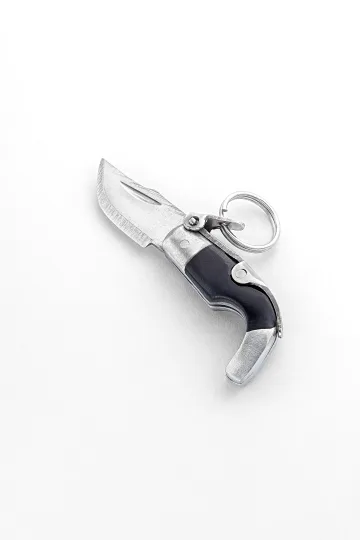
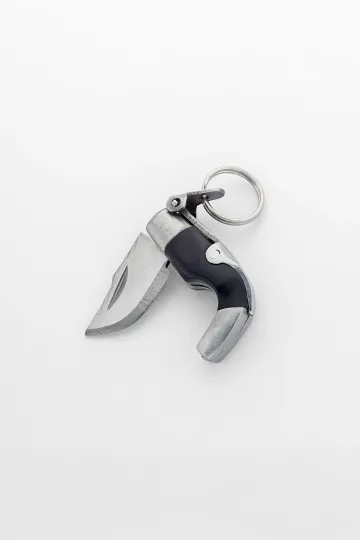
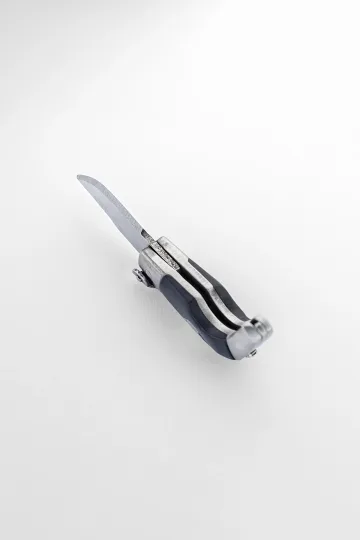
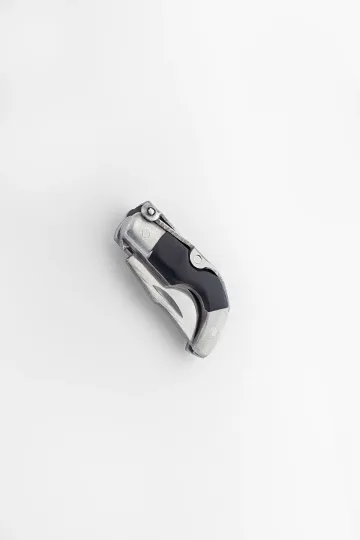
CAPAORA mini knife pendant
The 18th-century Spanish navaja in miniature: 40 mm of stainless steel, a real folding mechanism and a Palanquilla lock that clicks. An affordable gift to remember.
Authentic · Ships from Spain · 14-day returns
How to choose a merkaba
Flat or solid
The first decision worth making is between a flat pendant and a solid frame. A flat merkaba shows the figure in one projection, most often as a six-rayed star with internal lines. It is thinner, lighter, cheaper to make, and more convenient for everyday wear, because its edges do not snag on clothing and it slips quietly under a shirt. A solid frame tetrahedron reveals the essence of the figure more honestly: its three-dimensionality and its change of view as it turns. If the merkaba matters to you precisely as geometry, the volume is worth it. If you want an unobtrusive personal sign, the flat version is more practical.
Size for the job
Size changes not the meaning but the loudness of the statement. A pendant of one and a half to two centimetres reads as a restrained personal symbol, fitting in the office and under a shallow neckline. A medium size of two and a half to three centimetres already announces itself, looks good as a solid frame, and holds attention while staying everyday. A large star of four to six centimetres is an accent for evening or an expressive look; it calls for an open collarbone and a substantial chain. Choose the size for how loudly you want the symbol to speak.
Metal for your look
Polished silver is universal and reflects light well on the facets. Gold plating gives a warm tone and sits more softly on skin with a warm undertone. Gold of fourteen to eighteen carats is the durable, premium version for those who wear the symbol constantly. Oxidised silver, with darkened recesses, makes the volume graphic, almost like a technical drawing, and comes into its own against dark fabrics. A simple rule: cool minimalism loves polished silver, evening drama loves oxidised, and warm skin and gold get along well.
What to check before buying
For a solid merkaba, precision of assembly matters: the edges must meet at the vertices evenly, without skew, or the symmetry is lost and the star looks crooked. For a flat pendant, look at the cleanness of the lines and cut-outs. Check how the pendant attaches to the chain: on a sharp figure the bail must sit securely so the star does not tip to one side. If the piece has a stone, make sure the setting is tight and does not catch on fabric with its corners.
Merkaba tattoo or pendant: which to choose
Often the choice stands between a tattoo and jewellery, since the motif is the same. A tattoo is a final decision: the drawing stays with you, but it will not be lost and is always on hand. A pendant is softer and more reversible: you can take it off, change the size, pass it on, or give it away, and the meaning stays the same. Many combine the two, echoing the tattoo motif in a pendant or, the other way round, wearing a pendant for a long time and only then deciding on a tattoo. If in doubt, it makes sense to start with jewellery: it lets you live with the symbol without the irreversible step. A pendant is also easier to tune to a look, since metal, size, and chain length change with mood and occasion, which you cannot do with a tattoo.
Silver, gold, sacred-geometry symbolism, paired pieces and gift sets.
Who the merkaba suits
The merkaba suits those who love things with meaning and value the geometric cleanness of a form. Here are a few types of people to whom the symbol is close, each for a different reason.
For those who practise meditation and spiritual disciplines, the merkaba is close as a sign of centring and balance. Here it works as well as a mantra for the eye: even symmetry helps you gather yourself.
Lovers of sacred geometry and minimalism like the figure in itself, outside any esotericism. For them it is a beautiful formula in metal, kin to the flower of life and the Platonic solids.
For those looking for a symbol of the balance of masculine and feminine, earth and heaven, the merkaba gives a clear and uncluttered image. Two opposing pyramids are a plain metaphor for the accord of opposites.
For people interested in the history of symbols, the merkaba is intriguing for the double fate of its word: from Ezekiel's chariot and Jewish mysticism to late-twentieth-century esotericism. It is a rare case where one sign holds two divergent stories.
For lovers of geometric jewellery and graphics, the figure suits on purely aesthetic grounds. A solid star tetrahedron changes its look with every turn, and that alone is reason to wear it.
Materials and care
Materials
Most often the merkaba is made in 925 silver: the metal holds the fine edges of a frame figure well and reflects light handsomely on the facets. Gold-plated silver gives a warmer tone and looks softer on skin with a warm undertone. Gold of fourteen to eighteen carats is the premium version of the symbol, durable and neutral. Oxidised silver, with darkened recesses, emphasises the volume of the star tetrahedron and lends a graphic, almost technical-drawing look. For large evening pieces, blackened steel is sometimes used, which holds a massive form without much weight.
Care
A solid merkaba, with its many edges and inner angles, collects dust and cosmetic residue in hard-to-reach places. A soft toothbrush with a drop of soapy water easily cleans the frame between the edges, after which the piece is rinsed and wiped dry. For oxidised pieces it is best not to use ultrasonic cleaning, which strips the patina from the recesses. In that case, polish only the raised outer edges, leaving the inner hollows dark, for the sake of contrast. Silver darkens over time by itself, especially in a damp environment, and a light tarnish on a polished merkaba comes off with a special silver cloth. If the pendant has a stone, check the setting from time to time: the sharp vertices of the figure catch on fabric and gradually loosen the setting, and a jeweller will tighten it quickly.
The merkaba in silver and in gold
The choice between silver and gold is a choice not of meaning but of the character of the piece. 925 silver gives a cool, clean shine, brings out the edges well, and costs less, which is why most merkabas are made in it. It needs care against tarnish, but returns to shine easily with a silver cloth. Gold of fourteen to eighteen carats is heavier, warmer in tone, and barely dulls, the version for those who wear the symbol constantly and do not want to think about it. A gold merkaba takes contact with skin and water more calmly. An in-between option is gold-plated silver: a warm gold tone at a reasonable cost, but the plating wears off the raised edges over time, and that is worth bearing in mind for daily wear.
Send a friend a discount code, they save on their first order.
Facts that surprise
The merkaba is one of those figures where something unexpected hides at every step. Here are a few facts that change how you see the symbol.
First. The strict mathematical name of the merkaba was coined by the astronomer Johannes Kepler, the very one who discovered the laws of planetary motion. He named the figure stella octangula, the "eight-pointed star," fitting it into his picture of a harmonious cosmos. So the esoteric symbol has a thoroughly academic passport from the seventeenth century.
Second. Inside the star hides another regular figure. The shared core of the two tetrahedrons is a perfect octahedron, an eight-sided solid. Strip away the eight sharp rays in your mind, and at the centre of the merkaba a neat, crystal-like polyhedron remains.
Third. The word "merkava" was held so serious in Jewish tradition that the theme of the "Work of the Chariot" was forbidden to teach in public. It could be passed on only to a mature disciple, and only one-to-one with a teacher. A symbol that hangs freely in shop windows today was once wrapped in strict secrecy.
Fourth. The popular decoding of "Mer-Ka-Ba" as "light-spirit-body" appeared only in the late twentieth century and has no footing in the real ancient Egyptian language. The pretty formula turned out to be younger than many of the people who repeat it.
Fifth. The flat projection of the merkaba along its main axis gives exactly a six-pointed star. That is precisely why the solid star tetrahedron is so often confused with the Star of David and the Seal of Solomon: from one angle they really do look the same.
Sixth. The tetrahedron is the simplest possible solid in space, with only four vertices. No smaller solid polyhedron exists in principle, so the merkaba is built from the most fundamental brick of the geometry of solids.
Seventh. In Plato's system the tetrahedron answered for the element of fire, because of its sharp, light form. So the merkaba is, in essence, two joined signs of fire pointing toward each other, which chimes with its symbolism of the balance of forces.
FAQ
What is a merkaba in simple terms?
A merkaba is a solid star of two pyramid-tetrahedrons pushed into each other with their apexes pointing in opposite directions. In essence it is a three-dimensional version of the six-pointed star. In mathematics the figure is called a stellated octahedron, and in esotericism a merkaba, tied to balance, ascent, and sacred geometry.
What does the word "merkaba" mean?
The word has two lines of meaning. The Hebrew "merkava" means "chariot" and points to the vision of the prophet Ezekiel and to Jewish merkava mysticism. Separately, twentieth-century esotericism produced the reading "Mer-Ka-Ba" as light, spirit, and body, but that is unconfirmed by linguistics and belongs to a spiritual, not a scientific, interpretation.
Are the merkaba and the Star of David the same thing?
No. The Star of David is a flat six-pointed star and a national-religious symbol of Judaism. The merkaba is a solid figure of two tetrahedrons and a symbol of sacred geometry. They are alike in drawing, especially in projection, but differ in form, in meaning, and in the context of wear.
Is it true that there is a merkaba field around a person?
That claim comes from esoteric practice, not from science. Science finds no measurable field in the shape of a star tetrahedron around the body. The idea of "merkaba activation" belongs to the realm of belief and meditation. You can wear the symbol with any attitude to this concept.
Can a person of any faith wear a merkaba?
The form itself is geometric and not tied to a single religion, so it is worn by people of the most varied views, from those absorbed in sacred geometry to those who simply like symmetry. It is worth remembering its kinship with Jewish symbolism: if the religious context matters to you, it is better to understand in advance what meanings you are pouring into it.
Which merkaba pendant should I choose, flat or solid?
A solid frame pendant shows the figure more honestly, turns handsomely, and catches the light, but is a touch more temperamental to wear and more expensive. A flat pendant with engraving is thinner, more affordable, and more convenient day to day, but conveys only one projection. For expressiveness people take the solid one; for everyday ease, the flat one.
How does the merkaba differ from the Seal of Solomon?
The Seal of Solomon is a protective and magical sign from the medieval tradition of talismans, often drawn as a hexagram. The merkaba is a symbol of sacred geometry, about balance and ascent. By drawing, the flat versions can coincide, but their origins and meanings differ: one is about power over spirits, the other about geometry and harmony.
Which metal is best for a merkaba?
925 silver is universal and holds the fine edges well. Gold-plated silver gives a warm tone; gold of fourteen to eighteen carats is the durable, premium version. Oxidised silver emphasises the volume of the figure with a graphic contrast. The choice depends on whether you want clean minimalism or a more expressive, almost technical-drawing look.
Conclusion
The merkaba is a rare symbol whose biography has literally split in two. Along one branch it reaches back to the chariot of the prophet Ezekiel, to Jewish merkava mysticism, and to a strict discipline of contemplation, where the "Work of the Chariot" was spoken of only in a whisper and face to face. Along the other it comes from late-twentieth-century esotericism, with a new reading of its name and an image of a rotating field of light. And between them lies pure geometry: the stellated octahedron, described as far back as Kepler, two of the simplest solids of space joined into a stable star.
In jewellery the merkaba works on all these levels at once. For some it is a sign of a spiritual path and of the balance of forces. For others an image of the link between earth and heaven, masculine and feminine, body and spirit. For others still simply a beautiful symmetrical form that changes its look with every turn. None of these readings is obligatory, and none cancels the rest.
The honest bottom line is simple. Where the merkaba is described as a verifiable field or a proven energy, it is worth keeping a calm distance. And where it works as an image of harmony, as an anchor for attention, and as elegant geometry at the throat, it honestly does its job. Whatever you pour into this star of two pyramids is what it will mean.
Buying it as a gift? Each one arrives ready to give.
 A branded Zevira box and a little card come with every order.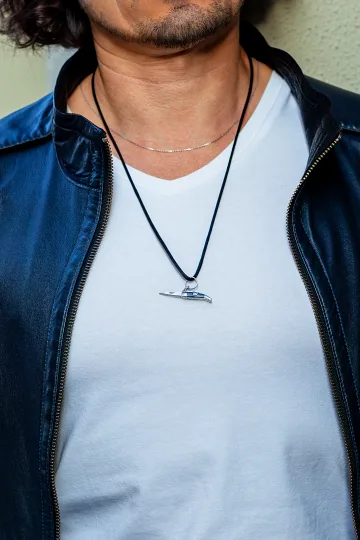





About Zevira
Zevira works in Albacete, Spain, a town with a long craft tradition in metalwork. The merkaba is part of our collection of sacred-geometry symbols, where it sits alongside the flower of life, the Platonic solids, and other signs in which form and meaning hold together.
What you can find with us bearing the merkaba:
- Solid frame merkaba pendants in silver
- Flat pendants with an engraved star tetrahedron
- Merkabas in oxidised silver for a graphic aesthetic
- Gold-plated versions with a warm tone
- Signet rings with an engraved star tetrahedron
- Paired pieces and gift sets with sacred-geometry symbolism
Personal engraving is available. We work in 925 silver and gold of fourteen to eighteen carats.