Hematite: Iron of the Earth, Grounding, Protection, and Masculine Strength
Ancient Greek warriors held a flat red stone before battle. They pressed it to their foreheads, whispered its name, and felt their feet settle into the ground like roots. Hematite. Blood of the Earth. The warrior who held it did not fall. Did not hesitate. Did not lose himself in fear. He stood rooted, immovable, like a stone that had seen ten thousand battles.
Modern science explains hematite through iron oxides, crystal structure, density, hardness. Ancient warriors explained it simply: this stone remembers the earth. It remembers those who pulled it from the ground. And it gives you their steadiness.
What happens when you don't just wear a hematite ring, but understand why it's called a grounding stone? Not as an abstract concept, but as a real anchor for your root chakra, the foundation that keeps you present, stable, unwavering. You stop feeling like you're floating above your life. You remember your weight. Your roots. Your core.
This is not mysticism. This is nearly 3,000 years of observation. This is physics and psychology meeting at the body.
Hematite: What It Actually Is
Hematite is iron oxide, Fe₂O₃, the most abundant source of iron in the Earth's crust. When you see rust, you see hematite in transition. When you see red beach sand, you're looking at billions of hematite particles.
But hematite jewellery doesn't use the red form. Polished hematite is black, metallic-glossy, deep like a mirror held to night sky. This polish opens hematite's true nature: not just stone, but a conductor of earth's metallic energy.
The density is 5.3 g/cm³. Heavy. When you wear a hematite ring, you don't forget it's there. The weight is constant. That weight is the anchor.
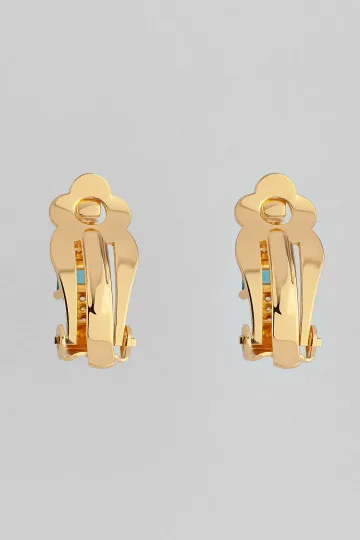
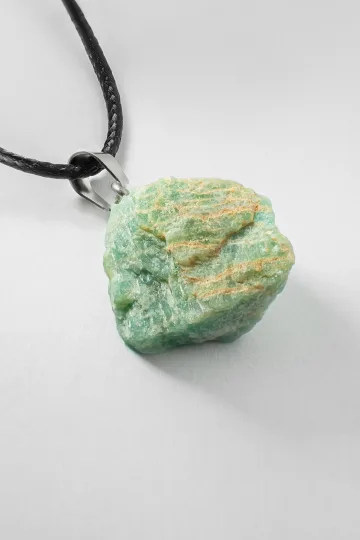
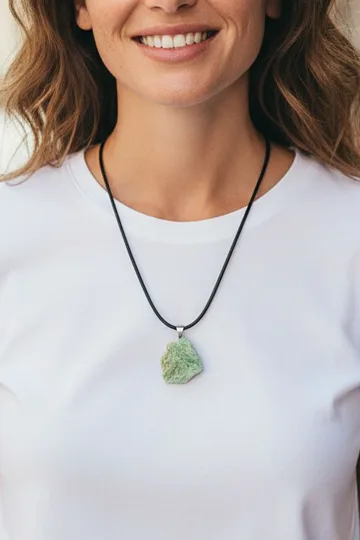
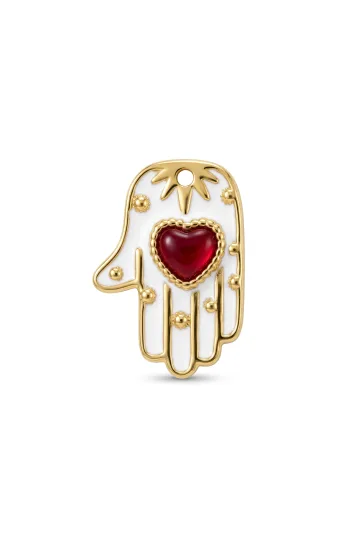
Wear the symbol, don't just read about it. These are in stock:




Hardness on the Mohs scale: 5.5-6.5. This means hematite is easily polished but easily scratched. It requires care. And it rewards care, the more you polish it, the deeper its reflection.
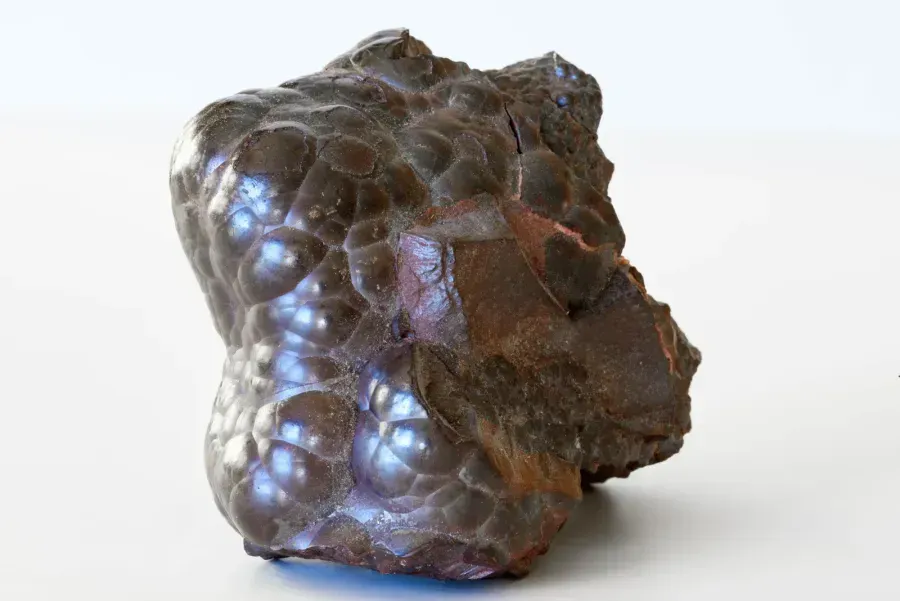
Deposits span the globe: Australia (largest reserves), Brazil, USA, Russia. Britain has its own classic source in the iron field of west Cumbria, where the smooth botryoidal masses long known as kidney ore were raised; the specimen in the photograph above comes from there. When you hold a hematite piece, you hold a stone that has fed iron to civilisations for millennia.
Make-up and structure
Pure hematite is two atoms of iron to three of oxygen. In nature titanium, manganese and water in the lattice usually come along for the ride. The mineral crystallises in the trigonal system, the same structure as corundum. Crystals may be platy or tabular, and now and then they gather into rosettes, the so-called iron roses. More often, though, hematite turns up not as separate crystals but as solid masses: granular, earthy, or in those characteristic kidney-shaped botryoidal flows with a smooth gleaming skin.
Hardness, density, lustre
- Mohs hardness 5.5 to 6.5. Middling. Hematite is harder than glass and than most metals, softer than quartz at 7. It takes a polish well and scratches without much trouble, which is why it asks for care in jewellery.
- Density about 5.3 g/cm³. Very high for a gem material: quartz sits at 2.65 and most stones between 2.6 and 4. That is where the surprising weight comes from, and it is a diagnostic sign in itself, since hematite is noticeably heavier than almost anything that resembles it.
- Lustre runs from metallic to semi-metallic on polished and crystalline faces, and falls to dull and earthy on loose masses.
- Colour in the mass runs from steel grey and black to brown; the streak, the colour of the powder, is always cherry red.
- Transparency: none. So refraction, dispersion and pleochroism in the usual sense have nothing to work on here. Light does not travel through the stone, only surface reflection matters, and that sets hematite apart from the transparent gems that live on refraction.
Hematite responds to a magnet weakly or not at all. Strongly magnetic black beads that cling to one another in a chain are as a rule not natural hematite but a sintered synthetic, which the section on fakes takes up below.
Why hematite gleams like metal yet passes no light
The familiar logic of gemstones does not apply here. An emerald or a sapphire is beautiful because light enters, bends at the facets and comes back to the eye coloured and split. Hematite works the other way. Its lattice is packed tight with iron atoms, and light barely penetrates even fractions of a millimetre. It bounces straight off the surface. Hence the mirror-like, almost mercurial sheen of a well polished stone, and hence its complete opacity against the light. What you have is less a gem than a mirror, and that changes everything: the way it is cut, the standard the polish must meet, and how the stone behaves in a piece.
There is one fine detail. On very thin flakes and along the edges of some varieties hematite will let a trace of reddish light through, and then the rim of a bead glows dark cherry against a bright source. It is an echo of that red powder: the colour of the substance is one and the same, read as black in the mass and as blood red in a thin layer.
The red streak: the one test that never fails
Streak is the colour of a mineral in powder, and for hematite it works without exception. On the outside the stone may be coal black, steel grey, brown or glittering, but draw it across rough unglazed ceramic and it leaves a rusty red, cherry, sometimes brick-brown mark. The reason is simple: crushed iron oxide is always red, whatever the specimen looked like to begin with. Geologists have carried a scrap of unglazed porcelain, a streak plate, for exactly this test for well over a century. Similar black minerals behave differently: magnetite gives a black streak, chromite a brownish one, and glass and plastic leave no coloured mark at all. One stroke across a tile settles nearly every identification error.
Hematite, magnetite and "hematine": three things that get confused
One black appearance hides quite different materials, and it pays to tell them apart before buying rather than after.
- Hematite (Fe₂O₃), a natural iron oxide, red streak, all but indifferent to a magnet.
- Magnetite (Fe₃O₄), another natural iron oxide, black streak, strongly drawn to a magnet. In the ground the two often sit side by side and pass into one another as oxidation proceeds.
- Hematine, sold as "magnetic hematite", is not a mineral at all. It is a synthetic material sintered in a furnace from iron oxide powders with additives, and it is deliberately given a strong magnetisation. Beads of it jump towards a magnet and cling in a chain. Natural hematite never behaves that way.
The practical conclusion: if black beads reach for a magnet and hold on to each other, what you have in front of you is almost certainly hematine rather than a stone out of the ground. It is inexpensive, neat and perfectly serviceable in jewellery. Calling it natural hematite is simply inaccurate.
History: From Warrior's Amulet to Modern Grounding Stone
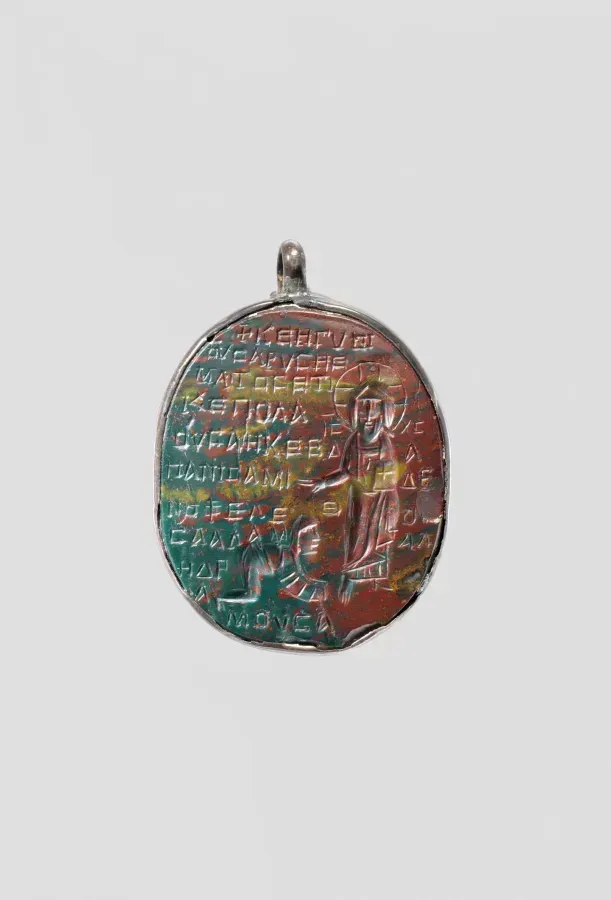
Ancient Warriors and Red Magic
In ancient Egypt, hematite was war itself. Pharaohs wore hematite amulets shaped as scarabs, hearts, eyes of Horus. Egyptian texts called it "the stone of blood", not from its colour alone, but because they ritually stained it with sacrifice during its polishing. The name travelled: "haima" from Greek means blood. Hematite: blood-bearer.
Greek soldiers wore hematite signet rings. Athletes believed it gave them stamina that didn't break. Philosophers held hematite while speaking so their voices wouldn't shake. Healers of the time placed polished hematite on wounds and spoke incantations, trusting in the calm a familiar object could bring.
Palaeolithic Ochre and the First Mines
The bond between people and red iron oxide reaches far deeper than metal, deeper even than farming. Palaeolithic sites yield lumps of hematite with grinding marks on them, bone and stone grinders stained red, and layers of ochre where camps stood for a long while. That pigment went on cave walls, on the bodies of the dead at burial, on skin and on objects. In southern Africa archaeologists have excavated ancient workings where people quarried hematite and related iron oxides deliberately for pigment: some of the oldest mines in history, opened long before anyone learned to smelt iron from the same ore. The red evidently carried a meaning of its own, usually linked with blood, life and death, though the exact readings can only be reconstructed. One thing is certain: the human pull towards this material is older than almost every craft.
Mirrors and the Polishing of Metal
Dense, easily polished iron oxide had another ancient use that rarely gets a mention: it put the shine on things. Before glass mirrors existed, reflecting surfaces were made of polished metal, and fine hematite powder served as the abrasive for the final pass on bronze, silver and gold. Polished hematite itself, with its mirror sheen, could double as a small dim looking glass. That role has survived almost unchanged. The finest red iron oxide powder, known as crocus or jeweller's rouge, still sits on the polishing wheels of workshops and is used for finishing metal and optics. The same material that coloured the walls of Palaeolithic caves now brings to a shine the very rings it is set into.
Medieval Alchemy: The Philosopher's Stone
Alchemists ground hematite into powder for sacred inks. They saw it as a bridge between lead (inert matter) and gold (perfection). They polished it under moonlight, then exposed it to sunlight, feminine then masculine energy, they said. It was a poetic language for working patiently with a difficult, beautiful material.
Victorian Era: Black Mourning, Hidden Power
In Victorian England and Europe, hematite became mourning jewellery. Widows wore hematite rings, brooches, bracelets. Black hematite. The fashion was about grief. But deeper, hematite helped the bereaved return to their bodies after shock. It grounded sorrow into the earth instead of letting it float as trauma.
Modern Era: Scientific Return
In the late 20th century, interest in hematite resurged through crystal therapy and energy work. The popular crystal guides of that period put hematite at the head of every list of grounding stones. Not ancient magic anymore, work with the root chakra, the muladhara, the foundational energy.
Today, hematite is the stone recommended most for those living in urban chaos, energetic fragmentation, disconnection from earth.
Hematite wants charcoal wool and a steel watch. Hang it off a gold chain and you look costumed, not dressed. No, I won't argue.
How to wear hematite
Over years on shoots and in fitting rooms, hematite has passed through dozens of looks with me. Here is what actually works, sorted by occasion and by metal.
What do I wear hematite with every day? For daily wear I recommend a smooth ring or a bracelet on a leather cord under a grey or khaki shirt, heavy cotton, denim. The stone likes rough textures and a muted palette: against them its mirror shine reads as quiet luxury rather than glitter. A light top lifts the metal, a dark one turns hematite into the accent.
Is hematite right for the office? Yes, as long as you keep it restrained. I suggest a signet on the ring finger or a narrow bracelet under a shirt with the sleeve rolled up. Black hematite on 925 silver echoes the cool metal of a watch and cufflinks and keeps the look composed instead of loud.
How do I build an evening look with hematite? Evening flips the logic: here the stone works on contrast. I choose a deep V or the open collar of a dark shirt, fine black knit, charcoal wool, and one large pendant on a long chain that rests on the chest. One accent, not three: hematite looks heavy, so there is no need to crowd it.
Which metal should I pair hematite with? Hematite gets on with cool silver and matte steel, a little more carefully with warm gold, though a copper setting beautifully strengthens its earthy character. On length: a 55 to 60 cm chain drops the pendant toward the solar plexus, a short 45 cm one takes the stone under the collar, closer to the body. Choose the length for the neckline, not the other way round.
Which stones go with hematite? Best with dark neighbours in the same graphic register: black onyx, smoky quartz, black tourmaline. Build layers on one hero: either a stack of thin bracelets where hematite sets the tone, or a single visible piece solo. One lead per set, the rest is support.

Turn on your camera, pick earrings, a pendant or a ring, and see the piece on yourself in real time.
Switch items in one tap.
Everything runs in your browser: no photo or video is ever uploaded.
Geology: Iron as the Basis of Life
Hematite forms through two main processes.
First: sedimentation in ancient seas. Billions of years ago, iron-rich waters deposited layer upon layer on the ocean floor. These layers, Banded Iron Formations (BIF), created the world's largest hematite deposits. Australia's iron ore beds tell a story of an earlier planet.
Second: hydrothermal precipitation. Hot mineral-laden water rises from the Earth's interior, cools, crystallises. Hematite is born. This process continues today.
Life itself began with iron. Early microorganisms used iron in their energy exchange. Hemoglobin, the protein carrying oxygen in your blood right now, contains iron. Hematite is the ancestor of your blood, pressed into stone.
When you wear hematite, you wear the memory of how life began on this planet.
The Great Oxidation Event: how hematite recorded the history of air
The main reserves of hematite have a startling back story, and it bears directly on what we breathe. Around two and a half billion years ago ancient microbes learned photosynthesis and began releasing oxygen. Until then the oceans were saturated with dissolved iron in its reduced form. Free oxygen seized greedily on that iron, and it settled to the floor in the finest layers of oxide. So the banded iron formations came about, hundreds of metres of alternating red-brown iron and dark siliceous bands. In effect it is a petrified record of the planet taking its first deep breath of oxygen. Each band registers a swing in that early atmosphere, and today the same beds supply humanity with the bulk of its iron ore. A hematite pendant carries a small fragment of that turning point in the history of the Earth.
Hematite on Mars: why the red planet is red
Mars is red for the same reason rusty soil is red. Its surface is covered in iron oxide dust, and a good share of that colour comes from hematite in particular. In 2004 a rover found small spheres of iron oxide scattered across the ground there, which the researchers nicknamed "blueberries": rounded hematite concretions about the size of a pea. On Earth such spheres normally form in the presence of water, and the discovery became a weighty argument that Mars once held liquid water. So the very mineral sitting in your bracelet helped scientists look into the watery past of a neighbouring planet. The red of Mars in the night sky and the red streak of hematite on a tile are one substance at two scales.
Where it is mined
Hematite is spread across the world. Among the well known sources:
- Australia, the largest iron ore provinces on the planet, predominantly hematite.
- Brazil, one of the leading world suppliers of iron ore.
- The United States, the Great Lakes district, whose ranges shaped a whole chapter of metallurgy.
- Britain, the west Cumbrian field, source of the classic kidney ore specimens, and the ironstones of the Cleveland Hills that once fed Teesside.
- Ukraine, Russia and Sweden, rich beds of banded iron quartzite.
In other words, buying a hematite piece puts one of the most ordinary minerals on the planet in your hand, not a rarity. It is valued for its look and its character, not for scarcity.
The Iron Nature: Earth's Energy and Stability
Iron is the element of will. Physically, iron is a ferromagnet: it concentrates, holds, remembers. Iron doesn't evaporate, doesn't dissolve, doesn't forget.
Touch polished hematite: cold, smooth, heavy. That sensation is the physical form of stability. Ancient warriors understood this intuitively. Modern physics confirms it: hematite conducts heat rapidly, accepting your body temperature, becoming part of you.
Energetically, hematite works with Earth's grounding current. Imagine yourself as a vertical antenna with roots reaching into the ground. Hematite materializes that connection. It draws ethereal energy from your thinking brain (where anxiety lives) downward, into your belly, your legs, into Earth. This is centralization. This is gathering yourself.
People who spend time in creative, imaginative spaces (artists, philosophers, spiritual seekers) often "float." Disconnected from sensation, from body, from real moment. Hematite returns them. Not violently, like an anchor, slowly, steadily.
Customer reviews
Zevira is a real jewellery shop. Genuine payments, deliveries and customer thank-yous.
🥰🥰🥰 gracias
Ok, ¡gracias! 🙂
Grounding and Protection: The Root Chakra Muladhara
Muladhara, the first chakra, sits at the spine's base. In Sanskrit: "mula" = root, "adhara" = base. This is Earth's chakra. Survival. Trust. Foundation.
When muladhara is blocked, you experience:
- Fear of the future, financial instability
- Avoidance of the body (living in fantasy, not present)
- Procrastination, inability to complete things
- Feeling like a parasite, weightless, not belonging
- Physical problems: back pain, digestive issues, weak legs
Hematite opens muladhara. It does this through one mechanism: it returns awareness to your body. Wearing a hematite ring on your ring finger (the finger connected to the heart and will) creates a miniature energy circuit: consciousness (head) → finger → ring → back to body. A closed loop.
Practice: During the day when anxiety rises, place your hematite-ringed hand on the base of your spine (muladhara point). Hold it. Breathe. You'll feel energy settle, mind quieten.
Protection, in this tradition, is what grounding is believed to provide. A grounded person is described as whole, dense, undispersed. In the old way of thinking, there's nothing for energy-drainers to grab, aggression seems to bounce off, and you feel like Earth rather than prey.
Masculine Energy: Strength, Confidence, Courage, Stability
Hematite is a stone of courage, but not aggression. Courage as clear knowledge of your own power.
Masculine energy (regardless of gender) is action energy, certainty, will-to-power. When it's developed:
- You know what you want and move toward it directly
- You don't seek approval, but listen to your inner compass
- You're ready for conflict if you need to defend your boundaries
- You accept responsibility for your choices
- Your energy points downward, into roots, into source, into strength
Hematite mirrors exactly this vibration. It's black (earth colour, night sky, impenetrability). It's heavy (presence, inertia, unmovable). It's smooth and polished (order, hierarchy, precision).
Men who wear hematite often report changes in embodiment. Their voices deepen. Their gaze sharpens. Their spine straightens as if an invisible hand steadies it. Not placebo. Psychosomatic feedback: when you wear something that symbolises strength, your body begins to perform strength.
Upload a photo of your pet, someone you love, or an object. We'll build a 3D model and hand-cast it in pewter.



Jewellery for Men: Rings, Bracelets, Pendants, Signet Seals
Hematite Rings
A hematite ring on the ring finger (connected to the heart and will) or index finger (authority, power) or pinky (communication, hidden wisdom) is classic.
The weight matters: 3-7 grams. You don't forget you're wearing it. This is the point.
Styles:
- Signet ring: flat surface for engraving. Initials, crest, rune. "I have a seal. I have authority. I declare myself."
- Polished smooth: form alone, no embellishment. Meditation object.
- Silver-set: 925 silver framing hematite. Contrast of black and silver, magic and matter, earth and sky.
Ring sizes: 16-20 mm diameter. The finger looks stronger, more present.
Hematite Bracelets
Bracelet on the left wrist (receiving hand, receptive). Hematite beads, 8-12 mm, strung on silk or leather.
Weight: 30-60 grams. You feel it constantly. A reminder: "I am here. I am in my body. I am Earth."
Hematite Pendants
Pendant resting on the chest (over the heart or near it). Shapes: heart, teardrop, or raw polished stone in silver. Weight: 5-15 grams. It moves as you move, touches your chest, reminds you of its presence.
A signet pendant (engraved hematite, pendant-form, hanging): rare, powerful. Your personal seal, worn over your heart.



Grounding Practices with Hematite
Silver, gold, engagement rings, symbolic jewellery, paired sets.
Root Meditation (5-7 minutes)
- Sit comfortably, spine straight
- Place your hematite-ringed hand on muladhara (base of spine, between tailbone and sitting bones)
- Close eyes
- Imagine red energy from hematite growing downward from your spine's base like tree roots
- These roots sink into earth, deeper and deeper, until they touch stone
- Feel yourself rooted, immobile, like stone
- Breathe into this sensation for 5-7 minutes
- Open eyes slowly
Walking with Body Awareness (10 minutes)
- Wear hematite ring or bracelet
- Walk slowly, attention on your feet
- With each step, whisper: "I am earth. I am here. I am real."
- Feel each step as an anchor sinking into ground
- Sync your breath: inhale for 4 steps, exhale for 4 steps
- Notice how thoughts settle, anxiety drops
"I Am Stone" Evening Practice (15 minutes, before sleep)
- Lie on your back on the floor or wooden floor
- Place hematite stone on your heart or muladhara
- Close eyes
- Imagine you are made of hematite, black, glossy, dense
- Your energy becomes thick, heavy, immobile
- Everything unnecessary flows out of you into the earth
- You are calm, stable, unshakeable
- Rest in this state for 10-15 minutes
- Slowly rise, maintaining the sense of density and earth
Combining Hematite with Other Stones
Hematite + Black Tourmaline
Black tourmaline protects; hematite grounds. Together: a shield. Grounded and protected from outside interference.
Good combination: bracelet of hematite with black tourmaline flecks, or ring where hematite is framed by tourmaline.
Hematite + Onyx
Onyx is will, dark discipline. Hematite + onyx = fighter. For those walking toward their goals with unwavering focus.
Pendant where hematite and onyx are joined in silver: "I am dense earth and I am will."
Hematite + Smoky Quartz
Smoky quartz transmutes; hematite grounds. Together: grounding without becoming stuck. Stay connected to Earth but reach toward Light.
Bracelet alternating hematite and smoky quartz beads: beautiful and powerful.
Leave your email, we'll send your discount code. No spam, unsubscribe anytime.
The code arrives by email, valid on your first order.
Magnetic Properties: Why Some "Hematite" Sticks to a Magnet
Here is the point where shops and buyers most often go wrong, so it is worth stating plainly: real hematite is not magnetic. Hold a fridge magnet against a natural polished bead and nothing happens, or at most you feel the faintest tug.
The physics behind that is unusual. Hematite is antiferromagnetic: the magnetic moments of its iron atoms line up in opposing directions and cancel each other out, leaving only a weak residual, or parasitic, ferromagnetism. Above the Néel point, around 680°C for pure hematite, even that ordering collapses and the mineral turns paramagnetic. Nothing you do at room temperature will make a hematite bead behave like a magnet.
So why do black beads on so many bracelets snap together in a chain and pick up paperclips?
- They are usually not hematite. The material is hematine, also sold as hemalyke, magnetic hematite or "magnet stone": iron oxide powders sintered in a furnace with additives, then deliberately magnetised. It is a manufactured product, cheap, tidy and perfectly wearable, but it is not a mineral raised from the ground.
- Magnetite or maghemite in the mix. A natural specimen carrying grains of these related oxides will show a real, if modest, attraction. That is a mixture rather than pure hematite.
- Heat during working. Firing and heat treatment can alter iron oxides and shift their magnetic behaviour, which is one more reason a "magnetic" bead is a manufacturing story rather than a geological one.
The practical test follows straight from this, and it is the fastest one there is. Bring a magnet to the beads. If they leap towards it and cling to one another, you are holding a sintered synthetic. If the response is barely there, and a stroke across unglazed tile leaves a rusty red streak, the stone is genuine. An honest seller who says "magnetic hematite" is in fact telling you the truth about the material, whether or not the label makes it obvious.
One further caveat is worth having in mind: strongly magnetic beads are best kept away from pacemakers, insulin pumps, hearing aids and bank cards, and that caution belongs to the magnet, not to the stone.
FAQ: 20 Questions About Hematite
Q: I feel scattered, floating. Will hematite help?
A: Yes, but with one condition. Hematite works as an anchor only if you feel it. If you wear it mechanically, nothing happens. If you look at your hematite ring and consciously think "I am earth, I am here, I am in my body," the process begins within days.
Q: Is hematite safe for children?
A: Physically, yes. Energetically, it depends. Children under 10 are naturally connected to earth. Hematite might be too strong for them. Children 10+, especially those on screens constantly, can benefit. Start with a small ring or stone for meditation.
Q: Can hematite help insomnia?
A: Many people find a calming bedtime ritual helps when an overactive mind won't shut down, and hematite is traditionally used as a focus for grounding. The "I Am Stone" practice before bed is a gentle wind-down. Some place hematite under the pillow. For ongoing sleep problems, see a doctor.
Q: How do I spot fake hematite?
A: Real hematite is dense (density 5.3). If it's light, it's fake. Real hematite leaves a reddish streak on white ceramic (that's iron oxide). Fake hematite doesn't. Real hematite is cold to touch and heats slowly. Plastic fake heats quickly.
Q: Does hematite need to be charged under the moon?
A: No. Hematite is already charged. Unlike quartz or amethyst, it doesn't need "recharging." If you want to refresh its energy, place it on black cloth under starlight (evening earth energy). Don't leave it in direct sun for hours, the polish can dull.
Q: I'm aggressive and quick to anger. Will hematite make it worse?
A: No. Aggression often comes from being ungrounded, masculine energy without roots. Hematite directs that energy downward, into Earth, where it becomes strength rather than rage. Over time, the aggressive person becomes calmer, not weaker.
Q: Can hematite help with a physical injury?
A: Hematite is not a medical treatment and has no proven effect on injuries. Follow your doctor's advice. Some people simply find that holding a calm, grounding object helps them feel steadier while they recover.
Q: Is hematite only for men?
A: Not at all. Grounding is universal. Hematite is traditionally chosen by women who want to develop "masculine energy": decisiveness, ability to say no, boundary-setting.
Q: I sleep with hematite under my pillow. Can I wear it during the day?
A: Absolutely. Hematite doesn't get tired. The more you use it, the stronger it becomes. Night: it helps your body rest and your unconscious open. Day: it keeps you grounded in action.
Q: My hematite's polish is dull. Can it be restored?
A: Yes. Find a jeweller with stone-polishing equipment (most do). Re-polishing costs a small fraction of what the piece is worth and takes 2-3 days. The stone returns to its original lustre.
Q: Is hematite fragile?
A: Somewhat. Hardness 5.5-6.5 means it's below quartz (7) but above metals. It scratches easily. If you work with heavy machinery or contact sports, expect wear. Re-polishing fixes it.
Q: Does hematite absorb negative energy?
A: Not like a battery. Energetically, hematite doesn't absorb, it transmutes. It doesn't soak up negativity; it helps you experience it without being overwhelmed. If you believe the stone has "taken on" your depression, that's a useful psychological ritual: it's helped you process something, now release it.
Q: Can I wear hematite if I'm religious?
A: Yes. Hematite is a natural stone, a mineral. It doesn't contradict any theology. Some traditions restrict talismans, follow your tradition. But hematite itself is philosophically neutral.
Q: What's the best hand for a hematite bracelet?
A: Left hand (receiving hand, receptive) for meditation and grounding. Right hand (giving/doing hand) if you want to project strength. Most wear it on the left.
Q: Is hematite safe during pregnancy?
A: Yes. Hematite strengthens the earth connection, which is helpful during pregnancy (the floating feeling some experience). A small stone in your pocket or bracelet is fine. Avoid sharp, pointed hematite pieces near your belly (superstition, but worth respecting).
Q: What silver setting works best with hematite?
A: Classic 925 silver (cool, white silver). High contrast: black hematite against silver, earth meeting light. If you have warm skin, consider copper framing hematite, more earthen, more "soil."
Q: I lost my hematite bracelet. Do I buy a new one?
A: If it was meaningful, search. If it was just jewellery, buy new. Energy principle: losing an object often means you've extracted what you needed from it. Your energetic body has "graduated" from that bracelet. A new one, new story, new chapter.
Q: How long does it take hematite to "work"?
A: First days: you notice the weight, the coolness. First week: you start consciously using it (meditation, checking in). First 3 weeks: real changes, less anxiety, clearer mind, steadier presence. But this is correlation with practice, not magic.
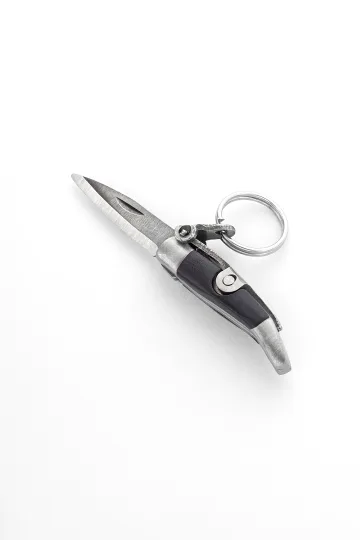
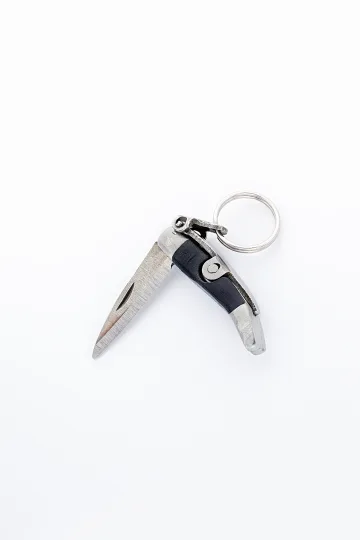
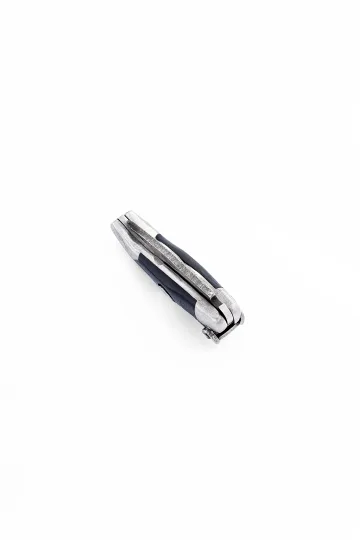
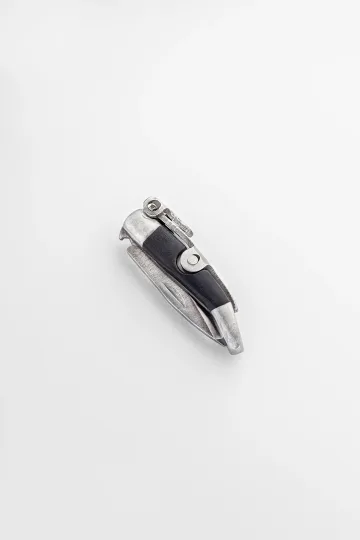
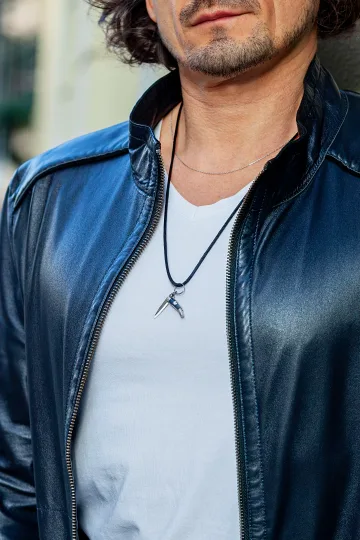
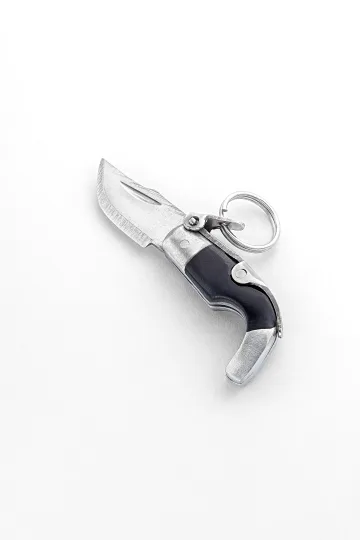
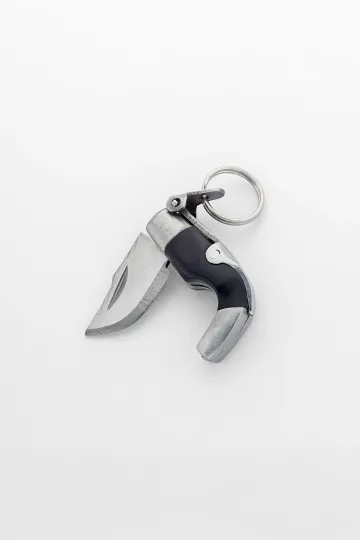
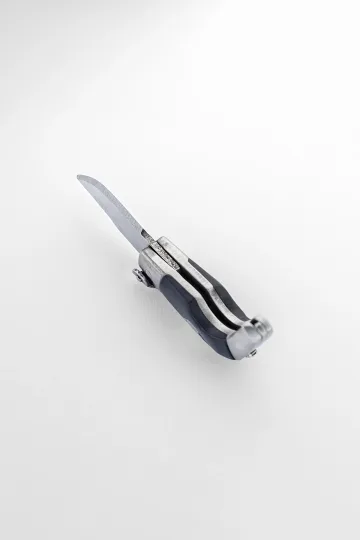
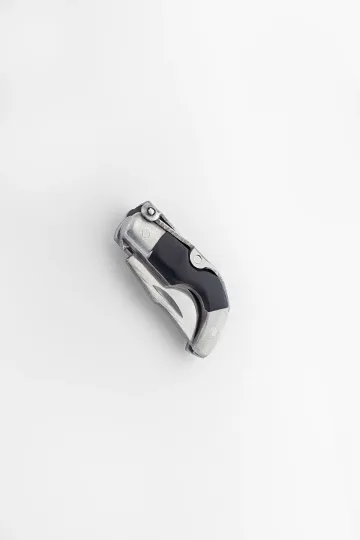
CAPAORA mini knife pendant
The 18th-century Spanish navaja in miniature: 40 mm of stainless steel, a real folding mechanism and a Palanquilla lock that clicks. An affordable gift to remember.
Authentic · Ships from Spain · 14-day returns
Myths About Hematite: Truth and Story
Myth 1: "Hematite can turn negative energy into positive energy."
Partly true. Hematite doesn't magically transform energy from bad to good. But it creates conditions where you can experience negativity without drowning. It's a tool for processing, not alchemy.
Myth 2: "Hematite must be charged under the full moon."
False. Hematite is already charged. Moon rituals work only through psychology, if you believe in them, you perform them better, and belief shapes behaviour.
Myth 3: "If hematite cracks, it saved you from disaster."
Myth. Hematite cracks because the material is brittle (hardness 5.5). You dropped it or temperature shocked it. Physics. You can assign meaning to it if you like, and this meaning might be useful, but the stone didn't actively protect you.
Myth 4: "Hematite only works if you believe."
Partly true. Belief creates habit. If you believe, you use the stone more, meditate more, get results. But there's also a physical level: cold surface, weight, sensation. These affect your nervous system regardless of belief.
Varieties, Coatings and Look-alikes
Mineralogists and carvers separate several forms of hematite that look distinctly unalike, and the shelves add a few forms that nature had no hand in.
Natural Forms
- Kidney ore. Smooth rounded botryoidal flows resembling a cluster of kidneys, with a strong metallic sheen. The classic of the Cumbrian mines.
- Specularite. Masses of small brilliant flakes that glitter like scattered sequins.
- Earthy hematite, red ochre. A loose dull mass, the main source of red pigment.
- Iron rose. An intergrowth of platy crystals in a rosette, a collector's rarity.
- Micaceous hematite. The fine-flaked variety, still used in protective paints for ironwork.
Rainbow Hematite and Other Coatings
"Rainbow" or "peacock" hematite shimmering in blue, violet, green and gold turns up constantly on sale. It is worth knowing that natural hematite does not look like that. The iridescence comes from an extremely thin coating of metal oxides, usually titanium, laid over the surface of a genuine stone. The bead itself is hematite; the whole rainbow is a film a micron thick, the same in kind as the temper colours on steel or the sheen of oil on a puddle.
That is not a fraud so long as the seller calls the stone treated. The coating gives a striking effect and plenty of people want exactly that. But it has a practical consequence: the film is thin and wears far sooner than the stone beneath it. Rainbow coatings rub away along facet edges, wherever a piece sits against skin, and under cosmetics and abrasives. So iridescent hematite asks for even gentler handling than the plain kind, and polishing pastes are entirely out of the question for it.
Telling them apart is easy. Natural hematite is a single tone of black or steel grey, and its brilliance is a metallic sheen rather than a coloured spectrum. If the stone throws every colour of the rainbow, you are looking at a coating. A restrained bluish or dove-grey cast on fine-flaked varieties can be natural, but it is subdued rather than spectacular. A useful rule of thumb: where a form carries a vivid marketing epithet, magnetic, rainbow, peacock, human intervention is behind it almost every time.
A Cheat Sheet for Similar Black Stones
When the streak test is out of reach, say because the stone is already in a closed setting, a set of indirect signs helps. Black onyx is appreciably lighter than hematite, warms in the hand faster and has no metallic cast, its lustre being glassy. Jet is astonishingly light, warm, and can smell scorched when rubbed against cloth. Obsidian is volcanic glass: light, with a sharp conchoidal break and a vitreous rather than metallic shine. Black spinel and black tourmaline are harder and give no red streak. Against all of them hematite gives itself away by its weight and by that mirror-metallic sheen, which nothing else quite matches. If there is any doubt and you can reach the stone, one stroke across unglazed tile decides it.
Cutting and Polish: Why Hematite Is Not Faceted Like a Gem
Hematite is opaque, so the classic faceted cut that plays light through a stone makes no sense for it: the light has nowhere to go. The whole effect is built on the surface, and that dictates the shapes it takes.
Cabochon. The commonest treatment: a smooth dome without facets. On a rounded polished surface the metallic sheen reads as a soft highlight that slides as the stone turns. This is how insets for rings, pendants and earrings are made.
Smooth beads and tumbling. For bracelets and strings hematite is worked into spheres, barrels and rondelles, or simply rolled in a barrel until rounded. A hematite bead is heavier than a glass one of the same size, which is normal and doubles as a clue when buying.
Surface faceting. Facets are sometimes cut on hematite after all, but they work differently from those on a transparent stone: each flat acts as a tiny mirror, and the piece glitters facet by facet instead of lighting up from within. On a black mirror-bright material the effect is handsome, though it demands a flawless polish, since on a metallic sheen every scratch and matte patch shows at once.
Carving and intaglio. The historic use, still alive: signets, monograms and small relief are cut into dense hematite, its middling hardness holding a fine line well.
When choosing, look first at the quality of the polish. The surface should behave like a mirror, with no dull swirls, pinpricks or orange peel. It is the evenness of that shine that separates good hematite from mediocre; colour and shape come second.
Send a friend a discount code, they save on their first order.
Selection, Care, and Cleansing
Choosing Quality Hematite
- Weight: real hematite is very dense. If it feels light, it's fake
- Polish: surface should be smooth and mirror-like. Matte surface = not genuine polished hematite
- Colour: deep black or grey-black. Unnaturally red = dyed glass fake
- Streak test: rub real hematite on white ceramic. It leaves a red-brown streak (iron oxide). Fake leaves nothing
- Price: real hematite is inexpensive. If someone charges like amethyst or opal, suspect fraud
Care
Daily:
- Wipe with soft cloth (cotton, flannel)
- Avoid water and soap (dulls the finish)
Weekly:
- Rinse under cool running water
- Dry with towel
- Rest on black cloth for 30 minutes
Monthly:
- Set on a window sill for a few hours (indirect sun)
- Or place on bare earth under stars for 3-4 hours
When dull:
- Find a jeweller with stone-polishing equipment
- Re-polishing: inexpensive next to the piece itself, takes 2-3 days
- The stone returns to its original depth
Energetic Cleansing
If you believe the stone accumulates "energy waste":
- Place in sea salt for 24 hours (or regular salt)
- Rinse under running water
- Set on earth under stars overnight
- Hold in your hands, visualise white light filling it
- Wear again
Remember: stones don't accumulate energy like batteries. This is a ritual of reassignment, you're renewing your intention, not cleaning something.
Urban Grounding: Using Hematite in the City
At the Office
Hematite ring on your ring finger. When pressure rises (boss, colleagues, deadlines), press the ring gently, feel its weight. Remind yourself: "I am earth. I am calm. I am here."
On Public Transport
Hematite bracelet visible. In the chaos of the bus or train, focus on the bracelet's cold surface. It's your anchor in chaos.
In Meetings or Presentations
Hematite signet on your hand on the table. Feel its weight. It reminds you: you have authority. You belong.
In Panic or Overwhelm
Hold hematite stone in your fist. Squeeze gently. Feel its density, its coldness. Breathe slowly. Physical contact with something real anchors you to your body and stops the spiral.
About Zevira: Masculine Energy in Jewellery
Zevira's men's collection is built on hematite's principle: density, black colour, silver gloss, the weight of presence.
Every piece, ring, bracelet, pendant, carries grounding force. It might be:
- Hematite or black onyx signet rings on silver
- Bracelets of hematite and black tourmaline on silk
- Pendants with iron symbols (axe, sword, anchor) in black metal
- Rings with hematite inlay or black enamel
The philosophy: jewellery doesn't decorate. It anchors. A man wearing Zevira doesn't seek approval. He seeks ground. Ground in himself, ground in Earth, clarity.
Buying it as a gift? Each one arrives ready to give.
 A branded Zevira box and a little card come with every order.





Conclusion: Hematite as a Path to Yourself
Hematite is Earth's textbook in stone form.
For 3,000 years, people knew one simple thing: if you're floating, if you're disconnected, if you're uncertain, take hematite. Hold it. And remember: you're not a cloud. You're stone. You're Earth. You're here.
This is not magic. It's physics. It's meditation. It's psychology. It's ritual. It's all of these together.
In the first days of wearing hematite, you might feel nothing. Normal. Your body is adjusting. Your unconscious is tuning. By week three, you notice: less anxiety, calmer speech, steadier presence. People feel this shift before you do. They see the anchor you've thrown into the ground.
Hematite works not because it believes in you. Hematite works because you start believing in yourself.
Sources and Further Reading
- Barbara Ann Brennan, "Hands of Light: A Guide to Healing Through the Human Energy Field"
- Doreen Virtue, "Crystal Therapy"
- Mineralogical Society of America: Hematite properties and geological occurrence
- Historical use of hematite in ancient Egypt: Metropolitan Museum of Art collection notes
- Modern scientific studies on grounding and electromagnetic contact with Earth
- Vedic chakra system: Root chakra (muladhara) characteristics and blockages