Nephrite: the stone tougher than steel, and why it refuses to break
Cracking a piece of nephrite takes more force than smashing a cast-iron block of the same size. In resisting a blow, nephrite outperforms steel: you cannot chip it cleanly, you have to grind it away, because inside the stone the fibres are matted together like felt rather than stacked in tidy layers. That is exactly why ancient craftsmen made axes and blade tips from nephrite, tools that took an impact against bone and wood without ever splitting.
Nephrite is only moderately hard, around 6 on the Mohs scale, and a steel knife will scratch it easily. But hardness and toughness are two different things. Glass is harder than nephrite, yet glass is brittle, while nephrite is almost impossible to break. That combination of a soft surface and phenomenal impact strength is what made the stone a favourite of carvers for thousands of years: you can work it in fine detail without fearing that the piece will snap in half.
Here we take nephrite apart on its own terms: what it is made of, how it forms, where it is mined, how it differs from jadeite (two separate minerals that both get called jade), how to tell a genuine stone from a dyed fake, and how to look after it. No mysticism, and no promises that the stone will "do" anything for you.
What nephrite is: composition, hardness, toughness
Nephrite is a dense variety of minerals from the amphibole group: a mixture of tremolite and actinolite. Chemically it is a silicate of calcium, magnesium and iron, with a complex formula along the lines of Ca2(Mg,Fe)5Si8O22(OH)2. The more magnesium it contains, the lighter the stone; the more iron, the greener and darker it becomes. Snow-white nephrite is almost pure tremolite, while a deep green stone is iron-rich.
The defining feature of nephrite lies not in its chemistry but in its structure. The mineral fibres do not lie parallel, nor do they form large crystals: they are woven into a dense, tangled felt of incredibly fine needles. To break the stone, a crack would have to thread its way through that felt, constantly changing direction, and that takes an enormous amount of energy. Hence nephrite's legendary toughness.
Wear the symbol, don't just read about it. These are in stock:







Chemistry and physics
The dry facts worth leaning on when you buy:
- Chemistry: the tremolite-actinolite amphibole series, a silicate of calcium and magnesium-iron. Iron sets the colour.
- Crystal system: monoclinic in the minerals themselves, but nephrite behaves like a dense, matted fibrous aggregate rather than a single crystal.
- Hardness: roughly 6 to 6.5 on the Mohs scale, a touch softer than quartz, scratched by steel and sand.
- Toughness: one of the highest of any natural stone; in resistance to breaking, nephrite beats steel.
- Density: around 2.9 to 3.1 g/cm3, almost three times heavier than water, so nephrite feels noticeably weighty in the hand.
- Refractive index: roughly 1.60 to 1.63. Nephrite shows no dispersion (the play of coloured flashes you get in a diamond).
- Lustre: oily and greasy on a polished surface, as though the stone were faintly damp. This is a signature trait of nephrite.
- Transparency: from opaque to translucent; the finest grades let light pass through the edge of a thin slice.
Nephrite's colour rests mostly on iron. The green range, from pale grassy tones to almost black, is the result of varying iron content in the actinolite component. White, cream and yellowish shades come from nearly pure tremolite with little iron. Brown and rust-coloured crusts on the surface are iron oxidising in air and soil, the "tan" of a pebble that has lain in a river.
To the touch, polished nephrite is cool, smooth and distinctly heavy. A hardness of 6 to 6.5 is plenty for rings, pendants, beads and carved figures, but the surface can be scratched by hard sand or a steel blade, so the polish should be kept away from anything abrasive. Chipping or splitting, on the other hand, is almost no threat: here nephrite is more dependable than many harder but brittle stones.
The oily lustre as a tell
Pick up a polished nephrite and turn it under the light, and the surface will not flash sharply like glass. Instead it gives off a soft, slightly greasy glow, as if the stone had been oiled. That waxy, oily lustre is a direct consequence of the matted fibrous structure: light scatters off countless tiny needles rather than reflecting off a smooth plane. Experienced carvers recognise nephrite by exactly this sense of "warm grease" within a cold stone.
An honest word about symbolism
Nephrite is credited with qualities of character: calm, balance, protection, longevity. That is part of the culture of stones and a centuries-old tradition, especially a Chinese one, and not a property of the mineral. There is no proven effect on health or mind. More on the symbolism further down, in its own short section, without making a fuss of it.
Geology: how a tough stone is born
Nephrite forms where different rocks meet and grind against one another. It is a stone of contact and pressure, and its tough, felted structure is a direct result of the conditions in which it grew.
Metamorphism: a stone from the friction zone
Most nephrite is born in so-called serpentinites, altered rocks of the ocean floor squeezed up towards the surface when tectonic plates collide. When fluids rich in calcium and silica seep through such rocks, amphibole fibres of tremolite and actinolite begin to grow along the boundary zones. Constant pressure and movement crush these fibres, stopping them from growing into large crystals and weaving them into a dense, tangled mass.
What happens to the rock, step by step:
- Oceanic crust rocks (the future serpentinites) are pushed up towards the surface as plates collide.
- Fluids carrying calcium, magnesium and silica filter through them.
- The finest needles of tremolite and actinolite start to grow along the contacts.
- Pressure and movement keep the needles from growing large, matting them into felt.
- Iron in the fluid sets the colour: more iron, greener stone.
- The finished mass reaches the surface, and rivers wash pebbles and boulders out of it.
The result is a dense, heavy, almost indestructible stone. That is precisely why, historically, nephrite was often gathered from riverbeds rather than mined: the water washed the tough boulders out of the soft surrounding rock and rolled them into smooth pebbles with a brown crust.
China and Central Asia: the classic sources
The historical benchmark is the white and pale green nephrite from the river district of Hotan (in present-day Xinjiang, in western China). For millennia nephrite was collected here straight from the rivers as rounded pebbles; the finest white grade was nicknamed "mutton fat" for its milky, greasy look. Green nephrite came from other parts of Central Asia too. These sources fed Chinese carving throughout its history.
Canada, New Zealand and others
Large deposits of green nephrite are found in Canada (British Columbia), where it comes out in sizeable blocks among other forms, and across Siberia and Central Asia, today one of the major world sources of jewellery and ornamental nephrite. New Zealand holds a special place: dark green New Zealand nephrite, pounamu, was a sacred stone of the Maori for centuries. Nephrite is also found in the United States (Wyoming, Alaska), Australia and a number of other countries.
Unlike rare gem-quality jadeite, ordinary green nephrite is fairly widespread and therefore relatively affordable, apart from the most prized grades such as white "mutton fat". A similar logic applies to jadeite, the "emperor's stone" valued above gold: the rarity of the source sets the price directly.
From boulder to jewellery
- Gathering. Nephrite boulders and pebbles are taken from rivers or mined from bedrock in blocks.
- Sorting. The raw material is sorted by colour, clarity, translucency and the presence of cracks.
- Sawing. Because of its toughness, nephrite is not split but sawn with diamond tools; this is slow.
- Grinding and carving. The stone is ground with abrasive; fine carving is possible precisely because of the toughness.
- Polishing. The surface is brought up to the oily lustre that is so prized in nephrite.
- Matching and setting. Beads are calibrated, cabochons are set in metal, large blocks go into carved pieces.
Because of its toughness, working nephrite is laborious: you cannot split it along a chosen line, everything is done by slow grinding. In that sense nephrite is a stone of patience, both for nature and for the craftsman.
Customer reviews
Zevira is a real jewellery shop. Genuine payments, deliveries and customer thank-yous.
🥰🥰🥰 gracias
Ok, ¡gracias! 🙂
Green nephrite belongs on silver against a bare collarbone, never buried under a roll-neck. Cloudy stones go on the keyring, no arguments.
What to wear nephrite with
I have run green nephrite through dozens of looks, from an office roll-neck to an evening dress. Here is what actually works, sorted by occasion and by the shade of the stone.
Which nephrite should I reach for every day? For everyday wear I recommend a calm green cabochon in silver: a smooth bracelet or a pendant on a medium chain. It settles onto a plain base (a white shirt, grey marl, dark denim) and never argues with your clothes. Cool silver flatters the green better than gold, so for daily wear that is what I choose.
Does nephrite work at the office? It does, as long as you keep it restrained. I suggest a small cabochon in a ring or earrings, again in silver. The stone reads well at the neckline of a roll-neck or under a shirt collar; I keep the length short so the pendant does not disappear under the buttons. Dark green nephrite looks serious and expensive on its own, so I add nothing to it.
How do I build an evening look? For the evening I recommend a large carved pendant or a strand of beads over a simply cut dress in a deep colour: wine, emerald, black. The stone becomes the main accent, so I take the rest of the jewellery off. The larger the carving, the longer the chain and the simpler the fabric around it should be.
Which shade suits warm skin? For a warm undertone I suggest white and honey nephrite in warm gold: the creamy glow of the stone and the yellow metal speak the same language. A pale stone like this is especially good on dark clothing, where its warm shine stands out.
Who does nephrite actually suit? Anyone who likes quiet stones with a history rather than loud sparkle. Two rules that never fail. First: a cool undertone takes silver and green, a warm undertone takes gold and a pale stone. Second: nephrite likes a clean background, so in a stack of bracelets give it quieter neighbours, smooth silver and a matte companion stone.

Turn on your camera, pick earrings, a pendant or a ring, and see the piece on yourself in real time.
Switch items in one tap.
Everything runs in your browser: no photo or video is ever uploaded.
History: the stone carved for eight thousand years
Nephrite has one of the longest unbroken histories of any stone. It was worked before the first metal was ever smelted, and it is still carved today.
The Stone Age: tools tougher than metal
Before metals appeared, the toughness of nephrite made it an ideal material for tools. People hewed axes, adzes, blade tips and knives from it: such an edge did not flake on impact the way flint did, and it held its sharpness. Nephrite tools are found at sites across Eurasia and in New Zealand. This is a rare case of a stone prized first for sheer practicality and only later for its beauty.
Ancient China: the stone of virtue
It was in China that nephrite outgrew the role of a simple material. It was tied to the ideas of nobility and dignity: the Chinese word "yu", used for nephrite, was for centuries a synonym for everything precious and perfect. Nephrite was made into ritual objects, seals, jewellery and pendants worn as a mark of status and moral purity. The oily lustre, the coolness of the stone and its indestructibility read as an image of a steady, calm character.
It matters that in the classical era Chinese craftsmen worked with nephrite, not jadeite. The vivid green jadeite (the famous "imperial jade") came to China from Burma much later, and only then pushed nephrite aside as the most prestigious green stone. There is a separate section below on the differences between these two minerals and why they were confused for so long. For the symbolism of jade as a stone of balance, see our piece on jade, the stone of balance and healing.
The Maori and pounamu
On the other side of the world, in New Zealand, dark green nephrite, pounamu, was a sacred stone of the Maori people. They made tools, weapons (including the distinctive flat clubs) and pendants from it, objects passed down through generations and believed to carry mana, the ancestral force and prestige of their owner. Pounamu was gathered from strictly defined places on the South Island, and the right to these sources was an important part of tribal life. Carved Maori nephrite pendants remain a recognisable cultural symbol today.
Pre-Columbian Mesoamerica
In Central America, green stone was also prized extremely highly, often above gold, but there it was mainly jadeite rather than nephrite that was used. This is an important detail: the "sacred green stone" of different cultures is not always the same mineral.
A rough timeline
- The Stone Age: nephrite is hewn into axes and tools across Eurasia and in New Zealand.
- Ancient China: nephrite ("yu") becomes the stone of virtue, status and ritual.
- Centuries of Maori tradition: pounamu, the sacred nephrite of New Zealand, carrier of ancestral force.
- Later eras: Burmese jadeite arrives in China and displaces nephrite as the most prestigious green stone.
- The modern age: deposits are opened and worked in Siberia, Canada and New Zealand; nephrite remains a material for carving and jewellery.
Upload a photo of your pet, someone you love, or an object. We'll build a 3D model and hand-cast it in pewter.



Types and shades of nephrite
No two nephrites are alike, but by colour and character a few recognisable types stand out.
Green nephrite
The best-known and most widespread type, from pale grassy green to deep, almost black. Iron gives the colour: the more there is, the darker and richer the stone. An even, calm green with an oily lustre is the classic "nephrite" colour that most people picture when they hear the word. Dark green New Zealand pounamu and Siberian green nephrite both belong here.
White nephrite and "mutton fat"
Nearly pure tremolite with little iron gives white, cream and slightly yellowish tones. The most prized grade is a milky-white stone with a faint translucency and a warm, greasy lustre, historically nicknamed "mutton fat". This is one of the few kinds of nephrite valued on a par with expensive stones, especially fine old material from Hotan.
Yellow, brown and "pumpkin"
Yellowish, honeyed and rusty-brown tones arise from the oxidation of iron. Often the brown colour is only a crust on the surface of a river pebble, beneath which a pale or green stone is hidden. Carvers sometimes deliberately leave this crust, playing on it in the composition of a piece.
Black nephrite
A very dark, almost black nephrite, rich in iron. Held up to the light along the edge of a thin slice, it often turns out to be dark green rather than coal-black. It is prized for its severe, graphic look; it works well in men's jewellery and large carvings.
What matters more than colour: clarity and lustre
The value of nephrite is set by colour, evenness of tone, clarity (the absence of cracks and cloudy patches), translucency and the quality of the oily lustre. A uniform stone with a warm, greasy glow is worth more than a mottled, cloudy one, even if the latter is brighter in colour. When choosing, always look at the stone against the light and under diffused light.
The nephrite palette in roughly descending order of usual value:
- White "mutton fat", the most expensive, especially historic Hotan material.
- Even, saturated green with a good lustre.
- Dark green and black, severe and graphic.
- Yellow and honey, warm and calm.
- Brown and mottled "crusty" material, more often used for carving.
What to ask the seller:
- The origin: Canada, New Zealand, Hotan or Central Asia.
- Whether the colour is natural or the stone is dyed and impregnated.
- Whether the tone is uniform, with no cloudy patches or cracks.
- Whether the stone is translucent at the edge of a thin slice.
- Whether it is the right mineral: nephrite, not jadeite or serpentine.



Nephrite and jadeite: two different stones under one name
This is the main source of confusion. The word "jade" has historically lumped together two completely different minerals: nephrite and jadeite. They look alike and both come in green, but they differ in chemistry, structure, hardness and price.
The real difference
- Mineral. Nephrite is an amphibole (tremolite-actinolite). Jadeite is a pyroxene (a silicate of sodium and aluminium). These are different mineral groups.
- Hardness. Nephrite is around 6 to 6.5 on Mohs, jadeite is a little harder, around 6.5 to 7.
- Toughness. Both are exceptionally tough, but nephrite, thanks to its matted fibrous structure, is reckoned the champion at resisting breakage.
- Lustre. Nephrite's is oily and greasy; polished jadeite is often glassier and more sparkling.
- Colour. Jadeite offers a wider, brighter palette, including the famous emerald-green "imperial" and lavender. Nephrite is usually calmer and more muted.
- Price. Top-grade gem jadeite is one of the most expensive gemstones in the world; ordinary green nephrite is far more affordable.
Why they were confused for centuries
Until the 19th century, mineralogists did not distinguish these stones, calling both "jade". Only in the 19th century did it emerge that two different minerals hid under one trade name, and the names "nephrite" and "jadeite" were introduced. The word "nephrite" itself goes back to an old belief in a stone that helped with kidney ailments (the same belief gave the Spanish name "piedra de ijada", stone of the flank, from which the English "jade" derives). The belief has no scientific basis whatsoever, but the name stuck.
For the buyer, the takeaway is simple: "jade" in a description is not a diagnosis. Ask whether you are looking at nephrite or jadeite, because the gap in price and properties is enormous. A detailed look at the costlier cousin is in our article on jadeite, the emperor's stone.
How to tell nephrite from similar stones and fakes
Nephrite is faked and imitated often: with cheaper stones, with dyed material and with glass. Let us go through the differences.
The main signs of authenticity
- Weight. Nephrite is dense and heavy (density around 3 g/cm3); a glass or plastic fake is noticeably lighter, and plastic is also warmer to the touch.
- Lustre. The oily, greasy glow of a polished surface is a signature of nephrite. A sharp glassy shine, or by contrast a dead matte look, should put you on guard.
- Coolness and sound. The stone is cool and warms slowly; tapped lightly, nephrite beads give a clear, slightly ringing sound, not a dull plastic knock.
- Toughness. Genuine nephrite is almost impossible to chip; a piece should not show the conchoidal chips typical of glass.
Nephrite and its lookalikes
- Jadeite: glassier lustre, often brighter and "juicier" in colour, a little harder. Hard for a beginner to tell apart by eye, see the section above.
- Serpentine ("new jade", "Korean jade"): softer (hardness around 2.5 to 4), easily scratched, often with a more soapy surface. A cheap substitute for nephrite.
- Aventurine and green quartz: have a different, grainier or more sparkling structure and a different lustre.
- Dyed marble and calcite: noticeably softer, scratched by a fingernail or coin, with a colour that is often unnaturally even.
- Glass: air bubbles inside, conchoidal chips at the edge, warmth to the touch, sometimes a moulding seam.
Signs of treatment and faking
The serious question for nephrite (as for jadeite) is "is the mineral natural" and separately "is the colour natural". Common are:
- Dyed nephrite: the colour is added with a dye, often too even and bright, concentrating in the cracks; it can fade over time.
- Polymer-impregnated: cracks and porosity are masked with resin to improve the look; such a stone is less durable.
- "Serpentine as nephrite": a cheaper, softer mineral passed off as nephrite.
What to look for: an unnaturally even, "chemically" bright colour; pooling of dye in cracks; a suspiciously low price for a "white" or vivid stone; softness (if the surface scratches too easily with a steel knife, it is most likely serpentine or marble, not nephrite).
Documents and price as a signal
For an expensive stone (especially white "mutton fat" or anything sold as jadeite) it makes sense to ask for a gemmological laboratory report: only an instrument can reliably tell nephrite from jadeite and detect dyeing. For a bead bracelet of ordinary green nephrite this is overkill; it is enough to check the weight, lustre and hardness and to buy from a reputable seller.
Buyer's checklist
- The stone is heavy and cool, warming slowly.
- The lustre is oily and greasy, not glassy and not dead matte.
- The surface does not scratch with a fingernail or coin (otherwise it is a soft imitation).
- The colour is naturally uneven, without dye pooling in the cracks.
- There are no air bubbles or moulding seams (signs of glass).
- For an expensive purchase there is a lab report: nephrite, not jadeite or serpentine.
Leave your email, we'll send your discount code. No spam, unsubscribe anytime.
The code arrives by email, valid on your first order.
Care and storage
Nephrite is one of the most carefree stones to wear, thanks to its toughness: breaking it is practically impossible. Its weak point is different, the moderate hardness of the surface (6 to 6.5), which can be scratched by abrasives.
What to do and what to avoid
You can:
- Wipe it with a soft, dry or slightly damp cloth.
- Wash it in warm water with a mild soap and dry it at once.
- Store it in a separate soft pouch or a fabric-lined compartment of a box.
You should not:
- Clean it with abrasives, baking soda, salt or stiff brushes: they scratch the polish.
- Use harsh household chemicals, acids or chlorine.
- Subject dyed or impregnated nephrite to ultrasound, steam or strong heat: this can damage the treatment (a natural stone takes them better, but caution does no harm).
- Store it loose alongside hard stones (diamond, corundum, topaz, quartz), which will scratch the nephrite.
- Leave it for long under blazing sun, especially dyed examples: the colour of imitations can fade.
Take nephrite off before cleaning with chemicals, working with sand and abrasives. Apply perfume and cosmetics before you put the piece on.
How hardness and toughness affect wearability
Nephrite can be worn every single day: its toughness makes it resistant to the knocks that harder but brittle stones fear. A ring with nephrite will survive active wear better than a ring with a stone of the same hardness but brittle. The only sensible caution is to protect the polish from sand and a steel blade, so that fine scratches do not dull the surface over time.
If the polish goes dull
Friction against fabric and skin can slightly wear the oily lustre. Do not polish the stone at home with abrasive pastes: it is easy to ruin the geometry of the piece. Take the item to a lapidary: a re-polish takes little time and restores nephrite's signature greasy glow. The procedure is rare, usually once every few years with active wear.
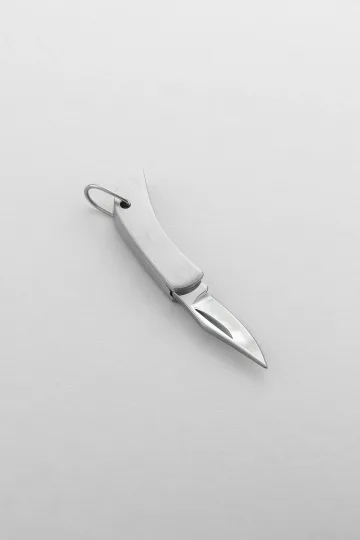
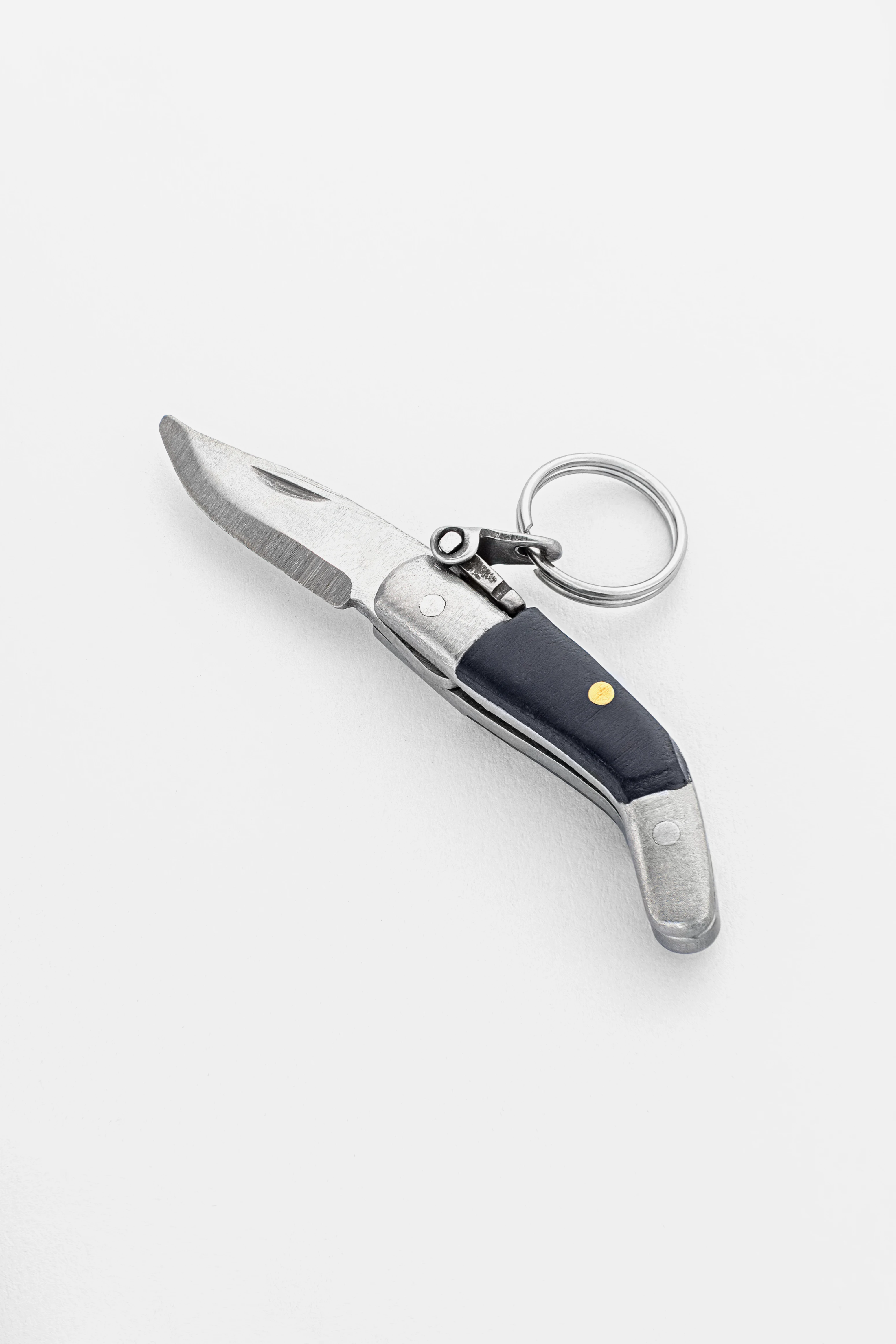
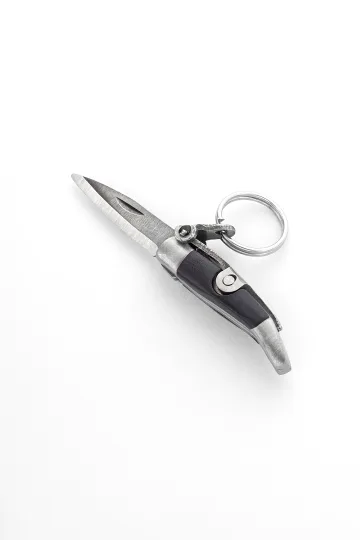
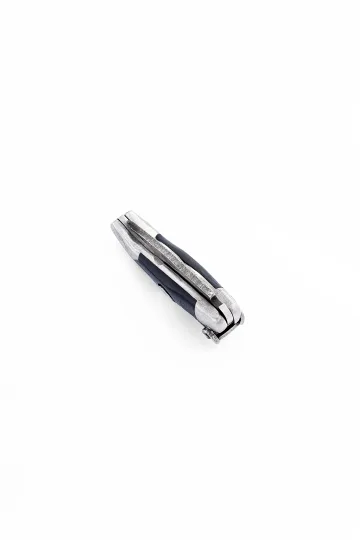
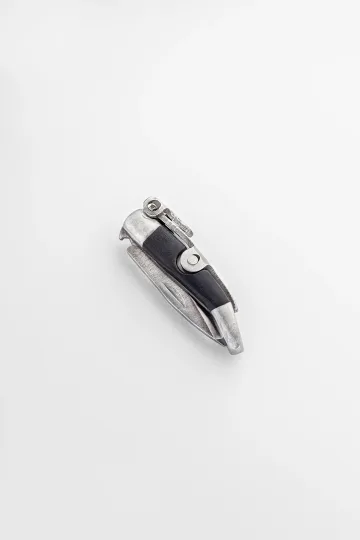
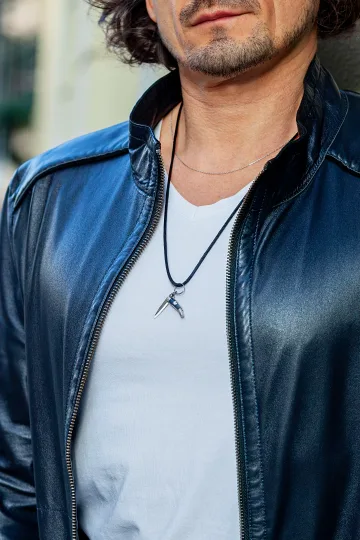
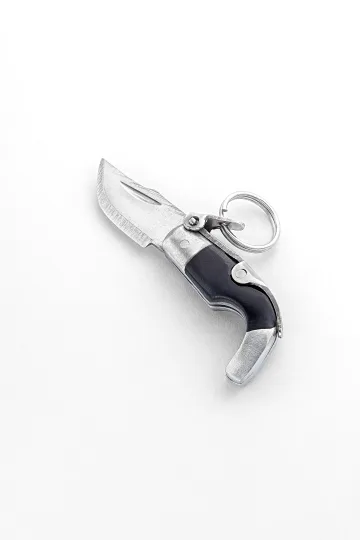
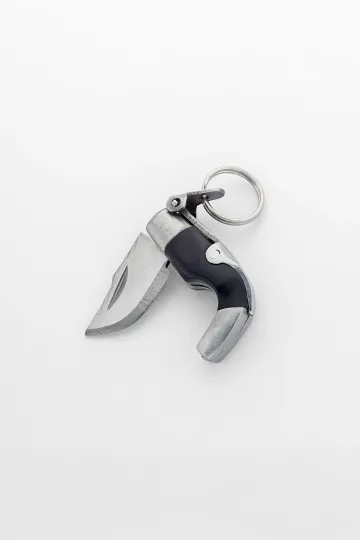
CAPAORA mini knife pendant
The 18th-century Spanish navaja in miniature: 40 mm of stainless steel, a real folding mechanism and a Palanquilla lock that clicks. An affordable gift to remember.
Authentic · Ships from Spain · 14-day returns
Symbolism: what tradition says
Everything below is cultural symbolism and centuries-old tradition, not a medical or physical fact. The mineral has no proven effect. We describe what people believe, not what will "happen".
In tradition, above all the Chinese one, nephrite is credited with a few persistent themes, and all of them lean on the physical properties of the stone:
- Balance and calm. The coolness, even colour and soft lustre read as an image of a steady, balanced character. Tradition links the same theme of harmony to jade as the stone of balance.
- Protection and strength. The indestructibility of the stone made it a symbol of resilience and a talisman; nephrite pendants were worn as protective tokens for centuries.
- Longevity and continuity. Nephrite pieces outlive their owners and pass down through families, so the stone is linked to the continuity of the line and a long life.
- Nobility. In classical Chinese culture, nephrite was an image of moral purity and dignity.
The stone "does" nothing on its own. If it supports a person at all, it does so as any meaningful keepsake does, through attention and habit, not through some mystical radiation. There is nothing shameful in that, but nothing to exaggerate either.
Jewellery with nephrite: rings, pendants, beads, carving
Thanks to its toughness, nephrite allows what brittle stones will not bear: fine openwork carving, long strands of beads, rings with a solid stone band. Let us go through it by type.
Rings and cabochons
Nephrite sits well in a ring precisely because of its toughness: it is hard to chip against a hard surface. A smooth cabochon is used, a domed form without facets that best reveals the oily lustre. Cool 925 silver underlines the calm green, while warm gold suits the yellow and white grades. There are also solid-stone rings, turned from a single piece of nephrite, a classic Chinese format.
Pendants and carved drops
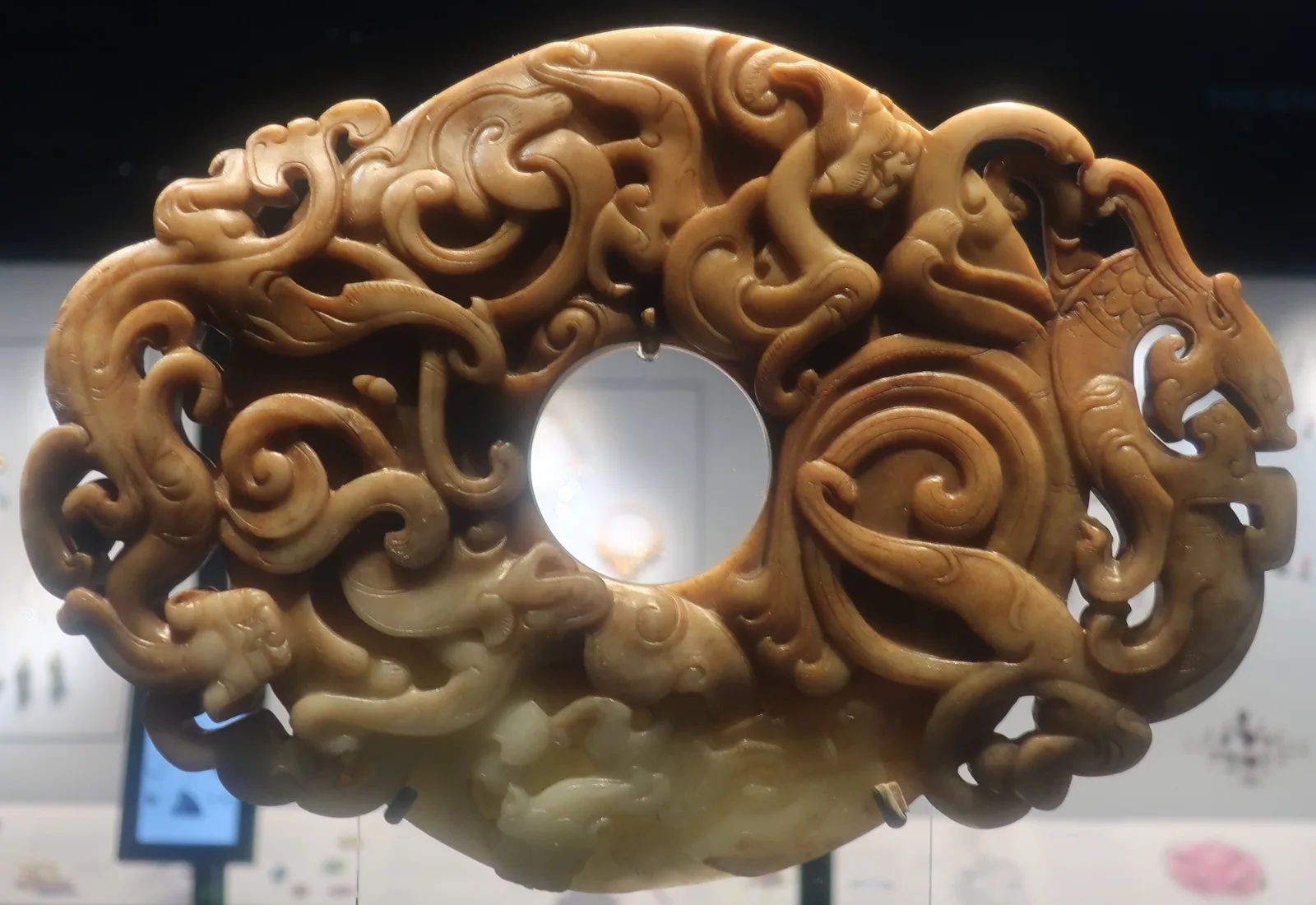
A pendant is the format for a beautiful piece of stone and for carving. Carvers cut discs with a hole, figures, symbols and natural motifs from nephrite; the toughness allows fine, lacy elements without fear of cracks. They are worn on a chain or a cord. A carved nephrite pendant is one of the most recognisable images of the stone, from the Chinese tradition to New Zealand pounamu.
Beads and bracelets
Long strings of nephrite beads and smooth solid-stone bracelets are a classic. Calibrated spheres show off evenness of colour and lustre, and the toughness of the stone makes the beads sturdy in daily wear. A solid bangle, turned from a single piece, is especially prized: it shows both the quality of the material and the skill of the carver.
Men's jewellery and large carving
Dark green and black nephrite goes into severe men's pieces: signet rings, cufflinks, heavy pendants. Large carving (figures, handles, interior objects) is a separate great tradition, where both the material and the complexity of the work are prized.
Matching the metal to the stone
- Calm green: 925 silver, white gold. Cool metal sets off the green.
- Dark green and black: silver, blackened metal, steel. A severe pairing.
- White "mutton fat": both silver and warm gold; the warm metal underlines the creamy tone.
- Yellow and honey: yellow and rose gold, brass. Warmth to warmth.
Steel and titanium suit those allergic to silver. For nephrite, protecting the stone within the setting matters less than it does for brittle gems: the setting's main job is to hold the stone and bring out its colour.
Send a friend a discount code, they save on their first order.
Frequently asked questions
What is nephrite in simple terms?
It is a dense ornamental and jewellery stone from the amphibole group, a mixture of the minerals tremolite and actinolite. Its defining feature is phenomenal toughness: inside the stone, the finest fibres are woven into felt, so nephrite is almost impossible to break and outperforms steel at resisting a blow. The colour is most often green (from pale to almost black), but it can be white, cream, yellow and brown. You recognise nephrite by its weight, its coolness and the characteristic oily, greasy lustre of a polished surface.
How does nephrite differ from jadeite?
They are two different minerals that were both historically called "jade". Nephrite is an amphibole (tremolite-actinolite), jadeite is a pyroxene (a silicate of sodium and aluminium). Jadeite is a little harder (6.5 to 7 against 6 to 6.5 for nephrite), gives a brighter and wider palette, including the costly "imperial" emerald green, and usually costs considerably more. Nephrite's lustre is oily, jadeite's is more often glassy. Both are exceptionally tough, but nephrite is reckoned the champion at resisting breakage. You can tell them apart reliably only in a laboratory.
Why is nephrite so strong if it is not very hard?
Because hardness and toughness are different things. Hardness is resistance to scratching (nephrite's is moderate, around 6 to 6.5, and steel scratches it). Toughness is resistance to breaking, and here nephrite's is one of the highest of any stone. The reason lies in the structure: the mineral fibres are woven into a dense, tangled felt, and a crack would have to thread through it, constantly changing direction. That takes an enormous effort, so nephrite does not chip, it grinds away.
Where is nephrite mined?
There are many sources. The historical benchmark is the Hotan region in western China, from which white and green nephrite came for centuries. Large modern deposits of green nephrite are found across Siberia and Central Asia and in Canada (British Columbia). New Zealand holds a special place with its dark green pounamu, the sacred stone of the Maori. Nephrite is also found in the United States (Wyoming, Alaska), Australia and other countries. On the whole nephrite is more widespread than gem jadeite, and so more affordable.
Which nephrite is the most expensive?
The most prized is white milky nephrite with a faint translucency and a warm, greasy lustre, historically nicknamed "mutton fat", especially fine old material from Hotan. Among the green grades, uniform stones of a rich but not cloudy colour with a good lustre are valued higher. Value is set by several things at once: colour, clarity (the absence of cracks and cloudy patches), translucency and the quality of the polish. A mottled, cloudy or dyed stone is always cheaper than an even, natural one.
Can you wear nephrite every day?
Yes, and it is one of the stones best suited to daily wear. Thanks to its toughness it is almost impossible to break, so it survives the knocks that harder but brittle gems fear. The only sensible caution is to protect the polish from abrasives: sand and a steel blade can scratch the surface (the hardness is moderate). Take the piece off before working with sand and cleaning with chemicals, and nephrite will serve for decades, even for generations.
Can nephrite get wet?
Yes. Natural nephrite takes water calmly: you can wash it in warm water with a mild soap and dry it off. Long soaking is no problem for a natural stone either. Caution is needed with dyed and polymer-impregnated examples: hot water, steam and chemicals can damage the treatment. Salt and abrasive cleaners are best avoided in any case: salt scratches the polish. After a swim or a shower it is sensible to wipe the piece dry.
Are nephrite and jade the same thing?
Yes and no. "Jade" is an old collective trade name that lumps together two different minerals: nephrite and jadeite. So nephrite is one kind of what is called jade, but not the only one: jadeite is also "jade". That is why the word "jade" in a description tells you nothing definite about composition and price. Always ask whether you are looking at nephrite or jadeite. For more on the symbolism of jade as a stone of balance, read our separate article.
Is there such a thing as white nephrite?
Yes, and it is one of the most prized kinds. White, cream and slightly yellowish nephrite forms when iron content is low (nearly pure tremolite). The finest grade is a milky-white stone with a faint translucency and a warm, greasy lustre, historically known as "mutton fat". Quality white nephrite, especially old Hotan material, is valued on a par with expensive stones. There is also yellow, brown and almost black nephrite: the colour is set by the amount and degree of oxidation of iron.
How can you tell genuine nephrite from a fake?
Check the weight, lustre and hardness. Nephrite is heavy and cool, warming slowly; glass and plastic are lighter and warmer. Nephrite's lustre is oily and greasy, not sharply glassy and not dead matte. The surface does not scratch with a fingernail or coin; if it scratches easily, you are looking at a soft imitation (serpentine, marble). Glass can have air bubbles and conchoidal chips. An unnaturally even, bright colour and dye in the cracks should put you on guard. The precise confirmation of an expensive purchase is best left to a gemmologist.
What is pounamu?
Pounamu is New Zealand nephrite, a dark green stone sacred to the Maori people for centuries. They made tools, weapons and pendants from it, objects passed down through generations and believed to carry the ancestral force and prestige of their owner. Pounamu was gathered from strictly defined places on the South Island, and the right to these sources was an important part of tribal life. Carved Maori nephrite pendants remain a recognisable cultural symbol of New Zealand today.
Is nephrite a precious or semi-precious stone?
By the old classification, nephrite is counted among the jewellery and ornamental stones. It is not a "precious" stone in the classic sense (like diamond, corundum, emerald), since ordinary green nephrite is fairly widespread. But the classification is arbitrary: value is set not by a label but by the rarity, beauty and quality of a particular specimen. Top-grade white "mutton fat" costs more than many formally "precious" small stones of low quality.
Where does the word "nephrite" come from?
From an old belief that the stone helped with kidney ailments. The Greek "nephros" means "kidney"; the same is reflected in the Spanish name for the stone, "piedra de ijada" (stone of the flank), from which the English "jade" derives. The belief has no medical basis, but the name stuck and was fixed to the mineral in the 19th century, when nephrite and jadeite were finally told apart as two different stones.
Can nephrite be carved?
It can, but it is hard work. Because of its toughness, nephrite cannot be split along a chosen line the way many other stones can: it is slowly sawn and ground with diamond tools. Yet that same toughness allows fine openwork carving and lacy elements without any fear that the piece will crack. It is precisely the combination of workability and strength that made nephrite a favourite material of carvers for thousands of years, from the Stone Age to our own day.
Does nephrite fade in the sun?
Natural nephrite, whose colour comes from iron within the structure, is stable and does not fade. Dyed imitations, on the other hand, can lose or change colour under direct rays; this is an indirect way to suspect a fake. The sun does no harm to the colour of a natural stone, but dyed and polymer-impregnated examples are best kept out of bright light and heat for long stretches, so as not to damage the treatment.
Which metal should you choose for nephrite?
It depends on the colour. 925 silver is the universal choice, its cool shine setting off the calm green. Warm gold (yellow or rose) suits white "mutton fat" and the yellow, honeyed grades, underlining the warmth of the stone. Dark green and black nephrite looks good with blackened metal and steel, especially in men's pieces. Steel and titanium suit those allergic to silver.
Quick takeaways
- Nephrite is a tough variety of amphiboles (tremolite-actinolite); hardness 6 to 6.5 on Mohs, density around 2.9 to 3.1 g/cm3, an oily lustre.
- The key property is phenomenal toughness: in resistance to a blow, nephrite outperforms steel, it is not chipped but ground away.
- Iron sets the colour: from white "mutton fat" through the whole green range to almost black.
- Nephrite and jadeite are two different minerals that were both historically called "jade"; you can tell them apart reliably only in a laboratory.
- Deposits: Hotan (China), Siberia and Central Asia, Canada, New Zealand (pounamu) and others.
- Fakes are serpentine, marble, glass and dyed material; they give themselves away by softness, lightness, an even "chemical" colour and dye in the cracks.
- The symbolism (balance, protection, longevity, nobility) is a centuries-old cultural tradition, not a proven fact.
- Protect the polish from abrasives and a steel blade; otherwise nephrite is almost indestructible and serves for generations.
Buying it as a gift? Each one arrives ready to give.
 A branded Zevira box and a little card come with every order.





About Zevira
At Zevira we love stones with character, and nephrite is exactly that: calm, heavy, with a warm oily glow you will not mistake for anything else. We choose the material by the purity of its colour, the evenness of its tone and the quality of its lustre, and we set nephrite to bring out its natural green: in 925 silver for the cool tones, in warm metal for the white and honeyed grades. And we honestly tell nephrite from jadeite: these are two different stones, and we always say which one is in front of you.
We talk about stones honestly: where there is history and where there is a pretty legend, where there is fact and where there is tradition. Nephrite is not obliged to "do" anything for you, but if you want to wear a stone with a thousand-year biography, strong enough to outlive its owner, it is hard to imagine anything more dependable.
Find your nephrite
Rings, pendants, beads and carved drops in natural nephrite, green and white. A calm oily lustre and a thousand-year tradition. We will match a piece to your shade and your occasion.
See nephrite jewelleryWant to go deeper into the world of green and "imperial" stones? Read our pieces on jadeite, the emperor's stone and on jade as a stone of balance and healing. And if you are curious about how stones end up in jewellery at all, and why some are prized and others not, take a look at the history of the jeweller's craft.