Obsidian in Jewellery: Volcanic Glass with a Razor Edge
Obsidian is sharper than surgical steel. That is not a figure of speech. The edge of a freshly knapped flake tapers down to a few atoms across, and in the 1970s surgeons started cutting scalpels from it for the most delicate operations. The blade a Stone Age hunter used to skin his kill and the lancet in a modern eye surgeon's hand work the same way. Both are volcanic glass, and glass fractures in a very particular fashion.
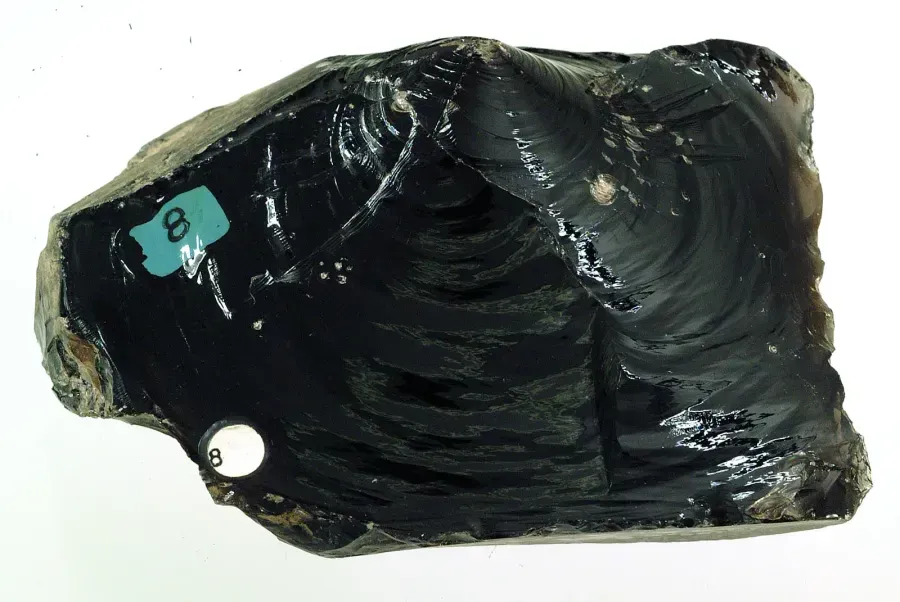
Obsidian is not a stone in the ordinary sense, and not a mineral either. It is lava that cooled before it could turn into crystals. Because of that it has no internal lattice, no cleavage along faces, no proper crystal shape. What it does have is a glassy lustre, a conchoidal fracture, and that famous razor edge along a break.
From here the practical questions: what obsidian is made of, how and where it forms, who used it and how for thousands of years, what varieties exist, how to tell the real thing from a lump of glass, and how to look after it so it never cracks.
What Obsidian Is: Composition and Physics
Volcanic Glass, Not a Mineral
A mineral, by definition, has an ordered crystal lattice. Obsidian has none. It is an amorphous natural glass that forms when viscous, silica-rich lava sets too fast for its atoms to line up into crystals. That is why mineralogists call it not a mineral but a mineraloid, a natural solid with no crystalline structure.
The make-up is essentially that of glass. The base is silica, SiO2, which usually accounts for 65 to 80 per cent of obsidian. Chemically that is the same stuff as quartz and window glass; the difference lies only in the arrangement. The rest is iron oxides (responsible for the black colour and a faint magnetism), plus oxides of magnesium, aluminium, sodium, potassium, calcium, and a small amount of water. The composition matches rhyolite, so obsidian is, loosely put, rhyolite that froze as glass rather than setting as rock.
Wear the symbol, don't just read about it. These are in stock:




The key physical properties:
- Mohs hardness: 5 to 5.5. For comparison, quartz is 7, feldspar 6, a steel knife about 5.5. So obsidian is softer than quartz and is easily scratched by sand (which contains quartz).
- Density: 2.3 to 2.6 g/cm3. The stone is noticeably heavier than plastic of the same size.
- Structure: amorphous, with no crystal lattice and no cleavage.
- Fracture: conchoidal, the breaks come out smooth, curved, with concentric ripples, like a smashed bottle. That is exactly how glass shatters.
- Lustre: glassy; on a polished piece, almost mirror-like.
- Refractive index: around 1.48 to 1.51, the same as ordinary glass. Obsidian has none of the dispersion and play of light you see in faceted gemstones.
- Transparency: opaque in the mass, but a thin flake held to the light often shows a brown or reddish tint.
- No radiation, no toxicity; it can be worn like any glass.
The sharpness of a break is a direct consequence of the amorphous structure. A crystalline mineral splits along the planes of its lattice and leaves a coarser edge. Glass breaks with no preferred direction and closes to an edge literally a few molecules thick. That is why obsidian gave the sharpest tools of the Stone Age, and also why it is brittle: the same edge chips away at the slightest knock.
How Obsidian Differs from Quartz and Other Stones
The main difference is in the structure. Quartz, tourmaline and beryl have a regular lattice: their atoms sit in a repeating three-dimensional order, the crystal has faces, cleavage, sometimes pleochroism. Obsidian is frozen chaos, like a liquid stopped in an instant. Under the microscope it has neither faces nor lattice.
Everything else follows from that. Obsidian is softer than most jewellery minerals (5 to 5.5 against quartz's 7) and markedly more brittle. On a break it is sharper than any crystal. And it behaves like glass: it dreads a knock and a sudden change of temperature.
Geology: How and Where Obsidian Forms
Obsidian is born where thick, acidic lava (of rhyolitic or dacitic composition) reaches the surface and sets within minutes, with no time to crystallise. Most often this is at the edges of lava flows and domes, where the melt chills abruptly in the air or in contact with water. Obsidian is geologically young: over time the glass clouds and slowly crystallises, which is why almost no ancient obsidian survives.
Deposits occur wherever there has been acidic volcanic activity:
- Mexico, one of the main and oldest mining regions. The deposits of central Mexico (around the Popocatépetl and Nevado de Toluca volcanoes) supplied Mesoamerica for millennia.
- The United States, Oregon, California, Nevada, the Yellowstone area. Vast deposits across the west of the country.
- Iceland, black and reddish obsidian in the island's young volcanic zones.
- Turkey (Anatolia), the volcanic highlands of central Anatolia, one of the oldest worked deposits.
- Armenia and the Caucasus, the volcanic belt of the Lesser Caucasus, where obsidian was mined from deep antiquity.
- Italy, the islands of Lipari and Pantelleria in the Mediterranean, the classic ancient sources.
- Japan, the volcanic regions, including Hokkaido.
- New Zealand, East Africa (the rift zone), Ecuador, Peru and other volcanic regions.
Why Obsidian Is Short-Lived on a Geological Scale
Obsidian slowly "ages" of its own accord. Glass is a thermodynamically unstable state: over time its atoms strive to arrange themselves into crystals. So old obsidian clouds, tiny spherulites grow inside it (those white flecks in snowflake obsidian are the start of just that process), and in the end it turns into a dull grey rock, perlite. On geological timescales obsidian is short-lived: the age of almost all known deposits is measured in single and tens of millions of years, not hundreds; older glass simply does not survive in glassy form.
The same property underpins an archaeological dating method, obsidian hydration. A fresh break begins to slowly absorb moisture from the air, and over time a thin hydrated layer forms, visible under the microscope in cross-section. It grows at a predictable rate, so from its thickness archaeologists estimate how long ago a flake was struck from an ancient tool. For the owner of a piece of jewellery the takeaway is reassuring: within a human lifetime polished obsidian will not "age" or cloud; we are talking of thousands and millions of years.
Obsidian belongs on a bare collarbone, not over a black turtleneck. Black on black is not depth, it is laziness, and no arguing.
What to Wear Obsidian With
After years of working with this stone I keep one rule: black obsidian does not argue with your clothes, it pulls a look together to a single point. Here is what I recommend, sorted by occasion.
What do I wear obsidian with every day? For daily wear I suggest a polished pendant of medium length over a plain tee, a roll-neck or a cotton shirt. The deep black stone reads best against grey, beige, olive and navy, and on white or cream it turns into a crisp graphic detail. Keep the metal at one temperature with the rest of your jewellery: silver and steel underline the cold, minimal side of the stone.
Is obsidian right for the office? Yes, as long as you keep it restrained. I recommend the same pendant tucked under the first undone button: the stone shows but never competes with a business code. I suggest a length of 45 to 50 cm so the obsidian sits under the collar rather than over a tie or scarf.
How do I build an evening look? For evening I choose an open neckline and a deep fabric colour: wine, emerald, black. Obsidian against bare skin at the collarbone looks dearest of all, its matt depth echoing silk, velvet and satin. For a special occasion I suggest snowflake obsidian: its light flecks stand in for the sparkle of small stones without looking loud.
How do I wear obsidian in layers and stacks? The stone takes to layering easily. On the neck I recommend a duet of a short chain and a long pendant at different heights. On the wrist I stack obsidian with hematite, black tourmaline or matt lava in a single black palette, then add one light stone, clear or white quartz, for contrast. Warm gold and a copper wrap take that stack towards a bohemian feel.
Who does obsidian actually suit? Almost everyone, but especially those drawn to a graphic, slightly dramatic style who like one strong piece over a scatter of small ones. Two tips that never fail. First: for everyday wear choose a medium size and a rounded edge, and save massive obsidian for pendants. Second: one deep black cabochon on a clean chain always beats a stone squeezed between five others.

Turn on your camera, pick earrings, a pendant or a ring, and see the piece on yourself in real time.
Switch items in one tap.
Everything runs in your browser: no photo or video is ever uploaded.
The History of Obsidian Across Peoples
The Stone Age and Anatolia
Obsidian was one of the first materials people began to trade over long distances. From it they made knives, points and scrapers long before metals: a single flake gave a ready blade sharper than flint. At the Neolithic settlement of Çatalhöyük in Anatolia (roughly the eighth to seventh millennium BC) archaeologists found obsidian tools, beads and polished mirrors, some of the oldest known mirrors in history. Obsidian from Anatolian sources travelled hundreds of kilometres, and from these finds scholars reconstruct ancient trade networks.
Mesoamerica: the Aztecs and Teotihuacan
In Mesoamerica obsidian was a strategic material, comparable in importance to metals in the Old World. In Nahuatl it was called itztli. From obsidian they made blades, points, the cutting edges of the macuahuitl war club, ritual knives, as well as mirrors and ornaments, earrings, pendants, inlays. Polished obsidian ornaments and objects were worn and used above all by the nobility: high-ranking warriors, priests, ruling families. In the strictness of its social code this is comparable to the way, in other cultures, the badge of supreme power was jadeite, the stone of emperors and kings.
Even before the Aztecs, at Teotihuacan (flourishing roughly from the first to the seventh century AD), there were whole craft quarters where obsidian was worked in great quantities and the finished goods sent out across the region. Archaeologists rate the skill of Mesoamerican obsidian working as among the highest in the stone industry of pre-Columbian America.
Obsidian Mirrors: from an Aztec God to the Elizabethan Court
Polished obsidian was humanity's first artificial mirror: a ground slab of black glass gives a dark, slightly cloudy reflection. A whole layer of culture grew out of that property.
For the Aztecs one of the chief gods was bound up with the obsidian mirror, Tezcatlipoca. The name itself means "smoking mirror" in Nahuatl: the god was depicted with a round obsidian disc in place of a foot or on his chest, through which he could supposedly see the thoughts and deeds of men. Scrying in a dark mirror was practised by the priests.
In Europe one such Aztec obsidian disc reached the court of Elizabeth I and ended up in the hands of John Dee, the queen's mathematician and astrologer. He used this round Mexican obsidian mirror for his séances; today the object sits in the collection of the British Museum, catalogued precisely as an Aztec cult mirror. The story is telling: an object made as a ritual piece in Mesoamerica became, a century later, an instrument of European occultism, and both times the material was prized for the same thing, the dark depth of its reflection.
The same principle explains why a black obsidian pendant sits so well against the skin: the polished surface acts like a tiny dark mirror, catching highlights and looking deeper than a matt black stone of the same colour.
Antiquity and the Old World
In the Mediterranean obsidian from Lipari, Pantelleria and other sources was used as far back as the Neolithic for tools, and later for mirrors and small ornaments. The word itself goes back to the Latin obsidianus: Pliny the Elder, in his Natural History, describes a black stone found in Ethiopia by one Obsius, and notes that mirrors and inlays were made from it. Polished obsidian as a dark mirror was known to the Romans too.
After antiquity obsidian almost vanished from everyday use in Europe: there were few good deposits of its own, and metal had long since replaced stone blades. In the jewellery of the Old World it was edged out by agate, jet and black onyx.
The Obsidian Scalpel: a Stone Blade in Modern Surgery
The sharpness of the break did not stay in the Stone Age. The edge of a well-knapped obsidian flake tapers to mere nanometres, finer than a steel blade can be honed; even under the microscope a steel edge looks jagged. So in the twentieth century obsidian blades came back into use: they are used in fine surgery, in operations where the cleanest cut and tidy healing matter, and in preparing samples for the electron microscope.
The drawbacks of a stone blade are the same as for any obsidian: it is brittle, chips easily and cannot withstand sterilisation and lateral loads the way steel can, which is why metal still rules the ordinary operating theatre. But the fact is striking: the material a Neolithic craftsman worked and the instrument in a microsurgeon's hand are physically the same thing. It is the same sharpness that makes raw obsidian dangerous and calls for rounded edges in jewellery.
Obsidian in the Cultures of Different Peoples
Black glass born of fire and frozen in an instant was never going to stay free of meaning. Among peoples separated by oceans and by thousands of years, obsidian took on a strikingly similar role: a material of power, of boundaries and of looking into another world. What follows is a handful of traditions in which the stone left a clear mark.
Armenia: the Stone That Sang Under the Craftsman's Hand
The Armenian highlands are one of the richest obsidian regions of the Old World. The local stone went by various names, and in common speech it picked up the nickname "satan's claw": a glossy black shard with a razor edge was easily linked to something dangerous and otherworldly. Yet obsidian here was quarried and worked from the deepest antiquity, and tools of Armenian glass travelled across the Caucasus and well beyond. Modern geologists can identify stone from particular Armenian volcanoes by its trace elements, and from those fingerprints they reconstruct where the old trade paths ran. Today Armenian obsidian has become a recognisable local material for keepsakes and jewellery, with black and sheen stones from regional workings going into pendants, bead strands and charms.
Japan: Blades of Glass and a Cult of Sharpness
In Japan obsidian, kokuyoseki in Japanese, meaning black glossy stone, was worked from the Palaeolithic onwards, and archaeologists have found whole workshops where the finest blade-flakes were struck from volcanic glass. Sharpness here was prized to the point of reverence: Japanese tradition holds the perfect cutting edge in awe, and stone glass was its oldest embodiment long before steel. Obsidian tools from Japanese sources spread across the islands and along the sea routes, and the stone with its mirror blackness later fitted neatly into an aesthetic of the dark, the restrained and the deep that suits local taste.
The Pacific: Volcanic Glass of the Islanders
On the volcanic islands of the Pacific, obsidian lay literally underfoot, and the peoples of Melanesia and Polynesia used it both as a cutting tool and as a material for ornaments and ritual objects. On Easter Island the local glass was worked into points known as mata'a, found there in their thousands, and chips of glossy stone were set into the eye sockets of stone and wooden figures so that the gaze would seem alive. That device, a dark obsidian pupil bringing an idol's face to life, echoes the Mesoamerican mirrors: in both places black glass worked as an eye that sees the unseen.
North America: Apache Tears and the Legend of the Mountain
Among the peoples of what is now the American southwest, obsidian carries a famous legend. Small rounded black nodules of volcanic glass are known there as Apache tears. The story tells of a band of Apache surrounded on a mountaintop who chose death over capture and rode off the cliff, and the tears of their women, falling to the ground, turned to stone as black pebbles. From that comes the consoling belief attached to Apache tears: whoever wears such a stone need never weep again, because the grief has already been wept. The historical accuracy of the tale is doubtful, but it shows well how many cultures tied black glass to mourning, memory and protection.
Customer reviews
Zevira is a real jewellery shop. Genuine payments, deliveries and customer thank-yous.
🥰🥰🥰 gracias
Ok, ¡gracias! 🙂
Varieties of Obsidian
Colour and pattern depend on the impurities and on what happened to the glass as it cooled.
- Black obsidian, the most common: solid black thanks to iron inclusions, mirror-like when polished.
- Snowflake obsidian, black with greyish-white flecks. These are spherulites of cristobalite, small radial crystallites that grew in the glass as crystallisation slowly began.
- Mahogany obsidian, black with brown and red-brown streaks from oxidised iron.
- Rainbow and sheen obsidian, where colour or silvery-gold gleams play on the polished surface as it tilts. They come from the finest layers of gas bubbles or micro-inclusions that scatter the light.
- Smoky and translucent obsidian, where thin areas show through brown.
- Apache tears, small rounded translucent nodules of black obsidian, smoky when held to the light.
Tektites deserve a separate mention, a natural glass that resembles obsidian. But they form not from lava, but from the impact of a large meteorite that melts the rock. They are not obsidian, though they look related.
Where the Sheen in Rainbow Obsidian Comes From
The rainbow and the silvery-gold gleam are neither a dye nor a coloured impurity. Inside such a stone lie frozen layers of the tiniest gas bubbles or microscopic inclusions, stacked parallel and vanishingly thin. When light passes through them and reflects back, different layers cancel and reinforce different wavelengths, and the surface flares with a quiet coloured or metallic glow. The effect shows only at a particular angle and only as the stone tilts, because it depends on the path of the light. That is exactly how a natural sheen is told from a sprayed-on coating: real obsidian plays from one side only, while a dyed rainbow holds its colour whichever way you turn it.
The practical upshot for a buyer is that photographs of rainbow obsidian flatter it. A seller shoots the stone at the one angle where the sheen is at its strongest, and in ordinary daylight, under grey British skies especially, the same pendant reads as plain black most of the time. That is not a defect and it is not deception, it is how the optics work, but it is worth knowing before you choose sheen over solid black.
How Snowflake Obsidian Differs from Mahogany
Snowflake and mahogany obsidian often sit side by side in a display case, but their patterns arise in different ways. Snowflake is black glass with greyish-white rounded flecks, crystallites that grew inside it, and the pattern looks like flakes or spatter. Mahogany takes its brown and red-brown streaks from oxidised iron, and its figure flows and pools like the grain of mahogany timber or like marble. Snowflake reads as graphic and high in contrast, mahogany as warmer and softer. In a cabochon both look calmer than solid black and suit anyone who finds an even blackness too severe.
There is a wearing difference too. Snowflake carries its own pattern and works best in a plain setting with nothing else competing, while mahogany, with its warm brown notes, sits more easily beside yellow gold and beside amber, tiger's eye or wood. If a piece is meant for daily wear with a dark work wardrobe, solid black stays the safest; the patterned varieties come into their own where the stone is the single point of interest.
Upload a photo of your pet, someone you love, or an object. We'll build a 3D model and hand-cast it in pewter.


How to Tell Obsidian from Fakes and Look-Alikes
Obsidian is cheap, so it is rarely faked, but plain black glass is passed off as it, and sometimes the other way round.
What to look at:
- The fracture. In genuine obsidian it is conchoidal, smooth, rippled. Unfortunately, ordinary glass has this too; the fracture alone is no proof.
- Bubbles. Man-made glass often shows round, even air bubbles and too uniform a colour. Natural obsidian usually has irregularities, sometimes small inclusions and a flow texture.
- The light test. On a thin edge or in smoky areas obsidian often gives a brown or reddish tint to transmitted light. Pure black with no glow at all is a reason to look closer.
- Hardness. Obsidian is 5 to 5.5; hardened steel scratches it, but it itself barely scratches glass. Plastic is noticeably softer, warmer to the touch and lighter in weight.
- Black tourmaline (schorl) is sometimes confused with obsidian because of the colour. Tourmaline is crystalline: it shows lengthwise striations along the crystal faces, it is harder (7 to 7.5) and does not give a glassy conchoidal break.
- Jet (black fossilised lignite) is far lighter than obsidian, warm, and smells burnt when rubbed.
A certificate is not usually issued for obsidian, the material being cheap. The most reliable approach is to check the whole set of traits: weight, temperature to the touch, the nature of the fracture and the light test.
Blue and Purple Obsidian, Goldstone and Other Substitutes
In nature obsidian comes black, grey, brown, red-brown and greenish in the mass. Pure blue, deep purple, turquoise or bright green obsidian does not exist. If a shop offers a smooth blue or purple stone with an even colour and calls it obsidian, it is almost always dyed or coloured glass.
A few common substitutes worth knowing honestly:
- Goldstone (also sold as aventurine glass, sometimes as blue or brown obsidian). This is man-made glass with tiny copper crystals mixed in, which give the characteristic glittering sparkle. No natural stone has such an even scatter of identical sparkles; it is a clear sign of glass.
- Dyed rainbow obsidian. Genuine sheen obsidian gives a quiet silvery-gold or blue-green gleam only at a certain angle, on the tilt. If the rainbow is bright, visible from every side and holds at any turn, it is a coating or coloured glass.
- Reconstructed or fused obsidian, crushed glass melted into a blank. The colour is even, with no texture and none of the natural irregularities.
Black obsidian itself is almost never treated: dyeing opaque black makes no sense, and heating only weakens it. So if you are looking at honest black, snowflake or mahogany obsidian, it is most likely a stone in its natural state, with no impregnation or dyeing. It is precisely the unnaturally bright colours that should raise suspicion.



What Sets the Price and Value of Obsidian
Obsidian is an inexpensive material, and that is its honest advantage: a handsome black stone with a glassy lustre is within almost everyone's reach. Naming a direct price here is pointless; it is more useful to break down what you pay extra for.
- Variety and effect. A plain black cabochon is the most affordable. A pronounced sheen effect (an even gold or blue-green gleam across the whole surface) is valued noticeably higher, as is a beautiful contrasting pattern in snowflake and mahogany.
- Quality of the sheen. In rainbow and silvery-gold obsidian a wide zone of gleam that plays at the slightest tilt is prized over a thin band at the edge.
- Clarity of the glass. A web of fine cracks, cloudy areas and a profusion of bubbles reduce both beauty and strength. Clear, uniform glass with no visible cobwebs holds a polish better.
- Quality of polish and cut. A mirror-smooth surface with no matt streaks and a precise symmetrical cabochon shape cost more than rough work.
- Size. A large uniform piece with no cracks is rarer than a small one, so big clean cabochons are noticeably dearer by weight.
The main guide is simple: it is worth paying for a pronounced optical effect, clear glass and a tidy polish, not for a loud colour name.
Obsidian in Jewellery: the Formats
Because of its low hardness and brittleness, obsidian tends to go into jewellery without constant impact loads, into pendants and beads, less often rings.
Pendants are the most common format. Polished black obsidian is cut as a cabochon (smooth, without facets) or a teardrop, with a mirror-smooth surface. Snowflake and mahogany obsidian look softer and warmer in a cabochon than pure black. Rainbow obsidian is cut or polished to catch the gleam.
Bracelets and beads. Obsidian polishes nicely into smooth beads of 6 to 10 mm. Polished beads are comfortable to wear and pleasant to the touch.
Earrings are made less often: the stone is brittle and chips easily on a fall, so it is set in a protective mount and kept to small cabochons.
Rings with obsidian are the riskiest option: on the finger the stone catches hard surfaces more often. If you wear one, do so with care and in a setting that shields the girdle.
A faceted cut is possible for obsidian (it polishes well), but faceting really only makes sense for the transparent and rainbow varieties; it adds almost no brilliance to opaque black and leaves the edges more vulnerable.
Leave your email, we'll send your discount code. No spam, unsubscribe anytime.
The code arrives by email, valid on your first order.
Size and Weight: How Obsidian Feels to Wear
Obsidian weighs roughly the same as window glass: a density of 2.3 to 2.6 g/cm3, so heavier than plastic but lighter than metal and most heavy gems. It is a convenient material for large shapes, lending a piece a pleasant heft without dragging.
A few reference points to gauge wearability before you even try it on:
- A bracelet of 10 mm beads on a wrist of about 19 cm weighs roughly 22 to 25 grams, a noticeable but comfortable mass for everyday wear. Beads of 6 to 8 mm come out two or three times lighter and suit a slim wrist.
- A cabochon pendant the size of a large coin (around 25 to 30 mm) weighs in the region of 10 to 20 grams depending on thickness. For a stone like that, choose a denser chain; a thin one will sag under the weight.
- Long obsidian earrings are made from small, thin cabochons for exactly this reason: otherwise the weight starts to drag at the lobe. Light cabochon studs cause no trouble.
The practical conclusion: for an everyday piece choose a medium size and a rounded shape, and leave massive obsidian for pendants and brooches, where the weight works for you rather than against your ears and clasp.
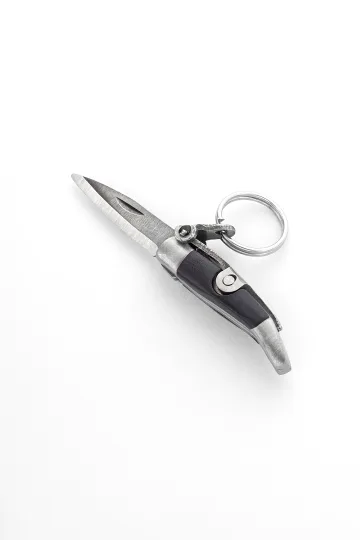
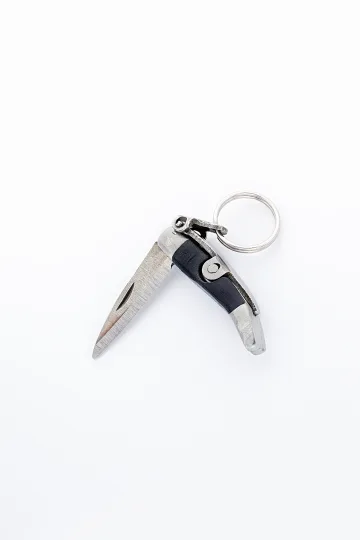
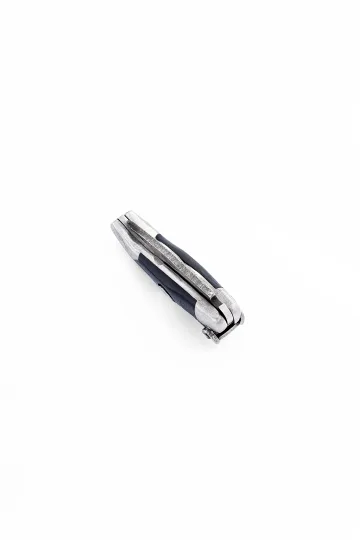
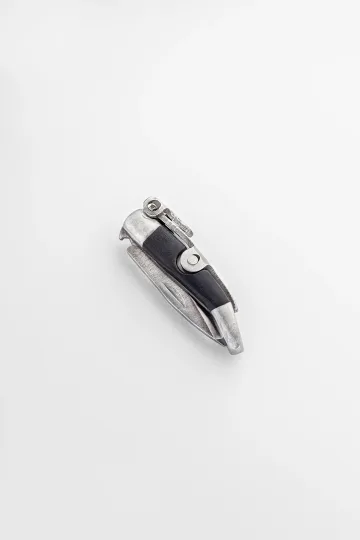
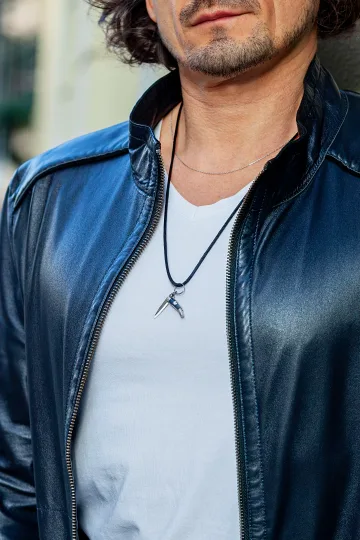
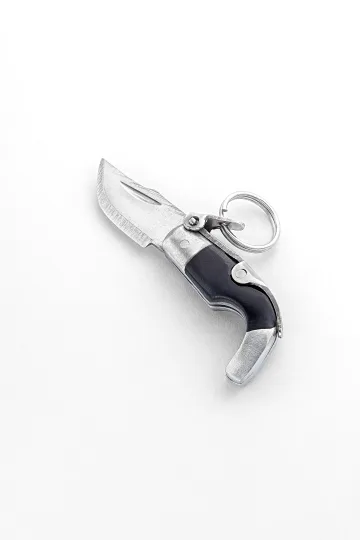
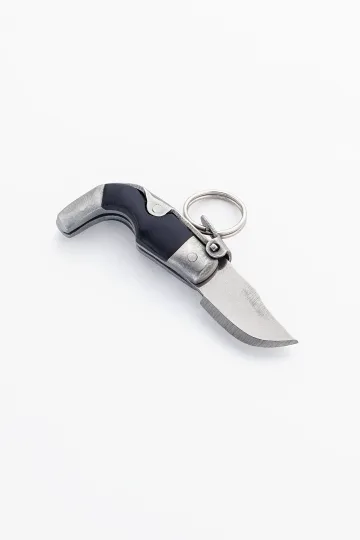
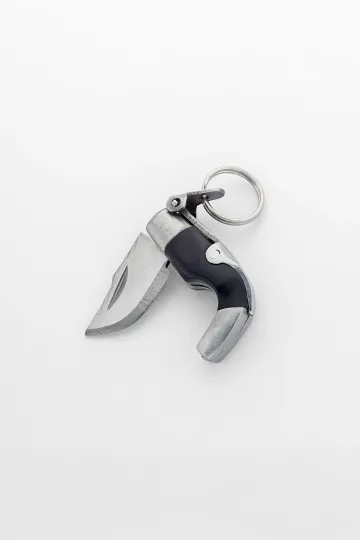
CAPAORA mini knife pendant
The 18th-century Spanish navaja in miniature: 40 mm of stainless steel, a real folding mechanism and a Palanquilla lock that clicks. An affordable gift to remember.
Authentic · Ships from Spain · 14-day returns
Caring for Obsidian
A hardness of 5 to 5.5 and brittleness govern all the care. Obsidian is softer than quartz, so ordinary dust will scratch it (dust contains quartz), and it shatters on impact.
- Cleaning. Warm water, a soft cloth or soft brush, a drop of mild soap if needed. No abrasives or harsh solvents, especially with a silver mount.
- Ultrasonic and steam are not recommended: a cracked or bubbly stone may split.
- Knocks and drops. The chief enemy. Take the piece off before sport, cleaning, any physical work.
- Temperature swings. Do not plunge a warmed stone into cold water or the reverse; glass cracks from thermal shock.
- Scratches. Store apart from hard stones (quartz, topaz, corundum) and metal, in a soft pouch or a separate compartment.
- Chlorine and salt. Best taken off in the shower, the pool and the sea.
Over time the polish may dull from micro-scratches; it is restored by re-polishing with a craftsman. The stone itself, handled with care, lasts for decades.
Symbolism: What Is Ascribed to Obsidian
Across various traditions obsidian was long given a protective role, the dark mirror-like stone linked with boundaries, reflection, "seeing the hidden". Polished obsidian mirrors were used for divination and contemplation in antiquity. The explanation is more cultural and psychological: a dark mirror gives a blurred reflection, and a person fills in the rest.
To be honest about it: obsidian has no proven physical or healing action. The stone is an amorphous silicate; it does not "absorb energy", does not heal, does not affect blood pressure, sleep or mood of itself. All that works is habit, association and the owner's own frame of mind, not the properties of the glass. If wearing obsidian is pleasant and it means something to you personally, that is a good reason. There are no medical or magical promises behind it.
The Psychology of Black: Why Obsidian Draws People In
Black obsidian is not chosen at random, and the reason has nothing to do with the energy of the stone; it lies in a perfectly ordinary psychology of colour and texture. Black reads as the colour of composure, control and confidence: it takes away the fuss, outlines the figure, gives a sense of order. The deep mirror blackness of obsidian adds what a matt black lacks, movement and depth. Here is what actually pulls people towards the stone.
The Dark Mirror Effect
Polished obsidian behaves like a small dark mirror: it catches highlights, reflects points of light and the skin, and so looks alive rather than flatly black. The eye keeps returning to that shifting surface the way it does to water in the dark. The same effect made people thousands of years ago stare into obsidian mirrors and read images into them, because the human brain is only too willing to complete a picture in an unclear reflection. In jewellery the trick works more gently, but it is why a black obsidian pendant rarely looks dull.
The Stone of One Strong Detail
Obsidian appeals to those who prefer minimalism with character over a scattering of small things. A single deep black cabochon at the throat gathers a look to a point and argues neither with the clothes nor with other jewellery. Psychologically it is the choice of someone who would rather state their case quietly but firmly: a dark graphic accent instead of glitter and pattern. That is why obsidian so often turns out to be the stone of people with severe, calm, faintly dramatic taste.
The Link with Protection and Personal Boundaries
Dark stones have been treated as charms in many cultures, and the association has survived into our own time, now as a purely psychological prop. Wearing obsidian for protection does not mean believing in magic: for many people it works as an anchor, a tangible reminder of their own steadiness, of the fact that what comes from outside can be held at a distance. The stone does nothing by itself, but the habit and the personal meaning invested in an object are real enough, and they help the wearer feel more collected.
Send a friend a discount code, they save on their first order.
Obsidian in Art and Objects of Luxury
Black glass was valued for its sharpness, for its beauty, and for centuries it was worked into things that had nothing to do with practicality. Here is how obsidian lived in art and in ceremonial objects.
Ceremonial Objects and Carving
From large blocks of clear obsidian, Mesoamerican craftsmen turned vessels, figurines and ceremonial pieces of the finest work, among them ritual containers in the shape of animals, polished to a mirror. Doing that in brittle glass, which chips at a misjudged blow, is extraordinarily hard, and such objects showed the highest level of the craft. In the Old World obsidian went into small carving too, into inlays, intaglios and gems, where its even dark depth was prized as a ground for the design. Several such Mesoamerican pieces sit in the British Museum today, brought back through the collections of the eighteenth and nineteenth centuries.
The Eyes of Statues and the Illusion of a Living Gaze
One of the most telling devices is the obsidian eye. In ancient Egypt, in Mesoamerica and on the Pacific islands, polished chips of black glass were set into sculpture in place of the pupils. The dark gleam caught the light, and a motionless face suddenly began to look back. It is an ancient discovery, that mirror blackness reads to the eye as a living gaze, and it is the same effect that makes an obsidian pendant so magnetic against the skin.
Dark Depth as an Aesthetic
In the decorative arts obsidian is valued for giving a perfect deep black without mattness and without the cheap gloss of plastic. That calm dark depth works well beside gold, silver, pale stone and wood, which is why black glass still appeals to makers working in a severe, graphic, slightly ascetic idiom. In jewellery this translates into a simple rule: obsidian looks best in a clean form where nothing distracts from its depth.
Obsidian Paired with Other Stones
Black obsidian combines easily with other dark stones in a single palette and is set off well by light ones.
- With hematite, a cool metallic palette, two stones with a mirror polish. Historically hematite, or bloodstone, was a warrior's stone; together with obsidian it gives a severe monochrome.
- With black tourmaline, a similar black palette, but tourmaline is harder and lengthwise-striated; the difference in texture reads up close.
- With rock crystal or white quartz, the contrast of black and clear, a classic graphic pair.
- With amethyst, cool purple beside deep black, restrained and festive at once.
These are pairings by colour and texture, not by "energy": choose what you like to look at.
Facts About Obsidian That Catch People Out
Volcanic glass has the whole history of human tool-making behind it and, at the same time, an unexpectedly modern use. A few facts that usually surprise people.
Obsidian Scalpels Are Still Used in Surgery
The edge of a well-struck obsidian flake is finer than any steel can be honed: under the microscope a steel blade looks like a serrated saw, while an obsidian edge tapers down almost to the thickness of a molecule. That is why stone blades returned to fine surgery in the twentieth century, used for particularly clean incisions that leave a tidier scar. The tool of a Neolithic craftsman and the scalpel in a microsurgeon's hand are physically the same thing.
Ancient Trade Routes Are Reconstructed from Obsidian
Every deposit yields glass with its own set of trace elements, a kind of chemical passport. When archaeologists find an obsidian tool hundreds of miles from the nearest volcano, they establish from its composition exactly which source it came from, and in that way they map exchange networks that existed thousands of years before writing. Obsidian became one of the first long-distance trade goods in history. British sites have their own version of the story with stone axes from the Lake District and Cornwall, but obsidian is the sharpest tracer of the lot, because the fingerprint is unambiguous.
The Mirror of an Aztec God Survived to Elizabeth's Court
The Aztecs linked the obsidian mirror to the god Tezcatlipoca, whose name means smoking mirror. One such Mexican disc of black glass reached Europe and came into the hands of John Dee, astrologer to Elizabeth I, who gazed into it during his sessions. A ritual object of one civilisation became the instrument of another's occultists, and both times the stone was prized for the same thing, the dark depth of its reflection. The disc is on display in the British Museum, a few rooms away from the cylinder seals.
Obsidian Slowly Turns into a Different Rock
Glass is thermodynamically unstable: over time its atoms tend to arrange themselves into crystals. So ancient obsidian clouds, small spherulites grow inside it, and eventually it turns into a matt rock, perlite. On the geological scale black glass is short-lived, and very old obsidian simply does not survive in glassy form. For jewellery none of this matters: within a human lifetime a polished stone does not change.
The White Snowflakes Are Crystallisation Beginning
The pattern of snowflake obsidian is not an impurity and not an inclusion of some other mineral, but those very spherulites of cristobalite grown inside the glass, radiating crystallites. In effect it is a frozen moment when the glass began turning back into crystalline rock and then the process stopped. Every snowflake is a tiny crystal caught halfway.
The Sharp Edge Forces Jewellery to Be Rounded
The same physics that makes obsidian surgically sharp makes it dangerous in the raw: a fresh break really does cut. So in jewellery the edges are always rounded and polished, and a finished pendant or bead is entirely safe. Obsidian stays sharp only on a fresh break, never on a stone that has been ground and polished.
Buying it as a gift? Each one arrives ready to give.
 A branded Zevira box and a little card come with every order.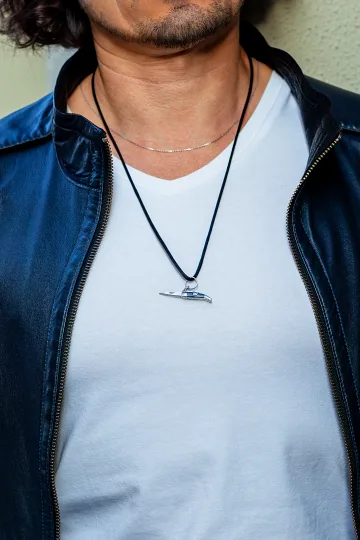




FAQ on Obsidian
Is obsidian a stone or glass?
Natural volcanic glass. Formally it is not a mineral but a mineraloid: it has no crystal lattice. In composition it is close to rhyolite and to quartz (the base, SiO2), but it set in an amorphous form.
How hard is obsidian?
5 to 5.5 on the Mohs scale. That is softer than quartz (7), so obsidian is scratched by dust and sand and needs careful storage.
Why is obsidian so sharp on a break?
Because of its amorphous structure it breaks with no direction along a lattice and gives an edge a few molecules thick. Ancient obsidian knives and modern obsidian scalpels for fine surgery are based on this.
Does obsidian come in colours other than black?
Yes. Snowflake (with white spherulites), mahogany (with brown streaks), rainbow and sheen, smoky translucent, Apache tears. Colour and pattern are set by iron impurities and by what happens as the lava cools.
Can you cut yourself on obsidian jewellery?
On finished jewellery the edges are rounded and polished, so you cannot cut yourself in ordinary wear. Only a raw break is sharp, and in jewellery it is framed.
Can obsidian crack?
Yes, it is brittle and dreads knocks and sudden temperature swings. Glass cracks from thermal shock, so do not heat the stone and then plunge it into cold water.
How do you tell obsidian from black glass?
It is hard by any single sign. You look at the whole picture: irregularities and flow texture (rather than even bubbles), a brown glow at a thin edge, a noticeable weight, coolness to the touch. Perfectly uniform black with no glow more often turns out to be glass.
How do you tell obsidian from black tourmaline?
Tourmaline is crystalline: it shows lengthwise striations along the crystal, it is harder (7 to 7.5) and does not break with the smooth conchoidal fracture of glass.
Does obsidian fade?
No. The black colour comes from iron inclusions, which do not bleach out. Only the polish can dull from scratches, and that is fixable by re-polishing.
Does obsidian heal or protect?
Traditions gave it a protective role, but there is no proven physical or healing effect. It is a piece of jewellery made of volcanic glass, no more.
About Zevira
At Zevira, obsidian is a piece of jewellery, not a charm with promises. We treat the stone as what it is: a beautiful volcanic glass with a deep black colour, a glassy lustre and a recognisable character.
What matters to us in working with obsidian:
- Genuine obsidian, not dyed glass. We check by fracture, light test, weight and uniformity.
- A careful cut for a brittle material: rounded edges, a smooth polish, a protective mount.
- Sterling 925 silver and steel for a cold, graphic look, warm gold and copper for a bohemian one.
- Different varieties: pure black, snowflake and mahogany, for different looks and moods.
Obsidian suits those who like one strong dark piece and a graphic style. Choose by the look and the feel of the stone in your hand; that is enough.