Onyx in jewellery: from Roman seals to men's signet rings
Most of the ancient signet rings pulled from the ruins of Pompeii and Rome reached us intact. Not because of the black colour, and not because of any magic, but because of the stone itself: onyx is hard, dense and does not crumble under the carver's tool. So when a Roman magistrate ordered a gem for his seal, he almost always chose onyx. The impression in wax came out crisp, and the stone outlived its owner by a couple of thousand years.
Onyx is a variety of chalcedony, a cryptocrystalline form of quartz. Black, banded, cool to the touch, with a hardness of around 7 on the Mohs scale. That toughness and its handsome layering made it a favourite of gem cutters, Renaissance jewellers and the makers of Victorian mourning pieces. Today it is the stone of restrained men's signet rings, sealing rings and bracelets.
What follows is straight to the point: what onyx is made of, how it forms, where it is mined, how to tell it from fakes and look-alikes, how to care for it and what to wear it with. No mysticism, no promises that the stone will change your life.
What onyx is: composition, structure and properties
Chemistry and mineralogy
Onyx is chalcedony, the cryptocrystalline (microcrystalline) variety of quartz. Its chemical formula is silicon dioxide, SiO₂. What sets it apart from clear rock crystal is that it consists not of one large crystal but of countless microscopic quartz fibres packed tightly together. That is why the stone is opaque, or translucent only at the edges.
The defining feature of onyx is its parallel banding. Layers of different colour, most often black and white, were laid down one after another, so a cut section shows even, straight stripes. Its close cousin agate has concentric, curved bands, while onyx has straight, parallel ones. Those even layers are exactly what made onyx ideal for cameos and seals: the carver shaved away the pale top layer so a figure stood out against the dark ground.
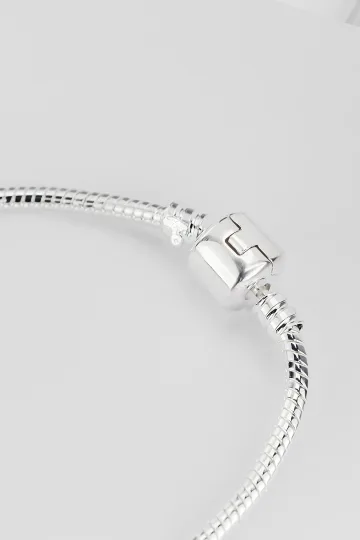
Wear the symbol, don't just read about it. These are in stock:


The colour of the bands comes from trace impurities. Black and dark grey come from carbon and iron compounds, while the reddish-brown tones, as in sardonyx, come from iron oxides. Pure chalcedony on its own is colourless or milky.
One thing should be said up front: a large share of the black onyx on the market is grey or unremarkable chalcedony, dyed by the old sugar-and-acid method. This is a long-standing, accepted practice going back to antiquity, not a deception in itself. The problem only arises when a dyed stone is passed off as a rare, naturally black one.
Physical properties
- Mohs hardness: 6.5 to 7. Onyx scratches glass easily, but sapphire and diamond will scratch it. That hardness is enough for a piece to last decades without visible wear.
- Crystal system: trigonal (like all quartz), but at the level of individual microcrystals; to the eye the stone looks solid.
- Density: around 2.6 g/cm³. The natural stone is noticeably heavier than plastic (roughly 1.2 g/cm³), but lighter than, say, haematite.
- Lustre: vitreous to waxy; once polished, the surface is mirror-like.
- Fracture: conchoidal, as in all quartz.
- Optics: refractive index in the region of 1.53 to 1.54, weak birefringence. Because the stone is microcrystalline and opaque, it shows no dispersion (fire) and no marked pleochroism. This is not a faceted transparent gem but a dense ornamental material.
- Translucency: along thin edges natural chalcedony usually lets a little light through.
Because of the banding, onyx has weak planes of cleavage along the layer boundaries. In practice that means a stone with pronounced layers can split along a layer under a sharp blow or a sudden change in temperature.
How black onyx is actually dyed
The dyeing deserves a closer look, because more confusion gathers around it than around anything else to do with the stone. Naturally coal-black onyx does exist, but it is uncommon and usually carries a grey cast. The overwhelming majority of what sits in shop windows labelled black onyx is pale or grey porous chalcedony that was blackened deliberately. The method is ancient, described by craftsmen in the classical world, and it was raised to an industrial process in the German town of Idar-Oberstein in the nineteenth century.
The principle is sugar and acid. First the porous chalcedony is steeped in a saturated sugar solution, ordinary sugar or honey will do, and the sugar works its way into the microscopic pores of the stone. Then the stone goes into hot sulphuric acid. The acid chars the sugar inside the pores, and what settles there is fine carbon: even, black, chemically stable. This is not a surface coating but carbon bonded into the structure of the stone. That is why the blackness does not rub off, does not fade, and holds up every bit as well as the natural colour. In effect a workshop repeats in a few days a process that nature sometimes carries out over millennia.
There is an important consequence for the buyer. Because the black sits deep in the pores, telling a well-dyed onyx from a naturally black one by eye is all but impossible, and there is nothing shameful in that. Enhancement of this kind counts as standard, accepted treatment across the jewellery trade, and British retailers are expected to disclose it under the trade descriptions rules that govern how goods are labelled. The dishonesty lies in one thing only: selling a dyed stone as a rare natural one and charging accordingly.
Why the porosity of the stone matters
Not every chalcedony takes the dye equally well. The method works precisely because the stone is porous and the sugar solution has time to soak in. Very dense, glassy chalcedonies take colour poorly and unevenly. So rough material destined to become black onyx is selected for its ability to absorb the solution, not for the colour it starts with. This also explains why cheap onyx sometimes shows brownish or greyish zones when held to the light: in those places the pores were tighter and less carbon settled. An even, deep black with no mottling is the sign of good rough and careful treatment.
Two practical checks follow from this. Hold the stone up to a bright window and look at the thin edge near the setting: patchy translucency with a warm brown glow usually means uneven dyeing, while a uniform, faintly grey edge suggests either a good dye job or a natural stone. And look at any drilled bead hole, since the inside of a hole drilled after dyeing will often show the paler original colour, which is a harmless but honest giveaway.
Onyx, agate and sardonyx: where the line falls
These three names are constantly mixed up, although chemically we are looking at a single material, chalcedony. Only the pattern and the colour of the layers separate them. Agate has concentric layers that follow the shape of the cavity the stone grew in, building up rings, eyes and swirling figures. Onyx has straight parallel layers, as even as the pages of a book stood on its end. Sardonyx has the same geometry as onyx (straight parallel bands), but in place of the black it carries reddish-brown and warm brown tones from iron oxides, alternating with milky white.
Different uses follow from that difference. The even parallel layers of onyx and sardonyx gave the carver a ready-made two-colour blank: shave away the pale top layer along the outline of a figure and the figure stands white against a dark ground. The chaotic rings of agate will not do that, which is why cameos and layered gems were cut from onyx and sardonyx, while agate went into beads, bowls and simpler inlays.
How onyx forms: geology and deposits
Origin in nature
Onyx, like agate, forms in cavities within volcanic and sedimentary rock. Gas bubbles in cooled lava (amygdules) or cracks and hollows in limestone are filled over time by silica from circulating low-temperature solutions. The silica settles layer upon layer on the walls of the cavity. When conditions change periodically (the make-up of the solution, the impurities, the rate of deposition), bands of different colour form. Parallel layers give onyx, concentric ones give agate.
The process is slow and runs at low temperatures in near-surface conditions. The finished stone is chemically stable: it does not fade in the light and is not broken down by water.
Where it is mined
The main sources of onyx and agate material have been known for a long time:
- Brazil (especially the states of Minas Gerais and Rio Grande do Sul), the world's largest supplier of agate and chalcedony, including the material that becomes black onyx after treatment.
- Uruguay, high-quality agates and chalcedonies, historically used for carved work.
- India (the Deccan, the Gujarat region), one of the oldest centres for mining and working agate and carnelian; the tradition of stone carving here goes back centuries.
- Germany, Idar-Oberstein: the historic centre of agate cutting and treatment in Europe; this is where the methods of dyeing chalcedony were perfected.
- Madagascar, the United States (Oregon, Montana), Mexico, well-known sources of agates and chalcedonies in various shades.
Sardonyx with natural reddish-brown bands was historically mined and worked in India and Arabia; in Europe it was long prized as a valuable material for gems.
Onyx wants cool metal and room to itself. Pile on gold and coloured stones and the stone sulks while you read as new money. Don't argue.
What to wear onyx with
I read onyx the way a stylist does: a black stone takes exactly as much attention as the background leaves it, so I always start with the clothes, not with the stone itself. Here are the questions I get asked most.
Which metal should I pair with onyx? I recommend cool metals: silver, white gold, platinum. Warm yellow gold argues with the matte black, while silver gives that play of cool shine against deep black that was prized as far back as the nineteenth century.
Does onyx belong at the office? Yes, and I suggest it as a near sure thing. A grey or navy suit, a pale shirt, a silver signet with a black stone on the ring finger. A slim bracelet of beads slips under the cuff nicely: barely seen, yet the wrist feels the weight.
What neckline and chain length work for a pendant? For the evening I choose a short chain, closer to the collarbone, and an open collar: a dark roll-neck or a shirt with the top button undone. That way the stone reads against bare skin or dark fabric, and black on black looks restrained and expensive.
Which stones does onyx get along with, and which not? I like to set white stones and pearls beside it: dark and light reinforce one another. Bright coloured stones I advise you to drop, they pull the attention away and onyx loses.
How many onyx pieces should I wear at once? I recommend one striking piece over three small ones: the stone likes solitude. If you put on several things, I keep them in one range, black onyx, silver, one pale accent at most.

Turn on your camera, pick earrings, a pendant or a ring, and see the piece on yourself in real time.
Switch items in one tap.
Everything runs in your browser: no photo or video is ever uploaded.
Onyx in culture and history
Antiquity: seals and gems
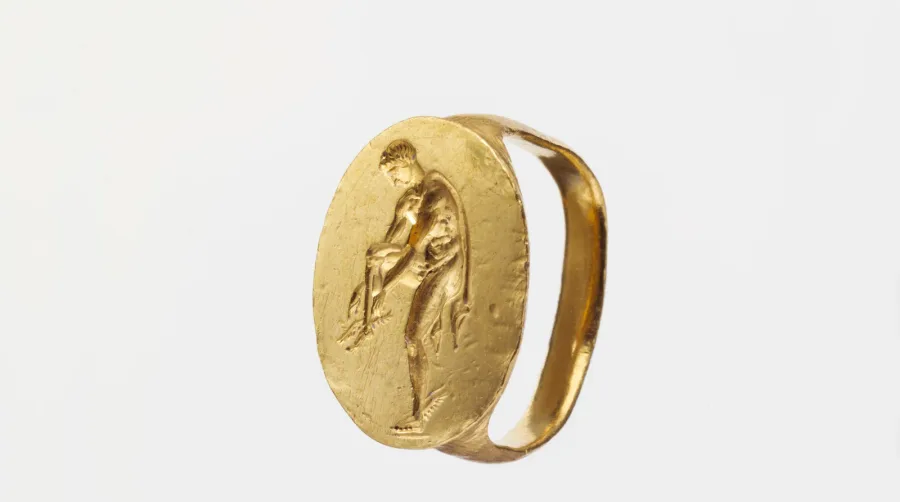
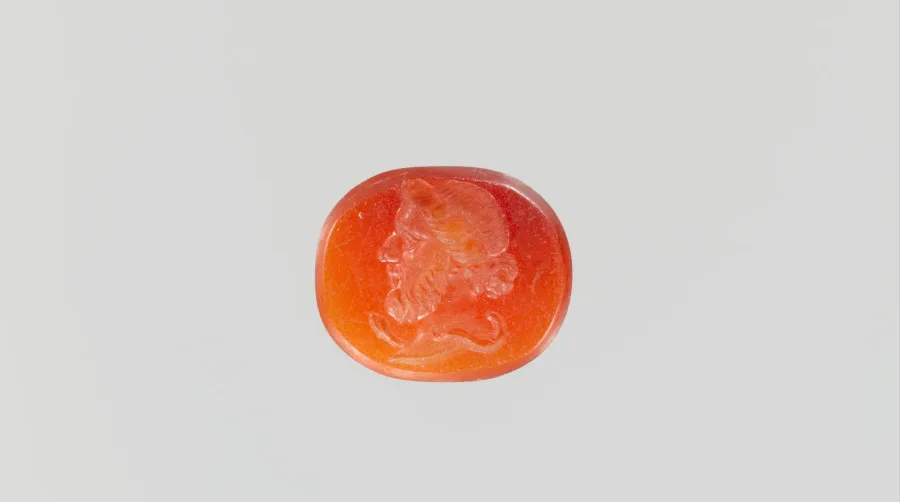
In ancient Greece and Rome, onyx and sardonyx were the main material for carved gems, for intaglios (an image cut into the stone, for sealing) and cameos (relief). A seal stood in for a signature: its impression in wax or clay authenticated a document. The contrast of the bands and the hardness of the stone made onyx ideal for the job, the fine design did not wear away through thousands of impressions.
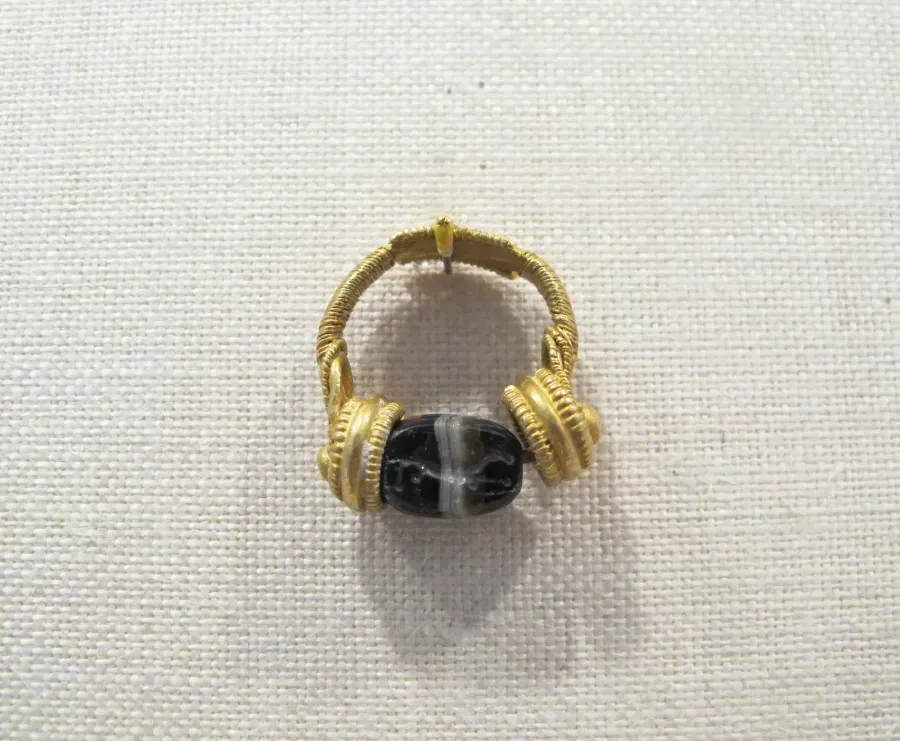
The word "onyx" comes from the Greek onyx, meaning "nail" or "claw". Pale translucent bands over a dark ground reminded the ancients of the lighter crescent on a fingernail. The stone appears in classical authors among the gems used for carving; Pliny the Elder, among others, wrote about the properties and varieties of onyx in his "Natural History".
The Renaissance: cameos from layered stone
Carving in layered stone had its golden age in the Renaissance. Master cutters learned to shave the layers so that a pale figure rose above a dark ground, producing many-coloured cameos. One of the most famous examples of sardonyx carving, the "Gonzaga Cameo" (a Hellenistic work that later passed into European collections), shows what the technique was capable of: a double portrait carved using the natural layers of the stone.
The nineteenth century: mourning jewellery
In the nineteenth century black onyx took a firm place in what is called mourning jewellery. The Victorian age developed an elaborate etiquette of mourning, and dark stones, onyx, jet, black enamel, became the fitting choice for brooches, rings and pendants worn in memory of the dead. This is also when the pairing of black onyx with pearls and pale stones took hold: the contrast of dark and light read as restrained and severe.
In parallel, onyx remained the material of men's signet rings carved with monograms and coats of arms, a tradition inherited directly from the ancient gems.
Mesopotamia and Egypt: cylinders and amulets
The history of carving layered chalcedony is older than the classical world. In Mesopotamia, thousands of years before Rome, agate and carnelian were cut into cylinder seals: a small barrel with an incised design was rolled across wet clay and left a continuous impression across the tablet. It served at once as a signature, a proof of ownership and a protective charm, worn on a cord or a pin. Hard chalcedony held fine carving better than softer rock, which is why so many of these seals have come down to us still legible. The British Museum holds one of the largest collections of them in the world, and anyone in London can see a case of them in an afternoon.
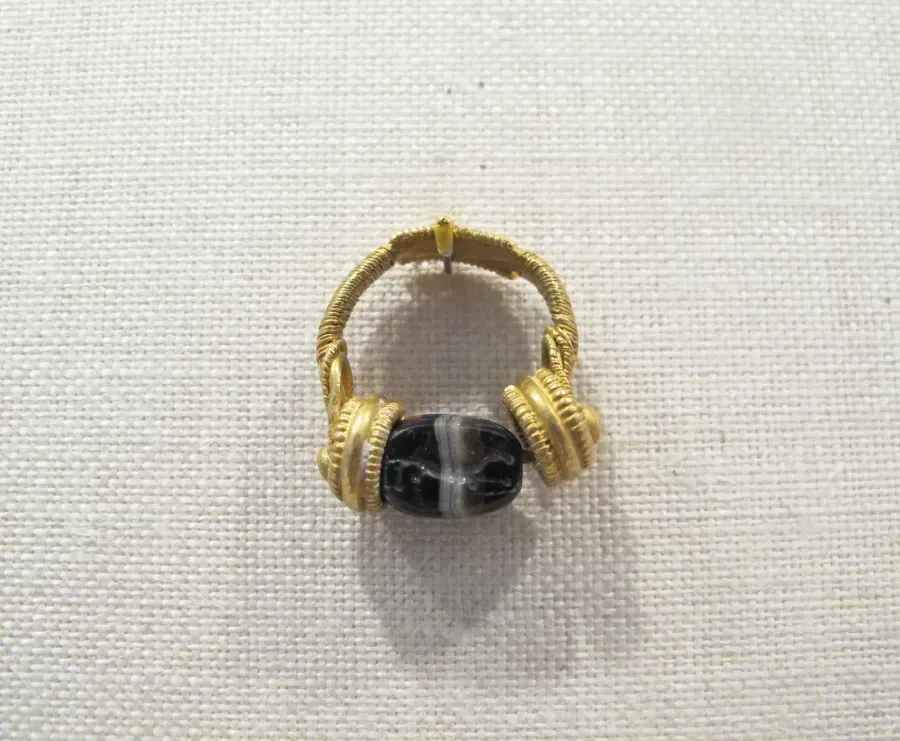
In ancient Egypt carnelian and layered chalcedony went into scarabs, beads and inlays for pectoral ornaments. A scarab seal with a design cut into its flat underside is the direct ancestor of the later engraved gem. That is also when the idea took shape that a carved ornament is both a handsome object and the carrier of a mark of authority or protection, an idea the Greeks and Romans inherited whole.
The Islamic world and India: carving and a regard for sardonyx
In Islamic culture carved stones remained an important tradition in settings where figural images were avoided: inscriptions, names and sayings were cut into carnelian and layered chalcedony. A seal ring with an engraved stone served both as a personal seal and as a mark of standing. Sardonyx was held in particular regard: several traditions name it among the stones credited with dignity and nobility, and that raised its standing in the eyes of craftsmen and owners alike.
India was for centuries one of the chief centres both of mining and of working agate, carnelian and sardonyx. The deposits of Gujarat supplied rough to local carvers and to the trade routes along which the stone travelled west as far as the Mediterranean. Indian craftsmen spent generations refining the techniques of carving and of drilling beads, and it was largely that school which made layered chalcedony a material of world trade. Much of the Victorian carnelian and sardonyx that turns up in British antique shops began life as Gujarati rough shipped through the East India trade.
Idar-Oberstein: how a German town set the standard
Idar-Oberstein deserves a paragraph of its own. This town in western Germany grew up around local agate deposits, and when those ran out it switched to imported rough, above all from Brazil. It was here in the nineteenth century that the dyeing of chalcedony, including the sugar-and-acid route to black onyx, was perfected and put on a commercial footing. Local workshops supplied treated stone to half of Europe, and largely thanks to them black onyx turned from a rarity into an affordable and instantly recognisable jewellery material. Birmingham's Jewellery Quarter and the Clerkenwell trade in London both bought their onyx blanks from these German cutters, which is why so much Victorian and Edwardian British mourning jewellery is set with stone from a single small valley. When you hold a ring with an even black onyx today, you are holding the heir to a technology worked out in those workshops.
Customer reviews
Zevira is a real jewellery shop. Genuine payments, deliveries and customer thank-yous.
🥰🥰🥰 gracias
Ok, ¡gracias! 🙂
Types of onyx and how it differs from similar stones
Varieties
- Black onyx, the most common jewellery type: uniformly black or with white bands. The bulk of the market is treated (dyed) chalcedony.
- Sardonyx, onyx with reddish-brown or brown bands instead of black, alternating with white. The red tone comes from iron oxides. It was historically valued more highly for its warm colour and its effect in cameos.
- White-grey and honey onyx, the pale banded varieties of chalcedony.
- "Onyx marble" (marble onyx), a separate story and a frequent source of confusion. It is not chalcedony at all but banded calcite or aragonite (calcium carbonate). It is used for vases, table tops and boxes. It is soft (hardness 3 to 4), scratches easily and reacts to acid. It has nothing to do with jewellery onyx-chalcedony, though it is sold under a similar name.
Onyx or agate
Onyx and agate are close relatives, both chalcedonies. The difference is in the pattern of the bands: agate has concentric, curved stripes following the shape of the cavity, while onyx has straight, parallel ones. In their properties (hardness, density) they are practically identical.
Onyx or black tourmaline, obsidian, jet
Black stones are easy to mix up, but their nature is different:
- Black tourmaline (schorl), a separate mineral, a silicate, harder than onyx (7 to 7.5), often with lengthwise striations on the faces and no banding.
- Obsidian, volcanic glass, amorphous, softer (around 5 to 5.5), with a characteristic glassy lustre and conchoidal fracture, sometimes translucent in smoky brown. Its nature is altogether different: there is more on this dark stone in the piece on obsidian in jewellery.
- Jet is not a stone in the mineralogical sense but a variety of fossil coal. Very light, warm to the touch, soft. It was jet, not onyx, that was the most popular "mourning" black material of the nineteenth century.
How to tell it from fakes and imitations
Dyed glass, plastic or heavily treated chalcedony is often sold as onyx. What helps at an everyday level:
- Weight and heat conduction. Natural stone feels cool to the hand and warms more slowly than plastic; glass feels lighter than stone of comparable size. This is a rough check, not proof.
- Translucency. The thin edges of natural chalcedony usually let a little light through. A completely opaque "onyx" may turn out to be glass or plastic.
- Bands under a loupe. In natural onyx the layers are imperfect, with tiny irregularities. A pattern that is too even, almost "printed", is a reason to be wary.
- Bubbles. Round air bubbles inside are a typical sign of glass, not stone.
Only a gemmologist with instruments can reliably tell natural colour from dye, let alone identify an imitation. Dyeing chalcedony is in itself a legitimate and ancient method of treatment; the only thing that matters is that the seller states it honestly.
Upload a photo of your pet, someone you love, or an object. We'll build a 3D model and hand-cast it in pewter.



How to choose onyx: what to look for in a finished piece
You don't buy onyx as a loose stone but as part of a ring, a signet, a pendant. So it is the whole piece that should be assessed, not the stone in mid-air. Here is what an experienced buyer's eye runs over.
Polish. The main indicator of quality work. Well-polished onyx gives an even mirror reflection with no matte patches and no "orange peel". Turn the stone under a lamp: the highlight should glide cleanly, without graininess. Cloudy areas mean under-polishing or micro-cracks beneath the surface.
Evenness of the black. In evenly dyed black onyx the colour is deep and free of brownish streaks. Greyish or brownish patches seen against the light point to uneven dyeing. This is not a fault in itself, but uneven colour is nothing to overpay for.
Chips along the edges. The vulnerable spot in onyx is the rim of the insert, especially with the flat plates used in signets. Run a fingernail along the edge of the stone and where it sits in the setting: catching chips and nicks are felt before they are seen. A good setting covers the rim with metal precisely to protect that edge.
Seating in the setting. The stone should not move in its bed. A slight wobble means the insert will fall out in time. For onyx a closed (bezel) setting or prongs that hold the stone firmly are preferable to a glued, butt-jointed seat.
Symmetry for beads. In a bracelet the beads should be of one calibre and free of flattened "barrels". Beads of varying size are a sign of cheap mixed grading.
A word on the honest question of dyeing. The overwhelming majority of black onyx is treated, and that is the norm. What should put you on guard is not the dyeing itself but an attempt to sell dyed chalcedony at the price of a rare, naturally black stone. A direct question to the seller, "natural colour or treated?", and a calm, specific answer, is already a good filter.
Insert shape: cabochon, plate, beads, intaglio
Onyx is not cut into facets like clear gems: it is opaque, it has no fire to play. So the stone is worked differently, and the shape has a direct bearing on how wearable it is.
A smooth cabochon (a domed polished drop with no facets) is the most common shape for pendants and women's rings. The domed surface reflects light in one soft highlight and stands up well to handling.
A flat plate goes into signets and men's rings. Its plus is the surface area for engraving, its minus is the sharp edges, which chip when knocked against a door frame or a table. A plate needs a setting that covers the rim.
Beads (4 to 8 mm for bracelets, smaller for strands) are convenient because the round shape has no vulnerable edges, so an onyx bracelet stands up to daily wear better than a ring with a flat insert.
Intaglio and cameo are carvings, cut in or in relief, the direct heir of the ancient gems. On solid black onyx an intaglio (a seal) is cut, on banded sardonyx a cameo is made using the contrast of the layers. Carved inserts are more sensitive to blows along the line of the cut, and should be worn more carefully than a smooth stone.
The practical takeaway: for a ring that will live an active life, a cabochon or a setting-protected plate is safer; for a dress piece you can allow yourself carving; for an everyday accessory worn without a thought for knocks, beads.



Myths about onyx
Leave your email, we'll send your discount code. No spam, unsubscribe anytime.
The code arrives by email, valid on your first order.
Caring for onyx
Onyx is hard enough (6.5 to 7) to resist scratches in everyday wear. Its weak points are the banding and a sensitivity to sudden changes in temperature, plus the fact that many stones on the market are dyed, and harsh chemistry can affect the dye.
Cleaning. Warm water, a drop of mild soap, a soft brush or cloth. Rinse, wipe dry. That is enough for regular care.
What to avoid. Ultrasonic and steam cleaning are inadvisable: vibration and heat can run along the layer boundaries or damage filled cracks. Don't keep the stone in direct sunlight or near sources of heat, or dip it in acids, chlorinated water and solvents. Put on perfume and cosmetics before you put on the jewellery, not after.
Storage. Apart from harder stones (diamond, sapphire and topaz will scratch onyx) and from anything it can scratch itself (pearls, silver). A soft pouch or a separate compartment of a jewellery box, in a dry place free of sharp temperature swings, suits it best.
Wearability. For rings and signets that take knocks, a hardness of 6.5 to 7 is a sensible minimum: onyx holds up better than soft stones like opal or jet, but it is still not eternal. Pendants and earrings wear less than rings and last longer.
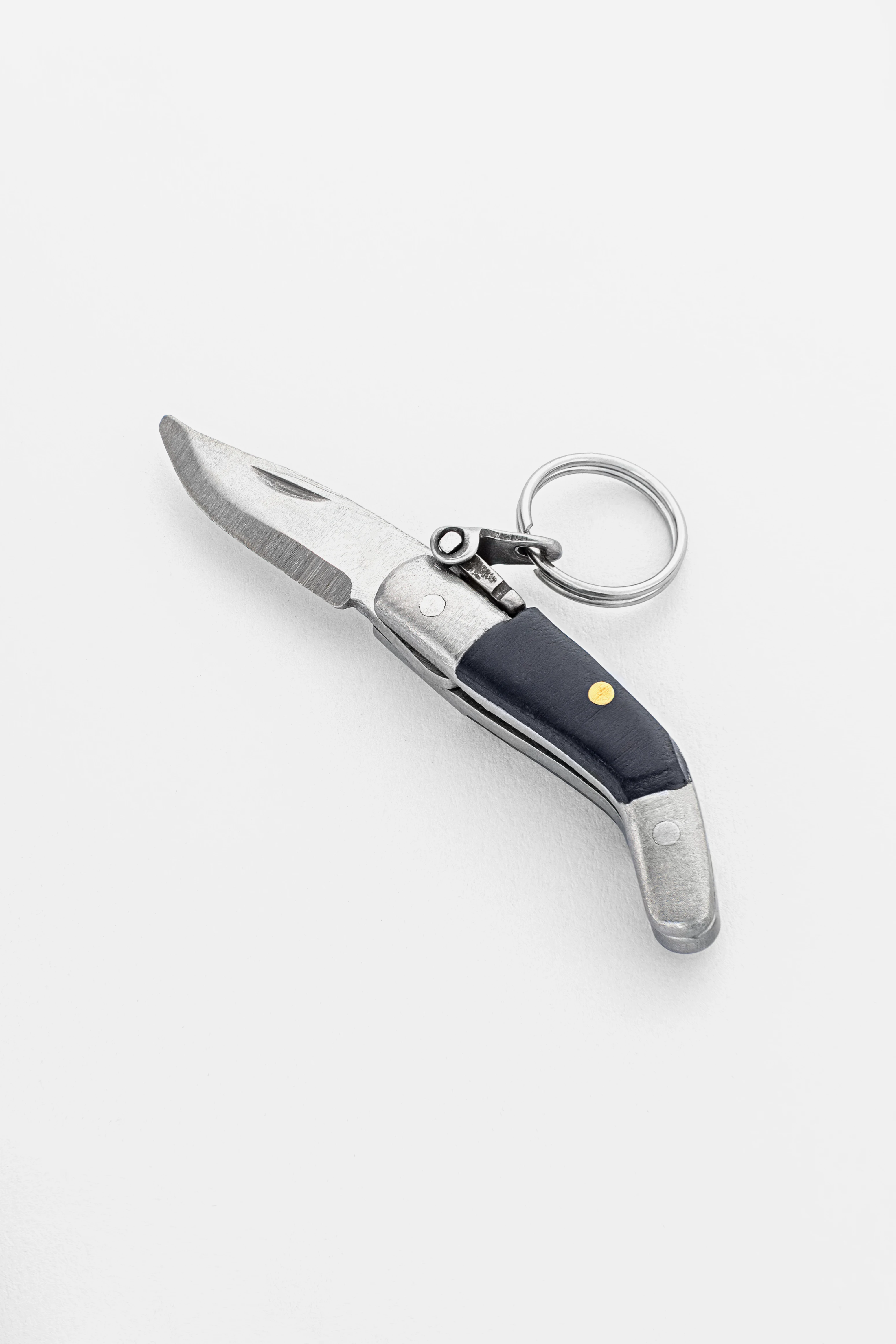
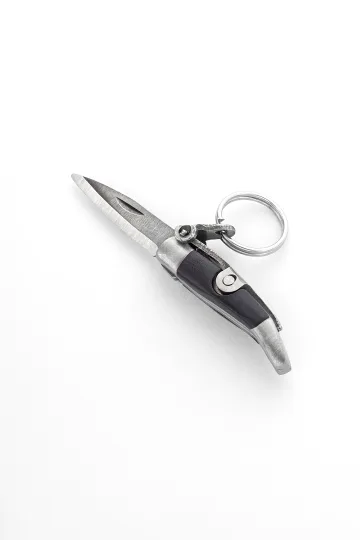
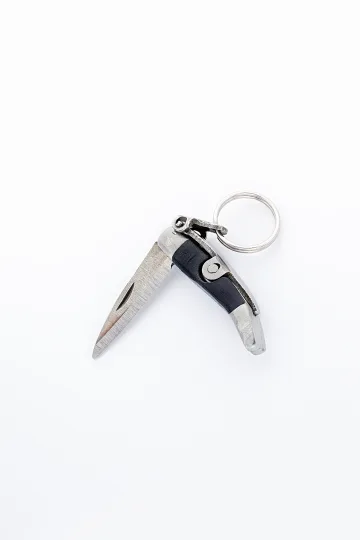
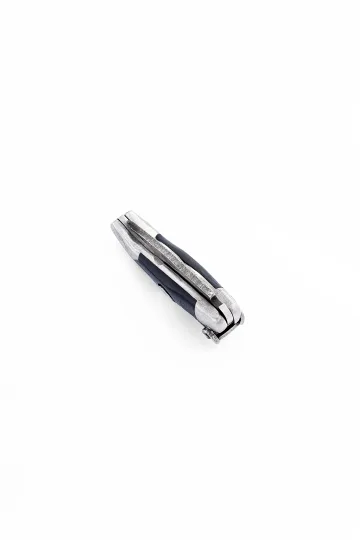
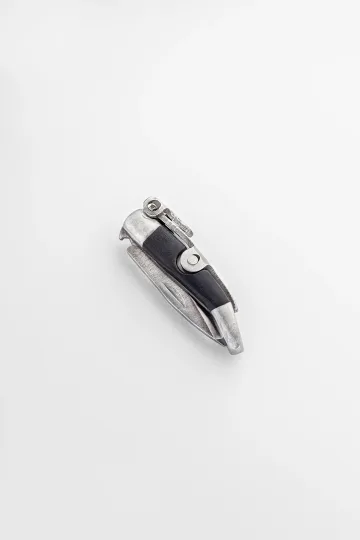
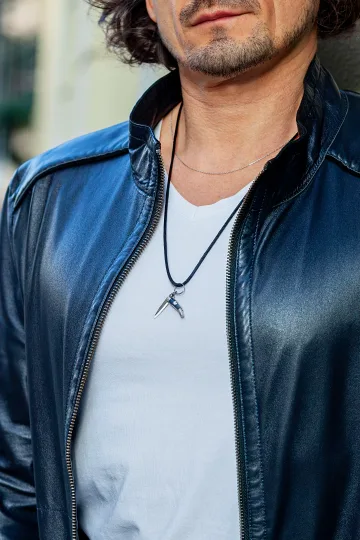
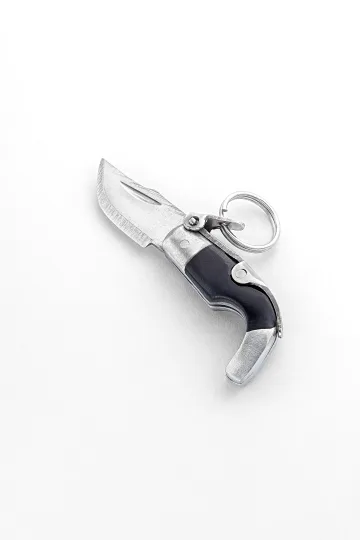
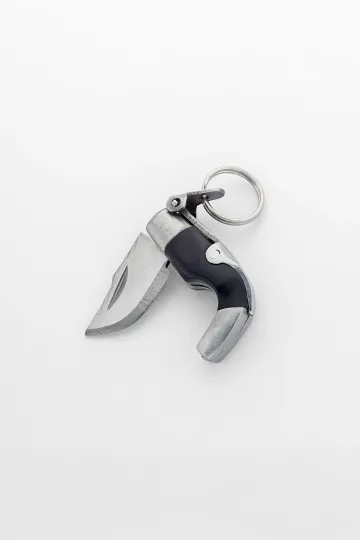
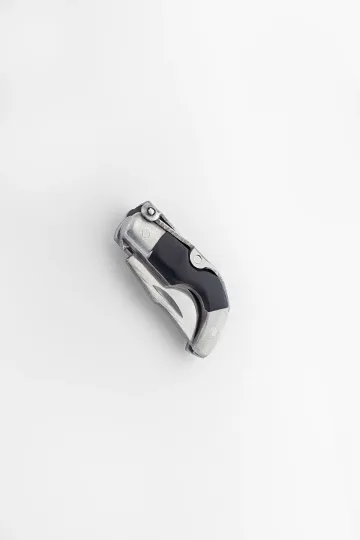
CAPAORA mini knife pendant
The 18th-century Spanish navaja in miniature: 40 mm of stainless steel, a real folding mechanism and a Palanquilla lock that clicks. An affordable gift to remember.
Authentic · Ships from Spain · 14-day returns
The symbolism of onyx: what to know, with a healthy scepticism
Different traditions credited onyx with properties of protection, grounding and resilience. The black colour was linked with seriousness and dignity, which is where the stone's role in mourning and ceremonial jewellery comes from. In the Indian astrological tradition onyx is associated with Saturn; in some medieval lapidaries it was given now protective, now gloomy properties, opinions diverged.
All of this is cultural symbolism, not proven properties. There is no confirmed effect of the stone on health, sleep, blood pressure, anxiety or luck. Onyx does not heal and does not "charge you with energy". If the stone appeals to you and supports a certain frame of mind, that is the ordinary psychological effect of a beautiful thing, nothing more. Buy a piece because it is beautiful and well made, not for the wonders it is promised to work.
Men's jewellery with onyx
The signet ring
The direct heir of the ancient gem. Today an onyx signet is worn as an ornament, sometimes engraved with initials or a monogram. The black stone looks restrained and does not shout the way yellow gold does. For a signet you take a massive stone (roughly from 12 by 16 mm) so it does not get lost, and a cool metal, sterling 925 silver gives an expressive contrast. Keep the engraving simple: one or two letters or a spare symbol read better on onyx than fine, wordy carving. On how to put together a monogram so the letters do not fight one another, see the guide to initials and monograms in jewellery.
The bracelet
Most often this is a bracelet of onyx beads (usually 4 to 8 mm) on an elastic cord or chain. It is spare, does not glint and suits daily wear. Another option is a silver bracelet with a single flat onyx insert.
The pendant
A polished onyx cabochon in a silver setting on a chain. Under a shirt and jacket it gets lost, but with an open collar or a dark roll-neck it reads well. A short chain holds the stone closer to the collarbone.
Onyx in women's jewellery
Black onyx is wrongly thought of as a purely men's stone, though historically it lived in women's jewellery no less. In the Victorian age it was women who wore onyx brooches and rings as part of the mourning wardrobe, and the classic pairing of black onyx with white pearls, which still reads as severe elegance, was born precisely in women's jewellery of the nineteenth century.
In a woman's look onyx works on contrast. It adds no colour, it adds graphic line: a sharp dark point or stroke against a pale ground. That is why pairings with white and clear are especially effective, onyx stud earrings with a pearl detail, a ring with a black cabochon next to a pale metal, a slim pendant on a long chain over a plain dress.
The logic of formats differs from the men's. Where men's jewellery takes onyx in a massive way (a signet, a large insert), women's pieces do better with small and medium forms: a 6 to 10 mm cabochon in a ring, drop earrings, a strand of small beads. A large black stone in a woman's ring sits well in a severe, almost business-like look and argues with a romantic one.
Black onyx is also versatile in tone: it pairs with both warm yellow gold and cool silver, because the stone itself has no colour temperature. That makes it a handy base when you would rather not match the stone to a particular metal.
Send a friend a discount code, they save on their first order.
Onyx in art and ceremony
Onyx in religious and ceremonial use
A black stone has long read as a mark of seriousness, and that fixed onyx in the world of ceremonial objects. Dark signets and seal rings were worn by officials, clergy, and members of fraternities and orders, for whom restrained black suited the occasion better than bright colour. Onyx and sardonyx also appear in the biblical tradition in the lists of precious stones, which added to their weight in medieval Europe: a stone from a sacred list was more readily accepted for important, high-status jewellery. English cathedral treasuries and civic collections still hold seal matrices and rings of this kind, and the shape of an office ring, a broad band with a dark engraved stone, has barely changed in six hundred years.
Cameos and intaglios as an art form
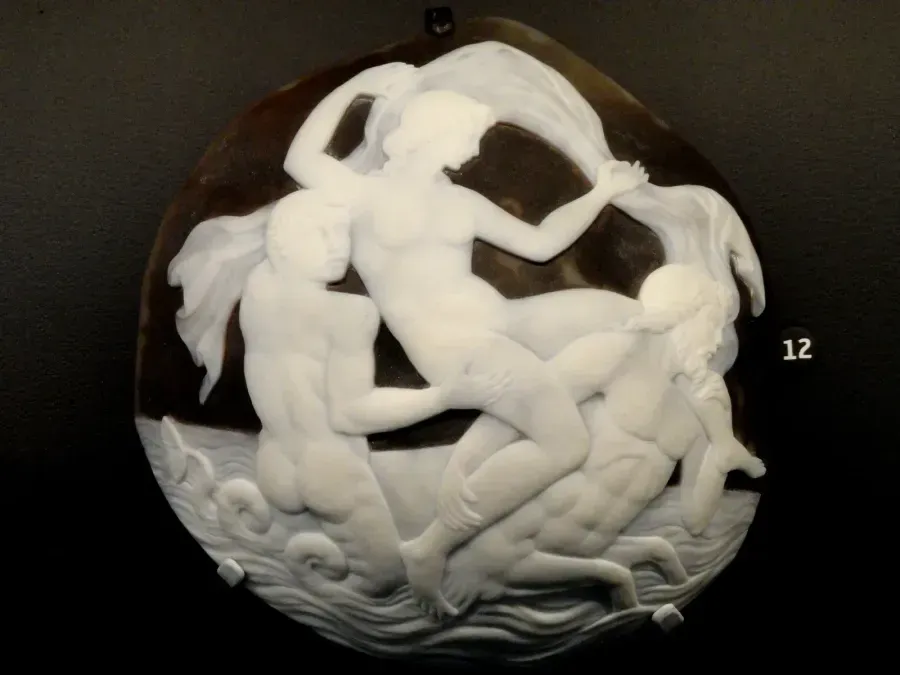
Carving in layered stone is an art in its own right, glyptics. The craftsman worked not with a brush but with a rotating tool and abrasive, taking the hard material away slowly and calculating in advance how the natural layers would fall. A mistake cost weeks of work and a piece of scarce stone. The finest sardonyx cameos rival miniature sculpture for delicacy: within a couple of centimetres the carver fitted a portrait with worked features and folds of drapery, using the shift from the dark layer to the pale one as ready-made light and shade. The distinction between the two techniques is simple to hold in mind: an intaglio is cut into the stone and was meant to leave a raised impression in wax, a cameo stands proud of the ground and was meant to be looked at.
The revival of interest in ancient glyptics
In the Renaissance, and again in the eighteenth century, collecting ancient gems became a fashion among the educated gentry. Old intaglios and cameos were gathered, set into rings and pendants, and copied. The British Grand Tour poured thousands of them into country houses, and casts of famous gems in sulphur or plaster were sold as sets so that a collector could study what he could not afford to own. That interest also spurred fresh carving: craftsmen repeated classical subjects on new sardonyx, and telling an ancient gem from a fine later copy can be difficult even for a specialist. Layered chalcedony proved once again that it is a material for both jewellery and serious art.
Facts about onyx that catch people out
A few things have piled up that upset the usual picture of the stone.
The name of onyx means fingernail
The Greek onyx translates as nail or claw. A pale translucent band on a dark ground reminded the ancients of the light showing through a fingernail against the skin beneath. In one legend a nymph trimmed the nails of the sleeping Aphrodite, and the gods turned the clippings into stone so that nothing belonging to the goddess should be lost. So the most down-to-earth-looking of stones turns out to have a fairly poetic pedigree.
Most black onyx is black by human hand
This is the most counter-intuitive fact of the lot. The coal-black, uniform onyx that many people take as the benchmark of the stone's natural beauty got its colour in a workshop rather than underground in the overwhelming majority of cases. Naturally pure black onyx is scarce. Which means the stone that looks the most natural is usually the one that has been enhanced.
The same stone answers to three different names
Onyx, sardonyx and agate are chemically one and the same substance, chalcedony. The only difference is the pattern and the colour of the layers. Straight black-and-white bands make onyx, straight red-and-white bands make sardonyx, concentric rings make agate. Change the geometry of the layers and the same mineral changes its name.
Onyx seals stood in for a passport and a signature
In Mesopotamia, Egypt, Greece and Rome a carved seal of layered chalcedony vouched for identity and property more reliably than any name on paper. Fine carving was hard to forge, and an impression in wax or clay was recognised at a glance. In effect a person carried a digital signature on one finger, thousands of years before anything digital existed. The habit outlived the ancient world: sealing letters with a signet was ordinary practice in Britain into the nineteenth century, and the wax seal only faded when the gummed envelope arrived.
"Onyx marble" is not onyx at all
Those translucent honey-coloured vases, table tops and boxes sold as onyx are not made of chalcedony but of banded calcite or aragonite. That is calcium carbonate, a soft stone of hardness 3 to 4, which a steel point will scratch and which fizzes when acid touches it. It is no relation to jewellery onyx; it inherited the name from the outward likeness of its bands.
Black with white in mourning came out of strict etiquette
The pairing of black onyx with white pearl, which reads today as universal elegance, was born from the rigid rules of Victorian mourning. Mourning ran in stages, each with its own permitted jewellery, and dark stones with pale accents were the fitting choice for a particular period. What began as a code of grief became, in time, simply a handsome contrast.
Onyx does not play with fire, and that is its strength
Transparent gems are faceted for the play of light. Onyx is opaque and has nothing to play with, so it is not faceted but polished into a smooth cabochon or plate. The paradox is that the absence of sparkle and flash is exactly what makes onyx so apt in severe, business and men's jewellery: it gives graphic line and depth rather than glitter.
FAQ: common questions about onyx
Is onyx a precious stone?
No, it is an ornamental (semi-precious) stone, a variety of chalcedony. It is more affordable than the classic precious stones, but it is beautiful and durable.
How does onyx differ from sardonyx?
In the colour of the bands. Onyx has black-and-white ones, sardonyx reddish-brown with white. In composition and hardness they are one and the same material, chalcedony.
What is the hardness of onyx?
6.5 to 7 on the Mohs scale. It scratches glass but is softer than sapphire and diamond. For everyday jewellery that is enough.
Can onyx crack?
Yes, under a hard blow or a sudden change of temperature, and the split most often runs along a layer boundary. With ordinary careful wear the stone lasts decades.
Is most black onyx dyed?
Yes, a large share of jewellery black onyx is treated (dyed) grey chalcedony. This is a long-standing and accepted method. The colour is stable and does no harm to the stone; the only thing that matters is that the seller does not hide it.
How do I tell onyx from black tourmaline and obsidian?
Tourmaline is a separate mineral, harder, often with lengthwise striations and no layers. Obsidian is volcanic glass, softer, with a glassy lustre and conchoidal fracture. Onyx usually shows parallel layers under a loupe.
Can I wear onyx in water, in the shower, the pool, the sea?
Water does the stone itself no harm, but chlorine and salt can affect the mount and the metal of the setting over time. Better to take the piece off before the pool and the sea.
What is the "onyx marble" in vases and table tops?
It is a different material, banded calcite or aragonite, soft (hardness 3 to 4). It does not belong to jewellery onyx-chalcedony, though the name is similar.
How do I clean onyx at home?
Warm water, mild soap, a soft brush or cloth. No ultrasound, no steam, no acids or solvents.
Is onyx suitable for women?
Yes. It is not a "men's only" stone: black onyx belongs in women's rings, earrings and pendants, especially in severe, contrasting looks with pearls or pale stones.
Buying it as a gift? Each one arrives ready to give.
 A branded Zevira box and a little card come with every order.






About Zevira
We make jewellery with onyx and sardonyx built for long wear: signets, sealing rings, bracelets and pendants in sterling 925 silver, with the option of engraving.
For us a stone is first of all a material with understandable properties, not a source of promises. We say honestly where the onyx is of natural colour and where it is treated chalcedony, we pick stones with an even polish and no cracks, and we set them in a mount that protects the vulnerable edges. We keep the engraving simple and legible, because that is how it looks best on onyx.
Open the catalogue of onyx jewellery
Signets, sealing rings and bracelets with natural black onyx and sardonyx, sterling 925 silver with the option of engraving.