Cameo and intaglio: the carved gem as portrait, seal and signature
A cameo and an intaglio are one craft turned inside out. On a cameo the image stands proud of the background; in an intaglio the design is cut down into the stone. The difference is the direction of the carver's hand, and the result is the opposite: a cameo is worn face up, while an intaglio was pressed into wax for centuries, and its impression stood in for a person's signature, seal and personal mark. One stone, two ways of cutting, and thousands of years of history fit onto a thumbnail.
The carved gem is the smallest of the great arts. The master worked without the magnification we take for granted, using tiny spinning drills loaded with abrasive, on stone harder than steel, and he saw the future portrait reversed, as a mirror image. Greeks and Romans rated a fine gem cutter above a painter, emperors kept private engravers, and in the neoclassical age anyone who came home from a tour of Italy carried a cameo as a trophy of taste. This article is about how to tell a cameo from an intaglio, a shell from an agate, hand carving from cast plastic, and how to wear an object that may be two thousand years old.
What a cameo is and what an intaglio is
Cameo: relief that rises above the ground
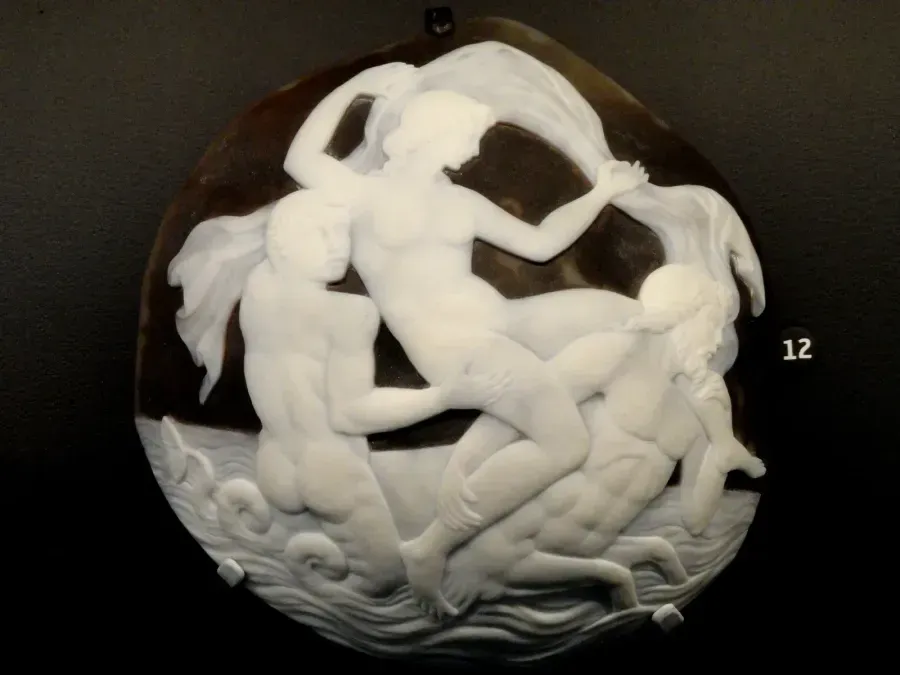
A cameo is a carved gem with a raised image. The cutter removes the background around the design, and the portrait, flower or figure lifts above the surface of the stone. The classic cameo is two toned: it is made from a layered material, where the pale upper layer becomes the image itself and the dark lower layer stays as the ground. A white profile against a deep brown or bluish field is the textbook look of a cameo, the one everyone recognises at a glance.
Work on a cameo runs from the top down. The cutter gradually shaves away the upper layer, leaving it only where the figure should be, feeling for the boundary between layers. The finer the transitions and the more shades a master can coax from the stone, the more the piece is valued. On the best ancient cameos in many-layered agate, figures are built up from three and four layers, like a painted scene rendered in relief alone.
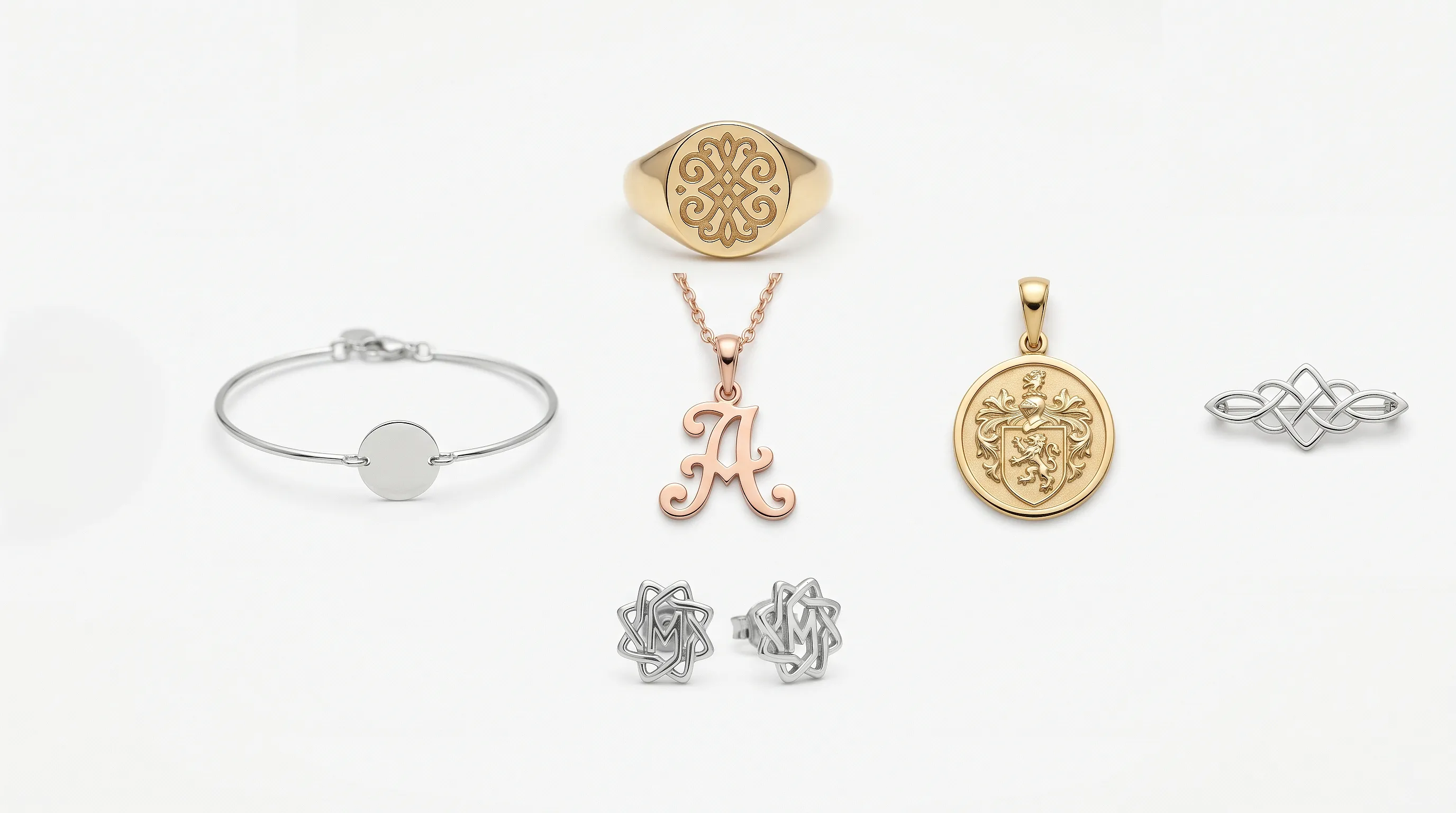
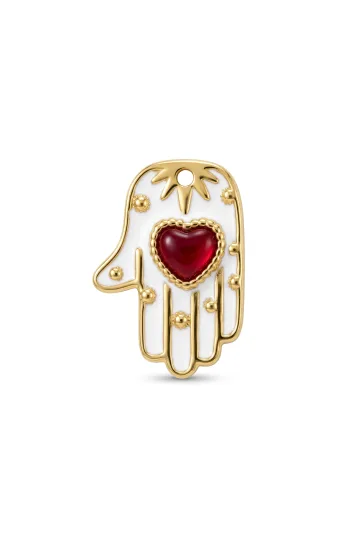
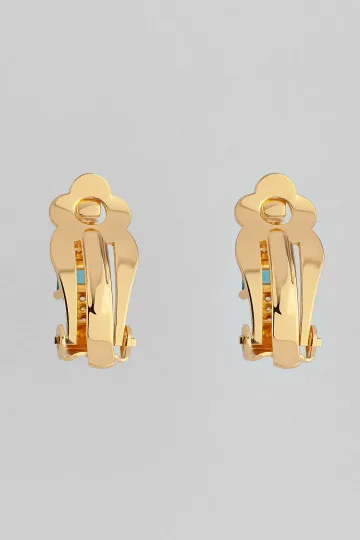
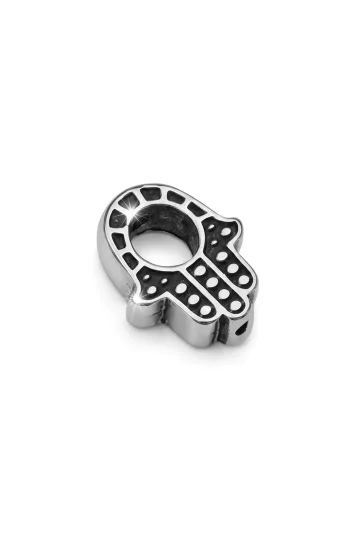
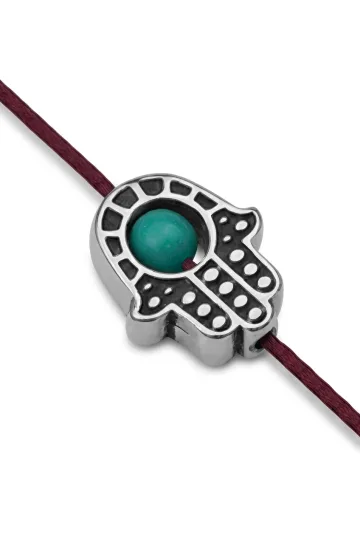
Wear the symbol, don't just read about it. These are in stock:



Intaglio: a design cut into the stone
An intaglio is the opposite of a cameo in technique. Here the image does not project but goes inward: the cutter shapes the stone so that the design is recessed, as if pressed into the surface. Hold an intaglio up to the light and you can see the lines hiding in the body of the gem. To the touch the surface stays flat or slightly concave, and the image reads through the play of light and shadow inside the hollow.
The point of an intaglio runs deeper than its beauty. The recessed design is conceived as a mould for an impression. Press an intaglio into soft wax or damp clay, and the imprint shows a raised mirror image, which is in effect a tiny cameo. This very ability turned the intaglio into a seal: it was cut in mirror reverse so the impression would read correctly, and worn on a finger or on a cord as a personal mark.
Gem, glyptic and sardonyx: the vocabulary of carved stone
To keep things straight, three words are worth separating. A gem is the general name for any carved precious or semi-precious stone, so a cameo and an intaglio are both gems. Glyptic is the art of carving stone itself, the trade of the gem engraver. And sardonyx is the favourite material of the classic cameo: a variety of agate with even, parallel bands of white and brown, ideal for two-toned relief.
In old collection catalogues a cameo is sometimes called carving in positive relief, and an intaglio carving in negative relief. The sense is the same: up or down. It is easy to remember. A cameo reads as a little hill, an intaglio as a little pit. Everything else in this craft grows out of that single fork.
Cameo versus intaglio: the real difference
The direction of the cut and how to check it with a finger
The most honest way to tell a cameo from an intaglio is to touch the gem with the pad of your finger. On a cameo the image is raised, and the finger feels the lift. On an intaglio the surface is smooth or hollowed, and the design feels like a dip. In soft light the difference shows to the eye too: a cameo casts its own shadow from the relief, while an intaglio plays with shadow inside the cut lines.
There is also a third, rarer technique worth knowing. Sometimes an intaglio is cut so deep and so fully that the figure inside the hollow becomes sculptural in its own right. Such work is called intaglio rilievato, carving inward with relief inside. This is the peak of skill, and it turns up mostly in museum pieces, but it shows just how thin the line between the two methods can be.
What a cameo was for and what an intaglio was for
Purpose separates these two objects more than anything else. A cameo was made to show: it is jewellery, a portrait, a ceremonial badge, a gift. It was set into rings, brooches, diadems and pendants with the carved face turned outward. An intaglio was made for centuries to conceal and to verify: a personal seal was hidden in a ring and brought out to close a letter, seal an agreement, or mark property.
From this comes a different fate. A cameo sits close to painting and sculpture, to the pure image. An intaglio sits close to the signature, to the legal act, to a person's identity. When the owner of a seal ring died, the ring was often destroyed or buried with him, so that no other hand could press his seal. Here the jewel was equal to the person.
Cameo, intaglio and engraving: how they differ
These three words get muddled constantly, although they stand for different crafts. Engraving is the cutting of lines and lettering into a finished metal or stone surface with a graver, and it stays shallow graphics: a monogram inside a ring, a date on a locket, a pattern on a watch case. Engraving does not model volume; it writes and draws across a flat plane. For a fuller account of what is put onto metal and how, there is a separate piece on engraving on jewellery.
A cameo and an intaglio are three-dimensional carving in stone, glyptic, not graphics on metal. A cameo builds a figure in raised relief from the layers of the material; an intaglio cuts it down into the stone for an impression. The difference is simple: engraving draws a line, a cameo lifts a form above the ground, an intaglio sinks a form into the stone. You sign a piece with engraving, decorate with a cameo, and stamp a seal with an intaglio. All three crafts often live in a single ring, but they should not be confused.
A cameo wants a black turtleneck, not your grandmother's lace. One to a look, and no arguments.
How and with what to wear cameo and intaglio
Over years on shoots the carved gem has moved through dozens of looks with me, from a formal brooch to a quiet signet. Here is what actually works, sorted by occasion and by type of piece.
Which format do I choose for which occasion? I match the format to the moment. For a formal entrance I recommend a cameo brooch at the throat or on the lapel: it pulls the eye and asks for plain, unpatterned clothing. A cameo pendant on a thin chain I suggest as the all-rounder, it works at the office, on a walk and under an evening dress. A signet ring with an intaglio I choose as a calm everyday mark that lives happily with a shirt or a jumper. The rule is simple: the larger the gem, the more formal the occasion.
How do I wear a cameo without looking dated? There is one cure I always come back to, and that is contrast. An antique profile comes alive on plain modern clothing: a black turtleneck, a denim shirt, heavy linen, a white tee. The stricter and cleaner everything else is, the more interesting the carving reads. A second vintage layer around the cameo, lace, ruffles, old silk, is exactly what ages it. I keep the cameo as the only antique thing among current pieces.
Which neckline and fabric do I pair it with? A cameo brooch wants support, so a heavy one I pin to firm material: tweed, wool, denim, dense cotton. Thin silk and knit hold only a light shell brooch, a heavy setting drags them down. A pendant I match to the neckline: on a V-neck the profile sits freely, on a closed collar it lands on the fabric and works as an accent button. A brooch is handy for pinning a scarf, a collar or a lapel.
What do I combine it with, and what do I take off? The carved gem does not tolerate a crowd, and that is the first thing I check. If you are wearing a cameo brooch, I suggest small, smooth earrings and a bare neckline. A cameo pendant allows at most a thin ring or modest studs. A signet ring with an intaglio I advise wearing as almost the only jewel on the hand. The metal of the setting sets the company: to a silver gem I add silver, to a gold one gold, and I do not recommend mixing them.
Who does the carved gem suit, and at what age? It has no age, and that is what I repeat most often. On a young person a cameo gives character if you wear it boldly, on denim and knit, not as a relic under the chin. On an older one it adds pedigree without fuss. Colour hints at the wardrobe: a pale stone cameo on a dark ground reads like a profile on a medal and befriends black and graphite, a pink-cream shell one is warmer and goes with beige and powder tones. An intaglio in a signet ring I recommend to anyone who prefers a discreet sign over a visible brooch.

Turn on your camera, pick earrings, a pendant or a ring, and see the piece on yourself in real time.
Switch items in one tap.
Everything runs in your browser: no photo or video is ever uploaded.
Customer reviews
Zevira is a real jewellery shop. Genuine payments, deliveries and customer thank-yous.
🥰🥰🥰 gracias

Ok, ¡gracias! 🙂

What cameos and intaglios are made from
Sardonyx and layered agate: the classic of the cameo
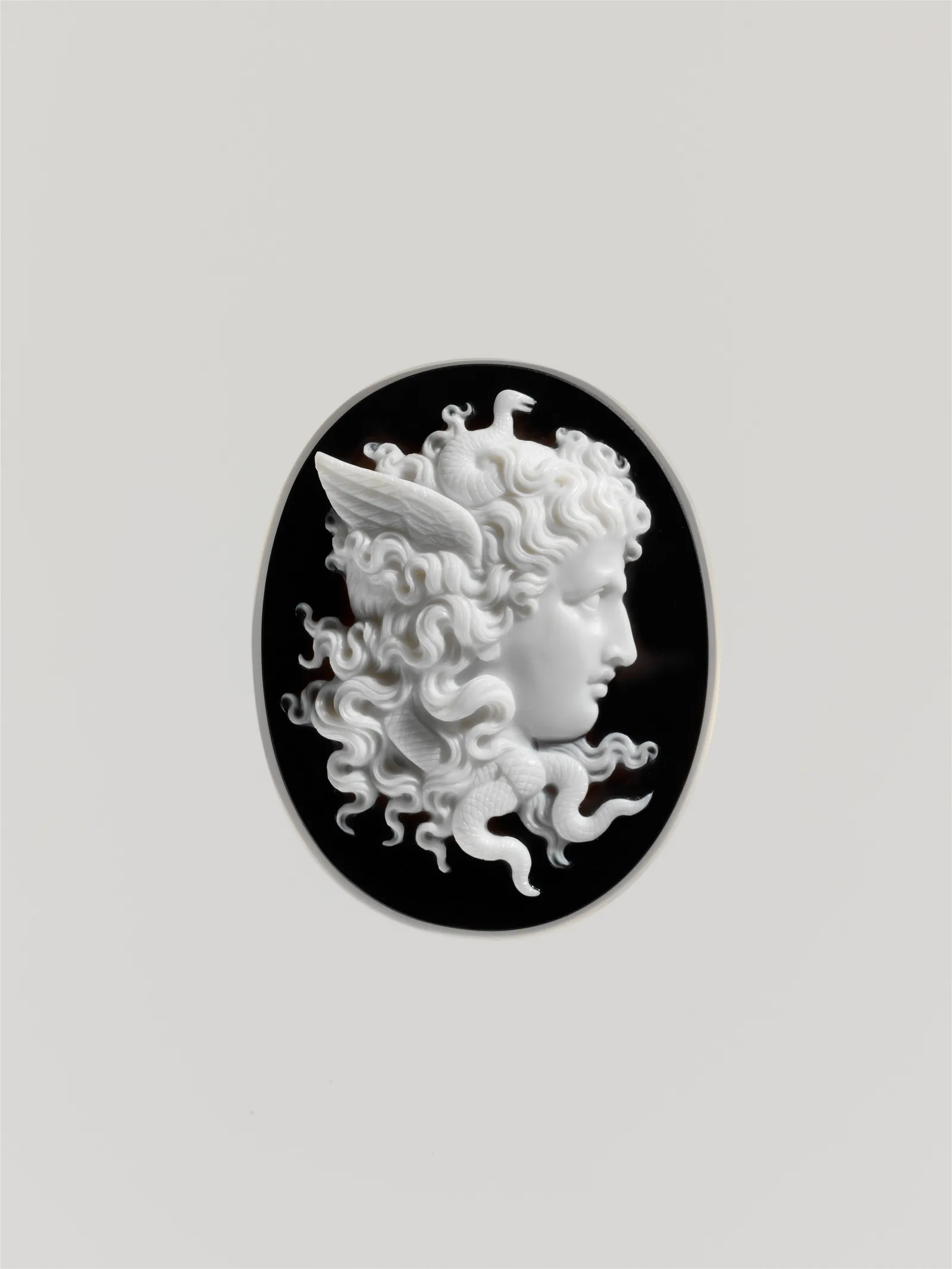
The main material of the stone cameo is sardonyx and its related layered agates. In them nature has laid down even, parallel bands of different colours: white, honey, brown, sometimes greyish or bluish. The cutter chooses a piece where the bands sit conveniently and shaves off the top layer so that the pale figure rises above the dark ground. The cleaner the boundary between layers and the more contrast between the colours, the more expressive the cameo.
Layered agate is hard, around seven on the Mohs scale, and so it barely fears scratches or time. Ancient agate cameos reach us in fine condition precisely because the stone is so hard. For more on how the bands work and the kinds of this stone, there is a piece on agate and all its varieties. For a cameo what matters most is even, parallel layering, so the finest pieces of sardonyx were prized apart from ordinary agate.
Shell: a light cameo for every day
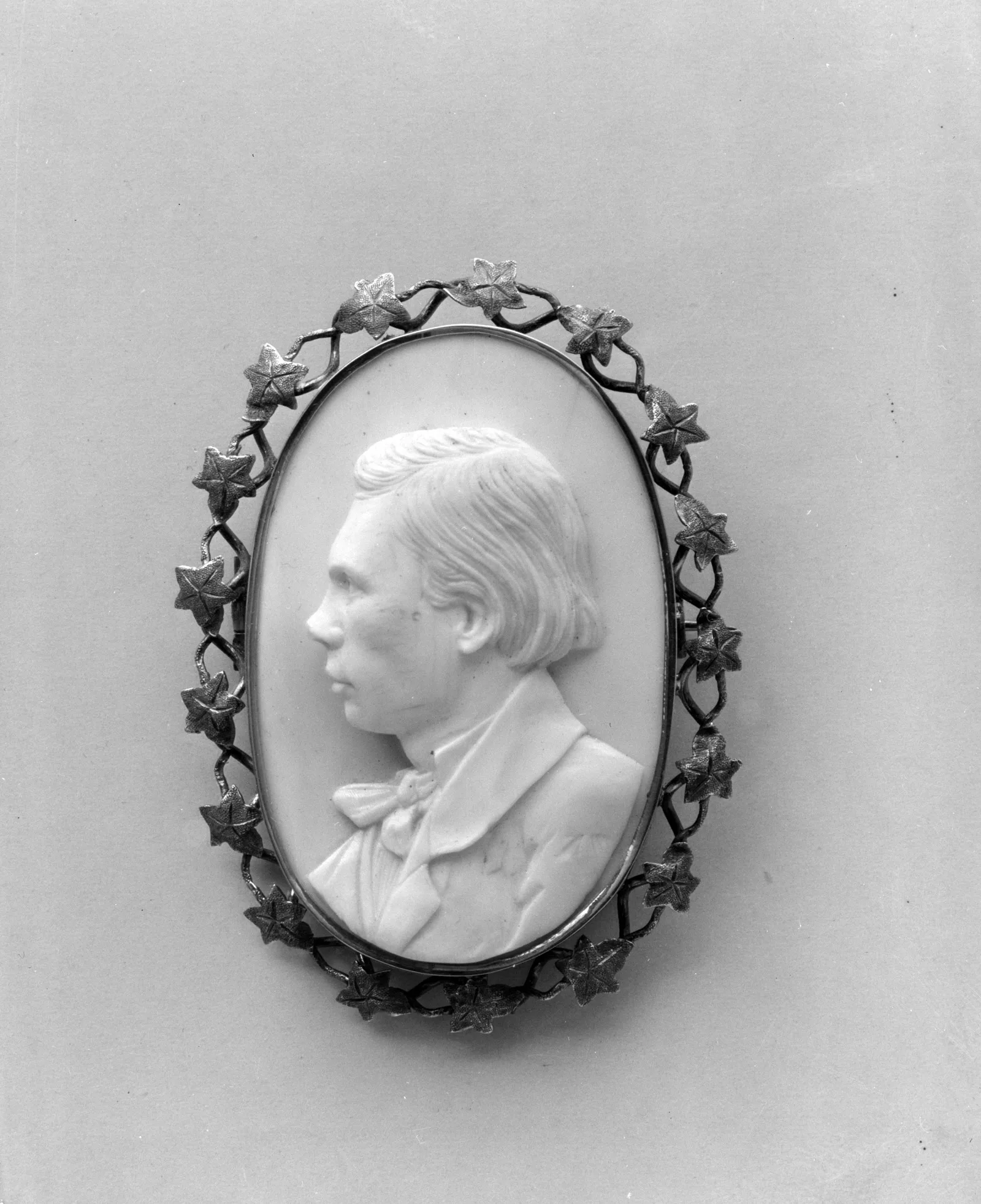
The shell cameo, as it is known, was born from the same idea of layers. The wall of a large sea shell is made of a pale outer layer and a darker inner one, and the cutter uses that step exactly as the bands of agate are used. Most often the shells of big tropical molluscs were used, with a pinkish-cream top and a brown-orange base. From them carvers cut profiles, bouquets and scenes, most of all in the nineteenth century around Naples.
Shell is softer than stone, cuts faster and costs less, which is exactly why it made the cameo affordable to a wide public. Lightness is a plus for a large brooch: a stone cameo of the same size would weigh noticeably more. The drawback is the same as with any soft material: shell fears knocks, drying out and acids. How to tell a shell cameo from a stone one gets its own section below, because the two are confused all the time.
Lava, coral, jet and amber: coloured gems
Beyond agate and shell, cameos were carved from a host of soft and coloured materials. In the nineteenth century lava became hugely popular: from the volcanic tuff around Vesuvius carvers cut cameos in grey, olive, cream and pinkish shades, and travellers happily brought them home from Italy. Lava holds fine detail and gives deep relief because it is soft and even.
Coral gave cameos in tender pink and deep red tones, very feminine and costly. For what makes noble red coral so prized and how to recognise it, there is a separate piece on luxury red coral. Jet, a black fossilised coal, went into mourning cameos with a strict silhouette, especially during the general fashion for mourning dress. Amber, mother of pearl, ivory in old pieces, turquoise and onyx also became gems. Each material dictated its own colour and its own theme.
Glass and casting: imitations old and new
Imitating a gem began back in antiquity. The Romans already cast cameos and intaglios from coloured glass, sometimes in two layers, to repeat the effect of sardonyx. Such glass gems were made in moulds in quantity and sold to those for whom real carved stone was out of reach. The eighteenth century brought the famous casts and composite glass pastes that copied ancient gems in whole series for collectors.
Modern imitations go further: cameos are stamped from plastic, resin and pressed powder, cast from composites in imitation of shell and agate. A cast piece carries no marks of the graver; the relief is soft and melted-looking, ground and figure are one material, with no honest boundary of layers. Telling a cast cameo from a carved one is not hard once you know the signs, and there is a whole chapter on this. Imitation is no sin in itself, but the price of carved stone and of cast plastic ought to differ as an original differs from a print.
Stone for the intaglio: hard gems made for sealing
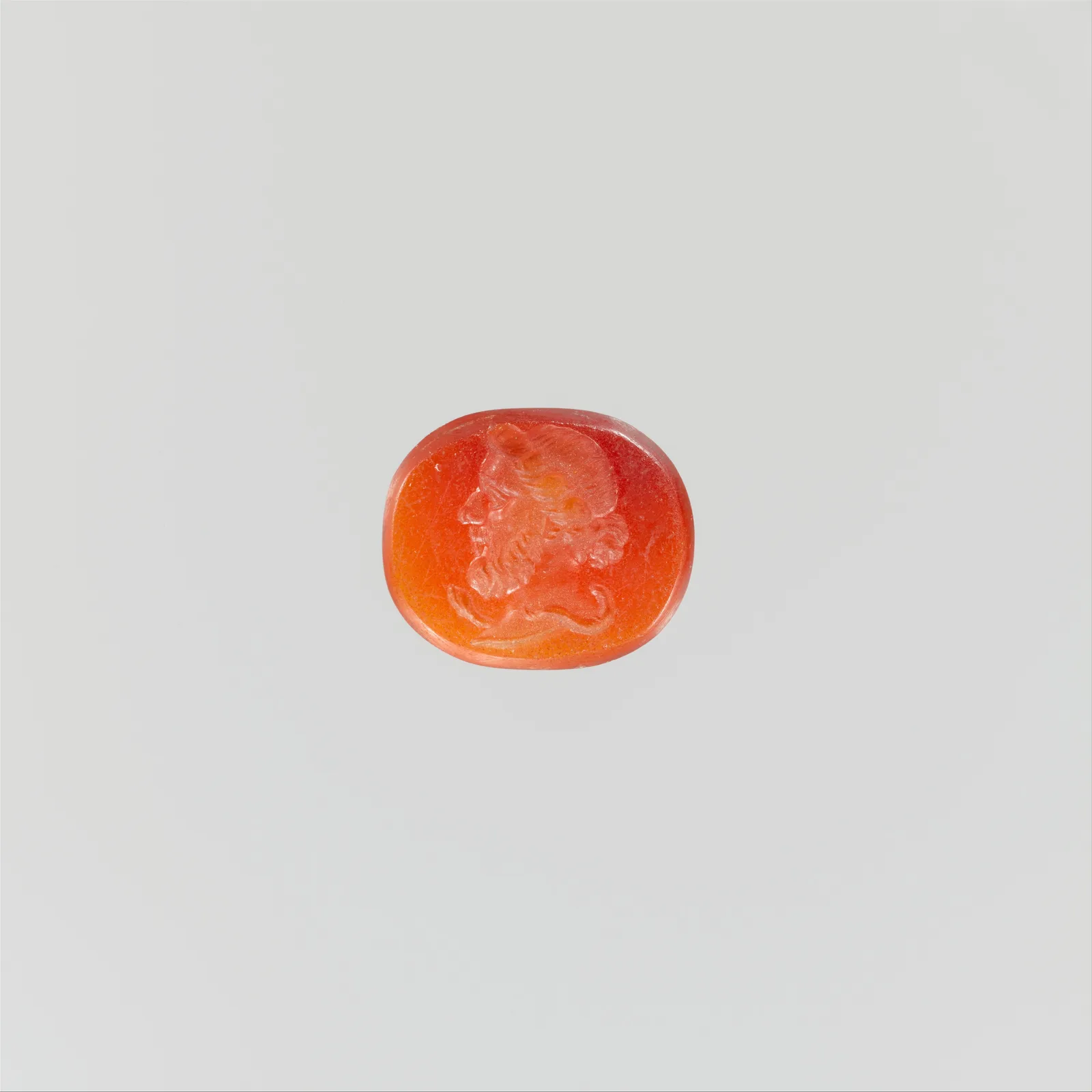
The intaglio was carved from harder and nobler stones. The favourite materials for seals were carnelian, a warm red-orange chalcedony, onyx and sardonyx, garnet, amethyst, rock crystal, bloodstone, and among the wealthiest patrons emerald and sapphire. Carnelian was prized above all: its smooth, dense surface released the wax impression cleanly without sticking, and so carnelian signet rings spread across the whole ancient world. For more on the dark layered stones used in signets, there is a piece on onyx in jewellery.
Hardness mattered more than colour for the intaglio. A seal had to take daily impressions for years without wearing down, so the stone chosen was tough, around seven on Mohs and above. Soft materials such as shell and lava were almost useless for a seal intaglio; they wore smooth too fast. So the material itself split the craft: the soft went into the showy cameo, the hard into the working seal.
Upload a photo of your pet, someone you love, or an object. We'll build a 3D model and hand-cast it in pewter.




The history of the carved gem: from Sumer to neoclassicism
The earliest seals: the gem as a personal mark
People began carving stone for impressions before writing existed. In Mesopotamia, several thousand years before our era, cylinder seals were in use: a tiny carved stone roller was rolled across damp clay, leaving an unbroken frieze on the tablet. This is intaglio in its purest form, carving inward for the sake of an impression. The seal was worn on a cord; it verified the owner's identity and closed deals. The idea of a personal mark cut into stone was born here.
In Egypt the same role was played by the scarab: a beetle carved from stone, with an intaglio on its flat underside. It was set into a swivel ring, and when needed it was turned carved-side out to seal a document. From the very start the gem was at once a piece of jewellery and a legal instrument, an extension of a person's hand and name.
Greece: the cameo is born, the intaglio flourishes
Classical Greece raised stone carving to a great art. Greek masters cut the finest seal intaglios with gods, heroes, animals and scenes from myth, and signed the best of them with their own name, like painters. It was with the Greeks that the set of subjects took shape that would be repeated for two thousand years: profiles of goddesses, heads of heroes, figures in motion.
The cameo as raised relief appears in the Hellenistic age, after the campaigns of Alexander, when many-layered Indian agate reached the carvers' hands. From it they began to cut raised portraits of rulers and allegories. The most famous large cameos of this time are complex multi-figure scenes glorifying dynasties. The cameo became a ceremonial, courtly object from the outset, unlike the working seal intaglio.
Rome: the seal in place of a signature
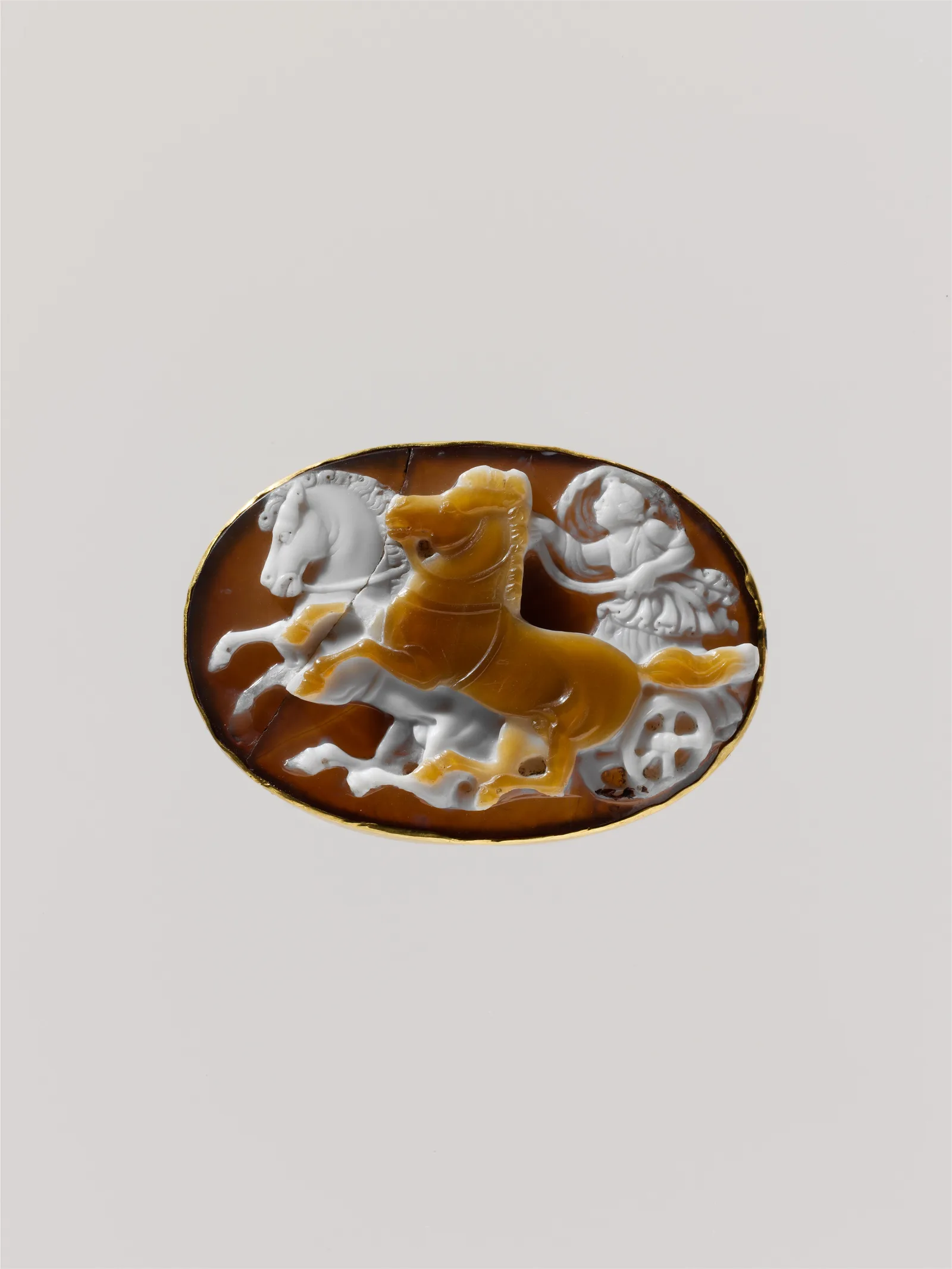
Rome made the intaglio part of everyday life for any free person of means. A signet ring with a carved gem was a must: with it people sealed letters, witnessed wills, marked storerooms and amphorae. The impression of an intaglio in wax or clay stood in for a signature, since not everyone could read or write, and a recognisable personal mark worked without fail. Forging another's seal counted as a grave crime.
The subjects of Roman intaglios make up a whole world: patron gods, symbols of luck, portraits, mottoes, erotic scenes, talismans for health and love. The cameo flourished among the Romans too: court masters cut portraits of emperors and their families from sardonyx, and such cameos were given as a token of favour. The gem was at once jewellery, amulet, document and badge of status, all in a single ring.
The Middle Ages and the Renaissance: a second life for ancient gems
After the fall of Rome the art of carving did not vanish, but it changed. In the Middle Ages ancient gems were prized as wondrous stones and were often set into crosses, book covers and reliquaries, with their subjects not fully understood. A pagan Jupiter might be taken for a saint, and a Medusa for a protective amulet. An old intaglio was sometimes reread anew, with a Christian symbol carved over it.
The Renaissance, with its cult of antiquity, gave stone carving back its old shine. Humanists collected ancient gems, and masters again cut cameos and intaglios in the antique spirit for popes, dukes and kings. Famous collections arose, whole cabinets of carved stones. The cameo became an emblem of learned taste, a sign that its owner understood antiquity and collected it in earnest.
The Grand Tour and neoclassicism: the cameo as a souvenir of taste
The eighteenth and nineteenth centuries were the golden age of the cameo in jewellery. Young aristocrats travelled on the Grand Tour through Italy and Greece and brought back carved gems as the obligatory trophy of an educated person. The excavation of ancient cities kindled a universal passion for antiquity, and the cameo in the neoclassical spirit came into fashion everywhere: profiles of goddesses, antique heads, mythological scenes.
Demand bred mass production. Around Naples and in Rome whole workshops cut shell and lava cameos for sale to travellers. Cameos were worn in brooches, bracelets, diadems, rings and belt buckles. Crowned heads of that era collected gems and commissioned ceremonial parures with cameos, and the whole nobility followed. By the end of the nineteenth century the shell cameo had become an affordable piece for the middling sort, and in that form it has survived to our day.








The subjects of carved gems: what was depicted on them
Profile and portrait: a face turned to the side
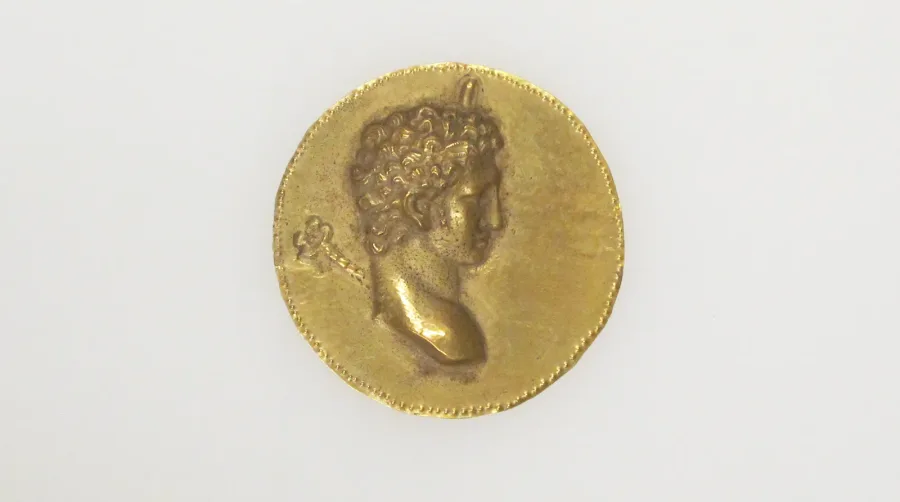
The most recognisable subject of a cameo is the profile, a human head turned sideways. The habit comes from ancient coins and seals: a profile reads more clearly than a full face, it is easier to carve with character, and it gives the features without distortion. On neoclassical cameos the profile is most often an idealised female or male head in the antique spirit, with no particular name, as an image of beauty in general.
But the cameo could also be an exact portrait. Carvers immortalised rulers, relatives and loved ones in stone. To commission a cameo with your own profile was to declare your standing, since carving in hard stone was costly and took weeks of work. The portrait cameo was a kind of stone photograph long before photography: a small profile meant to outlive its owner.
Goddesses and heroes: the antique pantheon in stone
Mythological subjects held their place in carving for millennia. Cameos and intaglios were peopled by gods and heroes: a winged goddess of victory, the god of love with his bow, a wise warrior maiden in her helmet, sea nymphs, centaurs and winged horses. These images were understood without a caption across the whole ancient world, which made them perfect for a small gem where there is no room for words.
In the neoclassical age this pantheon returned as a language of good taste. A cameo with a goddess said that the owner knew mythology, understood antiquity and belonged to high culture. The subjects repeated famous ancient gems known through prints and casts, and an educated person could recognise exactly which ancient piece a brooch cameo was copying.
Flowers, allegories and secret signs
Not everything in carved gems was about gods. A large body of subjects was flowers, baskets of fruit, allegories of the seasons and the virtues, cupids busy at one thing or another. Such cameos were given for betrothals, weddings and births, with a clear wish folded into the subject: faithfulness, fertility, love, luck.
The seal intaglio often carried a secret or private meaning. A motto, a monogram, a rebus, an image that only two people understood. The gem became the keeper of a secret, a little cipher that the owner pressed into wax every time a letter was closed. In this the carved gem comes closest to what we put today into a personal engraving.
How to tell hand carving from a cast imitation
Layers: an honest boundary of colour against a painted mass
The first sign of a real cameo is the layers of the material. In a carved cameo of sardonyx or shell, the figure and the ground are different natural layers of the stone, and the boundary between them runs exactly along the contour of the relief: where the pale layer ends, the white figure ends. The colour here belongs to the material itself, all the way down. In a cast imitation the figure and ground are usually one mass, and the two-tone effect is painted or achieved by tinting the surface, so a bevelled edge shows the same colour under the white layer as in the ground.
You can check this on the edge and on any chips. On a real gem the bands continue inward in even stripes on the side cut. On painted plastic or pressed powder the colour sits only on the top, while the mass inside is uniform. This test is almost foolproof for stone and shell cameos.
Under a loupe: marks of the graver against melted casting
Take a loupe and look at the relief up close. A hand-carved cameo carries the tool's marks: crisp edges, tiny parallel scratches from the spinning drill, a slight unevenness, a living asymmetry to the face. Each such piece differs a little from the next, because a hand carved it. A cast cameo, by contrast, is melted-looking and smooth: the edges are rounded, the details blurred, the surface as if half-thawed, and two cameos from one mould are absolutely identical.
Another sign of casting is the marks of the mould. Around the edge of a cast piece a thin seam often remains, the joint line of the two halves of the mould, or a round trace of the sprue, the spot where the mass was poured. On a carved gem such marks cannot exist in principle. Air bubbles inside a semi-transparent material also give casting away: natural stone has none, while resin and glass set with bubbles frozen inside.
Warm, cold, light: tests for the material
The simplest tests help identify the material. Real stone and shell feel cool against the skin and warm slowly in the hand, while plastic warms almost at once. A stone cameo is noticeably heavier than a shell or plastic one of the same size. Shell, held up to the light, shows a fine layered structure and sometimes small natural irregularities on the reverse.
Ring and hardness give hints too. Stone does not scratch with a needle and, tapped gently against a tooth, feels like stone, dense and dull. Plastic is softer, easy to scratch in a hidden spot, and different to the touch. No test should be done roughly on the face of an old piece, but from the edge, the mount and the weight a trained eye reads the material fast. And the main rule: an honest seller of a carved gem is happy to explain what it is and how it was made.
Shell cameo against stone cameo
These two are confused most often, so they deserve their own comparison. A shell cameo is lighter, a touch warmer to the touch, and when viewed from the side or against the light it shows the characteristic thin layering of the shell wall, sometimes with a slight curve, since a shell is not flat. Its colours are soft: a cream top, an orange-brown base. The back of a shell cameo often shows a slightly concave or wavy reverse with a natural texture.
A stone cameo of sardonyx is heavier, colder, harder and does not scratch. Its layers are strictly parallel and flat, the colours can be sharper and more contrasting, right up to an almost black ground with a snow-white figure. The back of a stone cameo is usually polished flat or left matte and flat. Shell is cheaper and more dressy in everyday wear, stone is dearer, tougher and more durable. Both can be of fine work, and both can be crude: the material does not equal the quality of carving, these are two independent things.
Leave your email, we'll send your discount code. No spam, unsubscribe anytime.
The code arrives by email, valid on your first order.
Signet rings with intaglio and how gems are worn
The signet ring: the intaglio at work
The classic home of the intaglio is the signet ring. The carved gem was set into a massive mount with the flat carved side facing out, and the owner wore a ready-made stamp on the finger. To make a seal, the ring was pressed into melted sealing wax or soft wax on a letter, leaving a raised impression with a coat of arms, monogram or figure. The signet was a deeply personal thing, rarely taken off and almost never lent.
This tradition survives to our day in men's and women's rings with a crest or monogram. The modern signet is more often decorative, but the idea stays the same: a mark that belongs only to you. For how this piece is built and who it suits, there is a piece on the women's signet ring. The intaglio in a ring is the most honest, working form of the carved gem.
Brooch, pendant, bracelet: the cameo on show
The cameo, unlike the intaglio, was always worn face out and large. Its most classic home is the brooch: an oval mount with a profile, pinned at the throat or on a lapel. The cameo was also set into pendants on a short chain, into link bracelets where several small cameos ran in a row, into rings and into diadems for ceremonial occasions. The larger the cameo, the more dressy the piece.
Today the cameo is worn more freely than a hundred years ago. A small cameo pendant on a fine chain looks modern and not at all museum-like. A cameo brooch is pinned to a jacket and a coat, to a scarf, to a bag strap. A vintage cameo can be worn as a family heirloom, playing on the contrast of an antique profile with simple modern clothes. The one rule: a cameo likes to be the single noticeable jewel, with no chorus of rivals beside it.
Who suits a carved gem and with what
The cameo is universal in age: a profile on a brooch suits a young woman equally well, as a bold vintage note, and a mature woman, as a mark of taste. A pale cameo on a dark ground looks especially fine on plain dark clothing, where the profile reads like a face on a medal. A pink-cream shell cameo is warmer and softer, and it gets on with beige, coffee and powder tones. A contrasting stone cameo is stricter and more dressy.
A man is closer to the seal intaglio: a ring with a recessed gem, carnelian or onyx, looks restrained and solid, without any femininity. A jet or onyx cameo of strict silhouette also sits well in a man's ring or cufflinks. The carved gem asks for no rich setting: its value lies in the carver's hand, not in carats, so it suits plain silver and gold alike.
CAPAORA mini knife pendant
The 18th-century Spanish navaja in miniature: 40 mm of stainless steel, a real folding mechanism and a Palanquilla lock that clicks. An affordable gift to remember.
Authentic · Ships from Spain · 14-day returns
Care for the carved gem and its collectible value
What soft gems fear
The chief danger to a cameo is a knock and a fall. Shell, lava, coral and jet are soft and brittle, and a fine relief chips easily against a hard surface. Take a cameo off before sport, cleaning and sleep, and store it separately so that other jewels do not scratch its relief. A stone cameo of agate is tougher, but its raised profile too is vulnerable to a direct blow on the highest point.
The second enemy is chemicals and dryness. Acids, household cleaners, perfume, hairspray and chlorinated water eat into shell, coral and amber, leaving the surface cloudy and rough. Put a cameo on last, after scent and make-up. Shell and amber also fear drying out: the dry heat of radiators and direct sun crack them. A shell cameo is sometimes wiped lightly with a soft oil to bring back its full lustre, but without going overboard.
How to clean and store
Clean a carved gem gently: a soft damp cloth or a cotton bud, slightly warm water, at most a drop of mild soap, then dry at once. No ultrasonic baths, steam cleaners, alcohol or abrasive pastes, especially for shell, coral, lava and amber. Dirt is picked out of the hollows of the relief with a soft brush. A stone cameo and intaglio take cleaning more easily, but ultrasound is against them too if the stone is cracked or old.
Gems are best stored separately, in soft pouches or compartments, relief upward, away from radiators and sun. An antique cameo in a thin mount is worth showing to a jeweller from time to time: a mount works loose over the years, and the stone can drop out. A well-cared-for carved gem lives for centuries, and many ancient gems have reached us in full condition precisely because they were guarded across generations.
What sets the collectible value
In a carved gem it is the carver's work that is valued above all. The fineness of the relief, the number of layers used, the expressiveness of the face, the cleanness of the line are worth more than the material itself. An ancient or Renaissance gem with a known provenance and a traced history of ownership is valued as a work of art, not as a stone. A master's signature on an intaglio or cameo sharply raises its standing.
Next come the material, the condition and the mount. A stone cameo of fine-layered sardonyx is dearer than a shell one, a whole one dearer than a chipped one, one in its original old mount dearer than a reset one. Glass casts and pastes of the eighteenth century are also collectible, but as reflections of the originals. Modern cast plastic, by contrast, carries almost no collectible value; it is simply jewellery. When buying an old gem in earnest, it is worth asking for a report: what material, which era, whether there has been restoration.
Facts that surprise
The carver worked blind and in reverse. The seal intaglio was cut in mirror image so the impression would read correctly, and the master cut every inscription back to front, holding the future result only in his head.
A cameo was sometimes built from several layers, like a painting. On the best ancient agate cameos the master drew out three, four and more coloured layers, making a multi-coloured scene from a single piece of stone in pure relief, without a drop of paint.
The signet ring was buried with its owner or broken. Because the impression of an intaglio stood in for a signature, after the owner's death his seal was often destroyed so that no stranger could close a document in his name.
Whole libraries of casts were sold like postcards. In the eighteenth century collectors bought up sets of thousands of sulphur and glass casts of ancient gems, to keep the whole of world glyptic in miniature at home without owning a single original.
Lava for cameos was carved straight from cooled Vesuvius. The grey and olive lava cameos, the favourite souvenir of the Grand Tour, were made from the volcanic tuff of the Naples region and sold as a piece of a real volcano on a brooch.
The scarab was a swivel seal. The Egyptian scarab ring could turn: the beetle on top as an amulet, and flip it over and below was an intaglio, a seal ready to use. One object, two functions, charm and signature at once.
The profile beat the full face for reasons other than beauty. The head on a gem and a coin was cut sideways because a profile makes it easier to give the features accurately in small relief and easier to read from afar, not for the sake of a beautiful pose.
The Romans already knew how to make a glass cameo. Two-layered blue and white glass imitating sardonyx was cast in moulds by Roman masters two thousand years ago, so the imitation of a carved gem is almost as old as the gem itself.
Send a friend a discount code, they save on their first order.
Frequently asked questions
What is the difference between a cameo and an intaglio in plain words?
A cameo is raised relief: the image stands above the ground, like a little hill, and is worn face out as jewellery. An intaglio is recessed carving: the design is cut down into the stone, like a little pit, and is meant for an impression, like a seal. One craft, two opposite directions of the graver.
How does a cameo differ from engraving?
Engraving is shallow lines and lettering cut with a graver into a finished surface of metal or stone, graphics across a flat plane. A cameo is three-dimensional carving in stone, where the figure rises above the ground in relief. You sign and decorate a flat surface with engraving; a cameo builds volume.
How can I tell whether a cameo is shell or stone?
A shell cameo is lighter, a touch warmer to the touch, shows the thin layering of the shell wall against the light, and often has a concave, uneven back. A stone cameo of sardonyx is heavier, colder, harder, does not scratch, its layers are strictly parallel and flat, and its colours can be sharper, right up to a black ground with a white figure.
How do I tell a real cameo from a plastic one?
In a carved cameo the figure and ground are different natural layers of the material, the colour boundary matches the contour of the relief, and under a loupe you can see the marks of the graver and a living asymmetry. A cast cameo is uniform in its mass, its two-tone effect is on the surface, the edges are melted-looking, a seam from the mould may run along the edge, and air bubbles can sit inside a semi-transparent material.
Can a cameo be worn every day?
A stone cameo of agate can be worn often, since it is hard and barely fears scratches, though it should be guarded from direct blows to the raised profile. A shell, lava, coral or jet cameo is better kept for going out and protected from knocks, chemicals and dryness, because these materials are soft and brittle.
What should I clean a carved gem with?
A soft damp cloth or a cotton bud, slightly warm water, with a drop of mild soap if needed, then dried at once. Dirt is picked out of the hollows of the relief with a soft brush. Ultrasound, steam, alcohol, abrasives and harsh chemicals are forbidden, especially for shell, coral, lava and amber.
How much does a real carved cameo cost?
The price depends less on the material than on the carver's work, the era and the condition. A simple modern shell cameo is as affordable as an ordinary brooch, while an antique stone cameo of fine work with a traced history sits in the range of a serious investment piece. A cast plastic cameo carries almost no collectible value; it is simply jewellery.
Is the cameo only a woman's jewel?
No. A cameo with a profile is more often worn by women, but a strict cameo of jet or onyx looks fine in a man's ring or cufflinks. And the seal intaglio was historically a man's jewel altogether: a ring with a recessed carnelian or onyx gem looks restrained and solid and suits a man without any femininity.
The short version
A cameo and an intaglio are two sides of one ancient craft. A cameo lifts the figure above the ground in relief and lives as jewellery; an intaglio cuts the design down into the stone and served for centuries as a seal, standing in for a signature. They are easy to confuse with engraving, but engraving only draws lines across a flat plane, while carving in stone builds volume. A stone cameo of sardonyx is tough and precious, a shell one light and dressy, lava, coral and jet give colour, and to tell hand work from cast plastic the layers, the edge and a loupe will help. The carved gem asks for no rich setting: all its value lies in the hand of the master who cut a face the size of a fingernail and made it outlive the centuries.
Silver, stones with a history, carved motifs, signets, brooches and pendants with character.
Buying it as a gift? Each one arrives ready to give.
 A branded Zevira box and a little card come with every order.














About Zevira
Zevira is a Spanish brand from Albacete, a city of metalworkers. We love things with a history: carved motifs, coloured stones, signets and symbols with a past. If the idea of a personal mark on a jewel appeals to you, start with the piece on engraving on jewellery, and for the stone of the classic cameo there is the piece on agate and its varieties.