Hermes (Mercury) in Jewelry: The Caduceus, Winged Sandals, and the Symbol of the Road
Of all the gods of Olympus, only Hermes wore shoes with wings. The image proved so durable that twenty-five centuries later it still appears on the emblems of postal services, flower delivery companies, and chambers of commerce around the world. The little staff with two snakes that Hermes carries is still confused with the medical symbol. Let us look at where this god of speed came from and why his attributes settled so well into metal.
Hermes to the Greeks and Mercury to the Romans is one and the same character: quick, deft, charming, slightly roguish, the patron of merchants, travellers, orators, and lucky deals. In jewellery he lives less through his face than through the things he carries: the caduceus staff, the winged sandals, the traveller's hat. These attributes read instantly and work as a personal mark for anyone who travels a great deal, negotiates, and earns a living through words.
Here is the order of what follows: who Hermes and Mercury are, how the image passed through gems, coins, and neoclassicism, what each of his symbols means, why the caduceus is not the rod of Asclepius, how the Greek Hermes differs from the Roman Mercury, what such jewellery is made from, and whom it suits.
Who Are Hermes and Mercury
Hermes is an Olympian god, the son of Zeus and the Pleiad Maia. The Greeks gave him several trades at once that seem poorly matched at first glance: commerce and theft, roads and borders, eloquence and cunning, dreams and the passage of souls to the realm of the dead. There is a logic to it. All these occupations concern movement, the crossing from one state into another, the ability to come to terms where others lose their footing.
The God Who Mediates Between Worlds
Hermes' main role is that of go-between. He is the only god who moves freely among Olympus, the earth, and the underworld. Zeus sends him on errands because Hermes will reach anywhere and come back. Hence his title, messenger of the gods. In a piece of jewellery this idea reads as the ability to connect, to relay, to find common ground. A good talisman for anyone whose work rests on negotiation and contacts.
Wear the symbol, don't just read about it. These are in stock:



Patron of Trade and Profit
Hermes presided over the market, over exchange, over the honest and the not-so-honest deal. The Greek word for profit was tied to his name. Merchants made offerings to him before a long journey and after a good sale. The Romans pushed this to the limit: their Mercury is outright the god of commerce, his name traced to a Latin root connected with goods and trade. People prayed to Mercury for a favourable rate, for profit, and for fast money.
Guide of Souls
Hermes also has a quiet, serious side. He is the psychopomp, the guide of the dead to the river of the underworld. Staff in hand, he escorts souls to the place from which none return. This role lends the image depth: a god of both the bustle of the market and the final road, of the crossing as such. In memorial symbolism this facet sometimes comes to the fore.
Messenger of the Gods
Hermes' most famous office is stated in a single word: messenger. Zeus kept him close as his personal courier and sent him with errands to gods, heroes, and mortals. Hermes delivered the will of Olympus, brought news, and settled matters by his mere arrival. The Greeks pictured him in this role most often of all: a youth halfway along the road, in winged sandals, with a staff that is about to dart onward again. As a symbol it stands for the one who passes things on, who connects, who carries a thought to its addressee. The image speaks to everyone whose work rests on message and delivery: from the courier to the person carrying an idea to a wide audience.
Patron of Travellers
The road was Hermes' domain in the most literal sense. His herm pillars stood along the highways and at crossroads, and a traveller would bow to them before a long journey and toss a stone at the base for luck. The Greeks believed that an encounter on the road and a happy find underfoot were a gift from Hermes. For this reason his sign was worn from ancient times as a road charm: a wish for an easy path and a safe return home. This facet links Hermes with the modern travel talisman, and it is the one most often poured into a winged sandal on a chain.
Patron of Thieves
Among Hermes' trades there is a shadowy one too: he is the patron of thieves, rogues, and sly tricksters. The Greeks saw no contradiction in this. The god who himself rustled a herd on his first day of life presided over everything gained by cunning and sleight of hand. Thieves did indeed pray to him before a job. But the meaning runs wider than plain theft: it is patronage of resourcefulness, of the ability to get one's way by a roundabout route where force is useless. In the symbol this facet reads as respect for a nimble mind, not as a justification for stealing.
Patron of Eloquence
Hermes also presided over the word. The Greeks held him to be the god of orators, interpreters, translators, and envoys: of all who work through speech and persuasion. The logic is the same as before: a mediator between worlds must know how to convey meaning, to translate the language of the gods into the language of mortals. The very name for the art of interpretation comes from his name. Seen this way, the sign of Hermes suits teachers, diplomats, negotiators, and everyone whose strength lies in the ability to explain and convince.
The History of the Image: From Ancient Gems to the Postal Emblem
Hermes is one of the earliest figures that people began to carry on themselves. His image passed through carved stones, coins, Renaissance medals, and finally settled on the signs of banks and post offices. Let us trace that path.
Herms: Roadside Pillars with the Face of the God
Before Hermes became a slender youth with wings at his heels, he was a rough stone pillar. Herms are four-sided columns with the head of the god on top, set up at crossroads, at the entrances of houses, and along the roads. They marked a boundary and brought luck to the traveller. The word herm itself gave names to many things, and from it runs a thread to the idea of a boundary marker. A small pendant in the shape of a herm is a nod to the most ancient, roadbound form of the god.
Gems and Intaglios: The God in Carved Stone
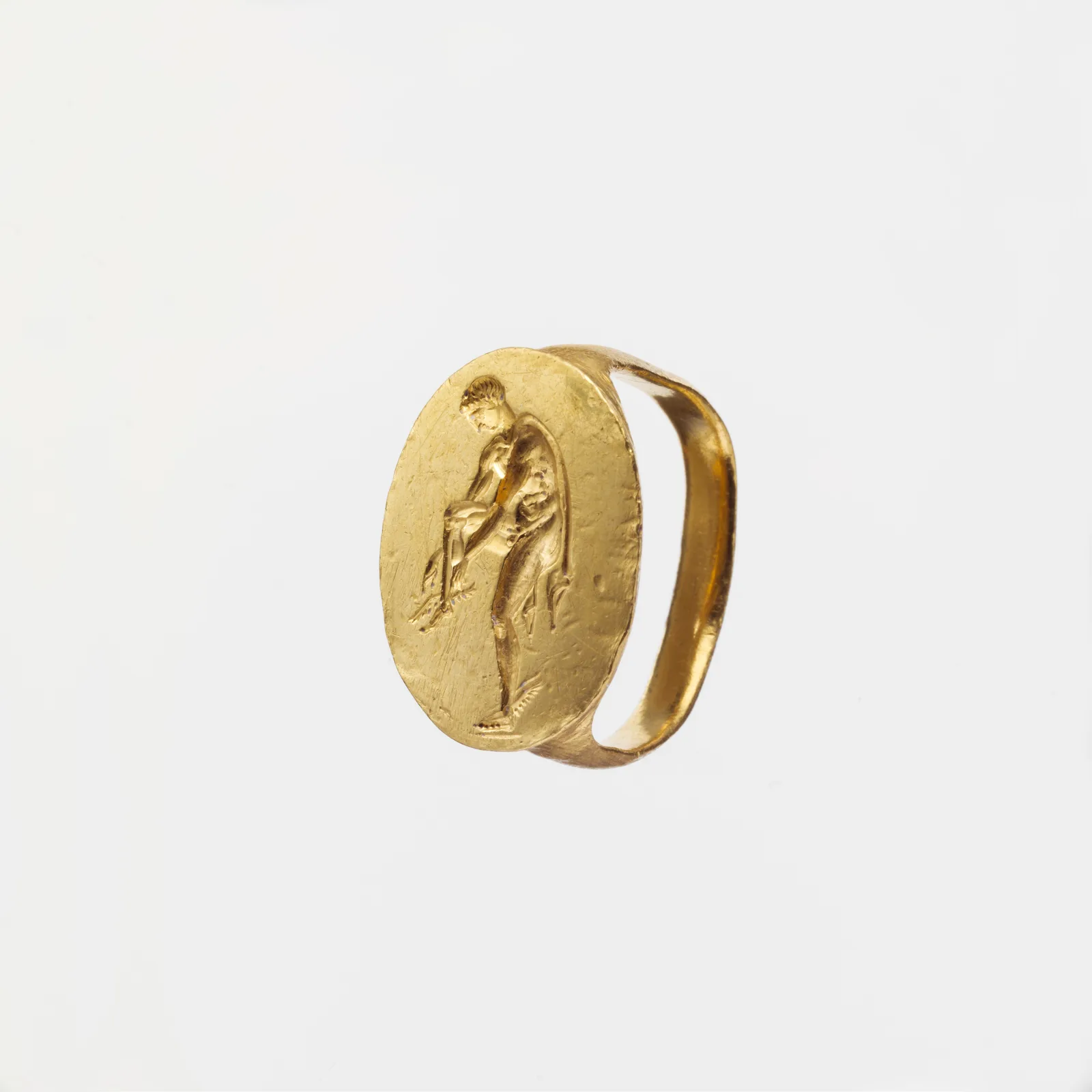
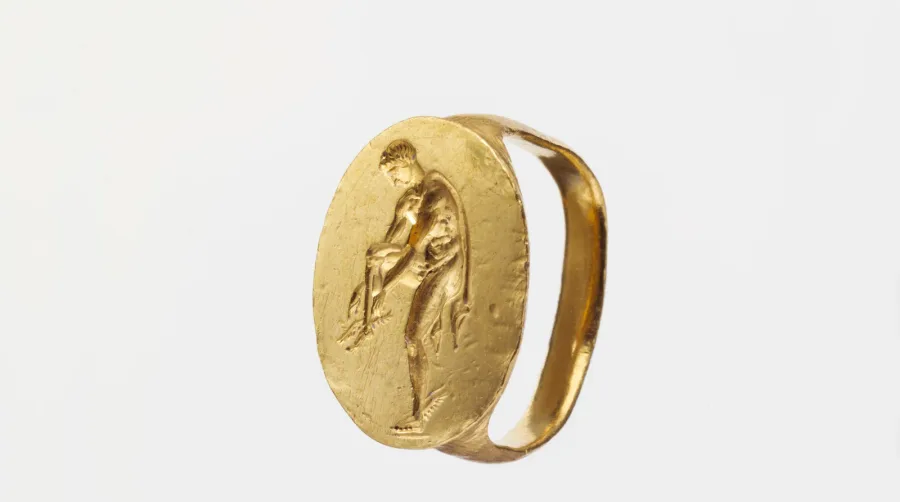
In antiquity the most personal piece of jewellery was the carved stone: an intaglio for sealing or a gem for admiring. On carnelian, agate, and jasper, masters carved Hermes with his purse and caduceus. A signet ring of this kind pressed its impression into wax, so a merchant was effectively signing a contract with an image of the god of trade. The result did double duty: a signature and a charm over the deal at once. Gems with Hermes and Mercury turn up all across the Mediterranean, from Greece to Roman Britain.
Coins with Mercury
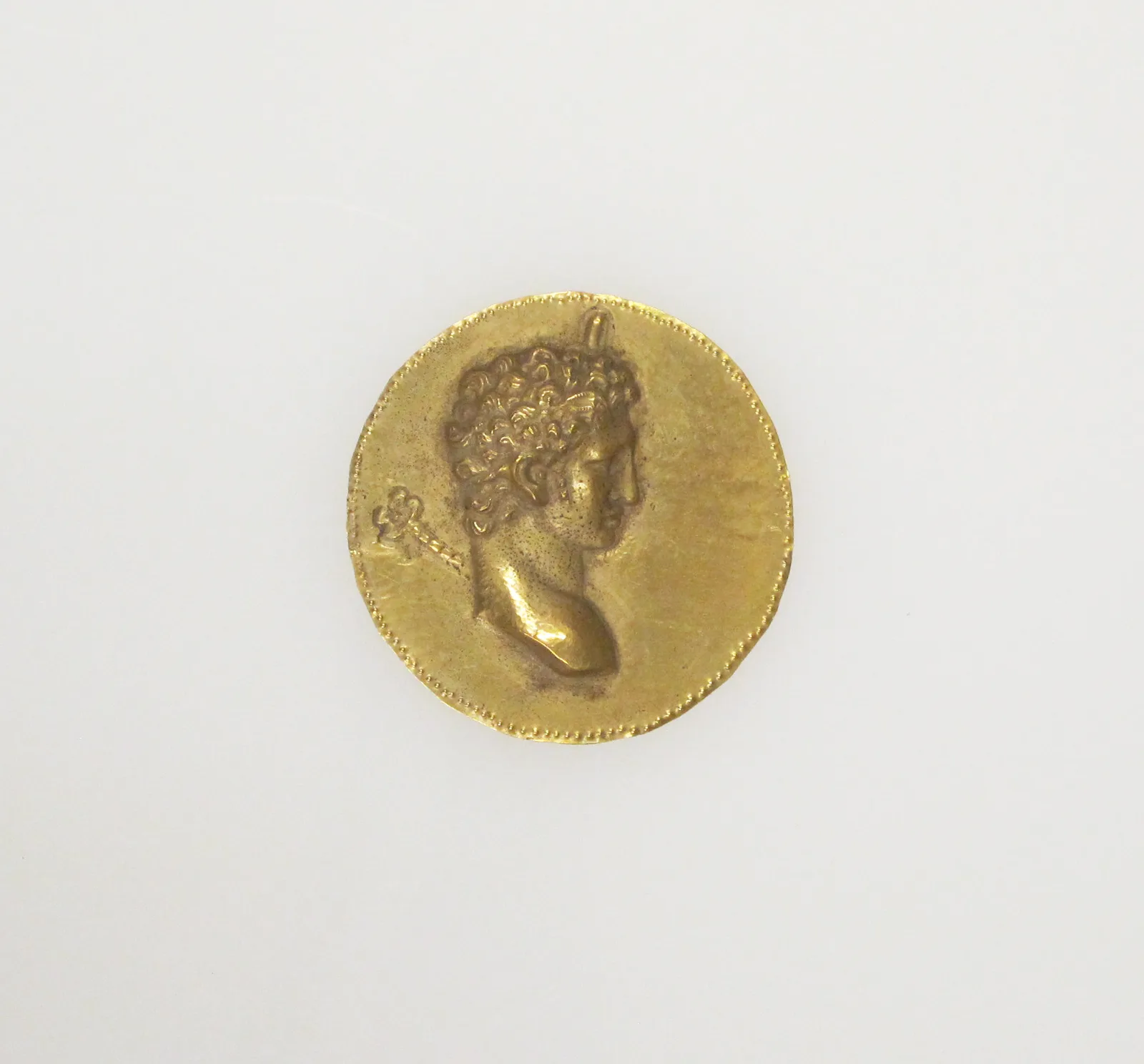
Mercury appeared often on ancient coins, and that stands to reason: the god of money on the money itself. His profile in the winged hat was struck by Greek city-states and Roman workshops. Centuries later the tradition returned. A head in a winged helmet adorned the coins of various countries in the modern era, and in the United States the early twentieth-century ten-cent piece was popularly nicknamed the Mercury dime, even though it actually showed an allegory of Liberty in a winged cap. The image had grown so fused with money that people recognised in it precisely the god of commerce.
Neoclassicism: The Return of the Ancient Youth
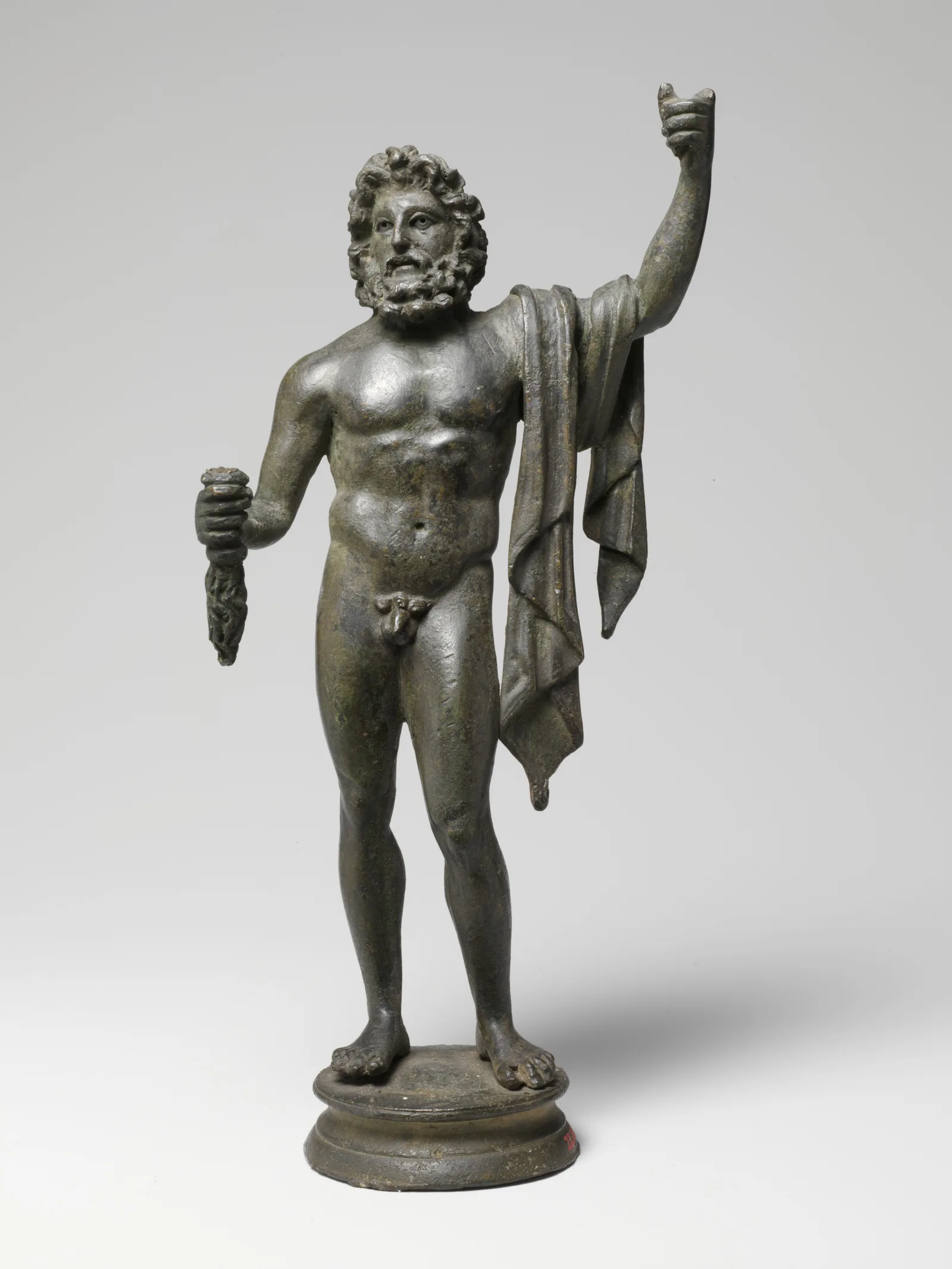
In the Renaissance, and especially in the neoclassicism of the eighteenth century, the ancient gods came back into fashion. Cameo cutters took up Mercury once again, and jewellers set his profile into rings and brooches. The bronze figure of a flying Mercury, balanced on one foot with a hand raised to the sky, became one of the most widely reproduced images in the decorative arts. It stood on mantelpieces, was repeated in miniature, and was cast as pendants.
Symbol of Post, Trade, and Communication
The nineteenth and twentieth centuries cemented Mercury's role as a brand mark. The winged hat and the caduceus appeared on the emblems of postal services, telegraph companies, chambers of commerce, banks, and flower deliveries. The logic is direct: the god of speed and message presides over everything that needs to be delivered quickly and bargained for well. So a modern person, even with no knowledge of mythology, still reads the winged hat as a sign of speed and commerce.
A caduceus wants a shirt collar, not a hoodie. It marks the dealmaker, not the show-off, and that's final.
How and With What to Wear the Symbol of Hermes
Over years on shoots and runways the caduceus and the winged sandal have passed through dozens of looks with me. Here is what actually works, sorted by occasion and by person.
How do I wear a caduceus into a business look? Under a shirt and jacket I recommend a silver or matte gold caduceus on a short chain, 45-50 cm, so the sign tucks under the top button. As an alternative I suggest a caduceus pin on the lapel: a quiet detail that only the initiated read. A strict dress code is no obstacle here, the sign lives happily under the collar.
What do I choose for the road? For a traveller I choose a winged sandal or a petasos on a fine chain. A light pendant does not snag or get in the way on the road, and it reads as a personal mark of the wanderer. Other road symbols sit well beside it: a compass, a star, a small coin.
Man or woman, does it matter? The symbolism of Hermes is gender-neutral, so there are no strict rules. For a man I more often suggest silver or steel on the larger side, on a solid chain. For a woman I recommend a fine gold or silver line under an open neckline. This piece is easy to choose as a pair or to give without guessing taste.
How do I wear it so the sign reads? The graphic line of Hermes is friendly with minimalism, so I will always choose one clear sign on a clean chain over a cluster of pendants. Under a V-neck the caduceus falls right to the centre, its best position. Under a closed collar I suggest a shorter chain, so the sign rests on the fabric rather than hiding.
What do I pair it with in layers? If you want layers, I give the caduceus its own length so it does not merge with the rest. Other classical motifs look good nearby: laurel, lyre, coin, and the figures of the Olympian pantheon. Among charms the sign of Hermes sits calmly next to road and protective signs, on which there is more in the guide to charms and talismans.

Turn on your camera, pick earrings, a pendant or a ring, and see the piece on yourself in real time.
Switch items in one tap.
Everything runs in your browser: no photo or video is ever uploaded.
The Symbols of Hermes and Mercury
Hermes is recognised in a piece of jewellery not by his face but by the things he carries. Each attribute has its own history and meaning, and each can be worn on its own as a sign in its own right.
The Caduceus: The Staff with Two Snakes
The caduceus is a short staff around which two snakes are coiled, with wings often spread at the top. This is the chief identifying mark of Hermes. By myth, Apollo gave him the golden staff, and the snakes appeared when Hermes threw it between two fighting serpents, which froze in place, coiling around the shaft. The caduceus stands for reconciliation, the balance of opposites, trade, and negotiation. The two snakes are two quarrelling parties whom the staff has brought to agreement. As jewellery the caduceus reads elegantly: symmetrical, vertical, with light wings at the top, it sits well in a pendant or a pin.
Winged Sandals (Talaria)
The talaria are the golden winged sandals that carried Hermes through air and over water faster than any wind. This is perhaps the most poetic of the god's attributes. In jewellery a pair of small wings at the heel, or simply a stylised wing, stands for freedom of movement, speed, and a readiness to set off. The perfect sign for someone who never sits still: a traveller, a restless spirit, a person who is always on the move.
Petasos: The Winged Traveller's Hat
The petasos is the broad-brimmed traveller's hat of the wayfarer, which Hermes too was given with wings. Unlike a helmet, the petasos is the headgear of a simple wanderer, and therein lies its charm: the god of roads is dressed like an ordinary traveller on foot. The winged hat became the most recognisable detail of the image, and it is the one that migrated onto postal emblems. In small-scale work the petasos is often shown on its own, as a spare, clear sign of the road.
The Staff and the Tortoise Lyre
Besides the caduceus, two more objects are linked with Hermes. A plain shepherd's staff recalls that he is the patron of herds and the boundaries of pastures. And the lyre is his invention: the newborn Hermes found a tortoise, strung cords across its shell, and made the first plucked instrument, which he later gave to Apollo. So the tortoise and the lyre are his signs too, tied to eloquence, music, and crafty inventiveness. A small lyre pendant nods to two gods at once: to Hermes the maker and to Apollo the owner.
The Lyre as a Sign in Its Own Right
The lyre deserves a separate word: it is a rare case where the attribute of one god became the chief symbol of another. Hermes invented it, Apollo owned it, and in jewelry the lyre works at the seam between two meanings. On one hand it is music, harmony, art. On the other it is the inventiveness of Hermes, the knack of making from a tortoise shell and a couple of cords a thing that even his stern elder brother could not resist. A small lyre pendant will suit a musician, anyone connected with creative work, and anyone who values the idea itself: to make beauty from little and from what is at hand. The lyre sits well alongside the other gods of Olympus and the motifs of Zeus in classical sets.
The Purse and the Rooster
Two less obvious attributes of Hermes turn up constantly on ancient gems. The purse in the god's hand is a direct sign of trade and profit: a merchant choosing such a seal was, in effect, holding his own luck in business in his fist. The rooster at Hermes' feet is linked with daybreak, watchfulness, and the start of a new day, since the god escorted both dreams and waking. On old intaglios these details help to identify Hermes the trader precisely, and not some other god. In a modern reproduction a gem with a purse reads unambiguously: it is the sign of someone who earns through exchange.
What Hermes Means in Jewellery
When a person chooses a symbol of Hermes, they are choosing a particular set of qualities. Let us look at exactly what stands behind this image and to whom each facet speaks.
Road and Movement
The most direct meaning is the road. Hermes is the patron of travellers, and his sign is worn as a wish for an easy road and a safe return. A winged sandal or a petasos works as the modern equivalent of a road charm. It is a talisman for someone often on the move, someone who relocates, who changes cities and countries.
Trade and Luck in Business
The second facet is profit and the lucky deal. Mercury is the god of commerce, and his symbol reads as a wish for success in business, for favourable negotiations, for good turnover. A caduceus on a lapel or a Mercury pendant suits an entrepreneur, a salesperson, anyone who earns through exchange and deals. The Greeks had a separate shade of this meaning too: Hermes granted both the earned take and the pleasant accident, the unexpected find, the gain that drops like a gift. So his sign is worn as a talisman of luck in business as well, not of effort alone.
Wit and Resourcefulness
Hermes was famed for his cleverness and quickness. He is the first trickster of European mythology: while still an infant he rustled Apollo's herd and talked his way out of trouble with charm and cunning. So his symbol is a sign of sharpness, a nimble mind, the ability to find a way out. For those who value their own quick wits, this image rings true.
Eloquence and Negotiation
The messenger god was also the god of the word. The Greeks held him to be the patron of orators, translators, and envoys. The very art of interpretation took its name from Hermes. His sign suits those whose strength lies in speech: teachers, diplomats, anyone who sells through words and persuades.
Guide and Crossing
The quiet facet we spoke of above: Hermes leads across borders, including the last one. In this sense his symbol reads as a companion through change, support at the crossing from one stage of life into another. Sometimes such a sign is chosen in memory of a loved one, as the image of a kind escort.
Boundary and Threshold
One more meaning is easy to miss, but it is important. Hermes is the god of boundaries in the most literal sense: his herm pillars were set up where one holding ended and another began. So his sign is a symbol of the threshold, of crossing a line, of the start of a new venture. It is fitting to choose at a moment of major change: a move, a change of profession, the launch of one's own project. It is a talisman for those who stand at the threshold and are ready to take the step.
Customer reviews
Zevira is a real jewellery shop. Genuine payments, deliveries and customer thank-yous.
🥰🥰🥰 gracias

Ok, ¡gracias! 🙂

Hermes in Myth: The Trickster Who Charmed Everyone
To understand why the image is so enduring, it helps to recall how the Greeks themselves described Hermes. He is not a pompous thunderer or a grim warrior, but the most human and charming of the gods.
The Theft of Apollo's Herd
The chief myth about Hermes is the story of his first day. Barely born, the god climbed out of his cradle and rustled Apollo's herd of cattle, covering his tracks by cunning: he drove the animals backward and fitted sandals to their hooves to confuse the pursuer. When Apollo finally worked out who the thief was, the infant played him a tune on the lyre he had just invented, and the elder god was so charmed by the music that he forgave the theft and traded the herd for the instrument. This story sets the tone for the whole image: deftness, charm, and the knack of turning a misdeed into a profitable deal.
Europe's First Trickster
Hermes is the archetype of the trickster, the rogue who breaks the rules but makes the world livelier and more mobile. He steals, deceives, and wriggles free, but never out of malice, rather out of zest and curiosity. In world mythology he has many relatives: the Norse Loki, the African Anansi, the Native American Coyote. They are all about cunning, inventiveness, and the breaking of stagnation. Therein lies the charm of the symbol: it is not about strength, but about wit and flexibility.
Helper of Heroes
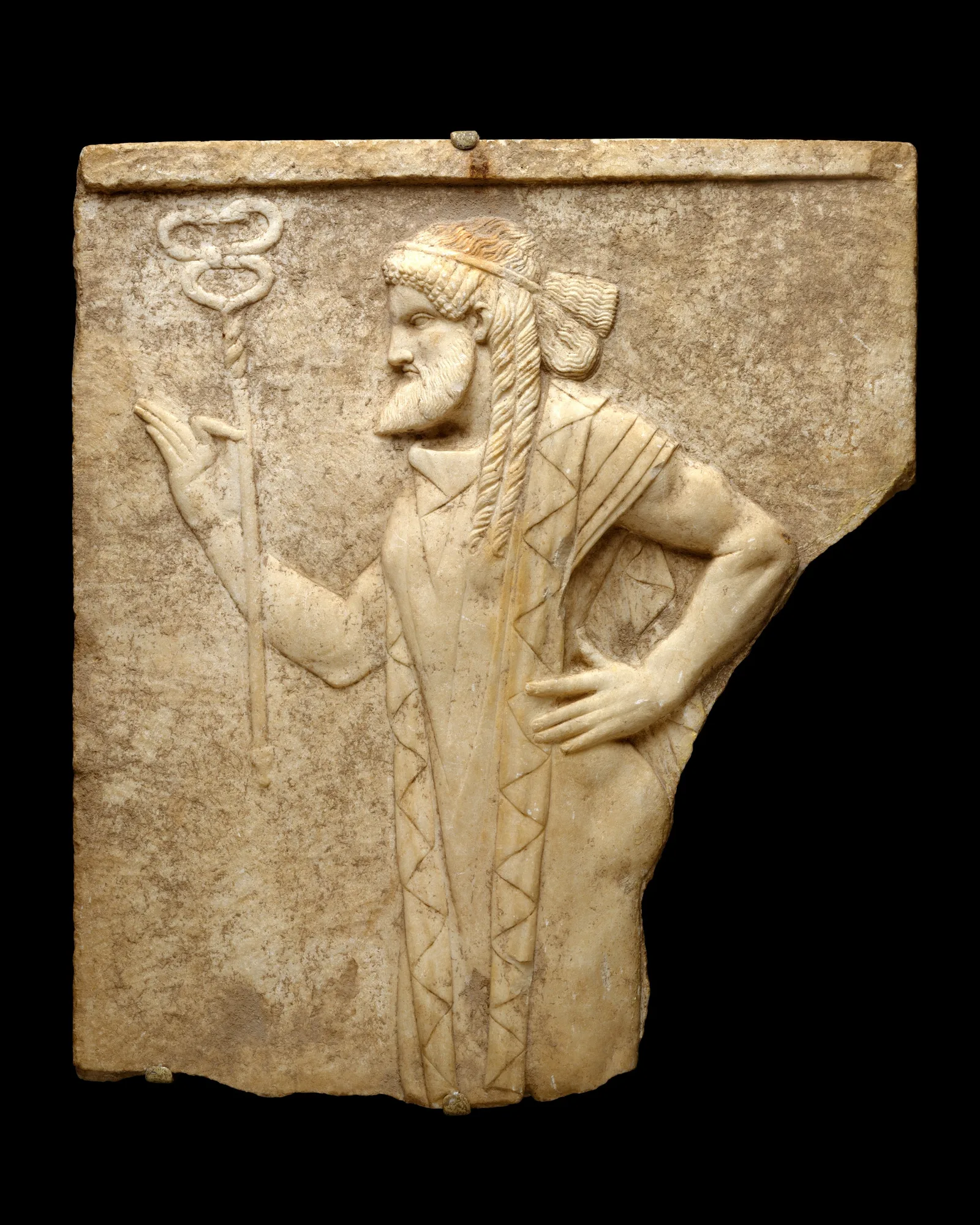
For all his roguishness, Hermes is forever bailing out the heroes. He gave Perseus winged sandals and a cap of invisibility for the battle with the gorgon. He guided Heracles, rescued Odysseus, and conveyed the will of the gods to mortals at the hard moment. The messenger always turns up where someone needs to be shown a way out or to have help delivered fast. So his sign reads as a symbol of the lucky go-between who arrives in time.
The Invention of the Lyre from a Tortoise
If the theft of the herd is about deftness, the story of the lyre is about inventiveness. By myth the infant Hermes, having climbed out of his cradle, met a tortoise and at once saw in its shell a ready-made resonator. He scooped out the shell, strung it with cords of sheep gut, and in minutes assembled the first plucked instrument. With this very lyre he later bought off the furious Apollo. The story shows the essence of the god: he is not merely cunning, he is a maker who finds a solution where others see only a tortoise on the road. For the Greeks it was a myth about the birth of music from pure ingenuity.
Hermes the Trickster and the Thrill of the Game
The Greeks gave Hermes a love of chance that links him with the game. They credited him with inventing dice and the drawing of lots, and a lucky throw was counted his gift. The trickster is no villain: he loosens a frozen order, brings in chance, and so brings the world to life. Therein lies the difference between Hermes and the other gods: Zeus and Poseidon inspire awe through strength, while Hermes does so through charm and unpredictability. So his symbol is chosen by those who feel closer to a game of wits than to a display of might, who believe in their own lucky touch and their knack for catching the right moment.
Companions and Related Figures
The image of Hermes does not stand alone: several figures and objects revolve around him that also appear in jewellery and help to understand the symbol more deeply.
Hermaphroditus
The son of Hermes and Aphrodite, whose name was fused from the names of both parents. The myth of his body merging with a nymph gave its name to a whole phenomenon. In art he is an image of the union of the masculine and the feminine, and he sometimes appears in classical symbolism beside his father.
Pan
Another son of Hermes, the goat-legged god of wild nature, of pastures, and of sudden fear. The word panic comes from his name. Pan links Hermes with the pastoral, wild side of the myth, for the messenger himself is the patron of herds and herdsmen.
Argus and the Story of the Pipe
Hermes lulled to sleep and killed the hundred-eyed giant Argus, the watchman whom Hera had set to guard one of Zeus' beloved. For this he earned an epithet meaning the slayer of Argus. And the giant's eyes Hera transferred to the tail of the peacock. So the myth of Hermes is bound up both with the origin of the peacock's pattern and with the invention of the shepherd's pipe, with which the god lulled the watchman to sleep.
Upload a photo of your pet, someone you love, or an object. We'll build a 3D model and hand-cast it in pewter.




Hermes and Mercury in Art
The ancient image of the god did not stay in antiquity: it passed through the whole history of European art and settled into our visual memory. These images are what feed today's jewellery.
Ancient Sculpture
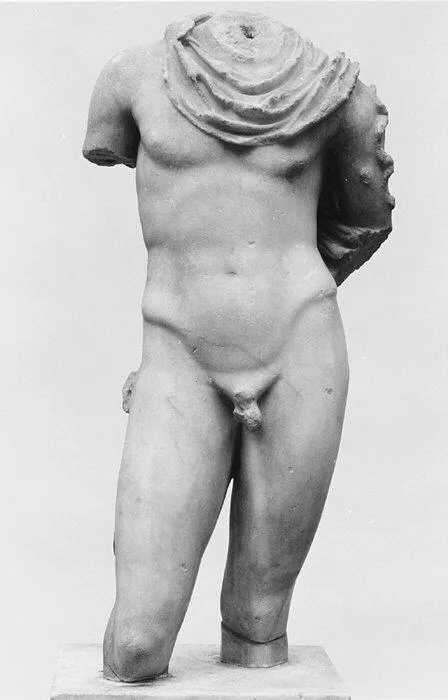
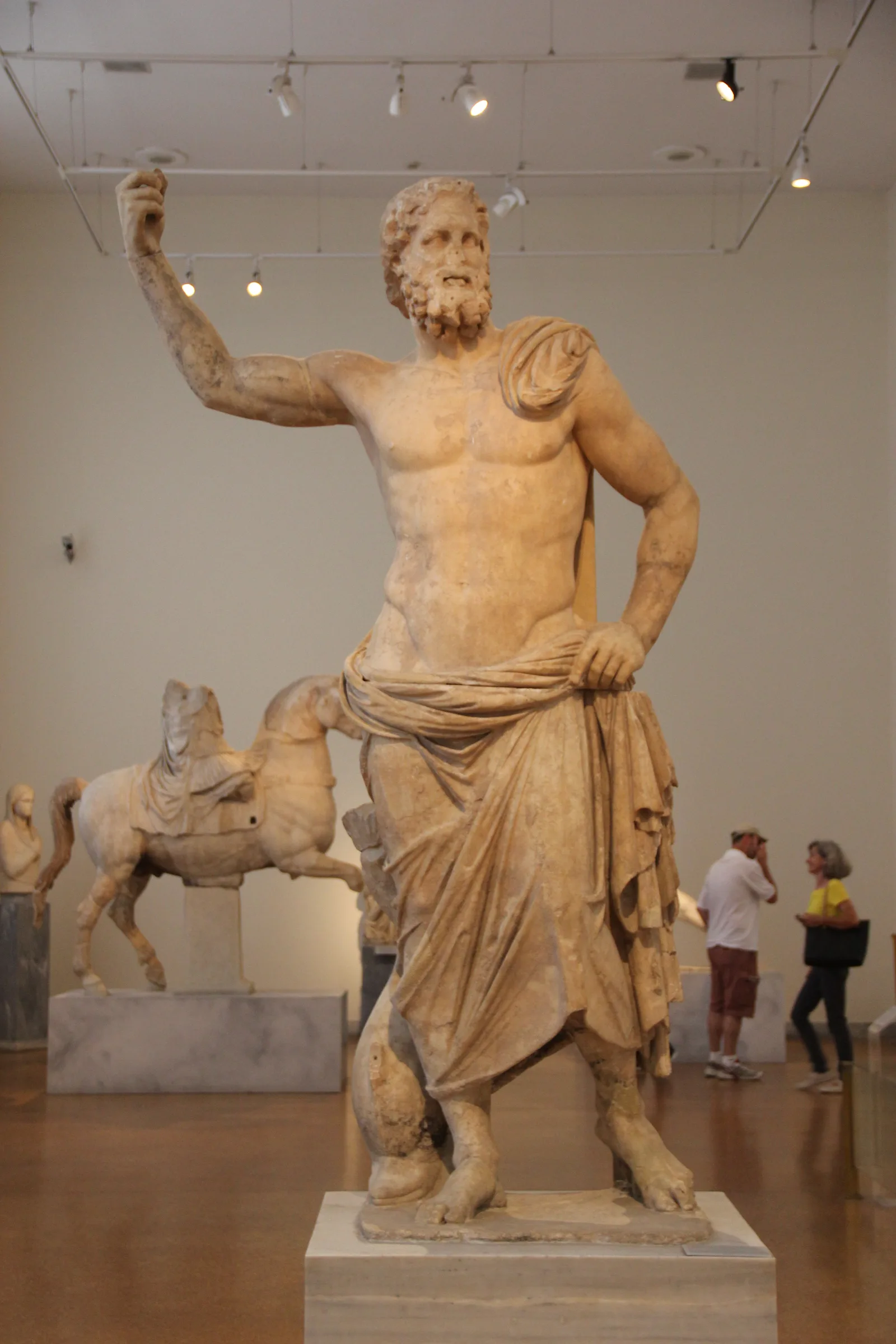
The Greeks and Romans loved to depict Hermes as a young athlete in motion. Several famous statues survive in which the god is caught in the act: tying a sandal, leaning on a rock, holding an infant. These poses convey the very essence of the image, lightness and a readiness to spring away. Gem cutters and medallists repeated the ancient poses in miniature, and through them the composition reached the jewellers.
The Flying Mercury
The most widely reproduced image of the god in the decorative arts is the flying Mercury, a figure balanced on one foot with a raised hand, as if already lifting off the ground. This dynamic pose was repeated in bronze thousands of times, set in studies and on mantelpieces, and shrunk to the size of a pendant. It is so recognisable that the silhouette of the flying god became a sign of speed in its own right.
Allegory of Trade and the Crafts
In the painting of the modern era Mercury often appeared as an allegory: his figure with the caduceus adorned the vaults of exchanges, banks, and chambers of commerce, standing for commerce and the prosperity of the city. Artists showed him distributing gifts, guiding ships, and patronizing the crafts. This businesslike image is what fixed the god in the role of a brand mark of trade.
Famous Ancient Depictions
Hermes has several canonical poses that the whole ancient world knew and that still surface in jewellery. The first is the god tying his sandal: he has bent over, set his foot on a stone, and is adjusting the strap, as if about to dart off down the road. The second is the resting messenger, perched on a rock after a long road, relaxed but ready to rise. The third is Hermes with an infant on his arm, a tender scene in which the god of mediation appears as a caring guardian. For centuries gem cutters and medallists repeated these compositions in miniature, and through them the ancient pose reached today's pendant. When you see a bent youth with a wing at his heel, it is a greeting from sculptors who worked more than twenty centuries ago.
Hermes on Ancient Pottery
A chapter of its own is vase painting. On black-figure and red-figure pottery Hermes is one of the most frequent guests: he escorts Persephone, leads the three goddesses to the judgment of Paris, and conducts souls to the underworld. Artists easily recognised him by the petasos and the caduceus and often placed him in the thick of events as the master of the scene. This painting on vessels has preserved for us the god's living gesture better than any statue: here Hermes is no frozen idol but an active participant, always in motion. The iconography of the pottery is what showed the jewellers how to depict the god in action, rather than simply standing like a post.





Famous Gems and Coins with Mercury
Since the carved stone and the coin were always the chief personal jewellery bearing Hermes, it is worth naming the best-known examples: they set the bar for authenticity.
Ancient Signet Rings
Museum collections hold hundreds of ancient intaglios with Mercury: the god stands with his purse and caduceus, sometimes beside a rooster or a tortoise. Such stones were set into rings and worn as a personal seal. The owner was effectively signing documents with an image of the god of trade, and this was counted a good omen for deals. Today such gems are museum pieces and the model for modern reproductions.
Mercury on Ancient Coins
The profile of Mercury in the winged hat was struck by Greek city-states and Roman mints. The god of money on the money itself was the natural choice. These coins set the iconography that later returned in the modern era on the small change of various countries. An old coin with Mercury, set into a pendant, is a popular way to wear genuine ancient symbolism.
Neoclassical Cameos
In the eighteenth and nineteenth centuries cameo cutters took up Mercury once more. The raised profile of the god in the winged hat against the dark ground of the stone is a typical motif of that age. Such cameos were set into brooches, rings, and pendants. They remain to this day the benchmark for how the classical image of the god should look in jewellery.
The Caduceus and the Rod of Asclepius: They Must Not Be Confused
This is the most common mistake around the symbols of Hermes, and it deserves a separate discussion. The two snake-staffs look alike but mean opposite things.
What the Difference Is
The caduceus of Hermes is a staff with two snakes and wings at the top. The rod of Asclepius is a staff with one snake and no wings. Asclepius is the Greek god of healing, and his single snake on a plain staff is the genuine symbol of medicine. The caduceus, by contrast, is about trade, negotiation, and speed, and not at all about health.
Where the Confusion Came From
The mix-up happened mainly in the twentieth century and mainly by mistake. The military medical service of one large country chose the caduceus for its emblem, confusing it with the rod of Asclepius. Hospitals, pharmacies, and medical companies followed. As a result the caduceus with two snakes and wings settled firmly onto medical signs, even though by meaning the single snake of Asclepius belongs there. Historians of symbols have long pointed out this slip.
What This Means When Choosing Jewellery
If you want a symbol of medicine, of a calling in healing, of care for health, you need the staff with one snake, the rod of Asclepius. If you want a sign of trade, the road, negotiation, and luck in business, that is the caduceus with two snakes and wings. When buying, simply count the snakes: one is medicine, two is commerce. This small detail changes the whole meaning of the piece.
Leave your email, we'll send your discount code. No spam, unsubscribe anytime.
The code arrives by email, valid on your first order.
Hermes and Mercury: The Greek and Roman Image
Hermes and Mercury are one character in two cultures, but their emphases differ a little. Understanding this difference helps you choose the one closer to you in spirit.
The Greek Hermes
For the Greeks Hermes is more many-sided. He is rogue and musician, guide of souls and patron of boundaries and inventor all at once. There is more mischief and mythological depth in him. The Greek image is a youth with fine features, light, mobile, a touch sly. Those drawn to mythology and to the character of the god usually gravitate to Hermes.
The Roman Mercury
The Romans focused on the business side. Their Mercury is above all the god of trade, profit, and a merchant's luck. The name itself is linked with the Latin word for goods. Mercury is more practical and down to earth, his image closer to money and turnover. For those choosing a sign for business and finance, the Roman version tends to resonate.
The Planet Mercury
The god's name passed to the planet nearest the Sun, the fastest in its run across the sky. The logic is the same: the swift planet took the name of the swift god. In astrology Mercury governs the mind, speech, communication, trade, and contacts, that is, the very same spheres as the mythological god. So the symbol of Mercury is favoured by those for whom this planet is strong in the chart: talkers, traders, people of a nimble mind.
Materials for Jewellery with Hermes
The image of Hermes is good in that it settles into a range of materials and techniques. The choice depends on the effect you want: ancient authenticity, lightness, or strict graphic line.
Silver
Sterling 925 silver is the most versatile choice. The cool gleam of the metal sets off the graphic line of the caduceus and the fine lines of the wings well. Silver is restrained, suits both men and women, causes no allergy in most people, and costs sensibly. A silver caduceus or winged sandal looks modern and unfussy.
Gold
Gold harks back to the ancient tradition: the real caduceus of Hermes was golden by myth, and the coins with Mercury were struck in the precious metal. A gold sign of Mercury reads as a wish for profit and plenty, which chimes well with the meaning of the image. Yellow gold gives a warm historical cast, white looks stricter and more graphic.
Carved Stone: Gem and Cameo
The most authentic option is carving in stone, as it was done in antiquity. An intaglio with an incised image of Mercury repeats the ancient signet rings, while a cameo with the raised profile of the god harks back to neoclassicism. The difference between them is simple: in an intaglio the design is sunk into the stone, in a cameo it stands out above the surface. Carnelian, onyx, agate, and chalcedony are the classic stones for such carving, and each gives its own character: warm reddish carnelian, severe black-and-white onyx, banded agate. A gem with Mercury is jewellery with a history, and with careful handling it lives for generations.
Bronze and Brass
Bronze is the material of ancient sculpture, and the figure of the flying Mercury was most often cast in it. A bronze or brass pendant gives a noble patina and a warm tone. It is the choice for those who love a sense of age and do not chase the shine of precious metals.
Steel
Stainless steel is the pragmatic modern option. It does not tarnish, is unafraid of water, and leaves no marks on the skin. A steel caduceus suits an active person who moves about a great deal and does not want to think about upkeep. The graphic line of the symbol on matte steel looks strict and businesslike.
CAPAORA mini knife pendant
The 18th-century Spanish navaja in miniature: 40 mm of stainless steel, a real folding mechanism and a Palanquilla lock that clicks. An affordable gift to remember.
Authentic · Ships from Spain · 14-day returns
How to Choose a Piece with Hermes
If you are buying such a sign for the first time, for yourself or as a gift, a few pointers will help you not to err on meaning and form.
Choose the Attribute to Match the Meaning
First decide which facet of the image is closer to you, and take the matching attribute. The caduceus is trade, negotiation, balance. The winged sandal is the road and speed. The petasos, the winged hat, is the path and the journey. A figure or profile of the god himself is the whole image at once, the universal option. The lyre nods to eloquence and music. One precise attribute works more strongly than an overloaded composition.
Count the Snakes
The main check when buying: if the staff has two snakes and wings, it is the caduceus of Hermes, the symbol of trade and the road. If there is one snake and no wings, it is the rod of Asclepius, the medical symbol. Sellers and catalogues often confuse them, so look for yourself. The number of snakes decides the whole meaning of the piece.
Assess the Quality of the Carving
If you are choosing a gem or a cameo, look at the clarity of the lines. In good carving the wings, the snakes, and the features of the face are worked out and read even at a small size. A blurred, sunken relief is a sign of cheap stamping or casting. In metal, pay attention to the working of the caduceus wings: it is they that give away the quality.
Pick the Metal to Match Your Way of Life
Silver and gold are beautiful, but they need care and can tarnish. Steel is more practical for an active person. Carved stone is striking but afraid of knocks. Think about how often and in what conditions you will wear the piece, and choose the material to match real life, not one pretty picture.
The Psychology of Choosing a Symbol of Hermes
Why is a person drawn to this image in the first place? Behind the choice of a symbol there is always something personal, and Hermes attracts a particular cast of character.
A Sign for People of Movement
Hermes is chosen by the restless: those who feel cramped in one place, who love the road, change, and new contacts. The symbol of the god of speed becomes for such a person a reflection of their own rhythm of life. It is not a talisman of calm but a sign of someone who lives on the move and takes pride in it.
Support in Negotiation and Deals
Psychologists long ago described the effect of confidence that a personal, meaningful object gives. A caduceus before an important meeting works as a quiet anchor: the owner feels more collected and calmer. There is no magic here, only a lowering of anxiety and a sense of footing. For someone who lives by negotiation, that is a real benefit.
Accepting One's Own Cunning
Hermes is the one god who openly praises deftness and resourcefulness, even on the edge of roguery. His symbol is chosen by those who value their own nimble mind and are not ashamed of the knack of wriggling free. It is a sign for people who feel closer to quick wits than to raw force, and who enjoy wearing a god who resembles themselves.
A Symbol of Change and the Threshold
A motif of choice all its own is the moment of life. The sign of Hermes is often taken not idly but on the threshold of a major change: before a move, a change of profession, the launch of one's own venture. The god of boundaries and crossings becomes the companion of one who has resolved to step into the unknown. Psychologically this makes sense: an object tied to a decision helps to fix it and lends courage. The person is, in a way, telling themselves that they have chosen movement over stagnation. So such a symbol is often given to mark a new stage, and it works as quiet support through the crossing.
Why Hermes Is Closer Than the Thunderers
If you compare whom people choose from the pantheon, a curious picture emerges. Zeus and Poseidon attract those drawn to the idea of power and elemental might. Aphrodite draws those who live by the theme of love and beauty. Hermes, though, falls to people of a quite different cast: not the loudest, but the most mobile and quick-witted. He is chosen not for grandeur but for humanity. He is the one god you want not to fear but to take onto your team, and therein lies the secret of why his image settles so easily onto a personal sign worn every day.
The Planet Mercury and Astrology
Since the god's name is borne by a planet, it is worth saying something of its astrological meaning: it is a separate layer of significance, and often the very thing that draws people to the symbol.
What Mercury Governs in a Chart
In astrology Mercury is about the mind, speech, learning, trade, travel, and any contacts. It is the fastest planet, nearest of all to the Sun, and it completes its circuit quicker than the rest. A strong Mercury is held to give a sharp mind, ease in communication, and a capacity to learn and to come to terms. The same spheres as the mythological god, and this is no coincidence: the ancients linked planet and god precisely by their speed and mobility.
To Whom the Symbol of Mercury Is Close
The sign of the planet or the god is often chosen by people in whom Mercury stands out in the chart: those who live by the word, who learn, teach, trade, or negotiate. The symbol is also taken by those passing through a period of change and movement, who need support in their affairs and contacts. It is a talisman of mobility and quick wits, not of calm.
Mercury Retrograde
Modern popular astrology has made a true meme-hero of Mercury retrograde: the periods when the planet visually moves backward are blamed for breakdowns in communication, muddles in contracts, and faulty technology. There is no scientific basis to this; it is the visible effect of the planets' motion. But as a cultural story it chimes beautifully with the trickster god: even in his day Hermes loved to stir up a little confusion.
Mercury and the Elements in a Chart
In the astrological tradition Mercury is held to be a neutral planet: it takes on the colour of the sign it stands in, as quicksilver takes the shape of its vessel. In the air signs it gives ease of speech and communication, in the earth signs a practical, trading mind, in water an intuitive instinct, in fire a quick, forceful tongue. This changeability again chimes with the shapeshifting god who moves between worlds and changes his guise to suit circumstance. For those seriously taken with astrology, the symbol of Mercury is close precisely for its flexibility: it is the sign of one who adapts and finds common ground in any setting.
A Talisman for the Retrograde Period
Since Mercury retrograde has become a popular bogeyman, the symbol of the god has acquired an unexpected role as a charm for these weeks. The logic is simple and slightly ironic: if the trickster planet is troubling you, wear the sign of the trickster himself so he is on your side. There is no serious magic here, of course. But as a psychological anchor it works: a small caduceus is a reminder to reread the contract once more, save the file, and not rush a decision. The result is a talisman not of mysticism but of aid to one's own attentiveness, which is very much in the spirit of the cunning god.
Send a friend a discount code, they save on their first order.
Hermes in Modern Culture
The image has lived on to our day and keeps working, often with no connection to mythology at all. It is a pleasure to spot these references.
Emblems and Logos
The winged hat and the caduceus still live on the emblems of postal services, flower deliveries, chambers of commerce, and financial companies around the world. Every time you see winged headgear on the sign of a delivery service, it is a greeting from the god of speed. The image works as a universal sign that something needs to be delivered quickly and reliably.
The Name in Language
The god's name is scattered through our vocabulary. Mercury is both the planet and the old name for quicksilver, a metal that is likewise swift and fluid. The word hermetic goes back to Hermes Trismegistus, a legendary figure of late antiquity associated with secret knowledge and the tightly sealed vessels of the alchemists. So the god gave his name both to a tight seal and to a whole tradition of hidden learning.
Sport and Fast Brands
The silhouette of a wing at the heel has long become a visual shorthand for speed. It is used wherever the aim is to say fast, light, swift. The image is so rooted that it reads instantly, even if a person has never opened a book of myths. Therein lies the power of the ancient sign: it outlived the very religion that bore it and went on working as a pure symbol of movement.
Facts That Surprise
The image of Hermes is full of details that rarely surface in popular retellings. Here are a few of them.
Hermes invented the lyre on his first day of life. By myth the newborn god climbed out of his cradle, found a tortoise, strung cords across its shell, and played at once. By the evening of that same day he had managed to rustle Apollo's herd. A very productive twenty-four hours for an infant.
The word hermeneutics comes from his name. The art of interpreting texts is named after Hermes the messenger, who translated the will of the gods to mortals. So the god of roads gave his name to a whole philosophical discipline.
Profit in Greek is linked with Hermes. A chance find, an unexpected income, a lucky windfall: the Greeks called all of this by a word that points to Hermes as the giver of sudden luck. The god of trade presided over both the honest take and the pleasant accident.
The Mercury dime does not depict Mercury. The famous American coin shows an allegory of Liberty in a winged cap, not the god at all. People nicknamed it the Mercury dime anyway, so fused had the winged headgear become with the image of the god.
The caduceus entered medicine by mistake. The genuine symbol of medicine is the rod of Asclepius with one snake. The caduceus of Hermes with two snakes ended up on hospitals through confusion and stuck, even though by meaning it is about trade.
Herms stood at every crossroads in Athens. Stone pillars with the head of the god were so widespread that their mass defacement once became a loud political scandal in ancient Athens.
Hermes is the only one who goes to the dead and back. Most gods did not descend to the underworld. As the guide of souls Hermes had a free pass there, which made him the indispensable go-between among all three worlds.
Mercury gave its name to a liquid metal. Quicksilver is called by the god's name in Latin and in a number of languages: the swift, fluid, elusive metal reminded the alchemists of the mobile Mercury. So the god of speed became kin to a substance impossible to hold in the hand.
Hermes was credited with inventing the alphabet and numbers. The Greeks held the messenger god to be the creator of writing, measures, and counting: of everything needed for trade and the passing on of thought. It is fitting that the patron of the word and the deal also presided over the tools without which neither works.
The word hermetic comes from Hermes. A tightly sealed vessel was named after Hermes Trismegistus, the legendary sage of late antiquity. The alchemists sealed their flasks hermetically, and so the god of roads unexpectedly gave his name to the most reliable of seals.
Tossing a stone at a statue of the god meant wishing for luck. Whole heaps of stones piled up by the roadside herms: each traveller added his own as a small offering for an easy road. From this custom, perhaps, came the very word for a pile of Hermes' stones.
Frequently Asked Questions
How does the caduceus differ from a doctor's staff?
The caduceus of Hermes is a staff with two snakes and wings at the top, a symbol of trade and negotiation. The medical symbol is the rod of Asclepius with one snake and no wings. To avoid a mistake, count the snakes: one is medicine, two is commerce and the road.
Are Hermes and Mercury different gods?
They are one and the same god in two cultures. Hermes among the Greeks, Mercury among the Romans. The character is shared: patron of trade, roads, eloquence, and deftness. The Romans stressed the business, money side more strongly, the Greeks the mythological depth.
Whom does jewellery with Hermes suit?
Those who travel a great deal, who negotiate, who deal in trade and business, who live by the word, or who value their own quick wits. The symbol is also taken by people with a strong Mercury in the astrological chart and by those passing through a period of change.
Can a woman wear the caduceus?
Yes, the symbolism of Hermes is gender-neutral. The caduceus, the wing, and the traveller's hat are geometric signs with no clear tie to one sex. A woman usually feels closer to a fine line in gold or silver, but there are no strict rules.
What do the winged sandals mean?
The talaria, the winged sandals of Hermes, mean speed, freedom of movement, and a readiness to set off. As jewellery they are the sign of the traveller and the restless spirit, a wish for an easy road and a safe return.
What is the best material for such a piece?
Silver is the versatile and affordable choice, gold harks back to the ancient tradition and the idea of profit, carved stone repeats the old signet gems, and bronze gives a sense of age. Steel suits an active person who does not want to think about upkeep.
Is Hermes a charm?
In antiquity his image was worn as a protective sign of the road and the lucky deal, especially in the form of signet gems and roadside herms. Today he is more often chosen as a personal symbol of movement, trade, and deftness, but the facet of the road talisman endures.
Why is Mercury also a planet?
The planet nearest the Sun was named after the god for its speed: it completes its circuit across the sky faster than any other. In astrology Mercury governs the mind, speech, and trade, that is, the same spheres as the god, so the symbol of the planet and of the god often coincide in meaning.
What are the talaria and the petasos?
These are two road attributes of Hermes. The talaria, the winged sandals, carried the god through air and over water faster than the wind. The petasos, the broad-brimmed traveller's hat with wings, sheltered the wanderer on the road. Both signs read as a symbol of the road and speed, and it is the winged hat that later migrated onto postal emblems.
Why is Hermes linked with theft?
The Greeks held Hermes to be the patron of thieves and rogues because he himself, on his first day of life, rustled Apollo's herd and wriggled free by cunning. But the meaning runs wider than plain theft: it is patronage of resourcefulness and the ability to get one's way by a roundabout route. In the symbol the facet reads as respect for a nimble mind, not as a justification for stealing.
Does the symbol of Hermes suit Mercury retrograde?
Many wear the caduceus during these very weeks as an ironic charm: if the trickster planet is troubling you, keep the sign of the trickster himself at hand. There is no magic here, but as a psychological anchor it works: it reminds you to be more careful with contracts and technology. It is a talisman in aid of your own composure.
Buying it as a gift? Each one arrives ready to give.
 A branded Zevira box and a little card come with every order.













Conclusion
Hermes and Mercury are the god of movement in pure form. Road, trade, the word, deftness, the crossing: all of it is about speed and connection. His attributes, the caduceus, the winged sandals, and the traveller's hat, read instantly and work as a personal mark for those who live on the road and in conversation. The main thing when choosing is to keep in mind the difference between the caduceus with two snakes and the medical staff with one: it changes the whole meaning of the piece. After that it is simple: silver for everyday wear, gold for the nod to ancient profit, carved stone for a genuine history on the finger or at the throat.
Silver, gold, symbolism, classical motifs, and matching sets.
About Zevira
Zevira is jewelry with meaning: symbols, charms, classical motifs, and spare graphic line in silver and gold. We love things that have a history, so with each symbol we give context, not just one pretty picture. If the image of Hermes speaks to you, look at the neighbouring signs in the selection on the gods of Olympus, or pick a gift for the road through the guide for the traveller.