A Gift for the Traveller: Jewellery With Character and Meaning
Airlines move somewhere near five billion passengers a year, and the number keeps climbing. Movement has become ordinary. Yet a traveller is the wrong person to hand a souvenir to: a souvenir reminds them of leaving. Give them what ties them to the road instead. A travel kit gets left in a hotel after one trip. A pendant engraved with the coordinates of a first shared journey gets worn for years.
The Traveller in 2026: who exactly are they
The word "traveller" has blurred so far that you need to work out who you are actually giving to before you choose anything. Behind the label sits more than "a person who likes going on holiday". It hides several genuinely different types, each with different needs, different values, and a different relationship with the objects they own.
The digital nomad
Someone who works from anywhere with an internet connection and has made that a way of life rather than an exception. Carries the bare minimum: one backpack, two at most. Refuses to accumulate trinkets and keepsakes, because everything has to be moved. Every object must earn its place. Values durability, practicality, and things whose story does not go stale.
Wear the symbol, don't just read about it. These are in stock:
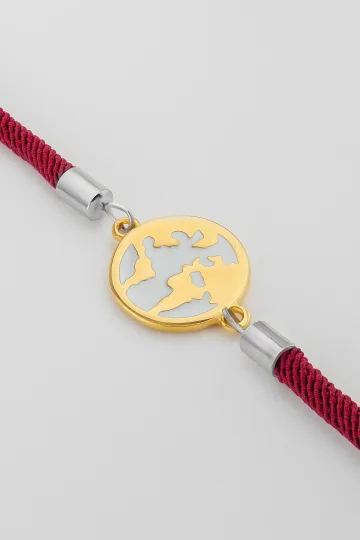
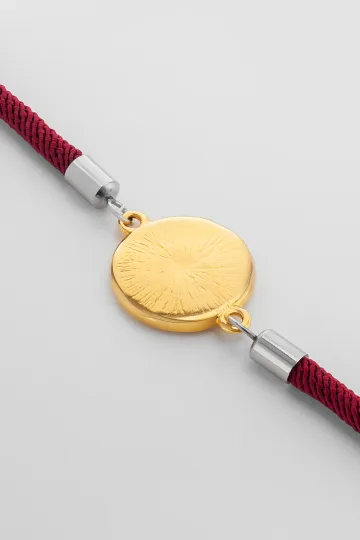
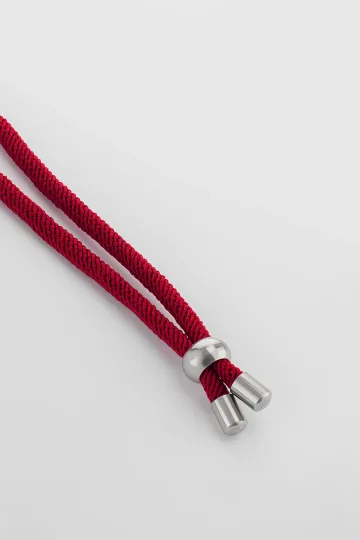


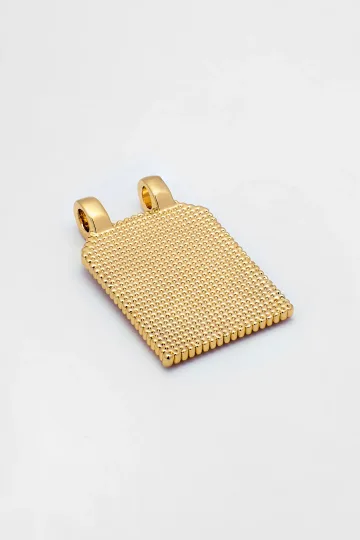
Jewellery for a digital nomad should be compact, robust, and low-maintenance. The best option is one thing, but a meaningful one. A pendant with the coordinates of a beloved city, or a single engraved phrase. Not a set of earrings, not a matching ring suite. One piece that travels everywhere and becomes part of a personal history.
The psychology here is particular: these people deliberately fight accumulation. So whatever they do choose to carry holds a disproportionate weight. If a nomad packed three pieces of jewellery, each one means something.
The gap year between life stages
Usually a young person taking a break between school and university, or between one job and the next chapter. A conscious decision to pause and see the world with their own eyes before stepping into ordinary life.
A gap year can be one of the most formative stretches anyone lives through. So many firsts: the first time alone in a foreign country, the first time without a timetable, the first time nobody knows where you are. So much that is sharp: real difficulty, real freedom, real decisions. So much that stays with you for decades.
A gift for this occasion is a gift for an important rite of passage. It should honour that weight rather than remain a pleasant object. Jewellery with a symbol of the journey, an engraved start date, a message that supports rather than worries.
A subtle point: parents who give jewellery for a gap year often try to pack their anxiety into it. "Be careful", "look after yourself", "come back". The better version of the gift says something else: "I trust you, you will find your way." A compass, not an anchor used as a leash. Freedom confirmed by an object.
The person who moved abroad
Someone who relocated to live in another country, usually for work or personal reasons. This is not tourism and not backpacking. It is a permanent life in a new place, often with a sense of belonging to two worlds at once. One world stayed back home; the other is being built here.
Good jewellery for this person connects two cities, two places. The coordinates of the home town and the new one. Or a piece with a symbol of a fresh start that simultaneously honours where they came from. The theme of emigration and jewellery as a symbol of transition is covered in detail in our guide to gifts for emigration and a new citizenship.
The slow traveller
People who travel slowly: not ten countries in two weeks, but one or two countries over several months. Enough time to feel a place, meet people, understand how daily life actually works. Slow travel is a deliberate refusal of speed, of the shallow business of ticking landmarks off a list.
This person often lives in a rented flat, cooks for themselves, shops at the local market, learns a few words of the language. Not a tourist, but not yet a local either. A particular position: the attentive observer.
For this traveller, a gift can be tied to the specific place they chose: coordinates, a local symbolic motif, something that nods to the culture of the country they are heading into. A turtle or an anchor as a symbol of an intentional stop works especially well for this type.
The weekend traveller
Travels at every opportunity: a different city every weekend, a different continent every holiday. Collects experience, not objects. Hungry for new impressions. Friday evening is already another country; Sunday night they are back. For this person jewellery works as an archive: coordinates of favourite places, an engraved history on metal, the symbol of an endless road.
Once you know which kind of traveller you are dealing with, the choice narrows dramatically.
Why a traveller is a special kind of recipient
Writers of every stripe have asked what travel really means for a person. Pico Iyer, in "The Art of Stillness", makes a paradoxical claim: true travel asks you to stop first. Not literally, but in the sense of inner attention. A traveller without inner presence merely changes the scenery without changing themselves. The deepest journey happens when a person can be fully where they are.
Alain de Botton, in "The Art of Travel", examines why we go where we go, and why expectation almost never matches reality, yet the trip changes us anyway. He writes about Gustave Flaubert, who loathed tourists while being one; about Wordsworth, who walked in order to think; about Alexander von Humboldt, who travelled for knowledge. Every traveller carries both a suitcase and a way of seeing the world, and it is that way of seeing that decides what the journey becomes.
Bruce Chatwin, author of "The Songlines", saw nomadism not as marginal but as the original human condition. His central idea: humans are made for movement, and settlement is historically the exception, not the rule. Chatwin's traveller is not someone fleeing from something but someone who moves by nature.
Why does any of this matter for a gift? Because a good gift for a traveller is never "something about travel". It is a gift that understands why this particular person travels at all. Their inner logic, their fears and joys, their relationship with home and the road. Jewellery that reflects that understood character stops being a souvenir and becomes a companion on the road.
A compass rides on an open collar and a sun-worn wrist, never under a boardroom tie. The road doesn't do lapels.
What to wear a traveller's jewellery with
This piece has to live on the body every day, not wait for the occasion, so I treat it differently from a decorative one. Here is how I place a compass pendant or a coordinate plate across a real week, sorted by moment.
What do I wear a compass pendant with every day? For the everyday mode I recommend a thin chain of forty-five to fifty centimetres over a plain tee, a roll-neck or a linen shirt. The pendant is half-seen and feels like your own. I suggest plain fabric in calm tones: silver leans towards cool shades (grey, blue, white), yellow gold comes alive on warm ones (beige, ochre, dark green).
And for the office or a business trip? Here I keep to one visible piece. I tuck a lighthouse or a labyrinth under a shirt or jumper and take a shorter chain so the pendant sits at the collarbones. For coordinates I actually choose to engrave the inner side of a bracelet: the meaning is with you, out of sight.
How do I build an evening look? For evening I bring the piece forward: an open neckline, dark or plain fabric, a slightly longer pendant so it becomes the centre. If you want layers, I recommend two chains of different lengths in one metal, a short one with a compass and a long one with coordinates. One metal keeps the whole thing pulled together.
And for a reunion after separation? Paired pendants (one with the one who left, one with the one who waited) I suggest wearing in sync and over the clothes. This is not about style, it is a sign, and it should show. Here I do not hide the piece under the collar.
Who suits what? For anyone who likes restraint I recommend one thin chain and a pendant up to two or three centimetres. For anyone who wears jewellery boldly I suggest several chains at once and a larger compass or wind rose. On a man an anchor or a compass on a leather cord sits naturally, as does an engraved bracelet. The rule that never fails: I pick one metal and stay with it, then even three pieces at once read as pulled together, not accidental.

Turn on your camera, pick earrings, a pendant or a ring, and see the piece on yourself in real time.
Switch items in one tap.
Everything runs in your browser: no photo or video is ever uploaded.
A gift before a big journey
The most common scenario: someone is leaving, and you want to give them something to take along. Not practical, but symbolic. Something that will be with them on the road and remind them of the bond with you, or of where they come from.
The strongest pieces for this scenario rest on one of two meanings.
A symbol of the journey. A compass says: you will find your road. A lighthouse says: there is always a reference point. Infinity says: the road does not end. A labyrinth says: a path without a map is still a path. Each of these carries a clear, readable message that needs no explanation.
A symbol of connection. Matching pieces, identical pendants, jewellery with the coordinates of home. The meaning is direct: a part of me travels with you. You are not alone. This approach is especially strong when one partner leaves for a long time and the other stays.
The central symbol for this scenario is the compass or wind rose pendant. As a navigation instrument, the compass gave jewellery its richest travel history. Sea captains wore compasses as talismans, as objects that connected them to home through magnetic north. The navigators of the Age of Discovery steered by the compass in the most literal sense: without it there would have been no Magellan, no Columbus, no Drake. In jewellery the compass kept all that weight: direction, choice, the ability to find a way even when the horizon is shut behind cloud.
The wind rose, an eight-point star with four cardinal and four intercardinal directions, appeared on Mediterranean portolan charts in the fourteenth century. It decorated maps as a functional element, and it carried the beauty of order amid the chaos of the sea. Today the wind rose in jewellery holds that same meaning: a beautiful order that orients a person in any space, geographical and inner alike.
A lighthouse symbol also works well as a pre-trip gift. A lighthouse is not movement but a reference point in unfamiliar space. It stands on the shore and tells the ship: I am here, hold to this spot. In the figurative sense, that is exactly what you want to be for the one leaving: constant, dependable, shining.
What to say when you hand it over
A piece given without words loses half its power. When you give it to a traveller, say or write the meaning you put into it.
A few formulations that work for different situations:
Compass: "Wherever you turn, you know where north is."
Lighthouse: "I will be here. You can always come back."
Swallow: "It always returns home. So will you."
Coordinates: "This is our place. It travels with you."
Infinity: "There is no last road. Only the next one."
You do not have to say it aloud; you can slip in a note. But once the meaning is spoken or written, the piece turns from a pretty object into the carrier of a specific message.
A gift on return: marking the experience
The second important scenario: the traveller has come back. They lived through something large. And you want to fix it, mark it, make it tangible.
Here the main tool is engraving. Specific, exact, unrepeatable.
The coordinates of the place that changed them. Not "Japan" or "Iceland", but a precise point on the map. That village in the mountains. That beach at dawn. That small cafe where they understood something. Jewellery with coordinates is not an abstraction; it is the exact address of a moment. More on this form of personalisation below, in the section on coordinate jewellery.
The date of a specific moment. Not "2024", but "14.03.2024". The date of the first day of a big journey. The date of something that will be remembered for life. The date of coming home.
A line from the road. Something short the person wrote in a journal, said to you on the phone, texted at three in the morning from somewhere in Nepal. Their words, not yours. This makes the piece a conversation rather than a monologue by the giver.
The initials of a companion. Whoever was beside them at the most important moment. Not necessarily a romantic partner. It could be a friend you shared a tent with for three weeks, or a stranger who helped at the right moment and whom you stayed in touch with for years.
A gift on return is a particular gesture: you acknowledge the weight of what happened. Travellers rarely receive that acknowledgement. Usually everyone is glad to see the person back and quickly moves on to the ordinary. An engraved piece, handed over a few days after their return, says: "I can see you lived through something large. It matters."
Symbols for the traveller: read by meaning
Compass and wind rose: the central travel symbol
The wind rose in jewellery is the eight-point star of navigators that appeared on Mediterranean charts in the fourteenth century. It has a three-hundred-year history in the jewellery of seafaring people, long before it entered the fashion of modern jewellers. Sailors heading out on long voyages took compass amulets with them: not as superstition but as a reminder of order amid chaos.
A compass works on several levels at once for a traveller. Literally: a navigation tool. Metaphorically: an inner bearing, the ability not to get lost. Emotionally: I will help you find your way. The compass is the gift with the clearest symbolism of all travel jewellery, and it never looks trite, because its history is too long and too real.
A compass or wind rose pendant works both as a road talisman and as an everyday piece. That matters: many "travel" pieces only come alive when the person is on the road and feel out of place at home. The compass is universal: people wear it on the road, at home, and in the office.
Anchor: when a stop is needed
The anchor in jewellery is symbolically the opposite of the compass. The compass says: move. The anchor says: stop, settle, take hold.
But that is not a contradiction; it is a complement. Travellers who move a great deal often need a grounding symbol just as much as a symbol of the road. The anchor is a sign that a person has a place they belong to. They are not drifting; they choose to stop. The maritime history of the anchor, with its image of steadfastness in a storm, gives the piece a particular character: the anchor holds the ship not because it is weak but because it deliberately chooses to stay.
The anchor works well as a gift for someone who travels a great deal and is also looking for steadiness: a digital nomad three years into the wandering, a person after a very intense stretch on the road, someone who has just come back from a long trip and is settling in again.
Lighthouse: a bearing in the unfamiliar
The lighthouse is a light in unfamiliar space. It stays put but helps those who move. The lighthouse does not go with you; it waits for you. In a gift context the lighthouse says: "I am here, I am constant, you can always come back to me as a fixed point."
A particularly strong meaning for a gift to a partner or parent who stays home. You are the lighthouse: unmoving, shining, reliable. It is a very precise metaphor for love across distance, the kind that does not try to hold on but promises presence.
Historically lighthouses were bearings in the literal sense: the Pharos of Alexandria, one of the seven wonders of the world, showed sailors the way into harbour at night and in fog. A lighthouse piece carries that millennia-old story of the bearing, the one who helps you find the way home.
Labyrinth: a path without a map
The labyrinth in jewellery is one of the most interesting symbols for a traveller, because it speaks of a different kind of road. Not the kind with a map and a compass, but the kind where you go by intuition, turn where it feels right, retrace your steps without shame, and choose a direction again.
A labyrinth is not a dead end. In classical symbolism the labyrinth, unlike a maze of many false turns, is a path that always leads to the centre if you keep walking. The Cretan labyrinth pattern, which lies at the root of European labyrinth symbolism, says exactly this: the only way out is forward. You cannot be lost forever as long as you keep moving.
It is the perfect meaning for someone heading into the unknown without a firm plan: a gap year without an itinerary, a journey taken on a whim, a slow life in an unfamiliar country. The labyrinth says: there is a path, even when there is no map.
The Fool in Tarot: readiness to leap
The Fool in Tarot is the zero card, the beginning of the path. In the classic image a young person stands at the edge of a cliff with a bundle on their shoulder, looking up rather than down. They do not know what lies below. But they step. Without fear, without calculation, fully open to whatever comes.
In the context of a gift for a traveller, the Fool is one of the most precise symbols for exactly those moments when someone does something genuinely large: a first solo journey, a gap year, a trip around the world, a move abroad. The Fool is not reckless; they are brave. The difference is fundamental.
A gift with the Fool's symbolism works well for young people taking a bold step, and also for those who, midway through life, decide to change course and head where they have long wanted to go.
Infinity: the continuity of the road
The infinity symbol, the lemniscate, is often read in jewellery as a romantic emblem of eternal love. But for a traveller it carries a different, no less powerful meaning: the road does not end. Every journey flows into the next. Experience accumulates rather than disappears. There is always a horizon, because the Earth is round.
The lemniscate is a mathematical curve with no beginning and no end: you walk along it and return to any point an endless number of times. It is the perfect geometry for a life lived in motion.
This is a gift for someone for whom travel is not an event but a way of life. Not "I went on holiday" but "this is how I live".
Swallow: the return home
The swallow in jewellery is symbolically tied to the return across the sea. In the sailors' tattoo tradition, a swallow on the skin meant the person had covered five thousand nautical miles and come back. Later it came to mean simply return. The swallow always flies back to its nest: that is not poetry, it is biology, and that is exactly why the symbol is so strong.
The swallow is bidirectional: it leaves and it returns. One bird for the one leaving, one for the one waiting. It is a paired symbol of parting and reunion at once.
Turtle: the wisdom of the long road
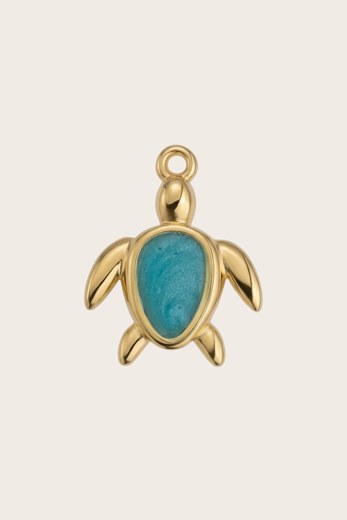
The turtle in jewellery is an image of slow, considered movement. The turtle is in no hurry. It carries its home on its shell: its home is always with it, wherever it goes. It lives long and remembers much.
For the slow traveller the turtle is the ideal symbol: not about speed but about depth. One of the few animal symbols that speaks directly about conscious movement. The turtle does not run. It goes at its own pace and arrives where it needs to be.
The sea turtle, which crosses the ocean once every few years to return to the very beach where it was born, carries both the meaning of an endless road and the meaning of a tie to the place of origin at once.
A gift for a partner travelling alone
One leaves, the other stays. This is one of the most emotionally loaded scenarios in the context of travel. And one of the ones where jewellery works best.
A few things worth keeping in mind when choosing.
Pairing. Two identical pieces, one for each. A swallow, a compass, an anchor, a lighthouse, an infinity. The meaning: we both carry this at the same time. Physical distance does not break the bond, because there is an object holding it. This is not magic; it is psychology: an object split between two people becomes a material anchor for an abstract feeling.
The coordinates of home. Jewellery with the coordinates of a place you share. Your flat. The city where you met. The spot of your first meeting. The partner carries the exact coordinates of the home where someone waits. This is not sentimentality: it is a navigational fix on the one point that matters more than any other.
A message inside. An engraving on the inner side of a pendant or bracelet, seen only by the wearer. Not for outside eyes, but for one specific person. It is one of the most intimate forms of personalisation in jewellery: a message that travels with you but stays private.
The practical side: do not choose anything too bulky or fragile. The one leaving will move a lot, change climates, cross borders. The piece has to take it. For the practical questions of travelling with jewellery, what is safe to take on a plane and how to carry it, there is a separate guide: jewellery while travelling.
Customer reviews
Zevira is a real jewellery shop. Genuine payments, deliveries and customer thank-yous.
🥰🥰🥰 gracias
Ok, ¡gracias! 🙂
A gift for the digital nomad: durability and minimalism
The digital nomad lives under constant optimisation. Every object carried is justified. There is no room, neither physically nor psychologically. On average such a person moves once every one to three months and covers tens of thousands of kilometres a year.
The best gift here is one thing, but the right one. A piece that is light and tough, needs no special care, and suits any outfit from a beach T-shirt to a meeting in a co-working space.
What matters when choosing:
Weight. A pendant under ten grams is worn without noticing it. A heavy piece starts to make itself felt on long journeys.
Durability. Sterling silver and 14K gold stand up to ordinary wear. Avoid pieces with fragile protruding elements or stones in open settings: they can suffer in a backpack.
Care. 14K gold needs practically no care. Sterling silver darkens on contact with seawater and sweat but cleans up easily. Gold-plated silver sits somewhere in between.
Versatility. A piece that looks equally good on the beach and in a coffee shop is more practical than one that works in only one context.
Meaning. A digital nomad who says "I do not wear jewellery" often means "I do not wear decorative jewellery with no meaning". A piece with an engraving, with coordinates, with a symbol that means something personally, is a different category of object.
A gift to yourself after a big journey
A separate and very important category. Many people come back from a big journey feeling they lived through something significant that deserves to be fixed in a way other than photos on a phone. The trip changed them. Something material should reflect that.
Jewellery as a gift to oneself after a journey is one of the oldest motifs in the craft. The navigators and traders of the Age of Discovery brought back jewellery from the places they had been: not as souvenirs but as material proof that they had been there. It was memory carried into an object.
What people choose:
The coordinates of a place that became important. A pendant or bracelet with exact coordinates. You can order online, or have it made by a local maker on the spot if time allows.
A piece with a local symbol. If the journey was to a specific country with a strong symbolic culture, a local motif in jewellery is living memory.
A date. Just a date. When it happened. Spare and exact. No explanation needed: you know what it means.
The line you wrote in your journal at the most important moment. People often write something very precise at three in the morning, in the middle of a foreign country, when something becomes clear. Such a line should not live only on a phone: carry it into metal.
A gift to yourself is still a gift. It is no less significant than a gift from someone else. Especially when it marks something real.
Upload a photo of your pet, someone you love, or an object. We'll build a 3D model and hand-cast it in pewter.



Engraving: a guide to personalisation
Engraving is what turns a beautiful piece into a meaningful one. The difference is fundamental: the beautiful you will eventually take off; the meaningful you will wear for years.
Coordinates. The most popular form of personalisation for travellers' jewellery. It works on any metal, in any size. The main thing: check the coordinates are correct before ordering. It is very unpleasant to discover the engraving points to the wrong place. Check your coordinates in Google Maps: type them in and make sure the point lands where it should.
Which format to choose:
- Decimal (51.5007, -0.1246 for the centre of London) is more compact and fits on a thin plate
- Degrees (51°30'N 0°07'W) reads like real navigational data and takes more space
- A single element only (latitude or longitude alone) for minimalist pieces where space is very tight
Date. Format DD.MM.YYYY or YYYY.MM.DD. For cases where the period matters rather than the day, just the year will do.
A phrase. Up to thirty to forty characters on most pieces. Keep it short. "The road is home." "Always find north." "Home is where we are." Important: these should be the person's own words or something very precise about them, not a generic quote from the internet.
Initials. The companion who was beside them at an important moment. Or simply: MNT, the first letters of three cities on the route. Or the initials of the giver.
Combinations. Coordinates plus a date. A phrase plus coordinates. A bracelet has room for several elements across different sections. The back of a pendant often fits several lines.
Technically, engraving comes in two kinds: laser (precise, good for fine type and intricate detail) and hand (slightly uneven, alive, with character). Both work well. Hand engraving costs more, but for a piece with personal meaning its very unevenness often feels right.
Coordinate jewellery: a global direction with a personal story
Jewellery with geographic coordinates has become one of the most durable jewellery ideas of the past fifteen years. Interest in it does not fade, because it has a fundamentally different quality compared with any other jewellery fashion: every such piece is unique by definition.
It all started in online jewellery around 2010 to 2012. First as a narrow personalised niche on craft marketplaces: small workshops offered to engrave the coordinates of any place on a plain pendant or bracelet. Then it went mainstream. Now it is one of the standard options in any jewellery brand that works with personalisation. Coordinate pendants are equally popular in every language.
Why coordinates rather than city names? Precision. The name "Rome" or "Tokyo" is a generality. The coordinates "41.8902, 12.4922" are the Colosseum. Specific, unmistakable, that object alone on Earth. Two pairs of numbers, and the place cannot be confused.
Another reason for their popularity is that coordinates let you mark places with no official address. A beach you can only reach on foot. A mountain pass. A spot in the forest where you pitched a tent. A clearing. A viewpoint over a valley. Places with personal meaning that exist only in your memory and in GPS. They cannot be given a name, but they can be given coordinates.
In jewellery, coordinates are engraved on:
- Flat plate pendants (the most common option)
- The inner surface of a bracelet (the intimate option, seen only by the wearer)
- The back of a pendant (a symbol outside, coordinates within)
- Around the band of a ring
Coordinate jewellery works well as a gift before a journey (the coordinates of home), as a gift after a journey (the coordinates of a meaningful place), as an anniversary gift (the coordinates of a first meeting), and as a gift before a parting (the coordinates of a shared place that each one carries).
Family travel: a paired pendant across generations
One of the most touching jewellery traditions tied to travel: a paired pendant of parent and child with the coordinates of the place of their first journey together.
Not a "first step" or a "birthday". Specifically: the coordinates of the place you first went to together. A small mountain village. The sea. Another country. A train to another city. It might have been a modest trip with a budget hotel, but it was the first shared one.
Two identical pendants. One for the child when they are older, one for the parent now. Or both right now, if the child is old enough to appreciate it. It is a piece that only becomes more meaningful over time. Twenty years on, when the child has grown and gone, both will be wearing the coordinates of that first journey.
Variations on the same theme:
The coordinates of the place where the whole family was together for the last time before the children scattered. The site of the last shared holiday before everyone went off to different cities or countries.
A paired pendant for grandparent and grandchild with the coordinates of a place they travelled to together. This is an especially strong gift, because grandparents and grandchildren rarely have a place-story of their own: it is usually created by the whole family, not by that pair.
For families living in different cities or countries: the coordinates of a place everyone considers shared. The town they grew up in. A place everyone loves. Grandmother's house.



Slow travel: a different pace, a different gift
Slow travel is a fundamentally different philosophy, and the gift for it should reflect that difference.
The person does not want to visit as many countries as possible. They want to live one country properly. Several months in one city. To learn enough of the language to talk to people. To find their favourite cafe. To become a little local. To understand how the local bus works, who sells the best tomatoes at the market, where townspeople go on a Sunday.
For this traveller a compass as a "symbol of moving anywhere" does not work. They are closer to the anchor: a deliberate stop, a chosen point. Or the coordinates of a specific destination. Or the turtle: conscious slowness, a home on the back, the wisdom of a road without haste.
A gift for slow travel: a pendant with the coordinates of a specific destination city. "I know you are going to Lisbon for three months. Here is Lisbon." That message says several things at once: I listened to you, I know where you are going, I am marking it with you, what you are doing matters to me.
Or a piece with a local symbol: a turtle (slow movement with a home on the back), a labyrinth (a path with no timetable that leads to the centre), an anchor (a deliberate stop).
What does not suit slow travel: fussy multi-element pieces, anything with little aeroplanes, symbols of speed and motion. The slow traveller has consciously rejected that aesthetic.
Emigration as the extreme case of travel
Sometimes travel is not a temporary story but a permanent one. A person leaves to live in another country. This is no longer tourism, nor a temporary work contract abroad. It is the relocation of a life: another language becomes native, another country becomes home, other people become close.
A gift in this context carries a different weight. It has to acknowledge the scale of the event. Not "good luck" but "you are doing something large and important". "We can see you are stepping into a new life." "We are here, whatever happens."
The coordinates of two cities: the one you came from and the one you are going to. This is not "you leave and forget". It is "you have two homes, two places, two belongings. Both are real."
Paired pendants for the one who stays and the one who leaves. The anchor as the symbol of a support that goes nowhere. The lighthouse as the symbol of a constant bearing across distance.
All of these scenarios are covered in detail in the large guide jewellery for emigration and a new citizenship.
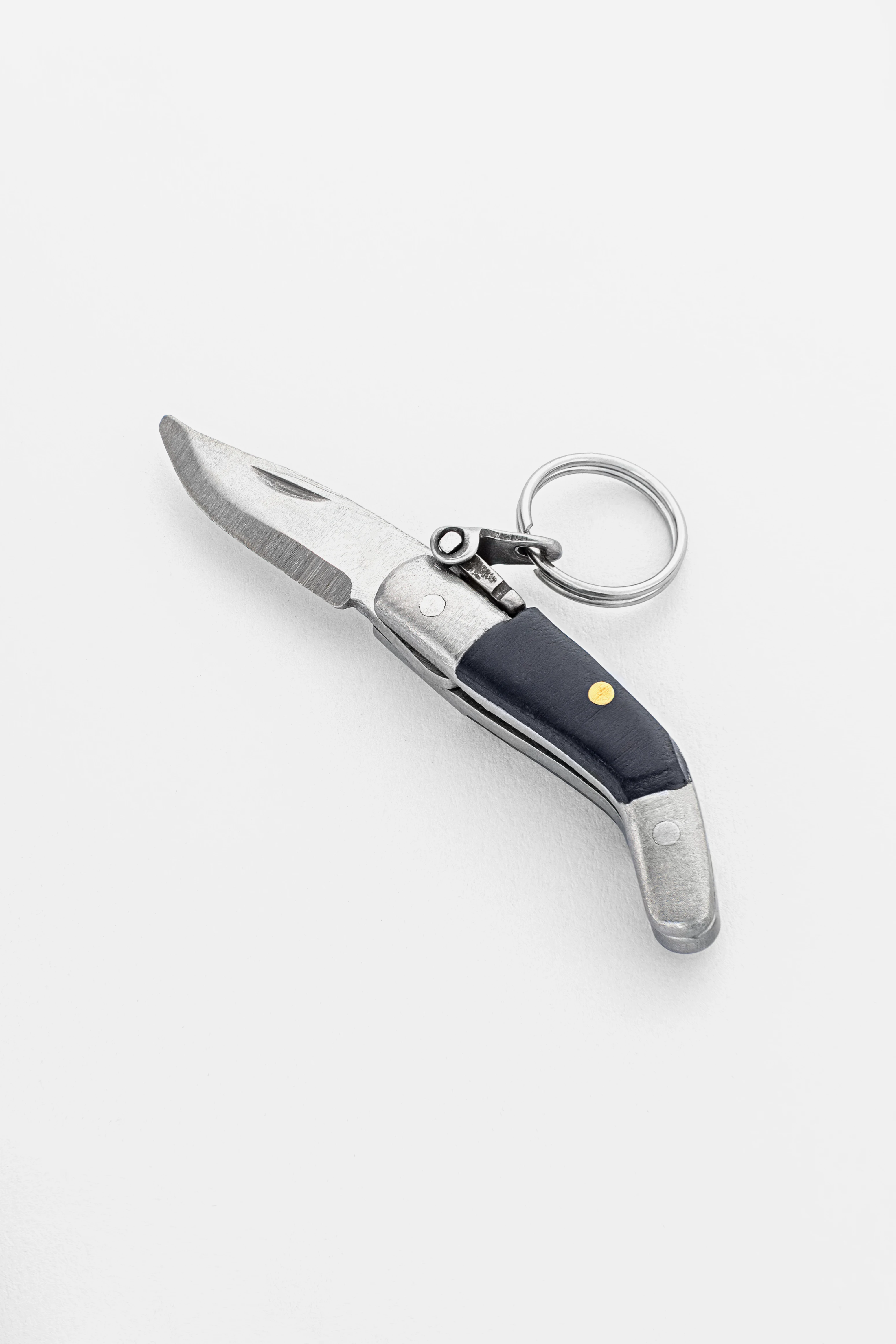
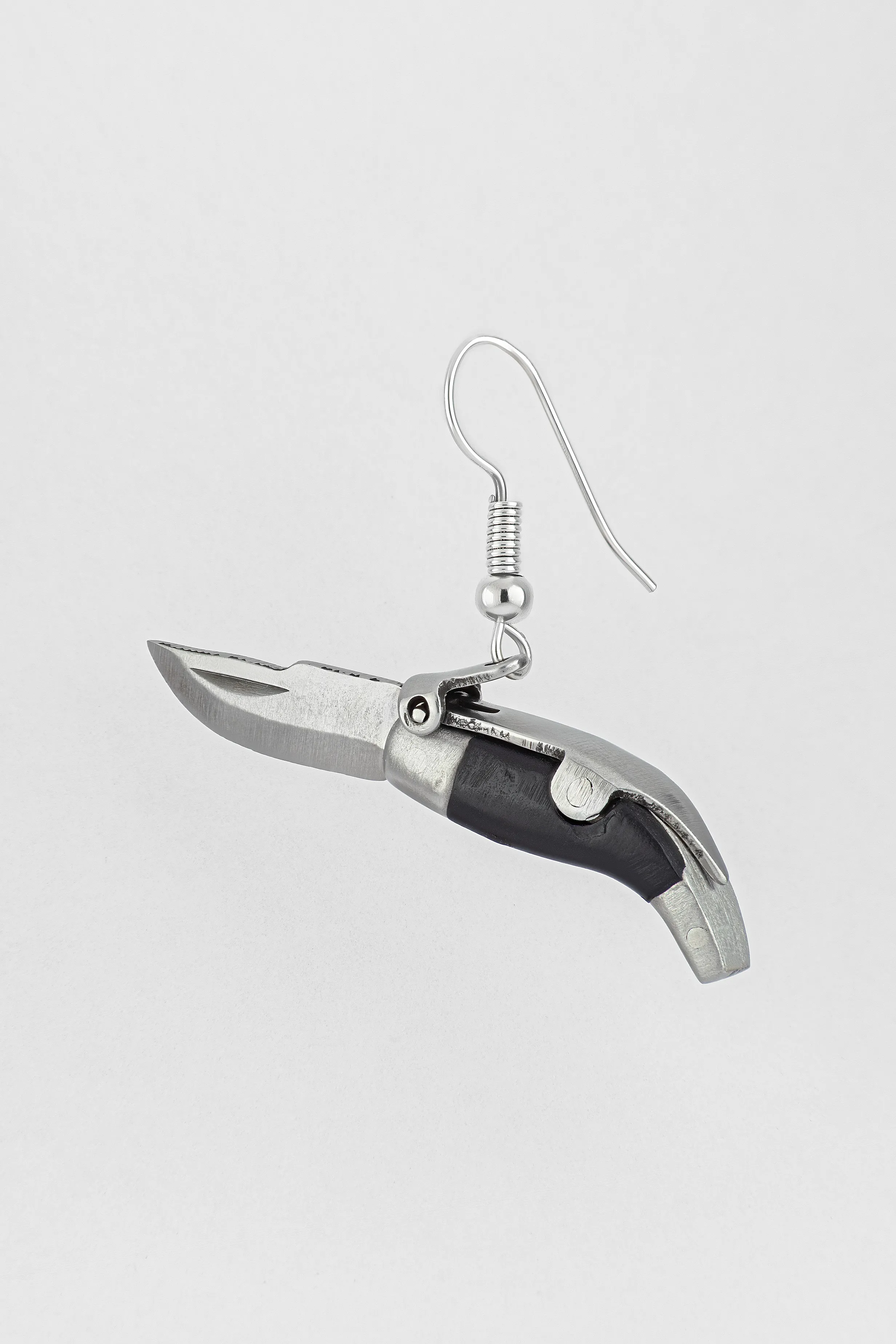
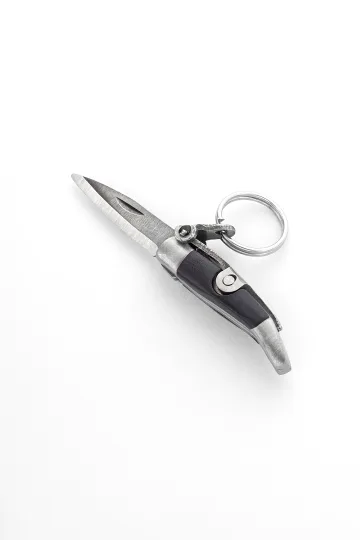
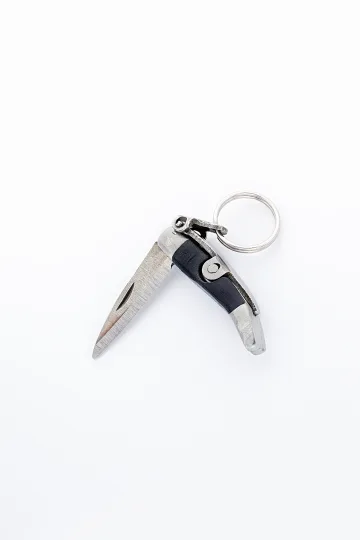
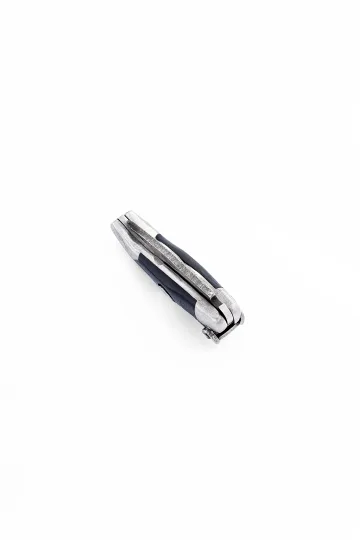
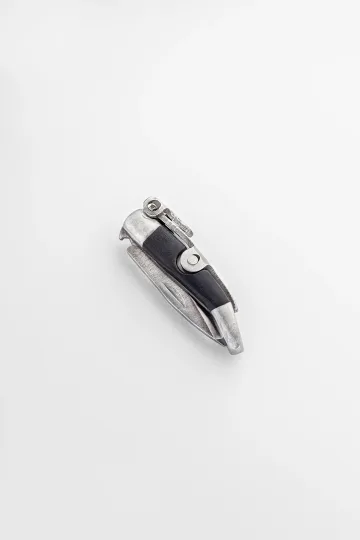
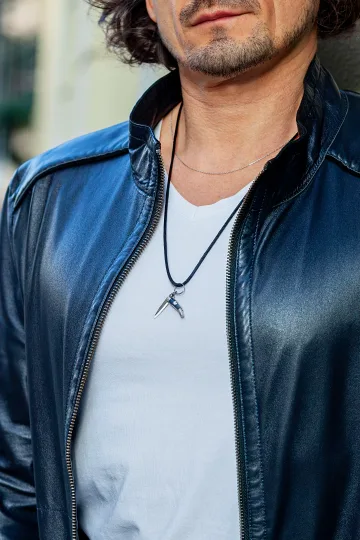
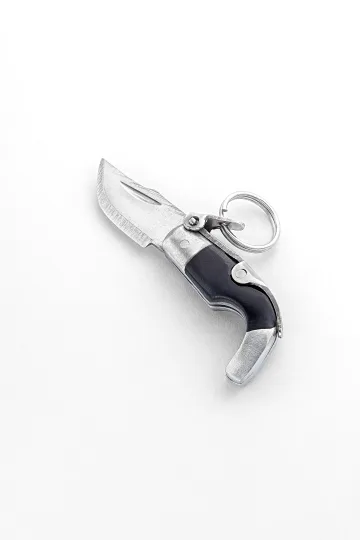
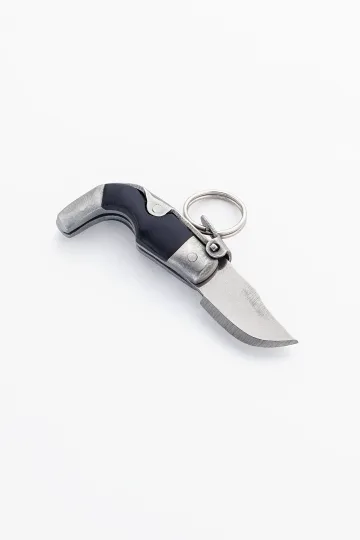
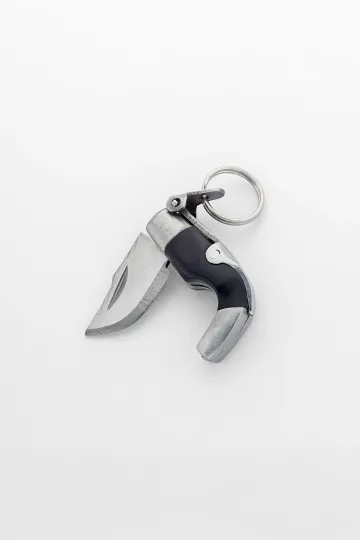
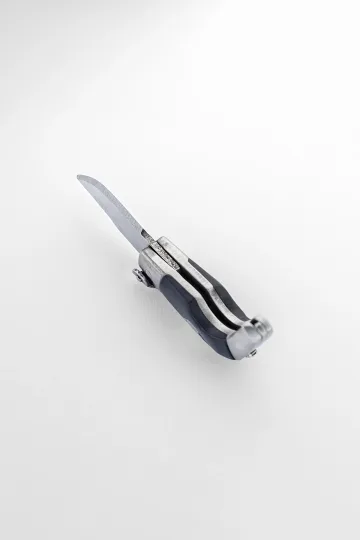
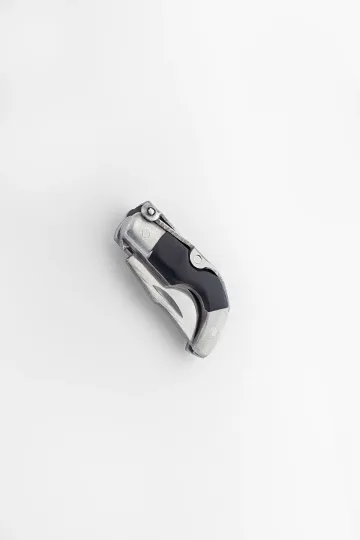
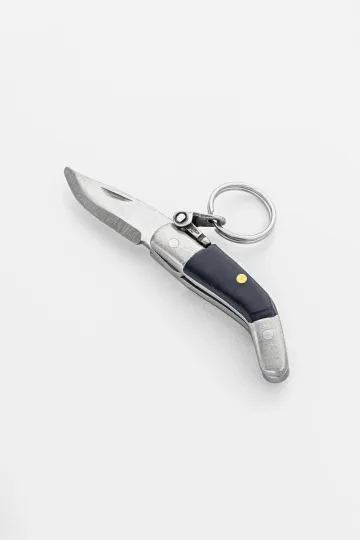
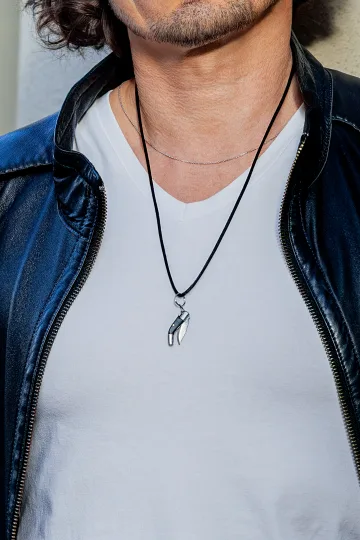
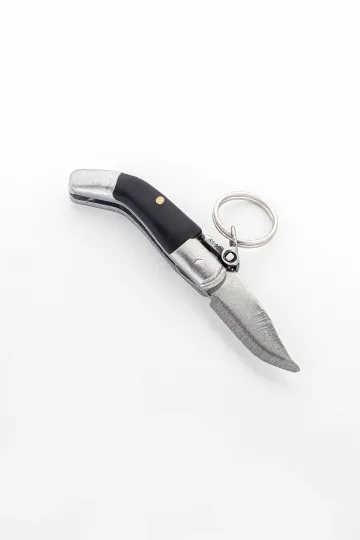
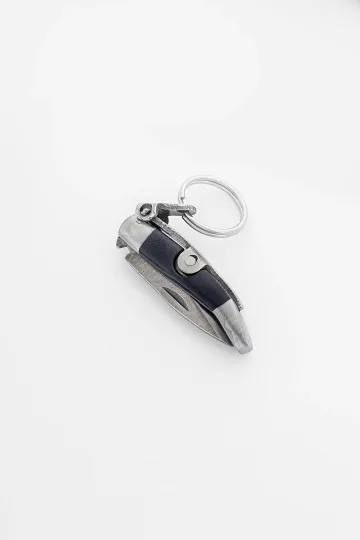
CAPAORA mini knife pendant
The 18th-century Spanish navaja in miniature: 40 mm of stainless steel, a real folding mechanism and a Palanquilla lock that clicks. An affordable gift to remember.
Authentic · Ships from Spain · 14-day returns
Practicality on the road: the bare necessities
One of the most frequent doubts when choosing jewellery as a gift for a traveller: will it be comfortable? Will it get lost? Will security take it away?
Sterling silver and 14 to 18K gold are not magnetic. At most airports a small piece passes through security without trouble: metal detectors and gates respond first to large metal objects and electronics, not to a small pendant weighing a few grams. For more on security rules, storage on the road, and choosing materials for different climates, read the practical guide to jewellery while travelling.
For a gift to a traveller the main practical criteria are:
Weight: no heavier than ten to fifteen grams for a pendant, or after a long day on the road it starts to make itself felt.
Durability: solid metal with no fragile elements, no open settings with stones that can catch.
Chain: a length of forty-five to fifty centimetres, wearable without taking it off, with a reliable clasp.
Care: the less special care, the better. 14K gold is ideal. Sterling silver will darken on the beach but wipes clean with a cloth.
What to choose for a male traveller
A separate question that comes up often: men are given jewellery less frequently, but male travellers make up a significant share of those for whom a piece would be fitting and valued.
For a male traveller, the pieces that work well are:
A bracelet with meaningful engraving: thin, leather or metal. Understated, not flashy, but present. A leather bracelet with a metal plate for engraving is a settled tradition in men's jewellery.
A compass pendant on a chain or leather cord. The compass in a men's piece carries real history: navigators, travellers, and soldiers wore compasses as talismans and tools at once. It is not a "feminine" symbol.
A ring with an engraving on the inner side. The year of the journey, coordinates, a date. Worn constantly, no one sees the inscription but him. It is the most personal option of all.
The anchor and lighthouse in men's jewellery are traditionally tied to maritime professions and feel entirely natural. Anchor symbolism has a long history in sailors' tattoos and jewellery.
A labyrinth as a pendant or a ring element: severe, geometric, with no needless decoration.
Important: jewellery for a male traveller should be functionally reliable. Not fragile. Needing no special care. Solid, robust, with a clear meaning that needs no explaining.
Leave your email, we'll send your discount code. No spam, unsubscribe anytime.
The code arrives by email, valid on your first order.
A history of travellers' jewellery: where the tradition comes from
The tradition of giving jewellery to someone setting off on a road is far older than it seems. It was not invented by jewellery shop marketing: it is built into human history across millennia.
The Phoenician merchants who set sail across the Mediterranean in the eighth to sixth centuries BC took amulets with them. Often these were images of patron gods or sacred animals: the dove of Astarte, the bull of Baal. These objects served a double function: a protective talisman for the one on the road, and a promise of return for those who stayed.
Greek seafarers had a practice of putting a pendant around the neck before going to sea: not superstition but a ritual acknowledgement that the road is unpredictable. Silver coins strung on a cord, or small images of Poseidon, Athena, or a local sea spirit.
In the European maritime tradition of the eighteenth and nineteenth centuries, sailors had tattoos done before long voyages: a compass, an anchor, a swallow. Some carried a direct code of meaning: the swallow meant five thousand nautical miles covered, the anchor meant a crossing of the Atlantic. Tattoos were a visual biography of the road. For those who did not want a tattoo, jewellery performed the same function: a memento of the road.
The Japanese tradition of giving a traveller an "omamori" before a journey goes back to Shinto and Buddhist practice. An omamori is a small amulet bought at a temple and given to a person setting out. Not necessarily expensive: what matters is the meaning of care and protection, not the cost of the object.
Across many European cultures there was a custom of giving someone leaving an object that carries a piece of home: a needle and thread, a piece of bread, a small icon or token. The principle is the same: a material go-between for those who part.
The modern jewellery gift for a traveller is a direct heir to these traditions. The technology has changed, the metals have grown thinner, the engraving more precise, but the deep meaning has stayed: you are setting off on a road, and we give you something material that carries our bond.
A good deal of belief and misconception has grown around road talismans. Let us separate the living meaning of the object from the superstitions attached to it.
Jewellery and the kind of trip: a detailed match
Different kinds of travel call for different jewellery. This is not a formality: a piece carrying a meaning incompatible with the style of the trip works worse than one that lands exactly.
Mountain trekking and hiking
A person heads into the mountains. A long route, physical effort, changeable climate. The jewellery must be as simple and tough as possible.
What works well: a small pendant on a chain with no protruding elements. A compass as a navigation symbol of direct action. Or nothing decorative at all, but the coordinates of a summit or route engraved on a thin bracelet that does not get in the way of gloves.
What does not work: fragile stones in open settings, massive pieces that press, long chains that catch.
Sea travel
Sailing races, yachting, a cruise. Maritime symbolism is in its element here and does not look out of place.
What works well: an anchor, a compass, a lighthouse. These are not metaphors but the historical symbols of seafaring people. A piece in a material that does not fear salt water: 14K gold over silver, which darkens in a salty environment.
City travel
Europe, Asia, the USA. Cities, museums, restaurants, architecture. Here the jewellery can be a little more visible, because the lifestyle allows it.
What works well: a pendant with the coordinates of a specific city on the route, a piece with a symbol of the destination country's culture, a small but expressive item.
The road without a plan
There is a category of travellers who buy a one-way ticket and decide the rest on the spot. No route made in advance. It demands a particular inner state: the ability to be with uncertainty.
For this traveller a labyrinth works well: a path that will lead you out, even with no map. Or the Fool in Tarot: the readiness to step off the cliff without knowing what lies below.
When one piece is not enough: scenarios with several gifts
Sometimes one piece is not enough, and two make sense. A few concrete scenarios.
Paired pendants for a parting. Already covered: one for the one leaving, one for the one staying. Both identical or complementary. A swallow and a nest. A compass and an anchor. A pendant with the coordinates of one city and one with the coordinates of another.
A piece plus engraving. First the piece: a symbol that suits the person. Then the engraving: after the journey, when there is a specific place and date. It is a two-stage gift: the symbol before the trip, the story after.
A piece plus a notebook for the road. Not everyone likes keeping a journal, but for many travellers a notebook is as valuable an object as jewellery. Two things that together say: I want you to record what is happening to you.
A joint gift from several people. A collective gift for a traveller works when everyone chips in for one meaningful piece with personal engraving, not when each brings something small of their own. One piece from everyone, with the names or initials of all on the back.
Jewellery as a road talisman: the psychology of the object
Why does jewellery work differently on the road than at home? A few psychological mechanisms.
The transfer effect. An object that has been consciously assigned a meaning carries that meaning with it. A pendant handed over with the words "this is so you find your way" becomes a physical reminder of that message. When the person notices it on their neck in a hard moment, the words come back.
The presence effect. A piece from a loved one, worn on the road, creates a sense of their symbolic presence. This is not mysticism but the work of memory and association. A paired pendant, the same as the one a partner has at home, makes the distance a little smaller.
The identity-anchor effect. On the road a person often loses their usual bearings: no room of their own, no people of their own nearby, no schedule of their own. Jewellery with personal meaning becomes an anchor of identity: I am myself, regardless of which city I am in now.
The ritual aspect. Putting jewellery on before a trip or taking it off after returning is a small rite of passage. Rituals help the brain switch between states. Put it on before the flight and you psychologically "switch on" travel mode. Take it off on return and you close the cycle.
All these mechanisms work better when the piece carries a specific personal meaning rather than staying merely beautiful. That is exactly why engraving and personalisation matter so much: they activate these mechanisms.
Materials for a traveller's jewellery: a practical guide
The question of materials in the context of travel deserves a separate word, though it should not take up too much room: the main thing in a piece is meaning, not metal.
Sterling silver, that is silver with 7.5 per cent of other metals for hardness, is the most common material in artisan jewellery. For a traveller: tough, fairly light, takes engraving well. On the downside: it darkens on contact with sulphur, which is present in seawater and in some perfumes. This is reversible: a wipe with a soft cloth is enough.
14K gold contains 58.5 per cent gold with copper, silver, or palladium for strength. For a traveller it is the ideal material: it does not darken, does not react with salt water, needs no care. More expensive than silver, but with the right choice it will last decades without losing quality.
Gold-plated silver: a silver base with a thin layer of gold. A middle option by price. On long journeys the plating can wear off at points of friction (the clasp, the chain). For an active lifestyle it is less preferable than solid gold.
For a traveller's gift with long-term value, the choice between silver and gold is set by both budget and the person's conditions of life. If the journey involves the sea and lasts months, gold or a resilient alloy is more practical. If it is city trips of a few weeks, sterling silver will do beautifully.
How not to get the gift wrong: a few practical principles
After all the scenarios described, it makes sense to boil the principles of choosing down to a few simple rules.
One object, not a set. A set of jewellery for a traveller works worse than one specific piece with an exact meaning. A set says "I was not sure what to choose". One piece says "I chose exactly this".
Personalisation over beauty. A beautiful piece without personal meaning will be worn sometimes. A piece with an engraving, with coordinates, with a personal date will be worn constantly.
The symbol should fit the person, not the situation. Do not give a compass simply because the person travels. Give a compass if the person is genuinely about finding a way. Or a swallow, if they are about returning. The right symbol for the wrong person works worse than no symbol at all.
Explain the meaning. Write a few lines. Say why this, specifically. A piece with its meaning explained becomes a different object.
Do not overdo the size. For a traveller the principle of compactness applies. A large, bulky piece, however beautiful, will sit in the backpack instead of being worn.
A traveller's jewellery and social codes
Jewellery on the road is a personal object. It also serves as a social signal: it tells other people something about who you are.
A compass or anchor pendant, in conversation with a stranger in a hostel or a co-working space, often becomes the start of a conversation. "What does that mean?" or simply "interesting piece" is an entry point into a story. For travellers who make friends easily, a symbolic piece works as a social marker: I am someone who travels with intent, not a random tourist.
More private travellers wear such a piece differently: under their clothes, for themselves, not for show. That too is a valid strategy. The same pendant can be a public statement or an intimate reminder, depending on how it is worn.
A special case: jewellery with paired symbolism (two identical pendants, one with the traveller, one with the person at home) creates a bond across distance that needs no words. The person simply knows: right now, wherever they are, someone is wearing the same thing. It may sound sentimental, but psychologically it works as a real anchor.
Send a friend a discount code, they save on their first order.
Jewellery as an archive of travels
There is a particular category of people who collect jewellery as a collection of routes. Every trip adds something new: a pendant with coordinates, a bracelet with an engraved date, a small ring with a symbol.
These are not souvenirs in the ordinary sense. A souvenir is an object with a picture of a landmark that gathers dust on a shelf. Archive jewellery is an object that gets worn, that is seen every day, that calls up specific memories at a glance or a touch.
After a few years such a collection becomes a jewellery biography: each piece a specific moment, a specific place, a specific version of yourself. It is a completely different way of keeping the memory of travels, more portable and more personal than photo albums and fridge magnets.
When you give jewellery with coordinates or engraving, you give the start of a collection. You help a person begin or continue such an archive. This is especially meaningful for those who love jewellery but do not know how to square it with a love of travel: archive jewellery is precisely their story.
Jewellery against other gifts for a traveller: an honest comparison
When you think about a gift for a traveller, different options come to mind. Let us weigh them honestly: where jewellery wins and where it loses.
Jewellery and tech accessories. A power bank, a plug adapter, a travel organiser. Such things are practical but impersonal. A good power bank is useful, but it can be bought by the person themselves. An engraved piece cannot be bought by oneself: it carries a meaning another person put in specifically for you. On practicality, tech wins. On personal meaning, jewellery wins outright.
Jewellery and a ticket or experience. A ticket for the next trip or a travel experience is a strong gift if you know where the person wants to go. If not, the risk is high: it may miss. A piece with the coordinates of a favourite place, or a symbol that fits the person exactly, cannot miss in the same way.
Jewellery and a guidebook or book. A guidebook is practical, but most travellers in 2026 use digital sources. A book about travel or about the destination is a good choice for people who read, but it requires precise knowledge of taste and interests. Jewellery is more universal in this respect.
Jewellery and money. Money is universal but impersonal. A traveller can spend it as needed. But a gift of money carries no message, says nothing about your seeing this particular person. Jewellery is a choice: you looked, you thought, you picked. The recipient feels that.
The honest conclusion: jewellery wins when it carries personal meaning. A generic piece without engraving or symbolism loses to tech on practicality and to money on flexibility. A personalised piece with an exact meaning has no competitor in its niche: it is an object nothing else can replace.
Buying it as a gift? Each one arrives ready to give.
 A branded Zevira box and a little card come with every order.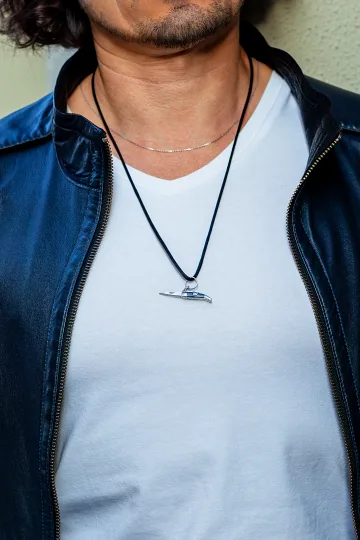




Special situations: a last-minute gift
Life does not always allow time for a careful choice. Sometimes you find out about a departure three days ahead and need to act fast.
A few tips for urgent situations:
A ready-made piece without engraving is better than a long search with engraving. A well-chosen symbol (a compass, a swallow, a lighthouse) with a note where you explain why this one works very well. The engraving can be done later, after the return.
Most jewellers with online shops offer express delivery. Laser engraving is often done in a day or two. If time is really tight: a piece without engraving plus a card with handwritten coordinates or a phrase. In some cases the card is even a better addition than the engraving itself.
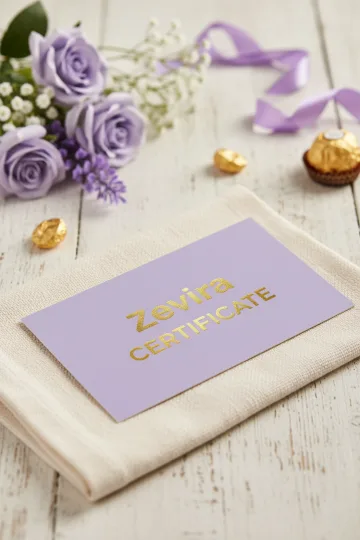
Another option for urgent cases: a digital gift certificate for an engraved piece, where the person chooses the coordinates or text themselves after the trip. This works especially well for a gift after a journey, when you want the person to decide for themselves what exactly to fix.
FAQ: common questions about gifts for travellers
Which piece suits if I do not know exactly where the person is going?
Symbols that work regardless of the specific destination: a compass (a bearing in any journey), infinity (travel as a way of life), a swallow (the return home). An engraving with a date or phrase can be done later, when the route is known. Many jewellers accept engraving orders within a few days.
Does the jewellery have to carry "travel" symbolism?
No. A gift with personal meaning that matters to this specific person works better than the right symbol with no connection. If the person has loved turtles since childhood, a turtle pendant with their route engraved is more valuable than an impersonal compass. The person matters more than the theme.
Which is better: a symbol or coordinates?
It depends on the situation. A symbol works well before a journey: it is a message about who you are setting off as, what you carry within. Coordinates work well after: an archive of what was. If you want both meanings, you can combine them: a symbol on the face of the pendant, coordinates on the back.
Will one piece suit different journeys?
Yes. A good piece is not tied to a specific trip; it is tied to the person who travels. A compass is relevant on any trip. A swallow is always relevant. The coordinates of a specific place are more of a memorial piece than a road talisman: they fix one specific event, not the whole path.
How do I choose the size of a pendant?
For everyday wear on a journey the optimum is two to three centimetres across, no more. A thin chain of forty-five to fifty centimetres. That sits under any collar, does not get in the way during physical activity, and does not catch on backpack straps.
Can I give jewellery to a male traveller?
Yes, and it works very well. A men's piece with travel symbolism (a bracelet, a pendant on a leather cord, a ring with an engraving) feels entirely natural. The key: minimalism and a specific personal meaning, not decoration for its own sake.
Which is better for a traveller: silver or gold?
Sterling silver is practical and affordable. It darkens on contact with seawater but cleans up easily with a cloth or a special wipe. 14K gold needs practically no care, does not darken, and is ideal for long journeys with an active lifestyle. If the person is away for a long time and does not want to think about caring for the piece, gold or gold-plated silver is preferable.
When is better to give it: before the trip or after?
Before the trip: when you want to pass on a symbol, a message, something that travels with the person. After: when you want to fix what was lived through, mark the experience. Both are equally strong, simply with a different meaning. A gift before says: "I believe in you." A gift after says: "I can see what you lived through."
What if the traveller makes a point of not wearing jewellery?
That is an important signal worth respecting rather than ignoring. But sometimes a person who "does not wear jewellery" simply has not found their own: not found the thing that carries enough personal meaning to become part of life. A piece with a very specific personal meaning, especially a small and unobtrusive one, often turns out to be the first one a person puts on and does not take off. Coordinates or an engraving in their own words make the piece different in nature: not a decoration but an object of meaning.
How long does engraving take?
It depends on the maker. Most jewellers do laser engraving within one to three working days. Hand engraving can take longer. If the gift is needed urgently, ask in advance. Many online jewellers take the engraving at the time of order, and the piece arrives already inscribed.
Jewellery for a traveller of different ages
A traveller's age affects what piece will be fitting. Not in the sense of "one thing for the young, another for the old", but in the sense of what lies behind travel at different periods of life.
18 to 25: the first independence. This is the time of first journeys without parents, first routes without a map, first decisions made alone on the other side of the world. Jewellery for this age should acknowledge the courage of that choice. The Fool in Tarot, a compass, a symbol of the start of the path. A labyrinth as an image of readiness to go without guarantees.
Engraving for this age: the date of a first independent trip, the coordinates of a first airport. It will be kept for decades as a mark of the point at which a new chapter began.
25 to 40: travel as a way of life. People of this age have often settled on the fact that travel is not a holiday once a year but a way of existing. Digital nomads, people who combine work and travel, slow travellers. For them jewellery is an archive and an identifying mark of a way of life.
Infinity works well (travel as a way of life with no final destination), accumulated coordinates of several places (a bracelet as a visual biography), a paired piece if there is a partner who shares this life.
40 to 60: considered travel. This is the age when people often move from collecting countries to depth of experience. Fewer ticks, more meaning. One India for three months instead of five countries in two weeks.
Jewellery for this age: the symbolism of slow travel, the coordinates of places that genuinely changed them, the anchor as a symbol of a deliberate stop. An engraving of a quote or phrase that expresses what the person believes about travel.
60 and over: travel as freedom. Many people at this age gain real freedom to travel for the first time, free of work and family constraints. It is a time of big routes long put off. A trip around the world. A dream country.
Jewellery for this age can carry the meaning of "at last": at last I am here, at last I am doing this. The coordinates of a place from the dream list. A symbol of a path begun not at the start of life but in its mature middle.
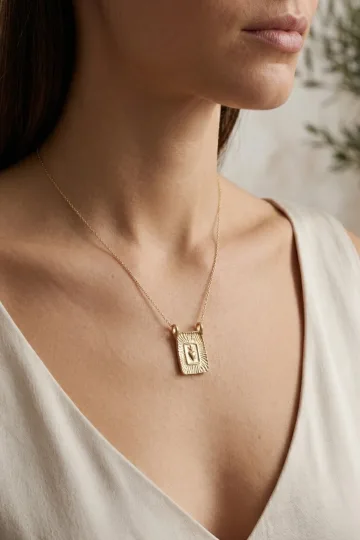
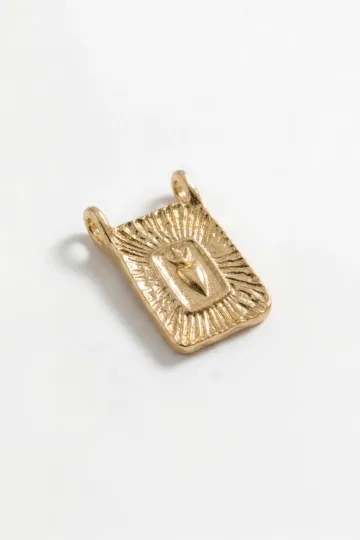
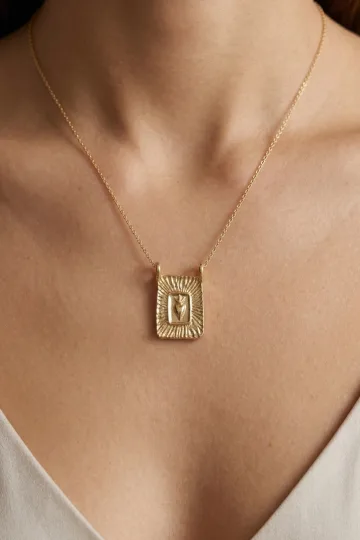
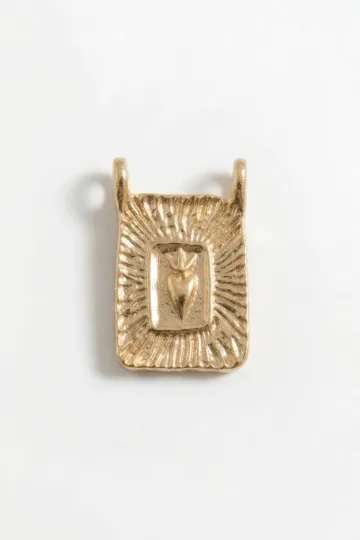
Wear the symbol, don't just read about it. These are in stock:


How to choose: three questions instead of a list
The recipient always reads the choice: "they picked exactly this for me, they saw that I am exactly like this." On receiving such a gift for the first time, many begin to wear a piece they would never have chosen themselves: the meaning another person put in creates a tie to the object you cannot create alone.
So when choosing jewellery for a traveller it is worth asking yourself three questions: what do I see in this person when I think of their road? What do I want them to carry with them? What do I want to say to them with this gift?
The answers will point to a piece more accurately than any list of recommendations.
Conclusion: jewellery as a portable home
Pico Iyer called travel not an escape from home but a way to understand what home is. A person leaves and discovers that home is not a place on the map but something they carry with them: a set of values, the image of faces that matter, the language they think in.
Jewellery for a traveller works in exactly that space. It does not say: "you are safe." It says: "you are not alone." Or: "you remember where you are from." Or: "I believe you will find your way." Or simply: here is fixed what you lived through and what is now part of you.
A compass on the road. The coordinates of home on the wrist. A lighthouse that looks back from the far side of distance. A swallow that always returns. A labyrinth that leads to the centre if you keep walking.
This is not sentimentality. It is one of the ways people have marked important moments of transition for millennia: something material that carries across distance what otherwise cannot be carried.
A person on the road carries very little. But what they carry, they carry on purpose.
Compass and wind rose, anchor, lighthouse, labyrinth, swallow, coordinate pendants. Sterling silver and 14K gold with personal engraving.
About Zevira
Zevira makes jewellery in the artisan tradition of Albacete, Spain. Among our recurring motifs: the compass and wind rose, the anchor, the lighthouse, the labyrinth, the swallow, and pendants with engraved coordinates.
For travellers we make:
- Compass and wind rose pendants in silver and gold
- The anchor and lighthouse as symbols of steadiness and bearing
- The labyrinth for those who go by intuition
- The swallow as a symbol of return, including matching pairs
- Engraving of coordinates, dates, and phrases on most of our pieces
- Paired pieces for those who leave and those who stay
We work with sterling silver and 14 to 18K gold. Every piece can be personalised with engraving.
Explore related topics too: