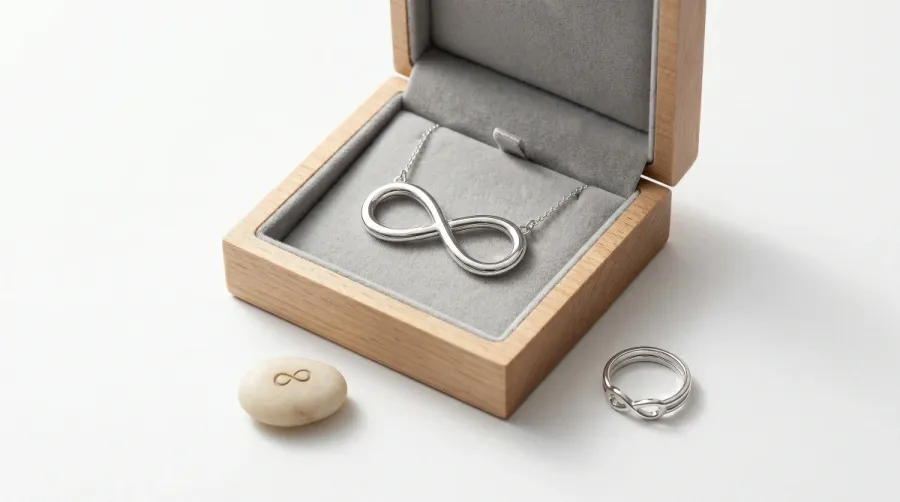
The Infinity Symbol in Jewellery: What It Actually Means and Why Everyone Wears It
A sideways eight that conquered the world
Someone, at some point, drew a figure eight on its side. And now it is everywhere. On necklaces, rings, bracelets, tattoos, Instagram bios, and the wrists of people who have never taken a mathematics class in their lives.
The infinity symbol is one of those rare designs that needs no explanation. You see it and you know what it means. Endlessness. Forever. Something without a beginning or an end. The shape itself does it. Your eye follows the curve around and around and never finds a stopping point.
But here is the thing most people do not know: the mathematical infinity symbol is only about 370 years old. The shape itself, though, is ancient. It appears in Tibetan art, Celtic stonework, Roman mosaics, and Norse carvings centuries before any mathematician got involved. The concept of an endless loop predates the notation by millennia.
So when you wear an infinity pendant, you are wearing something with two histories. One is mathematical and precise. The other is intuitive and very, very old. This is the full story of both.
Wear the symbol, don't just read about it. These are in stock:


The mathematics: John Wallis and the lemniscate
The man who named infinity
In 1655, an English mathematician named John Wallis published a treatise called "De Sectionibus Conicis" and introduced a symbol that would outlive everything else he ever wrote. He used a lazy eight, what we now call the lemniscate, to represent the concept of infinity.
Why that shape? Nobody knows for certain. Wallis never explained his choice. The leading theories range from the practical to the poetic. Some historians believe he adapted the Roman numeral for 1,000 (CIƆ or CƆ), which was sometimes used to mean "many" or "countless." Others suggest it came from the Greek letter omega (ω), the last letter of the alphabet, the end of everything, stretched on its side.
The most elegant theory? Wallis simply drew a shape you can trace without lifting your pen and without ever reaching a stopping point. A circle has a clear top and bottom, a start and finish even if they connect. The figure eight on its side has no such landmarks. Your pen moves continuously, crossing the centre, looping back, crossing again. There is no moment where it feels natural to stop. That is infinity, drawn in the simplest way possible.
The lemniscate of Bernoulli
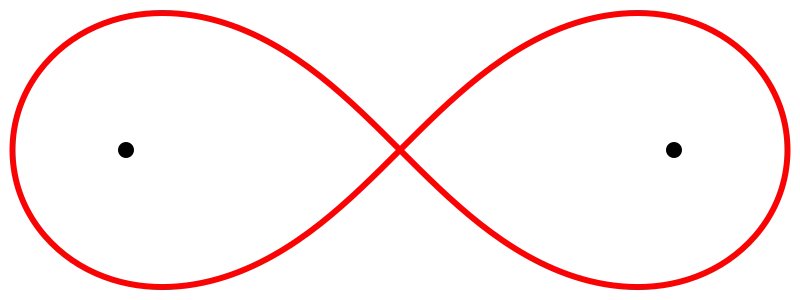
In 1694, Swiss mathematician Jacob Bernoulli gave the shape a proper mathematical definition. He described the lemniscate as the set of points whose distances from two fixed centres multiply to a constant. Essentially, he turned Wallis's doodle into rigorous geometry.
The name comes from the Latin "lemniscatus," meaning "decorated with ribbons." Which is accidentally perfect for jewellery. The infinity symbol is, literally by name, a ribbon decoration.
Bernoulli was fascinated by spirals and curves that represented natural processes: growth, decay, recurrence. He asked for a logarithmic spiral on his tombstone with the words "Eadem mutata resurgo" ("Though changed, I shall arise the same"). The infinity symbol belongs to the same family of ideas: forms that capture continuity and return.
Cantor and the hierarchy of infinities
Wallis introduced the symbol. But the deeper mathematical story of infinity unfolded two centuries later when German mathematician Georg Cantor proved something that caused a genuine crisis among his colleagues: infinities come in different sizes.
In 1874, Cantor demonstrated that the natural numbers (1, 2, 3, 4...) are infinite, but the real numbers (all numbers including fractions and irrationals) are more infinite. The infinity of natural numbers is "countable." The infinity of real numbers is "uncountable." And uncountable infinity is larger than countable infinity.
This sounds absurd. How can one infinity be larger than another if both are infinite? Yet Cantor proved it rigorously, and mathematics has since recognised an entire hierarchy of infinities: aleph-null, aleph-one, aleph-two, a staircase with no final step.
For jewellery, this adds an unexpected layer. The symbol on your pendant technically represents a specific notion of infinity. But behind it stands a whole architecture of infinities, each greater than the last. When you give an infinity pendant, you are technically giving something larger than "forever," a forever that contains other forevers inside it. Cantor would have approved.
The symbol also sits at the heart of some of mathematics' most beautiful paradoxes. Hilbert's Hotel: an infinite hotel with every room occupied that can still accommodate new guests, infinitely many of them. Zeno's paradox: Achilles should never catch the tortoise because the distance can always be halved again. He does catch it, of course, but the mathematical explanation of why took two thousand years to formalise. These paradoxes show that infinity does not operate by ordinary rules. Which is exactly why it works as a symbol for things that do not follow ordinary rules either.
An infinity wants a bare collarbone and one clean chain. Pile five pendants on top and you have got a junk drawer, not a look.
What to wear the infinity symbol with
Over years on shoots, dozens of loops have passed through my hands: thin lemniscates, rings, matching bracelets. Here is what actually works, occasion by occasion.
What do I wear an infinity with every day? For daily wear I recommend a thin steel or silver lemniscate, 15-20 mm, on a mid-length chain. A light top (white, grey, denim, sand) sets the metal free, a dark one turns the loop into an accent. Under a V-neck the symbol lands right on the collarbone, its best position. Under a crew neck I suggest a shorter chain so the infinity rests on the fabric instead of hiding.
Does it work at the office? It does, as long as you keep it quiet. I choose a stoneless lemniscate at mid-length: under a shirt collar, under fine knitwear, under a blazer. It reads as a tidy detail, not a piece that steals the room. If you want a warmer tone, I go for gold-toned metal over a solid deep colour: burgundy, emerald, graphite.
How do I build an evening look? For evening I suggest an infinity set with a row of stones or an interwoven double version: under an open neckline the stones catch the light. I recommend a longer chain that drops the symbol closer to the décolletage, with drop earrings to match. For a special day a duo works well: an infinity pendant plus a ring with the same motif on the right hand.
What do I pair it with so it does not get crowded? The infinity speaks the language of clean shapes, so it gets along with stars, thin crescents and smooth geometry, and it will not tolerate heavy, detailed symbols beside it. In a layered look I set an anchor at mid-length, add a shorter plain chain above and a longer pendant below. I keep metals in one family: gold with gold, silver with silver.
Who does it actually suit? Almost everyone, since the shape is neutral in gender and age. For a minimalist I suggest a thin steel lemniscate, for someone who likes a visible detail an infinity with stones or a heart-infinity speaks louder. Two rules that never fail. First: I match the length to the neckline, not the other way round, the symbol has to land in the open zone. Second: one infinity on a clean chain always beats one crushed between five pendants.

Turn on your camera, pick earrings, a pendant or a ring, and see the piece on yourself in real time.
Switch items in one tap.
Everything runs in your browser: no photo or video is ever uploaded.
Before the mathematics: the shape in ancient cultures
Celtic and Norse endless knots
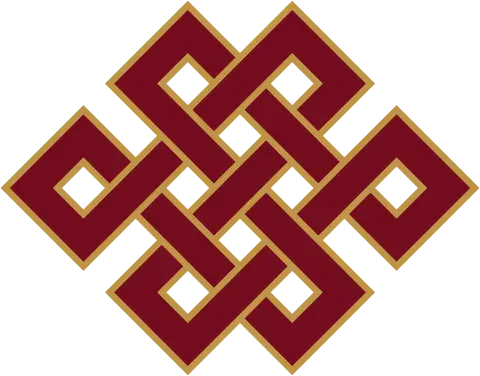
Walk into any museum with Celtic artefacts and you will see it: interlaced patterns with no beginning and no end. The Book of Kells (c. 800 CE) is filled with them. Celtic knotwork, at its core, is a meditation on infinity long before anyone called it that.
The Celtic endless knot, a single line weaving over and under itself to form a closed pattern, represents interconnection, continuity, and the cycle of life. Some designs look remarkably like the modern infinity symbol: a single line crossing itself in a figure eight, then returning to where it started.
For the Celts, these patterns were not abstract art. They represented the interconnectedness of physical and spiritual worlds, the cycle of seasons, and the bonds between people that persist beyond death. A love knot carved on a stone was not a pretty decoration. It was a statement: this bond does not end.
The Norse used similar patterns. The Valknut, three interlocking triangles associated with Odin, plays with the same concept of continuous, unbroken lines. The Norse artistic tradition was full of interlaced animals, serpents, and abstract bands that loop and return endlessly. Read more about Viking symbols and their meanings.
Tibetan and Hindu traditions
The endless knot (Shrivatsa) is one of the Eight Auspicious Symbols in Tibetan Buddhism. It appears on temple walls, prayer flags, and religious artwork throughout the Himalayan region.
In Buddhist philosophy, the endless knot represents the interdependence of all phenomena. Nothing exists in isolation. Every effect is also a cause. Every ending is also a beginning. The knot, with its lines flowing into each other without breaks, is a visual representation of dependent origination, one of the most fundamental concepts in Buddhist thought.
In Hinduism, similar interlaced patterns appear in yantras and mandalas. The concept of samsara, the cycle of death and rebirth, is essentially an infinity concept. The soul moves through lifetimes endlessly until it achieves liberation. The wheel turns. The loop continues.
The ouroboros connection
Before the figure eight, there was the serpent. The ouroboros, a snake eating its own tail, is the oldest known symbol of infinity. It appears in Egyptian tomb art from 1300 BCE, in Greek alchemy, in Norse mythology (Jormungandr, the world serpent).
The ouroboros is infinity with teeth. Where the mathematical lemniscate is abstract and clean, the ouroboros is visceral. An animal consuming itself to sustain itself. Destruction and creation in one image.
The modern infinity symbol is the polished, civilised descendant of the ouroboros. Same idea, different energy. The snake says "nothing ends." The figure eight says "nothing ends" with a smile. Both are worn as jewellery. The choice between them says something about the wearer.
The Möbius strip and its family
Less ancient but worth knowing: the Möbius strip is the infinity symbol's closest geometric relative. Take a strip of paper, give it one half-twist, and join the ends. The result is a surface with only one side and one edge. An ant walking along it would traverse what looks like both sides without ever crossing an edge.
The connection to the infinity symbol is not merely visual. Both the lemniscate and the Möbius strip are single continuous paths with no identifiable beginning or end. Sculptors have worked with Möbius forms for decades, and some jewellers create rings and pendants based on the Möbius geometry: a band that twists so the outside and inside are the same surface. It is the infinity symbol made into three dimensions.
Customer reviews
Zevira is a real jewellery shop. Genuine payments, deliveries and customer thank-yous.
🥰🥰🥰 gracias
Ok, ¡gracias! 🙂
What the infinity symbol means when you wear it
Eternal love
This is the big one. The reason infinity jewellery sells more than almost any other symbol in the market. A gift of an infinity pendant, ring, or bracelet says: I love you without end. No expiration date. No conditions. No fine print.
It works because it is direct. A heart symbol means love, but love of what kind? Romantic? Familial? Friendly? A rose means passion, but passion fades. Infinity means forever. The message is unambiguous and enormous and fits on a pendant smaller than a coin.
Couples exchange infinity jewellery for anniversaries, Valentine's Day, and "just because." It is less traditional than a heart, less heavy than a promise ring, but carries the same weight of commitment. It says something without requiring a speech.
Friendship and connection
Infinity jewellery is massively popular as a friendship symbol. Two people, each wearing half of an infinity set (or matching infinity bracelets), are declaring that the friendship endures regardless of distance, time, or life changes.
This is particularly powerful for friends separated by geography. When someone moves away, starts a new life, or simply grows up and grows apart, the infinity bracelet is a physical reminder: we are still connected. The loop is unbroken.
Empowerment and self-continuity
Some people wear infinity jewellery for themselves. Not as a relationship marker, but as a personal statement. The meaning shifts from "our love is infinite" to "I am infinite": limitless potential, endless resilience, continuous growth.
This interpretation gained momentum in recent years, especially among people recovering from difficult periods. After illness, loss, or major life transitions, an infinity symbol can mean: I survived. I continue. There is no end to what I can endure.
Spiritual meaning
For people with spiritual inclinations, infinity represents the eternal nature of the soul, the continuity of consciousness, or connection to something larger than oneself. It bridges Eastern and Western spiritual traditions: the Buddhist endless knot and the Christian concept of eternal life both find expression in the same simple curve.
The beauty of the infinity symbol is that it carries this weight without being tied to any single tradition. A cross is Christian. An Om is Hindu. A Star of David is Jewish. But infinity belongs to everyone. This cultural neutrality is a feature, not a limitation. A piece of jewellery that carries meaning across every background is genuinely rare.
Upload a photo of your pet, someone you love, or an object. We'll build a 3D model and hand-cast it in pewter.


Infinity in jewellery design: styles and variations
The classic lemniscate
The simplest version. A clean figure eight on its side, usually in metal wire or a flat band. No embellishment, no stones. The line itself is the message. This style works as a pendant, a ring (with the symbol on top of the band), or a bracelet connector.
Classic lemniscate designs suit minimalist wardrobes and people who prefer subtle symbolism. The kind of piece you notice on second glance, not first. In sterling silver or steel, it is understated. In gold tones, it catches light without shouting.
The weight of the wire matters here. A delicate, slender lemniscate reads as understated and elegant. A heavier-gauge wire version reads as architectural and bold. Same symbol, very different presence. When choosing, consider whether you want the infinity to whisper or to make itself heard.
Infinity with names or initials
Personalised infinity jewellery, where names, initials, or dates are engraved along the curves of the symbol, is one of the most popular gift categories in the industry. The symbol provides the meaning (forever), and the name provides the specificity (forever with you).
This style works best on pendants and bracelets where there is enough surface area for the engraving to be legible. Rings tend to be too small for names, though initials work.
The personalisation also solves a common problem with gift-giving: a generic infinity pendant is beautiful but anonymous. Add a name, a date, or a pair of initials, and the same piece becomes unmistakably specific. It was made for one person, by one person. That specificity is the gift inside the gift.
Infinity with stones
Cubic zirconia, crystals, or other stones set along the curves of the infinity symbol add sparkle and visual weight. The stones follow the line of the figure eight, creating a flowing, glittering path.
A word on materials: stones set in an infinity design are usually decorative, not precious. If a piece is marketed as having "diamonds" in an infinity design at a low price point, those are almost certainly not diamonds. Check the specifications. Cubic zirconia and lab-grown crystals are beautiful, durable, and honest, as long as they are labelled correctly.
Birthstones are a popular choice for infinity designs with stones. A mother's pendant with each child's birthstone placed along the curve of the infinity symbol combines personalisation with symbolism in a way that is hard to beat.
Double and interlocking infinities
Two infinity symbols intertwined represent two lives, two paths, two stories woven together permanently. This is a popular design for couples and particularly for wedding-related jewellery.
The interlocking version is visually more complex and carries a more specific meaning than the single symbol. Where a single infinity means "forever," a double infinity means "forever together." The distinction matters when choosing a gift.
The infinity heart
The infinity heart, where the curves of the lemniscate blend into a heart shape, is one of the most recognisable hybrid designs. The loop does not simply connect to a heart; in the best versions, the curves flow continuously so that the heart and the infinity are the same unbroken line, just seen differently depending on where you focus.
This design answers a real gap. The heart symbol conveys warmth but not duration. The infinity symbol conveys duration but not warmth. The infinity heart does both simultaneously, which is why it has become one of the most gifted jewellery designs for romantic relationships.
Infinity combined with other symbols
The infinity cross combines the mathematical symbol with a Christian cross. Infinity hearts merge the loop with the love symbol. Infinity anchors suggest a steady, permanent bond. These hybrid designs let the wearer layer meanings: not just "forever," but "forever in faith," "forever in love," or "forever grounded."



Who wears infinity jewellery and why
Young couples
Infinity is the entry-level forever symbol. Less formal than engagement rings, less culturally loaded than promise rings, it is the symbol couples reach for when they want to mark something real without making it feel like a contract. It says "I am serious about you" in a language that does not require parental notification.
It is also one of the few symbols that works across genders without modification. A stainless steel infinity bracelet or pendant reads the same way on any wrist. The symbol does not need a "masculine version" or a "feminine version." It is already both.
Mothers
Infinity jewellery with children's birthstones or names is a massive category. Motherhood and infinity fit naturally: the idea that a parent's love is literally without limit. Mother-daughter infinity sets are particularly popular, especially as gifts for Mother's Day or milestone birthdays.
These pieces have a second life as heirlooms. A mother's infinity pendant with her children's initials becomes, years later, something her children remember. Small, light, and worn every day, these are exactly the pieces that end up meaning the most.
Best friends
Matching infinity bracelets are the modern friendship bracelet. Less childish than beaded bracelets from summer camp, more meaningful than a random accessory. They work across age groups, which is rare for friendship jewellery.
The infinity bracelet says something a card cannot: I chose to wear a symbol of our friendship every day. On a bad day, the bracelet is a small physical presence that says someone out there is still thinking of you too.
Self-purchasers
Not all jewellery is a gift. A significant number of infinity pieces are bought by people for themselves. The motivation is personal: a reminder of inner strength, a marker of survival, or simply an appreciation of the design. Not everything needs to be about a relationship.
For people who have come through something difficult (illness, bereavement, a relationship that ended, a career that collapsed), the infinity symbol on their own wrist becomes a private statement: I continue. The loop is mine, and it is not broken.
Graduates and new beginnings
Infinity as a graduation gift says: your potential is unlimited. The future is open-ended. This is a beginning, not an end. Smart framing for a symbol that literally means "without end." The gift works because the message is forward-facing rather than backward-looking, which is exactly what someone beginning a new chapter needs to hear.
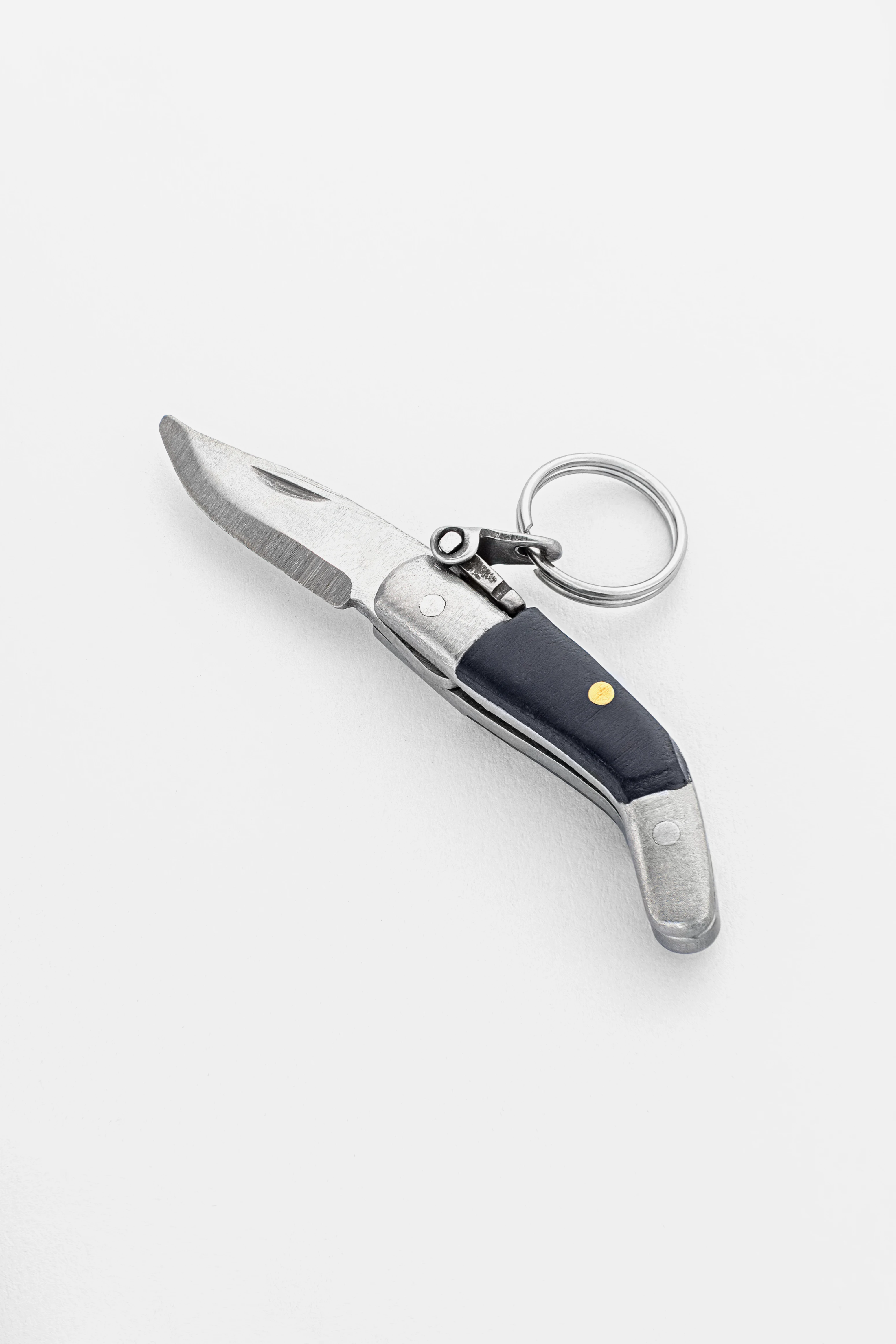
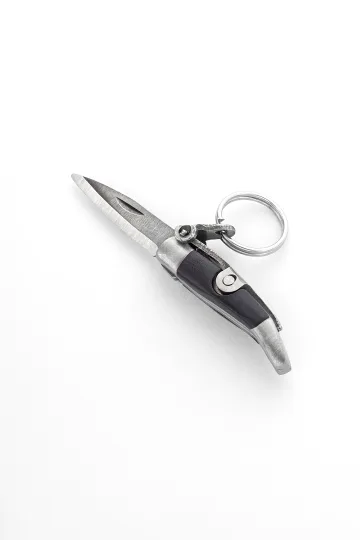
CAPAORA mini knife pendant
The 18th-century Spanish navaja in miniature: 40 mm of stainless steel, a real folding mechanism and a Palanquilla lock that clicks. An affordable gift to remember.
Authentic · Ships from Spain · 14-day returns
How to choose infinity jewellery
Material matters
For everyday wear, the material needs to withstand constant contact with skin, water, and friction. Stainless steel 316L handles all of this without tarnishing, discolouring, or causing allergic reactions for most people. It is the practical choice for a piece you plan to wear and forget about.
Sterling silver is beautiful but requires maintenance. It tarnishes over time and needs polishing. Fine for pieces you wear occasionally or keep carefully.
Gold-plated pieces look premium but the plating wears off eventually, especially on rings and bracelets where friction is constant. If you want gold tones without gold prices, look for PVD-coated options, since the coating is significantly more durable than traditional plating. Read more about how long gold plating lasts.
For a detailed breakdown of metals and skin reactions, see our nickel allergy guide.
Size and placement
The infinity symbol works across all jewellery types, but some are more effective than others:
Pendants. The most popular format. The symbol hangs at the collarbone or just below, visible but not aggressive. Works with any chain length. The symbol itself is usually 1.5-3cm across. More about choosing the right chain length.
Bracelets. The infinity symbol as a connector piece on a chain bracelet is a strong design. It sits on the wrist, visible when gesturing or resting a hand. The symbol is typically smaller than on a pendant, around 1-2cm, which keeps it proportional.
Rings. Infinity rings feature the symbol on top of the band. These are dressier than plain bands and work well as everyday rings or as right-hand statement pieces. Sizing matters more than with other infinity jewellery: see our ring size guide.
Earrings. Infinity studs or small drops. Subtle, symmetrical, and suitable for any ear piercing. These are excellent starter jewellery for people who are unsure about wearing symbols: an infinity stud is barely louder than a plain circle.
Choosing for someone else
If you are buying infinity jewellery as a gift, consider the recipient's existing style. Minimalists prefer the clean lemniscate in silver or steel tones. People who like statement pieces might prefer infinity designs with stones or interlocking patterns. People who wear mostly gold will want gold-toned options.
When in doubt, a simple infinity pendant on a mid-length chain is the safest choice. It works with virtually any wardrobe, any neckline, and any personal style. It is the gift equivalent of a safe bet that still feels thoughtful.
For more gift ideas, check our gift guide for girlfriends or gift guide for boyfriends.
Infinity vs other "forever" symbols
Infinity vs ouroboros. Both mean "without end." The ouroboros is darker, more primal, rooted in mythology and alchemy. The infinity symbol is cleaner, more modern, more universally understood. The ouroboros says "I understand that endings are beginnings." The infinity symbol says "there are no endings." Different philosophies wearing similar shapes.
Infinity vs circle. A circle is closed. An infinity symbol is continuous but not closed: it crosses itself, creating a dynamic flow. A circle represents completion. Infinity represents ongoingness. A wedding band is a circle: "we are complete." An infinity bracelet says: "we are continuing."
Infinity vs heart. Hearts mean love. Infinity means forever. Combining them covers both bases. But separately, a heart is warmer and a lemniscate is more cerebral. Hearts are emotional. Infinity is philosophical. Choose based on whether the recipient thinks with their heart or their head.
Infinity vs Celtic knot. Extremely similar in concept: both represent endless continuity through interlaced lines. The Celtic knot carries cultural specificity (Celtic/Irish heritage), while infinity is culturally neutral. If the recipient has Celtic connections, a Celtic knot might resonate more deeply. If not, infinity is the universal version.
Infinity vs tree of life. The tree of life represents growth, connection, and rootedness. Infinity represents continuity and limitlessness. Trees are grounded. Infinity is free. The tree says "we are connected." Infinity says "we are endless."
Leave your email, we'll send your discount code. No spam, unsubscribe anytime.
The code arrives by email, valid on your first order.
Caring for infinity jewellery
The care depends entirely on the material, not the symbol. A stainless steel infinity pendant requires almost nothing, just occasional wiping with a soft cloth. Sterling silver pieces need regular polishing to combat tarnish. Gold-plated pieces should be kept away from water, sweat, and perfume to extend the life of the plating.
For detailed care instructions by material, see our guide on how to clean jewellery at home and our tarnish removal guide.
The good news about infinity jewellery specifically: the simple curves of the design mean there are few places for dirt to accumulate. Unlike intricate filigree or settings with many crevices, an infinity symbol is smooth and easy to clean. A soft cloth and warm water handle most situations.
One practical note for rings: the top of an infinity ring (where the symbol sits) catches more contact than a plain band. It is worth checking the orientation occasionally. After months of daily wear, a ring can rotate slightly on the finger so the symbol ends up pointing at an angle. A quick adjustment takes two seconds and keeps the piece looking as intended.
The infinity tattoo problem (and why jewellery is better)
Infinity is consistently one of the top five most-requested tattoo designs worldwide. It is also one of the most regretted. The design is so common that it has become a punchline in tattoo culture: the "basic" tattoo, alongside birds on a collarbone and a compass on an inner wrist.
This is where jewellery has a genuine advantage over ink. Jewellery can be removed, changed, or upgraded. You can wear an infinity pendant at 20 and still love it at 40 because you chose a timeless material and a clean design. If your taste changes, the pendant goes in a box. No laser removal required.
A well-made infinity pendant in quality metal outlasts any tattoo. It does not fade, blur, or stretch with age. It does not require touch-ups. And if someone gives you a different piece ten years later, you can wear both.
The symbol works because it is simple. Simplicity ages well in metal. It ages poorly in ink.
There is a practical test if you are uncertain: wear a pendant for six months. If you still want to see the symbol every day after that, you have your answer. If the pendant ends up forgotten in a drawer after three weeks, you have also learned something useful, and the lesson cost far less than a laser session.
Infinity jewellery across cultures
The infinity symbol has a rare quality: it belongs to no culture and all cultures simultaneously. Unlike a cross, a hamsa, or an Om, the infinity symbol carries no religious or ethnic baggage. It is mathematics made visible. And mathematics is universal.
In Europe, infinity jewellery tends toward the understated. Fine silver or steel, clean lines, small scale. The European minimalist tradition favours the symbol as a subtle presence rather than a focal point. In Germany, where Bauhaus principles still influence design thinking, the infinity symbol works particularly well because it is pure form with clear meaning: no ornament, no waste.
In Mediterranean cultures, the infinity symbol picks up warmth. Italian goldsmiths in Vicenza and Arezzo work the shape in 18-carat gold, giving it the sensuality that Italian design brings to everything it touches. Spanish interpretations often combine infinity with other symbols (hearts, names, dates), creating pieces that carry multiple layers of meaning in one design. Zevira, working from its workshop in Albacete, follows this tradition of layered meaning: the infinity symbol as one voice in a conversation that also includes heritage, craft, and specificity of place.
In East Asia, the infinity shape connects naturally to existing traditions of endless knots and continuous patterns. Japanese minimalism embraces the symbol's simplicity. The clean figure eight on a fine chain fits perfectly within the Japanese aesthetic of restraint and intentional beauty.
In the Americas, infinity jewellery is particularly popular as a relationship marker. The straightforward message, "forever," appeals to cultures that value direct emotional expression. Matching infinity bracelets for couples and best friends have become a significant gifting category.
Send a friend a discount code, they save on their first order.
Seasonal styling with infinity jewellery
The infinity symbol is one of the most seasonally versatile designs in jewellery. The same piece changes character depending on how and when you wear it.
In summer, a thin chain with a small steel or silver infinity sits against tanned skin and reads lighter, more spontaneous. Open necklines and minimal clothing give the symbol space, and the contrast of metal against warm skin is at its most striking.
In autumn and winter, the same pendant disappears under scarves and high collars, becoming more private. This is when the ring and bracelet formats come into their own, since hands are visible more than necks during the colder months. An infinity ring on the right hand catches light every time you reach for something.
Spring is when matching friendship bracelets make the most sense. Wrists emerge from winter sleeves, and a bracelet is the first piece of jewellery to see daylight after months of being covered.
The point is that you do not need to rotate jewellery seasonally if the design is right. A good infinity piece works in all four scenarios. The context and the outfit do the variation.
Silver and gold jewellery, wedding bands, symbolic pendants, paired sets.
FAQ
What does infinity jewellery mean as a gift? It means "forever," whether that is love, friendship, family, or commitment. The specific relationship context defines the exact meaning. An infinity pendant from a partner means eternal love. From a parent, eternal support. From a friend, enduring friendship.
Is infinity jewellery appropriate for men? Absolutely. Infinity designs in steel, matte finishes, or darker metals work well for men. The symbol is not gendered. A stainless steel infinity bracelet or a simple pendant on a leather cord reads masculine without effort.
Can I wear infinity jewellery if I am not in a relationship? Yes. Many people wear infinity symbols for themselves, representing personal growth, resilience, or limitless potential. The symbol belongs to anyone who connects with its meaning.
What is the difference between the infinity symbol and the number 8? Orientation. The number 8 is vertical. The infinity symbol is horizontal (on its side). Numerologically, 8 represents balance, power, and abundance. The infinity symbol represents endlessness. Related concepts, different emphases.
Is infinity jewellery a good anniversary gift? Very much so. It carries the right sentiment (eternal love) without being as formal as diamonds or as generic as flowers. Particularly effective for early anniversaries where an engagement ring would be premature.
What is the best metal for infinity jewellery? For daily wear: stainless steel 316L (durable, hypoallergenic, affordable). For special occasions: sterling silver or gold-plated (more lustrous, requires more care). For luxury: solid gold or platinum.
Does infinity jewellery have religious meaning? Not inherently. The mathematical symbol is secular. But many people interpret it through a spiritual lens: eternal soul, divine love, cosmic continuity. It can carry religious meaning if the wearer assigns it, but it does not come pre-loaded with any specific doctrine.
Why is infinity jewellery so popular? Three reasons. First, the meaning is universally understood, no explanation needed. Second, the design is clean and works with any style. Third, it is appropriate for almost any gift occasion and any relationship. Very few symbols tick all three boxes.
Can infinity jewellery be worn with other symbolic pieces? Yes. Infinity pairs well with hearts, stars, and other abstract symbols. It can clash visually with very detailed or ornate pieces simply because its strength is simplicity. Pair it with other clean, minimal designs for the best effect. See our layering guide for more ideas.
What is the infinity heart design? The infinity heart is a hybrid where the curves of the lemniscate blend seamlessly into a heart shape: a single continuous line that reads as both symbol and heart depending on how you look at it. It covers both "forever" and "love" in one unbroken form, which is why it has become one of the most popular romantic jewellery designs.
Is there a difference between a single and a double infinity symbol? Yes. A single infinity represents endlessness in a general sense: love, potential, continuity. A double infinity, two lemniscates interlocked, specifically represents two people or two paths permanently woven together. It is a more specific statement and works better as a couples' symbol than the single version.
Buying it as a gift? Each one arrives ready to give.
 A branded Zevira box and a little card come with every order.



The bottom line
The infinity symbol works because it is honest. It does not promise protection (like an amulet). It does not claim magical properties (like a talisman). It does not invoke any specific deity or tradition. It simply says: this does not end.
That is a powerful statement in a world where everything seems temporary. Relationships, jobs, trends, moods all come and go. Wearing a small metal curve on your neck or wrist that says "but this continues" is a quiet act of defiance against impermanence.
Whether the "this" is love, friendship, family, or just your own stubborn persistence, that is up to you. The symbol holds whatever meaning you pour into it. It has been doing that for centuries, and it is not going to stop.
Which, when you think about it, is exactly the point.
The infinity symbol does not need your belief. It does not need your culture. It does not need your explanation. It just needs your finger to trace it once, following the curve that never ends, to understand exactly why it has endured for as long as it has. Some shapes are just true.
Wear the symbol, don't just read about it. These are in stock:



About Zevira
Zevira makes jewellery in the artisan tradition of Albacete, Spain. The infinity symbol has a special place in our paired collections: it is the universal language of "forever," read without explanation in any culture.
Here is what you will find with us in the infinity motif:
- Classic lemniscate pendants on fine chains
- Matching bracelets for couples and best friends
- Infinity with personal engraving of names or dates
- Infinity combined with an anchor, a heart, or a cross
- Rings with the symbol set on top of the band for everyday wear
Every piece can be personalised with engraving by a craftsperson, with personal engraving available on request. We work in sterling silver and 14-18K gold.


