Zeus and Jupiter in Jewelry: Eagle, Thunderbolt, and the Mark of Supreme Power
For two thousand years the Greeks carved Zeus onto tiny carnelian seals, and the Romans struck his profile on coins that travelled from Britain to Syria. The eagle and the thunderbolt became a universal cipher for power long before any coat of arms existed. Today the same eagle perches on a signet ring, and the thunderbolt turns into a pendant. The oldest god on Olympus has gone nowhere.
Who Are Zeus and Jupiter
Zeus is the supreme god of the ancient Greek pantheon, lord of the sky, the storm, and the lightning, father and king of gods and men. To the Romans his counterpart goes by the name Jupiter. They are essentially one deity under two names, because the Romans took over Greek mythology almost wholesale and mapped it onto their own gods. When a Greek said "Zeus," a Roman heard "Jupiter," and the two understood each other perfectly.
The name "Zeus" goes back to an ancient Indo-European root meaning "to shine," "the bright daytime sky." From the same root come the Latin "deus" (god) and the Sanskrit "Dyaus" (sky-father). In other words, the very name carries the idea of a bright daytime sky from which the lightning strikes. Jupiter in Latin is literally "Dyeu-pater," "sky-father," and there too you can hear the same celestial root plus the word "father."
Wear the symbol, don't just read about it. These are in stock:
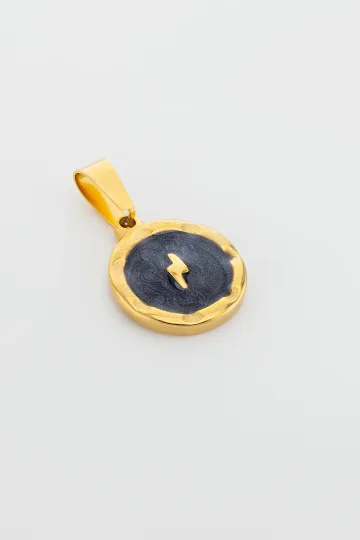


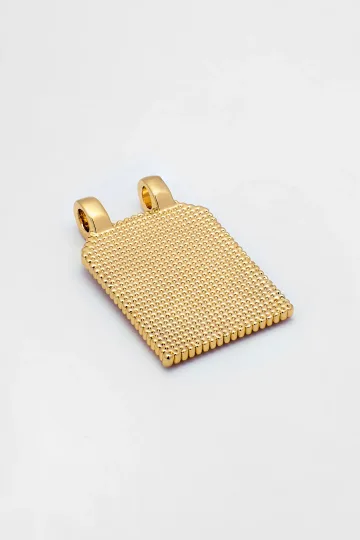
In jewellery Zeus and Jupiter rarely appear as the portrait of a bearded man, and far more often through their attributes: the eagle, the thunderbolt, the oak, the sceptre, the Aegis. These signs read instantly. They stand for power, protection, justice, and supremacy. A pendant with an eagle or a signet ring with a thunderbolt works like an ancient badge of seniority, understood without a caption.
The Thunderer stands at the head of the third generation of gods. Before him the Titans ruled the world, led by his father Cronus, and earlier still the primordial powers Uranus and Gaia. The myth says Cronus devoured his own children, fearing he would be overthrown, but his mother hid the infant Zeus on Crete, slipping her husband a swaddled stone instead. The grown Zeus freed his swallowed brothers and sisters, raised a rebellion, and won a ten-year war against the Titans. Afterwards the three brothers cast lots: Zeus drew the sky, Poseidon the sea, Hades the underworld. So the Thunderer became lord of the sky not by birth but as the outcome of a struggle, and that history gives his symbols a flavour of power that was won rather than handed down.
Zeus Among the Gods of Olympus
Zeus heads the twelve gods of Olympus, and his seniority rests not on brute force but on a recognized right to judge. Hera is his wife and sister, guardian of marriage. Poseidon and Hades are the brothers who divided the world with him. Athena, Apollo, Artemis, Hermes, Aphrodite, Ares, Hephaestus, and Dionysus are his children and kin, each with their own element and their own set of symbols. Zeus among them is the supreme one, the one people turn to for the final word, and that is exactly why his attributes read as the marks of the highest authority. When someone chooses a pendant with an eagle rather than Athena's owl or Apollo's lyre, they are choosing the symbol at the very top of the pyramid.
It is worth remembering the inner circle around the Thunderer too. The eagle carries his thunderbolts, the goddess of victory Nike stands in his palm, his daughter Hebe pours nectar at the feasts, and the messenger Hermes carries his will. This retinue explains why the eagle and the small winged figure of Nike so often appear together on coins and gems: they show the god not alone but surrounded by the signs of his power and his luck.
In order, then: where the image of the Thunderer came from, what each of his symbols means, how the Greek Zeus differs from the Roman Jupiter, what such jewellery is made of, how and with what to wear it, and where Zeus meets other storm gods like Thor and Perun.
The Image Through History: From Carved Gems to Neoclassicism
The image of Zeus lived a long life, and at almost every stage it left a mark in small-scale work, that is, in precisely the field from which jewellery grew. Seals, signet rings, coins, cameos. All of it was worn on the body, all of it was portable.
How Zeus Came to Power
The Thunderer's power was not given to him at birth, and that detail explains why his symbols read as the marks of a won, not an inherited, seniority. Zeus's father, the Titan Cronus, ruled the world in fear of a prophecy: he was told that one of his children would overthrow him, just as he had once overthrown his own father Uranus. So Cronus swallowed every newborn. His wife Rhea, weary of losing her children, hid her youngest son on the island of Crete and slipped her husband a swaddled stone, which he swallowed without suspecting a thing. Zeus grew up in secret, suckled by the goat Amalthea, under the clatter of the shields of the Kouretes warriors, who drowned out his cries.
Come of age, Zeus forced his father to disgorge the swallowed brothers and sisters: Hades, Poseidon, Hera, Demeter, and Hestia. So a whole generation of gods appeared, ready for a war over the world. The ten-year battle with the Titans, the Titanomachy, swayed back and forth until Zeus freed the Cyclopes and the hundred-handed giants chained in the underworld. In gratitude the Cyclopes forged him the thunderbolt, and it was the thunderbolt that turned the tide of the war. The defeated Titans were locked in Tartarus, and the hundred-handed guards were set to watch them.
After the victory the three brothers cast lots, dividing the world into three parts. Zeus drew the sky, Poseidon the sea, Hades the underworld of the dead. The earth and Olympus were left in common. So the Thunderer became lord of the sky not by right of birth but by the outcome of a struggle and a lucky draw, and there lies the root of his image: he is first among equals, a king who seized the throne rather than inheriting it. Everyone who wears an eagle or a thunderbolt unknowingly plugs into this very story of a strength that was won, not handed down.
Archaic and Classical: The First Images
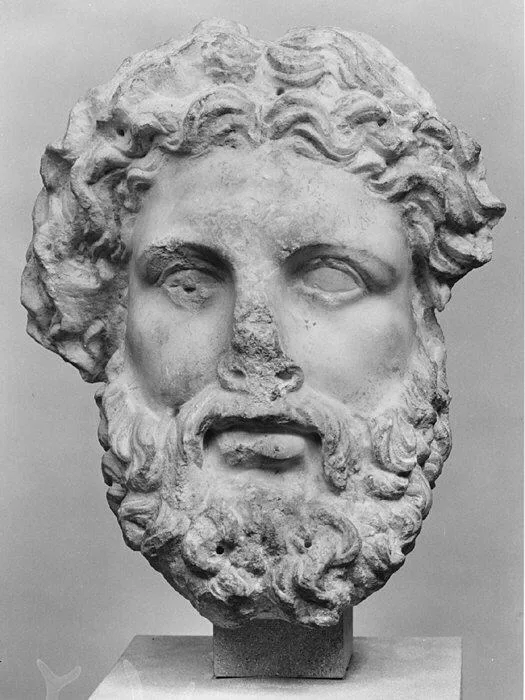
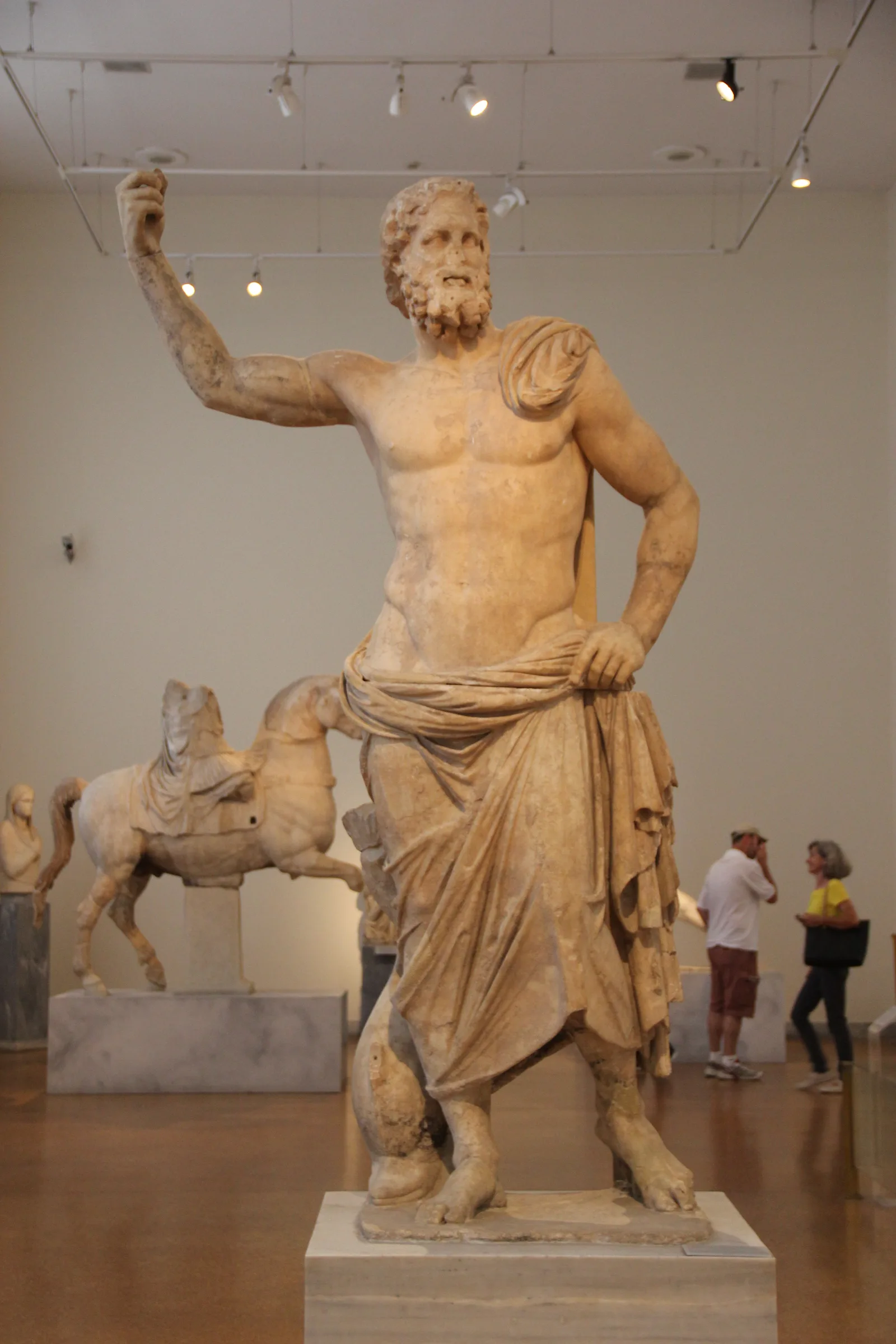
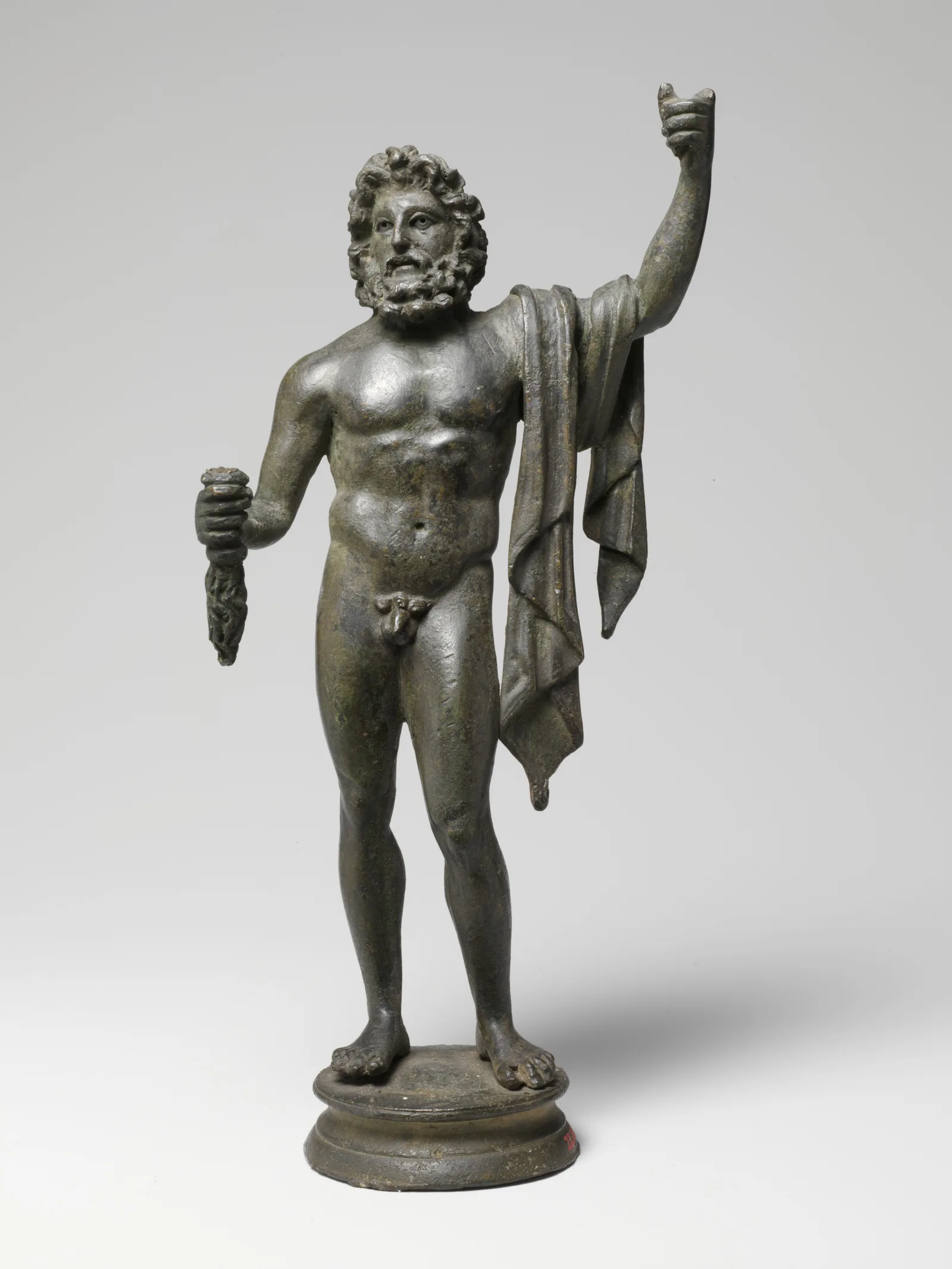
In early Archaic Greece Zeus was depicted schematically, as a stern bearded man with a thunderbolt in his raised hand, striding into the attack. Over time the image softened: classical sculptors of the fifth century BCE gave him a calm grandeur, the bearing of a ruler who needs no sharp gestures to prove his strength. The bronze statue from Artemision, found in the sea, shows the god in the act of hurling the thunderbolt: legs wide apart, arm drawn back, the body gathered like a spring. Many art historians argue over whether it is Zeus or Poseidon, but the pose of the Thunderer with his thunderbolt became the canon.
The most famous statue, the Zeus of Olympia by Phidias, was one of the seven wonders of the ancient world. The thirteen-metre god sat enthroned in gold, ivory, and precious stones, holding a figure of the goddess Nike in his hand, with an eagle standing at his feet. The statue has not survived; it perished in late antiquity, but its reflections can be seen on the coins of Elis, where the Thunderer sits on his throne with a sceptre and an eagle. People carried those coins in their purses, traded them, buried them in the ground at the first sign of danger, and the god's profile spread across the entire ancient world as a current, universally recognised picture. It was through such small mass-produced work, not through colossi, that the image of Zeus reached us alive.
Greek Gems and Signet Rings
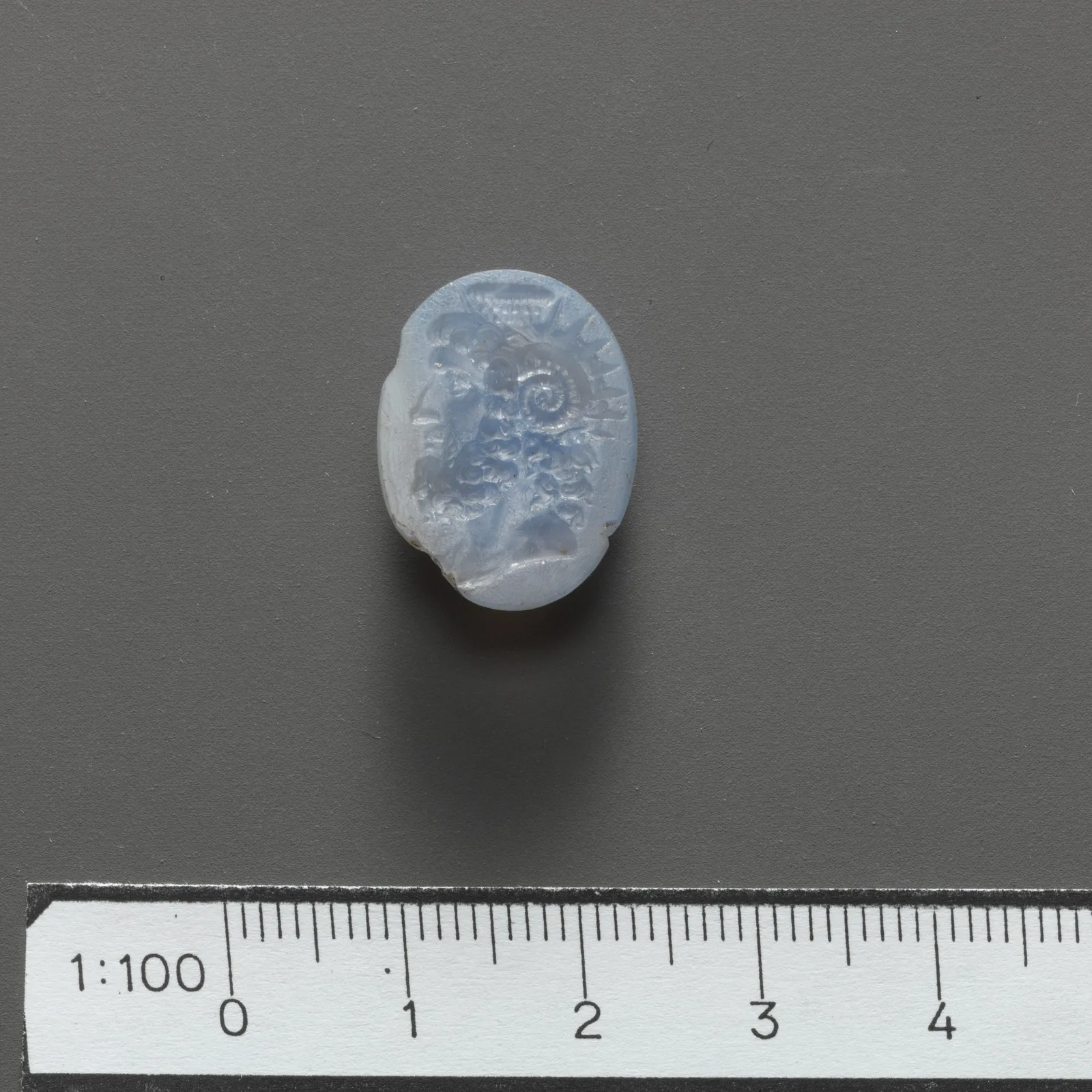
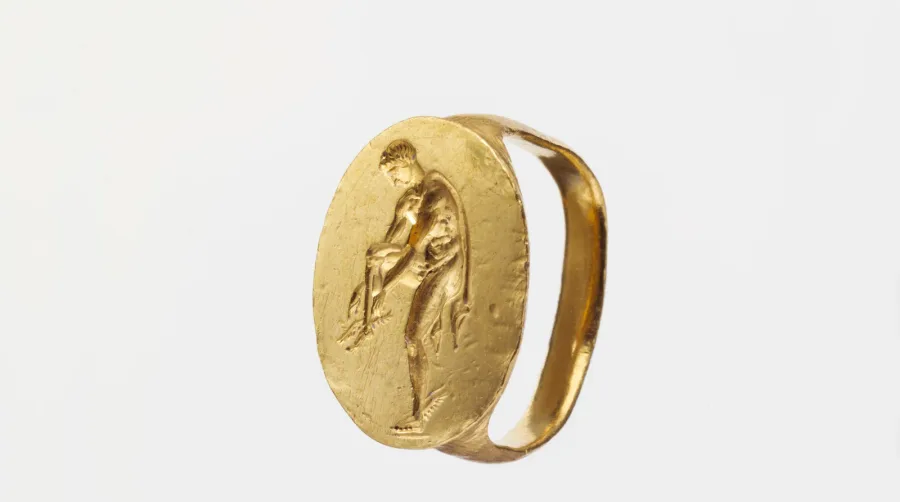
A carved gem is a miniature relief on a hard stone: carnelian, chalcedony, agate, sardonyx. The Greeks set such gems into rings and used them as a personal signature, pressing the figure into wax or clay. Zeus was a popular subject: the god on his throne, an eagle with spread wings, a bundle of lightning. To wear a ring with Zeus meant to declare strength and protection from above. This is the direct ancestor of the modern signet ring with a symbol.
Coins with Zeus and Jupiter
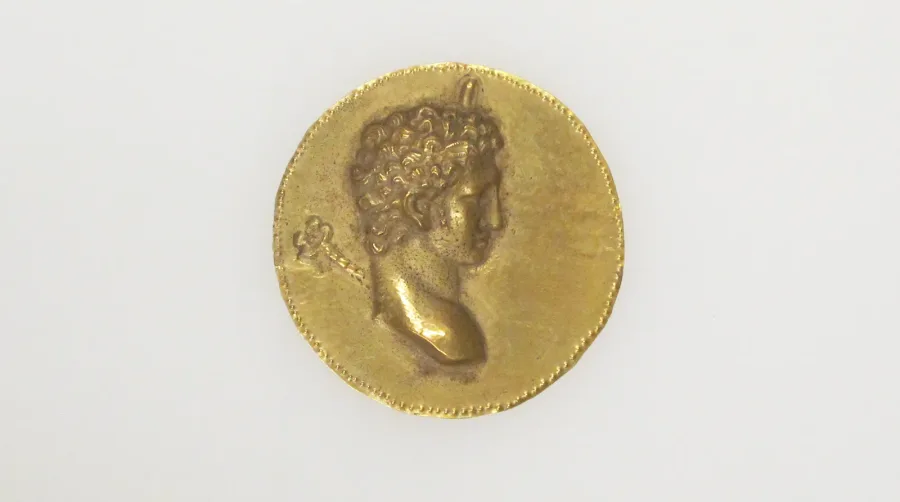
In antiquity a coin served both as money and as the chief instrument of propaganda. Hellenistic kings struck Zeus to hint at their own godlike status. Alexander the Great issued tetradrachms with a seated Zeus and an eagle on his hand. Later the Romans put Jupiter on coins with a sceptre and a thunderbolt, sometimes with the inscription "Jupiter the Guardian" or "Jupiter Best and Greatest." These small discs of metal spread the image of the Thunderer farther than any statue, and many of them reached us precisely because people hid them and kept them close.
The Eagle of Rome: A Symbol of Power
Jupiter's eagle became the chief emblem of the Roman state. The silver or gilded eagle on a staff, the aquila, was the sacred standard of every legion. To lose the aquila in battle was held the gravest disgrace, and armies went to fresh wars to win it back. So the bird of the storm god turned into a symbol of state, later adopted by countless empires and coats of arms. Any modern eagle pendant "with wings spread wide" is the aesthetic heir of that Roman eagle.
The later fate of this bird shows how durable a symbol can be. After Rome the eagle was taken up by Byzantium, and in time the double-headed eagle appeared, looking west and east at once. From Byzantium the medieval powers took it, and the eagle spread across hundreds of coats of arms, seals, and coins of Europe. Each such bird is, in effect, a distant descendant of the aquila, which in turn descends from the eagle that stood at the feet of the Zeus of Olympia. When someone today chooses an eagle pendant, they connect to this unbroken two-thousand-year line, even without thinking about it. The eagle remains the most durable of all the signs of Zeus precisely because it travelled the road from myth through statehood to personal adornment.
The Renaissance and Neoclassicism
In the Renaissance, ancient gems with Zeus were collected as treasures, copied, and set into new mounts. By the eighteenth and early nineteenth century the fashion for antiquity returned with new force. Craftsmen carved cameos and intaglios with Jupiter, the eagle, and the thunderbolt, and mounted them in rings and pendants. The neoclassical taste loved "stern grandeur," and the image of the Thunderer suited it perfectly. It was then too that the tradition took hold of using the eagle and the thunderbolt in awards and ceremonial jewellery, marks of distinction, and cufflinks.
Famous Ancient Images
The most celebrated image of the Thunderer was the statue of the Zeus of Olympia by the sculptor Phidias, one of the seven wonders of the ancient world. The thirteen-metre god sat enthroned in the temple at Olympia, made in the chryselephantine technique: the exposed parts of the body were covered in ivory, the robe and the throne blazed with gold, and the eyes were assembled from precious stones. In his right hand Zeus held a figure of the winged Nike, in his left a sceptre topped with an eagle, and an eagle lay at his feet. The ancients wrote that to see this statue at least once in a lifetime was the duty of every Greek, and that a man who died without seeing it had lived his life in vain. The colossus has not reached us; it perished in late antiquity, but its reflections survive on the coins of Elis, and it was through them that the canon of the enthroned Thunderer spread across the world.
Beside the Zeus of Olympia stands the bronze god from Artemision, raised from the seabed off Cape Artemision. The two-metre figure is frozen in the act of throwing: legs wide apart, the left arm stretched out to aim, the right drawn back with a thunderbolt or a trident. Art historians still argue over who it is, Zeus with the thunderbolt or Poseidon with the trident, because the object in the hand itself is lost. That pose, gathered and menacing, became fixed as the image of the Thunderer on the attack.
A separate line of famous images runs through the carved gems and coins of the Hellenistic kings. Alexander the Great struck tetradrachms with a seated Zeus and an eagle on his palm, hinting at his own godlike status. On gems the Thunderer was shown full-length with a bundle of lightning or as a single regal head. These tiny masterpieces carried the image of Zeus farther than any colossus, because a coin and a ring could be carried in a pocket to the ends of the earth. It was small-scale work, not the giants, that made the look of the Thunderer immortal.
An eagle wants an open shirt and a bare hand, not a pile of pendants. Crowd it and you get a flea market, not Olympus. Don't argue.
How and With What to Wear the Thunderer's Symbol
Over years on shoots the eagle, the thunderbolt and the signet have passed through dozens of looks with me. Here is what actually works, sorted by occasion and by character.
What do I wear an eagle with every day? For daily wear I recommend a medium eagle on a chain long enough for the bird to sit on the chest and read whole. A large eagle I pair with a plain top without a pattern, or the silhouette blends into the fabric. A small eagle on a thin chain works more delicately and slips nicely under a shirt with the top button undone. Silver keeps the look sterner, gold makes it warmer.
Where do I put a signet with an eagle? A signet I always let take the lead alone. I wear the massive ring with an eagle or a thunderbolt on the little or ring finger and keep no other rings on that hand, so they do not compete for attention. A silver signet suits everyday, a gold one a ceremonial look. This is the case where one strong ring beats five small ones.
How do I wear a thunderbolt? The thunderbolt is the most graphic and modern of the symbols. I wear it short, at the collarbones, or longer, over a sweater. Its sharp form does not quarrel with round, smooth pendants, so it layers easily with neutral chains. For a bold look I choose blackened silver or steel, for a softer one gold.
And if I want layers, not a single sign? Then I give one strong symbol the solo and keep the rest neutral. The eagle and the thunderbolt get on with celestial and force motifs: the sun and moon, a zodiac sign, a protective amulet. What I avoid: a menacing eagle beside a scattering of little flowers loses its character. One loud sign plus quiet chains always beats a heap of equal pendants.
Whom and for which occasion is it given? A signet with an eagle or the profile of Zeus I suggest giving to a father, a mentor, or the head of a family as a mark of respect for seniority. A thunderbolt I choose for someone decisive and direct. An oak leaf and an acorn I recommend for an anniversary: a small acorn that grows into a mighty tree reads as a wish for growth and strong bonds. The symbol strengthens what is already in a person, so give it with thought.

Turn on your camera, pick earrings, a pendant or a ring, and see the piece on yourself in real time.
Switch items in one tap.
Everything runs in your browser: no photo or video is ever uploaded.
The Symbols of Zeus and Jupiter
The Thunderer has a whole set of attributes, and each has turned into a motif of its own in jewellery. Let us take them one by one.
The Eagle
The eagle is the sacred bird of Zeus and Jupiter, his messenger and companion. In the myth it was the eagle that brought the god his thunderbolts and watched the world from on high. The eagle is the only creature able to look at the sun without squinting, and so it was held to be the link between sky and earth. In jewellery the eagle means power, keen sight, loftiness of spirit, and royalty. An eagle pendant or a signet ring with an eagle reads as a claim to strength and independence, which is why the motif is loved equally by men and women.
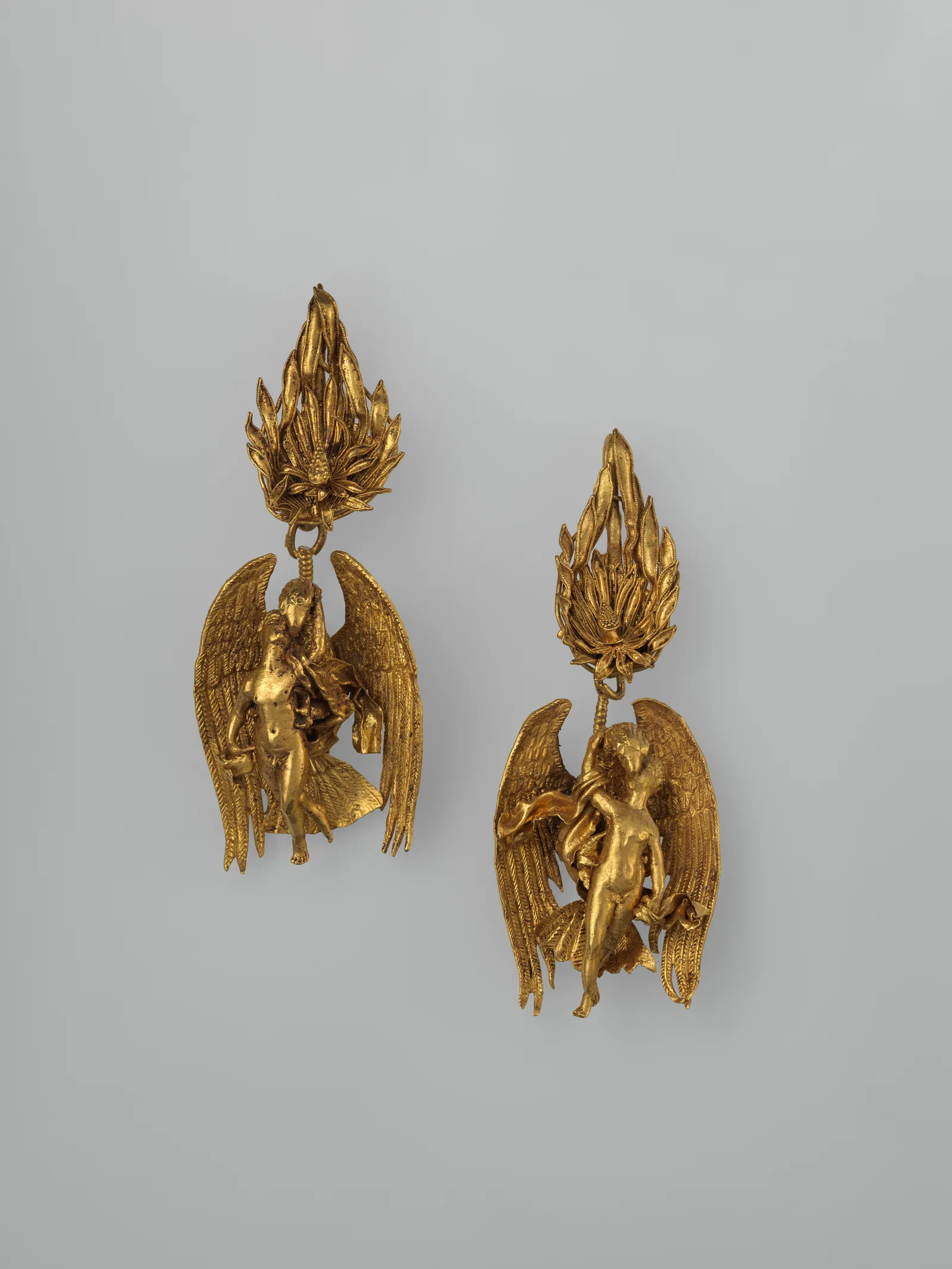
The eagle has its reverse, darker side in the myth too. It was in the shape of an eagle that Zeus carried off the young Ganymede, bearing him to Olympus as cupbearer of the gods, and that scene found its way onto many gems and earrings in antiquity. Here the eagle is not reduced to the role of guardian: it is the very embodiment of the Thunderer's irresistible will, the force that takes and exalts at the same time. This duality, regal keenness and predatory resolve, is what makes the eagle the richest in meaning of all the signs of Zeus: in a single silhouette protection and capture, patronage and power live side by side.
The Thunderbolt
The thunderbolt is the chief weapon of Zeus. Legend says the Cyclopes forged it for him, and the strike of this bolt no one could deflect. The thunderbolt symbolises instant justice, punishment, and an inescapable force. In small-scale work the thunderbolt is shown as a bundle of zigzags, sometimes with wings on the sides or with finials shaped like torches. A thunderbolt pendant looks sharp and modern, which is why of all the Thunderer's attributes the thunderbolt most often lands in minimalist jewellery.
It is curious that the Greeks did not depict the thunderbolt the way we are used to seeing lightning in children's drawings. The canonical thunderbolt of Zeus, the keraunos, was drawn as a symmetrical figure: a bundle of two or three sharp tongues above and below, sometimes with a pair of wings in the middle, like a feathered arrow. This stylised form read instantly, and it was placed on shields, coins, and altars as a stamp of divine power. The modern zigzag pendant is closer to the everyday image of lightning, but if you want historical accuracy, look for exactly the symmetrical winged thunderbolt: it is both older and more graphic than the ordinary jagged line.
The Oak and the Acorn
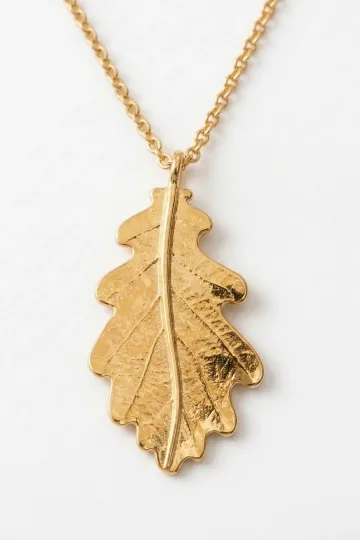
The oak was the sacred tree of Zeus. His chief sanctuary at Dodona was built around an ancient oak, and the priests foretold the future by the rustle of its leaves. The oak means strength, longevity, endurance, and a bond with the sky, since it is the tall oaks that lightning strikes most often. The acorn, the fruit of the oak, became a separate symbol of hidden strength and potential: from a tiny acorn grows a mighty tree. Carved acorns and oak leaves have long lived in jewellery as a sign of stamina.
The link between the oak and the Thunderer is not a priestly invention but an observation of nature. The oak lives for hundreds of years, its wood is among the hardest, and its tall crown is the very target that lightning strikes most often, leaving a deep burn on the trunk. The ancients saw in this a direct touch of the god: a tree that Zeus himself had chosen to mark with fire from the sky. From there came the oak wreath as the highest reward for endurance and merit, and that tradition outlived millennia. In jewellery the oak leaf therefore carries a meaning not of show but of quiet strength: of the one who stands long and takes the blow without bending.
The Aegis
The Aegis is the protective attribute of Zeus, most often described as a shield or a cloak of goatskin with the head of the Gorgon in the middle and a fringe of serpents. The very word "aegis" survives in the English phrase "under the aegis of," that is, under protection and patronage. In jewelry the Aegis itself appears rarely, but its close relative, the head of Medusa the Gorgon, became a powerful talisman in its own right, a warder-off of evil.
The Sceptre and the Throne
The sceptre is the staff of power that Zeus holds while seated on his throne. The throne and the sceptre together mean supreme rule, the right to judge and to dispose of fates. On ancient coins the Thunderer almost always sits with a sceptre in one hand and an eagle or a figure of the goddess Nike in the other. In modern jewellery the sceptre barely appears directly, yet its idea has dissolved into the general aesthetic of "regal" rings and signets with crowns, eagles, and lions.
The sceptre of Zeus was crowned by that same eagle, and this is no accident. For a Greek the sceptre was not a ceremonial stick but the sign of the right to speak and to judge: at the public assembly a speaker took the sceptre in hand and only then received the floor. The sceptre of Zeus, crowned with an eagle, meant the highest instance of that right, the final word that could not be contested. The idea of the staff as judge outlived antiquity and dissolved into royal regalia, into the finials of staffs, into the very gesture of a ruler's raised hand. When a tiny sceptre or crown appears beside an eagle on a signet, the piece is quoting exactly that ancient pairing: power that has the right to decide.
The Bull, the Swan, and the Face of the Thunderer
Zeus often changed his shape, and some of those transformations became symbols in their own right. The bull, into which the god turned to carry off the princess Europa, gave one of the most recognisable subjects of ancient art and made its way onto many coins and carved gems. To the Greeks the bull meant fertility and untamed male strength, and in this guise the Thunderer reads as a primal, earthly might. The swan, in whose form Zeus came to Leda, added a quite different facet to the image: grace and a deceptive softness. The golden rain by which he reached the locked-away Danae became a metaphor for irresistible wealth pouring from the sky. In jewellery these subjects most often live in antique-style cameos and medallions, where the scene with the bull or the swan becomes a miniature relief. The bearded face of the Thunderer itself, a mighty elder with a wave of hair and a thick beard, also remains a motif: the profile of Zeus is carved on signets and struck on coin-shaped pendants as a sign of mature, confident strength.
Customer reviews
Zevira is a real jewellery shop. Genuine payments, deliveries and customer thank-yous.
🥰🥰🥰 gracias
Ok, ¡gracias! 🙂
What Zeus Means in Jewellery
Why wear the symbol of the supreme god? The Thunderer has several layers of meaning, and each answers a different need.
Power and Leadership
Zeus is the king of the gods, so his symbols mean supremacy, authority, and the right to lead. The eagle and the thunderbolt speak of a person used to making decisions and bearing the responsibility for them. Such a piece is often chosen as a personal mark of ambition and strength of character.
Protection and Patronage
Among the Romans Jupiter was called the Guardian, the defender of the state and of order. The Aegis, turned into the image of Medusa, drives evil away outright. To wear the symbol of the Thunderer means to ask for protection from above, to set a reliable umbrella over yourself against trouble. In this sense Zeus the protector stands in the same row as other talismans.
Justice
The thunderbolt of Zeus is not blind rage but punishment for the breaking of oaths and the laws of hospitality. The Thunderer watched over order and punished those who tore it down. So the thunderbolt symbolises justice, the inevitability of retribution, honest force. This meaning is close to people who value directness and rules.
Fatherhood and Lineage
The very name "Jupiter" means "sky-father." Zeus is father to a host of gods and heroes, the head of a large and noisy divine family. So his image is tied to the theme of fatherhood, headship of a lineage, the continuation of a family line. A piece with the symbol of the Thunderer is sometimes given as a mark of respect to a father or the head of a family.
Supremacy and Sky
Zeus is lord of the sky and of daylight. His element is height, openness, the clear sky after the storm. The symbols of the Thunderer carry the idea of supremacy both in the sense of power over people and in the sense of spiritual height, the view from above, clarity. The eagle soaring beneath the clouds conveys this with particular precision.
Upload a photo of your pet, someone you love, or an object. We'll build a 3D model and hand-cast it in pewter.


Zeus and Jupiter: The Greco-Roman Difference
Zeus and Jupiter are two names for one image, but between them lie shades born of different cultures.
The Greek Zeus is closer to a living, passionate, contradictory character. The Greeks told dozens of stories about him: quarrels with his wife Hera, love affairs, transformations into a bull, a swan, and golden rain, the war with the Titans. The Zeus of the Greeks is capricious, jealous, mighty, and very human in his weaknesses. He is a king, but a king with a temper.
The Roman Jupiter is sterner and more statelike. The Romans cared less for love stories and more for how Jupiter guarded Rome and its laws. The chief temple of Jupiter Capitolinus stood on the city's main hill, and there commanders brought offerings after their victories. Jupiter was part of the official trinity together with Juno and Minerva. If Zeus is the god of myths, Jupiter is in many ways the god of the state.
For jewellery this difference matters as tone. The "Greek" approach leans toward mythological scenes, antique-style cameos, and the image of the mighty bearded god. The "Roman" approach leans toward stern heraldry: the eagle, the thunderbolt, a spare profile, the aesthetic of the coin. In choosing a piece you are choosing, in effect, which facet of the Thunderer you want to wear: living myth or the mark of power.
Jupiter as the Backbone of the Roman State
For the Romans Jupiter was not so much a character of myth as the very backbone of the whole state order. His chief temple, that of Jupiter Capitolinus, stood on the Capitoline Hill and was the heart of Roman religion. There triumphant generals climbed after victorious campaigns to make an offering and lay their laurels at the feet of the god. His full title was Jupiter Best and Greatest, and under that formula a Roman understood not love affairs but a guarantee that Rome stood and won with the approval of the highest power.
Jupiter belonged to the Capitoline triad together with Juno, his consort, and Minerva, the goddess of wisdom. The chief temple was dedicated to this trio, and it was honoured as the patron of the city. Oaths sworn in the name of Jupiter were held to be unbreakable, treaties were sealed by his authority, and the breaking of one's word was an insult to the god himself. From there came the epithet Guardian, under which Jupiter was honoured as the defender of the state and of order.
For modern symbolism this state-facing facet of Jupiter explains why his signs took root so easily in coats of arms, awards, and official heraldry. The eagle-aquila, the thunderbolt, the spare profile on a coin carry the stamp not of personal passion but of public force. Whoever chooses the "Roman" version of a piece takes, in effect, the mark not of whim but of law: stern, measured, statelike in spirit.



Materials
The image of the Thunderer calls for materials that hold the idea of strength and durability. Far from all of them fit, and each has its own logic.
Silver
Silver, with its cold shine, conveys well the "stormy" aesthetic of the thunderbolt and the steely dignity of the eagle. Sterling silver, the 925 grade, is sturdy, wearable every day, and does not cause allergies in most people. An eagle and a thunderbolt in silver look graphic and bold, and silver is easily blackened in the recesses of a relief to bring out the texture of the feathers or the zigzag of the thunderbolt.
Gold
Gold is the "solar" metal, and for the supreme god of the sky it fits ideally. A gold signet with an eagle or a gold profile of Jupiter inherits directly from the ancient tradition, since the most prestigious coins and gems were made precisely in gold. A gold Thunderer reads as the premium, ceremonial option, a mark of means and of serious intent.
Bronze and Brass
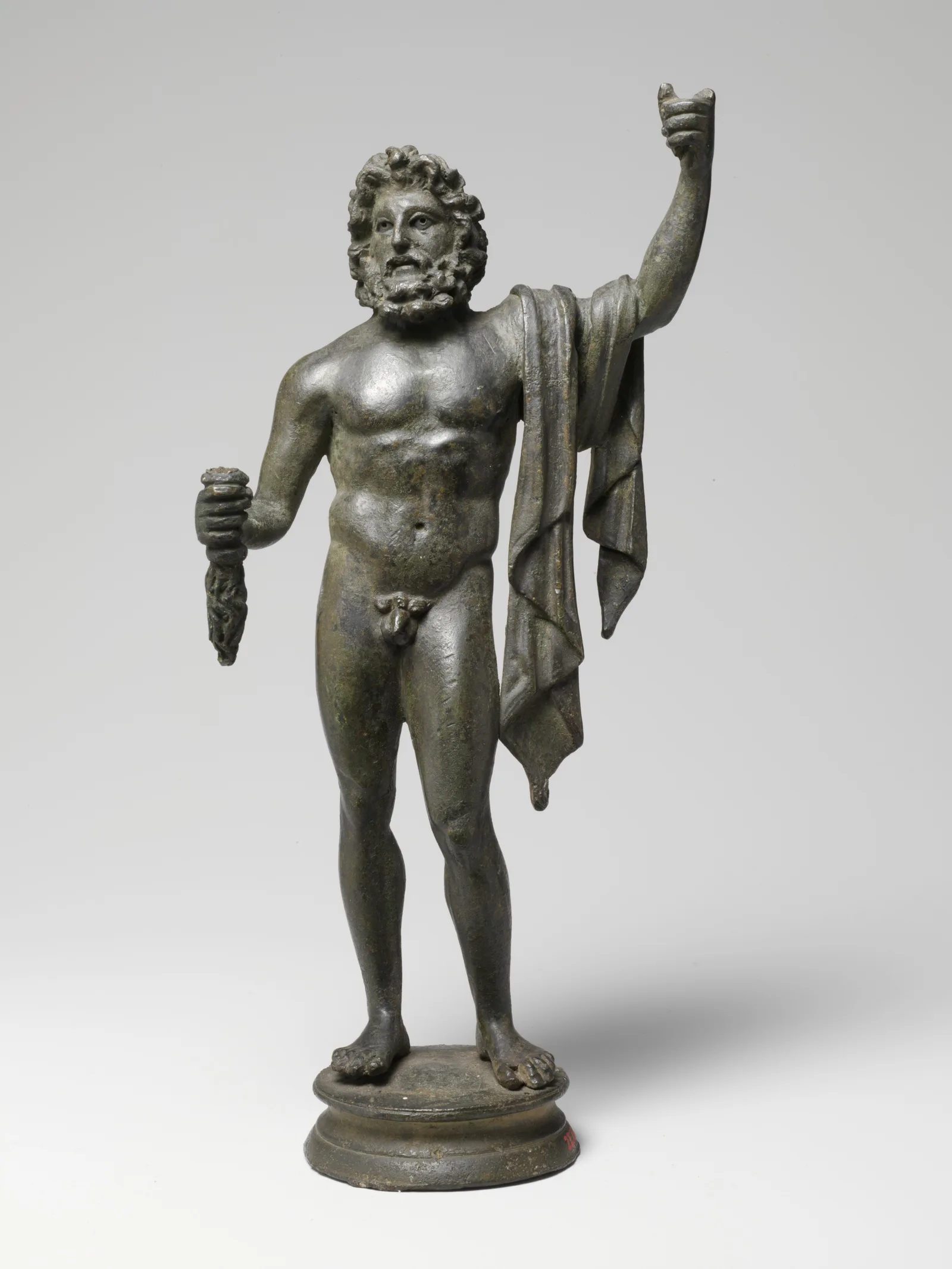
Bronze is a historically accurate material: many ancient statuettes and amulets of Zeus were cast precisely in bronze. The warm coppery cast gives the image an archaic, museum depth. Brass with its golden tone works similarly and costs less. The downside of copper alloys is that they darken over time and can leave marks on the skin, so such pieces need care. Bronze and brass are best taken off before a shower and before sleep, wiped with a soft cloth, and kept in a dry place; then the patina settles handsomely rather than in blotches. Anyone who wants exactly that warm antique texture without the fuss chooses gilded silver: the look is close to bronze, but the base is noble.
Steel
Stainless steel is the choice of those who want a modern, brutal Thunderer without the fuss. Steel does not darken, is not afraid of water, and holds a crisp engraving of a thunderbolt or an eagle. A PVD coating gives a black or golden shade that lasts for years. A steel thunderbolt pendant looks sharp and gathered, which is close to an urban, technological aesthetic.
Stones and Gems
A separate line is carving on stone in the spirit of ancient gems. Carnelian, onyx, agate, lapis lazuli. Dark onyx with a carved eagle harks back to the signet rings, while lapis, with its blue, hints at the sky of the Thunderer. Stone adds depth to the image and ties a modern piece to the two-thousand-year tradition of intaglios and cameos.
How to Choose a Piece with the Thunderer
A good piece with an eagle or a thunderbolt holds not by a loud subject but by the quality of the workmanship. A few markers will help you tell a piece with character from a faceless stamping.
What to Look for in the Relief
The eagle and the profile of Zeus live in the details: a feather, the gaze, the turn of a wing. In a good piece the feathers read separately, the bird's eye is expressive, the lines are crisp, with no blurred transitions from a cheap mould. In a weak casting the relief is flat, the details fuse, and everything looks like a melted copy of a copy. A thunderbolt is tested by the sharpness of the zigzag: the edge should be crisp, not rounded, or the thunderbolt loses its graphic boldness. Run a finger over the relief: on a quality piece the recesses are cleaned out and the edges do not scratch the skin.
Hallmark and Metal
Real silver carries a hallmark of its grade, most often 925. Gold has its own grade, and steel usually bears a marking like 316L. A suspiciously light "silver" piece with no hallmark and a surface that quickly darkens to green is a sign of a cheap alloy under a coating. Bronze and brass darken honestly and predictably, that is their nature, but they should be declared as an alloy, not passed off as a precious metal. A carved stone is checked for chips and cracks at the edges of the mount, and a gem for the crispness of the incised design.
Size and Proportion
The symbol of the Thunderer loves a measured scale. Too large an eagle on a thin neck or a slender hand looks theatrical; too small a thunderbolt gets lost and does not read. A signet is chosen by the width of the finger so that the face does not hang to one side. A pendant is matched to the length of the chain: the eagle should lie on the chest and be seen whole, not hide under a collar. Before buying, it is worth trying the piece on in front of a mirror and looking at it from arm's length, because the symbol works precisely through the readability of its silhouette.
Leave your email, we'll send your discount code. No spam, unsubscribe anytime.
The code arrives by email, valid on your first order.
Whom It Suits and to Whom It Is Given
The symbol of the Thunderer is not a neutral piece, and that is its strength. It suits those who want to wear a sign with character, and it works splendidly as a meaningful gift.
Whom the Symbol of Zeus Suits
The eagle and the thunderbolt suit people with a pronounced inner backbone. Those used to leading, to making decisions, to answering for the result. This does not mean "a boss by title": it is about a cast of character, about a readiness to take the blow and to go first. The oak leaf and the acorn are closer to those who value reliability, roots, quiet endurance without show. The glyph of the planet Jupiter suits dreamers and optimists, people of big plans who need a sign of luck and growth rather than of power. The universal rule is simple: the symbol of the Thunderer strengthens what is already in a person, rather than ascribing what is foreign.
Zeus as a Gift
A piece with the Thunderer is given with a clear message. A signet with an eagle or the profile of Zeus is given to a father, a mentor, or the head of a family as a mark of respect for his seniority, since the very name Jupiter means "sky-father." A thunderbolt pendant is given to a decisive and direct person, as a wish for strength and honesty. An oak motif suits an anniversary or symbolises strong, time-tested relationships: a small acorn that grows into a mighty tree reads as a wish for growth. A matching set with an eagle and a thunderbolt works as "he is strong, she is swift" or as two signs of one storm for people close to each other.
The Psychology of Choosing a Symbol of Power
Behind the pull toward a symbol of the Thunderer stands an understandable human need: to feel in control of one's own life. Psychologists noticed long ago that talisman objects help people gather themselves before an important moment, add confidence, and work as an anchor. An eagle on the chest or a thunderbolt on the finger is not magic but a reminder to oneself: I hold the helm, I answer for the course. So the symbolism of Zeus is often chosen on the threshold of change, before a new role, after a hard decision. A thing does not make a person stronger, but it helps them take a strong position in their own head, and that is already no small matter.
What works here is the effect that researchers call grounding, or amplifying through an object. When a person wears a sign of strength and protection, they shift part of their anxiety onto an external support: it is not I alone who takes the blow, the symbol of the eldest, the one above all, is with me. This eases the tension and frees the mind for the task. Talismans play a similar role for athletes and soldiers, and the difference between a symbol of power and a symbol of protection here is subtle: the eagle and the sceptre say "I lead," the Aegis and the image of Medusa say "I am covered." The choice between them often reveals what a person is lacking right now: the need to resolve or the need to feel safe. Understanding this helps to choose a sign honestly, for a real inner task rather than for a pretty picture.
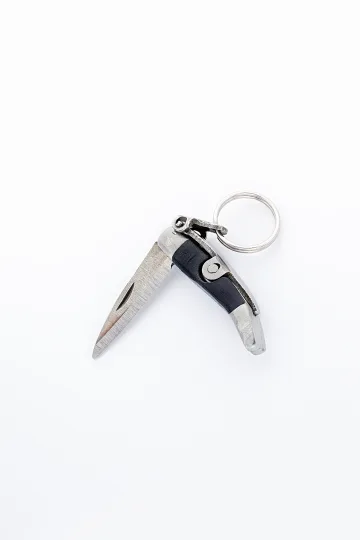
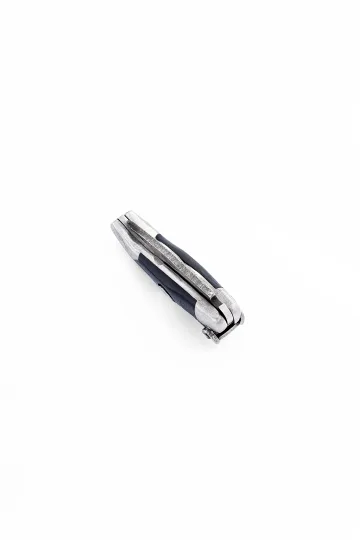
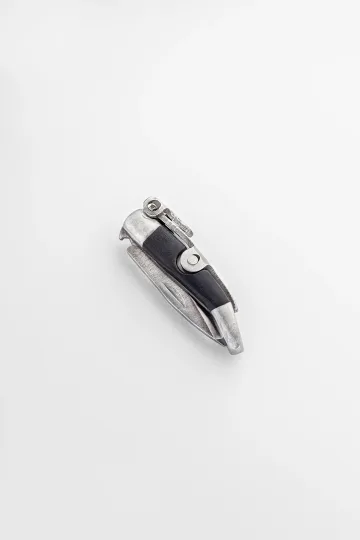
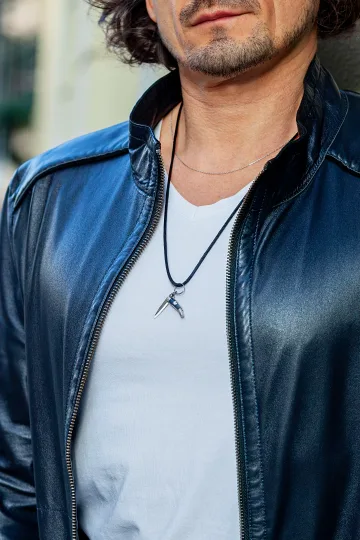
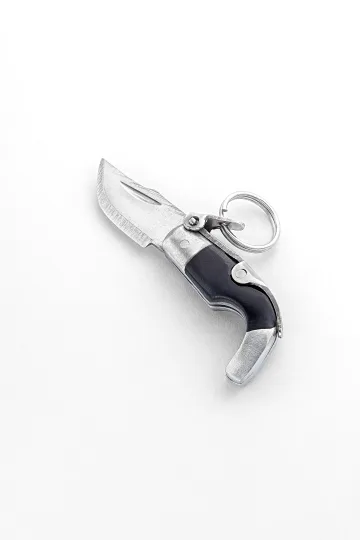
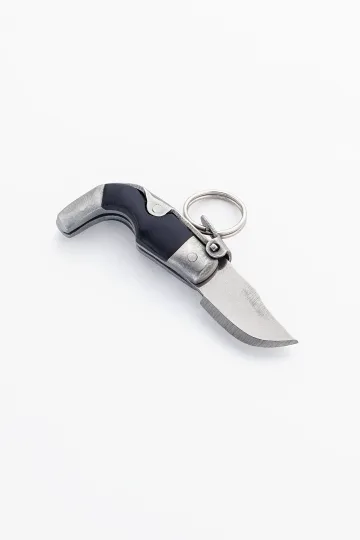
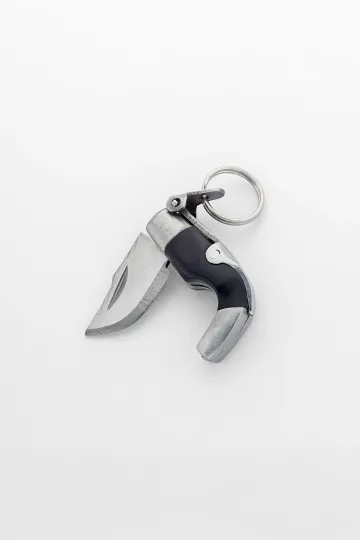
CAPAORA mini knife pendant
The 18th-century Spanish navaja in miniature: 40 mm of stainless steel, a real folding mechanism and a Palanquilla lock that clicks. An affordable gift to remember.
Authentic · Ships from Spain · 14-day returns
Zeus in Art and in Astrology
The Thunderer has two great cultural lives beyond myth: in the visual arts and in the sky as a planet. Both feed the modern symbolism of jewellery.
Zeus and Jupiter in Art
Artists returned to the Thunderer for millennia. Ancient sculptors created colossi like the Zeus of Olympia. Masters of the Renaissance and the Baroque painted mythological scenes: "Jupiter and Io," "The Abduction of Europa," "Danae and the Golden Rain." The Thunderer on these canvases is now a mighty elder with a thunderbolt, now a seducer transforming into a bull or a swan. The eagle and the bundle of lightning wander from painting to painting as identifying marks. From this painterly tradition jewellery inherited the habit of depicting Zeus as majestic, bearded, surrounded by his attributes. The antique-style cameos of the eighteenth century carried these images literally onto stone.
Sculpture fed the jewellery image no less than painting did. After the Zeus of Olympia by Phidias, the canon of the enthroned Thunderer was repeated in marble, bronze, and ivory across the whole ancient world, and Renaissance masters copied the surviving fragments and the Roman busts. Each such copy fixed a set of recognisable features: the high brow, the heavy eyebrows, the wave of hair and beard, the calm commanding gaze. The gem-carvers held those features in mind as they carved a tiny profile on carnelian, and so the ancient signet with Zeus and today's coin-shaped pendant speak one visual language. The image proved so durable that even without a caption a bearded elder with an eagle at his feet reads as the king of the gods.
Zeus in Language and Culture
The trace of the Thunderer is left on canvas, in marble, and in the very fabric of the speech we use every day. The phrase "under the aegis of" goes straight back to the protective attribute of Zeus. "Olympian calm" is the calm of the gods on Mount Olympus, at whose head stood the Thunderer. When someone is said to "thunder and rage," behind it stands the image of an angered Zeus. Even the word "jupiter" in the sense of a powerful lighting instrument used to flood a film set with light is named after the shining god of the sky.
The Thunderer is fixed in the reckoning of time too. Thursday in many languages is the day of Jupiter: the Latin phrase "dies Iovis" (the day of Jupiter) gave the French jeudi and the Italian giovedì, while the Germanic peoples replaced Jupiter with their own Thor, hence the English Thursday, "Thor's day." So the image of the Thunderer spread across the calendar, the sky, and the dictionary, and this cultural ubiquity explains why the eagle and the thunderbolt read instantly: they have long become part of the common language rather than a museum rarity. A modern piece with these signs rests on a layer of associations that has gathered for thousands of years.
The Planet Jupiter in Astrology
The largest planet in the Solar System bears the name of the Roman Thunderer, and this is no accident: the ancients chose the name of the chief god for the brightest and most "regal" planet. In astrology Jupiter is held to be the planet of luck, expansion, abundance, wisdom, and growth. It rules the sign of Sagittarius and is tied to optimism and big plans. So the symbolism of the planet Jupiter draws those who seek in a piece not power but luck and development. The astrological glyph of Jupiter, resembling a stylized figure four or a thunderbolt with a crossbar, sometimes becomes a motif of a spare pendant in its own right. So one and the same god yields two different pieces: a menacing eagle for strength and a fine planetary glyph for luck.
Zeus Against Other Storm Gods
Zeus is not the only one who hurled lightning. Almost every major people had its own god of the storm, and the comparison helps us understand exactly what makes the image of the Thunderer strong in jewellery.
Zeus and the Norse Thor
Thor is the god of the storm among the Norse, but he is built differently from Zeus. Zeus is a king and a judge; he rules from above and rarely descends into battle in person. Thor is a fighter on the front line, a defender of people, who himself goes out against the giants with a hammer in his hands. Thor's chief weapon, the hammer Mjolnir, became one of the most popular talisman symbols in the world, whereas the thunderbolt of Zeus appears more rarely in jewelry. If Zeus is power, then Thor is the protection of the ordinary person, and the pendants reflect this: the eagle says "I am the chief," the hammer says "I will protect."
Zeus and the Slavic Perun
Perun is the god of storm and war among the Slavs, the supreme patron of warriors and princes. By function he is close to both Zeus and Thor: he rules from above, like Zeus, and he fights, like Thor. Perun's weapon is the axe and the thunder-stone, and his symbol is often named as a six-rayed thunder mark. The parallel with Zeus is direct: both are supreme, both are storm gods, both are tied to the oak that lightning strikes. It is curious that the Greeks, the Slavs, and the Norse independently arrived at the idea of a sky-father with a thunderbolt, because all of them descend from common Indo-European ancestors.
Why There Are So Many Such Images
For ancient people the storm was the most vivid display of celestial force: the sudden thunder, the blinding flash, the strike able to split an oak or kill. No wonder that the chief god of many peoples was exactly a storm god. Zeus, Jupiter, Thor, Perun, the Indian Indra, the Baltic Perkunas. All of them are kin by idea. So a piece with a thunderbolt or an eagle is understood by a person of any culture: the sign of celestial force is older than any borders.
Send a friend a discount code, they save on their first order.
Facts That Surprise
The Thunderer has gathered over the millennia so many stories that some of them sound almost beyond belief.
The name of Zeus and the word "god" are relatives. The Greek "Zeus," the Latin "deus," the Sanskrit "dyaus," and even the English "day" go back to one ancient root meaning "to shine, the bright daytime sky." When you say "deity," you are pronouncing a distant relative of the Thunderer's name.
The eagle of the legion was worth more than gold. The Romans treated the silver aquila eagle like a living sacred object. Over a single lost legionary standard they could launch a whole military campaign, just to bring the bird of Jupiter back.
Zeus was given offerings by the rustle of an oak. At the sanctuary of Dodona the priests "listened" to the sacred oak of the Thunderer and read the future by the noise of its leaves and the cooing of doves in its crown. It was one of the oldest oracles of Greece, older than the famous Delphi.
The largest planet bears the name of the Thunderer for a reason. Jupiter is so massive that all the other planets of the Solar System combined would fit inside it. The ancients, of course, did not know its size, but intuitively gave the most noticeable planet to the chief god.
The thunderbolt for Zeus was forged by one-eyed giants. In the myth the thunderbolt was made by the Cyclopes, whom Zeus freed from the underworld. In gratitude they forged him the thunderbolt, Hades a cap of invisibility, and Poseidon a trident. So the Thunderer received a weapon against which there was no defence.
A day of the week bears the name of the Thunderer. Thursday in many languages is named after Zeus-Jupiter: the Latin "dies Iovis" (the day of Jupiter) gave the French jeudi and the Italian giovedì, while the Germanic peoples swapped Jupiter for their own Thor, hence the English Thursday, "Thor's day."
Even the flies feared Zeus. The Thunderer had the epithet Apomyios, "the driver-off of flies," under which he was prayed to at Olympia so that swarms of insects would not spoil the sacrifices. So the king of the gods answered for very earthly, everyday concerns too.
A lightning strike as the trace of divine wrath became a sacred place. The Greeks held the spot where lightning struck to be marked by Zeus himself and often fenced it off as sacred. One could not enter it freely, for the land had been touched by the Thunderer himself.
The eagle showed where the centre of the world lay. By legend Zeus released two eagles from opposite ends of the earth, and they met over Delphi. That place was declared the "navel of the earth," and a stone, the omphalos, was set there. The bird of the Thunderer literally mapped out the geography of the Greeks' sacred world.
Zeus was once nearly overthrown by his own gods. In the myth Hera, Poseidon, and Athena conspired against the Thunderer, bound him with thongs in his sleep, and tied a hundred knots. Zeus was saved by the sea nymph Thetis, who called for help the hundred-handed giant Briareus, who in a single moment untied the god. A harsh punishment awaited the conspirators, and this story shows that even supreme power on Olympus did not hold forever and demanded vigilance.
The Thunderer swallowed his own wife. Zeus's first consort was Metis, the goddess of wisdom. Learning that her son could overthrow his father, Zeus repeated the trick of his own father Cronus and swallowed the pregnant Metis whole. After a time his head began to ache terribly, Hephaestus split it open with an axe, and out of it, in full armour, came Athena. So wisdom stayed inside the Thunderer, and a daughter was born straight from his head.
A stone instead of a baby became a sacred object. That same swaddled stone that Rhea slipped to Cronus instead of the newborn Zeus was later, by the myth, disgorged back. The Greeks believed this stone, the omphalos, was kept at Delphi, anointed with oil and adorned like a relic. The object that saved the Thunderer in his cradle survived in cult into historical times.
Frequently Asked Questions
How does Zeus differ from Jupiter?
They are one and the same deity under two names. Zeus is the Greek name, Jupiter the Roman. The Romans took over Greek mythology and identified their own god of the sky with Zeus. The differences are mostly of emphasis: the Greek Zeus is the hero of a host of living myths, the Roman Jupiter a stern state patron of Rome.
What does the thunderbolt of Zeus symbolise?
The thunderbolt means instant justice, an inescapable force, and punishment for the breaking of oaths and laws. It is not blind rage but punishment by right of the supreme judge. In jewellery a thunderbolt pendant reads as a sign of strength of character and honest directness.
Why is the eagle linked with Zeus?
The eagle is the sacred bird of the Thunderer, his messenger and companion. The eagle flies higher than all and is the only one, by belief, able to look at the sun without squinting, so it links sky and earth. From the bird of Jupiter the eagle turned into a symbol of Rome, and then into many state coats of arms.
Can a woman wear the symbol of Zeus?
Yes. The eagle, the thunderbolt, and the oak leaf have long become universal motifs. The feminine version is usually finer and more graphic: a slender thunderbolt, a small eagle, an oak branch. The image of the Thunderer carries the idea of strength and protection, and that is close to a person of any gender.
Which material is best for a piece with the Thunderer?
It depends on the goal. Silver gives a stern, graphic "stormy" look and suits everyday wear. Gold harks back to ancient coins and reads as the ceremonial, prestigious option. Steel is the modern brutal choice with no fuss in care. A carved stone like onyx or lapis lazuli ties a piece to the tradition of ancient gems.
Is Zeus the same as Thor and Perun?
No, these are different gods of different peoples, but very close in essence. All three are supreme storm gods. Zeus is a king and a judge, Thor a fighter-protector, Perun a patron of warriors. The likeness is explained by the common Indo-European roots of all three mythologies.
What does the Aegis of Zeus mean?
The Aegis is the protective attribute of the Thunderer, a shield or a cloak with the head of the Gorgon and serpents along the edge. The word survives in the phrase "under the aegis of," that is, under protection and patronage. In jewellery the Aegis more often shows itself through the image of the head of Medusa the Gorgon, which became a talisman in its own right.
Is the symbol of Jupiter suitable for those keen on astrology?
Yes. In astrology the planet Jupiter answers for luck, growth, abundance, and wisdom, and rules the sign of Sagittarius. Those who seek in a piece not power but luck and development are closer to exactly the "planetary" Jupiter: its astrological glyph or the image of the largest planet in the Solar System.
What should I choose, the eagle or the thunderbolt?
The eagle is about seniority, authority, and the view from above; it suits those who lead and carry responsibility. The thunderbolt is about speed, directness, and resolve; it is closer to people who are sharp and honest, and it loves minimalism. If you need a ceremonial, prestigious sign, take the eagle, better in gold. If you need a sharp modern accent, take the thunderbolt in silver or steel.
What should I give the head of a family with the symbolism of Zeus?
The best choice is a signet with an eagle or the profile of the Thunderer, since the name Jupiter literally means "sky-father." Such a gift reads as a mark of respect for the seniority and the support that the person provides for those close to them. Gold will underline the prestige of the gesture, silver will make it sterner and more restrained. With the signet it is good to add a few words about the meaning of the eagle, so the gift opens up fully.
How did Zeus become the chief god?
Power came to Zeus not by birth but by the outcome of a struggle. His father, the Titan Cronus, swallowed his children out of fear of a prophecy, but his mother hid the infant Zeus. Come of age, he freed his swallowed brothers and sisters, overthrew the Titans in a ten-year war with the help of the thunderbolt forged by the Cyclopes, and together with his brothers divided the world by lot: he drew the sky. So his symbols read as the marks of a strength that was won, not handed down.
How is Zeus connected to the other gods of Olympus?
Zeus heads the twelve gods of Olympus and stands at the centre of the whole family. His brothers Poseidon and Hades divided the world with him, his wife and sister Hera guards marriage, and his children, among them Athena, Apollo, Artemis, and the messenger Hermes, rule their own elements. Among them Zeus is the supreme judge, the one people turn to for the final word, so his attributes mean the very top of the divine hierarchy.
What does the oak of Zeus symbolise?
The oak was the sacred tree of the Thunderer: his chief sanctuary at Dodona was built around an ancient oak, by the rustle of which the future was foretold. The oak lives for hundreds of years, its wood is among the hardest, and its tall crown attracts lightning most often, that is, the touch of the god himself. So the oak leaf and the acorn carry a meaning of quiet, enduring strength and steadfastness without show.
Conclusion
Zeus and Jupiter outlived the fall of their own temples and remained in the most durable form antiquity knew: in small carved stones, in coins, in rings worn on the body. The eagle, the thunderbolt, the oak, and the sceptre proved stronger than marble, because they could be carried along. Today the symbolism of the Thunderer answers simple human needs: the wish for power over one's own life, for protection, for justice, for clarity. In choosing an eagle or a thunderbolt, a person in effect continues the gesture of an ancient Greek pressing the figure of the god into wax with a seal. Power, protection, and the sky fit in the palm of a hand.
Silver, gold, symbolism, protective talismans, matching sets.
Buying it as a gift? Each one arrives ready to give.
 A branded Zevira box and a little card come with every order.




About Zevira
Zevira is jewellery with meaning: symbols, talismans, signs of strength and protection in clean forms of silver and gold. We love things that have a history thousands of years long, and we carry it into modern design without needless pomp. The eagle, the thunderbolt, and the symbols of the ancient gods in the catalogue sit alongside minimalist pendants and matching sets, so everyone finds their own sign.