Titanium Jewelry: the space-age metal that's almost impossible to kill
A ring that's stronger than steel and half its weight, one you can wear for years, drop on concrete, soak in seawater and never take off at night, and it barely changes. The same metal gets implanted in the human body, skins aircraft and forms the hulls of submarines. And it turns rainbow colours without a single drop of paint.
We're talking about titanium. In the jewellery world it's still treated as an outsider: it arrived not from velvet boxes and safes but from engineering offices and operating rooms. Hence its reputation as a cold technical metal, and a pile of myths along with it: supposedly brittle, supposedly cheap, supposedly unserious.
Let's get to the heart of it: what this metal actually is and why it was named after the Titans, how it manages to be light and strong at the same time, why the body doesn't reject it and even the fussiest skin doesn't flare up, where those blue and violet shimmers come from with no paint involved, and who titanium jewellery suits and who it doesn't. With history, facts and no mysticism.
What titanium is and where the name comes from
Before arguing about rings, it helps to know what you're dealing with. Titanium isn't an alloy or a brand name, it's a chemical element in its own right: a silvery-grey metal, number twenty-two on the periodic table. In nature it almost never turns up pure, it sits locked in ores like ilmenite and rutile, and for a long time nobody knew how to pull it out.
Why it's named the way it is
The German chemist Martin Heinrich Klaproth gave the metal its name at the very end of the eighteenth century. He named it after the Titans of Greek mythology, the ancient giant deities, children of Uranus and Gaia, who ruled the world before the Olympian gods. The choice turned out to be prophetic: the metal really did live up to its namesakes, mighty and tough. At the moment of christening nobody yet knew titanium's true strength, but the name stuck for good.
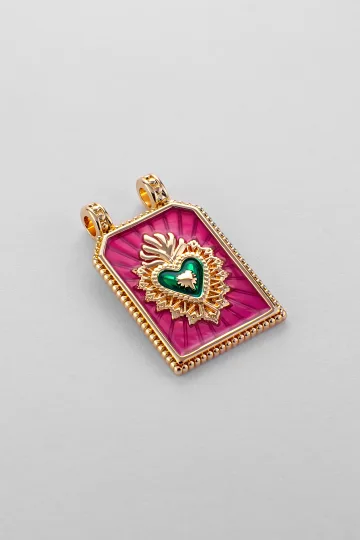
Wear the symbol, don't just read about it. These are in stock:




Why titanium stayed exotic for so long
The element was discovered in the late eighteenth century, but learning to produce it in pure, workable form only happened in the twentieth, closer to its middle. The reason lies in the metal's temperament: molten titanium greedily grabs oxygen and nitrogen from the air, and that makes it brittle. To smelt usable titanium you need a vacuum or a protective blanket of inert gas, and that's expensive and difficult. So it came to jewellery very late, once industry had already set up production for aviation and space.
Where titanium occurs in nature
The paradox is that there's plenty of the element on Earth: by abundance in the crust, titanium ranks among the top ten metals, more of it than copper, zinc and lead combined. The difficulty isn't finding the ore, it's extracting pure metal from it. So titanium is both common underground and no cheaper than gold on the shelf, with all the cost sitting in the processing.
Light and strong at once: titanium's main trick
This is the feature that got titanium into engineering in the first place, and later into jewellery. Most metals force you to choose: either light or strong. Titanium breaks that compromise.
The strength of steel at half the weight
Roughly speaking, by specific strength, that is, strength per unit of weight, titanium beats steel. A titanium alloy on its own can carry loads on par with good steel, yet weighs about half as much. Aluminium is lighter than titanium but noticeably weaker. The result is a sweet spot: a piece almost as tough as steel that feels like a feather in your hand. For a ring, an earring or a bracelet, that means you can make something large and bold without it dragging down an earlobe or pressing on a finger.
Where that strength comes from
The secret is in the crystal lattice and in the alloys. Pure titanium is already decent, but real fighting strength comes from additives, most often aluminium and vanadium. The most famous alloy, Grade 5 (marked Ti-6Al-4V, meaning six percent aluminium and four percent vanadium), combines a light base with hardness close to tempered steel. These are the alloys that go into aircraft components and tough rings that are hard to bend or scratch.
What strength means in real wear
On the finger it comes down to something simple: a titanium ring survives what would have dented a silver one. A knock against a door handle, a fall onto tile, daily friction against a keyboard and a steering wheel, all of it is nothing to titanium. It holds its shape, stays round, doesn't crumple. Steel has a similar toughness, but it's heavier. With titanium you get strength without weight, and that's the whole point.
Matte titanium belongs under a rolled sleeve, never beside a lump of gold. If you need sparkle to be noticed, this is not your metal.
How to wear titanium
Plenty of titanium has passed through my hands on shoots: rings, earrings, chains. Here is what actually works, sorted by occasion and by type of piece.
How do I wear titanium every day? For daily wear I recommend a matte or brushed ring in a Grade 5 alloy: it hides scratches and survives everything from the steering wheel to the gym. Grey titanium sits with denim, knitwear and a sporty look, and a dark top turns it into the accent. You do not need to take it off, and that is the whole point of the metal.
Is it right for the office or under a suit? For a put-together look I suggest polished titanium in a calm shape, keeping the length and fit restrained. Next to massive gold it clashes, so keep it in a cool palette: steel, white gold, grey and blue. Under a shirt and jacket titanium reads as a quiet technical detail, not a loud accent.
What should I choose for sensitive skin and ears? For lobes and fresh piercings I choose implant titanium, the medical alloy with low impurities. It holds no nickel, so the skin under it stays calm, and its lightness does not drag the lobe down. A large titanium earring can be worn with confidence, it weighs less than it looks.
How do I bring colour into the look? If you want colour, I recommend anodised titanium with a blue or purple sheen. That shine comes from the optics of the oxide film, not from paint, so it will not peel and gives off no nickel. This titanium works on a bold look and alongside cool metals, and on quiet clothing it acts as the single bright accent.
Which metals does titanium get along with? I suggest mixing titanium with its cool relatives: steel, white gold, silver, rhodium-plated pieces. Grey titanium and silver on neighbouring fingers read as a single cool line. With yellow gold the contrast is sharp, so either play it deliberately or spread the metals across different areas.

Turn on your camera, pick earrings, a pendant or a ring, and see the piece on yourself in real time.
Switch items in one tap.
Everything runs in your browser: no photo or video is ever uploaded.
Biocompatibility: a metal the body trusts
Here we enter territory where titanium has almost no rivals. The word "biocompatibility" sounds like it came from a medical pamphlet, but the meaning is plain: the body doesn't treat titanium as a stranger and doesn't try to reject it.
Why titanium gets implanted in people
Titanium is used for dental implants, artificial joints, bone plates and screws, and the pins that hold broken bones together. Surgeons place it inside the body for years and decades, and the body lives with it calmly, bone even grows onto the titanium surface. The reason is that oxide film again: in air and in tissue, titanium instantly coats itself in the thinnest layer of oxide, inert and stable, which doesn't react and doesn't poison tissue. The body sees not metal but a neutral surface.
What medical titanium for piercing means
For piercing, especially a fresh one, a puncture still healing, the same approach is used as in surgery. These are special alloys, most often the variant known by the implant-purity standard (designated Ti-6Al-4V ELI, or by the ASTM F-136 standard). ELI here means extra-low interstitial, an especially low level of impurities. Titanium like this is fit for contact with an open wound because it releases nothing extra into it. For a first earring in a fresh piercing it's one of the safest materials there is, alongside implant-grade steel and niobium.
Why this matters for ordinary jewellery
Even if you never get pierced and never wear an implant, biocompatibility works for you every day. A ring, an earring or a chain made of titanium doesn't react with sweat, water and skin, doesn't release metal ions the body might answer with irritation. Put bluntly, if a metal can be trusted to sit against bone inside the body, wearing it on the outside is safer still.
Fully hypoallergenic: relief for sensitive skin
Biocompatibility and hypoallergenic comfort are close but not identical. The first is about the body accepting metal inside. The second is about skin on the outside not breaking out in a rash, itch and red blotches. Titanium is good at both.
Why titanium doesn't cause allergies
A metal allergy is almost always caused by nickel. It turns up in cheap costume jewellery, in some grades of gold and steel, and it's nickel that produces that familiar reaction: itching, redness, weeping skin under a ring or in an earlobe. Pure titanium contains no nickel at all, and in its jewellery alloys nickel is either absent or bound so tightly it doesn't leach out. On top of that, the inert oxide film lets nothing reactive reach the skin. As a result, titanium ranks among the most hypoallergenic metals there is.
Who this matters to most
If your earlobes ever itched from earrings, if the skin under a ring darkened or itched, if a blue patch appeared under a bracelet, nickel is most likely to blame. Titanium clears the problem completely. For more on the reaction itself and how to spot it, there's a separate breakdown of nickel allergy. And if you want to work out which metal will actually agree with your skin by tone and by reaction, the guide to choosing a metal for your skin will help.
Hypoallergenic wear and skin colour
Another pleasant side effect: titanium leaves no dark or greenish marks on the skin, the kind brass and cheap alloys are guilty of. The skin under a titanium ring stays clean even after weeks of never taking it off. For people with sweaty or temperamental skin, that solves half the trouble with jewellery in one go.
Customer reviews
Zevira is a real jewellery shop. Genuine payments, deliveries and customer thank-yous.
🥰🥰🥰 gracias
Ok, ¡gracias! 🙂
Anodising: a rainbow without a drop of paint
Titanium's prettiest trick, and also its most misunderstood. The blue, violet, gold and turquoise of titanium jewellery isn't coloured with pigment. The colour is born from physics, not from the chemistry of a dye.
Where the colour comes from if there's no paint
There's always a clear oxide film on the surface of titanium. If you pass an electric current through the metal in a special solution, that film starts to grow, to thicken. And here's the crux: light hitting the film partly reflects off its top boundary and partly off the bottom one, off the metal itself. The two reflected waves overlap and cancel some colours of the spectrum while reinforcing others. The eye sees the result as a pure colour. A soap bubble or an oil slick on a puddle shimmers exactly the same way: nobody painted them, the colour comes from a thin film and the play of light.
Why voltage sets the colour
The thickness of the film depends on the voltage applied. The higher the voltage, the thicker the oxide layer, and the further along the spectrum the colour travels. Low voltage gives golden and bronze tones, medium gives violet and blue, high gives sky blue, turquoise and greenish hues. The maker essentially "tunes" the colour with a voltage dial, like a radio tuning to a station. So two neighbouring shades of blue on titanium are simply a difference of a few volts.
Why anodising beats paint
Since the color is the oxide film itself rather than a layer of pigment on top, it can't be rubbed off or chipped like enamel or lacquer. It doesn't fade in sunlight and doesn't wash off in water. You can scratch the film, and a deep scratch will change the color in that spot, but it can't peel like paint. It's an honest color, built into the metal. In spirit, anodizing is a cousin of how two-tone and three-tone jewelry gets its color, where the different tones also come from the metal itself rather than a coating.
How titanium reached jewellery: aviation, space and the deep
Titanium has no jewellery pedigree. It came into jewellery not from a gem-cutter's workshop but from the harshest industries there are, and that backstory explains a lot about its character.
Titanium in aviation and space
Aviation became titanium's main customer. A light, strong metal that shrugs off high temperatures turned out to be ideal for aircraft: engine components, skin panels, landing-gear elements. In spaceflight it's just as indispensable, titanium alloys go into the bodies and tanks of spacecraft, where every extra gram costs dearly and strength is critical. That's exactly where titanium gets its nickname, the space-age metal: it literally flew into space long before it landed in a display case.
Titanium in submarines and at sea
Underwater, titanium has its own edge: it doesn't corrode in seawater. A steel hull has to be defended against rust and fouling, while a titanium one holds up in saltwater for decades without corroding. Titanium alloys went into the hulls of deep-diving submarines able to descend deeper than their steel cousins, and into parts for marine equipment. If a metal can take the pressure of ocean depths and saltwater, the sweat on your wrist is certainly no threat to it.
Titanium in watch cases and tools
For the same reasons, watchmakers and makers of rugged tools came to love titanium: a light case that doesn't scratch easily, doesn't trigger allergies under a strap and doesn't fear water. From watches and sporting gear the road into jewelry was a short one. In essence, titanium arrived where stainless steel had arrived before it, into the niche of tough, hard-wearing, everyday pieces with character. There's plenty said about that neighboring niche in the piece on steel jewelry.
Upload a photo of your pet, someone you love, or an object. We'll build a 3D model and hand-cast it in pewter.



Titanium wedding rings: pros and cons
A big topic of its own. Titanium became a serious player precisely in wedding and engagement rings, especially men's. The choice has weighty upsides and a couple of honest downsides worth knowing in advance.
What makes titanium good for a wedding ring
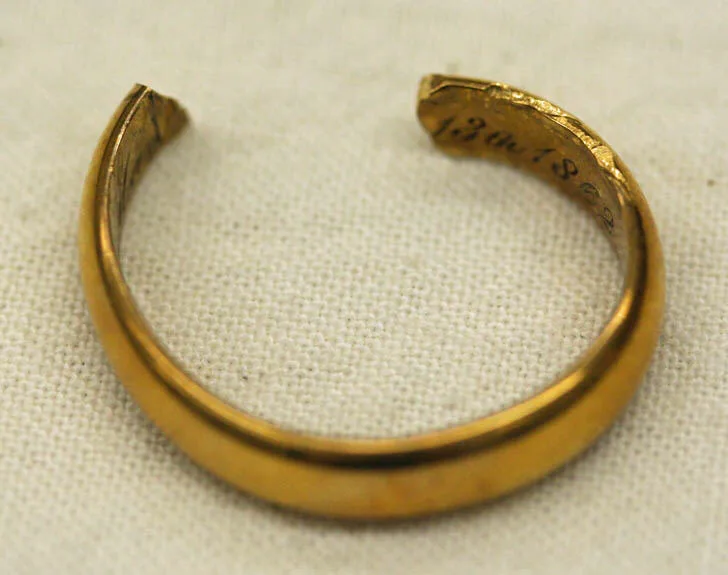
A wedding ring gets worn for years without coming off, and this is where titanium shows its full hand. It's light, and a finger gets used to it within a day. It's hypoallergenic, which matters if your skin reacts to metal. It barely scratches or dents, so it survives building sites, the gym, cooking and a thousand small knocks. It doesn't tarnish and needs no cleaning. And it's affordable next to gold, which for a couple starting out often settles the matter. For an active person who works with their hands, a titanium ring is often more practical than gold.
Downside one: the size barely changes
Here titanium shows the flip side of its strength. You can't stretch or shrink a titanium ring the way you can a gold one: the metal is too hard and resists jeweller's adjustment. Many titanium rings can't be resized at all, it's simpler to order a new one in the right size. So the size at purchase is measured precisely, with allowance for how a finger might change over time. That's the price of hardness, and it's worth knowing honestly before the wedding rather than after.
Downside two: how to remove it in an emergency
Plenty of scare stories circulate around this, and the fog is worth clearing. Yes, in case of injury when a finger swells and the ring has to come off quickly, a titanium ring is removed the same way as any other, with the special ring cutters doctors use. The myth that a titanium ring "can't be cut off" and the finger will have to be amputated is false: medical tools cut titanium without much trouble, sometimes a touch longer than soft gold, but they cut it. So there's no need to fear it, emergency removal is always possible.
Who a titanium ring suits
It fits perfectly anyone who leads an active life, works with their hands, hates taking jewellery off and values lightness. Anyone with an allergy to the usual metals. Couples who care about practicality and don't plan to change size. But if a wedding ring is, to you, a family heirloom to be passed down to children and one day melted and reworked, classic gold suits better: it can be repaired, resized and remade across generations.


Titanium jewellery by type
Different pieces show off titanium from different angles. In one place lightness comes to the fore, in another hypoallergenic comfort, in another strength. Let's run through the main ones.
Titanium ring
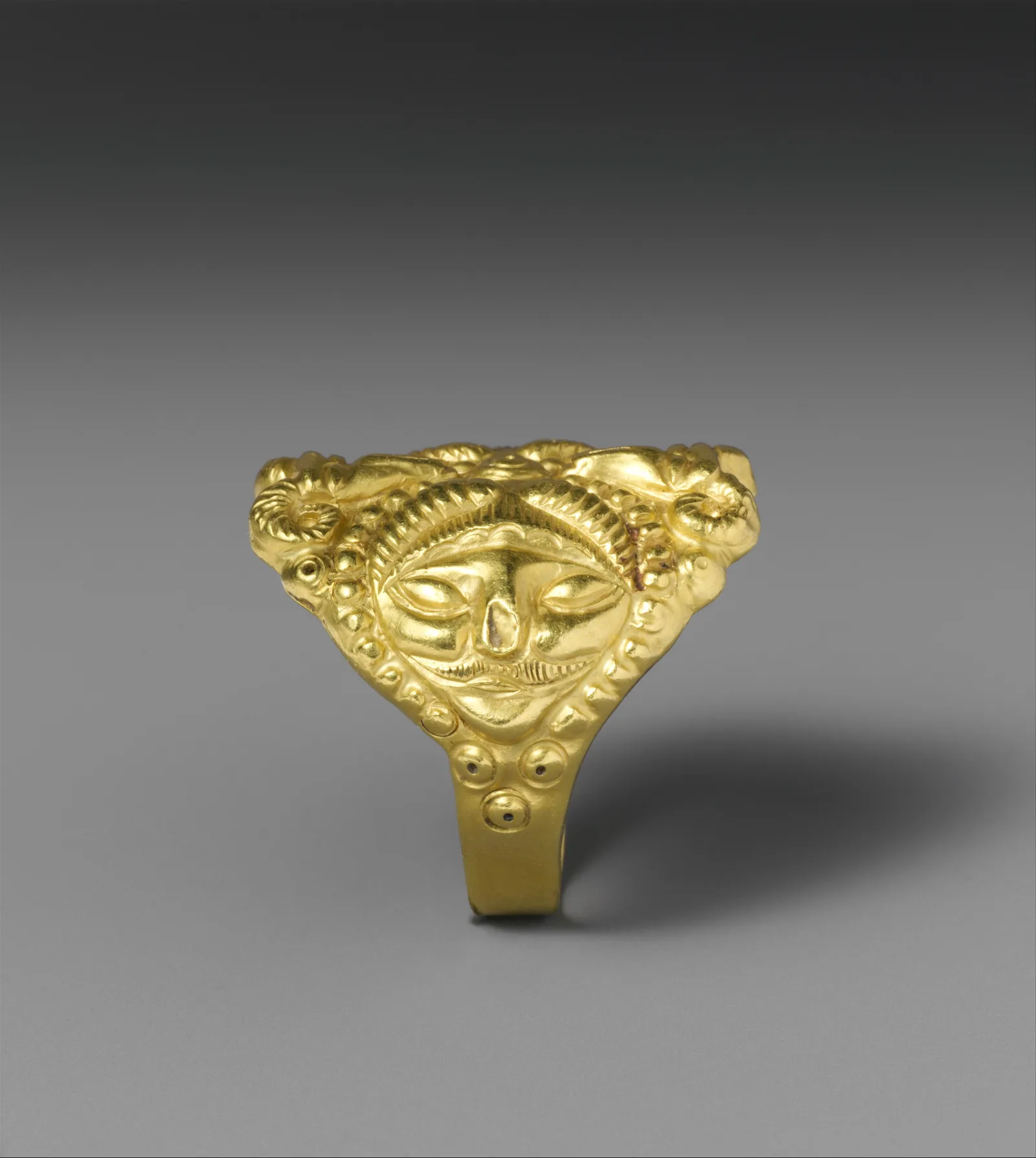
The main role for titanium is the wedding ring, more often a man's. The reason is simple: it gets worn for years without coming off, and here the metal's lightness and low maintenance decide everything. A finger gets used to a titanium ring within a day, it doesn't press or drag, doesn't tarnish, needs no cleaning, and survives knocks that would have dented gold. The hypoallergenic nature removes any question of irritation under the band. Pick the finish by temperament: matte hides the marks of wear and looks restrained, polished is brighter but shows small scratches more readily. Two honest details are worth knowing up front. A titanium ring's size barely yields to resizing, the metal is too hard, so the measurement is taken precisely, and if the finger changes it's simpler to order a new ring. And in an emergency, when a finger swells after an injury, a titanium ring is cut off with a medical ring cutter just like any other, no amputation required.
Titanium bracelet
A bracelet is the piece where titanium's lightness genuinely startles the hand. Used to the weight of a steel or silver bracelet, you expect the same from titanium, and it's barely there on the wrist. For a large, eye-catching bracelet that's the deciding argument: you can wear something bold without paying for it in heaviness and fatigue. For active people a titanium bracelet is convenient because it fears no water, sweat or knocks, there's no need to take it off before the gym, the shower or hands-on work. For allergy sufferers it closes an old problem: a bracelet rests on the sensitive skin of the wrist for hours, and the usual nickel alloys often raise itching and patches there. Titanium is inert, so the skin under it stays clean, the metal doesn't tarnish on its own and leaves none of the dark or greenish marks that brass and cheap costume jewellery are guilty of. Wear it and forget it, that's its format.
Titanium earrings and studs
Here titanium has almost no rivals, and the reason is in the ears. An earlobe is a sensitive zone, and a fresh or troublesome piercing reacts to metal most sharply of all: it itches, reddens, weeps. Nickel in cheap alloys is almost always to blame. Titanium contains none, and implant titanium, that medical alloy of reduced impurity, is fit even for contact with a healing wound. So studs and earrings in medical titanium are a sensible choice for fresh piercings and for those lobes that battled ordinary costume jewellery for years. Lightness works here too: a large titanium earring doesn't drag the lobe down or stretch the piercing the way a heavy metal one does. Anodised coloured earrings give blue and violet shimmer with no paint and no nickel, so colour doesn't come at the price of irritation. For sensitive ears that's a rare pairing of beauty and peace of mind.
Titanium chain and pendant
A chain and pendant get chosen for that same sense of weightlessness. A light titanium chain doesn't press on the neck and is barely felt under clothing, while a pendant that looks massive doesn't hang like a weight the way its steel or silver twin of the same size would. The neck is a delicate zone, the skin there is thin and sweaty, and the usual alloys often raise irritation or a dark mark there by the end of the day. Titanium is inert: it doesn't react with sweat and skin, doesn't release ions the body answers with itching, and leaves no streaks. Strength counts in its favour too, a thin titanium link is harder to bend or break than a soft silver one, and the clasp doesn't loosen from water and sweat. A titanium chain can stay on in the shower, at training and on the beach, seawater is no threat to it. For anyone who wears a pendant constantly and forgets about it, the material fits perfectly.
Titanium piercing
For piercing, titanium is the gold standard, and not just in words. A piercing is an open wound that needs to heal, and the material of the first earring directly affects how healing goes. Implant titanium, the same alloy surgeons place inside the body, has high biocompatibility: it's inert, releases no metal ions into the wound and provokes no inflammation. For safety in a fresh piercing it stands alongside implant-grade steel and niobium, and for anyone who reacts to steel it's often the only comfortable option. There's a separate bonus, colour: anodised titanium piercing jewellery comes in blue, violet and gold, and those shades come from the optics of the oxide film, not from a coating with nickel or other allergens. The colour is built into the metal, doesn't peel into the wound and touches the tissue with nothing reactive. So coloured titanium is safe where coloured steel of dubious makeup might let you down.
Types and grades of titanium: pure metal versus alloys
The word "titanium" on a tag doesn't tell the whole story by itself. Behind it stands a specific grade, and the difference between them is real.
Commercially pure titanium
This is titanium without serious additives, marked Grade 1, 2, 3, 4 in rising order of strength and impurity content. It's softer than the alloys, easier to work, and has maximum corrosion resistance and biocompatibility. Pure titanium is good where inertness matters most, for example in simple jewellery and some medical uses. It anodizes beautifully, giving clean, vivid colours.
Grade 5 alloy and its kin
The most common structural titanium, that same Ti-6Al-4V with aluminium and vanadium. It's noticeably stronger and harder than pure titanium, holds its shape, resists scratching. It goes into the most wear-resistant rings and load-bearing parts. For a piece meant to last and shrug off knocks, Grade 5 is preferable. Its medical variant with reduced impurity content goes into implants and piercings.
Which grade you actually need
For an everyday tough ring, especially a man's wedding band, it makes more sense to take Grade 5 alloy: more hardness, less risk of denting. For studs in a fresh piercing and for very sensitive skin, implant-purity titanium is better. For vivid anodised pieces, pure titanium works well too, it takes colour brightly. The main thing is that the seller can actually name the grade: a nameless "titanium" with no marking is a reason to be wary.
Leave your email, we'll send your discount code. No spam, unsubscribe anytime.
The code arrives by email, valid on your first order.
Titanium finishes: matte versus polished
The same titanium looks different depending on how the surface is treated. It's a question not of quality but of character and taste.
Polished titanium
The surface is brought to a mirror shine. Polished titanium catches the light and looks brighter, closer to the familiar look of jewellery. Because of the metal's greyish steel tone, the shine comes out cooler than silver, more steely. The flip side of the mirror is the same as with any polished metal: small scratches and fingerprints show more, though titanium itself scratches reluctantly.
Matte and satin titanium
The surface is worked so it doesn't shine but spreads light evenly. Matte titanium looks restrained, technical, modern, and in this finish the metal looks at its most "titanium," its most recognisable. The big plus of matte is that it hides the marks of wear better: small scratches get lost on a non-shiny surface. For a ring worn hard and every day, matte is more practical than a mirror.
Brushed and combined surfaces
Titanium is often given a brushed finish, with a fine directional grain, as if combed in one direction. It gives a soft, muted shine and also hides scratches well. Combinations are popular too: a matte centre on the ring with polished edges, or a brushed band with a mirror bevel. The contrast of textures makes a simple titanium piece more interesting without adding either stones or colour.
Weight, comfort and everyday wear
One of the main arguments for titanium isn't even strength, it's how it feels on the body. This is the case where lightness sells as well as beauty.
Why titanium is so comfortable
Titanium's lightness means the piece is barely felt. A large ring doesn't press on the finger, a heavy-looking earring doesn't drag the lobe, a chain doesn't hang like a weight on the neck. For people who find heavy jewellery tiring or uncomfortable, that's the deciding argument. You can wear something bold and noticeable without paying for it in weight.
Wearing it without taking it off
Titanium is built for continuous wear. It doesn't tarnish, doesn't fear water, sweat, soap, the sea or the gym, doesn't cause irritation. You can keep it on in the shower, overnight, at training, on the beach. For anyone who can't stand the ritual of taking jewellery on and off and forever losing it, this is the ideal material: put it on and forget it.
Where titanium does ask for attention
Nothing is perfect, and a couple of caveats are more honest than gloss. The anodised coloured layer, while it doesn't peel like paint, will change shade at a deep scratch in that spot, so coloured titanium pieces get guarded from rough knocks with sharp objects a little more carefully. And a ring's size, as already noted, is better pinned down precisely from the start. Otherwise titanium is one of the most low-maintenance materials in the world.
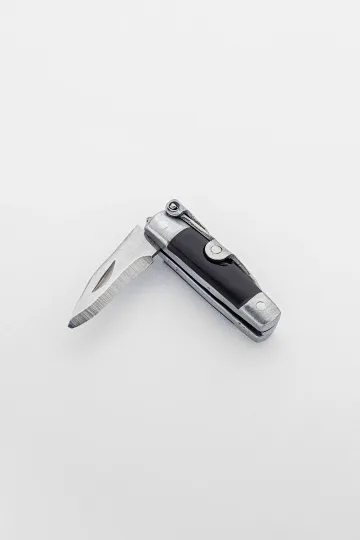
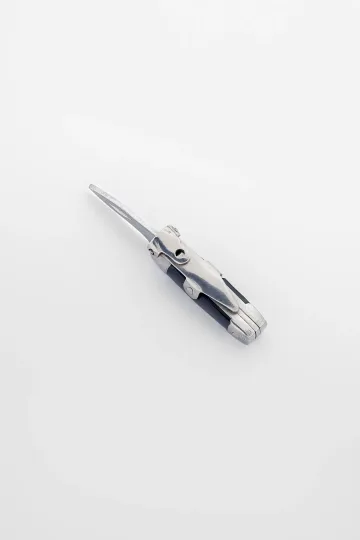
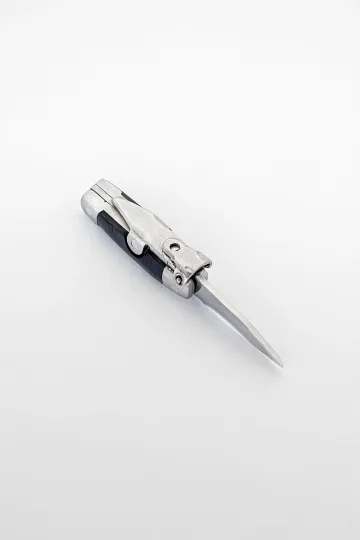
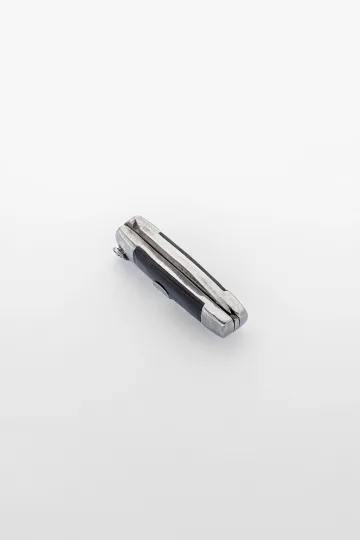
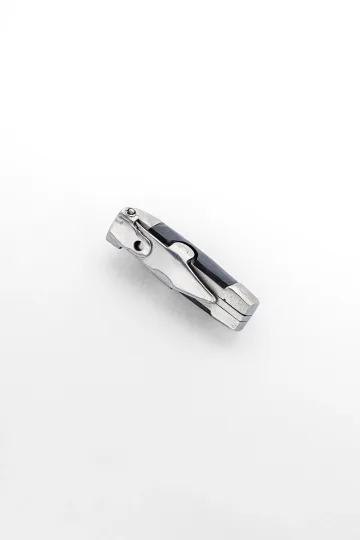
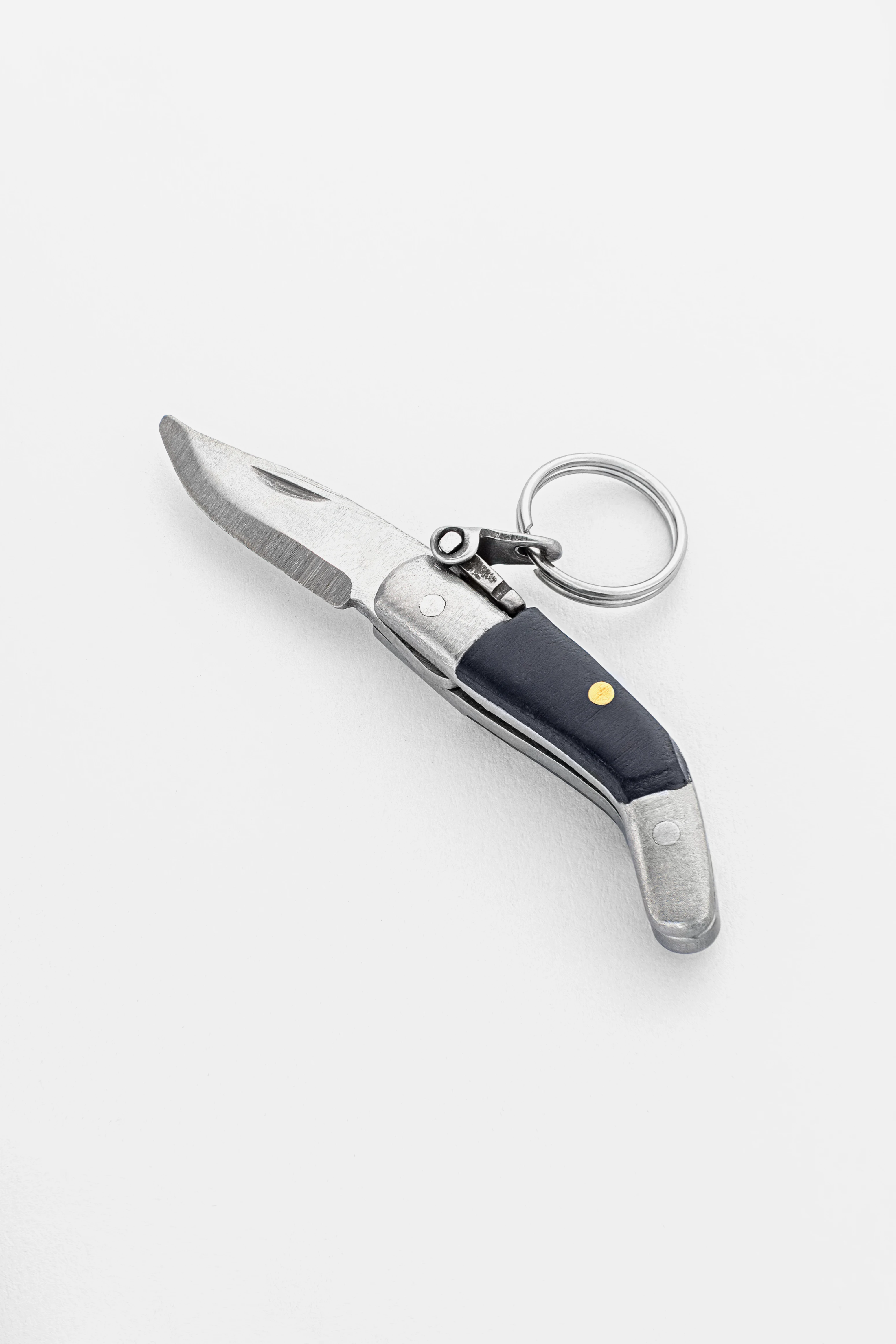
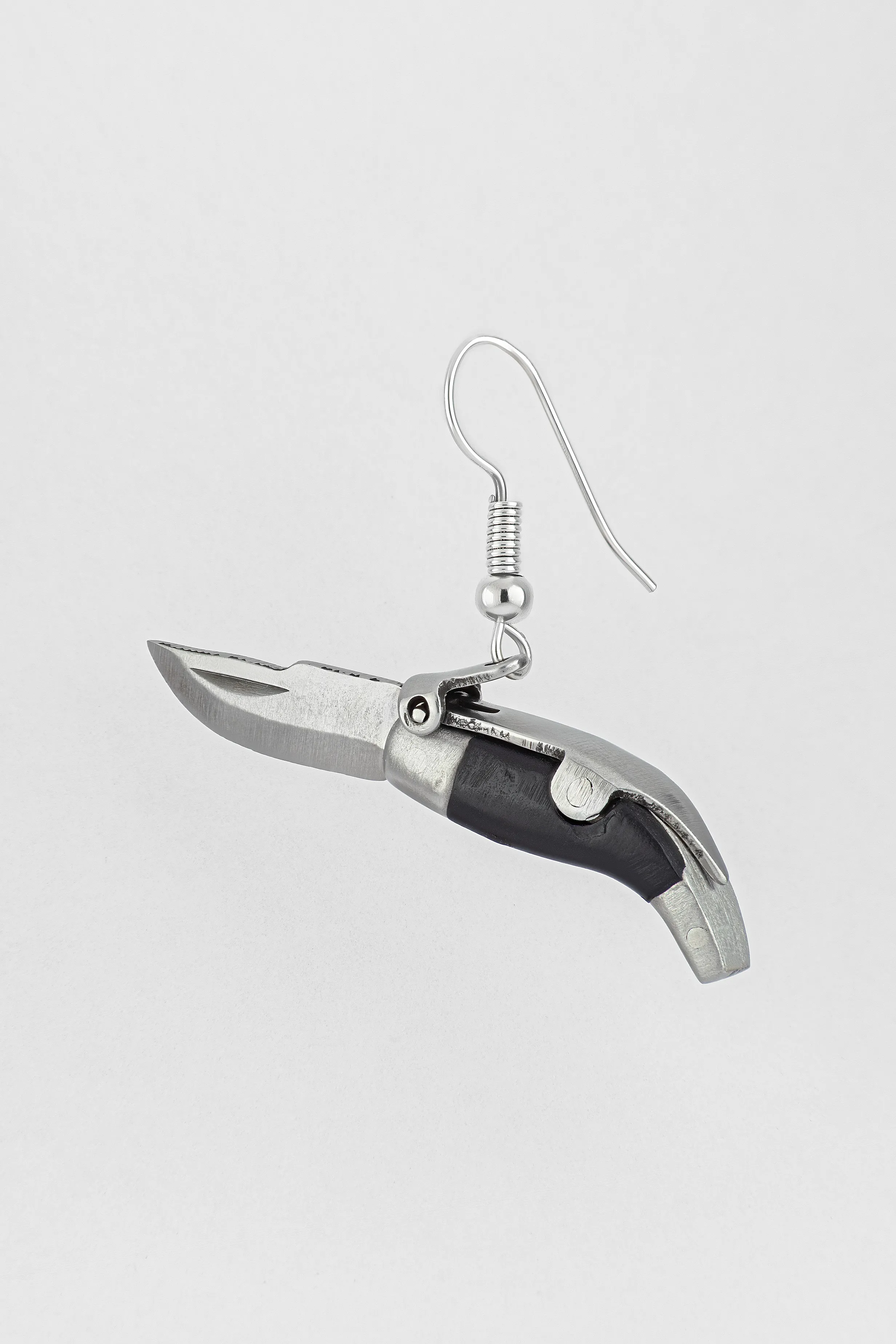
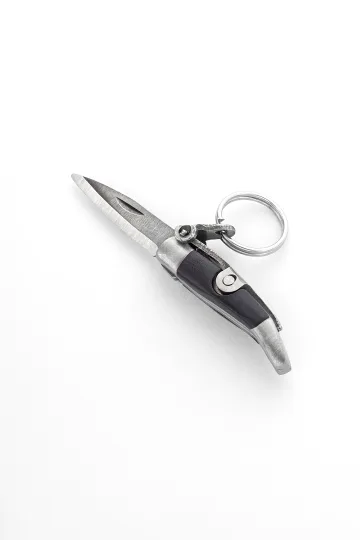
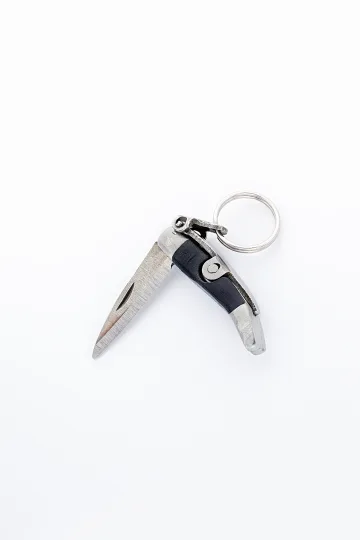
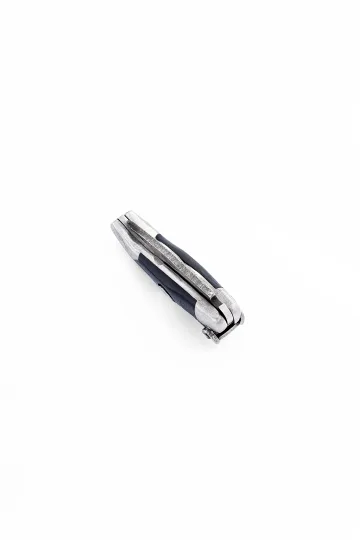
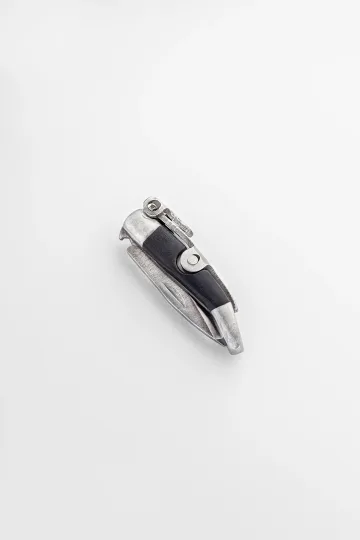
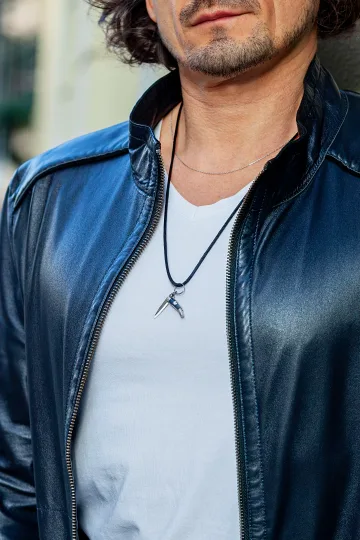
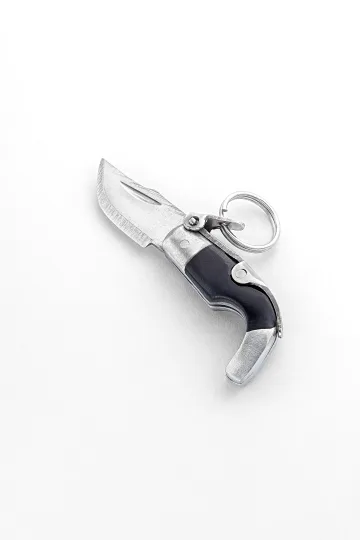
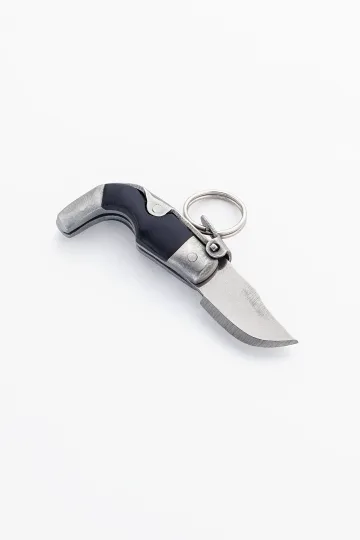
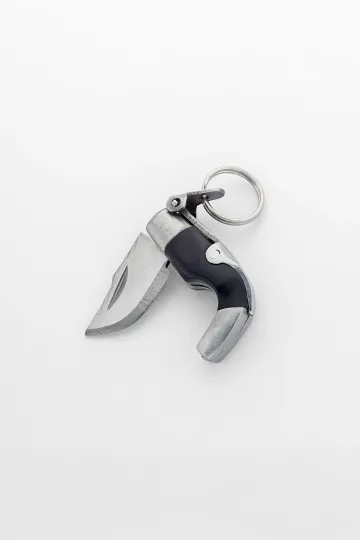
CAPAORA mini knife pendant
The 18th-century Spanish navaja in miniature: 40 mm of stainless steel, a real folding mechanism and a Palanquilla lock that clicks. An affordable gift to remember.
Authentic · Ships from Spain · 14-day returns
Caring for titanium: almost nothing to do
This section will be short, and that's the best compliment to the metal. Titanium asks for almost no care, and that's part of its charm.
Why titanium doesn't tarnish
Silver dulls and blackens from sulphur compounds in the air, and it has to be cleaned regularly. None of that happens with titanium: its inert oxide film doesn't react, the metal doesn't oxidise and doesn't darken from air, water or sweat. A titanium piece looks the same a year on as it did the day you bought it, with no cleaning at all.
How to wash titanium
If titanium gets dusty or skin oil settles on it, warm water with a drop of mild soap and a soft cloth or brush is enough. Rinse, wipe dry, done. No special solutions like silver needs, and no polishing pastes for blackening, because there's no blackening to begin with. Polished titanium can be freshened with a soft polishing cloth if you want to bring the shine back.
What not to do
The one thing worth avoiding is a harsh abrasive on coloured anodised pieces: a rough brush or abrasive paste can scratch the oxide film and knock out the colour where it rubs. With ordinary grey titanium there's no need to stand on ceremony at all. In essence, caring for titanium comes down to "wipe it if it's dirty," and that's it.
Comparison: titanium versus steel, tungsten and silver
To understand titanium's place, it helps to set it next to its neighbours. Every metal has its own character, and titanium isn't the best at everything, it's the best at its own thing.
Titanium versus stainless steel
Both are strong, both don't tarnish, both are hypoallergenic in good grades, both are affordable. The difference is in weight: titanium is nearly half the weight of steel at comparable strength. Steel is a touch easier to work and cheaper, titanium is lighter and more comfortable, and a little more resistant to corrosion in a harsh environment. If you need maximum lightness, the choice is titanium. If price matters more, and a heavy "heft" in the hand is part of the appeal, steel will hold its own. A detailed comparison of steel with other metals is laid out in the guide on brass, steel and silver.
Titanium versus tungsten
Tungsten rings are popular too, and here the contrast is sharp. Tungsten is far harder, almost impossible to scratch, and holds a mirror shine like nothing else. But you pay for that with two downsides: tungsten is heavy, one of the heaviest metals there is, and brittle. The hardness turns into brittleness: a tungsten ring can shatter like ceramic under a strong blow rather than bend. Titanium bends but doesn't crack, and weighs a quarter as much. Tungsten gets chosen for its shine and scratch resistance, titanium for its lightness and for the fact that it won't split.
Titanium versus silver
Silver is a noble metal with a warm white shine and a jewelry tradition centuries deep. It's soft, easy to work, solder, resize, it can be melted down and repaired. But it tarnishes, scratches, needs care, and in some people triggers a reaction from the impurities in the alloy. Titanium loses to silver in "jewelry feel" and repairability, but wins in strength, lightness, low maintenance and hypoallergenic comfort. If you want a classic you can pass down and melt, the choice is silver, and here a breakdown of what the 925 hallmark means comes in handy. If you need a hard-wearing everyday piece you put on and forget, titanium is the more convenient one.
Who titanium is for
A metal with this kind of character doesn't fit everyone, and that's fine. But for the people it does suit, it suits perfectly.
Active people
For those who work with their hands, do sport, lead a moving life, titanium is nearly irreplaceable. It fears no knocks, water or sweat, and doesn't have to come off before a task. A ring that survives a building site and the gym is a titanium ring.
Allergy sufferers and sensitive skin
If metals cause itching, redness and patches, titanium is often the only comfortable way out. Full hypoallergenic comfort and inertness make it safe even for the fussiest skin. Many come to titanium precisely after a long war with nickel allergy.
For men's wedding rings
Lightness, strength, hypoallergenic comfort and an affordable price made titanium one of the favourite metals for men's wedding rings. Especially for those who never wore jewellery before and want something unobtrusive, tough and care-free.
For piercing
Implant titanium is one of the safest materials for a piercing, especially a fresh one. It releases nothing extra into the wound, causes no reaction and is well tolerated by healing skin. For a first earring in a new piercing it's a sensible choice.
Who titanium isn't for
If you love classic gold, a warm shine, stones in a high setting and pieces handed down and reworked across generations, titanium will feel cold and uninviting. It's about practicality and technical character, not jewellery luxury. That's worth admitting honestly: titanium doesn't cancel gold, it answers a different need.
Send a friend a discount code, they save on their first order.
Myths about titanium
Tall tales always pile up around an outsider metal. Let's sort out the most persistent ones.
Myth: titanium is brittle
Exactly the opposite. Tungsten is the brittle one, the metal that can shatter from a blow. Titanium is plastic and tough: it bends sooner than it cracks, and even that takes some effort. Titanium's strength was proven long ago by aviation and submarines, and you don't hang loads like that on a brittle material.
Myth: titanium scratches easily
Also untrue. Titanium, especially in Grade 5 alloy, scratches noticeably harder than silver and gold. You can't call it perfectly scratch-proof, the outright champion there is tungsten, but in everyday wear titanium holds its looks far better than soft precious metals. A matte finish hides small marks.
Myth: titanium is an unserious metal
This prejudice is purely cultural: since it didn't come from a velvet box, it can't be "real jewellery." But a metal trusted with human bone, an aircraft engine and a submarine hull is hard to call unserious. Titanium simply plays in a different league: not in luxury but in strength and technology. For some that's even more honest than sparkle.
Myth: coloured titanium is painted and will peel
No. The colour of anodised titanium is an optical effect of the oxide film, not a layer of paint. It has nothing to peel like lacquer or enamel, because it's not a coating on top but a property of the surface itself. You can scratch the film deep enough to change the colour, but it can't flake off.
Myth: a titanium ring can't be removed in an injury
The most dangerous tale, and it's false. Medical ring cutters cut titanium, sometimes a touch longer than gold, but without trouble. No amputation is required. A titanium ring can always be removed in an emergency.
Facts that surprise
A cold technical metal hides more of the unexpected than it seems. A few verified facts that change how you look at a titanium piece.
Titanium is named after the ancient giant gods. The chemist Klaproth gave the metal its name, nodding to the Titans of Greek mythology, the mighty deities who ruled the world before the Olympians. The name turned out prophetic: the metal really did live up to its namesakes in strength and endurance.
The colours on titanium aren't paint, they're optics. The blue, violet and gold on anodised titanium are born the same way as the shimmer on a soap bubble or an oil slick. The thinnest oxide film refracts light, and the eye sees a pure colour. No pigment is involved.
The colour is tuned with voltage, like a radio. The shade of anodised titanium is set by the size of the electric voltage applied: the higher it is, the thicker the film and the further the colour travels along the spectrum. Neighboring tones of blue on titanium are simply a difference of a few volts.
Titanium isn't magnetic. Unlike ordinary steel, titanium is non-magnetic. Bringing a magnet near it is pointless, it won't be drawn. This property, by the way, helps tell real titanium from a steel fake.
Titanium doesn't corrode in seawater. Saltwater, which eats steel and iron away with rust, has almost no effect on titanium. That's why it went into the hulls of deep-diving submarines and parts for marine equipment that serve in the ocean for decades.
There's more titanium in the crust than copper, zinc and lead combined. By abundance the element ranks among the top ten metals of the Earth's crust. It's no rarity underground, all its cost sits in the difficulty of extracting pure metal from ore.
Bone grows onto titanium. Surgery has a phenomenon called osseointegration: living bone tissue fuses with the surface of a titanium implant as if with its own. That's exactly why titanium dental implants and joints hold firmly in the body for the long term.
Titanium flew into space before it landed in a display case. The nickname space-age metal isn't for show: titanium alloys went into the bodies and tanks of spacecraft and the components of aircraft long before anyone started making rings and earrings from it.
Frequently asked questions
Does titanium cause allergies? Practically never. Pure titanium contains no nickel, the main culprit behind metal allergy, and the inert oxide film releases nothing reactive to the skin. Titanium ranks among the most hypoallergenic metals and suits even very sensitive skin. If you react to ordinary costume jewellery, titanium will most likely solve the problem.
Does titanium tarnish over time? No. Titanium doesn't oxidise the way silver does and doesn't darken from air, water or sweat. A year of wear on, it looks the same as the day you bought it, with no cleaning. It's one of the most low-maintenance metals to care for.
Can a titanium ring be resized? In most cases no, or very little. Titanium is too hard for easy resizing, so many rings are simpler to order anew in the right size. Because of that, the size at purchase is measured especially precisely. It's the price of the metal's strength.
And if a finger swells, can the ring be removed at the hospital? Yes, without trouble. The myth that a titanium ring can't be cut off is false. Medical ring cutters cut titanium, sometimes a touch longer than soft gold, but always successfully. It poses no threat to the finger.
Is coloured titanium painted? Will the colour wear off? The colour of anodised titanium is an optical effect of the oxide film, built into the surface itself, not paint. It can't peel like lacquer. You can scratch the film deep enough to change the shade where it's scratched, so coloured pieces are guarded from rough knocks with sharp objects, but the colour can't flake off.
Is titanium stronger than steel? By specific strength, that is, strength per unit of weight, yes. Titanium on its own is comparable in strength to good steel, yet weighs about half as much. It's exactly that combination of strength and lightness that made titanium so valuable, first in aviation and then in jewellery.
How does titanium differ from tungsten? Tungsten is harder and holds its shine better, almost impossible to scratch, but it's heavy and brittle: a strong blow can shatter it. Titanium is several times lighter, it bends but doesn't crack. Tungsten gets chosen for its mirror shine and scratch resistance, titanium for its lightness and reliability.
Is titanium suitable for a fresh piercing? Yes, implant titanium is one of the safest materials for a fresh piercing. It's inert, releases nothing extra into the wound and is well tolerated by healing skin. For a first earring in a new piercing it's a sensible and safe choice.
Buying it as a gift? Each one arrives ready to give.
 A branded Zevira box and a little card come with every order.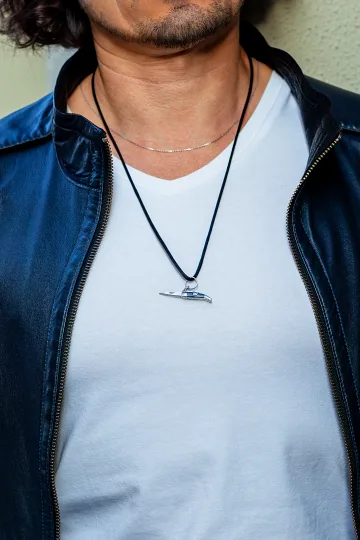




In short
Titanium came to jewellery not from a velvet box but from engineering offices, operating rooms and space workshops, and that's its whole character. It's light and yet strong as steel. The body accepts it without rejection, and the skin without allergy, because it holds no nickel and an inert oxide film protects it. The colour on it is born of physics, not paint, so it doesn't peel. It doesn't tarnish, asks for almost no care, and survives what would have dented silver.
It has exactly two downsides, and both are honest: a ring's size barely changes, and it wasn't built for classic jewellery luxury with melting down across generations. But for an active life, for allergy sufferers, for men's wedding rings and for piercing, titanium is often the best choice there is. It's a metal not about sparkle but about strength, lightness and peace of mind, and that's what it's loved for.
Silver, steel, light hypoallergenic metals, coloured stones, symbolism, matching sets.
About Zevira
Zevira is a Spanish jewelry brand from Albacete. We love pieces with honest material and character, from classic 925 sterling silver to light hypoallergenic metals worn without ever coming off. If your skin reacts to the usual costume jewelry, start with the breakdown on nickel allergy, then take a look at the catalog.