Anodized Titanium and Niobium: Color Without a Coating
Blue, purple and gold on titanium are not paint and not plating. They are an ultra-thin transparent film of oxide grown right on the surface of the metal by an electric current. The colour does not sit in the film as pigment, it is born from the play of light, and it depends on one thing only: the voltage used to grow the film. Want a deep blue? Give it more volts. Want gold? Less.
It sounds like a trick, but it is ordinary physics, the same physics that colours a soap bubble and an oil slick on a puddle. The rainbow shimmer there is not pigment either, it is light bent inside a thin layer. On titanium and niobium this effect has been tamed and made permanent. The result is jewellery whose colour is the metal itself: it cannot be scratched off because there is nothing to scratch, the film is thousands of times thinner than a hair and clings to the surface for good.
In jewellery this opened a whole direction: earrings the colour of a peacock feather, rings that fade from blue to lilac, body jewellery that does not irritate the skin and still carries any cool shade you like. Let us get into it: what anodising is and why colour appears at all, how titanium differs from niobium in this, what palette is available and which colours stay out of reach, who this jewellery suits, where its weak spots are and whether the colour can be renewed. With the physics, the facts, and none of the mysticism.
What Anodising Is and Why Colour Appears
Before arguing about colours, let us sort out the process itself. The word "anodising" sounds technical, but the idea behind it is simple, and it explains everything else.
What Actually Happens to the Metal
Anodising is the controlled oxidation of a surface using an electric current. The piece is lowered into an electrolyte solution, connected to the positive terminal of a power source (hence the name: the anode is the positive electrode) and a voltage is applied. A layer of oxide begins to grow on the surface, the same compound of metal and oxygen that forms in nature on its own, only slowly and thinly. The current speeds the process up and, crucially, lets you set the film thickness precisely.
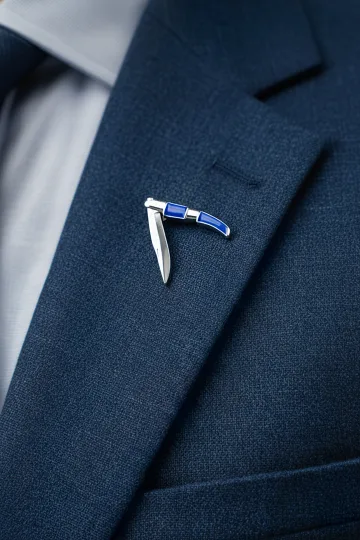
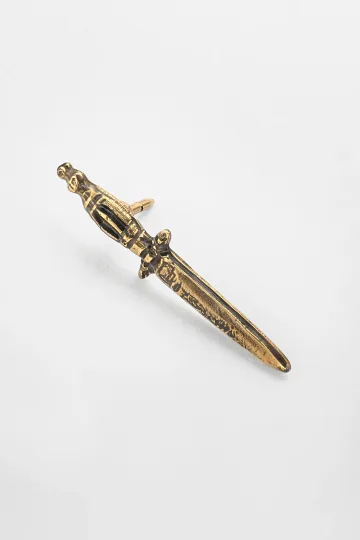
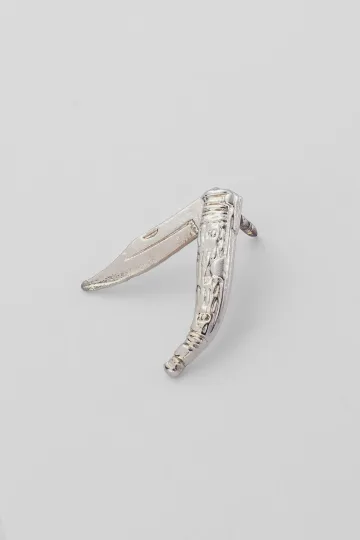
Wear the symbol, don't just read about it. These are in stock:





On titanium and niobium the oxide is transparent and very stable. It does not dull, does not peel, does not react with anything. It is essentially the metal's natural armour, which a person has simply grown thicker and more evenly than it builds up by itself.
Where the Colour Comes From If the Film Is Transparent
Here is the key point: the oxide film is colourless and transparent. The colour in it comes not from a substance but from light. When a ray hits a thin transparent film, part of it reflects off the top boundary of the film, and part passes through and reflects off the metal beneath it. These two reflected waves overlap. Where they match, the colour strengthens; where they cancel, it disappears. This is called interference of light.
The result depends on the path the light travelled inside the film, and therefore on its thickness. A thin film reinforces some wavelengths, a slightly thicker one reinforces others. The eye reads this as different colours. The same effect makes an oil slick on water or a soap bubble rainbow-coloured: there is no pigment there, yet there is colour.
Why Film Thickness Is the Colour
This is the whole point. The colour of anodised titanium is set by one thing only, the thickness of the oxide film, and by nothing else. And the thickness, in turn, is set by the voltage applied during anodising. The higher the voltage, the thicker the film and the further the colour moves along its scale.
That scale is strictly ordered, like a rainbow, and runs roughly like this: at low voltage you get golden and bronze, then purple and violet, then blue, then sky blue and turquoise, then greenish and silvery grey, and at still higher values the cycle partly repeats on a new round. The maker does not pick a paint, he picks the volts. Same solution, same metal, the only difference is the number on the power supply, and the output is a different colour. That is what makes anodising so precise and repeatable.
What Really Goes On in the Solution
If you look inside the process, the picture is this. The piece and a second electrode are lowered into a harmless electrolyte, most often a weak solution of soda ash, borax or another salt that conducts current but does not eat the metal. Voltage is applied, and a reaction starts on the titanium surface: atoms of the metal bond with oxygen from the solution, forming oxide. The film does not grow endlessly, but up to a limit set precisely by the voltage: the higher the voltage, the thicker the layer can grow before the process stalls. So it is enough to set the right number of volts and wait for the film to reach its thickness, and the colour fixes itself. There is no paint in the solution, and there cannot be: the colour is born afterwards, when light falls on the finished film.
Why the Result Repeats So Well
Unlike hand painting, where much depends on the hand and the coat, anodising is tied to a physical quantity, the voltage. Set the same volts, on the same metal, in the same solution, and you get the same colour. This makes the method predictable and reproducible: the shade is not "whatever comes out" but a value set by a number. Small deviations arise only from the shape of the piece and the cleanliness of the surface, but the base colour is dictated by the voltage, and it dictates it firmly.
Why the Colour Does Not Wear Off Like Paint
The most common question about coloured titanium: will it wear away over time, the way cheap plating flakes off? The answer comes down to what this colour actually is.
The Colour Is Not a Layer Over the Metal, It Is the Metal
Paint, lacquer, enamel and plating share one trait: they are a foreign material applied on top of the base. Between them and the metal there is a boundary, and along that boundary the coating can peel, chip or wear away. The thinner the layer and the worse the bond, the faster this happens.
On anodised titanium the boundary works differently. The oxide film is not a foreign material laid on top, it is the transformed surface of the metal itself. The top layer of titanium oxidised and became titanium oxide, which is physically a continuation of the metal beneath it. There is nothing to peel: the film does not sit on the surface, it is the surface. To remove the colour you would have to take off the metal layer itself, not separate a coating.
What "Nothing to Wear Off" Means
Paint is worn away by friction: tiny pigment particles tear off the surface. With an oxide film that cannot happen, because there is nothing to tear off, no separate pigment layer. The colour lasts exactly as long as the oxide layer stays intact. And that layer is, first, very hard, harder than the base metal, and second, simply does not break under minor contact. Light touches, sweat, water, the fabric of clothing, all of it is a matter of indifference to the film.
So anodised titanium does not fade in the sun, does not wash off in the shower and does not dull from sweat, unlike many coatings. That is its fundamental advantage over anything coloured on top.
Where This Toughness Has Its Limit
Honestly about the boundary: the colour is not made invulnerable. A deep scratch cuts the oxide film down to bare metal, and in that spot the interference vanishes and a grey metallic mark shows through. Heavy rubbing with an abrasive will, over time, grind the film away. So the colour cannot be worn off, but it can be cut through or sanded down. These are different things, and the second one we will discuss in the sections on drawbacks and care. The main thing: under normal wear, without sandpaper or striking a sharp corner against concrete, the colour lives for years.
Electric blue wants a black turtleneck and a bit of nerve. Keep it away from the beige cardigan, and don't argue.
How to Wear Coloured Titanium
Blue, violet and gold on titanium I sort into different scenarios, because they behave differently. Here is what I have tested on shoots and in life, short and to the point.
What do I wear coloured titanium with every day? For everyday I recommend hidden colour and narrow accents: a thin anodised band over grey titanium, a coloured stud in the ear or a small hoop. Blue and violet sit cleanly on black, grey, white and denim, with no clash of colours. One bright accent on a neutral background holds the gaze; a second one I would already drop.
Which shade should I choose for my skin undertone? For a cool, pinkish undertone I suggest blue, violet and turquoise: they pick up the coolness of the skin and ring true. A warm, golden undertone is closer to the gold and bronze of anodising, and among the cool shades a soft blue-green. If in doubt, take blue, it suits almost everything and almost everyone.
How do I pair coloured titanium with other metals? I keep the cool sheen in one cool family with silver, steel and grey titanium: peacock earrings next to a silver chain look in tune. With yellow gold the cool blue clashes, so there I choose golden or bronze anodised titanium, which lands in the same warm register as gold.
What do I wear for the evening? Evening allows some scale: a large coloured pendant with a peacock or electric-blue sheen, full-length earrings. A shimmering piece is dressy on its own, so I keep the rest of the look quiet to leave the shimmer the hero. The colour is alive, it shifts as you turn, and that beats any glitter.
Who does coloured titanium especially suit? People with allergies first: for skin that itches from silver or gilding, titanium and niobium give both colour and calm at once. Colour lovers who feel cramped in the silver-and-gold classic. And those who live actively: light, colour-tough titanium survives sport, work and travel, will not drag the lobe and will not rub off on a sleeve.

Turn on your camera, pick earrings, a pendant or a ring, and see the piece on yourself in real time.
Switch items in one tap.
Everything runs in your browser: no photo or video is ever uploaded.
Titanium and Niobium: How They Differ for Anodising
Both metals are coloured the same way and both give a rainbow out of volts. But in the details they part ways, and for jewellery that difference matters.
Why Both Metals Colour At All
Both titanium and niobium belong to the so-called valve metals: a dense, transparent, stable oxide film grows on their surface, and its thickness can be precisely regulated by voltage. Not every metal can do this; on most the oxide is loose, cloudy or fragile. On titanium and niobium it is exactly the kind needed for clean interference. That is why these two metals became the main characters of coloured anodising in jewellery.
Why Niobium's Colours Are Cleaner and Brighter
Niobium is considered the more rewarding material for colour. Its oxide film comes out especially even and transparent, and the metal beneath it is light and uniform. As a result the interference colours on niobium come out richer, cleaner and more predictable: deeper blue, brighter purple, sharper transitions. Titanium colours well too, but its shades are a touch more restrained and greyish, especially if the titanium is alloyed, that is, a blend with additives rather than the pure metal. For bright, almost precious-looking colours, makers more often reach for niobium.
Why Niobium Is Also More Hypoallergenic
Niobium is one of the most inert metals in jewelry. It barely reacts with the body, does not give off ions, contains no nickel and does not cause irritation even on very sensitive skin. For tolerability it stands alongside medical titanium, and some rate it even higher. So niobium is loved wherever the skin decides everything: in earrings for pierced ears, in body jewelry, in pieces for people with allergies. For more on why a reaction to metal happens at all, there is a separate piece on nickel allergy in jewelry.
When You Choose Titanium and When Niobium
In short: titanium is chosen when you need strength and lightness, a ring that will live a hard life, take knocks and not bend. Its structural merits are covered in detail in the guide to titanium in jewelry. Niobium is chosen when the main thing is color and tolerability: earrings, body jewelry, colored accents, pieces for people with allergies. Niobium is softer than titanium and not as strong structurally, but for color and comfort on the skin it is the champion. The two are often combined: a base of strong titanium with a colored detail of niobium.
Customer reviews
Zevira is a real jewellery shop. Genuine payments, deliveries and customer thank-yous.
🥰🥰🥰 gracias
Ok, ¡gracias! 🙂
What Palette Is Available and Which Colours You Cannot Get
Coloured titanium can do a great deal, but not everything. Understanding the limits of the palette is useful before buying, so you do not expect from the metal what it does not give.
What Falls Within the Anodising Rainbow
The available range is cool and metallically noble. As the voltage rises the metal passes through golden and bronze, through warm purple and violet, through rich royal blue, through sky blue and turquoise, through greenish and steely tones. The most striking results are the deep peacock blue-violet and the pure electric blue that anodised titanium became famous for. Gold and bronze are popular too: they give the look of a warm metal without a single gram of gold.
Why You Get Shimmers and Gradients
Since the colour is tied to film thickness, and thickness can be varied smoothly, on a single piece you really can get a fade from colour to colour. If the film builds up unevenly across the surface, you get a gradient: from blue to violet and on to gold, say. Makers use this on purpose, creating shimmers like those on a butterfly's wing or an oil film. Each such piece is a little unique, because repeating the transition by hand exactly is hard.
Where Nature Gets the Same Colours
It is curious that many of the most beautiful colours in living nature work exactly the way anodised titanium does, without any pigment. The blue of a morpho butterfly's wing, the shimmer of a peacock feather, the glint of fish scales and a beetle's shell are not paint but structural colour: microscopic layers on the surface bend light and produce interference. That is why anodised titanium feels so "natural" in the character of its colour: it works on the same principle as a butterfly wing, not on the principle of a can of paint. Hence the liveliness of the shade, which shifts a little as you turn it.
Why Red and Warm Saturated Colours Come Hard
Here is the main limitation. Pure red, orange, bright yellow are produced badly by interference on the oxide film, or not at all. The reason lies in the nature of the phenomenon: warm saturated colours sit in an awkward part of the scale, where the shades come out muddy, unstable and poorly repeatable. So bright-red anodised titanium is almost never seen, and if you do see it, it is most likely no longer interference but paint or some other coating on top. The strong side of the method is the cool half of the spectrum: blue, violet, green, turquoise, plus the warm metallics gold and bronze. Beyond that, the compromises begin.
Can You Get Black
A deep matte black cannot be reached by pure anodising either; interference by its nature gives colour, not a dead black. Dark, almost-black blue-grey shades are possible, but a truly saturated black on jewellery is usually achieved by other treatments, not by coloured anodising. If you specifically need a black metal, that is a separate story and a different method.
Upload a photo of your pet, someone you love, or an object. We'll build a 3D model and hand-cast it in pewter.



What Anodised Titanium and Niobium Are Good For
This material has its own strong scenarios, where it beats almost everything else, and it is useful to understand them when choosing.
Earrings and Body Jewellery
This is the home turf of coloured titanium and especially niobium. An earring, and even more so a body piece, is in constant contact with the skin, sometimes with the open wound of a fresh piercing. Tolerability is critical here, and anodised titanium and niobium provide it in full: no nickel, no irritation, no reaction. Plus a colour that does not come off and does not stain the lobe. For pierced ears and for body jewellery this is one of the most successful materials there is. On the different kinds of piercings and what to put in them, there are separate pieces in our journal.
Rings With Character
A coloured titanium ring is a way to wear bright colour on the finger without going into enamel or stones. Blue, violet, with a shimmer, such a ring looks unusual and at the same time is indestructible in wear thanks to the strength of titanium. Often rings are made where the body itself is natural grey titanium and a coloured anodised band or the inner side adds an accent. Hidden colour on the inside of a ring is a trick in its own right: calm grey metal outside, and inside a private blue or violet that only you see. For couples' and wedding rings this is a quiet way to add meaning without showing it off.
Pendants and Bracelets With a Cool Sheen
Anodised titanium is good in larger forms too. A pendant with a blue or peacock sheen catches light differently from a stone or enamel: the colour in it is alive, it shifts a little with the angle, because interference depends on how the ray falls. Bracelets and rigid bangles of light titanium do not drag on the wrist and still carry a colour that will not rub off from constant contact with a desk and a sleeve. Where a steel bracelet of the same size would feel heavy, a titanium one is almost weightless.
Coloured Accents in Jewellery
Anodised details work well as a spot of colour: a coloured inset, a bead, an element of a pendant, a contrasting detail in a combined piece. Since the colour is got by current, not by a stone or enamel, it is easy to match to the shade you had in mind. The cool blue or violet of anodised titanium gets along with silver and steel, giving a cool, technological palette in spirit.
Jewellery for People With Allergies
For people whose skin reacts to ordinary metals, anodised titanium and niobium are a rescue. There is no nickel in them, they barely give off ions, the oxide film is inert. You can wear a coloured piece all day without taking it off, without itching or redness. Anyone who has tried silver, steel and gilding and caught a reaction everywhere should take a close look at exactly this pair of metals.



Pros and Cons: An Honest Reckoning
There is no perfect material, and coloured titanium has both strong sides and weak ones. Let us lay them out.
Where It Is Genuinely Good
Hypoallergenic at the level of medical materials: no nickel, no irritation. Low weight: titanium is half as heavy as steel at comparable strength, niobium is light too, a large earring will not drag the lobe. Lasting colour that does not come off, does not fade in the sun and does not wash off in the shower, because it is the metal itself, not a coating. A rich cool palette and the possibility of shimmers that a plain metal will not give. And a separate plus for skin health: the absence of heavy coatings that could flake and touch the body in crumbs.
Where Its Weak Spots Are
The colour can be cut through with a deep scratch: at the spot of the cut down to metal the film breaks and grey shows through. The colour cannot be restored at home; that needs re-anodising on equipment, ordinary home polishing will not bring the colour back but will rather grind it off. The palette is limited to the cool part of the spectrum plus gold and bronze: there will be no pure red, orange or deep black. And one more thing: niobium is softer than titanium, so for rings that take a lot of knocks it suits worse than titanium itself.
How to Live With This
The drawbacks are not catastrophic if you understand the material. The color is vulnerable only to deep damage, not to ordinary wear, and with careful handling it lives for years. The palette is limited, but within its cool part it is rich and beautiful. And the impossibility of home repair is offset by the fact that the color is not really supposed to break under normal use, and if anything, it can be regrown by a specialist. Compared with steel, by the way, which has its own set of compromises, colored titanium wins where weight and tolerability matter. For more on the steel alternative there is a piece on stainless steel jewellery.
Caring for Coloured Titanium and Niobium
The good news: the care needed is minimal. The bad news: a couple of mistakes can ruin the colour forever. Let us sort out what you can and cannot do.
What You Absolutely Must Not Do
The main enemy is the abrasive. Any powders, gritty pastes, hard sponges, sandpaper, metal-polishing products, all of it grinds away the oxide film and kills the colour. What you clean ordinary silver with to a shine is poison for anodised titanium. You must not rub the piece with sand, baking soda, an abrasive sponge or tooth powder. Take off a layer of the film, lose the colour.
What to Protect It From
From deep scratches by sharp and hard objects. Do not keep a coloured titanium ring in one box, jumbled together with hard metal jewellery that will scratch it. Take it off for rough work involving stone, metal, tools. Light touches do not harm the film; what is dangerous is precisely deep cuts down to metal.
How to Clean It Right
It is all simple: warm water, a drop of mild soap, a soft cloth or a soft toothbrush for textured spots. Rinse, gently wipe dry with a soft cloth. No powders, no aggressive products, no abrasive. That is enough: the oxide film is chemically inert, dirt and skin oil wash off with soap and water, and the metal needs nothing more. Store it separately, in a soft pouch or a slot, so its neighbours in the box do not leave scratches.
Leave your email, we'll send your discount code. No spam, unsubscribe anytime.
The code arrives by email, valid on your first order.
Can You Recolor or Renew the Colour
One of the pleasant secrets of anodising: the colour on it is reversible and changeable. This is a rare property among coloured jewellery.
Why the Colour Can Be Regrown
Since the colour is the thickness of the oxide film, and the film can be grown or removed, the colour lends itself to remaking. The process is called re-anodising: the piece is cleaned, the old film is removed if needed, and a new one is grown by setting the right voltage. Want to turn blue into violet? Change the voltage, get a different colour on the same piece. The metal stays the same; only the thickness of the oxide changes.
What This Means in Practice
A scratched or dulled piece can be brought back to life by a specialist who does anodising, rather than thrown away. You can also change the colour to suit your mood, though on jewellery this is done less often than in engineering. But there is a boundary: this is work for equipment, you cannot do it at home. Still, the very fact that the colour is repairable and changeable sets anodised titanium apart from coatings that, once damaged, are only thrown out.
Why This Beats Paint and Plating
Flaked paint or worn plating usually cannot be restored; applying an even new layer on a finished piece is hard and expensive, easier to replace the thing. Anodising, by its nature, is repeatable: same metal, same process, same result. This makes coloured titanium a long-playing material rather than a single-use one.
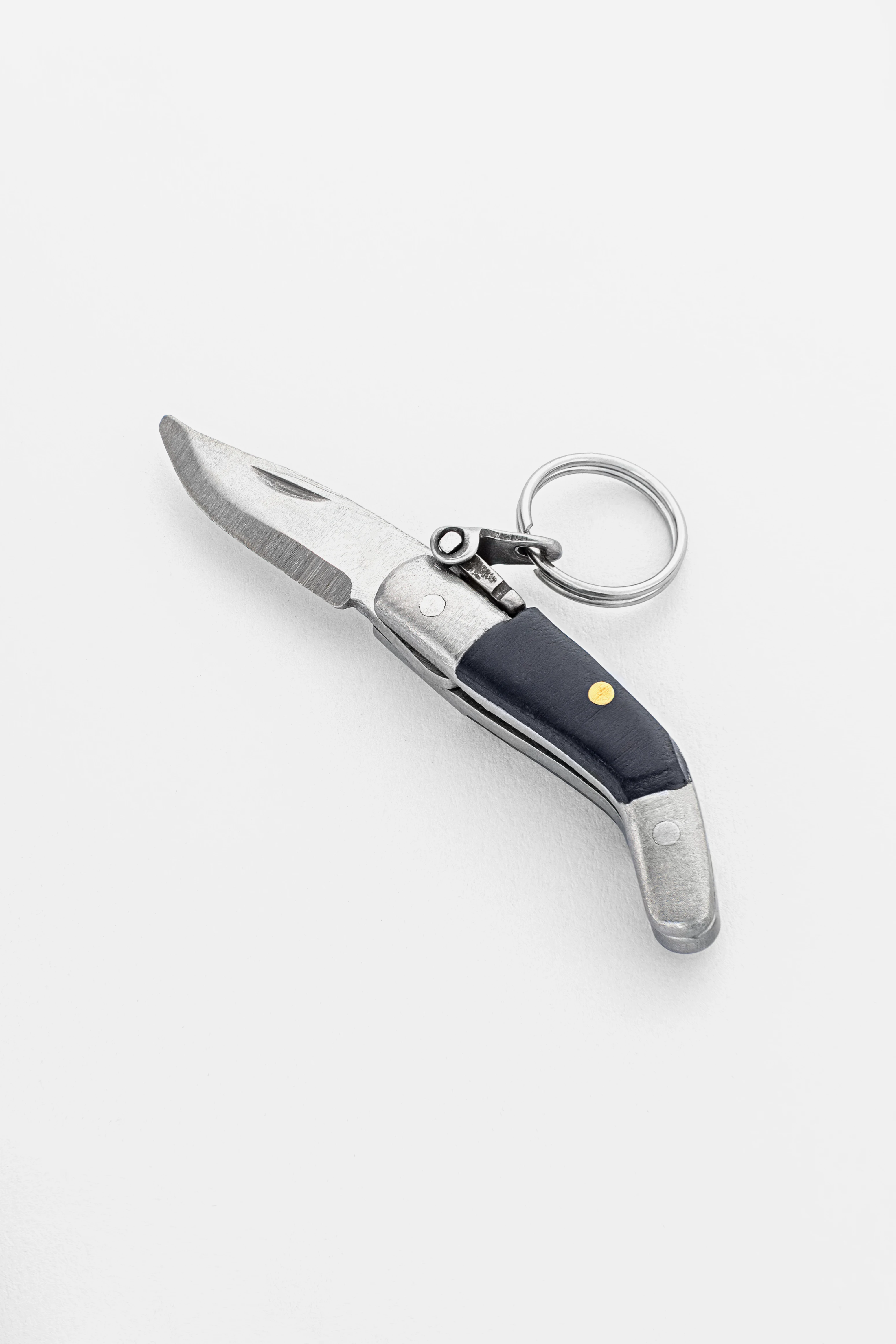
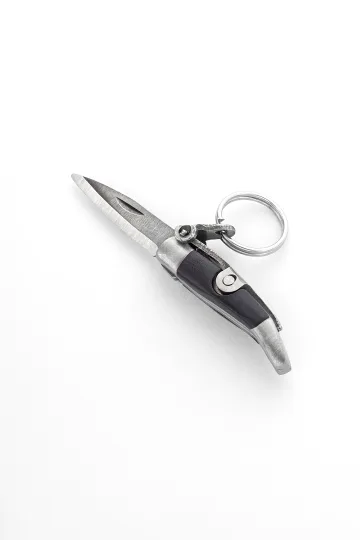
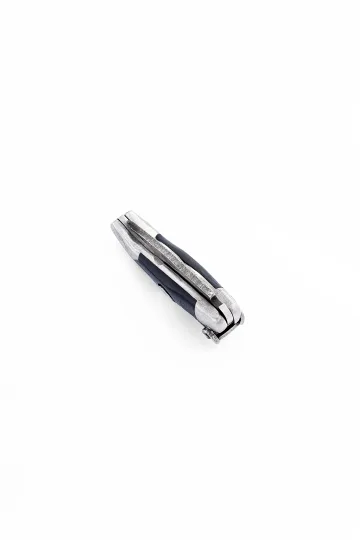
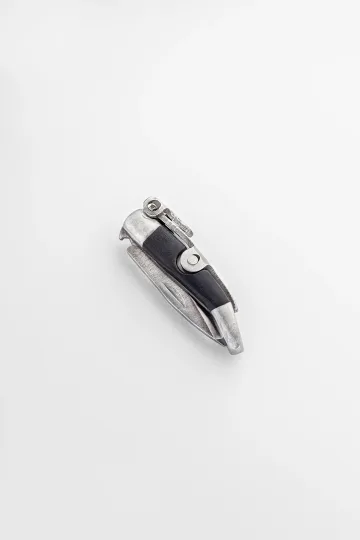
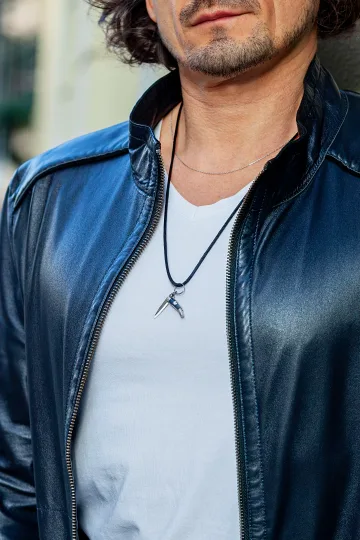
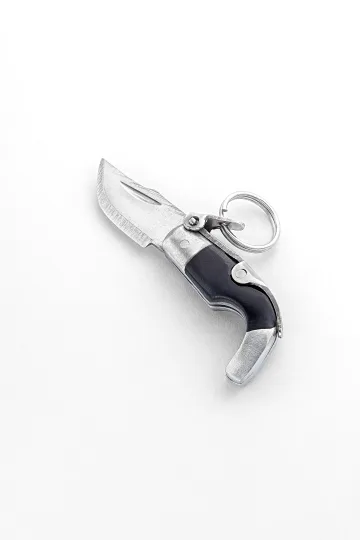
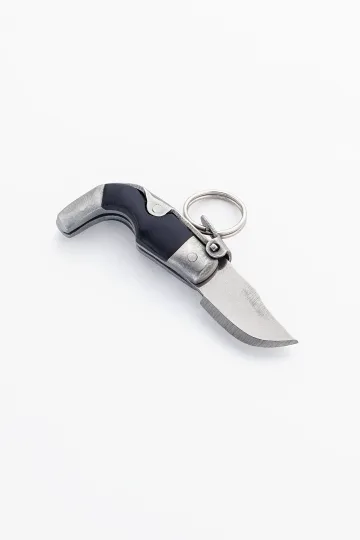
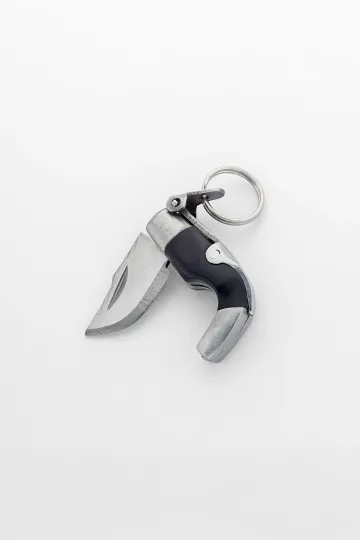
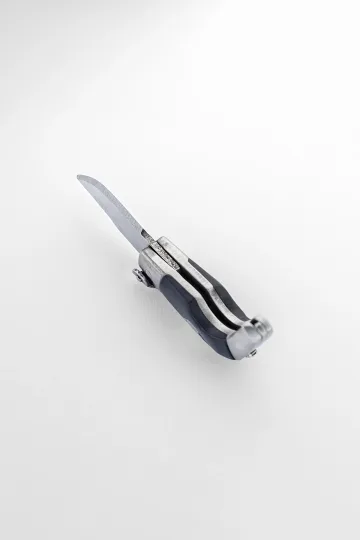
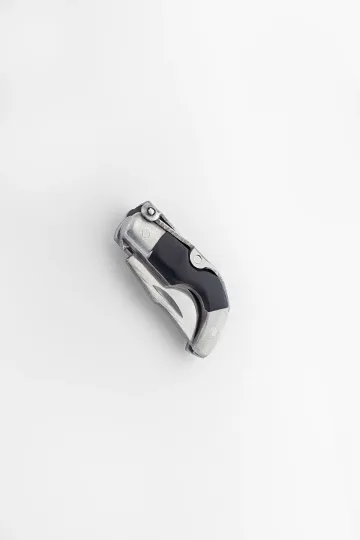
CAPAORA mini knife pendant
The 18th-century Spanish navaja in miniature: 40 mm of stainless steel, a real folding mechanism and a Palanquilla lock that clicks. An affordable gift to remember.
Authentic · Ships from Spain · 14-day returns
Anodising Versus Enamel, Plating and Paint
To understand the place of coloured titanium, it helps to compare it with other ways to add colour to jewellery. Each has its own nature and its own compromises.
Anodising Versus Enamel
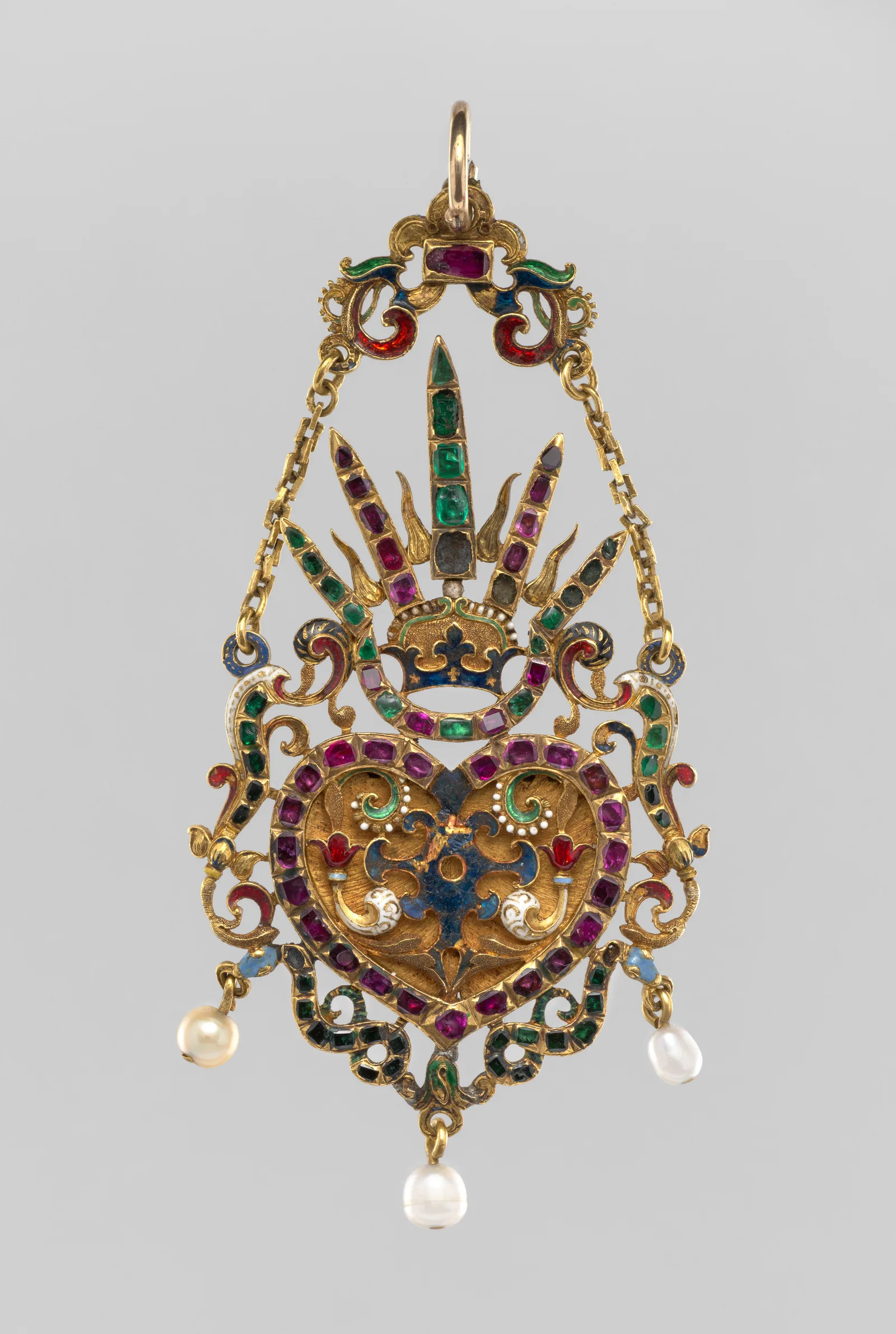
Enamel is glass fused to metal at high temperature, a separate material lying on the surface. It gives any colors, including bright red and black, which anodizing lacks, and a rich, deep surface. But enamel is a layer over the metal: it can chip on a knock, crack, fly off at the edge. Anodized color cannot chip, but its palette is cooler and narrower. Bluntly: want a bright warm color and an artistic pattern, that is enamel; want an indestructible cool sheen and maximum tolerability, that is anodizing. On the care of enamel and its weak spots there is a separate piece on enamel on jewelry.
Anodising Versus Plating
Plating, including the so-called PVD, is the deposition of an ultra-thin layer of another substance onto the surface in a vacuum. The layer is strong and handsome, but it is still a coating over the base, with a boundary along which it can wear away over time, especially on edges and ridges. Anodising does not apply colour but grows it out of the metal itself, so there is nothing there to wear away, only to cut through. Plating gives more colours, including black and warm ones; anodising gives a fundamentally non-fading but narrower-palette colour.
Anodising Versus Paint
Paint and lacquer are the simplest and least durable way. Pigment in a binder, applied on top, rubs off, scratches and fades fastest of all. On serious jewellery paint is almost never used precisely for this reason. Anodising here is beyond competition for durability: between a non-fading oxide colour and paint that will flake off in a season, the choice is obvious. Paint wins in one thing only: with it you can apply any colour and pattern cheaply, but the price will be a short life.
Anodising Versus Bluing and Blackening
Sometimes coloured titanium is compared with bluing and blackening, familiar from steel and silver. But this is something else: bluing gives a black-grey film, and blackened silver is metal darkened by reaction. Both methods are about a dark range, not about blue and violet. Anodising is about bright cool colour and shimmers. If you need a deep black, it is more logical to go for blackening or a special coating; if you need a coloured rainbow without coatings, go for anodising. They close different tasks and barely overlap.
When to Choose What
To sum it up briefly: enamel for bright colours and artistry with a risk of chips; plating for a wide palette with a risk of wear on edges; paint for cheapness with a short life; blackening for a dark range; anodising for non-fading cool colour and maximum skin tolerability. Coloured titanium has its own niche, and in it it has almost no rivals. Before buying, it is worth answering one question honestly: which matters more, breadth of palette or non-fading colour and comfort on the skin. The answer will point to the material.
Niobium, Medicine and Piercing
Niobium deserves a separate word in the context of the body, because it is here that it opens up most fully.
Why Niobium Is Allowed Near the Body
Niobium is chemically almost inactive. It does not corrode in the environments of the body, does not give off irritating ions, contains no nickel. For biocompatibility it stands next to titanium, and like titanium it is used in medicine, including where the metal sits next to tissue. For a piece of jewellery that spends all day on the skin, this inertness means a simple thing: the body simply does not notice it.
Niobium in a Fresh Piercing
A fresh piercing is essentially a small wound, and the metal in it must be as neutral as possible. Niobium suits this well: it does not interfere with healing and does not provoke a reaction. On top of that it can be anodised to colour without losing this neutrality, since the colour is the same inert oxide film. The result is a coloured piece for a fresh piercing, which is impossible for most other coloured materials.
Why This Combination Is Rare
Usually colour comes at the price of the skin's contact with a coating: paint, enamel, plating, each with its own chemistry. Anodised niobium breaks this trade-off: colour and tolerability go together, because the colour is the metal's own inert oxide. So in circles where piercing material is treated strictly, anodised niobium and implant-grade titanium are named among the safest options, alongside surgical steel.
Colour That Does Not Stain the Skin
One more quiet benefit: the oxide film gives nothing to the skin. Cheap coloured metals and some coatings, over time, leave a mark on the skin, green it or darken it, because they give off ions or crumble. Anodised titanium and niobium have nothing to give off; the colour is an inert oxide sitting firmly on the metal. Wear it all day, even in the heat, and the skin under the piece stays clean. For earrings that sit in the ears around the clock, this is a tangible convenience.
Send a friend a discount code, they save on their first order.
Facts That Surprise
A few stories and curious details that make anodising more interesting than dry physics.
Temper Colours: The Same Thing, Only by Fire
If you heat a clean steel or titanium part, it colours itself into a rainbow: straw, purple, blue, sky blue. These are the famous temper colours, which smiths and gunmakers have known for centuries. Their nature is exactly that of anodising: under heat a thin oxide film builds on the surface, and its thickness gives the interference colour. By the temper colour, masters judged the hardening temperature of a blade by eye. Anodising is essentially the same trick, only the film is grown not by heat but by current, and so the thickness, and therefore the colour, is controlled more precisely.
Anodising Comes From Aviation and Engineering
Coloured titanium in jewellery is a late guest, arriving from industry. The anodising of metals was developed for the protection and marking of parts in aviation, engineering, equipment: the coloured oxide both protects the surface and helps tell parts apart by colour. The rainbow titanium worn in the ears today comes from the same engineering tasks as aircraft skin. Jewellery here, as with titanium itself, borrowed the technology from engineers.
A Colour That Depends on One Number
There is an almost magical trait in this method for those used to paints: the colour here is not a can of pigment but a number of volts. Change the figure on the power source, get a different colour, on the same metal, in the same solution. The scale of colours is firmly tied to voltage, like notes to keys. An anodising master thinks not in a palette of paints but in a range of voltages, and that is an entirely different way of working with colour than a painter with a brush.
Each Piece Is a Little Its Own
Since the film thickness is hard to repeat perfectly on a complex shape, two "identical" coloured pieces almost always differ a little in shade and shimmer. For mass paint this would be a defect, but for anodised titanium it is a feature: each thing comes out slightly unique, with its own one-off colour transition, like a fingerprint.
Frequently Asked Questions
Is anodised titanium paint?
No. It is an ultra-thin transparent oxide film grown on the metal itself by an electric current. The colour in it is born from the interference of light, as on a soap bubble, not from pigment. There is no paint or plating on top.
Will the colour wear off over time?
Under normal wear, no. There is nothing to wear off: the colour is the oxidised layer of the metal itself, not a coating over it. It does not fade in the sun and does not wash off in the shower. The colour can be damaged only by a deep scratch down to metal or by an abrasive, but not by the friction of clothing or by water.
Why is niobium better than titanium for coloured jewellery?
Niobium's oxide film is more even and transparent, so the colours on it are cleaner and brighter, especially blue and violet. It is even more inert and is tolerated by the skin even better than titanium. The downside: niobium is softer, so for strong rings titanium is more reliable.
Can you get red or black anodised titanium?
Pure red and saturated black are almost unattainable by anodising: interference gives the cool part of the spectrum well (blue, violet, green, turquoise) plus gold and bronze. If you see a bright-red "titanium," it is most likely paint or another coating, not an interference colour.
Is such jewellery suitable for people with allergies?
Yes, it is one of the best solutions. There is no nickel in titanium and niobium, they barely give off ions, the oxide film is inert. Skin that reacts to silver, steel or gilding usually does not answer anodised titanium and niobium with irritation.
How do you care for coloured titanium?
Warm water, a drop of mild soap, a soft cloth or brush, wipe dry. No abrasives, powders or metal-polishing pastes: they grind down the film and kill the colour. Store it separately, so that hard neighbours in the box do not scratch it.
Can the colour be restored or changed if it is damaged?
Yes, through re-anodising by a specialist: the old film is removed if needed and a new one of the right voltage is grown. This way the colour can be both restored and changed. You cannot do it at home, equipment is needed, but the colour itself is repairable, unlike flaked paint.
Is coloured titanium safe for piercing and a fresh wound?
Anodised niobium and implant-grade titanium are considered among the safest materials for piercings, including fresh ones, alongside surgical steel. The colour on them is an inert oxide; it does not interfere with healing and gives off nothing irritating into the wound.
In Short
The colour of anodised titanium and niobium is not paint, not lacquer and not plating, but a thin transparent oxide film grown by current right on the metal. The colour in it is born by the interference of light, and its shade is set by one thing only, the voltage: the more volts, the thicker the film and the further the colour along the scale from gold to violet, blue and green. There is nothing to wear off in such a colour, it is the metal itself, so it does not fade and does not wash off, though it does fear a deep scratch or an abrasive. Niobium gives cleaner colours and is tolerated by the skin even more gently than titanium, while titanium is stronger for rings. The palette is cool and noble, with almost no red or black, but the blue and violet come out as no coating will give. Hypoallergenic, light, repairable through re-anodising, ideal for earrings, body jewellery and coloured accents. The physics of a soap bubble, put to the service of jewellery.
Steel, titanium, silver, coloured accents, symbolism, matching sets.
Buying it as a gift? Each one arrives ready to give.
 A branded Zevira box and a little card come with every order.




About Zevira
Zevira is a Spanish brand from Albacete, a city of metalworkers. We love things with character: strong metals, living color, clean forms and tolerability for the most temperamental skin. If you are choosing between metals, start with the guide to titanium in jewelry, and on the skin's reaction everything is told by the piece on nickel allergy.