Niello: Deliberate Black Decoration, Not Damage
The black drawing on antique silver is not dirt and not tarnish. It is a fused alloy that craftsmen cooked from silver, copper, lead and sulphur thousands of years ago, poured into cut grooves and set with fire. Niello does not fade and does not wipe off with a cloth. It holds for centuries because it is part of the metal, not a film on top of it.
This craft carries dozens of names across the world. The Romans called it nigellum, from the word for black, which gave Italian niello and the wider European term. In Georgia and the Caucasus it belongs to the world of weapons and silverwork; in Thailand it is called nielloware. Everywhere the idea is the same: silver draws with light, niello draws with shadow, and the contrast between them carries the whole pattern.
This article covers what niello is cooked from, how it is laid into metal, where it began and how far it travelled, how it differs from ordinary silver tarnish and from black rhodium, and how to care for a piece so you never accidentally rub off a drawing that has outlived several generations.
What niello is and what it is made from
Niello is an alloy, not a paint or a lacquer
Niello is a hard black alloy based on metal sulphides. In plain terms, the maker takes silver, copper and lead and melts them together with sulphur. The sulphur bonds with the metals into sulphides, and the result is a brittle black mass with a deep graphite sheen. This mass is ground to powder, packed into a pattern cut into the metal and heated again until the niello melts and grips the surface for good.
The key difference from any paint, enamel or black coating is that niello fuses with the base at the level of the metal itself. It is not a layer on top but an inlay melted into the piece. That is why you cannot chip it with a fingernail or dissolve it in soapy water like a coating. The only way to remove it is mechanically, by filing it away together with the top layer of silver.
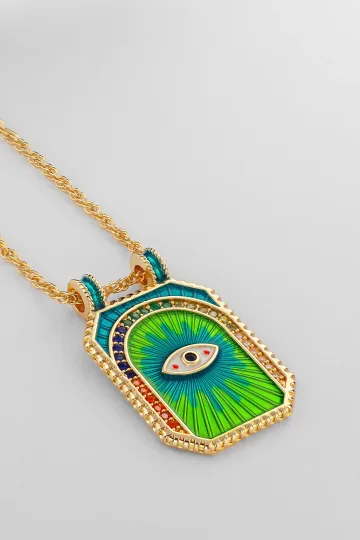
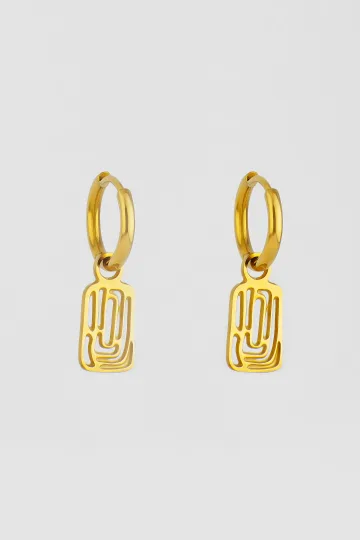
Wear the symbol, don't just read about it. These are in stock:






The classic recipe: silver, copper, lead, sulphur
The most famous recipe for niello was written down early in the sixteenth century by the Florentine goldsmith and sculptor Benvenuto Cellini. In his version, one part silver went with two parts copper and three parts lead, all melted with an excess of sulphur. Every school keeps its own exact proportions: by changing the share of silver, copper and lead, the maker controls how deep the black will be, how durable it is and at what temperature it flows.
Silver in the mix gives adhesion to the silver base. Copper makes the alloy a touch harder and darker. Lead lowers the melting point so the niello flows before the piece itself starts to soften and fills the finest lines. Sulphur binds it all into sulphides, which give that velvety black colour.
Why niello is black
The colour comes from the chemistry of sulphur. Silver sulphide, copper sulphide and lead sulphide are dark on their own, from steel grey to blue black. In the alloy they give an even, slightly warm black with a faint metallic glow, neither flat like soot nor mirror bright like blued steel. That depth is what separates real niello from flat black enamel or paint: niello seems to glow from within, because the structure of the metal shows through the polish.
How niello differs from black enamel
Enamel is glass. It is cooked from quartz sand with oxide additives, laid on metal and fired until the glass flows and sets as a coloured layer. Enamel can be any colour, it shines like glass and it chips like glass under a knock. Niello is a metal alloy: it is matte and deep, it does not shine like a mirror and it does not splinter, it wears down like a soft metal. There is a separate breakdown of glass on metal and how to look after it in the piece on enamel jewellery care; here we are talking about the alloy.
How niello is applied: engraving, filling, firing, polishing
Step one: engraving the pattern
First the pattern is cut into the smooth silver or gold surface. With a graver, a sharp steel chisel, the maker cuts grooves of the chosen design into the metal: lines, outlines, hatching, background. Depth matters: a groove too shallow will not hold the niello, one too deep weakens the piece. In effect the jeweller draws the negative of the future image, removing metal wherever the black will later sit. How metal is cut and what can be carved into a piece at all is covered in detail in the guide to jewellery engraving.
Step two: filling with niello
The finished alloy is ground to a fine powder and mixed with a flux, often borax, so the niello flows better and does not oxidise under heat. This damp paste is packed firmly into all the cut grooves, like filler. The excess is scraped away, with care that the powder lies evenly and without gaps, otherwise the firing will leave cavities in the design.
Step three: firing and fusing
The piece is heated until the niello melts. The melting point of niello is lower than that of silver, so the alloy flows while the base stays whole. The molten niello fills the grooves to the very bottom and grips the walls of the metal. This is the most demanding moment: overheat it and the niello burns out and blisters, underheat it and it will not bond and later crumbles away. The maker's experience counts for more here than any instrument.
Step four: grinding and polishing
After it cools, the piece is ground. The excess niello that stands above the surface is filed and sanded flush with the metal. Bit by bit the drawing emerges from under the abrasive: black lines sit in the grooves level with the silver, while the silver between them is polished to a shine. The final polish creates the very effect the whole thing was for: glossy bright silver and a matte, deep black pattern in one plane, smooth to the touch, with no step between them.
The tools of the niello workshop
Behind the spare technology sits a set of tools that has barely changed over the centuries. The chief one is the graver, a steel chisel sharpened for the line it has to cut: one cuts a fine outline, another clears a broad background, a third lays down hatching. Beside it sit a crucible for melting the alloy, a mortar for grinding the niello to powder, a spatula for packing the grooves, a torch or furnace for firing and a range of abrasives for the final grind, from coarse stone to soft paste. The maker works under good side light, to see how each line falls and whether any gaps remain in the fill. This modest kit and hands trained over years give a result that no machine repeats.
Why niello is made with sulphur in particular
Sulphur here is not a chance additive but the heart of the whole technology. Only compounds of sulphur with metals, the sulphides, give that deep dark colour that does not burn off in light or fade over time like paint. On top of that, sulphides melt at a moderate temperature, lower than pure silver, so the niello has time to flow through the grooves before the base is harmed. Swap the sulphur for something else and you lose either the colour or the alloy's ability to flow and bond. Thousands of years of trial led makers to one and the same solution, and it still holds.
Why it is hard and valuable
This technology gives no room for a string of small mistakes. The graver slips, the hand shakes while packing the powder, the torch heats unevenly, the polish runs too long, and the work is ruined. Niello does not forgive haste, and every piece passes through human hands from the first line to the last polish. That is why good niello has always cost more than plain silver, and why mass production could never properly fake it for centuries.
Blackened silver wants a dark shirt and cold light. Keep it away from a tan and yellow gold, or the whole pattern goes to ash.
How to wear blackened silver
Over years on shoots, niello has passed through strict suits, ethnic looks and vintage with me. Here is what really works, sorted by occasion and by piece.
What do I wear niello with every day? For daily wear I recommend a signet ring or a thin band with a niello pattern under a plain top in a deep tone: graphite, navy, black. Against that ground the light silver flares while the black drawing holds a crisp edge. Busy and acid prints I would set aside, they drown out the fine black line.
Is niello right for the office? Yes, as long as you keep it restrained. Under a shirt and jacket I choose cufflinks or a signet: the black and silver range reads as a strict detail, not a loud accent. A long chain with a large locket I would not suggest for work, save that for a look with a story.
Which style does niello play with best? I recommend three directions. A strict wardrobe, where the black and silver pattern sits under a suit as if it belongs. An ethnic and Caucasian look, where the winding Kubachi ornament gets along with textured wool, leather and dense fabrics. And vintage, where Ustyug scenes and monograms support tweed, heavy knit and an outfit that nods to the old days.
How do I pair niello with other jewellery? I suggest not loading it with neighbours: niello is already a ready contrast within one piece. Smooth or matte silver of the same cool tone works best beside it, while white stones and pearls pick up the light part of the pattern. With yellow gold I mix carefully, one accent piece rather than a whole set, or warm and cool metal start to argue.
Who does blackened silver actually suit? Anyone who likes pieces with a story and character over a shiny pile. By skin tone niello especially flatters cool and neutral undertones, where the silver looks fresh. It suits warm skin too, as long as there is no yellow gold nearby. And a rule that never fails: one expressive niello piece on a look beats three that talk over each other.

Turn on your camera, pick earrings, a pendant or a ring, and see the piece on yourself in real time.
Switch items in one tap.
Everything runs in your browser: no photo or video is ever uploaded.
A history of niello: from Egypt to Siam
Ancient Egypt and the classical world
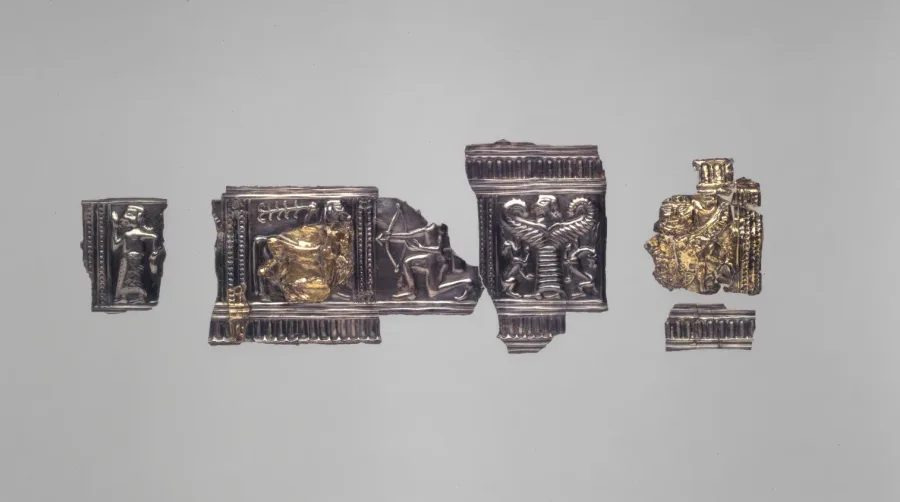
Craftsmen made black patterns in metal as far back as the Bronze Age. Finds with dark inlays appear in Egyptian and Mycenaean work of the second millennium BC, though the early examples are not always pure niello in the later sense: the black mass was then produced in various ways. The idea was always the same: to strengthen the drawing by filling cut lines with a dark alloy, so that gold and silver played off the contrast. Even then people grasped a simple thing: shiny metal holds a fine drawing poorly on its own, while a black line on it reads from across the room.
Rome and the rise of the technique
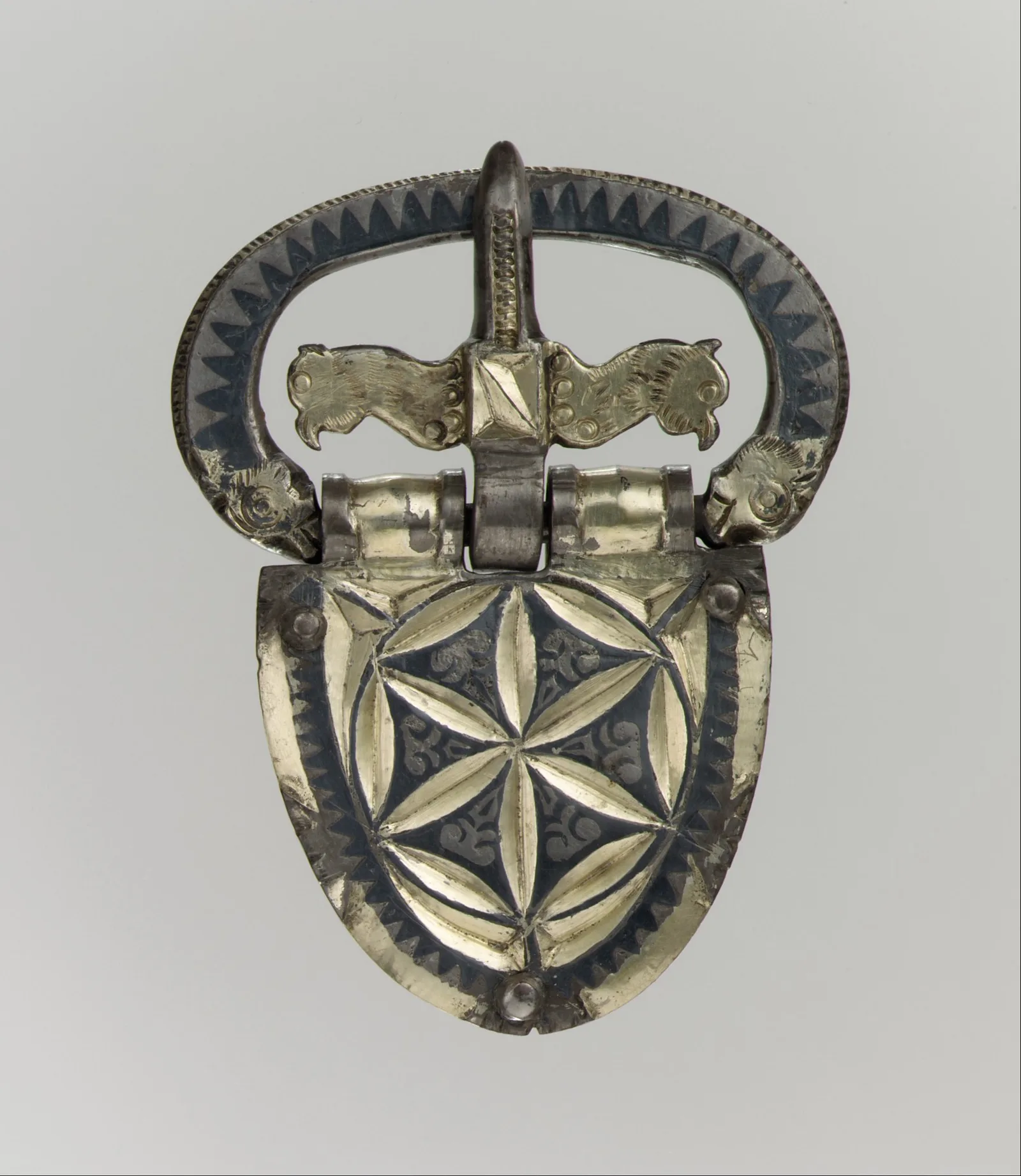
The Romans turned niello into a confident craft. They used it on silver tableware, belt fittings, hilts and signet rings. From the Latin nigellum, blackish, the word niello itself descends. Roman makers already worked silver with a cut design and a sulphide alloy fill, that is, they applied the same principle used a thousand years later. Through the Roman provinces the technique spread across Europe and settled wherever there was silver and a taste for luxury.
Byzantium: niello as an imperial style
Byzantium turned niello into a court art. It went onto icon covers, crosses, rings, belt plates and ceremonial vessels. Byzantine taste loved a dense black ground, against which figures of saints, inscriptions and ornament stood out in gold and silver. From there niello, like much in Christian art, reached the Slavic lands together with the faith, the books and the makers.
Kievan Rus and blackened silver
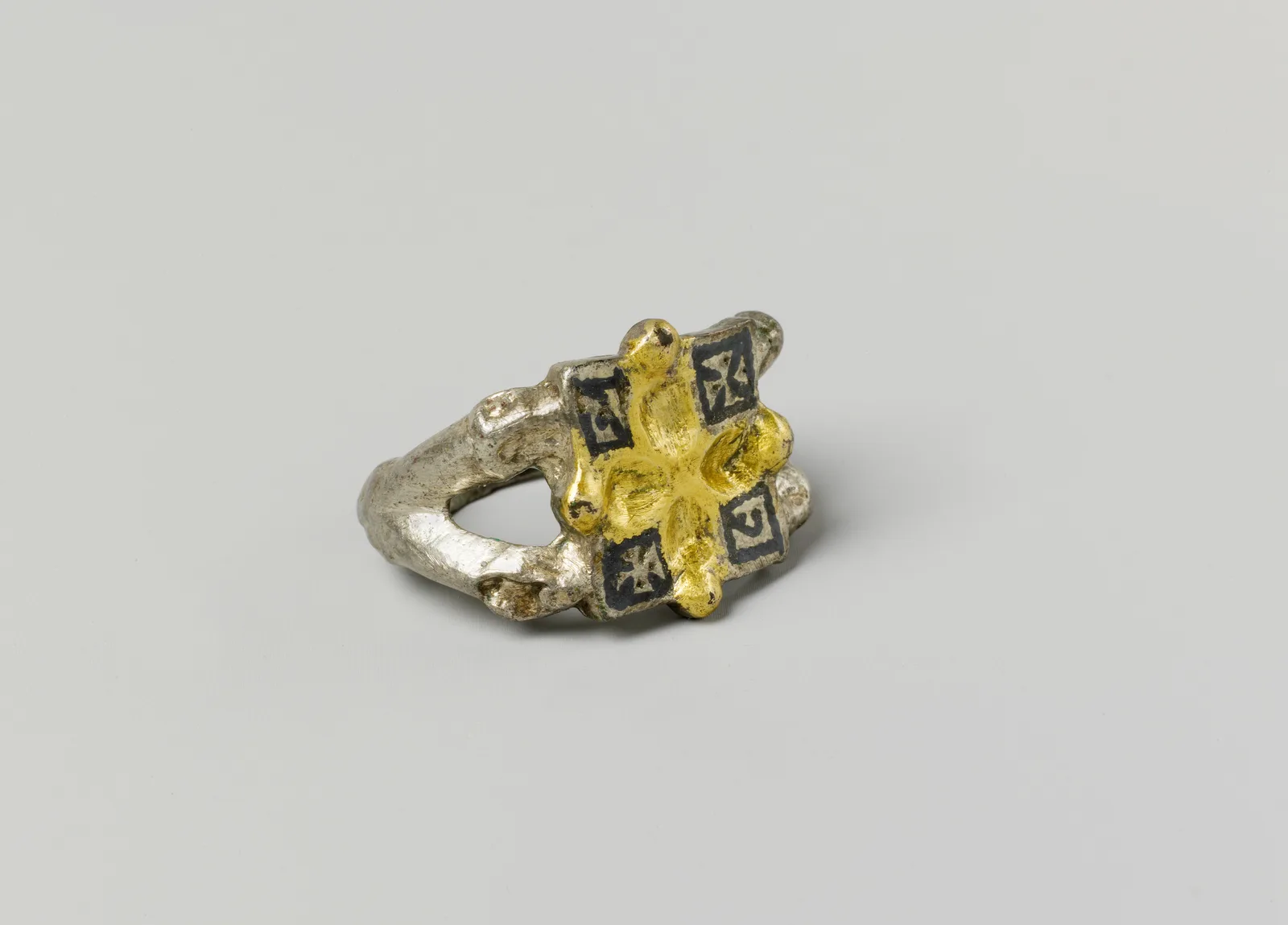
In medieval Rus niello took root early and became local. Already in pre-Mongol times the makers of Kiev and Vladimir produced niello temple pendants, hinged cuff bracelets, rings and pendants. On the silver hinged bracelets of the twelfth and thirteenth centuries whole scenes stood out against a black ground: musicians with gusli, dancers, birds, fantastic beasts, the interlace of plant ornament. Niello let people tell whole stories in metal, and for a princely household this was what a miniature was for a book. The silver here holds the light, and the niello holds the story.
The northern niello of Veliky Ustyug
In Russia classic niello is tied above all to Veliky Ustyug. From the eighteenth century a distinct craft took shape here, the northern niello, with its own recognisable hand: silver snuffboxes, caskets, flasks, cups and jewellery carrying a fine niello drawing. The Ustyug makers became known for view scenes, town panoramas, coats of arms, hunting scenes and floral garlands. The craft did not die out in the Soviet period either: Ustyug niello was produced as art silver and prized at exhibitions. This is a rare case where an ancient technique survived as a living school rather than a museum memory.
The Caucasus: Kubachi and Caucasian niello
In the mountain Dagestan village of Kubachi, niello on silver belongs to the male world of weapons and ornament. For centuries Kubachi makers covered daggers, cartridge holders, belts, bracelets and rings with niello pattern. Their ornament is recognised at once: a winding plant motif, dense and flowing, which the locals name by their own terms for the design. Alongside niello the Kubachi masters command engraving and inlay with virtuosity, and often several techniques meet in a single piece. Caucasian niello on weapons and silver was long the benchmark of fine work across the whole region.
Tula: niello and weapon silver
Tula, the famous arms capital, gave its own school of niello on silver and steel. Tula makers decorated hilts, snuffboxes and vessels with niello, playing on the contrast of polished metal and black ornament. The local tradition wove tightly into the weapons trade, where a dark pattern on a light ground was both a beauty and a way to shield the metal from corrosion in places hands did not touch.
Thailand: nielloware from Nakhon Si Thammarat
Siam grew a strong school of niello of its own. In the city of Nakhon Si Thammarat in the south of Thailand a craft took shape that the locals call nielloware, from the same Latin root. Thai niello is usually very dense: black fills almost the entire ground, leaving the pattern itself in silver, so the piece looks like black and silver graphics. It decorated cigarette cases, caskets, belts, bowls and tableware. Thai niello became a recognisable souvenir and an export article without losing its handmade quality.
Customer reviews
Zevira is a real jewellery shop. Genuine payments, deliveries and customer thank-yous.
🥰🥰🥰 gracias

Ok, ¡gracias! 🙂

How niello differs from silver tarnish
Tarnish is the chemistry of air, niello is the work of a maker
Here is the section many people came for. Silver darkens of its own accord over time: in air it reacts with sulphur compounds and grows a thin film of silver sulphide, the same one that turns a shiny spoon dull and greyish yellow. That is tarnish, and it is unwanted. There is a separate article on why metal darkens and how to bring back the shine, on why a piece has gone dark. Niello, by contrast, is a sulphide alloy that the maker deliberately cooked, cut a pattern for and fused into the metal. One happens to silver, the other is done to silver.
How to tell them apart by eye
Tarnish lies as a continuous film over the whole surface, with no pattern, and sits heaviest in recesses and hard to reach spots. Niello sits only in the lines of the drawing, exactly level with the polished silver, and forms a clear pattern. If the darkness covers the whole piece evenly and is worst where the metal is touched least, that is tarnish. If the darkness gathers into an ornament, a scene or an inscription with sharp edges, while the silver between the lines shines, that is niello.
Why tarnish rubs off and niello does not
The film of tarnish is thin, a fraction of a micron, and holds weakly. A silver cloth, a paste, ultrasound or even a simple clean takes it off. Niello sits in the grooves to their full depth and is fused with the metal, so ordinary cleaning does not threaten it. What is more, on a niello piece the light silver around the drawing can itself tarnish, and then a polish returns the shine to the silver without touching the black pattern. So a single piece can carry both wanted niello and unwanted tarnish at once, and each needs different care.
Sterling silver as a base for both niello and tarnish
Niello is most often made on sterling silver: it is clean enough for a fine shine and strong enough to hold the cut. That same sterling silver also tarnishes in air because of the alloying copper in it. So one and the same metal serves both as the canvas for the maker and as the reason for tarnish. What the 925 mark means and why it became the standard is covered in the guide to sterling silver 925.
Upload a photo of your pet, someone you love, or an object. We'll build a 3D model and hand-cast it in pewter.




How niello differs from oxidising and black rhodium
Oxidising: fast darkening with a special solution
Oxidising, or artificial patination, is when silver is deliberately darkened with chemistry, usually a solution of liver of sulphur. The surface blackens in minutes, the maker rubs off the excess, leaving the dark in the recesses of the design, and gets a contrast. It looks like niello, but in essence it is the same sulphide film as in tarnish, only induced on purpose. It is thinner and weaker than real niello and can partly wear off the raised areas over time through friction. Oxidising is cheaper and faster, so it is often used to imitate the niello effect in inexpensive pieces.
Black rhodium: an electroplated coating
Black rhodium is a quite different story, electroplating. The piece is dipped in a solution and a current deposits on it a very thin layer of rhodium, a platinum group metal, with a dark tint. The result is an even black or anthracite coating over the whole surface, with no drawing in the metal at all. Black rhodium is handsome and fashionable, but it is a layer on top, and on heavily worn spots it rubs off, after which the coating has to be renewed. Light rhodium, by contrast, is given to white gold for a cool shine: rhodium plating and metal tones are covered in detail in the guide to white, yellow and red gold.
The main difference in one sentence
Niello is an alloy fused into a cut groove to its full depth, forever. Oxidising is a dark film induced by chemistry on the surface. Black rhodium is a layer of metal laid by current over the piece. The first holds for centuries and sits in the drawing; the second and third lie as a continuous layer and need renewing in time. In price and durability, real niello stands apart.


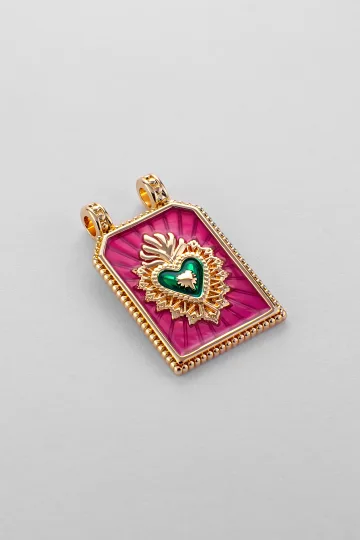



Patterns and subjects of niello silver
Plant ornament
The most common niello motif is winding shoots, leaves, flowers and interlace. Plant ornament is good because it fills any form, running around the band of a bracelet or the rim of a cup with no beginning and no end. The Kubachi tutta and the Ustyug floral garlands are different dialects of one language: a fine black weave on light silver. Such ornament does not date and sits well on old vessels and on a modern ring alike.
Narrative scenes
Niello can tell a story. On the old Rus cuff bracelets whole compositions were laid out in black: musicians, dancers, hunters, fantastic beasts. The Ustyug makers loved view subjects, town panoramas, hunting and battle scenes. Here niello works like an engraving in metal: fine hatching gives half tones, dense fill gives shadow, and an almost graphic drawing with depth emerges on the silver.
Monograms, inscriptions and coats of arms
Niello is ideal for letters. A black letter on a light field reads sharply and lasts forever, so monograms, dedications, mottoes and arms were made in niello. On snuffboxes and cigarette cases the owner's monogram, filled with niello, was both decoration and signature. This tradition chimes with modern engraving on gifts: a dark inscription on silver looks stricter and richer than plain carving.
Why contrast works on a dark pattern
The human eye catches the border of light and shadow more strongly than colour itself. Bright polished silver throws glints and loses fine relief: on a clean shiny surface a thin drawing simply drowns in reflections. A black line kills those reflections and gives an even, readable outline under any light. That is why niello was used for centuries for exactly the things that had to read from a distance and not get lost in the shine: scenes, inscriptions, arms. The contrast of silver and niello is, in essence, a way to make metal hold a drawing as crisply as paper holds it.
Geometry and background grids
Sometimes niello fills not the drawing but the background. Then the silver pattern stays light, while everything around it goes black, as in Thai nielloware. Geometric grids, diamonds, scale patterns and interlace create a dense dark carpet on which the light elements seem raised, though the surface is smooth. It is a play of positive and negative, where the eye decides for itself what is drawing and what is ground.
What niello is made on: silver and gold
Silver as the main material
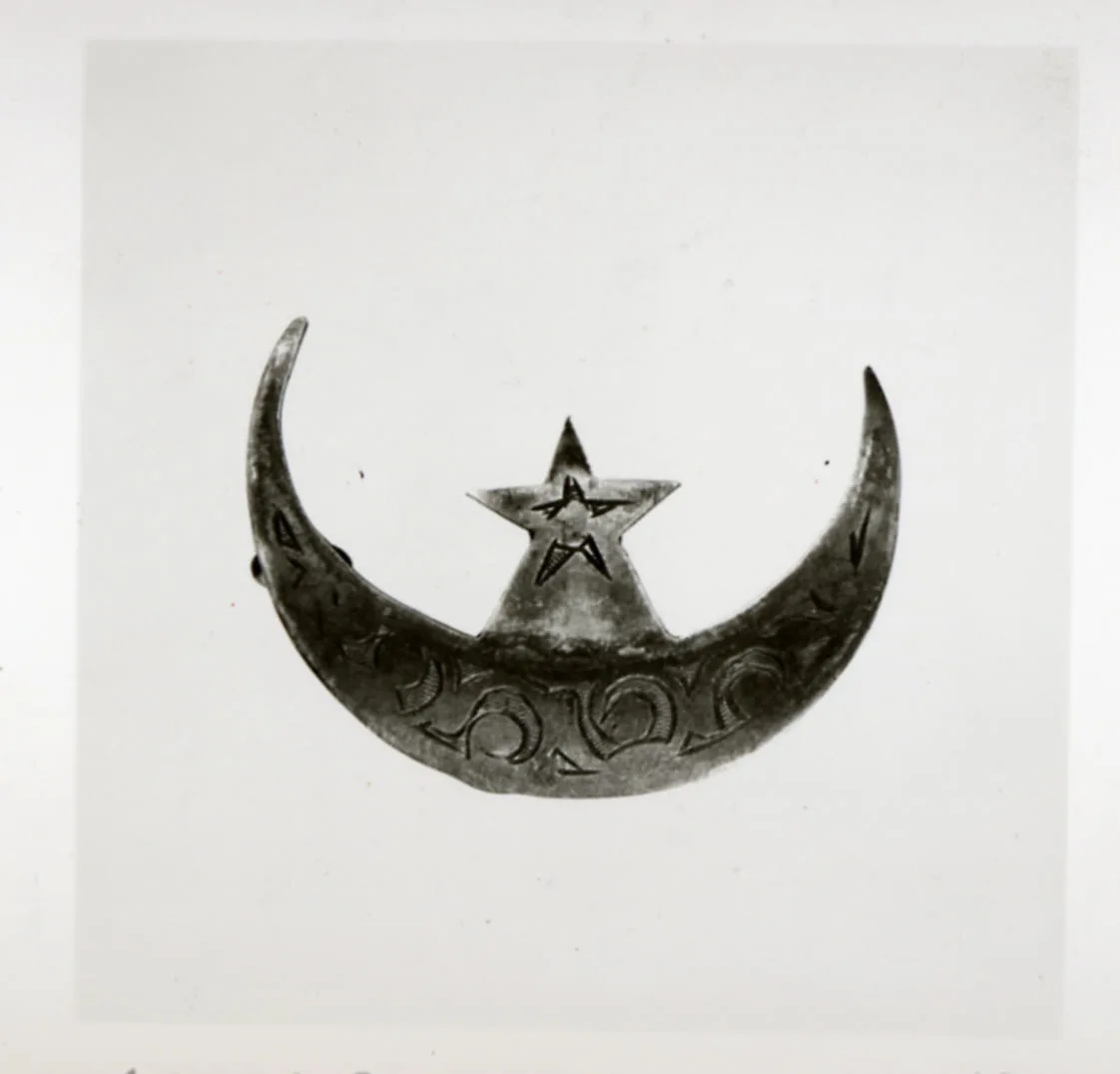
Silver is the native base for niello. The light shiny metal gives maximum contrast with the black alloy, and its softness is convenient for cutting with a graver. Niello on silver is the classic of every school, from Kiev to Thailand. Sterling silver, in this sense, is the happy medium: clean enough for beauty, strong enough for fine work and long wear.
Gold and niello
Niello is laid on gold too, though more rarely. The contrast there is different, warm: a black pattern on yellow gold looks richer and more archaic, as on old rings and icon covers. Technically niello on gold is harder: the alloy has to be chosen so it bonds with the gold base and does not harm it under heat. Because of the cost of the metal, such pieces were always one off and ceremonial.
Steel and weapons
In the weapons tradition a black pattern was made on steel too, but there it is more often not classic niello but related techniques: bluing, gold and silver inlay on a dark ground, blackening of steel. The line between niello on silver and dark decoration on steel is fluid in the weapons schools, and often silver niello on the mounts meets the dark steel of the blade in one piece. A kindred world of dark metal with gold and silver inlay is the Spanish Toledo damascene, close in spirit but different in technology.
Six fast checks, no tools. Leave your email, we'll send the PDF and a discount code.
No spam, unsubscribe anytime.
Durability and care: can niello be rubbed off
Can niello be rubbed off
In normal wear, no. Niello sits in the grooves to their full depth and is fused with the metal, so it does not fear water, sweat, soap or ordinary cleaning. The only way to remove it is rough mechanics: hard polishing with an abrasive paste, sandpaper, aggressive grinding. So unless you deliberately try to polish the black drawing to a shine, it will outlive its owner.
Do not confuse niello with patina and tarnish
A niello piece can carry three dark layers at once, and it matters not to mix them up. Niello is the drawing; it must not be touched. Tarnish is the grey film on the light silver around the drawing; it can and should be removed. Patina is a light, noble darkening that many collectors actually preserve, because it gives an old piece depth. Before cleaning it is worth working out what is in front of you: removing tarnish, it is easy to scrape off, out of ignorance, the patina that gave the piece its character.
How to clean without removing niello
The main rule: gently and locally. The light silver between the niello lines is brought back to a shine with a soft silver cloth or a delicate paste applied with a finger, without heavy pressure on the drawing itself. No hard brushes, abrasive powders or long machine polishing over the black. A heavily soiled piece is washed in warm water with a drop of mild soap and a soft brush, then blotted dry. If the piece is old or valuable, it is better not to experiment at home but to take it to a restorer.
What to avoid
Niello dislikes three things: strong abrasive, aggressive chemistry and impact. Abrasive grinds the drawing away. Harsh chemistry can eat at the sulphide alloy faster than the silver. A knock on brittle niello can crumble it out of the groove, especially if the fill had gaps to begin with. Ultrasound is also questionable for fine old niello: better to spare the piece than to risk vibration on a brittle alloy.
How to store blackened silver
Store it like any silver, but with allowance for the value of the drawing: separately, so that hard stones and steel clasps of neighbouring pieces do not scratch the surface, in a dry place, ideally in a soft cloth pouch or with anti tarnish paper. The less the silver around the niello tarnishes, the less often you will have to clean it, and so the fewer chances to catch the pattern itself by accident.
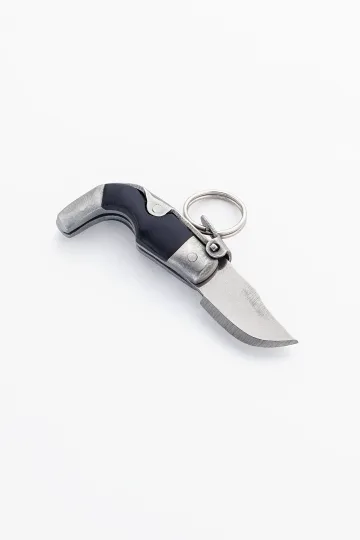
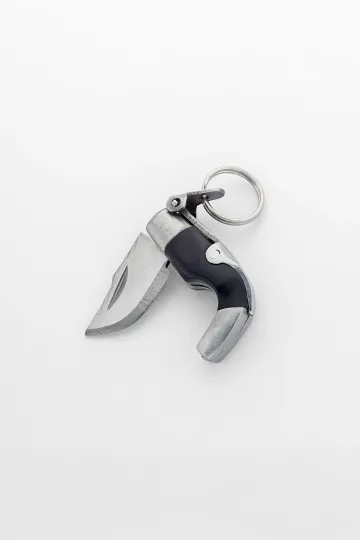
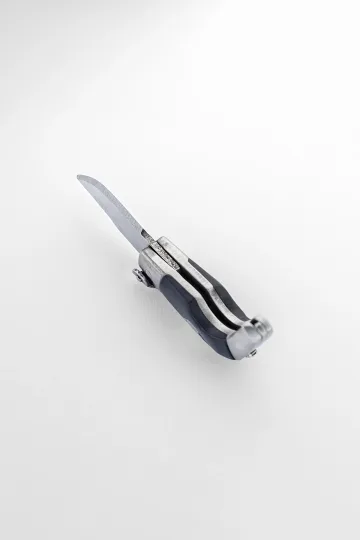
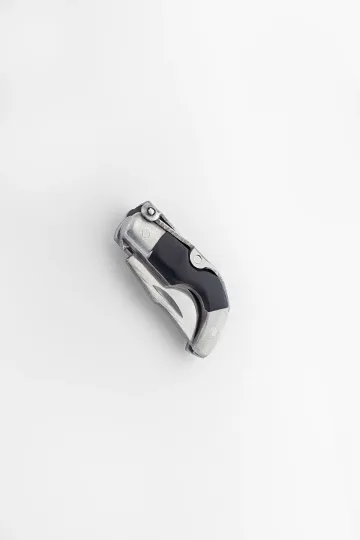
CAPAORA mini knife pendant
The 18th-century Spanish navaja in miniature: 40 mm of stainless steel, a real folding mechanism and a Palanquilla lock that clicks. An affordable gift to remember.
Authentic · Ships from Spain · 14-day returns
Niello in modern jewellery
Niello in studio jewellery
Today niello lives in the hands of metal artists. Modern jewellers value it for exactly what electroplating lacks: a handmade character, the depth of the black, the fact that every drawing is unique. Rings, pendants, earrings and signets with a niello ornament look both antique and graphic at once, hitting the taste of those tired of smooth gloss. Niello pairs well with engraving, texture and matte silver, lending a piece age and weight even when it is new.
Niello and personalisation
Since niello is, in essence, a drawing fused in forever, it suits named and commemorative pieces perfectly. A monogram, a date, a motto or arms made in niello will not wear off, unlike surface engraving on areas that take friction. That makes a niello piece a good choice for a gift meant to live long and stay readable across decades.
Why the technique is in demand again
In a world where most dark jewellery is made with a quick coating, hand niello has become a mark of true craft. It takes time and skill and does not scale onto a conveyor, so a niello piece always carries the stamp of a particular maker. For the buyer that is at once a beauty and a guarantee: hours of handwork went into the piece, and the drawing is not going anywhere.
Regions and crafts of niello
A map of living traditions
Niello is not a museum exhibit but a living craft in several places at once. In Russia it is the northern niello of Veliky Ustyug and the Tula school. In the Caucasus it is Dagestan Kubachi with its niello on weapons and jewellery. In Southeast Asia it is Thai nielloware from Nakhon Si Thammarat. In Europe the technique lives on with individual makers and restorers, heirs of the Italian and Byzantine lines. Each school is known by its hand: by the density of the black, the character of the ornament, the favourite subjects.
How the schools differ
Ustyug niello leans toward a fine drawing and view subjects on a light ground. The Kubachi school breathes a winding plant ornament, dense and flowing. The Thai school fills almost the whole ground with black, leaving the pattern in silver. It is like different accents of one language: the material and the principle are shared, but each region has its own intonation. A connoisseur can often guess from a single fragment of pattern where a piece comes from.
Why the crafts matter to the buyer
When a piece has a school and a provenance, it is easier to understand that you have real handwork in front of you, not an imitation. Workshop niello silver is not anonymous goods but the continuation of a tradition with the names of makers, an exhibition history and a recognisable style. Such a piece is priced differently and lives differently, because a craft stands behind it, not a stamping press.
Send a friend a discount code, they save on their first order.
How to tell hand niello from imitation
Look at the relief and the edges
In real niello the drawing sits in cut grooves level with the silver; to the touch the surface is smooth, with no step between black and light. The edges of the lines are sharp, because they were cut with a graver. In a cheap imitation, induced by oxidising over a stamped relief, the dark lies in the recesses of a design that was not cut but pressed by a die, and the edges are usually softer and more blurred.
Check wear on the raised parts
Surface oxidising and thin coatings wear off in time on the raised, often touched spots: on the edges of a ring, on the crests of the ornament, the light metal shows through. Real niello sits in the recesses of the drawing and barely suffers from friction on top, because it simply is not there, it is in the lines. An old niello piece usually keeps the drawing crisp even when the silver around it is worn to a shine.
The colour and depth of the black
Real niello gives a deep, slightly warm black with a faint metallic glow and a visible structure under the polish. Black paint is flat and matte, black enamel shines glassily and can chip, an electroplated coating is even and cool over the whole surface. If the black covers both the drawing and the smooth areas equally as a continuous layer, it is a coating, not niello.
Hallmarks, school and price
Serious hand niello almost always comes with a silver hallmark and often with the stamp of a workshop or maker. Provenance, a recognisable school style and a sensible price are the best clues. Real niello work cannot cost like a stamped trinket: hours of handwork stand behind it. If dark silver is sold at the price of an ordinary chain and with no provenance at all, you are almost certainly looking at oxidising or a coating, not niello.
Facts that surprise
Niello may have given birth to printmaking on paper
There is a fine theory that European engraving on paper grew out of the niello workshops. Before filling a drawing with niello, the maker took an impression of the cut plate on paper, to check the design. From these proof impressions of niello plates, by one hypothesis, runs the thread to engraving as an independent art of print. So a purely technical step by a jeweller may have begun a whole branch of graphic art.
The recipe for niello was written by a great sculptor's hand
The exact recipe for the niello alloy was left by Benvenuto Cellini, that same Florentine goldsmith and sculptor of the sixteenth century, author of the famous statue of Perseus. In his treatises on the jeweller's craft he described both the composition and the fine points of working with niello. So the technology of black on silver was preserved for us by a man remembered above all for his masterpieces in bronze and marble.
Niello can outlive the piece itself
There are known cases where the silver around the drawing wore down and tarnished beyond recognition, while the niello pattern stayed crisp. The alloy in the grooves sometimes proves more durable than the thin top layer of silver around it. So the darkest element of a piece is often the most lasting, the opposite of how we are used to thinking about a black film on metal.
One word across half the world
From the Latin nigellum, blackish, descend at once the Italian niello, the Russian term, the Thai nielloware and dozens of local names. The technique spread together with trade, faith and makers, and almost everywhere one and the same root word for the colour black followed it. A rare case where a craft carried a single Latin root from Italy to Siam.
Black silver hid the metal from rust
On weapons the dark pattern on a light ground served more than beauty alone. In places that were rarely touched by hand, the dark coating and the niello together protected the metal from corrosion and glare. Beauty and use coincided here: what looked handsome also guarded the blade and the mounts. The decoration worked as armour against time as well.
Frequently asked questions about niello
Is niello the same as tarnished silver?
No. Tarnish is an unwanted film of silver sulphide that grows by itself in air and comes off with cleaning. Niello is a sulphide alloy that the maker deliberately cooked, cut a pattern for and fused into the metal for good. One happens to silver on its own, the other is done by hand. There is a separate article on darkening in detail.
Can niello be rubbed off accidentally during cleaning?
In ordinary cleaning, no, niello sits in the grooves and is fused with the metal. The only way to remove it is rough mechanics: hard polishing with an abrasive, sandpaper, aggressive grinding over the drawing itself. Clean gently, bringing the shine back to the light silver around the pattern and not pressing a brush on the black lines.
How does niello differ from black rhodium?
Black rhodium is a thin layer of metal laid on the surface by electroplating, even and continuous over the whole piece. It wears off in time on the parts that take friction and needs renewing. Niello is an alloy fused into a cut groove to its full depth, which holds for centuries and sits only in the drawing, not as a continuous layer.
What is niello made from?
From an alloy of silver, copper and lead with sulphur. The sulphur turns the metals into dark sulphides, and the result is a brittle black mass with a deep sheen. It is ground to powder, packed into the cut drawing and fused with fire. The proportions differ by school, but the classic recipe goes back to Benvenuto Cellini.
What metal is niello made on?
Most often on silver, usually sterling 925: it gives the best contrast and is convenient for cutting. More rarely niello is laid on gold, where the contrast is warm and the work harder. In the weapons tradition a kindred dark decoration is made on steel too, but that is already a related technique, not classic niello on silver.
Is niello an ancient technique or is it still made today?
Both. Niello is an ancient craft, but it lives on: the northern niello of Veliky Ustyug, the Tula school, Dagestan Kubachi, Thai nielloware, individual European makers. Modern jewellers value it for its handmade character and the uniqueness of every drawing, so niello pieces are made today as well.
How do you tell real niello from imitation?
In real niello the drawing is cut with a graver and filled level with the silver, the surface is smooth, the black is deep and warm, and the pattern sits in the lines rather than lying as a continuous layer. In an imitation the dark is induced over a stamped relief or laid on as a coating, wears off on the raised parts and lies as an even layer. A hallmark, a workshop stamp, a recognisable school style and a sensible price all help.
Does blackened silver darken over time?
The niello itself does not, it is black already. But the light silver around the drawing tarnishes in air, like any silver. That is normal: it is enough to gently return the shine to the silver without touching the black pattern. A single piece can carry both wanted niello and unwanted tarnish at once, and each needs different care.
Silver with character and history
Blackened silver is a craft with hours of handwork and a tradition thousands of years deep behind it. If you want a piece with the depth of a black pattern, warm silver and character, take a look at the selection in the Zevira catalogue.
See silver jewelleryBuying it as a gift? Each one arrives ready to give.
 A branded Zevira box and a little card come with every order.








About Zevira
Zevira makes jewellery for people who value meaning and craft, not shine alone. We love silver for its honesty: it lives, tarnishes, takes a patina and accepts the hand of a maker. Niello is for us a model of how dark on metal can be intent rather than defect, and of how handwork outlives generations. In the catalogue we gather pieces that have character and history, not surface alone.