Moss Agate: Jewellery with Green Moss, History, Meditation and Care 2026
Green branches inside a clear stone look exactly like real moss, pressed into mineral form. In reality it is usually not a plant at all, but iron and manganese oxides that, as silica settles around them, grow into dendrites resembling moss. The stone itself genuinely is millions of years old: it formed layer by layer inside cracks in volcanic rock. That is where the effect comes from, the one that is so hard to fake, and why every single slice is one of a kind.
The History of Moss Agate: From Victorian Cabinets of Curiosities to a Modern Revival
Discovery and the First Finds
Agate had been known since antiquity, but moss agate specifically entered European fashion in the eighteenth and nineteenth centuries. During the Enlightenment, aristocratic homes embraced the "cabinet of curiosities", a private collection of natural marvels, and polished slices with a green pattern landed there as some of the most striking specimens on show.
This kind of agate was found above all in Europe: in Germany, around extinct volcanoes, in Scotland, in the rivers of the highlands, and in England. The stone often turned up by chance during earthworks. Nobody understood how it formed, so a myth held on that it was petrified forest, or a plant trapped inside the mineral. That myth still lives on among people who have never studied geology.
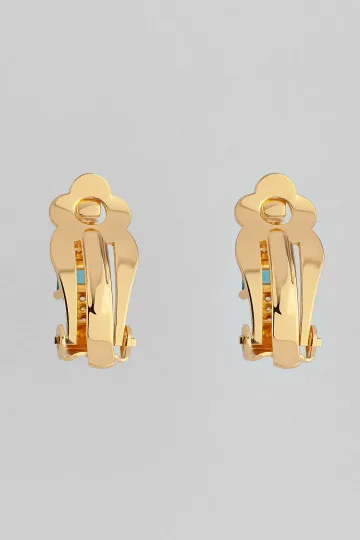
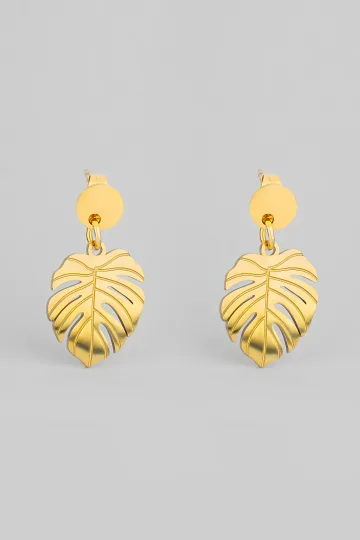
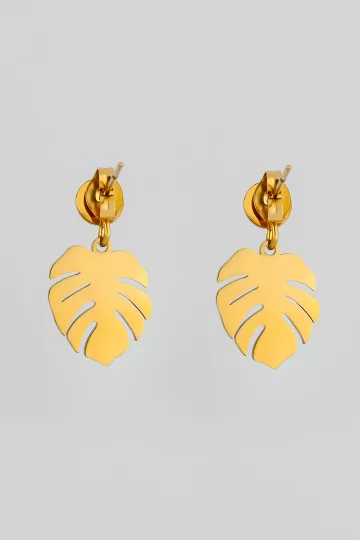
Wear the symbol, don't just read about it. These are in stock:



In Scotland, polished slices earned the name "Scottish landscape agate": with the right light you can read a whole landscape in the stone, green "trunks" of moss, yellow and brown bands from iron oxides, and a clear quartz base behind it all.
The Victorian Era: A Stone of Science and Romanticism
The Victorian era, from 1837 to 1901, was a contradictory one. On the one hand: steam, the railway, factories, the idea of mastering nature through machinery. On the other: a powerful movement of romantics and naturalists who saw in wild nature a value that no one could recreate.
Moss agate happened to suit both moods at once. It was a token of scientific interest in mineralogy and natural history, and at the same time a romantic symbol of wild, pre-civilisation nature. People kept polished pieces on mantelpieces, gave them to one another, collected them. To wear a stone with a "living" green pattern inside, in an age of factory smoke, was a quiet gesture towards the natural world.
The Twentieth-Century Eclipse
In the early twentieth century the fashion drained away. Several things played their part: mass diamond mining after the South African discoveries of the 1870s, and the arrival of synthetic corundum. Around 1902 the Frenchman Auguste Verneuil perfected a way to grow synthetic ruby by melting in a flame. Later, in the 1970s, cheap cubic zirconia joined them.
The market logic was simple: sparkle visible from across the room read as status, while a soft green agate asked to be examined up close. Two world wars made jewellery more practical and stripped it of philosophy. By the middle of the century moss agate was thought of as old-fashioned, something out of a grandmother's box, and it all but vanished from jewellery, surviving in museums, antique shops and old family collections.
The Revival: From the Green Movement to Minimalism
From the 1970s, on a wave of interest in ecology and "getting back to nature", the stone returned. The New Age movement made it one of its central stones in crystal therapy, a "grounding stone". In the 2000s, as so much of life moved onto screens, demand for natural stones grew as a pull towards something physical and genuine.
Today moss agate is fashionable again for reasons that make plain sense: minimalism as an aesthetic, the appetite for mindful consumption, the wish to wear something natural and one of a kind. No two slices are ever the same, and in a world of identical objects, that is its strongest card.
The Geology of Moss Agate: How the "Moss" Gets Inside the Stone
What It Is in Mineralogical Terms
Moss agate is not a separate mineral but a variety of agate, that is, microcrystalline quartz (SiO₂, silicon dioxide). Essentially it is quartz with inclusions, and those inclusions create the pattern.
Precision matters here. The "moss" inside is most often not a fossilised plant but metal oxides. Iron oxide gives brown, yellow and reddish lines; manganese oxide gives black and dark violet. Some specimens really do hold genuine mineralised algae or moss, caught in the silica as it settled, but telling one from the other takes a microscope and chemical analysis. For the wearer the difference is small: the result is the same, a clear stone with a green pattern.
The basic make-up:
- SiO₂ (quartz), the main mass, providing hardness and translucency.
- Iron oxides, the yellow, brown and red shades.
- Manganese oxide, the black and dark-grey lines.
- Chlorite (a green silicate), which can give green colour where the inclusions really are plant remains.
The quartz crystals in agate are very fine, invisible to the naked eye. That is where the translucency comes from, along with a hardness of 7 on the Mohs scale.
How It Forms
Moss agate forms in zones of geothermal activity: volcanic regions, geysers, hot springs. Hot solutions saturated with silica pass through cracks in the rock. When the pressure drops and the temperature shifts, the silica comes out of solution and settles in thin layers. Plant particles or metal oxides may land on a fresh layer, and the next dose of silica seals them in. Layer upon layer, thousands and millions of times over, and the pattern assembles itself.
The speed depends on how active the springs are and how much silica the water carries. In very active zones the visible layers build up relatively quickly; in calmer ones the process stretches across millions of years. Then, after vast spans of time, erosion and the work of rivers carry the stone up to the surface.
Where Moss Agate Is Found
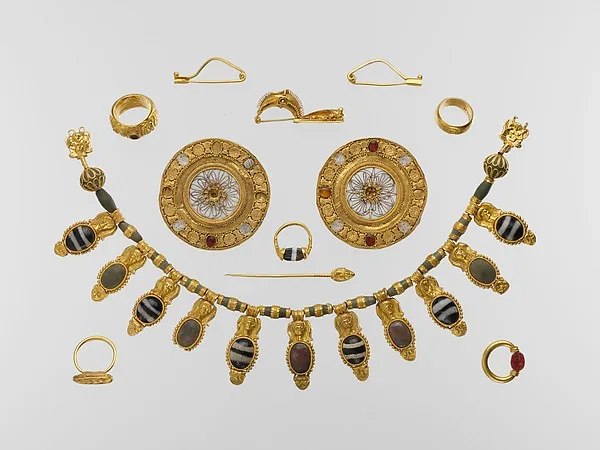
India (the Deccan Plateau): one of the main sources today, with a light-green pattern and often a clear or milky base.
Brazil: a historic and current source, the stone heavier and darker, with black and grey inclusions, and a dense structure that holds a cut well.
Germany: a historic source around extinct volcanoes, with small reserves today, mostly old finds in museums and collections.
Scotland and England: heavily mined in the nineteenth and twentieth centuries, with reserves now nearly exhausted, and prized by collectors.
The United States (Oregon, Washington): a more recent source, where the specimens tend to be smaller and lighter.
Madagascar: a source of the last few decades, with variable quality, including bright specimens with crisp patterns.
Smaller quantities also come from Australia, Mexico, Uruguay and China. Below is a summary by region: colour, base translucency, durability, and which jewellery each suits best.
Moss lives on linen and quiet. Whoever pins it over a loud print has read neither the stone nor themselves, and no, don't argue.
How to Wear Moss Agate
Over years on shoots this green stone has passed through dozens of looks in my hands. Here is what actually works, sorted by occasion and by format.
What do I pair moss agate with every day? For daily wear I recommend a pendant or a bead bracelet over something plain: a white shirt, a grey roll-neck, beige linen. A light background lifts the green, while a dark-green or mustard knit turns the stone a shade brighter. Busy prints steal the moss pattern, so I leave them to other pieces. Under an open collar I suggest a fine chain of 45 to 50 cm so the pendant lands mid-chest.
Is it right for the office? Yes, kept restrained. I choose moss agate in silver or white gold on a delicate chain: the cool metal sharpens the green and never argues with a suit. A smaller cabochon, a clean setting, no scatter of tiny stones. A strict dress code is no obstacle here; a quiet natural pattern reads as taste rather than decoration.
How do I build an evening look? For evening the logic reverses. I recommend a large cabochon in a substantial setting, a ring or a bangle, and let the stone take the lead. Warm yellow gold beside the green sounds richer, almost Victorian. A smooth fabric in a deep tone, emerald, wine, graphite, gives the stone all the light.
Which format suits whom? A pendant I suggest for almost anyone: on the chest the slice catches light all day and opens up the pattern. A bead bracelet suits those who like to turn the stone in their hand. A ring I choose with care, and only a low cabochon in a rub-over setting, since agate is softer than sapphire and fears a knock on the edge. Earrings and a pendant are the safest everyday bet.
Which stones do I combine it with? Moss agate keeps company with the natural palette. I recommend clear or smoky quartz for a clean contrast, amethyst for a rare violet-and-green pairing, moonstone and jade for a soft duo. Malachite I add with care, as its dense green easily pulls the eye. Black stones and bright red I avoid; they swallow or quarrel with the green. One rule holds: a single striking moss stone says more than three modest ones. More on malachite in jewellery.

Turn on your camera, pick earrings, a pendant or a ring, and see the piece on yourself in real time.
Switch items in one tap.
Everything runs in your browser: no photo or video is ever uploaded.
Why Moss Agate Is Not, Strictly Speaking, an Agate
Here is where the story gets interesting, and where the name itself becomes contested. In mineralogy the word "agate" is reserved for a variety of chalcedony with visible banding, concentric or parallel layers of differing colour. The bands are what make an agate an agate. Classic moss material has no bands at all: a translucent or milky body with a branching green pattern suspended inside it. By strict gemmological standards this is not an agate but a chalcedony with inclusions. The familiar name survives from old dealers and collectors, for whom any patterned translucent quartz was an "agate".
What Chalcedony Actually Is
Chalcedony is the cryptocrystalline form of quartz. Its crystals are so small that the eye reads a continuous mass rather than individual faces. Carnelian, onyx, chrysoprase and flint share that same nature. They are all relatives, and the difference lies in colour and in whatever happened to be caught inside as the material grew. Moss stone belongs to the same family: a translucent chalcedony body plus foreign inclusions that supply the pattern. When someone tells you "technically that is chalcedony, not agate", they are not nitpicking, they are describing the structure honestly.
Where the Line Between the Names Falls
In practice the line is blurred, and arguing with a seller about it gets you nowhere. The trade has settled on its own rules: if the pattern is green and bushy, the stone is called moss agate, even when it carries no banding whatsoever. Gemmological laboratories tend to be more cautious on a report and write "chalcedony" or "chalcedony with dendrites". This is worth knowing for one reason. If the word "chalcedony" turns up in a description, it is not a trick and not a downgrade, it is the more precise term for exactly the same object.
Dendrites: A Beautiful Illusion of a Plant
The central misunderstanding about this stone attaches to the word "dendrite". Dendrite comes from the Greek for tree-like, and the pattern genuinely does resemble twigs, fern fronds, frost on a window. But it is neither a plant nor an impression left by one. Dendrites are crystalline growths of metal oxides and hydroxides, most often manganese and iron. They do not grow the way a living thing grows. They follow physics: a solution carrying dissolved metal seeps along the finest hairline cracks in the translucent chalcedony and precipitates out along branching lines. That distinction matters more than any other single fact about the stone, because almost every romantic claim made for moss agate rests on the assumption that something once alive is trapped inside it.
Why the Shape Comes Out "Like a Plant"
The coincidence of form is not accidental, and it is genuinely absorbing. A tree branch, a river delta, a crack of frost and a manganese dendrite all obey the same mathematics of branching: growth heads towards the path of least resistance, and each new limb divides again. Scientists call this pattern of growth fractal self-similarity. Living nature and lifeless chemistry arrive at the same picture independently of each other. That is why a mineral dendrite looks so much like moss or bracken despite sharing neither ancestry nor origin with them. Once you have seen the same geometry in a dry riverbed from an aeroplane window, you cannot unsee it in a polished slice.
Is There Ever a Real Plant Inside
Occasionally, yes, and that deserves an honest caveat. In a small proportion of specimens, remains of algae or moss, or green silicates such as chlorite and celadonite, really were caught inside the chalcedony as it grew, and those supply the green. But telling genuine organic matter from a purely mineral dendrite by eye is impossible. It takes a microscope and chemical analysis. For most of the green stones on the market the honest answer is a single line: these are mineral inclusions, not a compressed forest, whatever the nineteenth century believed.
Customer reviews
Zevira is a real jewellery shop. Genuine payments, deliveries and customer thank-yous.
🥰🥰🥰 gracias

Ok, ¡gracias! 🙂

Moss, Dendritic, Landscape: What the Difference Is
These three names are confused constantly, sellers use them interchangeably, and that does buyers no favours. The differences are real, and understanding them helps you pick the character of pattern you actually like. All three are relatives from the chalcedony family, but each carries its own kind of figure.
Moss Agate
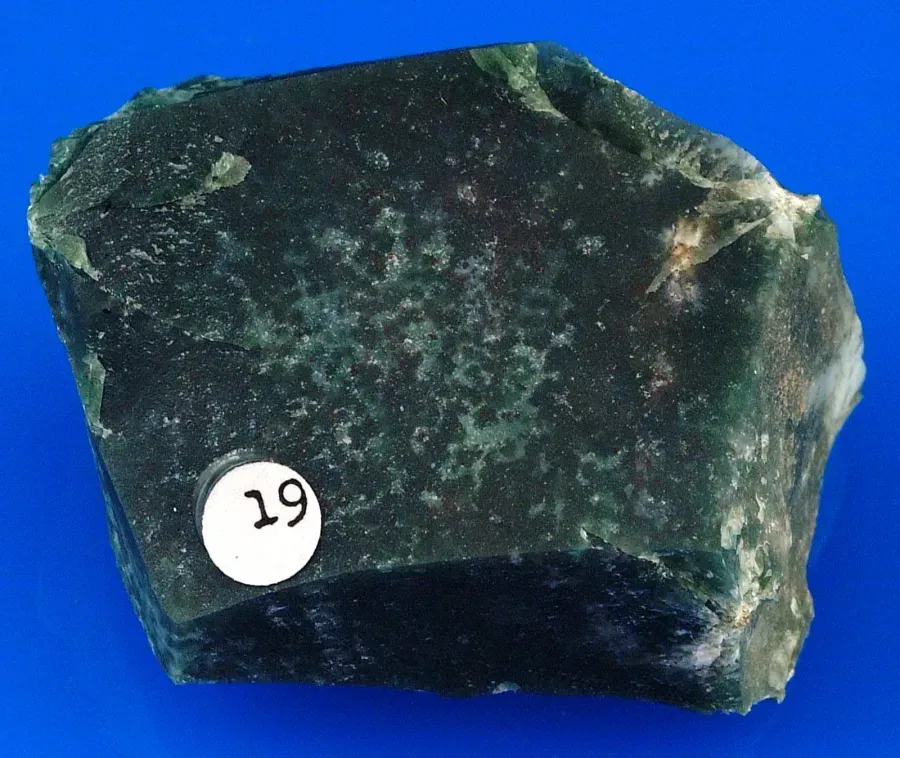
The pattern is green, bushy, scattered unevenly through the body of the stone in tufts, like moss on rocks beside a stream or weed drifting in water. The colour usually comes from chlorite or green silicates, and sometimes from iron oxides in reduced form. The body is translucent or milky. The giveaway: the green does not form distinct separate "trees", it diffuses into soft clouds and clumps.
Dendritic Agate
The pattern is black or brown, graphic, with clearly legible branching lines that look like a tree or a fern drawn in ink. The colour comes from manganese oxides. The body is usually completely clear and colourless, so the figure reads like ink on glass. If you can see individual elegant little trees standing on a clean field, that is dendritic, not moss. By strict gemmology it too is chalcedony rather than agate, for the same reason.
Landscape Agate
Here the pattern assembles into an entire scene: a horizon, hills, trees, sky, sometimes a lake. This is the effect of banding, dendrites and colour zones combining in one slice. Nineteenth-century Scottish polished stones were prized for exactly this, and a lucky cut could be read as a real view. Landscape is less a separate mineral than a cutter's way of selecting and presenting a slice so that the pattern resolves into a scene.
How Not to Get Confused When Buying
A simple rule for the eye. Green bushy tufts, moss. Crisp black or brown twigs on a clear field, dendritic. A whole picture with a horizon, landscape. Shop labels drift, so trust the pattern rather than the tag. And bear in mind that the same block of rough, sawn along different planes, can yield both a "moss" and a "landscape" slice. The cutter's hand decides.
Upload a photo of your pet, someone you love, or an object. We'll build a 3D model and hand-cast it in pewter.




Green Colour, Symbolism and the Psychology of Moss Agate
Why Green in a Stone Moves Us
We reliably link green with life, growth and calm, and that is no accident. Green in nature means vegetation, water and shelter, so our response to it is ancient and physical. Natural greenery tends to settle us, and moss agate, with its green pattern, lands in that same zone of perception.
In a stone a paradox is added to all this: the green looks alive, yet it is sealed inside an unchanging mineral. Life and stillness at once. It is precisely that combination that makes a slice so compelling to look at.
Hold a piece of moss agate jewellery in your hand during a tense moment, and many people notice they feel calmer. This is not the magic of the stone but a simple link: a familiar natural object in your hand, its weight and coolness, brings your attention back into your body and into the present.
Symbolism Across Traditions
This is a matter of belief, not of proven fact, so no promises of "healing".
Western esotericism and the New Age: moss agate is called a "grounding stone", used in meditation to connect with "earth energy" and to feel steady again after stress or loss.
Indian tradition and Ayurveda: the stone is associated with the heart chakra (Anahata) because of its green colour, and is used in practices for "opening the heart" and finding balance.
Holistic practices: there is no clinical evidence; within these systems the stone is held to support people through anxiety and a sense of vulnerability.
Stripped of any mysticism, the stone keeps an honest symbolism: patience and constancy. The pattern came together over millions of years, layer by layer. If that idea resonates with you, that alone is reason enough to wear it.
The Gardener's Stone: Where the Nickname Comes From
Moss agate carries a folk name in English, the gardener's stone, and of all its legends that one is the most charming. The logic is direct: the green branching pattern looks like plants, so the stone was credited with a link to growth, fertility and luck in the garden. English country tradition had people carry a piece when starting new plantings, and the name stuck through Victorian gardening manuals and into modern lapidary shops. It is folklore rather than horticulture, but it is lovely folklore: a stone with a permanent garden inside it as the talisman of someone tending a living garden outside.
A Symbol of Abundance and Slow Growth
Out of the garden theme grew a broader image, a stone of abundance and gradual increase. Not quick luck and not money magic, but slow, dependable growth of the kind a tree or a crop shows. Balance matters here, and it is worth promising nothing. No mineral brings in money or grows tomatoes. But the idea of patient work that yields fruit year after year settles onto this stone naturally, and as a metaphor it is an honest one. Anyone who has waited three seasons for a hedge to fill in understands the image without needing it explained.
A Talisman of New Beginnings
Across several folk traditions moss agate was tied to beginnings: a new venture, a move, the first day of something that mattered. The explanation was always the same pattern, which looks like life pushing through. Take away the mysticism and a comprehensible psychological support remains. An object a person has chosen as a marker of a beginning helps them gather themselves and hold to an intention. What works is the ritual and the meaning invested in it, not the mineral.
The Honest Line Between Belief and Fact
Any discussion of symbolism deserves plain speaking. The stone has no healing or money-drawing properties. This is the territory of belief and culture, not of demonstrated science. But a symbol invented by people still functions as an anchor for attention and mood. Wearing a gardener's stone for the idea of growth and patience is a perfectly good reason and a graceful one. Expecting a harvest or a windfall from it is naive. That honesty takes nothing away from the stone's charm, it simply makes the conversation about it an adult one.





Moss Agate Jewellery: Pendants, Rings, Bracelets, Cabochons
The Pendant: The Classic Choice
The pendant is the most popular format, and for good reason. On the chest the stone catches light all day, and as light passes through a polished slice it reveals the green patterns in full detail.
What to look at when choosing:
Size: a comfortable range runs from 2 to 4 or 5 cm. Under 2 cm and the pattern is hard to read; over 5 cm and the piece feels heavy. Around 3 by 2 cm suits most people.
Cut: a cabochon, a smooth domed shape, is the best choice. It opens up the pattern and, thanks to its rounded edges, protects the stone from chips. Faceted moss agate looks unusual, but the pattern can get lost in the glare.
Base translucency: the key parameter. The base between the green lines should be clear like glass, or at least milky-translucent. A cloudy grey base is a sign of poor cutting.
Setting: sterling silver and white gold sharpen the green; yellow gold adds warmth and contrast; rose gold lends a romantic tone. Go for a fine chain, so the attention stays on the stone.
The Ring: A Rare Choice
A ring with moss agate is rare, and rightly so. A finger is in constant contact with objects, water and cosmetics, and at 7 on the Mohs scale agate is noticeably softer than sapphire (9) and diamond (10), so scratches are inevitable. On top of that, the stone shows less on a finger than on the chest.
If you do want a ring, go for a large cabochon (an oval of 2 to 3 cm) in a bold but plain setting, with no fussy small stones around it. Take it off before washing up, cleaning and sport, and rinse it once a week.
The Bracelet: The Practical Option
On the wrist there is less movement than on a finger, and the stone is visible both to you and to others. The options:
A bangle: sterling silver or gold with one or two agate inserts, which looks substantial, though it may not sit comfortably on a slim wrist.
A chain bracelet: a chain with a hanging cabochon, lighter and airier, and easier to take off at night.
Beads: a bracelet of polished 8 to 10 mm beads, pleasant to run through your fingers, and many people use it like worry beads.
Mixed: agate with quartz, amethyst or moonstone, where the moss agate stays at the centre.
Cabochons: How to Choose by Pattern
A cabochon, a polished but unfaceted stone with a smooth domed surface, is the ideal form for moss agate. What to look at:
Pattern clarity: the "moss" should read clearly against the base. If the stone is simply an even green with no lines, it is green agate, not moss agate.
Uniqueness: every pattern is its own, a forest seen from above, a bend in a river, a fern frond. No two are ever the same.
Base translucency: the clearer the better; cloudiness points to lower quality or careless cutting.
Size and shape: the sweet spot is around 2.5 by 3.5 cm, in the classic shape, the oval.
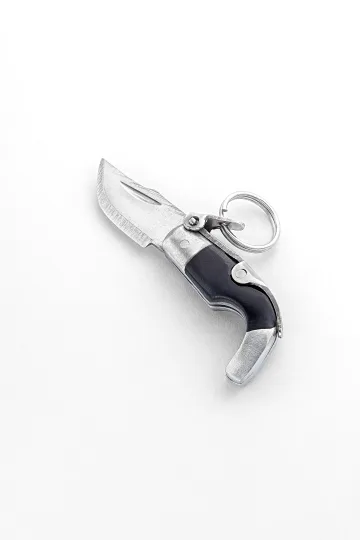
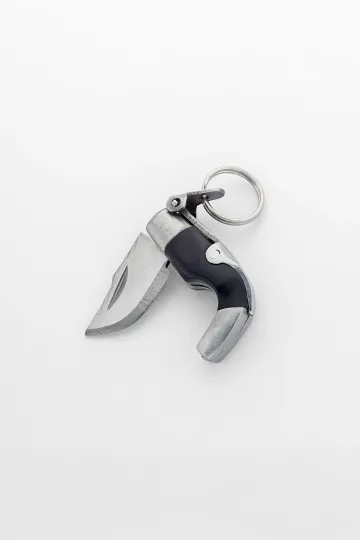
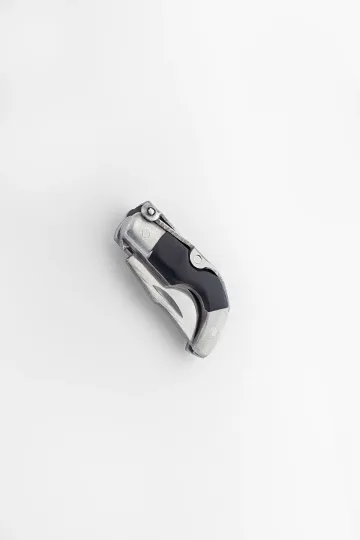
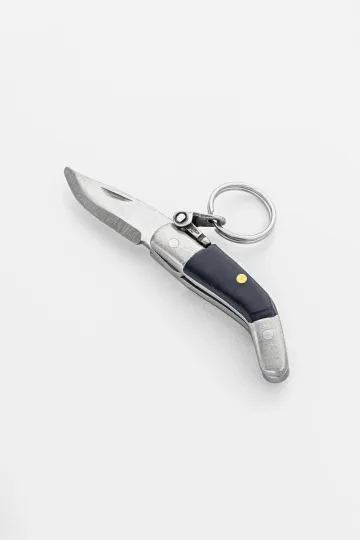
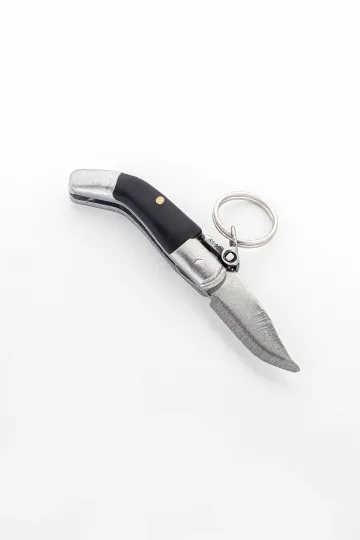
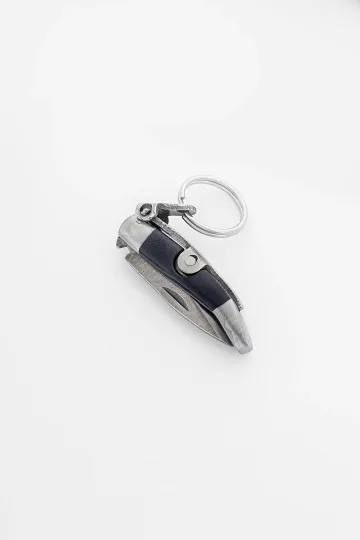
CAPAORA mini knife pendant
The 18th-century Spanish navaja in miniature: 40 mm of stainless steel, a real folding mechanism and a Palanquilla lock that clicks. An affordable gift to remember.
Authentic · Ships from Spain · 14-day returns
Varieties of Moss Agate
Classic moss agate: crisp green lines (iron oxides, chlorite) on a clear or milky base. This is what people usually look for, sourced mainly from India and Brazil.
Dark, "earthy": a deeper green with black and brown inclusions, more severe to look at. Brazil, Madagascar.
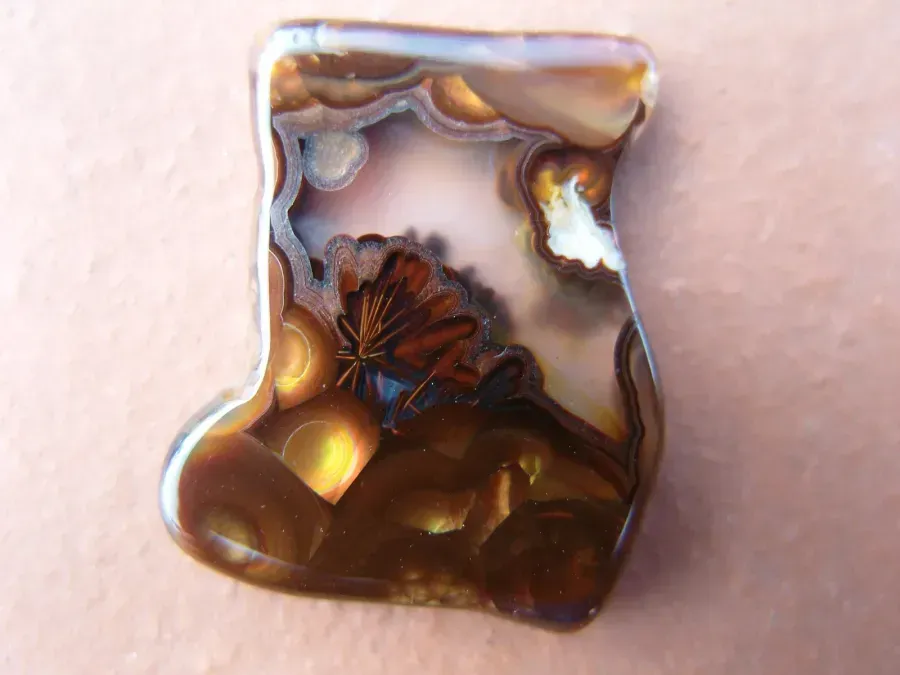
Dendritic agate: black and brown branching patterns (manganese oxides) dominate instead of green. Found less often. For a contrast in character, fire agate, with its shimmer of red and orange, plays an entirely opposite note, and the comparison helps you work out which type of agate is closer to your own mood.
With coloured flecks: rare specimens with red, yellow and pink inclusions from iron oxides in different states.
Cloudy: a cloudy base with green patterns, valued lower, but sometimes lovely.
How to Tell Moss Agate from Similar Stones
Imitations in glass or plastic are rare: faking a unique three-dimensional pattern costs more than selling the real stone. The genuine confusion is with other natural stones that look, from a distance, "green with a pattern".
Green aventurine. The most common stand-in in cheap bead strings. Aventurine is an even green with tiny glints (fuchsite inclusions), with no clear gaps and no readable "moss". In moss agate the green gathers into separate branches on a clear base, and there are no glints. Just hold the stone up to the light: aventurine is almost opaque, while moss agate lets light through between its lines.
Dendritic agate. A close relative, but its pattern is usually black and brown (manganese oxides) rather than green, and the base is more often fully clear and colourless. Geologically the line between them is loose; by eye, dendritic agate is more severe and more graphic.
Plume agate. A pattern like fluffy feathers or tassels, three-dimensional and often red-orange or white. If the "moss" looks like soft plumes rather than branches, you are more likely looking at plume agate.
Prase and green quartz. Solid green translucent quartz with no pattern. No branches, no dendrites, so it is not moss agate but green agate or dyed quartz.
The main test for being natural stays the same: turn the stone under a lamp. In a natural piece the pattern has depth, the branches recede inward, and when you tilt it the picture seems to shift. A flat "picture" lying exactly under the polish is a sign of printing or surface dyeing.
Leave your email, we'll send your discount code. No spam, unsubscribe anytime.
The code arrives by email, valid on your first order.
Dyeing and Treatment: What You Honestly Need to Know
Agate is one of the easiest stones to dye, and that is worth keeping in mind when you buy. Microcrystalline quartz is porous, so dye and heat penetrate between the grains; dyed agate is therefore common on the market, especially in bright beads and souvenirs.
The good news: classic green moss agate is usually not worth dyeing, because it is valued precisely for its natural, muted pattern, while an even, garish green is exactly what you get by dyeing cheap grey agate. So suspicion should fall on unnaturally bright, even tones, especially fuchsia-pink, acid blue and turquoise; moss agate never shows these in nature.
How to spot dyeing:
- The colour is too even and saturated, with no transitions and no half-tones.
- Dye pools in the cracks, and the rim of a bead's drill-hole is darker than the centre.
- Several beads in a string look like colour clones of one another.
As for natural specimens: real moss agate generally needs no treatment; it is not heated or impregnated with resin, as is done with some porous turquoise or onyx. If a seller honestly says "dyed" of a bright decorative agate, that is no deception; it is a perfectly normal product for interiors, only it is not worth paying for as a natural collector's stone.
Durability and Wearability: What the Stone Will Take
A hardness of 7 on the Mohs scale means moss agate is not scratched by household dust (quartz sand has the same hardness) and wears calmly for years. But hardness is not the same as toughness. Agate has no cleavage, so it does not split along a plane the way topaz does, yet a sharp, point-loaded knock against tile or stone can give it a chip or a crack. That is why thin cut edges and protruding cabochons are vulnerable.
The practical takeaway by item:
- Earrings and pendant. The safest scenario: the stone barely takes any knocks, and wearability is close to unlimited.
- Bead bracelet. The beads are rounded, with no sharp edges, so the risk of chipping is low; keep an eye on the thread, not the stone.
- Ring. The most vulnerable format, not because of scratches but because of edge knocks against door handles, tables and equipment. Choose a cabochon with a gentle dome and a setting with a rim (a bezel) that shields the girdle.
There is one more risk, a thermal one. A sharp swing in temperature (hot water after frost, a hairdryer held close) could in theory give a microcrack to a stone with internal stresses. In practice this is rare for agate, but the habit of not pouring boiling water onto cold jewellery is a useful one.
Meditation and Grounding with Moss Agate: Soberly
No promises here. The stone is not a medicine but a convenient anchor for the attention. A simple mechanism is at work: a heavy, cool object in your hand pulls your focus back into your body and into the present moment, and that eases the sense of anxiety.
The basic practice is simple. Sit comfortably, keep your back straight, take the stone in your palm, close your eyes, and for a few minutes breathe evenly and slowly. Keep your attention on the sensations: weight, coolness, texture. When thoughts drift off, calmly bring them back to the breath and to the stone. Ten to fifteen minutes is enough.
In acute stress the five-senses technique helps: name aloud or to yourself what you see, what you hear, what you feel in your body. The stone in your hand is one of those anchor points. If you are dealing with serious anxiety or depression, the stone does not replace a professional; it is support, not treatment.
Send a friend a discount code, they save on their first order.
Facts That Surprise
The most interesting things about this stone usually stay off camera in the standard how-to-choose guide. Here is the material that changes how you look at a green pattern sealed in glassy quartz.
The Dendrites Are Chemistry, Not Biology
The headline surprise: the branching "moss" inside has nothing to do with plants. These are crystals of manganese and iron oxides grown in cracks within chalcedony. They only repeat the shape of plants because they obey the same geometry of branching that trees and river deltas do. Nature drew the same picture twice, once with living cells and once with pure chemistry.
It Is Not a True Agate
Despite the name, classic moss material is not an agate in the strict sense. An agate by definition has banding, and moss material has none, only inclusions suspended in a uniform body. Gemmologists call it chalcedony. Which means the most natural-looking of the agates formally belongs to a different category altogether.
The Victorians Thought It Was Petrified Forest
Before the geology was understood, educated people seriously believed the stone held ancient moss or a miniature forest caught inside while still alive. The myth held for decades and still circulates among anyone at a distance from mineralogy. Reality is more prosaic and somehow more astonishing: the forest was painted by metals.
Every Slice Is Genuinely Unique
Two identical moss stones cannot physically exist. The pattern depends on precisely how the metal-bearing solution spread through microcracks, and that is a random process. Even two slices cut from the same block will give different pictures. In a world of stamped-out objects, that guaranteed non-repetition is a rare property.
One Stone, Several Different Pictures
Because the pattern is three-dimensional and runs into the depth of the material, the same cabochon shows a different figure as you tilt it under a lamp. The cutter, choosing the angle of the saw, is literally deciding which landscape will appear. From one unpromising pebble a practised hand pulls out a forest one day and a river the next.
Its Green Often Has Nothing to Do with Chlorophyll
In living plants, green comes from chlorophyll. In moss stone the green comes from entirely different substances: green silicates such as chlorite and celadonite, or iron in its reduced form. So the plant-like colour was achieved without a single living cell.
The Same Hardness as the Sand Underfoot
Moss stone sits at 7 on the Mohs scale, exactly the hardness of quartz sand. Which is why ordinary household dust, full of sand grains as it is, does not scratch it: only something equally hard or harder can mark quartz. The stone is on level terms with the material that beaches are made of.
Scotland Turned It into a Fashion
Polished slices from Scottish rivers became a genre of their own in the nineteenth century, Scottish landscape agate. A good stone read as a whole terrain, and such slices were collected for the scene inside them, like small natural paintings. That vogue is what fixed the image of a landscape in glass to the stone permanently.
FAQ: The Main Questions About Moss Agate
1. Is that real moss inside the stone? Usually not. It is normally metal oxides (iron, manganese) arranging themselves into a moss-like pattern. In some specimens it is mineralised algae or moss. Only a microscope with chemical analysis can say for sure.
2. Can the "moss" inside grow over time? No. It is a non-living structure; the stone is completely static and does not change.
3. Does moss agate come in blue, red or yellow? The classic colour is green. Yellow and reddish shades come from iron oxides, but those are usually classed as other agates. Blue is practically never seen.
4. How do I tell a real stone from a fake? Fakes are rare; an imitation would cost more than the natural stone. Signs of the genuine article: the pattern is asymmetrical and unique, and when you turn it under light it shows depth (a 3D effect). An imitation looks like a flat, even picture on the surface.
5. How hard is moss agate? 7 on the Mohs scale (proposed by the German mineralogist Friedrich Mohs in 1812). Harder than glass, softer than sapphire (9) and diamond (10).
6. Can I wear it in water, at the beach, in the shower? Yes, agate does not dissolve in water. But sea salt speeds up the oxidation of a silver setting over time, so rinse with fresh water after the beach and avoid very hot water.
7. Do I need to "cleanse" the stone energetically? If you believe in it, the tradition uses the full moon, running water, smoke. If you do not, it is unnecessary, and it has no effect on the beauty of the stone.
8. Can I give moss agate as a gift? Yes. A good present for anyone who values nature and unusual stones. With a sceptic, simply don't push talk of "energy".
9. Roughly how much does moss agate cost? A rough piece is the most affordable tier (the price of a coffee). A cabochon is inexpensive. A piece set in silver is mid-range. Victorian antiques cost noticeably more, and there you are paying for history and rarity. Suspiciously cheap is either luck or a fake.
10. Where do I buy a good stone? Mineral fairs, trusted mineral shops, antique dealers (for Victorian pendants), and jewellers who work with natural stones. Be careful with anonymous marketplaces, where dyed goods turn up.
11. How do I clean the jewellery at home? Wipe it with a soft cloth; if soiled, wash it in warm water with mild soap and a very soft brush, rinse and dry. Tarnished silver is cleaned with special wipes or by a jeweller.
12. Can sunlight or UV damage the stone? Agate itself is stable. But do not keep the jewellery in direct sun for long, as the metal of the setting heats up and expands.
13. Which star sign does it "suit"? By traditional sources, Virgo and Gemini. This is a convention: if you like the stone, it suits you.
14. Is it precious or semi-precious? By the old classification, semi-precious. Modern gemmologists divide stones differently, and the "precious/semi-precious" scheme itself is already arbitrary.
15. Can a pregnant woman wear it? There are no medical contraindications. Esoteric properties are a matter of belief and no substitute for a doctor.
16. How do I store it when I'm not wearing it? In a dry place out of direct sun, in a soft pouch or cloth, separate from other jewellery so it does not get scratched.
17. Can I use it in interior decoration? Yes, a polished cabochon or a rough stone on a windowsill or shelf looks good and glows nicely in the sun.
18. Isn't it "overdone" given the fashion for minerals? No, the fashion for natural stones has held for decades. Moss agate is less worn out than amethyst or rose quartz, so it looks fresher.
19. Does it change colour over time? No, agate is geologically stable. It is not an organic material and not a plant dye.
20. Should I take it off at night? Up to you. If it disturbs your sleep, take it off; if not, you can leave it on.
Buying it as a gift? Each one arrives ready to give.
 A branded Zevira box and a little card come with every order.










Caring for Your Jewellery
Once a month wipe the stone with a soft cloth; if soiled, wash it in warm water with mild soap, rinse and air-dry. Store it in a dry place, in a pouch or cloth, separate from other jewellery. Take it off before cleaning and sport, do not leave it for long in sea or chlorinated water (the setting suffers), and do not use aggressive chemicals such as acetone or bleach. A sharp knock can crack agate, so protect it from blows against hard surfaces. Tarnished silver is cleaned with silver wipes or taken to a jeweller.
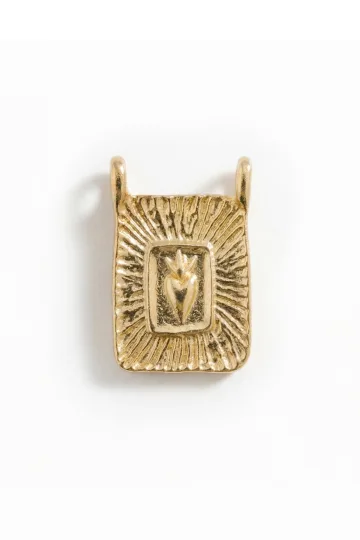
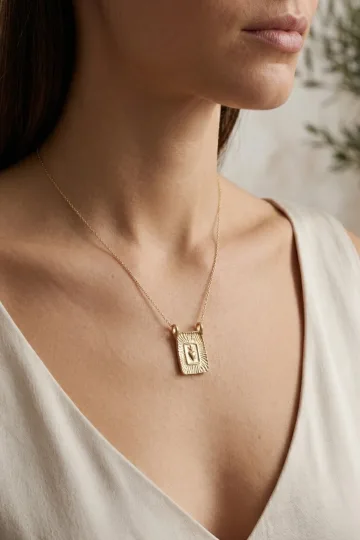
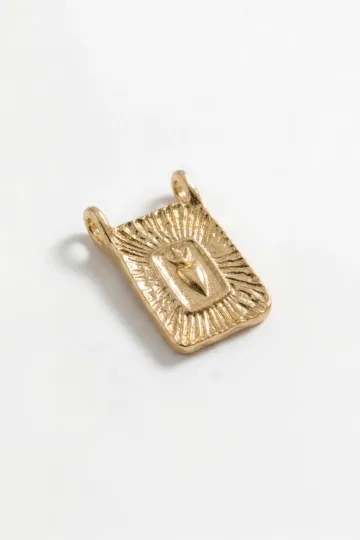
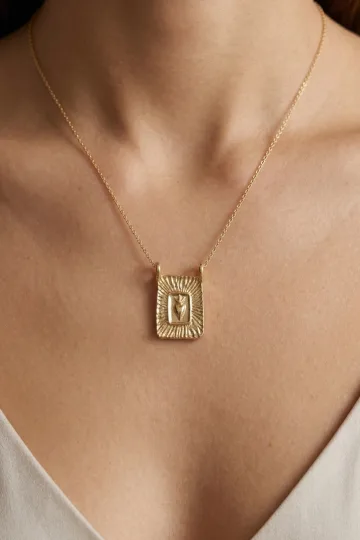
Wear the symbol, don't just read about it. These are in stock:

About Zevira: Jewellery That Tells Stories
Jewellery with natural stones is beauty that catches the light, with a story sealed inside. Every slice of moss agate is a piece of time: nature locked a moment into silica and made it permanent.
Zevira works with natural stones, choosing each one for its quality and the singularity of its pattern. Moss agate in our collection is an invitation to look closely at how nature creates: slowly, with patience, never with two identical results. Every stone is unique, and by wearing it you carry on its story.